New Mexico utility to exit nuclear power, go for renewable energy instead
|
June 15, 2020 A New Mexico utility will exit current leases for nuclear power and will instead develop renewable power by 2040, Kallanish Energy reports. PNM said it will allow leases for 114 megawatts of electricity power from the Palo Verde Nuclear Generating Station in Arizona to expire. Replacing that reduced capacity will allow PNM “to integrate more renewable resources that provide the best value to customers and support the path to emissions-free energy,” said the company that is a subsidiary of PNM Resources. “The increase in renewables combined with ongoing nuclear ownership will maximize cost savings to customers and is essential to achieving our plans of emissions-free energy by 2040,” said Pat Vincent-Collawn, PNM Resources chairman, president, and CEO, in a statement……… The company provides power to 790,000 customers in New Mexico and Texas. https://www.kallanishenergy.com/2020/06/15/new-mexico-utlity-to-allow-nuclear-leases-to-expire/ |
|

Nuclear industry encroaching further into USA education, thanks to DOE funding.
 Department of Energy Invests $65 Million at National Laboratories and American Universities to Advance Nuclear Technologym Energy.gov
JUNE 18, 202 WASHINGTON, D.C. – Today, the U.S. Department of Energy (DOE) announced more than $65 million in nuclear energy research, cross-cutting technology development, facility access, and infrastructure awards for 93 advanced nuclear technology projects in 28 states. The awards fall under DOE’s nuclear energy programs called the Nuclear Energy University Program (NEUP), the Nuclear Energy Enabling Technologies (NEET), and the Nuclear Science User Facilities (NSUF)…….
Nuclear Energy University Program ($55M)
DOE is awarding more than $38.6 million through NEUP to support 57 university-led nuclear energy research and development projects in 24 states. NEUP seeks to maintain U.S. leadership in nuclear research across the country by providing top science and engineering faculty and their students with opportunities to develop innovative technologies and solutions for civil nuclear capabilities.
Additionally, 21 university-led projects will receive more than $5.7 million for research reactor and infrastructure improvements, ……. https://www.energy.gov/articles/department-energy-invests-65-million-national-laboratories-and-american-universities
Massachusetts officials have dropped a lawsuit against Holtec over $1B Nuclear cleanup
 Holtec Settles Legal Battle with Massachusetts Over $1B Nuclear Plant Cleanup, ENR, 19 June 20, Massachusetts officials have dropped a lawsuit against Holtec International, now site owner and intended cleanup manager of the closed Pilgrim Nuclear Plant near Plymouth that allows the $1.13 billion-decontamination and decommissioning of the 670-MW site to move forward to be completed in 2027.
The state also dropped its challenge to the U.S. Nuclear Regulatory Commission’s transfer of the site operating license from Entergy Nuclear to Holtec.
Under the agreement reached June 16, Holtec will set aside $193 million of the plant’s decommission trust fund to pay for cost increases, project delays and possible hidden contamination.
Once cleanup is competed, $38.8 million will be set aside to cover the cost to transport spent nuclear fuel stored at the site to out-of-state storage. ….. https://www.enr.com/articles/49588-holtec-settles-legal-battle-with-massachusetts-over-1b-nuclear-plant-cleanup
U.S. – China talks may cover North Korea nuclear issue
 North Korea nuclear issue may be on the agenda at US-China SCMP, 17 June 20
Stephen Biegun, the US special representative for North Korea, will join the talks in Hawaii on Wednesday.
, suggesting the stalemate in nuclear disarmament negotiations with Pyongyang could be on the agenda.
and threatened military action against the South……….
The Hawaii meeting comes as relations between the world’s two largest economies are at their lowest point in decades and facing off on many fronts – from trade and technology to Hong Kong and the South China Sea. US officials, including President Donald Trump and Pompeo, have blamed Beijing for the coronavirus pandemic, while Beijing has accused Washington of trying to pass the buck to hide its own failings in dealing with Covid-19 in the US.
t also comes as tensions on the Korean peninsula are again escalating after Pyongyang demolished a four-storey liaison office set up near the border with South Korea in 2018 after the first summit between North Korean leader Kim Jong-un and South Korean President Moon Jae-in. A major setback for the detente in the region, observers said the move reflected Pyongyang’s growing frustration over its stalled nuclear talks with Washington.
Donald Trump’s extraordinary ignorance on which countries are nuclear powers
 Bolton Says Trump Impeachment Inquiry Missed Other Troubling Actions, NYT, By Peter Baker, June 17, 2020
-
- “…….Mr. Bolton’s volume is the first tell-all memoir by such a high-ranking official who participated in major foreign policy events and has a lifetime of conservative credentials. It is a withering portrait of a president ignorant of even basic facts about the world, susceptible to transparent flattery by authoritarian leaders manipulating him and prone to false statements, foul-mouthed eruptions and snap decisions that aides try to manage or reverse.
Mr. Trump did not seem to know, for example, that Britain is a nuclear power and asked if Finland is part of Russia, Mr. Bolton writes. He came closer to withdrawing the United States from NATO than previously known. Even top advisers who position themselves as unswervingly loyal mock him behind his back. During Mr. Trump’s 2018 meeting with North Korea’s leader, according to the book, Secretary of State Mike Pompeo slipped Mr. Bolton a note disparaging the president, saying, “He is so full of shit”
Intelligence briefings with the president were a waste of time “since much of the time was spent listening to Trump, rather than Trump listening to the briefers.” Mr. Trump likes pitting staff members against one another, at one point telling Mr. Bolton that former Secretary of State Rex W. Tillerson had once referred to Nikki R. Haley, then the ambassador to the United Nations, by a sexist obscenity — an assertion Mr. Bolton seemed to doubt but found telling that the president would make it.
Mr. Trump said so many things that were wrong or false that Mr. Bolton in the book regularly includes phrases like “(the opposite of the truth)” following some quote from the president. And Mr. Trump in this telling has no overarching philosophy of governance or foreign policy but rather a series of gut-driven instincts that sometimes mirrored Mr. Bolton’s but other times were, in his view, dangerous and reckless……..” https://www.nytimes.com/2020/06/17/us/politics/bolton-book-trump-impeached.html
Say NO to hauling dangerous nuclear waste across America
Say NO to hauling dangerous nuclear waste across America, NIRS,17 June 2020 The Nuclear Regulatory Commission (NRC) is accepting comments on two proposals to build Consolidated Interim Storage (CIS) facilities in New Mexico and Texas. Building these so-called ‘interim’ sites would require hauling dangerous, high-level nuclear waste all over the country twice: Once to the ‘interim’ sites, then once again to the permanent site—if that is ever built. If the permanent site is not built, the ‘interim’ sites could become de-facto permanent storage sites. Communities in New Mexico and Texas would become the latest sacrifice to the nuclear industry.
We can’t allow this dangerous, high-level nuclear waste to be hauled around the country to storage sites that won’t be permanent solutions to our nuclear waste problem. Tell the NRC and your member of Congress to say NO to the CIS facilities in New Mexico and Texas….. https://org2.salsalabs.com/o/5502/p/dia/action4/common/public/?action_KEY=27069
USA taxpayers’ money can now go to private companies overseas building nuclear reactors!
 Kinzinger Applauds Rule Change On International
  Private Nuclear Programs http://www.wcsjnews.com/news/local/kinzinger-applauds-rule-change-on-international-private-nuclear-programs/article_b54bef56-af18-11ea-8e41-17fada1bb113.html Jun 15, 2020
-
- Congressman Adam Kinzinger is applauding a decision by the U.S. International Development Finance Corporation that would allow America to support civilian nuclear power projects around the world. Kinzinger wrote a letter to the DFC in March expressing his concerns with internal guidelines that prevented the federal organization from cooperating with international civil nuclear projects. Now that the US can invest in foreign private nuclear programs, Kinzinger said this will strengthen our allies in Eastern Europe and deal a blow to the predatory business practices of Russia and China.
South Carolina Electric and Gas lawyers and executives could face gaol for fraud
 SCE&G LAWYERS MAY BE CHARGED IN NUCLEAR FRAUD, https://www.lexingtonchronicle.com/news/sceg-lawyers-may-be-charged-nuclear-fraud More utility executives may face prison time, too
By Jerry Bellune
JerryBellune@yahoo.com
Former SC Electric & Gas executive Steve Byrne may have company.
His plea agreement on fraud charges reveals that other executives and lawyers for SCANA, the owner of SCE&G, are at risk of being charged,.
Federal officials believe a conspiracy of executives and their lawyers hid a $9 billion nuclear failure from state officials, investors and the public for years.
An official federal document filed in US District Court in Columbia revealed:
• Byrne and unidentified “others” orchestrated a cover-up of costly errors at the nuclear construction site.
• They “deceived regulators and customers to maintain financing for the project and to financially benefit SCANA” and themselves.
• “As construction problems mounted, costs rose and schedules slipped,” Byrne and others hid the truth.
For the rest of what the federal documents reveal, see Thursday’s Lexington County Chronicle.
Bernie Sanders, and moving the money away from militarism
For many years now, the Congressional Delegate from Colonized Washington D.C., Eleanor Holmes Norton, has introduced a resolution to move funding from nuclear weapons to useful projects. At some point, bills like that one need to rise to the top of our agenda. But Sanders’ amendment is a current priority, because it can be attached this month to a bill that the supposedly partisan and divided and gridlocked U.S. Congress has consistently and harmoniously passed with overwhelming majorities every year since time immemorial.
We need this step now and it is obtainable. Get out there and demand
|
Bernie, Amendments, and Moving the Money, Senator Bernie Sanders has finally done something that some of us thought would give his presidential campaign a big boost four years ago, and again this past year. He’s proposed to introduce legislation to move a significant amount of money from militarism to human and environmental needs (or at least human needs; the details aren’t clear, but moving money out of militarism is an environmental need).Better late than never! Let’s make it happen with an overwhelming show of public support! And let’s make it a first step!
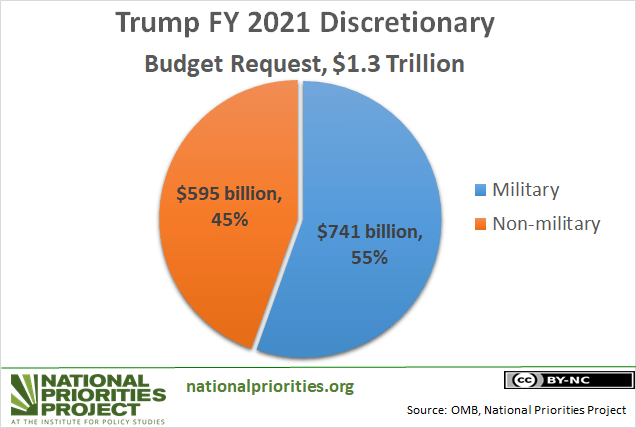
Technically, back in February, Bernie buried in a fact-sheet about how he would pay for everything he wanted to do, an $81 billion annual cut to military spending. While his current proposal is even smaller at $74 billion, it is a straightforward proposal to move the money; it’s not buried in a long document seeking to pay for transformative change almost entirely by taxing the wealthy; it’s already been covered at least by progressive media; it connects with a current burst of extraordinary activism, and Sanders has tweeted this: “Instead of spending $740 billion on the Dept. of Defense, let’s rebuild communities at home devastated by poverty and incarceration. I’ll be filing an amendment to cut the DoD by 10% and reinvest that money in cities and towns that we’ve neglected and abandoned for far too long.” And this: “Instead of spending more money on weapons of mass destruction designed to kill as many people as possible, maybe—just maybe—we should invest in improving lives right here in the United States of America. That’s what my amendment is all about.” One reason for this move by Sanders is almost certainly the current activism demanding that resources be moved from armed policing to useful expenses. The grotesque diversion of local budgets into militarized police and prisons is of course far outstripped in absolute numbers, in proportions, and in the suffering and death created, by Congress’s diversion of the federal discretionary budget into war and preparations for more war — which is of course where the weaponry and warrior training and a lot of the destructive attitudes and the troubled misguided veterans in local policing come from. Trump’s 2021 budget request varies little from past years. It includes 55% of discretionary spending for militarism. That leaves 45% of the money Congress votes on for everything else: environmental protections, energy, education, transportation, diplomacy, housing, agriculture, science, disease pandemics, parks, foreign (non-weapons) aid, etc., etc. The priorities of the U.S. government have been wildly out of touch with both morality and public opinion for decades, and have been moving in the wrong direction even as awareness of the crises facing us has inched upward. It would cost less than 3% of U.S. military spending, according to UN figures, to end starvation on earth, and about 1% to provide the world with clean drinking water. Less than 7% of military spending would wipe out poverty in the United States. Continue reading |
Trump wants costly armed nuclear ice-breakers – where will the money come from ?
U.S. Seeks Armed Nuclear Icebreakers For Arctic Show Of Force, David Hambling
Aerospace & Defense, 14 June 20,
President Trump has called for a ‘ready, capable, and available fleet of polar security icebreakers’ to give America a ‘strong presence’ in the Arctic and Antarctic regions. The call comes in a White House memorandum dated June 9 and envisages armed, nuclear-powered icebreakers engaging in operations for both national security and commercial interests. This is hugely ambitious considering that the U.S. currently has a single, ageing, non-nuclear icebreaker, while Russia is rapidly expanding its huge nuclear icebreaker fleet.
Russia has long seen the waters off their northern coast as a key economic asset, both for oil and gas exploration and as a shipping route, anticipating that the emerging Northern Sea Route will attract trade away from the Suez Canal by trimming 40% off the journey from Europe to Asia. Russia has ramped up its Arctic military presence in recent years with new air bases, ships and land forces to support these interests.
—
India will follow with nuclear weapons testing, if USA resumes testing
If the Donald Trump Resumes U.S. Nuclear Weapons Testing, India Will Follow, Hasan Ehtisham, The National Interest•June 13, 2020
On May 15, according to media reports, the Trump administration conducted serious discussions on whether or not to break the informal ban to carry out a nuclear test explosion. Washington’s intent to resume nuclear testing threatens to elevate already grown strategic tensions with China, Russia, and others. Some analysts comprehended that this is a proper course to influence Russia and China to support Washington’s plan for trilateral talks related to nuclear arms controls and disarmament issues. ……
The head of the Comprehensive Nuclear-Test-Ban Treaty Organisation (CTBTO), Lassina Zerbo, has presaged that any attempt by the United States to recommence nuclear testing would have serious ramifications for global peace and security. While mentioning CTBTO’s close relationship with the U.S. National Laboratories, Zerbo categorically precluded the notion of any requirement for nuclear testing. Chinese Foreign Ministry spokesperson Zhao Lijian has also shown “grave concerns about the report.” He urged the Trump administration to meet its “due obligations and honour its commitment by upholding the purpose and objective of the CTBT.” During the contemporary strategic competition of major powers, an uncertain situation has emerged about any sort of political gains for Washington against Moscow or Shanghai with a nuclear test. The most plausible consequence of a nuclear explosion by the United States at this point will facilitate other countries to resume nuclear testing. Washington will be criticized by other nuclear weapons states for violating the nuclear test moratorium practiced since 1998 by all countries, except North Korea.
Robert Rosner, a professor of physics at the University of Chicago, has evaluated that after the United States others will also resume nuclear testing and “the crucial question is: Who are the others?” In the South Asian strategic scenario, India will be that other country. India, one of the world’s fastest developing nuclear weapons states, has long been waiting for such a mistake, particularly from the United States, so that it could revoke the pledge of nuclear non-testing. It has been unable to do so just because it aspires to become part of the Nuclear Suppliers Group (NSG) and other global regimes. Once the United States resumes nuclear testing, India will find it easier to further demonstrate its nuclear weapon capability.
This latest paradigm shift by the United States allows India to conduct more nuclear testing to assess the design of its thermonuclear weapon which it claimed to have detonated on May 11, 1998, in the Operation Shakti-1. Numerous international experts believe that the results of the thermonuclear test were highly inflated and doubt that the device successfully ignited the second fusion stage of the explosion. The scientist community who coordinated the Operation Shakti-1 in 1998 has concluded that the test was a failure, as the yield of the fusion device never produced the desired results.
Nuclear pundits in India have already materialized a comprehensive and robust nuclear facility to meet any kind of eventuality that could provide India with an opportunity to carry out further nuclear tests. For instance, in 2012, India’s secret nuclear city at Challakere, Karnataka was revealed by independent researchers. Experts have shown apprehensions that the facility will be a major complex of nuclear centrifuges under military control, along with atomic research laboratories, weapons and aircraft testing sites. Once it starts functioning, the facility would enable India to modernize its existing nuclear warheads and the nuclear fuel from domestic reserves will be used for a thermonuclear weapon. India is also working on a uranium enrichment plant from which it will be able to produce about twice as much weapons-grade uranium as New Delhi will need for its operational nuclear weapon programme. That significant excess of the enriched uranium would be used for the development of thermonuclear weapons.
India has already done the necessary homework to manipulate any step the United States may take in the near future. The Defence Research and Development Organisation (DRDO) has signaled the capacity to conduct more nuke tests at short notice. If India alters the status of its moratorium on nuclear testing, then it would not only upset the deterrence balance but most significantly it would start a fresh nuclear arms race in South Asia. Under the pretext of growing Indo-US strategic relations in the region, the U.S. is offering a free ride to India to enhance the nuclear capability by resuming nuclear testing. It is strategically prudent for the U.S. national interest to uphold its commitments regarding the unilateral pledge of nuclear non-testing while ratifying the CTBT. The United States should also press India to continue its moratorium on nuclear weapons testing which was the primary prerequisite for the U.S.-India nuclear deal of 2008. It will reinforce the global standards against nuclear testing and encourage regional stability. https://news.yahoo.com/donald-trump-resumes-u-nuclear-120000804.html
Hasan Ehtisham is the M. Phil Scholar of Defence and Strategic Studies at Quaid-e-Azam University in Islamabad, Pakistan.
Plan for USA’s taxpayers to fund nuclear power exports
|
US Agency Proposes Financing of Nuclear Power Exports, VOA, By Reuters June 11, 2020 WASHINGTON – A U.S. development agency proposed lifting restrictions that bar the financing of advanced nuclear energy projects abroad, a move the Trump administration hopes will help the industry compete with state-owned companies in China and Russia.
The U.S. International Development Finance Corp., or DFC, late Wednesday opened a 30-day comment period on the proposal. The idea was included in the Trump administration’s Nuclear Fuel Working Group report, released in April, on ways to modernize nuclear energy policy……. The DFC, which replaced the Overseas Private Investment Corp., launched in January with a $60 billion budget. It is seen by analysts as an attempt by Washington to provide an alternative to Beijing’s sweeping Belt and Road Initiative, which sponsors large-scale infrastructure, like nuclear projects, in developing countries. Russia’s state-owned nuclear energy company, Rosatom, is also looking to sell nuclear technology. Ed Lyman, a nuclear power expert at the Union of Concerned Scientists, said it is “utterly irresponsible for the Trump administration to promote the export of unproven and potentially dangerous nuclear technologies to the developing world.” He said Washington should first work with countries to create independent nuclear regulators. …….. Advanced nuclear power is expected to be less expensive than traditional nuclear stations costing tens of billions of dollars. But nonproliferation experts caution that the plants and their supply chains could become targets of attack. https://www.voanews.com/usa/us-agency-proposes-financing-nuclear-power-exports |
|
Trump’s plan for a nuclear trest – dangerous brinkmanship
 A Nuclear Test Would Blow Up in Trump’s Face
The Trump administration doesn’t understand the brinkmanship concept its nuclear diplomacy is based on. Foreign Policy,
BY SARAH BIDGOOD JUNE 11, 2020,
|
The last 42 months have offered a sobering window into the Trump administration’s philosophy on nuclear arms control. On display is its penchant for withdrawing from agreements rather than engaging in dispute resolution—be they the Joint Comprehensive Plan of Action, the Intermediate-Range Nuclear Forces Treaty, or, most recently, the Open Skies Treaty. While many experts see this approach as ill-conceived and damaging to U.S. national security interests, the administration often frames it as a form of brinkmanship designed to signal resolve in an era of strategic competition. The intended message appears to be that the United States will no longer play ball unless its rivals—Russia and China—agree to abide by Washington’s rules.
The latest example of this tendency comes amid reports that the administration might conduct a “rapid” nuclear test to strengthen its hand in negotiations with China and Russia. Experts around the world have denounced this proposal as dangerous, foolhardy, and “catastrophically stupid.” As they point out, were the United States to test for the first time in nearly three decades, it would open the door for the resumption of widespread explosive testing. At the same time, it would undermine the nuclear taboo, hurt the credibility of the nonproliferation regime, and diminish support for the Comprehensive Nuclear-Test-Ban Treaty (CTBT). While all true, these arguments are unlikely to sway this administration, which has shown little regard for existing norms or the disarmament machinery writ large.
What might give decision-makers pause, though, is the fact that a nuclear test is unlikely to be an effective signal in the current context. It would not help deliver President Donald Trump’s goal of a trilateral arms control agreement, but it would provide ample opportunity for misinterpretation and a response in kind. In the process, it would likely put Washington in a worse negotiating position than when it started, making it not only risky but also pointless to boot………..
In short, if decision-makers in Washington do choose to test, this attempt at brinkmanship will certainly fail to convince Russia or China to sit down at the arms control negotiating table. Instead, it will make it all the more likely that the very outcomes trilateral arms control seems to be intended to prevent come to bear—and soon. The good news, then, is that there is plenty of time to walk this ill-conceived and ineffective plan back from the brink. In this instance, restraint—such as it is—may be the most effective nuclear signal this administration could possibly send. https://foreignpolicy.com/2020/06/11/nuclear-test-arms-control-trump-united-states-brinkmanship/
|
|
U.S. nuclear industry looks for salvation to hydrogen production – clutching at straws?
|
Hydrogen May Be a Lifeline for Nuclear—But It Won’t Be Easy, Power, Jun 11, 2020, by Sonal Patel Four U.S. nuclear generators—Energy Harbor, Xcel Energy, Exelon, and Arizona Public Service (APS)—are making headway on projects to demonstrate hydrogen production at nuclear plants, but scaling those efforts up to net new end-users and sources of revenue is still ridden with hurdles, company officials said in a panel discussion at the American Nuclear Society’s (ANS’s) virtual 2020 annual meeting on June 9………
The economics are especially important for Exelon, the nation’s largest nuclear generator, and exploring hydrogen production is a natural evolution to keep its plants financially afloat amid stagnating load growth and challenging economics in competitive energy markets, Greenlee said.
Energy Harbor faces similar predicaments. In 2018, the independent power producer—which was known as FirstEnergy Solutions until Feb. 27, when it completed Chapter 11 restructuring—had planned to shutter Davis-Besse in 2020; along with the twin-unit 1,872-MW Beaver Valley Power Station in Shippingport, Pennsylvania, in 2021; and the Perry Nuclear Power Plant in Perry, Ohio, in 2021. Last year, Energy Harbor pushed for and won nuclear subsidies in Ohio to keep the Davis-Besse and the Perry nuclear plants open through 2027, and this March, it said Beaver Valley would remain open.
Like Energy Harbor, Exelon helped enact the Future Energy Jobs Act in December 2016 (it went into effect in June 2017), to keep Exelon’s Clinton and Quad Cities plants running. Exelon also strongly backed New York’s Clean Energy Standard, a measure that became effective in April 2017, to preserve the at-risk Nine Mile Point, FitzPatrick, and Ginna reactors in upstate New York. And in 2018, New Jersey also enacted zero-emission credits (ZECs) to bolster profitability of the Hope Creek plant, which is owned by PSEG, and Salem, whose output Exelon owns jointly with PSEG.
As Greenlee noted, Exelon has since 2018 been seeking ways to “repurpose” its nuclear plants to make them more viable. The company’s efforts included convening academic experts, former employees, and former federal regulators in a brainstorm session. “And over the last several years, what we have boiled that table down to is, basically, hydrogen,” he said. “Hydrogen is what we want to look at going forward. We think it fits in with potentially a future hydrogen economy.” …….https://www.powermag.com/hydrogen-may-be-a-lifeline-for-nuclear-but-it-wont-be-easy/
|
|
USA’s reckless nuclear spending as coronovirus hits the nation
|
Debating US nuclear spending in the age of the coronavirus, Bulletin of the Atomic Scientists By Kingston Reif, June 10, 2020 As the novel coronavirus pandemic continues to exact a terrible human and economic toll on the United States, Americans are adjusting how they view national security. There also appears to be agreement, even within the senior leadership of the Defense Department, that the military budget, which has seen significant growth during the Trump administration, is likely to be pared back in the coming years as federal deficits soar.
So it should be no surprise that the havoc wrought by the virus has also fanned the flames of an ongoing debate about the Trump administration’s aggressive and costly plans to sustain and upgrade the US nuclear arsenal……. The unsustainable nuclear budget. At the Arms Control Association, where I am the director for disarmament and threat reduction policy, we have long argued that the administration’s approach is unnecessary, unsustainable, and unsafe. The financial and opportunity costs have steadily grown and the biggest nuclear weapons modernization bills are just beginning to arrive. Government officials in charge of the nuclear weapons enterprise warn about the “pervasive and overwhelming risk” facing the current nuclear modernization program………. The danger posed by the plans is on full display in the administration’s fiscal year 2021 budget request. The Defense and Energy Departments are requesting $44.5 billion for next year to sustain and modernize US nuclear delivery systems and warheads and their supporting infrastructure, a larger-than-anticipated increase of about $7.3 billion, or 19 percent, from the fiscal year 2020 level. Meanwhile, the administration is recommending a lower overall national defense budget than Congress provided last year. The combination of a decreased topline budget but an increased nuclear budget means that other defense programs would have to be cut. Some programs on the chopping block include the Navy’s planned second Virginia class submarine, the Energy Department’s efforts to clean up nuclear waste leftover from US nuclear weapons production during the Cold War, and the Pentagon’s Cooperative Threat Reduction program, which supports global efforts to detect and secure dangerous pathogens such as the coronavirus. And this was all before the coronavirus began its deadly march across the country and before Congress spent several trillion dollars trying to save the US economy from complete collapse. Although Pentagon officials insist that nuclear weapons should be shielded from possible future defense budget cuts, the pressure on the federal budget imposed by the response to the virus is likely to exacerbate the affordability and execution challenges confronting the administration’s nuclear spending plans. If great power competition with China is the Pentagon’s top priority, is it prudent to sacrifice a Virginia class submarine every year for the next 10 to 15 years to attempt to keep an excessive and overburdened nuclear modernization effort on track? The answer should be no, especially in light of the quantitative and qualitative superiority of the US nuclear arsenal over China’s. In the view of many, the Trump administration’s proposal to expand spending on nuclear weapons is a sad and dangerous illustration of wildly misplaced federal spending priorities. As it proposed a 19 percent increase for nuclear weapons next year, the White House initially planned to slash the budgets for the Centers for Disease Control by 19 percent and the National Institutes of Health by 7 percent. The Pentagon’s proposal to cut the budget for the Cooperative Threat Reduction program in order to fund weapons modernization amid a global pandemic is shockingly reckless…… Inexplicably, the unprecedented economic crisis facing the nation hasn’t stopped some Trump administration officials from raising the prospect of even greater spending on nuclear weapons above and beyond what is already planned. Marshall Billingslea, President Trump’s special envoy for arms control, said recently that if Russia and China don’t agree to US demands for talks on new trilateral arms control to replace the 2010 New Strategic Arms Reduction Treaty (New START), Washington could win a new arms race if necessary. “We know how to win these races, and we know how to spend the adversary into oblivion,” he said. More US spending on nuclear weapons won’t force the current Russian and Chinese leadership to capitulate and would be fraught with peril. The administration’s desire to pursue a more ambitious arms control agreement is the right goal, but it can’t be achieved before New START is slated to expire next February. A new quantitative arms race that could follow the collapse of New START would further undermine stability between the United States and Russia, the health of the global nonproliferation regime, and the US military’s emphasis on competition with China. Our new post-pandemic reality should make it all the more obvious that the current modernization plans need to be reconsidered in a way that eliminates the most excessive and destabilizing elements, saves taxpayer dollars for other pressing national and health security needs, and is in sync with a revitalized and realistic strategy to cap and reduce global nuclear stockpiles…….. Lisa Gordon Hagerty, head of the National Nuclear Security Administration, was asked to explain the rationale for such a large unplanned increase at a Congressional hearing in March, but her attempt at an answer hardly cleared up the situation. Perhaps there is a clearer explanation for why the agency so badly misjudged its funding needs for 2021, but if so the agency has yet to provide it…. (lengthy rebuttal of Frank Miller’s claims about nuclear weapons spending) ……. https://thebulletin.org/2020/06/debating-us-nuclear-spending-in-the-age-of-the-coronavirus/# |
|
|
1 This Month
15 October. Joint Appeal for Nuclear Abolition Day -presentation to the UN on October 15 will be live on UNWebTV
Endorse the Nuclear Abolition Day Appeal
23-25 October – on Zoom – World BEYOND War’s annual global conference

To see nuclear-related stories in greater depth and intensity – go to https://nuclearinformation.wordpress.com
-
Archives
- October 2026 (129)
- September 2026 (339)
- August 2026 (330)
- July 2026 (355)
- June 2026 (287)
- May 2026 (306)
- April 2026 (356)
- March 2026 (251)
- February 2026 (267)
- January 2026 (308)
- December 2025 (358)
- November 2025 (359)
-
Categories
- 1
- 1 NUCLEAR ISSUES
- business and costs
- climate change
- culture and arts
- ENERGY
- environment
- health
- history
- indigenous issues
- Legal
- marketing of nuclear
- media
- opposition to nuclear
- PERSONAL STORIES
- politics
- politics international
- Religion and ethics
- safety
- secrets,lies and civil liberties
- spinbuster
- technology
- Uranium
- wastes
- weapons and war
- Women
- 2 WORLD
- ACTION
- AFRICA
- Atrocities
- AUSTRALIA
- Christina's notes
- Christina's themes
- culture and arts
- Events
- Fuk 2022
- Fuk 2023
- Fukushima 2017
- Fukushima 2018
- fukushima 2019
- Fukushima 2020
- Fukushima 2021
- general
- global warming
- Humour (God we need it)
- Nuclear
- RARE EARTHS
- Reference
- resources – print
- Resources -audiovicual
- Weekly Newsletter
- World
- World Nuclear
- YouTube
-
RSS
Entries RSS
Comments RSS

