Exelon’s threat to Illinois – aiming to get more tax-payer funding
|
Dive Brief:
|
|

Renewed concerns about safety as dig starts for new shaft at New Mexico’s nuclear Waste Isolatio Pilot Plant
 Groups Raise Concerns About New Shaft at US NuclearDump, By Associated Press, Wire Service Content Sept. 4, 2020
Crews at the U.S. government’s underground nuclear waste repository in New Mexico are starting a new phase of a contentious project to dig a utility shaft. https://www.usnews.com/news/best-states/new-mexico/articles/2020-09-04/groups-raise-concerns-about-new-shaft-at-us-nuclear-dump
ALBUQUERQUE, N.M. (AP) — Crews working at the U.S. government’s underground nuclear waste repository in New Mexico are starting a new phase of a contentious project to dig a utility shaft that officials say will increase ventilation at the site where workers entomb the radioactive remnants of decades of bomb-making.
Officials at the Waste Isolation Pilot Plant said this week that the $75 million project is a top priority and that work will be done round the clock five days a week, with an additional shift on Saturdays. The shaft will eventually span more than four-tenths of a mile and connect to an underground system of passageways.
After reaching a depth of about 60 feet (18 meters), workers now will be drilling small holes and using explosive charges to clear more rock.
Adequate ventilation at the repository has been a big issue since 2014, when a radiation release forced a temporary closure and contamination limited air flow underground where workers dispose of nuclear waste. That prompted the need for a new ventilation system so full-scale operations could someday resume.
The repository is at the center of a multibillion-dollar effort to clean up waste from decades of U.S. nuclear research and bomb-making. Over more than 20 years, tons of waste have been stashed deep in the salt caverns at the southern New Mexico site.
Watchdog groups are raising red flags, saying the work is being done before state environmental officials finish a process allowing the public weigh in and before they have issued a final permit. The New Mexico Environment Department in April granted federal officials temporary approval to start the work as part of a larger request to dig the shaft and passageways.
The Southwest Research and Information Center is among those opposing the project. The group filed legal challenges, saying environmental officials ignored existing regulations, past agency practices and case law when giving temporary approval for contractors to begin working.
The Environment Department has defended its decision, saying the temporary approval was limited to digging the shaft, not using it.
Don Hancock with the Southwest Research and Information Center said state officials essentially foreordained the permit request by allowing work to begin. He also said the state has not provided any technical basis for its decisions and that it reduced the amount of time the public had to comment on the project by delaying the release of a draft permit.
The group has suggested that the shaft, given its size and location, could be used to expand the repository. It says that creates potential for the government to send high-level and commercial waste to the site, along with new radioactive waste that will be generated by manufacturing plutonium cores for the nation’s nuclear arsenal.
Despite congressional limits on the amount and type of waste that can be shipped to the repository, Hancock and other critics said the state’s actions have favored the federal government while limiting the public’s ability to give their input.
The repository’s hazardous waste permit also is up for renewal this year, and more legal wrangling is expected.
U.S. Court fins that mass surveillance program exposed by Snowden was illegal
 U.S. court: Mass surveillance program exposed by Snowden was illegal, Raphael Satter, (Reuters) 4 Sept 20, – Seven years after former National Security Agency contractor Edward Snowden blew the whistle on the mass surveillance of Americans’ telephone records, an appeals court has found the program was unlawful – and that the U.S. intelligence leaders who publicly defended it were not telling the truth.In a ruling handed down on Wednesday, the U.S. Court of Appeals for the Ninth Circuit said the warrantless telephone dragnet that secretly collected millions of Americans’ telephone records violated the Foreign Intelligence Surveillance Act and may well have been unconstitutional.
Snowden, who fled to Russia in the aftermath of the 2013 disclosures and still faces U.S. espionage charges, said on Twitter that the ruling was a vindication of his decision to go public with evidence of the National Security Agency’s domestic eavesdropping operation. …….
“Today’s ruling is a victory for our privacy rights,” the ACLU said in a statement, saying it “makes plain that the NSA’s bulk collection of Americans’ phone records violated the Constitution.”
Reporting by Raphael Satter; Editing by Tom Brown https://www.reuters.com/article/us-usa-nsa-spying-idUSKBN25T3CK?fbclid=IwAR3sRR-njWN8HPgtFcejytlwQP7TV5Ca0HqxOYy-PhSL-AnnEE5fL3krU5w
Despite the undoubted danger of USA’s gigantic new plutoniu pit production, USA safety officials won’t bother with a new environment study
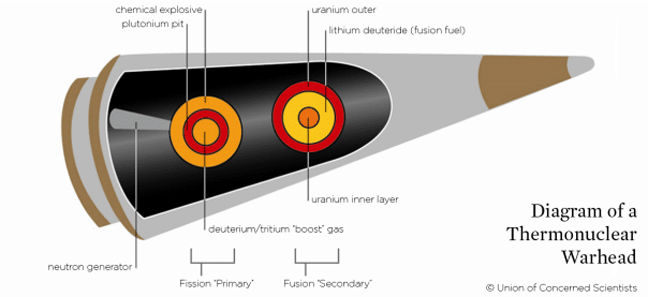
 Officials Dismiss New Environmental Study for Nuclear Lab https://www.mbtmag.com/home/news/21173922/officials-dismiss-new-environmental-study-for-nuclear-lab
Watchdog groups say the plutonium pit production work will amount to a vast expansion of the lab’s mission. Manufacturing Business Technology , Sep 3rd, 2020 ALBUQUERQUE, N.M. (AP) — The National Nuclear Security Administration says it doesn’t need to do an additional environmental review for Los Alamos National Laboratory before it begins producing key components for the nation’s nuclear arsenal because it has enough information.
Watchdog groups are concerned about Tuesday’s announcement, saying the plutonium pit production work will amount to a vast expansion of the lab’s nuclear mission and that more analysis should be done.
Los Alamos is preparing to resume and ramp up production of the plutonium cores used to trigger nuclear weapons. It’s facing a 2026 deadline to begin producing at least 30 cores a year — a mission that has support from the most senior Democratic members of New Mexico’s congressional delegation. The work is expected to bring jobs and billions of federal dollars to update buildings or construct new factories.
The work will be shared by the Savannah River Site in South Carolina, which has been tasked with producing at least 50 plutonium cores a year.
The National Nuclear Security Administration on Tuesday released its final supplemental analysis of a site-wide environmental impact statement done for the lab more than a decade ago. The agency concluded that no further analysis is required.
Critics have pushed for a new environmental impact statement, saying the previous 2008 analysis didn’t consider a number of effects related to increased production, such as the pressure it puts on infrastructure, roads and the housing market.
“The notion that comprehensive environmental analysis is not needed for this gigantic program is a staggering insult to New Mexicans and an affront to any notion of environmental law and science,” Greg Mello of the Los Alamos Study Group said in a statement.
Lab officials last year detailed plans for $13 billion worth of construction projects over the next decade at the northern New Mexico complex as it prepares for plutonium pit production. About $3 billion of that would be spent on improvements to existing plutonium facilities for the pit work, the Albuquerque Journal reported. AT TOP Lab officials last year detailed plans for $13 billion worth of construction projects over the next decade at the northern New Mexico complex as it prepares for plutonium pit production. About $3 billion of that would be spent on improvements to existing plutonium facilities for the pit work, the Albuquerque Journal reported.
Exelon again bullying Illinois into subsidies for nuclear power stations
 Inside Clean Energy: Illinois Faces (Another) Nuclear Power Standoff. Exelon wants a subsidy to keep two nuclear plants running, reigniting a longstanding—and acrimonious—debate. Inside Climae News, BY DAN GEARINO 4 Sept 20,
If this sounds familiar, it’s because something very similar happened in Illinois about five years ago, leading to a 2016 state law that subsidized two other Exelon nuclear plants in the state—a law now tainted by a still-unfolding bribery scandal.
Despite all the reasons to tell Exelon to take a hike, some consumer and environmental advocates say there is a strong case for keeping the plants open because they are an important source of carbon-free electricity. This ties into the larger, often acrimonious debate about the role of nuclear power in the transition away from fossil fuels.
Exelon owns all six nuclear plants in Illinois. This includes the two that would close in 2021, two (the Braidwood and LaSalle plants) that the company says are at risk of closing for financial reasons but are not yet scheduled to close and two (the Quad Cities and Clinton plants) that are subsidized by the 2016 law.
The six plants produced 54 percent of the electricity generated in the state last year. Coal is a distant second with 27 percent, followed by natural gas with 10 percent.
Renewable energy is growing, thanks in part to programs that also were part of the 2016 nuclear bailout legislation. But wind and solar are still small shares of the energy mix, with 8 percent and less than 1 percent, respectively.
Renewable energy is growing, thanks in part to programs that also were part of the 2016 nuclear bailout legislation. But wind and solar are still small shares of the energy mix, with 8 percent and less than 1 percent, respectively. ……….
Exelon has a lot of baggage these days. Federal prosecutors said in July that Commonwealth Edison, which is owned by Exelon, provided illegal payments and favors to help persuade lawmakers to pass the 2016 nuclear bailout.
ComEd agreed to pay $200 million to resolve the case, and is now cooperating in an ongoing probe that is likely to be focused on the lawmakers who allegedly accepted the favors, including Illinois House Speaker Mike Madigan, a Democrat.
Adding to the complexity of this debate is that environmental advocates are divided on whether nuclear should be part of a clean energy future. The case against nuclear is that it’s unsafe, with risks of devastating accidents and concerns about where to store nuclear waste.
David Kraft, director of the Nuclear Energy Information Service in Chicago, describes this latest push by Exelon as “yet another nuclear hostage crisis.” His group has been campaigning since 1981 for the country to phase out nuclear power.
“A better future for our children would be one that’s both carbon-free and radioactive waste free!” Kraft said in a guest commentary published Monday in The Chicago Tribune.
“To create a truly low-carbon and less-polluting energy future, put those funds gambled on nuclear directly into renewables, efficiency and energy storage upfront instead, eliminating nuclear power’s unpredictable risks and perpetual bailouts,” he said. ………….https://insideclimatenews.org/news/02092020/inside-clean-energy-nuclear-illinois-ohio
How to educate American children about nuclear weapons?
|
What’s missing from American schools’ curricula? Nuclear weapons. Bulletin of the Atomic Scientists, By Sara Z. Kutchesfahani, September 3, 2020 This week, students across the United States are heading back to school. While many high schools and universities are still deciding whether classes this semester will happen online, in-person, or in some hybrid combination, one thing is certain: Nuclear weapons are not a standard part of their class curricula.
The answer is fairly simple. Nuclear weapons issues are not a standard part of secondary school education, nor are they widely covered in undergraduate and graduate programs. A 2018 survey of 1,100 high school students in Washington State found that less than 1 percent even knew which countries possessed nuclear weapons. The finding was all the more startling because the students live in a nuclear-armed country themselves, and in an area with a nuclear legacy dating back to the Manhattan Project. While the situation is not as bad at the university level, the number of undergraduate courses that cover nuclear weapons issues is still low. A 2019 study on undergraduate nonproliferation education found that, among 75 of the top-ranked public, private, and military institutions in the country, on average, each institution offered seven such courses over a two-year academic period, or less than two courses per semester. A good way to contextualize that is to compare it to course offerings on climate change—the other most pressing threat to humanity’s survival. The same study found that on that topic, the nation’s three leading public, private, and liberal arts institutions each offered between 19 and 30 courses during just a single academic year (2017–2018). Why does this matter? It matters because the nuclear weapons threat isn’t going away—if anything, it is growing—but the number of people working in the field is shrinking. …. The field is going to need many more bright minds to solve current and future nuclear challenges. Attracting those bright minds starts with building awareness of the issue. And awareness of any issue can be linked to issue exposure. So, if school boards, curriculum writers, and teachers and professors continue to ignore the topic of nuclear weapons and do not include it in class curricula, the public will continue to be unaware of the existential threat these devastating weapons pose to humanity, and the professional field will have difficulty sustaining itself. Nuclear weapons policy is confusing, highly technical, intimidating, shrouded in secrecy, and largely dominated by an awfully small group of men. So those who want to begin exploring the subject may find it exclusive, inaccessible, and hierarchical. But the simple and easy-to-understand fact remains that nuclear war remains a significant global threat……… Here are three relatively easy and practical solutions that teachers and professors can implement this school year—without having to go through too many bureaucratic hurdles. First, check out a new platform that offers a diverse volunteer network of professionals ready to speak with students and teachers about topics, lessons, classes, college, internships, and career advice on nuclear issues. The platform is called NRICHED, and its creators want to empower students with agency to tackle the world’s biggest problems through experiential learning……. Second, consider offering a nuclear security undergraduate class at your institution, and press administrators to recognize its importance. For those whose administrators are hesitant, the Stanton Foundation provides grant support for the development of new nuclear-related courses for undergraduates each academic year…….. Third, enlist the outstanding work of Girl Security, an organization that provides specialized programming for (female) high school students on national security subjects, including nuclear weapons. The Girl Security team helps empower young women with practical training through simulation exercises developed by women national security practitioners. Moreover, they provide girls with placement in a phased mentorship network, pairing them with women national security professionals who are one step ahead of them in their academic and professional advancement……….. https://thebulletin.org/2020/09/whats-missing-from-american-schools-curricula-nuclear-weapons/ |
|
Ohio lawmakers wrangle over how to repeal crooked nuclear bailout law
 Meanwhile, Ohio Has Its Own Nuclear Debate, Inside Clean Energy: BY DAN GEARINO – 4 Sept 20, Ohio lawmakers talked this week about whether—and how—to repeal a 2019 nuclear bailout law whose main backers are now the subject of a federal bribery probe.

On a superficial level, the discussions in Ohio and Illinois have a lot in common with talk about the role of nuclear power in the energy system, and lots of intrigue from federal prosecutors. For more details, see my story from July.
But the tone in Ohio is different, largely because the state government is controlled by Republicans who place little value on making a smooth transition to clean energy.
“I’ve never known this state or this General Assembly to be overly concerned with the environment,” said Thomas Suddes, who teaches at Ohio University and writes about state politics for The Plain Dealer in Cleveland.
He said both parties tend to value retaining jobs for constituents and helping party allies, and that this usually takes precedence over ideology.
Closing the nuclear plants would cost thousands of jobs, and a bill repealing the subsidies could be used in arguments ahead of the November election to portray lawmakers as insensitive to local concerns in the areas that host the plants.
So, even with the bribery scandal, there is a natural reluctance to repeal the bill, which makes Suddes doubtful that any substantial action will happen in the next few months.
“The cautious thing to do for a lot of incumbents would be to leave it alone,” he said.
Gov. Mike DeWine and some legislators have said they want to repeal and replace the 2019 law. But the governor and many others say they still support many of the law’s provisions, including subsidies for the state’s two nuclear power plants, owned by Energy Harbor, the company formerly known as FirstEnergy Solutions.
For now, there is nothing approaching consensus on what a replacement should look like.
House Speaker Robert Cupp has said he favored repealing and replacing the law, although he has given no specifics about a replacement. He said this week that he will appoint a special committee to study the issue, which is likely to mean there will not be quick action on a repeal…………
Randi Leppla, the lead energy attorney for the Ohio Environmental Council Action Fund, said the situation with the repeal effort seems to change “hour by hour.”
“It’s very, very clear that what we need to be doing is ripping this off the books and starting over from scratch,” she said. “This bill is corrupt from the bottom up, and it’s really just bad policy for Ohio.”
In addition to the nuclear bailout, the Ohio law subsidizes two coal-fired power plants and eliminates state requirements that utilities meet annual benchmarks for renewable energy and energy conservation.
The combination of policies harmful to the environment have made the Ohio law an example of a nuclear bailout that has little public benefit, according to the Union of Concerned Scientists and many others.
At least for now, Ohio leaders are doing little to erase this dubious distinction. https://insideclimatenews.org/news/02092020/inside-clean-energy-nuclear-illinois-ohio
Students unaware of nuclear weapons and the existential threat that they pose
Students Aren’t Learning About Nuclear Weapons. That’s a Major Problem. AT TOP https://www.popularmechanics.com/military/weapons/a33917558/nuclear-weapons-education-in-schools/ Popular Mechanics, BY CAROLINE DELBERT, SEP 4, 2020
- Not enough young people have access to even the option of studying nuclear weapons dynamics, an industry report says.
- Nuclear weapons development continues around the world.
- The current nuclear risk workforce is aging out, with few interested in replacing them.
- At the Bulletin of the Atomic Scientists, innovation advocate Sara Z. Kutchesfahani says the vast majority of U.S. students don’t learn about nuclear weapons in high school, or even in most relevant college coursework. Kutchesfahani says that low level of knowledge, combined with industry factors, means the nuclear workforce itself is about to hit a critical state.
- Kutchesfahani is writing on behalf of an industry thinktank, N Square, a “funders collaborative” that advocates for nuclear threat reduction. She says the lack of flow of new, younger workers into the nuclear sector will create a dangerously unbalanced workforce demographic in an industry that will still need a lot of support for the foreseeable future. Even if nuclear weapons are never used, they must be maintained carefully. If they’re “disarmed” in the future, trained people must handle and dispose of or recycle them.
- In the essay, Kutchesfahani likens nuclear weapons awareness and literacy to the idea of climate change awareness and curricula, because, she says, both are existential threats:
“[I]f school boards, curriculum writers, and teachers and professors continue to ignore the topic of nuclear weapons and do not include it in class curricula, the public will continue to be unaware of the existential threat these devastating weapons pose to humanity, and the professional field will have difficulty sustaining itself.”
Much of nuclear investment in 2020 is in energy—for better or worse, world powers are treating next-generation nuclear power like the next big thing and even using that as a way to underfund investment in wind, solar, hydro, and other sustainable forms of energy.But there has also been a new kind of nuclear warhead developed and now tested in 2020, a low-yield warhead launched from a submarine that, again, is publicly billed as a “deterrent” to other nations’ nuclear aggressions, particularly Russia.
This content is imported from {embed-name}. You may be able to find the same content in another format, or you may be able to find more information, at their web site. - The fact remains that as long as there are nuclear weapons in play on the world stage, the world must realistically discuss them. That’s separate from politics, or even whether advocates are for or against nuclear weapons at all. If someone walked into your home while juggling flaming batons, you’d suddenly wish you had a flaming batons expert to help you decide what to do next.
Top official at USA nuclear safety agency resigns
|
Top official at nuclear safety agency resigns, Santa Fe New Mexican By Scott Wyland swyland@sfnewmexican.co, Sep 3, 2020
The chairman of the agency that oversees workplace safety at nuclear facilities has resigned, a move that officials say shouldn’t affect oversight of Los Alamos National Laboratory. Bruce Hamilton, who has chaired the Defense Nuclear Facilities Safety Board for two years, will leave Sept. 12. Hamilton gave no reason for his decision when he submitted his resignation……. The agency has come under fire during the Trump administration, which has sought to limit its oversight. In 2018, the U.S. Energy Department issued an order limiting the board’s access to sensitive information it needed for safety inspections. It also required Energy Department employees to “speak with one voice” to the board, discouraging individual workers from reporting safety violations. Critics say the constraints run counter to the board’s statutory mission of working independently to assess accidents, missteps or unsafe conditions at nuclear weapons facilities to protect workers and the public. In March, Hamilton wrote a letter to Congress describing how reduced access to information has hampered the board. “During 2019, the Board experienced challenges and delays in accessing information necessary to perform its responsibilities,” he wrote. He thanked Congress for stating in the proposed 2021 defense budget that the board’s full authority should be recognized……… https://www.santafenewmexican.com/news/local_news/top-official-at-nuclear-safety-agency-resigns/article_2e9d333c-ed31-11ea-ba57-1fb63def0647.html |
|
Nuclear Workers Sue Over ‘Creeping Chernobyl’ in Ohio
Nuclear Workers Sue Over ‘Creeping Chernobyl’ in Ohio (1) Maya Earls, Legal Reporter, Sept. 5, 2020,
- COURT: S.D. Ohio
- TRACK DOCKET: No. 2:20-cv-04621 (Bloomberg Law Subscription)
- JUDGE: Edmund A. Sargas Jr. (Bloomberg Law Subscription)
- DEFENDANTS: Goodyear Tire & Rubber Co., Lockheed Martin Corp.
Companies including Lockheed Martin Corp. and Goodyear Tire & Rubber Co. recklessly and negligently operated a nuclear site in Ohio that poisoned nuclear workers and contaminated the environment, according to a class complaint filed in an Ohio federal court.
The defendants not only showed a lack of concern for safety, but they tried to hide information about criminal operations at the site in violation of the Racketeer Influenced and Corrupt Organizations Act, according to the lawsuit filed Thursday in the U.S. District Court for the Southern District of Ohio.
The lawsuit’s claims stem from operations at the Portsmouth Gaseous Diffusion… (subscribers only) https://news.bloomberglaw.com/environment-and-energy/nuclear-workers-sue-over-creeping-chernobyl-in-ohio
Over 800 coronavirus cases among workers at Vogtle nuclear project, may increase costs and delays

|
Georgia nuclear project reports more than 800 COVID-19 cases to date, https://www.ajc.com/ajcjobs/georgia-nuclear-project-
 reports-more-than-800-covid-19-cases-to-date/P4BXNDI5ONHX7BSPCPTJYZNWYE/ By Matt Kempner, 20 Sept 20, The Atlanta Journal-Constitution, Georgia Power’s massive nuclear expansion project has had more than 800 workers who have tested positive for COVID-19 since the coronavirus pandemic began. reports-more-than-800-covid-19-cases-to-date/P4BXNDI5ONHX7BSPCPTJYZNWYE/ By Matt Kempner, 20 Sept 20, The Atlanta Journal-Constitution, Georgia Power’s massive nuclear expansion project has had more than 800 workers who have tested positive for COVID-19 since the coronavirus pandemic began.
In a new filing with the state, Georgia’s largest electric provider said it has weathered another wave of cases at the Plant Vogtle project underway south of Augusta, but that the number of new cases is receding again. Georgia Power said more than 700 of the workers who tested positive are now eligible to return to work, and that there were 109 active confirmed cases as of Friday. A spokesman declined to disclose if any workers have been hospitalized or died, citing privacy laws. About 7,000 workers are stationed on site after 2,000 were sent home in April in hopes of reducing the virus’ spread and dealing with growing absenteeism. The virus has been blamed for further slowing the project, which is already years behind schedule and billions of dollars over budget. Independent monitors for the Georgia Public Service Commission warned in June that even without considering the impact of COVID-19, Vogtle’s costs will rise by another $1 billion and the project is “highly unlikely” to have its two new reactors in service by November 2021 and November 2022, respectively. In a filing made public Monday, the company said it continues to plan for the scheduled operation dates. But Georgia Power said it recognizes “that the project may continue to experience challenges and that unanticipated events, or failure to meet the current plan, may require further revision to the site work plan, capital cost forecast, and/or project schedule.” In a July filing, the company said costs for its share of the project are expected to be $149 million over current forecasts and that it later may ask state regulators to charge customers for the increase. After coronavirus cases rose early in the pandemic, the project went several weeks without any new confirmed cases on the site, according to the company’s latest filing. But the confirmed cases grew again. Then, in recent weeks, “the site has followed the general trend in the region with a decline in the number of active cases.” |
|
|
The nuclear industry a big winner from U.S. election as Democrats and Republicans embrace this toxic industry
 Nuclear Power Could Win Big In U.S. Elections, Oil Price By Jon LeSage – Sep 2, 2020
The world’s largest nuclear power market is ready to gain more government backing for the energy — no matter who wins in November.
For nearly a half century, the Democratic Party’s election year party platform has excluded nuclear energy, but that’s not the case this year. The newly-released party platform says It favors a “technology-neutral”  approach that includes all zero-carbon technologies, including hydroelectric power, geothermal, existing and advanced nuclear, and carbon capture and storage.
It’s the first time since the 1972 election year that the party has had any positive statements to make about nuclear power, which did include early testing of fusion nearly a half century ago. That year, the Democratic party said it supported “greater research and development” into “unconventional energy sources” including solar, geothermal, and “a variety of nuclear power possibilities to design clean breeder fission and fusion techniques.”
Since then, the Democratic Party has either ignored or opposed nuclear energy. Environmental groups have been opposed to nuclear power for years, and have had much influence on campaigns and elected officials.
A clear example of it comes from 2005, when about 300 environmental groups –
including Greenpeace, Sierra Club, and Public Citizen – signed a statement which said “we flatly reject the argument that increased investment in nuclear capacity is an acceptable or necessary solution….[N]uclear power should not be a part of any solution to address global warming.”
The Sierra Club, the largest US environmental lobby, says it remains “unequivocally opposed to nuclear energy.”………
Presidential candidate Joe Biden’s campaign website also includes nuclear power support …..
Biden has been championing starting a new agency, Advanced Research Projects Agency for Climate Change (ARPA-C). Like predecessor ARPA-E that funded advanced technology in renewable energy, electric vehicles, and other technologies, and DARPA that supported advanced military vehicle applications, ARPA-C would back test projects working toward lowering cost, driving efficiency, and reducing emissions.
The change in policy statements is good news for the American nuclear-energy sector…….
But its already been in the works in Washington. During the past two years, bipartisan support on Capitol Hill has led to new laws, including the Nuclear Energy Innovation and Modernization Act and the Nuclear Energy Innovation Capabilities Act …… https://oilprice.com/Alternative-Energy/Nuclear-Power/Nuclear-Power-Could-Win-Big-In-US-Elections.html
Fluor could improve its finances by abandoning NuScam, as some cities pull out of ”small” nuclear reactor scheme
 Fluor could improve earnings by reducing underperforming assets, including NuScale
But two cities, Logan and Lehi, Utah have walked away from the project, and a third is now considering dropping its support because of risks and a lack of backers, according to officials.
Allen Johnson, the power department director for Bountiful, Utah, said chances are greater than 50-50 it will withdraw.
“You’ve got to have enough people to support it and some of the players I thought would be interested are not,” he said.
The defections are bad news for U.S. efforts to develop modular nuclear energy …
Combined, cities have so far committed to buying just under 200 megawatts of the plant’s planned 720 megawatts of power.
The U.S. Department of Energy has pumped more the $280 million into the project since 2013, and is expected to commit another $1.4 billion over the next nine years. The department did not respond to requests for comment…….
The consortium earlier this year pushed back the project’s commercial operation date to 2030 from 2026, Webb said, to provide more time for public input and opportunities for cities to reconsider their participation at various phases.
CITIES RETHINK COSTS
NuScale, based in Portland, Oregon, is majority owned by construction and engineering firm Fluor Corp.
The project would include 12 60-megawatt modules at the Energy Department’s Idaho National Laboratory.
The Nuclear Regulatory Commission last week approved NuScale’s design, the first such green light for a modular reactor.
Small modular reactors are meant to be cheaper and quicker to build than traditional reactors because they can be manufactured in factories. But critics say economies of scale are lost with the smaller plants.
The NuScale project’s projected cost of $6.1 billion has risen from $3.6 billion in 2017, Mark Montgomery, head of the municipal utility in Logan told officials there last month ahead of their vote to abandon the project.
Lehi withdrew from the project due to a lack of interest from other entities and increased costs, according to the Aug. 25 resolution approved by its city council.
“These cities should not be acting as venture capital investors,” said Rusty Cannon, vice president of the Utah Taxpayers Association, which has been pushing cities to leave.
Previous cost estimates did not account for financing and decommissioning, as well as higher labor, construction and materials costs over ten years, UAMPS spokesman Webb said, explaining the change.
NuScale said the project delay had been requested by UAMPS. It did not comment specifically on the city defections.
A Wednesday report written by M.V. Ramana a professor of disarmament and human security at the University of British Columbia said Fluor had cut its own investment in the project and excluded NuScale expenses from its financial forecasts because it was expecting additional funding from third party investors.
Financial analyst Jamie Cook of Credit Suisse said last year that Fluor could improve earnings by reducing underperforming assets, including NuScale. ………https://whtc.com/news/articles/2020/sep/02/some-us-cities-turn-against-first-planned-small-scale-nuclear-plant/1054578/
Small nuclear reactors – NuScam looking dodgy as parent company Fluor shares sink?
declined by -15.01% in the 3 months of the year. Over the past six months meanwhile, it has lost -19.89% and lost -47.51% year-on date. DBT News 25 August 20
Small nuclear reactor NuScam’s parent company Fluor sued over allegations of insider trading and deception
 Fluor Board Sued Over Insider Trading, Accounting Allegations, Mike Leonard, Legal Reporter, Aug. 14, 2020, COURT: Del. Ch., TRACK DOCKET: No. 2020-0655 (Bloomberg Law Subscription, JUDGE: J. Travis Laster (Bloomberg Law Subscription), COMPANY INFO: Fluor Corp. (Bloomberg Law Subscripti
The board of Fluor Corp., a leading engineering and construction conglomerate that does significant business with the federal government, has been hit with a Delaware lawsuit claiming several of its members sold stock at inflated prices while conspiring to mask the company’s deteriorating finances.
“At the same time,” Fluor’s board and top executives “engaged in a pattern” of having the company “repurchase its own shares at over-inflated prices,” the 98-page Chancery Court complaint says. “This repurchase of inflated stock cost the company over $1.6 billion.”
The heavily redacted derivative suit, made public Wednesday, comes about three months after Fluor……….(subscribers only) https://news.bloomberglaw.com/mergers-and-antitrust/fluor-board-sued-over-insider-trading-accounting-allegations
-
Archives
- October 2026 (129)
- September 2026 (339)
- August 2026 (330)
- July 2026 (355)
- June 2026 (287)
- May 2026 (306)
- April 2026 (356)
- March 2026 (251)
- February 2026 (267)
- January 2026 (308)
- December 2025 (358)
- November 2025 (359)
-
Categories
- 1
- 1 NUCLEAR ISSUES
- business and costs
- climate change
- culture and arts
- ENERGY
- environment
- health
- history
- indigenous issues
- Legal
- marketing of nuclear
- media
- opposition to nuclear
- PERSONAL STORIES
- politics
- politics international
- Religion and ethics
- safety
- secrets,lies and civil liberties
- spinbuster
- technology
- Uranium
- wastes
- weapons and war
- Women
- 2 WORLD
- ACTION
- AFRICA
- Atrocities
- AUSTRALIA
- Christina's notes
- Christina's themes
- culture and arts
- Events
- Fuk 2022
- Fuk 2023
- Fukushima 2017
- Fukushima 2018
- fukushima 2019
- Fukushima 2020
- Fukushima 2021
- general
- global warming
- Humour (God we need it)
- Nuclear
- RARE EARTHS
- Reference
- resources – print
- Resources -audiovicual
- Weekly Newsletter
- World
- World Nuclear
- YouTube
-
RSS
Entries RSS
Comments RSS

