Too much power to USA president, to control nuclear war strategy: what if he is ill?
 Why The President Is The Weakest Link In U.S. Nuclear Strategy, Forbes, Loren Thompson 7 Oct 20 President Trump’s hospitalization after testing positive for Covid-19 is one of many instances in which the performance of the nation’s chief executive has been impaired by medical issues.
Eisenhower had a massive heart attack in 1955. His successor, John F. Kennedy, was afflicted by Addison’s disease and various other maladies that required heavy use of painkillers. Kennedy’s successor, Lyndon Johnson, was hospitalized during the Hong Kong flu pandemic of 1968.
Other presidents have seen their performance compromised by psychological issues.
Richard Nixon became clinically depressed during the Watergate controversy and took to drinking heavily. Ronald Reagan may have exhibited early symptoms of Alzheimer’s disease during the closing years of his presidency.
Such frailties have long been a part of the human condition, but the advent of nuclear weapons raised alarming possibilities about where presidential disability might lead. You see, the president has unilateral authority to launch nuclear weapons, and that power is one of the few places in the federal system where no checks and balances exist.
Thus, the prosect that a president might be physically or mentally impaired is alarming………
Mr. Trump’s recent hospitalization highlights some of the things that might go wrong. A report released this week by the Northwestern Medicine healthcare system found that a third of the patients hospitalized for Covid-19 in the system’s Chicago-area facilities developed altered mental states, including confusion and delirium.
In addition, President Trump’s doctors administered a heavy regimen of drugs aimed at mitigating the health consequences of his infection. Unfortunately, one of those drugs was a steroid, and steroids are known to cause psychological symptoms in some patients such as anxiety, agitation and mood swings.
When you consider the awesome nuclear authorities vested in the president, it is unsettling to contemplate how impaired judgment or medical disability might impact decision-making in a crisis……… https://www.forbes.com/sites/lorenthompson/2020/10/07/why-the-president-is-the-weakest-link-in-us-nuclear-strategy/#7f5796d76aee

Pressure on U.S. Congress to reinstate research on links between nuclear stations and cancer

Activists push Congress to revive probe into links between nuclear plants and cancer
Nuclear Regulatory Commission killed study in 2015 after spending five years and $1.5 million on the effort, Orange County Register, By TERI SFORZA | tsforza@scng.com | October 5, 2020 Scientists and activists were stunned back in 2015 when the Nuclear Regulatory Commission pulled the plug on what was designed to be the best study of cancer near nuclear power plants ever done.
Last week, a petition with some 1,200 signatures demanding that the study resume went to members of Congress representing Southern and Central California.
“This is a scientific endeavor which will improve our understanding of cancer, the leading cause of death in California,” the petition states. “It is especially important for women, children, and the human fetus who are much more vulnerable to the biological effects of harmful ionizing radiation.”
No one knows threat
The retired San Onofre and Diablo nuclear power plants, both shut down in 2013, have been discharging low-level radioactivity into the ocean and atmosphere for decades, the petition continues, and no one knows for sure whether that poses a threat to nearby residents………
More modern studies in Europe have found that children living within 3 miles of nuclear power plants had double the risk of developing acute leukemia as those living farther away, with the peak impact on children ages 2-4.
Bart Ziegler, president of the Samuel Lawrence Foundation, said the inquiry is long overdue and must begin right away. https://www.ocregister.com/2020/10/05/activists-push-congress-to-revive-probe-into-links-between-nuclear-plants-and-cancer/
U.S. Dept of Energy report shows danger of radioactive wastes leaking from Hanford’s old decayed tanks
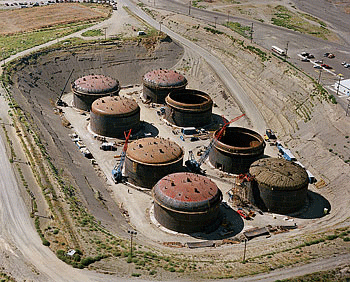
Report: Hanford unprepared for potential nuclear waste leak, by Associated Press, Wednesday, October 7th 2020 TRI-CITIES, Wash. (AP) — A report by the Department of Energy has shown that the Hanford nuclear reservation could face immediate issues as double-shell tanks holding high-level radioactive waste deteriorate.
An inspector general audit report released Monday said that the underground tanks at the Hanford site are planned to store waste until at least 2047, posing a threat if the deteriorating tanks fail, the Tri-City Herald reported.
The site produced plutonium for nuclear weapons during the Cold War and World War II, leaving 56 million gallons of radioactive waste in underground tanks until it can be treated for disposal.
A major leak could potentially reach groundwater. https://komonews.com/news/local/report-hanford-unprepared-for-potential-nuclear-waste-leak
Speeded up decommissioning of Crystal River nuclear reactor – some concerns about this
Duke nuclear plant demolition timeline cut from half-century to 7 years, By KEVIN SPEAR, ORLANDO SENTINEL |OCT 07, 2020 Duke Energy is poised to begin demolition of its shuttered nuclear plant, with a timeline reduced from nearly six decades to seven years because of a drop in costs.
Duke’s 890-megawatt reactor near Crystal River at the Gulf of Mexico has been out of commission since 2009, when a construction accident crippled the containment building. In 2015, facing a projected demolition cost of more than $1 billion, Duke was prepared to let the plant remain for 60 years before removing it.
But with the aging of nuclear power around the world and competitive advances in demolition technology, Duke is proceeding with a fixed contract of $540 million to remove the plant. That cost is to be covered by a trust fund of $717 million already paid for by the utility’s customers.
A newly formed company, Accelerated Decommissioning Partners, has begun engineering designs for demolition and is about to remove structures and infrastructure outside of the reactor building.
Accelerated Decommissioning Partners is a joint venture that includes NorthStar Group Services, which describes itself as the world’s largest demolition company, with services ranging from hurricane cleanup to asbestos removal, and is currently taking down the Vermont Yankee Nuclear Power Station.
The other partner is Orano USA, a supplier of nuclear materials and services. In 2018, the company transferred the Crystal River plant’s used nuclear fuel from a storage pool to containment within dry casks that are now stored in concrete bunkers at the plant site. There is no designated disposal facility in the U.S. for used fuel, and the dry casks could remain at Duke’s Crystal River site for years or decades………
In 2009, a major effort to extend the life of the the reactor damaged the reactor-containment building’s 3-foot-thick wall. After botched repair attempts, the plant was declared economically beyond repair.
The additional cost that customers had to absorb for the attempted upgrade and trying to fix the containment building was an estimated $1.7 billion, according to the Florida Office of Public Counsel, a legislatively created agency that serves as an advocate for utility customers.
Other lost nuclear costs would arise from Duke’s move to build a $22 billion plant in Levy County. That initiative was announced in 2006 but abandoned within a decade, resulting in costs that customers had to absorb of more than $870 million .
Charles Rehwinkel of the Office of Public Counsel said Duke’s contract with Accelerated Decommissioning Partners should have included better protections in case of demolition or financial problems.
“We remained concerned that this process, which is fairly new, could have a problem down the road,” Rehwinkel said. “The problems we would be concerned about would be cost overruns and if they get part way through the process in an area where there is still contaminated metal components and there is a bankruptcy or some halt that leaves them in the position of Duke having to get somebody else to come in.”
Edward Lyman, director of nuclear power safety at the Union of Concerned Scientists, said there isn’t much track record yet for the kind of accelerated decommissioning and demolition being performed at Duke’s plant.
But his initial concern is that Duke’s fixed-price contract with the joint venture leaves little flexibility for dealing with unexpected challenges.
“They are going to have a strong incentive to minimize cost and that could potentially come at the cost of safety,” Lyman said……..
The most challenging work will involve the reactor vessel, a cylindrical assembly the size of a semitruck, with steel walls at least 5 inches thick.
Roberts said crews will cut the vessel into pieces while submerged underwater, which blocks radiation.
Cuts will be done with robots and other remotely controlled machines with a variety of band saws, diamond-wire saws and high pressure water jets with abrasive ingredients. Cutting will be according to specific sizes, shapes and weights.
While still underwater, pieces will be inserted into canisters, which, in turn, will be inserted into steel casks for shipment “more than likely by rail” to a disposal site in west Texas, Roberts said…… https://www.orlandosentinel.com/news/environment/os-ne-duke-nuclear-plant-demolition-20201007-oa4bvubxanevnof2dzyzyshg2a-story.html
USA ‘s Environment and climate cases face a bleak future with a Republican dominated Supreme Court
 HOW WILL CLIMATE AND ENVIRONMENTAL CASES FARE ON A 6-3 CONSERVATIVE SUPREME COURT? THE ALLEGHENY FRONT, REID FRAZIER, OCTOBER 2, 2020
It appears that President Trump has enough votes in the Senate to confirm Supreme Court nominee Amy Coney Barrett before Election Day. That means the court’s balance would tip from a 5 to 4 advantage for conservatives to 6 to 3. What would this majority mean for the environment?
For our podcast, Trump on Earth, Reid Frazier examines what the loss of RBG could mean for the environment with Ellen Gilmer, senior legal reporter for Bloomberg Law.
But first, we take a look back at Ginsburg’s environmental legacy with Pam King and Jeremy Jacobs, reporters for E&E News who wrote in a recent article, “The passing of Supreme Court Justice Ruth Bader Ginsburg could shake the foundation of America’s bedrock environmental laws, leaving a chasm on the bench where once sat an environmental champion.” (Read the transcript to that interview HERE.)
(The interviews were conducted before Amy Coney Barrett was nominated to fill Justice Ruth Bader Ginsburg’s seat on the Supreme Court.)
Listen to the full episode or read the transcript below:
Texas Governor Greg Abbott opposes 2 plans for nuclear waste dumping
|
Texas Governor Urges Trump To Oppose Nuclear Waste Plans, Texas Standard, 5 Oct 20, “It’s an unusual thing for environmentalists and oil companies to be on the same page, and we are on this issue,” says an Austin-based environmental advocate.
From Courthouse News Service: Texas Governor Greg Abbott has come out against two rival plans to ship highly radioactive waste from the nation’s nuclear power plants to sites on the Texas-New Mexico border, saying either plan would be unsafe and would threaten the region’s sprawling Permian Basin oilfield……. The nuclear waste plans have for years drawn the ire of advocacy groups who worry about a range of possible environmental and safety threats, but oil and gas interests have become increasingly involved in the fight as well. A coalition of oil companies and West Texas landowners called Protect the Basin was launched in 2018 to oppose the plans and has more recently stepped up its outreach. One of the coalition members, a ranching and oil company tied to one of the nation’s richest families, has been involved in fighting the issue all the way up to the D.C. Circuit. “It’s an unusual thing for environmentalists and oil companies to be on the same page, and we are on this issue,” said Karen Hadden, an environmental advocate who leads the Austin-based Sustainable Energy and Economic Development Coalition. In his letter Wednesday, Abbott urged Trump to also oppose the waste plans, echoing a call from Democratic New Mexico Governor Michelle Lujan Grisham, who wrote to the president over the summer. For years, two companies have been competing for a federal license that would allow them to take in shipments of “high-level” radioactive waste from all over the country, mostly in the form of used-up nuclear fuel from power plants. Congress and the federal government have been wrangling for decades over how and where to dispose of the nation’s growing stockpile of high-level waste, but a clear path forward has never emerged. The Trump administration once flirted with the idea of reviving a long-stalled plan to dispose of the waste at Nevada’s Yucca Mountain, but the president seemed to backtrack on that idea in February. On the New Mexico side, Holtec International wants to build a new facility to house the waste, while a company called Interim Storage Partners plans to bring the waste to an existing facility on the Texas side that has stored less-radioactive types of waste for years. Federal environmental reviews have given both plans the initial thumbs-up, though neither has received a final license to move forward. Neither company immediately responded to a request for comment on Abbott’s letter. The White House also did not immediately respond. In the letter, Abbott suggested that neither of the proposed sites would be a suitable choice for storing the waste. “The proposed sites in Texas and New Mexico do not provide the deep geologic isolation required for permanent storage in order to minimize the risks of accidents, terrorism, or sabotage, which could disrupt the country’s energy supply with catastrophic effects on the American economy,” he said. Abbott has previously voiced displeasure at the general idea of bringing more radioactive types of nuclear waste to Texas, though he hadn’t until Wednesday specifically opposed the two high-level waste plans. Last year, the governor wrote on Twitter that he wouldn’t let Texas become “the radioactive waste dumping ground of America.” Abbott’s letter comes as the federal Nuclear Regulatory Commission considers public comments on its initial reviews of both the Texas and New Mexico plans, and as opponents continue to fight the issue in federal appeals courts. There is no set timeline for when the commission might make a final decision on either plan. “We will continue to fight and be very vocal,” said Hadden, the environmental advocate. “It’s great that the governor came out against the projects…but that doesn’t mean that this is over.” https://www.texasstandard.org/stories/texas-governor-urges-trump-to-oppose-nuclear-waste-plans/ |
|
Ohio nuclear reactors expect tax-payer subsidy, they’re making a profit anyway !
 Nuclear plants at center of Ohio subsidy fight operating above wholesale prices, S and P Global,Darren Sweeney, Gaurang Dholakia 5 Oct 20,
As the owner of two Ohio nuclear plants is pressed to open its books on the profitability of the units, the timing of subsidies at the center of a federal criminal investigation may be a larger issue.
An S&P Global Market Intelligence analysis shows Energy Harbor Corp.’s 908-MW Davis-Besse and 1,268-MW Perry nuclear plants, both in northern Ohio, have operating costs higher than wholesale electricity prices. A mid-2019 analysis showed the plants with operating costs running below wholesale electricity prices.
The most recent analysis shows wholesale prices in the PJM Interconnection rising through the end of 2020 and into 2021, which is when Ohio’s clean air credit for nuclear plants kicks in.
House Bill 6, which establishes a $9/MWh credit for clean air resources, provides $150 million in annual financial support for the Davis-Besse and Perry nuclear units beginning Jan. 1, 2021, through Dec. 31, 2027…………
Ohio Attorney General Dave Yost has reportedly told state lawmakers to bring Energy Harbor and FirstEnergy Corp. officials before legislative committees to disclose whether the nuclear plants need the subsidies.
In addition, Yost on Sept. 23 filed a civil lawsuit to halt the collection of ratepayer-backed subsidies for the state’s nuclear plants.
The lawsuit and legislative hearings come after federal prosecutors in July filed bribery charges against former Ohio House Speaker Larry Householder and four associates. They have been indicted and accused of using “more than $59 million” through a “slush fund” to steer H.B. 6 through the Ohio Legislature. An affidavit filed by an FBI special agent implies that FirstEnergy and affiliated entities, though not mentioned by name, wired funds through a 501(c)(4) nonprofit group called Generation Now to support H.B. 6 and combat a statewide referendum to repeal the law.
Former FirstEnergy subsidiary FirstEnergy Solutions Corp. emerged from bankruptcy in late February as Energy Harbor. https://www.spglobal.com/marketintelligence/en/news-insights/latest-news-headlines/nuclear-plants-at-center-of-ohio-subsidy-fight-operating-above-wholesale-prices-60569193
Ohio’s nuclear bailout law caused dissent and trouble for renewables industries

 Revival of renewables sought in debate over nuclear bailout, imaohio.com, By Jim Provance – The (Toledo) Blade, 4 Oct 20, COLUMBUS — EDP Renewables North America, the world’s fourth-largest wind developer, invested more than $700 million into projects in Paulding and Hardin counties when Ohio first rolled out the red carpet.
But more recent signals from the state — including last year’s passage of the $1 billion bailout of two nuclear plants — have convinced the company to look elsewhere for its future investments.
“HB 6 created a false dichotomy — that Ohio must sacrifice a clean-energy future at the expense of its energy past,” Erin Bowser, EDP’s director of project management, on Wednesday told a House of Representatives select committee now considering repealing House Bill 6.
“But rather than pit technologies against each other, we encourage the state to leverage the strengths of each and maximize the contributions that can come from various energy sectors,” she said.
Most of the effects of the law at the heart of a $60 million Statehouse bribery scandal are set to take effect Jan. 1. The law generally creates or expands consumer-fueled subsidies for legacy nuclear and coal-fired power plants in Ohio and offsets those costs by rolling back and eliminating existing surcharges designed to create markets for renewable sources like wind and solar and reduce energy consumption overall.
House Bill 6 — and stricter property-line setback requirements separately enacted several years ago — have rolled up that red carpet first extended in 2008, Bowser said.
The House Select Committee on Energy Policy and Oversight, chaired by state Rep. Jim Hoops, R-Napoleon, whose district includes Putnam County, is considering two bills — separately introduced by Republicans and Democrats — that would outright repeal House Bill 6.
But the committee is also considering whether to replace the law, which has many moving parts that go well beyond the $1 billion, seven-year bailout of the Davis-Besse nuclear power plant near Oak Harbor and its sister Perry plant east of Cleveland.
The law also contains expanded customer subsidies through 2030 for two 1950s-era, coal-fired power plants in southern Ohio and across the border in Indiana that are owned by a consortium of utilities. American Electric Power holds the biggest share.
It also holds $20 million a year for five specific utility-scale solar projects in Hardin County and southern Ohio
The latter provision has caused a split within the Utility Scale Solar Energy Coalition of Ohio, an 18-member trade association for developers, manufacturers, and industry leaders.
“Some of our members benefited from the solar language in current law while others took a loss with the reduction in (the renewable power mandates),” said Jason Rafield, the group’s executive director. “Our members would support a return to the previous (renewable standards) because it’s good for the industry.”
But the projects that have received or been promised a piece of the $20 million solar pie under House Bill 6 don’t want to see that disappear.
Former Ohio House Speaker Larry Householder, R-Glenford, and four of his allies face federal racketeering charges for allegedly using a non-profit corporation to launder some $60 million in “dark money” from FirstEnergy Corp. and related entities.
The money was used to help elect state representatives loyal to Householder, who then helped to elect him speaker in 2019. The new speaker then used his power to push through the law that would provide $150 million a year to support the two nuclear plants owned by a former FirstEnergy subsidiary now called Energy Harbor.
Once it became law, the funding scheme allegedly continued to fight successfully an effort to ask voters to repeal the law on this fall’s ballot. All of the defendants have been accused of diverting some of the money for their personal use……… https://www.limaohio.com/news/430030/revival-of-renewables-sought-in-debate-over-nuclear-bailout
”Peaceful” nuclear powerr for nuclear weaponry in space
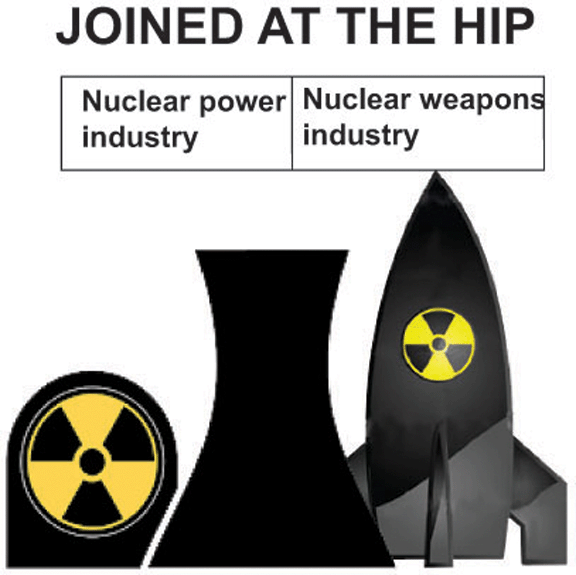 US military eyes nuclear thermal rocket for missions in Earth-moon space, Space.com, By Mike Wall 1 Oct 20,
DARPA awarded a $14 million task order to help make it happen. The U.S. military aims to get a nuclear thermal rocket up and running, to boost its ability to monitor the goings-on in Earth-moon space.
The Defense Advanced Research Projects Agency (DARPA) just awarded a $14 million task order to Gryphon Technologies, a company in Washington, D.C., that provides engineering and technical solutions to national security organizations.
The money will support DARPA’s Demonstration Rocket for Agile Cislunar Operations (DRACO) program, whose main goal is to demonstrate a nuclear thermal propulsion (NTP) system in Earth orbit. ……. https://www.space.com/darpa-nuclear-thermal-rocket-for-moon-contract
Trump with Covid-19 – a potential power vacuum. E-6B Mercury nuclear war command posts in flight on each coast
Covid 19 coronavirus: Why ‘doomsday’ nuclear planes have taken to the skies in the US, https://www.nzherald.co.nz/world/news/article.cfm?c_id=2&objectid=12369993 By: Jamie Seidel, 2 Oct 20, America’s doomsday planes are in the air following news that the nation’s commander-in-chief, President Donald Trump, has Covid-19.
 Two US Navy E-6B Mercury nuclear war command posts were observed in flight Friday, one on each coast of the United States. They were initiating the “Take Charge and Move Out” (TACAMO) defence protocol – essentially dispersing the command and communications facilities needed to control the US nuclear arsenal.
These aircraft are activated by the Pentagon when it is deemed necessary to communicate with the US Navy’s secretive nuclear missile submarines, stealth bombers and missile silos.
The move underscores the potential severity of the situation.
The President of the United States is also the commander-in-chief of the nation’s armed forces, including its nuclear forces. The incapacitation of whoever holds this position could be seen as an opportunity by potential belligerents.
Covid-19, which has so far killed 200,000 US citizens, is particularly deadly among older sufferers. President Trump is 74 years old.
It was announced this morning that he is already experiencing “mild symptoms”.
The two E-6Bs appeared on flight tracking systems 30 minutes before Trump announced his condition.
It’s no accident the aircraft were seen.
Military aircraft and ships usually fly with their radio identification transponders turned off in order to avoid being tracked and identified.
 Doomsday Planes
Based on Boeing 707 airliner airframes, the E-6B aircraft have been built to be particularly resistant to electronic warfare and the electromagnetic-pulse generated by nuclear bursts.
About 16 of the aircraft were delivered from 1986. The fleet underwent a major upgrade in 2006.
Their job is to get into the air in the time of crisis. But an unknown number is also maintained aloft at any one time.
In the event of war, their job is to relay commands from the president and defense secretary directly to the deterrent nuclear force. The heart of this force are the Ohio-class nuclear ballistic-missile submarines hiding deep in the world’s oceans. Their immense payloads of nuclear missiles constantly threaten the prospect of a devastating retaliatory blow.
I would expect them to pop up if he tests positive,” US open-source intelligence hobbyist Tim Hogan tweeted with flight tracking maps identifying the flights.
“It’s the plane that has the ability to order the killing of everyone on earth if someone attacks the US with nukes in a first strike. It can talk to our missile subs under water even if DC is gone.”
Talking to submarines deep underwater is no easy task.
Very Low Frequency (VLF) radio can reach about 20m beneath the ocean’s surface. But its transmission speed is very slow and require large, high powered emitters for broadcast. In order to operate this equipment, the E-6B must unspool a kilometres-long wire to act as an aerial.
Command and Control
The US Constitution deals with the prospect of a president who is physically or mentally unable to discharge his duties. The role “shall devolve on the vice president”, it states.
What it doesn’t make clear is how the judgement to “devolve” should be made, or by whom.
The 25th Amendment, enacted in 1967, is supposed to provide a framework for this decision. But it was not initiated in 1981 when President Ronald Reagan was shot. For 10 days Reagan lay near death. But his key powers were not transferred to Vice President George H. W. Bush.
This has raised further questions about how presidential powers would be divested in an emergency. The 25th Amendment calls for a signed statement from the serving President, or if “the vice president and a majority of either the principal officers of the executive departments or of such other body as Congress may by law provide” a similar statement.
The resulting power vacuum, especially in the role of US Commander-in-Chief, potentially poses a strategic risk in times of international – and internal – crisis.
As Donald Trump gets coronavirus, USA’s ”doomsday” planes take flight
 Donald Trump Tests Positive For COVID—And America’s Nuclear Doomsday Planes Launch Controversy, Forbes,
David AxeContributor 2 Sept 20, U.S. president Donald Trump tested positive for the novel-
coronavirus on Friday morning. Shortly before the news broke, the U.S. Navy’s doomsday planes launched on both American coasts.
Some observers asserted that the two things were related. But military spokespeople and some experts explained it was coincidence.
The Navy has 16 Mercuries. One often is in the air, and it’s not unheard-of for two or more to be airborne at the same time. But the timing of Friday’s twin sorties seemed noteworthy to some.
In an atomic war, the E-6s would relay orders to the Ohio boomers, helping the boats’ crews to target enemy cities and military bases with nuclear-tipped Trident submarine-launched ballistic missiles, or SLBMs.
It could be no accident that E-6s were airborne over both coasts in the minutes before Trump’s announcement that he was infected, tweeted Tim Hogan, an American open-source intelligence practitioner. “I would expect them to pop up if he tests positive.”………. https://www.forbes.com/sites/davidaxe/2020/10/02/donald-trump-tests-positive-for-covid-and-americas-nuclear-doomsday-planes-launch/#3022db8658ba
Ionising radiation – the tragedy of the ”radium girls”.

They weren’t just making paints, they were doing the painting, too. According to NPR, US Radium hired scores of girls and young women — as young as just 11-years-old — to paint watch dials with the glow-in-the-dark, radium-based paint. As if just working with the paint wasn’t bad enough, they were also encouraged to put the brush between their lips and twirl it into a point. It was the best way to get truly precise numbers and brush strokes, but with each lick of the brush, they were swallowing radium.
the human body isn’t great at telling the difference between radium and calcium. Radium gets absorbed into the bones just like calcium does, and when that happens, the rot starts.
Writer and historian Kate Moore documented the cases of the Radium Girls (via The Spectator) and found that there were a whole host of symptoms. Some started suffering from chronic exhaustion. For many, it started with their teeth — one by one, those teeth would start to decay and rot. When they were removed, their gums wouldn’t heal. In some cases, the jaw would just simply disintegrate at the dentist’s touch. Bad breath was common. Skin became so delicate that the slightest touch would tear open wounds. Ulcers formed for some, and those that were pregnant bore stillborn babies.
THE RADIUM GIRLS HAD TO BE BURIED IN LEAD-LINED COFFINS
The Radium Girls weren’t just sick, they were very literally radioactive. Mollie Maggia was exhumed in 1927, in the hopes that her bones would give still-living Radium Girls the evidence they needed to win in court. According to Popular Science, her coffin was lifted out of the ground, and her body? It glowed. That wasn’t entirely surprising, considering her bones were found to be highly radioactive — and considering radium’s half-life is 1,600 years, they’re not going to stop glowing any time soon.
Eventually, 16 separate sites around Ottawa would be classified as Superfund sites.
NPR Illinois says that many have been cleaned up, but as of 2018, there was at least one site — a 17-acre plot of land on the Fox River — that still remained a highly radioactive and terrifying legacy of the Radium Girls.
THE MESSED UP TRUTH ABOUT THE RADIUM GIRLS https://www.grunge.com/181092/the-messed-up-truth-about-the-radium-girls/ BY DEBRA KELLY/DEC. JULY 14, 2020
History is filled with episodes that prove mankind is just sort of making everything up as it goes. There’s no shortage of things that can kill us or do horrible, terrible things to our soft and squishy bodies, and every time we think we know about them all, it turns out there’s something else lurking around the corner.
And sometimes, it’s disguised as something awesome. Need proof? Look no further than the Radium Girls.
Yes, that radium. Today, the Royal Society of Chemistry says there’s really only one use for radium — targeted cancer treatments, because it’s so good at killing cells. It was first discovered in 1898 by Marie and Pierre Curie, after they extracted a single milligram from ten tons of a uranium ore called pitchblende. And it was pretty darn cool. It glowed, and seriously, how exciting is that? Unfortunately, it was also deadly — as the so-called Radium Girls would find out.
The road to fascism. Trump is quite open about his plans to derail the election
 Trump Isn’t Keeping His Fascist Plan Secret. He’s Trying to Derail the Election. David Renton, Truthout,
  October 1, 2020
In the 1930s, when a New York publishing company was thinking of bringing out an unexpurgated English-language edition of Hitler’s Mein Kampf, its editors first approached the radicals of New York’s New School for Social Research, who assembled a specialist team of anti-fascist German refugees to do the translation. Why would the refugees do that — one might think — hadn’t they suffered enough? But the translators agreed readily. They wanted the world to know what Hitler was thinking, to take his ideas seriously, to grasp how different his politics was from the “normal” right-wing politics that had come before.
We should look at Trump’s comments in Tuesday’s presidential debate in the same spirit and take them as seriously as he does. We should think about the exchange when Trump was asked, “What are you prepared to do to reassure the American people that the next president will be the legitimate winner of this election?”
He answered, “Don’t tell me about a free transition…. We won’t know. We might not know for months because these ballots are going to be all over.”
Trump wasn’t saying he would reject an election that Biden won. Rather, he was threatening to use the office of the president to prevent there from being a decisive outcome against him………
In-person votes will be counted first. So, even if by the time all postal votes have been counted, Biden can be shown to have won by, say, seven or more clear percentage points, Trump may be ahead on election night.
It’s much easier to challenge postal votes than it is to challenge in-person votes. What if the security envelopes are marked, or there are no security envelopes at all? What if the envelope arrives but the postmark is almost invisible? Trump wants Republican vote counters to object to every postal vote they can, raising the natural 1 or 2 percent rejection rate to more like 30 or 40 percent.
If that happens, then we may never get to the point where anyone can say with any clarity that Biden did in fact win by seven clear points, because state after state is going to be bogged down in partisan recounts………
For one thing, Trump is calling on his supporters to attend the polls in person and “watch” (by which he likely means “demonstrate”). “I’m urging my supporters to go into the polls and watch very carefully,” he said. “They’re called poll watchers, a very safe, very nice thing.”
There’s a long and honorable tradition of neutral observers traveling to watch disputed elections in semi-democratic states. That’s not what Trump is getting at. He’s not planning to mobilize neutrals; he’s calling out his own base.
A model for this kind of behavior happened in Fairfax, Virginia, where, in September, a group of Trump supporters walked into the polling place waving flags and shouting, “Four more years.” So powerful is the megaphone of Trump’s Twitter account with its 86 million followers that we should see this as a real threat……..
Finally, Trump signaled at the debate to his armed supporters that if the election does go the way of Florida in 2000, he expects them to play their part in backing him. It’s in that context that Trump’s “stand by” order was given to the Proud Boys……..
In turning to his street supporters, Trump is calling on people who feel no doubts about using violence. For since 2016, attacks on left-wing demonstrators have become ever more frequent. The best known remains the killing of anti-fascist protester Heather Heyer at Charlottesville, when James Alex Fields Jr. drove his car at protesters after being photographed earlier brandishing a shield with Mussolini’s fasces symbol, complete with an executioner’s axe.
Since late May, more than 100 white supremacists have attempted to disperse anti-racist protests by driving their cars at demonstrators.
At the heart of Trump’s plan is the idea of using crowds of hostile people to bring the election counts to a halt, to so foul up the reality of which votes went to which candidate that no one could say any longer what was fake and what was real.
However, massive voter turnout — particularly in-person voting — could thwart Trump’s plan. …….. https://truthout.org/articles/trump-isnt-keeping-his-fascist-plan-secret-hes-trying-to-derail-the-election/?eType=EmailBlastContent&eId=0018d1e1-82a8-4f1e-91cf-32ac2c3010b2
U.S. election: Progressive groups are mobilizing to de-escalate far right violence at the polls
 Progressive Groups Are Mobilizing to De-Escalate Far Right Violence at the Polls, Ella Fassler, Truthout, October 1, 2020 In preparation for potential voter intimidation this year, the Women’s March, Working Families Party, Movement for Black Lives Electoral Justice Project, United We Dream and other organizations are mobilizing “election defenders” to de-escalate tense situations as well as provide voters with personal protective equipment and water on Election Day.
“So far, more than 6,000 people across the country have signed up to be election defenders,” Working Families Party National Director Maurice Mitchell told Truthout. “Trump is operating from a place of weakness, not strength, and the single best way to avoid a contested election is for voters to repudiate him at the polls by an overwhelming margin.
Mobilization efforts are likely to ramp up following Trump’s call-to-action during the first presidential debate on Tuesday. “I’m urging my supporters to go in to the polls and watch very carefully, because that’s what has to happen,” he said at the debate. “I am urging them to do it.” In addition Trump told the far right paramilitary group the Proud Boys, who have said on tape “Hitler did nothing wrong,” to “stand back and stand by.”
Already, roughly 20 Trump supporters had descended on a polling booth in Fairfax, Virginia, intimidating early voters and election staff. The demonstrators gathered from a “Trump Train” parade, according to The New York Times; some chanting “Four more years, four more years!” and holding Trump flags, while others drove circles around the voters. Election officials provided escorts for voters and moved the line indoors……..
Truthout contributor Mark Bray, an author and historian of human rights, terrorism and fascist movements, says we can’t treat this election as any other. Bray tweeted: “Trump has articulated his plan to mobilize fascists for voter intimidation, reject the outcome of the election, and hold on to power (while not denouncing white supremacy). If he and his followers won’t recognize the vote, then ‘just vote’ is a woefully insufficient response.”
There’s a strong precedent for statements like Trump’s, which sow deep distrust in the electoral process……….
Whether Trump’s supporters will disrupt polls on a wide scale this time around remains to be seen. But, from Trump’s “joking” about holding power beyond his term limit, to enfeebling the integrity of mail-in ballots without evidence, it’s clear that voter intimidation may be the tip of the iceberg of what’s to come. https://truthout.org/articles/progressive-groups-are-mobilizing-to-de-escalate-far-right-violence-at-the-polls/?eType=EmailBlastContent&eId=0018d1e1-82a8-4f1e-91cf-32ac2c3010b2
Joe Biden on climate change
What a Joe Biden presidency would mean for five key science issues. The coronavirus pandemic, climate change and space exploration are among the issues that Biden will influence if he wins the upcoming US election. Nature, Amy Maxmen, Nidhi Subbaraman, Jeff Tollefson, Giuliana Viglione & Alexandra Witze, 2 Oct 20,
If Biden wins the election on 3 November, he will inherit not only a country in the throes of a pandemic that’s destroyed lives and livelihoods — but also one in which public opinion is deeply divided over the true extent of the coronavirus outbreak and the measures taken to abate it. Despite public-health agencies counting more than 200,000 COVID-19 deaths in the country, some Trump supporters feel that the impact of the virus has been exaggerated in an effort to control the populace.
Biden would also inherit a haphazard pandemic response, researchers say ……….. Biden’s pandemic plans — which his team has been preparing since March, say sources close to the campaign — promise to ramp up the country’s test-and-trace programmes; address racial and ethnic disparities in COVID-19 infection rates and outcomes; and rebuild pandemic-readiness programmes cut by the Trump administration……… The Biden team will need to change the public-health messaging so that it supports the science without driving sceptics even further away,……
If Biden wins, his administration will have to tackle public mistrust of the federal agencies leading the US response to curtail the pandemic. …….
If elected, Biden has committed to supporting the World Health Organization (WHO), which Trump began to withdraw the United States from in July. …….
Climate change
The coronavirus pandemic isn’t the only divisive issue that Biden would face if elected — he would also be confronting climate change. Trump has moved to pull the United States out of the 2015 Paris climate treaty, rolled back a suite of regulations intended to reduce greenhouse-gas regulations and called global warming a hoax.
In contrast, Biden is now campaigning on the most aggressive climate platform ever advanced by a US presidential nominee in the general election. Addressing the demands of an increasingly vocal liberal base, his US$2-trillion plan calls for massive investments in clean-energy research and development and low-carbon infrastructure, such as public transit and energy-efficient buildings. It also calls for the United States to generate 100% clean electricity by 2035 and to produce “net-zero emissions” by 2050. The question facing Biden and his team, if they win in November, is how to make it happen.
Biden has said he will have the United States rejoin the Paris climate accord, making the country an active partner of the more than 190 nations that have committed to limiting global warming to 1.5–2 oC above pre-industrial levels. He would also appoint climate-friendly leadership at the Environmental Protection Agency and quickly move to restore — or even bolster — climate and environmental regulations rolled back under Trump over the past four years. It could take a few years to finalize those changes, but Biden could do so with existing authority under federal law…… https://www.nature.com/articles/d41586-020-02786-4
-
Archives
- October 2026 (120)
- September 2026 (339)
- August 2026 (330)
- July 2026 (355)
- June 2026 (287)
- May 2026 (306)
- April 2026 (356)
- March 2026 (251)
- February 2026 (267)
- January 2026 (308)
- December 2025 (358)
- November 2025 (359)
-
Categories
- 1
- 1 NUCLEAR ISSUES
- business and costs
- climate change
- culture and arts
- ENERGY
- environment
- health
- history
- indigenous issues
- Legal
- marketing of nuclear
- media
- opposition to nuclear
- PERSONAL STORIES
- politics
- politics international
- Religion and ethics
- safety
- secrets,lies and civil liberties
- spinbuster
- technology
- Uranium
- wastes
- weapons and war
- Women
- 2 WORLD
- ACTION
- AFRICA
- Atrocities
- AUSTRALIA
- Christina's notes
- Christina's themes
- culture and arts
- Events
- Fuk 2022
- Fuk 2023
- Fukushima 2017
- Fukushima 2018
- fukushima 2019
- Fukushima 2020
- Fukushima 2021
- general
- global warming
- Humour (God we need it)
- Nuclear
- RARE EARTHS
- Reference
- resources – print
- Resources -audiovicual
- Weekly Newsletter
- World
- World Nuclear
- YouTube
-
RSS
Entries RSS
Comments RSS

