U.S. election – possibility of armed factions with military-style rifles showing up at polling places
 Will Trump’s Call for Poll-Watchers Bring Paramilitaries to the Voting Booth?
  TruthOut, BYKenny Stancil, Common Dreams, October 11, 2020
Two weeks after Donald Trump Jr. took to social media in an attempt to recruit an “army for Trump’s election security,” and with early voting already underway, Republicans this week have begun dispatching thousands of volunteers to in-person voting locations and mail-in ballot drop boxes, part of a desperate “effort to find evidence to back up Trump’s unsubstantiated complaints about widespread voter fraud,” Reuters reported Thursday.
According to more than 20 officials involved in the effort, “the mission… is to capture photos and videos Republicans can use to support so-far unfounded claims that mail voting is riddled with chicanery, and to help their case if legal disputes erupt over the results of… the contest between Republican incumbent Trump and his Democratic opponent Joe Biden.”
But critics of the Trump campaign’s operation — which revolves around baseless presumptions of fraudulent electoral activity committed by supporters of Democratic candidates — argued that the president’s “call for his supporters to serve as self-appointed” poll-watchers “sounded more like an incitement to voter intimidation and violence than an endorsement of the role election observers play in protecting democratic norms.”
Given the White House’s alarming normalization of violence against political foes, voting rights experts, civic officials, and citizens are increasingly concerned about the negative consequences that could ensue if tensions escalate and the president’s most militant supporters — white nationalist gangs, so-called “patriots” donning Confederate and Nazi regalia, and other heavily armed pro-Trump factions — follow his authoritarian cues.
Steven Gardiner, a scholar at the progressive think tank Political Research Associates, told The Guardian on Friday that “the militias will absolutely seize on” Trump’s comments.
“The possibility of armed factions with military-style rifles showing up at polling places is very troubling,” Gardiner added……..
As Common Dreams reported on Thursday amid the revelation that 13 suspects had been arrested on kidnapping and terrorism charges after law enforcement officials foiled a right-wing plot to attack the Michigan State Capitol and hold Gov. Whitmer hostage, many observers have made connections between Trump’s demagogic rhetoric and his followers’ violent actions.
“I wonder where they got their motivation from,” Rep. Rashida Tlaib (D-Mich.) noted sarcastically on social media, referring to an incendiary message Trump shared in April — during the height of anti-lockdown protests in the state — to “Liberate Michigan!”
“This is a pattern: Trump paints a target. An attack or plot follows,” tweeted Washington Post national security correspondent Greg Miller.
Gardiner told The Guardian that “the relationship between the militias and the current administration is call and response.”
“It’s not always clear who’s leading the chant,” he added. “Sometimes it’s coming from the militias, sometimes it’s coming from the president.”
Another worrisome development is that gun sales nearly doubled between summer 2019 and 2020, meaning that the U.S. is further arming itself with “deadly weaponry [that] is increasingly finding its way onto the streets, borne by self-styled private militias, and culminating in violent clashes that have caused bloodshed in several U.S. cities,” as The Guardian explained.
The New York Times estimated last month that the number of active militia members hovers around 20,000 people in 300 groups, with military veterans constituting one-fourth of those. But a new investigation by The Atlantic magazine into the Oath Keepers, one of the most prominent far-right paramilitary groups, revealed a list of nearly 25,000 current or former members, two-thirds of whom had military or law enforcement backgrounds, suggesting that the number of Americans with ties to extremist factions is larger.
As Common Dreams reported last month, armed white supremacists pose the greatest domestic terrorism threat in the U.S., according to the FBI, despite efforts by the Trump administration to downplay the risks associated with right-wing militias. ………..
Rivas explained that “militia groups such as the Montana branch of the United States Freedom Protectors were positioning themselves to be vigilante outriders of law enforcement on Election Day,” and that “the possibility of interventions by armed members of the group had to be taken seriously.”
“They present themselves as protectors of property and law and order, and are now starting to talk about the election,” Rivas said. “They may show up at polling places claiming to want to protect voting rights, but their impact will clearly be intimidatory.”……….
Rivas stressed that the threat of voter intimidation “really is top down.” Far-right paramilitary groups “are repeating word for word what they hear from President Trump,” she said. https://truthout.org/articles/will-trumps-call-for-poll-watchers-bring-paramilitaries-to-the-voting-booth/?eType=EmailBlastContent&eId=614ce999-9844-4d61-a600-169db0c99052
Trump’s psychopathology a threat to US democracy and to global stability.
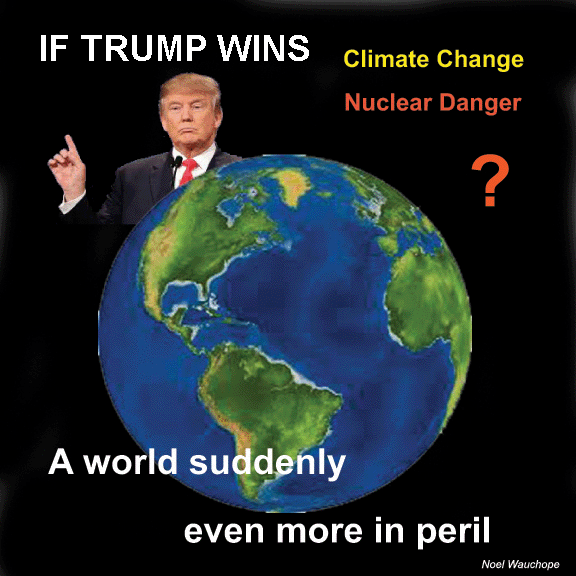 There’s one headline about Donald Trump that has not been printed but makes the most sense of all, https://www.smh.com.au/world/north-america/there-s-one-headline-about-donald-trump-that-has-not-been-printed-but-makes-the-most-sense-of-all-20201008-p563b7.html By Ian Hughes and Alan D. Blotcky, October 11, 2020 For almost four years, there has hardly been a day that Donald Trump has not made front-page news. The unrelenting avalanche of lies and norm-shattering behaviour that Trump has unleashed has presented the mainstream media with an unprecedented challenge. It is a challenge that the media has struggled to meet, largely because of the ethical and practical difficulties that journalists face in dealing with Trump’s mental pathology.Even before his election, mental health professionals were warning that Trump’s psychopathology posed a threat to US democracy and to global stability. After his election, dozens of mental health experts collaborated on the book The Dangerous Case of Donald Trump which became a New York Times bestseller. Over the past three or four months, the number of voices expressing alarm at Trump’s pathology has been growing. There’s one headline about Donald Trump that has not been printed but makes the most sense of all, https://www.smh.com.au/world/north-america/there-s-one-headline-about-donald-trump-that-has-not-been-printed-but-makes-the-most-sense-of-all-20201008-p563b7.html By Ian Hughes and Alan D. Blotcky, October 11, 2020 For almost four years, there has hardly been a day that Donald Trump has not made front-page news. The unrelenting avalanche of lies and norm-shattering behaviour that Trump has unleashed has presented the mainstream media with an unprecedented challenge. It is a challenge that the media has struggled to meet, largely because of the ethical and practical difficulties that journalists face in dealing with Trump’s mental pathology.Even before his election, mental health professionals were warning that Trump’s psychopathology posed a threat to US democracy and to global stability. After his election, dozens of mental health experts collaborated on the book The Dangerous Case of Donald Trump which became a New York Times bestseller. Over the past three or four months, the number of voices expressing alarm at Trump’s pathology has been growing.
The media, however, has largely continued to cover Trump’s actions one story at a time, without joining up the dots and accurately describing his pathology. Of all the thousands of headlines, there is one headline that has not been printed but that makes the most sense of all: “Donald Trump suffers from a dangerous incurable narcissistic disorder which makes him incapable of empathy or reason. He is a grave danger to the US and the world.” The failure of the media to emphasise this obvious fact is a lost opportunity to inform and educate the public so that Trump’s pathology is fully appreciated and understood. As mental health professionals know, Trump’s mental disorder manifests itself in a wide variety of behaviours and not in isolated or disconnected events. In these dangerous times, the challenge for the media, difficult though it is, should be to explain Trump’s pathology in all its complexities and ramifications for the public. To illustrate this, consider three separate headlines from the past few days. “The President’s taxes: Long-concealed records show Trump’s chronic losses and years of tax avoidance”, The New York Times, September 27, 2020. Pathological narcissists have a “false self” that they try to maintain at all cost. Trump’s “false self” is that he is smarter and richer and stronger and better looking than anyone else. Anything that undermines or contradicts his “false self” is aggressively defended against. Donald Trump has actively refused to share his federal tax returns with the American people in order to defend this “false self”. He has not wanted to reveal his losses, his fraud, and, perhaps, even his underhanded connections to Russia. The projection of his “false self” is the ultimate lie of a narcissist. Trump’s thousands of lies all join up as a defence against the truth of his true persona as a business failure. “Donald Trump ensures first presidential debate is national humiliation”, The Guardian, September 30, 2020. Donald Trump’s narcissistic pathology did not allow him to engage in reasonable and rational debate with Joe Biden. He is incapable of rational, orderly, and thoughtful discourse, and is compelled and guided instead by his internal needs, wants, and desires. In addition, Trump is increasingly desperate because he knows his poll numbers are dropping. As a narcissist, his reflexive response when his grandiose self- image is threatened is to attack and to bully. Over the past few months, Trump’s pathological response to the threat of failure has been in plain view: wild accusations, lies, scapegoating, conspiracy theories, and gaslighting. His unpresidential debate performance was an extension of this pathological behaviour. “Trump’s reckless joyride tops Bible-holding photo op in Washington”, The Sydney Morning Herald, October 5, 2020 Trump is unable to function without constant praise and adulation. This is the opposite of strength. Pathological narcissists need frequent affirmation to fill up their hollow shells. They need constant confirmation that their “false self” is indeed true – when it is not. With no internal capacity for maintaining a true and authentic identity, Trump is totally dependent on external adulation to function. His neediness now is on full display. In the space of a single week, Trump has exhibited three of the defining features of narcissistic personality disorder – sociopathy in defence of a “false self”, disordered thinking that renders him incapable of reason, and a constant need for adulation. Every headline on this president has spotlighted one or other aspect of his narcissistically disordered mind. The evidence about Trump is overwhelming. A free press is one of the central pillars of a democracy. Its role is to be a watchdog on our political leaders and to inform the public. The media can play a vital role in engaging with the alarming reality of Trump’s pathology, despite the difficulties in doing so. . Donald Trump is part of a much larger picture. Individuals with dangerous personalities have risen to the highest ranks of power throughout modern history – from Nixon to Mao, Stalin to Pol Pot. Some have played a crucial role in steering our world towards disaster. A widespread understanding of this basic fact has now become essential for the protection of democracy. Ian Hughes is the author of Disordered Minds: How Dangerous Personality Disorders Are Destroying Democracy and contributing author to The Dangerous Case of Donald Trump. He is a Senior Research Fellow at the MaREI Centre at University College Cork in Ireland. Alan D. Blotcky is a clinical psychologist in private practice in Birmingham, Alabama |
|
Trump hoping to conclude nuclear arms deal with Russia before Election Day
|
Trump aiming for nuclear arms deal with Russia before Election Day. Axios Dave Lawler, author of World, 9 Oct 20, The Trump administration is pushing to get a nuclear arms control agreement with Russia ready for President Trump and Vladimir Putin to apply their signatures before Election Day. Where things stand: The U.S. believes the prospective deal has buy-in from Putin — who has discussed arms control on a series of phone calls with Trump — and could be negotiated in as little as a week, according to a source familiar with the discussions.
The big picture: Election day is not the only deadline driving this process. New START, the last major bilateral treaty limiting the nuclear arsenals of the U.S. and Russia, is due to expire on Feb. 5.
The stakes: Russia knows that if Trump loses, it can expect Biden to agree to an extension shortly after taking office on Jan. 20.
The latest: That deadlock may have broken following a meeting in Geneva last Friday between National Security Adviser Robert O’Brien and his Russian counterpart, Nikolai Patrushev……….. https://www.axios.com/trump-russia-nuclear-arms-agreement-new-start-4fe42c37-83e0-4088-aa26-b37f8a07bf7f.html |
|
|
Trump’s false claim about the Green New Deal
|
Independent 10th Oct 2020, Donald Trump falsely claimed that the Green New Deal would require “tiny little windows”, during a rambling interview with Fox News host Sean Hannity on Thursday. “I mean, they literally want to take buildings down and rebuild them with tiny little windows, OK, little windows, so you can’t see out, you can’t see the light,” the president said.https://www.independent.co.uk/environment/trump-green-new-deal-hannity-windows-climate-change-b918754.html |
|
Greta Thunberg: ‘Get everyone to vote for Joe Biden’
Greta Thunberg: ‘Get everyone to vote for Joe Biden’ The New Daily, 11 Oct 20, Teen climate crusader Greta Thunberg is still too young to vote, but she knows presidential candidate Joe Biden has made the future of the planet his running-mate in the upcoming US election.
The Swedish 17-year-old said in a tweet that she never engages in party politics, but “the upcoming US elections is above and beyond all that”.
“From a climate perspective it’s very far from enough and many of you of course supported other candidates. But, I mean … you know … damn! Just get organized and get everyone to vote #Biden,” she wrote.
Thunberg, who sparked a global climate protest movement after striking outside the Swedish parliament in 2018, could encourage participation among younger voters typically less likely to vote than older Americans.
After Thunberg was named Time‘s Person of the Year in 2019, US President Donald Trump mocked the teen activist………
Trump has focused on dismantling former US President Barack Obama’s climate agenda to free the energy and auto industries from the costs of regulations meant to protect health and the environment, while Biden has a focus on a new massive green infrastructure. https://thenewdaily.com.au/life/science/environment/2020/10/11/greta-thunberg-get-everyone-to-vote-for-joe-biden/
U.S. and Russian negotiators try tosalvage arms control pact
their nuclear warhead stockpiles in a bid to salvage their last remaining
arms control pact before it expires next year, a source has said.
https://www.thenational.scot/news/18785398.us-russia-agree-freeze-nuke-stockpile/
The world’s climate future – much depends on America’s presidential election
|
As we approach planetary tipping points, it’s vital to understand the two candidates’ plans—or lack thereof (Trump doesn’t have one)—for combatting climate change. Fast Company, 9 Oct 20, BY ADELE PETERS Whether the world succeeds in avoiding the worst impacts of climate change is likely to hinge in part on the results of the upcoming U.S. election. Climate scientist Michael Mann has said that a second Trump term would be “game over” for the climate, making it virtually impossible to limit global warming to 1.5 degrees Celsius. Biden, by contrast, is proposing the most ambitious climate policy of any major party nominee in U.S. history. Here’s a closer look at the differences. TRUMP: “IT WILL START GETTING COOLER”
The first major difference: Trump doesn’t accept the science of climate change or even necessarily seem to understand what “climate change” means. On a September visit to California, where heat and drought driven by climate change have helped fuel record-breaking fires, Trump said, “It will start getting cooler.” (He has previously called climate change a “con,” “hoax,” and claimed that it was invented by China.) At the first presidential debate, when asked about climate change, Trump started talking about clean air and water, and then claimed “we have now the lowest carbon.” (In fact, carbon dioxide levels in the atmosphere are now the highest that they have been in 15 million years.)
Through his first term, Trump has actively moved the country in the wrong direction on climate. “Across the board, the Trump administration has rolled or attempted to roll back all of the significant steps that the previous administration took under the Clean Air Act and other laws to reduce the carbon pollution and the other pollutants that are driving dangerous climate change,” says David Doniger, a senior advisor to the NRDC Action Fund, a political affiliate organization of the Natural Resources Defense Council. The administration weakened fuel economy standards, eliminated the Clean Power Plan, and weakened standards for emissions from the oil and gas industry. ……..
Trump’s campaign website says nothing about a plan for climate change. The Republican platform, recycled from 2016, says that climate change is “the triumph of extremism over common sense,” even though military experts have identified climate change as a national security threat and thousands of scientists have warned that we’re facing a climate emergency. To actually tackle climate change, the federal government would need to do far more, and a second Trump term would delay that action as the window of opportunity is closing………..
BIDEN: THE MOST AMBITIOUS CLIMATE POLICY OF ANY MAJOR PARTY NOMINEE
Biden, by contrast, has proposed investing $2 trillion to set us “on an irreversible course to meet the ambitious climate progress that science demands,” with a target of net-zero emissions by 2050. By 2035, he wants to decarbonize the electric grid. “This is more ambitious than the most ambitious states in the country,” says Stokes. (California and Hawaii are aiming for 100% clean electricity by 2045; New York is aiming for 2040.) The work on the electric grid would create millions of jobs. Retrofitting buildings to improve energy efficiency would create another million jobs. Ramping up the electric vehicle industry, and infrastructure like charging stations, would create a million more jobs. The plan also calls for “high-quality, zero-emissions” public transit for every large city, “climate-smart” agriculture, cleaning up pollution from the oil and gas industry, and the construction of 1.5 million sustainable homes and housing units. All of this would be done through the lens of environmental justice, ensuring that communities that have been hardest hit by pollution in the past see the benefits.
Though Biden has said that his plan is different from the Green New Deal, a resolution sponsored by Alexandria Ocasio-Cortez, the core principle is the same—creating jobs and fostering equity while reducing emissions. …..
The scope of the plan has to be massive because the country has waited so long to act; the changes could have been much more gradual if we had started 25 years ago. “We’re in a tough spot now,” Doniger says. “If Biden is elected, there’s a need for very deep reductions very fast.” Still, the vast scope of work means creating millions of jobs at a moment when the country also needs to invest in economic recovery.
If Biden wins—and, crucially, if Democrats also control Congress—it’s possible that the world could still avoid the worst impacts of climate change while addressing the recovery. “We’re going to need a very big recovery package, probably a lot bigger than the one from 2009,” Doniger says. “There’s a huge opportunity to build into that infrastructure spending for the transition to clean energy and low emissions that we need, and to do it in a way that invests in communities that have been underserved and beset by pollution.” https://www.fastcompany.com/90560969/the-2020-presidential-election-will-decide-the-fate-of-the-climate
|
|
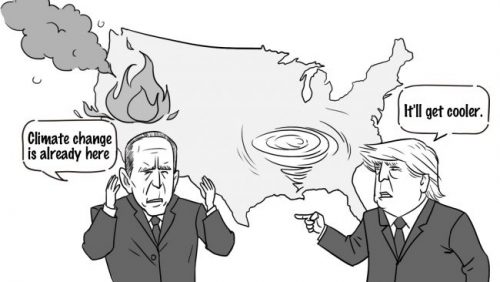
Trump’s harsh approach on Iran. Biden firm, but more conciliatory
 Trump and Biden propose different paths for taking on Iran and its nuclear ambitions, by Stephen Loiaconi, Saturday, October 10th 2020 WASHINGTON (SBG) — With less than four weeks until Election Day, President Donald Trump is escalating a maximum pressure campaign against Iran that he has claimed will produce swift results if he is reelected, but some experts on the region do not share his confidence.
The White House’s latest actions appear intended to set up a second-term drive to corner the Iranian regime into accepting stiffer restrictions on its nuclear program and other activities or face economic collapse. President Trump’s Democratic opponent, former Vice President Joe Biden, has promised a more conciliatory approach that harkens back to the diplomatic engagement he fostered during the Obama administration.
“What the U.S. has now done, it has said essentially, if you are dealing with this Iranian bank, you’re going to be sanctioned and you’re going to have to pay fines,” said Hossein Askari, a professor emeritus of international affairs at George Washington University.
Iranian President Hassan Rouhani declared the new sanctions “cruel, terrorist and inhumane,” according to state media. Foreign Minister Javad Zarif accused the Trump administration of trying to “blow up our remaining channels to pay for food & medicine.”……..
experts are skeptical humanitarian transactions can continue unimpeded with Iran’s banks blacklisted. Askari, who has acted as a mediator between Iran and Saudi Arabia and Iran and Kuwait, said he knows people in Iran who have been unable to get medication because of existing sanctions, and he fears the hardships will only get worse.
“The people that are going to suffer are the average Iranians because of what the United States is doing right now,” he said……..
Many countries have experienced economic strains because of coronavirus lockdowns, but the damage to Iran’s economy has been compounded by severe U.S. sanctions. Constraints on oil and other exports have limited the country’s ability to restart economic activity.
“These sanctions have now been building up ever since the Trump administration came to office This is an economy in really critical trouble and it’s also an economy that faces major military and defense expenditures,” said Anthony Cordesman, a national security expert at the Center for Strategic and International Studies and former Department of Defense official……….
David Belt, an expert at National Intelligence University, warned in a post for Modern Diplomacy Friday that U.S. sanctions are pushing Iran into a closer relationship with Russia and China. The two countries have veto power on the U.N. Security Council, allowing them to challenge U.S. attempts to step up international pressure on Tehran.
“Necessity is the mother of all invention, and Iran has been forced to look to China and Russia for every national security need to avoid the impact of sanctions…The main rivals of the U.S. are cautiously weighing the costs of an informal economic and security bloc, in part to mitigate the impact of U.S. sanctions and other economic pressures on them as well,” Belt wrote.
The direction of U.S. policy toward Iran is one of many issues on the ballot in November. Trump and Biden have drastically different approaches, and experts are divided on which is more likely to produce results and avert a military conflict neither country wants. ……..
Biden has made clear his top priority for arms control policy is to return to the nuclear deal if Tehran is willing to fall back into compliance with its commitments. He has called for using “hard-nosed diplomacy” to strengthen and extend the agreement while challenging Iran’s destabilizing activities on other fronts.
“We have lost our standing in the region,” Biden said during a primary debate in January. “We have lost the support of our allies. The next president has to be able to pull those folks back together, re-establish our alliances, and insist that Iran go back into the agreement, which I believe with the pressure applied as we put on before we can get done.”…………… https://mynbc15.com/news/nation-world/trump-and-biden-propose-different-paths-for-taking-on-irans-nuclear-ambitions
New Zoom link for Oct 11 Festival of Hope, Two to be Sentenced Oct 15, Four Others Continued Until Nov 12 & 13
 New Zoom link for Oct 11 Festival of Hope, Two to be Sentenced Oct 15, Four Others Continued Until Nov 12 & 13 Bill Ofenloch, October 9, 2020/, Kings Bay Plowshares 7, Father Steve Kelly and Patrick O’Neill are scheduled to be sentenced in Brunswick, GA on October 15 & 16 in the early afternoon. It is expected that the two will be combined on October 15. The remaining four defendants, Carmen Trotta, Martha Hennessy, Mark Colville, and Clare Grady, were granted continuances yesterday by Judge Wood to Nov. 12 & 13 because of COVID-19.
The defendants ask, “In the interest of public safety, and out of love for our supporters during this Covid 19 pandemic, the seven Kings Bay Plowshares members request that no one come to Brunswick for the sentencing hearings scheduled for Oct. 15-16. We do, however, encourage you all to join the Oct. 11 pre-sentencing Zoom meeting. Thank you all for your love and support, which sustains us.”
There is expected to be an audio link from the court to listen to the proceedings as was done with Liz McAlister in June. The call-in number and times will be posted on the website when we get them.
A virtual Festival of Hope is planned for Sunday, October 11, at 5pm EDT prior to the sentencing of Fr. Steve Kelly and Patrick O’Neill. It will now be hosted on the Code Pink Zoom channel. It will also be on the Code Pink YouTube channel and on the KBP Facebook page. Patrick and several of the defendants will appear. Fr. Steve Kelly will send a message from jail. Marcia Timmel, Susan Crane and Steve Baggarly, plowshares activists, will speak. There will also be a slideshow and music and a blessing.
The new Zoom link:
Climate misinformation advertisements on Facebook, seen by millions

Climate denial ads on Facebook seen by millions, report finds
The ads included calling climate change a hoax and were paid for by conservative US groups, Guardian, Damian Carrington 9 Oct 20, Adverts on Facebook denying the reality of the climate crisis or the need for action were viewed at least 8 million times in the US in the first half of 2020, a thinktank has found.The 51 climate disinformation ads identified included ones stating that climate change is a hoax and that fossil fuels are not an existential threat. The ads were paid for by conservative groups whose sources of funding are opaque, according to a report by InfluenceMap.
Last month Facebook said it was “committed to tackling climate misinformation” as it announced a climate science information centre. It said: “Climate change is real. The science is unambiguous and the need to act grows more urgent by the day.”Facebook uses factcheckers and bans false advertising but also says this process “is not meant to interfere with individual expression, opinions and debate”. Some of the ads were still running on 1 October. The ads cost just $42,000 to run and appear to be highly targeted, with men over the age of 55 in rural US states most likely to see them.
Warren and other senators wrote to Facebook in July calling on it to close the loopholes.
Citizens express opposition to dangerous increased plutonium pit production
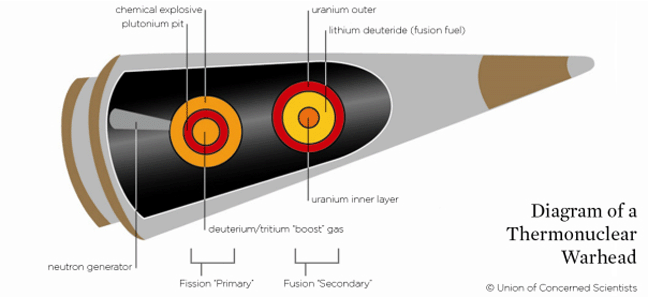
 Citizens’ Hearing Held at New Mexico Capitol about Increased Plutonium Pit Production at LANL, http://nuclearactive.org/
The Pentagon has stated it needs annual production of 80 plutonium pits, the triggers for nuclear weapons. T The DOE has approved its Supplement Analyses for four possible ways to execute thisapproved its Supplement Analyses for four possible ways to execute this.
At LANL, DOE proposes upgrades to both LANL’s Plutonium Facility and the Radiological Laboratory Utility and Office Building which is part of the Chemistry and Metallurgy Research Replacement (CMRR) Project.
Despite a mission that has been re-directed and an expansion involving about $15 billion in upgrades for two major buildings and related infrastructure, DOE has decided not to undertake a new Site-Wide Environmental Impact Statement (SWEIS) for LANL. https://www.energy.gov/nepa/downloads/doeeis-0380-sa-06-final-supplement-analysis and https://www.energy.gov/nepa/downloads/doeeis-0380-amended-record-decision Neither our congressional delegation nor our Governor has voiced disapproval of bypassing the SWEIS.
On Wednesday afternoon, October 7th, a citizens’ hearing was held outside the New Mexico State Capitol Building. Testimony was taken about DOE’s dramatic expansion plans for LANL that involve an installation of the size and importance and with the attendant dangers of the closed nuclear weapons plant at Rocky Flats, Colorado. The event, which provided a place for dozens of citizens to express their opposition to DOE’s plans in Northern New Mexico, was sponsored by the Los Alamos Study Group. http://www.lasg.org/
The DOE proposals are too broad and too expensive to go forward without an SWEIS with public review and comment opportunities.
Every day, new information is released about the increased hazards at LANL. This week the Defense Nuclear Facilities Safety Board issued a new report about the inconsistent and inappropriate consideration of potential energetic chemical reactions, or explosions, involving transuranic waste stored at LANL. The Board conducted an analysis of transuranic, or plutonium-contaminated, wastes stored at the Plutonium Facility, the old Chemistry and Metallurgy Research Facility, the Transuranic Waste Facility, and Area G and the potential for explosions. It found that LANL has not fully analyzed for possible explosions involving transuranic waste stored at these facilities that would result in high exposures to workers and the public. https://www.dnfsb.gov/documents/reports/technical-reports/potential-energetic-chemical-reaction-events-involving
The Board asked DOE to respond within 120 days.
Utah congressman takes action to stop future nuclear weapons testing in U.S.
|
Utah congressman takes action to stop future nuclear weapons testing in U.S. The Daily Universe, By Kaela Cleary, October 9, 2020 With all of the chaos surrounding the U.S. presidential election, word of the Trump administration and Senate Republicans creating legislation to prepare to resume nuclear weapons testing at the Nevada Test Site hasn’t received much public attention.
|
|
USA trying to beat China, in marketing nuclear reactors to Romania
 Romania, U.S. to sign cooperation agreements over nuclear reactors, By Reuters Staff, 9 Oct 20, BUCHAREST (Reuters) – Romania’s economy ministry will sign cooperation and financing agreements with the United States
Trump’s COVID infection shows why it’s time to retire the nuclear football
 Trump’s COVID infection shows why it’s time to retire the nuclear football, Bulletin of the Atomic Scientists , By Tom Z. Collina, October 6, 2020 President John Kennedy took powerful pain medications. President Richard Nixon was a heavy drinker. President Ronald Reagan had dementia. And now President Donald Trump has the coronavirus. These conditions can significantly impair one’s ability to think clearly. And yet, as president, each had—or, in Trump’s case, still has–the unilateral authority to launch US nuclear weapons within minutes.
President Trump is followed 24/7 by a military aide that carries the “football,” the briefcase that holds all he would need to order the immediate launch of up to 1,000 nuclear weapons, more than enough megatonnage to blow the world back into the stone age. He does not need the approval of Congress or the secretary of defense. Shockingly, there are no checks and balances on this ultimate executive power.
President Trump took the nuclear football with him to Walter Reed Medical Center, where he received treatment for COVID-19. According to Trump’s doctor, the president’s blood oxygen levels had dipped. And this, according to independent health experts, can impair decision-making ability. He is taking dexamethasone, which can cause mood swings and “frank psychotic manifestations.” Yet as far as we know, at no point did the president transfer his powers to the vice president, as allowed under the 25th Amendment.
To state the obvious, we should not entrust nuclear launch authority to someone who is not fully lucid. (Reagan transferred authority temporarily before planned surgery, as did President George W. Bush before a medical procedure that required his sedation.) A nuclear crisis can happen at any time, including at the worst possible time. If such a crisis takes place when a president’s thinking is compromised for any reason, the results could be catastrophic. ……..
If the president or his advisors have reason to believe that Trump’s thinking may be compromised, nuclear launch authority should be transferred to the vice president, Mike Pence. If Pence also gets COVID, the football could then be passed to House Speaker Nancy Pelosi, President Pro Tempore of the Senate Chuck Grassley, and the secretaries of State, Treasury and Defense, in that order.
But kicking the football down the line does not solve the problem—and in fact shows why the system is broken. Does anyone really believe that the president pro tem of the Senate or the Treasury Secretary has spent much time preparing for nuclear war? And even if they had prepared, the central dilemma remains: All humans are imperfect, and we should not trust the fate of the world to any one person.
The whole concept of giving the president unilateral nuclear authority is built on the false assumption that Russia might launch a surprise first strike. In fact, Russia has never seriously considered a first strike against the United States for a simple reason: It would be national suicide. Both sides have to assume that an attack would provoke an unacceptable nuclear retaliation. Both nations, and much of the rest of the globe, would be obliterated. Starting such a war would be insanity………
It is time to retire the nuclear football. The only thing standing between us and nuclear holocaust is one man with COVID on heavy meds. That is the plan? Ending sole authority is better than entrusting it to any individual. In a vibrant democracy, no one person should have the unchecked power to destroy the world. https://thebulletin.org/2020/10/trumps-covid-infection-shows-why-its-time-to-retire-the-nuclear-football/
The very costly effort of trying to resuscitate the dying nuclear industry

Nuclear Energy — The High Cost Of A Dying Industry, Clean Technica, October 6th, 2020 by Johnna Crider
Nuclear energy has had a seriously rough year. In an article by OilPrice.com, the author asked a question: “Why is nuclear energy so expensive?” One answer, besides the obvious 2020 curse that was activated when Egyptian authorities opened up 30 ancient wooden coffins in 2019, is that other sources have just gotten much cheaper while nuclear hasn’t……….
As we know, in 2020, the coronavirus pandemic shut down US energy demand, and this added nuclear energy to a long list of energy industries that are begging for taxpayer money — well, in the case of nuclear, even more taxpayer money. And the Trump administration came through for this dying and expensive industry. Back in June, the Department of Energy announced that it would award more than $65 million in nuclear energy research. This would cross-cut technology development, facility access, and infrastructure awards.
PowerTechnology reported that these awards would be for these departments’ nuclear energy programs:
- The Nuclear Energy University Programme
- Nuclear Energy Enabling Technologies
- Nuclear Science User Facilities.
That $65 million will also be poured into 93 advanced nuclear technology projects in 28 states. And the Office of Nuclear Energy, which is part of the US Department of Energy (DOE), has spent more than $800 million on research since 2009. OilPrice noted that the $65 million would probably be “too little, too late for domestic nuclear energy.” CleanTechnica‘s perspective is that nuclear has been long dead and we’re just waiting for the green leaves of the tree (existing power plans) to turn brown (close down). New nuclear is financially hopeless, many times more expensive than renewable energy options even with energy storage costs included.
Global State Of Nuclear Energy
Antony Froggat, who co-authored the report and is a Senior Research Fellow at Chatham House in London, said, “At the same time, COVID-19 puts additional stress on the sector. In economic terms, renewables continue to pull away from nuclear power, over the past decade the cost estimates for utility-scale solar dropped by 89 percent, wind by 70 percent, while nuclear increased by 26 percent.”
Also in the US, force-on-force exercises were suspended. These are simulated terrorist attacks on nuclear power plants that use a mock adversary force to replicate design basis threat characteristics during an attack. These are supposed to help assess and improve readiness in case of an actual terrorist attack on a nuclear reactor.
In Russia and Sweden, control room staff were made to isolate in housing that was located onsite. They lived at their jobs. In Russia, one national operation reported weekly on infections among the nuclear staff. In July, there were a total of 4,500 cases.
Technology Costs
The report compared the costs of solar, onshore wind, and nuclear. The report looked at analyses for the US conducted by Lazard at the end of 2019, which advises on financial matters while managing investment portfolios. This is what they found out in a nutshell:
- Solar PV (crystalline, utility-scale) averaged $40/MWh, compared to $65/MWh in 2015.
- Onshore wind was $41/MWh, compared to $55/MWh in 2015.
- Nuclear is $155/MWh, compared to $117/MWh in 2015.
The report points out that over the past 5 years, the annual Levelized Cost of Energy (LCOE) for nuclear has risen by over 50%. In stark contrast, renewables have become the most inexpensive of any type of power generation. “What is remarkable about these trends is that the costs of renewables continue to fall due to incremental manufacturing and installation improvements, while nuclear, despite over half a century of industrial experience, continue to see costs rising. Nuclear power is now the most expensive form of generation, except for gas peaking plants.”
The report also states that even though Trump’s White House supports nuclear power and coal, both have not thrived at all under his presidency. This is due, the report says, to renewables being cheaper and basic economics. Lazard also assessed that the costs of renewables continue to fall. You can learn more about the nuclear report here.
Whether it’s the curse of 2020 or humans are slowly evolving, we are phasing out of the old and phasing in the new. In the case of energy, it’s renewables, which will benefit not only our planet but the health and well-being of people all across the globe. For now, though, it seems that taxpayers will continue footing nuclear’s expensive high maintenance bills. https://cleantechnica.com/2020/10/06/nuclear-energy-the-high-cost-of-a-dying-industry/
-
Archives
- October 2026 (120)
- September 2026 (339)
- August 2026 (330)
- July 2026 (355)
- June 2026 (287)
- May 2026 (306)
- April 2026 (356)
- March 2026 (251)
- February 2026 (267)
- January 2026 (308)
- December 2025 (358)
- November 2025 (359)
-
Categories
- 1
- 1 NUCLEAR ISSUES
- business and costs
- climate change
- culture and arts
- ENERGY
- environment
- health
- history
- indigenous issues
- Legal
- marketing of nuclear
- media
- opposition to nuclear
- PERSONAL STORIES
- politics
- politics international
- Religion and ethics
- safety
- secrets,lies and civil liberties
- spinbuster
- technology
- Uranium
- wastes
- weapons and war
- Women
- 2 WORLD
- ACTION
- AFRICA
- Atrocities
- AUSTRALIA
- Christina's notes
- Christina's themes
- culture and arts
- Events
- Fuk 2022
- Fuk 2023
- Fukushima 2017
- Fukushima 2018
- fukushima 2019
- Fukushima 2020
- Fukushima 2021
- general
- global warming
- Humour (God we need it)
- Nuclear
- RARE EARTHS
- Reference
- resources – print
- Resources -audiovicual
- Weekly Newsletter
- World
- World Nuclear
- YouTube
-
RSS
Entries RSS
Comments RSS

