On climate: instead of denial or despair, there’s determined resolve
 ATLANTIC PLANET Scylla and Charybdis, Beyond climate denial and despair, The Atlantic, LAWRENCE
  WESCHLER 16 Oct 20 ”……………………..There is only one truly serious political problem facing all of us today, and that is climate change. Judging whether or not the human prospect on our planet is worth saving is the fundamental question confronting Americans in particular these coming weeks. Everything else—the fate of the Affordable Care Act, especially in the context of a rampaging pandemic; whether identity politics ought to supersede class solidarity; whether immigration controls should be tightened or loosened; even what to do about that Supreme Court vacancy—comes afterward………..
But it is possible, and urgent, to imagine a third possibility in lieu of Denial and Despair, a path forging clean between them: the course of Determined Resolve.
It’s worth remembering, for example, that the entire Manhattan Project in its Los Alamos incarnation, from soup to nuts—from the erection of those barracks and the ingathering of those scientists through the dropping of the first atomic bomb in Hiroshima, as hideous as that outcome proved—took less than three years. And if the prospect of climate disaster indeed calls us to what William James once cast as “the moral equivalent of war,” what would it be like if a president (or, for the time being, just a candidate for the presidency) promised to exercise his considerable authority by bringing together the finest minds in the country (not just scientists but educators and social workers and writers and artists and thinkers and managers as well) to brainstorm better battery technologies; quantum improvements in solar, tidal, and wind technologies and disbursements; desalinization; carbon-capture technologies; meat replacements; massive reforestation; resilient coastline and floodplain projects; ….—all on a virtually wartime footing, worthy of the urgencies and streamlined exigencies involved?……..
And as for all those other campaign issues, almost all of them can be subsumed within the wider climate debate, or at least viewed in ways that render the climate component crucial. Black lives matter, to be sure, but that’s all the more reason to foreground environmental-justice initiatives. This current pandemic may well turn out to be just the first of many more occasioned by mankind’s relentless encroachment on nature. If you think tidal migrations are politically destabilizing now, just wait until the migrations necessitated by the rising seas caused by polar melts or the narrowing zones of habitability caused by droughts, their attendant firestorms, and the ensuing wars for arable land really begin to kick in. …….. https://www.theatlantic.com/science/archive/2020/10/lawrence-weschler-beyond-climate-denial-and-despair/616698/
Bankrupt Mallinckrodt company faces large liabilities in radioactive trash cleanup
 Bankrupt Mallinckrodt may still be expected to help shoulder nuclear cleanup costs, St Louis Post
  Dispatch, Bryce Gray, 17 Oct 20
- ST. LOUIS — Two sets of nuclear waste complaints against Mallinckrodt have been thrown into question in a two-week span, while the company restructures in bankruptcy court.
Facing a wave of lawsuits and a $1.6 billion settlement stemming from its role in the national opioid crisis, the company with deep St. Louis roots filed for protection from creditors on Monday.
While industry analysts have focused on Mallinckrodt’s future as a drugmaker, the company also faces potential liabilities for work a predecessor company, St. Louis-based Mallinckrodt Chemical Works, performed decades ago, when it processed uranium for the U.S. government. Radioactive waste left over from Mallinckrodt’s uranium production is buried today in the West Lake Landfill Superfund site in Bridgeton and also along sections of Coldwater Creek, which runs from St. Ann to the Missouri River.
On Sept. 30, a two-year-old lawsuit aimed at getting Mallinckrodt to help shoulder the looming $205 million cleanup at West Lake was dismissed, but appears to be in mediation. Lawyers involved with the case warn that, despite the dismissal, the matters at hand remain unresolved and under discussion. ……
The dispute arose in 2018, when — after decades of inaction — a plan to soon excavate the bulk of West Lake’s radioactivity was finally announced. In the months that followed, Republic Services — the waste hauling company whose subsidiary, Bridgeton Landfill LLC, is the legal owner of the Superfund site — initiated a chain of legal actions against Mallinckrodt and other entities in an apparent strategy to spread out the nine-figure cost of the site’s long-awaited cleanup.
Allegations in the ensuing lawsuits focused on the histories of Mallinckrodt and other parties that Republic said belong at “the table,” regarding work at West Lake.
Mallinckrodt was the first to be roped into the litigation. During the development of the atomic bomb in World War II, the company “purified and provided all of the uranium oxide used by the Manhattan Project,” according to its website. Some of the radioactive waste from the company’s St. Louis operations eventually made it to West Lake Landfill, where it was illegally dumped in the 1970s…….….
West Lake’s cleanup is not the only matter involving radioactive waste that could affect Mallinckrodt.
For almost a decade, the company has confronted personal injury lawsuits alleging that residents of surrounding communities have faced cancers and other health issues caused by the legacy of radioactive contamination along Coldwater Creek, after waste from Mallinckrodt was stored and buried at an upstream site near the airport.
Some of the cases — which originated in 2012 — have already been settled, and lawyers said in a hearing Wednesday that settlements that were verbally approved would not likely be affected by Mallinckrodt’s bankruptcy case. Outstanding cases will likely be stayed while bankruptcy proceedings take place, though it’s not clear what may happen next.
Back at West Lake, cleanup costs are currently set to be divided among Republic and two other parties deemed liable at the site: the U.S. Department of Energy and Exelon, the Chicago energy company that formerly owned the uranium processor, Cotter Corp., through a subsidiary….. https://www.stltoday.com/business/local/bankrupt-mallinckrodt-may-still-be-expected-to-help-shoulder-nuclear-cleanup-costs/article_dc7643f9-fc32-53e4-9a98-d1bcafdcdcc8.html
‘Fracking’ with its environmental harms, now acceptable to U.S. Democrats, to help win the election?
 Press Worries About a Fracking Ban’s ‘Risk’ to Democrats—Not Fracking’s Threat to Planet, Fair,
“I will repeat, and the American people know, that Joe Biden will not ban fracking. That is a fact,” Harris said.
Harris emphasized that Biden “believes” in science; claimed that he “understands that the West Coast of our country is burning” and “sees what is happening on the Gulf states, which are being battered by storms”; and that he has “seen and talked with the farmers in Iowa, whose entire crops have been destroyed because of floods.”
One can —only wonder whether Biden or Harris truly “believe” in science when they pretend a fracking ban and a host of other strong climate measures are not urgent necessities required immediately. In 2018, the UN’s Intergovernmental Panel on Climate Change announced that carbon pollution needed to be cut by 45% by 2030 in order to keep the planet below the critical 1.5°C warming threshold to prevent irreversible planetary devastation (Guardian, 10/8/18). As time goes on, more reports inform us that pollution and the climate crisis are actually even worse than we thought (e.g., Vox, 8/12/20; New York Times, 10/23/19, 12/4/19).
Yet whenever there are discussions about enacting a national fracking ban, corporate media seem to prioritize the supposed short-term potential “risks” to Democrats’ electoral prospects, or potential economic downturns, over the long-term prospects for human civilization’s survival.
When there was discussion of Sen. Bernie Sanders and Rep. Alexandria Ocasio-Cortez’s bill for a nationwide fracking ban earlier this year, the New York Times’ “In Crucial Pennsylvania, Democrats Worry a Fracking Ban Could Sink Them” (1/27/20) cited a few state Democratic politicians claiming that any presidential candidate who supports a national fracking ban would risk losing Pennsylvania in the general election. The Times trivialized the issue by reducing it to a “political bet,” with the highest stakes being the mere loss of a Democratic presidency, as opposed to dooming humanity to climate apartheid (FAIR.org, 7/30/19) and ultimately losing human life as we know it
to natural disasters (FAIR.org, 6/11/19, 9/5/19, 1/3/20, 9/18/20). The Times’ Lisa Friedman and Shane Goldmacher wrote:
A pledge to ban all hydraulic fracturing, better known as fracking, could jeopardize any presidential candidate’s chances of winning this most critical of battleground states — and thus the presidency itself… In some ways, the fracking ban is indicative of the entire political bet undergirding the candidacies of Mr. Sanders and Ms. Warren that the 2020 campaign will not be won by appeals to the narrow interests of traditional swing voters but through the mass mobilization of an energized electorate.
NPR’s “Proposals to Ban Fracking Could Hurt Democrats in Key States” (2/11/20) likewise made dubious pronouncements on the opinions of swing-state voters the focal point of the story, as opposed to what actions are required to resolve the climate crisis:
Climate change is a top issue in the Democratic presidential primaries and some candidates have taken relatively aggressive policy stands, including vows to ban hydraulic fracturing. But some Democrats worry that could push moderate voters in key swing states to reelect President Trump next November… In a swing state like Pennsylvania, a major gas producer, fracking and energy are key issues. Even a small segment of voters swayed one way or another could change the election.
After the primaries, it’s clear that corporate media believe it’s their duty to function as Biden’s de facto campaign manager by explaining to voters what Biden’s position on a fracking ban actually is, as well as advising Biden to reject a fracking ban because, they claim, that would be an electoral disaster. Soon after the debate, Quartz (10/8/20) explained that Biden and Harris don’t support a fracking ban, because it “tempts political suicide in swing states like Pennsylvania and Ohio where fossil fuels still rule.” Why an electoral disaster ought to be prioritized over civilizational disaster is never explained. …….
Environmental activist Bill McKibben (New Yorker, 10/9/19) pointed out that US claims to have reduced carbon emissions during the past 20 years have mainly been accomplished by replacing coal-fired power plants with natural gas-fired power plants. While burning gas produces less carbon dioxide than coal, carbon dioxide isn’t the only greenhouse gas. The second most important contributor is methane, which can warm the planet more than 80 times as much as the same amount of carbon dioxide over a 20-year period.
“Fracking,” more formally known as “hydraulic fracturing,” is a method of extracting natural gas (as well as oil) from the ground with a horizontal drilling process that pumps water, sand and chemicals into the ground to fracture rocks that release fossil fuels. And in the process of fracking, lots of methane leaks out at every stage. The US strategy of reducing carbon emissions without reducing the total amount of greenhouse gases emitted is a form of literal gaslighting that encourages other countries to do the same.
The New York Times (11/8/19, 12/16/19) has published a series of excellent investigative reports that used infrared video gear and satellite measurements to capture the invisible methane emissions at “super emitter” fracking sites, where large-scale methane leaks are responsible for a disproportionately high share of methane emissions. The Times (6/21/18, 2/19/20) has also reported on findings showing that the US oil and gas industry is responsible for a much larger proportion of methane emissions than the US government previously thought, with oil and gas production in general being more responsible for soaring methane levels than natural sources, like the ocean bed and mud volcanoes. ……
FAIR (10/16/19) has pointed out how corporate media cheerleading of the “Shale Revolution” helped lead the US to become the world’s largest oil and gas producer during the Obama years; when they bemoaned the loss of fossil fuel emissions during the Covid pandemic (FAIR.org, 4/29/20), corporate journalists seemed more concerned with the profits of advertisers than with the survival of human civilization. Running excuses for presidential candidates in the pocket of the fossil fuel industry is only more evidence of the same.
Environmental and labor activists, economists and scientists have for years discussed the need for a full employment program based on green jobs to serve as a just transition for workers who would be displaced by a fracking ban; there is no reason for a fracking ban to be “political suicide” unless corporate journalists are determined to equate that with the death of the fossil fuel industry. https://fair.org/home/press-worries-about-a-fracking-bans-risk-to-democrats-not-frackings-threat-to-planet/
Donald Trump’s pre-election plan for nuclear deal with Russia has fizzled out badly
 Trump Thought He Had a Nuclear Deal With Putin. Not So Fast, Russia Said.
Trump administration officials want to broaden the New START accord and warn that the price of a new deal will rise after the election. Joe Biden supports a straight five-year extension of the deal. NYT, By David E. Sanger and Andrew E. Kramer 14 Oct 20, President Trump had a pre-election plan to show he had gotten something out of his mysteriously friendly relationship with President Vladimir V. Putin of Russia.
In the weeks before the election, the two men would announce that they had reached an agreement in principle to extend New START, the last remaining major arms control agreement between the two countries. It expires on Feb. 5, two weeks after the next presidential inauguration.
Mr. Trump has long refused to sign off on a clean five-year extension of the agreement, a step both leaders could take without Senate approval. He has described the Obama-era treaty as deeply flawed — the same thing he said about the North American Free Trade Agreement and the Iran nuclear accord — because it did not cover all of Russia’s nuclear arms, or any of China’s….
On Tuesday, Marshall Billingslea, Mr. Trump’s lead negotiator, announced that the two leaders had an “agreement in principle, at the highest levels of our two governments, to extend the treaty.” Mr. Billingslea described an added “gentleman’s agreement” to cap each country’s stockpile of weapons not currently deployed on missiles, submarines or bombers. Details needed to be worked out, he cautioned, including the tricky work of verifying compliance.
It sounded like a promising solution, for a few hours.
Then the Russian deputy foreign minister, Sergei A. Ryabkov, shot back that this was a figment of someone’s election-season imagination. “Washington is describing what is desired, not what is real,” he said in a statement.
With less than three weeks to Election Day, it seems no agreement is in the offing, and Trump administration officials are saying that, after the election, the price will go up. Former Vice President Joseph R. Biden Jr., the Democratic nominee who was involved in the negotiation of the original agreement in 2010, has indicated that, if elected, he will agree to a straightforward, immediate extension of the accord for five years, the maximum allowed under the current terms, and then work to expand its scope. ……..
Russia’s foreign minister, Sergey V. Lavrov, joined the Kremlin’s dismissal of prospects for an agreement before the election, saying the Trump administration’s one-sided announcement of a nuclear limitation deal was an “unclean” diplomatic maneuver…….https://www.nytimes.com/2020/10/14/us/politics/trump-russia-nuclear-deal.html
Confusion as USA- Russia nuclear arms talks fail
Nuclear arms talks spiral into confusion as Russia rejects US ‘delusion’, Top US negotiator claimed there was ‘an agreement in principle’ between Trump and Putin, Guardian, Julian Borger in WashingtonWed 14 Oct 2020 US-Russian nuclear arms control talks have sunk into confusion after the top American negotiator claimed there was “an agreement in principle” between Donald Trump and Vladimir Putin, a claim Moscow quickly rejected as a “delusion”. ………
The US had previously insisted that China be included in any future arms control negotiations rather than extending the bilateral arrangements in New Start, but Billingslea has dropped that demand in recent weeks, accepting that trilateral talks could be arranged later.
Alexandra Bell, a former state department official and now senior policy director at the Center for Arms Control and Non-Proliferation, said the pre-election urgency followed “literally months of the Trump administration saying there’s plenty of time to do this – there’s no rush”.
Senior parliamentarians from across Europe wrote to their US counterparts on Tuesday urging them to support a New Start extension.
Ohio lawmakers likely to repeal the tainted nuclear bailout law, after November 3
 Gov. DeWine Expects Bill to Repeal Bailout of Nuclear Power Plants to Come During Lame Duck Session, WKSU, The Statehouse News Bureau | By Jo Ingles, October 13, 2020 It’s been nearly three months since former Ohio House Speaker Larry Householder and four others connected to him were arrested on federal charges of wrongdoing associated with an energy bill signed into law last year. Gov. DeWine has said he wants that law, HB 6, repealed. But that hasn’t happened yet.The law took effect last year, and there are court challenges over the charges that ratepayers will see on their bills starting in January. And though legislation to repeal the bailout has been stymied in the Ohio Legislature so far, DeWine says he thinks Ohio lawmakers will pass the bill after the Nov. 3 election. Gov. DeWine Expects Bill to Repeal Bailout of Nuclear Power Plants to Come During Lame Duck Session, WKSU, The Statehouse News Bureau | By Jo Ingles, October 13, 2020 It’s been nearly three months since former Ohio House Speaker Larry Householder and four others connected to him were arrested on federal charges of wrongdoing associated with an energy bill signed into law last year. Gov. DeWine has said he wants that law, HB 6, repealed. But that hasn’t happened yet.The law took effect last year, and there are court challenges over the charges that ratepayers will see on their bills starting in January. And though legislation to repeal the bailout has been stymied in the Ohio Legislature so far, DeWine says he thinks Ohio lawmakers will pass the bill after the Nov. 3 election.
“We’ve certainly talked about this, about the importance of it passing and that it needs to pass. I get the impression that the lame duck session will be an interesting session, and I hope very productive,” DeWine sais. ….https://www.wksu.org/government-politics/2020-10-13/gov-dewine-expects-bill-to-repeal-bailout-of-nuclear-power-plants-to-come-during-lame-duck-session |
|
USA starts off $3.2 billion subsidy program with $80 million each for “next generation” nuclear reactors

|
US DOE awards TerraPower, X-energy $80 million each for advanced nuclear reactors, S and P Global , Joniel Cha William Freebairn , EditorDerek Sands 14 Oct 20, Washington — The US Department of Energy has awarded two companies proposing next-generation nuclear reactors $80 million each in an initial award as part of a $3.2 billion program to build two advanced reactors that can be operational within seven years, Energy Secretary Dan Brouillette said Oct. 13.
One award went to a group including TerraPower, a company co-founded by billionaire Bill Gates, working with a General Electric and Hitachi joint venture, while the other is X-energy, a start-up that is advancing a reactor design originally developed in Germany. The awards are part of DOE’s Advanced Nuclear Reactor Demonstration Program, and future funding is dependent on appropriations, Brouillette said. Regarding advanced reactors, which generally use a different coolant than all operating commercial reactors in the US, “We want to make them more affordable to build, and we want to make them more affordable to operate,” Brouillette said. Brouillette said “it is likely” the advanced reactors will be built in Washington state, where he said a site is available. The key criteria to select applicants included that the reactor design represent a truly advanced technology dissimilar from existing reactors, Brouillette said. A second key factor was DOE’s assessment that the management team of the winning groups be able to supply the required 50-50 match in resources and deliver the projects within seven years, he said. TerraPower partnered with GE Hitachi, engineering and construction company Bechtel, and utilities Energy Northwest, Duke Energy and Pacificorp for its Natrium sodium fast reactor. The system will be supported by a new fuel fabrication facility to supply fuel for the unit, DOE said in a statement Oct. 13. That Natrium reactor and storage system is a 345-MW net reactor system coupled with a molten-salt-based energy storage system that will provide greater operating flexibility for owners, the companies have said. The Natrium system is designed to cost under $1 billion excluding financing costs. …… Congress appropriated $230 million to start a new demonstration program for advanced reactors in the fiscal 2020 budget. DOE said in May it would award $80 million each to two projects that could be operational in the next five to seven years. Additional funding was to be made available to up to five additional projects with anticipated deployment later than the near-term time frame. The other funding awards will be made in December, DOE said in the statement. https://www.spglobal.com/platts/en/market-insights/latest-news/electric-power/101320-us-doe-awards-terrapower-x-energy-80-million-each-for-advanced-nuclear-reactors X-energy is developing an 80-MW high temperature gas-cooled reactor, the Xe-100, which has begun a vendor design review with the Canadian Nuclear Safety Commission. It is working with Canadian engineering company Hatch on potential Canadian projects to deploy the Xe-100. The X-energy proposal includes four Xe-100 reactors and completion of a commercial-scale fuel fabrication facility. |
|
Exelon to offload its nuclear power stations?
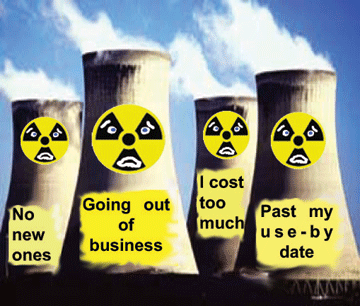 Exelon weighs shedding nuclear plants, other non-utility assets, Kiel Porter, Bloomberg News , 14 Oct 20, Exelon Corp. is considering a breakup that would involve separating its non-utility assets, according to people familiar with the matter.
The Chicago-based company is working with advisers to evaluate the split, said the people, who asked to not be identified because the matter isn’t public. No final decision has been made and Exelon could opt to keep its current structure, they said…….
Exelon’s non-utility operations include 21 nuclear reactors as well several solar, wind and natural-gas generating assets, according to its website. A potential split would leave Exelon focused on the regulated power market, with a portfolio that includes a half-dozen utilities in Pennsylvania, Maryland, Delaware and elsewhere.
Power companies are increasingly unloading unregulated assets to focus on their utilities, in part because investors prefer pure-play businesses. DTE Energy Inc. is considering unloading its non-utilities businesses, people familiar with the matter said last week. Dominion Energy Inc. agreed to sell its natural gas infrastructure earlier this year to Berkshire Hathaway Inc………
Christopher Crane said the company regularly evaluates whether to split up its utility and non-utility assets.
“One thing I can tell you is there’s an annual review on all the non-nuclear assets to see if they propose more value to others than we have projected for ourselves, and that annual review will continue,” he said. “And as we see assets that could perform better in somebody else’s portfolio and we could monetize those assets, we’ll do that.”Christopher Crane said the company regularly evaluates whether to split up its utility and non-utility assets. https://www.bnnbloomberg.ca/exelon-weighs-shedding-nuclear-plants-other-non-utility-assets-1.1507251
USA to market nuclear reactor to Bulgaria
 Bulgaria to hold talks with U.S. companies over new nuclear reactor, SOFIA, Oct 13 (Reuters) – Bulgaria’s government gave state-owned energy firm Bulgarian Energy Holding (BEH) a green light on Wednesday to start talks with U.S. companies on plans to build a new nuclear reactor at its Kozloduy power plant, the energy minister said…… Bulgaria to hold talks with U.S. companies over new nuclear reactor, SOFIA, Oct 13 (Reuters) – Bulgaria’s government gave state-owned energy firm Bulgarian Energy Holding (BEH) a green light on Wednesday to start talks with U.S. companies on plans to build a new nuclear reactor at its Kozloduy power plant, the energy minister said……
On Tuesday, Prime Minister Boyko Borissov said the new reactor should be based on U.S. technology and allow diversification in nuclear energy ….
Petkova did not name the companies that would be involved in talks, but said they were developers of nuclear technology, including those who work on small modular designs. She said she would have until the end of January to present the results from the research, which will explore potential technology that could be used for the new unit at the Kozloduy plant and options for its construction. Petkova did not name the companies that would be involved in talks, but said they were developers of nuclear technology, including those who work on small modular designs. She said she would have until the end of January to present the results from the research, which will explore potential technology that could be used for the new unit at the Kozloduy plant and options for its construction. https://www.reuters.com/article/bulgaria-nuclear-kozloduy/bulgaria-to-hold-talks-with-us-companies-over-new-nuclear-reactor-idUSL8N2H44VI |
|
Donald Trump’s erratic behaviour revives the debate on the President’s unchecked nuclear authority
 Trump’s Virus Treatment Revives Questions About Unchecked Nuclear Authority
Even before the president was given mood-altering drugs, there was a movement to end the commander in chief’s sole authority to launch nuclear weapons. NYT, 12 Oct 20, By David E. Sanger and William J. Broad,
President Trump’s long rants and seemingly erratic behavior last week — which some doctors believe might have been fueled by his use of dexamethasone, a steroid, to treat Covid-19 — renewed a long-simmering debate among national security experts about whether it is time to retire one of the early inventions of the Cold War: the unchecked authority of the president to launch nuclear weapons.
Mr. Trump has publicly threatened the use of those weapons only once in his presidency, during his first collision with North Korea in 2017. But it was his decision not to invoke the 25th Amendment and turn control over to Vice President Mike Pence last week that has prompted concern inside and outside the government.
Among those who have long argued for the need to rethink presidents’ “sole authority” powers are former Defense Secretary William J. Perry, considered the dean of American nuclear strategists, who has cited the fragility of a nuclear-weapons control chain and the fear that it can be subject to errors of judgment or failure to ask the right questions under the pressure of a warning of an incoming attack.
Mr. Trump’s critics have long questioned whether his unpredictable statements and contradictions pose a nuclear danger. But the concerns raised last week were somewhat different: whether a president taking mood-altering drugs could determine whether a nuclear alert was a false alarm.
That question is a new one. The military’s Strategic Command often conducts drills that simulate actual but inconclusive evidence that the United States may be under nuclear attack. Such simulations drive home the reality that even a president asking all the right questions could make a mistake. But they rarely simulate what would happen if the president’s judgment was impaired.
“A nuclear crisis can happen at any time,” Tom Z. Collina, the policy director at the Ploughshares Fund, a private group that seeks to defuse nuclear threats, noted last week in an opinion piece. “If such a crisis takes place when a president’s thinking is compromised for any reason,” he added, “the results could be catastrophic.”
Traditionally, presidents have temporarily conveyed authority — including nuclear launch authority — to the vice president when they anticipated being under anesthesia. Ronald Reagan took that step in 1985, and George W. Bush did so in 2002 and 2007. There was no indication that Mr. Trump was unconscious, but there was reason to be concerned that the cocktail of drugs he was given could impair his judgment to make the most critical decisions entrusted to a president.
Last week in telephone interviews with Fox News and Fox Business Network, Mr. Trump said he was no longer taking experimental medications but was still on dexamethasone, which doctors say can produce euphoria, bursts of energy and even a sense of invulnerability. On Friday, he told Fox News he was off the drug, which he appears to have taken for less than a week.
But during that week, his prolific Twitter activity and rambling interviews led many to question whether the drugs had accentuated his erratic tendencies. His doctors’ refusal to describe with any specificity his condition or treatment only played up the concern.
“The history of obfuscating the medical condition of presidents is as old as the Republic,” said Vipin Narang, a professor at the Massachusetts Institute of Technology who has studied the nuclear command-and-control chain. “The issue here is that the dex” — shorthand for dexamethasone — “can make you paranoid and delusional.”
“We don’t know how much he was given,” Mr. Narang said. “And if he gives an order in the middle of the night, and no one is there to stop him, we are dependent on his military aide not to transmit the order or the duty officer at the national military command center to stop it.”………….
The “sole authority” tradition is unusual among the world’s nine nuclear powers; even Russia requires two out of three designated officials to sign off on a nuclear launch. While the Constitution says that only Congress can declare war, the speed of bombers and missiles made clear during the Cold War that there would be no time to convene Congress or mount a defense. As a result, Congress began delegating to the president all powers to use nuclear weapons during Harry S. Truman’s administration. He is the only president who has ordered a nuclear strike……..
“The last finger I would want on the nuclear button,” said Hans M. Kristensen, the director of the Nuclear Information Project at the Federation of American Scientists, a private group in Washington, “is that of a president on drugs.”……… https://www.nytimes.com/2020/10/11/us/politics/trump-nuclear-weapons-coronavirus.html
What to do about the USA President’s sole authority to launch a nuclear pre-emptive strike?
|
Quote of the week: “Ours is a world of nuclear giants and ethical infants… We have grasped the mystery of the atom and rejected the Sermon on the Mount.” The President of the United States has unrestricted powers to use nuclear weapons first if he or she deems this necessary. Concerns about the absence of checks and balances on the first use of nuclear weapons have spiked because of Donald Trump’s bellicose temperament and shallow understanding of nuclear flash points. They have been exacerbated by his erratic behavior and remarks while recovering from the COVID virus. What to do? Some on Capitol Hill have introduced legislation that would prohibit the president from launching a nuclear first strike without a declaration of war by the Congress. In my view, this is the wrong remedy. Instead, I propose a three person rule for crossing the nuclear threshold first that can be enacted by executive order and reaffirmed by the Congress………… https://www.armscontrolwonk.com/archive/1210154/the-presidents-sole-authority-for-first-use/ |


Los Alamos National Laboratory nuclear waste is potentially explosive
Report: LANL nuclear waste mix potentially explosive https://www.taosnews.com/news/environment/report-lanl-nuclear-waste-mix-potentially-explosive/article_543eb72c-0b50-11eb-825a-3777d9ad7922.html, By Scott Wyland swyland@sfnewmexican.com, Oct 10, 2020
Some of LANL’s facilities store radioactive waste without any engineered controls or safeguards beyond the containers, the board wrote in a cover letter addressed to the U.S. Department of Energy.
“As such, additional credited safety controls may be necessary to protect workers and the public,” the board said.
In 2014, a LANL waste container was packaged in a volatile blend of organic cat litter and nitrate salts, which caused the container to rupture and spew radiation at the Waste Isolation Pilot Plant. The underground disposal site closed for three years while it underwent a $2 billion cleanup.
The incidents that released high levels of radiation at WIPP and Idaho National Laboratory have shown the importance of adding multiple layers of protection to reduce the consequences of an accident, the board said.
The report estimates that an exploding waste canister could expose workers to 760 rem, far beyond the threshold of a lethal dose. A rem is a unit used to measure radiation exposure.
Federal guidelines define a lethal dose as high enough to cause 50 percent of the population to die within 30 days. Those levels range from 400 to 450 rem.
The 760 rem estimate is equal to 380,000 chest X-rays, said Dan Hirsch, retired director of programs on environment and nuclear policy at the University of California, Santa Cruz.
“This is vastly above what’s permissible for workers’ exposure,” Hirsch said, adding that far lower doses can cause cancer.
The 760 rem estimate is actually conservative, he said, noting that the WIPP explosion released four times that amount.
A spokeswoman for the National Nuclear Security Administration said officials were aware of the board’s letter and report regarding issues with transuranic waste storage and handling. She didn’t answer questions about the board’s criticisms or how the agency would tackle the problems identified in the report.
“Maintaining the safety, security, and effectiveness of America’s nuclear deterrent remains paramount to NNSA,” she said.
“It’s elementary,” Hirsch said. “You put certain chemicals together and they explode.”
Even water seeping into a barrel of waste containing sodium can trigger an explosion, Hirsch said. That’s what made a waste container blow up at a Nevada nuclear storage site five years ago, he said.
Having the waste containers stored above ground magnifies the hazard, Hirsch said. If one of those burst, it would be far more dangerous than one exploding at an underground site like WIPP, he said.
The report points to years of waste disposal problems that haven’t been corrected, said Greg Mello, executive director of the nonprofit Los Alamos Study Group.
“LANL keeps kicking the waste problem down the road,” Mello said. “LANL has always prioritized its weapons work, and this waste problem has built up for decades.”
If the lab produces plutonium triggers for bombs as planned, it will generate more waste that must be disposed of, Mello said. So if it doesn’t make its current waste safe and acceptable for WIPP, that waste might end up being stuck at the lab as a permanent hazard, Mello said.
The board, whose access the Energy Department has tried to restrict, has again shown how vital it is to report on hazards to workers – in this case, potentially lethal doses of radiation, said Jay Coghlan, executive director of nonprofit Nuclear Watch New Mexico.
“These dangers will only grow worse as LANL becomes less and less a lab and more and more a permanent nuclear weapons production site,” Coghlan said.
Any plutonium release is extremely hazardous, Hirsch said.
If someone inhales one millionth of an ounce of plutonium, that person has a 100 percent chance of getting cancer, Hirsch said. So every effort must be made to keep it contained and stabilized – something lab officials are not doing, he said.
“They seem to cut corners,” Hirsch said. “And they’re cutting corners with the most dangerous materials on Earth.”
On our website Read this story at santafenewmexican.com to view the Defense Nuclear Facilities Safety Board’s report on Los Alamos National Laboratory’s faulty radioactive waste storage, which includes the board’s letter to the U.S. Department of Energy.
Inadequate Emergency Planning Zones for small modular nuclear reactors
No emergency planning zones for SMRs? NRC commissioner warns against “flimsy” rule that could extend to current reactor fleet, Beyond Nuclear International By Jeff Baran, 12 Oct 20, In a 3-1 vote by NRC Commissioners on December 17, 2019, Proposed Rule: Emergency Preparedness for Small Modular Reactors and Other New Technologies (SECY-18-0103) was accepted. The Rule would eliminate the need for Emergency Planning Zones and dedicated offsite emergency planning for Small Modular Reactors. The lone dissenting vote came from NRC Commissioner Jeff Baran. These are his comments.
For the last 40 years, NRC has required emergency planning zones, or EPZs, (Emergency Planning Zones) around nuclear power plants “to assure that prompt and effective actions can be taken to protect the public in the event of an accident.” Every one of the 96* operating large light-water reactors in the country has a plume exposure pathway EPZ that extends about 10 miles around the site with dedicated offsite radiological emergency plans and protective actions in place to avoid or reduce radiation dose to the public during an accident. An ingestion exposure pathway EPZ with a radius of 50 miles around each of these sites is designed to avoid or reduce dose from consuming food and water contaminated by a radiological release.
The EPZs and dedicated radiological emergency plans are meant to provide multiple layers of protection – or defense-in-depth – against potential radiological exposure. Other NRC requirements are focused on preventing or mitigating a radioactive release. The emergency planning regulations are there to provide another layer of defense in case a release occurs despite those safety requirements.
In other words, EPZs and radiological emergency planning are designed to address low-probability, high-consequence events. The Federal Emergency Management Agency (FEMA) assesses the adequacy of the offsite emergency plans, and NRC regulations require licensees to hold offsite emergency preparedness drills at each plant at least once every 2 years to practice implementing the plan .
Under this proposed rule, emergency planning for small modular reactors (SMRs) and non-light-water reactors would be flimsy by comparison. Instead of a 10-mile plume exposure pathway EPZ, these reactors would have EPZs that encompass only areas where the projected dose from “credible” accidents could exceed 1 rem. An EPZ extending only to the site boundary is explicitly permitted under this methodology.
In the case of a site-boundary EPZ, NRC would not require dedicated offsite radiological emergency planning and FEMA would have no role in evaluating the adequacy of a site’s emergency plans. In addition, the proposed rule would eliminate the requirement for an ingestion exposure pathway EPZ and no longer require a specific drill frequency for emergency planning exercises. Overall, this proposed rule represents a radical departure from more than 40 years of radiological emergency planning…………
We need to take FEMA’s warnings seriously. FEMA has a key role in determining whether the emergency planning for a nuclear power plant site is adequate. Under NRC’s regulations, a nuclear power plant license cannot be issued unless NRC makes a finding that the major features of the emergency plan meet the regulatory requirements. And NRC is supposed to base its finding on FEMA’s determinations as to whether the offsite emergency plans are adequate and whether there is reasonable assurance that they can be implemented.
No new SMR or non-light-water reactor designs have yet been approved by NRC, and only one SMR design has been submitted for the staff’s review. These new designs could potentially be safer than current large light-water-reactor designs. But that does not eliminate the need for EPZs and dedicated offsite emergency planning to provide defense-in-depth in case something goes wrong…….
In addition to the issues identified by FEMA, there are several other significant problems with the proposed rule.
First, the logic of the proposed EPZ sizing methodology could be applied to the existing fleet of large light-water reactors to weaken the current level of protection. As the Advisory Committee on Reactor Safeguards noted:
No technical basis is stated in the rule or the guidance for restricting the use of the new rule to SMRs and [other new technologies] with a limit on thermal power. The rule could apply to any reactor technology regardless of size. During our meetings, the staff acknowledged this point.
In fact, the proposed rule explicitly seeks comment on whether to apply this kind of approach to large light-water reactors. This opens the door to smaller EPZs and reduced emergency planning for the existing fleet of power reactors. If the proposed rule’s formulaic approach is adopted, a precedent will be established for applying a purely risk-based methodology to EPZ sizing.
Second, the proposed rule does not account for the possibility of accidents affecting more than one SMR module. Even though some SMR designs contemplate several reactors at one site, the EPZ sizing methodology addresses each reactor in isolation. This ignores a key lesson of the Fukushima accident – that severe natural disasters can simultaneously threaten multiple reactors at a site. Under the draft proposed rule, a SMR is defined as a power reactor that produces less than 1,000 megawatts-thermal. The combined heat energy produced by just two SMRs of this size could be larger than that of some existing large light-water reactors in the U.S. But, under the proposed rule, each module could individually qualify for a site boundary EPZ without consideration of the other.
Third, unlike the existing regulations for large light-water reactors, the proposed rule “would not define the required frequency of drills and exercises” for emergency preparedness. As a result, SMR and non-light-water reactor licensees would not be required to conduct a full offsite emergency preparedness drill every 2 years. The NRC staff provides no basis for this weaker standard.
Finally, the proposed rule would eliminate the ingestion pathway EPZ for SMRs and non- light-water reactors . . . No FEMA evaluation of this change is provided. Nor is there any discussion of the effectiveness of ad hoc responses to previous radiological releases. Moreover, if the staff’s unbounded rationale were adopted, it could ultimately lead to ingestion pathway EPZs being dropped for the existing fleet of large light-water reactors.
For these reasons, I do not support finalizing the proposed rule in its current form. NRC needs a rule that provides regulatory certainty for potential applicants and recognizes that SMRs and non-light-water reactors will be different than traditional, large light-water reactors. It makes sense to have a graded approach that accounts for potential safety improvements in new designs. But the rule should not be purely risk-based, relying entirely on the results of a dose formula. Instead, NRC should issue a rule to establish the following emergency planning requirements for three categories of nuclear power plants………….https://beyondnuclearinternational.org/2020/10/12/no-emergency-planning-zones-for-smrs/
Reopening of a Cold-War era submarine base, as USA struggles to beat Russia to control the Arctic.
Olavsvern will also be used to house submarines for NATO amid increased concerns over Russia’s activity in the region.
The base is located 220 miles from the Russia border and thus offers an ideal outpost for Western allies to quickly contain, and defend against any aggression from the state.
Modifications will now be made to the base in order for it to house America’s nuclear attack submarine, the USS Jimmy Carter.
The announcement of the base comes as the UK’s First Sea Lord, Admiral Tony Radakin, warned China and Russia could soon exploit the Arctic Sea.
Due to climate change, he claimed the once-frozen passages are now thawing thus opening up potential naval routes.
With these routes now appearing, Chinese and Russian ships could now have gateways through to the UK.
He added the Royal Navy was essential in stopping these ships from trespassing in the UK’s waters but also policing the vital global trade routes………..
The undersea world matters. “Because this one remaining stealth medium is also the home to our nuclear deterrent. ”…… https://www.express.co.uk/news/world/1346694/world-war-3-russia-cold-war-Norway-submarine-base-arctic-Vladimir-Putin
Public Input Wanted On Transportation Of Nuclear Waste
|
Public Input Wanted On Transportation Of Nuclear Waste, Dryden, ON, Canada / CKDR, Sarah McCarthy
Oct 12, 2020 A site in Ignace is up for consideration to become a nuclear repository and the Nuclear Waste Management Organization is looking for feedback on their Transportation Framework plan.
The Rotary Club of Dryden had a chance to provide their input, as the organization was a guest at one of their virtual meetings. Relationship Manager, Norman Sandberg explains road and rail are the two modes of transportation being considered to carry the fuel. “Water is a transportation mode that is used, but Canadians earlier in the process made it very clear that transportation of used nuclear fuel across the great lakes is not socially acceptable.” If road was picked, there would be two trucks per day or by via rail there would be two trains per week. The fuel would be transported across half the country, from Manitoba or New Brunswick and it could be a combination of both modes of transportation. Sandberg adds would be a 45 to 50 year transportation period. “We don’t anticipate being in a position to be able to transportation of used fuel until at least the mid 2040’s, because we have to have a repository not only approved and licensed, but constructed and ready for operation.” The potential repository sites under assessment right now include one in Ignace and another in Southern Ontario……… https://www.ckdr.net/2020/10/12/rotary-club-of-dryden-receive-presentation-on-nuclear-waste/ |
|
1 This Month
26 April – Chernobyl: Inside the Meltdown airs on National Geographic on Sunday 26th April from 4pm

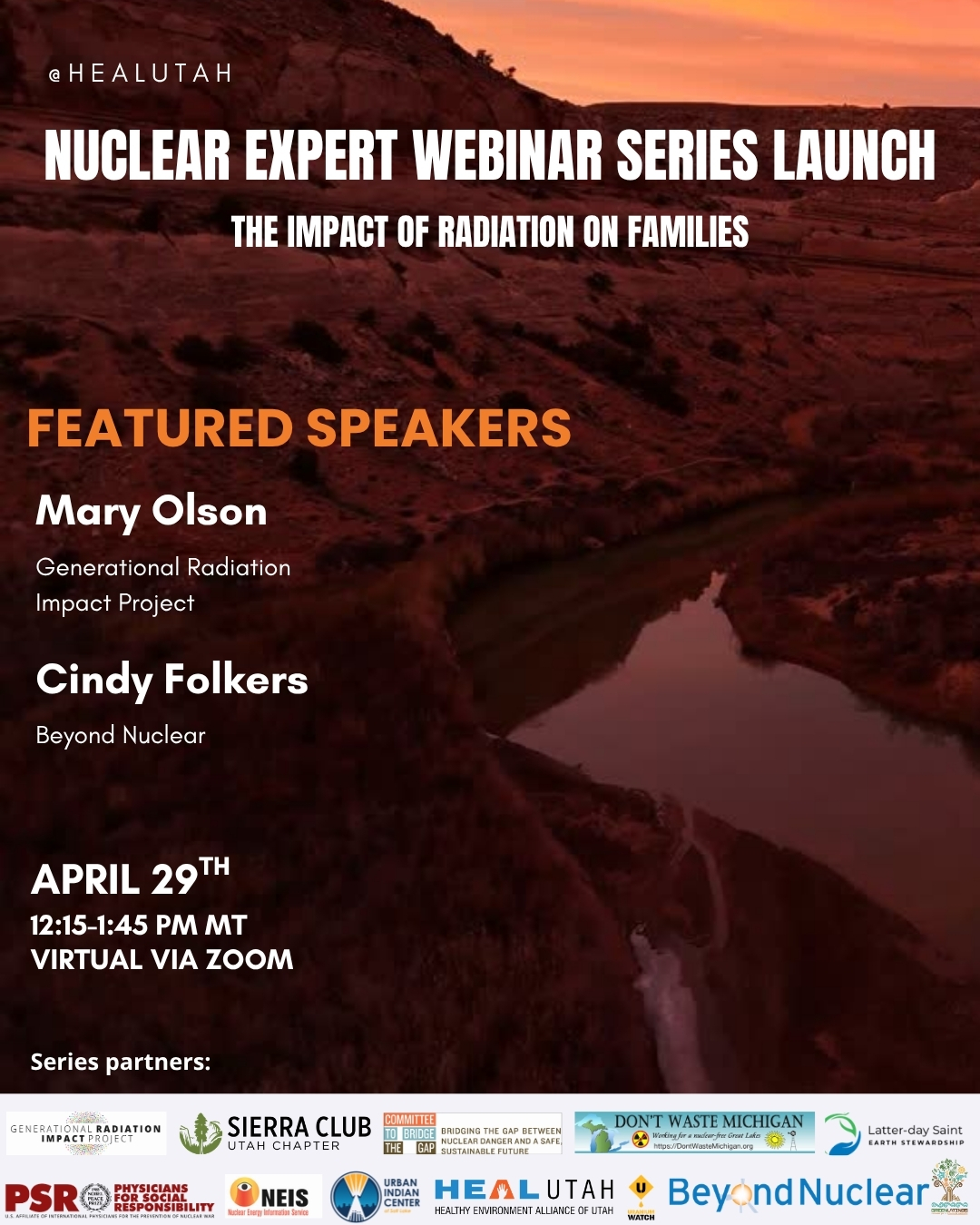
29 April – Nuclear Expert Webinar #1 – Radiation Impacts on Families with Mary Olson and Cindy Folkers
- 12:15 PM MT – 1:45 PM MT
- Location: Virtual – REGISTER TODAY

4 May -West Suburban Peace Coalition to discuss Iran war at May Educational Forum
Monday, May 4, 7:00 – 8:00 PM Central Standard Time
Title: : How Trump’s Narrative Tries to Shape the Reality of the War on Iran.
Contact Walt Zlotow, zlotow@hotmail.com 630 442 3045 for further information
14 May – online event From Bombs to Data Centres: the Face of Nuclear Colonialism

Pine Ridge Uranium is the real threat, not Tehran- Tell Burgum: Stop the Extraction.
Chernobyl: The Lost Tapes – A good documentary on Chernobyl on SBS available On Demand for the next 3 weeks– https://www.sbs.com.au/ondemand/tv-program/chernobyl-the-lost-tapes/2352741955560
To see nuclear-related stories in greater depth and intensity – go to https://nuclearinformation.wordpress.com
-
Archives
- May 2026 (12)
- April 2026 (356)
- March 2026 (251)
- February 2026 (268)
- January 2026 (308)
- December 2025 (358)
- November 2025 (359)
- October 2025 (376)
- September 2025 (257)
- August 2025 (319)
- July 2025 (230)
- June 2025 (348)
-
Categories
- 1
- 1 NUCLEAR ISSUES
- business and costs
- climate change
- culture and arts
- ENERGY
- environment
- health
- history
- indigenous issues
- Legal
- marketing of nuclear
- media
- opposition to nuclear
- PERSONAL STORIES
- politics
- politics international
- Religion and ethics
- safety
- secrets,lies and civil liberties
- spinbuster
- technology
- Uranium
- wastes
- weapons and war
- Women
- 2 WORLD
- ACTION
- AFRICA
- Atrocities
- AUSTRALIA
- Christina's notes
- Christina's themes
- culture and arts
- Events
- Fuk 2022
- Fuk 2023
- Fukushima 2017
- Fukushima 2018
- fukushima 2019
- Fukushima 2020
- Fukushima 2021
- general
- global warming
- Humour (God we need it)
- Nuclear
- RARE EARTHS
- Reference
- resources – print
- Resources -audiovicual
- Weekly Newsletter
- World
- World Nuclear
- YouTube
-
RSS
Entries RSS
Comments RSS
 nuclear-news