Democrat lawmakers call on President Biden to reduce the role of nuclear weapons in the upcoming Nuclear Posture Review.
SENATORS MARKEY, MERKLEY AND REPS. BEYER, GARAMENDI LEAD COLLEAGUES IN URGING PRESIDENT BIDEN TO REDUCE MILITARY ROLE OF U.S NUCLEAR WEAPONS IN UPCOMING NUCLEAR POSTURE REVIEW https://www.markey.senate.gov/news/press-releases/senators-markey-merkley-and-reps-beyer-garamendi-lead-colleagues-in-urging-president-biden-to-reduce-military-role-of-us-nuclear-weapons-in-upcoming-nuclear-posture-review Washington (July 22, 2021)–
Today, Senators Edward J. Markey (D-Mass.), Jeffrey A. Merkley (D-Ore.) and Representatives Don Beyer (VA-08) and John Garamendi (CA-03), co-chairs of the Nuclear Weapons and Arms Control Working Group, led 18 of their colleagues in calling on President Joseph R. Biden to actively guide the formation of the Department of Defense-led Nuclear Posture Review. The Nuclear Posture Review (NPR) will be part of an integrated National Defense Strategy that the Department of Defense says will be completed by early next year. The lawmakers urged the Administration to consider a series of bold actions that would fulfill the President’s pledge to reduce the role of “nuclear weapons in our national security strategy.”
“Mr. President, as a United States Senator and then as Vice President, you were a party to every major nuclear weapons debate of the past five-decades. From bolstering the Anti-Ballistic Missile Treaty, to building European support for the Intermediate-Nuclear Forces Treaty, to securing votes for ratification of the New START Treaty, you have consistently been on the right side of history. Your Administration’s NPR is a watershed moment where you can reject a 21st century arms race and make bold decisions to lead us towards a future where nuclear weapons no longer threaten all humanity,” the lawmakers wrote in their letter to President Biden.
Specifically, the lawmakers called for President Biden’s Nuclear Posture Review to:
- Adjust U.S. declaratory policy to assign a reduced role for U.S. nuclear weapons, consistent with the President’s past stated view that: “Given our non-nuclear capabilities and the nature of today’s threats — it’s hard to envision a plausible scenario in which the first use of nuclear weapons by the United States would be necessary. Or make sense.”
- Direct the Department of Defense to include in its proposed target list a breakdown of the damage expectancy, civilian casualties, and climatic and humanitarian consequences stemming from nuclear weapons use.
- Examine the number and types of new weapons needed to deter nuclear attack, taking into account recommendations from the Government Accountability Office to consider deferring or cancelling certain nuclear weapons modernization programs.
- Complete independent review of the proposed intercontinental ballistic missile (ICBM) – the Ground Based Strategic Deterrent – that looks into the technical feasibility and comparative cost savings of life-extending the current Minuteman III ICBM.
- Eliminate two of President Trump’s new types of nuclear weapons: the nuclear sea-launched cruise missile (SLCM) under development and the low-yield W-76(2) warhead already deployed on U.S. ballistic missile submarines.
- Commit to pursuing robust diplomacy with Russia and China on arms control through U.S.-Russia bilateral strategic stability talks, which build upon an extended New START Treaty, and starting a new bilateral U.S.-China strategic stability dialogue that builds towards the eventual conclusion of arms control measures that reduce the risk of miscalculation.
A copy of the letter can be found HERE.
First Energy company to pay fine for bribing Ohio officials to bail out nuclear power stations
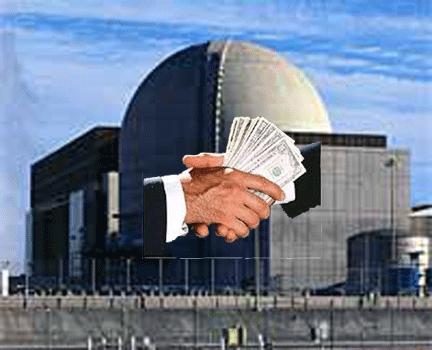
FirstEnergy agrees to pay $230M fine for bribing Ohio officials to bail out two nuclear plants, Utility Dive, Iulia Gheorghiu July 23, 2021
Dive Brief:
- FirstEnergy Corporation announced on Thursday a settlement agreement to pay a $230 million penalty for bribing Ohio officials to ensure the passage of a ratepayer-funded bailout for older generation assets, including two nuclear plants.
- The utility cooperated with federal investigators to disclose paying millions through dark money groups to state officials, including former Ohio House Speaker Larry Householder and former Public Utilities Commision of Ohio (PUCO) Chairman Sam Randazzo. The company acknowledged using 501(c)(4) organizations, which are registered lobbying entities, to conceal the nature, source and control of payments in the pursuit of the nuclear legislation……………
The details in the 49-page settlement agreement, in which FirstEnergy had to admit that company executives paid money to public officials in return for official action, has led to stakeholders raising questions about utility dark-money and political spending………….
The OEC Action Fund is also asking for a full repeal of HB 6 and has called for an investigation into every PUCO and Ohio Power Siting Board ruling made under Randazzo’s tenure.
“Each case he presided over is possibly tainted by corrupt ties to FirstEnergy,” Taylor-Miesle said……………………. https://www.utilitydive.com/news/firstenergy-agrees-to-pay-230m-fine-for-bribing-ohio-officials-to-bail-out/603836/
Racism and the misguided efforts to expand nuclear energy around the world
Early efforts to expand nuclear energy were rife with racism and peril,
reminds a historian. “Those who cannot remember the past are condemned to
repeat it,” wrote the philosopher George Santayana in 1905. Heeding this
aphorism, in The Wretched Atom, historian Jacob Darwin Hamblin seeks to
remind readers of the misguided 20th-century effort launched by the United
States, its allies, and international agencies to expand nuclear energy
around the world. The compelling narrative should lead readers to realize
the importance of preventing a repeat of the follies that marked the early
decades of the atomic age.
Science 21st July 2021
https://blogs.sciencemag.org/books/2021/07/21/the-wretched-atom/
Pentagon review: What happens if ‘nuclear football’ is lost?
Pentagon review: What happens if ‘nuclear football’ is lost? Questions about security procedures arose after Jan. 6, when Vice President Mike Pence was escorted to safety along with a military aide carrying the backup communications system.. 6, when Vice President Mike Pence was escorted to safety along with a military aide carrying the backup communications system.
By The Associated Press NBC News, 21 July 21, WASHINGTON — The Pentagon is taking a rare look at whether it is prepared to deal with the theft or compromise of the portable communications system nicknamed the “nuclear football,” which enables the president or a stand-in to order a nuclear attack.
In announcing the probe Tuesday, the Pentagon inspector general’s office did not disclose what precipitated it, but questions about security procedures arose in the aftermath of the Jan. 6 insurrection at the Capitol.
Vice President Mike Pence was seen on security camera video being escorted to safety, along with a military aide carrying the backup “nuclear football,” as rioters entered the Capitol.
A backup system always accompanies the vice president so that he is able to communicate in the event the president cannot. The “football,” officially called the Presidential Emergency Satchel, enables communication with the office inside the Pentagon that transmits nuclear attack orders.
The inspector general’s office said its review began this month. It gave no timeline for completing it.
“The objective of this evaluation is to determine the extent that DoD processes and procedures are in place and adequate to alert DoD officials in the event that the Presidential Emergency Satchel is lost, stolen, or compromised,” Randolph R. Stone, an assistant inspector general, wrote in a July 19 letter to the director of the White House military office and the director of the Joint Staff at the Pentagon. “This evaluation will also determine the adequacy of the procedures the DoD has developed to respond to such an event.”
Two Democrats who had asked the Pentagon inspector general to review the matter, Reps. Stephen Lynch of Massachusetts and Jim Cooper of Tennessee, said in a joint statement that the Jan. 6 riot raised questions about whether the Pentagon was even aware that Pence’s “nuclear football” was potentially in danger of falling into the hand of insurrectionists………..
“U.S. Strategic Command, which is responsible for U.S. strategic deterrence and nuclear operations, was reportedly unaware that Vice President Pence, his military aide, and the nuclear football were all potentially in danger and only came to understand the gravity of the incident several weeks later when security camera footage was played as a video exhibit during the Senate impeachment trial,” they wrote. https://www.nbcnews.com/politics/national-security/pentagon-review-what-happens-if-nuclear-football-lost-n1274582
Small nuclear reactor project cut back to half size, due to financial worries

Eastern Idaho nuclear project goes from 12 to six reactors. IDAHO FALLS, Idaho (AP) 19 July 21— A Utah energy cooperative said it will reduce the number of small modular nuclear reactors it will build in Idaho from 12 to six for a first-of-a-kind project [ totally ineffective against global heating] that is part of a federal effort to reduce greenhouse gasses that cause climate change……
The reactors are being built by Portland, Oregon-based NuScale Power. The U.S. Nuclear Regulatory Commission last year approved NuScale’s application for the small modular reactors, the first time U.S. officials approved a design for a small commercial nuclear reactor.
………….. Idaho Falls has committed to buying 5 megawatts of power from the reactors through the Carbon Free Power Project. The city had been committed to 10 megawatts but cut that in half in October amid concerns about financial risks.
……….. Idaho Falls City Council member John Radford said at a July 8 meeting. “This project is something that can help keep this country on this trajectory to a carbon-free future and maybe a better existence for all of us.” – [a complete untruth!! this Councillor is either ignorant, or lying] https://madison.com/news/national/govt-and-politics/eastern-idaho-nuclear-project-goes-from-12-to-six-reactors/article_cb353af6-5659-5baa-8365-dc575aeeba8d.html
Wiscasset – just one of thousands of American communities stuck with stranded nuclear wastes.

The situation in Wiscasset underscores a thorny issue facing more than 100 communities across the U.S.: What to do with hundreds of thousands of tons of nuclear waste that has no place to go.

All told, the country’s many abandoned nuclear facilities — including Maine Yankee — have cost the federal government billions of dollars, a sum that increases by about $2 million each day
Keeping the spent fuel on the site was meant to be a temporary solution until the dry storage casks, or canisters, could be transported to a permanent home deep underground where they could stay undisturbed for hundreds of thousands of years.
Armed Guards Protect Tons Of Nuclear Waste That Maine Can’t Get Rid Of Maine Public | By By Abigail Curtis, BDN July 19, 2021 In the summertime, the picturesque village of Wiscasset is infamous for its long lines of people hungry to try a lobster roll at Red’s Eats and cars that crawl through town on the often-clogged U.S. Route 1.
But just a few miles south of downtown is a different kind of roadblock: thousands of tons of nuclear waste stored on a coastal peninsula at the now-decommissioned Maine Yankee atomic energy plant that have nowhere to go.
The change in presidential administrations means another chance for the federal government to make good on its promise to remove the waste, so the site can be closed for good. The Biden administration’s Department of Energy seems to be picking up where the Obama administration left off, creating a process for communities to volunteer to host the waste.
“What worries me is that there really isn’t any national leadership right now on this stuff. There isn’t an agency that has a mission and has developed a strategy, that has goals and is willing to act on it,” Don Hudson, the chairman of the Maine Yankee Community Advisory Panel, said. “We’re currently in this limbo.”
That’s a problem because the waste — 1,400 spent nuclear fuel rods housed in 60 cement and steel canisters, plus four canisters of irradiated steel removed from the nuclear reactor when it was taken down — is safe for now, but can’t stay in Wiscasset forever.
The situation in Wiscasset underscores a thorny issue facing more than 100 communities across the U.S.: What to do with hundreds of thousands of tons of nuclear waste that has no place to go.
Securing these remnants of nuclear energy generation is an ongoing task that requires armed guards around the clock and costs Maine Yankee’s owners some $10 million per year, which is being paid for with money from the government.
After the government failed to remove the spent fuel, Maine Yankee and the other two decommissioned nuclear power plants in New England — Connecticut Yankee in East Hampton, Connecticut, and Yankee Atomic in Rowe, Massachusetts — took it to court. So far, they have been awarded a total of $575.5 million in damages during four rounds of litigation, money that has been paid out of the U.S. Judgment fund. A fifth round is happening now, and the lawsuits are likely to continue until the fuel is removed.
Continue readingAfter the lab-leak theory, US-Chinese relations head downhill
The United States and China could work together in sharing biosecurity-related samples, genetic materials and data, developing protocols and countermeasures against biosafety accidents, promoting transparency in dual-use research of concern, countering disinformation, and strengthening compliance with global health laws, including the Biological Weapons Convention and the International Health Regulations.
But the US push to investigate the lab leak and the political context in both countries likely puts the goal of finding the origins of COVID-19 and many other ambitions at risk………
After the lab-leak theory, US-Chinese relations head downhill, Bulletin of the Atomic Scientists, By Yanzhong Huang | July 16, 2021 In October, 2018, more than a year before the COVID-19 pandemic, dozens of international trainees visited the Wuhan Institute of Virology for an expansive workshop meant to “promote the cooperation between China and other countries in the field of biosafety.” The attendees, many from developing countries, took classes on virus handling and bioethics, they listened to speeches by Chinese and UN arms control officials, and learned from eminent scientists. For the organizers, the 10-day event was a chance to showcase China’s expertise in biosafety management. And for this, they could hardly have chosen a more perfect location, a prestigious virology institute that had just months earlier opened the country’s first state-of-the-art, specialized facility for safely studying the world’s most dangerous pathogens, a biosafety-level (BSL) 4 lab.
The marketing plan hasn’t paid out.
Two years on, the lofty vision the workshop at the advanced Chinese biolab embodied—one of international collaboration on disease control and scientific research—has disintegrated as the United States and China tangle in an increasingly nasty fight over the origins of the still-raging coronavirus pandemic. In the United States, President Joe Biden, prominent scientists, and once-skeptical mainstream media outlets have collectively revived a hypothesis that was initially largely framed as a conspiracy theory, that the COVID-19 virus could have escaped from the Wuhan lab. Meanwhile, in China, many are convinced COVID-19 started somewhere else, outside of the country.
The Wuhan Institute of Virology now sits at the forefront of the US-China row on the origins of a once-in-a-century pandemic.
Continue readingJudge rules distribution of compensation for investors who lost fortunes in multi billion-dollar nuclear reactor failure in South Carolina

Judge OKs distribution for $192M nuclear project settlement, https://www.miamiherald.com/news/business/article252884293.html
BY MEG KINNARD ASSOCIATED PRESS, JULY 19, 2021 OLUMBIA, S.C.
Investors who lost fortunes in the failure of a multi billion-dollar nuclear reactor construction deal in South Carolina will soon begin to see their portions of a $192 million settlement, under a recently approved distribution.
Last week, a federal judge signed off on a plan to disperse the funds among former shareholders in SCANA Corp., the former parent company of South Carolina Electric & Gas. The settlement itself was the largest securities class action recovery obtained in South Carolina when a judge approved it last year, according to attorneys for the investors.
The utility company became embroiled in controversy after announcing in summer 2017 that it was shuttering a nuclear reactor construction project at the V.C. Summer Nuclear Station in Jenkinsville, about 30 miles (48 kilometers) north of Columbia, following the bankruptcy of lead contractor Westinghouse.
Up to that point, SCANA and state-owned utility Santee Cooper, a minority partner in the project, had spent nearly $10 billion on it. The failure cost ratepayers and investors billions and left nearly 6,000 people jobless.
The abandonment spawned multiple lawsuits, some by ratepayers claiming company executives knew the project was doomed and misled consumers as well as regulators as they petitioned for a series of rate increases. State and federal authorities launched investigations, which have led to guilty pleas from two top-level SCANA executives.
More than 737,000 SCE&G customers had already paid more than $2 billion toward the project, which never generated any power. Customers did ultimately see retroactive credits applied to bills after lawmakers passed a temporary rate cut that knocked about $25 a month off the average residential customer’s bill.
SCANA shareholders accused the company of assuring them the project was above board, even as costs and delays spiraled out of control. This, investors alleged, caused SCANA stock to be traded at artificially inflated prices, numbers that plummeted once the project was mothballed. In July 2016, SCANA stock was trading at $76.12 a share but dropped more than 50% after news of the project’s failure, and the investigations surrounding it, became public, according to the investors’ attorneys.
The settlement includes $160 million in cash, with the remaining $32.5 million covered by cash or stock in Dominion Energy. The Virginia-based company took over SCANA in 2019, paying more than $6.8 billion to buy out the company’s stock and assuming its consolidated net debts of $6.6 billion.
Claimants will be required to cash their checks within 120 days or forfeit the award, according to the order.
“We are pleased that the court has approved the settlement distribution plan, and look forward to the distribution of the settlement funds to eligible class members according to the plan,” said Marlon Kimpson, a state senator and attorney representing the investors.
Pro nuclear U.S. lawmakers again introduce Bill to promote nuclear industry
WASHINGTON, D.C. 19 July 21, – U.S. Senator Shelley Moore Capito (R-W.Va.), Ranking Member of the Senate Environment and Public Works (EPW) Committee, along with Senators Sheldon Whitehouse (D-R.I.), John Barrasso (R-Wyo.), Cory Booker (D-N.J.), and Mike Crapo (R-Idaho) reintroduced the American Nuclear Infrastructure Act (ANIA)
……. pecifically, ANIA will:
- Reestablish American international competitiveness and global leadership;
- ANIA empowers the Nuclear Regulatory Commission (NRC) to lead a consensus-building process in international forums to establish regulations for advanced nuclear reactor designs.
- ANIA provides the NRC authority to deny imports of Russian nuclear fuel on national security grounds.
- Expand nuclear energy through advanced nuclear technologies;
- ANIA creates a prize to incentivize the successful licensing process of next generation nuclear technologies and fuels.
- ANIA requires the NRC to identify and resolve regulatory barriers to enable advanced nuclear technologies to reduce industrial emissions.
- Preserve existing nuclear energy; and
- ANIA authorizes a targeted credit program to preserve nuclear plants at risk of prematurely shutting down.
- ANIA modernizes outdated rules that restrict investment in nuclear energy.
- Revitalize America’s nuclear supply chain infrastructure.
- ANIA identifies modern manufacturing techniques to build nuclear reactors better, faster, cheaper, and smarter. https://www.capito.senate.gov/news/press-releases/capito-whitehouse-barrasso-booker-crapo-introduce-legislation-to-preserve-and-expand-americas-nuclear-energy-sector
Problems of nuclear power in space
Houston, are we going to have a problem with space nuclear power? Bulletin of the Atomic Scientists, By Beau Rideout | July 19, 2021 ” ………….. space nuclear power isn’t just about propulsion. The dynamic commercial space and national security sectors can also benefit from nuclear capabilities and have an important role to play in developing dual-use technologies that have both military and civilian applications, though with some caveats to ensure human safety.
While the National Academies report published in February advocates for the use of nuclear power in propulsion, nuclear power for non-propulsion applications is becoming increasingly attractive as the commercial space sector seeks to expand its activities. It would be prudent to discuss and establish policy on the use of space nuclear power now, so that policy and safety concerns can be fully addressed during the development proposed by NASA and the National Academies. The United States, and the world, has important decisions to make about whether, when, and how to use nuclear power in space.
Nuclear propulsion in space. The fiscal year 2021 spending approved by Congress provides $110 million for space nuclear propulsion development. This reflects growing NASA interest in more ambitious deep-space missions and a burgeoning commercial interest in exploiting extraterrestrial resources on the Moon, Mars, and the asteroid belt, for which nuclear power would be a key enabling technology……………….
With both a high-power output and high mass efficiency, nuclear propulsion would strike a mighty blow against the tyranny of the rocket equation, which dictates that spacecraft need exponentially more fuel to travel farther. Space nuclear propulsion would enable entirely novel types of space missions, such as capturing small asteroids or, as NASA plans, sending humans to Mars.
Non-propulsion activities in space. In addition to providing advanced propulsion capabilities, nuclear power would enable other space activities and allow the commercial space industry to reduce its reliance on solar panels. For example, space-based radar systems can image the ground day or night, regardless of cloud cover, but require large amounts of electrical power. Communication systems relay data across the world but are constrained by the size of their solar panels. With nuclear power, they could send more data down to Earth, or serve more customers by operating from higher orbits.
The space industry is offering new in-space services and aiming for new destinations beyond geostationary orbit but within the moon’s orbit. Lockheed Martin has announced that future GPS satellites will be designed to receive hardware upgrades of processors and sensors while in orbit. A DARPA program is investigating future in-space manufacturing of large, lightweight structures using raw materials harvested from the Moon. And the NASA Commercial Lunar Payload Services program is scheduled to begin sending commercial lunar landers to the Moon in the fourth quarter of this year. This uptick of activity requiring frequent trips beyond low Earth orbit indicates that requirements for propulsion and power generation will continue to expand, making nuclear power an increasingly attractive solution. In anticipation of this demand, conversations about the proper, safe use of nuclear power in space must begin now.
………… The United States should lead the way in identifying the types of applications that should be encouraged, those where caution may be indicated, and perhaps some applications that should be discouraged because the risks outweigh potential benefits.
…………. Interagency review should also identify measures to protect human safety. For example, the National Academies report has recommended that nuclear applications in space minimize the amount of radioactive material required, undergo sufficient testing to ensure reliable operations prior to any orbital flight, restrict reactor use until a spacecraft has achieved a safe orbit, and design all space-going reactors to automatically go into a “safe state,” in which the reactor is highly unlikely to achieve criticality and sustain a fission chain reaction, if a launch failure occurs. Nuclear power applications in low Earth orbits should be required to include back-up safety mechanisms such as redundant communications or a secondary propulsion system, as objects in these orbits are most at risk of uncontrolled reentry events like the Soviet Kosmos 954 reactor accident
In that 1978 accident, the Kosmos 954 satellite broke apart over Canada, spreading radioactive debris over the Northwest Territories and requiring a multimillion-dollar cleanup operation. Kosmos 954 was not the first fission reactor in space. The United States flew an experimental satellite called SNAPSHOT in 1965 to test a small nuclear reactor powering an early form of electric propulsion. SNAPSHOT failed 43 days after launch, but the reactor safely shut down and was left in a high orbit. The Soviet Union launched 33 RORSAT radar satellites powered by reactors between 1967 and 1988. Unlike SNAPSHOT, these RORSAT satellites orbited at low altitude and would fall back to Earth unless boosted up to a higher disposal orbit from which they would not return for several centuries. However, this boosting maneuver was not always successful and on two occasions resulted in the reactor cores crashing back to Earth. ………………. https://thebulletin.org/2021/07/houston-are-we-going-to-have-a-problem-with-space-nuclear-power/?utm_source=Newsletter&utm_medium=Email&utm_campaign=MondayNewsletter07192021&utm_content=NuclearRisk_NuclearPowerInSpace_07192021
Significant downsizing of NuScale’s small nuclear reactor project for Idaho – (cost of project unknown)

The company [NuScale] refused to disclose the modular reactor project’s exact costs.
Eastern Idaho nuclear reactor project downsized, Post Register, By KYLE PFANNENSTIEL kpfannenstiel@postregister.com, Jul 16, 2021
A project to build a first-of-its-kind nuclear reactor in eastern Idaho has been significantly downsized.
The initial plan for the Carbon-Free Power Project was to build 12 interconnected miniature nuclear reactor modules to produce a total of 600 megawatts. It would be the first small modular reactor in the United States. After the company tasked with manufacturing the plants said it could make the reactors more power-efficient, planners reduced the project down to six module reactors that could produce 462 MW total.
“After a lot of due diligence and discussions with members, it was decided a 6-module plant producing 462 MW would be just the right size for (Utah Associated Municipal Power Systems) members and outside utilities that want to join,” said LaVarr Webb, UAMPS spokesman.
The project between UAMPS and Portland-based reactor producer NuScale received $1.4 billion from the U.S. Department of Energy last year. The reactor is planned to be built on the DOE’s 890-square mile desert site west of Idaho Falls at Idaho National Laboratory.
…….. now that we have made significant progress, including a large cost-share award from the Department of Energy, and NuScale has received design approval from the (Nuclear Regulatory Commission), we’re seeing more and more utilities express interest in the plant.”
So far, Webb said 28 participants have committed to a total of 103 MW. But, he said, “all are currently evaluating whether to increase or decrease” their commitments.
…….. Others who support the project worry about its incomplete financial support. All but one council member that day voted to continue Idaho Fall’s 5 MW commitment. But two voiced direct concern over the project not having full subscriptions. Council member Jim Francis was the sole nay vote.
Last October, the Idaho Falls City Council halved its then-10 MW commitment. The move maintained the city’s involvement but reduced the risk to customers of the city-ran grid, by Idaho Falls Power, if the investment doesn’t pan out, the Post Register previously reported.
Downsizing the project reduces the project’s costs and the amount of power it can produce, overall.
…….. The company [NuScale] refused to disclose the modular reactor project’s exact costs.
Webb said the project is currently working toward submitting an application to the NRC in 2024 to build and operate the reactor. https://www.postregister.com/news/inl/eastern-idaho-nuclear-reactor-project-downsized/article_0c60abf6-d0ea-5d42-9f9e-3cdb1a49b381.html
Students from North Arizona researched and wrote about the effects of uranium mining, especially on indigenous people.

Navajo youth essay winner looks at uranium trail in Arizona
Picking up the fight — Beyond Nuclear International Diné student wins uranium essay contest, Beyond Nuclear, By Sandra J. Wright, 18 july 21,
Charisma Black, along with other students from northern Arizona, took on a challenge issued by the 4th World Foundation to research uranium mining effects on Black Mesa.
Each writer was also asked to propose actions to limit exposure to radiation.
Black was named the winner of the contest in April. On May 13, she accepted the $500 scholarship award along with a large hand-woven basket filled with traditional clothing and jewelry.
Tommy Rock, an alumnus of Northern Arizona University’s School of Earth Sciences and Environmental Sustainability, presented the award to Black.
Black’s extended family is from the Pinon, Arizona, area of the Navajo Reservation. But her immediate family moved to Phoenix when she was young.
She returned to northern Arizona about two years ago, and is a graduating student of Flagstaff High School. Only 18 years old, Black has spent a lot of time thinking about uranium.
“My greatest concern was for family members,” Black said. “Uranium has shortened my time with some of them. We have to take care of them. I hope things can change for everyone, not just us Navajo and Hopi people.”
Her awareness of the uranium issue began when she was 10 years old……………
Black’s essay spoke to the environmental reality of living on Black Mesa.
“Uranium is a big issue because it contaminates the water source from underground aquifer of both Navajo and Hopi,” Black wrote. “Water that is accessed is being not only depleted at a dramatic rate, water is also undrinkable in areas that only have wells and windmills for drinking.
“This impacts their health, their livestock, their fields, etc.,” she said. “It is becoming unsafe, uninhabitable and unsustainable to live on the land in Black Mesa. New disease and sickness have come to Black Mesa.”
Black concluded that people “have to participate and learn better ways to keep our land, air and water clean for our peoples, animals and other species. We need to continue the advocacy and organizing to bring attention to the issue of uranium contamination on Black Mesa for sustainability, healthy communities and future generations.”………….
Somana Tootsie, the director of the 4th World Foundation, was on hand during the dinner held in Black’s honor.
Tootsie said that the contest was designed to get tribal youth in the region talking about the larger picture of environmental awareness and responsibility.
“This was an opportunity for young people to hold a conversation with their family members about the effects of uranium on their tribes and neighbors,” Tootsie said.
“We received amazing responses and great ideas on what to do to get more attention on the need for the removal or remediation of radioactive materials left exposed throughout northern Arizona,” she said. “We wanted to get them interested in science.”………….
Exposure not just Navajo
Exposure is not limited to the Navajo, Hopi and other tribes of the region. Radiation from the nuclear testing begun during World War II has created “downwinder” victims across the country to the east.
He finds hope that more people are working the devastating effects of the uranium industry.
“We have many grass-roots organizations addressing uranium,” Rock said. “The University of New Mexico has undertaking a study on uranium exposure. Amended by these studies, we have better access to health care from exposure.
The Navajo Nation Environmental Agency has been stepping up,” he said. “We have the Dine’ Uranium Remediation Advisory Committee, which I sit on.”
The uranium industry has definitely affected drinking water across northern Arizona, and people need to be informed of that fact, Rock said.
“We all must face the reality that we need access to potable water,” Rock said. “Not just for us, but for future generations. We need to be informed.
“We live off the land, and uranium has a great impact on our environment,” he said. “We have to educate tribes, chapter houses, communities, and tell them what we are learning, what we are doing.”………….. https://beyondnuclearinternational.org/2021/07/18/picking-up-the-fight/
USA’s Department of Energy brushes aside the community’s concerns about the so-called MARVELlous small nuclear reactor plan
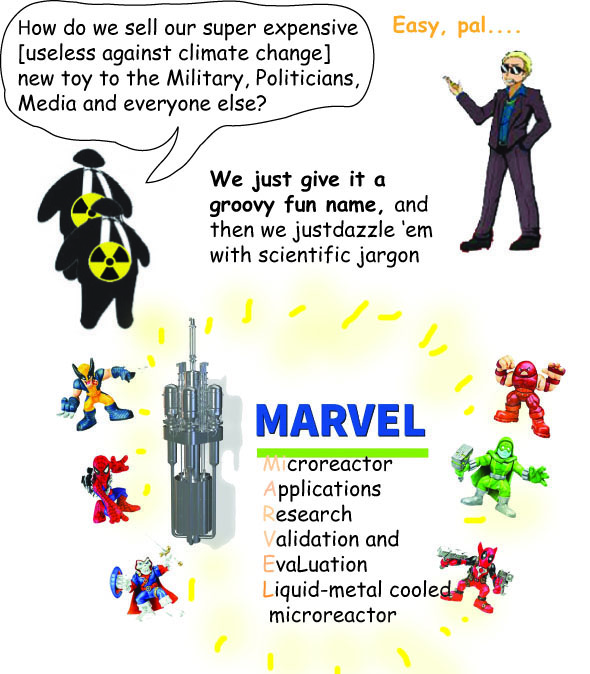
Concerns with nuclear energy must be taken seriously https://www.postregister.com/opinion/guest_column/opinion-concerns-with-nuclear-energy-must-be-taken-seriously/article_4e1e08d1-cad9-56dd-83cc-6ceadb828b24.html 16 July.By IAN COTTEN In June, the Department of Energy released a final environmental assessment for the MARVEL nuclear reactor project proposed to go in at Idaho National Laboratory. The result of the environmental assessment was a proposed finding of no significant impact.
It was incredibly discouraging to read through the DOE’s response to the public’s comments of concern in the final assessment. Many of the responses were copied and pasted responses and/or dismissively replied that the concerns around the proposal were out of scope for the assessment.
All nuclear energy produces highly dangerous, radioactive waste. The U.S. currently has no permanent radioactive waste repository. This means that every ounce of waste produced in this, and all other nuclear projects that take place at INL is destined to be stored in perpetuity at INL, which sits directly atop the Snake River Aquifer. This subsurface body of water is of critical importance to Idaho and provides drinking water to more than 300,000 people and irrigation water for our state’s richest agricultural regions. Continuing to add to the waste that is stored at INL is setting us up for catastrophe.
Littered throughout the assessment are mentions of how safely this reactor will operate and that there will be no impacts on groundwater during normal operations. Of course, project managers with the DOE intend for this reactor to operate as planned and for there to be no impact on the environment. But putting blind faith in a technology that exists only on paper and has no real-life operating experience is a reckless way to approach assessing potential environmental impacts.
It is also important to look at proposals like MARVEL within the larger energy landscape as we look ahead. When looking toward our energy future, the cost of research and development of new technologies must be considered. Every federal dollar that is spent on nuclear energy research, development and implementation is a dollar that cannot be spent on the development of actual renewable energy sources, such as wind and solar. Nuclear energy is considerably more expensive than renewables, often by orders of several magnitudes.
All of the safety concerns listed above should be considered in scope for this project, and the fact that the DOE refused to adequately acknowledge these concerns is disheartening. At the very least, our government should be willing to do their due diligence and prepare a more comprehensive environmental impact statement that assesses the potential health and safety impacts of this proposal in more depth.
While this proposed finding of no significant impact means that the DOE will likely avoid being required to prepare an environmental impact statement, MARVEL is not yet a sure thing. Idahoans who are concerned about this and other nuclear energy development in their state should voice their concerns to their Congress members and other elected officials. Idaho is too valuable to waste on untested, dangerous and dirty nuclear energy projects. Nuclear energy is out of scope for a safe, clean, equitable and renewable energy future.
US and Allies’ military machine – out of Afghanistan (where it’s needed) and into the Pacific – against its new enemy – The Great Barrier Reef

War games on despite pandemic, threat to Great Barrier Reef https://www.greenleft.org.au/content/war-games-despite-pandemic-threat-great-barrier-reef, Kerry SmithJuly 16, 2021 Lurking off the coast of China’s eastern seaboard now are three United States aircraft carrier battle groups (each with about 30 support vessels).
They will be joined by a British aircraft carrier group and Australian and Canadian warships as part of biennial military exercises, which start on July 18 and last until the end of the month.
Talisman Sabre 2021 (TS21) will involve a US expeditionary strike group from the USS America, the amphibious assault ship based at Sasebo Naval Base in Japan, and 17,000 Australian, US and foreign troops in combined land, sea and air war exercises.
According to Stars and Stripes, for the first time, there will be live-fire training: the US Army will fire a Patriot missile defense system from Shoalwater Bay in Queensland at a pair of drone targets on July 16.
This is within the Great Barrier Reef Marine Park and other environmentally and culturally significant areas.
The war games will also take place in Darwin in the Northern Territory and Evans Head, New South Wales.
All are thousands of kilometres away from their home base, and provocatively close to the new declared enemy — China.
Forces from Canada, Japan, New Zealand and the Republic of Korea will take part and Australia-based personnel from India, Indonesia, France and Germany will observe.
Meanwhile, the ABC’s “defence correspondent” hyperventilated on July 14 that a solitary Chinese military ship, outside Australian territorial waters, poses a threat to national security.
The Independent and Peaceful Australia Network (IPAN) is concerned about both the war games and its impact on environmentally and culturally significant sites.
“TS21 will involve amphibious assaults, movement of heavy vehicles, use of live ammunition as well as the use of U.S. nuclear-powered and nuclear-weapon capable vessels,” IPAN spokesperson Annette Brownlie said.
“These activities are incompatible with the protection of the environment and, in particular, the Great Barrier Reef.
“During Talisman Sabre 2013, the US jettisoned four unarmed bombs on the Great Barrier Reef when they had difficulty dropping them on their intended target, Townshend Island,” Brownlie said.
The objective of Talisman Sabre is to further integrate the Australian military with the US — now ranked among the world’s worst polluters.
IPAN said the ADF did not engage in a Public Environment Report process for TS21 and has yet to release an environmental assessment for the areas in which TS21 will take place.
However, the Department of Defence did produce an environmental awareness video for visiting troops that promotes the military use of the Great Barrier Reef. The video reminds troops to consider the reef and not to litter.
“Talisman Sabre is a threat to the reef and to the environment. Putting out a video is a completely inadequate response,” Brownlie said.
This comes as federal environment minister Sussan Ley is lobbying to keep the Great Barrier Reef off the United Nations Educational, Scientific and Cultural Organization World Heritage Committee’s “in danger” list.
Despite a global pandemic, about 1800 foreign military personnel have arrived in Darwin to participate.
A worrying combination – nuclear + Bitcoin

Nuclear-Powered Bitcoin Mining Is Coming to the States, Nasdaq, Portfolio Insider, JUL 16, 2021 Amid last month’s heated debate over Bitcoin’s environmental impact, two companies are confident they have the answer on how to mitigate some of the negative effects: nuclear energy.
Nuclear-powered Bitcoin mining is part of a new wave of innovation of companies developing smaller reactors that they say would be faster and cheaper to build than conventional nuclear plants. These Bitcoin nuclear reactors can be small and would generate a lot of power without harmful emissions –[this is a lie]
Bitcoin mining is necessary for releasing new Bitcoins into circulation. To help avoid fraud, miners authenticate transactions on Bitcoin’s blockchain. In return, miners are given new Bitcoin. Miners need to solve extremely complex math problems to verify transactions, which require a large amount of computational power.”Right now, millions of Bitcoin mining devices around the world are generating 130 quintillion of such guesses every second of the day non-stop,” Alex de Vries, a financial economist who runs Digiconomist, told CNBC. “Combined, these machines are now consuming as much electrical energy as a country like the Netherlands.”
Bitcoin mining to go nuclear
Along with other clean ? energy sources like wind, solar and hydro, nuclear energy could be the best power source for Bitcoin mining due to its reliability, cheapness [ whaaa at“} and carbon-free nature (carbon free – that’s a lie). ………. https://www.nasdaq.com/articles/nuclear-powered-bitcoin-mining-is-coming-to-the-states-2021-07-16—
-
Archives
- October 2026 (112)
- September 2026 (339)
- August 2026 (330)
- July 2026 (355)
- June 2026 (287)
- May 2026 (306)
- April 2026 (356)
- March 2026 (251)
- February 2026 (267)
- January 2026 (308)
- December 2025 (358)
- November 2025 (359)
-
Categories
- 1
- 1 NUCLEAR ISSUES
- business and costs
- climate change
- culture and arts
- ENERGY
- environment
- health
- history
- indigenous issues
- Legal
- marketing of nuclear
- media
- opposition to nuclear
- PERSONAL STORIES
- politics
- politics international
- Religion and ethics
- safety
- secrets,lies and civil liberties
- spinbuster
- technology
- Uranium
- wastes
- weapons and war
- Women
- 2 WORLD
- ACTION
- AFRICA
- Atrocities
- AUSTRALIA
- Christina's notes
- Christina's themes
- culture and arts
- Events
- Fuk 2022
- Fuk 2023
- Fukushima 2017
- Fukushima 2018
- fukushima 2019
- Fukushima 2020
- Fukushima 2021
- general
- global warming
- Humour (God we need it)
- Nuclear
- RARE EARTHS
- Reference
- resources – print
- Resources -audiovicual
- Weekly Newsletter
- World
- World Nuclear
- YouTube
-
RSS
Entries RSS
Comments RSS

