An added small nuclear reactor would just increase the burden of radioactive trash at Columbia Generating Station

“A new nuclear reactor and its inevitable waste would further perpetuate the burden of cleanup,”
Oregon group claims new nuclear reactor plan poses threat to Tri-Cities, Columbia River https://www.union-bulletin.com/news/northwest/oregon-group-claims-new-nuclear-reactor-plan-poses-threat-to-tri-cities-columbia-river/article_66e8ffd6-23d7-11ec-be7c-fbf4fdf0cc75.html Annette Cary The Tri-City Herald, 3 Oct 21,
RICHLAND — An Oregon environmental group is objecting to Energy Northwest’s plan to place a small modular power reactor on its leased land on the Hanford nuclear reservation near the Columbia River just north of Richland.
Earlier this year Energy Northwest, which operates the Columbia Generating Station nuclear power plant near Richland, announced plans with X-energy and Grant County PUD to add a small modular reactor near its current, full-size commercial nuclear power reactor.
Columbia Riverkeeper says in a new report that it is concerned about the used radioactive fuel the proposed new reactor would generate.
The United States now lacks a deep geological repository for used commercial nuclear power plant fuel, after work stopped to develop the repository at Yucca Mountain, Nev.
The used fuel for the Columbia Generating Station, the Northwest’s only commercial nuclear power reactor, is stored in 19-feet-tall concrete and steel storage cylinders on a reinforced concrete pad near the reactor until the nation has a repository.
The small nuclear reactor planned by Energy Northwest is a high temperature gas-cooled Xe-100 reactor, which could be the nation’s first operating advanced nuclear reactor. The 80-megawatt reactor could be operating in 2028.
The project, with modular reactors added, could be scaled up to a 320-megawatt reactor.
Columbia Generating Station has the capability to produce 1,207 megawatts of electricity.
Columbia Riverkeeper says the Xe-100 reactor would generate more used fuel than the conventional large reactor per the power output of each.
It also is concerned about siting the plant on Energy Northwest’s leased land at the Department of Energy’s Hanford nuclear reservation in Eastern Washington, which was developed for wartime weapons production rather than commercial power production.
The 580-square-foot DOE nuclear reservation was used to produce two-thirds of the nation’s plutonium from World War II through the Cold War.
Now about $2.5 billion is being spent annually to clean up radioactive and chemical contamination left from the project.
DOE is focused now on 56 million gallons of radioactive and chemical waste in underground tanks after chemical processes were used to separate small quantities of plutonium from irradiated uranium fuel.
Used fuel from commercial nuclear power reactors remains in a solid form rather than being chemically processed.
“Adding more nuclear infrastructure — a small modular nuclear reactor — at Hanford without any long-term plan for the radioactive waste should be a nonstarter,” said Lauren Goldberg, legal director with Columbia Riverkeeper.
The waste from a small modular reactor would burden future generations, said Miya Burke, the lead author of Columbia Riverkeeper’s new report “Q&A: Nuclear Energy Development Threatens the Columbia River.”
“A new nuclear reactor and its inevitable waste would further perpetuate the burden of cleanup,” she said.
The report quotes the Confederated Tribes of the Umatilla Indian Reservation, which have treaty rights at Hanford, as opposing new nuclear missions on the Hanford site.
The Umatillas say no expansion of nuclear energy production should be developed without permission obtained through the tribes with government-to-government consultation.
Energy Northwest responded to Columbia Riverkeepers concerns, saying that it has always supported open discussions on advanced nuclear and small modular reactors.
But it has questions of the validity of some of the claims in the new report and the data supporting them.
Among issues raised in the report was the safety and cost of the proposed new small modular reactor, which remains under development.
X-energy says its proposed reactor design is based on “safe, secure, clean and affordable technology.” The Department of Energy awarded it $80 million to develop and demonstrate its first commercial small modular reactor.
“Over the past year we have engaged many groups and stakeholders — from environmental organizations and tribes to elected officials and local communities — to understand their concerns and receive their input,” Energy Northwest said in a statement. “Energy Northwest and our partners hope to have the same opportunity with the authors of this report.”
Entergy faces federal fine for violations at its nuclear power plant near St Francisville
 |
Entergy faces federal fine for violations at its nuclear power plant near St. Francisville, BY KRISTEN MOSBRUCKER | STAFF WRITER
The Nuclear Regulatory Commission is proposing a $150,000 fine against Entergy for three violations related to its River Bend Nuclear Station near St. Francisville.
The federal agency found there was an issue with an exam proctor falsifying a test and submitting it, an operator skimped on safety checks at the plant’s control building and a senior reactor operator gave an unauthorized employee an access key to a room with cybersecurity-related equipment inside.
The violations at the nuclear power plant occurred between 2018 and 2020, according to the commission’s report. ……………….. https://www.theadvocate.com/baton_rouge/news/business/article_e35480aa-22dc-11ec-a3fc-c75f751ef8a3.html
Elon Musk , world’s richest man, pays no tax, likes nuclear power

A flippant Elon Musk takes shots at Biden, the SEC and anti-nuclear sentiment , SEP 29 2021 Lora Kolodny Kolodny@lorakolodny
- At an appearance Tuesday at the Code Conference in Beverly Hills, California, Elon Musk criticized Joe Biden for not inviting Tesla to a White House summit on electric vehicles.
- He also poked at the SEC and explained his point of view on taxation practices.
- In addition, he said he didn’t quite understand why renewable energy supporters are against nuclear power.
- SpaceX and Tesla CEO Elon Musk criticized President Joe Biden on Tuesday, deeming his administration “biased” against Tesla and saying it appears to be “controlled” by unions during a speech on stage at the Code Conference in Beverly Hills, California.Musk, in his typically irreverent form, also repeated several of his prior taunts against federal financial regulators at the Securities and Exchange Commission, reiterated his support for cryptocurrency and nuclear energy, and said he is optimistic about Tesla and tech in China despite recent antitrust and cryptocurrency crackdowns there
…………….On taxes. Swisher asked Musk — who is currently the wealthiest person in the world, according to Bloomberg — to respond to criticism that while his companies have received a good deal of government contracts and subsidies, the CEO has avoided paying some taxes personally in the U.S. through creative, if legal, accounting practices.
In June, the investigative news site ProPublica reported on Musk’s tax bill as part of a massive analysis of billionaires’ finances. They found that Musk’s income tax bill amounted to zero in 2018.
- Musk insulted ProPublica’s reporting, calling it “tricky” and “misleading.”Then he said that the number was so low because he does not draw a salary, so his cash compensation is basically zero. Musk borrows money against stock options that vest over time instead.As he has amassed more and more shares in Tesla and SpaceX, he said, he has “not really bothered” to take money off the table by selling a stake……….
- When asked for comment by CNBC, ProPublica responded with the following statement from Editor-in-Chief Stephen Engelberg:
“Elon Musk’s remarks confirm the accuracy of our reporting, which disclosed that he paid no federal income taxes in 2018. As we pointed out in our story, Musk has supported his lifestyle by borrowing money against his stockholdings, a textbook example of the strategy known as ‘buy, borrow and die.’ We noted in our story that his tax payments to the government in recent years were a tiny portion of his multi-billion dollar gains in wealth.”………….
In 2018, the SEC sued Tesla and Musk for securities fraud after the CEO wrote on Twitter that he was considering taking Tesla private for $420 per share and had funding secured.They ultimately settled that lawsuit, with Musk and Tesla each paying a $20 million fine to the feds and Musk relinquishing his role as chairman of the board at Tesla. Musk also agreed to have his tweets reviewed by a compliance officer at Tesla before he posts them if they contain any material company information.
…………….. Crypto and China
Tesla made waves in February when it revealed it had purchased about $1.5 billion worth of bitcoin. After it disclosed the holdings, the price of bitcoin skyrocketed. In May, when Musk said on Twitter that Tesla would stop accepting bitcoin as a payment for its electric cars, the price of bitcoin plummeted.
When Musk tweets an endorsement of a particular coin — as he has done with dogecoin — its price tends to increase, at least temporarily.
When Swisher asked about cryptocurrency regulation, Musk said that the SEC should back off.
“Just let it fly,” he suggested.The People’s Bank of China recently declared all cryptocurrency-related activities illegal. …………
Space and energy Swisher and Musk discussed SpaceX, its competitors, plans to expand satellite internet service Starlink, and ambitions to make humanity a “multi-planet species” at length. During the course of their SpaceX discussion, Musk took the opportunity to mock the phallic shape of Blue Origin’s rocket and berate Jeff Bezos for his aerospace company’s litigiousness.……
…. “I’m also kind of pro-nuclear. And I’m sort of surprised by the public sentiment against nuclear. https://www.cnbc.com/2021/09/29/elon-musk-takes-shots-at-biden-sec-anti-nuclear-sentiment-at-code.html
Why America is ecstatic about Morrison’s AUKUS pact

Why Washington was so ecstatic about Morrison’s AUKUS pact, SMH, 28 Sept 21,
Political and international editor ”………….. For many years, a critical element of American war planning has been to defeat China’s navy by bottling it up in the shallow waters of the South China Sea.
It would do this by blocking choke-points that allow passage in and out. And submarines are the most effective tool for achieving this.
If much of China’s navy is contained in those coastal waters, it’s relatively easy for the US to find and destroy. China’s submarines are at their most vulnerable in the shallow littorals nearest their homeland. It’s easier to shoot fish in a barrel than in a pond.
“US forces and their allies will stand a far greater chance of finding Chinese submarines, hemmed into the South China Sea, than China will of finding America’s in the vast Pacific,” as Rory Medcalf of the ANU’s National Security College puts it.
This helps explain why Beijing has put such effort into asserting control of the South China Sea and, just to its north, the East China Sea. In the event of a crisis, China’s priority is to scramble its submarines well beyond the first island chain into the deep waters of the Pacific where they can operate freely, concealed and lethal.
……………In the event of all-out war, the US wants Tokyo’s 22 subs and Canberra’s six to complement the US fleet of 68. Japan’s have been pencilled in to operate in the north and Australia’s in the south.
This is where AUKUS come in. It includes in-principle agreement from Washington and London to supply Australia with nuclear propulsion technology for a new fleet of eight submarines instead of the planned 12 diesel-electric subs, now ditched.
Why was this greeted rapturously in Washington? “The long-term prospect of eight nuclear-powered RAN subs prowling the Pacific resets the naval balance of power,” says Mike Green of the Centre for Strategic and International Studies in Washington.
…….. Australian officials say it will take almost 20 years to actually get the first Australian-built, nuclear propelled sub into the water. ……. The Australian Strategic Policy Institute’s subs expert, Marcus Hellyer says that the only plausible way that Australia could put a nuclear-powered sub in the water in time to be relevant to the looming US-China contest would be if America handed over some of its ageing Los Angeles class subs. The Pentagon is currently pensioning them off. They’d need to be refurbished. But that’d still be a lot faster, taking years rather than the decades of waiting for the first Australian-made one…..
And AUKUS is about much more than subs. “It’s about areas like cyber and emerging technologies…….https://www.smh.com.au/national/why-washington-was-so-ecstatic-about-morrison-s-aukus-pact-20210927-p58v3c.html
CIA Reportedly Considered Kidnapping, Assassinating Julian Assange
CIA Reportedly Considered Kidnapping, Assassinating Julian Assange
Mike Pompeo was apparently motivated to get even with Wikileaks following its publication of sensitive CIA hacking tools https://www.rollingstone.com/politics/politics-news/cia-julian-assange-kidnap-assasinate-1232546/
ByWILLIAM VAILLANCOUR The CIA reportedly plotted to kidnap Julian Assange, and some senior officials in the agency and the Trump administration allegedly went so far as to consider options for how to assassinate the WikiLeaks founder, Yahoo! Newsreported Sunday.
According to the report, then-director Mike Pompeo was apparently motivated to get even with Wikileaks following its publication of sensitive CIA hacking tools, which the agency found to be “the largest data loss in CIA history.”
Pompeo and others “were completely detached from reality because they were so embarrassed about Vault 7,” according to a former Trump national security official, referring to the document dump. “They were seeing blood.”
Additional CIA plans allegedly included “extensive spying on WikiLeaks associates, sowing discord among the group’s members, and stealing their electronic devices.”
The report, based on conversations with more than 30 former officials, notes that the CIA’s plans for Assange reportedly led to strenuous debates regarding their legality. Some administration officials were so concerned that they felt the need to tell members of Congress about Pompeo’s suggestions.
Assange is currently imprisoned in London as courts weigh a U.S. request to extradite him.
Texas sues federal government to block nuclear waste facility along New Mexico border
Texas sues federal government to block nuclear waste facility along New Mexico border, Adrian Hedden, Carlsbad Current-Argus, 27 Sept 21, A lawsuit filed by the State of Texas last week stated a proposal to build a storage facility for nuclear waste in the state “unlawful” and called on a federal appeals court to vacate a federal license issued for the project earlier this month..
Interim Storage Partners (ISP) received the license from the Nuclear Regulatory Commission (NRC) to build a temporary storage facility for spent nuclear fuel rods in Andrews, Texas along the state’s western border to New Mexico.
The project, an expansion of the company’s facility in Andrews that holds low-level waste, would ultimately hold up to 40,000 metric tons of the high-level waste temporarily until a permanent repository is available.
There is presently no permanent holding place for the waste and critics of the project feared it could become a “de facto” permanent resting place for the waste.
The lawsuit filed Sept. 23 by Abbott and the Texas Commission on Environmental Quality in the Fifth Circuit U.S. Court of Appeals demanded the court review and ultimately vacate the license.
“Petitioners pray that, upon review, the Court will hold unlawful and set aside the order issuing Materials License No. SNM-2515 and vacate the License,” the lawsuit read……………….. https://www.currentargus.com/story/news/local/2021/09/27/texas-sues-block-nuclear-waste-facility-along-new-mexico-border/5883388001/
New Natrium Fast Reactors’ Also Present a Fast Path to Nuclear Weapons

This is worse than hypocrisy. Once nations have easy access to nuclear explosive material, no inspections can prevent them from making bombs.
‘Fast Reactors’ Also Present a Fast Path to Nuclear Weapons, New “fast reactors” promise sustainable nuclear energy. They also pose serious proliferation risks because they can make lots of plutonium. https://nationalinterest.org/feature/%E2%80%98fast-reactors%E2%80%99-also-present-fast-path-nuclear-weapons-194272, by Victor Gilinsky Henry Sokolski 6 Sep 21, The Energy Department’s choice for the leading reactor design for reviving nuclear power construction in the United States is so at odds with U.S. nonproliferation policy that it opens America to charges of rank hypocrisy. The Biden administration is proposing to use nuclear fuels that we are telling others—most immediately Iran—not to produce. It will make it difficult to gain the restraints the United States seeks to limit nations’ access to bomb-grade uranium and plutonium.
We are talking here about the Department of Energy’s (DOE’s) enthusiastic support of TerraPower’s proposed Natrium “fast reactor” demonstration plant and similar fast reactor projects, which DOE has showered with grants and supports with department-funded enrichment, test reactor, and spent nuclear fuel recycling programs. TerraPower and DOE expect to build hundreds of fast reactors for domestic use and export.
Unlike conventional nuclear plants that exploit fission reactions triggered by slow neutrons, fast reactors maintain nuclear chain reactions with much more energetic fast neutrons. These reactors are billed as advanced technology, but they are an old idea. The first fast reactor designs date back to post-World War II.

Fast reactors’ main advantage is that they can make lots of plutonium, which can be extracted and used as reactor fuel instead of mining and using more uranium. This sounded good, so good to the Nixon administration that it set a goal to shift electric generation to plutonium-fueled fast reactors by the turn of the century. But the project came a cropper when it ran into safety hurdles that escalated costs. And then the increased awareness of the dangers of putting plutonium—one of the two key nuclear explosives—into the world’s commercial channels finally caused President Gerald Ford to announce the United States would not rely on plutonium fuel until the world could cope with it.
Continue reading
Democrat politicians, who get big donations from weapons corporations, vote against cuts to Pentagon spending
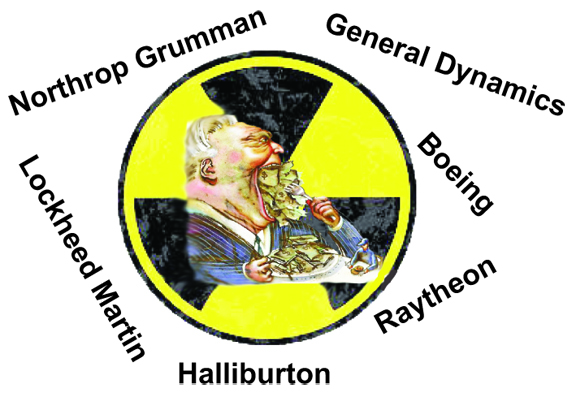
Since fiscal year 2001, military contractors have received over 54% of Pentagon spending, totaling about $8 trillion,” Sludge noted. “Over $2.2 trillion of that went to the five largest weapons firms: Lockheed Martin, Raytheon, General Dynamics, Boeing, and Northrop Grumman. These five firms comprise about 40% of military industry cash given to federal candidates.”
Dems Who Opposed Pentagon Cuts Received Nearly 4x More Donations From Weapons Makers, Common Dreams The latest passage of the NDAA “is particularly strong evidence that Pentagon contractors’ interests easily take precedence over national security and the public interest for too many members of Congress,” said one critic.
Dems Who Opposed Pentagon Cuts Received Nearly 4x More Donations From Weapons Makers, Common Dreams The latest passage of the NDAA “is particularly strong evidence that Pentagon contractors’ interests easily take precedence over national security and the public interest for too many members of Congress,” said one critic.
KENNY STANCIL Common Dreams, September 24, 2021 In a bipartisan 316-113 vote on Thursday night, the U.S. House authorized a $778 billion military budget for fiscal year 2022. Every Republican voted against two amendments to reduce Pentagon spending, but Democrats were split, and a new analysis reveals that lawmakers who rejected the proposed cuts received far more campaign cash from the weapons industry than those who supported the cuts.
One amendment to the National Defense Authorization Act (NDAA), introduced by Rep. Mark Pocan (D-Wis.), would have slashed the overall spending authorization level by 10%, exempting the paychecks and health benefits of military personnel and the Defense Department’s federal civilian workforce.
The measure failed by a tally of 86-332. According to an analysis of OpenSecrets data by the Security Policy Reform Institute (SPRI) and Sludge, the Democrats who voted against the 10% Pentagon budget cut have taken, on average, 3.7 times more campaign money from arms manufacturers since January 2019 than the Democrats who voted for it.
Sludge‘s Donald Shaw and SPRI’s Stephen Semler wrote Friday that “the average amount of defense cash received by Democrats who opposed the amendment was $60,680, while the Democrats who supported it received an average of $16,497” in contributions from the PACs of Defense Department contractors “as well as donations larger than $250 from those companies’ employees.”
“The vote was a step backwards for House progressives,” noted Shaw and Semler, who added that:
Last year, an identical amendment was put forward and it received 93 votes in favor, seven more than it received yesterday. Nine Democrats switched from supporting the 10% reduction last year to opposing it this year: Emanuel Cleaver (Mo.), Dwight Evans (Pa.), Al Green (Texas), Bill Keating (Mass.), Robin Kelly (Ill.), Stephen Lynch (Mass.), Richard Neal (Mass.), Brad Sherman (Calif.), and Bennie Thompson (Miss.).
Earlier this month, the House Armed Services Committee voted in favor of a Republican-sponsored amendment to add $23.9 billion on top of President Joe Biden’s proposed $753 billion military budget for fiscal year 2022—already up from the $740 billion approved for the previous fiscal year under the Trump administration.
A second NDAA amendment, led by Rep. Barbara Lee (D-Calif.), would have restored military spending to the level requested by the president. That proposal for a modest 3% cut to the NDAA’s top-line figure garnered the support of a majority of—but not all—House Democrats and was shot down in a 142-286 vote.
Sludge reported that “the 77 Democrats who opposed the 3% cut have received, on average, $52,211 from the defense sector since January 2019, and the 142 Democrats who supported it have received an average of $35,898.”
Lindsay Koshgarian, program director of the National Priorities Project at the Institute for Policy Studies (IPS), told Common Dreams on Friday that “the passage of the $23.9 billion increase in the House is particularly strong evidence that Pentagon contractors’ interests easily take precedence over national security and the public interest for too many members of Congress.”
As she spoke in support of Pocan’s amendment on Wednesday, Rep. Alexandria Ocasio-Cortez (D-N.Y.) pushed back against the narrative that cutting Pentagon spending would make Americans less safe, emphasizing how easy it would be to find the funds.
“The Pentagon could save almost $58 billion by eliminating obsolete weapons, weapons like Cold War-era bombers and missiles designed and built in the last century that are completely unsuitable for this one,” said Ocasio-Cortez.
“We could find another $18 billion by simply preventing the end-of-year spending sprees that lead to contract money being shoveled out the door every September,” she added, echoing Sen. Bernie Sanders’ (I-Vt.) observation earlier this week that the Pentagon—which has never passed an audit—is “inherently susceptible to fraud.”…………………
The House passage of the NDAA came just over a week after researchers at Brown University’s Costs of War project estimated that as much as half of the $14 trillion that the Pentagon has spent since the U.S. invasion of Afghanistan two decades ago has gone to private military contractors. IPS’ Koshgarian and SPRI’s Semler, meanwhile, have both said that corporations gobbled up more than half.
“Since fiscal year 2001, military contractors have received over 54% of Pentagon spending, totaling about $8 trillion,” Sludge noted. “Over $2.2 trillion of that went to the five largest weapons firms: Lockheed Martin, Raytheon, General Dynamics, Boeing, and Northrop Grumman. These five firms comprise about 40% of military industry cash given to federal candidates.” https://www.commondreams.org/news/2021/09/24/dems-who-opposed-pentagon-cuts-received-nearly-4x-more-donations-weapons-makers
Nuclear lobby stooge Jennifer Granholm wants ”unusual partnerships” in order to save the nuclear industry

Top U.S. Energy Official Sees ‘Unusual Partnerships’ for Nuclear, From reactors at coal plants to hydrogen production and potential cross-border collaboration, Secretary of Energy Jennifer Granholm is seeking new roles for U.S. nuclear power.
Bloomberg Green, By Jonathan Tirone, 21 September 2021, The Biden administration’s top energy official said the nuclear industry should broaden its business case beyond power markets in order to ensure its place in a carbon-free economy.
U.S. nuclear energy has come under relentless pressure in recent years from cheap natural gas, solar and wind power. More reactors are being taken offline permanently than built, risking the long-term future of the country’s biggest clean energy source. resident Joe Biden has pledged financial support to keep aging atomic plants online. Secretary of Energy Jennifer Granholm said “building back better” for nuclear might mean more than just generating electricity as it competes with emerging renewable energy and storage technologies.

“We need to pursue a silver buckshot rather than a silver bullet approach,” Granholm said in an interview with Bloomberg News in Vienna. The former governor of Michigan said some “unusual partnerships” between nations and industries might be needed for U.S. nuclear operators to tap the $23 trillion global clean [nuclear is NOT clean] energy market over the next decade. Granholm urged more cross-border collaboration in developing a new generation of small modular reactors, as well as using nuclear plants for the production of emissions-free hydrogen…….
Granholm spoke at a meeting of senior officials at the International Atomic Energy Agency, where Chinese and Russian envoys called for more research-and-development collaboration to accelerate the deployment of new generations of miniature reactors.
The Department of Energy curtailed some joint projects with China during the Trump administration, including work on a test reactor backed by billionaire Bill Gates. Granholm suggested the urgency of the climate crisis might require re-evaluating prohibitions on some technology transfers and cooperation. She did not signal any new near-term partnerships with Russia or China. The issue could be revisited during two weeks of international climate talks — known as COP26 — beginning Oct. 31 in Glasgow, Scotland…..

Granholm reserved special praise for the Gates-led company, TerraPower LLC, which in June announced it would build its first test plant at a shuttered coal site in Wyoming rather than in China. …. https://www.bloomberg.com/news/articles/2021-09-21/top-u-s-energy-official-sees-unusual-partnerships-for-nuclear
Pentagon forces out Leonor Tomero, a top official with moderate views (they can’t have that!)
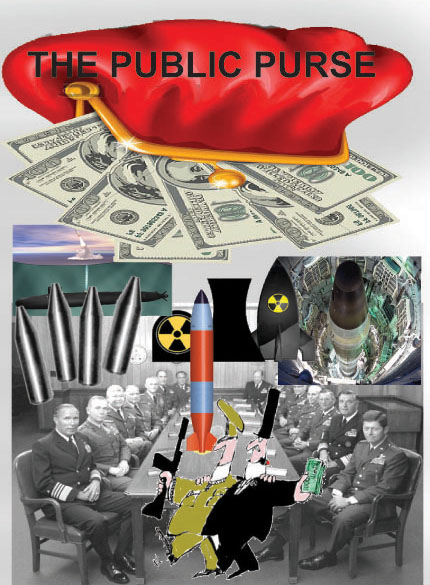
Pentagon hawks circle Biden’s nuclear policy, Politico, By ALEXANDER WARD 09/23/2021 With help from Daniel Lippman The forced dismissal of a top Pentagon nuclear official could mean curtains for President JOE BIDEN’s nuclear agenda.
Biden installed national security officials intent on negotiating new arms control treaties and curtailing nuclear weapons spending. One of them was LEONOR TOMERO, a leading voice for nuclear restraint on Capitol Hill and in the think tank community, who was appointed to oversee the Nuclear Posture Review that will set the administration’s nuclear weapons policy and strategy.
But officials with more traditional views on nuclear weapons, who promote a more hawkish nuclear agenda to include modernizing the land, sea and airborne legs of America’s nuclear arsenal, did not take kindly to Tomero’s progressive ideology, 11 current and former defense officials, as well as others with insight into the debate, told our own LARA SELIGMAN and BRYAN BENDER (with an assist from your host).
“Her appointment was something that people were immediately resistant to,” JEFFREY LEWIS, a professor and nuclear weapons expert at the Middlebury Institute for International Studies and host of the podcast Arms Control Wonk, told POLITICO. “People with very traditional views of nuclear weapons policy did not want someone in charge of the Nuclear Posture Review who might think differently about those issues.”
The Defense Department insists Tomero was nothing more than a casualty of a reorganization, leaving no space for her as her duties were moving to another office……….
Experts now worry that her removal signals the Nuclear Posture Review, or NPR, will not fully consider alternative options for maintaining the U.S. nuclear deterrent that might be less costly or evaluate new ways to carry out nuclear strategy.
“The decision to fire Leonor suggests to me that the first draft of NPR is going to be a continuation of the line of thinking we saw in the Trump administration’s NPR,” Lewis said. “They have put themselves on the course that is a first draft that is 180 degrees to what Biden said on the campaign trail.”
If that’s the case, one staffing change over at DoD might be the death knell for Biden’s hopes of changing U.S. nuclear policy for the foreseeable future.
The United States is currently planning to upgrade the nuclear force to the tune of $634 billion over the next decade, according to a recent analysis by the nonpartisan Congressional Budget Office.
Read Seligman and Bender’s full story here. https://www.politico.com/newsletters/national-security-daily/2021/09/23/pentagon-hawks-circle-bidens-nuclear-policy-494450
Jennifer Granholm and Westinghouse enthusiastic to sell ”clean” nuclear power to Poland

You really have to wonder just who Jennifer Granholm works for. Is it the American people, or is it the nuclear industry? She’s great at regurgitating nuclear lies about ”clean” nuclear
US lures Eastern Europe with nuclear power, $23t in clean [nuclear is NOT clean]energy market
By Frédéric Simon | EURACTIV.com 24 Sept 21, The climate crisis presents “a market opportunity for carbon-reducing technologies” such as nuclear power, said US energy Secretary Jennifer Granholm, teasing a $23 trillion market to countries in Central and Eastern Europe by 2030.
Low-carbon technologies “will be a 23 trillion-dollar market by the end of this decade,” which offers “an enormous potential to countries on both sides of the Atlantic,” Granholm said on Wednesday (22 September).
Speaking from Poland during an online press briefing, Granholm said the transatlantic market “will give us a chance to launch new business, new industries, to attract billions of dollars of new investment, and certainly to create millions of new jobs”………
In the US, President Biden’s ‘build back better‘ agenda includes an objective to have 100% of US electricity produced from “clean sources” by 2035, [nuclear is NOT clean] she explained, saying this involves reducing CO2 emissions by more than 50% by 2030 and cutting them down to net-zero by 2050……
Nuclear: ‘The reason we’re here.’
And nuclear power features highly among the US objectives.
“The reason we’re here in Poland is because we have been talking about a partnership in the area of nuclear,” Granholm said. “We’re really excited that we may have this partnership here with Poland”.
In October last year, Warsaw and Washington signed a 30-year intergovernmental agreement on future cooperation in the development of the Polish civil nuclear energy programme.
And the US is in pole position to win those contracts.
“Our collaboration to develop Poland’s civil nuclear programme is vital to Poland achieving EU carbon reduction targets and to guarantee its energy security,” Granholm said. “That dispatchable, clean [nuclear is NOT clean] , uninterruptable power is the gold standard of what every nation is looking for” in their quest to reduce CO2, she explained.
In July, US nuclear power firm Westinghouse announced the launch of a front-end engineering and design study – or FEED – under a grant from the US Trade Development Agency to advance Poland’s nuclear energy programme.
“It’s an opportunity to give American technology to help meet Poland’s clean-energy needs, [nuclear is NOT clean] and Westinghouse is going to offer its AP1000 nuclear reactor for the project,” Granholm said. https://www.euractiv.com/section/energy/news/us-lures-eastern-europe-with-nuclear-power-23tln-clean-energy-market/
Senator Markey calls on Biden administration for answers on removal of top Defense official Ms. Tomero
SENATOR MARKEY ASKS BIDEN ADMINISTRATION FOR ANSWERS ON ELIMINATION OF KEY NUCLEAR POLICY POSITION AS PART OF DEPARTMENT REORGANIZATION https://www.markey.senate.gov/news/press-releases/senator-markey-asks-biden-administration-for-answers-on-elimination-of-key-nuclear-policy-position-as-part-of-department-reorganizationLead civilian official within the Office of the Secretary of Defense (OSD) was responsible for drafting the Nuclear Posture Review Washington (September 24, 2021) – Senator Edward J. Markey (D-Mass.) today wrote to President Joseph R. Biden to express concern about organizational changes at the Department of Defense in the midst of drafting the administration’s Nuclear Posture Review. On September 21, 2021 the Department of Defense announced that it removed the lead civilian official within the Office of the Secretary of Defense (OSD) responsible for drafting the Nuclear Posture Review, part of the Administration’s Integrated National Security Strategy.
“The Department of Defense stated that it eliminated the position of the Deputy Assistant Secretary for Nuclear and Missile Defense Policy, held by Leonor Tomero, as part of a reorganization within the Department. But according to press reports, Department officials may have driven Ms. Tomero from her position for challenging traditional views on the role of U.S. nuclear weapons.
“Congress needs to understand whether ideology played any role in Ms. Tomero’s dismissal. I am also concerned that the sudden departure of a top appointee, charged with presenting you options on the future of the U.S. nuclear weapons enterprise, will result in a draft Nuclear Posture Review that reflects the Cold War era’s overreliance on nuclear weapons, rather than your lifetime of work championing policies that reduce nuclear weapons risks.” A copy of this letter can be found HERE.
In his letter, Senator Markey requests responses to the following questions:
1. Why did the Defense Department eliminate the top civilian position in OSD responsible for the Nuclear Posture Review? Why was the position eliminated in the midst of that Review, as opposed to before it began or when it is completed?
2. Ms. Tomero’s demonstrated expertise in nuclear deterrence policy, arms control, and missile defense made her well-suited to lead and contribute substantively to the Nuclear Posture Review process. Why, given Ms. Tomero’s specific expertise on nuclear policy, was she removed from the Nuclear Posture Review process or why was she not reassigned to a position under the Assistant Secretary of Defense for Space Policy, who will be taking over responsibility for nuclear policy?
3. When did the Department of Defense inform Ms. Tomero that it had eliminated her position as a result of a reorganization? Which Department officials communicated with Ms. Tomero about her dismissal and when? I am particularly interested in any communications that occurred between or among Ms. Tomero, her then-boss Acting Assistant Secretary of Defense for Strategy, Plans, and Capabilities, Melissa Dalton, and Undersecretary of Defense for Policy Colin Kahl. After Ms. Tomero’s dismissal, did any senior Department leader communicate with her about the reason(s) for her dismissal?4. The Defense Department stated that the decision to eliminate the Deputy Assistant Secretary of Defense for Nuclear and Missile Defense Policy was part of a reorganization within OSD Policy. How will the reorganization change the current OSD Policy office structure? Which officials will take over the duties previously performed by the former Deputy Assistant Secretary position?
5. On September 22, 2021, Defense Department Spokesperson John Kirby said that “we have a wide-ranging team of experts working” on the Nuclear Posture Review. Please identify the individuals and organizations consulting on the Nuclear Posture Review, including paid contractors.
6. Mr. Kirby also said: “We’re going to continue to consider and include a wide range of viewpoints in the Nuclear Posture Review, including those from Administration Officials, of military leaders, academics and all others.” How will the Department ensure that the advice of individuals who do not support the default military reliance on nuclear weapons is included in this process?
7. The President’s 2021 Interim National Security Guidance stated that the Administration will “re-establish [its] credibility as a leader in arms control” and “take steps to reduce the role of nuclear weapons in [U.S.] national security strategy. How will you ensure that your guidance is reflected in the options the Department of Defense puts forth?
8. I understand that the Department of Defense expects that by 2022 an independent review will be completed to evaluate the technical feasibility of extending the life of the Minuteman III intercontinental ballistic missile (ICBM). To what extent will that independent review impact the options presented to you in connection with the Nuclear Posture Review and your Fiscal Year 2023 budget request
In July, Senators Edward J. Markey (D-Mass.), Jeffrey A. Merkley (D-Ore.) and Representatives Don Beyer (VA-08) and John Garamendi (CA-03), co-chairs of the Nuclear Weapons and Arms Control Working Group, led 18 of their colleagues in aletter calling on President Biden to actively guide the formation of the Department of Defense-led Nuclear Posture Review. The lawmakers urged the Administration to consider a series of bold actions that would fulfill the President’s pledge to reduce the role of “nuclear weapons in our national security strategy”.
USA has conned Australia into paying for its super-costly nuclear submarine project

Last week’s AUKUS announcement was nothing more than PR stunt in Australia, with the government merely committing to spend the next 18 months deciding what to buy—which conveniently kicks any actual the decision far enough down the road to avoid the next federal election.
Has PM put Australia on the hook to finance struggling UK, US submarine projects? Michael West Media, By Marcus Reubenstein| September 23, 2021,
“Almost comical”. Experts lambast Scott Morrison’s “crazy” AUKUS deal to buy nuclear submarine tech from parlous UK and US programs. Marcus Reubenstein finds a real prospect Australia will be used to “underwrite” the foundering foreign submarine industry.
Twenty-five years of ongoing maintenance delays for nuclear submarines, chronic shortage of both parts and skilled workers, under capacity at shipyards, and attack class submarines missing from deployments for up to nine months. These sound like potential problems for Australia’s future nuclear submarine fleet but they are actual problems right now confronting the US Navy and its fleet of 70 submarines.
The US is at the cutting edge of nuclear propulsion. It has the largest and most sophisticated submarine fleet in the world, its first nuclear submarine was commissioned 67 years ago, and the US has literally decommissioned twice as many nuclear subs as Australia is planning to buy.
If the US cannot manage to keep its fleet in the water, how can the Morrison government commit up to $100 billion of taxpayer money to secure nuclear submarines and guarantee they will be always operational and ready for deployment?
Professor Hugh White, ANU Professor of Strategic Studies, former Deputy Secretary of Defence and an eminent figure in strategic policy, wrote in The Saturday Paper, “The old plan was to build a conventionally powered version of a nuclear-powered French submarine. It was crazy.”
“The new plan—to buy a nuclear-powered submarine instead—is worse”.
Says White, “There is a reason why only six countries, all of them nuclear-armed, operate nuclear powered subs.”
The sales pitch is underway
Last week’s AUKUS announcement was nothing more than PR stunt in Australia, with the government merely committing to spend the next 18 months deciding what to buy—which conveniently kicks any actual the decision far enough down the road to avoid the next federal election.
The ripples of the announcement, however, reached British shores in double-quick time. Just two days after the AUKUS alliance UK Defence Secretary Ben Wallis announced a $320 million (£170m) grant to be shared between BAE Systems and Rolls Royce to develop technology for Britain’s next generation submarines.
According to Department of Finance figures, In the past twelve months BAE Systems has collected $1.88 billion from Australian taxpayers. The Astute class submarine, touted as one of the two options Australia is considering, is manufactured by BAE Systems.
US Naval analyst, and Forbes Defense columnist, Craig Hooper predicts AUKUS could give the US Navy a big shot in the arm as well. He says a deal with Australia could effectively underwrite major improvements to the US Navy’s outdated submarine maintenance facilities by supporting “America’s decade-long, $US25 billion ($34.6 billion) effort to refit the U.S. Navy’s four aging public shipyards. With yard repair costs already high, America would go to great lengths to welcome any additional bidders for shipyard capability improvements.”
US subs in dry dock In a report published six months ago, the US Congressional Budget Office (CBO) found: “The Navy’s four shipyards have experienced significant delays in completing maintenance on its submarines (all of which are nuclear-powered).” ………. Should Australia go down the nuclear sub path what choice will it have other than to outsource the fleet’s maintenance? …..
Her Majesty’s sub optimal fleet
Britain, touted as the alternative nuclear submarine supplier to Australia, has problems of its own. The Royal Navy operates ten submarines, only four of them were designed and commissioned this century.
Like their American nuclear counterparts there are systemic problems keeping these subs in service……
That report also indicated significant delays to the BAE Systems built Astute hunter-killer submarines, the same class of nuclear submarine being touted for Australian as part of the AUKUS deal………. https://www.michaelwest.com.au/has-pm-put-australia-on-the-hook-to-finance-struggling-uk-us-submarine-projects/
New push on to expand nuclear radiation compensation in US
New push on to expand nuclear radiation compensation in US https://www.seattletimes.com/seattle-news/health/new-push-on-to-expand-nuclear-radiation-compensation-in-us/, Sep. 22, 2021 By SUSAN MONTOYA BRYAN, The Associated Press
ALBUQUERQUE, N.M. (AP) — A bipartisan group of lawmakers is renewing a push to expand a U.S. compensation program for people who were exposed to radiation following uranium mining and nuclear testing carried out during the Cold War.
Advocates have been trying for years to bring awareness to the lingering effects of nuclear fallout surrounding the Trinity Site in southern New Mexico, where the U.S. military detonated the first atomic bomb, and on the Navajo Nation, where more than 30 million tons of uranium ore were extracted over decades to support U.S. nuclear activities.
Under legislation introduced Wednesday by U.S. Sens. Ben Ray Luján, a Democrat from New Mexico, and Mike Crapo, a Republican from Idaho, other sites across the American West would be added to the list of places affected by fallout and radiation exposure. Eligibility also would be expanded to include certain workers in the industry after 1971, such as miners.
The legislation also would increase the amount of compensation someone can receive to $150,000 and provide coverage for additional forms of cancer.
A multibillion-dollar defense spending package approved last year included an apology to New Mexico, Nevada, Utah and other states affected by radiation from nuclear testing, but no action was taken on legislation that sought to change and broaden the compensation program.
Advocates, including those who testified before Congress earlier this year, say it’s time to do so, especially because the existing provisions are set to expire next July. The legislation would extend the Radiation Exposure Compensation Act, or RECA, another 19 years.
Tina Cordova, a cancer survivor and co-founder of the Tularosa Basin Downwinders Consortium, said she has been working on the legislation for months with other residents of places affected by radiation, from Indigenous communities in New Mexico to Gaum.
Continue readingU.S. Militarism’s Toxic Impact on Climate Policy
Biden told the UN General Assembly that “…as we close this period of relentless war, we’re opening a new era of relentless diplomacy.” But his exclusive new military alliance with the U.K. and Australia, and his request for a further increase in military spending to escalate a dangerous arms race with China that the United States started in the first place, reveal just how far Biden has to go to live up to his own rhetoric, on diplomacy as well as on climate change
U.S. Militarism’s Toxic Impact on Climate Policy, Medea Benjamin and Nicolas J. S. Davies LA Progressive 22 Sept 21, President Biden addressed the UN General Assembly on September 21 with a warning that the climate crisis is fast approaching a “point of no return,” and a promise that the United States would rally the world to action. “We will lead not just with the example of our power but, God willing, with the power of our example,” he said.
But the U.S. is not a leader when it comes to saving our planet. Yahoo News recently published a report titled “Why the U.S. Lags Behind Europe on Climate Goals by 10 or 15 years.” The article was a rare acknowledgment in the U.S. corporate media that the United States has not only failed to lead the world on the climate crisis, but has actually been the main culprit blocking timely collective action to head off a global existential crisis.
The anniversary of September 11th and the U.S. defeat in Afghanistan should be ringing alarm bells inside the head of every American, warning us that we have allowed our government to spend trillions of dollars waging war, chasing shadows, selling arms and fueling conflict all over the world, while ignoring real existential dangers to our civilization and all of humanity.
The world’s youth are dismayed by their parents’ failures to tackle the climate crisis. A new survey of 10,000 people between the ages of 16 and 25 in ten countries around the world found that many of them think humanity is doomed and that they have no future.
Three quarters of the young people surveyed said they are afraid of what the future will bring, and 40% say the crisis makes them hesitant to have children. They are also frightened, confused and angered by the failure of governments to respond to the crisis. As the BBC reported, “They feel betrayed, ignored and abandoned by politicians and adults.”
Young people in the U.S. have even more reason to feel betrayed than their European counterparts. America lags far behind Europe on renewable energy. European countries started fulfilling their climate commitments under the Kyoto Protocol in the 1990s and now get 40% of their electricity from renewable sources, while renewables provide only 20% of electric power in America. ………..
the enormous amount of money the U.S. spends on militarism. Since 2001, the United States has allocated $15 trillion (in FY2022 dollars) to its military budget, outspending its 20 closest military competitors combined. The U.S. spends far more of its GDP (the total value of goods produced and services) on the military than any of the other 29 Nato countries—3.7% in 2020 compared to 1.77%. And while the U.S. has been putting intense pressure on NATO countries to spend at least 2% of their GDP on their militaries, only ten of them have done so. Unlike in the U.S., the military establishment in Europe has to contend with significant opposition from liberal politicians and a more educated and mobilized public. ………
On climate change, the infrastructure bill includes only $10 billion per year for conversion to green energy, an important but small step that will not reverse our current course toward a catastrophic future. Investments in a Green New Deal must be bookended by corresponding reductions in the military budget if we are to correct our government’s perverted and destructive priorities in any lasting way. This means standing up to the weapons industry and military contractors, which the Biden administration has so far failed to do.
The reality of America’s 20-year arms race with itself makes complete nonsense of the administration’s claims that the recent arms build-up by China now requires the U.S. to spend even more. China spends only a third of what the U.S. spends, and what is driving China’s increased military spending is its need to defend itself against the ever-growing U.S. war machine that has been “pivoting” to the waters, skies and islands surrounding its shores since the Obama administration.
Biden told the UN General Assembly that “…as we close this period of relentless war, we’re opening a new era of relentless diplomacy.” But his exclusive new military alliance with the U.K. and Australia, and his request for a further increase in military spending to escalate a dangerous arms race with China that the United States started in the first place, reveal just how far Biden has to go to live up to his own rhetoric, on diplomacy as well as on climate change
The United States must go to the UN Climate Summit in Glasgow in November ready to sign on to the kind of radical steps that the UN and less developed countries are calling for. It must make a real commitment to leaving fossil fuels in the ground; quickly convert to a net-zero renewable energy economy; and help developing countries to do the same. As UN Secretary General Antonio Guterres says, the summit in Glasgow “must be the turning point” in the climate crisis.
That will require the United States to seriously reduce the military budget and commit to peaceful, practical diplomacy with China and Russia. Genuinely moving on from our self-inflicted military failures and the militarism that led to them would free up the U.S. to enact programs that address the real existential crisis our planet faces – a crisis against which warships, bombs and missiles are worse than useless. https://www.laprogressive.com/toxic-impact-on-climate-policy/
-
Archives
- October 2026 (104)
- September 2026 (339)
- August 2026 (330)
- July 2026 (355)
- June 2026 (287)
- May 2026 (306)
- April 2026 (356)
- March 2026 (251)
- February 2026 (267)
- January 2026 (308)
- December 2025 (358)
- November 2025 (359)
-
Categories
- 1
- 1 NUCLEAR ISSUES
- business and costs
- climate change
- culture and arts
- ENERGY
- environment
- health
- history
- indigenous issues
- Legal
- marketing of nuclear
- media
- opposition to nuclear
- PERSONAL STORIES
- politics
- politics international
- Religion and ethics
- safety
- secrets,lies and civil liberties
- spinbuster
- technology
- Uranium
- wastes
- weapons and war
- Women
- 2 WORLD
- ACTION
- AFRICA
- Atrocities
- AUSTRALIA
- Christina's notes
- Christina's themes
- culture and arts
- Events
- Fuk 2022
- Fuk 2023
- Fukushima 2017
- Fukushima 2018
- fukushima 2019
- Fukushima 2020
- Fukushima 2021
- general
- global warming
- Humour (God we need it)
- Nuclear
- RARE EARTHS
- Reference
- resources – print
- Resources -audiovicual
- Weekly Newsletter
- World
- World Nuclear
- YouTube
-
RSS
Entries RSS
Comments RSS

