Decommissioning is just the beginning of the huge nuclear legacy problem

Nuclear power concerns outlast decommissioning, Great Lakes Echo, By Cameryn Cass 4 Feb 22,
Editor’s note: This is part of a package of two articles and a podcast about nuclear power in Michigan.
As Michigan and other states gradually move away from coal and other brown energy sources, there’s growing interest in carbon-free alternatives, including nuclear energy,
As Michigan and other states gradually move away from coal and other brown energy sources, there’s growing interest in carbon-free alternatives, including nuclear energy, which some advocates call a “clean alternative” that now fuels 30% of Michigan’s total electricity.
One nuclear plant in the state, Big Rock Point in Charlevoix closed in 1997 and has been fully decommissioned. In the spring of 2022, the Palisades Nuclear Plant in Southwest Michigan’s Van Buren County will close because of a “business decision.”
Michigan also has the Fermi Nuclear Power Plant in Newport, near Monroe, and the Donald C. Cook Nuclear Power Plant in Berrien County’s Bridgman, according to the Department of Environment, Great Lakes and Energy.
With Palisades and other plants in the Great Lakes region scheduled to shut down in the coming decades, more people are considering the long-term impacts of this energy source.
After decommissioning, radioactive waste remains on-site, said Susan Chiblow, an Indigenous environmental scholar in Ontario.
The waste stays in the environment for trillions of years, so calling nuclear power clean is propaganda, she said.
In short, risks don’t disappear when a plant is decommissioned, a process that can take up to 60 years, said Edwin Lyman, the nuclear safety project director at the Union of Concerned Scientists, a nonprofit science advocacy organization based in Massachusetts.
Although closed plants no longer have to worry about accidents post shut-down, their operators remain responsible for managing the radiated materials and spent nuclear waste, Lyman said.
He said waste now stored on-site is vulnerable to security threats and climate disasters.
For five years, the waste is kept in large swimming pool-like structures where it’s mixed with water to keep it cool. Then, it’s transferred to dry casks, he said.
The U.S. Department of Energy is technically responsible for removing the waste, but it has nowhere to bring it, Lyman said.
“It’s going to be a long-term storage problem for any nuclear plant that’s shut down,” Lyman said……………………………
Thirteen states have banned construction of new nuclear plants.
In the Great Lakes region, Minnesota adopted its ban in 1994. ……
Because the Great Lakes account for one-fifth of the world’s freshwater, Chiblow and other environmentalists are especially interested in protecting it……….c
Bill To Ban Spent Nuclear Fuel Storage In New Mexico Passes House Committee

“It’s inconceivable why New Mexico has to be the dumping ground for the nation’s ill-advised investment in nuclear energy and nuclear weapons,” said Paul Gibson, co-founder of Retake Our Democracy. “The risk to our community is far greater than the benefit.”
Although the site is termed temporary, Holtec is seeking a 40-year license to operate there, which opponents say would make it permanent.
By SCOTT WYLAND, The Santa Fe New Mexican, 4 Feb 22, A bill clearly aimed at blocking Holtec International from building an underground storage site for spent nuclear fuel in southeastern New Mexico is moving forward.
The House Energy, Environment and Natural Resources Committee voted 5-4 to advance a bill that would ban the storage or disposal of spent nuclear fuel in the state — and would essentially kill Holtec’s plans to build a repository for this high-level radioactive waste in the Carlsbad area.
It now will go to the House Judiciary Committee.
A key point in the debate was whether the state has the authority to stop the federal government from approving what’s described as an interim storage site to keep the material until a permanent place is created.
Some lawmakers and regulators who back House Bill 127 say although the state can’t interfere with how the commission regulates the waste, it can block storage sites that could cause adverse environmental impacts.
The bill’s opponents argue the state still would be preempting the Nuclear Regulatory Commission’s authority in managing commercial nuclear waste. That simply is not allowed, no matter what criteria the state uses, they said.
But Sen. Jeff Steinborn, D-Las Cruces, who strongly supports the bill, said the state is well within its rights to say no to nuclear disposal sites that could contaminate vital resources, such as groundwater, and pose risks to communities when the waste is transported by rail across the country.
“Does New Mexico have the authority to do this? Yes, we do,” Steinborn said. “The Nuclear Regulatory Commission absolutely has primacy over regulating spent fuel. But what we’re talking here is the siting of this material, and our concerns on multiple grounds.”
Still, Rep. Larry Scott, R-Hobbs, contends the federal government’s power to regulate radioactive material overrides any state authority, including on environmental matters.
“I’m looking at your legislation, which seems to completely contradict that,” Scott said.
Last year, the state sued the federal government, contending the commission hadn’t done enough to ensure Holtec’s proposed site wouldn’t harm the environment, communities or the oil and gas industry in one of the nation’s richest fossil fuel regions.
Although the site is termed temporary, Holtec is seeking a 40-year license to operate there, which opponents say would make it permanent.
State Deputy Environment Secretary Rebecca Roose said no permanent disposal site has been established, so the waste has nowhere else to go.
“It’s more likely to stay there — the inertia will be to keep it there as opposed to move it someplace else permanent,” Roose said, “if and when a permanent facility is identified.”…………………
The bill’s proponents say it’s necessary to prevent a massive amount of high-level radioactive waste from coming to New Mexico and disproportionately affecting poor and minority communities.
“It’s inconceivable why New Mexico has to be the dumping ground for the nation’s ill-advised investment in nuclear energy and nuclear weapons,” said Paul Gibson, co-founder of Retake Our Democracy. “The risk to our community is far greater than the benefit.” https://ladailypost.com/bill-to-ban-spent-nuclear-fuel-storage-in-new-mexico-passes-house-committee/
Nuclear power: CO2 fix or cost disaster?
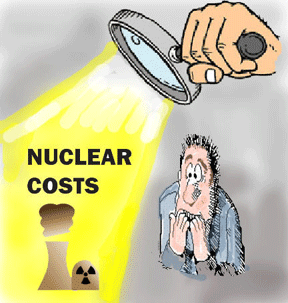
Nuclear power: CO2 fix or cost disaster? E and E News | 02/04/2022 President Biden’s plan to decarbonize the U.S. electricity sector by 2035 could give a boost to nuclear power, but that may hinge on two key questions: Can carbon targets really incentivize the technology, and can it compete cost wise with natural gas?
It’s a debate that is resurfacing, considering recent surging prices of natural gas.
Yet industry hasn’t answeredwhether nuclear will be more economic for producing power, especially after costs for two new reactors at Plant Vogtle in Georgia skyrocketed. The actual costs of 75 of the more than 90 existing nuclear power reactorsin the U.S. exceeded the initially estimated costs of the units by over 200 percent, according to the U.S. Department of Energy.
There are many facets of the cost question — existing nuclear plants in competitive markets face economic challenges that could force them to close early, saddling operators with stranded costs and removing emissions-free electrons [not really emissions-free] from the grid. Meanwhile, no large, baseload reactors are on the table. The industry is working to develop smaller, next-generation reactors by the next decade, but the fate and final costs of projects are uncertain.
“There doesn’t seem to be, in the near term, a big thing that’s going to be pushing” nuclear, said Paul Patterson, a utility analyst with Glenrock Associates LLC. Whether the nuclear industry builds new reactors could help shape the electricity mix for decades. Falling renewable energy costs and higher gas prices may also influence investment decisions for nuclear in unexpected ways.
………… Southern Co.’s Vogtle expansion project hasn’t helped the case for baseload nuclear. The project, which was supposed to lead a resurgence of larger reactors in the 2000s, remains theonly major nuclear power construction project in the United States. Vogtle’sprice tag is twice an earlier $14 billion budget, andthe project is more than seven years behind schedule.
……more than one big electric company has shelved its plans to build large reactors using similar technology because of the litany of troubles at Vogtle…………………….
it’s unclear whether SMRs will face some of the same cost challenges as traditional reactors.
In the past, the higher price tag for nuclearin comparison to expectations was tied to safety regulations, which are the most stringent of all power plants. What’s more, if any work needs to be redone to meet strict codes, that pushes out the deadline to finish the plant.
The longer it takes to get it right, the more expensive the reactors become.
“There are so many concerns about radioactive material, etc., so that’s what drives much of the cost,” Glenrock’s Patterson said. “You don’t have the same issues associated with regulations for other power plants, understandably so.”
………… A group of former nuclear regulators in the United States, Germany and France argued last month that nuclear isn’t safe, clean or smart.
It’smore expensive than renewables in terms of producing energy and mitigating carbon dioxide, even accounting for costs such as pairing renewable energy with storage, according to the group, which alsoincludes a former secretary to a United Kingdom radiation protection committee.
The former regulators said nuclear is unlikely “to make a relevant contribution to necessary climate change mitigation” that’s needed by the 2030s………………………………..
Gas and renewables
Ultimately, the trajectory of nuclear will directly affect how wind, solar, batteries and fossil fuels are used in the coming decades.
Coyle pointed out that while the cost of Vogtle has doubled during the seven-year delay, the price of renewables, including storage, has dropped. Going forward, she argues that Georgia Power should compare the cost of planned generation with not only combined-cycle natural gas but also with renewable options such as utility-scale solar and long-term agreements to buy wind power.
“This argument that, ‘Well, it’s reliable, it’s low-cost, it’s carbon-free,’ then why are we still comparing it to combined-cycle natural gas?” Coyle said.
“There are now significantly more cost-effective renewable energy options than any of us anticipated back in the day when Vogtle 3 and 4 were certified.”……………
Chomsky: US Approach to Ukraine and Russia Has “Left the Domain of Rational Discourse”
Chomsky: US Approach to Ukraine and Russia Has “Left the Domain of Rational Discourse” C.J. Polychroniou, Truthout 4 Feb 22, ”………….In a new exclusive interview for Truthout on the ongoing Russia-Ukraine crisis, world-renowned public intellectual Noam Chomsky outlines the deadly dangers of U.S. intransigence over Ukrainian membership in the North Atlantic Treaty Organization (NATO) even when key Western allies have already vetoed earlier U.S. efforts in that direction. He also seeks to shed some light on the reasons why Republicans today seem to be divided on Russia…………..
C.J. Polychroniou: Tensions continue to escalate between Russia and Ukraine, and there is little room for optimism since the U.S. offer for de-escalation fails to meet any of Russia’s security demands. As such, wouldn’t it be more accurate to say that the Russia-Ukraine border crisis stems in reality from the U.S.’s intransigent position over Ukrainian membership in NATO? In the same context, is it hard to imagine what might have been Washington’s response to the hypothetical event that Mexico wanted to join a Moscow-driven military alliance?
Noam Chomsky: We hardly need to linger on the latter question. No country would dare to make such a move in what former President Franklin Delano Roosevelt’s Secretary of War Henry Stimson called “Our little region over here,” when he was condemning all spheres of influence (except for our own — which in reality, is hardly limited to the Western hemisphere). Secretary of State Antony Blinken is no less adamant today in condemning Russia’s claim to a “sphere of influence,” a concept we firmly reject (with the same reservation).
There was of course one famous case when a country in our little region came close to a military alliance with Russia, the 1962 missile crisis. ………
The tensions over Ukraine are extremely severe, with Russia’s concentration of military forces at Ukraine’s borders. The Russian position has been quite explicit for some time. It was stated clearly by Foreign Minister Sergei Lavrov at his press conference at the United Nations: “The main issue is our clear position on the inadmissibility of further expansion of NATO to the East and the deployment of strike weapons that could threaten the territory of the Russian Federation.” Much the same was reiterated shortly after by Putin, as he had often said before
There is a simple way to deal with deployment of weapons: Don’t deploy them. There is no justification for doing so. The U.S. may claim that they are defensive, but Russia surely doesn’t see it that way, and with reason………………………
It is sometimes claimed that NATO membership increases security for Poland and others. A much stronger case can be made that NATO membership threatens their security by heightening tensions. Historian Richard Sakwa, a specialist on East Europe, observed that “NATO’s existence became justified by the need to manage threats provoked by its enlargement” — a plausible judgment……………………………
It is indeed curious to watch what is unfolding. The U.S. is vigorously fanning the flames while Ukraine is asking it to tone down the rhetoric. While there is much turmoil about why the demon Putin is acting as he is, U.S. motives are rarely subject to scrutiny. The reason is familiar: By definition, U.S. motives are noble, even if its efforts to implement them are perhaps misguided………………………………… https://truthout.org/articles/us-approach-to-ukraine-and-russia-has-left-the-domain-of-rational-discourse/?eType=EmailBlastContent&eId=0ec432a8-b38b-4908-8c62-c8ef785a8e3d
America’s military leaders reassure their staff ”We will win a nuclear war!”

US defense to its workforce: Nuclear war can be won, Bulletin of the Atomic Scientists, By Alan Kaptanoglu, Stewart Prager | February 2, 2022 Ronald Reagan and Mikhail Gorbachev once said that “a nuclear war cannot be won and must never be fought,” and five major nuclear weapon states, including the United States, repeated this statement earlier this year. Yet many in the US defense establishment—the military, government, think tanks, and industry—promote the perception that a nuclear war can be won and fought.
Moreover, they do so in a voice that is influential, respected, well-funded, and treated with deference. The US defense leadership’s methodical messaging to its workforce helps shape the views of this massive, multi-sector constituency that includes advocates, future leaders, and decision makers. It advances a view of nuclear weapon policies that intensifies and accelerates the new nuclear arms race forming between the United States, China, and Russia.
The 23-chapter Guide to Nuclear Deterrence in the Age of Great Power Competition provides an excellent and representative case study for examining this critical messaging. This guide is published by the Louisiana Tech Research Institute, which provides support for the US Air Force Global Strike Command. It is written by nuclear arms experts for the approximately 30,000 members of the US Air Force Global Strike Command and the “700,000 total force airmen who engage in the profession of arms.”
All of the authors have direct or indirect connections with the nuclear weapons complex or associated think tanks, and several of the authors have held senior positions with the Air Force Global Strike Command, US Strategic Command, and other national security agencies in the US government. The guide’s messaging is comprehensive but dangerously skewed.
The guide centers around a new reality—the aggressive development of nuclear arms by Russia and China that is intensifying a new Cold War. Nuclear arms treaties—an important tool for limiting arms races—are brushed aside as functionally pointless since, according to the guide, Russia will cheat and China won’t come to the bargaining table. In one passage, the guide claims “it is unlikely that these countries would be foolish enough to engage in a strategic arms race with the United States, and, if they do, they will lose.” Yet much of the remainder of the document analyzes all the ways in which China and Russia are advancing their capabilities beyond US capabilities. These threatening developments are then used to justify the rapid and expensive modernization of the US nuclear weapon complex, while many historic nuclear arms agreements wither away, including the Anti-Ballistic Missile Treaty, Intermediate-range Nuclear Forces Treaty, and the Iran nuclear deal.
What follows are some of the misrepresentations, an omission, and a questionable policy in the guide:
Misrepresentation: A nuclear war can be fought and won. That the US military considers scenarios under which nuclear deterrence fails is unsurprising. But in the event of limited nuclear war, the United States has plans in place to “beat” its adversaries. …………………
Omission: The reality of nuclear war. In this more-than-400 page guide, only three pages are devoted to a rather anodyne description of the devastating harms of nuclear weapons. ………..
The guide does not mention the well-documented human toll of the bombings of Hiroshima and Nagasaki. The guide does not discuss the full horrors of the “day after” a nuclear exchange. Nor does it address the potentially civilization-ending effects of climate change and nuclear winter from the resulting firestorms. …………………
Misrepresentation: Nuclear weapons keep the peace. The guide credits nuclear weapons and US nuclear superiority with the era of “long peace”—the absence of major wars between superpowers since 1945. As such, it posits that, the more US nuclear weapons, the better………………
The guide does not note that the world came very close to a potentially catastrophic nuclear exchange during the Cuban Missile Crisis. It singularly portrays US nuclear weapons as a benefit for humankind.
Misrepresentation: Nuclear weapon mistakes and accidents never happen. Indeed, the guide does not mention the many well-documented false-alarms and close calls of nuclear detonation from technical or human error that could have led to catastrophe. It does not acknowledge the dangers posed by the imperfect humans who control the nuclear weapons and infrastructure. It does not mention that intercontinental ballistic missile (ICBM) crew members were caught cheating on exams or that the Joint Chiefs’ of Staff unanimously recommended an invasion of Cuba during the missile crisis. Nor is there mention of the harms caused by nuclear testing to many communities.
The guide portrays the United States as if it is in perfect control of its nuclear weapons operations.
Questionable policy: A nuclear triad is necessary. The guide argues strenuously that the United States would be less secure without all three legs of its nuclear triad consisting of warhead-equipped submarines, aircraft, and land-based missiles…………………
Lastly, this scenario assumes that NATO allies would not bother to use any of their several hundred nuclear warheads after an adversary destroys a significant portion of the US homeland.
The guide dismisses critiques of the ICBM force, including the accompanying launch-on-warning and use-them-or-lose-them postures that increase the danger of accidental nuclear war.
The authors seek perpetual US nuclear superiority. They dismiss the option of minimal deterrence—keeping only a minimal complement of nuclear weapons primarily to provide a second-strike capability—as not viable. According to the guide, the United States must not only possess a second-strike capability but the potential to fight and win a limited nuclear war against any adversary. ……………..
To be clear, the authors are considering a scenario in which at least several hundred nuclear weapons have been used on both the US and adversary’s homeland. Hundreds of millions of people are likely dead, modern civilization might have collapsed, and nuclear winter might soon starve another few billion people. What exactly is worth bargaining for in this scenario?
Finally, the guide notes that “[t]he United States has never been content with a mere second-strike capability.” In this context, “[t]he United States” appears to refer primarily to US military and government institutions; the majority of the US public favors a minimal deterrence policy, and an overwhelming majority support the phasing out of ICBMs, according to a recent poll.
……………. defense messaging justifies a vigorous and expanding nuclear arms force, exceptionalizes the United States, and blames downsides on Russia and China. If service members received more thoughtful messaging about nuclear deterrence and preparedness, their efforts to think critically might help them understand—in the profound ways that Reagan and Gorbachev once understood—that “a nuclear war cannot be won and must never be fought.” https://thebulletin.org/2022/02/us-defense-to-its-workforce-nuclear-war-can-be-won/
Raytheon and Lockheed Martin boast to investors that Ukraine-Russia crisis is a boon for their business

The statements come from leaders of an industry that exerts tremendous influence in Washington, employing an average of 700 lobbyists per year over the past five years, or more than one lobbyist per member of Congress, according to Brown University’s Costs of War project.
Everyone in D.C. knows that weapons manufacturers are helping skew U.S. policy towards militarism
WEAPONS COMPANIES BOAST UKRAINE-RUSSIA TENSIONS ARE BOON FOR BUSINESS , Popular Resistance, By Sarah Lazare, In These Times., January 31, 2022
In Calls With Investors, Raytheon And Lockheed Martin Boasted That The Worsening Conflict Is Helping Profits.As the United States weighs more involvement in the growing conflict between Ukraine and Russia, some of the largest weapons companies in the world — Raytheon and Lockheed Martin — are openly telling their investors that tensions between the countries are good for business. And General Dynamics, meanwhile, is boasting about the past returns the company has seen as a result of such disputes.
The statements come as the U.S. government escalates arms shipments to Ukraine, among them the Javelin missiles that are a joint venture between Raytheon and Lockheed Martin. House Democrats, meanwhile, are trying to quickly push through a bill that would significantly increase U.S. military assistance to Ukraine, and impose new sanctions on Russia.
Anti-war campaigners warn that U.S. escalation, amid renewed tensions between Ukraine and Russia, could bring dire consequences, and spill into a much larger and more protracted war. “As we are shipping advanced weaponry to the Ukrainian military, the Biden administration has signaled that U.S. military advisors will continue to stay in the country,” Cavan Kharrazian, progressive foreign policy campaigner for the advocacy organization Demand Progress, tells In These Times. “Who will most likely set up and teach the Ukrainian army how to use these weapons systems? The U.S. military.”
Among those openly discussing the boon to profits is Raytheon CEO Greg Hayes. During a January 25 appearance on CNBC’s “Squawk on the Street,” he was asked, “Do we have anything that would make it so if you inserted 8,000 American soldiers into Ukraine, they can stop 103,000 Russian soldiers?”
In his reply, Hayes touted the role the company could play in arming U.S. allies. “Obviously we have some defensive weapons systems that we could supply which could be helpful, like the patriot missile system.” He went on to add, “We’ve got the technologies to help in these engagements, whether it’s patriot systems, some of the radar systems.”………
If it sounds like Hayes is using mounting tensions as an advertising opportunity for his company, this may not be far fetched. On a January 25 earnings call (which was noted on Twitter by Nick Cleveland-Stout of the Quincy Institute), Hayes included “tensions in Eastern Europe” among the factors that Raytheon stands to benefit from. He said: “We just have to look to last week where we saw the drone attack in the UAE, which have attacked some of their other facilities. And of course, the tensions in Eastern Europe, the tensions in the South China Sea, all of those things are putting pressure on some of the defense spending over there. So I fully expect we’re going to see some benefit from it.”
Raytheon isn’t alone in its projections. Among those noting the likely boost to profits is Jim Taiclet, the chairman, president and CEO of Lockheed Martin. In a January 25 earnings call, he told investors, “If you look at the evolving threat level and the approach that some countries are taking, including North Korea, Iran and through some of its proxies in Yemen and elsewhere, and especially Russia today, these days, and China, there’s renewed great power competition that does include national defense and threats to it.”
This “great power competition,” he suggested to investors, bodes more business for the company. Taiclet says, “And the history of the United States is when those environments evolve, that we do not sit by and just watch it happen. So I can’t talk to a number, but I do think, and I’m concerned personally that the threat is advancing, and we need to be able to meet it.”
The statements come from leaders of an industry that exerts tremendous influence in Washington, employing an average of 700 lobbyists per year over the past five years, or more than one lobbyist per member of Congress, according to Brown University’s Costs of War project.
Everyone in D.C. knows that weapons manufacturers are helping skew U.S. policy towards militarism, but they usually try to be less obvious,” Erik Sperling, executive director of Just Foreign Policy, an anti-war organization, told In These Times. “They are cashing in on tensions over Ukraine as the U.S. pours weapons into the region.”……..
Everyone in D.C. knows that weapons manufacturers are helping skew U.S. policy towards militarism, but they usually try to be less obvious,” Erik Sperling, executive director of Just Foreign Policy, an anti-war organization, told In These Times. “They are cashing in on tensions over Ukraine as the U.S. pours weapons into the region.”
But Kharrazian warns, “While it may not be profitable for arms manufacturers, engagement in good-faith, realistic diplomacy is what will benefit the region as a whole and mitigate unnecessary and potentially catastrophic conflict.” https://popularresistance.org/top-weapons-companies-boast-ukraine-russia-tensions-are-a-boon-for-business/
New Mexico’s Bill to stop the State becoming a ‘sacrifice zone’ for nuclear wastes

“New Mexico, with less than one half of 1% of the nation’s population, should not continue to be the sacrifice zone because we can be exploited,”
New Mexico Debates Bill to Block Spent Nuclear Fuel Storage, Feb. 1, 2022, By SUSAN MONTOYA BRYAN, Associated PressALBUQUERQUE, N.M. (AP) — Gov. Michelle Lujan Grisham and members of New Mexico’s congressional delegation already have voiced strong opposition to building a multibillion-dollar facility along the state’s border with Texas that would store tons of spent nuclear fuel from commercial power plants around the U.S.
Top New Mexico officials contend the Nuclear Regulatory Commission hasn’t done enough to vet plans by Holtec International to build a facility to store thousands of tons of spent uranium in the state. They argue that without a plan by the federal government to deal with spent fuel, the material would remain in New Mexico indefinitely.
Texas Gov. Greg Abbott has also expressed his opposition to a similar storage facility in his state. Both states have sued the federal government over the issue.
Democratic Sen. Jeff Steinborn of Las Cruces, who is sponsoring the New Mexico legislation, said the federal government needs to address the problem and establish a policy for dealing with the spent fuel piling up at the nation’s nuclear power plants.
“New Mexico, with less than one half of 1% of the nation’s population, should not continue to be the sacrifice zone because we can be exploited,” he told fellow lawmakers, noting that many communities have passed resolutions opposed to bringing high-level nuclear waste to the state.
………………… The federal government is paying to house the fuel, and the cost is expected to stretch into the tens of billions over the next decade, according to a review by independent government auditors.
The fuel is sitting at temporary storage sites in nearly three dozen states, either enclosed in steel-lined concrete pools of water or in steel and concrete containers known as casks.
U.S. Energy Secretary Jennifer Granholm has talked about revisiting recommendations made a decade ago by a blue ribbon commission on America’s nuclear future. In November, her agency issued a request seeking input on a consent-based siting process to identify locations to store commercial spent nuclear
Increased risk of flooding due to population increase and global heating
Climate change and population growth could drive a 26% rise in US flood
risk by 2050 – disproportionately impacting black and low-income groups
– new research finds. The study, published in Nature Climate Change,
models property-level changes in flood risk across the US over the next
three decades.
It finds that in 2020, the US saw an “average annual
loss” of $32bn from flooding, but that cost could rise to $41bn by 2050.
The authors find that population growth will be the main driver of
increasing flood risk, causing 75% of the rise in “average annual
exposure” to flooding by 2050. The impacts of climate change –
including rising sea levels, intensifying hurricanes and changing rainfall
patterns – will account for 19% of the increased risk.
Carbon Brief 31st Jan 2022
Bill to help build small nuclear reactors in Indiana passes Senate,
Bill to help build small nuclear reactors in Indiana passes Senate, WFYI Indianapolis,
REBECCA THIELE 2 Feb 22,
A bill that would make it easier for smaller, more advanced nuclear power plants to be built in Indiana passed in the state Senate on Tuesday…….
But opponents of SB 271 said small modular nuclear reactors are a risky investment for the state. None of the planned modular nuclear reactors have been built yet and many have gone over their proposed budgets — some by billions of dollars.
Sen. Shelli Yoder (D-Bloomington) said the fact that ratepayers would have to foot the bill for these projects is concerning.
“This is a question of who is going to pay and for quite some time and before any project has ever come to fruition,” she said.
The Union of Concerned Scientists has also questioned the safety of the plants. It said the nuclear industry has sometimes used the plant’s smaller size to justify cutting back on safety equipment and staff as well as shrink the area that would be told to evacuate in a disaster.
The bill now moves on to the House for consideration. https://www.wfyi.org/news/articles/bill-to-help-build-small-nuclear-reactors-in-indiana-passes-senate
UK preparing for ‘exo-atmospheric nuclear attack’ as greatest threat in space war, government report warns
UK preparing for ‘exo-atmospheric nuclear attack’ as greatest threat in space war, government report warns
Such an event would be a ‘permanent kill’ scenario worse than any electronic weapons or orbital anti-satellite weapons, a new report states, Adam Smith Independent 2 Feb 22,
The government says space will be a key future battlefield with the most dangerous threat being a “exo-atmospheric nuclear attack”.
In a report from the Ministry of Defence, the government body described such an event as a “permanent kill” scenario; this would be vastly more dangerous than either electronic warfare, laser dazzling, cyber attacks, or orbital ASATs (anti-satellite weapons)………… (registered readers only) https://www.independent.co.uk/space/atmospheric-nuclear-attack-space-war-government-b2005990.html
Give Nuclear Exposure Victims a Break
Those who become sick as a result of work in the nuclear weapons manufacturing and testing industry are eligible for health care benefits and compensation from those two federal programs: the Radiation Exposure Compensation Program (RECP) and the Energy Employees Occupational Illness Compensation Program (EEOICP).
Give Nuclear Exposure Victims a Break https://progressive.org/op-eds/give-nuclear-victims-break-stephens-220202/
My experience working with nuclear weapons and uranium workers has shown me that we must continue to provide essential benefits to workers and their survivors.
BY R. HUGH STEPHENS, FEBRUARY 2, 2022 Every month or so, my law office will get a call from the spouse of a nuclear weapons or uranium worker who has been diagnosed with terminal cancer. We help file a claim for the worker with the Department of Justice or the Department of Labor, both of which run a compensation program.
Typically, these claims can be handled in a matter of weeks. Modest compensation provided through these programs provide help with medical bills and certain other financial obligations.
Most people don’t realize that these programs exist, or even that our nuclear weapons system affects so many people across the country.
Originally known as the Manhattan Project, the U.S. nuclear weapons program in 1945 produced its first nuclear blast, the Trinity Test, in Alamogordo, New Mexico. But the impact of this testing has not been limited by either time or geography. Every day, downwinders, on-site participants, uranium miners, millers and ore transporters are diagnosed with cancers, pulmonary fibrosis and other serious illnesses from exposures that happened decades ago. Even today, nuclear weapons workers are being made ill at facilities across the country.
Those who become sick as a result of work in the nuclear weapons manufacturing and testing industry are eligible for health care benefits and compensation from those two federal programs: the Radiation Exposure Compensation Program (RECP) and the Energy Employees Occupational Illness Compensation Program (EEOICP).
The programs, not unlike the Veterans Affairs program that provides benefits for U.S. soldiers, provide vital benefits to workers who have borne the brunt of the physical and financial toll imposed by the nation’s nuclear weapons program.
Currently pending bills would extend the RECP and allow on-site participants and downwinders to receive medical care for their accepted conditions under the EEOICP. This would make their claims more similar to the other beneficiaries, including uranium miners, millers and ore transporters, thereby eliminating a flaw in the RECP that prevents on-site participants throughout the country and downwinders in the southwest from receiving the same medical benefits as uranium miners, millers, and ore transporters receive.
Without action from Congress and the president, RECA will expire in July of this year. One path forward is a set of bipartisan bills introduced by Representative Leger Fernandez (H.R. 5338) and Senator Mike Crapo (S.2798). These bills extend and make important improvements to these compensation programs.
My experience working with nuclear weapons and uranium workers has shown me that these programs continue to provide essential benefits to workers and their survivors, whose lives have been disrupted by participation in the nuclear weapons program. Both of these programs should be extended and improved.
We owe that, at least, to those who have sacrificed their health in the service of the nation’s nuclear ambitions.
Terra Power chose Wyoming because it is an oligarch and dictator’s paradise.
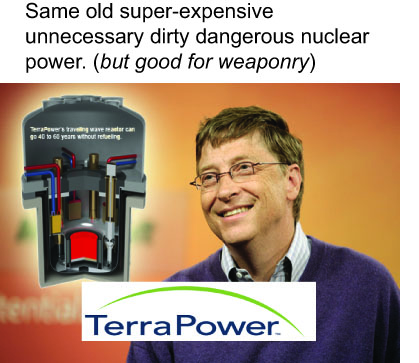
Paul Richards, Nuclear Fuel Cycle Watch Australia, https://www.facebook.com/groups/102118604791305231 Jan , TerraPower – nuclear reactor design and research firm, chose, Wyoming, as it’s an oligarch and dictator’s Paradise.
Wyoming’s trust, as well as asset protection laws, combined with its property tax, sales tax, and excise tax. Give the uber-wealthy 1% a free ride, as one of only seven states that have no personal income tax.Therefore, even more, difficult for top tier energy auditors, to test and measure, proof of concept in engineering terms, by default that includes economic and environmental viability.Wyoming is the best on-shore tax haven state in the  USA, arguably the best in the world outside
  China.
“Wyoming trust and layers of private companies with concealed ownership allow the world’s wealthy to move and spend money in extraordinary secrecy, protected by some of the strongest privacy laws in the country and, in some cases, without even the cursory oversight performed by regulators in other states.” The Washington PostAll in a state, that has a deplorable record of ecological disasters, created by the other fuel-burning; Linear Business Model,damaging earth systems, accelerating the Anthropocene.• burning – fuel
• churning – production• consuming – excess energy• consuming – products• dumping – waste in earth systems• ad Infinitum – Latin, literally ‘to infinity’19C flawed business model, that birthed corporatism, which created an acceleration in the climate crisis in the first place.Democracy without transparency is not democracy._____________source: The Washington Post.https://www.washingtonpost.com/…/wyoming-trusts…/BANKING FRAUD PANDORA PAPERShttps://en.wikipedia.org/wiki/Pandora_PapersPANAMA PAPERShttps://en.wikipedia.org/wiki/Panama_PapersPARADISE PAPERShttps://en.wikipedia.org/wiki/Paradise_PapersMAURITIUS PAPERShttps://en.wikipedia.org/wiki/Mauritius_Leaks
COVID-19 an obstacle for nuclear waste disposal at Waste Isolation Pilot Plant, officials say

COVID-19 an obstacle for nuclear waste disposal at Waste Isolation Pilot Plant, officials say,
Officials plan to ramp up operations as pandemic hoped to subside, Adrian Hedden, Carlsbad Current-Argus, 31 Jan 22,
COVID-19 continued to strain operations to dispose of nuclear waste at the Waste Isolation Pilot Plant near Carlsbad, officials said, slowing shipments accepted at the repository near Carlsbad last year.Officials from WIPP detailed the progress made in 2021 before state lawmakers Monday during the annual WIPP Legislative Breakfast held each year at the start of the Legislative Session.
This year’s presentation was held virtually via Zoom due to health concerns from the COVID-19 pandemic.
In the Fiscal Year 2021, about 199 shipments of waste were emplaced at WIPP, where they are permanently disposed of as an underground salt formation slowly collapses to bury the waste about 2,000 underground.
Shipments averaged about five weekly last year and were occasionally reported at seven or eight per week, said Reinhard Knerr, manager of the U.S. Department of Energy’s Carlsbad Field Office.
The facility’s target was about 240 shipments of waste for FY 2021, he said, and officials hoped to aim for up to 400 shipments in FY 2022.
“Unfortunately, COVID-19 has continued to be a significant challenge on that front,” he said of last year’s shipments. “We’ll be looking to increase here in the next few months.”
In early 2022, Knerr said WIPP hoped to increase shipments of waste to 10 to 12 per week from DOE nuclear facilities around the country including Los Alamos National Laboratory (LANL) in northern New Mexico.
Shipments from LANL recently drew concerns from state officials as the New Mexico Environment Department (NMED) called for federal oversight into how the DOE prioritizes shipments from around the country.
Meanwhile, the DOE announced plans to increase LANL’s production of plutonium pits, which are used to trigger nuclear bombs, to about 30 pits a year by 2026 – a move critics argued would increase waste generation at the site……………………… https://www.currentargus.com/story/news/local/2022/01/31/covid-19-obstacle-nuclear-waste-disposal-wipp/9239299002/
In 2022, compensation funds for the nuclear-affected ”Downwinders” are due to expire
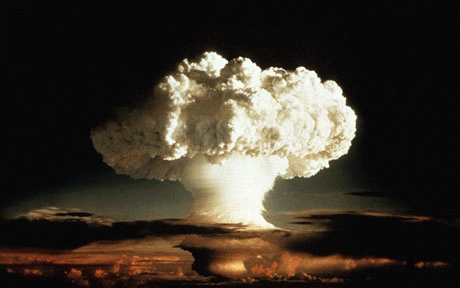
Funds for those impacted by nuclear weapons tests set to expire in 2022 https://www.thedenverchannel.com/news/national/funds-for-those-impacted-by-nuclear-weapons-tests-set-to-expire-in-2022 By: Bo Evans, , Feb 01, 2022
Raymond Harbert may not have the words to describe it.
“It is really hard to relay all the feelings you get from one of those megaton tests,”
But he never forgot the details of the detonation of a nuclear bomb well.
“If you can imagine, 40 miles away, and you can feel the heat when it arrives. It arrives at a separate time. It’s a prickly heat, and then the pressure wave coming—the brightness. The feeling when they finally say, you can take your glasses off. Those are memories that will stick with me for the rest of my life,” said Harbert.
In this 2005 interview conducted by the University of Nevada Las Vegas, Harbert lays out an experience shared by thousands of Americans exposed to radiation from nuclear weapons tests between 1945 and 1962.
The fallout has lasted for decades.
“People don’t realize over 200 above-ground tests were done between 1945 and 1962, and an additional 900+ were done after that below ground. Which exposed Nevadans, people in Utah, Arizona, Colorado, places that were downwind of these tests to fallout,” said Dr. Laura Shaw.
Shaw works with the Nevada Radiation Exposure Screening & Education Program or RESEP at UNLV to provide medical services and cancer screening to people who are known as downwinders.
We review their history, we look at their medications, we offer additional screenings that include colon cancer screening, lung imaging, labs that screen for diabetes, anemia, cholesterol, so we do a lot,” said Shaw.
It’s all paid for by the Radiation Exposure Compensation Act or RECA. The law was passed in 1990. The fund is set to expire in July 2022.
“These people have another 30, 40 years, hopefully, to live that were potentially exposed, so we need this program much, much longer,” said Shaw.
Some in Congress are attempting to extend and expand the fund.
“Tragically, for some, it is already too late. We’ve lost Idahoans Sheri Garmin, Teresa Valberg, and Srgt. 1st Class Paul Cooper to Cancer,” said Sen. Mark Crapo, (R) Idaho, in a congressional hearing.
The Radiation Exposure Compensation Act Amendments of 2021 have been introduced in both the House and Senate and have been referred to committees.
Dr. Shaw remains hopeful it will pass.
“Cancer is still going to happen. These people are going to develop problems associated with their previous exposure. Cancer can happen years later, and it’s not going to pay any attention to any deadlines,” she said.
Nuclear weapons plutonium pits development planned for Los Alamos National Laboratory, but there’s strong opposition on safety grounds.
 | |||
Nuclear weapons development coming soon to Los Alamos National Laboratory amid safety concerns https://www.currentargus.com/story/news/local/2022/01/29/los-alamos-national-lab-prepares-nuclear-weapons-development/6562490001/, Adrian Hedden, Carlsbad Current-Argus
A main component of nuclear weapons was poised to be built in New Mexico after federal regulators granted approval for a plan to prepare Los Alamos National Laboratory (LANL) for the work.
The National Nuclear Security Administration (NNSA), an arm of the U.S. Department of Energy, announced earlier this month it approved LANL’s project to prepare areas of the lab to be used in plutonium pit production – a project known as LAP4.
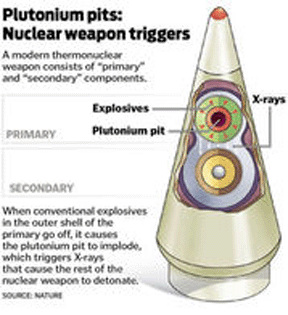
Plutonium pits are hollow spheres of plutonium that when compressed using explosives cause a nuclear detonation, per a DOE report.
The pits were first used in the 1940s during the Manhattan Project, the report read, used to detonate atomic bombs tested at the Trinity Site in south-central New Mexico and then in the bomb dropped on Nagasaki in Japan – largely credited with ending World War II.
Since the war ended, Los Alamos’ pit production was limited to research purposes, and from 2007 to 2011 the lab produced pits to replace those in 31 warheads carried on U.S. military submarines.
Between 1952 and 1989, most of the plutonium pits in the U.S. were generated at the Rocky Flats Plant near Denver amid the Cold War with a peak nuclear stockpile of 31,225 weapons outfitted with the pits reported in 1967, read the report.
Rocky Flats was shut down in 1989, and after concerns that the pits produced since the 1980s or earlier would begin to deteriorate over time, Los Alamos was called to make new ones.
The DOE called on Los Alamos to increase efforts at the lab to produce 30 pits a year by 2026, and the Savannah River Site in South Carolina was tasked with producing 50 pits annually by 2030.
That means that by that year, the U.S. would be producing 80 pits per year.
But to prepare LANL for the work, a project to remove existing equipment and glove boxes was needed to make way for pit manufacturing equipment.
That work was intended to begin this spring via a project known as the Decontamination and Decommissioning Subproject, the first of five operations to get the site ready.
equipment and infrastructure needed to safely manufacture pits for the nuclear stockpile,” said Summer Jones, NNSA assistant deputy administrator for production modernization at LANL.
“LAP4 is a complex, challenging endeavor, and getting the approval to begin the D&D subproject is a big step toward restoring this important capability.”
Opponents call for environmental review of plutonium operations
The effort to resume producing plutonium pits and thus nuclear weapons at the New Mexico lab and in South Carolina as met with controversy from government officials and watchdog groups in both states opposing the projects.
Santa Fe City Councilors passed a resolution last year calling for a “site-wide” environmental impact statement to be conducted and any safety issued be resolved and certified by the federal government before pit production was increased.
“The Governing Body (Santa Fe City Council) requests that the National Nuclear Security Administration suspend any planned expanded plutonium pit production until all nuclear safety issues are resolved, as certified by the independent Defense Nuclear Facilities Safety Board,” read the resolution.
Nuclear Watch New Mexico and Savannah River Site Watch subsequently in June 2021 filed a lawsuit in U.S. District Court for the District of South Carolina’s Aiken Division against the DOE and NNSA, arguing pit production should not be increased until site-wide environmental analysis were conducted at both facilities.
“The drastic expansion of plutonium pit production and the utilization of more than one facility to undertake this production are substantial changes from the Defendants’ long-standing approach of producing a limited number of pits at only one facility,” the suit read.
The suit argued the increased pit production was not only intended for replacing existing warheads but to develop a new warhead known as the W87-1.
This project was developed with proper environmental analysis, the suit read, or proper planning for where associated nuclear waste would be disposed of.
“The drastic expansion of plutonium pit production and the utilization of more than one facility to undertake this production are substantial changes from the Defendants’ long-standing approach of producing a limited number of pits at only one facility,” read the suit.
In southeastern New Mexico is the Waste Isolation Pilot Plant (WIPP), a repository for low-level transuranic (TRU) nuclear waste – clothing materials and equipment irradiated during nuclear activities.
But the litigants argued WIPP was already at limited capacity and its current permit with the New Mexico Environment Department (NMED) specified the repository would have to cease waste disposal by 2024 and begin the decommissioning process.
The DOE last year submitted a permit renewal application to NMED that removed the 2024 closure date, leaving WIPP’s lifetime largely open ended.
Still, the suit alleged the DOE failed to address the need for waste disposal.
“As a National Academy of Sciences has concluded, the WIPP is already oversubscribed for future waste from multiple sites and will overextend its capacity from this increase in TRU production from the pit project and other DOE projects set to generate large amounts of TRU waste,” read the suit.
“The Defendants have failed to meaningfully address this critical waste disposal question.”
-
Archives
- October 2026 (91)
- September 2026 (339)
- August 2026 (330)
- July 2026 (355)
- June 2026 (287)
- May 2026 (306)
- April 2026 (356)
- March 2026 (251)
- February 2026 (267)
- January 2026 (308)
- December 2025 (358)
- November 2025 (359)
-
Categories
- 1
- 1 NUCLEAR ISSUES
- business and costs
- climate change
- culture and arts
- ENERGY
- environment
- health
- history
- indigenous issues
- Legal
- marketing of nuclear
- media
- opposition to nuclear
- PERSONAL STORIES
- politics
- politics international
- Religion and ethics
- safety
- secrets,lies and civil liberties
- spinbuster
- technology
- Uranium
- wastes
- weapons and war
- Women
- 2 WORLD
- ACTION
- AFRICA
- Atrocities
- AUSTRALIA
- Christina's notes
- Christina's themes
- culture and arts
- Events
- Fuk 2022
- Fuk 2023
- Fukushima 2017
- Fukushima 2018
- fukushima 2019
- Fukushima 2020
- Fukushima 2021
- general
- global warming
- Humour (God we need it)
- Nuclear
- RARE EARTHS
- Reference
- resources – print
- Resources -audiovicual
- Weekly Newsletter
- World
- World Nuclear
- YouTube
-
RSS
Entries RSS
Comments RSS

