Amid ‘staggering’ Ukrainian toll and souring US polls, Biden seeks billions more for war

the Zelensky government does appear to be a willing partner in McConnell’s sacrifice ritual. Ukrainian defence minister Oleksiy Reznikov is said to have told US officials that flooding Ukraine with weapons allows NATO allies to “actually see if their weapons work, how efficiently they work and if they need to be upgraded. For the military industry of the world, you can’t invent a better testing ground.”
As Ukraine faces “staggering” losses and US public mood shifts, the Biden administration seeks billions more to prolong the war.
| Aaron Maté, AUG 15, 2023, https://mate.substack.com/p/unlocked-amid-staggering-ukrainian?utm_source=post-email-title&publication_id=100118&post_id=135995766&isFreemail=true&utm_medium=email— |
The Biden administration is asking Congress for an additional $24 billion for the Ukraine proxy war, more than half of it in military aid. The request comes one week after a CNN poll showed, for the first time, that a majority of Americans oppose additional funding to Kiev.
For a White House committed to ensuring a Russian “quagmire” in Ukraine, public opinion is of secondary importance. Two months into a widely hyped yet now faltering Ukrainian counteroffensive, a fresh influx of NATO weaponry appears necessary to prolong the war. In one of several gloomy assessments to appear in US establishment media, a senior western diplomat tells CNN that the prospect that Ukrainian forces can “make progress that would change the balance of this conflict” is “extremely, highly unlikely.” Ukraine’s “primary challenge” is breaking through Russia’s heavily fortified defensive lines, where “Ukrainian forces have incurred staggering losses.” According to Democratic Rep. Mike Quigley, US military assessments of the war are “sobering,” with Ukraine now facing “the most difficult time of the war.”
This picture, CNN’s Jim Sciutto observes, represents “a marked change from the optimism at the start of the counteroffensive,” with Western officials now acknowledging that “those expectations were ‘unrealistic.’” The battlefield reality is so dire that it is even “now contributing to pressure on Ukraine from some in the West to begin peace negotiations, including considering the possibility of territorial concessions.”
But as Biden’s new spending request suggests, there is no sign that the US is among those Western states applying pressure for peace. After all, the stated US aim, as top officials have made clear, is not to defend Ukraine and its long-term future but to instead “weaken” Russia (Lloyd Austin) and ensure “a strategic failure for Putin,” so that Russian can “pay a longer-term price in terms of the elements of its national power.” (Jake Sullivan)
Whereas CNN’s Western sources now allow themselves to admit that their publicly voiced “optimism at the start of the counteroffensive,” was “unrealistic”, it was in fact, dishonest. As Pentagon leaks and subsequent disclosures have confirmed, US officials were well aware that Ukraine was not prepared to take on Russia’s heavily fortified defenses, but kept that assessment under wraps. Accordingly, while Ukraine’s battlefield losses are indeed “staggering”, what is perhaps most “sobering” is the fact that the Biden administration both anticipated and encouraged them.
But just like souring US public opinion, Ukrainian casualties are also a secondary concern, as the Biden administration’s more candid neoconservative proxy war partners continue to make clear.
To push through the new spending package , the White House is “counting on help from Senator Mitch McConnell of Kentucky, the Republican minority leader,” the New York Times reports. At a public event, McConnell detailed his rationale: The US, he explained, hasn’t “lost a single American in this war,” – not accurate if one counts mercenaries and private citizens, but correct in its implicit recognition that Ukraine has lost tens of thousands of lives on its American sponsors’ behalf. According to McConnell, there are additional benefits of the war that do not extend to ordinary Ukrainians: “Most of the money that we spend related to Ukraine is actually spent in the US, replenishing weapons, more modern weapons. So it’s actually employing people here and improving our own military for what may lie ahead.”
Therefore, according to prevailing Biden-McConnell policy, the US must continue to fund a war that will sacrifice many more Ukrainian lives, all so that domestic war profiteers can reap taxpayer largesse for “replenishing weapons”, and so that the US – not having its soldiers die in Ukraine – can use the opportunity for “improving our own military” for a war that it might actually fight.
Although US officials have reportedly “expressed frustration” at Ukraine’s efforts to minimize military casualties, the Zelensky government does appear to be a willing partner in McConnell’s sacrifice ritual. Ukrainian defence minister Oleksiy Reznikov is said to have told US officials that flooding Ukraine with weapons allows NATO allies to “actually see if their weapons work, how efficiently they work and if they need to be upgraded. For the military industry of the world, you can’t invent a better testing ground.”
For the benefit of weakening Russia, enriching US military contractors and serving as a NATO “testing ground,” Ukrainian lives are not the only staggering sacrifice. According to the Wall Street Journal, “20,000 and 50,000 Ukrainians who have lost one or more limbs since the start of the war,” a scale unseen for a Western military since the First World War, and a potential undercount “because it takes time to register patients after they undergo” surgery.
According to veteran State Department bureaucrat Aaron David Miller, the Biden administration has no other choice but to continue sacrificing Ukrainians. The US, he explained, “is in an investment trap in Ukraine with no clear way out. Chances of a military breakthrough or a diplomatic solution are slim to none; and slim may have already left town. We’re in deep and lack the ability to do much more than react to events.” The key term here is “investment trap”: having invested in a proxy war aimed at bleeding Russia, the US is therefore obliged to continue it.
But if the US were driven by other concerns – such as Ukrainian well-being – it could consider supporting the diplomatic opportunities that it has blocked to date. Prior to Russia’s invasion, the Biden administration encouraged the Ukrainian government to crack down on political opponents; further integrate its military into NATO; avoid implementing the Minsk accords for ending its post-2014 civil war; and assault the Russian-allied Donbas. When Russia submitted detailed proposals in December 2021 to address its concerns, the White House effectively balked. And after Russia’s invasion, the US blocked a tentative peace deal that would have seen Russia withdrew to its pre-February 2022 lines. More recently, the US has pushed Ukraine into a counteroffensive that it knew had no chance, and rejected a Ukrainian NATO bid that it had long encouraged for the apparent purpose of baiting Moscow.
In short, the Biden administration has provoked this war and is now seeking a new influx of taxpayer money to prolong it. Even the latter goal is now openly admitted. At last month’s NATO summit in Lithuania, the New York Times reported, “several American and European officials acknowledged” that their “commitments” to Ukraine “make it all the more difficult to begin any real cease-fire or armistice negotiations.” Additionally, US-led “promises of Ukraine’s eventual accession to NATO — after the war is over —create a strong incentive for Moscow to hang onto any Ukrainian territory it can and to keep the conflict alive.”
So long as keeping the conflict alive comes predominantly at the cost of Ukrainian lives, then Washington’s bipartisan proxy warriors clearly have no qualms about forcing a war-weary public to foot the bill.
Small Modular reactors- a US view

we now have ‘an echo chamber, with each outlet clambering over the next to crow about the great benefits of nuclear power in misleading language that suggests this technology is already entirely proven out’.
It all fits into what see she see as an emerging pro-SMR mind set, with there being a lot of speculative investment venture cash still around- and a lot of press support. She says that though ‘very few of the proposed SMRs have been demonstrated and none are commercially available, let alone licensed by a nuclear regulator’, the media has been promoting them as the way ahead.
August 12, 2023 https://renewextraweekly.blogspot.com/2023/08/small-modular-reactors-us-view.html

Allison Macfarlane, who was Chair of the US Nuclear Regulatory Commission (NRC) from 2012-2014, has been looking at Small Modular Reactors in the USA and elsewhere. She thinks they are likely to be uneconomic, much like the their larger brethren, which, as she describes, have recently been doing very poorly in the USA.
Indeed, just like the EPR story in the EU, it makes for a sorry saga: ‘The two units under construction in South Carolina were abandoned in 2017, after an investment of US$9 billion. The two AP-1000 units in Georgia were to start in 2016/2017 for a price of US$14 billion. One unit started in April, 2023, the second unit promises to start later in 2023. The total cost is now over US$30 billion.’
Big reactors do look increasingly hard to fund and build on time and budget, while it is argued that smaller ones could be mass produced in factories at lower unit costs and finished units installed on site more rapidly. However, that would mean foregoing conventional economies of (large) scale, and, overall, Macfarlane claims that SMRs may end up being worse that large plants in operational and economic terms.
For example, she says ‘one of the reasons SMRs will cost more has to do with fuel costs’ with some designs requiring ‘high-assay low enriched uranium fuel (HALEU), in other words, fuel enriched in the isotope uranium-235 between 10-19.99%, just below the level of what is termed “highly enriched uranium,” suitable for nuclear bombs.’ She notes that ‘currently, there are no enrichment companies outside of Russia that can produce HALEU, and thus the chicken-and-egg problem: an enrichment company wants assurance from reactor vendors to invest in developing HALEU production. But since commercial-scale SMRs are likely decades away, if they are at all viable, there is risk to doing so.’

She also notes that the use of HALEU, so as to offset the smaller size of the reactor core, will ‘result in increased security and safeguards requirements that will add to the price tag’. As she has explored in a PNAS paper with others, smaller cores mean more neutron escapes and so a need for more shielding, which will become activated, adding to the waste burden to be dealt. Indeed she says, overall, some SMRs may produce ‘significantly more high-level waste by volume that current light water reactors.’ That view did not go down well with SMR promoters, who sometimes portray SMRs as being cleaner than standard reactors.
Some advanced SMRs may use molten salt fluids as a reactant and also coolant, and the waste chemistry then is different, although there will still be wastes to deal with. But for the moment, the focus is on simpler technology – just scaled down versions of the standard Pressurised Water Reactor (PWR). Macfarlane notes that one of these, NuScale, is the only SMR design to received ‘design certification’ for its 50MW unit from the NRC

However, the company has now decided to submit a new application to the NRC to build a larger version, presumably in the expectation that this would be more economic. It’s also proposed to have multiple units on one site, sharing some common services. That might offset some of the extra costs of small systems, but not much. Macfarlane says ‘cost estimates for the reactor have risen from US$55/megawatt electric (MWe) in 2016 to $89/MWe in 2023, according to the Institute for Energy Economics and Financial Analysis.’
Arguably, to be economic, they need to be bigger. That seems to have been the logic behind another mini-PWR, the Rolls Royce SMR being developed in the UK by Rolls Royce. Although at 470MW, that one is hardly ‘small’.
By contrast, Oklo, another US company, is going in the opposite direction. It has been developing Auora, an advanced micro-nuclear power plant. It’s a tiny (1.5 MW) liquid sodium cooled fast neutron reactor. However, it was outright rejected by the NRC. Macfarlane says that ‘the NRC rarely outright rejects an application, instead working with licensees until they either get the application right or decide to walk away. In this case, Oklo refused to fill “information gaps” related to “safety systems and components.’ But Oklo persevered. And she notes it has gone for public finance via a merger with AltC Acquisition Corporation.
It all fits into what see she see as an emerging pro-SMR mind set, with there being a lot of speculative investment venture cash still around- and a lot of press support. She says that though ‘very few of the proposed SMRs have been demonstrated and none are commercially available, let alone licensed by a nuclear regulator’, the media has been promoting them as the way ahead.
Even usually sane US outlets like the Atlantic Policy journal seem to have joined in. She says we now have ‘an echo chamber, with each outlet clambering over the next to crow about the great benefits of nuclear power in misleading language that suggests this technology is already entirely proven out’.
So she concludes, a bit pessimistically, that, in the USA, ‘in the nuclear celebratory mood of the moment, there is little patience or political will for sober voices to discuss the reality that new nuclear power is actually many decades away from having any measurable impact on climate change – if at all’.
The situation in Europe is a bit different. Although nuclear is also being supported in some countries, like the UK and France, anti-nuclear views are also apparent. For example a recent academic paper in Joule claims that ‘relying on nuclear new-builds to achieve the EU climate targets is virtually impossible.’ And overall it concludes ‘in solving the climate crisis, new nuclear is a costly and dangerous distraction.’ Whereas SMRs will be any better is unclear. There are quite few speculative SMR ventures around the word, as a UK review noted, but a recent study of 19 proposed SMR designs found that they were likely to be generally more expensive than conventional nuclear, and even more so than renewables. So, why bother?
As Macfarlane says, the battle lines are drawn on this issue around the world, with much of it being a PR battle – there is no real hardware yet. While the likes of Forbes magazine are pushing SMRs as the ‘go-to energy source’, in a hard hitting article in Fortune, Stephanie Cookes says ‘the billions currently being spent on nuclear are crowding out viable, less costly solutions for decarbonizing the power sector.’
Place your bets…but, for some, the outcome already looks clear. As David Schlissel said in US trade journal Utility Drive, ‘an old adage is that anything that sounds too good to be true probably is. Given the history of the nuclear power industry, everyone – utilities, ratepayers, legislators, federal officials and the general public – should be very skeptical about the industry’s current claim the new SMRs will cost less and be built faster than previous designs.’
McCarthyism Is Back, and It’s Coming for the Peace Movement
https://portside.org/2023-08-12/mccarthyism-back-and-its-coming-peace-movement
With rising global tensions, unsurprisingly the same old McCarthyite playbook is again being dusted off. We reject these smears.
Defending Rights & Dissent condemns in the strongest possible terms the increasing McCarthyite attacks on leftwing and peace groups critical of US-policy towards China. As tensions between the US and China escalate, we have unsurprisingly seen attacks against those who dissent from the prevailing foreign policy orthodoxy.
Over the weekend, the New York Times published an inflammatory regurgitation of innuendo, aspersions, and propaganda focusing on a number of groups, including Code Pink and the People’s Forum.
With the “paper of record” giving these smears a veneer of legitimacy, Senator Marco Rubio sent a letter to the Department of Justice urging them to investigate these activist groups under the Foreign Agents Registration Act. This would not be the first time that biased reporting was used to predicate an FBI investigation.
Defending Rights & Dissent has worked with Code Pink for decades. Just days before the Times published their hit job, we joined with Code Pink to deliver a letter to the State Department about imprisoned journalist Julian Assange. In 2020, we launched our report Still Spying on Dissent: The Enduring Problem of FBI First Amendment Abuse at the People’s Forum. We also co-sponsored the New York session of the Belmarsh Tribunal, which was held at the People’s Forum. In spite of the attempted intimidation of Sen. Rubio, Defending Rights & Dissent fully plans to continue working with both Code Pink and the People’s Forum.
Code Pink has been a courageous and bold voice and the People’s Forum has been an invaluable space for activists. These efforts to silence them have far-reaching implications beyond just US-China policy.
On October 10, 1960, Defending Rights & Dissent was formed as the National Committee to Abolish the House Un-American Activities Committee. The New York Times covered the event, regurgitating the press release issued by the House Un-American Activities Committee (HUAC), which noted that HUAC had accused six of our founders of being Communists. Over a decade later when we sued the FBI under the Freedom of Information Act, it was revealed the FBI were the true authors of the HUAC press-release the New York Times dutifully parroted.
In those days, merely opposing HUAC or questioning the FBI’s vast domestic surveillance leviathan was enough to tar someone with suspicion of something sinister. During the Cold War, J. Edgar Hoover’s FBI, HUAC, and other forces of political repression all treated the holding of verboten views on anything from civil rights to foreign policy as evidence the speaker was part of a subversive plot. According to Hoover, although it was difficult to prove membership in the Communist Party, it was easy to prove they were speaking the “Communist Line.” The FBI compiled reports on the “Communist Line” and did side-by side comparisons with activist groups or political publications. Both membership in a subversive organization or the belief that one may be influenced by subversives opened one up to the same intensive surveillance and dirty tricks of the FBI.
After restrictions were placed on the FBI in the 1970s, the FBI used its nebulous foreign counterintelligence powers to say it was combatting “active measures” in the form of Soviet disinformation and international terrorism to target dissent. The official reasoning may have changed, but the internal logic was the same, and the FBI set out in pursuit of opponents of Ronald Reagan’s murderous Central American policy arguing they were “foreign agents” or supporting terrorism as evidenced by their political views.
We saw this same playbook repeated again after September 11, 2001 and applied to critics of the US wars in Iraq and Afghanistan, as well as the suppression of civil liberties at home. Repeatedly, supporters of Palestinian rights have also been subject to similar McCarthyite tactics. In many cases, the FBI justified its investigations and inquiries based on information coming from right wing groups. That is precisely what Sen. Rubio and others are hoping will be the result of the Times piece.
With rising global tensions, unsurprisingly the same old McCarthyite playbook is again being dusted off. We reject these smears.
Racism and the choice to bomb Hiroshima and Nagasaki

Dehumanizing of “others” began but did not end with Japan
By Linda Pentz Gunter, Aug 13 2023, e https://beyondnuclearinternational.org/2023/08/13/the-choice-to-bomb-hiroshima-and-nagasaki/
The debate about whether the United States “needed” to drop atomic bombs on Japan will likely be waged indefinitely. Was it to end the war, save American lives, test the bomb or send a message to Stalin?
Amidst all the theories, some of which are disputed and a few disproven, one over-riding motivation remains: racism.
After the bombing of Pearl Harbor, a highly effective propaganda campaign was waged in the US to paint Japanese people as sub-human or worse. The Japanese were depicted as predators and vermin. During reporting from Iwo Jima, Time magazine, pronounced the Japanese people “ignorant” and went on speculate: “Perhaps he is human. Nothing. . . indicates it.”
Today, the posters and rhetoric in circulation then would be considered abhorrent hate speech. But in the 1940s, it instilled enough revulsion in the American public to justify the annihilation of at least 200,000 human beings in Hiroshima and Nagasaki.
And it was only the beginning. After World War II, the newly emergent atomic powers began testing their weapons of annihilation on Indigenous communities far away. The Americans bombed the Marshall Islanders; the British targeted Aboriginal lands in Australia and the islands of Micronesia; the French went to Algeria and then Polynesia; the Soviet Union chose Kazakhstan.
The Marshallese, like the Japanese before them, were characterized as subhuman. They were deliberately experimented on, to see what would happen to human beings living in a highly radioactive environment. This included returning the people of Rongelap to their atoll just three years after they were removed to make way for the enormous and disastrous Castle Bravo test on March 1, 1954. They were returned, because, said, Merril Eisenbud, director of the U.S. Atomic Energy Agency’s health and safety laboratory, “That island is by far the most contaminated place on Earth and it will be very interesting to get a measure of human uptake when people live in a contaminated environment.”
Much of this was celebrated by the US military brass. The Marshallese victims of atomic tests were brutally denigrated as uncivilized, albeit they were, conceded Eisenbud in one his most appalling statements, “more like us than mice”.
The uranium needed for atomic weapons was mined in places such as the Congo in Africa, and on Native American and First Nations lands in North America.
Today, France still gets at least half of the uranium needed to power its commercial nuclear reactors from Niger, although the recent coup there may have put that supply chain in jeopardy. But many of the people who mine it live without electricity and running water and suffer the health consequences of the radioactive tailings and waste left behind in their environment.
Of course, it’s not an entirely racist story. Atomic veterans the world over have struggled for recognition of their suffering and for compensation, largely unsuccessfully. Many experienced the tests directly. Others were sent in later to “clean up” the radioactive mess left behind.
In the US, citizens of Nevada and surrounding states were shocked to learn that their own government was willing to treat them like guinea pigs. The more than one thousand atomic tests carried out at the Nevada Test Site, situated on Western Shoshone land, contaminated communities across multiple US states.
Those communities were not warned or protected. Indeed, the Nevada tests were treated as something thrilling. Las Vegas even promoted them as some sort of bizarre tourist attraction. One postcard of the time depicts a massive mushroom cloud rising behind the “Desert Inn” in Las Vegas as an American family unpack their luggage. But the postcard was no mere fantasy. Photographs of the time show Las Vegas hotel guests around a swimming pool watching a mushroom could rise in the distance.
Still today, sickeningly, you can buy Fat Man and Little Boy earrings at the National Atomic Testing Museum in Las Vegas.
The United States has never officially apologized — to the people of Japan, or the Marshall Islands, or New Mexico, where the first Trinity test took place, or Nevada and the neighbouring states. Nor has France for its part in bombing Algerians in the Sahara and French Polynesians in the South Pacific. The UK has neither apologized to, nor agreed to compensate, its atomic veterans for their exposures during atomic tests on Australian Aboriginal land and the Line Islands of the Pacific.
The dehumanizing of other human beings, mostly on the basis of what we erroneously call “race” (we are all the same “race”) is of course not restricted to the nuclear sector. Communities of color, at least in the United States, are routinely targeted by the fossil fuel and chemical industries and by industrial and inhumane factory farming.
In North Carolina, for example, where a large portion of the country’s horrendous hog factory farms are located — known as Concentrated Animal Feeding Operations or CAFOs — there are 10 million pigs, about one per person. However, these are concentrated in a handful of mainly African American counties. As the Rachel Carson Council describes it in its report, Pork and Pollution, in one predominantly North Carolina African American county alone there are 2.3 million hogs.
Addressing the fundamental crime of racism is an essential step if we are to eliminate the existential threats of nuclear war and the climate catastrophe now upon us.
This article is adapted from a blog entry originally published by Scottish CND and a subsequent webinar presentation for Scottish CND on August 8. For an essential deep look at racism and the nuclear sector, read Vincent Intondi’s excellent book, African Americans Against The Bomb.
Illinois Gov. Pritzker vetoes bill that would have allowed new nuclear construction
Capitol News Illinois | By Andrew Adams August 11, 2023
Gov. JB Pritzker on Friday vetoed a bill that would have lifted a 1980s moratorium on the construction of new nuclear reactors.
The passed in May with three-fifths majorities in both legislative chambers, meaning that if all of the members that voted for it also support an override of the governor’s veto, it still could become law. Its Senate sponsor, state Sen. Sue Rezin, R-Morris, said she has already filed paperwork to bring the bill up in the legislature’s fall veto session scheduled for late October and early November.
The governor said in a message to lawmakers explaining his veto that he did it “at the request of the leadership team of the Speaker of the House and advocates.”……………
“This bill provides no regulatory protections for the health and safety of Illinois residents who would live and work around these new reactors,” Pritzker wrote. “My hope is that future legislation in Illinois regarding SMRs would address this regulation gap.”
The governor also cited an “overly broad definition of advanced reactor” in the bill that he said could “open the door to proliferation” of large-scale nuclear power plants, like the reactors at the state’s six existing generating stations.
Pritzker said these traditional reactors are “so costly to build that they will cause exorbitant ratepayer-funded bailouts.”……………………………………………………………..
Rezin’s claims about advanced nuclear reactors are contentious, particularly among some environmental advocates that have been leading voices in the push for carbon-free energy in Illinois.
On Tuesday, a pair of influential advocacy groups sent a letter to Pritzker asking him to veto the bill. The Sierra Club Illinois Chapter and the Illinois Environmental Council’s joint letter outlined several concerns, including waste disposal, costs and a lack of up-to-date regulation.
………………………………… Beyond waste, environmental advocates also say that focusing on nuclear power diverts attention and resources away from the development of wind, solar and battery storage technology.
“SB76 would have opened the door to increased risk, negative environmental impacts, and higher costs for consumers while jeopardizing our progress toward Illinois’ clean energy future,” Sierra Club Illinois Director Jack Darin said in a Friday news release……………………………. https://www.wsiu.org/state-of-illinois/2023-08-11/gov-pritzker-vetoes-bill-that-would-have-allowed-new-nuclear-construction
Oppenheimer, Japan bombings put nuclear energy in a harsh light
Utah Public Radio | By Eric Tegethoff, August 11, 2023 , https://www.upr.org/utah-news/2023-08-11/oppenheimer-japan-bombings-put-nuclear-energy-in-a-harsh-light
The power and destructiveness of nuclear energy has been in the spotlight since the film “Oppenheimer” was released in July. It is in focus again this week with the anniversaries of the atomic bombs dropped on Hiroshima and Nagasaki, Japan during World War II.
Mary Miller, a member of Idaho nuclear energy watchdog Snake River Alliance, explained the movie about J. Robert Oppenheimer and the first experiment with the atomic bomb stops short of the bombs dropped on Japan. But Miller noted Oppenheimer’s ideas changed after that.
“His message was that humanity must learn humility in the face of nature and use its experience with atomic energy to prosper international peace,” she said. “The nuclear power that was unleashed on Japan was just unimaginably too big and too lethal for humankind.”
The 78th anniversary of the dropping of the atomic bomb on Hiroshima was Sunday, and the anniversary of the Nagasaki bombing is on Wednesday. It is estimated the two bombs may have killed as many as 226,000 people, most of whom were civilians.
Advocates for nuclear energy are increasingly promoting its ability to help move the country from dirty sources of fuel in the fight against climate change, but Miller said it should not be considered a clean source of energy because its negatives outweigh the good it might be able to achieve.
“Just like that power that was unleashed in the bomb, the use of nuclear energy for electricity, which is called nuclear power, cannot be safely anticipated, predicted or controlled,” she explained.
Miller pointed to a number of issues with nuclear energy, such as safe transportation and storage of its waste, which sometimes has a radioactive half life that extends thousands of years. Experiments on new types of nuclear reactors are eing conducted at the Idaho National Laboratory.
War is a Racket… U.S. and NATO Arms Industries Make Record $400 BILLION in Sales from Proxy War With Russia

Strategic Culture Foundation, 11 Aug 23
Western capitalism is at once a sponsor and an addict of war.
Western weapons manufacturers are popping champagne corks over record sales with total revenues hitting $400 billion for last year. According to media reports, this coming year-end will see that record figure exceeded by another salivating $50 billion.
Ukraine may be resembling a bloodbath, as we noted in last week’s editorial. But apparently, Western military corporations are swimming in a bonanza of profits and stock market investments.
Most of this lucrative new business stems from NATO’s proxy war with Russia in Ukraine, which is heading toward its second year. There is no sign of a diplomatic effort from the West or the Kiev regime it sponsors to end the bloodshed.
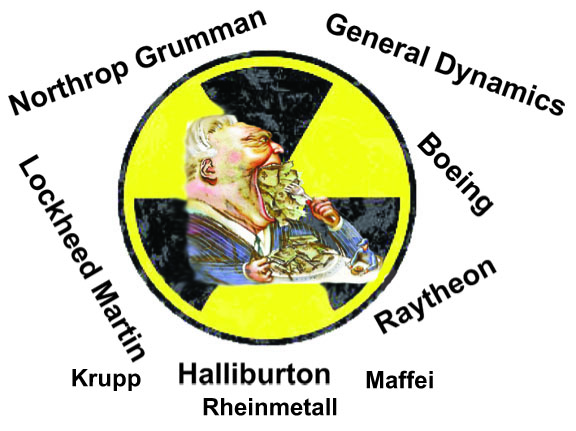
The main corporate beneficiaries making a financial killing from Ukraine are by far the American firms. They include such behemoths as Lockheed Martin, Boeing and RTX (formerly Raytheon). But also enjoying soaring profits are arms makers in other NATO countries: BAE in the United Kingdom, Airbus in France, Netherlands and Spain, Leonardo in Italy, and Germany’s Rheinmetall.
This week the Joe Biden administration requested another $24 billion in U.S. taxpayer-funded aid to Ukraine. It’s hard to keep track of the money flowing from NATO countries to prop up the Nazi regime in Kiev. Even the NATO authorities don’t seem to know the precise figures, such is the rampant corruption that is inevitably associated with the vast doling of funds. But estimates of total U.S. and NATO aid to Ukraine range from $150 billion to $200 billion over the past year alone.
What we are seeing is an audacious racket whereby the American and European public are subsidizing the funneling of their own taxpayers’ money into the coffers of weapons firms. And there is no democratic choice in the matter. It’s a fait accompli. Or, put another way, extortion.
Of course, too, part of this huge scam is the hefty financial cuts for the inner circle of the Kiev regime, including its puppet president, Vladimir Zelensky, and the brazenly sleazy defense chief Aleksy Reznikov. It is reckoned that at least $400 million has been grafted by the top members of the regime from the arms bazaar flowing into Ukraine. Reznikov has even boasted that his country serves as a testing ground for NATO weaponry.
Nearly a century ago, former U.S. Marine Corps General Smedley D Butler popularized the phrase, “war is a racket” as the title of his classic book in which he condemned how American capitalism profits obscenely from military invasions and killing.
Butler’s critique is as relevant today, perhaps more so, as evinced by the conflict in Ukraine.
Western media reports are increasingly admitting – albeit coyly – that the war is a disaster for the Kiev regime and, by extension, the NATO powers. The death toll among Ukrainian forces may be as high as 400,000 since the conflict erupted last February. The much-anticipated Ukrainian counteroffensive launched in early June has resulted in no territorial gains despite the horrendous casualties and despite the gargantuan supply of NATO weapons, training and logistical support.
A report in the Washington Post this week shows that most Ukrainian people are despairing of the grinding war and endless casualties. They see no point in the continuation of hostilities given the failure of the NATO-backed forces to make any advance against well-fortified Russian defense lines.
Yet against this grim reality, the U.S. and European officials keep running the taps of blood.
We see NATO leaders like Polish President Andrzej Duda this week urging for more weapons to be sent to Ukraine even while he concedes the military defeat so far.
Zelensky and his cronies are, not surprisingly, also demanding more NATO arms and claiming with bravado they will never negotiate with Russian President Vladimir Putin. Some people want this conflict to keep going because of their irrational Russophobia and simply because it is too lucrative for their own personal gain.
Where does democracy come into this? It doesn’t, whatsoever. Polls show that most Americans are opposed to the continuing supply of military aid to Ukraine. There are sound reasons to believe that most European citizens are also firmly against the fueling of a bloody war in which Ukrainian corpses keep piling higher. In addition, the perpetuation of this conflict runs the outrageous risk of spiraling out of control into an all-out war between the United States and Russia, the world’s biggest nuclear powers……………………………….. more https://strategic-culture.org/news/2023/08/11/war-iracket-us-nato-arms-industries-make-record-400-billion-sales-from-proxy-war-with-russia/
TVA should focus on a better grid and renewable, not nuclear, energy
Tennessean, Ita Hardesty-Mason, 11 Aug 23
Nuclear energy is a fool’s folly and a waste of time and money. Unfortunately, the lobby around the Tennessee Valley Authority’s nuclear options is strong. It must be noted that Jeff Lyash, president and CEO of TVA, who wrote the guest column “How Tennessee Valley Authority is planning for growth and meeting future demands,” is also the chairman of the Nuclear Energy Institute. I am not so sure TVA has the best interests of its customers in mind.
Several experts and foundations have investigated this form of energy. Massive nuclear plants are costly, and a recent Fortune magazine article stated that since 2000 “at least $50 billion has been spent on a frantic effort to create a new Golden Age for nuclear energy in the U.S.” Nuclear energy will cost more per kilowatt hours than the renewable energy options like solar, wind, geothermal and hydropower.
The money wasted on these dangerous sites could be more wisely used by TVA to take the steps towards the switch to safe, sustainable forms of energy and a better energy grid.
………………. Nuclear power is not making us safe. It demands perfect conditions, and its problems can be exponentially harmful.
It must be asked if TVA, several elected representatives, and Gov. Bill Lee are being influenced by the fossil fuel and nuclear lobby.
It’s important that we all understand we must move away from fossil fuels and avoid nuclear energy.
We must see the sustainable options being deployed. Investment in and implementation of clean and safe energy is well underway. Renewable energy focus right now will satisfy our energy needs much quicker than nuclear power.
We need help understanding we can turn to solar, wind, hydropower and geothermal-generated energy and that we must make the switch to clean, sustainable energy as soon as possible.
Why in the world would TVA put us at such risk?
https://www.tennessean.com/story/opinion/contributors/2023/08/11/opinion-tva-should-focus-on-shift-to-renewable-not-nuclear-energy/70532888007/
The blockbuster movie ‘Oppenheimer’ leaves out the real story’s main characters: New Mexicans

The terrible emptiness of “Oppenheimer” Searchlight New Mexico, by Alicia Inez Guzmán, August 8, 2023
Bernice Gutierrez was eight days old when a light 10,000 times hotter than the surface of the sun cracked open the predawn sky. No one in south-central New Mexico knew where it came from, or that the tiniest units of matter could be split to unleash such energy. Nor could they know that when the cloud that followed bloomed some 50,000 feet into the sky, it was surrounded for the briefest of seconds by a blue halo, the “glow of ionized air,” as the Manhattan Project physicist Otto Frisch described it.
The impacts of that unholy halo were all too apparent in the years after, when her great-grandfather died of stomach cancer. One person after another would receive their own wrenching cancer diagnoses — 41 people in her immediate family, spanning five generations. Every one of them had lived in the Tularosa Basin and within 50 miles of the Trinity Site, where the first atomic bomb, nicknamed “Gadget,” was detonated on the northern edge of the Chihuahuan Desert.
Gutierrez was one of a group of downwinders, including Mary Martinez White and Tina Cordova, cofounder of the Tularosa Basin Downwinders Consortium, who watched the movie “Oppenheimer” together when it opened. In one scene after another, New Mexico’s landscapes unfurled — all painfully beautiful and all, it appeared, empty and unpeopled.
In New Mexico, we have lived in the blind spot of a national narrative for eight decades, repeated once again in this box office hit. Over its exhaustive three-hour run-time, it managed to avoid mentioning what we here have been sharing with loved ones at kitchen tables for decades: the violent evictions that took place on the Pajarito Plateau to build Los Alamos, the Pueblo and Hispanic men and women who did essential work for the Manhattan Project, or the thousands of New Mexicans affected to this day by the Trinity test.
To watch J. Robert Oppenheimer’s character instead create and destroy in the state’s big, beautiful and ostensibly barren lands is to deny the presence of so many people whose lives were indelibly transformed by the dawn of the atomic era and continue to be shaped by the juggernaut that is today’s nuclear industrial complex.
Oppenheimer, the son of a wealthy businessman, had come here as part of a cultural moment. He hiked, rode horses and camped. He stayed at a dude ranch in Pecos. He fell in love with and then changed New Mexico forever.
“I am responsible for ruining a beautiful place,” he would later confess.
The film, Gutierrez said, skipped blithely over the ruin. “They leave out the fact that in those isolated areas lived ranchers whose lands they took away and who were never compensated for it.”
The blast was so hot it liquified sand and pieces of the bomb into hunks of green glass. Lead-lined tanks were dispatched to take soil samples at ground zero as fallout cascaded across 46 states. Ash fell from the sky like snow for days afterward, contaminating cisterns, acequias, crops, livestock, clothing and people. At the time of the detonation, 13,000 people lived within a 50-mile radius.
‘Love-struck’ with the beauty
Oppenheimer initially arrived in New Mexico among a wave of smitten travelers. Artists, writers, dancers, anthropologists, museum boosters, health seekers and at least one psychoanalyst (Carl Jung), all had come as well-to-do tourists in search of the ineffable — landscapes, light, exotic cultures, “a patch of America that didn’t feel American,” in the words of writer Rachel Syme.
Long before he became the father of the atomic bomb, Oppenheimer was “love-struck” with the stark beauty of New Mexico, as Kai Bird and Martin J. Sherwin wrote in “American Prometheus,” the biography upon which the movie is based. He would later lease and then buy a home in the Sangre de Cristo Mountains with his brother, Frank. Like so many others, he’d been mesmerized by the West.
New Mexico and the Southwest had long been lodged in America’s psyche. Landscape painting and photography pictured this new and alien frontier to incoming settlers and tourists as early as 1848, the year the United States annexed the region from Mexico. The art forms ended up serving the nation’s gospel, Manifest Destiny, by portraying “uninhabited” landscapes open to settlement. At the same time, U.S. forces brutally removed Indigenous peoples and others of mixed descent from their ancestral lands.
That aesthetic was at work in “Oppenheimer,” a movie that not only played up the romance of the landscape but also made it appear that the atomic bomb test only affected an elite group of scientists watching raptly in cars and bunkers.
“That’s the thing about the white supremacist imagination, right? They create alternate realities for our lives and communities and we have to live with the consequences,” said Mia Montoya Hammersley, an environmental attorney and member of the Piro-Manso-Tiwa tribe whose ancestry includes the earliest stewards of the Tularosa Basin, where the first bomb was detonated.
“This narrative that New Mexico is this empty barren place, people still really buy into that and believe it.”………………………………………………………………………………………………
There is nothing to suggest during any of that storytelling that New Mexico was essentially poisoned, its residents never warned, evacuated or educated about the health hazards of the July 16, 1945 Trinity test.
“It was,” as artist Medina put it, “a great act of desecration.”
Some geologists propose that this moment marks the start of a new epoch of geologic time, the Anthropocene. In New Mexico, it marks a new epoch of our own — when we became a nuclear colony. We are the only “cradle-to-grave” state in the nation, home to uranium mining, nuclear weapon manufacturing and waste storage. Two of the nation’s three weapons labs — Los Alamos and Sandia — are located here, and some 2,500 warheads are buried in an underground munitions complex spitting distance from the Albuquerque Sunport.
Los Alamos National Laboratory is currently undergoing a multi-billion-dollar expansion to create plutonium pits on an industrial scale — the “new Manhattan Project,” as Ted Wyka, the National Nuclear Security Administration’s field office manager, recently said in an aside before a media tour. Wyka told me he imagined himself in the role of Lt. Gen. Leslie Groves, the director of the Manhattan Project; LANL’s current director Thomas Mason was his Oppenheimer, he said.
The film gestures obliquely toward a future world irrevocably changed by the spectacle of nuclear military might. That future — our present — is now a global arms race. ………………………………………………………………………………………………………………………………………………………………………………
in the film, there are only two references to Indigenous peoples. In the first, Oppenheimer is selecting the Pajarito Plateau for the Manhattan Project. The second arrives after the U.S. decimates Hiroshima and Nagasaki. A scene in the oval office shows a crass Harry Truman asking Oppenheimer what to do with the site now that the bombs have been dropped.
Oppenheimer’s response? “Give it back to the Indians.”
Instead, the nuclear arms race was born……………………………………………………………………………………………………………
What remains is a persistent belief that the creation of atomic weapons ended World War II and made for “one of the greatest scientific achievements of all time,” as a plaque near the Santa Fe Plaza reads…………………………………………………………………………………………………………………………..
Gutierrez, White and Cordova, all three on the Tularosa Basin Downwinders Consortium’s steering committee, left the film no less resolved. Days after seeing the movie, Gutierrez was back at work, researching all the infants that died the summer of the Trinity test. Cordova was busy writing about the movie and pushing for compensation for New Mexico’s downwinders, her mission for the past 18 years. And White had helped organize a photography exhibition in Las Cruces on the legacy of Trinity from a local perspective.
The movie’s over, but the battle goes on.
Small nuclear Reactor (SMR) Stock Analysis Overview
Investors Observer 10 Aug 23
What this means: InvestorsObserver gives Nuscale Power Corp (SMR) an overall rank of 40, which is below average. Nuscale Power Corp is in the bottom half of stocks based on the fundamental outlook for the stock and an analysis of the stock’s chart. A rank of 40 means that 60% of stocks appear more favorable to our system………. https://www.investorsobserver.com/symbols/smr—
Biden vows to compensate New Mexico residents sickened by nuclear weapons radiation after 1945 testing
The state’s place in American history as a testing ground has gotten more attention recently with the release of “Oppenheimer,” a movie about physicist J. Robert Oppenheimer and the top-secret Manhattan Project
August 9, 2023 https://www.nbcdfw.com/news/national-international/biden-vows-to-compensate-new-mexico-residents-sickened-by-nuclear-weapons-radiation-after-1945-testing/3313610/
President Joe Biden said Wednesday that he’s open to granting assistance for people sickened by exposure to radiation during nuclear weapons testing, including in New Mexico, where the world’s first atomic bomb was tested in 1945.
Biden brought up the issue while speaking Wednesday in Belen at a factory that produces wind towers.
“I’m prepared to help in terms of making sure that those folks are taken care of,” he said.
The state’s place in American history as a testing ground has gotten more attention recently with the release of “Oppenheimer,” a movie about physicist J. Robert Oppenheimer and the top-secret Manhattan Project.
Biden watched the film last week while on vacation in Rehoboth Beach, Delaware.
Democratic Sen. Ben Ray Lujan of New Mexico spoke of how the first bomb was tested on soil just south of where the event was. The senator also discussed getting an amendment into the Radiation Exposure Compensation Act, which gives payments to people become ill from nuclear weapons tests or uranium mining during the Cold War.
“And those families did not get the help that they deserved. They were left out of the original legislation,” Lujan added. “We’re fighting with everything that we have” to keep the amendment in the National Defense Authorization Act.
Last month, the U.S. Senate voted to expand compensation. The provisions would extend health care coverage and compensation to so-called downwinders exposed to radiation during weapons testing to several new regions stretching from New Mexico to Guam.
Biden said he told Lujan that he’s “prepared to help in terms of making sure that those folks are taken care of.”
Ukraine biggest recipient of US aid since WWII – Washington Post
7 Aug, 2023 https://www.rt.com/news/580960-us-ukraine-military-aid/
Washington has contributed more than $60 billion to Kiev since the beginning of its conflict with Russia, estimates suggest
The United States has committed in excess of $60 billion in aid to Ukraine since the beginning of Moscow’s military operation last year, according to the Washington Post.
A recent analysis has shown that various US aid packages to Kiev have included $43 billion in direct military aid, making it the US’ biggest investment in a country since World War II, according to the paper.
“These are off-the-charts numbers,” Michael O’Hanlon of the think tank Brookings Institution told the WP
He added that Washington’s financial assistance to Ukraine could only be historically compared to the Marshall Plan – a US foreign aid package issued to Western Europe after the end of World War II. Adjusted for inflation, that initiative funded war recovery efforts to the tune of around $150 billion over three years.
The paper notes that Washington’s aid to Ukraine vastly surpasses the financial support issued to some of the US’ more traditional foreign partners, such as Israel, which was sent $8.6 billion in 2022 and 2023, and the $6.2 billion that was sent to Egypt and Jordan combined during the same period. It also significantly eclipses US financial support for Taiwan.
The US Department of Defense has an annual budget of $1.77 trillion, according to government data.
Some signs have shown that public support in the US for continued military assistance is weakening as the conflict enters its 18th month. Research in June found that 44% of Republicans or right-leaning independents believed that Joe Biden’s administration was spending too much on Ukraine aid.
However, O’Hanlon pointed out that the US could continue to fund Ukraine indefinitely. “We could do it forever,” he said. “It’s not economically unsustainable. But it’s probably politically unsustainable.”
Moscow has frequently cited Western support for Ukraine as a primary factor in prolonging the conflict. Anatoly Antonov, Russia’s ambassador to the US, responded to a renewed military package from the US to Ukraine last month by saying it is “beyond morality and common sense.” He claimed that while Washington seeks to portray itself as Kiev’s “selfless benefactor,” in practice it only strives for “more human suffering and deaths.”
Russian officials have repeatedly warned that shipments of heavy weapons and other military aid to Ukraine make NATO members de facto direct participants in Moscow’s conflict with Kiev. Moscow also insisted that Western support would not change the course of the outcome.
The Illusory Truth Effect And The “Unprovoked” Invasion Of Ukraine

CAITLIN JOHNSTONE, AUG 9, 2023 https://www.caitlinjohnst.one/p/the-illusory-truth-effect-and-the?utm_source=post-email-title&publication_id=82124&post_id=135829389&isFreemail=true&utm_medium=email
Illusory truth effect Repetition makes statements easier to process, relative to new, unrepeated statements, leading people to believe that the repeated conclusion is more truthful.
Arguably the single most egregious display of war propaganda in the 21st century occurred last year, when the entire western political/media class began uniformly bleating the word “unprovoked” in reference to Russia’s invasion of Ukraine.
On February 23 of last year, the day before the invasion began, the New York Times editorial board wrote that “an unprovoked invasion of a sovereign European state is an unprovoked declaration of war on a scale, on a continent and in a century when it was thought to be no longer possible.”
After the war began, the Biden White House released a statement titled “Remarks by President Biden on Russia’s Unprovoked and Unjustified Attack on Ukraine.” Secretary of State Antony Blinken shared Biden’s statement on Twitter with the comment “Russia’s premeditated, unprovoked, and unjustified attack on Ukraine blatantly disregards the lives of innocent men, women, and children, Ukraine’s sovereignty and territorial integrity, and international law.”
In early March of last year, the New York Times editorial board wrote that western sanctions against Russia in retaliation for the invasion “have demonstrated that there are consequences for unprovoked wars of aggression.”
In April of last year the New York Times editorial board again repeated this slogan, writing that Putin had “ordered an unprovoked war to satisfy his ambitions of empire and the destruction of a neighboring nation.”
In May of last year the New York Times editorial board reiterated that “Ukraine deserves support against Russia’s unprovoked aggression.”
According to analyst Jeffrey Sachs, the New York Times used the word unprovoked “no fewer than 26 times, in five editorials, 14 opinion columns by NYT writers, and seven guest op-eds.”
But it wasn’t just the Paper of Record singing from the same hymnal as the US government on Ukraine. The Guardian editorial board wrote that “Mr Putin’s unprovoked war against a smaller, democratic neighbour has resulted in 1.7 million people fleeing their homes.” The LA Times editorial board wrote that the “most conspicuous victims of Russia’s unprovoked invasion of Ukraine are the people who will lose their lives in defending their country against a brutal (and nuclear-armed) neighbor.” The Chicago Tribune editorial board made reference to “Putin’s audacious, unprovoked invasion of Ukraine.” The Financial Times editorial board made reference to “Putin’s unprovoked assault on Russia’s neighbour.” The Washington Post editorial board made reference to “Moscow’s disastrous, unprovoked invasion” and to “Russia’s unprovoked invasion” in two separate pieces.
Everywhere you looked, that word was being uncritically regurgitated by the western press. CNN saying “Russia’s unprovoked invasion of Ukraine has devastated the country, killing hundreds of civilians, sparking a humanitarian disaster and resulting in a wave of sanctions from the West.” Time babbling about “Russia’s unprovoked invasion of Ukraine on Feb. 24.” The New Yorker saying “Vladimir Putin ordered Russia’s unprovoked invasion of Ukraine.” NBC News saying “Russia’s unprovoked attack on Ukraine began Thursday, after weeks of buildup.” CNBC talking about “Russia’s unprovoked invasion of Ukraine.”
This is just me citing a few of the basically limitless examples I can point to of this war sloganeering throughout the mass media. The western press uphold themselves as impartial arbiters of truth, purporting to be superior to the state media propagandists of nations like Russia and China, and claiming a legitimacy that ordinary people using social media don’t have. And yet here they are uncritically parroting the talking points of the US government and taking sides against Russia.
The western media claim to report the facts, but the way they’ve fallen in line behind the “unprovoked” narrative reveals that their actual job is to frame world events in a way that serves the information interests of their government. Which would be bad enough if that narrative was just a biased framing of a contentious issue, and not the bald-faced lie that it actually is.
During an interview last year with the Useful Idiots podcast, Noam Chomsky argued that the reason we keep hearing the western press using the word “unprovoked” in reference to Russia’s invasion of Ukraine is because it absolutely was provoked, and they know it.
“Right now if you’re a respectable writer and you want to write in the main journals, you talk about the Russian invasion of Ukraine, you have to call it ‘the unprovoked Russian invasion of Ukraine,” Chomsky said. “It’s a very interesting phrase; it was never used before. You look back, you look at Iraq, which was totally unprovoked, nobody ever called it ‘the unprovoked invasion of Iraq.’ In fact I don’t know if the term was ever used — if it was it was very marginal. Now you look it up on Google, and hundreds of thousands of hits. Every article that comes out has to talk about the unprovoked invasion of Ukraine.”
“Why? Because they know perfectly well it was provoked,” Chomsky said. “That doesn’t justify it, but it was massively provoked.”
Indeed, you can disagree with Russia’s invasion or believe that Putin overreacted to the situation, but what you can’t do is legitimately claim that the invasion was unprovoked. It’s just a well–documented fact that the US and its allies provoked this war in a whole host of ways, from NATO expansion to backing regime change in Kyiv to playing along with aggressions against Donbass separatists to pouring weapons into Ukraine. There’s also an abundance of evidence that the US and its allies sabotaged a peace deal between Russia and Ukraine in the early weeks of the war in order to keep this conflict going as long as possible to hurt Russian interests.
We know that western actions provoked the war in Ukraine because many western foreign policy experts spent years warning that western actions would provoke a war in Ukraine. There’s footage of John Mearsheimer back in 2015 urgently warning that “the west is leading Ukraine down the primrose path, and the end result is that Ukraine is going to get wrecked.” And that’s exactly how it played out.
The reason foreign policy “realists” like Mearsheimer were able to correctly predict the war in Ukraine is because they held at the forefront of their analysis the fact that great powers will never accept threats from other great powers on their borders. This is a key point to understanding the major conflicts of the 2020s, not just between the US and Russia but between the US and China as well — and the US is the one amassing the threats on the borders of its enemies in both instances.
The thesis of the war being unprovoked is very strategic,” foreign policy analyst Max Abrams recently tweeted in response to my commentary on this subject. “It whitewashes the role of NATO expansion, meddling in the Maidan uprisings and siding with far right extremists in the civil war. Not only does it exonerate America but it helps vilify Russia and sell the war as wholly good.”
The reason the mass media have been bleating the word “unprovoked” in unison with regard to this war is because the mass media are propaganda organs of the US empire. Their repetition of this war propaganda slogan exploits a glitch in human cognition known as the illusory truth effect, which makes it difficult for our minds to tell the difference between the experience of hearing something many times and the experience of hearing something that’s true. Just repeatedly inserting the word “unprovoked” into Ukraine war commentary across the board causes people to assume it must have been launched without provocation, because the illusory truth effect can circumvent reason and logic to insert a narrative into the collective consciousness of our civilization.
The fact that all mass media outlets began doing this in unison, against all journalistic training and ethics, shows you just how united the mass media are in service of the US empire. When the need to push a narrative is particularly urgent, the facade of journalistic impartiality and independence drops away, and we see the true face of the most sophisticated propaganda machine that has ever existed.
We don’t need nuclear cruise missiles at sea
Washington Post, By the Editorial Board, August 9, 2023
When the Cold War ended more than 30 years ago — and a coolheaded realism still existed in both U.S. political parties about the dangers of expanding nuclear stockpiles — President George H.W. Bush removed cruise missiles armed with nuclear warheads from America’s ships and submarines. Bush’s move was a prudent step for nuclear stability. In 2013, President Barack Obama retired the nuclear cruise missiles permanently.
Or so we thought. This month, as House and Senate conferees begin to iron out differences between the two chambers on a nearly $900 billion Pentagon spending bill for next fiscal year, both the House and Senate armed services committees want to place a new generation of nuclear-armed sea-launched cruise missiles (known as SLCM-Ns) back on Navy vessels. That would be a mistake……………………….
putting SLCM-Ns aboard attack submarines would complicate the mission of those vessels, which are charged with hunting enemy vessels. They would take up limited launch-tube space needed for anti-submarine warfare and require the Navy to recertify crew members for nuclear operations. Carrying nuclear cruise missiles would also limit the subs’ participation in allied naval exercises as well as their ability to make port calls and maintenance stops in countries that don’t welcome nuclear platforms in their harbors. This goes for surface ships as well and helps explain why the Navy opposes the missiles’ return.
Another reason to forgo SLCM-Ns: They are destabilizing. Cruise missiles fly low, under radars, and at much higher speeds than a generation ago. That combination reduces warning times to minutes and would force our rivals in Moscow and Beijing to match the capability. Returning these weapons to our arsenal would also lead other nations — Iran comes to mind — to hurry their development.
Then there is the cost-benefit crunch. A new generation of SLCM-Ns (and their warheads) would cost roughly $10 billion over 10 years, according to the Congressional Budget Office, and perhaps much more to make them operational at sea. Conferees should weigh that price tag against the three systems the United States already has in place to deliver tactical nuclear weapons……………………………………………………..
The Pentagon is set to undergo a broad modernization of its nuclear triad that is expected to cost $756 billion, if not more, over the next 10 years. The Editorial Board has said that some of those moves make sense while others could be slowed, or even halted, without endangering our security. But bringing back shorter-range nuclear weapons, especially those removed for good reason decades ago, would prove both expensive and dangerous. https://www.washingtonpost.com/opinions/2023/08/09/nuclear-weapon-sea-launched-cruise-missile-slcmn/
Poll Shows Majority of Americans Oppose Further Aid in Ukraine
By Talia Mullin / ScheerPost, 9 Aug 23
On Aug. 4, 2023, CNN released a poll, conducted with Social Science Research Solutions (SSRS), which found that most Americans oppose Congress authorizing additional aid to Ukraine in their war with Russia. While previous coverage highlighted a divide between Democrats and Republicans concerning the United States’ role in Ukraine, the recent poll results reveal a split public opinion on whether the U.S. has sufficiently supported Ukraine.
The poll was conducted by SSRS, an independent research company, in July with a random national sample of 1,279 adults who completed the survey by telephone or online after being initially contacted by mail.
According to the poll, 55% of respondents say that Congress should not authorize further funding to support Ukraine, and an additional 51% believe the U.S. has already done enough to help Ukrainian forces. This contrasts a poll conducted in Feb. 2022 which found that 62% of people felt that the U.S. could have been doing more to aid Ukraine. ……………………………………….
more https://scheerpost.com/2023/08/09/poll-shows-majority-of-americans-oppose-further-aid-in-ukraine/
—
1 This Month



No Nuclear in Cwm Llynfi! Stop the nuclear power station near Maesteg.
To see nuclear-related stories in greater depth and intensity – go to https://nuclearinformation.wordpress.com
-
Archives
- September 2026 (164)
- August 2026 (330)
- July 2026 (355)
- June 2026 (287)
- May 2026 (306)
- April 2026 (356)
- March 2026 (251)
- February 2026 (267)
- January 2026 (308)
- December 2025 (358)
- November 2025 (359)
- October 2025 (375)
-
Categories
- 1
- 1 NUCLEAR ISSUES
- business and costs
- climate change
- culture and arts
- ENERGY
- environment
- health
- history
- indigenous issues
- Legal
- marketing of nuclear
- media
- opposition to nuclear
- PERSONAL STORIES
- politics
- politics international
- Religion and ethics
- safety
- secrets,lies and civil liberties
- spinbuster
- technology
- Uranium
- wastes
- weapons and war
- Women
- 2 WORLD
- ACTION
- AFRICA
- Atrocities
- AUSTRALIA
- Christina's notes
- Christina's themes
- culture and arts
- Events
- Fuk 2022
- Fuk 2023
- Fukushima 2017
- Fukushima 2018
- fukushima 2019
- Fukushima 2020
- Fukushima 2021
- general
- global warming
- Humour (God we need it)
- Nuclear
- RARE EARTHS
- Reference
- resources – print
- Resources -audiovicual
- Weekly Newsletter
- World
- World Nuclear
- YouTube
-
RSS
Entries RSS
Comments RSS
 nuclear-news