What the Pentagon Doesn’t Want You to Know About China
WEI YU, Dec 20, 2022, Common Dreams
We must be vigilant about the warmongering lies about China.
Escalating tension with China was a mistake, and building a colossal military budget is doubling down on this mistake.
To encourage Congress to authorize the largest defense budget ever, the Pentagon just released its annual report on China, which dangerously misrepresents the country’s defense strategy. Such deliberate lies about China to drum up justification for more US war spending need to be urgently addressed.
Let’s debunk these lies:
On Nuclear Weapons: The Pentagon reports that China possesses around 400 nuclear warheads with no clear plan on how to use them. If this estimation of China’s arsenal is correct, it’s still trivial compared to the US’s almost 6,000 warheads. China is the only nuclear power with an unconditional “no first use” policy, and has been clear that it only intends to use its nuclear power for assurance and defense. Meanwhile, the United States is the only country to have used nuclear weapons in war and has also flirted with escalating tensions into a nuclear war with Russia this year. Who is preparing for war?
On Global Military Presence: The Pentagon reports that since China established its first overseas military base in Djibouti, it has ambitions to expand its military presence globally. At the same time, the United State has more than 750 military bases in around 80 countries. This includes more than 250 bases in the Asia-Pacific encircling China with 375,000 personnel in the Indo-Pacific Command, while China has no military presence in the Western Hemisphere. Who is preparing for war?
On International Order: The Pentagon reports that China may challenge the US in the international arena. It is true that China is taking the lead internationally in economic development, in technological innovation, and in fighting climate change. Other countries around the world are happy for its support in growing their capacities to be independent of United States hegemony in their regions. China builds relationships through economic cooperation and good diplomacy. In contrast, the United States asserts its global dominance through direct or proxy war, occupation, crippling sanctions, and regime-changing coups. The international order that the United States seeks to maintain is rooted in violence and destruction. Let’s invest in peace, not war!
While the United States is desperately pursuing its outdated policy of enforcing global hegemony, the rest of the world is already moving towards a multilateral sphere, which ensures the greatest chance for peace. Escalating tension with China was a mistake, and building a colossal military budget is doubling down on this mistake. We must be vigilant about the warmongering lies about China. “China is not our enemy” is not a hollow slogan but firm ground that peacemakers stand on.
Ways to Take Action:……………………………. more https://www.commondreams.org/views/2022/12/20/what-pentagon-doesnt-want-you-know-about-china
How did the US nuclear industry fare in 2022?

Nuclear plants big and small are getting support from the feds. Still, problems persist — TerraPower can’t source fuel, Oklo and NuScale are tangled in red tape, and more.
Canary Media 28 December 2022 Eric Wesoff
The U.S. nuclear power market continued to sputter in 2022 as it faced regulatory, technical and financial setbacks — despite solid support from the federal government.
This mirrors the global nuclear scene; plant closings and construction delays have resulted in nuclear falling to just 9.8 percent of global power generation in 2021, its lowest level since the 1980s, according to the World Nuclear Industry 2022 annual report.
The United States generates more nuclear power than any other country in the world, with about 95 gigawatts of capacity, followed by China, but construction of new plants has been plagued by cost and schedule overruns, as well as an inability to keep up with the plunging costs of natural gas and renewable energy sources. Still, nuclear power provides a crucial 20 percent of U.S. electricity from the 92 light-water reactors that were built in a seemingly unreplicable construction binge in the 1970s and ‘80s.
Some of these plants are struggling financially, many are approaching their decommission dates, and the only new large reactors constructed in recent memory, at the Plant Vogtle in Georgia, have been calamitous money pits brimming with incompetence and even fraud.
Here are the U.S. nuclear industry’s highs and lows from 2022.
Diablo Canyon lives
Diablo Canyon, California’s last remaining nuclear plant, was granted up to $1.1 billion in support from the U.S. Department of Energy in November, which might allow the two-reactor plant to remain in business. ……………..
Still, Diablo faces a reckoning with the federal Nuclear Regulatory Commission regarding its license, as the plant must now confront years of deferred maintenance in the run-up to its anticipated retirement.
Fuel loading at Vogtle
On October 17, Georgia Power reported that “fuel load” into the Plant Vogtle Unit 3 reactor core had been completed, marking an overdue milestone in the bumpy journey of getting two new reactors at this power plant up and running. During the fuel-loading process, technicians and operators transferred scores of fuel assemblies one by one to the Unit 3 reactor…………………….
On December 7, Vogtle’s Unit 4 completed cold hydro testing, the penultimate step before hot functional testing, which is scheduled to begin early next year.
The two units are the first new nuclear units to be built in the U.S. in more than three decades — and they haven’t made nuclear power look good. The project is six years overdue and will cost utility customers over $30 billion, more than double the original price tag. DOE’s Loan Programs Office provided more than $12 billion in loan guarantees to help complete Vogtle’s expansion.
DOE and IRA love nuclear power
The Biden administration is committed to maintaining the existing nuclear fleet and bringing innovative, new nuclear-reactor designs to market.
The Inflation Reduction Act provides generous production credits for existing nuclear plants and added premiums for meeting prevailing-wage requirements. These credits offer a potential $30 billion lifeline to struggling plants at risk of early retirement.
The IRA also provides a tax credit for advanced nuclear reactors and a credit of up to 30 percent for microreactors, while devoting $700 million to support the development of high-assay low-enriched uranium (HALEU), the highly enriched fuel used in many advanced nuclear reactors.
This funding is in addition to the 2021 Bipartisan Infrastructure Law’s $6 billion Civil Nuclear Credit program, which lets existing U.S. reactors bid on credits to help support their continued operations. The DOE’s Loan Programs Office also has $11 billion in funding for nuclear plants and nuclear supply chains, according to Jigar Shah, director of the office.
………………………….. TerraPower and dozens of other advanced nuclear startups require a concentrated form of fuel — HALEU. But the only current commercial supplier of HALEU is Tenex, a Russian state-owned company. That wasn’t a great situation even before Russia invaded Ukraine.
In mid-December, TerraPower announced that it has pushed back the planned start date for its reactor because depending on HALEU sourced from Russia had become an unworkable business plan. “Given the lack of fuel availability now, and that there has been no construction started on new fuel enrichment facilities, TerraPower is anticipating a minimum of a two-year delay to being able to bring the Natrium reactor into operation,” said CEO Chris Levesque.
The world’s fleet of light-water reactors runs almost entirely on fuel enriched to 3 to 5 percent U-235, which is classified as low-enriched uranium (LEU). In contrast, the vast majority of non-light-water reactor designs in development, like TerraPower’s, run on enrichments of 5 to 20 percent (HALEU).
X-energy goes public via SPAC
X-energy, a developer of small modular nuclear reactors and fuel, is going public through the magic of a merger with Ares Acquisition Corporation, a publicly traded special-purpose acquisition company…………… Once the disreputable domain of pink-sheet over-the-counter stocks, SPACs have become an acceptable way for companies to go public without the burden of revenue or the actual due diligence most public companies go through. ………………………………………………..
NuScale’s NRC blues………….
https://www.canarymedia.com/articles/nuclear/how-did-the-us-nuclear-industry-fare-in-2022—
US spies pushed Twitter to censor ‘anti-Ukraine narratives’ – media
more
https://www.rt.com/news/568879-twitter-files-cia-collusion/ 28 Dec 22
New batch of of files exposes collusion with ‘other government agencies’.
The Pentagon, CIA and other US intelligence and law-enforcement agencies became increasingly “more aggressive” with takedown requests, the latest trove of Twitter files has revealed. The documents suggest the agencies were effectively pushing the platform to censor foreign-policy stories that ran against the Washington-approved narrative.
The files show the FBI acting as doorman to a vast program of social media surveillance and censorship, encompassing agencies across the federal government – from the State Department to the Pentagon to the CIA,” journalist Matt Taibbi wrote in the Christmas Eve edition of the Twitter Files, released with the blessing of the social media platform’s owner, Elon Musk.
Thousands of censorship requests flowed to Twitter from what were termed OGA” in the documents, or “Other Government Organizations,” through the FBI’s Foreign Influence Task Force.
Twitter executives often struggled to validate government claims, but were under constant pressure to find evidence to blame any foreign actor, Russia in particular.
“Found no links to Russia,” an unnamed analyst said in one of the emails, later suggesting he could “brainstorm” to “find a stronger connection.” Former Trust and Safety chief Yoel Roth admitted in another instance that he’d found “no real matches using the info.”
Internal communications show that Twitter had been getting so many requests that its executives had to improvise a system for prioritizing them. The feds had dedicated personnel tasked with tailoring takedown requests to Twitter’s policies for faster processing, which the execs acknowledged as “odd,” but even then the company often struggled to justify censorship.
“Many people wonder if Internet platforms receive direction from intelligence agencies about moderation of foreign policy news stories. It appears Twitter did, in some cases by way of the FITF/FBI,” Taibbi wrote. At least some of these directives originated at the CIA, according to former agent and whistleblower John Kiriakou, who said he “recognized the formatting.”
The feds sometimes sent massive batches of over 1,000 accounts lined up for “digital execution,” with only a brief explanation of the alleged problems. On multiple occasions they accused “Russian agents” of directing accounts that highlighted “predominantly anti-Ukraine narratives” or documented “purported rights abuses committed by Ukrainians.”
Another intelligence assessment sent to Twitter claimed that accounts spreading information about “neo-Nazis” in Ukraine were part of a Kremlin-controlled propaganda campaign and must be banned.
In what Taibbi called a “damning admission,” an unnamed former CIA-turned-Twitter executive once noted that the “government partners” were getting increasingly “aggressive” with their takedown requests.
In what Taibbi called a “damning admission,” an unnamed former CIA-turned-Twitter executive once noted that the “government partners” were getting increasingly “aggressive” with their takedown requests.
“Due to a lack of technical evidence on our end, I’ve generally left it be, waiting for more evidence,” he said about the InfoBRICS account. He further argued that since “BRICS is an inherently Russia-dominated economic organization” it was “always likely…directed by the Kremlin.”
“Our window on that is closing, given that government partners are becoming more aggressive on attribution and reporting on it…I’m going to go ahead with suspension and marking the domain UNSAFE.”
Spearheaded by Taibbi in cooperation with fellow reporters Bari Weiss, Lee Fang, and others, the Twitter Files have shed light on several controversial decisions made by the company, including material surrounding the suspension of ex-President Donald Trump, the practice of shadow banning, as well as a site-wide ban on a New York Post report about the foreign business dealings of Hunter Biden, the son of President Joe Biden.
The files also explained how the US intelligence community worked hand-in-glove with the platform to flag speech for suspension that the US government deemed “misinformation,” and showed how the FBI and Twitter locked horns over the agency’s claims of increased activity by ‘propaganda’ bots, of which Twitter said it found no evidence.
Every social media firm censors for US government – Musk
Platforms remove content at the “explicit direction” of US federal agencies, the Twitter CEO has claimed.
Rt.com 28 Dec 22,
All social media platforms work with the US government to censor content, Twitter CEO Elon Musk claimed on Tuesday. Documents released by Musk following his purchase of Twitter showed that the platform colluded with the FBI, CIA, Pentagon and other government agencies to suppress information on elections, Ukraine, and Covid-19.
“*Every* social media company is engaged in heavy censorship, with significant involvement of and, at times, explicit direction of the government,” Musk tweeted, adding that “Google frequently makes links disappear, for example.”
Musk was referring to internal Twitter communications published by journalist Matt Taibbi with his approval, which suggested that the platform’s senior executives held regular meetings with members of the FBI and CIA, during which the agencies gave them lists of “hundreds of problem accounts” to suspend in the run-up to the 2020 election.
In addition to Twitter, the government was in contact “with virtually every major tech firm,” Taibbi claimed. “These included Facebook, Microsoft, Verizon, Reddit, even Pinterest.” CIA agents “nearly always” sat in on meetings of these firms with the FBI’s Foreign Influence Task Force, Taibbi claimed, explaining that although this task force was convened to fight alleged election interference by foreign states, it made “mountains of domestic moderation requests.”
A lawsuit filed earlier this year by the attorneys general of Missouri and Louisiana alleges that officials from no fewer than 12 government agencies met weekly with representatives of Twitter, Facebook, and other Big Tech firms in 2020 to decide which narratives and users to censor, with topics ranging from alleged election interference to Covid-19…………………………….
https://www.rt.com/news/569016-musk-social-media-censorship/
“Nuclear Sharing” – USA’s obscene system to turn non-nuclear weapons countries into nuclear attackers/targets.

The Steadfast Noon exercise will practice a controversial arrangement known as nuclear sharing, under which the United States installs nuclear equipment on fighter jets of select non-nuclear NATO countries and train their pilots to carry out nuclear strike with U.S. nuclear bombs.
NATO Steadfast Noon Exercise And Nuclear Modernization in Europe,
By Hans Kristensen • October 17, 2022,
Today, Monday October 17, 2022, the North Atlantic Treaty Organization (NATO) will begin a two-week long exercise in Europe to train aircrews in using U.S. non-strategic nuclear bombs. The exercise, known as Steadfast Noon, is centered at Kleine Brogel Air Base in Belgium, one of six airbases in Europe that store U.S. nuclear bombs. The exercise takes place midst significant modernizations at nuclear bases across Europe.
The arrangement is controversial because the United States as a party to the nuclear Non-Proliferation Treaty (NPT) has promised not to hand over nuclear weapons to other countries, and the non-nuclear countries in the sharing arrangement have promised not to receive nuclear weapons from the nuclear weapon states. In peacetime the nuclear weapons are under U.S. control, but the arrangement means that they would be handed over to the non-nuclear country in war time. The arrangement was in place before the NPT was signed so it is not a violation of the letter of the treaty. But it can be said to violate the spirit and has been an irritant for years.
Steadfast Noon exercises are held once every year, but this year is unique because the exercise will take place during the largest conventional war in Europe since World War II with considerable tension and uncertainty resulting from Russia’s war in Ukraine. Moreover, Steadfast Noon is expected to more or less coincide with a large Russian strategic nuclear exercise. For NATO officials, other than Putin’s war in Ukraine, this is all routine. But for the public, it is but the latest development in rising tensions and unprecedented fears about nuclear war.
According to NATO, Steadfast Noon will involve 14 countries (less than half of the 30 NATO allies) and up to 60 aircraft. That involves fourth-generation F-16s and F-15Es as well as fifth-generation F-35A and F-22 fighter jets. A number of tankers and surveillance aircraft will also take part. Although the exercise is practicing NATO’s non-strategic nuclear forces, a couple of U.S. strategic B-52 bombers will also participate. Training flights will take place over Belgium and the United Kingdom as well as over the North Sea. There might also be flights over Germany and the Netherlands.
Practicing Nuclear Bomb Sharing
The Steadfast Noon exercise will practice a controversial arrangement known as nuclear sharing, under which the United States installs nuclear equipment on fighter jets of select non-nuclear NATO countries and train their pilots to carry out nuclear strike with U.S. nuclear bombs.
“If NATO was to conduct a nuclear mission in a conflict,” NATO says, “the B-61 [sic] weapons would be carried by certified Allied aircraft…However, a nuclear mission can only be undertaken after explicit political approval is given by NATO’s Nuclear Planning Group (NPG) and authorisation is received from the US President and UK Prime Minister.” It is unclear why the U.K. Prime Minister would have to authorize employment of U.S. nuclear weapons, and unless NATO territory had been attacked with nuclear weapons first, it seems unlikely that the 29 countries in the NPG would be able to agree to approve of employment of non-strategic nuclear weapons from bases in Europe.
NATO disclosed earlier this year that seven NATO countries contribute dual-capable aircraft to the nuclear sharing mission. The countries were not identified but five are widely known: Belgium, Germany, Italy, Netherlands, and the United States. The sixth country is probably Turkey (despite rumors that it was no longer part of the mission), in which case some Turkish F-16s are still equipped to deliver B61 bombs. The seventh country is a mystery, but might possibly be the United Kingdom, in which case some British Eurofighters would have a nuclear mission with U.S. bombs [Note: a UK role has not been confirmed].
Nuclear Base Modernizations
During the past several years, the nuclear bases and the infrastructure that support the nuclear sharing mission in Europe have been undergoing significant upgrades, including cables, command and control systems, weapons maintenance and custodial facilities, security perimeters, and runway and tarmac areas.
There are currently six active sites in Europe that store U.S. nuclear bombs: Kleine Brogel air base in Belgium, Büchel air base in Germany, Aviano and Ghedi air bases in Italy, Volkel air base in the Netherlands, and possibly Incirlik in Turkey. The estimated number of weapons at each site is based on the number of active vaults, aircraft, and other information:
Each of these bases have one or two dozen active vaults (Weapons Storage Security System, WS3) inside as many protective aircraft shelters. Ramstein air base in Germany used to be the largest storage site in Europe but only 7 vaults remain active possibly for training and transfer. All weapons were withdrawn from Lakenheath before 2007 but the United Kingdom was recently added to the nuclear infrastructure storage modernization program, which means there are now eight active WS3 sites in Europe:
The modernizations at the various bases vary depending on capacity, location, and host country. At Kleine Brogel Air Base in Belgium,…………………………
At Büchel Air Base in Germany…………………….
At Volkel Air Base in the Netherlands,…………
Ghedi Air Base in Italy………….
Upgrades of Aviano Air Base in Italy and Incirlik Air Base in Turkey……….
Weapons Modernization……………………..
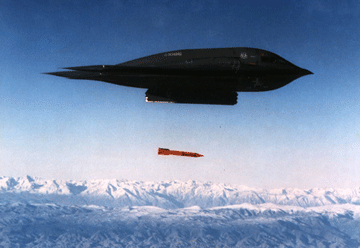
Finally, the existing B61 nuclear bombs will soon be replaced by the enhanced B61-12 guided nuclear bomb. Development is essentially complete and full-scale production of about 480 B61-12s is expected to begin soon. The new weapon is thought to have the same yield range as the current B61-4: 0.3, 1.5, 10 and 50 kilotons. Training of the units in Europe to receive the new weapon is scheduled to begin in early-2023 and the first weapons potentially arriving at the first base in late-2023 or 2024.
In addition to the non-strategic fighter jets F-15E, F-16, F-35A, and Tornado, the B61-12 will also be integrated on the B-2 and B-21 strategic bombers. ecause of the increased provided by the tail kit, all the digital aircraft that can make use of it (all except F-16 and Tornado) will be able to hold at risk a wide range of targets. The combination of increased accuracy and lower-yield options on non-strategic and strategic stealth aircraft will significantly increase the capability of the gravity bomb mission.
Feverishly Racing Toward Our Own Destruction…

End of the American Dream by Michael
After months of feigned confidence and optimism from both the West and Ukraine’s senior military leadership, cracks are beginning to appear. During Ukrainian Commander-in-Chief General Valery Zaluzhny’s recent interview with the Economist, Ukraine’s desperate need for additional arms and the consequences for not receiving them was made very clear.
The discussion revolved around the desperate need for resources – everything ranging from air defense missiles to tanks, armored vehicles, artillery pieces and artillery shells themselves – all things that both the West and now Ukraine are admitting are in short supply, and perhaps cannot be supplied any time in the near or intermediate future.
From “Extending Russia” to “Demilitarizing” NATO
We are careening directly into an abyss of war, pain and misery, and our leaders are thunderously applauding as it happens. Ukrainian President Volodymyr Zelenskyy came to Washington this week because he wanted more money, and our politicians in Washington definitely did not disappoint him. Even though we had already given Ukraine far more money than the rest of the world combined, our politicians agreed to give him another colossal mountain of cash. On some level, we all have to respect Zelenskyy’s skills as a con man. Even though he has banned the main opposition party in Ukraine, and even though he has banned all television stations that were critical of him, and even though he just banned an entire ancient Christian denomination, our politicians continue to worship him like some sort of a pop music star. Zelenskyy has become an extremely oppressive dictator that has set himself up to rule Ukraine for as long as he wants, but members of Congress from both parties continue to hail him as a “champion of democracy” that deserves our unquestioning support.
What makes this so dangerous is that Zelenskyy has been trying very hard to pull the United States into his war with Russia.
Throughout 2022 the U.S. has been getting increasingly involved in the conflict, and at this point we are “providing most of the funding, most of the equipment, most of the ammunition, most of the high level intelligence and much of the training” for the international army that is fighting the Russians in Ukraine.
In other words, we are essentially a direct participant in the war.
For years I have been warning my readers that there would be a war with Russia, and now it is here.
If we had rational leaders in Washington, they would be trying to end this conflict before the nukes start flying.
But instead, they are pledging to give Zelenskyy whatever he needs for as long as it takes to defeat the Russians.
When Zelenskyy visited Washington this week, the White House literally rolled out the red carpet for him.
To see such an honor bestowed upon a cruel foreign dictator that is ruthlessly oppressing anyone that opposes him should nauseate all of us.
And when Zelenskyy arrived to deliver his speech to a joint session of Congress, he was greeted with a standing ovation.
It isn’t just the Democrats that have fallen for Zelenskyy’s act.
At this point, Mitch McConnell says that showering Ukraine with money should be our “number one priority”…………………………………….
once a con man has identified a “golden goose”, he is just going to keep coming back again and again.
So even though we have already given Ukraine more money than everyone else combined, it will never be enough to satisfy Zelenskyy…………………………….
In addition to cold, hard cash, the U.S. also continues to give the Ukrainians some of our best military equipment.
The Biden administration just agreed to send Patriot missile systems to Ukraine, and that represents another huge escalation…………….
If both sides just keep escalating matters, we will eventually reach a point where somebody crosses a line that will never be able to be uncrossed.
We have been pushed to the brink of nuclear war, and the Russians are getting ready to officially deploy their new Sarmat intercontinental ballistic missiles in January…….
The Sarmat is the most advanced intercontinental ballistic missile in the entire world by a wide margin, and we have no way to defend against them.
So maybe we should think twice before getting into a nuclear war with Russia.
Unfortunately, our leaders seem to have gone completely mad at this point, and of course our leaders in Washington are simply a reflection of what has happened to the rest of our society. http://endoftheamericandream.com/feverishly-racing-toward-our-own-destruction/
The Nuclear Subsidy Tango of Bill Gates and Joe Manchin

Bill Gates sold West Virginia Sen. Joe Manchin on this year’s Democratic climate spending blowout as a way to put unemployed coal workers to work building advanced nuclear reactors.
Now we learn, belatedly, that these projects depend on Russia for fuel and will cost taxpayers more than
advertised. The Energy Department last year awarded up to $2 billion for an advanced nuclear reactor “demonstration” project in Wyoming being developed by TerraPower, a company Mr. Gates founded. These advanced reactors have been promoted because they take up significantly less space than conventional reactors and could theoretically use reprocessed nuclear fuel.
Wall St Journal 22nd Dec 2022
Atomic Bomb Effects Cover-up Reported in New York Times

https://www.wanttoknow.info/atomicbombcoverup— 25 Dec 22
The below article is an excellent example of how even the New York Times has twisted the facts and manipulated public opinion in order to support a deeper agenda. This revealing story covers the bombing of Hiroshima back in 1945, yet the same deceptive techniques of distortion and manipulation continue to be used today to support the profit-making war machine.
The New York Times itself acknowledged government and media complicity in hiding the effects of the Atomic bomb in an Aug. 3, 2005 Reuters article they published titled “U.S. Suppressed Footage of Hiroshima for Decades.” Read this revealing article on the Times website on this webpage.
[Note: Since this message was originally posted in 2004, the New York Times removed the article at the above link. A web search shows that no other major media have this revealing story posted. Thankfully, you can still read a copy of this Reuters article on a foreign news website.]
Here’s a quote from this Reuters article, “In the weeks following the atomic attacks on Hiroshima and Nagasaki, U.S. authorities seized and suppressed film shot in the bombed cities by U.S. military crews and Japanese newsreel teams to prevent Americans from seeing the full extent of devastation wrought by the new weapons.” The below article goes into greater detail on the depth of deception. Please help to inform others by sharing this revealing news with your friends and colleagues and exploring the “What you can do” section below.
Hiroshima Cover-up:
How the War Department’s Timesman Won a Pulitzer
by Amy Goodman and David Goodman, Aug. 10, 2004
At the dawn of the nuclear age, an independent Australian journalist named Wilfred Burchett traveled to Japan to cover the aftermath of the atomic bombing of Hiroshima. The only problem was that General Douglas MacArthur had declared southern Japan off-limits, barring the press. Over 200,000 people died in the atomic bombings of Hiroshima and Nagasaki, but no Western journalist witnessed the aftermath and told the story. The world’s media obediently crowded onto the USS Missouri off the coast of Japan to cover the surrender of the Japanese.

Wilfred Burchett decided to strike out on his own. He was determined to see for himself what this nuclear bomb had done, to understand what this vaunted new weapon was all about. So he boarded a train and traveled for thirty hours to the city of Hiroshima in defiance of General MacArthur’s orders.
Burchett emerged from the train into a nightmare world. The devastation that confronted him was unlike any he had ever seen during the war. The city of Hiroshima, with a population of 350,000, had been razed. Multistory buildings were reduced to charred posts. He saw people’s shadows seared into walls and sidewalks. He met people with their skin melting off. In the hospital, he saw patients with purple skin hemorrhages, gangrene, fever, and rapid hair loss. Burchett was among the first to witness and and describe radiation sickness.
Burchett sat down on a chunk of rubble with his Baby Hermes typewriter. His dispatch began: “In Hiroshima, thirty days after the first atomic bomb destroyed the city and shook the world, people are still dying, mysteriously and horribly – people who were uninjured in the cataclysm from an unknown something which I can only describe as the atomic plague.”
He continued, tapping out the words that still haunt to this day: “Hiroshima does not look like a bombed city. It looks as if a monster steamroller has passed over it and squashed it out of existence. I write these facts as dispassionately as I can in the hope that they will act as a warning to the world.”
Burchett’s article, headlined THE ATOMIC PLAGUE, was published on September 5, 1945, in the London Daily Express. The story caused a worldwide sensation. Burchett’s candid reaction to the horror shocked readers. “In this first testing ground of the atomic bomb I have seen the most terrible and frightening desolation in four years of war. It makes a blitzed Pacific island seem like an Eden. The damage is far greater than photographs can show. “When you arrive in Hiroshima you can look around for twenty-five and perhaps thirty square miles. You can see hardly a building. It gives you an empty feeling in the stomach to see such man-made destruction.”
Burchett’s searing independent reportage was a public relations fiasco for the U.S. military. General MacArthur had gone to pains to restrict journalists’ access to the bombed cities, and his military censors were sanitizing and even killing dispatches that described the horror. The official narrative of the atomic bombings downplayed civilian casualties and categorically dismissed reports of the deadly lingering effects of radiation.
Reporters whose dispatches [conflicted] with this version of events found themselves silenced: George Weller of the Chicago Daily News slipped into Nagasaki and wrote a 25,000-word story on the nightmare that he found there. Then he made a crucial error: He submitted the piece to military censors. His newspaper never even received his story. As Weller later summarized his experience with MacArthur’s censors, “They won.”
U.S. authorities responded in time-honored fashion to Burchett’s revelations: They attacked the messenger. General MacArthur ordered him expelled from Japan (the order was later rescinded), and his camera with photos of Hiroshima mysteriously vanished while he was in the hospital. U.S. officials accused Burchett of being influenced by Japanese propaganda. They scoffed at the notion of an atomic sickness. The U.S. military issued a press release right after the Hiroshima bombing that downplayed human casualties, instead emphasizing that the bombed area was the site of valuable industrial and military targets.
Four days after Burchett’s story splashed across front pages around the world, Major General Leslie R. Groves, director of the atomic bomb project, invited a select group of thirty reporters to New Mexico. Foremost among this group was William L. Laurence, the Pulitzer Prize-winning science reporter for The New York Times. Groves took the reporters to the site of the first atomic test. His intent was to demonstrate that no atomic radiation lingered at the site. Groves trusted Laurence to convey the military’s line; the general was not disappointed.
Laurence’s front-page story, U.S. ATOM BOMB SITE BELIES TOKYO TALES: TESTS ON NEW MEXICO RANGE CONFIRM THAT BLAST, AND NOT RADIATION, TOOK TOLL, ran on September 12, 1945, following a three-day delay to clear military censors. “This historic ground in New Mexico, scene of the first atomic explosion on earth and cradle of a new era in civilization, gave the most effective answer today to Japanese propaganda that radiations [sic] were responsible for deaths even after the day of the explosion, Aug. 6, and that persons entering Hiroshima had contracted mysterious maladies due to persistent radioactivity,” the article began. Laurence said unapologetically that the Army tour was intended “to give the lie to these claims.”
Laurence quoted General Groves: “The Japanese claim that people died from radiation. If this is true, the number was very small.” Laurence then went on to offer his own remarkable editorial on what happened: “The Japanese are still continuing their propaganda aimed at creating the impression that we won the war unfairly, and thus attempting to create sympathy for themselves and milder terms. Thus, at the beginning, the Japanese described ‘symptoms’ that did not ring true.”
But Laurence knew better. He had observed the first atomic bomb test on July 16, 1945, and he withheld what he knew about radioactive fallout across the southwestern desert that poisoned local residents and livestock. He kept mum about the spiking Geiger counters all around the test site.
William L. Laurence went on to write a series of ten articles for the Times that served as a glowing tribute to the ingenuity and technical achievements of the nuclear program. Throughout these and other reports, he downplayed and denied the human impact of the bombing. Laurence won the Pulitzer Prize for his reporting.
It turns out that William L. Laurence was not only receiving a salary from The New York Times. He was also on the payroll of the War Department. In March 1945, General Leslie Groves had held a secret meeting at The New York Times with Laurence to offer him a job writing press releases for the Manhattan Project, the U.S. program to develop atomic weapons. The intent, according to the Times, was “to explain the intricacies of the atomic bomb’s operating principles in laymen’s language.” Laurence also helped write statements on the bomb for President Truman and Secretary of War Henry Stimson.
Laurence eagerly accepted the offer, “his scientific curiosity and patriotic zeal perhaps blinding him to the notion that he was at the same time compromising his journalistic independence,” as essayist Harold Evans wrote in a history of war reporting. Evans recounted: “After the bombing, the brilliant but bullying Groves continually suppressed or distorted the effects of radiation. He dismissed reports of Japanese deaths as ‘hoax or propaganda.’ The Times’ Laurence weighed in, too, after Burchett’s reports, and parroted the government line.” Indeed, numerous press releases issued by the military after the Hiroshima bombing – which in the absence of eyewitness accounts were often reproduced verbatim by U.S. newspapers – were written by none other than Laurence.
“Mine has been the honor, unique in the history of journalism, of preparing the War Department’s official press release for worldwide distribution,” boasted Laurence in his memoirs, Dawn Over Zero. “No greater honor could have come to any newspaperman, or anyone else for that matter.”
“Atomic Bill” Laurence revered atomic weapons. He had been crusading for an American nuclear program in articles as far back as 1929. His dual status as government agent and reporter earned him an unprecedented level of access to American military officials – he even flew in the squadron of planes that dropped the atomic bomb on Nagasaki. His reports on the atomic bomb and its use had a hagiographic tone, laced with descriptions that conveyed almost religious awe.
In Laurence’s article about the bombing of Nagasaki (it was withheld by military censors until a month after the bombing), he described the detonation over Nagasaki that incinerated 100,000 people. Laurence waxed: “Awe-struck, we watched it shoot upward like a meteor coming from the earth instead of from outer space, becoming ever more alive as it climbed skyward through the white clouds. It was a living thing, a new species of being, born right before our incredulous eyes.”
Laurence later recounted his impressions of the atomic bomb: “Being close to it and watching it as it was being fashioned into a living thing, so exquisitely shaped that any sculptor would be proud to have created it, one . . . felt oneself in the presence of the supranatural.”
Laurence was good at keeping his master’s secrets – from suppressing the reports of deadly radioactivity in New Mexico to denying them in Japan. The Times was also good at keeping secrets, only revealing Laurence’s dual status as government spokesman and reporter on August 7, the day after the Hiroshima bombing – and four months after Laurence began working for the Pentagon. As Robert Jay Lifton and Greg Mitchell wrote in their excellent book Hiroshima in America: Fifty Years of Denial, “Here was the nation’s leading science reporter, severely compromised, not only unable but disinclined to reveal all he knew about the potential hazards of the most important scientific discovery of his time.”
Radiation: Now You See It, Now You Don’t
A curious twist to this story concerns another New York Times journalist who reported on Hiroshima; his name, believe it or not, was William Lawrence (his byline was W.H. Lawrence). He has long been confused with William L. Laurence. (Even Wilfred Burchett confuses the two men in his memoirs and his 1983 book, Shadows of Hiroshima.) Unlike the War Department’s Pulitzer Prize winner, W.H. Lawrence visited and reported on Hiroshima on the same day as Burchett. (William L. Laurence, after flying in the squadron of planes that bombed Nagasaki, was subsequently called back to the United States by the Times and did not visit the bombed cities.)
W.H. Lawrence’s original dispatch from Hiroshima was published on September 5, 1945. He reported matter-of-factly about the deadly effects of radiation, and wrote that Japanese doctors worried that “all who had been in Hiroshima that day would die as a result of the bomb’s lingering effects.” He described how “persons who had been only slightly injured on the day of the blast lost 86 percent of their white blood corpuscles, developed temperatures of 104 degrees Fahrenheit, their hair began to drop out, they lost their appetites, vomited blood and finally died.”
Oddly enough, W.H. Lawrence contradicted himself one week later in an article headlined NO RADIOACTIVITY IN HIROSHIMA RUIN. For this article, the Pentagon’s spin machine had swung into high gear in response to Burchett’s horrifying account of “atomic plague.” W.H. Lawrence reported that Brigadier General T. F. Farrell, chief of the War Department’s atomic bomb mission to Hiroshima, “denied categorically that [the bomb] produced a dangerous, lingering radioactivity.” Lawrence’s dispatch quotes only Farrell; the reporter never mentions his eyewitness account of people dying from radiation sickness that he wrote the previous week.
The conflicting accounts of Wilfred Burchett and William L. Laurence might be ancient history were it not for a modern twist. On October 23, 2003, The New York Times published an article about a controversy over a Pulitzer Prize awarded in 1932 to Times reporter Walter Duranty. A former correspondent in the Soviet Union, Duranty had denied the existence of a famine that had killed millions of Ukrainians in 1932 and 1933.
The Pulitzer Board had launched two inquiries to consider stripping Duranty of his prize. The Times “regretted the lapses” of its reporter and had published a signed editorial saying that Duranty’s work was “some of the worst reporting to appear in this newspaper.” Current Times executive editor Bill Keller decried Duranty’s “credulous, uncritical parroting of propaganda.”
On November 21, 2003, the Pulitzer Board decided against rescinding Duranty’s award, concluding that there was “no clear and convincing evidence of deliberate deception” in the articles that won the prize.
As an apologist for Joseph Stalin, Duranty is easy pickings. What about the “deliberate deception” of William L. Laurence in denying the lethal effects of radioactivity? And what of the fact that the Pulitzer Board knowingly awarded the top journalism prize to the Pentagon’s paid publicist, who denied the suffering of millions of Japanese? Do the Pulitzer Board and the Times approve of “uncritical parroting ” – as long as it is from the United States?
It is long overdue that the prize for Hiroshima’s apologist be stripped.
The original of the above article published on Aug. 10, 2004 is available here.
Amy Goodman is host of the national radio and TV show “Democracy Now!.” This is an excerpt from her new national bestselling book The Exception to the Rulers: Exposing Oily Politicians, War Profiteers, and the Media that Love Them, written with her brother journalist David, exposes the reporting of Times correspondent William L. Laurence. Democracy Now! is a national radio and TV program, broadcast on more than 240 stations.
Important Note: A profound 22-minute video features interviews of a number of “atomic soldiers” who were ordered to watch the nuclear bomb blasts from as close as a mile away. They were sworn to secrecy under a penalty of a $10,000 fine (roughly $100,000 in today’s dollars) or 10 years in jail and instructed never to talk to their wives or their fellow soldiers about anything they saw or experienced. Don’t miss this incredible film, available on this webpage, that the U.S. government doesn’t want you to see.
U.S. Faith Leaders Call for Xmas Truce in Ukraine as Zelensky Visits D.C. Seeking More Arms & Money
Democracy Now 22 Dec 22,
Ukrainian President Volodymyr Zelensky has wrapped up a one-day visit to Washington, D.C., where he called on the Biden administration and lawmakers to provide more military and financial aid to Ukraine in its fight against Russia. This was Zelensky’s first overseas trip in nearly a year, since the war began. Ahead of the trip, over 1,000 faith leaders in the United States called for a Christmas truce in Ukraine. For more on the war and hopes for peace, we speak with CodePink co-founder Medea Benjamin, theologian Cornel West and Reverend Graylan Scott Hagler, senior adviser to the Fellowship of Reconciliation……………………
AMY GOODMAN: During his speech to a joint session of Congress later in the day, Ukrainian President Volodymyr Zelensky said aid to Ukraine should be viewed as investment, not charity.
AMY GOODMAN: Ahead of President Zelensky’s trip to Washington, over a thousand faith leaders in the United States called for a Christmas truce in Ukraine. The signatories included the Reverend Jesse Jackson, Bishop William Barber and members of the Russian Orthodox Church. The letter was initiated by the Fellowship of Reconciliation, CodePink and the National Council of Elders. The groups also released this short video featuring some of the signatories.
AMY GOODMAN: We’re joined now by three guests involved in this call by over a thousand faith leaders for a Christmas truce in Ukraine.- Reverend Graylan Scott Hagler….. Cornel West … Medea Benjamin, co-founder of CodePink………………..
MEDEA BENJAMIN: We feel that this war is not going to be won on the battlefield. This is something that the Chair of the Joint Chiefs of Staff Mark Milley said. We see that the head of NATO, Jens Stoltenberg, who has been so hawkish on this, was asked his greatest fear; he said, “Spinning out of control. If it goes wrong, it could go horribly wrong.” We see us no longer marching towards a nuclear Armageddon with their eyes closed; it’s with our eyes opened. There will not be a military victory. There must be negotiations.
And we don’t want the moral center questioning this war to be coming from people like Marjorie Taylor Greene, Lauren Boebert, Donald Trump or Tucker Carlson, who are the people now questioning this war. We want it to come from the moral center of this country. That means the faith-based community, who understands that we have to protect all of God’s creations and that our moral obligation is to stop the killing, stop the fighting, stop the war. And that’s why we have called for this Christmas truce.
CORNEL WEST: ……………………… we have to be willing to have a moral witness that keeps track of the organized greed, of the routinized hatred, of the manipulated fear and the chronic hypocrisy of the wounded Russian empire and the American empire, that is, of course, 800 — has 800 military troops units around the world and doesn’t want to be honest about its own role. We know that if there were missiles in Canada or Mexico or Venezuela or Cuba, the U.S. military would blow them to smithereens. So we have no moral authority when it comes to dealing with the gangster activity of Putin. We have American gangster activity in our military-industrial complex tied to the White House.
…………….. AMY GOODMAN: And, Reverend Graylan Hagler, if you can talk about what this truce would mean, as a minister in Washington, D.C., and senior adviser to the Fellowship of Conciliation? It seems that in the United States — this is unlike even the media in France, for example, and Germany — that negotiation is viewed as capitulation. In other places, it’s viewed as how to save the planet. But talk about what it would look like here and what your response was to yesterday’s joint session of Congress, to the plea that President Zelensky made, with his people under fire across Ukraine, what it means for President Biden to agree to send this Patriot missile system. Clearly, Zelensky, to laughter, has said he’ll be asking for more.
REV. GRAYLAN SCOTT HAGLER:………………………………………….. What we’re looking at is, in 1914, on Christmas Eve, in World War I, people came out of the trenches, combatants, and celebrated for a moment an atmosphere of peace. And we’re saying that that history is speaking to us right now and calling upon us right now to create an atmosphere where we can begin the road towards peace and reconciliation, because the issue is, is weapons are not going to take us there, and combatants are not going to take us there. It’s only when we sit down and say, “Enough is enough, and we need to reason from the heart and the spirit of justice.”
…………………..MEDEA BENJAMIN: Well, I think it’s important to understand that Angela Merkel, in her interview, also said, “Why would Putin ever trust the West in peace negotiations?” Basically, using those peace negotiations not to stop the inflow of weapons into Ukraine, but to start pouring them in even more. And so, there is no trust on any side at this point.
But there is a need for negotiations. Both sides have staked out their positions, maximalist positions on each side, Zelensky now saying they want every inch of Donbas and all of Crimea back, and the Russians saying they now control and owned these four regions of Ukraine that they can’t even control on the battlefield. But these are positions for negotiations. But the call for negotiations has to come from Biden. And it is not happening. We see that after he met with Macron, the head of France, Macron said there are legitimate security interests of Russia that have to be taken into account. So that all has to be dealt with at the peace table.
And so, what we are saying with this Christmas truce call is that let’s be realistic with the American people. We keep pouring more money. Now it will be another $45 billion that will be approved by the end of this week. That’s over $100 billion, without a year going by, that could have been used for so many essential needs here in this country, and instead poured into a war that is not winnable on the battlefield.
So, we need to be honest about this. And that’s why we have this call for a Christmas truce. That’s why Reverend Barber will be giving a Christmas Eve sermon on the moral imperative of a truce. That’s why we’re having a week of protests, starting January 13th; February 19th, the Libertarian Party and the People’s Party calling for a protest in Washington, D.C.; March 8th, International Women’s Day, an international call of women to say, “Stop this war, and end all wars.” That’s what we need to do.
AMY GOODMAN: I wanted to turn to two clips of President Biden. This was the joint news conference that he held with the Ukrainian President Volodymyr Zelensky yesterday afternoon at the White House.
…………… (Biden – ) the United States is committed to ensuring that the brave Ukrainian people can continue, continue to defend their country against Russian aggressions as long as it takes.
AMY GOODMAN: And Biden went on to indicate he would let Zelensky set the timetable for any negotiated settlement with Russia.
PRESIDENT JOE BIDEN: It can succeed in the battlefield with our help, and the help of our European allies and others, so that if and when President Zelensky is ready to talk with the Russians, he will be able to succeed, as well, because he will have won on the battlefield……………………..
AMY GOODMAN: ………………………………….There’s also discussion that this moment that President Biden and President Zelensky have seized for Zelensky’s joint session of Congress address is right before the House changes hands to Republicans, because a number of Republicans — not clear if the House speaker will be McCarthy — are demanding that this money and weapons flow stop. How do you feel as a progressive antiwar activist — two things — being allied with far-right Republicans and, secondly, being called by some a Russian apologist?
MEDEA BENJAMIN: I feel that if I were in Russia, I would be in jail for protesting this war. I also feel terrible that my congresspeople in the Progressive Caucus were cowed and silenced. I think the 30 who signed on that letter, in their heart of hearts, probably believe that negotiations is the only way. And we have to pressure them more to come out and say that their original stance was right………………. So, it’s our job to put the pressure on our members of Congress, whether they’re Republican or Democrat, to come out with the only rational position right now.
The U.S., unfortunately, and the Biden administration, has been against negotiations, nixed the negotiations that were going on in late March, early April, and told the Ukrainians, basically, “You don’t have to negotiate, because we’re going to keep pouring more weapons in.” This is only helping the weapons companies, who actually were the sponsors of a reception at the Ukrainian Embassy in Washington, D.C., on December 8th, brought to you by Lockheed Martin, Northrop Grumman and Raytheon. They are the ones who are getting rich in this. The Ukrainians are suffering. ………. …………………………………more https://www.democracynow.org/2022/12/22/christmas_truce_letter
Getting rid of plutonium pits — so many questions
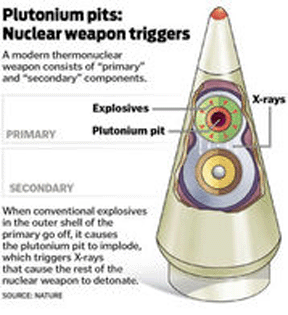
https://www.santafenewmexican.com/opinion/editorials/getting-rid-of-plutonium-pits-so-many-questions/article_4178b6d4-824e-11ed-aaa7-775a96e0dc9f.html 25 Dec 22. A Department of Energy proposal to dilute and dispose of plutonium waste at the Waste Isolation Pilot Plant in Carlsbad is ready for public comment — the draft environmental impact statement, all 412 pages of it, has been released.
The public can weigh in, whether in writing or by showing up for public hearings that will take place early next year.
Buckle up. This is going to be a contentious discussion.
The U.S. wants to be rid of 34 metric tons of plutonium bomb cores, or pits, stored at the Pantex Plant in Amarillo. The pits are Cold War legacies; because WIPP is restricted in the type of waste it can take, before disposing of it, the material must be diluted. Thus, the term, dilute and dispose. The Department of Energy’s decision about the waste was announced two years ago, but with no details.
At one point the Energy Department wanted to turn Cold War plutonium into a mixed oxide fuel for use in commercial nuclear plants. That would have happened at the Savannah River Site in South Carolina, but billions in cost overruns and delays hamstrung the effort, and the Trump administration killed the project in 2018.
It chose the dilute-and-disposal plan.
The draft statement fleshes out just what would happen to prepare the pits for disposal — in a facility, we might point out, that currently is seeking a renewal of its hazardous waste permit from the state of New Mexico. WIPP is open, but state Environment Department Secretary James Kenney and Gov. Michelle Lujan Grisham want more oversight of waste disposal at the plant.
That back and forth is separate from the Energy Department dilute-and-disposal proposal, but the permit discussion provides context for the coming fierce debate.
Here’s what community members already are questioning. The Energy Department plan includes considerable time on highways carrying radioactive material, including trucking the stuff at least twice through New Mexico. That would include trips on congested corridors inside the southern edge of Santa Fe. First, the material would be shipped to LANL, where workers would convert it to oxidized powder. From Los Alamos, the powder would be transported to Savannah River
There, crews would add an adulterant to make the powder unusable in weapons. The dilution portion taken care of, the material would be taken to WIPP, the underground disposal site.
That’s a lot of time on the highway for radioactive material, especially considering conditions on Interstate 40. It seems an expensive and inefficient way of disposing of plutonium — a 3,300-mile trip, ending with the materials deep beneath the ground at WIPP.
That’s a site, by the way, that only was supposed to store low-level transuranic waste — the contaminated gloves, equipment, clothing, soil and other materials that need to be disposed of safely. The WIPP mission continues to be expanded, another reason the state must increase its oversight. We expect elected officials — whether the governor or members of New Mexico’s congressional delegation — to speak up further about possible plutonium pit disposal, too.
There are questions about whether the pits need to be removed from Pantex at all, or whether work to make them inoperable in weapons could take place where they currently are being held. That would mean improving storage facilities, but eliminate a lot of highway traffic. Barring keeping the pits in place, all waste roads lead to New Mexico, That why residents here have a huge stake in determining what happens to these pits.
Stay alert for notices of meetings and time for public comment. There’s no guarantee informed opposition will change plans by agencies intent on certain action, but speaking up beats staying quiet. Oh, and think about this: before rushing full speed ahead to produce even more plutonium pits, it’s time to at least try to find a way to dispose of the waste we’ve already created.
Maybe, just maybe, not all the waste has to be buried in New Mexico. Or driven across New Mexico highways. It’s a big country.
The Democrats are Now the War Party
The Democratic Party has become the party of permanent war, fueling massive military spending which is hollowing out the country from the inside and flirting with with nuclear war.
Chris Hedges Substack, 26 Dec 22,
The Democrats position themselves as the party of virtue, cloaking their support for the war industry in moral language stretching back to Korea and Vietnam, when President Ngo Dinh Diem was as lionized as Ukrainian President Volodymyr Zelensky. All the wars they support and fund are “good” wars. All the enemies they fight, the latest being Russia’s Vladimir Putin and China’s Xi Jinping, are incarnations of evil. The photo of a beaming House Speaker Nancy Pelosi and Vice President Kamala Harris holding up a signed Ukrainian battle flag behind Zelensky as he addressed Congress was another example of the Democratic Party’s abject subservience to the war machine.
The Democrats, especially with the presidency of Bill Clinton, became shills not only for corporate America but for the weapons manufacturers and the Pentagon. No weapons system is too costly. No war, no matter how disastrous, goes unfunded. No military budget is too big, including the $858 billion in military spending allocated for the current fiscal year, an increase of $45 billion above what the Biden administration requested.
The historian Arnold Toynbee cited unchecked militarism as the fatal disease of empires, arguing that they ultimatley commit suicide.
There once was a wing of the Democratic Party that questioned and stood up to the war industry: Senators J. William Fulbright, George McGovern, Gene McCarthy, Mike Gravel, William Proxmire and House member Dennis Kucinich. But that opposition evaporated along with the antiwar movement. When 30 members of the party’s progressive caucus recently issued a call for Biden to negotiate with Putin, they were forced by the party leadership and a warmongering media to back down and rescind their letter. Not that any of them, with the exception of Alexandria Ocasio-Cortez, have voted against the billions of dollars in weaponry sent to Ukraine or the bloated military budget. Rashida Tlaib voted present.
The opposition to the perpetual funding of the war in Ukraine has come primarily from Republicans, 11 in the Senate and 57 in the House, several, such as Marjorie Taylor Greene, unhinged conspiracy theorists. Only nine Republicans in the House joined the Democrats in supporting the $1.7 trillion spending bill needed to prevent the government from shutting down, which included approval of $847 billion for the military — the total is boosted to $858 billion when factoring in accounts that don’t fall under the Armed Services committees’ jurisdiction. In the Senate, 29 Republicans opposed the spending bill. The Democrats, including nearly all 100 members of the House Congressional Progressive Caucus, lined up dutifully for endless war.
This lust for war is dangerous, pushing us into a potential war with Russia and, perhaps later, with China — each a nuclear power. It is also economically ruinous. The monopolization of capital by the military has driven U.S. debt to over $30 trillion, $6 trillion more than the U.S. GDP of $24 trillion. Servicing this debt costs $300 billion a year. We spend more on the military than the next nine countries, including China and Russia, combined. Congress is also on track to provide an extra $21.7 billion to the Pentagon — above the already expanded annual budget — to resupply Ukraine.
“But those contracts are just the leading edge of what is shaping up to be a big new defense buildup,” The New York Times reported. “Military spending next year is on track to reach its highest level in inflation-adjusted terms since the peaks in the costs of the Iraq and Afghanistan wars between 2008 and 2011, and the second highest in inflation-adjusted terms since World War II — a level that is more than the budgets for the next 10 largest cabinet agencies combined.”
The Democratic Party, which, under the Clinton administration aggressively courted corporate donors, has surrendered its willingness to challenge, however tepidly, the war industry.
“As soon as the Democratic Party made a determination, it could have been 35 or 40 years ago, that they were going to take corporate contributions, that wiped out any distinction between the two parties,” Dennis Kucinich said when I interviewed him on my show for The Real News Network. “Because in Washington, he or she who pays the piper plays the tune. That’s what’s happened. There isn’t that much of a difference in terms of the two parties when it comes to war.”
In his 1970 book “The Pentagon Propaganda Machine,” Fulbright describes how the Pentagon and the arms industry pour millions into shaping public opinion through public relations campaigns, Defense Department films, control over Hollywood and domination of the commercial media. Military analysts on cable news are universally former military and intelligence officials who sit on boards or work as consultants to defense industries, a fact they rarely disclose to the public. Barry R. McCaffrey, a retired four-star army general and military analyst for NBC News, was also an employee of Defense Solutions, a military sales and project management firm. He, like most of these shills for war, personally profited from the sales of the weapons systems and expansion of the wars in Iraq and Afghanistan…………………………………………..
By not opposing a Democratic Party whose primary business is war, liberals become the sterile, defeated dreamers in Fyodor Dostoevsky’s “Notes from the Underground.”
A former convict, Dostoevsky did not fear evil. He feared a society that no longer had the moral fortitude to confront evil. And war, to steal a line from my latest book, is the greatest evil https://chrishedges.substack.com/p/the-democrats-are-now-the-war-party?utm_source=substack&utm_medium=email
The Claim That The Ukraine War Advances US Interests Discredits The Claim That It’s “Unprovoked”

Caitlin Johnstone 23 Dec 22 https://caitlinjohnstone.substack.com/p/the-claim-that-the-ukraine-war-advances?utm_source=post-email-title&publication_id=82124&post_id=92381287&isFreemail=true&utm_medium=email
One of the most illustrative examples of how the mainstream worldview is based on narratives rather than facts is the way Republican officials like senate minority leader Mitch McConnell have been branded servants of Russia despite consistent track records as virulent Russia hawks.
“Moscow Mitch”, as Democrats absurdly titled him during the height of Russiagate hysteria in 2019, gave a speech on the Senate floor on Wednesday arguing that the primary reason to back Ukraine in its war against Russia is because doing so serves US interests.
“President Zelensky is an inspiring leader,” McConnell said in his speech ahead of the Ukrainian president’s visit to Washington. “But the most basic reasons for continuing to help Ukraine degrade and defeat the Russian invaders are cold, hard, practical American interests. Helping equip our friends in Eastern Europe to win this war is also a direct investment in reducing Vladimir Putin’s future capabilities to menace America, threaten our allies, and contest our core interests.”
McConnell argued that backing Ukraine “will massively wear down the arsenal that is available to Putin for future efforts to use bullying and bloodshed,” taking a stab at the Biden administration for not requesting more money for this immensely useful proxy war.
“So I’ll say it one more time. Continuing our support for Ukraine is morally right, but it is not only that. It is also a direct investment in cold, hard, American interests,” McConnell said. “That’s why Republicans rejected the Biden Administration’s original request for Ukraine assistance as insufficient.
“Finally, we all know that Ukraine’s fight to retake its territory is neither the beginning nor end of the West’s broader strategic competition with Putin’s Russia,” McConnell concluded. “Increasing the pressure on Putin’s regime can and should be a bipartisan priority.”
You see US empire lackeys gushing all the time about how extraordinarily efficient and cost-effective the proxy war in Ukraine is for furthering US interests against Russia, which is funny because they spend the rest of the time talking about how this invasion was “unprovoked” and rending their garments about how horrible it is. The official imperial position is somehow simultaneously (A) “We hate this war and never wanted it,” and (B) “This war benefits us tremendously.
The only way to reconcile these two positions is to believe that Vladimir Putin acted against the interests of Russia in the service of the United States by invading Ukraine, for no other reason than because he is too stupid and evil to do otherwise. The other choice is to do what most empire loyalists do and simply not think very hard about those obvious contradictions.
Alternatively, you can consider the possibility that Putin was pressured into choosing between two bad options by the many aggressive provocations the empire has been making for years. Empire apologists always claim that western provocations had nothing to do with the invasion of Ukraine, but if that’s true then why did so many western experts spend years warning that western provocations would lead to an invasion of Ukraine?
Plainly the claim that the US is just an innocent bystander helping its good buddy Ukraine because it loves freedom and democracy is discredited by the claim — often made by those very same claimants — that this war serves US interests. But you hear them bounce seamlessly between the two all the time.
There’s a viral thread making the rounds on Twitter right now by a historian named Brett Devereaux that exemplifies this perfectly. In the first tweet in the thread he’s enthusing about how “for just 5% of the US military budget, we’ve disabled 50% of Russia’s military power,” then in the very next post in the thread he’s weeping about what a humanitarian crisis the war is and how we just want peace, and then in the very next post after that he’s saying “from a pure realpolitik perspective, Putin’s war was a massive blunder that has strengthened the US global position, degrading Russian capabilities (which frees up resources for other threats) and strengthening our alliances.”
California representative Adam Schiff, who has been calling this war “unprovoked” since the invasion, was saying all the way back during the Trump impeachment hearings of 2020 that “the US aids Ukraine and her people so that we can fight Russia over there and we don’t have to fight Russia here.”
Another congressman, Dan Crenshaw, said on Twitter this past May that “investing in the destruction of our adversary’s military, without losing a single American troop, strikes me as a good idea.”
“It is in America’s interests to help Ukraine defeat one of our most powerful foes,” tweeted The Atlantic’s David French in the wake of Zelensky’s PR appearance in Washington.
“It is in America’s national security interests for Putin’s Russia to be defeated in Ukraine,” tweeted warmongering senator Lindsey Graham.
Statements like these should fully discredit the official narrative that the US is helping Ukraine fight off an unprovoked attack by a reckless tyrant. These are mutually contradictory positions; either it’s a completely unprovoked invasion that Washington didn’t want, or it’s an excellent way of getting Washington everything it wants. It’s nonsensical and naive to believe both.
But of course they do not discredit the official Ukraine narrative in the eyes of the public, because the US has the most effective propaganda machine that has ever existed. The many glaring inconsistencies and misdeeds of the empire are simply airbrushed away with a little spin and sweet talk.
If it weren’t for the imperial spin machine, nobody would believe the US just coincidentally stumbled its way into a lucky proxy war that happens to help it advance its agendas of global domination.
Democrats Are Making a Devil’s Bargain on Pentagon Funding. It’s Not Paying Off.
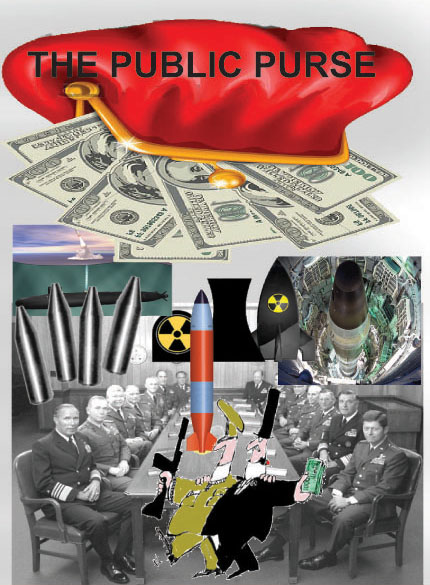
The Pentagon is not just another government agency. It’s the embodiment of a U.S. foreign policy that prizes militarism and force over diplomacy and multilateralism.
Progressives can’t win unless Pentagon spending is put on the chopping block. By Lindsay Koshgarian , TRUTHOUT, December 23, 2022
The year 2022 confirmed yet again that accepting massive military budget increases in exchange for a smattering of social benefits funding — a common devil’s bargain struck by Democrats in Congress — will never deliver the kind of world we dream of.
The military budget deal just reached by Congress will put Pentagon spending at $858 billion — more than $118 billion higher than when President Biden came into office, and more than $180 billion higher than the last budget approved under President Obama. That increase would have been more than enough to cover the costs of the entire Build Back Better agenda.
By comparison with the ever-growing Pentagon budget, wins on big progressive spending priorities in the last two years have been hit or miss, with plenty of notable misses. Political fortunes for the successful Inflation Reduction Act and the failed Build Back Better plan were widely understood to rest on a couple of high-profile swing votes, but a larger and longer-running political dynamic was also at play.
Members of Congress who favor progressive spending priorities regularly make deals to accept big military increases in exchange for a smattering of domestic spending increases, a pattern that’s set to play out again this year. The result of this tacit understanding in Congress has been that the priorities in the annual discretionary budget have remained frozen, with more than half of the annual budget going to the military in a typical year.
With the exception of pandemic relief, even when the budget pie grows, domestic spending never takes a significantly larger portion. To win more progressive priorities, that balance must shift. Pentagon spending has to be put on the chopping block — both because the military budget is far too high, and because the current dealmaking consensus means an eternally limited budget share for progressive priorities.
Progressive Goals Lose When the Pentagon Gains
It’s been a mixed year for progressive spending priorities. The Inflation Reduction Act, the first major act by Congress to address climate change, was a historic moment and a huge win for progressives — but it was also far too small to address the massive challenge posed by the climate crisis……………………………………
How Pentagon Spending Gets a Pass
The $858 billion budget that Congress just approved for the military, on a bipartisan basis, is part of the National Defense Authorization Act (NDAA). The NDAA is widely considered “must-pass” legislation, having passed with wide bipartisan support every year for more than 60 years. No other piece of legislation except the budget deal (and possibly the debt limit) is regarded as required in the same way………………..
There is no shortage of reasons why so many members continue to support the NDAA and Pentagon budget increases in general. Many in Congress still conflate military spending with security, and think there can never be too much of it — or else it’s purely political maneuvering to avoid being seen as weak on defense. And with Pentagon contractors sprinkling campaign contributions and federally funded jobs on congressional districts like so much fairy dust, there are plenty of politically expedient reasons to vote for a Pentagon budget increase.
But a less recognized part of the problem is the now-ingrained practice of trading off higher Pentagon spending for more domestic spending. The commonly accepted practice of negotiating bigger Pentagon budgets in exchange for a smattering of smaller domestic spending increases has greased the wheels of politically treacherous budget negotiations for years. It has also meant that Pentagon budget increases sail through with far too little scrutiny, even at a time like now when the agency has just failed its fifth audit.
It Wasn’t Always Like This
The long-accepted pattern of trading higher Pentagon spending in exchange for higher domestic spending solidified with the 2011 Budget Control Act, which explicitly locked in shares of the annual discretionary budget for military and non-military purposes.
The Budget Control Act locked in budget patterns that were in place at the height of the post-9/11 wars, a time of historically high Pentagon spending. But the legislation expired in 2021, and the negotiations have stayed stuck in the same mold.
Fifteen years before the Budget Control Act was passed, Congress had just completed a historic drawdown of the Pentagon budget. In the years after the end of the Cold War, it was widely agreed that the U.S. could pull back militarily, and the nation did go through a period of decreased military spending. That ended with the post-9/11 wars — but now that the U.S. has officially ended those wars, pulling the last troops out of Afghanistan last year, no military cutbacks have materialized. It’s the first time on record that no “peace dividend” resulted from the end of a major U.S. war.
The Pentagon Is a Losing Trade
Year after year, the saga continues: Democrats accept a big Pentagon increase in exchange for a smattering of little increases that even put together, don’t quite add up to what the Pentagon gets.
The progressive movement has had some wins, but in many ways, it has stalled on major spending priorities. The failure to seriously take on Pentagon spending is one of the reasons.
That’s beginning to change. In recent years, progressive movements and progressive champions in Congress have begun to take on Pentagon spending. The Poor People’s Campaign and the People Over Pentagon coalition have connected the need for a lower Pentagon budget to winning other progressive priorities. This year, a majority of House Democrats voted to remove $37 billion that the House Armed Services Committee had voted to add to the Pentagon budget. Also this year, Representatives Barbara Lee and Representative Mark Pocan introduced The People Over Pentagon Act, to cut $100 billion from the Pentagon budget and reinvest it in domestic priorities.
Those efforts haven’t been successful yet. But they’re necessary both ethically and practically. The Pentagon is not just another government agency. It’s the embodiment of a U.S. foreign policy that prizes militarism and force over diplomacy and multilateralism. It’s the agency that executed the wars after the 9/11 attacks, leading to more than 900,000 deaths. The list of ongoing damage done by the Pentagon runs long, from poisoned drinking water, to complicity in unjust wars and unaddressed harm to its own service members.
Practically, fighting to cut the military budget is also necessary because politics as usual will keep leading to the same results as usual. If progressives want more wins on progressive investments ranging from health care to child care to climate change, the Pentagon budget has to become a target. https://truthout.org/articles/democrats-are-making-a-devils-bargain-on-pentagon-funding-its-not-paying-off/?eType=EmailBlastContent&eId=2ebfd90a-c597-4908-b350-da03822ad182
America’s complicated problem of disposing of tons of plutonium bomb cores, as the government to spend $1.7 billion on more plutonium bomb cores

The nuclear security agency’s draft statement comes as the Senate approved a military spending bill that seeks to funnel $1.7 billion to the lab’s pit operations, an unprecedented funding amount.
Weehler said the government should hold off on producing pits, which will generate more waste, until it has figured out a safe and effective way to dispose of the radioactive material it already has.
LANL would aid in diluting plutonium in controversial disposal plan
https://www.santafenewmexican.com/news/local_news/lanl-would-aid-in-diluting-plutonium-in-controversial-disposal-plan/article_e6cb6380-6d26-11ed-9a6c-731a070c9235.html By Scott Wyland swyland@sfnewmexican.com, Dec 17, 2022
The federal government has released a draft environmental impact statement on its plans to dilute and dispose of surplus plutonium, plans that worry some activists, residents and state officials because the radioactive material would be trucked at least twice through New Mexico, including the southern edge of Santa Fe.
The U.S. Energy Department’s nuclear security agency placed a notice of the 412-page draft in the Federal Register on Friday, providing details on the plutonium disposal it first announced two years ago but had kept mostly silent about.
Agencies want to get rid of 34 metric tons of plutonium bomb cores, or pits, that are left over from the Cold War and being kept at the Pantex Plant in Amarillo, Texas.
Plans call for shipping the material to Los Alamos National Laboratory, where it would be converted to oxidized powder, then transported to Savannah River Site in South Carolina so crews can add an adulterant to make it unusable for weapons.
From there, it would go to the Waste Isolation Pilot Plant, an underground disposal site in Carlsbad. This “downblending” is required because WIPP only takes waste below a certain radioactive level.
The public will have a chance to weigh in, both with written comments and at several public hearings scheduled for early next year.
Critics have spoke out against the plan for more than a year, arguing it puts communities along the trucking routes at risk and should be reconsidered.
Cindy Weehler, who co-chairs the watchdog group 285 ALL, said the environmental review confirms her concerns about the region becoming a hub for material that is more radioactive than the transuranic waste — contaminated gloves, equipment, clothing, soil and other materials — the lab now ships to WIPP.
“The preferred option is still to do this 3,300-hundred-mile road trip and have the two operations occur at two different labs,” Weehler said.
The impact statement offers possible alternatives, such as doing all the downblending at the lab or Savannah River to reduce transportation, but it makes clear the original plan is the preferred method.
The National Nuclear Security Administration has been quiet about the dilute-and-dispose plans, other than to acknowledge an environmental impact statement was underway.
This silence has frustrated residents, state and local officials and community advocates like Weehler.
If all the downblending is done at the lab, it would keep the plutonium from being hauled through a dozen states, so that would be better for many neighborhoods across the country, Weehler said.
However, dangerous radioactive substances would still go through Los Alamos and Santa Fe counties twice, she said.
Whether the oxidized powder leaves the lab in pure form or is adulterated, it would be hazardous to breathe in if the containers were breached in an accident, she said.
The draft statement said the powder would go into a steel canister, which would be placed into a reinforced 55-gallon drum known as a “criticality control container.” As many as 14 control containers can be put into a heavily fortified Trupact shipping container.
The lab has an operation known as ARIES for oxidizing plutonium on a small scale. Boosting the quantity would require installing more glove boxes — the sealed compartments that allow workers to handle radioactive materials — and other equipment to the plutonium facility, the statement said. The additions would expand the facility to 6,800 feet from 5,200 feet.
Structures would have to be built to accommodate the work, including a logistical support center, an office building, a warehouse, a security portal and a weather enclosure for the plutonium facility’s loading dock, the statement says.
The idea of doing away with surplus plutonium began after the Cold War. In 2000, the U.S. and Russia agreed to each eliminate 34 metric tons of the plutonium so it could no longer be used in nuclear weapons.
Russia reportedly withdrew from the pact later, but the U.S. decided to stick with its commitment.
The Energy Department originally sought to build a Savannah River facility that could turn Cold War plutonium into a mixed oxide fuel for commercial nuclear plants. But after billions of dollars in cost overruns and years of delays, the Trump administration scrapped the project in 2018 and decided to go with diluting and disposing of the waste.
One nuclear waste watchdog questioned why the leftover pits must be removed from Pantex at all.
That facility should be able to continue storing the plutonium safely, just as it has since the 1990s, said Don Hancock, director of nuclear waste safety for the nonprofit Southwest Research and Information Center.
“If it’s not safe to be at Pantex, then that raises some severe questions about the safety of the Pantex plant for its assembly and disassembly mission” for nuclear weapons, Hancock said.
Hancock said he opposes the government using WIPP as the sole disposal site for the diluted plutonium and other nuclear waste.
The nuclear security agency’s draft statement comes as the Senate approved a military spending bill that seeks to funnel $1.7 billion to the lab’s pit operations, an unprecedented funding amount.
Weehler said the government should hold off on producing pits, which will generate more waste, until it has figured out a safe and effective way to dispose of the radioactive material it already has.
“This is just a commonsense thing,” she said. “We have the weaponry we need.”
Bank of America, investors, thrilled and delighted with the nuclear arms race

Above: Banks investing in nuclear weapons
These 3 stocks will benefit from the nuclear arms race – Bank of America
Stock Markets (Dec 20, 2022,
The U.S. defense stocks are likely to continue outperforming the market, thanks to the ongoing conflict in Ukraine and a potential conflict in Taiwan, according to Bank of America analysts.
One particular area of the defense sector to be monitored closely is the one focused on the development of nuclear weapons.
“We expect concerns of nuclear proliferation to drive secular and governmental defense spending, particularly as the US moves away from nation-state conflicts, like in the Middle East, and focuses attention on near-peer threats. We expect US defense companies to see much of the upside from increased demand for nonstrategic nuclear weapons,” the analysts said in a client note……………….
As Europe lacks the industrial footprint the US has cultivated, we expect that US defense primes will be called upon to fill demand, reflecting a significant upside to these names,” they added.
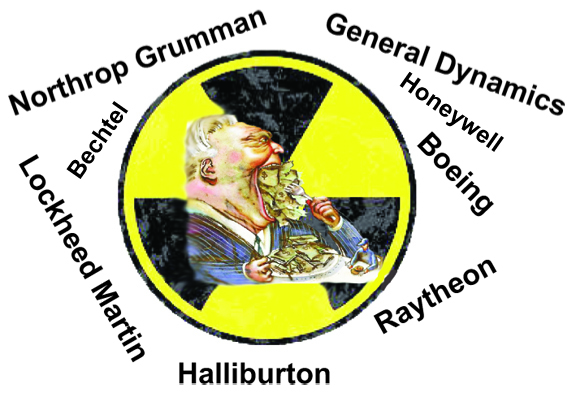
Along these lines, the analysts see Northrop Grumman (NYSE:NOC), Boeing (NYSE:BA), and Lockheed Martin (NYSE:LMT) benefiting from the increased demand as these three have the largest nuclear operations.
“This reinforces our Buy rating on Northrop Grumman. We remain Neutral on Boeing and Lockheed Martin on account of continued supply chain challenges and operational hurdles,” the analysts concluded. https://au.investing.com/news/stock-market-news/these-3-stocks-will-benefit-from-the-nuclear-arms-race–bank-of-america-432SI-2747010
1 This Month

of the week – Shut Down Drone Warfare!


Tell the Ukrainian Government to Drop Prosecution of Peace Activist Yurii Sheliazhenko

Petition to revoke the licensing of the Near Surface Nuclear Disposal Facility (NSDF) at Chalk River. https://www.ourcommons.ca/petitions/en/Petition/Details?Petition=e-7247
To see nuclear-related stories in greater depth and intensity – go to https://nuclearinformation.wordpress.com
-
Archives
- April 2026 (114)
- March 2026 (251)
- February 2026 (268)
- January 2026 (308)
- December 2025 (358)
- November 2025 (359)
- October 2025 (376)
- September 2025 (257)
- August 2025 (319)
- July 2025 (230)
- June 2025 (348)
- May 2025 (261)
-
Categories
- 1
- 1 NUCLEAR ISSUES
- business and costs
- climate change
- culture and arts
- ENERGY
- environment
- health
- history
- indigenous issues
- Legal
- marketing of nuclear
- media
- opposition to nuclear
- PERSONAL STORIES
- politics
- politics international
- Religion and ethics
- safety
- secrets,lies and civil liberties
- spinbuster
- technology
- Uranium
- wastes
- weapons and war
- Women
- 2 WORLD
- ACTION
- AFRICA
- Atrocities
- AUSTRALIA
- Christina's notes
- Christina's themes
- culture and arts
- Events
- Fuk 2022
- Fuk 2023
- Fukushima 2017
- Fukushima 2018
- fukushima 2019
- Fukushima 2020
- Fukushima 2021
- general
- global warming
- Humour (God we need it)
- Nuclear
- RARE EARTHS
- Reference
- resources – print
- Resources -audiovicual
- Weekly Newsletter
- World
- World Nuclear
- YouTube
-
RSS
Entries RSS
Comments RSS
 nuclear-news