NASA partners with the military to test nuclear fission-powered spacecraft engine by 2027
The technological advancement has long been seen as critical to long-haul missions, including a manned trip to Mars.
Aljazeera 24 Jan 2023
The top official at the United States space agency NASA has said the country plans to test a spacecraft engine powered with nuclear fission by 2027, an advancement seen as key to long-haul missions including a manned journey to Mars.
NASA will partner with the US military’s Defense Advanced Research Projects Agency (DARPA) to develop the nuclear thermal propulsion engine and launch it into space, NASA administrator Bill Nelson said on Tuesday. The project has been named the Demonstration Rocket for Agile Cislunar Operations or DRACO……………………..
Under the NASA-DARPA agreement, NASA’s Space Technology Mission Directorate will lead technical development of the nuclear thermal engine, which will eventually be integrated with an experimental spacecraft created by the military.
The agency said the last US nuclear thermal rocket engine tests were discontinued in the 1970s… https://www.aljazeera.com/news/2023/1/24/nasa-to-test-nuclear-fission-powered-spacecraft-engine-by-2027
Julian Assange and the US government’s war on whistleblowers
Chris Hedges, The Real News Network, Fri, 20 Jan 2023
Thirteen years ago, WikiLeaks published extensive leaked US government documents detailing a range of criminal and unethical acts, from the slaughter of civilians in the “War on Terror” to acts of espionage against foreign heads of state. Since then, the persecution of Julian Assange has not ceased. This year, Assange is expected to stand trial in the US for violations of the Espionage Act. Journalist Kevin Gosztola joins The Chris Hedges Report to review the cases of Julian Assange and Chelsea Manning, and discuss Washington’s wider war against whistleblowers and the truth itself.
Kevin Gosztola is the managing editor of Shadowproof, where he writes The Dissenter. He is the author of Guilty of Journalism: The Political Case Against Julian Assange.
TRANSCRIPT
Chris Hedges: The long persecution of Julian Assange, the publisher of WikiLeaks, is set to culminate in its final act: a trial in the United States, probably this year. Kevin Gosztola has spent the last decade reporting on Assange, WikiLeaks, and the wider war on whistleblowers. His new book, Guilty of Journalism: The Political Case against Julian Assange, methodically lays out the complex issues surrounding the case, the gross distortions to the legal system used to facilitate the extradition of Julian, now in a high security prison in London, the abuses of power by the FBI and the CIA, including spying on Julian’s meetings when he sought refuge in the Ecuadorian embassy in London with his family, doctors, and attorneys, and the dire consequences, should Julian be convicted, for the press.
Joining me to discuss his new book is Kevin Gosztola. So Kevin, you do a very… I think your book and Nils Melzer are the two books I would recommend for people who don’t understand the case. I use this show in this interview to really lay out for people who are unfamiliar with the long persecution of Julian and the legal anomalies that have been used against him. You know, what those are. So let’s just start with what are the charges, what are the allegations, which is where you begin your book.
Kevin Gosztola: Yeah. And the intention was to look ahead and say, Julian Assange is likely to be brought to the US by the end of 2023, maybe 2024. We need something out there for the general public so they can wrap their head around the unprecedented nature of what’s unfolding. And so the charges against Julian Assange, he was first indicted back in April of 2019. Or sorry, that was when it was unveiled. He was charged first with a computer crime offense. They alleged, essentially, a password cracking conspiracy. And that was of intrusion, of essentially agreeing to help Chelsea Manning anonymously access military computers.
And then the other charges were 17 espionage act offenses. ………………………………………………………… https://therealnews.com/julian-assange-and-the-us-governments-war-on-whistleblowers

Former DEA Nuclear Security Official Says Wyoming Reactor Not Safe

the sodium reactor planned for Kemmerer has a high degree of potential for explosive accidents and proliferation of nuclear weapons material.
Sodium reacts with water and air, which Tallen said poses a huge risk for accidents.
Cowboy State Daily, By Kevin Killough, State Energy Reporter
Kevin@CowboyStateDaily.com January 25, 2023January 25, 2023
When TerraPower and PacifiCorp announced in November 2021 that they had selected Kemmerer as the location of its Natrium reactor demonstration project, many welcomed the opportunity as a path to a diverse energy economy for Wyoming.
In the next few months, TerraPower plans to break ground on a sodium testing project for the larger demonstration project. If the reactor design is proven, it would provide lots of carbon-free energy and provide a viable replacement for retiring coal plants in the state, TerraPower said.
Wapiti resident Bill Tallen had a 20-year career with the Department of Energy that was focused on the threat posed by terrorists who sought ways to create improvised nuclear devices.
Tallen argues that the sodium reactor planned for Kemmerer has a high degree of potential for explosive accidents and proliferation of nuclear weapons material. Henry Sokoloski, executive director of the Nonproliferation Policy Education Center (NPEC), which is based in Washington D.C., has a lot of the same concerns.
Jeff Navin, director of external affairs with TerraPower, says these concerns have been considered and addressed as much as reasonably possible in the project’s design and development.
Not Opposed To Nuclear
Tallen said he’s not ideologically opposed to nuclear power. He said he rubbed elbows with that crowd years ago, but it’s not where he stands today.
“The distrust of nuclear power is one of the major ideological tenets of left-wing, anti-establishment politics,” Tallen said. “I had to say to them, I can’t agree with you on many of your basic assumptions. I’m just saying that this particular [Natrium] technology pursued the way it is right now – I don’t think it’s a good idea.”
Reaction Risk
The Natrium reactor being built in Kemmerer uses sodium instead of water as a heat sink for the reactor core. That heat will then be transferred to water, which will produce steam to turn turbines.
Sodium reacts with water and air, which Tallen said poses a huge risk for accidents.
“There’s never been a sodium reactor that has actually met its promises. They’ve all had leaks and fires and explosions and toxic releases,” Tallen said. “Granted, in America we haven’t had big problems, but the past is not always prologue. The risk is still there.” ……………………
Plutonium And Proliferation
Sokolski with NPEC said these reactors produce plutonium during the fission process.
“The plutonium produced in these machines isn’t just weapons usable. It isn’t even weapons grade. It’s super weapons grade,” Sokolski said.
The Natrium reactors run on high-assay low-enriched uranium, known commonly as HALEU. It’s currently produced only in Russia, and due to the invasion of Ukraine, supplies of the material are scarce. This has led to a delay in the Kemmerer project.
Tallen said that as these reactors grow and more HALEU is produced, it’s just inviting a nation like Iran to find sources of the material, which can be enriched to weapons-grade with the right facilities.
“These are parties that do in fact have, or can construct, enrichment capabilities and will not be concerned by U.S. export restrictions,” Tallen said. ……………………….. https://cowboystatedaily.com/2023/01/25/former-dea-nuclear-security-official-says-wyoming-reactor-not-safe/
The Ohio nuclear scandal: Davis-Besse and Perry power plants in northern Ohio couldn’t cover costs, let alone make a profit.
An arm of FirstEnergy Corp. was “bleeding cash” as it explored options
for the two aging nuclear plants eventually rescued by Ohio House
legislation that federal prosecutors say former Speaker Larry Householder
championed in exchange for corporate bribes, a utility executive testified
Tuesday.
Steven Staub, the company’s vice president and treasurer, told
jurors on the second day of Householder’s corruption trial that power
prices had gotten so low in the years leading up to the bill’s passage in
2019 that the Davis-Besse and Perry power plants in northern Ohio couldn’t
cover costs, let alone make a profit.
Independent 24th Jan 2023
New documentary film ‘Downwind’ explores why testing, using nuclear weapons are deadly mistakes
St George News, by Stephanie DeGraw, January 25, 2023
PARK CITY — The tragedies of nuclear testing are not over, advocates and directors with the world premiere of the film “Downwind” told the audience at the Slamdance Film Festival in Park City Monday evening.
“Subsequent generations may suffer more than the original exposed generation,” Dr. Brian Moench, founder and president of the Utah Physicians for a Healthy Environment, said. “The faces behind the statistics we’ve heard are real human beings, but there will be more who you don’t see because they haven’t been born yet.”
The Slamdance Spotlight documentary film is still relevant today, locally and globally. The film exposes an often-forgotten chapter of U.S. history and the ongoing health consequences for Americans living downwind.
Some 928 nuclear detonations took place from 1951 to 1992 near Las Vegas, Nevada. These included the 100 atmospheric tests residents of Southern Utah could watch. Research shows St. George has above-average rates of radioactivity compared with the nationwide average.
The West Shoshone is also profoundly affected by the government’s testing. Ian Zabarte, principal man of the West Bands of the Shoshone Nation, said their sacred land continues to be cordoned off as a nuclear test site.
For 40 years, large-scale atomic weapons obliterated the landscape. It exposed people, the environment, livestock and agriculture across the country to deadly fallout. Zabarte said despite a moratorium on testing, the Nevada Test Site remains operational with the possibility of resumed testing.
“The film ‘Downwind’ is important because it provides us with an understanding of the past,” Zabarte said. “Awareness is key. If we’re going to protect future generations, we need to know what happened in the past and not repeat those mistakes.
“Testing, developing and using nuclear weapons is a mistake. America is the only nation that’s ever killed people with nuclear weapons.”
Zabarte said that atomic weapons are illegal under the new international law, the Treaty on the Prohibition of Nuclear Weapons, which was enacted on Jan. 22, 2021.
“We can protect our environment, our Mother Earth, by ending our obsession with nuclear weapons of mass destruction,” Zabarte said. “We can join the Treaty on Prohibition of Nuclear Weapons,.”………………………………………………………………………….. more https://www.stgeorgeutah.com/news/archive/2023/01/25/sdw-new-documentary-film-downwind-explores-why-testing-using-nuclear-weapons-are-deadly-mistakes/#.Y9I1onZBy5c
Cost Estimate for Plutonium Pit Project at Savannah River Site Hits $16.5 Billion, $5 Billion above Current Estimate
“Given the myriad of cost and schedule threats facing the SRS pit facility, it’s simply not acceptable that DOE will for four years hide updated costs estimate and technical updates for this daunting project,”
“The shocking cost jumps and continuous delays underscore questions about the need for the redundant SRS pit plant,
NEWS PROVIDED BY Savannah River Site Watch, January 25, 2023,
Public Interest Group Obtains and Releases DOE Assessment of the SRS Plutonium Processing Facility, to make Plutonium Pits for Provocative New Nuclear Warheads
Given the myriad of cost and schedule threats facing the SRS pit facility, it’s simply not acceptable that DOE is hiding updated cost estimates and technical information for this daunting project.”
— Tom Clements, Director, Savannah River Site Watch
COLUMBIA, SC, US, January 25, 2023 /EINPresswire.com/ — A key U.S. Department of Energy document assessing the progress of planning for the proposed plutonium pit project at the Savannah River Site reveals a cost range billions of dollars higher than what has been previously known. DOE has not made the document public and it is only now being released by a non-profit organization tracking the costly project.
The document prepared in 2021 by the DOE’s National Nuclear Security Administration (NNSA) – the nuclear weapons agency inside DOE – estimates that the controversial project to fabricate plutonium pits (cores) for new nuclear warheads could range from $8.7 billion to $16.5 billion, far higher than the currently known cost range of $6.9 billion to $11.1 billion.
The cost estimate for the SRS Plutonium Processing Facility (SRPPF) – also known as the SRS Plutonium Bomb Plant (SRS) PBP) – is presented in a report by a NNSA team that analyzed the SRS pit project in March 2021, three months before the current cost estimate was released and the project given the go-ahead. The review of the documentation to move ahead with the pit project is titled “Critical Decision (CD)-1 Independent Project Review (IPR) – Savanah River Plutonium Processing Facility (SRPPF).” [Correct spelling is “Savannah.”]
The SRS pit “project review,” requested by the acting administrator of the NNSA, was obtained on January 9, 2023 by the public interest organization Savannah River Site Watch via a Freedom of Information Act (FOIA) request. (Key documents are linked here, in SRS Watch news release.)
The document affirms that the congressionally mandated 2030 date to fabricate 50 or more plutonium pits at SRS, in the shell of the partially finished plutonium fuel (MOX) building, cannot be met and makes the startling revelation that the facility would not produce pits until February 2036, a full 2 years after the anticipated 2034 approval to operate, in so-called Critical Decsion-4.
That 2036 start date for the SRS nuclear bomb facility is beyond the 2032-2035 start date presented in congressional testimony by NNSA. The Critical Decision-1 go-ahead decision and rough cost estimate came in June 2021 but a more refined cost estimate might not be available for four years, when Critical Decision-2 is reached in mid-2025, with a new project cost baseline and a supposed 90% design completion. The just-revealed cost estimate includes CD-1 costs.
“Given the myriad of cost and schedule threats facing the SRS pit facility, it’s simply not acceptable that DOE will for four years hide updated costs estimate and technical updates for this daunting project,” said Tom Clements, director of SRS Watch, in Columbia, SC. “The shocking cost jumps and continuous delays underscore questions about the need for the redundant SRS pit plant, which is being pursued at SRS to fill the funding hole when the MOX boondoggle was terminated in 2018,” added Clements.
This significantly higher cost estimate of the program to make new plutonium pits for questionable new nuclear warheads is actually higher as “it does not include Fee or NNSA Other Direct Cost (ODC), both of which are still being developed, typically they are 4% and 2% respectively.”
SRS Watch is a non-profit, public-interest organization working on sound policies and projects by the U.S. Department of Energy, with a focus on the Savannah River Site in South Carolina.
Abandoned plutonium fuel (MOX) building at DOE’s Savannah River Site in South Carolina, coutersy High Flyer to SRS Watch; DOE aims to turn the building into the SRS Plutonium Bomb Plant.
Diagram of nuclear warhead, with plutonium pit. Image by South Carolina Environmental Law Project (SCELP).
Public Interest Group Obtains and Releases DOE Assessment of the SRS Plutonium Processing Facility, to make Plutonium Pits for Provocative New Nuclear Warheads
Given the myriad of cost and schedule threats facing the SRS pit facility, it’s simply not acceptable that DOE is hiding updated cost estimates and technical information for this daunting project.”
— Tom Clements, Director, Savannah River Site Watch
COLUMBIA, SC, US, January 25, 2023 /EINPresswire.com/ — A key U.S. Department of Energy document assessing the progress of planning for the proposed plutonium pit project at the Savannah River Site reveals a cost range billions of dollars higher than what has been previously known. DOE has not made the document public and it is only now being released by a non-profit organization tracking the costly project.
The document prepared in 2021 by the DOE’s National Nuclear Security Administration (NNSA) – the nuclear weapons agency inside DOE – estimates that the controversial project to fabricate plutonium pits (cores) for new nuclear warheads could range from $8.7 billion to $16.5 billion, far higher than the currently known cost range of $6.9 billion to $11.1 billion.
The cost estimate for the SRS Plutonium Processing Facility (SRPPF) – also known as the SRS Plutonium Bomb Plant (SRS PBP) – is presented in a report by a NNSA team that analyzed the SRS pit project in March 2021, three months before the current cost estimate was released and the project given the go-ahead. The review of the documentation to move ahead with the pit project is titled “Critical Decision (CD)-1 Independent Project Review (IPR) – Savanah River Plutonium Processing Facility (SRPPF).” [Correct spelling is “Savannah.”]
The SRS pit “project review,” requested by the acting administrator of the NNSA, was obtained on January 9, 2023 by the public interest organization Savannah River Site Watch via a Freedom of Information Act (FOIA) request. (Key documents are linked here, in SRS Watch news release.)
The document affirms that the congressionally mandated 2030 date to fabricate 50 or more plutonium pits at SRS, in the shell of the partially finished plutonium fuel (MOX) building, cannot be met and makes the startling revelation that the facility would not produce pits until February 2036, a full 2 years after the anticipated 2034 approval to operate, in so-called Critical Decsion-4.
That 2036 start date for the SRS nuclear bomb facility is beyond the 2032-2035 start date presented in congressional testimony by NNSA. The Critical Decision-1 go-ahead decision and rough cost estimate came in June 2021 but a more refined cost estimate might not be available for four years, when Critical Decision-2 is reached in mid-2025, with a new project cost baseline and a supposed 90% design completion. The just-revealed cost estimate includes CD-1 costs.
“Given the myriad of cost and schedule threats facing the SRS pit facility, it’s simply not acceptable that DOE will for four years hide updated costs estimate and technical updates for this daunting project,” said Tom Clements, director of SRS Watch, in Columbia, SC. “The shocking cost jumps and continuous delays underscore questions about the need for the redundant SRS pit plant, which is being pursued at SRS to fill the funding hole when the MOX boondoggle was terminated in 2018,” added Clements.
This significantly higher cost estimate of the program to make new plutonium pits for questionable new nuclear warheads is actually higher as “it does not include Fee or NNSA Other Direct Cost (ODC), both of which are still being developed, typically they are 4% and 2% respectively.”
The document is mentioned in a footnote (on page 3) in a report issued on January 13, 2023 by the Governmental Accountability Office – “NNSA Does Not Have a Comprehensive Schedule or Cost Estimate for Pit Production Capability” (https://www.gao.gov/products/gao-23-104661) but the cost information in the just-released NNSA report was not mentioned or analyzed by the GAO. Rather, GAO reported the NNSA’s cost figures from the Fiscal Year 2023 budget justification – $6.9 billion to $11.1 billion. – and cited NNSA’s “concerns that publicizing preliminary or uncertain information would lead to misinterpretation over increasing costs if preliminary numbers rise.”
The GAO also said that “using NNSA’s fiscal year 2023 budget justification GAO identified at least $18 billion to $24 billion in potential costs for the 80-pit-per-year” pit production construction costs at the Savannah River Site and the Los Alamos National Lab (LANL), where NNSA is aiming for production of 30 or more pits per year………………………………..
The just-revealed $8.7 billion to $16.5 billion SRS pit plant cost could increase the range of the cost of the two pit facilities to a staggering $19.8 billion to $29.4 billion. ………………………………..
“NNSA must immediately implement transparency about the challenging SRS pit project and regularly release cost and technical information but it appears they are choosing the path of needless secrecy and obfuscation, a sure sign the project isn’t healthy,” said Clements. “The clock is ticking on this project and it sadly looks like we could have another MOX debacle in the making by an inflexible bureaucracy that urgently needs an education in openness,” added Clements. https://www.einnews.com/pr_news/613279071/cost-estimate-for-plutonium-pit-project-at-savannah-river-site-hits-16-5-billion-5-billion-above-current-estimate
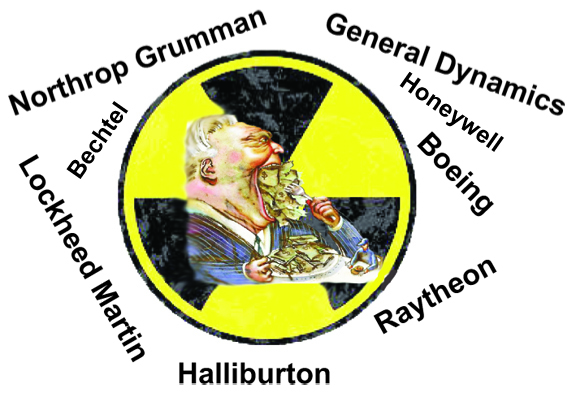
As the war rages on and military spending booms, the US arms industry is a big winner in Ukraine
ABC News, By Annika Burgess 21 Jan 23
As the war in Ukraine heads towards the one-year mark, so far there has been only one clear winner — the US arms industry.
There is no way Ukraine would have been able to hold out against Russia without American weapons.
But as the conflict rages on, there have been accusations from some EU officials that the US is profiting from the war through weapons sales and gas prices.
Meanwhile, analysts have warned of excessive spending and the US military-industrial complex (MIC) expanding beyond what is needed in response to Ukraine.
Defence budgets are also booming worldwide as countries replenish stocks sent to Ukraine and try to boost military capabilities in the face of mounting security threats.
Ultimately, the US defence contractors are set for a bonanza. ……..
What are the issues with the MIC?
The military-industrial complex is a term coined during the Cold War to describe the relationship between a government and defence industry contractors that lobby for increased military spending.
A country’s MIC has the potential to exert influence over government policy, especially if there are legislators who can benefit from the partnerships.
In the US, there is a wider vested interest in keeping the industry thriving, especially for local economies that are highly dependant on defence contractors for jobs.
Charles Miller, senior lecturer at the ANU’s school of politics and international relations, said about 800,000 jobs are directly tied to the sector.
“The local economy is highly dependent on defence contractors for its economic wellbeing,” Mr Miller told the ABC.
“And that’s not the Raytheons or the Boeings themselves, but what’s called the secondary contractors — that is, the people and the companies that make a living by servicing them.”
Former US president Dwight Eisenhower warned of the rise of the MIC and its threat to democracy in his 1961 farewell address.
“He viewed it as a huge problem,” Bill Hartung, a defence analyst at the US Quincy Institute for Responsible Statecraft, told the ABC.
“Although, he did say in the Cold War-era large military sales were necessary, but the question was how to control it, and what democratic guardrails could be put in place.”
Today, there doesn’t seem to be the same level of concern.
The MIC was already a “powerful force”, and in response to Ukraine the US has stripped away many safeguards to protect against waste and price gouging, Mr Hartung said.
He added that a lot of changes being discussed will last far beyond the war in Ukraine.
“The United States is kind of seizing this moment to try to get out a bunch of things that have been on their wish list for years, like committing to multi-year procurement of weapons,” Mr Hartung said.
“All of which will probably make it easier for those companies to rip off the government, because there will be less negotiation over prices and the inclination to just push things out the door.”………………………………….
Who are the biggest winners?
Since Russia’s full-scale invasion in February 2022, the US and its NATO allies have been throwing tens of billions of dollars worth of military aid Ukraine’s way.
The United States alone sent around $US21.3 billion ($30 billion) in security assistance to Kyiv last year.
Contracts have been rolled out thick and fast to speed up weapons production and fill supply gaps.
And there are a small number of companies in the highly consolidated industry that are reaping the rewards.
Lockheed Martin, Raytheon, Boeing and Northrop Grumman — all from the US — are among the top contractors.
They also produce some of the most in-demand and expensive weapons being sent to Ukraine.
The conflict has sent their stocks surging, with the share price of Northrop Grumman increasing 40 per cent by the end of 2022, while Lockheed Martin’s was up by 37 per cent.
In October, the Pentagon announced $US1.2 billion in contracts were underway to replenish US military stocks for weapons sent to the battlefield.
Production for Lockheed Martin’s popular Javelin anti-tank missiles — dubbed “Saint Javelin”, the protector of Ukraine — increased from 2,100 to nearly 4,000 per year.
While production for its High Mobility Artillery Rocket Systems (HIMARS) shot up from 60 to 96 units a year.
The US upped the ante further in November, awarding Raytheon — which also co-produces Javelins — a $US1.2 billion contract for another six National Advanced Surface-to-Air Missile Systems (NASAMS) for Ukraine.
Soon after, Lockheed Martin won a $US7.8 billion contract modification for F-35 aircraft, and $US431 million to deliver new HIMARS and support services for the US Army and its foreign allies.
Australia this month also announced it was purchasing 20 HIMARS and associated hardware for $558 million.
Global defence spending boom
Last month, the US Senate passed a funding bill that included a record $US858 billion in annual defence spending — up from $US740 billion the previous year.
It was $US45 billion more than what was proposed by President Joe Biden.
The bill includes funding for Taiwan and Ukraine, allowing the Pentagon to buy massive amounts of high-priority munitions using multi-year contracts — both to help Kyiv fight Russia and to refill US stockpiles.
“It’s surprising how much it has gone up,” Mr Hartung said.
Hanna Homestead, a policy associate from the Center for International Policy (CIP) — a US-based group monitoring military spending and weapons — said contractors were already receiving a staggering amount.
“In 2020, Lockheed Martin got more money through federal contracts than the Department of State and USAID combined,” she told the ABC.
Allies like Japan have also announced historic surges in defence spending.
Last month, Prime Minister Fumio Kishida said he was boosting Japan’s 2023 defence budget by 20 per cent in the face of regional security concerns and threats posed by China and North Korea.
It includes around 250 billion yen ($3.16 billion) to buy Lockheed Martin fighter jets.
Japan’s major military reform plan will see it double defence spending to 2 per cent of GDP by 2027, using a spending target that follows the NATO standard.
Meanwhile, some NATO countries are pushing for a greater defence commitment in response to the Ukraine conflict, saying the benchmark of 2 per cent of GDP should be the bare minimum.
‘That’s just the way it is’
Many believe the US arms industry doesn’t have a great reputation.
“They continue to arm repressive regimes like Saudi Arabia, Egypt, the Philippines and Algeria that have horrific human rights records and have engaged in destabilising activities,” Mr Hartung said.
He also accused companies of “pure profiteering” when it came to Ukraine, saying they are buying back their own share market stocks to boost the prices at a time when they claim they need more money.
“[This] has nothing to do with making anyone safer,” Mr Hartung said.
“In general, the chaos of war makes profiteering easier.
The European Union’s chief diplomat Josep Borrell has accused the US of profiting from high gas prices, weapons and trade while its allies suffer.
However, Ms Homestead said it was still a small amount of companies getting the bulk of the benefits, which doesn’t necessarily trickle down.
“It’s really the private companies that are profiting, I wouldn’t say the US government is profiting,” she said. …………………………………………. https://www.abc.net.au/news/2023-01-21/us-arms-industry-military-spending-profits-ukraine-war-russia/101843752
New NASA Nuclear Rocket Plan Aims to Get to Mars in Just 45 Days
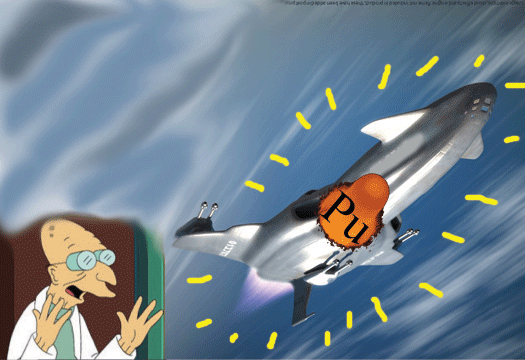
Science Alert23 January 2023, By MATT WILLIAMS, “…………………………. A few years ago, NASA reignited its nuclear program for the purpose of developing bimodal nuclear propulsion – a two-part system consisting of an NTP and NEP element – that could enable transits to Mars in 100 days.
As part of the NASA Innovative Advanced Concepts (NIAC) program for 2023, NASA selected a nuclear concept for Phase I development. This new class of bimodal nuclear propulsion system uses a “wave rotor topping cycle” and could reduce transit times to Mars to just 45 days………………………….
Nuclear-Electric Propulsion (NEP), on the other hand, relies on a nuclear reactor to provide electricity to a Hall-Effect thruster (ion engine), which generates an electromagnetic field that ionizes and accelerates an inert gas (like xenon) to create thrust. Attempts to develop this technology include NASA’s Nuclear Systems Initiative (NSI) Project Prometheus (2003 to 2005)………………………………………..
A transit of 45 days (six and a half weeks) would reduce the overall mission time to months instead of years. This would significantly reduce the major risks associated with missions to Mars, including radiation exposure, the time spent in microgravity, and related health concerns.
In addition to propulsion, there are proposals for new reactor designs that would provide a steady power supply for long-duration surface missions where solar and wind power are not always available………….. more https://www.sciencealert.com/new-nasa-nuclear-rocket-plan-aims-to-get-to-mars-in-just-45-days
Investigation underway after nine nuclear missileers develop non-Hodgkin’s lymphoma
ABC News 23 Jan 23
Nine military officers — who had worked decades ago at a nuclear missile base in Montana — have been diagnosed with a blood cancer, and there are “indications” the disease may be linked to their service, according to military briefing slides obtained by The Associated Press. One of the officers has died.
Key points:
- One of the nine officers diagnosed with non-Hodgkin lymphoma has since died
- Top officials say military medical professionals are investigating the new cases
- Previously, 14 cancer cases were investigated at the base, which was deemed safe
All of the officers — known as missileers — were assigned as many as 25 years ago to Malmstrom Air Force Base, home to a vast field of 150 Minuteman III intercontinental ballistic missile silos.
The nine officers were diagnosed with non-Hodgkin’s lymphoma, according to a January briefing by US Space Force Lieutenant Colonel Daniel Sebeck.
Missileers ride caged elevators deep underground into a small operations bunker encased in a thick wall of concrete and steel.
They remain there sometimes for days, ready to turn the launch keys if ordered to by the country’s president.
“There are indications of a possible association between [this] cancer and missile combat crew service at Malmstrom AFB,” Lieutenant Colonel Sebeck said in slides presented to his Space Force unit this month.
The “disproportionate number of missileers presenting with cancer, specifically lymphoma” was concerning, he said…………………………..
Non-Hodgkin’s lymphoma — which, according to the American Cancer Society, affects an estimated 19 out of every 100,000 people in the US annually — is a blood cancer that uses the body’s infection-fighting lymph system to spread………………..
The median age for adult non-Hodgkin’s lymphoma is 67, according to the National Institutes of Health.
However, the former missileers affected are far younger.
Officers are often in their 20s when they are assigned duty watch.
The officer who died, who was not identified, was a Space Force officer assigned to Schreiver Space Force Base in Colorado, with the rank of major, a rank typically achieved in a service member’s 30s.
Two of the others are in the same Space Force unit with the rank of lieutenant colonel, which is typically reached in a service member’s early 40s…………………………………………………
Last year, President Joe Biden signed the PACT Act, which greatly expanded the the types of illnesses and toxic exposures that would be considered presumptive — meaning a service member or veterans would not face an uphill battle to convince the government that the injury was tied to their military service — in order to received covered care. https://www.abc.net.au/news/2023-01-23/nuclear-missileers-develop-non-hodgkins-lymphoma/101883726
David Schlissel: Small modular reactor project likely to end badly for Utah utilities

NuScale plan shows no promise of being better than solar and wind.
https://www.sltrib.com/opinion/commentary/2023/01/19/david-schlissel-small-modular/ By David Schlissel The Tribune, Jan. 20, 2023,
Solar and wind power, augmented by battery storage, are becoming less expensive. Hydropower and geothermal energy already are providing substantial amounts of power in many parts of the country. Cost-effective, proven technologies exist and can speed the transition to a carbon-free economy.
Small modular reactors (SMRs) designed by NuScale are not among them.
More than two dozen of the 48 Utah Associated Municipal Power Systems (UAMPS) members have signed on to buy power from the NuScale SMR when the project is planned to come online in 2029. But a history of the project — and of nuclear energy projects in general — suggests the project is likely to end badly for utilities and worse for ratepayers.
UAMPS announced earlier this month that the cost per megawatt-hour (MWh), a unit of measurement roughly equivalent to the electricity used by the average U.S. home for a little more than a month, has risen from $58/MWh to $89/MWh, a 53% increase. Plus, the cost of power from the project would be much higher than $89/MWh without more than $4 billion in subsidies the project would receive from the U.S. government. Already, the total cost of the project has risen from $5.3 billion to $9.3 billion.
Nuclear advocates often claim that the costs of nuclear reactors fall after a first design, which (if true) would be very good news for the NuScale design. Unfortunately, the nuclear industry has never shown the ability to take advantage of a learning curve, and there is no evidence to suggest that it will be able to do so now. A 2020 Massachusetts Institute of Technology study found the costs of successive nuclear projects are more expensive than the original project, which is very bad news for the NuScale design.
It’s also not good news for ratepayers. New reactor designs are already notoriously expensive and highly unlikely to meet initial deadlines. The Westinghouse AP1000 design at Plant Vogtle in Georgia, for example, was originally expected to cost $14 billion and begin operation in 2016. Its price tag has soared past $34 billion, and it won’t provide power until later this year.
Think corporations like Georgia Power, which are posting record profits, will pick up the tab? Think again: Residential consumers have already eaten $1.66 billion of construction costs, with more on the menu.
To be sure, nuclear energy has some advantages. It doesn’t emit carbon dioxide, takes up a relatively small amount of space and produces large amounts of energy. Its advantages, however, become far less apparent when the costs of a nuclear facility — and the time that it takes to build even a modest-sized project — are considered.
Proven, less-costly clean alternatives exist, especially in the western U.S. Geothermal, for example, made up 5.7% of California’s electricity generation in 2021; it was responsible for 9% in Nevada, and it’s being pushed as a much less expensive alternative to the NuScale project. Solar covers about 16% of Arizona electricity production and 6% in New Mexico. Almost 20% of Wyoming electricity comes from wind; in Idaho, the figure is about 16%.
The NuScale SMR is just another in a long line of overhyped and overpriced nuclear projects that take too much time and money — resources the planet doesn’t have in abundance if we’re serious about avoiding cataclysmic climate change by limiting global warming to 1.5⁰C by 2050.
Small modular reactors may be viable one day — but they are not today, will not be tomorrow, and may never make as much economic sense as renewable sources of electricity. We should stick to carbon-free energy sources that make financial and environmental sense.
It comes down to weapons

NewAge, by Richard Moser , Jan 22,2023
THE deep divisions in the US left over the Ukraine war can be reduced to a single practical question: Do you support sending weapons to Ukraine?
The answer to that question depends on whether or not you accept the idea that we’re the cops of the world. The two parties accept this without question but the pro-weapons left? Behind a facade of left-sounding words, political practice tells the tale……………..
The pro-weapons left hides their collaboration with NATO behind the seemingly simple idea that ‘Ukraine has the right to get weapons or seek aid from anywhere they see fit.’ Except that ‘anywhere’ does not exist in the real world. Ukraine is not a customer in some free market for weapons. There is a highly structured supply chain for weapons that is a long-standing feature of the US empire and it is directed by the US war machine. The US has dominated the weapons trade since its rise to global power after WWII. Yes, Russia was often in second or third place, but Ukraine will sure not get its weapons from Russia. The only ‘anywhere’ that actually exists is the US government, which is the primary source for weapons transfers to Ukraine.
The other flaw in the ‘from anywhere they see fit’ formula is the assumption that weapons given from the US to Ukraine are simply an exercise in Ukrainian self-determination — not one way it’s incorporated into the US-dominated global order. Self-determination is not a by-product of the world’s largest military alliance, whose standard operating procedure is to turn allies into pawns and proxies. The drill begins with the mandatory weapons trade demanded of all NATO members. The Ukrainian defense minister recently admitted that Ukraine is a NATO proxy trading blood for weapons.
No, the existing international order is not some normal, natural state of affairs whose peace and harmony was disrupted by the ‘unprovoked’ Russian invasion. To believe that, you’d have to ignore decades of historical context, including the obvious expansion of NATO that put missiles and troops on Russia’s borders, military advisers inside Ukraine and the less obvious policy of ‘full spectrum dominance’ by which the US seeks to dominate ‘everyone, everywhere, all at once.’ The neoliberal world order is no more based on free markets than self-determination or peace.
Instead, Ukraine found itself between two great powers with a long history of hostility and rivalry. Its only hope for self-determination would have been to maintain the balancing act of neutrality and diplomacy, playing one power off the other. …………………………………………………….. more https://www.newagebd.net/article/192295/it-comes-down-to-weapons
Nuclear Regulatory Commission certifies NuScam’s design for small nuclear reactor, despite predictions on uneconomic costs

1st small modular nuclear reactor certified for use in US
AP News, By JENNIFER McDERMOTT, January 21, 2023
The U.S. Nuclear Regulatory Commission has certified the design for what will be the United States’ first small modular nuclear reactor.
The rule that certifies the design was published Thursday in the Federal Register. It means that companies seeking to build and operate a nuclear power plant can pick the design for a 50-megawatt, advanced light-water small modular nuclear reactor by Oregon-based NuScale Power and apply to the NRC for a license.
It’s the final determination that the design is acceptable for use, so it can’t be legally challenged during the licensing process when someone applies to build and operate a nuclear power plant, NRC spokesperson Scott Burnell said Friday. The rule becomes effective in late February………
It’s the seventh nuclear reactor design cleared for use in the United States. The rest are for traditional, large, light-water reactors………….. The first small modular reactor design application package included over 2 million pages of supporting materials………..
However, David Schlissel at the Ohio-based Institute for Energy Economics and Financial Analysis expressed concerns about the costs. Schlissel, who has studied the history of the nuclear power industry and the finances of the NuScale project, expects they will continue to go up, which could limit how many NuScale reactors are built. He said he thinks they’re not competitive in price with renewables and battery storage.
………… The U.S. Energy Department said it provided more than $600 million since 2014 to support the design, licensing and siting of NuScale’s VOYGR small modular reactor power plant and other domestic small reactor concepts. ……………………………..
Diluted plutonium disposed of at Carlsbad nuclear waste site as program draws controversy
“DOE decided to do this before they did any of the analysis,” Hancock said. “All these documents are to give legal cover and justify decisions already made.”
Adrian Hedden, Carlsbad Current-Argus
Federal nuclear waste officials announced a shipment of diluted surplus, weapons-grade plutonium was disposed of using a repository near Carlsbad last month, after it was sent to New Mexico from South Carolina, amid criticism from nuclear watchdog groups in the state.
The shipment contained plutonium diluted using a process known as “downblending” that lowered its radioactivity to meet requirements at the Waste Isolation Pilot Plant, where the U.S. Department of Energy disposes of transuranic (TRU) nuclear waste in an underground salt deposit.
It was brought to WIPP from the DOE’s Savannah River Site, a laboratory where the federal government develops nuclear weapons.
After the downblending, the waste meets the definition of TRU waste, read an announcement from the DOE’s National Nuclear Security Administration (NNSA), and can be legally disposed of at WIPP.
Disposal at WIPP was in response to a 2020 agreement between the DOE and State of South Carolina that called for the removal of 9.5 metric tons (MT) of plutonium waste from the state, reached after years of negotiations and litigation.
The waste was initially brought to Savannah River to be irradiated at a mixed-oxide (MOX) facility, converting the nuclear waste into fuel…………………………………………………………
The initial shipment was announced as the DOE was underway with a public comment period on using the same “dilute and dispose” method for 34 metric tons (MT) of plutonium waste, most of which is at the Pantex Plant in Amarillo, Texas.
But this would entail shipping waste from Pantex to Los Alamos, then to Savannah River Site for final packaging before going to WIPP, meaning the waste would cross through New Mexico three times.
Opponents of this proposal in New Mexico feared the repeated trips through their state would increase the risk of exposing their communities to radiation.
Critics oppose use of New Mexico site to dispose of plutonium
Don Hancock, nuclear waste program manager at Albuquerque watchdog group Southwest Research and Information Center said the group and others in the state opposed the project and its use of WIPP.
He said DOE’s practice of seeking approval for separate segments of the plutonium waste, rather than for all of the waste at once was intended to protect decisions already made without public input.
“DOE decided to do this before they did any of the analysis,” Hancock said. “All these documents are to give legal cover and justify decisions already made.”…………………………………………
Hancock argued using WIPP as the disposal site for the plutonium, even after its diluted to meet the requirements of TRU waste, marked an undue expansion of WIPP’s mission beyond what the people of New Mexico agreed to when the facility was sited in their state.
“We don’t oppose geologic disposal. We don’t think WIPP is the right place,” he said. “WIPP has a limited mission. It was never intended for surplus plutonium. It’s already been decided. The public should be outraged.” https://www.currentargus.com/story/news/2023/01/20/diluted-plutonium-disposed-of-at-carlsbad-nuclear-waste-site/69811929007/
The ‘all-of-the-above’ story used to sneak nuclear power in as a climate-action technology along with renewables .

“These claims are almost entirely misleading as you start looking at the facts”
Nuclear power gets another look in ‘all-of-the-above’ energy approach as climate worries mount
But critics cite safety concerns, costs and say widespread use of reactors is decades away.
Utility Dive. Jan. 20, 2023, Nuclear energy is increasingly getting another look by federal and state officials seeking to cut greenhouse gas emissions and bolster energy security………
A federal zero-emission nuclear power production credit, state legislation ending bans on nuclear plant construction and state policies easing development of small modular reactors, defined by the International Atomic Energy Agency as advanced nuclear reactors with a capacity of up to 300 MW, are among the recent developments spurring renewed interest in the industry.
Detractors cite safety risks, rising costs and other concerns. Critics also caution that a significant increase in nuclear generation in the U.S. is years, maybe even decades, away……….
In the U.S…..nuclear electricity generation declined for a second consecutive year in 2021, according to the U.S. Energy Information Administration. Output from nuclear power plants totaled 778 million MWh, or 1.5% less than in 2020. Nuclear’s share of U.S. electricity generation across all sectors in 2021 was similar to its average share in the previous decade: 19%.
As of November, seven units with a net summer capacity of 5,505 MW had retired since 2018, according to the EIA. The agency listed four Entergy plants: Palisades in Michigan; Indian Point 2 and Indian Point 3 in New York; and Pilgrim in Plymouth, Massachusetts. Also retired were two Exelon plants: Three Mile Island in Pennsylvania and Oyster Creek in New Jersey and NextEra Energy’s Duane Arnold facility in Iowa.
In addition, California’s Diablo Canyon, which is slated to retire a unit in 2024 and another in 2025, could remain open with funding conditionally approved by the U.S. Department of Energy.
Federal money, state policies induce nuclear investment
The Inflation Reduction Act, which commits $369 billion for climate efforts, includes a zero-emission nuclear power production credit. It provides up to $15 a MWh for electricity produced, assuming labor and wage requirements are met.
The credit will be available for plants in service in 2024 and would extend through 2032, according to the DOE.
However, the fiscal year 2023 omnibus spending measure enacted last month cut funding for the DOE’s Office of Nuclear Energy by $182 million from fiscal year 2022, to $1.47 billion. The FY 2023 spending includes $85 million for the Advanced Reactor Demonstration Program, $322 million for fuel cycle research and development, $114 million for accident tolerant fuels and $259 million for reactor research and development.
Maria Korsnick, president and CEO of the Nuclear Energy Institute, said the $1.7 trillion spending bill includes “robust funding” for public-private partnerships and support for nuclear energy education and research infrastructure. But she said it “fell short” of $2.1 billion needed to bolster the domestic nuclear fuel supply.
Federal spending to provide incentives for nuclear energy development began before Congress and President Joe Biden approved the omnibus spending bill last year.
The $1.2 trillion Infrastructure Investment and Jobs Act that Biden signed into law in November 2021 includes $62 billion for clean energy projects. Spending was directed at advanced nuclear projects, preventing the premature retirement of nuclear plants and considering how nuclear power may produce hydrogen for other energy applications.
In addition, states are looking to bolster nuclear power. Christine Csizmadia, senior director of state government affairs and advocacy at the NEI, said several states are broadening policies that aim to advance nuclear energy. Legislation supports studies of small modular reactors, providing tax incentives for nuclear power plant construction and ending moratoriums on new plants…………………………………………………………………………………..
The U.S. is not a ‘great market’ for new nuclear plants
Policies giving nuclear energy a boost have their limits.
Bret Kugelmass, CEO of Last Energy a manufacturer of what it calls micro modular reactors that generate about 20 MW, is active in European markets. It’s announced 10 projects in Poland, two in Romania and has “some activity” in the U.K. that has yet to be publicly detailed, he said in an interview……………………………………
Next nuclear technology is seen as a decade away
Avi Brenmiller, president and CEO of Brenmiller Energy, a thermal energy storage manufacturer, said the next nuclear technology is 10 years away “to be safe and clean, and I don’t see the move yet.”…………………………………………………………
Critics say nuclear power is potentially dangerous and that its promoters are overly optimistic about construction schedules.
Edwin Lyman, director of nuclear power safety at the Union of Concerned Scientists, said during the forum that nuclear power has the potential for a “catastrophic accident that could lead to large scale radiological contamination of the environment, massive economic damages and the potential for significant human health impacts.”
The industry cannot easily estimate the risks associated with storms, earthquakes and tidal waves as climate change makes weather more unpredictable, he said.
Even if a reactor is safe against accidents, it’s vulnerable to terrorists or military attacks as in Ukraine at the hands of Russia, Lyman said.
He questioned whether SMRs are easier to cool and are less radioactive than light water reactors “and therefore we don’t have to worry about it as much.”
“These claims are almost entirely misleading as you start looking at the facts,” he said.
Developers looking to reduce capital expenses and operating costs are cutting “rigorous requirements” for sites in or near populated urban centers or towns, Lyman said.
David Schlissel, director of resource planning analysis at the Institute for Energy Economics and Financial Analysis, cited cost overruns and schedule delays in the nuclear power industry.
“We don’t need a transition from coal to nuclear,” he said at the Dec. 15 forum. “We’re already pretty far along a transition from coal and natural gas to renewables.”……………………… https://www.utilitydive.com/news/nuclear-power-smr-climate-ira-omnibus-spending/639484/
Pentagon can’t account for $220 billion in govt property, fails fifth audit
Pentagon can’t account for $220 billion in gov’t property, fails fifth audit | 18 Jan 2023 | A Tuesday report by the Government Accountability Office revealed that the Department of Defense failed its fifth audit in a row after it could not account for at least 220 billion in government-furnished property, the Daily Caller News Foundation reported.
The DOD has been mandated by federal law to complete audits since 1994; however, the mandate was ignored for decades due to the agency’s massive size, according to Military dot com. Since launching its first independent audit, in 2017 the Pentagon has never passed.
The Pentagon failed its fifth audit in November after the agency could not prove expenditures for 61% of its 3.5 trillion in assets. To perform this year’s overall audit of the DOD, which was expected to cost 218 million, the agency aggregated 27 separate audits conducted by approximately 1,600 auditors. According to Military.com, the auditors performed 220 in-person site visits and 750 virtual site visits.
MICAELA BURROW, January 17, 2023
he Department of Defense (DOD) has neglected to address its inability to keep track of at least 220 billion in equipment provided to government contractors, according to a Tuesday report by the Government Accountability Office (GAO).
Auditors first reported the Pentagon’s failure to account for government-owned equipment or material offered up for use to contracting agencies, also called government furnished property, in 2001, according to the report. DOD has made little improvement since then, increasing the risk that the Pentagon could accidentally overlook errors in the books.
“This long-standing issue affects the accounting and reporting of GFP and is one of the reasons DOD is unable to produce auditable financial statements,” GAO said. Of all the major federal agencies GAO is obligated to review, DOD is the only one unable to receive an opinion on its financial statements. https://dailycaller.com/2023/01/17/watchdog-pentagon-billions-equipment-contractors/
1 This Month

of the week – Shut Down Drone Warfare!


Tell the Ukrainian Government to Drop Prosecution of Peace Activist Yurii Sheliazhenko

Petition to revoke the licensing of the Near Surface Nuclear Disposal Facility (NSDF) at Chalk River. https://www.ourcommons.ca/petitions/en/Petition/Details?Petition=e-7247
To see nuclear-related stories in greater depth and intensity – go to https://nuclearinformation.wordpress.com
-
Archives
- April 2026 (114)
- March 2026 (251)
- February 2026 (268)
- January 2026 (308)
- December 2025 (358)
- November 2025 (359)
- October 2025 (376)
- September 2025 (257)
- August 2025 (319)
- July 2025 (230)
- June 2025 (348)
- May 2025 (261)
-
Categories
- 1
- 1 NUCLEAR ISSUES
- business and costs
- climate change
- culture and arts
- ENERGY
- environment
- health
- history
- indigenous issues
- Legal
- marketing of nuclear
- media
- opposition to nuclear
- PERSONAL STORIES
- politics
- politics international
- Religion and ethics
- safety
- secrets,lies and civil liberties
- spinbuster
- technology
- Uranium
- wastes
- weapons and war
- Women
- 2 WORLD
- ACTION
- AFRICA
- Atrocities
- AUSTRALIA
- Christina's notes
- Christina's themes
- culture and arts
- Events
- Fuk 2022
- Fuk 2023
- Fukushima 2017
- Fukushima 2018
- fukushima 2019
- Fukushima 2020
- Fukushima 2021
- general
- global warming
- Humour (God we need it)
- Nuclear
- RARE EARTHS
- Reference
- resources – print
- Resources -audiovicual
- Weekly Newsletter
- World
- World Nuclear
- YouTube
-
RSS
Entries RSS
Comments RSS
 nuclear-news