As ‘Oppenheimer’ leads Oscar nominees, Sentor Hawley wants spotlight on nuclear testing victims
Rachel Looker, USA TODAY, 26 Jan 24, https://www.usatoday.com/story/news/politics/2024/01/26/josh-hawley-oscars-oppenheimer-nuclear-testing/72368363007/—
WASHINGTON − Sen. Josh Hawley, R-Mo., is pushing for the Oscars to acknowledge victims of nuclear testing after the Academy announced that “Oppenheimer” leads in nominations.
Hawley sent a letter Friday urging the Academy of Motion Picture Arts and Sciences to include programming that pays tribute to the victims of nuclear testing ahead of the 2024 Academy Awards.
“Oppenheimer,” directed by Christopher Nolan, chronicles the life of J. Robert Oppenheimer, the American physicist whose stewardship of the Manhattan Project led to the atomic bomb. The Manhattan Project‘s scientists built and deployed two bombs that were dropped on Japanese cities, leading to the country’s surrender in World War II.
“Oppenheimer” leads this year with 13 nominations.
“The ‘Oppenheimer’ film tells a compelling story of these test programs. But it does not tell the story of the Americans left behind—still reckoning with the health and financial consequences of America’s nuclear research, after all these years,” Hawley wrote in the letter.
The Missouri lawmaker pointed to Americans, like those in his home state, who suffer from cancer or other medical conditions because of radiation exposure from the radioactive waste that was not cleaned up as part of the Manhattan Project.
“Congress stands poised to allow what limited compensation the government has offered victims to expire. That cannot be allowed to happen,” he wrote. “These victims deserve justice through fair compensation from their government—and you can help by telling their stories.”
Hawley has long been an advocate for those impacted by government-caused nuclear contamination.
In December, Hawley called upon his colleagues in Congress to reauthorize the Radiation Exposure Compensation Act in the 2024 annual defense spending bill. The legislation compensates victims of government-caused radiation in the St. Louis region.
He created a procedural hurdle as the Senate worked to pass the defense bill and voted against the bill after the compensation program was not included in its final version
Microsoft Looks to Nuclear to Fuel AI Plans, (with help from nuclear front group Terra Praxis)

Microsoft goes nuclear to deal with energy influx due to the meteoritic rise of its AI platforms.
tech.co by Abby Ward, January 25, 2024,
Microsoft is looking to fuel its future AI plans with nuclear, according to a recent moves by the company.
AI notoriously requires huge amounts of energy on a daily basis, and with more and more of us using it, and companies investing heavily in the technology, the scramble for power is ramping up.
With Microsoft throwing its weight (and money) behind AI, including huge investments in OpenAI, it seems nuclear power could be the key to its success………………………………
Due to the explosive arrival of AI, consuming a whopping four times more power than cloud servers, Microsoft appears to be preparing for this increased demand to power their data centers as they continue to accelerate their growth plans in the AI arena.
Among other signs that Microsoft will be looking to nuclear power to plan for the shortfall in energy is the appointment of a Director of Nuclear Development Acceleration last week.
Data Center Energy Shortfall
Data centers, the things that physically store and share applications and data, require an enormous amount of energy to run……………………
To put the size of the problem into perspective, McKinsey wrote that a hyperscaler’s data center can use as much power as 80,000 households do.
In the same article, McKinsey forecasted that the power needed to facilitate US data centers are set to jump from 17 gigawatts (GW) in 2022 to 35 GW by 2030………………………………………

A recent collaboration between Microsoft and Terra Praxis, a non-profit advocating for repurposing old coal plants into SMR facilities, further underlines the company’s nuclear ambitions. According to reports from Data Center Dynamics, together, they developed a generative AI model to streamline the lengthy and costly nuclear regulatory process, showcasing Microsoft’s commitment to making nuclear power a viable option for its data centers…………………………………..
Microsoft’s foray into nuclear power is bound to raise eyebrows and concerns about safety and waste disposal will need to be addressed in due course………………………………
https://tech.co/news/microsoft-nuclear-fuel-a
Chris Hedges: The Four Horsemen of Gaza’s Apocalypse

Biden has always been an ardent militarist — he was calling for war with Iraq five years before the U.S. invaded.
Blinken, along with Biden, lobbied for the invasion of Iraq
Sullivan, Biden’s national security advisor, and McGurk, are consummate opportunists, Machiavellian bureaucrats who cater to the reigning centers of power, including the Israel lobby.
Joe Biden relies on advisors who view the world through the prism of the West’s civilizing mission to the “lesser breeds” of the earth to formulate his policies towards Israel and the Middle East.
By Chris Hedges ScheerPost 21 Jan 24
Joe Biden’s inner circle of strategists for the Middle East — Antony Blinken, Jake Sullivan and Brett McGurk — have little understanding of the Muslim world and a deep animus towards Islamic resistance movements. They see Europe, the United States and Israel as involved in a clash of civilizations between the enlightened West and a barbaric Middle East. They believe that violence can bend Palestinians and other Arabs to their will. They champion the overwhelming firepower of the U.S. and Israeli military as the key to regional stability — an illusion that fuels the flames of regional war and perpetuates the genocide in Gaza.
In short, these four men are grossly incompetent. They join the club of other clueless leaders, such as those who waltzed into the suicidal slaughter of World War One, waded into the quagmire of Vietnam or who orchestrated the series of recent military debacles in Iraq, Libya, Syria and Ukraine. They are endowed with the presumptive power vested in the Executive Branch to bypass Congress, to provide weapons to Israel and carry out military strikes in Yemen and Iraq. This inner circle of true believers dismiss the more nuanced and informed counsels in the State Department and the intelligence communities, who view the refusal of the Biden administration to pressure Israel to halt the ongoing genocide as ill-advised and dangerous.
Biden has always been an ardent militarist — he was calling for war with Iraq five years before the U.S. invaded. He built his political career by catering to the distaste of the white middle class for the popular movements, including the anti-war and civil rights movements, that convulsed the country in the 1960s and 1970s. He is a Republican masquerading as a Democrat. He joined Southern segregationists to oppose bringing Black students into Whites-only schools. He opposed federal funding for abortions and supported a constitutional amendment allowing states to restrict abortions. He attacked President George H. W. Bush in 1989 for being too soft in the “war on drugs.” He was one of the architects of the 1994 crime bill and a raft of other draconian laws that more than doubled the U.S. prison population, militarized the police and pushed through drug laws that saw people incarcerated for life without parole. He supported the North American Free Trade Agreement, the greatest betrayal of the working class since the 1947 Taft-Hartley Act. He has always been a strident defender of Israel, bragging that he did more fundraisers for the American Israel Public Affairs Committee (AIPAC) than any other Senator.
“As many of you heard me say before, were there no Israel, America would have to invent one. We’d have to invent one because… you protect our interests like we protect yours,” Biden said in 2015, to an audience that included the Israeli ambassador, at the 67th Annual Israeli Independence Day Celebration in Washington D.C. During the same speech he said, “The truth of the matter is we need you. The world needs you. Imagine what it would say about humanity and the future of the 21st century if Israel were not sustained, vibrant and free.”
The year before Biden gave a gushing eulogy for Ariel Sharon, the former Israeli prime minister and general who was implicated in massacres of Palestinians, Lebanese and others in Palestine, Jordan and Lebanon — as well as Egyptian prisoners of war — going back to the 1950s. He described Sharon as “part of one of the most remarkable founding generations in the history not of this nation, but of any nation.”
Continue readingRare nuclear bunker hits the market as America’s wealthiest people prepare for the worst
Real Estate Brendan Casey, Property Journalist and Editor, 23 Jan 2024, News Corp Australia Network
A rare bunker with roots in the Cold War era has found its way into the real estate market, carrying an asking price of $1.88m (US$1.24m).
Nestled in the city of Sprague in Washington state, this property, constructed in 1959, once safeguarded some of America’s most critical nuclear weapons during the tumultuous time, which spanned from 1945 to 1991, The Post reports.
The Cold War was marked by a strategic standoff between the United States and the Soviet Union, defined by political rivalries and the looming threat of nuclear warfare.
The intense global tension finally subsided in 1991 when Soviet president Mikhail Gorbachev and US president George H. W. Bush inked a historic treaty, putting an end to the conflict………………………………………………………………………………………………………………………………………
In recent years, bunkers have experienced a surge in popularity, reflecting a growing demand for doomsday shelters in the USA.
According to Post sources, the scarcity of such shelters has led to a significant spike in prices.
Some of America’s wealthiest individuals, including Mark Zuckerberg and Peter Thiel, are investing in bunkers for their own doomsday preparations.
Zuckerberg, the Facebook founder and CEO of Meta Platforms, is building a $100m compound in Hawaii, complete with an underground bunker and self-sustaining resources.
Financier Peter Thiel is awaiting approval for a bunker project in New Zealand, joining the ranks of other notable figures such as Sam Altman of OpenAI, and Larry Ellison of Oracle, who are also constructing their own ‘end-of-days retreats’. https://www.realestate.com.au/news/rare-nuclear-bunker-hits-the-market-as-americas-wealthiest-people-prepare-for-the-worst/?campaignType=external&campaignChannel=syndication&campaignName=ncacont&campaignContent=&campaignSource=herald_sun&campaignPlacement=spa
URANIUM FILM FESTIVAL MARATHON ACROSS THE USA

EIN Presswire Oct 28, 2023, https://fox5sandiego.com/business/press-releases/ein-presswire/664773439/uranium-film-festival-marathon-across-the-usa/
The International Uranium Film Festival will embark on a marathon tour of the United States next year, including Vancouver in Canada.LOS ANGELES, CA, USA, October 28, 2023 /EINPresswire.com/ — The schedule for the American edition of the International Uranium Film Festival is almost set. From March 2nd to May 10th, 2024, the world’s only film festival on nuclear dangers will embark on a marathon tour across the USA and take place in 10 states and more than 12 cities including Vancouver in Canada – www.uraniumfilmfestival.org.
“We will be showing important, eye-opening films about risks and consequences of uranium mining, the use nuclear power, nuclear arms and uranium weapons,” says festival’s director and co-founder Norbert G. Suchanek. The IUFF will start in March in Albuquerque and Window Rock, the capital of the Navajo (Diné) Nation. From there, the festival will go on its marathon like round tour. Cities already included with fixed dates are Tucson, Santa Fe, Ashville (NC), Seattle, Portland, Salem, Irvine, Santa Barbara and Las Vegas.
One highlight shall be Washington DC. Here the International Uranium Film Festival (IUFF) will focus on documentaries about the use of Depleted Uranium (DU) Weapons. “It will be the first International Gathering to stop Depleted Uranium Weapons use in Washington DC held in conjunction with the International Coalition to Ban Uranium Weapons (ICBUW),” says Damacio A. Lopez, the IUFF director of the American Southwest.
In California, the festival will be held in several cities with the participation of Libbe HaLevy, Ambassador of the IUFF to the USA. Libbe is producer of the weekly radio show Nuclear Hotseat – www.nuclearhotseat.com.
Last May this year, the 12th IUFF of Rio de Janeiro at the famous Modern Art Museum Cinematheque showed 15 atomic films from around the globe including the new US productions “Radioactive: The Women of Three Mile Island” by Heidi Hutner and “Downwind” by Mark Shapiro and Douglas Brian Miller. Heidi Hutner’s film received the Best Investigative Documentary Award and “Downwind” the Best Documentary Feature Award of the festival in Rio.
In addition Students of the State School FAETEC Adolpho Bloch presented at MAM Rio a special Dance performance remembering the terrible accident with blue shining highly radioactive Cesium 137 in Goiânia in 1987: “The blue shine of death”.
Libbe HaLevy: “For the dance, about 30 students, dressed all in white, presented themselves miming normal actions – brushing hair, putting on make-up, talking, hugging in friendship. I have never thought of how dance might address nuclear issues. So to see this was both shocking and deeply moving. It challenged me, and all the audience. The cheers at the end went on for several minutes.“
“We wish we could take the FAETEC dance group with us on the tour of the USA. But for that we would need a lot more donations and sponsors,” says FAETEC teacher and IUFF executive director Márcia Gomes de Oliveira. The Uranium Film Festival depends mainly on hard and a lot of voluntary work and donations from individuals. Márcia: “We thank all volunteers and festival partners Anna Rondon from the New Mexico Social Justice Equity Institute (NMSJEI) and the Navajo Nation, Veterans for Peace in Santa Fe and Albuquerque, Jesse Andrewartha from the Atomic Photographers Guild (APG) and Cineworks Independent Filmmakers Society in Vancouver, Jad Baaklini from Washington Physicians for Social Responsibility (WPSR) in Seattle, PSR Oregon in Portland, Principal Man Ian Zabarte from the Western Bands of the Shoshone Nation in Las Vegas, Leslie Poplawski from WNC-PSR in Ashville and Kathy Altman from PSR-Az in Tucson just to name a few.“
NNSA Issues Final Surplus Plutonium Environmental Impact Statement

The Department of Energy’s National Nuclear Security Administration (NNSA) published a Notice of Availability (NOA) in the Federal Register on Jan. 19, 2024, announcing the availability of the final Surplus Plutonium Disposition Program (SPDP) Environmental Impact Statement (EIS). The SPDP would employ the dilute and dispose strategy to safely and securely dispose of up to 34 metric tons of plutonium surplus to the Nation’s defense needs, using new, modified, or existing facilities at sites across the Nation.
The EIS satisfies NNSA’s obligations under the National Environmental Policy Act (NEPA) as the agency seeks to fulfill two important goals:
- Reduce the threat of nuclear weapons proliferation worldwide by dispositioning surplus plutonium in the United States in a safe and secure manner.
- Meet NNSA’s domestic and international legal obligations.
The 34 metric tons of surplus plutonium covered in the EIS was previously intended for use in fabricating mixed oxide (MOX) fuel. After irradiation in commercial power reactors, the fuel would have been stored pending disposal in a deep geologic repository for spent nuclear fuel. DOE cancelled the MOX project in 2018.
NNSA’s preferred alternative, the dilute and dispose strategy, also known as “plutonium downblending,” includes converting pit and non-pit plutonium to oxide, blending the oxidized plutonium with an adulterant, compressing it, encasing it in two containers, then overpacking and disposing of the resulting contact-handled transuranic (CH-TRU) waste underground in the Waste Isolation Pilot Plant (WIPP) facility in New Mexico. The approach would require new, modified, or existing capabilities at the Savannah River Site (SRS) in South Carolina, Los Alamos National Laboratory (LANL) in New Mexico, the Pantex Plant in Texas, and WIPP.
Under the No Action Alternative, up to 7.1 metric tons of non-pit plutonium would be processed at either LANL or SRS. If the processing occurs at LANL, then the resulting plutonium oxide would be transported to SRS. If it occurs at SRS, then the resulting material would remain there. In both cases the processed material would be diluted, characterized, packaged, and transported as CH-TRU defense waste to the WIPP facility for disposal.
The final SPDP EIS is posted on the NNSA NEPA reading room web page. NNSA will publish a Record of Decision (ROD) for the program after Feb. 20, 2024. The ROD will be published in the Federal Register and posted on the DOE NEPA and NNSA NEPA Reading Room websites.
NNSA announced its intent on Dec. 16, 2020, to prepare an EIS to evaluate the environmental impacts of the dilute and dispose strategy. It released the draft EIS for public comment on Dec. 16, 2022. It conducted three in-person public hearings and one virtual public hearing in January 2023. NNSA has incorporated public comments and developed the final SPDP EIS and is committed to complying with all appropriate and applicable environmental and regulatory requirements.
Nuclear lobby “kills” nomination of regulator who cares too much about safety
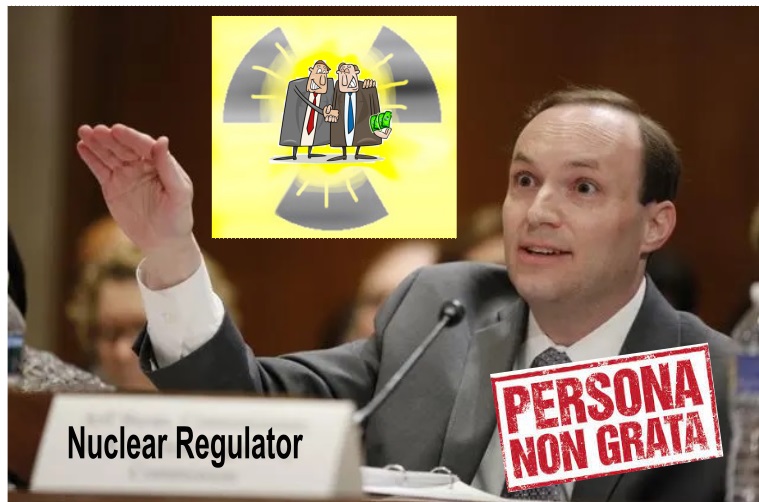
“We killed this nomination,” said Ted Nordhaus, executive director of the Breakthrough Institute, a California-based climate think tank that advocates for more nuclear energy.
Biden Drops Nuclear Regulator Nominee After Senate Backlash
Alexander C. Kaufman, Tue, 23 January 2024 https://au.news.yahoo.com/biden-drops-nuclear-regulator-nominee-190521226.html
President Joe Biden is dropping his pick to fill the open seat on the Nuclear Regulatory Commission after a handful of Democrats joined Senate Republicans to block the nomination last year, HuffPost has learned.
Jeff Baran had held a seat on the five-person federal panel overseeing atomic energy and radiation safety since former President Barack Obama first named to the position in 2014. The Democratic commissioner easily won Senate approval when former President Donald Trump renominated him in 2018.
But pro-nuclear advocates angry over what they saw as Baran’s unwillingness to overhaul the regulatory process in favor of building new types of reactor technologies launched a campaign against the commissioner last year. With Republicans opposed to the nomination, the Biden administration needed almost every Democrat in the Senate to vote for Baran ― or leave the NRC without a tie-breaker for party-line votes between the four current commissioners.
The White House had wanted the Senate’s narrow Democratic majority to reconfirm Baran before his term ended last July. But as many as four senators on the Democratic side, including Sen. Joe Manchin (D-W.Va.) and Sen. Kyrsten Sinema (I-Ariz.), either planned to come out against Baran or refused to pledge their votes, according to a source with knowledge of the process. Neither senator’s office immediately responded to emails requesting comment on Monday.
When the Senate ended 2023 last month without a vote, the nomination automatically went back to the White House.
The NRC directed HuffPost’s questions about when the administration would name its nominee for the open commission seat to the White House, which did not respond to a request for comment.
But three sources with knowledge of the plans confirmed to HuffPost that the Biden administration does not plan to nominate Baran again. Two spoke to HuffPost on condition of anonymity because they were not authorized to comment publicly. The third claimed Baran’s loss as a victory.
“We killed this nomination,” said Ted Nordhaus, executive director of the Breakthrough Institute, a California-based climate think tank that advocates for more nuclear energy.
He was among the most vocal opponents of Baran’s nomination, and helped drum up votes against the Democratic commissioner. Nordhaus had cast Baran as a holdover from an earlier era of liberal regulators who saw their job primarily as safeguarding the public against the atomic energy industry.
“It is my job to focus on nuclear safety and security,” Baran said in 2017 at his reconfirmation hearing before the Senate Environment and Public Works committee. “It is not my job to weigh in on the pros and cons of the merits of nuclear power.”
That view, Nordhaus said, was common among Democrats for decades. But a modern outlook on nuclear safety has to consider not only the threats of using atomic energy, but the risks that not doing so increases pollution from fossil fuels that damages lungs and traps heat in the planet’s atmosphere.
“Everyone went into this just assuming everybody would line up behind Baran, that this is just the kind of guy Democrats put on the commission,” Nordhaus said.
“The fact that enough Democratic senators were willing to say we’re not going to vote for this guy,” he added, “it’s pretty clear that for the first time in maybe ever a bunch of Democrats now recognize that we need reform at the NRC, that something has to change, that the technology can’t succeed if the NRC continues to approach this in the way it historically has.”
But Baran had defenders. The progressive pro-nuclear group Good Energy Collective previously told HuffPost Baran had a strong record of fighting for environmental justice and building relationships with communities saddled with radioactive pollution from the past.
Biden Has Started Another US War
CAITLIN JOHNSTONE, Jan 22 2024, https://www.caitlinjohnst.one/p/biden-has-started-another-us-war?utm_source=post-email-title&publication_id=82124&post_id=140915473&utm_campaign=email-post-title&isFreemail=true&r=1ise1&utm_medium=email
The Washington Post has an article out titled “As Houthis vow to fight on, U.S. prepares for sustained campaign,” with “sustained campaign” being empire-speak for a new American war.
“The Biden administration is crafting plans for a sustained military campaign targeting the Houthis in Yemen after 10 days of strikes failed to halt the group’s attacks on maritime commerce, stoking concern among some officials that an open-ended operation could derail the war-ravaged country’s fragile peace and pull Washington into another unpredictable Middle Eastern conflict,” the Post reports.
The Post acknowledges that “sustained military campaign” means “war” in the ninth paragraph of the article, saying the anonymous US officials cited in the report “don’t expect that the operation will stretch on for years like previous U.S. wars in Iraq, Afghanistan or Syria.” Which is about as reassuring as a pyromaniac saying he doesn’t expect he’ll be burning down any more houses like all those other houses he’s burned down.
This bizarre refusal to just call a war a war also appeared in a recent press conference with Pentagon spokesperson Sabrina Singh, who acted shocked and aghast that reporters would even ask if repeatedly bombing a country would qualify as being at war with them.
“Is it now fair to say that the U.S. is at war in Yemen?” Singh was asked by a Reuters reporter on Thursday.
“No, we don’t seek war,” Singh replied. “We don’t think that we are at war. We don’t want to see a regional war. The Houthis are the ones that continue to launch cruise missiles, antiship missiles at innocent mariners, at commercial vessels that are just transiting an area that sees, you know, 10 to 15 percent of world’s commerce.”
In a follow-up several questions later, Singh was asked by a reporter from Politico, “You said that we are not at war with the Houthis, but if — you know, this tit-for-tat bombing — we’ve bombed them five times now. So if this isn’t war, can you just explain this a little — a little bit more to us? If this isn’t war, what is war?”
“Sure, Lara, sure, great question, I just wasn’t expecting it phrased exactly that way,” Singh replied with a laugh and a smirk. “Look, we are — we do not seek war. We are — we do not — we are not at war with the Houthis. In terms of a definition, I think that would be more of a clear declaration from the United States. But again, what we are doing and the actions that we are taking are defensive in nature.”
It is worth noting that since that Thursday press conference the number of US strikes on Yemen has increased from five to seven as of this writing.
It is also worth noting here that, per Singh’s absurd definition, the US has not been at war since the end of WWII, as there has not been a “clear declaration of war” since June 5, 1942. The only wars the US has officially declared through congress in accordance with its own constitution have been the War of 1812, the Mexican-American War, the Spanish-American War, and the two world wars.
If you go by this definition the US is among the more peaceful nations in the world, since it hasn’t been at war in eight decades. In reality the US is the single most warlike and murderous nation of modern times with wars of aggression that have killed millions and displaced tens of millions just in the 21st century alone, and plays some role in most of the world’s major international conflicts.
Singh’s claim that the US attacks on Yemen are “defensive in nature” is also self-evidently absurd; Yemeni forces weren’t even attacking American commercial vessels until the US began attacking them. Only the US could launch unprovoked attacks on a foreign nation on the other side of the planet and call it self-defense.
Antiwar’s Dave DeCamp explains:
Indeed, the only reason Houthi forces began attacking ships in the Red Sea was to pressure Israel and its allies into ceasing the ongoing massacre that has been taking place in Gaza since October 7. As usual the world’s most murderous and powerful government is framing its horrifying acts of extreme aggression as innocent defensive responses to unprovoked attacks, when in reality the US empire is bombing Yemen in order to facilitate the genocide of Palestinians.
And while we’re on the subject of Gaza and Yemen it’s probably worth pointing out that according to US empire managers the stated goals of both campaigns have been completely unsuccessful. A new report by The Wall Street Journal says that according to US intelligence Israel is nowhere remotely close to eliminating Hamas, with only 20 to 30 percent of the group having been killed since October. Asked by the press on Thursday if the strikes against the Houthis are working, Biden replied “Well, when you say ‘working’ — are they stopping the Houthis? No. Are they going to continue? Yes.”
“Before the US began bombing the Houthis, Ansar Allah officials made clear they would only stop attacking Israeli-linked commercial shipping if the onslaught on Gaza ended. Instead of pressuring Israel to end the slaughter in Gaza, President Biden chose escalation, and now the Houthis are targeting US commercial shipping, and several US merchant vessels have been hit with missiles.”
So they’re raining military explosives on impoverished middle easterners to maintain their status quo domination, under the pretense of goals which they themselves admit are not being achieved. Just another day in the empire, I guess.
A new ‘Cold War’ on a deadly hot planet?
China and the US must cut war-like posturing and face a world in desperate danger
By Tom Engelhardt, Tom Dispatch/Common Dreams
Tell me, what planet are we actually on? All these decades later, are we really involved in a “second” or “new” Cold War? It’s certainly true that, as late as the 1980s, the superpowers (or so they then liked to think of themselves), the United States and the Soviet Union, were still engaged in just such a Cold War, something that might have seemed almost positive at the time. After all, a “hot” one could have involved the use of the planet’s two great nuclear arsenals and the potential obliteration of just about everything.
But today? In case you haven’t noticed, the phrase “new Cold War” or “second Cold War” has indeed crept into our media vocabulary. (Check it out at Wikipedia.) Admittedly, unlike John F. Kennedy, Joe Biden has not actually spoken about bearing “the burden of a long, twilight struggle.” Still, the actions of his foreign policy crew — in spirit, like the president, distinctly old Cold Warriors — have helped make the very idea that we’re in a new version of just such a conflict part of everyday media chatter.
And yet, let’s stop and think about just what planet we’re actually on. In the wake of August 6 and August 9, 1945, when two atomic bombs destroyed the Japanese cities of Hiroshima and Nagasaki, there was little doubt about how “hot” a war between future nuclear-armed powers might get. And today, of course, we know that, if such a word can even be used in this context, a relatively modest nuclear conflict between, say, India and Pakistan might actually obliterate billions of us, in part by creating a — yes, brrr — “nuclear winter,” that would give the very phrase “cold” war a distinctly new meaning.
These days, despite an all too “hot” war in Ukraine in which the U.S. has, at least indirectly, faced off against the crew that replaced those Soviet cold warriors of yore, the new Cold War references are largely aimed at this country’s increasingly tense, ever more militarized relationship with China. Its focus is both the island of Taiwan and much of the rest of Asia. Worse yet, both countries seem driven to intensify that struggle.
In case you hadn’t noticed, Joe Biden made a symbolic and much-publicized stop in Vietnam (yes, Vietnam!) while returning from the September G20 summit meeting in India. There, he insisted that he didn’t “want to contain China” or halt its rise. He also demanded that it play by “the rules of the game” (and you know just whose rules and game that was). In the process, he functionally publicized his administration’s ongoing attempt to create an anti-China coalition extending from Japan and South Korea (only recently absorbed into a far deeper military relationship with this country), all the way to, yes, India itself.
And (yes, as well!) the Biden administration has upped military aid to Japan, Taiwan (including $85 million previously meant for Egypt), Australia (including a promise to supply it with its own nuclear attack submarines), and beyond. In the process, it’s also been reinforcing the American military position in the Pacific from Okinawa, Guam, and the Philippines to — yes again — Australia. Meanwhile, one four-star American general has even quite publicly predicted that a war between the U.S. and China is likely to break out by 2025, while urging his commanders to prepare for “the China fight”! Similarly, Director of National Intelligence Avril Haines has called China the “leading and most consequential threat to U.S. national security” and the Biden foreign policy team has been hard at work encircling — the Cold War phrase would have been “containing” — China, both diplomatically and militarily.
On the Chinese side, that country’s military has been similarly ramping up its air and naval activities around and ever closer to the island of Taiwan in an ominous fashion, even as it increases its military presence in places like the South China Sea (as has the U.S.). Oh, and just in case you hadn’t noticed, with a helping hand from Russia, Beijing is also putting more money and effort into expanding its already sizable nuclear arsenal.
Yes, this latest version of a Cold War is (to my mind at least) already a little too hot to handle. And yet, despite that reality, it couldn’t be more inappropriate to use the term “new Cold War” right now on a globe where a previously unimagined version of a hot war is staring us all, including most distinctly the United States and China, in the face.
As a start, keep in mind that the two great powers facing off so ominously against each other have long faced off no less ominously against the planet itself. After all, the United States remains the historically greatest greenhouse gas emitter of all time, while China is the greatest of the present moment (with the U.S. still in second place and Americans individually responsible for significantly more emissions than their Chinese counterparts). The results have been telling in both countries…………………………………………………………… more https://beyondnuclearinternational.org/2024/01/21/a-new-cold-war-on-a-deadly-hot-planet/
US urges discussions with China on practical nuclear risk reduction steps
Reuters, January 19, 2024
WASHINGTON, Jan 18 (Reuters) – The United States does not expect formal nuclear arms-control negotiations with China anytime soon, but does want to see a start of discussions on practical risk-reduction measures, a senior White House official said on Thursday.
Pranay Vaddi, the senior White House official for arms control and non proliferation, told a Washington think tank it had been important to have initial arms-control talks in November with China, but stressed the need for them to involve key Chinese decision makers or influencers on the country’s nuclear posture………………………..
The U.S. and China held their first talks on nuclear arms control in nearly five years on Nov. 6, amid growing U.S. concerns about China’s nuclear build up, but the meeting produced no specific results…………………………………………..
The U.S. and China held two days of military talks in Washington last week, their latest engagement since agreeing to resume military-to-military ties.
In its annual report on the Chinese military in October, the Pentagon said China has more than 500 operational nuclear warheads and will probably have over 1,000 warheads by 2030.
The U.S. has a stockpile of about 3,700 nuclear warheads, of which roughly 1,419 strategic nuclear warheads were deployed.
Reporting by David Brunnstrom; Editing by Sandra Maler, https://www.reuters.com/world/us-urges-discussions-with-china-practical-nuclear-risk-reduction-steps-2024-01-18/
United Against Nuclear Iran: The Shadowy, Intelligence-Linked Group Driving the US Towards War With Iran
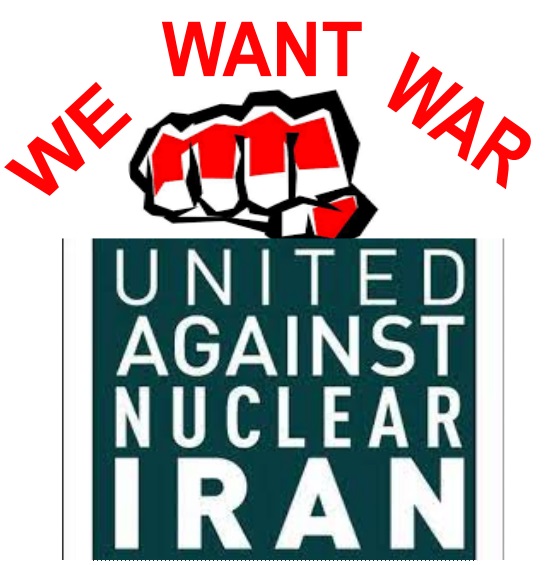
United Against Nuclear Iran, a secretive neoconservative organization with close links to the CIA and the Mossad, is trying to escalate the Israeli assault on Gaza into an Iraq-level U.S. Attack on Iran.
By Alan MacLeod / MintPress News
Most of the world has watched the Israeli assault on Gaza in horror. As tens of thousands have been killed and millions displaced, tens of millions of people around the world have poured onto the streets to demand an end to the violence. But a few select others have taken to the pages of our most influential media to demand an escalation of the violence and that the United States help Israel strike not just Palestine, Syria, and Lebanon but Iran as well.
“I might have once favored a cease-fire with Hamas, but not now,” wrote Bush-era diplomat Dennis Ross in The New York Times, explaining that “if Hamas is perceived as winning, it will validate the group’s ideology of rejection, give leverage and momentum to Iran and its collaborators and put [our] own governments on the defensive.”
In the wake of Hamas’ October 7 assault, arch-neoconservative official John Bolton was invited on CNN, where he claimed that what we witnessed was really an “Iranian attack on Israel using Hamas as a surrogate” and that the U.S. must immediately respond. When asked whether he had any evidence, given the implications of what he was saying, he shrugged and replied, “This is not a court of law.”
On December 28, Bolton doubled down on his hawkish stance, writing in the pages of Britain’s Daily Telegraph that “The West may now have no option but to attack Iran” – a position he has held for at least a decade.
Meanwhile, in an interview with Saudi state-funded broadcaster Iran International, senior Bush official Mark Wallace bellowed that, “This is Iran’s work. Iran will suffer at the hands of retribution and will suffer the consequences of supporting this terror group and its horrific attack on Israel.” Wallace continued:
No civilized country wants further conflict. But the Iranians are forcing the civilized world’s hand. And you will see a dramatic response soon as the United States, Israel, and our allies begin to position assets around the world in preparation.”
If there was any doubt as to what sort of “dramatic response” Wallace wanted to see, he added a message to Iran’s Islamic Revolutionary Guard Corps: “I look forward to seeing you hanged from the end of one of your own ropes.”
Iran was recently the victim of a deadly terrorist attack. As mourners commemorated the U.S. assassination of Qassem Soleimani, two bombs exploded, killing 91 and injuring hundreds more. In this context, it was understandable why Iranian officials pointed the finger at the U.S. and Israel.
WARMONGERS, INC
What these individuals all have in common is that they are board members of United Against Nuclear Iran (UANI), a shadowy but influential organization dedicated to pushing the West toward a military confrontation with the Islamic Republic.
Founded in 2008, the group is led by neoconservative hawks and has close ties to both U.S. and Israeli intelligence. It does not divulge where it receives its copious funding. However, it is known that right-wing Israeli-American billionaire Sheldon Adelson was a source. There is strong circumstantial evidence that Gulf dictatorships may also be bankrolling the group, although UANI has strongly denied this. In 2019, Iran designated UANI as a terrorist organization.
When asked by MintPress what he made of UANI’s recent statements, Eli Clifton, one of the few investigative journalists to have covered the group, said, “It’s very consistent with the positions and advocacy that the organization has taken since its inception.” Adding,
United Against Nuclear Iran does not miss an opportunity to try to bring the United States closer to a military conflict with Iran. And on the other side of the equation, they also have worked very hard to oppose efforts to de-escalate the U.S.-Iran relationship.”
UANI’s board is a who’s who of high state, military and intelligence officials from around the Western world. Among its more notable members include:………………………………………………………………………………………………………………………………….
In addition, notable former board members include ex-CIA Director R. James Woolsey; head of Mossad between 2002 and 2011, Meir Dagan; and one-time chief of British spy agency MI6, Sir Richard Dearlove.For 15 years, UANI has organized conferences, published reports, and lobbied politicians and governments, all with one goal: pushing a neoconservative line on Iran. “UANI are a force multiplier. They provide at least the veneer of an intellectual infrastructure for the Iran hawk movement. They did not invent being hawkish on Iran, but they sure made it a heck of a lot easier,” Ben Freeman, Director of the Democratizing Foreign Policy Program at the Quincy Institute, told MintPress.
CONFLICTS AND CONFLICTS OF INTEREST
For such a large, well-financed, and influential organization filled with senior officials, United Against Nuclear Iran keeps its funding sources very quiet. However, in 2015, Clifton was able to obtain a UANI donor list for the 2013 financial year. By far and away, the largest funders were billionaire New York-based investor Thomas Kaplan and multibillionaire Israeli-American casino mogul Sheldon Adelson……………………………………………………………………………………………………………..
PUTTING IRAN IN THE CROSSHAIRS
One of United Against Nuclear Iran’s primary activities, Iranian political commenter Ali Alizadeh told MintPress, is to create a worldwide “culture of fear and anxiety for investing in Iran.” The group attempts to persuade businesses to divest from the Islamic Republic and sign their certification pledge, which reads as follows:…………………………………………………………………………………………………………………………………………..
INTELLIGENCE CONNECTIONS
That UANI is headed by so many state, military and intelligence leaders begs the question: to what extent is this really a non-governmental organization? “That is one of the dirty secrets of think tanks: they are very often holding tanks for government officials,” Freeman said, adding:
The Trump folks all had to leave office when Biden won, so a lot of them ended up in think tanks for a while, four years, let’s say. And if Trump wins again, they will bounce back into government. And the same is true of Democratic administrations, too.”
he U.S. government also clearly has a longstanding policy of outsourcing much of its work to “private” groups in order to avoid further scrutiny. Many of the CIA’s most controversial activities, for example, have been farmed out to the National Endowment for Democracy (NED), a technically non-governmental organization funded entirely by Washington and staffed with ex-state officials. In recent years, the NED has funneled millions of dollars to protest leaders in Hong Kong, organized an attempted color revolution in Cuba, organized anti-government rock concerts in Venezuela, and propped up dozens of media organizations in Ukraine………………………………………………………………………………………….
UANI’s funders certainly also have extensive connections to Israel. Kaplan is the son-in-law of Israeli billionaire Leon Recanati and is said to be close with Prime Ministers Naftali Bennet and Yair Lapid. He has also employed a number of Israeli officials at his businesses. An example of this is Olivia Blechner, who, in 2007, left her role as the Director of Academic Affairs at the Israeli Consulate General in New York to become Executive Vice-President of Investor Relations and Research at Kaplan’s Electrum Group – a rather perplexing career move……………………………………………………………
A NETWORK OF REGIME CHANGE GROUPS
While United Against Nuclear Iran is already a notable enough organization, it is actually merely part of a large group of shadowy non-governmental groups working to cause unrest and, ultimately, regime change in Iran. These groups all share overlapping goals, funders and key individuals…………………………………………………………………………………………………………………………………………………
In short, then, there exists a network of American NGOs with the mission statements of helping Iran, opposing Iran, preserving Iran, and bombing Iran, all staffed by largely the same ex-U.S. government officials……………………………………………………………………………………………………..
A LESSON FROM HISTORY
The history of Iran has been intimately intertwined with the United States since at least 1953 when Washington orchestrated a successful coup against Prime Minister Mohammad Mosaddegh……………………………………………………………………………………………………………………………………….
The slaughter in Gaza has been horrifying enough. More than 22,000 people have been killed in the Israeli invasion, and a further 1.9 million displaced. Israel is also simultaneously bombing the West Bank, Syria and Lebanon. The U.S. is facilitating this, sending billions of dollars in weaponry, pledging iron-clad political support to Israel, silencing critics of its actions, and vetoing United Nations resolutions.
But United Against Nuclear Iran is eager to escalate the situation to a vastly greater level, urging Washington to attack a well-armed country of nearly 90 million people, erroneously claiming that Iran is behind every Hamas or Hezbollah action. ………………………………………………………………………
IF UANI gets its way, a conflict with Iran might spark a Third World War. And yet they are receiving virtually no pushback to their ultra-hawkish pronouncements, largely because they operate in the shadows and receive virtually no public scrutiny. It is, therefore, imperative for all those who value peace to quickly change that and expose the organization for what it is. https://scheerpost.com/2024/01/16/united-against-nuclear-iran-the-shadowy-intelligence-linked-group-driving-the-us-towards-war-with-iran/
Biden administration finalizes a $1.1 billion aid package for California’s last nuclear power plant

LOS ANGELES (AP) — President Joe Biden’s administration on Wednesday finalized approval of $1.1 billion to help keep California’s last operating nuclear power plant running.
The funding is a financial pillar in the plan to keep the Diablo Canyon Power Plant producing electricity to at least 2030 — five years beyond its planned closing.
Terms of the aid package were not released by the Energy Department.
In 2016, plant operator Pacific Gas & Electric, environmental groups and plant worker unions reached an agreement to close the four-decade-old reactors by 2025. But the Legislature voided the deal in 2022 at the urging of Democratic Gov. Gavin Newsom, who said the power is needed to ward off blackouts as climate change stresses the energy system.
California is the birthplace of the modern environmental movement and for decades has had a fraught relationship with nuclear power. Environmentalists argued California has adequate power without the reactors and that their continued operation could hinder development of new sources of clean energy. They also warn that long-delayed testing on one of the reactors poses a safety risk that could result in an accident, a claim disputed by PG&E……………………… https://www.hindustantimes.com/world-news/biden-administration-finalizes-a-1-1-billion-aid-package-for-california-s-last-nuclear-power-plant-101705536723552.html
The Military-Industrial Complex Is the Winner (Not You)

The best route to preventing a future Chinese invasion of Taiwan would be to revive Washington’s “One China” policy that calls for China to commit itself to a peaceful resolution of Taiwan’s status and for the U.S. to forswear support for that island’s formal independence. In other words, diplomacy, rather than increasing the Pentagon budget to “win” such a war, would be the way to go.
SCHEERPOST, By William D. Hartung / TomDispatch, 17 Jan 24
2023 was a year marked by devastating conflicts from Russia’s ongoing invasion of Ukraine to Hamas’s horrific terror attacks on Israel, from that country’s indiscriminate mass slaughter in Gaza to a devastating civil war in Sudan. And there’s a distinct risk of even worse to come this year. Still, there was one clear winner in this avalanche of violence, suffering, and war: the U.S. military-industrial complex.
In December, President Biden signed a record authorization of $886 billion in “national defense” spending for 2024, including funds for the Pentagon proper and work on nuclear weapons at the Department of Energy. Add to that tens of billions of dollars more in likely emergency military aid for Ukraine and Israel, and such spending could well top $900 billion for the first time this year.
Meanwhile, the administration’s $100-billion-plus emergency military aid package that failed to pass Congress last month is likely to slip by in some form this year, while the House and Senate are almost guaranteed to add tens of billions more for “national defense” projects in specific states and districts, as happened in two of the last three years.
Of course, before the money actually starts flowing, Congress needs to pass an appropriations bill for Fiscal Year 2024, clearing the way for that money to be spent. As of this writing, the House and Senate had indeed agreed to a tentative deal to sign onto the $886 billion that was authorized in December. A trillion-dollar version of such funding could be just around the corner. (If past practice is any guide, more than half of that sum could go directly to corporations, large and small.)
A trillion dollars is a hard figure to process. In the 1960s, when the federal budget was a fraction of what it is now, Republican Senator Everett Dirksen allegedly said, “A billion here, a billion there, and pretty soon you’re talking real money.” Whether he did or not, that quote neatly captures how congressional attitudes toward federal spending have changed. After all, today, a billion dollars is less than a rounding error at the Pentagon. The department’s budget is now hundreds of billions of dollars more than at the height of the Vietnam War and over twice what it was when President Eisenhower warned of the “unwarranted influence” wielded by what he called “the military-industrial complex.”
To offer just a few comparisons: annual spending on the costly, dysfunctional F-35 combat aircraft alone is greater than the entire budget of the Centers for Disease Control and Prevention. In 2020, Lockheed Martin’s contracts with the Pentagon were worth more than the budgets of the State Department and the Agency for International Development combined, and its arms-related revenues continue to rival the government’s entire investment in diplomacy. One $13 billion aircraft carrier costs more than the annual budget of the Environmental Protection Agency. Overall, more than half of the discretionary budget Congress approves every year — basically everything the federal government spends other than on mandatory programs like Medicare and Social Security — goes to the Pentagon.
It would, I suppose, be one thing if such huge expenditures were truly needed to protect the country or make the world a safer place. However, they have more to do with pork-barrel politics and a misguided “cover the globe” military strategy than a careful consideration of what might be needed for actual “defense.”
Congressional Follies
The road to an $886-billion military budget authorization began early last year with a debt-ceiling deal negotiated by President Biden and then-House Speaker Kevin McCarthy. That rolled back domestic spending levels, while preserving the administration’s proposal for the Pentagon intact. McCarthy, since ousted as speaker, had been pressed by members of the right-wing “Freedom Caucus” and their fellow travelers for just such spending cuts. (He had little choice but to agree, since that group proved to be his margin of victory in a speaker’s race that ran to 15 ballots.)……………………………………………………………………………………
Threat Inflation and the “Arsenal of Democracy”
Perhaps you won’t be surprised to learn that the strategic rationales put forward for the flood of new Pentagon outlays don’t faintly hold up to scrutiny. First and foremost in the Pentagon’s argument for virtually unlimited access to the Treasury is the alleged military threat posed by China. But as Dan Grazier of the Project on Government Oversight has pointed out, that country’s military strategy is “inherently defensive”:
“[T]he investments being made [by China] are not suited for foreign adventurism but are instead designed to use relatively low-cost weapons to defend against massively expensive American weapons. The nation’s primary military strategy is to keep foreign powers, and especially the United States, as far away from its shores as possible in a policy the Chinese government calls ‘active defense.’”
The greatest point of potential conflict between the U.S. and China is, of course, Taiwan. But a war over that island would come at a staggering cost for all concerned and might even escalate into a nuclear confrontation. A series of war games conducted by the Center for Strategic and International Studies (CSIS) found that, while the United States could indeed “win” a war defending Taiwan from a Chinese amphibious assault, it would be a Pyrrhic victory. “The United States and its allies lost dozens of ships, hundreds of aircraft, and tens of thousands of servicemembers,” it reported. “Taiwan saw its economy devastated. Further, the high losses damaged the U.S. global position for many years.” And a nuclear confrontation between China and the United States, which CSIS didn’t include in its assessment, would be a first-class catastrophe of almost unimaginable proportions.
The best route to preventing a future Chinese invasion of Taiwan would be to revive Washington’s “One China” policy that calls for China to commit itself to a peaceful resolution of Taiwan’s status and for the U.S. to forswear support for that island’s formal independence. In other words, diplomacy, rather than increasing the Pentagon budget to “win” such a war, would be the way to go.
The second major driver of higher Pentagon budgets is allegedly the strain on this country’s arms manufacturing base caused by supplying tens of billions of dollars of weaponry to Ukraine, including artillery shells and missiles that are running short in American stockpiles. The answer, according to the Pentagon and the arms industry, is to further supersize this country’s already humongous military-industrial complex to produce enough weaponry to supply Ukraine (and now Israel, too), while acquiring sufficient weapons systems for a future war with China.
There are two problems with such arguments. First, supplying Ukraine doesn’t justify a permanent expansion of the U.S. arms industry. In fact, such aid to Kyiv needs to be accompanied by a now-missing diplomatic strategy designed to head off an even longer, ever more grinding war.
Second, the kinds of weapons needed for a war with China would, for the most part, be different from those relevant to a land war in Ukraine, so weaponry sent to Ukraine would have little relevance to readiness for a potential war with China (which Washington should, in any case, be working to prevent, not preparing for).
The Disastrous Costs of a Militarized Foreign Policy
Before investing ever more tax dollars in building an ever-expanding garrison state, the military strategy of the United States in the current global environment should be seriously debated. Just buying ever more bombs, missiles, drones, and next-generation artificial intelligence-driven weaponry is not, in fact, a strategy, though it is a boon to the military-industrial complex and an invitation to a destabilizing new arms race.
Unfortunately, neither Congress nor the Biden administration seems inclined to seriously consider an approach that would emphasize investing in diplomatic and economic tools over force or the threat of force. …………………………………………………………………………………………………………………
A serious national conversation is needed on what a genuine defense strategy would look like, rather than one based on fantasies of global military dominance. Otherwise, the overly militarized approach to foreign and economic policy that has become the essence of Washington budget-making could be extended endlessly and disastrously into the future, something this country literally can’t afford to let happen.
https://scheerpost.com/2024/01/17/the-military-industrial-complex-is-the-winner-not-you/
When Yemen Does It It’s Terrorism, When The US Does It It’s “The Rules-Based Order”
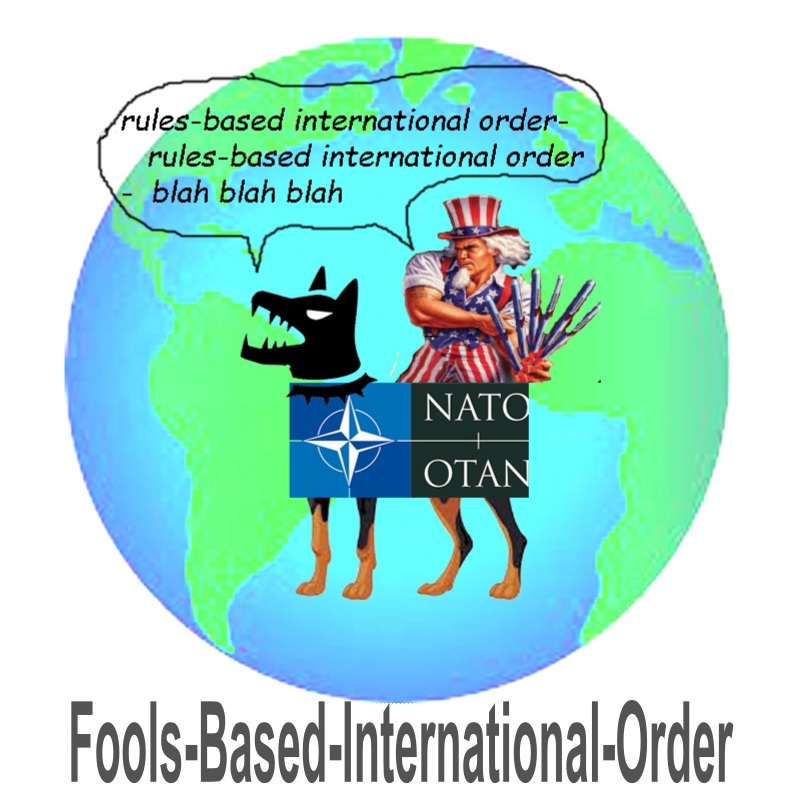
That’s right kids: when Yemen sets up a blockade to try and stop an active genocide, that’s terrorism, but when the US empire imposes a blockade to secure its geostrategic interests in the middle east, why that’s just the rules-based international order in action.
What this shows us is that the “rules-based international order” the US and its allies claim to uphold is not based on rules at all; it’s based on power, which is the ability to control and impose your will on other people. The “rules” apply only to the enemies of the empire because they are not rules at all: they are narratives used to justify efforts to bend the global population to its will.
CAITLIN JOHNSTONE, JAN 18, 2024
The Biden administration has officially re-designated Ansarallah — the dominant force in Yemen also known as the Houthis — as a Specially Designated Global Terrorist entity.
The White House claims the designation is an appropriate response to the group’s attacks on US military vessels and commercial ships in the Red Sea and the Gulf of Aden, saying those attacks “fit the textbook definition of terrorism.” Ansarallah claims its actions “adhere to the provisions of Article 1 of the Convention on the Prevention and Punishment of the Crime of Genocide,” since it is only enforcing a blockade geared toward ceasing the ongoing Israeli destruction of Gaza.
One of the most heinous acts committed by the Trump administration was its designation of Ansarallah as a Foreign Terrorist Organization (FTO) and as Specially Designated Global Terrorists (SDGT), both of which imposed sanctions that critics warned would plunge Yemen’s aid-dependent population into even greater levels of starvation than they were already experiencing by restricting the aid that would be allowed in. One of the Biden administration’s only decent foreign policy decisions has been the reversal of that sadistic move, and now that reversal is being partially rolled back, though thankfully only with the SDGT listing and not the more deadly and consequential FTO designation.
In a new article for Antiwar about this latest development, Dave Decamp explains that as much as the Biden White House goes to great lengths insisting that it’s going to issue exemptions to ensure that its sanctions don’t harm the already struggling Yemeni people, “history has shown that sanctions scare away international companies and banks from doing business with the targeted nations or entities and cause shortages of medicine, food, and other basic goods.” DeCamp also notes that US and British airstrikes on Yemen have already forced some aid groups to suspend services to the country.
So the US empire is going to be imposing sanctions on a nation that’s still trying to recover from the devastation caused by the US-backed Saudi blockade that contributed to hundreds of thousands of deaths between 2015 and 2022. All in response to the de facto government of that very same country imposing its own blockade with the goal of preventing a genocide.
That’s right kids: when Yemen sets up a blockade to try and stop an active genocide, that’s terrorism, but when the US empire imposes a blockade to secure its geostrategic interests in the middle east, why that’s just the rules-based international order in action…………………………………..
What this shows us is that the “rules-based international order” the US and its allies claim to uphold is not based on rules at all; it’s based on power, which is the ability to control and impose your will on other people. The “rules” apply only to the enemies of the empire because they are not rules at all: they are narratives used to justify efforts to bend the global population to its will……… https://www.caitlinjohnst.one/p/when-yemen-does-it-its-terrorism?utm_source=post-email-title&publication_id=82124&post_id=140790707&utm_campaign=email-post-title&isFreemail=true&r=1ise1&utm_medium=email
 | |||
| |||
1 This Month





PLEASE OPPOSE HR 8255 AND S.3639 – bills would accelerate satellite deployment, with no environmental review or safeguards – https://ncstd5li.quorum.us/campaign/169331/
To see nuclear-related stories in greater depth and intensity – go to https://nuclearinformation.wordpress.com
-
Archives
- October 2026 (39)
- September 2026 (339)
- August 2026 (330)
- July 2026 (355)
- June 2026 (287)
- May 2026 (306)
- April 2026 (356)
- March 2026 (251)
- February 2026 (267)
- January 2026 (308)
- December 2025 (358)
- November 2025 (359)
-
Categories
- 1
- 1 NUCLEAR ISSUES
- business and costs
- climate change
- culture and arts
- ENERGY
- environment
- health
- history
- indigenous issues
- Legal
- marketing of nuclear
- media
- opposition to nuclear
- PERSONAL STORIES
- politics
- politics international
- Religion and ethics
- safety
- secrets,lies and civil liberties
- spinbuster
- technology
- Uranium
- wastes
- weapons and war
- Women
- 2 WORLD
- ACTION
- AFRICA
- Atrocities
- AUSTRALIA
- Christina's notes
- Christina's themes
- culture and arts
- Events
- Fuk 2022
- Fuk 2023
- Fukushima 2017
- Fukushima 2018
- fukushima 2019
- Fukushima 2020
- Fukushima 2021
- general
- global warming
- Humour (God we need it)
- Nuclear
- RARE EARTHS
- Reference
- resources – print
- Resources -audiovicual
- Weekly Newsletter
- World
- World Nuclear
- YouTube
-
RSS
Entries RSS
Comments RSS

