Nuclear safety staffing in the United States: a crisis with no easy fix
Bulletin, By David Gillum, Itty Abraham, Kathleen M. Vogel | July 14, 2023
According to the International Atomic Energy Agency (IAEA), the UN’s nuclear watchdog, nearly 13 million people are exposed to ionizing radiation in occupational settings every year worldwide. There are horror stories within the nuclear safety community of what can happen with lax institutional oversight of nuclear and radiological materials—from stockpiles of improperly managed radiological waste to missing or inaccurate inventories to lost or destroyed records.
Remedies for such infractions can cost millions of dollars and damage the reputation of institutions. That is why it is essential to have qualified, trustworthy staff and an engaged leadership team overseeing radiation safety within the many academic, governmental, and corporate entities that handle radiological materials.
In the United States, however, three challenges stand in the way of maintaining adequate levels of nuclear safety staffing: an insufficient supply of qualified experts, the loss of established experts, and the loss of tacit knowledge held by experts who retire. No single solution can fix all three challenges. But the loss of experienced personnel and the knowledge they possess should be of highest concern in the medium term.
What a radiation safety officer does. One of the most important responsibilities of a radiation safety officer is to ensure that worker and community radiation doses are kept “as low as reasonably achievable.”
………………………………………………………………….No matter what the future growth of nuclear power is, radiation safety officers will be needed to handle the radioactive waste generated by current and retired reactors. Yet, the pool of radiation protection personnel is already insufficient, increasing competition between private industry and public sectors seeking these highly skilled professionals. ………………………………………………………. https://thebulletin.org/2023/07/nuclear-safety-staffing-in-the-united-states-a-crisis-with-no-easy-fix/—
More than 113 million Americans under extreme heat alerts as relentless temperatures continue
More than 113 million Americans under extreme heat alerts as relentless
temperatures continue Relentless, hazardous heat is expected to continue
for at least another week across parts of the south.
Independent 13th July 2023
The US says it will not “under any circumstances” pay reparations todeveloping countries hit by climate change-fuelled disasters
Climate envoy John Kerry made the remarks at a Congress hearing before flying to China to
discuss the issue. Some countries want major economies – which produce the
most greenhouse gases – to pay for past emissions. A fund has been
established for poorer nations, but it remains unclear how much richer
countries will pay. Mr Kerry, a former secretary of state, was asked during
a hearing before a House of Representatives foreign affairs committee
whether the US would pay countries that have been damaged by floods, storms
and other climate-driven disasters. “No, under no circumstances,” he said
in response to a question from Brian Mast, the committee chair.
BBC 14th July 2023
White House: Ordering the Selected Reserve and Certain Members of the Individual Ready Reserve of the Armed Forces to Active Duty
By the authority vested in me as President by the Constitution and the laws of the United States of America, including sections 121 and 12304 of title 10, United States Code, I hereby determine that it is necessary to augment the active Armed Forces of the United States for the effective conduct of Operation Atlantic Resolve in and around the United States European Command’s area of responsibility. In furtherance of this operation, under the stated authority, I hereby authorize the Secretary of Defense, and the Secretary of Homeland Security with respect to the Coast Guard when it is not operating as a service in the Navy, under their respective jurisdictions, to order to active duty any units, and any individual members not assigned to a unit organized to serve as a unit of the Selected Reserve, or any member in the Individual Ready Reserve mobilization category and designated as essential under regulations prescribed by the Secretary concerned, not to exceed 3,000 total members at any one time, of whom not more than 450 may be members of the Individual Ready Reserve, as they deem necessary, and to terminate the service of those units and members ordered to active duty…………………………………………………..
JOSEPH R. BIDEN JR.
THE WHITE HOUSE,
July 13, 2023.
US to deploy 3 armored brigades to Poland and Romania, positioning B-52s in Alaska, closer to Russia
According to Larry Johnson in the interview below (statement made beginning at the 20:44 mark),three days before the NATO meeting in Lithuania, Biden — in a secret meeting with military national security advisors — made the decision to send 3 US armored brigades (15,000 men) to undisclosed locations in Poland and Lithuania (this is in addition to the 3,000 reservists activated to go to Europe to provide reinforcements for Operation European Resolve, which is directed against Russia). In this meeting, it was also decided to move US B-52 bombers from North Carolina to Alaska, so that they could be closer to Russia.
Johnson says that the US and NATO are acting on the mistaken belief that Russia is weak and cowardly, and that this will result in some military disaster for the West in the coming weeks.
http://smoothiex12.blogspot.com/2023/07/ania-larry-and-me.html
1
White House opposes independent oversight of Ukraine aid
https://www.rt.com/news/579510-white-house-opposes-ukraine-aid-oversight/ 12 July 23
President Joe Biden’s administration has urged lawmakers to drop plans for an inspector general to monitor assistance to Kiev
President Joe Biden’s administration has objected to plans by US lawmakers to establish an independent inspector general who would scrutinize Washington’s massive military and economic aid packages for Ukraine.
At issue is a provision added to the $874 billion US defense budget for the government’s next fiscal year, calling for an additional oversight layer on Ukraine aid modeled after the inspector general established for reconstruction in Afghanistan.
Conservative lawmakers, including Representative Matt Gaetz, a Republican from Florida, have argued that the White House lacks adequate controls to prevent fraud and other misuse of the $113 billion in aid approved by Congress to support Ukraine in its conflict with Russia.
However, the administration argued on Monday that the Pentagon inspector general and the Government Accountability Office (GAO) were already working with relevant congressional committees to “ensure accountability” for Ukraine aid. The Pentagon inspector general and the GAO are currently conducting investigations of “every aspect of this assistance,” the White House Office of Management and Budget (OMB) said in a statement.
The White House also opposes an amendment to the defense bill that would expand the authority of the Afghanistan reconstruction inspector general. “This expansion is both unnecessary and unprecedented” because inspectors from both the US State Department and the US Agency for International Development already oversee the aid, the OMB said.
John Sopko, the independent inspector general for Afghanistan reconstruction, warned in February that strong safeguards were needed to prevent corruption from undermining Washington’s aid packages for Ukraine. Failure to learn from the US mistakes in Afghanistan, where much aid was “diverted or stolen,” could lead to a repeat in Ukraine.
You’re bound to get corrupt elements of not only the Ukrainian or host government, but also of US government contractors or other third-party contractors to steal the money,” Sopko told Fox News.
Last year, Congress blocked an initiative spearheaded by Representative Marjorie Taylor Greene, a Republican from Georgia, to audit the aid to Kiev.
Ukraine consistently ranks as one of the most corrupt countries in Europe. Ukrainian President Vladimir Zelensky fired a number of top officials earlier this year for profiteering. An August 2022 report by CBS News indicated that only about 30% of the Western weaponry sent to Kiev was actually making it to the front lines because of waste and corruption.
‘Atomic Fallout’: Records reveal government downplayed, ignored health risks of St. Louis radioactive waste for decades
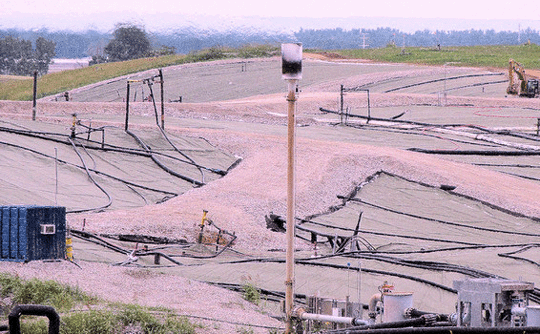
In May, almost 50 years after the waste was dumped at West Lake, the Environmental Protection Agency acknowledged what many residents had long feared: Radiological waste was spread throughout the West Lake Landfill, not confined to two specific portions as officials had long maintained.
The West Lake Landfill contamination was discovered in 1974. It was designated a Superfund site in 1990, and there is still no date certain for when the cleanup will begin.
MuckRock, by Allison Kite, Edited by Derek Kravitz, Jason Hancock 12 July 23
For kids like Sandy Mitchell, Ted Theis and Janet Johnson, childhood in the North St. Louis County suburbs in the 1960s and ‘70s meant days playing along the banks or splashing in the knee-deep waters of Coldwater Creek.
They caught turtles and tadpoles, jumped into deep stretches of the creek from rope swings and ate mulberries that grew on the banks.
Their families — along with tens of thousands of others — flocked to the burgeoning suburbs and new ranch style homes built in Florissant, Hazelwood and other communities shortly after World War II. When the creek flooded, as it often did, so did their basements. They went to nearby Jana Elementary School and hiked and biked throughout Fort Belle Fontaine Park.
Growing up, they never knew they were surrounded by massive piles of nuclear waste left over from the war.
Generations of children who grew up alongside Coldwater Creek have, in recent decades, faced rare cancers, autoimmune disorders and other mysterious illnesses they have come to believe were the result of exposure to its waters and sediment.
“People in our neighborhood are dropping like flies,” Mitchell said.
The earliest known public reference to Coldwater Creek’s pollution came in 1981, when the U.S. Environmental Protection Agency listed it as one of the most polluted waterways in the U.S.
By 2016, the Centers for Disease Control and Prevention was advising residents to avoid Coldwater Creek entirely. Cleanup of the creek is expected to take until 2038. A federal study found elevated rates of breast, colon, prostate, kidney and bladder cancers as well as leukemia in the area. Childhood brain and nervous system cancer rates are also higher.
“Young families moved into the area,” Johnson said, “and they were never aware of the situation.”
Theis, who grew up just 75 yards from the creek and played in it daily, died in August at the age of 60 from a rare cancer. Mitchell is a breast cancer survivor whose father died from prostate cancer. Johnson’s sister has an inoperable form of glioblastoma and other family members, including her father, daughter and nephew, have had various cancers.
Families who lived near Coldwater Creek were never warned of the radioactive waste. Details about the classified nuclear program in St. Louis were largely kept secret from the public. But a trove of newly-discovered documents reviewed by an ongoing collaboration of news organizations show private companies and the federal government knew radiological contamination was making its way into the creek for years before those findings were made public.

Radioactive waste was known to pose a threat to Coldwater Creek as early as 1949, records show. K-65, a residue from the processing of uranium ore, was stored in deteriorating steel drums or left out in the open near the creek at multiple spots, according to government and company reports.
A health expert who, as part of this project, was recently presented with data from a 1976 test of runoff to the creek concluded it showed dangerous levels of radiation 45 years ago.
Federal agencies knew of the potential human health risks of the creek contamination, the documents show, but repeatedly wrote them off as “slight,” “minimal” or “low-level.” One engineering consultant’s report from the 1970s incorrectly claimed that human contact with the creek was “rare.”
The Missouri Independent, MuckRock and The Associated Press spent months combing through thousands of pages of government records obtained through the Freedom of Information Act and interviewing dozens of people who lived near the contaminated sites, health and radiation experts and officials from government agencies.
Some of the documents, obtained by a nuclear researcher who focuses on the effects of radiation, had been newly declassified in the early 2000s. Others had been previously lost to history, packed away in government archives and not released publicly until now. (Read the documents here and learn more about our methodology here.)
All told, the documents from the now-defunct Atomic Energy Commission; its successors, the U.S. Department of Energy and the Nuclear Regulatory Commission; and the Environmental Protection Agency span the 75-year lifespan of the nuclear saga in St. Louis.
It starts in downtown St. Louis, where uranium was processed, and at the St. Louis airport, where it was stored at the end of the war; a monthslong move of the waste to industrial sites on Latty Avenue in suburban Hazelwood and a quarry in Weldon Spring, next to the Missouri River; an illegal dumping of waste at the West Lake Landfill in Bridgeton in the 1970s by a private company; and the declaration of the landfill as a federal toxic Superfund site in 1990.
Since then, the contaminated sites have been subjected to a seemingly endless cycle of soil, air and water testing, anxious community meetings attended by an ever-growing chorus of angry residents and panic when a subsurface smoldering event, similar to an underground fire, at the Bridgeton landfill threatened the radioactive waste buried nearby. That fire sent noxious and hazardous fumes into surrounding neighborhoods. The company in charge of the Bridgeton landfill now spends millions a year to contain it.
The documents have a familiar cadence: Year after year, decade after decade, government regulators and companies tasked with cleaning up the sites downplayed the risks posed by nuclear waste left near homes, parks and an elementary school. They often chose not to fully investigate the potential harms to public health and the environment around St. Louis………………………………………………………………………………………………………………………………………………
Illegal dumping of radioactive waste
When the Atomic Energy Commission sold the remnant nuclear waste, it anticipated being able to get rid of the more than 100,000 tons of toxic residues without spending any money.
The first company to purchase the waste, Continental Mining and Milling Co. of Chicago, borrowed $2.5 million to buy it in 1966 and then, shortly after, went bankrupt. Continental’s lender, Commercial Discount of Chicago, re-purchased the waste at auction for $800,000 and, after failing to get a bidder at a second auction, sold it to the Cotter Corp. To turn a profit, Cotter would ultimately dry the material and ship it to its uranium mill plant in Cañon City, Colorado………………………………………………………….
Cotter asked the government to bury the waste at Weldon Springs multiple times, in the late 1960s and early 1970s, but were rebuffed each time, meeting minutes show.
So, over a period of 2 ½ months in the summer and fall of 1973, Cotter took the problem into its own hands, without telling government regulators.
The company mixed the radioactive waste with tens of thousands of tons of contaminated soil from the site and illegally dumped it in a free, public landfill called West Lake, under three feet of soil and other garbage……………………………..
The AEC released Cotter from its St. Louis permit without immediate sanctions in 1974, but the company is partially responsible for the cleanup costs at the site.
Cotter’s parent company, General Atomics, did not respond to multiple requests for comment……………………………………………………………….
‘Tip of the iceberg’
In 1999, when Robbin Dailey moved into Spanish Village, a neighborhood of only a few dozen homes with its own park less than a mile from the back side of West Lake Landfill, she had no idea she was living next to a Superfund site.
When the EPA decided initially in 2008 to cap the waste at West Lake and leave it in place, Dailey never heard about the plan. Two years later, in 2010, she was alerted to the radioactive waste when a “subsurface smoldering event” — a type of chemical reaction that consumes landfilled waste like a fire but lacks oxygen — sent a pungent stench into the air around her home.
Dailey and her husband had their house tested and found thorium in the dust at hundreds of times natural levels. They sued the landfill’s owners, Republic Services, as well as the Cotter Corp. and Mallinckrodt.
Dailey said she and the companies had “resolved” their legal issues, but she, like all of the residents in North St. Louis County, was still in the dark about where within the landfill site the waste actually was.
Court records reveal a bevy of lawsuits against the private companies involved, at various times, with the West Lake Landfill. Not only that, but the landfill operators sued Mallinckrodt in an attempt to force the maker of the radioactive waste to pay for part of the cleanup.
Since the late 1970s, federal regulators repeatedly failed to uncover the true extent of contamination at West Lake.
In October 1977, the Nuclear Regulatory Commission used a helicopter to take hour-long passes back and forth over the landfill from an altitude of 200 feet. The goal was to measure gamma radioactivity coming from the site using specialized equipment.
While the effort correctly identified two areas with high levels of radiation, it had serious limitations, experts say. A survey of that type can miss contamination if it’s buried deep underground or if the ground is obstructed by vegetation.
And it did…………………………………
In May, almost 50 years after the waste was dumped at West Lake, the Environmental Protection Agency acknowledged what many residents had long feared: Radiological waste was spread throughout the West Lake Landfill, not confined to two specific portions as officials had long maintained……………………..
EPA officials said the contamination was found all over the property — in some areas at the surface and, in other areas, at great depths.
The agency looked at the dates on newspapers above and below the radioactive waste in two areas of the site previously thought to be uncontaminated to approximate when it was dumped, said Chris Jump, the EPA’s lead remedial project manager for the site.
It’s likely been there the whole time.
…………………………… Dawn Chapman, who left her job and co-founded Just Moms STL to advocate for the community around the landfill, said the EPA used to treat her and other activists like their fears were hysterical.
………………
A staffer with the Missouri Department of Natural Resources wrote in 1980 that contamination at the landfill was more severe and widespread than previously thought. In 1986 and 1990, onsite sampling showed possible radiological contamination in the groundwater in areas outside the sections of the landfill thought to be radioactive.
In 1987, the state classified the landfill as a hazardous waste site. The radioactive waste was in direct contact with the groundwater, the agency said in its annual report.
“Based on available information, a health threat exists due to the toxic effects of chemicals and low-level uranium wastes buried at the site and the possibility that off-site migration of these materials might occur,” the agency wrote.
…………………………. The West Lake Landfill contamination was discovered in 1974. It was designated a Superfund site in 1990, and there is still no date certain for when the cleanup will begin.
…………………………………….. Back to the drawing board
EPA’s first plan for the site would not have included moving the radioactive waste at all.
In 2008, the Environmental Protection Agency approved a plan for the landfill’s “primarily responsible parties” — the government and private contractors responsible for the site — to place a cap over the landfill and leave the waste in place.
Following criticism from the surrounding communities, EPA asked the Department of Energy, the Cotter Corp. and the landfill’s owner, Republic Services, to test the site again.
In the meantime, an underground fire brought a new level of scrutiny.
Starting in 2010, the Bridgeton landfill, which sits adjacent to the West Lake Landfill, has been experiencing a subsurface smoldering event.
………………………………………………….. The depth and severity of the new contamination the EPA found is not yet clear. The agency is preparing to release a report that will include the readings, a spokesperson said. A remedial design portion of the project is underway, the last step before the excavation begins.
But EPA doesn’t have a date certain as to when work on the project might start.
Curtis Carey, a spokesperson for the EPA, said despite decades of delays, the agency is planning next steps for the landfill “with a great deal more information because of our purposeful approach than was available 10, 15, 20 years ago.”
The following people contributed reporting, writing, editing, document review, research, interviews, photography, illustrations, analysis and project management. Chris Amico, Dillon Bergin, Kelly Kauffman and Derek Kravitz of MuckRock; Jason Hancock, Allison Kite and Rebecca Rivas of The Missouri Independent; Michael Phillis and Jim Salter of The Associated Press; Sarah Fenske, Theo Welling, Tyler Gross and Evan Sult of the Riverfront Times; EJ Haas, Madelyn Orr, Sydney Poppe, Mark Horvit and Virginia Young of the University of Missouri; Katherine Reed of the Association of Health Care Journalists; Liliana Frankel, Erik Galicia, Laura Gómez, Lauren Hubbard, Sophie Hurwitz and Steve Vockrodt; and Gerry Everding and Carolyn Bower of the original St. Louis Post-Dispatch team that published the seven-part “Legacy of the Bomb” series in 1989. https://www.muckrock.com/news/archives/2023/jul/12/st-louis-landfill-toxic-superfund/
Michigan ratepayers will foot the bill for Resuscitation of Palisades Nuclear Reactor
What changed? Holtec saw an opportunity to feed from the public trough by getting billions of dollars of corporate welfare, from both the state and federal government, to raise Palisades from the dead.
CounterPunch, BY JEFF ALSON, 12 July 23
The 52-year old Palisades nuclear power plant near South Haven, Michigan, on the shore of Lake Michigan near both Chicago and Grand Rapids, is one of the oldest and most degraded reactors in the country. In 2006, Palisades’ original owner, Consumers Energy, cited a wide range of major safety concerns when it sold the plant to Entergy, including that Palisades had one of the most embrittled reactor vessels in the country, needed a new reactor vessel head and steam generator, and had suffered from control rod drive mechanism seal leaks since it first opened.
As natural gas, and then wind and solar, became cheaper and cheaper, Palisades’ electricity became increasingly uncompetitive. Michigan ratepayers subsidized its electricity for years, sometimes paying as much as 57% above market rates. Trying to minimize additional costs, Entergy refused to invest in the most important safety repairs.
In 2018, Entergy announced it would sell the old and dangerous plant to Holtec, a decommissioning company, and the U.S. Nuclear Regulatory Commission (NRC) approved. The plant was formally closed on May 20, 2022, nuclear fuel was removed on June 13, and the plant was sold to Holtec on June 28, 2022.
The NRC then terminated Palisades’ operating license.
For four years, from 2018 through 2022, every major stakeholder—Entergy, the NRC, the Michigan Public Service Commission, energy and environmental NGOs, groups representing electricity consumers, and, notably, Michigan Governor Gretchen Whitmer—agreed that Palisades should be shut down.
The Governor’s own MI Healthy Climate Plan, released in April 2022, appropriately ignored Palisades’ imminent closure, since there are far cheaper and safer alternatives to reduce greenhouse gas emissions.
What changed? Holtec saw an opportunity to feed from the public trough by getting billions of dollars of corporate welfare, from both the state and federal government, to raise Palisades from the dead.
Holtec has requested a $300 million subsidy from Michigan taxpayers and in late June got a $150 million blank check from the Michigan legislature added to the current state budget without any public debate whatsoever. More ominous, Holtec also wants Michigan ratepayers to, once again, be forced to buy electricity at above-market prices that could significantly raise Michigan’s electricity rates, already the highest in the Midwest.
…………………………………. .Holtec will likely apply for multiple federal subsidies as well. To reopen Palisades, Holtec has already applied to the Department of Energy (DOE) for a billion dollar nuclear loan guarantee under the 2022 Inflation Reduction Act, and may apply for an additional $1.2 billion from the 2021 Infrastructure bill. Separately, Holtec has applied to DOE for $7.4 billion in loan guarantees under the 2005 Energy Policy Act for one or more future small modular nuclear reactors.
Michigan taxpayers and ratepayers have had too many nuclear white elephants:…………………………………………..
Of course, Michigan is not unique in this regard, as no U.S. nuclear power plants have been built on schedule or on budget in the last 50 years. In the wake of these and scores of other nuclear economic debacles across the country after Three Mile Island, Forbes business magazine concluded, “The failure of the U.S. nuclear power program ranks as the largest managerial disaster in U.S. business history….only the blind, or the biased, can now think that money has been well spent.”
…… A closed U.S. nuclear power plant has never been re-opened and would take, at best, many years. Investing in wind, solar, and battery storage provides much faster, cheaper, and more sustainable greenhouse gas emissions reductions. Of course, nuclear plants also entail unnecessary risks such as high-level nuclear waste, routine radiation releases, the potential for catastrophic accidents, and terrorist attacks…… https://www.counterpunch.org/2023/07/13/michigan-ratepayers-will-foot-the-bill-for-resuscitation-of-palisades-nuclear-reactor/
We must focus our state and federal resources on the most economical and sustainable climate energy solutions, and not squander more taxpayer and ratepayer funds on more misguided investment in nuclear power.
Small size, big problems: NuScale’s troublesome small modular nuclear reactor plan

EWG, 12 July 23
- Two energy experts discuss the design risks and excessive costs of the NuScale small modular nuclear reactor.
- NuScale project distracts from the need to push clean energy sources.
Despite its small size, NuScale has outsize cost and safety problems.
NuScale is one of several companies making long-shot attempts to commercialize what are known as small modular nuclear reactors, or SMRs. Its 77-megawatt project is the furthest along in the Nuclear Regulatory Commission, or NRC, licensing approval process, but in the earliest stages, with a long way to go. But the NRC has identified serious safety concerns, and cost estimates have ballooned in recent years.
EWG has long warned about the folly of investing in nuclear power, including SMRs that are unlikely ever to get off the ground.
And in a new analysis commissioned by EWG, two nuclear experts with decades of experience note significant NuScale cost and safety drawbacks that have been raised by NRC staff.
The experts recently analyzed the November 15, 2022, pre-application readiness assessment report the NRC issued to NuScale, which details many concerns about the project’s safety. The two authors are Arjun Makhijani, Ph.D., president of the Institute for Energy and Environmental Research, which advocates for a safer environment, and M.V. Ramana, Ph.D., a professor at the School of Public Policy and Global Affairs, University of British Columbia.
Their findings further strengthen the case against more funding for NuScale – yet another nuclear boondoggle that will fleece American taxpayers.
The primary issues they identified were escalation costs and design issues, for which the company has not properly addressed the safety issues involved. These include:
Costs. The projected construction costs of the first proposed NuScale project have grown from $5.3 billion, as estimated in November 2021, to $9.3 billion, in January 2023.
Risks. The NRC and its Advisory Committee on Reactor Safeguards identified several safety risks in the design for the reactor, in particular with the steam generator.
Energy companies, states and the government should stop throwing good money after bad, wasting it on lofty “all of the above” nuclear plans that will never come to fruition.
Instead they should focus on promoting workable, clean power solutions that already exist, like wind, solar and distributed generation, and associated technologies. Taxpayer dollars should be spent only on technologies that fight the climate crisis and do not have a history of persistent, inevitable ratepayer and taxpayer bailouts. Nuclear power and carbon capture and sequestration both fail that test.
The nuclear money pit
The nuclear industry survives in part thanks to assertions of clean, cheap power, which have never materialized, and an oversize influence in Congress and state legislatures………………………………….
Experts: NuScale’s costs soaring
NuScale’s first SMR plant is intended for the Utah Associated Municipal Power Systems, or UAMPS. The goal is to provide power to electric utilities in Utah and surrounding states. The target date is 2029, though nuclear plants have typically been plagued by significant delays. Its estimated cost is over $9 billion for just six small reactors that would, in total, be less than half the size of the standard large nuclear unit.
That estimate has increased by $4 billion in less than two years.
But the government keeps throwing taxpayer dollars at NuScale, promising $1.4 billion to the UAMPS project on top of the $400 million it has already squandered.
Other than these expected costs spiraling out of control, Makhijani and Ramana in their analysis find that even though NuScale keeps changing design specifications for its unit, NuScale’s safety analyses have not evaluated the impact of these design changes.
Experts: Changes in design present dangerous power projections
NuScale has increased by 50 percent the power output of its yet-to-be-built SMR reactor design. This means there will be more heat, pressure and radioactivity, which will further stress critical components of the reactor. These factors increase the risk of a catastrophic breakdown and radiation leak.
Unlike any nuclear power plant that’s already online, NuScale would house the reactor core – the nuclear fuel – and steam generator in the same vessel. This would be a departure from the traditional design, in which the steam generator is separated from the fuel, outside the reactor vessel but inside the secondary containment.
The helical design of the steam generator has also never been used in any other commercial nuclear power plant, which makes it hard to evaluate how it would behave in the long run.
Experts: Risky reactor design
The NRC has preliminarily approved NuScale’s design, despite serious questions about the steam generator. And NuScale still hasn’t produced the necessary analysis of all the accidents that could occur. …………………………………………………………….
Experts: NRC ignored risk guidance
The Advisory Committee on Reactor Safeguards, or ACRS, warned in a letter to NRC the “design and performance of the [NuScale] steam generators have not yet been sufficiently validated.”
The 1954 Atomic Energy Act requires ACRS to review and report to the NRC commissioners and staff about safety studies and reactor facility license and license renewable applications, among other issues.
The ACRS noted that NuScale’s plan “introduces different failure modes.”…………………………………………..
Experts: A flawed energy plan
Makhijani and Ramana conclude that the NuScale project, referred to as VOYGR, has too many problems and that there is insufficient information to justify NuScale’s safety claims.
“[T]he 77-MW VOYGR . . . has not received standard design approval, much less full Commission certification. On the contrary, it has received a letter from the NRC staff with 99 ‘significant’ observations and six major challenges,” they write.
Further, they warn:
These problems need real-world analysis, design, and most important, real-world testing to be resolved. Premature wear of the steam generators and their potential failure were not analyzed properly and insufficiently tested even for the (previous) 50 MW design. The hurdles are even higher with the 77-MW version.
The NuScale project is a trainwreck waiting to happen.
It would be irresponsible for the NRC to proceed at this juncture with any further approval. The question for NRC is whether the agency wants to keep the financially unviable, unsafe nuclear industry alive or focus on public safety and legitimate options for fighting the climate crisis. https://www.ewg.org/news-insights/news/2023/07/small-size-big-problems-nuscales-troublesome-small-modular-nuclear
Rep. Gaetz Says He Will Co-Sponsor Amendment to Block Cluster Bombs to Ukraine
https://scheerpost.com/2023/07/12/rep-gaetz-says-he-will-co-sponsor-amendment-to-block-cluster-bombs-to-ukraine/ By Dave DeCamp / Antiwar.com
Rep. Sara Jacobs (D-CA) introduced an amendment to the NDAA to block the provision of cluster munitions.
Rep. Matt Gaetz (R-FL) said Monday that he will be the Republican co-sponsor of an amendment to the 2024 National Defense Authorization Act (NDAA) that aims to block the provision of cluster bombs to Ukraine.
The amendment was introduced by Rep. Sara Jacobs (D-CA) and is co-sponsored by Reps. Ilhan Omar (D-MN), Pramila Jayapal (D-WA), and Rep. Jim McGovern (D-MA).
“I’m going to be the Republican co-sponsor of the Jacobs amendment before the House Rules Committee,” Gaetz said on his podcast.
The amendment reads: “Notwithstanding any other provision of law, no military assistance shall be furnished for cluster munitions, no defense export license for cluster munitions may be issued, and no cluster munitions or cluster munitions technology shall be sold or transferred.”
Gaetz said that the NDAA will be voted on this week in the House. “We have an opportunity with bipartisanship to stand against the war-mongering Bidens,” he said.
Cluster bombs spread small submunitions over large areas, many of which do not explode on impact, making them a hazard for civilians who can come across them years or even decades later. Because of their indiscriminate nature, cluster munitions are banned by over 100 countries, including many of the US’s top NATO allies.
“Children will be left without limbs and without parents because of this decision by Joe Biden if we do not work together in a bipartisan fashion to stop it,” Gaetz said.
While there is an effort to block the shipment of cluster bombs to Ukraine, they could already be on the way. The Pentagon announced they were providing cluster munitions in the form of 155mm artillery rounds using the Presidential Drawdown Authority, which allows Biden to ship weapons to Ukraine directly from US stockpiles.
Biden has defended his decision to arm Ukraine with cluster munitions by saying both Ukraine and the US are running low on ammunition. Colin Kahl, undersecretary of defense for policy, said the US will arm Ukraine with “hundreds of thousands” of the munitions.
Nuclear power is still an option at Comanche 3. These Pueblo activists want to change that
James Bartolo, The Pueblo Chieftain
Xcel Energy’s Comanche 3 power plant in Pueblo is slated to ditch coal by 2031, but what will replace the fossil fuel as the site’s energy source remains to be seen.
One of the the power generation options being considered by Xcel and the Pueblo Innovative Energy Solutions Advisory Committee (PIESAC) is nuclear energy. However, Nuclear-Free Pueblo, a coalition of local environmental activists that formed two years ago when the idea was first broached by Pueblo County commissioners, continues to fight against nuclear as a replacement.
The coalition believes a nuclear plant would pose a health risk to Pueblo County residents and siphon funds away from the county’s transition to renewable energy. Its members spent Saturday canvassing local neighborhoods before holding a rally outside the Pueblo County Courthouse during its “Day of Action.”
“As far as what can go wrong, it ranges from minor issues that can cause us to just be without power for a while to anything up to and including a meltdown situation like Chernobyl, Fukushima, or so many of these other nuclear reactors we have heard about melting down,” said Jamie Valdez, organizer for Mothers Out Front. “If we have a situation like that, Pueblo and surrounding areas could be rendered unlivable for generations to come.”
Radioactive waste and water usage among coalition’s concerns
In a “toolkit” distributed to community members in both English and Spanish, Nuclear-Free Pueblo lists its reasons for opposing nuclear energy in Pueblo.
Among them: the thousands of years that high-level nuclear waste remains reactive; the lack of a permanent disposal facility for high-level waste in the United States; and the average small modular reactor’s daily water use of 160 million to 390 million gallons.
The toolkit also sites a 2012 International Journal of Cancer study that indicated increased incidences of childhood cancer near nuclear plants.
What is Nuclear-Free Pueblo?………………………………….
FBI colluded with Ukraine in social media crackdown – lawmakers
https://www.rt.com/news/579523-fbi-ukraine-meta-twitter/ 11 July 23
The bureau failed to properly vet information provided by Kiev, the US House Judiciary Committee says
The FBI cooperated with Ukraine’s Security Service (SBU) to clamp down on social media accounts disseminating alleged “Russian disinformation,” but ended up flagging pages run by the US State Department and American journalists, a report by the House Judiciary Committee has revealed.
Released on Monday, the report accused the FBI of not properly vetting lists of accounts provided to it by the SBU before sending them to the likes of Meta, Google, and Twitter.
As a result, the two agencies “flagged for social media companies the authentic accounts of Americans, including a verified US State Department account and those belonging to American journalists,” and requested that those pages be deleted, the document read.
On some occasions, the FBI followed up to ensure that “these accounts were taken down,” according to the report, which was based on documents subpoenaed from Meta and Alphabet in February.
In one of the SBU’s lists forwarded by the FBI to Meta, the official Russian-language Instagram account of the US State Department was described as “distribut[ing] content that promotes war, inaccurately reflects events in Ukraine, justifies Russian war crimes in Ukraine in violation of international law,” the report stated.
CNN pointed out that Meta, which owns Instagram and Facebook, apparently did not comply with the request to delete the State Department page.
Another moderation request filed to Facebook by the US domestic security agency included a roster of 5,165 accounts, the House Judiciary Committee said.
The report cited an email by a senior Twitter employee who indicated to the FBI that “a few accounts of American and Canadian journalists” were on one of the lists sent to the company by the agency.
Alphabet platforms Google and YouTube were also approached about censoring alleged pro-Russian accounts. A high-ranking member of Google’s cybersecurity team told the authors of the report that the company had been “deluged with various requests” for the removal of content, mainly from “the Ukrainian government, other Eastern European governments, the European Union, and the European Commission.”
The House Judiciary Committee suggested that the FBI had “violated the First Amendment rights of Americans and potentially undermined our national security” through its partnership with the SBU, claiming that the latter had been “infiltrated by Russian-aligned actors.”
The author of the paper noted the purge within the SBU by Ukrainian President Vladimir Zelensky last summer, which saw the agency’s head sacked and hundreds of criminal cases launched against employees on treason charges.
The report was released ahead of FBI Director Christopher Wray’s testimony before the House Judiciary Committee, which is scheduled for Wednesday.
A Judiciary Committee aide told CNN that the Republicans on the panel are planning to question Wray about the content of the paper and use it to claim that the FBI interferes in free speech.
Archbishop to denounce nuclear arms on Trinity test’s 78th anniversary
Jul. 10—The first atomic blast that lit up the early morning sky at the Trinity Site in south-central New Mexico on July 16, 1945 — an event that opened the door for two nuclear bombs to be dropped on Japan — had an immense impact on the state that is still felt to this day.
Santa Fe Archbishop John Wester will mark the 78th anniversary of the Trinity test by denouncing the nuclear weapons program that has escalated since the long-ago detonation in a remote desert, and for which New Mexico finds itself in a primary role.
Wester and anti-nuclear groups are organizing an event Sunday at the Santa Maria de la Paz Community Hall, featuring speakers, music, exhibitions and moments of reflection and prayer on the atomic blast that reshaped civilization. The public can attend or livestream it;
We can no longer deny or ignore the extremely dangerous predicament of our human family,” Wester said in a statement. “We are in a new nuclear arms race far more dangerous than the first, and I believe we need to rejuvenate a sustained, serious conversation about universal, verifiable nuclear disarmament.”
Because of Trinity, New Mexico will be forever linked to the two bombs dropped on the Japanese cities of Hiroshima and Nagasaki. The bombs, credited by many with hastening the war’s end and saving tens of thousands of American lives, killed more than 200,000 Japanese people and inflicted radiation poisoning on much of the populace.
The atomic test released radioactive fallout in downwind communities in New Mexico, causing fatal illnesses such as cancer in what many believe are a large number of residents, though the actual quantity remains unknown because the federal government didn’t track such aftereffects as part of the secrecy surrounding the project………………………………………………… more https://news.yahoo.com/archbishop-denounce-nuclear-arms-trinity-033300743.html?guccounter=1&guce_referrer=aHR0cHM6Ly9uZXdzLmdvb2dsZS5jb20v&guce_referrer_sig=AQAAADJqdcGm_qX6CdNLQ8_g7p81OistELVP4KvAUR1PfQl-0Q2SBtdSRa8GwdKyTIcwvX8aofXxou_a1DmL9axGTUu9S4o5f35bRYrwMTXGG5ZaoooE2PgjQaFWi5uLyJbf3gg8EShjtVi5A26UqvyJcSYMPWp9GQCX2T9NlsjflzJW
US cluster bombs deal is clear signal that war is not going well for Ukraine
America risks losing the moral high ground by supplying Ukraine with a weapon banned by much of the world, so why are they supplying it?
Mark Stone, US correspondent @Stone_SkyNews
The White House is fully aware of the huge controversy surrounding this cluster munitions decision.
Some 123 countries are part of the 2008 International Convention on Cluster Munitions which bans the use or transfer of this particular weapon.
Almost all of America’s allies are signatories to the convention.
Even within US government circles, there has been deep unease about supplying its own stockpile of cluster munitions to Ukraine.
Ukraine war latest: US to send Kyiv controversial weapon banned by more than 100 countries
As recently as last week, within the state department, there was division about the decision to supply the weapon.
The long and grim record of the cluster bomb explains the unease and the controversy.
Globally, civilians represent 97% of cluster munition casualties, according to a report last year by the Landmine and Cluster Munition Monitor – an organisation that seeks to ban them altogether.
Children are overwhelming the victims.
By supplying the weapon, there is a clear risk to civilians, not now necessarily, but in the future. The legacy of unexploded cluster bomblets is evident on former battlefields globally.
America also risks losing the moral high ground against Russia by supplying a weapon banned by much of the world.
So why supply it?
Well, the facts on the ground are not in Ukraine’s favour. The transfer is a clear signal that the war is not going well for Ukraine.
The so-called spring offensive did not materialise in the spring and looks set to falter through the summer too.
Ukraine is fast running out of more conventional artillery with supply stocks in America and elsewhere running low.
A ‘bridge of supply’ is necessary.
………………. The munitions would be used by Ukraine on occupied Ukrainian soil. The risk to civilians would be owned by Ukraine. The onus would be on Ukraine, with a pledge of American help, to clear the unexploded munitions when the war comes to an end.
The announcement is part of a multi-million dollar tranche of new weaponry which is an attempt by the Biden administration to future-proof the conflict; to give Ukraine the weapons it needs now in case domestic political circumstances change in the next 18 months.
American politics is in flux.
There is no guarantee of open-ended support for Ukraine. https://news.sky.com/story/us-cluster-bombs-deal-is-clear-signal-that-war-is-not-going-well-for-ukraine-12917101
1 This Month

of the week – Shut Down Drone Warfare!


Tell the Ukrainian Government to Drop Prosecution of Peace Activist Yurii Sheliazhenko

Petition to revoke the licensing of the Near Surface Nuclear Disposal Facility (NSDF) at Chalk River. https://www.ourcommons.ca/petitions/en/Petition/Details?Petition=e-7247
To see nuclear-related stories in greater depth and intensity – go to https://nuclearinformation.wordpress.com
-
Archives
- April 2026 (103)
- March 2026 (251)
- February 2026 (268)
- January 2026 (308)
- December 2025 (358)
- November 2025 (359)
- October 2025 (376)
- September 2025 (257)
- August 2025 (319)
- July 2025 (230)
- June 2025 (348)
- May 2025 (261)
-
Categories
- 1
- 1 NUCLEAR ISSUES
- business and costs
- climate change
- culture and arts
- ENERGY
- environment
- health
- history
- indigenous issues
- Legal
- marketing of nuclear
- media
- opposition to nuclear
- PERSONAL STORIES
- politics
- politics international
- Religion and ethics
- safety
- secrets,lies and civil liberties
- spinbuster
- technology
- Uranium
- wastes
- weapons and war
- Women
- 2 WORLD
- ACTION
- AFRICA
- Atrocities
- AUSTRALIA
- Christina's notes
- Christina's themes
- culture and arts
- Events
- Fuk 2022
- Fuk 2023
- Fukushima 2017
- Fukushima 2018
- fukushima 2019
- Fukushima 2020
- Fukushima 2021
- general
- global warming
- Humour (God we need it)
- Nuclear
- RARE EARTHS
- Reference
- resources – print
- Resources -audiovicual
- Weekly Newsletter
- World
- World Nuclear
- YouTube
-
RSS
Entries RSS
Comments RSS
 nuclear-news