“Highly emotive terms for the killing of civilians like ‘slaughter,’ ‘massacre,’ and ‘horrific’ were reserved almost exclusively for Israelis who were killed by Palestinians, rather than the other way around,”
Got it? In Ukraine people die from bombs because Russia launched Russian airstrikes and killed them very Russianly, whereas in Gaza people get hurt by explosions because they got too close to some type of explosive material.
“…………………… “In the war of propaganda it is very difficult to defeat the United States because the United States controls all the world’s media and many European media,” Putin replied, adding, “The ultimate beneficiary of the biggest European media are American financial institutions.”
… Putin is definitely correct about the strength of the American propaganda machine. Of all the fronts one could possibly choose to challenge the United States on, propaganda is surely the least favorable. The US empire has by far the most sophisticated and effective propaganda machine ever to have existed, operating with such complexity that most people don’t even know it exists.
…………………………………………………………………In reality the nature of the US-centralized empire allows it to run a massive, nonstop international propaganda campaign through mass media platforms which are mostly privately owned. A diverse network of factors feeds into this dynamic which I’ve detailed in my unusually lengthy article “15 Reasons Why Mass Media Employees Act Like Propagandists”, but the gist of it is that anyone who’s wealthy enough to control a mass media platform is going to have a vested interest in preserving the status quo upon which their wealth is premised, and they will cooperate with establishment power structures in various ways toward that end.
The fact that these mass media outlets look independent but function as propaganda organs for the US empire allows its propaganda to fly into people’s minds without triggering any gag reflex of critical thinking or skepticism, which wouldn’t be the case if people knew those outlets were feeding them propaganda. Propaganda only really has persuasive power if you don’t know it’s happening to you.
The invisibility of US propaganda is further aided by the subtle methods by which it is administered, which we’ve seen exemplified beautifully in the coverage of Israel’s ongoing US-backed mass atrocity in Gaza.
“Highly emotive terms for the killing of civilians like ‘slaughter,’ ‘massacre,’ and ‘horrific’ were reserved almost exclusively for Israelis who were killed by Palestinians, rather than the other way around,” The Intercept’s Adam Johnson and Othman Ali report. “The term ‘slaughter’ was used by editors and reporters to describe the killing of Israelis versus Palestinians 60 to 1, and ‘massacre’ was used to describe the killing of Israelis versus Palestinians 125 to 2. ‘Horrific’ was used to describe the killing of Israelis versus Palestinians 36 to 4.”
This is the sort of manipulation that a casual news consumer wouldn’t notice. Unless you’re on alert for bias and are keeping track of what words are and aren’t being used where, you’re probably not going to notice the absence of emotionally-charged words when reporting on Palestinians who are killed by Israelis.
It’s easy to spot the difference when they’re placed next to each other like I just did, but unless you’re really watching out for it and have a good background on what’s going on here you’re likely to miss what’s happening. If you’re like most people and don’t read past the headline, you’d never know from the imperial media headlines that the child was killed by Israel, and you’d certainly never know about her terrified phone call for help while trapped by IDF fire and surrounded by the bodies of her dead relatives. If you look to the legacy media and its algorithmically-boosted online iterations for information about the world, you went one more day with a distorted perspective of what’s happening in Gaza.
The western press constantly write headlines like this when trying to minimize the impact of someone’s death at the hands of a party they sympathize with, particularly with regard to Palestinians. Last month the BBC published an article titled “Record number of civilians hurt by explosives in 2023”, as though they were mishandling fireworks or something instead of being actively killed by Israeli bombs. The BBC later revised their atrocious headline, but revised it in the opposite direction, replacing “Record number” with “High number” to further minimize the impact.
Got it? In Ukraine people die from bombs because Russia launched Russian airstrikes and killed them very Russianly, whereas in Gaza people get hurt by explosions because they got too close to some type of explosive material.
Last week The Washington Post ran an opinion piece titled “Is America complicit in Israel’s bloody war in Gaza?”, which is already a ridiculously skewed headline because the answer is self-evidently yes — implying that there’s any question of this skews things in America’s favor. But even this was too much for the Post’s editors, who re-titled the piece “Has the Israel-Gaza war changed your feelings about being American?” to keep Americans from thinking too hard about Israel’s bloody war in Gaza and their country’s complicity in it.
In a Wednesday article titled “Biden Tries Again With Arab Americans in Michigan”, New York Times editorial board member Farah Stockman wrote the absolutely insane line “The Oct. 7 Hamas attack on Israel seems to be affecting Biden’s election prospects.” And then The New York Times actually printed it.
Read that line again. She’s saying Arab Americans are rejecting Biden because of the October 7 Hamas attack, which is of course absurd; they’re rejecting Biden because he’s backing a genocide in Gaza. She wrote this nonsensical line because in the New York Times you can’t say things like “Israel’s genocide in Gaza” or “the president’s facilitation of crimes against humanity”, and you won’t be hired if you’re the sort of person who’d be inclined to. Instead we’re pretending that for some inexplicable reason Arab Americans are just hopping mad at Biden because October 7 happened.
But again, these little manipulations fly under the radar if you’re not on the lookout for them. Such is the brilliance of the US empire’s invisible propaganda machine. That’s why it’s very difficult to win a propaganda war against the United States, that’s why westerners have been so successfully manipulated into accepting a status quo of endless war, ecocide, injustice and exploitation, and that’s why the world looks the way it looks right now.
Walt Zlotow, West Suburban Peace Coalition, Glen Ellyn IL 11 Feb 24
For 4 months President Biden has been beseeching Congress to grant another $61 billion in aid to Ukraine to continue their 2 year war with Russia. This is on top of $113 billion that has made no dent in Ukraine’s efforts to prevail against overwhelming Russian forces.
Biden could give Ukraine a trillion dollars in aid but it’s essentially worthless because Ukraine is running out of soldiers to use US weapons.
A dozen Ukrainian soldiers and commanders told the Washington Post that personnel deficits are at their lowest point ever.
One mechanized brigade battalion commander advised he’s down to 40 soldiers from a normal 200 to hold off the Russian advance. Another mentioned the same shortage in his unit.
Replacements are scares since August when Zelensky fired all recruitment office heads due to corruption. That’s caused a dramatic decline in replacements still not solved.
But if Biden gets his $61 billion he’d be better off tossing it into a bonfire instead of squandering it on more weapons for Ukraine. That will only prolong a war that was lost on Day One, 717 days ago. Had Biden not torpedoed a peace deal nearly inked in the first month, over 400,000 Ukrainian soldiers would still be alive, the Ukraine economy would not be devastated, and Ukraine may not have lost a single square mile of territory.
Biden knows the $61 billion more will not turn the tide. But as Pete Seeger sang about LBJ continuing to fight a lost war in Vietnam 57 years ago, in today’s White House…’The Big Fool says to push on.’
Two northern Arizona tribes this week condemned the start of operations at a uranium mine just south of the Grand Canyon.
The statements came after Denver-based company Energy Fuels Inc. announced last month that operations at its Pinyon Plain Mine had commenced.
“It is with heavy hearts that we must acknowledge that our greatest fear has come true,” a statement from the Havasupai Tribal Council read.
Meanwhile, Navajo Nation President Buu Nygren said in a statement that mining remains opposed “by all neighboring tribes that have forever called Grand Canyon their home.”
The Havasupai Tribe, along with many conservation groups, have long worried that the mine could contaminate area groundwater.
The Pinyon Plain Mine, previously known as the Canyon Mine, sits above the Redwall-Muav aquifer, which acts as a source of water for countless seeps and springs throughout the Grand Canyon, and is the sole source of drinking water for the Havasupai.
The mine also sits near Red Butte, an area with deep cultural importance to the Havasupai.
Energy Fuels has insisted that mining poses no risk to groundwater in the area.
Energy Fuels Vice President of Marketing and Development Curtis Moore said last month that the concerns over contamination were unfounded and designed to scare the public and push an antinuclear political agenda.
But those statements provided little comfort to those opposed to the mine.
“As guardians of the Grand Canyon, we the Havsuw ‘Baaja, the Havasupai Tribe, have opposed uranium mining in and around our reservation and the Grand Canyon since time immemorial. We do this to protect our people, our land, our water, our past, our present and our future,” a statement from the Havasupai Council read. “And yet, despite the historic and current assistance and advocacy from numerous allies, and the countless letters, phone calls and personal pleas, our urgent requests to stop this life-threatening action have been disregarded.”
Nygren on Thursday called on the federal government to protect tribes from the impact of new mining.
“I join our neighboring tribes and the many non-Native organizations to implore the federal government to uphold its promise to protect us,” Nygren wrote. “We are very concerned about the impending transport of radioactive materials from the Pinyon Plain/Canyon uranium mine to White Mesa Mill in Utah.”
The statements came as activists say they have observed uranium ore being stockpiled at the mine site.
Moore previously told the Arizona Daily Sun they didn’t yet know when they would begin to haul ore from the mine to the Utah Mill for processing. He said it was likely to begin within the year, however.
In 2012, the Navajo Nation passed a law banning the transportation of uranium ore within Navajo lands. That law does not impact federal highways that cross tribal lands.
There are two potential routes trucks bringing uranium ore from the mine to the Utah mill could take. One would direct trucks through Flagstaff, while a second would utilize ranching roads to skirt north of the city. Still, both routes pass through the Navajo Nation on U.S. Route 89.
Nygren also said he was disappointed that he and other tribal officials only learned mining operations had commenced through media reports, as opposed to hearing the news from federal partners.
“Despite all of our objections through the years, we learn through the media, rather than from our federal trustee — the U.S. Department of Agriculture, U.S. Forest Service and U.S. Department of the Interior/Bureau of Land Management — as would correctly expect, that our land and water will again be threatened with contamination,” he said. “Our relatives, the Havasupai, Hualapai and other tribes along the Colorado River, are bracing themselves for renewed anxiety, worry and constant unease about the safety of their resources and homelands.”
There is a long and controversial history of uranium mining within northern Arizona.
Throughout the Cold War era, nearly 30 million tons of uranium ore were extracted and often processed from Navajo Nation lands. Hundreds of those mines, often near Navajo communities, were then abandoned by the companies operating them.
More than 500 contaminated sites remain across the Navajo Nation.
The $61 billion will make no difference on the battlefield except to prolong the war, the tens of thousands of deaths, and the physical destruction of Ukraine.
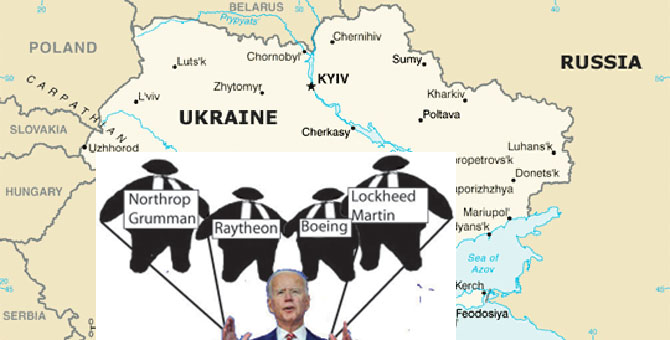
President Joe Biden is refusing to fold a losing hand as he bets with Ukrainian lives and U.S. taxpayer money. Biden and Democratic Senate Majority Leader Chuck Schumer propose to squander the lives of tens of thousands more Ukrainians and $61 billions of federal funds to keep Biden’s disastrous foreign policy failure hidden from view until after the November election.
The $61 billion will make no difference on the battlefield except to prolong the war, the tens of thousands of deaths, and the physical destruction of Ukraine. It will not “save” Ukraine. Ukraine’s security can only be achieved at the negotiating table, not by some fantasized military triumph over Russia.
$61 billion is not nothing. This worse-than-useless outlay would exceed the combined budgets of the U.S. Department of Labor, Environmental Protection Agency, National Science Foundation, and the Women, Infant, and Children nutrition program.
Almost exactly 10 years ago this month, Biden did much to put Ukraine on the path to disaster. This is well known to those who have looked carefully at the facts but is kept hidden from view by the White House, the Senate Democrats, and the mainstream media that back Biden. I have previously provided a detailed chronology, with hyperlinks, here.
Ukraine’s security can only be achieved at the negotiating table, not by some fantasized military triumph over Russia.
In 1990, President George H. W. Bush, Sr. and his German counterpart Chancellor Helmut Kohl promised Soviet President Mikhail Gorbachev that NATO would not expand eastward if the Soviet Union accepted German reunification. When the Soviet Union disbanded in December 1991, with Russia as the successor state, American leaders decided to renege.
President Bill Clinton began NATO expansion over the vociferous opposition of top diplomats like George Kennan and the opposition of his own Secretary of Defense, William Perry. In 1997 Zbigniew Brzezinski upped the ante, with a plan for NATO to expand all the way to Ukraine. He famously wrote that without Ukraine, Russia would cease to be a great power.
Russian leaders have repeatedly made clear that NATO expansion to Ukraine is understandably the reddest of Russian redlines.
In 2007, President Vladmir Putin stated that NATO enlargement to that date was a cheat on the 1990 promise, and that it must go no further. Despite these clear warnings, including by his own diplomats, George W. Bush Jr. committed in 2008 to expand NATO to Ukraine and Georgia in order to surround Russia in the Black Sea.
William Burns, now CIA director, and then the U.S. Ambassador to Russia, wrote a famous memo entitled “Nyet means Nyet,” explaining that Russia’s opposition to NATO enlargement was across Russia’s political spectrum. Most Ukrainians themselves were also firmly against the plan, favoring neutrality over NATO membership. The Ukrainian Rada declared Ukraine’s state sovereignty in 1990 on the basis of becoming “a permanently neutral state.” In 2009, the people of Ukraine elected Viktor Yanukovych, who ran on a platform of neutrality.
In early 2014, the U.S. decided to help bring down Yanukovych in a coup. This was standard U.S. deep-state operating procedure, one used on dozens of occasions around the world. he CIA, National Endowment for Democracy, USAID, and NGOs like the Open Society Foundation went to work in Ukraine. The point person was Victoria Nuland, who was first Richard Cheney’s principal deputy foreign policy advisor, then George Bush Jr.’s ambassador to NATO, then Hillary Clinton’s spokesperson, and by 2014 Assistant Secretary of State.
This time, the Russians caught the conspiracy on tape, in an intercepted call between Nuland and U.S. Ambassador to Ukraine Geoffrey Pyatt (now Assistant Secretary of State). Nuland explains to Pyatt that Vice President Joe Biden will help choose and cement the post-coup government. The 2014 Ukraine team, including Biden, Nuland, Jake Sullivan (then and now Biden’s national security advisor), Geoffrey Pyatt, and Antony Blinken (then the deputy national security advisor), remains the Ukraine team today.
It is a team of bunglers. They thought that Yanukovych’s overthrow would quickly usher in NATO expansion. Instead, ethnic Russians in Ukraine virulently rejected the Russophobic post-coup government that was installed by Nuland, and called for autonomy of the ethnically Russian regions. In a referendum, Crimea voted overwhelmingly to join Russia.
Obama, Biden, and their team armed the post-coup government to attack the ethnically Russian regions, thinking this would be the end of it. Yet the regions resisted. Ukraine and the breakaway regions signed the Minsk Agreements to bring an end to the fighting and give constitutional autonomy to the ethnically Russian Donbas. The Minsk II agreement was backed by the UN Security Council, but the U.S. privately agreed with the Ukrainian government that it was okay to ignore it.
In 2021, after 7 years of fighting and more than 14,000 deaths in the Donbas, Putin called on newly elected President Biden to stop NATO enlargement and engage in negotiations with Russia over mutual security arrangements. Biden rejected Putin’s call to end the gambit of NATO enlargement to Ukraine.
In February 2022, Putin launched the Special Military Operation (SMO) invasion to push Ukraine to the negotiating table. Ukraine’s President Volodymyr Zelensky immediately called for negotiations based on Ukraine’s neutrality. Within a month, a framework agreement to end the fighting was reached between Ukraine and Russia, based on Ukraine’s neutrality and an end to NATO’s enlargement to Ukraine. Biden stepped in to stop the deal, with the U.S. informing Zelensky that the U.S. would not support neutrality.
Biden and team had still more failed tricks up their sleeve. They firmly believed that U.S. financial sanctions—freezing Russia’s assets and cutting it out of the SWIFT banking system—would cripple the Russian economy and cause Putin to relent. In fact, they expected that the ensuing economic crisis would topple him. Of course, nothing of the sort happened.
Then they expected that NATO weaponry would trounce Russia on the battlefield. That too did not happen. Then they expected that Ukraine’s “counter-offensive” in the summer of 2023, backed by Pentagon and CIA planners, would defeat Russia. Instead, Ukraine lost hundreds of thousands of soldiers dead and wounded—its military hardware destroyed.
The entire war, including the loss of Ukrainian territory, the hundreds of thousands of Ukrainian casualties, and the utter waste of more than $100 billion of U.S. taxpayer money to date, could easily have been avoided.
Now, Biden and Schumer want to throw more Ukrainian lives and more tens of billions of dollars at this glaring failure. They want to do this in a rushed vote, without any Congressional let alone public oversight, without hearings, and without any strategy. The fact is they want to save Biden from the embarrassment of a decade of puerile and failed plotting, at least until the November election.
There remains one answer for Ukraine’s security: diplomacy and neutrality. That solution doesn’t cost lives or money. It was Ukraine’s choice before the 2014 coup and again in 2022 until stopped by Biden. It is the path that Biden and the Senate Democrats still refuse to take.
The United States has not seen a widespread nuclear disarmament movement since the early 1980s. A new one is desperately needed — but with a twist.
The 1980s movement was based on fear. In 1982, a million people, alarmed by President Ronald Reagan’s nuclear buildup, gathered in New York City’s Central Park to oppose the nuclear arms race — still the largest one-day protest in U.S. history. The next year, 100 million people — almost half the population of the United States — watched the television movie “The Day After,” which horrifically depicted the nuclear destruction of Kansas City.
Fear can generate a fight-or-flight reaction, but it’s ultimately counterproductive. People become so scared that they think nothing can be done and give up. Or they ignore the issue entirely, at least on a conscious level.
There are still plenty of things to fear. Nuclear treaties are lapsing. National leaders have threatened to use nuclear weapons against their enemies. New research, now being reviewed by the National Academies of Sciences, Engineering, and Medicine, has strengthened the case that even a limited nuclear war could shut down agriculture for years and doom billions to starvation. A large-scale nuclear war could smother agriculture for more than a decade and end civilization.
But fear isn’t necessary to spur action. There are two very practical reasons to abolish nuclear weapons.
The first is their outrageous cost. The U.S. government is on track to spend at least $1.5 trillion over the next 30 years modernizing its nuclear weapons. That’s as much as the federal government currently spends on the National Institutes of Health. Or, to put it another way, four years of that spending, evenly divided among the 50 states, would buy us an entirely new ferry fleet.
Key parts of the modernization effort, like the new Sentinel ballistic missile program, are already massively over budget. Taking apart nuclear weapons systems would cost a small fraction of the money now slated to build new ones.
The second reason for getting rid of nuclear weapons is that they are far more dangerous than they are useful. Nuclear bombs are too large and destructive to deploy effectively in warfare. They would kill soldiers and noncombatants on both sides of a conflict. Nuclear fallout would drift far from a battlefield. Weapons have been getting smaller and smarter, not bigger and dumber.
Nuclear weapons also don’t make sense politically. If a nuclear weapon were detonated in a war — assuming that a general nuclear war did not follow — the responsible nation would face devastating conventional attacks and be ostracized internationally. No country has been willing to face those consequences, at least not since the very different circumstances that prevailed at the end of World War II.
The existence of nuclear weapons supposedly deters their use. No one has been able to figure out what that nonsensical statement means. Making a threat implies being willing to carry it out. The idea that deterrence has worked ignores the history of crises, miscalculations, and accidents that almost triggered nuclear war. Deterrence works until it doesn’t.
Nuclear weapons are a federal responsibility. For us as Washingtonians, that means working through our 10 U.S. representatives and two U.S. senators to change nuclear policy. Except for U.S. Rep. Pramila Jayapal, the members of our congressional delegation have been, at best, guarded in their statements about nuclear weapons. Washington receives about $20 billion a year in defense spending. Reducing that flow of funds would seem to be a recipe for electoral disaster.
But couldn’t at least part of our defense funding be spent in more socially productive ways? After all, flying a nuclear bomb-carrying F-35A jet for two hours costs as much as a nurse makes in a year. Keeping more than 55,000 mostly young men and women here in Washington well-trained and outfitted for future conflicts may help us feel more secure. But it doesn’t build infrastructure, spark innovation, or improve the health and well-being of the population at large.
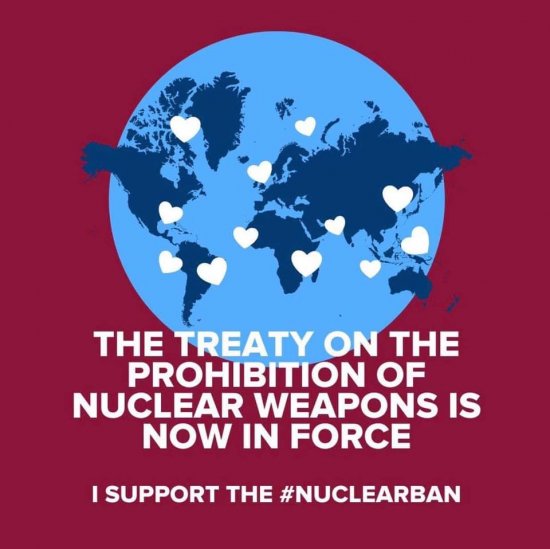
In 2021, the International Treaty on the Prohibition of Nuclear Weapons, which prohibits the development, production, use, and threat of use of nuclear weapons, entered into force after being ratified by 50 countries. The nine countries that have nuclear weapons have so far opposed the treaty, but they are nevertheless bound by the 1968 Treaty on the Non-Proliferation of Nuclear Weapons to negotiate an agreement “on general and complete disarmament under strict and effective international control.” That they have not yet done so is both a bitter disappointment and a betrayal of their stated intentions.
Nuclear disarmament will not be unilateral or immediate. Nations will need to negotiate stepped reductions and means of verifying progress. An especially urgent task is to eliminate the ground-based missiles now clustered in underground silos in Colorado, Montana, Nebraska, North Dakota and Wyoming, as well as in Russia and China. These weapons are inherently destabilizing and dangerous. They have to be launched within minutes if a president thinks a nuclear attack is underway. A mistake, miscalculation, or moment of madness could spell the end of the world.
Unlike efforts to slow climate change, which will require widespread changes in how we live, the threat of nuclear annihilation could be eliminated if nine men agreed to destroy about 12,500 pieces of elaborately machined metal. Reagan and then-president of the Soviet Union Mikhail Gorbachev almost agreed to junk their nuclear weapons in 1986. The only stumbling block was Reagan’s commitment to a nuclear weapons defense program that was canceled a few years later.
“The supplemental funding proposed, which includes no humanitarian aid for Gaza nor assistance for Ukraine, supports weapons of war and destruction that further jeopardize Israeli hostages and Palestinian civilians,
“Each U.S.-made or funded bomb dropped in Gaza further jeopardizes the chances of long-lasting peace for Israelis and Palestinians,” said Rep. Delia Ramirez.
A Republican effort to push through a standalone military aid package for Israel failed to clear the U.S. House on Tuesday, with members of the Congressional Progressive Caucus condemning the proposed $17.6 billion in unconditional assistance for a government that stands accused on the world stage of committing genocide in the Gaza Strip.
The legislation, which President Joe Biden threatened to veto if it reached his desk, needed two-thirds support to pass the House under a suspension of the rules. The final tally was 250 to 180, with 166 Democrats and 14 Republicans voting no.
Rep. Delia Ramirez (D-Ill.) said in a statement that “under no circumstances” could she have voted for the legislation, which House Republican leaders sought to advance ahead of the Senate’s planned procedural vote on a broader package that includes military aid to Israel and Ukraine and a border agreement that would dramatically weaken asylum protections.
“The death toll in Gaza continues to rise. Gazans are starving,” Ramirez said late Tuesday. “Over 1.5 million people have been displaced. Hostilities between the U.S. and Iran are escalating. And just this morning, The New York Times reported that one-fifth of the hostages still in captivity since the start of the conflict have likely died. We must change course.”
“The supplemental funding proposed, which includes no humanitarian aid for Gaza nor assistance for Ukraine, supports weapons of war and destruction that further jeopardize Israeli hostages and Palestinian civilians,” she continued. “Each U.S.-made or funded bomb dropped in Gaza further jeopardizes the chances of long-lasting peace for Israelis and Palestinians. I’ve said it before, and I’ll say it now: I will only support actions that bring us closer to peace.”
In a brief floor speech ahead of Tuesday’s vote, Rep. Ro Khanna (D-Calif.) described standalone Israel aid legislation as a “blank check for [Israeli Prime Minister Benjamin] Netanyahu” and other far-right officials seeking the permanent removal of Palestinians from Gaza.
If passed, the aid measure would have allowed the U.S. State Department to waive congressional notification requirements for billions of dollars in U.S. military financing for Israel, which has massacred Gaza civilians with American-made weaponry.
“I will vote no because it is painfully obvious to the entire world that what is needed today is a permanent cease-fire and a release of all hostages,” Khannas said. “There come moments in a nation’s history when our actions reveal our values. This is such a moment.”
The failure of the Israel aid bill came shortly after House Republicans also fell short in their effort to impeach Homeland Security Secretary Alejandro Mayorkas.
Rep. Ayanna Pressley (D-Mass.) wrote in response to the Mayorkas vote that “Republicans are deeply disconnected from the people.”
“They’re not serious about fixing our immigration system, they have no plan to improve folks’ lives, and they keep wasting our time with political stunts like these,” Pressley added. “This sham, failed impeachment is just the latest example.”
Senate Republicans on Wednesday are expected to block consideration of the broader supplemental security package over the border agreement, which they claim isn’t sufficiently harsh—a position right in line with that of former President Donald Trump, the frontrunner for the 2024 GOP presidential nomination.
The US decision to re-designate the Houthis as “Specially Designated Global Terrorists” will block the payment of public sector workers living in Houthi-controlled Yemen, who have gone without pay for years.
The payment of civil workers has been a key demand of the Houthis and is part of the first phase of the peace deal. The Houthis had asked for the salaries to be paid for using oil revenue that goes to the Saudi-backed Yemeni government, whose leaders are mainly based in Saudi Arabia. It’s unclear if the Saudi side agreed to the Houthi demand or if they decided to pay the salaries using other means.
The first phase of the peace deal would also fully open Yemen’s airports and sea ports that have been under blockade since 2015, another aspect of the deal that will be complicated by the new US sanctions, which will go into effect later this month.
A US official told the Times that the US would only allow the payment of Yemeni civil salaries if the Houthis choose the path of “peace” and stop attacking shipping in the Red Sea. But the Houthis, who govern the most populated area of Yemen, have been clear the operations will only stop once the Israeli slaughter of Palestinians in Gaza ends.
Instead of pressuring Israel to stop its onslaught, President Biden launched a new war against the Houthis, which has dramatically escalated the situation. The Houthis are now targeting American and British commercial shipping, and there’s no sign they will back down.
Since January 12, the US has launched at least 18 rounds of missile strikes on Houthi-controlled Yemen. President Biden has acknowledged the strikes are not “working” since they haven’t stopped Houthi attacks. But he vowed to continue bombing Yemen anyway.
The US supported a Saudi/UAE-led coalition in Yemen in a brutal war that killed at least 377,000 people between 2015 and 2022. More than half of those killed died of starvation and disease caused by the bombing campaign and blockade.
A truce between the Saudis and Houthis has been held since April 2022, but a formal peace deal hasn’t been signed. Despite the new US bombing campaign, the Saudis and Houthis appear determined not to restart the war. When President Biden launched his bombing campaign in Yemen, Saudi Arabia urged the US to “avoid escalation.”
This week, a Houthi official said the Yemeni group was ready to formally make peace with the Saudis. “Sanaa is prepared for peace with Riyadh despite the challenges posed by the US and its associated Yemeni groups,” said Hussein al-Ezzi, the Houthi deputy foreign minister.
Some members of the US and Saudi-backed Yemeni presidential council are calling for a ground campaign against the Houthis. But the council does not have much influence and is known in Yemen as the “government of hotels” since many of its members are in exile.
Walt Zlotow, West Suburban Peace Coalition, Glen Ellyn IL 7 Feb 24
The genocidal madness of President Biden has no limits.
For 123 days he’s been in near total support of Israel’s genocidal ethnic cleansing of 2,300,000 Palestinians in Gaza. He’s given them over 20,000 tons of war material to kill tens of thousands of Palestinians, destroy three quarters of their housing, send two million fleeing US bombs just to be blasted by more US bombs while on the run. Most hospitals and schools are gone under US bombs. Hundreds of thousands are starving or dying from lack of medicine.
In addition, he’s given them public support and a veto protection at the UN Security Council which called for ceasefire. He’s dismissed the Court of International Justice genocide hearing on Israel’s genocide as “meritless.” Biden and his Israeli counterpart Netanyahu are joined at the bombsight in their combined genocide in Gaza. US deserved to be joined in the dock with Israel in the ICJ hearing.
Now Biden demands $14 billion more to complete the grotesque project he could have stopped on Day 1 simply by denouncing Israel’s genocidal ethnic cleansing in Gaza, and cutting off every bloody dollar of aid.
Half of Americans polled say Israel has gone too far. Fully a third call it genocide. Biden calls it ‘helping our best ally.’ On Genocide Day 100, he honored Israel without a single mention of the 2,300,000 Palestinians whose lives were being degraded, if not destroyed with his help.
Joe Biden has supported every failed US war of world dominance for half a century. He won’t admit it, but the Israeli war to cleanse Gaza of Palestinians may already have failed. Palestinian resistance and worldwide revulsion and condemnation may bring about the downfall of Israel as well as Gaza.
Joe Biden is the 45th man to occupy the White House. He’s earning the dubious distinction of becoming the first Genocide President.
A MintPress study of major U.S. media outlets’ coverage of the Yemeni Red Sea blockade has found an overwhelming bias in the press, which presented the event as an aggressive, hostile act of terrorism by Ansar Allah (a.k.a. the Houthis), who were presented as pawns of the Iranian government. While constantly putting forward pro-war talking points, the U.S. was portrayed as a good faith, neutral actor being “dragged” into another Middle Eastern conflict against its will.
Since November, Ansar Allah has been conducting a blockade of Israeli ships entering the Red Sea in an attempt to force Israel to stop its attack on the people of Gaza. The U.S. government, which has refused to act to stop a genocide, sprang into action to prevent damage to private property, leading an international coalition to bomb targets in Yemen.
The effect of the blockade has been substantial. With hundreds of vessels taking the detour around Africa, big businesses like Tesla and Volvo have announced they have suspended European production. Ikea has warned that it is running low on supplies, and the price of a standard shipping container between China and Europe has more than doubled. Ansar Allah, evidently, has been able to target a weak spot of global capitalism.
Western airstrikes on Yemen, however, according to Ansar Allah spokesperson Mohammed al-Bukhaiti, at least, said that they have had only a “very limited” impact so far. Al-Bukhaiti made these comments in a recent interview with MintPress News.
For full information and coding, see the attached viewable spreadsheet. [on original]
BIASED REPORTING.
The study found the media wildly distorted reality, presenting a skewed picture that aided U.S. imperial ambitions. For one, every article in the study (60 out of 60) used the word “Houthis” rather than “Ansar Allah” to describe the movement which took part in the Yemeni Revolution of 2011 and rose up against the government in 2014, taking control of the capital Sanaa, becoming the new de facto government. Many in Yemen consider the term “Houthi” to be a derogatory term for an umbrella movement of people. As Mohammed Ali al-Houthi, Head of Yemen’s Supreme Revolutionary Committee, told MintPress:
‘Houthis’ is not a name we apply to ourselves. We refuse to be called Houthis. It is not from us. It is a name given to us by our enemies in an attempt to frame the broad masses in Yemeni society that belong to our project.”
Yet only two articles even mentioned the name “Ansar Allah” at all.
Since 2014, Ansar Allah has been in control of the vast majority of Yemen, despite a U.S.-backed Saudi coalition attempting to beat them back and restore the previous administration.
Many of the articles studied, however (22 of the 60 in total), did not present Ansar Allah as a governmental force but rather as a “tribal group” (the New York Times), a “ragtag but effective” rebel organization (CNN), or a “large clan” of “extremists” (NBC News). Fourteen articles went further, using the word “terrorist” in reference to Ansar Allah, usually in the context of the U.S. government or American officials calling them such.
Some, however, used it as a supposedly uncontroversial descriptor. One Fox article, for example, read: “For weeks, the Yemeni terrorist group’s actions have been disrupting maritime traffic, while the U.S. military has been responding with strikes.” And a CNN caption noted that U.S. forces “conducted strikes on 8 Houthi targets in Iranian-backed Houthi terrorist-controlled areas of Yemen on January 22.”
Ansar Allah is responding to an Israeli onslaught that has killed tens of thousands of civilians and displaced around 1.9 million Gazans. Yet Israel and its actions were almost never described as “terrorism,” despite arguably fitting the definition far better than the Yemeni movement. The sole exception to this was a comment from al-Houthi, whom CNN quoted as calling Israel a “terrorist state.” Neither the United States nor its actions were ever described using such language……………………………………………………………………………………………………………………………… more https://www.mintpressnews.com/new-study-shows-media-pushing-us-war-yemen/286754/
One of the noblest and most important things a western journalist can do these days is help expose the propagandistic manipulations of the mainstream western press institutions who have duped our civilization into consenting to a profoundly dysfunctional status quo which does not serve the interests of normal human beings. Unfortunately this rarely happens, because western journalists tend to view the mainstream press as allies and potential employers.
This happens to be one such rare occasion, and it happened in one of the lastplaces you’d probably have guessed if you follow mass media propaganda with a critical eye. The Guardian has a great new article out titled “CNN staff say network’s pro-Israel slant amounts to ‘journalistic malpractice’” by a guy named Chris McGreal which cites multiple CNN staff members and internal documents to reveal the immense top-down pressure in the network to tilt coverage heavily in favor of Israel.
McGreal writes the following:
“CNN is facing a backlash from its own staff over editorial policies they say have led to a regurgitation of Israeli propaganda and the censoring of Palestinian perspectives in the network’s coverage of the war in Gaza.
“Journalists in CNN newsrooms in the US and overseas say broadcasts have been skewed by management edicts and a story-approval process that has resulted in highly partial coverage of the Hamas massacre on 7 October and Israel’s retaliatory attack on Gaza.
“‘The majority of news since the war began, regardless of how accurate the initial reporting, has been skewed by a systemic and institutional bias within the network toward Israel,’ said one CNN staffer. ‘Ultimately, CNN’s coverage of the Israel-Gaza war amounts to journalistic malpractice.’”
McGreal’s sources say CNN’s wildly biased coverage of Israel’s assault on Gaza is the direct result of edicts from the network’s new CEO Mark Thompson, who assumed his role two days after the October 7 attack. From 2012 to 2020 Thompson was the president and CEO of The New York Times, which is currently experiencing its own internal strife due to the pro-Israel bias of that outlet.
Before his NYT executive gig Thompson was the director-general of the BBC, where he came under fire multiple times for the pro-Israel bias he imposed on the British state broadcaster. In 2005 he held meetings in Jerusalem with then-Israeli Prime Minister Ariel Sharon with the reported aim to “build bridges with the country’s political class,” immediately after which he removed BBC correspondent Orla Guerin from Jerusalem following accusations of “antisemitism” made against her by the Israeli government. In 2009 he was hotly criticized for choosing not to air the Disasters Emergency Committee appeal for Gaza, and in 2011 he presided over the decision to censor the lyrics “free Palestine” from a performance by rapper Mic Righteous on BBC Radio 1Xtra.
This is the sort of person who gets hired to multiple executive positions in multiple highly influential western media platforms. If you’ve ever wondered why it looks like the western press function in pretty much the same way as the state propaganda services in the autocracies the west proudly sets itself apart from, this is why. The corporate media are owned and controlled by plutocrats who have a vested interest in preserving the status quo power structure upon which their kingdoms are built, and state broadcasters like the BBC have the same interest for the same reason. They decide who the executives of those outlets will be, and those executives make policy and hiring decisions which cause the outlet to function in a way that is indistinguishable from state propaganda.
These are the people who’ve been pulling the wool over the eyes of the mainstream public and manipulating the masses into thinking, speaking, working, consuming, and voting in ways that serve the interests of the ruling power structure. In this way they are able to ensure that revolutionary opposition to that power structure remains a fringe minority position, even as that power structure wages wars, sponsors genocides, destroys the biosphere, and keeps everyone poor, sick, and stupid.
Our world will never see the revolutionary changes it desperately needs until the people begin using the power of their numbers to force those changes to happen, and the people will never start using the power of their numbers to force revolutionary change as long as they are being manipulated by propagandists into accepting the status quo. Our task therefore, as people who love truth and desire a healthy world, is to begin waking the public up to the reality that everything they’ve been told about their society, their government and their world is a lie, and pointing them toward true information about what’s really going on.
That’s how humanity will awaken from its propaganda-induced coma to create a healthy world: one pair of eyelids at a time. This might sound like a slow-going project, but for every newly opened pair of eyes there is one more voice who can help wake up the others, which means exponential growth is possible. This is how we move humanity into the light of truth and begin the shift toward a truth-based society.
And we’ve got an advantage: the empire needs to use human beings to generate its propaganda. That’s what we’re seeing in CNN staff turning against their boss and reporting his malfeasance to another news outlet. As long as the empire depends on ordinary human beings to turn its gears and facilitate its horrific atrocities, there’s always the possibility that the next pair of eyes to open will be someone on the inside.
Democrats were almost twice as likely as Republicans to find Israel’s bombardment of the Palestinian enclave excessive
Half of Americans think Israel’s military response to the October 7 Hamas raid has “gone too far,” according to an AP-NORC poll published on Friday. The figure represents a ten-point increase since the pollster asked the same question in November.
Less than a third (31%) of the 1,152 poll respondents said West Jerusalem’s military actions had “been about right,” while 15% said it had not gone far enough. Both figures represent a significant decrease from November, when 38% of those polled approved of the response, and 18% said it should go further.
Democrats were almost twice as likely as Republicans to say Israel had gone too far in its bombardment of Gaza – 62%, compared to 33%.
However, more Democrats also said the campaign had not gone far enough compared to November’s polling (9% vs 7%). Over a third (37%) of respondents said the US was too supportive of Israel. However, the majority (61%) of those who answered the survey said Hamas held “a lot” of responsibility for the war compared to just 35% who said the same about the Israeli government. A third also thought the Iranian government was significantly responsible, but just one in ten thought Washington had played a major role.
Two-thirds (67%) disapproved of President Joe Biden’s handling of the conflict, with a growing portion of Democrats speaking out against their leader (53% compared to just 39% in December).
Despite Washington’s unqualified support for Israel’s military actions in Gaza, only a little over a third (35%) of those surveyed described the nation as “an ally that shares US interests and values.” A plurality (44%) instead viewed it as “a partner that the US should cooperate with, but doesn’t share its interests and values,” while another 9% called it “a rival that the US should compete with, but that it’s not in conflict with.” Just 7% described Israel as an adversary.
Israel has killed over 27,000 Palestinians in Gaza since the war began nearly four months ago, according to the enclave’s Health Ministry, leading South Africa to accuse it of genocide in a case filed with the International Court of Justice in December. The court has since ordered West Jerusalem to prevent genocide in the territory and preserve evidence of any crimes classifiable as such.
Israel was also ordered to alleviate the humanitarian situation for Palestinians, most of whom are considered in danger of starvation or malnutrition. Over 85% of Gaza residents have been displaced by Israeli bombardment since October.
Instead of allowing more aid into the besieged territory, Israel accused the UN’s Palestinian refugee agency, UNRWA, of aiding and abetting Hamas. This led the US and over a dozen other countries to pull funding from the already-overstretched organization.
Holtec International avoids criminal prosecution related to false documents
NJ Spotlight News, JEFF PILLETS | JANUARY 30, 2024
Holtec International, the Camden firm behind controversial nuclear power projects in New Jersey and four other states, has agreed to pay a $5 million penalty to avoid criminal prosecution connected to a state tax break scheme.
New Jersey Attorney General Matthew J. Platkin announced Tuesday that Holtec has been stripped of $1 million awarded by the state in 2018 under the Angel Investor Tax Break Program. Holtec will also submit to independent monitoring by the state for three years regarding any application for further state benefits, Platkin said.
The agreement, which also covers a real estate company owned by Holtec founder and CEO Krishna Singh, came after a lengthy criminal investigation that discovered Holtec had submitted false information to the state in seeking the Angel tax breaks.
Holtec’s use of misinformation for private gain, as detailed by the state attorney general, closely parallels allegations that have followed the company for years as it sought public subsidies to finance international ambitions in the nuclear field……………………………………..
Previously fined
In 2010, the Tennessee Valley Authority fined Holtec $2 million and ordered company executives to take ethics training after a bribery investigation involving Singh’s dealings with a key subcontractor.
The TVA also banned Holtec from federal work for 60 days, the first ever such debarment in the agency’s history.
In 2023, Holtec’s former chief financial officer filed a federal lawsuit claiming that he had been fired after refusing to sign off on false financial information the company was allegedly sending to potential investors. Kevin O’Rourke alleges that Holtec intentionally sought to inflate revenue projections and hide millions in expected losses.
Those allegations, which Holtec has denied, include the company’s effort to mask $750 million in potential losses for its controversial proposal to build a consolidated nuclear waste storage facility in southeast New Mexico. That project, which was approved by federal regulators last year, faces a federal court challenge lodged by private groups and New Mexico state officials, who say Holtec lied about key information on its applications to build the storage facility.
The alleged false information, New Mexico officials say, included Holtec’s representation that it had obtained property rights from mine owners and oil drillers who are active near the 1,000-acre plot of desert land where Holtec would eventually place up to 10,000 spent nuclear fuel canisters with some 120,000 metric tons of radioactive waste.
New Mexico lawsuit
New Mexico Land Commissioner Stephanie Garcia Richard, who is suing in federal court to stop the Holtec plan, told NJ Spotlight News in an earlier interview that Holtec’s “false claims” could have profound potential impact on her state. There are more than 50 oil, gas and mineral wells within a 10-mile radius of Holtec’s site, she said, and the potential for underground contamination is real.
“I understand we need to find a [nuclear waste] storage solution, but not in the middle of an active oil field, not from a company that is misrepresenting facts,” Garcia Richard said in an earlier statement.
New Mexico state Sen. Jeff Steinborn, whose law to ban the facility is now part of that federal lawsuit, told NJ Spotlight News that questions about Holtec’s character should be a deep concern for the public. Holtec, he pointed out, plans to transport dangerous spent fuel from retired power reactors across the nation to the site……………………………………………………………….
Decommissioning operations
Over the past half-decade, Holtec has moved aggressively forward from its manufacturing roots to take ownership of closed nuclear plants that are in the process of being retired. The company runs decommissioning operations at the retired Oyster Creek generating station along Barnegat Bay at Lacey Township, and three other sites, including New York’s Indian Point and the Pilgrim plant in Massachusetts.
The company has informally discussed starting up some of the new reactors at Oyster Creek and the Palisades site in Michigan, and is also pursuing plans to bring the next-gen nukes to Ukraine, Great Britain and other countries overseas.
Holtec now controls billions in public money that was set aside by utility users in each state for the safe decommissioning of nuclear reactors, a process that regulators have estimated could take 60 years for most reactors. Holtec, instead, has claimed it could dismantle the old plants and restore the land for public use in a fraction of that time.
Despite approval from the Nuclear Regulatory Commission, public interest groups worry that Holtec, a private limited liability company, may drain the decommissioning trust funds and go bankrupt in its effort to complete expedited closure of some of America’s oldest nuclear plants.
Legal settlements elsewhere
Attorneys general in Massachusetts and New York were so worried that taxpayers could be left high and dry, they filed lawsuit pointing out multiple inconsistencies in Holtec’s plans. Both states have won legal settlements designed to stop Holtec from depleting the trust funds.
In addition to controlling the public trust funds, Holtec has also received or applied for billions in taxpayer subsidies and federal grants and loans. Some of those subsidies would help the firm finance its proposed storage dump in the New Mexico desert, as well as construction of a new generation of so-called SMRs, or small modular reactors.
The company has informally discussed starting up some of the new reactors at Oyster Creek and the Palisades site in Michigan, and is also pursuing plans to bring the next-gen nukes to Ukraine, Great Britain and other countries overseas.
No such small nuclear reactor has ever been brought online in the U.S., as they face significant costs and regulatory hurdles despite the support of some policymakers who argue that nuclear power can help reduce atmospheric carbon. A plan to build SMRs in Idaho collapsed last year after its cost more than doubled, to $9 billion.
It is unclear how the fine and criminal investigation announced Tuesday by New Jersey might affect Holtec’s plans to develop a new fleet of reactors.
The NJ case
According to the attorney general’s office, Holtec’s false tax break application concerned its partnership with a battery manufacturing firm named Eos Energy Storage. Holtec had planned on using Eos to help develop SMR technology at a manufacturing plant in western Pennsylvania.
Holtec and Singh Real Estate, a subsidiary owned by the company’s owner, invested $12 million in Eos in exchange for six million shares in the company. Holtec, however, manipulated its tax break application to hide information about the investment and double its tax award from $500,000 to $1 million, according to the attorney general
Investors in EOS have brought a class-action lawsuit against the battery manufacturer, citing unspecified financial fraud. Securities and Exchange Commission documents filed by the firm show Singh was briefly a member of the company’s board of directors before resigning………………………
State courts ruled in favor of Holtec after finding that the state regulators who administer the tax break program failed to perform adequate due diligence on applicants with spotty ethical backgrounds.
Public interest groups and nuclear safety experts who continue to oppose Holtec’s plans around the country, however, say the New Jersey fine is another warning sign. They said federal regulators, including the Department of Energy, must redouble scrutiny before awarding more public subsidies to the company.
“Clearly, Holtec lies habitually for fraudulent financial gain,” said Kevin Kamps, a radioactive waste specialist at Beyond Nuclear, a leading watchdog group that is suing to stop Holtec’s New Mexico plan, as well as efforts to collect billions in subsidies to restart the retired Palisades nuclear plant in Michigan.
Washington has launched a new bombing campaign against Iranian-backed fighters in Iraq and Syria.
The Pentagon has commenced retaliation strikes in response to a drone attack that killed three US troops at a secretive base in Jordan, targeting dozens of sites in Iraq and Syria linked to Iran’s Islamic Revolutionary Guard (IRGC) Quds Force and affiliated militia groups.
“Our response began today” and “will continue at times and places of our choosing,” US President Joe Biden announced on Friday night. The airstrikes started around midnight on Saturday local time and hit more than 85 Iranian-linked targets, the US Central Command (CENTCOM) said in a statement.
The bombings come nearly one week after a drone packed with explosives struck Tower 22, a US base in Jordan located near the Syrian and Iraqi borders, killing three soldiers and wounding more than 40 others. The attack, which the US blamed on the Iranian-backed Islamic Resistance in Iraq, marked the first deaths of American troops in a wave of assaults triggered by the Israel-Hamas war.
04 February 202416:35 GMTUS airstrikes on Syria, Iraq and Yemen over the last two days were only the “first round” of Washington’s military response to last week’s drone attack on a US base in Jordan, White House national security spokesman John Kirby told NBC.
“We intend to take additional strikes and additional action to continue to send a clear message that the United States will respond when our forces are attacked or people are killed,” he said.
Kirby promised “more steps – some seen, some perhaps unseen” in comments to CBS, while stressing that he would not describe the planned US actions in the region as “some open-ended military campaign.”
16:15 GMTFurther aggression from the US and UK will not sway Yemen’s Houthis from their decision to act in support of the Palestinians of Gaza, the group’s spokesperson Mohammed Abdulsalam said in a statement, adding that the movement’s military capabilities had been forged during years of brutal war and would not be easily destroyed.
14:51 GMT
UK Prime Minister Rishi Sunak has announced on X (formerly Twitter) that British Typhoon fighter jets “successfully took out specific Houthi military targets in Yemen, further degrading the Houthis’ capabilities.”
He denounced as “unacceptable” the attacks on merchant vessels in the Red Sea being perpetrated by Yemeni Shiite Houthi militants. The PM added that it is London’s duty to “protect innocent lives and preserve freedom.”
Earlier in the day, the US Central Command revealed that a series of combined air- and sea-launched strikes had taken out at least 36 Houthi targets in 13 locations across Yemen…………………………………………………………………………………………………………….
The US-led coalition has targeted Yemen with 48 airstrikes in the past few hours, Houthi spokesman Brigadier General Yahya Saree has said on X (formerly Twitter). The US Central Command earlier announced that the bombing campaign had hit at least 36 targets in 13 locations in the country.
“These attacks will not deter us from our moral, religious and humanitarian stance in support of the steadfast Palestinian people in the Gaza Strip,” Saree insisted, adding that the actions of the US and the UK “won’t pass without response and punishment.”
Australian Prime Minister Anthony Albanese has affirmed his support of Washington’s latest military actions, calling the strikes “proportionate” and “retaliatory.”
“You can’t have the sort of attacks that we’ve seen and see no response – that’s whether it be the actions of the Houthis in targeting our trade, whether it be the attacks that occurred on Americans in Jordan,” Albanese told ABC on Sunday,
this bill would mark a major reduction in Congress’s ability to stop dangerous or ill founded weapons transfers to foreign military forces.
It would mandate that the United States build up an even larger (taxpayer funded) military industry in order to meet the world’s weapons needs in a timely manner! It would help the arms industry divert more taxpayer funds into its coffers.
Congress poised to cede more foreign weapons oversight. Why?
New bill would speed up the delivery of deadly arms while scaling back the ability of elected representatives to monitor the implications
Next week, the committee is marking up the Foreign Military Sales Technical, Industrial and Governmental Engagement for Readiness Act. But don’t be fooled by the mundane title — this bill would mark a major reduction in Congress’s ability to stop dangerous or ill founded weapons transfers to foreign military forces. In short, this proposed legislation would speed up the delivery of deadly weapons while scaling back the ability of our elected representatives to assess the security implications of such transfers.
Because arms shipments are such an important part of warmaking and therefore U.S. foreign policy, current law requires the executive branch to notify Congress of proposed weapons deals over a certain dollar threshold. Congress then has 15 or 30 days — depending on whether the country is a treaty ally or not — to review the transaction before the administration can proceed.
During that review period Congress can pass a joint resolution to block the sale. Doing so is extraordinarily difficult in such a short time, and has in fact never been done. The closest Congress came was in 2019 when both the Senate and the House passed a resolution prohibiting the transfer of precision-guided munitions to Saudi Arabia and the UAE, over concerns that they would use the bombs to further devastate Yemen.
President Trump vetoed the effort, and Congress could not override his veto, showing that the legislative branch needs more, rather than less ability to challenge weapons supply to foreign armies.
But if Congress is not even notified about a sale the administration is planning, there is absolutely no chance it can block the transfer. This arms industry-backed bill the House is marking up raises the dollar threshold for notice to Congress substantially – by 66%! – and would dramatically reduce the number of potential sales Congress is told about each year.
Even without the proposed threshold increase, we know that the volume of deals that fall below Congress’s radar can be significant.
The State Department Inspector General documented that over a four-year period at the height of their brutal intervention in Yemen the administration provided more than $11 billion dollars in weapons sales to Saudi Arabia and UAE that fell below the congressional notification threshold. This included equipment that Congress had placed holds on due to concerns over the devastating impact on civilians. Congress was not aware of these transfers at the time they occurred.
So you might ask: What problem is Congress seeking to address with this bill? Why should Congress decide to receive less rather than more information about proposed deadly weapons transfers? Proponents suggest that raising the threshold simply keeps up with inflation and allows U.S. companies to remain competitive.
But U.S. weapons companies already dominate the global arms trade, so the idea that maintaining current levels of minimal congressional vetting will hurt their competitiveness doesn’t pass muster.
Others say that this notification process slows sales down. But the State Department is already approving 95% of government-negotiated Foreign Military Sales (FMS) cases within 48 hours and has seen record increases in both FMS and industry-direct arms sales over the last several years.
In addition to exempting more sales from its own oversight, with this bill Congress would require the secretary of state to take weapons from U.S. government stocks for delivery to foreign forces in cases where the production and delivery of the weapons is taking more than three years. It would achieve this through the use of “Drawdown Authority,” an emergency mechanism used at a very large scale to move weapons from U.S. stockpiles to Ukraine over the past two years.
Specifically, it would require the administration to take weapons from U.S. stockpiles if arms are not delivered within three years of when Congress is notified of a potential sale. This provision would establish an arbitrary time commitment that fails to reflect the many concerns that may arise in the intervening period — such as a change in government, the outbreak of war, or serious human rights violations or widespread civilian harm by the recipient government forces.
It would also prioritize foreign armies over that of the United States. What problem is this addressing? Answer: It would mandate that the United States build up an even larger (taxpayer funded) military industry in order to meet the world’s weapons needs in a timely manner! It would help the arms industry divert more taxpayer funds into its coffers.
In sum, if Congress were to pass this bill, it would have less knowledge of which weapons are being transferred to which countries, and less ability to ensure that transfers are consistent with U.S. law, policy, and interests. Trashing this bill should be Congress’s first step towards taking back more power to review and block foreign weapons deals, not less.
the media coverage, which is, once again, treating Israeli allegations as proven facts. Nor could you tell by the U.S. response. Secretary of State Antony Blinken stated, “We haven’t had the ability to investigate [the allegations] ourselves. But they are highly, highly credible.”
That is a stunning statement. They are simply taking Israel’s word for it, and on that basis, they are suspending aid to nearly two million people who need that aid more than anyone in the world.
Secretary Blinken admits that the U.S. has been unable to investigate the “evidence” presented by Israel claiming 13 of UNRWA’s 13,000 Gaza employees participated in October 7. Biden took Israel’s word for it anyway.
In the latest demonstration of the boundless cruelty of U.S. President Joe Biden and his despicable administration, they have turned the backbone of what little aid Palestinians in Gaza receive into a political football, to be toyed with and batted around while jeopardizing that support for people who are already near the edge of what any human, however brave, can possibly endure.
It’s the latest in what feels like an eternal cycle of the United States and Israel beating up on the UN Relief and Works Agency (UNRWA) for political gain. There have been many hearings on Capitol Hill over the years bashing UNRWA and calling for either a complete structural overhaul of the agency or its dismantlement and absorption into the larger United Nations High Commission for Refugees (UNHCR).
The root of the attacks, prior to October 7, 2023, has been UNRWA’s unique mission which is to provide humanitarian assistance — including food, housing, medical aid, and the role that has taken up the bulk of its budget for years, education — to Palestinian refugees exclusively. Because of this mandate, Israel and its supporters blame UNRWA for the definition of “refugee” in the Palestinian context, which includes not only those made refugees by the 1948 and 1967 wars, but also their descendants born into refugee status.
Many on the pro-Israel and Israeli right and center believe doing away with UNRWA would essentially allow Israel to do away with Palestinian refugees because they believe UNRWA is the only thing maintaining that generational definition.
They’re wrong, of course. International law is clear on this point, as the UN states: “Under international law and the principle of family unity, the children of refugees and their descendants are also considered refugees until a durable solution is found. Both UNRWA and UNHCR recognize descendants as refugees on this basis, a practice that has been widely accepted by the international community, including both donors and refugee-hosting countries. Palestine refugees are not distinct from other protracted refugee situations such as those from Afghanistan or Somalia, where there are multiple generations of refugees, considered by UNHCR as refugees and supported as such. Protracted refugee situations are the result of the failure to find political solutions to their underlying political crises.”
There’s no ambiguity there, but that hasn’t stopped the controversy. ……………………………
Israelis have always known that they need the agency, despite all their hateful rhetoric about it. For years, Israel would bash UNRWA mercilessly in the media, but would always tell the United States that its operations were necessary, especially in Gaza. Without UNRWA, Israel would be expected to ensure that a humanitarian catastrophe did not ensue, so Israel needs the agency.
In 2018, emboldened by a reckless U.S. administration under Donald Trump, Netanyahu suddenly changed that position and called for the U.S. to dramatically cut its support of UNRWA. Trump eagerly did so. When Netanyahu made that sudden shift, it surprised and disturbed many in his own government who disagreed with the decision. Just about the only positive step Joe Biden took when entering office was to restore UNRWA’s funding. But Trump’s action made the question of UNRWA’s funding even more politically charged than it had always been.
Unable to investigate
The old cycle seems to be playing out again, but this time, the highly charged politics in Washington are more intricate.
On January 26, Israeli allegations against a dozen UNRWA employees surfaced. The agency immediately fired nine of them and said that two others were dead, hoping their swift and pre-emptive action would stave off rash U.S. actions. Nonetheless, the United States and a host of other countries immediately suspended funding for UNRWA, over the actions of 12 of over 30,000 employees, 13,000 of whom are in Gaza.
It’s worth pausing over that last fact for a moment. Twelve out of 13,000 Gaza employees have caused all of this, and it’s based on evidence that has not been made public. You’d never know that from much of the media coverage, which is, once again, treating Israeli allegations as proven facts. Nor could you tell by the U.S. response. Secretary of State Antony Blinken stated, “We haven’t had the ability to investigate [the allegations] ourselves. But they are highly, highly credible.”
That is a stunning statement. They are simply taking Israel’s word for it, and on that basis, they are suspending aid to nearly two million people who need that aid more than anyone in the world.
Recall that Israel, in October 2021, labeled six Palestinian organizations as being connected to “terrorist groups,” specifically referring to the Popular Front for the Liberation of Palestine (PFLP). The “evidence” Israel presented was so threadbare that European countries dismissed it as baseless, and even the Biden administration, which has repeatedly supported Israeli claims based on no evidence that turned out to be false, could not accept the Israeli charges, though it avoided explicitly calling out Israel’s attempted deception.
Yet now, Israel has presented a “dossier” that contains its case against the twelve UNRWA workers. The actual evidence has not been made public, and even the United States, as noted above, has admitted it can’t verify the Israeli claims. But the U.S. suspended UNRWA’s funding anyway and led seventeen other countries to follow suit. …………………………………………………………………………………………………………………………
Biden’s incompetence and mindless cruelty
For Biden, the hearings, as well as the general tone and tenor in Washington after years of bashing UNRWA, present a problem. If he doesn’t restore UNRWA’s funding, conditions in Gaza will grow much worse very quickly, and calls for a ceasefire will be overwhelming, as will Biden’s downward trend in polls. If he restores UNRWA’s funding, he will find himself under attack from Republicans as well as some Democrats.
In the wake of the hearing this week, one of Israel’s leading advocates in Congress, Brad Schneider (D-IL), bluntly stated, “We have to replace UNRWA with something else. I support getting rid of UNRWA.”………………………………….
Had Biden and Secretary of State Antony Blinken not reacted in knee-jerk fashion to the unsubstantiated Israeli allegations, this would be less of a problem. They could have noted that UNRWA immediately fired the workers in question, that it had launched an investigation, and that its work was needed now more than ever. Biden could then have talked about reviewing UNRWA over the coming weeks and months, and made some political show of it without jeopardizing the aid to Gaza, which even the Israeli government doesn’t want to see cut………………………..
Even government officials from both the Biden administration and the Netanyahu government have been forced to acknowledge the crucial role UNRWA plays. That this has become a political hot potato is not just a testament to Biden’s incompetence, but also to his mindless cruelty and unquenchable hostility to the Palestinian people. https://mondoweiss.net/2024/02/u-s-admits-it-hasnt-verified-israels-unrwa-claims-media-ignores-it/—