Maintaining nuclear weapons is both dangerous and expensive.
Inkstick, ALICIA INEZ GUZMÁN, MARCH 4, 2024
Sprinkled across five western states, in silos buried deep underground and protected by reinforced concrete, sit 400 intercontinental ballistic missiles. Each of those missiles is equipped with a single nuclear warhead. And each of those warheads is itself equipped with one hollow, grapefruit-sized plutonium pit, designed to trigger a string of deadly reactions.
All of those missiles are on “hair-trigger alert,” poised for hundreds of targets in Russia — any one of which could raze all of downtown Moscow and cause hundreds of thousands of casualties.
Except — what if it doesn’t? What if, in a nuclear exchange, the pit fizzles because it’s just too old? In that case, would the weapon be a total dud or simply yield but a fraction of its latent power?
Outwardly, at least, that’s the question driving a whole new era of plutonium pit production at Los Alamos National Laboratory (LANL) and the Savannah River Plutonium Processing Facility in South Carolina……………………………………………………
Now, as the nuclear industrial complex awakens from its long slumber, the resumption of plutonium pit production has emerged as a deeply polarizing and political act. Anti-nuclear activists have accused the federal government of exploiting the uncertainty around aging to jumpstart a nearly $60 billion dollar manufacturing program. They assert that the real reason America has resumed the production of pits is for the purpose of introducing a new generation of warheads for a new generation of missiles — the first of which is the Sentinel, one of the most complex and expensive programs in the history of the US Air Force……………………………………………………..
“The issue of plutonium pit aging is a Trojan horse for the nuclear weaponeers enriching themselves through a dangerous new arms race,” said Jay Coghlan, executive director of Nuclear Watch New Mexico, an anti-nuclear group based in Santa Fe. “Future pit production is not about maintaining the existing, extensively tested stockpile. Instead, it’s for deploying multiple new warheads on new intercontinental ballistic missiles.”
……………………………………………..America’s plutonium pits are also estimated to hold their power for a good 85 years, and some estimates give them decades more. Much of the current stockpile is about 40 years old, which suggests there is no looming crisis.
The mystery of pit aging has nonetheless been at the heart of numerous studies conducted over decades at LANL and Lawrence Livermore National Laboratory (LLNL). In 2006, each lab released its findings to JASON, an independent and elite group of scientists that’s been advising the federal government since the Cold War, for review. JASON’s conclusion: “Most plutonium pit types have credible lifetimes of at least 100 years.” Half a dozen years later, researchers at LLNL were able to artificially age plutonium to 150 years. Those plutonium samples, researchers stated at the time “continue to age gracefully.”
But, come 2019, the political tide had changed. With President Donald Trump in office and a receptive Congress backing a plan to reinstate pit production, JASON was not convinced that enough studies on aging had been conducted in recent years. The group urged more studies. It also urged that “pit manufacturing be re-established as expeditiously as possible,” the brief report read………………………………………………………………………………………………….
Too Big to Fail”
The political machinations actually go back even further — to the 2010 concession that President Barack Obama made to a largely Republican bloc of Senators: arms control in exchange for a revival of the nuclear weapons complex.
“The deal was that in return for Senate ratification of the New [Strategic Arms Reduction Treaty], Obama would support a modernization plan that would modernize literally almost every aspect of the entire US nuclear arsenal,” explained Sharon Weiner, an associate professor at the School of International Service at American University.
At the time, the deal was heralded as a rare moment of bipartisan consensus. Today, experts look back on it as the beginning of a new era, a tectonic modernization of America’s nuclear triad — land, sea and air — now projected to cost close to $2 trillion over the next 30 years. That’s roughly the GDP of Canada.
Plutonium pits, of course, represent only a small fraction of the cost. That mind-boggling figure reflects a total reimagining of the nation’s entire nuclear program, complete with brand new ballistic missile submarines, 400 new Sentinel intercontinental ballistic missiles, tactical aircrafts, underground silos and 800 nuclear warheads.
The Sentinel program alone — cost, $131 billion — is a juggernaut. “I think this program has become too big to fail for an entrenched part of the military-industrial-congressional complex,” said Geoff Wilson, an expert on federal defense spending at the Independent watchdog, Project on Government Oversight.
And all of it together is being embraced in response to the same argument — that missiles, warheads, silos, and pits, nearly everything built during the Cold War — are getting too old. In a society defined by obsolescence, the language is potent.
……………………………………………………..A New Cold War
In the unthinkable scenario that a Sentinel is deployed, it would propel like a rocket beyond earth’s atmosphere and into space. As it reached its apogee, the missile would shed all its pieces and the warheads would descend toward their intended targets, half a world away.
For now, though, the Sentinel is barely a reality. The program is so complex and vastly over budget that some in the arms control community are calling for its complete cancellation. Experts question such a missile’s ability to deter China without provoking Russia. Other critics consider the plan to build new weapons as a dangerous return to the policies of the Cold War.
……………………………………even if all the timetables are met, intercontinental ballistic missiles will always be a “danger to the world as long as they are on launch-on-warning alert,” according to Frank N. von Hippel, senior research physicist and professor of public and international affairs emeritus with Princeton University’s Program on Science and Global Security.
The risk of a false alarm is enough reason to “do away with the ICBMs altogether,” as he and others — presidents, retired commanders, and at least one secretary of defense, alike — have long campaigned to do. “An accidental launch is a major contributor to the overall probability of an all out nuclear war.”
That’s because a president would have no more than a few minutes to decide whether a threat is real or false. As President George Bush was famously quoted, that wouldn’t give him enough time to get “off the crapper.”
And once an ICBM is launched, there would be no way to stop it, von Hippel emphasized.
It’s not the weapons so much that are archaic, but the thinking behind them, according to Wilson of the Project on Government Oversight. ICBMs were born in a different age, as was the entire nuclear triad: “a Cold War relic that the military-industrial complex has worked overtime to retroactively justify.”
In late November, the Washington Post (11/22/23) factchecked President Joe Biden’s repeated claims that babies had been beheaded during Hamas’s October 7 attack in Israel.
Biden’s remarks during a November 15 news conference triggered the factcheck:
Hamas has already said publicly that they plan on attacking Israel again, like they did before, to where they were cutting babies’ heads off to burning women and children alive.
Despite acknowledging a lack of confirmation of such atrocities, the Post stopped short of branding Biden’s statements false, and declined to dole out any of its iconic Pinocchios.
“It’s too soon in the Israel/Gaza war to make a definitive assessment,” Post Factchecker Glenn Kessler wrote, noting that even the most basic facts weren’t yet known.
“The Israeli prime minister’s office has said about 1,200 people were killed on October 7, down from an initial estimate of 1,400,” he said, “but it’s unclear how many were civilians or soldiers.”
An authoritative count
That statement isn’t true. While the exact number killed amid the extreme violence and chaos of October 7 may never be finalized, an authoritative count of civilian deaths—as well as data that definitively refutes claims babies were beheaded—was available to anyone with access to the internet little more than a month after the attack.
That’s when Bituah Leumi, or National Insurance Institute, Israel’s social security agency, posted a Hebrew-language website (11/9/23) with the name, gender and age of every identified civilian victim and where each had been attacked.
Two days later Bituah Leumi (also transliterated as Bituach Leumi) posted an English-language news release (11/11/23) publicizing the website as a memorial to the civilian victims of the “Iron Swords” war—Israel’s name for Hamas’s attack and Israel Defense Forces’ response. (The news release refers to “695 identified war casualties,” but there are no wounded; all the victims are listed as “killed.”)
The journalistic importance of the memorial website was shown less than a month later, when Haaretz (12/4/23), Israel’s oldest newspaper, used the social security agency’s data to debunk some of the most sensational atrocities blamed on Hamas.
‘Proved untrue’
Haaretz’s 2,000-word, English-language article was cautious, with allowances for mistaken and exaggerated reports from traumatized observers describing horrific scenes of carnage. But unlike the Washington Post’s factcheck, the Israeli newspaper didn’t pull its punches, flatly concluding that some of the claims of atrocities “have been proved untrue.”
Chief among the claims disproved was that Hamas fighters deliberately slaughtered dozens of babies—beheading some, burning and hanging others.
“According to sources including Israel’s National Insurance Institute, kibbutz leaders and the police, on October 7 one baby was murdered, 10-month-old Mila Cohen,” the Haaretz article stated. “She was killed with her father, Ohad, on Kibbutz Be’eri.” The child’s mother survived.
In addition to a single infant, the social security agency’s list of victims includes only a few other young children. Haaretz’s reporters were able to determine the circumstances of each of their deaths:
According to the National Insurance Institute, five other children aged 6 or under were murdered, including Omer Kedem Siman Tov, 2, and his 6-year-old twin sisters Arbel and Shachar, who were killed on Kibbutz Nir Oz. There was also 5-year-old Yazan Zakaria Abu Jama from Arara in the southern Negev, who was killed in a Hamas rocket strike, and 5-year-old Eitan Kapshetar, who was murdered with his parents and his 8-year-old sister, Aline, near Sderot.
Haaretz also used the social security data to refute allegations made by Israeli Prime Minister Benjamin Netanyahu to Biden that Hamas targeted and tortured children:
There is no evidence that children from several families were murdered together, rendering inaccurate Netanyahu’s remark to US President Joe Biden that Hamas terrorists “took dozens of children, tied them up, burned them and executed them.”
‘Details still sparse’
The Washington Post (12/4/23) acknowledged the Haaretz story the same day it was published, with a one-paragraph “update” inserted into its November 22 factcheck. While crediting Haaretz with doing a “detailed examination of unverified accounts of alleged atrocities disseminated by Israeli first-responders and army officers,” the Post downgraded the Israeli newspaper’s conclusion, saying only that “no accounts of beheaded or burned babies could be verified.”
While the Post noted that Haaretz “could document only one case of a baby being killed in the Hamas attacks,” the update did not explain that the source of that critical fact was an agency of the Israeli government. Nor did the Post alter the factcheck’s inconclusive, mishmashed “Bottom Line”:……………………………………………………………………………………………………………………………
‘War on truth’
The first major news outlet outside of Israel to use data from the social security agency’s website was the French wire service Agence France-Presse.
The AFP’s 1,000-word, English-language dispatch, headlined “Israel Social Security Data Reveals True Picture of October 7 Deaths,” was picked up by France24 (12/15/23), the Times of India (12/15/23), the financial weekly Barron’s (12/15/23) and a scattering of small newspapers, including the Caledonian (Vermont) Record (12/15/23).
The AFP story covered much the same ground as Haaretz’s analysis, listing the same slain infant—Mila Cohen—and five other young victims under 7 years old in refuting claims of wholesale slaughter of babies.
While Google searches found no US mainstream media reporting on the Israeli social security agency’s data, several independent journalists did.
Gareth Porter, an American historian and journalist whose credentials go back to the Vietnam War, cited the social security data in an article in Consortium News (1/6/24) that argued that the Netanyahu government sought to build support for the invasion of Gaza by “inventing stories about nonexistent atrocities and planting them with credulous US news outlets.”
In February, Jeremy Scahill used that data to make the same case in a 8,000-word article, headlined “Netanyahu’s War on Truth,” in the Intercept (2/7/24), the investigative website he helped found.
Both journalists credit the December 15 AFP dispatch as the source of the Israeli social security data. (Porter’s story provides a link to the Times of India; Scahill links to France24.)
Earlier this week a third independent journalist, Glenn Greenwald (3/3/24), quoted the December 4 Haaretz report, which used the Israeli social security data, in a YouTube video, titled “October 7 Reports Implode: Beheaded Babies, NY Times Scandal & More.”
Emotion-inflaming stories
In the months since the Haaretz and AFP reports were published, Bituah Leumi has updated its civilian death count to 779, including 76 foreign workers, as more victims are identified (Jewish News Syndicate, 1/15/24.).
But a detailed examination this week of the 16-page list of victims on the memorial website found no additional infants or young children—only those already accounted for by Haaretz and AFP—and a total of 36 children under 18 years old.
Mila Cohen remains the only infant reported killed in the October 7 attack.
US corporate media’s failure to cite the social security agency’s data to forcefully refute claims of butchered babies and other outrages comes at a high cost. Such emotion-inflaming stories continue to foul the public debate over whether Israel’s invasion of Gaza, which has resulted in the deaths of more than 30,000 Palestinians (AP, 2/29/24)—two-thirds of those women and children (PBS, 2/19/24)—is a criminally disproportionate response to the Hamas attack………………………………………………………………………………………………………………………………..
Unfounded horror stories about Hamas’s infant victims that should have been debunked were still being repeated by Biden (12/12/23) at a campaign fundraiser more than two months after Israel was attacked:
I saw some of the photographs when I was there—tying a mother and her daughter together on a rope and then pouring kerosene on them and then burning them, beheading infants, doing things that are just inhuman—totally, completely inhuman.
This time the Washington Post didn’t factcheck Biden—even though the White House stated months earlier that the president had never seen such photos (CNN, 10/12/23).
Victoria Nuland’s retirement is an admission that Washington’s premier foreign policy project has failed. No government official is more identified with the Ukraine fiasco than Nuland. She was on the ground micro-managing activities during the 2014 coup, and has overseen the State Department’s sordid involvement since the war began. Her career-path is inextricably linked to the ill-fated NATO-backed disaster which has resulted in the needless deaths of hundreds of thousands of Ukrainian regulars and the obliteration of much of the country. Thus, the question we need to ask ourselves is whether Nuland’s persistent machinations to drag NATO into an unwinnable war with Russia is the reason she ‘got the axe’, er, announced her retirement? Here’s an excerpt from the official State Department Press Statement:
But it’s Toria’s (Nuland) leadership on Ukraine that diplomats and students of foreign policy will study for years to come. Her efforts have been indispensable to confronting Putin’s full-scale invasion of Ukraine and marshaling a global coalition to ensure his strategic failure, and helping Ukraine work toward the day when it will be able to stand strongly on its own feet – democratically, economically, and militarily. On the Retirement of Under Secretary of State for Political Affairs Victoria Nuland, US State Department,
This is an extraordinary paragraph that places the blame for the Ukrainian debacle squarely on Nuland’s shoulders. Yes, she was “indispensable” in leading the drive to confront Putin just as she played a critical role in “marshaling a global coalition” to prosecute a proxy war on Russia. And, what this statement tells us is that Nuland was one of the main architects of the ongoing conflict, which means she is largely responsible for the widening chasm between the NATO leaders, the mounting carnage on the battlefield, and America’s strategic defeat to its primary geopolitical rival, Russia. In short, no other government official is more responsible for the Ukrainian quagmire than Victoria Nuland.
Also, Nuland leaves behind a gargantuan catastrophe for which there is no apparent remedy and no easy way out. We cannot expect the Biden administration to simply ‘cut and run’ in what is perceived to be a direct confrontation with Moscow. Biden will undoubtedly press-ahead as a face-saving gesture regardless of the costs, further straining relations with the allies while handing-over large chunks of east Ukraine to the Russian army. This is clearly a no-win situation for Washington which is why (we think) Nuland –who created this mess– got her ‘Pink Slip’. ……………………………………………….
Victoria Nuland is one of the most knowledgeable and experienced diplomats in the entire State Department, but –even so– they are throwing her under the bus during a time of extreme crisis because she failed in the biggest and most important assignment of her 35-year career. Isn’t that what they’re saying?
It is. You can be 100% certain that a combative street-fighter like Nuland would never throw in the towel unless she was explicitly ordered to leave. And, perhaps, she might have held-on to her job if there was any sign of progress in the war, but there isn’t any sign of progress. It’s as hopeless and dire a situation as we have ever seen. Even as we speak– the Ukrainian front lines are collapsing while the body count continues to rise. Ukraine is out-gunned, out-manned, and out-led. It’s a total mismatch and has been ever since Putin called up the reserves over a year ago. Young men are presently being slaughtered in droves and left to rot in mud-filled trenches that stink of gunpowder and death. All of this suggests that the end is near. And if the end is near, then someone will have to be blamed. Enter Nuland with a bullseye affixed to her back.
Nuland deserves whatever she gets. As a diehard Warhawk she has always played fast-and-loose with the facts building the case for war on half-truths and outright fabrications, all with the intention of plunging the country into another pointless bloodletting that would inevitably end in another humiliating defeat…………………………………………………
Nuland and her former colleagues, John Brennan and Hillary Clinton, have had a poisonous effect on our politics, elevating Russophobia to a state religion while dragging the nation’s reputation through the mud at every turn…………………………………
In any event, we think that Nuland’s retirement is anything but voluntary. We think that she’s being terminated by foreign policy elites who no longer believe in her blustery rhetoric and empty promises of beating Putin. By removing Nuland they are acknowledging that the proxy-war has failed and that a different strategy is needed. And while we don’t yet know what that policy-change will entail, we do know that Nuland won’t be involved in its implementation.
…………………………………………….. Ukraine’s chances of success are extremely poor unless they get more money, more troops and more firepower, all of which are now seriously in doubt…………………..the State Department has not convened any back-channel negotiations with Russia, so there’s no possibility of a surprise settlement either. And, now Nuland is telling them that neither she nor her colleagues have formulated a back-up plan in the event the war doesn’t turn out as they had anticipated. No Plan B.
……………………….Regrettably, we don’t think that ‘changing the messenger’ necessarily means a fundamental rethinking of the policy. Even so, it is a step in the right direction. As America’s ‘air of invincibility’ continues to erode, and its moral authority collapses (Gaza), Washington will be forced to pull in its horns and ‘play nice’ with its neighbors. That day is fast approaching.
“We have a situation where the US is airdropping aid on day one, and Israel is dropping bombs on day two. And the American taxpayer is paying for the aid and the bombs.”
The spectacle, if it did not say it all, said much of it. Planes dropping humanitarian aid to a starving, famine-threatened populace of Gaza (the United Nations warnsthat 576,000 are “one step from famine”), with parachuted packages veering off course, some falling into the sea. Cargo also coming into Israel, with bullets, weaponry and other ordnance to kill those in Gaza on the inflated premise of self-defence. Be it aid or bullets, Washington is the smorgasbord supplier, ensuring that both victims and oppressors are furnished from its vast commissary.
This jarring picture, discordant and hopelessly at odds, is increasingly running down the low stocks of credibility US diplomats have in either the Israel-Hamas conflict, or much else in Middle Eastern politics. Comments such as thesefrom US Vice President Kamala Harris from March 3, made at Selma in Alabama, illustrate the problem: “As I have said many times, too many innocent Palestinians have been killed. And just a few days ago, we saw hungry, desperate people approach aid trucks, simply trying to secure food for their families after weeks of nearly no aid reaching Northern Gaza. And they were met with gunfire and chaos.”
Harris goes on to speak of broken hearts for the victims, for the innocents, for those “suffering from what is clearly a humanitarian catastrophe.” A forced, hammed up moral register is struck. “People in Gaza are starving. The conditions are inhumane. And our common humanity compels us to act.”
It was an occasion for the Vice President to mention that the US Department of Defense had “carried out its first airdrop of humanitarian assistance, and the United States will continue with these airdrops.” Further work would also be expended on getting “a new route by sea to deliver aid.
It is only at this point that Harris introduces the lumbering elephant in the room: “And the Israeli government must do more to significantly increase the flow of aid. No excuses.” They had to “open new border crossings”, “not impose any unnecessary restrictions on the delivery of aid” and “ensure humanitarian personnel, sites, and convoys are not targeted.” Basic services had to be restored, and order promoted in the strip “so more food, water, and fuel can reach those in need.”
In remarks made at Hagerstown Regional Airport in Maryland, President Joe Biden toldreporters that he was “working with them [the Israelis] very hard. We’re going to get more – we must get more aid into Gaza. There’s no excuses. None.”
In a New Yorkerinterview, White House National Security spokesman John Kirby keeps to the same script, claiming that discussions with the Israelis “in private are frank and very forthright. I think they understand our concerns.” Kirby proceeds to fantasise, fudging the almost sneering attitude adopted by Israel towards US demands. “Even though there needs to be more aid, and even though there needs to be fewer civilian casualties, the Israelis have, in many ways, been receptive to our messages.”
The other side of this rusted coin of US policy advocates something less than human. The common humanity there is tethered to aiding the very power that is proving instrumental in creating conditions of catastrophe. The right to self-defence is reiterated as a chant, including the war goals of Israel which have artificially drawn a distinction between Hamas military and political operatives from that of the Palestinian population being eradicated.
Harris isalways careful to couple any reproachful remarks about Israel with an acceptance of their stated policy: that Hamas must be eliminated. Hamas, rather than being a protean force running on the fumes of history, resentment and belief, was merely “a brutal terrorist organization that has vowed to repeat October 7th again and again until Israel is annihilated.” It had inflicted suffering on the people of Gaza and continued to hold Israeli hostages.
Whatever note of rebuke directed against the Netanyahu government, it is clear that Israel knows how far it can go. It can continue to rely on the US veto in the UN Security Council. It can dictate the extent of aid and the conditions of its delivery into Gaza, which is merely seen as succour for an enemy it is trying to crush. While alarm about shooting desperate individuals crowding aid convoys will be noted, little will come of the consternation. The very fact that the US Airforce has been brought into the program of aid delivery suggests an ignominious capitulation, a very public impotence.
Jeremy Konyndyk, former chief of the USAID’s Office of Foreign Disaster Assistance during the Obama administration gives his unflattering judgment on this point. “When the US government has to use tactics that it otherwise used to circumvent the Soviets and Berlin and circumvent ISIS in Syria and Iraq, that should prompt some really hard questions about the state of US policy.”
In his remarks to The Independent, Konyndyk finds the airdrop method “the most expensive and least effective way to get aid to a population. We almost never did it because it is such an in-extremis tool.” Even more disturbing for him was the fact that this woefully imperfect approach was being taken to alleviate the suffering caused by an ally of the United States, one that had made “a policy choice” in not permitting “consistent humanitarian access” and the opening of border crossings.
Even as this in extremis tool is being used, US made military hardware continues to be used at will by the Israel Defence Forces. The pointwas not missedon Vermont Democratic Senator Peter Welch: “We have a situation where the US is airdropping aid on day one, and Israel is dropping bombs on day two. And the American taxpayer is paying for the aid and the bombs.”
The chroniclers of history can surely only jot down with grim irony instances where desperate, hunger-crazed Palestinians scrounging for US aid are shot by made-in-USA ammunition.
Ukraine forces are in retreat and the war is going badly from NATO’s perspective, Biden’s $60+ billion for Kiev is halted in the House, and the Democratic incumbent’s reelection chances are looking grim in November. And as if confirming there’s no light at the end of the tunnel, Victoria Nuland is stepping down as Under Secretary of State for Political Affairs of the United States.
The State Department announced Tuesday morning she is retiring. The Associated Press announcement interestingly enough underscores her hawkish legacy on Russia and Ukraine. “Victoria Nuland, the third-highest ranking U.S. diplomat and frequent target of criticism for her hawkish views on Russia and its actions in Ukraine, will leave her post this month, the State Department said Tuesday,” it wrote.
Her boss Antony Blinken said something a bit ironic on the occasion of unveiling her departure: “But it’s Toria’s leadership on Ukraine that diplomats and students of foreign policy will study for years to come.”
Indeed, many already know her as Victoria-‘Fuck the EU’-Nuland and for essentially running foreign policy in Europe, stretching back through the Obama years as then Assistant Secretary of State for Europe, where many of the problems which sparked the disastrous and tragic Russia-Ukraine war were first set in motion.
According to more praise from Secretary Blinken:
“Her efforts have been indispensable to confronting Putin’s full-scale invasion of Ukraine, marshaling a global coalition to ensure his strategic failure, and helping Ukraine work toward the day when it will be able to stand strongly on its own feet – democratically, economically, and militarily.”
Of course, Blinken’s boldly declaring Russia’s “strategic failure” seems a bit forced and premature (to put it mildly), considering too that even from a propaganda angle leading NATO countries are currently very much on the defensive. Things simply aren’t going well in NATO-land, by many accounts.
Western Europe has no conceivable interest in escalating the Ukraine war through a long-range missile exchange. While it should sustain its logistical support for Ukrainian forces, it has no strategic interest in Kyiv’s desire to drive Russia out of the majority Russian-speaking areas of Crimea or Donbas. It has every interest in assiduously seeking an early settlement and starting the rebuilding of Ukraine.
As for the west’s “soft power” sanctions on Russia, they have failed miserably, disrupting the global trading economy in the process. Sanctions may be beloved of western diplomats and thinktanks. They may even hurt someone – not least Britain’s energy users – but they have not devastated the Russian economy or changed Putin’s mind. This year Russia’s growth rate is expected to exceed Britain’s.
The crass ineptitude of a quarter of a century of western military interventions should have taught us some lessons. Apparently not.
Just over a week ago, she was talking about “tightening the noose” around Putin to CNN…………………………………………………
At this point we might say she’s wisely choosing to “quit while ahead”… but the reality of her disastrous interventionist policies in Eastern Europe is something more like quitting while you’re behind.
Recall too that she ran point for Obama’s regime change “democracy promotion” efforts in Ukraine. In 2014 leaked audio clip posted to YouTube caused deep embarrassment for the State Department amid accusations the US was coordinating coup efforts using the ongoing “Maidan Revolution” to oust then President Viktor Yanukovych.
The overriding question is how to reduce the risk of nuclear war, a topic that will no doubt be addressed as the Times series continues to be rolled out
For most Americans, nuclear weapons are a relic of the Cold War, out of sight and out of mind. But a surge of attention over the past year may put these world-ending weapons on the public agenda again, in a way that has not been seen since the rise of the disarmament movement of the 1980s.
First came the announcement that the Doomsday Clock of the Bulletin of the Atomic Scientists – which expresses the view of a panel of experts of how close we are to ending life as we know it through a nuclear conflagration or the accelerating impacts of climate change – was maintained at an uncomfortably close 90 seconds to midnight.
Then came the release a few months later of Christopher Nolan’s biopic Oppenheimer, which told the story of the man pundits of his time called “the father of the atomic bomb.” The film followed the arc of Oppenheimer’s life and career, including his support for the dropping of the bombs on HIroshima and Nagasaki because he thought that once their sheer destructive power was understood, the human race would abandon war as a way of resolving disputes. He was tragically wrong, but the success of Oppenheimer and its prominent place in Hollywood’s awards season offers an opportunity to reflect anew on the history and consequences of the bomb, including issues that were largely ignored in the film, like the plight of the people exposed to lethal radiation from bomb tests in the U.S. and the Pacific, the devastating health problems of uranium miners, and, most terribly of all, the bombing of Hiroshima and Nagasaki, with a death toll estimated by independent experts of over 140,000 people.
In the wake of these reminders of the nuclear danger, The New York Times NYT+1.2%has come out with a timely and urgently important series called At the Brink, which looks at current day nuclear risks based on nearly a year of reporting and research. It is a much needed corrective to our false sense of security regarding the continued presence and costly “modernization” of the world’s nuclear arsenals.
The opening essay of the series, written by longtime national security journalist and current New York Times opinion writer W.J. Hennigan, notes up front that “In the fall of 2022, a U.S. intelligence assessment put the odds at 50-50 that Russia would launch a nuclear strike to halt Ukrainian forces if they breached its defense of Crimea.” He later notes that the risk of nuclear escalation in Ukraine is now relatively low, but that the overall state of the world has created the greatest risk of the use of nuclear weapons since the height of the Cold War. Hennigan also gives a graphic presentation of the devastating impact of even a relatively small nuclear weapon – the exact kind of sobering depiction that was omitted from Oppenheimer.
The Times piece reminds us of the vast scope of the Cold War nuclear arms race, as well as the current one among the U.S., Russia, and China – a competition that is all the more dangerous because the last U.S.-Russia nuclear arms control treaty, New START, is hanging by a thread, set to expire in February 2026.
The overriding question is how to reduce the risk of nuclear war, a topic that will no doubt be addressed as the Times series continues to be rolled out. The only way to be truly safe from nuclear weapons is to eliminate them altogether, as called for in the Treaty on the Prohibition of Nuclear Weapons, which entered into force in January 2021 and has been ratified by 70 nations. Conspicuously missing from that list are the world’s nuclear weapons states, which still hold onto the illusion that a nuclear balance of terror can be sustained indefinitely. As wars proliferate from Ukraine to Gaza to Sudan and beyond, the added risk posed by nuclear weapons underscores the need to move beyond outmoded rationales for continuing to build and deploy these devastating weapons. As the issue of nuclear weapons returns to public consciousness after years of denial, there is an opportunity to have a serious debate about whether and how to eliminate them before they eliminate us. We can’t afford to miss that chance.
The money that Washington allocates for Kiev supports jobs in America, the high-ranking State Department official has said.
Washington spends most of the money allocated as aid for Ukraine on weapons production at home, Acting US Deputy Secretary of State Victoria Nuland said in an interview with CNN this week.
Commenting on the pending aid package which Congress failed to approve before going on winter recess, Nuland said she has “strong confidence” that it will pass, as it addresses America’s own interests.
“We have to remember that the bulk of this money is going right back into the US economy, to make weapons, including good-paying jobs in some forty states across the US,” she stated, adding that support for Ukraine in America “is still strong.”
Lawmakers in the House of Representatives blocked a bill requested by US President Joe Biden for an aid package for Kiev worth $60 billion, most of which is earmarked for weapons, earlier this month. They are expected to restart discussions on the package after they reconvene on February 28.
US Secretary of State Antony Blinken also recently said that roughly 90% of the financial assistance for Ukraine is spent on domestic production of weapons and equipment. At a press conference on December 20, he said additional tranches would “benefit American business, local communities, and strengthen the US defense industrial base.”
According to Germany’s Kiel Institute, which tracks international support for Kiev, Washington allocated nearly €68 billion ($73.7 billion) in aid for Ukraine between January 24, 2022 and January 15, 2024, including roughly €43 billion ($46.6 billion) in military aid.
However, Kiev has been increasingly demanding more aid from its Western backers. Several days ago, Ukrainian President Vladimir Zelensky warned visiting American legislators that Kiev would “lose the war” against Russia without Washington’s assistance, according to US Senate Majority Leader Chuck Schumer.
Russia has criticized the US and other Western states for their military support for Kiev, arguing that it is only dragging out the conflict.
According to a recent survey from the Harris Poll and the Quincy Institute, a growing number of Americans do not support US military aid to Kiev unless it is tied to peace talks. Only 22% of respondents said Washington should continue ‘unconditionally’ providing Ukraine with financial assistance, while 48% said new funding must be conditioned on progress toward a diplomatic solution. Around 30% said the US should halt all aid.
The only real and proven tool we have, the hard work of diplomacy, is nowhere to be found.
Instead of creating alliances with China and Russia to solve our dire mutual challenges, this rapid warring footing is being touted here as the only real option for our security.
There’s been a shift at these conferences away from facts and towards ideology. “We’ve moved from Civil Service to profit”
Outraged about all the innocents being slaughtered in Russia/Ukraine, Israel/Palestine, and the build-up for war in China/Taiwan? Thank you. Most of these below represent the armaments, bombs, guidance systems, and “intelligence” skill sets being sent to these regions. It is one industry, clamoring for global dominance.
Ten feet tall, high above our heads, as the escalator descends deep below ground to the conference rooms for the 3-day “16th Annual Nuclear Deterrence Summit” in Washington DC is a brightly lit welcoming. It reads:
Securing Our World,
Ensuring Our Future
In reality, nothing could be further from the truth.
Deterrence need only fail once. Once.
It will. What gives anyone the right to threaten all our grandchildren’s existence? Nothing and no one. Our leaders have exceeded the banal mindset of the Cold War, without the public knowing it. The ominous and wrong presumption of leading a nuclear arms race to win a nuclear war has crept back in.
Hundreds of contractors, corporations, the Pentagon, Government agencies, and universities fill the rooms to solidify contracts, and encourage each other to continue building more facilities for more nuclear devices, and much faster. Why? The constant shout here: “Evil.” The enemies Russia and China are fast upon us. The “Summit” echoes their call for a national mobilization to move immediately and fully to deter these two “expansionist” fronts.
The only real and proven tool we have, the hard work of diplomacy, is nowhere to be found. Only a handful have heard of the Treaty on The Prohibition of Nuclear Weapons, and those misperceive it as naive. The trillions $ funneled quietly for this “enterprise” are flowing, unaudited, and without any media discussion, oversight or democratic process.
Jim Carrier, a discerning journalist reporting on the Summit, “I’m coming at this from the viewpoint of a journalist, not as an activist. Although… it’s very eye-opening. When I was covering this industry in 1995 everything seemed to be shutting down…. I’m shocked really. Remarkably, it has all come back to life. The vibe last year was that we couldn’t find enough people… this year it is the opposite tone. [The industry] is underway and we’ve hired many thousands of new workers. The big news announced is they will have the first new plutonium pit and it will be “war ready”.
It is frightening to see the inside of the sausage, the enthusiasm these folks are bringing to it, and the power theywield. What we have is a huge lobbying machine of contractors, … We are in a new arms race, a new war going on. The American public is wholly ignorant of it.”
“Enemies” remain the reason for maintaining a secret world of nuclear weapons and warfare. The three days of drumming to build faster was eased by finding a knowledgeable, brave soul.
Greg Mello, Executive Director of Los Alamos Study Group, “This is a real mental health challenge….. There’s been a shift at these conferences away from facts and towards ideology. …I’m going to be very blunt here. This conference is very Sino and Russophobic, … completely ignorant of aspects of foreign policy and history. I spoke to someone on our U.S. Strategic Nuclear Posture Committee, and he did not know anything about US-Russia relations. I was very shocked. It is the acquired stupidity and incompetence in the highest parts of our government, which we did not have in the past, even under Reagan. We don’t understand our “adversaries”. There were hawks back then, but there were a lot of realists who had respect for their counterparties in the Soviet Union. Now that is gone. Now we have arrogance. It has all been politicized. … We’ve moved from Civil Service to profit.”
Mello wisely addressed the NNSA (National Nuclear Security Administration) and State Department during their presentation, “How can we bring in more of the dissident voices to make the discourse in your offices richer and more critical? Can we get back to a more rational approach to the world? And a little less righteous? We need to do more to create channels, find a way to move forward.”
Mello confides later, “Back in the Obama years, on the policy side, it was clear, they could not hate Russia enough! I felt this was going to go to a very dark place.” Indeed, it has.
Hidden deeply on this Ground Hog Day of 2024, General Anthony Cotton, Commander of U.S. Strategic Command (STRATCOM, all nuclear weapons of land, sea, air, space, and related facilities), addresses the Summit talking of the new “business model” of partnership with civilian industry and academia to give our nuclear weapon industry greater agility and speed. “The tables have turned, the advancements of the civilian sector are being introduced to the DOD (Dept. of Defense), … incorporating these new technologies …. to make sure the Labs and the NNSA (National Nuclear Security Administration) have all they need” He talks of modernizing facilities and tech systems “to move fast”, “sustain that flow, the tempo of a constant production line.”
The military-industrial complex we were warned of in 1959 is extolled at the “Summit” to be a national priority, hiring the young, luring in, and incorporating the ingenuity and wisdom long developed by our civilian sector, from Apple, Microsoft, Google, Amazon, Tesla, AI developers, Boeing, Harvard, MIT, and hundreds of other entities.
Instead of creating alliances with China and Russia to solve our dire mutual challenges, this rapid warring footing is being touted here as the only real option for our security.
General Cotton shares the blinders of this “integrated battle space”. “…Platforms, weapons, they all have to be in alignment, in synch. … Analytically driven data, that informs the senior decision maker [the President] of what the picture truly is. The confidence in the decision that you make will be incredible. …A digitalized enterprise is what we are looking at, the tools and state of the art capabilities… the incredible efficiencies we are seeing in the cloud-based environments….”
Harvey Bennett, a Vietnam Veteran, and member of Veterans for Peace reporting for Pacifica Radio, stood up for the final comment facing squarely General Cotton’s presentation. “General, I think the military has been doing the job they’ve been tasked with. But those missing in action, are the diplomats. When I think about what an acceptable risk in strategic deterrence is, if it is not zero, then it is not acceptable because we are talking about annihilation, not just of our country, but worldwide.
Our successes in modernization and technology are laudable, but in the big picture, do they make us safer? Or do they increase our adversary’s sense of vulnerability, and reduce their decision time when there is a question about whether they are under attack with nuclear weapons?
I want to mention the UN Treaty on the Prohibition of Nuclear Weapons (TPNW) which entered into force January 2021. None of the nuclear weapon states are signatories, but we are a signatory to the Non-Proliferation Treaty, and Article 6 of that treaty mandates that nuclear states to pursue in good faith to negotiate with other states to reduce the nuclear arsenals with a view to disarmament.
We have a treaty now to globally eliminate nuclear weapons. I don’t want anyone to be out of a job, but I think the world wants peace, the world wants security. I don’t think that is a zero-sum game. We can’t be secure if the rest of the world isn’t secure. Relying on nuclear weapons is not going to make us safe.
I was alarmed reading a report by General John Hyten in 2018, who had your job (Cmdr. of STRATCOM), speaking to the Arms Control Association. He was describing the Global Thunder War Games of Strategic Deterrence. He was blunt and said
“I hate to tell you but (nuclear war games) ENDS THE SAME WAY EVERY TIME. IT ENDS BAD.”
Bennett said, “Even if it is not “every time”, that’s too many.”
The moderator quickly jumped in thanking the General, not allowing a response, and calling for a lunch break. Silence is not an option, and neither is “Russia, China, Iran”. Thank you, Mr. Bennett, perfectly put.
We know the solution: Shame our Representatives, and companies. Stop our unlimited funding to warfare, and re-direct it to the jobs we need for life and civilization to move forward.
The Summit on Nuclear Deterrence was just last week and “WE” were there to witness the insanity and the "evil." Harvey Bennett joined Greg Mello, Executive Director of the Los Alamos Study Group, and journalist Jim Carrier, who attended the three-day "summit" to hear members of the nuclear industrial complex and the Federal Government talk about nuclear war and deterrence. Can you imagine that they actually believe that we need to be ready to fight a nuclear war and win it? Hear that and a few voices of reason on what our country is doing in your name and with your tax dollars.
Walt Zlotow, West Suburban Peace Coalition, Glen Ellyn IL, 4 Mar 24
“Four months into this thing, I like the structural path we’re on here. As long as we help Ukraine with the weapons they need and the economic support, they will fight to the last person. The best money we’ve ever spent.” Sen. Lindsay Graham (R-SC)
“It is a relatively modest amount that we are contributing without being asked to risk life and limb. The Ukrainians are willing to fight the fight for us if the West will give them the provisions. It’s a pretty good deal.” Sen. Roger Wicker (R-MS)
“I call that a bargain.” ND Republican Governor Doug Burgum referring to US war funding damaging Russian military without mentioning catastrophic Ukrainian military damage.
These people are not humane political leaders…they are moral monsters.
Walt Zlotow, West Suburban Peace Coalition, Glen Ellyn IL
“The issue of plutonium pit aging is a Trojan horse for the nuclear weaponeers enriching themselves through a dangerous new arms race,” said Jay Coghlan, executive director of Nuclear Watch New Mexico, an anti-nuclear group based in Santa Fe. “Future pit production is not about maintaining the existing, extensively tested stockpile. Instead, it’s for deploying multiple new warheads on new intercontinental ballistic missiles.”
The risk of a false alarm is enough reason to “do away with the ICBMs altogether,……. “An accidental launch is a major contributor to the overall probability of an all out nuclear war.”
Are America’s plutonium pits too old to perform in the new Cold War? Or are new ones necessary?
Sprinkled across five western states, in silos buried deep underground and protected by reinforced concrete, sit 400 intercontinental ballistic missiles. Each of those missiles is equipped with a single nuclear warhead. And each of those warheads is itself equipped with one hollow, grapefruit-sized plutonium pit, designed to trigger a string of deadly reactions.
All of those missiles are on “hair-trigger alert,” poised for hundreds of targets in Russia — any one of which could raze all of downtown Moscow and cause hundreds of thousands of casualties.
Except — what if it doesn’t? What if, in a nuclear exchange, the pit fizzles because it’s just too old? In that case, would the weapon be a total dud or simply yield but a fraction of its latent power?
Outwardly, at least, that’s the question driving a whole new era of plutonium pit production at Los Alamos National Laboratory (LANL) and the Savannah River Plutonium Processing Facility in South Carolina.
Plutonium is widely known as one the most exotic elements in the periodic table. Trace amounts of it have been identified in the earth’s crust, though all of what’s now used for America’s nuclear weapons is manmade. For decades, these pits were cast with plutonium and other materials at a breakneck pace, installed in warheads and strapped into missiles that were regularly upgraded and modernized in an escalating arms race with the Soviet Union. Plutonium pits were never intended to grow old and senescent.
“We never worried about aging,” said Siegfried Hecker, former director of LANL and one of the world’s leading plutonium experts. “Because bombs were supposed to be out there for a dozen years or so.”
It’s been almost 40 years since America’s Cold War pit factory at Rocky Flats near Denver was raided by FBI agents and closed due to environmental crimes — among them, releases of radioactive effluent into nearby waterways. In that time, pit production went largely dormant, the USSR collapsed, arms reductions treaties were signed, stockpiles reduced and underground testing ceased.
Now, as the nuclear industrial complex awakens from its long slumber, the resumption of plutonium pit production has emerged as a deeply polarizing and political act. Anti-nuclear activists have accused the federal government of exploiting the uncertainty around aging to jumpstart a nearly $60 billion dollar manufacturing program. They assert that the real reason America has resumed the production of pits is for the purpose of introducing a new generation of warheads for a new generation of missiles — the first of which is the Sentinel, one of the most complex and expensive programs in the history of the U.S. Air Force.
The Sentinel ICBM has the capability to carry three separate warheads, each with its own target. Earlier versions of America’s missiles could and did have such capabilities and the option has remained available, but with post-Cold War weapons reductions, the number of warheads per missile was also reduced — one warhead, one intercontinental ballistic missile. As the U.S., Russia and China barrel toward a new Cold War, the U.S. will likely eschew such a convention in a matter of years.
“The issue of plutonium pit aging is a Trojan horse for the nuclear weaponeers enriching themselves through a dangerous new arms race,” said Jay Coghlan, executive director of Nuclear Watch New Mexico, an anti-nuclear group based in Santa Fe. “Future pit production is not about maintaining the existing, extensively tested stockpile. Instead, it’s for deploying multiple new warheads on new intercontinental ballistic missiles.”
But to hear Hecker and his colleagues tell it, the question of pit aging is as scientifically vexing as it is political. Plutonium, to its most studied acolytes, borders almost on the mystical, its properties as capricious as the human body. It can be brittle or soft under some circumstances or turn to powder when heated in air. It can disintegrate at room temperature. It can bombard itself with radiation and mar its own internal lattice structure. It can even heal that damage within fractions of a second, if not over the course of several decades.
According to Glenn Seaborg, former chair of the Atomic Energy Commission and the chemist credited with first synthesizing the element for use in weapons, plutonium is “so unusual as to approach the unbelievable.”
This quality means that even the most knowledgeable experts are reluctant to commit themselves to anything definitive when it comes to a plutonium pit’s long-term prospects. Does it last 50 years? One hundred? Is it comparable to a human body, whose bones weaken and whose mind is vulnerable to dementia? Or is it actually impervious to entropy?
“It is difficult to quantify how much the properties of a plutonium pit will change over time,”…………………………………………………………………………………………..
Too big to fail”
The political machinations actually go back even further — to the 2010 concession that President Barack Obama made to a largely Republican bloc of Senators: arms control in exchange for a revival of the nuclear weapons complex.
………………….
the beginning of a new era, a tectonic modernization of America’s nuclear triad — land, sea and air — now projected to cost close to $2 trillion over the next 30 years. That’s roughly the GDP of Canada.
Plutonium pits, of course, represent only a small fraction of the cost. That mind-boggling figure reflects a total reimagining of the nation’s entire nuclear program, complete with brand new ballistic missile submarines, 400 new Sentinel intercontinental ballistic missiles, tactical aircrafts, underground silos and 800 nuclear warheads.
The Sentinel program alone — cost, $131 billion — is a juggernaut. “I think this program has become too big to fail for an entrenched part of the military-industrial-congressional complex,” said Geoff Wilson, an expert on federal defense spending at the Independent watchdog, Project on Government Oversight.
…………………………………………………………. America’s warheads have also been regularly surveilled since the late 1990s, leading even the most cautious scientists to vouch for their reliability. In 2000, Raymond Jeanloz — a professor of earth and planetary science and astronomy at University of California, Berkeley— found little evidence that defects in those warheads increased significantly with age. His statistical models, based on data culled from LANL and LLNL, showed that such defects, if any, accumulate at the glacial rate of one percent per quarter century…………………….
A new Cold War
In the unthinkable scenario that a Sentinel is deployed, it would propel like a rocket beyond earth’s atmosphere and into space. As it reached its apogee, the missile would shed all its pieces and the warheads would descend toward their intended targets, half a world away.
For now, though, the Sentinel is barely a reality. The program is so complex and vastly over budget that some in the arms control community are calling for its complete cancellation. Experts question such a missile’s ability to deter China without provoking Russia. Other critics consider the plan to build new weapons as a dangerous return to the policies of the Cold War.
As for the plutonium pits, LANL is behind by at least four years; Savannah River by at least six. Indeed, to meet the projected quota demanded for future weapons could take decades.
But even if all the timetables are met, intercontinental ballistic missiles will always be a “danger to the world as long as they are on launch-on-warning alert,” according to Frank N. von Hippel, senior research physicist and professor of public and international affairs emeritus with Princeton University’s Program on Science and Global Security.
The risk of a false alarm is enough reason to “do away with the ICBMs altogether,” as he and others — presidents, retired commanders, and at least one secretary of defense, alike — have long campaigned to do. “An accidental launch is a major contributor to the overall probability of an all out nuclear war.”…………………………. And once an ICBM is launched, there would be no way to stop it
Nearly 1,000 Palestinians were killed and wounded after Israeli forces opened fire on people surrounding an aid convoyby Kyle Anzalone March 1, 2024
The US vetoed a UN Security Council resolution condemning Israel for a massacre of civilians surrounding an aid convoy in Gaza, a motion supported by all other member states. The Israel Defense Forces has acknowledged its soldiers fired on the crowd.
On Thursday, hundreds of Palestinians were killed and injured by Israeli soldiers as they gathered around an aid convoy near Gaza City. As some people took aid off the trucks, the IDF claimed the same Palestinians approached Israeli soldiers nearby, saying its troops felt “endangered” and opened fire. The killing has been dubbed the “flour massacre.”
More than 100 Palestinians were killed in the shooting and ensuing panic, while at least 750 others were injured. Tel Aviv has attempted to blame the Palestinians for the deaths, saying the violence was caused by the mob. Washington has claimed it needs more information to assess the incident.
While Israeli troops would bear responsibility for the carnage whether they fired upon civilians or merely incited a deadly stampede, doctors treating the victims said most of the injuries were gunshot wounds. Some outlets report that IDF forces also fired artillery or tank shells at the desperate crowd………………………………………………………………….
With a growing number of Palestinians on the brink of starvation amid dire food shortages, aid convoys have increasingly faced unrest from hungry crowds – most crucially in devastated northern Gaza, where aid shipments have all but ground to a halt. Jens Laerke, the spokesman for the UN humanitarian agency OCHA, explained that famine is now almost inevitable, and “once a famine is declared, it is too late for too many people.”
The UN estimates that one in four Palestinians are teetering on the edge of famine. The situation is worst in northern Gaza where one in six children are suffering from acute malnutrition and wasting.
In response to Hamas’ October 7 attack, top Israeli officials declared that Gazans would be cut off from food, water, fuel, and other aid. Tel Aviv has largely followed through with that threat, allowing only a trickle of aid into the besieged coastal enclave.
World Peace Foundation executive director Alex de Waal explained the starvation inflicted on the Palestinians is uniquely horrific in recent history. “Nothing is comparable in terms of the speed and the concentrated effort at destroying what is essential to sustain the life of people – nothing compares to Gaza over the last 75 years. The speed of deterioration of humanitarian conditions is absolutely terrifying,” he said.
n February 20 and 21, as nearly 1,000 supporters of Julian Assange gathered outside the London courthouse, a two-judge panel of the High Court of Justice presided over a “permission hearing.” Assange’s lawyers asked the judges to allow them to appeal the home secretary’s extradition order and raise issues that the district court judge had rejected without full consideration.
The High Court panel, Dame Victoria Sharp and Justice Jeremy Johnson, were concerned that the U.S. government could execute Assange if he is extradited to the United States, a penalty outlawed in the U.K. Although Assange faces 175 years in prison for the charges alleged in the indictment, there is nothing to prevent the U.S. from adding additional offenses which would carry the death penalty.
The Trump Administration Indicted Assange for Exposing U.S. War Crimes
Assange is charged with 17 counts of alleged violations of the Espionage Act, based on obtaining, receiving, possessing and publishing national defense information. He is accused of “recruit[ing] sources” and “soliciting” confidential documents just by maintaining the WikiLeaks website that stated it accepted such materials. Assange is also charged with one count of “conspiracy to commit computer intrusion” with intent to “facilitate [whistleblower Chelsea] Manning’s acquisition and transmission of classified information related to the national defence of the United States.”
The basis for the indictment, Assange’s lawyers told the panel, is WikiLeaks’s “exposure of criminality on the part of the U.S. government on an unprecedented scale.” Assange is charged for revealing war crimes committed by the United States in Iraq, Afghanistan and Guantánamo Bay. The indictment has nothing to do with Hillary Clinton and the 2016 election or Swedish allegations of sexual misconduct, which have been dropped.
WikiLeaks revealed the “Iraq War Logs” — 400,000 field reports including 15,000 unreported deaths of Iraqi civilians, as well the as systematic rape, torture and murder after U.S. forces handed over detainees to a notorious Iraqi torture squad. The revelations also included the “Afghan War Diary” — 90,000 reports of more civilian casualties by coalition forces than the U.S. military had reported.
In addition, WikiLeaks revealed the “Guantánamo Files,” 779 secret reports with evidence that 150 innocent people had been held at Guantánamo Bay for years, and 800 men and boys had been tortured and abused, in violation of the Geneva Conventions and the Convention Against Torture and Other Cruel, Inhuman or Degrading Treatment or Punishment.
WikiLeaks also revealed the notorious 2007 “Collateral Murder Video,” in which a U.S. Army Apache attack helicopter targeted and killed 11 unarmed civilians in Baghdad, including two Reuters journalists and a man who came to rescue the wounded. Two children were injured. The video contains evidence of war crimes prohibited by the Geneva Conventions.
And WikiLeaks exposed “Cablegate” — 251,000 confidential U.S. State Department cables that “disclosed corruption, diplomatic scandals and spy affairs on an international scale.” According to The New York Times, they told “the unvarnished story of how the government makes its biggest decisions, the decisions that cost the country most heavily in lives and money.”
“These were the most important revelations of criminal U.S. state behavior in history,” Assange attorney Mark Summers argued to the High Court panel.
Assange’s Appellate Issues
Assange is asking the U.K. High Court to review issues of treaty obligations, human rights violations and political persecution.
The U.S.-U.K. Extradition Treaty would allow the U.S. to amend or add charges which could expose Assange to the death penalty, a punishment prohibited in the U.K. In response to questioning by one of the judges, the prosecutor admitted that the U.S. had not provided assurances that Assange would not be subject to the death penalty if extradited.
Article 4(1) of the extradition treaty does not allow extradition for political offenses. Espionage is the “quintessential” political offense, Assange attorney Edward Fitzgerald told the panel. “The gravamen (and defining legal characteristic) of each of the charges is thus an alleged intention to obtain or disclose US state secrets in a manner that was damaging to the security of the US state,” which makes them political offenses, Assange’s lawyers wrote. The defense claimed it was an abuse of process for the United States to pursue extradition of Assange for a political offense……………………………………………………………………………….
“The Most Important Revelation Since Abu Ghraib”
The Collateral Murder video is “the most important revelation since Abu Ghraib,” Summers told the panel. “The cables Assange published disclosed extrajudicial assassinations, rendition, torture, dark prisons and drone killings.” Summers said the Guantánamo Files revealed a “colossal criminal act.” The defense pointed out that WikiLeaks’s revelations actually saved lives. After WikiLeaks published evidence of Iraqi torture centers established by the U.S., the Iraqi government refused President Barack Obama’s request to grant immunity to U.S. troops who committed criminal and civil offenses there. As a result, Obama had to withdraw U.S. forces from Iraq.
The Obama administration, which prosecuted more whistleblowers under the Espionage Act than all prior U.S. administrations combined, considered prosecuting Assange, but feared it would violate the First Amendment. The administration was unable to distinguish what WikiLeaks did from what The New York Times and The Guardian did since they also published documents that Chelsea Manning had leaked.
But the Trump administration did indict Julian Assange. The U.K. arrested Assange and has held him in Belmarsh Prison for nearly five years pending a decision on whether he should be extradited to the U.S. to stand trial.
In January 2021, following a three-week hearing, Baraitser denied extradition after finding that Assange’s mental health was so frail there was a “substantial risk” of suicide if he was extradited to the U.S. because of the harsh conditions of confinement in which he would be held. But she rejected all other legal objections to extradition that Assange had raised.
U.S. “Assurances” That Assange Will Be Treated Humanely
After Baraitser had already ruled, the U.S. came forward with diplomatic “assurances” that Assange would be treated humanely if extradited to the United States. The Biden administration assured the court that Assange: (1) would not be subject to onerous Special Administrative Measures (SAMs) that would keep him in extreme isolation and monitor his confidential communications with his attorneys; (2) would not be housed at the notorious ADX Florence maximum security prison in Colorado; (3) would receive psychological and clinical treatment in custody; and (4) could serve any custodial sentence in Australia.
But the U.S. said the assurances wouldn’t apply if Assange committed a “future act” that “met the test” for the SAMs. That unspecified contingency would be based on a subjective determination of prison authorities with no judicial review.
Although the United States has reneged on nearly identical assurances in the past, the High Court accepted them at face value, saying it was satisfied that the U.S. was acting in good faith, and in December 2021, the High Court reversed Baraitser’s denial of extradition.
However, in a 2023 decision, the U.K. Supreme Court unanimously held that the court has an independent duty to determine the validity of assurances,
writing, “The government’s assessment of whether there is such a risk is an important element of that evidence, but the court is bound to consider the question in the light of the evidence as a whole and to reach its own conclusion.”
In June 2023, a single High Court judge, Jonathan Swift, refused Assange permission to appeal in a cursory three-page ruling. The hearing on February 20 and 21 was an effort by Assange’s legal team to reverse that decision so that the High Court will entertain his appeal.
Assange Redacted Names of Informants to Protect Them
…………………… Several witnesses testified at the 2020 extradition hearing that Assange took great care to ensure that the names were redacted. Other outlets published the unredacted cables before WikiLeaks with no adverse consequences.
………………….Moreover, Brig. Gen. Robert Carr testified at Manning’s court martial that no one was harmed by the WikiLeaks releases. Summers told the panel that Baraitser never balanced the public interest in the disclosures against the fact that no harm came from them.
Conviction of Assange Would Chill Investigate Journalists From Exposing Government Secrets
In November 2022, The New York Times, The Guardian, Le Monde, DER SPIEGEL and El País signed a joint open letter calling on the Biden administration to drop the Espionage Act charges against Assange. They wrote, “Publishing is not a crime,” noting that Assange is the first publisher to be charged under the Espionage Act for revealing government secrets.
The indictment would punish conduct that national security journalists routinely engage in, including cultivating and communicating confidentially with sources and soliciting information from them, shielding their identities from disclosure, and publishing classified information. If Assange is prosecuted and convicted, it will discourage journalists both in the U.S. and abroad from publishing evidence of government wrongdoing.
No publisher has ever been prosecuted under the Espionage Act for disclosing government secrets. The U.S. government has never prosecuted a publisher for publishing classified information, which constitutes an essential tool of investigative journalism.
But rather than dropping Trump’s prosecution of Assange consistent with the position of the Obama-Biden administration, Joe Biden has zealously pursued extradition and prosecution.
Pending House Resolution Would Call for Dismissal of All Charges Against Assange.
On December 13, 2023, House Resolution 934 was introduced in the U.S. House of Representatives by Rep. Paul A. Gosar (R-Arizona), with cosponsors from both political parties. It would express “the sense of the House of Representatives that regular journalistic activities are protected under the First Amendment, and that the United States ought to drop all charges against and attempts to extradite Julian Assange.” The resolution states that the WikiLeaks disclosures “promoted public transparency through the exposure of the hiring of child prostitutes by Defence Department contractors, friendly fire incidents, human rights abuses, civilian killings, and United States use of psychological warfare.”
…………… The conviction of Assange under the Espionage Act, the resolution continues, “would set a precedent allowing the United States to prosecute and imprison journalists for First Amendment protected activities, including the obtainment and publication of information, something that occurs on a regular basis.”
…………..
At the conclusion of the two-day hearing, the High Court panel set a due date of March 4 for further written submissions from the parties. If the court agrees to review at least one of Assange’s appellate issues, there will be a full hearing. Meanwhile, Assange, who is in poor physical and emotional health, remains in prison.
If the High Court denies his right to appeal, Assange can ask the European Court of Human Rights to hear his case. If that court finds “exceptional circumstances” and an “imminent risk of irreparable harm,” it can order provisional measures, including a stay of execution while the case is pending in the European court. But there is a danger that the U.K. could immediately extradite Assange to the United States before the European Court of Human Rights has a chance to consider Assange’s petition.
The plant resumed normal operations on Wednesday, officials said.
“Thanks to the responsive actions of all Pantexans and the NNSA Production Office in cooperation with the women and men of the Pantex Fire Department and our mutual aid partners from neighboring communities, the fire did not reach or breach the plant’s boundary,” Pantex said in a social media post on Wednesday afternoon.
At a press conference Tuesday evening, Laef Pendergraft, a nuclear safety engineer with the National Nuclear Security Administration production office at Pantex, said the evacuations were out of an “abundance of caution.”
“Currently we are responding to the plant, but there is no fire on our site or on our boundary,” Pendergraft told reporters.
The 90,000-acre Windy Deuce fire burning four to five miles to the north of the Pantex plant was 25 percent contained as of late Wednesday afternoon.
Until the fire is fully contained, it will continue to pose a threat to the nearby Pantex plant, says Nickolas Roth, the senior director of nuclear materials security at the Nuclear Threat Initiative. “I think the sign that the coast is clear is that the fire is no longer burning,” he told the Bulletin. “One can imagine many reasons operations would resume.”……………………………………….
While the specific cause of the Smokehouse Creek fire has not yet been identified, climate change is making explosive wildfires more likely, with serious implications for the country’s nuclear weapons programs.
Since 1975, the Pantex plant has been the United States’ primary facility responsible for assembling and disassembling nuclear weapons. It is one of six production facilities in the National Nuclear Security Administration’s Nuclear Security Enterprise.
If a wildfire were to impact the site directly, the health and safety implications could be enormous.
“I don’t like to speculate in terms of worst-case scenarios,” Roth told the Bulletin. “The potential for danger if a fire ever broke out at a site with weapons usable nuclear material is quite great.”
“The danger from plutonium really comes from inhaling particulates,” Dylan Spaulding, a senior scientist in the Global Security Program at the Union of Concerned Scientists, explained on a podcast in 2023. “So if powder is inhaled, or if somehow powder were to be dispersed through, say, a big fire or some kind of incident at the site, that would certainly pose a risk for surrounding communities.”
But as Robert Alvarez wrote in the Bulletin in 2018, the plutonium is stored in facilities built over half a century ago that were never intended to indefinitely store nuclear explosives. After extreme rains flooded parts of the facility in 2010 and 2017, some of the containers began showing signs of corrosion.
A 2021 review by the Defense Nuclear Facilities Safety Board of the Pantex plant’s operations found that an increasing number of plutonium pits are stored in unsealed containers. These pits are either “recently removed from a weapon, planned to be used in an upcoming assembly or life extension program, or pending surveillance,” the board explained. The board previously recommended that these pits be repackaged into sealed insert containers for their safe long-term staging. But the plant personnel “stated it is only achieving approximately 10 percent of its annual pit repackaging goals, citing a lack of funding and priority.”…………………………………………………………………………..
A Department of Energy report published in April 2022 on fire protection at the Pantex, which identified several weaknesses within the plant, did not discuss risks from wildland fires.
“The event is obviously a stark reminder of the dangers of climate change on even high security nuclear weapons facilities,” said Kristensen.
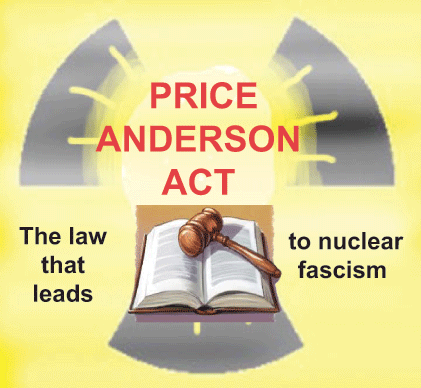
The ADVANCE Act of 2023 (HR6544) with Price-Anderson renewal for 40 years passes US House floor vote
Bipartisan support to extend severe accident liability protection to “inherently safe” new reactors?
The “Price-Anderson Nuclear Industries Indemnity Act”, also known as the “Price-Anderson Act” (PAA), is moving for renewal by Congress. The federal law to shield the nuclear industry from full liability of a nuclear accident is presently scheduled to sunset on December 31, 2025.
However, there is remains little to no transparency of the Act’s extension and expansion process to the public’s scrutiny of its incongruities.
Since 1957, Congress has periodically extended an adjusted upper limit for the nuclear industry’s financial liability protection from the otherwise unpredictably high projected cost in damages from the next severe radiological accident at a commercial nuclear power plant.
Originally, the industry’s limited liability for damages caused by a single nuclear accident was artificially set at $500 million per incident including personal injuries caused by radioactive fallout, population and economic dislocation by prolonged evacuations without re-entry, potentially permanent loss of property (residential, commercial and industrial), agricultural production and the contamination of natural resources with widespread and long-lived radioactivity.
The “Price-Anderson Nuclear Industries Indemnity Act”, also known as the “Price-Anderson Act” (PAA), is moving for renewal by Congress. The federal law to shield the nuclear industry from full liability of a nuclear accident is presently scheduled to sunset on December 31, 2025.
However, there is remains little to no transparency of the Act’s extension and expansion process to the public’s scrutiny of its incongruities.
Since 1957, Congress has periodically extended an adjusted upper limit for the nuclear industry’s financial liability protection from the otherwise unpredictably high projected cost in damages from the next severe radiological accident at a commercial nuclear power plant.
Originally, the industry’s limited liability for damages caused by a single nuclear accident was artificially set at $500 million per incident including personal injuries caused by radioactive fallout, population and economic dislocation by prolonged evacuations without re-entry, potentially permanent loss of property (residential, commercial and industrial), agricultural production and the contamination of natural resources with widespread and long-lived radioactivity.
According to the latest figures provided by the Congressional Research Service (CRS) Report published January 25, 2024, the industry’s financial liability ceiling for a single, severe nuclear accident is now capped at $16.6 billion by federal law. Beyond that ceiling, damages would supposedly be covered by US taxpayers. But the still unrealized total damage costs of a severe nuclear accident as evidenced by ongoing nuclear catastrophes at Fukushima (13 year ago) and Chernobyl (38 years ago) are already running into the hundreds of billions of dollars. The Fukushima Daiichi nuclear catastrophe’s damage is recently updated to surpass ¥15.4trillion ($102.7 billion).
The PAA renewal is part of the controversial“Accelerating Deployment of Versatile, Advanced Nuclear for Clean Energy (ADVANCE) Act of 2023” that is now approved by both the Senate and the House with significant differences including the PAA liability protection extension period.
The US Senate version (SB 1000) extends the PAA by 20 years to December 31, 2045, was passed on July 31, 2023 as a “must pass” inclusion in the National Defense Authorization Act of 2023 without a single public hearing. With Senate passage, the National Defense Authorization Act went to the US House of Representatives for approval where the ADVANCE Act of 2023 along with the PAA renewal on its coattail were instead culled from the military spending bill.
The ADVANCE Act with its the Price-Anderson renewal rider were introduced to the House as stand alone legislation (HR 6544) with the House version extending the industry’s limited accident liability protection to 40 years (December 31, 2065). According to E&ENews, “The House will vote on bipartisan nuclear energy legislation this week (02.26.2024) in hopes of reaching an agreement with the Senate in the coming weeks”—still without a single public hearing. The House floor vote to pass the HR 6544 with broad bipartisan support was confirmed by E&ENews February 29, 2024. The ADVANCE Act with the Price-Anderson extension for 40 years now goes back to the Senate to consider reconciliation.
Both the Senate and House versions intend to expand the government’s limited accident liability coverage beyond the aging, economically distressed and grandfathered commercial nuclear power fleet to now include new and supposedly “inherently safe” Small Modular Reactors and Advanced Non-Light Water reactor designs that incongruently could be licensed without any offsite radiological emergency planning zones.
All of this, thus far, has been accomplished without the transparency of a single congressional hearing in either the US Senate or House to explain the extension and expansion of Price-Anderson Act liability protection to increasingly economically distressed old reactors and new reactors where safety claims have yet to be technically certified.
The mainstream national press has scarcely reported any of this. Maybe they view it as a local story. But this kind of nuclear corruption has also occurred in South Carolina and Illinois, culminating in multiple indictments and prison sentence
Why does the nuclear industry find itself mired in these kinds of criminal conspiracies? Because it has no chance of standing on its own financial feet.
Former executives face a judge — in their ankle monitors
It was called “likely the largest bribery money-laundering scheme ever perpetrated against the people of the state of Ohio.” And the shoes are still dropping. Or should that be ankle monitors? Because these latter belong to the three latest criminals indicted for their roles in a scheme that saw FirstEnergy hand over $61 million in bribes to Ohio politicians and their co-conspirators to secure favorable legislation.
That bill, known as HB6, guaranteed a $1.3 billion bailout to FirstEnergy in order to keep open its two failing Ohio nuclear power plants, Davis-Besse and Perry, as well as struggling coal plants. The nuclear portion of the bill has since been rescinded, but Ohio consumers are still paying to prop up two aging coal plants, to the tune of half a million dollars a day, amounting to an extra $1.50 a month on every ratepayer’s electric bill.
The $61 million bribery plot was the mastermind of then speaker of the Ohio House, Larry Householder, who is now a household name in Ohio for all the wrong reasons. He was sentenced last June to 20 years in prison for his part in the conspiracy. GOP Chairman Matt Borges, was also found guilty of racketeering conspiracy and sentenced to five years in federal prison. Both men say they will appeal.
Householder may have been the instigator, but in those earlier trials, FirstEnergy was described as a company that went “looking for someone to bribe them”. They found willing accomplices among politicians but also in the person of then Ohio Public Utilities Commission chairman, Samuel Randazzo.
So on February 12, yet more indictments were handed down, this time to Randazzo and the two FirstEnergy executives who corrupted him — former CEO Charles Jones, and former senior vice president of external affairs, Michael Dowling.
Their list of crimes, including a collective 27 felonies, was announced at a press conference by Ohio Attorney General Dave Yost. But although the presence of their company had been requested, the accused were not there. ……………………………………………………………
The mainstream national press has scarcely reported any of this. Maybe they view it as a local story. But this kind of nuclear corruption has also occurred in South Carolina and Illinois, culminating in multiple indictments and prison sentences. It’s possible we could yet see something similar go down in Georgia as electricity rates there soar to pay for the two late-arriving and over-budget Vogtle reactors, the second of which just started fissioning earlier this month.
Why does the nuclear industry find itself mired in these kinds of criminal conspiracies? Because it has no chance of standing on its own financial feet. Meanwhile, cheaper, faster, more job-friendly renewable energy industry options are leaving nuclear power behind in a cloud of radioactive dust.
This economic collapse has, in turn, put pressure on politicians to make things right for their corporate nuclear friends, something Senator Joe Manchin and others are currently working hard to do on Capitol Hill.
So there may yet be more shoes (and ankle monitors) to drop and it’s going to be very interesting to see who’s wearing them.