Critics blast the ever-extending timeline and bloated budget of Plant Vogtle’s expansion. Supporters say the Georgia project is part of a nuclear revival.
Georgia Power was set to reach a milestone last month and open the first of two long-awaited nuclear reactors at Plant Vogtle. Then came a delay — and more uncertainty.
Missed deadlines are a familiar refrain for the project near Augusta, Ga. The expansion is placing the country’s first major reactors built from scratch this century near two existing nuclear units brought online in the 1980s……………………….
The Vogtle expansion’s arrival is a huge moment for the U.S. electric industry that experts and officials expect to ripple well beyond eastern Georgia. Never mind that the two new nuclear gems Southern is scrambling to add to its crown were supposed to be up and running in 2016 and 2017. Or that their cost has more than doubled to over $30 billion.
………………………………… “Yes, we’ve had our challenges,” CEO Chris Womack said during the company’s annual meeting. “I’m confident that the state of Georgia and our customers, our company, the world, will be so proud of the work that we’ve done in bringing Vogtle online.”
Spokespeople for Southern and Georgia Power did not provide updates on future nuclear investment plans when asked last week by E&E News.
‘U.S. nuclear renaissance’
Vogtle’s steps toward completion come as the Georgia Public Service Commission plans to decide how much ratepayer costs should rise to cover the project’s overruns. And U.S. senators last week passed legislation that’s supportive of the nuclear industry.
………………….To help construct the expansion to Vogtle, the Department of Energy’s Loan Programs Office had issued $12 billion in loan guarantees to Georgia power providers. Its director, Jigar Shah, said in an interview that there were a lot of mistakes made and lessons learned……………………
Clean energy groups like the Southern Alliance for Clean Energy warn that the enormous costs of units 3 and 4 could fall on ratepayers, because monopoly utilities, they say, aren’t meaningfully regulated in the region.
“There is no nuclear power plant that we’re aware of that has ever come on in the Southeast on budget or on schedule,” Stephen Smith, the alliance’s executive director, said in an interview.
…………………..Challenges ranged from workforce constraints — the project required 9,000 builders, welders, electricians at the peak of construction — to what critics called a lack of meaningful regulation from public utility commissions to the Nuclear Regulatory Commission.
“It’s not that simple to manufacture these complex components and just stamp them together like Legos,” Lyman said.
Smith from the Southern Alliance for Clean Energy pointed to difficulties at a similar South Carolina nuclear project.
An attempt to add two AP1000s to South Carolina’s V.C. Summer nuclear plant fell through in 2017. The expansion was designed to be similar to Vogtle’s and had an estimated $9.8 billion cost. But its price quickly ballooned, and its construction timeline was pushed back years past scheduled operational dates of 2016 and 2019.
Even a relatively small slice of the Pentagon and Department of Energy nuclear budgets could create many more jobs if invested in green energy, sustainable infrastructure, education, or public health – anywhere from 9% to 250% more jobs, depending on the amount spent…..
Tom Dispatch, JULY 30, 2023
Yes, the atomic bombs dropped on Hiroshima on August 6 and Nagasaki on August 9, 1945, would kill staggering numbers of people and be an eerily (if all too grimly) appropriate ending to the war that started with the Japanese sneak attack on Pearl Harbor on December 7, 1941, and, by August 1945, had resulted in the saturation bombing of 64 Japanese cities.
The scientist who led the team responsible for creating the bombs that destroyed those two cities (and for the initial nuclear test in New Mexico that, as we only recently learned, spread fallout over 46 states, Canada, and Mexico), the 41-year-old J. Robert Oppenheimer, would later borrow a line from the Bhagavad Gita, the Hindu scriptures, to describe his mood at the time: “Now, I am become death, the destroyer of worlds.” And eerily enough, the use of the weapon that would prove to be the second way humanity found to destroy our planet — the first, climate change, was already in effect but not yet known — would find all too few in the U.S. government hesitant to use it at that time. As historian John Dower would put it in his memorable book Cultures of War,
“The policy makers, scientists, and military officers who had committed themselves to becoming death… never seriously considered not using their devastating new weapon. They did not talk about turning mothers into cinders or irradiating even the unborn. They brushed aside discussion of alternative targets, despite the urging of many lower-echelon scientists that they consider this. They gave little if any serious consideration to whether there should be ample pause after using the first nuclear weapon to give Japan’s frazzled leaders time to respond before a second bomb was dropped.”
They just did it, twice, and the world changed radically. Almost 80 years later, at a moment when a global leader is once again evidently considering the possible use of what are now called “tactical nuclear weapons” (but can be several times more powerful than the bombs that destroyed Hiroshima and Nagasaki), Oppenheimer is having his moment in the sun (or is it a blaze of atomic light?) in a film that, to the surprise of many, has hit the big time in an almost nuclear fashion. And as TomDispatch regular and Pentagon expert William Hartung reminds us while considering that three-hour odyssey of a film, what “Oppie” began then has by now become a full-scale nuclear-industrial complex on a planet where ultimate destruction, it often seems, always lurks just around the corner. Tom
The Profiteers of Armageddon
Oppenheimer and the Birth of the Nuclear-Industrial Complex
“…………………………………………………………………………………………………………………… A feature film on the genesis of nuclear weapons may not strike you as an obvious candidate for box-office blockbuster status. As Nolan’s teenage son said when his father told him he was thinking about making such a film, “Well, nobody really worries about nuclear weapons anymore. Are people going to be interested in that?” Nolan responded that, given what’s at stake, he worries about complacency and even denial when it comes to the global risks posed by the nuclear arsenals on this planet. “You’re normalizing killing tens of thousands of people. You’re creating moral equivalences, false equivalences with other types of conflict… [and so] accepting, normalizing… the danger.”
These days, unfortunately, you’re talking about anything but just tens of thousands of people dying in a nuclear face-off. A 2022 report by Ira Helfand and International Physicians for the Prevention of Nuclear War estimated that a “limited” nuclear war between India and Pakistan that used roughly 3% of the world’s 12,000-plus nuclear warheads would kill “hundreds of millions, perhaps even billions” of us. A full-scale nuclear war between the United States and Russia, the study suggests, could kill up to five (yes, five!) billion people within two years, essentially ending life as we know it on this planet in a “nuclear winter.”
Obviously, all too many of us don’t grasp the stakes involved in a nuclear conflict, thanks in part to “psychic numbing,” a concept regularly invoked by Robert Jay Lifton, author of Hiroshima in America: A History of Denial (co-authored with Greg Mitchell), among many other books. Lifton describes psychic numbing as “a diminished capacity or inclination to feel” prompted by “the completely unprecedented dimension of this revolution in technological destructiveness.”
Given the Nolan film’s focus on Oppenheimer’s story, some crucial issues related to the world’s nuclear dilemma are either dealt with only briefly or omitted altogether.
The staggering devastation caused by the bombings of Hiroshima and Nagasaki is suggested only indirectly without any striking visual evidence of the devastating human consequences of the use of those two weapons. Also largely ignored are the critical voices who then argued that there was no need to drop a bomb, no less two of them, on a Japan most of whose cities had already been devastated by U.S. fire-bombing to end the war…………………..
The film also fails to address the health impacts of the research, testing, and production of such weaponry, which to this day is still causing disease and death, even without another nuclear weapon ever being used in war. Victims of nuclear weapons development include people who were impacted by the fallout from U.S. nuclear testing in the Western United States and the Marshall Islands in the Western Pacific, uranium miners on Navajo lands, and many others. Speaking of the first nuclear test in Los Alamos, New Mexico, Tina Cordova of the Tularosa Basin Downwinders Consortium, which represents that state’s residents who suffered widespread cancers and high rates of infant mortality caused by radiation from that explosion, said “It’s an inconvenient truth… People just don’t want to reflect on the fact that American citizens were bombed at Trinity.”
Another crucially important issue has received almost no attention. Neither the film nor the discussion sparked by it has explored one of the most important reasons for the continued existence of nuclear weapons — the profits it yields the participants in America’s massive nuclear-industrial complex.
Once Oppenheimer and other concerned scientists and policymakers failed to convince the Truman administration to simply close Los Alamos and place nuclear weapons and the materials needed to develop them under international control — the only way, as they saw it, to head off a nuclear arms race with the Soviet Union — the drive to expand the nuclear weapons complex was on. Research and production of nuclear warheads and nuclear-armed bombers, missiles, and submarines quickly became a big business, whose beneficiaries have worked doggedly to limit any efforts at the reduction or elimination of nuclear arms.
The Manhattan Project and the Birth of the Nuclear-Industrial Complex
……………………………………………………. According to nuclear expert Stephen Schwartz, author ofAtomic Audit, the seminal work on the financing of U.S. nuclear weapons programs, through the end of 1945 the Manhattan Project cost nearly $38 billion in today’s dollars, while helping spawn an enterprise that has since cost taxpayers an almost unimaginable $12 trillionfor nuclear weapons and related programs. And the costs never end. The Nobel prize-winning International Campaign to Abolish Nuclear Weapons (ICAN) reports that the U.S. spent $43.7 billion on nuclear weapons last year alone, and a new Congressional Budget Office report suggests that another $756 billion will go into those deadly armaments in the next decade.
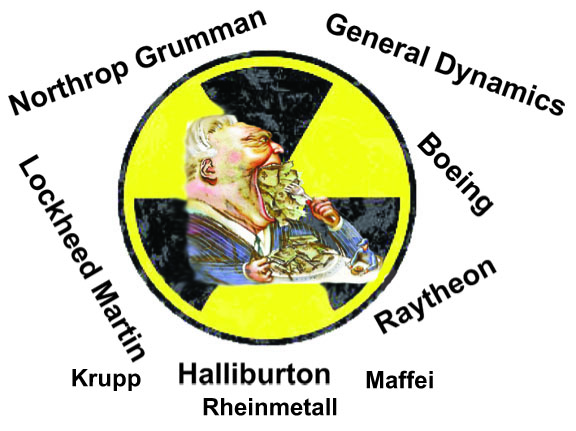
Private contractors now run the nuclear warhead complex and build nuclear delivery vehicles. They range from Raytheon, General Dynamics, and Lockheed Martin to lesser-known firms like BWX Technologies and Jacobs Engineering, all of which split billions of dollars in contracts from the Pentagon (for the production of nuclear delivery vehicles) and the Department of Energy (for nuclear warheads). To keep the gravy train running — ideally, in perpetuity — those contractors also spend millions lobbying decision-makers. Even universities have gotten into the act. Both the University of California and Texas A&M are part of the consortium that runs the Los Alamos nuclear weapons laboratory.
The American warhead complex is a vast enterprise with major facilities in California, Missouri, Nevada, New Mexico, South Carolina, Tennessee, and Texas. And nuclear-armed submarines, bombers, and missiles are produced or based in California, Connecticut, Georgia, Louisiana, North Dakota, Montana, Virginia, Washington state, and Wyoming. Add in nuclear subcontractors and most states host at least some nuclear-weapons-related activities.
And such beneficiaries of the nuclear weapons industry are far from silent when it comes to debating the future of nuclear spending and policy-making.
Profiteers of Armageddon: The Nuclear Weapons Lobby
The institutions and companies that build nuclear bombs, missiles, aircraft, and submarines, along with their allies in Congress, have played a disproportionate role in shaping U.S. nuclear policy and spending. They have typically opposed the U.S. ratification of a Comprehensive Nuclear Test Ban treaty; put strict limits on the ability of Congress to reduce either funding for or the deployment of intercontinental ballistic missiles (ICBMs); and pushed for weaponry like a proposed nuclear-armed, sea-launched cruise missile that even the Pentagon hasn’t requested, while funding think tanks that promote an ever more robust nuclear weapons force.
A case in point is the Senate ICBM Coalition (dubbed part of the “Dr. Strangelove Caucus” by Arms Control Association Director Daryl Kimball and other critics of nuclear arms). The ICBM Coalition consists of senators from states with major ICBM bases or ICBM research, maintenance, and production sites: Montana, North Dakota, Utah, and Wyoming. The sole Democrat in the group, Jon Tester (D-MT), is the chair of the powerful appropriations subcommittee of the Senate Appropriations Committee, where he can keep an eye on ICBM spending and advocate for it as needed.
The Senate ICBM Coalition is responsible for numerous measures aimed at protecting both the funding and deployment of such deadly missiles. ……………………….. That Coalition’s efforts are supplemented by persistent lobbying from a series of local coalitions of business and political leaders in those ICBM states. Most of them work closely with Northrop Grumman, the prime contractor for the new ICBM, dubbed the Sentinel and expected to cost at least $264 billion to develop, build, and maintain over its life span that is expected to exceed 60 years.
Of course, Northrop Grumman and its 12 major ICBM subcontractors have been busy pushing the Sentinel as well. They spend tens of millions of dollars on campaign contributions and lobbying annually, while employing former members of the government’s nuclear establishment to make their case to Congress and the executive branch. And those are hardly the only organizations or networks devoted to sustaining the nuclear arms race. You would have to include the Air Force Association and the obscurely named Submarine Industrial Base Council, among others.
The biggest point of leverage the nuclear weapons industry and the arms sector more broadly have over Congress is jobs. How strange then that the arms industry has generated diminishing job returns since the end of the Cold War. According to the National Defense Industrial Association, direct employment in the weapons industry has dropped from 3.2 million in the mid-1980s to about 1.1 million today.
Even a relatively small slice of the Pentagon and Department of Energy nuclear budgets could create many more jobs if invested in green energy, sustainable infrastructure, education, or public health – anywhere from 9% to 250% more jobs, depending on the amount spent. Given that the climate crisis is already well underway, such a shift would not only make this country more prosperous but the world safer by slowing the pace of climate-driven catastrophes and offering at least some protection against its worst manifestations.
A New Nuclear Reckoning?
Count on one thing: by itself, a movie focused on the origin of nuclear weapons, no matter how powerful, won’t force a new reckoning with the costs and consequences of America’s continued addiction to them. But a wide variety of peace, arms-control, health, and public-policy-focused groups are already building on the attention garnered by the film to engage in a public education campaign aimed at reviving a movement to control and eventually eliminate the nuclear danger.
Past experience — from the Campaign for Nuclear Disarmament that helped persuade Christopher Nolan to make Oppenheimer to the “Ban the Bomb” and Nuclear Freeze campaigns that stopped above-ground nuclear testing and helped turn President Ronald Reagan around on the nuclear issue — suggests that, given concerted public pressure, progress can be made on reining in the nuclear threat. The public education effort surrounding the Oppenheimer film is being taken up by groups like The Bulletin of the Atomic Scientists, the Federation of American Scientists, and the Council for a Livable World that were founded, at least in part, by Manhattan Project scientists who devoted their lives to trying to roll back the nuclear arms race; professional groups like the Union of Concerned Scientists and Physicians for Social Responsibility; anti-war groups like Peace Action and Win Without War; the Nobel Peace prize-winning International Campaign to Abolish Nuclear Weapons; nuclear policy groups like Global Zero and the Arms Control Association; advocates for Marshall Islanders, “downwinders,” and other victims of the nuclear complex; and faith-based groups like the Friends Committee on National Legislation. The Native American–led organization Tewa Women United has even created a website, “Oppenheimer — and the Other Side of the Story,” that focuses on “the Indigenous and land-based peoples who were displaced from our homelands, the poisoning and contamination of sacred lands and waters that continues to this day, and the ongoing devastating impact of nuclear colonization on our lives and livelihoods.”
On the global level, the 2021 entry into force of a nuclear ban treaty — officially known as the Treaty on the Prohibition of Nuclear Weapons — is a sign of hope, even if the nuclear weapons states have yet to join. The very existence of such a treaty does at least help delegitimize nuclear weaponry. It has even prompted dozens of major financial institutions to stop investing in the nuclear weapons industry, under pressure from campaigns like Don’t Bank on the Bomb.
In truth, the situation couldn’t be simpler: we need to abolish nuclear weapons before they abolish us. Hopefully, Oppenheimer will help prepare the ground for progress in that all too essential undertaking, beginning with a frank discussion of what’s now at stake. https://tomdispatch.com/the-profiteers-of-armageddon/
Our first president in his farewell address warned us about three things: debt, political parties and foreign entanglements. Few now would doubt the prescient wisdom of the first two warnings, but we have also become entrapped in the third. Most notably we are forced by a declining Russia and a rising China to engage in a dangerous game of nuclear deterrence.
George Washington likely could not have envisioned a world in which his country was threatened with destruction either intentionally or accidentally by ballistic missiles launched from a foreign country thousands of miles away. Despite the new nature of the threats there may still be a measure of wisdom to be distilled from his advice. It is unlikely he would engage China in a destructive war over Taiwan although he might well provide them with the weapons to defend themselves. The problem with nuclear weapons would be more complicated and the only thing we can know for sure is that Washington would do what he perceived to be in his country’s best interest.
What is his country’s best interest? As we near the 78th anniversary of the atomic bombing of Hiroshima and Nagasaki, which resulted in the instant death of 150,000 people, we should take pause. United Nations general secretary Antonio Guterres warned us over a year ago that that we are one accident or miscalculation away from disaster.
The Power 5 nuclear weapon states: China, France, Russia, United Kingdom and the United States jointly stated over a year ago that “a nuclear war cannot be won and should never be fought.” Yet all the nuclear weapon states are renewing and trying to enhance their weapons in an ever-increasing cycle of ratcheting up that undermines stability and benefits no one. Secretary of Defense Robert McNamara said after the Cuban Missile Crisis “we lucked out.” Only good luck prevented a nuclear war and to depend on continued good luck, as the risks increase, is magical thinking better suited for children’s books of fairy tales, than as part of national defense policy.
We must tear down the metaphorical wall between the soothing idea of security through nuclear deterrence and the reality of the cataclysmic threat that nuclear weapons pose. The U.S. must lead the way and work with the authoritarian states, convincing them that it is in everyone’s best interest to maintain security without the ever-present threat of global annihilation.
The United Nations’ Treaty to Prohibit Nuclear Weapons, TPNW, in force since January 2021, is the best hope to begin the multi-generational trust building that will allow the required rigid verification regimes. Pursuing the path to global elimination of nuclear weapons is the only way to free ourselves from this dreadful foreign entanglement.
Although the total elimination of nuclear weapons is the ultimate solution there are things that can be done right now to reduce the risk of catastrophe. There is a grassroots movement endorsed by hundreds of nongovernmental organizations and municipal and state governments. Back from the Brink — preventnuclearwar.org — has four additional actions that can reduce risk and encourage our adversaries to follow.
The U.S. should have a No First Use policy. Using nuclear weapons first against a nonnuclear weapon state would merit world condemnation; using them against a nuclear weapon state would bring devastating retaliation. The second and third actions are linked. The U.S. should take nukes off high alert status and eliminate sole presidential authority to launch. Only Congress can declare war and loitering nuclear-armed submarines virtually undetectable allow that option. Finally, many former military leaders including former Secretary of Defense William Perry have spoken against replacing the entire U.S. arsenal. The ground-based ICBMs are “sitting ducks” virtually inviting a first strike by a deranged tyrant.
It is also important to remember that the military industrial political complex that President Dwight Eisenhower warned us about is often disingenuous touting weapon systems for profit that do not make us safer. U.S. House of Representatives Resolution 77 introduced by Representative McGovern endorses the Back from the Brink campaign and already has 34 cosponsors. A companion bill should be introduced in the senate. The grace of public pressure by “we the people” can force our government to adopt a less insane nuclear policy.
I feel that a real leader, like Washington, would have the audacity, like presidents Reagan and Gorbachev, who made great progress ending the cold war, to pursue this path.
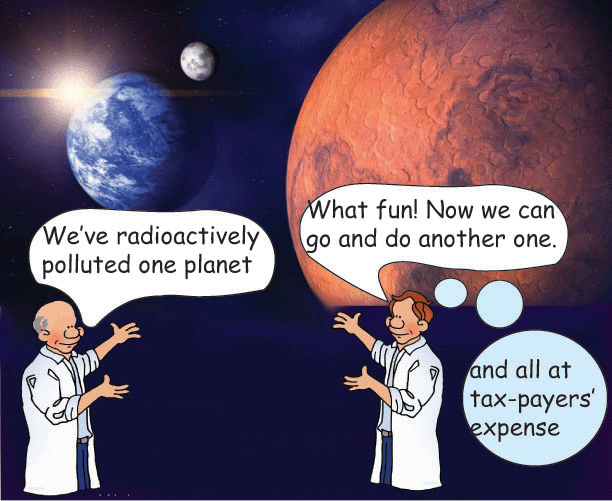
The space race has been revived, but this time, the goal post has been shifted much further – to Mars. As recent technological advancements promise to open new horizons of exploration, NASA plans to cut the travel time to Mars with a nuclear-powered spacecraft.
A trip to Mars currently takes approximately seven months, covering a staggering 300-million-mile journey. NASA, in collaboration with the US Defense Advanced Research Projects Agency (DARPA), now proposes an ambitious plan that hinges on the promise of nuclear thermal propulsion technology to reduce this duration significantly.
DRACO spacecraft is nuclear-powered
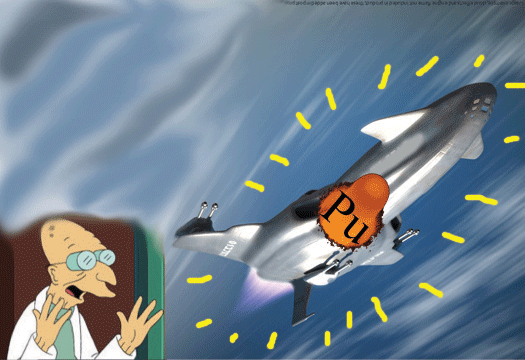
NASA aims to launch a nuclear-powered spacecraft, known as DRACO (Demonstration Rocket for Agile Cislunar Operations), into Earth’s orbit either by late 2025 or early 2026. The spacecraft, under construction by Lockheed Martin, a leading aerospace and defense company, will serve as a testbed for this groundbreaking technology.
NASA administrator Bill Nelson said that this technology “would allow humans to travel in deep space at record speed.” However, it remains unclear by how much the nuclear thermal propulsion technology can decrease the travel time.
…………………………………………………………………. The history of NASA’s interest in nuclear propulsion dates back over six decades. The concept was first explored in the 1960s when Wernher von Braun, a pioneer of rocket technology, advocated for a Mars mission utilizing a nuclear propulsion system. Unfortunately, budgetary constraints and shifting priorities resulted in the abandonment of this vision in 1972
But with the dawn of the new space age, NASA’s pursuit of the Red Planet has been rekindled. In collaboration with the US government, the space agency aims to expedite progress with the DRACO nuclear thermal rocket program.
“The ability to accomplish leap-ahead advances in space technology through the DRACO nuclear thermal rocket program will be essential for more efficiently and quickly transporting material to the Moon and eventually, people to Mars,” commented Dr Stefanie Tompkins, director at DARPA………………………………………………………………………………………………
More about Mars…………………….
Size
Mars is about half the size of Earth but has the same amount of dry land. It is much colder than Earth, with temperatures ranging from -195 degrees F in winter at the poles to 70 degrees F in summer near the equator. Mars has the largest dust storms in the solar system, capable of covering the entire planet and lasting for months.
Atmosphere
The planet’s atmosphere is very thin, composed mainly of carbon dioxide (95%), with traces of nitrogen and argon. It lacks a magnetic field, which on Earth serves to protect us from harmful solar radiation. As a result, the surface of Mars is exposed to higher levels of radiation, which can be a challenge for human exploration and potential colonization.
………………………….... Potential for life on Mars
The possibility of liquid water in the past, and thus the potential for life, has made Mars a prime target for future human exploration. The planned missions to Mars, such as NASA’s Artemis program and SpaceX’s Starship project, aim not only to land humans on Mars but also to establish a sustainable colony, marking a significant leap in our exploration of the cosmos. https://www.earth.com/news/could-a-nuclear-powered-spacecraft-shorten-the-trip-to-mars/
The Biden administration announced a $345 million weapons package for Taiwan on Friday, the first tranche in a total of $1 billion the U.S. has allotted to be transferred directly from Pentagon stockpiles to the island this year.
The move is sure to anger China as Washington has been trying to rebuild relations with Beijing. Senior administration officials, including Secretary of State Antony Blinken and Treasury Secretary Janet Yellen, recently visited China, but the outreach has done little to quell tensions over a range of issues, from U.S. support to Taiwan to Beijing’s spy balloon program…………………..
The package marks the first time the U.S. has used new authority from Congress to transfer military equipment directly from Pentagon inventory to Taiwan. The transfer is done under the Presidential Drawdown Authority, the same mechanism Washington uses to send weapons to Ukraine………………………………………..
Defense Secretary Lloyd Austin told lawmakers in May that a presidential drawdown package was in the works for Taiwan, but it’s taken weeks of additional work before the aid could be officially announced. Among other challenges, DOD had to work through an “accounting error” that forced officials finalizing packages for Ukraine and Taiwan to recalculate the value of equipment that was being sent………….. more https://www.politico.com/news/2023/07/28/u-s-300million-weapons-taiwan-00108811
What folly! Just as a dam necessary for cooling nuclear waste at Europe’s biggest nuclear power complex is blown up, members of the Connecticut legislature pass a bill that includes promotion of dangerous outmoded nuclear power.
Senate Bill 7 creates a “Council for Advancing Nuclear Energy Development” specifically packed with six positions for people who work in the nuclear energy industry. Their mission will be to discuss “advancements that are occurring in nuclear energy development.” They’ll study “small modular reactors, advanced nuclear reactors, [and] fusion energy facilities.”
Rather than seek “advancement,” we should be figuring out how to phase out this technology. We see by the Ukraine example that parties at war do not respect what one would think would be totally obvious, the need to do nothing to harm the safety of nuclear power plants. Not that we expect warfare to break out in the U.S., but this country should lead in best practices so that countries where war is a lot more likely won’t go down the nuclear path and risk huge releases of nuclear contamination that spread world-wide.
Realize that the Chernobyl disaster of 1986 led to thousands of fatalities. In Ukraine alone 35,000 women have received compensation for spouses who died because of the disaster. And that’s only the numbers from Ukraine. High levels of radiation covered southern Belarus too, but the government there has never released its statistics.
Another section of the Connecticut bill would classify nuclear power as a “Class 1 renewable energy source.” That would allow the owner of a new nuclear facility to sell renewable “energy credits,” another dubious idea. Rather than limit the use of polluting fuels, the idea is for “the market” to take care of things. Grand, let’s rely on the same market whose mindless profit seeking got us hooked on fossil fuels in the first place.
The new council will study ways to “promote nuclear energy development, expansion and research” in Connecticut. What won’t be studied is the problem of importation of Russian uranium that is used to generate nuclear power. Every year hundreds of millions of dollars are spent by U.S. companies to buy raw and enriched uranium from Russia. Presumably Connecticut nuclear power companies are no different.
Reuters reports that the U.S. power industry relies on Russia and its allies Kazakhstan and Uzbekistan for roughly half of the uranium powering its nuclear power plants. Why not respond to a petition about this and study how to stop relying on a fuel that enriches the Russian dictator?
On May 19 the Mirror published Jan Ellen Spiegel’s piece headlined, “Advocates searching for any kind of legislative win on environment.” Obviously, some things moved forward this session, but is there anything that’s going to have a major impact on the immense problem of our climate emergency?
On June 6 it was noted that last month carbon dioxide levels measured at the federal government’s Mauna Loa Atmospheric Baseline Observatory in Hawaii reached concentrations of 424 parts per million. That’s far, far higher than the 350 ppm that climate scientists believe necessary for long term functioning of human civilization. Sure it was probably at 424 ppm before, but that was 4 million years ago!
Governor Lamont should veto SB 7. Then call a special session to pass a revised SB 7 clean of plans for more nuclear power. After doing that stay in session and spend time passing blockbuster legislation that will provide leadership for a country teetering on a climate precipice.
FORTUNE, BY STEPHANIE COOKE, July 29, 2023 Since the turn of the millennium, at least $50 billion has been spent on a frantic effort to create a new Golden Age for nuclear energy in the U.S. Billions more are being lavished on an even more desperate effort to launch small reactors as supposedly safer, cheaper alternatives to yesteryear’s elephant-sized versions. Most of the money comes from ratepayers and taxpayers, accompanied by an avalanche of public relations that rivals the 1950s “Atoms for Peace” campaign with its claims of “too cheap to meter” electricity.
So far, the effort has produced little in tangible assets: roughly one gigawatt of capacity from the Watts Bar-2 reactor completed after decades of on-and-off-again construction and the promise of 2 GW from the long-delayed Plant Vogtle in Georgia. So far, not a single molecule of CO2 emissions has been avoided by a new reactor, and the primary beneficiaries are not the people who paid but publicly-owned utilities, reactor design companies, and PR and law firms. They are part of a chorus of advocacy groups and government agencies, led by the Department of Energy (DOE), advancing the idea that low-carbon nuclear is essential to any long-term climate change solution.
The story is selling well but the push for more and more money—in direct subsidies, ratepayer financing, and government grants or loans–has a dark side. To cite just a few examples, former state officials and utility executives in Illinois and Ohio face lengthy prison terms for bribery schemes linked to subsidies for unprofitable nuclear plants. In South Carolina, two former Scana executives received prison sentences after pleading guilty to criminal charges in 2020 and 2021 over a nuclear project that ultimately collapsed. Two Westinghouse executives also charged are facing a similar fate, with one still awaiting trial in October.
When it comes to costs and schedules, the lack of honesty surrounding nuclear projects is often breathtaking. In Georgia, where two Westinghouse reactors at Vogtle have been under construction since 2009, only one is completed and is now struggling to achieve commercial operation after multiple unplanned reactor and turbine trips, according to recent Georgia Public Service Commission staff testimony. That testimony also included allegations that utility executives have been providing “materially inaccurate” cost estimates over the project’s life. Vogtle’s estimated total $33 billion cost, as outlined in the testimony, versus $13.3 billion originally estimated makes it the most expensive power plant ever built in the United States. Most of the tab is being footed by ratepayers, with the US taxpayer, via DOE, providing $12 billion in loans.
And still, the messaging that nuclear is a must for reducing emissions goes on at a fever pitch. But the message is distorted: The industry cannot deliver what is needed. The U.S. lost its industrial base, including heavy forging capacity, decades ago–and the costs of a major nuclear buildout could now be in the trillions.
Moreover, the billions currently being spent on nuclear are crowding out viable, less costly solutions for decarbonizing the power sector (not only renewables such as wind and power but also high-voltage direct current transmission lines to deliver them to where they’re needed), thus slowing the transition. A surfeit of renewables projects is seeking grid access, enough to meet 90% of the Biden administration’s goal of a carbon-free power sector by 2035, according to a Berkeley Lab report, but the country’s Balkanized electricity market system, monopolistic utilities, and lack of adequate transmission capacity will likely prevent most of it from succeeding.
The transmission capacity needed for renewables will require anywhere from $30 billion to $90 billion to meet demand by 2030, with the figures rising to $200 billion to $600 billion between 2030 and 2050, according to a study by the Brattle Group. Squandering such sums on nuclear should be out of the question.
Our current fleet of 92 reactors generates about a fifth of the nation’s electricity, but most of the plants are slated for permanent closure by 2050, assuming they operate well beyond their 40-year design life. The DOE admits that such “life extensions” put operators in uncharted waters because there is no actual experience to support 60- or 80-year reactor lifetimes.
The problem of where to put used nuclear fuel (radioactive waste) remains after funding was withdrawn for an estimated $100 billion underground repository project at Yucca Mountain in Nevada. Proposed privately-owned interim storage sites in New Mexico and Texas, though licensed by the U.S. Nuclear Regulatory Commission, face intense local and state opposition as well as political obstacles at the federal level.
Industry officials privately acknowledge these challenges. Even so, nuclear is receiving the most favorable media coverage since the 1950s, and the latest annual Gallup poll on nuclear, released in April, showed the highest level of support in a decade for nuclear power among the American public–at 55%. Nuclear opponents in Congress are now silent on the issue or even hinting at changed views, and bipartisan support in Congress has over the past couple of years resulted in billions in tax incentives and other forms of support for both existing and planned nuclear plants.
But public opinion is fickle–and no guarantee for the future. Since Gallup began polling on nuclear in 1994, support peaked at 62% in 2010, a year before the triple meltdowns at Fukushima. After that, it went steadily down, to a low of 44% in 2016. Nor is popular opinion an indicator of whether nuclear’s formidable technical, financial, environmental, and geopolitical challenges can be overcome.
The primary aims of today’s promoters are to prevent aging, uneconomic reactors from closing, and to secure funding for small modular reactors (SMRs) and “advanced” reactors (and associated fuels).
The push for smaller reactors appears to have been an act of desperation by a nuclear-centric energy agency–the DOE (which also oversees the country’s nuclear weapons programs)—after its failed attempt to create a nuclear “renaissance” in the early 2000s. Although that project generated interest (utilities filed plans for 28 large-scale reactors), only the two at Vogtle were ever built………………………………………………………………………………………
New Mexico found itself at ground zero of a changed world on July 16, 1945 when scientists from the newly created Los Alamos National Laboratory detonated the world’s first atomic bomb, exposing nearby communities to radiation. Just 34 years later to the day, Church Rock, New Mexico became the site of the largest release of radioactive material ever to occur in the United States.
The impact of that history was something Bryan Kendall, who grew up in Albuquerque, hadn’t learned much about prior to enrolling in the Fall 2020 Nuclear New Mexico: Social and Environmental Impacts course at The University of New Mexico.
“It blew my mind that no one was talking about it. It drove a passion in me that has not subsided since,” Kendall said.
The course helped Kendall, who graduated earlier this year with a bachelor’s degree in mechanical engineering and a minor in sustainability studies, decide he would avoid working for an organization with an ongoing nuclear focus though he doesn’t fault those who do.
Though the name of the class has changed over time, the goal to provide critical, interdisciplinary nuclear education remains the same. Each course includes field trips to key sites around the state, guest speakers from organizations like the Tularosa Basin Downwinders Consortium and Tewa Women United, as well as a final project to apply learning to social or environmental justice.
Eileen O’Shaughnessy, an instructor and Ph.D. Candidate in Language, Literacy, and Sociocultural Studies with an emphasis on nuclear education, has taught the class for several years through Sustainability Studies, the Honors College, and this fall, Women and Gender Studies. Most recently, O’Shaughnessy co-taught with Associate Professor Myrriah Gómez, Ph.D., the author of the 2022 release Nuclear Nuevo México. Gómez has taught a similar course titled Atomic Bomb Cultures in the Honors College for many years. O’Shaughnessy’s upcoming course is titled The Atomic Bomb and Feminism and will explore topics like the hetero-patriarchal nuclear family, notions of apocalypse, anti-nuclear activism, environmental racism, nuclear colonialism, and more.
“I developed this class called Nuclear New Mexico based on my research that was a critical interdisciplinary look at the environmental, social, and cultural impacts of the nuclear industry, specifically on New Mexico, but also the world,” O’Shaughnessy said. “The beginning of the atomic age is located here, but it really rippled out from New Mexico.”
The class explores everything from uranium mining to the disposal and storage of radioactive materials and the outsized impact those processes have had on indigenous communities and communities of color.
does it really sound like a coincidence that we’re seeing all these news stories about UFOs and aliens at the same time we’re seeing news stories about a race between the US and China and Russia to dominate space militarily?
If Wednesday’s House Oversight subcommittee hearing on UFOs had happened ten years ago instead of today, it would have shaken the world. Imagine someone from 2013 hearing congressional testimonies about “routine” military pilot encounters with giant flying tic tacs, floating orbs, 300-foot red squares, and cubes in clear spheres zipping around in ways that surpass all known earthly technology by leaps and bounds, or about secret government possession of otherworldly aircraft they’re trying to reverse engineer and the dead bodies of their non-human pilots, or about the possibility that these creatures are not merely extraterrestrial but extra-dimensional. Their jaws would have hit the floor.
Now in 2023 we’ve been getting incrementally drip-fed bits and pieces of these stories for six years, so the scene on Capitol Hill on Wednesday didn’t have the impact it would’ve had in 2013. It’s making headlines and getting attention, but not as much as Sinead O’Connor’s death or people’s thoughts on Barbie and Oppenheimer. The response from the general public could be described as a collective nervous laugh and a shrug.
……………………………………………………. the new UFO narrative wasn’t just cooked up at the last minute to distract from current headlines, it’s been unfolding for six years, and people aren’t even paying that much attention to it. The empire doesn’t tend to orchestrate spectacular events as a “distraction” anyway; the adjustment of public attention tends to take the much more mundane form of agenda setting in the media, where some stories receive more attention than others based on what’s convenient for the oligarchs who own the press.
……………………………………. for me what really stinks about all this UFO stuff is the timing. Here we are in the early stages of a new cold war which features a race to militarize space, and we’re hearing congressional testimony about mysterious vehicles posing a threat to US airspace which have the ability to go up and down between earth and space very quickly. That smells off.
I mean, does it really sound like a coincidence that we’re seeing all these news stories about UFOs and aliens at the same time we’re seeing news stories about a race between the US and China and Russia to dominate space militarily?
A Foreign Policy article from last year blares the headline “China and Russia Are Catching Up to U.S. in Space Capabilities, Pentagon Warns” with the subheading “The militarization of space is picking up pace.” These warnings are echoed in articles by Defense One and Time. An article on the United Nations website from last year carries the title “‘We Have Not Passed the Point of No Return’, Disarmament Committee Told, Weighing Chance Outer Space Could Become Next Battlefield.” A 2021 report from the war machine-funded Center for Strategic and International Studies titled “Defense Against the Dark Arts in Space: Protecting Space Systems from Counterspace Weapons” warns of the urgent need to build more space weapons to counter US enemies. A Global Times article from last year carries the title “Chinese experts urge avoidance of space weaponization amid commercial space capability deployment in Ukraine.”
………………………………….it just seems mighty suspicious to me how we’re being slowly paced into this UFO narrative (or UAP narrative for those hip to the current jargon) right when there’s a mad rush to get weapons into space. I can’t actually think of any other point in history when the timing of something like this would have looked more suspicious.
So for me the most disturbing parts of the UFO hearing were the parts that could wind up facilitating the agenda to militarize space, like when this phenomenon was framed as a “national security” threat or when it was mentioned that they can transition from earth to space very rapidly.
When asked by congressman Glenn Grothman “do you believe UAPs pose a threat to our national security?”, former Navy commander David Fravor answered with an unequivocal yes. A few minutes later Fravor described these vehicles as being able to “come down from space, hang out for three hours and go back up.”
When asked by congressman Andy Ogles whether UFOs could be “collecting reconnaissance information” on the US military, all three witnesses — Grusch, Fravor, and former Navy pilot Ryan Graves — answered in the affirmative. Asked by Ogles if UFOs could be “probing our capabilities,” all three again said yes. Asked if UFOs could be “testing for vulnerabilities” in US military capabilities, all three again said yes. Asked if UFOs pose an existential threat to the national security of the United States, all three said they potentially do. Asked if there was any indication that UFOs are interested in US nuclear technology, all three said yes.
Ogles concluded his questioning by saying, “There clearly is a threat to the national security of the United States of America. As members of Congress, we have a responsibility to maintain oversight and be aware of these activities so that, if appropriate, we take action.”
When asked by congressman Eric Burlison if “there has been activity by alien or non-human technology, and/or beings, that has caused harm to humans,” Grusch said he couldn’t get into specifics in a public setting (a common theme throughout the hearing), but said that “what I personally witnessed, myself and my wife, was very disturbing.”
Grusch would complicate this cryptic statement a few minutes later by saying that he’s never seen a UFO. How this statement doesn’t contradict his previous statement about having witnessed harmful behavior from non-human technology and/or beings was not made clear.
So you’ve got US policymakers being told that there are vehicles using technology not of this world routinely violating US airspace and posing an existential threat to US national security, and that these craft can go from earth to space and back at will, and that they need to help make sure their nation can address this threat.
What conclusions do you come to when presented with that kind of information? If you’re a lawmaker in charge of facilitating the operation of a highly militaristic empire, you’re probably not going to conclude that it’s time to hold hands and sing Kumbaya. You’re probably eventually going to start thinking in terms of military technology.
One of the most important unanswered questions in all this UFO hullabaloo is, why now? Why are we seeing all this movement on “disclosure” after generations of zero movement? If these things are in fact real and the government has in fact been keeping them secret, why would the adamant policy of dismissal and locked doors suddenly be reversed, allowing “whistleblowers” to come forward and give testimony before congress? If they had motive to keep it a secret this entire time, why would that motive no longer be there?
…………………………………So why now? Why the drastic and sudden shift from UFOs and aliens being laughable tinfoil hat nonsense to the subject of serious congressional inquiries and widespread mainstream media coverage?
Well, the timing of the race to militarize space might provide an answer to the “why now?” question. Is it a coincidence that this new UFO narrative began its rollout in 2017, around the same time as the rollout of the Space Force? Are we being manipulated at mass scale about aliens and UFOs to help grease the wheels for the movement of war machinery into space? How likely is it that by pure coincidence this extraplanetary narrative timed out the way it did just as the US empire makes a last-ditch grab at unipolar planetary domination?
I don’t know. I do know that if I’m assigning degrees of probability, “Extraterrestrial or extradimensional beings are here and take a special interest in us and sometimes crash their vehicles and our government recovered them but kept them a secret but suddenly decided not to be so secretive about them anymore” ranks significantly lower than “Our rulers are lying and manipulating to advance their own interests again.”
I am 100 percent wide open to the possibility of extraterrestrials and otherworldly vehicles zipping around our atmosphere. What I am not open to is the claim that the most depraved institutions on earth have suddenly opened their mind to telling us the truth about these things, either out of the goodness of their hearts or because they were “pressured” by UFO disclosure activists.
The vanishing profession of preventing nuclear war
More than a dozen experts across the ideological spectrum I spoke with — hawks and doves alike — agreed a renaissance is needed to rebuild lost muscle memory and fashion new strategies to deter increasingly belligerent nuclear peers and new wannabe nuclear states. And the emergence of artificial intelligence, some analysts fear, could enhance an aggressor’s nuclear first-strike capability or sow dangerous confusion among atomic adversaries.
Tensions among nuclear powers are rising, but decades of peace have resulted in a dearth of people trained to deal with the continuing threat.
Politico, By BRYAN BENDER, 07/28/2023
SANTA MONICA, Calif. — At the height of the Cold War, the RAND Corporation crackled with the collective energy of the best brains the Pentagon could find to tackle the biggest threat.
At lunchtime, an eclectic group of physicists, economists and social scientists would play Kriegspeil, a form of double-blind chess modeled on Prussian wargames in which players can’t see their opponent’s pieces and infer their moves from a referee sharing sparse information. Then they would spend the rest of the workday developing the military doctrine, deterrence theory and international arms control frameworks to prevent nuclear war — and if all else failed, how they might win one, or at least avoid total annihilation.
It’s been several decades since the likes of Herman Kahn, the alpha male of the so-called “Megadeath Intellectuals” whose famous book On Thermonuclear War casually contemplated the long-term prospects for a society that had endured the sudden extinction of more than 100 million people, roamed RAND’s halls. The favored lunchtime competition these days seems to be ping pong in the courtyard — if anyone’s around.
One recent morning, I visited RAND’s headquarters here on the scenic California coast. After being escorted past three layers of security, I found Ed Geist, the intellectual heir to those legendary Cold Warriors, holding down the fort in the “Coffee Cove” in the RAND library.
Geist, who holds a Ph.D. in Russian history and is author of the forthcoming book Deterrence Under Uncertainty:Artificial Intelligence and Nuclear Warfare, said the Pentagon-funded think tank’s team of dedicated nuclear policy experts and strategists, spread across half a dozen offices worldwide, could barely fill a couple tables in the lunchroom now. And many of the ones who are left, he said, are in the twilight of their careers.
“It is much, much reduced,” he said, framed by obscure periodicals with titles like North Korean Review, Phalanx and Strategic Policy. “We have more work than we can do.”……………………….
This summer, as the public is treated to a rare thriller about the development of the atomic bomb in director Christopher Nolan’s biopicOppenheimer, the nation’s leading nuclear policy wonks like Geist are more concerned than ever about the specter of a nuclear war — and warn that we are far less prepared than during the Cold War to deal with a more expansive threat. As Oppenheimer reminds us, the bomb itself was the creation of a relatively small number of geniuses assigned to the New Mexico desert in the waning days of World War II. But once it was unleashed and other major powers followed, an entire nuclear complex employing thousands of weapons engineers and technicians, political and social scientists, and diplomats sprang up to harness a humanity-erasing technology and fashion strategies to prevent the unthinkable.
Over time, however, the pervasive fear that fueled that intellectual apparatus has ebbed — and with it the urgency to restock the ranks of experts. Three decades after the Cold War ended, RAND and the broader network of government agencies, national laboratories, research universities and think tanks are struggling to meet the demands of a new — and many contend, far more dangerous — chapter in the global nuclear standoff.
The discipline’s steady decline, which only accelerated following the Sept. 11 attacks when the military pivoted to the war on global terrorism, is compounded by reduced funding from some of the leading philanthropies that funded nuclear policy studies and the graying of the last generation of practitioners both in and out of government. As for government funding, most of it — to the tune of $75 billion a year over the next decade — is dedicated to overhauling the U.S. arsenal of nuclear-armed missiles, bombers and submarines, far eclipsing investments in the humans who manage them.
More than a dozen experts across the ideological spectrum I spoke with — hawks and doves alike — agreed a renaissance is needed to rebuild lost muscle memory and fashion new strategies to deter increasingly belligerent nuclear peers and new wannabe nuclear states. And the emergence of artificial intelligence, some analysts fear, could enhance an aggressor’s nuclear first-strike capability or sow dangerous confusion among atomic adversaries.
……………………………………………………………….
Joan Rohlfing has been sounding the alarm about the trend for years.
For the last 13 years, the former top nuclear adviser at the Departments of Defense and Energy and staffer for the House Armed Services Committee, has been president of the Nuclear Threat Initiative. The nonprofit, founded in 2001 by media mogul Ted Turner, is dedicated to reducing the dangers of weapons of mass destruction. And it has emerged as the standard bearer — and often lead funder — of training programs and policy work that is central to government nuclear strategies.
……………………………………. “That may sound alarming,” Rohlfing acknowledged, “but I have deep concerns that we are underestimating the dangers of the moment. There is a lot more complexity, with more nuclear weapons states, with more lethal weapons, with weapons that fly faster on hypersonic vehicles.
“And on top of all that,” she stressed, “there is a hot war in Europe with nuclear threats being made.”
……………………………………………………………………….. the arms control agreements that Washington and Moscow relied on for decades to bring some measure of stability and transparency to the world’s largest nuclear arsenals —including requiring reciprocal visits of each other’s weapons bases — have become another casualty of degrading relations between the United States and Russia in recent years.
…………………………………………………………………… The Pentagon has estimated that Beijing could quadruple its deployed warheads to 1,000 by 2030, uncomfortably close to the number of nuclear weapons that Moscow and Washington have deployed. But China is not party to any arms control agreements or international limits. “We have not built a good foundation for these discussions with the Chinese,” says Geist, the RAND nuclear expert.
Meanwhile, successive government studies and think-tank reports warn about the threat of cyber-attacks on nuclear command and control systems that could lead to deadly miscalculation.
Add to the mix the uncharted territory of AI, the race to develop new weapons that can destroy early warning or communications satellites in orbit, and the failure of the international community to prevent North Korea and Iran from building up their nuclear weapons complexes.
“All the ingredients are here for a catastrophe,” Rohlfing said. “I think there is a high degree of denial because we have gone so long without nuclear use. We are discounting the warning signs that are right in front of us. In the heat of the moment, all it takes is a miscommunication or miscalculation to create a series of events that spiral out of control.”
Yet the level of the threat is not matched by the brain power needed to confront it, she said.
Rohlfing pointed to a 2019 assessment of the nuclear arms control and disarmament community that painted a decidedly gloomy outlook for a field that was once vibrant.
………………………………………………………………………………………. “The capacity in the field is shrinking as the threat is expanding,” said Rohlfing. “Nuclear is woefully neglected.”
Mark Bucknam arrived at the National War College in 2010. He discovered the leading academic institution for training military, diplomatic and foreign leaders in national security strategy was bestowing masters degrees without any instruction on nuclear deterrence, which had been a pillar of the curriculum in the years before the 9/11 attacks.
………………………………………………………………………………………………………. Stephen Schwartz, a senior fellow at the Bulletin of the Atomic Scientists, which has been advocating for reductions in nuclear arsenals since the arrival of the nuclear age in 1945, believes the lack of experience and expertise is particularly acute in Congress, where few lawmakers or staff are steeped in arms control, nuclear strategy or deterrence theory.
The debates, in his view, “are almost solely on the cost of nuclear weapons and not their utility.”
…………………………………… Congress is about to get another wake-up call, however, in the form of the bipartisan commission’s upcoming report.
………………………………………………………………… In the meantime, the paucity of people with the expertise to do that instruction are the guardians of a knowledge that remains far too obscure. Like relics of a distant era.
Ahead of my visit, RAND officials culled some of their nuclear archives, including a palm-sized disc labeled “BOMB DAMAGE EFFECT COMPUTER,” a circa-1958 device that would have been in the desk drawer of anyone who needed to estimate the probable impacts of atomic weapons. Geist rotated the concentric dials that can estimate what a nuclear blast, ranging from a kiloton to 100 megatons, would produce in terms of crater size and “maximum fireball radius.”
These days, Geist sometimes feels like an artifact, too.
An alliance of rightwing groups has crafted an extensive presidential proposal to bolster the planet-heating oil and gas industry and hamstring the energy transition, it has emerged. Against a backdrop of record-breaking heat and floods this year, the $22m endeavor, Project 2025, was convened by the notorious rightwing, climate-denying thinktank the Heritage Foundation, which has ties to fossil fuel billionaire Charles Koch.
Called the Mandate for Leadership: The Conservative Promise, it is meant to guide the first 180 days of presidency for an incoming Republican president. Climate experts and advocates criticized planning that would dismantle US climate policy.
Nearly one month into Russia’s invasion, the New York Times quietly abandoned any pretense that the US aim was to defend Ukraine and bring the war to a quick end. The White House, the Times reported, “seeks to help Ukraine lock Russia in a quagmire without inciting a broader conflict with a nuclear-armed adversary or cutting off potential paths to de-escalation.”
Eighteen months later, the desired quagmire has been achieved. This is due not only to a massive influx of NATO weaponry, but a Western blockade of every tangible path to de-escalation, most notably the April 2022 Ukraine-Russia peace deal that Boris Johnson nixed.
With a Russian quagmire the overriding goal, the US and its partners have adopted an attendant disregard for the tens of thousands of Ukrainian lives sacrificed for the task.
In the war’s early stages, only the most outwardly enthusiastic proxy warriors, such as Sen. Lindsey Graham, could candidly admit that US support ensured that Ukraine would “fight to the last person.” With Ukraine now struggling to mount a widely hyped counteroffensive, the prevailing indifference to its human toll is more widely acknowledged.
“When Ukraine launched its big counteroffensive this spring, Western military officials knew Kyiv didn’t have all the training or weapons—from shells to warplanes—that it needed to dislodge Russian forces. But they hoped Ukrainian courage and resourcefulness would carry the day. They haven’t.”
It is unclear how Western officials could have “hoped” that Ukrainian “resourcefulness” would make up for the training and weapons that they did not provide. A war zone, after all, is not an episode of MacGyver or the A-Team, and Ukraine’s adversary happens to be one of the world’s most powerful militaries. The operative Western definition of “Ukrainian courage”, however, is not hard to discern: a willingness to use Ukrainian soldiers as cannon fodder.
“Senior U.S. officials,” the New York Times reports, have “privately expressed frustration that some Ukrainian commanders… fearing increased casualties among their ranks” have recently “reverted to old habits — decades of Soviet-style training in artillery barrages — rather than sticking with the Western tactics and pressing harder to breach the Russian defenses.”
The Times did not ask these same US officials whether it is appropriate to express “frustration” at the decision of another military – the one we claim to support – to avoid “increased casualties” among its ranks. But Andriy Zagorodnyuk, a former Ukrainian defense minister, asked an equally salient question of his US counterparts: “Why don’t they come and do it themselves?”
Frustrated US officials are well aware of Ukraine’s toll. According to the New York Times, Western states now estimate that Ukraine lost about 20 percent of its weaponry in the first weeks of its counteroffensive, a “startling rate of losses… as Ukrainian soldiers struggle against Russia’s formidable defenses.” Oddly, the Times omits any mention of losses in Ukrainian lives – a tacit admission, perhaps, that the human casualties are even more startling.
As is also increasingly admitted, all of this was foreseen. “U.S. Defense Department analysts knew early this year that Ukraine’s front-line troops would struggle against Russian air attacks,” the Wall Street Journal notes. Or as the Washington Post puts it: “Privately, U.S. military officials concede that their expectation from early this year, described in leaked intelligence documents, that Ukraine is likely to make only modest gains in its counteroffensive has not changed, despite public pronouncements seeking to downplay fallout from the disclosure.”
In other words, US “public pronouncements” have entailed lying to the public to “downplay fallout” of fueling a knowingly catastrophic and futile war. The participants in this deception include Secretary of Defense Lloyd Austin, who declared in March that the Ukrainian military had “a very good chance for success,” despite privately being told the opposite.
One reason for Ukraine’s current woes, as President Biden recently admitted to CNN, is that “the Ukrainians are running out of ammunition,” and “we’re low on it” as well. Another major factor, a classified Pentagon assessment noted in February, was Ukraine’s “inability to prevent Russian air superiority.” Or as a senior European official now warns, “everyone worries that the Ukrainians will run out of ammunition and air defenses.”
“America would never attempt to defeat a prepared defense without air superiority, but they [Ukrainians] don’t have air superiority,” John Nagl, a retired U.S. Army lieutenant colonel and professor at the U.S. Army War College, observes. “It’s impossible to overstate how important air superiority is for fighting a ground fight at a reasonable cost in casualties.”
According to the Pentagon, NATO’s latest influx of heavy weaponry will not change the tide. Speaking at a Washington security conference this month, John Kirchhofer, chief of staff at the US Defense Intelligence Agency, claimed that the Ukraine war is at a “stalemate” and that “none of these” newly provided weapons – including Storm Shadow missiles and cluster bombs — “are the holy grail that Ukraine is looking for.”
Accordingly, the Wall Street Journal notes, the unlikelihood of “any large-scale breakthrough by the Ukrainians… raises the unsettling prospect for Washington and its allies of a longer war—one that would require a huge new infusion of sophisticated armaments and more training to give Kyiv a chance at victory.”
For Washington, perhaps that prospect is not unsettling. According to veteran Washington Post columnist David Ignatius, the Ukraine war has already yielded a “triumphal summer” for the NATO alliance.
“The West’s most reckless antagonist has been rocked,” Ignatius writes. “NATO has grown much stronger with the additions of Sweden and Finland. Germany has weaned itself from dependence on Russian energy and, in many ways, rediscovered its sense of values.”
Accordingly, “for the United States and its NATO allies, these 18 months of war have been a strategic windfall, at relatively low cost (other than for the Ukrainians).”
Indeed, it is quite easy to reap a “windfall” from 18 months of war when the US is not itself fighting it. It has instead sacrificed future generations of an entire nation, whose worth is so devalued that their unfolding catastrophe is openly reduced to an afterthought.
SOTT – Signs of The Times, Michael Hudson, The Unz Review, Sat, 22 Jul 2023
Economic Logic has been Replaced by National Security Overrides
The July NATO summit in Vilnius had the feeling of a funeral, as if they had just lost a family member – Ukraine. To clear away NATO’s failure to drive Russia out of Ukraine and move NATO right up to the Russian border, its members tried to revive their spirits by mobilizing support for the next great fight – against China, which is now designated as their ultimate strategic enemy. To prepare for this showdown, NATO announced a commitment to extend their military presence all the way to the Pacific.
The plan is to carve away China’s military allies and trading partners, above all Russia, starting with the fight in Ukraine. President Biden has said that this war will be global in scope and will take many decades as it expands to ultimately isolate and break up China.
The U.S.-imposed sanctions against trade with Russia are a dress rehearsal for imposing similar sanctions against China. But only the NATO allies have joined the fight. And instead of wrecking Russia’s economy and “turning the ruble to rubble” as President Biden predicted, NATO’s sanctions have made it more self-reliant, increasing its balance of payments and international monetary reserves, and hence the ruble’s exchange rate.
To cap matters, despite the failure of trade and financial sanctions to injure Russia – and indeed, despite NATO’s failures in Afghanistan and Libya, NATO countries committed themselves to trying the same tactics against China. The world economy is to be split between US/NATO/Five Eyes on the one hand, and the rest of the world – the Global Majority – on the other. EU Commissioner Joseph Borrell calls this as a split between the US/European Garden (the Golden Billion) and the Jungle threatening to engulf it, like an invasion of its well-manicured lawns by an invasive species.
From an economic vantage point, NATO’s behavior since its military buildup to attack Ukraine’s Russian-speaking eastern states in February 2022 has been a drastic failure. The U.S. plan was to bleed Russia and leave it so economically destitute that its population would revolt, throw Vladimir Putin out of office and restore a pro-Western neoliberal leader who would pry Russia away from its alliance with China – and then proceed with America’s grand plan to mobilize Europe to impose sanctions on China…………………..
The US/NATO West has led this global fracture, yet it will be the big loser. NATO members already have seen Ukraine deplete their inventory of guns and bullets, artillery and ammunition, tanks, helicopters weapons and other arms accumulated over five decades. But Europe’s loss has become America’s sales opportunity, creating a vast new market for America’s military-industrial complex to re-supply Europe. To gain support, the United States has sponsored a new way of thinking about international trade and investment. The focus has shifted to “national security,” meaning to secure a U.S.-centered unipolar order.
The world is dividing into two blocs: a post-industrial US/NATO vs the Global Majority
……………………………………………………………………………. By trying to prevent other countries from following this logic, U.S. and European NATO diplomacy has brought about exactly what U.S. supremacists most feared. Instead of crippling the Russian economy to create a political crisis and perhaps breakup of Russia itself in order to isolate it from China, the US/NATO sanctions have led Russia to re-orient its trade away from NATO countries to integrate its economy and diplomacy more closely with China and other BRICS members.
Ironically, the US/NATO policy is forcing Russia, China and their BRICS allies to go their own way, starting with a united Eurasia. This new core of China, Russia and Eurasia with the Global South are creating a mutually beneficial multipolar trade and investment sphere.
By contrast, European industry has been devastated. Its economies have become thoroughly and abjectly dependent on the United States – at a much higher cost to itself than was the case with its former trade partners. European exporters have lost the Russian market, and are now following U.S. demands that they abandon and indeed reject the Chinese market. Also to be rejected in due course are markets in the BRICS membership, which is expanding to include Near Eastern, African and Latin American countries……………………………………………………………………..
Today’s fighting against Russia on the Ukrainian front can be thought of as the opening campaign in World War III. In many ways it is an outgrowth of World War II and its aftermath that saw the United States establish international economic and political organizations to operate in its own national self-interest. The International Monetary Fund imposes U.S. financial control and helps dollarize the world economy. The World Bank lends dollars to governments to build export infrastructure to subsidize US/NATO investors in control of oil, mining and natural resources, and to promote trade dependency on U.S. farm exports while promoting plantation agriculture, instead of domestic food-grain production. The United States insists on having veto power in all international organizations that it joins, including the United Nations and its agencies.
The creation of NATO is often misunderstood. Ostensibly, it depicted itself as a military alliance, originally to defend against the thought that the Soviet Union might have some reason to conquer Western Europe. But NATO’s most important role was to use “national security” as the excuse to override European domestic and foreign policy and subordinate it to U.S. control. Dependency on NATO was written into the European Union’s constitution. Its objective was to make sure that European party leaders followed U.S. direction and opposed left-wing or anti-American politics, pro-labor policies and governments strong enough to prevent control by a U.S.-client financial oligarchy.
NATO’s economic program has been one of adherence to neoliberal financialization, privatization, government deregulation and imposing austerity on labor. EU regulations prevent governments from running a budget deficit of more than 3% of GDP. That blocks Keynesian-type policies to spur recovery. Today, higher military arms costs and government subsidy of energy prices is forcing European governments to cut back social spending. Bank policy, trade policy and domestic lawmaking are following the same U.S. neoliberal model that has deindustrialized the American economy and loaded it down with debt to the financial sector in whose hands most wealth and income is now concentrated.
Abandoning economic self-interest for “national security” dependence on the US
The post-Vilnius world treats trade and international relations not as economic, but as “national security.” Any form of trade is the “risk” of being cut off and destabilized. The aim is not to make trade and investment gains, but to become self-reliant and independent. For the West, this means isolating China, Russia and the BRICS in order to depend fully on the United States. So for the United States, its own security means making other countries dependent on itself, so that U.S. diplomats won’t lose control of their military and political diplomacy…………………………………………………………………………………………………
The world is dividing into two blocs – with quite different economic philosophies……………………………………………………………………………………………………………………………………………
We are witnessing what seems to be an inexorable Decline of the West. U.S. diplomats have been able to tighten their economic, political and military control leadership over their European NATO allies. Their easy success in this aim has led them to imagine that somehow they can conquer the rest of the world despite de-industrializing and loading their economies so deeply in debt that there is no foreseeable way in which they can pay their official debt to foreign countries or indeed have much to offer.
The traditional imperialism of military conquest and financial conquest is ended
……………………………….. The US has only one weapon: Missiles and bombs can destroy, but cannot occupy but not occupy and take over a country.
The second way to create imperial power was by economic power to make other countries dependent on U.S. exports……………………………Control of world oil trade has been a central aim of US trade diplomacy………………………………………………………………………………………………. https://www.sott.net/article/482853-Washingtons-looming-war-against-China —
NASA will test launch nuclear-powered spacecraft for the first time to try and get to Mars faster. Nasa has revealed that it plans to use nuclear-powered spacecrafts to help humanity land on Mars. Whilst it sounds like the stuff of science fiction, the space agency has been perfecting the technology for over 60 years and the first rockets could soon be blasting off. In fact, the insane tech could be tested within the next couple of years.
Agency identifies 70,000 acres at five weapons sites
DOE land could host largest US solar farm at Hanford Site
The Energy Department plans to turn some of its Cold War nuclear weapons development sites into grounds for clean energy generation, including what could be the largest US solar project, agency leaders announced Friday.
The department has identified about 70,000 acres at five sites that hosted nuclear weapons development and testing and have since been cleaned up, according to details of the announcement shared in advance with Bloomberg Law. The announcement is part of the agency’s new Cleanup to Clean Energy initiative, an effort to repurpose parts of DOE-owned lands into clean energy generation sites.
“It’s a good deal and a huge opportunity,” Energy Secretary Jennifer Granholm said at the outset of a daylong event with clean energy industry representatives held in an auditorium space at the agency’s headquarters in Washington.
Developers would have a unique opportunity to lease land from the Energy Department, Granholm said. The sites have massive tracts of land whose characteristics are already mapped out. The decades of site analysis and remediation would speed up environmental and permitting reviews, too.
“Therefore, it will take less time to get shovels in the dirt,” Granholm said.
One former nuclear testing facility, the Hanford site in Richland, Wash., has the potential to host the largest solar farm in the country, Granholm said.
Another site, the Idaho National Laboratory in Idaho Falls, Idaho, sprawls 890 square miles and purchased about 50 megawatts of power in fiscal year 2020 to support 5,400 employees, 600 vehicles, and 300 buildings and trailers, according to the agency. The other sites under consideration include: Nevada National Security Site, in Nye County, Nev.; the Savannah River Site, in Aiken, S.C.; and the Waste Isolation Pilot Plant, near Carlsbad, N.M.
The agency’s Office of Environmental Management, Office of Legacy Management, Office of Nuclear Energy, and National Nuclear Security Administration all worked to locate the best sites.
The industry officials included those “with proven experience in implementing successful clean electricity projects generating 200 MW or larger,” according to the department.
After the panel, DOE officials told reporters they’re looking forward to project proposals that could power not just DOE facilities but the surrounding region.
Power generators could even propose an arrangement with a customer—a hydrogen producer, semiconductor manufacturer, or other type of facility, said Katy Huff, assistant secretary for the Office of Nuclear Energy.
At the Hanford site, the biggest nuclear cleanup site in the country, “there are certainly plenty of developers who have expressed interest” but the department hasn’t made any decisions, said Ike White, who leads the Office of Environmental Management.
“The department is just opening up this for ideas,” White said, adding the agency is open to a range of clean energy technologies.











 nuclear-news