The White House’s circumvention of Congressional review is consistent with its refusal to follow US law, which bars weapons transfers to countries that commit serious human rights abuses.
The Biden administration has evaded this requirement by simply pretending that it is a helpless bystander, rather than willing accomplice.
Ignoring US laws and its own token promises, the Biden administration protects Israel’s extermination campaign in Gaza.
As Israeli warplanes resumed bombing Gaza on December 1st, putting an end to a seven-day pause, Secretary of State Antony Blinken’s motorcade “sped out of his hotel in Israel on its way to the Tel Aviv airport,” the Washington Post reported.
Before exiting Israel, Blinken claimed that he had pressed its government to prioritize “minimizing harm to innocent civilians.” But according to Axios, “Blinken didn’t ask Israel to stop the operation but… said the longer the high-intensity military campaign goes on, the more international pressure will build on both the U.S. and Israel to stop it.”
Additionally, Blinken asked Israel to “make sure that a military operation in southern Gaza doesn’t lead to an even higher amount of civilian casualties.” To Blinken, “minimizing harm” to the people of Gaza apparently means murdering slightly fewer of them.
After more than one week of relentless Israeli attacks on civilian targets, Blinken has been forced to acknowledge that even his token requests were ignored. When it comes to Israel’s assault, Blinken said Thursday, “there does remain a gap between exactly what I said when I was there — the intent to protect civilians — and the actual results that we’re seeing on the ground.”
There is not merely a gap between what Blinken and his colleagues say out loud and the reality on the ground, but an endless chasm.
One month ago, the Biden administration claimed that it was pressuring Israel to use smaller bombs against the densely populated Gaza Strip. “If the United States can get those smaller munitions to Israel, American officials hope Israel will use them to mitigate the risk to civilians,” the New York Times reported on Nov. 4th. That talking point is long forgotten. “In the first month and a half, Israel dropped more than 22,000 guided and unguided bombs on Gaza that were supplied by Washington,” according to US intelligence figures obtained by the Washington Post. During this same period, the US has given Israel at least 15,000bombs, including 2,000-pound bunker busters. So much for “smaller bombs.”
The Wall Street Journal characterizes the current US approach as “urging its top ally in the region to consider preventing large-scale civilian casualties while supplying many of the munitions deployed.” The US position is therefore akin to an accomplice continuing to re-arm a school shooter’s assault rifle while asking him to consider slaughtering fewer students. The Biden administration is so committed to fueling the carnage in Gaza that it has even invoked rare emergency powers for transferring tank ammunition without Congressional review. “The arms shipment has been put on an expedited track, and Congress has no power to stop it,” the New York Times reports.
The White House’s circumvention of Congressional review is consistent with its refusal to follow US law, which bars weapons transfers to countries that commit serious human rights abuses. The Biden administration has evaded this requirement by simply pretending that it is a helpless bystander, rather than willing accomplice.
As this farcical theatre of constipated morality unfolded, the Biden administration was happy to beef up the Israeli war machine by asking Congress to urgentlyapprove the sale of 45,000 shells for the IDF’s Merkava tanks to aid its offensive in Gaza. The sale, worth around $500 million, does not form part of Biden’s $110.5 billion supplemental request that covers funding for both Ukraine and Israel.
In pursuing such a course of action, be it defending Israel’s policies in the Security Council, or via armaments, the US is effectively colluding in the perpetration of crimes against humanity.
Bloodletting as form; murder as fashion. The ongoing campaign in Gaza by Israel’s Defence Forces continues without stalling and restriction. But the burgeoning number of corpses is starting to become a challenge for the propaganda outlets: How to justify it? Fortunately for Israel, the United States, its unqualified defender, is happy to provide cover for murder covered in the sheath of self-defence.
Such cover also takes the form of false fairness and forced balance. “We don’t have to choose between defending Israel and aiding Palestinian civilians,” Secretary of State Antony Blinken wroteinanely in the Washington Post on October 31. “We can and must do both. That is the only way to stand firmly by one of our closest allies, protecting innocent lives, uphold the international rules of the road that ultimately benefit the American people, and preserve the sole viable path to lasting peace and security for Israelis and Palestinians: two states for two peoples.” Given that innocent lives are being taken with mechanistic ruthlessness, international laws broken with impunity, and any remnant of a Palestinian state being liquidated, Blinken seemingly inhabits a parallel universe of mind-bending cynicism.
The latest attempt to halt hostilities came in the form of an intervention by UN Secretary-General António Guterres under the auspices of Article 99 of the UN Charter. The article grants the secretary-general the liberty to “bring to the attention of the Security Council any matter which in his opinion, may threaten the maintenance of international peace and security.”
In his December 6 letterto the members of the Security Council, Guterres gives a brief account of the conflict, commencing on October 7. After noting the death of 1,200 Israelis and 250 abductions (130 are still being held in captivity in Gaza), the focus shifts to the death of over 15,000 individuals in the strip itself, “more than 40 per cent of whom were children.” Somewhere in the order of 80 per cent of the population of 2.2 million residents in Gaza had been displaced, with 1.1 million seeking refuge in UNRWA facilities across the strip “creating overcrowded, undignified, and unhygienic conditions.” The provision of viable health care had all but ceased, with 14 hospitals of 36 facilities “partially functional.” Overall, Gaza was facing “a severe risk of collapse of the humanitarian system.”
The secretary-general concludes his note by urging the Security Council members “to press to avert a humanitarian catastrophe” and seek a “humanitarian ceasefire”. But on December 8, Washington predictably sabotaged the passage of the follow up resolution, which had been proposed by the United Arab Emirates. (Thirteen countries voted for the measure; with the United Kingdom abstaining.) The resolution demanded an immediate humanitarian ceasefire in Gaza and the immediate and unconditional release of all hostages and ensuring humanitarian access.
The US deputy ambassador to the UN Robert A. Wood, claimedthat he and the delegation had “engaged in good faith on the text.” But “nearly all” of Washington’s recommendations had been ignored, resulting in “an unbalanced resolution divorced from reality on the ground.” Again, a sticking point was the omission in the draft of any reference to Hamas’s attack on October 7, Israel’s right to self-defence, and reference to any permission for the International Committee of the Red Cross (ICRC) to access and provide medical treatment to the hostages still being held by Hamas.
With the gloves off, Wood made it clear that, in solidarity with Israel, the US will not countenance the continued existence of Hamas. “The resolution retains a call for an unconditional ceasefire – this is not only unrealistic but dangerous; it will simply leave Hamas in place, able to regroup and repeat what it did on 7 October.”
While Israel’s UN ambassador, Gilad Erdan, was not present to address the Security Council, he subsequently affirmed the blood curdling, unending mission his country has embarked upon. “A ceasefire will only be possible only with the return of all the hostages and the destruction of Hamas.”
-ADVERTISEMENT-
As this farcical theatre of constipated morality unfolded, the Biden administration was happy to beef up the Israeli war machine by asking Congress to urgentlyapprove the sale of 45,000 shells for the IDF’s Merkava tanks to aid its offensive in Gaza. The sale, worth around $500 million, does not form part of Biden’s $110.5 billion supplemental request that covers funding for both Ukraine and Israel.
In pursuing such a course of action, be it defending Israel’s policies in the Security Council, or via armaments, the US is effectively colluding in the perpetration of crimes against humanity. This was certainly the view of Palestinian President Mahmoud Abbas, who said in a statementreleased by his office that “the American position is aggressive and immoral, a flagrant violation of all humanitarian principles and values, and holds the United States responsible for the bloodshed of Palestinian children, women and elderly people in the Gaza Strip.”
Amnesty International’s Secretary General, Agnès Callamard alsoexpressed the view that the US, in vetoing the resolution, had “displayed a callous disregard for civilian suffering in the face of a staggering death toll, extensive destruction and an unprecedented humanitarian catastrophe happening in the occupied Gaza Strip.” Washington had “brazenly wielded and weaponized its veto to strongarm the UN Security Council, further undermining its credibility and ability to live up to its mandate to maintain international peace and security.” Not that it had much credibility to begin with.
“Rushing deadly weapons to the far-right and openly genocidal Israeli government without congressional review robs American voters of their voice in Congress,” said one critic.
Hours after United States Ambassador Robert Wood on Friday acted alone to veto a United Nations Security Council resolution demanding an immediate cease-fire in Gaza, the Biden administration again illustrated its growing isolation in continuing to back Israel’s onslaught as it bypassed Congress to send more weapons to the country’s extreme right-wing government.
The U.S. Defense Department posted a notice online Saturday saying U.S. Secretary of State Antony Blinken had informed Congress that a government sale of 13,000 rounds of tank ammunition was moving forward, even though Congress had not completed an informal review of the transaction.
The State Department invoked an emergency provision of the Arms Control Export Act to bypass the review process generally required for weapons sales to foreign nations. The sale, which Congress has no power to stop now that the provision has been invoked, was valued at more than $106 million.
“Rushing deadly weapons to the far-right and openly genocidal Israeli government without congressional review robs American voters of their voice in Congress, emboldens Netanyahu to kill more Palestinian civilians, and furthers stains our nation’s standing in the world,” saidEdward Ahmed Mitchell, national deputy director of the Council on American–Islamic Relations (CAIR).
Mitchell noted that the sale was finalized as media outlets confirmed Israeli tanks have “deliberately targeted and slaughtered journalists in Lebanon.”
“The Biden administration’s decision is an affront to democracy and an act of moral insanity,” he said.
The State Department notified congressional committees of the sale around 11:00 pm EST Friday, hours after a new Pew Research poll showedthat only 35% of Americans support the Biden administration’s backing of Israel’s attacks on Gaza. The Israel Defense Forces have now killed more than 17,700 Palestinians in Gaza in just over two months, while claiming they are targeting Hamas.
Thirteen members of the U.N. Security Council on Friday voted in favor of a humanitarian cease-fire, while the U.K. abstained from voting. The U.S. vetoed the resolution in a move CAIR condemned as “unconscionable.”
“It is not clear what level of suffering by the Palestinian people would prompt our nation’s leaders to act in their defense,” said CAIR national executive director Nihad Awad.
Also on Saturday, the global charity Save the Children warned that at least 7,685 children under age five in Gaza are now so malnourished—a result of Israel’s total blockade of the enclave that began in October and the delivery of just a small fraction of the aid that is needed—that they require “urgent medical treatment to avoid death.”
“The repeated failure of the international community to act signifies a death knell to children,” said Jason Lee, country director for Save the Children. “I’ve seen children and families roaming the streets of what hasn’t been flattened in Gaza, with no food, nowhere to go, and nothing to survive on. Even the internationally-funded humanitarian aid response—Gaza’s last lifeline—has been choked by Israeli-imposed restrictions.”
“Gaza’s children are being condemned to further bombardment, starvation, and disease,” said Lee. “We must heed the lessons from the past and must immediately prevent ‘atrocity crimes’ from unfolding.”
The intensifying opposition to Israel’s U.S.- and U.K.-backed bombardment of Gaza was made apparent by an estimated 15,000-20,000 people who marched through London on Saturday to demand a cease-fire.
From Alaska to Florida, people in the US once again took to the streets en masse to demand a permanent ceasefire in Israel’s war on Gaza and an end US aid to Israel. The Shut It Down for Palestine Coalition, composed of several organizations including the International Peoples’ Assembly, the Palestinian Youth Movement, the ANSWER Coalition, and National Students for Justice in Palestine, called for a day of action on December 8, to continue putting pressure on Israel and the US one week after Israel resumed its genocidal violence against Gaza. This coalition of organizations is bringing together the Palestine solidarity movement to disrupt major centers of power across the country.
Many of the December 8 actions happened simultaneously to the United States vetoing a UN Security Council draft resolution that would have demanded an immediate humanitarian ceasefire.
Early in the morning, the demonstration was brought directly outside of Secretary of State Antony Blinken’s home in McLean, Virginia. Demonstrators chanted, “Blinken Blinken rise and shine, you’re committing genocide!” Last week, Blinken met with Israel’s war cabinet in occupied Jerusalem, after which he urged Israel to limit civilian casualties. Many suspect that he gave the greenlight for Israel to end its temporary pause in aggression and resume full-scale attacks. The death toll of Palestinians killed by Israel in Gaza has crossed 17,700……………………………………………………………………………………………………………………………………. https://scheerpost.com/2023/12/10/as-the-us-vetoes-un-ceasefire-resolution-the-people-take-the-streets-for-palestine/
US Deputy National Security Advisor Jon Finer said Thursday that the Biden administration has not set a deadline on Israel’s war in Gaza and reiterated US opposition to a ceasefire.
“We have not given a firm deadline to Israel, not really our role. This is their conflict. That said, we do have influence, even if we don’t have ultimate control over what happens on the ground in Gaza,” Finer told the Aspen Security Forum.
Financial Timesreported last week that the Israeli onslaught is expected to last over a year. US officials told CNN that they expect the current phase of the war, which involves constant airstrikes and a ground operation, would continue into 2024, and then Israel would narrow down its targeting to specific Hamas members, possibly by January.
Finer said the US supports Israel’s goal of ensuring that “Hamas can no longer govern,” although Israeli Prime Minister Benjamin Netanyahu has repeatedly stated his objective is the elimination of Hamas altogether. Finer said the US is “not in place yet of asking Israel to stop or for a ceasefire.”
There’s no indication that Israel is successfully taking out Hamas fighters, as its bombardment has incurred a massive civilian death toll. Gaza’s Health Ministry said Thursday that 17,177 Palestinians have been killed since Israel unleashed its campaign on October 7, and about 70% of the dead are women and children.
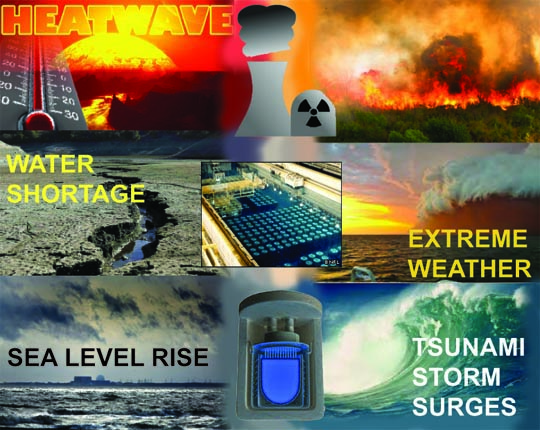
Changing ambient temperatures are already posing serious risks to nuclear plants across the world. Nuclear regulators cannot wait until sea-level rise coupled with storm surges begin impacting operational safety of their plants—they must act now.
Note: This is part two of a two-part blog series on the impacts of climate change on nuclear power plants. Check out our first blog post on the impact of increasing ambient temperatures.
Climate action isn’t simply about reducing emissions—it’s also about addressing local environmental concerns and minimizing risks to human health and safety. With that in mind, if nuclear power is going to have a role in addressing climate change, stronger safety and environmental regulations will be needed.
Unfortunately, this approach is missing from the U.S. Nuclear Regulatory Commission (NRC), which in January voted in a 3-to-2 decision to water down recommendations from its own staff to reevaluate seismic and flooding hazards at nuclear sites. “This decision is nonsensical,” Commissioner Jeff Baran wrote in his dissent, “Instead of requiring nuclear power plants to be prepared for the actual flooding and earthquake hazards that could occur at their sites, NRC will allow them to be prepared only for the old, outdated hazards typically calculated decades ago when the science of seismology and hydrology was far less advanced than it is today.”
The January ruling came almost eight years after staff scientists released a list of recommendations in direct response to the 2011 Fukushima nuclear meltdown. With the approval (and pending approvals) this year to rollback multiple safety regulations , the U.S. nuclear fleet, the oldest in the world, cannot afford to wait another decade to strengthen safety and environmental regulations in preparation of climate change–in this case, rising sea levels.
What are the Risks?
Nuclear power plants require huge amounts of water to prevent fission products in the core and spent nuclear fuel from overheating (incidentally making nuclear the most water intensive energy source in terms of consumption and withdrawal per unit of energy delivered). That’s why over 40 percent of the world’s nuclear plants are built along the coasts, with that number rising to 66 percent for just plants under construction. Unable to run on the electricity it generates itself to power the pumps that provide cooling water to the core and to the spent nuclear fuel stored onsite, a nuclear plant must rely on the grid or backup generators to ensure cooling water circulation. Any hazard that cuts off access to those sources of power restricts access to cooling water, ultimately risking a nuclear meltdown and off-site release of radiation, as happened during the flooding of Fukushima.
Flooding evaluations conducted by the NRC concluded that 55 of the 61 evaluated U.S. nuclear sites experienced flooding hazards beyond what they were designed to handle. Even more alarming, in 2014, the flood barriers at Florida Power & Light’s St. Lucie Nuclear Plant–one of the few plants reported to be prepared for disaster but which had been missing proper seals for decades–gave way to 50,000 gallons of water after heavy rainfall.
Storm surges like the one at St. Lucie Nuclear plant and extreme weather events, as witnessed in Fukushima, pose very real risks to both operational and decommissioned plants, almost all of which (in the US) will continue to store nuclear waste onsite for decades until a permanent storage solution is found. Coupled with increasingly rising sea-levels, these risks will continue to grow. Even under a very low scenario of 1°C warming by midcentury, the 2018 U.S. National Climate Assessment reports that the “frequency, depth, and extent of both high tide and more severe, damaging coastal flooding will increase rapidly in the coming decades.” And the Intergovernmental Panel on Climate Change concluded that 1.5°C of warming could be reached in as little as 11 years.
While all energy technologies will be impacted in some way by the increasing severity of natural disasters and sea level rise, the failure of nuclear power plants can result in irreversible health and environmental consequences on top of social and economic damages, including worst of all the release of radiation that can remain lethal for thousands of years. Under government estimates, the Fukushima meltdown resulted in the displacement of 165,000 people, cleanup and compensation costs of up to $200 billion, and a timeline of 30 to 40 years. Experts say, however, that true costs could reach $500 billion and decontamination timelines could be underestimated by decades.
Nuclear in East Asia
Despite initial vocal opposition from the public in many East Asian countries that have slowed down nuclear buildout after Fukushima, the direction of government policies for nuclear development in East Asia remain mostly unchanged, and have simply resulted in rather a more conservative, moderate pace. In fact, this pace has sustained much of nuclear development in East Asia, home to many countries that have found nuclear power as an attractive solution to addressing the dilemma between achieving energy security for an increasing population and decarbonizing to mitigate global climate change.
Of the 56 nuclear power plants currently in construction around the world, 33 of them are in Asia; 16 in China alone. As observed in the graph below, [on original] if all nuclear units that are currently under construction reach completion, East Asia is slated to become the region with the largest number of operating nuclear power plants, 93 percent of which will reside along the coast.
What is alarming is that East Asia and the Pacific region is uniquely vulnerable to sea-level rise. A 2015 report by Climate Central found that of the top 10 countries most likely to be affected sea level rise for 4°C warming, seven are in Asia. Similarly, in a study by the World Bank, China and Indonesia will be the most vulnerable to permanent inundation. Given the heightened flooding risks in Asia, strengthening the authority of regulatory structures that oversee the safety of nuclear build out will be increasingly important.
What’s the Plan?
Fukushima was a lesson to the global community that even one of the world’s most technologically advanced and experienced countries can fail to prevent a nuclear meltdown. To prepare for the realities of rising sea levels that pose unique risks to different nuclear plants, regulators must require climate adaptation plans and heightened safety oversight. Nonetheless, at the international scale, not much work is being done to address these sea-level rise concerns.
The Nuclear Energy Agency (NEA), in recognizing that the “world is ill-prepared for the risks from a changing climate,” conducted a study on the vulnerability of nuclear power plants to climate change, which is not yet available to the public. Since 2014, the International Atomic Energy Agency (IAEA) has begun to include a section about the impacts of climate change on nuclear energy in its annual Climate and Nuclear Power Report. Yet even as these international organizations detail the many hazards changing climate poses to nuclear reactors, preventative and/or adaptation measures do not seem to be prioritized or encouraged, especially for existing nuclear plants.
“Outside of their Scope” at Home
Similar attitudes are held here in the U.S. Perched at the southern tip of Florida, the Turkey Point Nuclear Generating Station is seeking to be the first U.S. nuclear plant permitted to run for 80 years. Initially refusing to consider sea-level rise in the environmental review of the license extension, the Nuclear Regulatory Commission (NRC) released a revised draft this year, only to come to the following conclusion: It’s outside of the scope of the agency.
If new information about changing environmental conditions (such as rising sea levels that threaten safe operating conditions or challenge compliance with the plant’s technical specifications) becomes available, the NRC will evaluate the new information to determine if any safety-related changes are needed at licensed nuclear power plants,” the NRC report said.
The report arrives at this conclusion by utilizing lower-bound sea level rise estimates from the 2018 U.S. Climate Change assessment, rationalizing that the report “assigns very high confidence to the lower bounds of these projections and medium confidence to the upper bounds.” As highlighted by this Bloomberg analysis released this year, nuclear plant operators are not only allowed to perform their own flood risk estimates but are also able to decide what assumptions are made, with review from the NRC.
The uncertainty that comes with sea-level rise projections obviously exists. In securing the safety of such critical infrastructure, however, using the highest sea-level rise estimates is the only way to ensure that all actions that can be taken against a potential threat are taken. On the other hand, relying on the lowest storm surge estimates is akin to receiving a warning about a potential threat, and taking the bare minimum actions to prepare for it.
Changing ambient temperatures are already posing serious risks to nuclear plants across the world. Nuclear regulators cannot wait until sea-level rise coupled with storm surges begin impacting operational safety of their plants—they must act now. With the world’s scientists calling attention to the climate crisis ahead of us, action must be taken to ensure nuclear plants are part of the solution, not the problem.
New Mexico’s congressional delegation has expressed outrage with the U.S. House leadership’s move to block compensation for people sickened by exposure to radiation during nuclear weapons testing and the mining of uranium during the Cold War
SANTA FE, N.M. — All members of New Mexico’s congressional delegation expressed outrage with the U.S. House leadership’s move to block compensation for people sickened by exposure to radiation during nuclear weapons testing and the mining of uranium during the Cold War.
Originally, the bill expanded eligibility for compensation under the Radiation Exposure Compensation Act, offering up tens of thousands of dollars in compensation to residents of New Mexico, Colorado, Montana, Guam and Missouri — as well as those in some parts of Arizona, Nevada and Utah — who suffered the effects of nuclear testing or uranium mines and who are not covered under the current program.
The Santa Fe New Mexican reported that the compensation was included in a massive defense spending bill that won Senate approval in July. But the GOP-controlled House removed those provisions from the act Wednesday, rendering New Mexicans — including those stricken with ailments from the radioactive fallout of the first atomic bomb — still ineligible for federal help unless it is reattached to the final bill.
“Generations of New Mexicans and their families have gotten sick and died from the radiation exposure and the lasting impacts of the Trinity Test,” said Sen. Ben Ray Luján, referring to the first-ever atomic bomb test in the New Mexico desert in 1945. “For New Mexico to have been ground zero for the first nuclear weapon — and left out of the original RECA program — is an injustice.”
Luján, a Democrat, has introduced radiation exposure compensation bills in every Congress since he was first elected to the U.S. House in 2008.
The hit summer film “Oppenheimer” about the top-secret Manhattan Project and the dawn of the nuclear age during World War II has brought new attention to decades-long efforts to extend compensation for families who were exposed to fallout and still grapple with related illness.
Advocates also have been trying for years to bring awareness to the lingering effects of radiation exposure on the Navajo Nation, where millions of tons of uranium ore were extracted over decades to support U.S. nuclear activities.
The US Department of State and US Export-Import Bank (EXIM) have announced a suite of financial tools to support the deployment of advanced nuclear energy systems to help reach net-zero goals. They also announced plans to mobilise more than USD4.2 billion of investment in enrichment and conversion capacity through the five-nation Sapporo 5 collaboration.
Hundreds more civilians have been slaughtered since Blinken’s remarks. In other words, Israel ignored him. As long as it’s only talk, Israel can afford to.
So far not one bullet, nor one penny has been withheld from Netanyahu’s vicious regime
The U.S. vice president, secretary of state and defense secretary are using unusually blunt language against Israel’s massacres of Palestinians. But the money and weapons keep flowing, says Joe Lauria.
In the midst of an Old Testament-style genocide against the Palestinian people, there is a paraphrased line from the Book of Daniel that has come into full view for the Biden administration: “The writing is on the wall.”
Everywhere in the U.S. that prominent administration officials go, they are hearing it from a public increasingly alarmed about their complicity in genocide. It is not criticism they can easily ignore.
For one thing, if they have a shred of conscience left they cannot avoid seeing that Israel’s military campaign is “deliberately inflicting on the group [Gazans] conditions of life calculated to bring about its physical destruction in whole or in part,” as the Convention on the Prevention and Punishment of the Crime of Genocide defines the supreme crime.
But even if their hearts are stones, political warnings are scratched on the wall in a fast-approaching presidential election in which increasing numbers of Democrats are affixing “genocide” to Biden’s first name.
Thus Biden, though not Biden himself, was spurred in the past few days to dispatch his top deputies to deliver the sternest message to Israel.
At the climate summit in Dubai on Saturday, Vice President Kamala Harris told a press conference: “The United States is unequivocal: International humanitarian law must be respected. Too many innocent Palestinians have been killed.”
On the same day Harris spoke, in what appears to have been coordinated by the White House, Defense Secretary Lloyd Austin said in a speech at the Reagan National Defense Forum in Simi Valley, CA, that, “I have repeatedly made clear to Israel’s leaders that protecting Palestinian civilians in Gaza is both a moral responsibility and strategic imperative.”
“In this kind of a fight, the center of gravity is the civilian population,” Austin said. “And if you drive them into the arms of the enemy, you replace a tactical victory with a strategic defeat.” Even then, Austin couched his remarks in military and not moral terms. Still the message was clear to Israel: Stop killing so many civilians.
Harris’s and Austin’s remarks followed by two days comments by Secretary of State Antony Blinken during his third jaunt to Jerusalem since Oct. 7.
After meeting Israeli Prime Minister Benjamin Netanyahu, Blinken told the press:
“We discussed the details of Israel’s ongoing planning and I underscored the imperative for the United States that the massive loss of civilian life and displacement of the scale that we saw in northern Gaza not be repeated in the South. …
As I told the prime minister, intent matters, but so does the result. … Israel has one of the most sophisticated militaries in the world. It is capable of neutralising the threat posed by Hamas, while minimising harm to innocent men, women and children. …
That means taking more effective steps to protect the lives of civilians, including by clearly and precisely designating areas and places in southern and central Gaza, where they can be safe and out of the line of fire.”
Israel responded with some maps supposedly outlining safe areas for civilians to go to. But the bombing in the south of Gaza, where 1.8 million Gazans are displaced from the north, has been among the most intense in two months of Israeli attacks.
Hundreds more civilians have been slaughtered since Blinken’s remarks. In other words, Israel ignored him. As long as it’s only talk, Israel can afford to.
An unconfirmed report from Israel’s Channel 12 following Blinken’s meeting with Netanyahu said the secretary of state supposedly “linked American military support to certain conditions, including proof that the I.D.F. plans to take into consideration the civilian population in Gaza, reduce civilian evacuations from their homes to a minimum, and provide more safe areas for non-combatants.”
Leverage
On Monday, Sen. Bernie Sanders, a Biden ally, said according to the AP: “’The truth is that if asking nicely worked, we wouldn’t be in the position we are today,’ Sanders said in a floor speech. It was time for the United States to use its ‘substantial leverage’ with its ally, the Vermont senator said. ‘And we all know what that leverage is,’ he said, adding, ‘the blank-check approach must end.’”
Until such leverage is used — and Washington has let two months go by with more than 16,000 dead, 7,000 missing and 40,000 injured — these are mere words.
Such talk from these Biden officials and allies will not fool many people, except for fools, and will not scare Netanyahu.
So far not one bullet, nor one penny has been withheld from Netanyahu’s vicious regime.
This is Biden’s quandry: continue to support Israel’s genocide and see his poll numbers continue to plummet. The dilemma he must answer is: what would damage him more, sticking with Israel through its murderous campaign or risk the Israel Lobby’s consummate skill at destroying American politicians?
On Nov. 5, 2024, American voters will weigh Biden in the balance and, as Daniel told King Belshazzar, he may be found wanting.
The failure of a high profile small modular reactor (SMR) contract in the United States has prompted concerns that Gen IV nuclear may be further off than expected.
NuScale, the first new nuclear company to receive a design certificate from the Nuclear Regulatory Commission (NRC) for its 77 MW Power Module SMR, said in November it was terminating its Carbon Free Power Project (CFPP) with the Utah Associated Municipal Power Systems (UAMPS).
UAMPS serves 50 community-owned power utilities in the Western United States and the CFPP, for which the Department of Energy approved $1.35 billion over 10 years subject to appropriations, was abandoned after the project failed to attract enough subscriptions.
NuScale shares tumbled 37% to less than $2 on the day of the news, Nov. 8, though that had largely been recovered by the end of the month. The early December share price of $3.1, however, is a long way from highs of nearly $15 in August 2022 just three months after going public.
The CFPP had aimed to build NuScale SMR units at a site near Idaho Falls to be operable by 2029 though concerns arose that some at UAMPS members may be unwilling to pay for power from the project after NuScale raised the target price to $89/MWh from a previous estimate of $58 MW/h in January.
The cancellation came shortly after another advanced reactor developer, X-Energy and special purpose acquisition company Ares Acquisition Corporation, called off a $1.8-billion deal to go public citing “challenging market conditions (and) peer company trading performance.”
The work with UAMPS had helped advance NuSCale’s technology to the stage of commercial deployment, President and CEO John Hopkins said.
However, the failure of the much-anticipated proof case for advanced nuclear alongside the X-Energy market retreat left many questioning whether next generation nuclear could live up to its promises.
“Almost all these kinds of MoUs and contracts, as we saw with the NuScale contract, are just not worth the paper they’re written on. There are so many off ramps and outs for both sides and no one’s willing to expose themselves to the downside risk of projects that go way over budget cost and take too long,” says Founder and Executive Director of The Breakthrough Institute Ted Nordhaus.
Nordhaus co-wrote a piece for The Breakthrough Institute, ‘Advanced Nuclear Energy is in Trouble’, a scathing criticism of policy efforts to commercialize advanced nuclear which, it says, to date have been entirely insufficient.
The nuclear industry was keen to ‘whistle past the graveyard’ of recent developments and efforts to commercialize the new generation of reactors ‘are simply not on track’, the Breakthrough piece said.
Mounting challenges
There are five areas that pose mounting challenges for the industry, according to Breakthrough; high interest rates and commodity prices, constrained supply chains, a regulatory regime that penalizes innovation, project costs versus system costs, and fuel production.
High interest rate and commodity costs in the last couple of years have hit the industry especially hard due to long project lead times. Nuclear supply chains struggle to rebuild as tight regulation forces many materials to be tracked from certified mine to certified manufacturer………………………………………………………………..
new nuclear has not been attracting the cash it needs. That’s partly due to developers’ lack of focus on development activities, according to Fiona Reilly, CEO of energy consultancy FiRe Energy……………….
The NuScale failure with UAMPS and X-Energy’s cancelled offering are just further bad signs for the market, especially when, at the same time these projects are announcing problems, the international nuclear community is in Dubai during COP28 saying they need to triple capacity by 2050……..
Bipartisan efforts to extend and expand a program granting compensation to victims of government-caused nuclear contamination are faltering. It is set to expire in June.
By Catie Edmondson, Reporting from the Capitol, Dec. 8, 2023,
More than two decades ago, Congress declared that victims of government-caused nuclear contamination who developed cancer and other serious illnesses — including uranium miners and those exposed to radiation from Manhattan Project-era atomic tests — should receive federal compensation.
“The health of the individuals who were unwitting participants in these tests was put at risk to serve the national security interests of the United States,” read the law enacted in 1990. “The United States should recognize and assume responsibility for the harm done to these individuals.”
And an effort to broaden it substantially beyond Cold War-era victims, to others who have been harmed by the aftereffects in the decades since, has run into a brick wall on Capitol Hill.
The Senate voted overwhelmingly in July to attach legislation renewing and expanding the program to the annual defense policy bill. But in the final version negotiated behind doors by congressional leaders, that measure, sponsored by Senators Josh Hawley, Republican of Missouri, and Ben Ray Luján, Democrat of New Mexico, was dropped………………………………………..
The original legislation was written with a narrow scope, meant to compensate those who participated in or were present for aboveground atomic bomb testing, a hallmark of the Manhattan Project in the 1940s, or uranium miners who worked between 1942 and 1971.
The law has paid out more than $2.5 billion in benefits to more than 55,000 claimants since its creation in 1990, according to congressional researchers. Claimants, who can include children or grandchildren of those who would have benefited from the program but have since died, receive a one-time payment ranging from $50,000 to $100,000.
The updated version by Mr. Hawley and Mr. Luján would expand the number of people eligible to receive compensation, and also increase the highest payout to $150,000. The law currently restricts eligibility for “down-winders,” or people who lived near one of the test sites, to those who resided in a handful of counties in Utah, Nevada and Arizona.
“The members that worked on this policy once upon a time, they left out states like New Mexico — and not just the entire state,” Mr. Luján, who has pushed to expand eligibility to individuals in most western states, said in an interview. “They left out the entire county where the first bomb was tested. That alone shows the people have been left out.”
The bill, which President Biden has endorsed, makes the case that the federal government should compensate anyone grievously sickened by the legacy of the nation’s nuclear weapons program.
It would extend access to the federal fund for 19 years and expand eligibility to Missourians sickened by radioactive waste that was never properly disposed of — and in some cases left out in the open near a creek — in St. Louis, the home of a uranium processing site in the 1940s.
A blockbuster report by The Missouri Independent, MuckRock and The Associated Press earlier this year found that generations of families growing up in the area have since faced “rare cancers, autoimmune disorders and other mysterious illnesses they have come to believe were the result of exposure to its waters and sediment.”
It wasn’t until 2016 that the Centers for Disease Control and Prevention advised residents to avoid the creek entirely, and cleanup is expected to take until 2038.
“It is true that the Manhattan Project is in the past and the Cold War-era nuclear testing is in the past,” Mr. Hawley said in an interview. “But people are still dealing with the consequences of that.”
Unless Congress passes new legislation extending the law, the fund will shut down in June. Republican leaders in both the House and Senate objected to including it in the annual defense bill, citing a report by the Congressional Budget Office estimating that the proposed renewal would introduce $140 billion in new, mandatory spending. https://www.nytimes.com/2023/12/08/us/politics/nuclear-exposure-compensation.html
The Good: New Documents on the Cuban Missile Crisis, JFK and Germany, South Korea, Taiwan, and Other Nonproliferation Issues
The Bad and the Ugly: Defense Department Denials on Dimona 1963, U.S. Aid to British SLBMs, SAC Censors Film on Airborne Command Posts
National Security ArchiveWashington, D.C., December 6, 2023– Recent U.S. government decisions on the declassification of historical records on nuclear proliferation demonstrate the good, the bad and the ugly in the current national security secrecy system.
On the plus side are releases that add historically valuable information to the public record, such as the opening of documents that were reclassified after having been released at the National Archives, a newly declassified Kissinger-Nixon telcon, and U.S. embassy messages from 1980 on nuclear nonproliferation policies.
In contrast to these good releases are a number of bad and just plain ugly responses from the Pentagon and the U.S. Air Force, among others, highlighting a persistent problem where government agencies—for whatever reason—try to maintain security classification restrictions even in cases where the information has already been released, sometimes decades earlier.
Some of the documents now released in full had been held up for 20 years by the review process initiated by the Kyl-Lott Amendment and related provisions, under which the Department of Energy effectively reclassified many historical records already opened to the public at the National Archives, although other organizations, such as the U.S. Air Force and some of the intelligence agencies, also got in on the act using their own authorities.
Another key document, the CIA’s own internal assessment of its intelligence failures (and successes) before and during the Cuban Missile Crisis, includes details that were censored in 2012, and withholds details that the CIA published in 1992.
The ugliest cases demonstrate the Pentagon’s overreach. Defense Department objections led to the withholding of key parts of a Kissinger-to-Nixon memo about the British submarine-launched missile program, a document that was declassified and published in full in the Foreign Relations of the United States series nearly ten years ago. The Pentagon also censored multiple 60-year-old documents about the Israeli nuclear program, apparently completely unaware of the huge number of declassified records already available on U.S. concerns about Israel’s nuclear intentions and the Dimona reactor in particular.
Republican representative Thomas Massie claims that the money being sent to Kiev ultimately ends up in the pockets of stockholders
The US Congress is continuing to vote in favor of sending billions of dollars to Ukraine because a lot of that money ends up being laundered back into the US military-industrial complex, Kentucky Representative Thomas Massie has said.
In an interview with Tucker Carlson on X (formerly Twitter) published on Wednesday, the politician was asked to explain why Washington continued to push for more funding for Ukraine despite it becoming obvious that Kiev’s forces “cannot win.”
Massie, who has repeatedly voted against funding Kiev’s military operations, alleged that a lot of the funds that are sent to Ukraine ultimately end up “enriching” people within specific US districts and “stockholders, some of whom are congressmen.”
“You know, people are getting rich, so let’s do it. It’s an immoral argument, but it is one. But that’s not the argument they’re making in public,” he said, noting that those supporting the funding of Ukraine with US tax dollars are instead arguing that it is a “moral obligation” to do so.
“You’re a bad person if you’re against this,” he complained, referring to a statement recently made by US National Security Advisor Jake Sullivan, who suggested that failing to support “the fight for freedom in Ukraine” meant letting Russian President Vladimir Putin “prevail.”
“But no one mentions that we have abetted the killing of an entire generation of Ukrainian men that will not be replaced. To fight a war that they cannot win,” Massie noted.
In order to support the US government’s proposals on Ukraine aid, the congressman claimed, a person has to be “economically illiterate and morally deficient.”
Meanwhile, US President Joe Biden has hit out against Republicans like Massie, who have opposed aid packages for Ukraine, calling the failure to support Kiev “absolutely crazy” and “against US interests.” The US leader has repeatedly pledged that Washington would support Kiev for “as long as it takes” in its conflict with Russia.
Congress is currently in the midst of a debate around accepting a $111 billion ‘national security supplemental request,’ which includes funding for Ukraine, as well as Israel. Republicans have said they would not let the bill pass unless Washington first boosts spending on the US-Mexico border, tightens immigration controls, revises asylum and parole laws in immigration proceedings.
Last week, former Russian President Dmitry Medvedev also stated that Washington’s continued support for Ukraine had nothing to do with defending “democracy” or battling Russia, but instead boiled down to making a profit and modernizing the US military-industrial complex.
Triggered by dramatic floods across the entire Midwest, the disaster at Offutt Air Force Base, home to U.S. Strategic Command, destroyed 137 structures and covered a large portion of the runway. Although the flooding itself only lasted a short time, black mold quickly engulfed the base and surrounding housing, and inflicted serious hardship to residents, who were largely left to deal with it on their own.
One resident, whose husband worked at Offutt, told the Omaha World Herald that she began suffering from “joint pain, headaches, shortness of breath, muscle twitches, brain fog and panic attacks within a few weeks,” and that it “almost ruined my life and put my family in serious financial burden.”
Latest estimates predict that complete recovery of the base will cost over $1 billion and will take at least five years––and what’s worse, the Pentagon had apparently been made aware of the flood risks since 2011, but simply didn’t act in time.
It is increasingly evident that the U.S. nuclear enterprise is ill-equipped to deal with the inevitable onslaught of climate catastrophes that will devastate nuclear bases and their employees in the coming months and years.
And, by the Pentagon’s own admission, incidents like the flooding at Offutt are going to happen more frequently––and are going to get worse.
In 2019, the Department of Defense delivered a report to Congress listing the top military facilities vulnerable to climate catastrophe. Of the 79 installations listed, 23 of them are related to the nuclear mission, and seven actually store nuclear weapons onsite.
Those seven bases include both ballistic missile submarine bases at Kings Bay, Georgia, and Kitsap, Washington; the three ICBM bases in Montana, North Dakota, and Wyoming; Whiteman Air Force Base in Missouri, which houses 100 warheads for deployment aboard B-2 nuclear bombers; and the Kirtland Underground Munitions and Maintenance Storage Complex in Albuquerque––the largest nuclear weapons storage site within the United States. Collectively, these seven facilities are home to nearly 6,000 nuclear warheads––almost the entirety of the U.S. nuclear arsenal––and all are will be increasingly threatened by extreme weather events.
According to the Pentagon report, all of these facilities are currently affected by some combination of flooding, drought, desertification, and wildfires, and the devastation will only increase in the years to come. This is highly dangerous, as nuclear warheads and their delivery systems are relatively delicate: stored warheads need to be cooled, missile silos need to be kept clean and dry, runways can’t be underwater, and shipyards can’t be flooded.
In addition to those installations that actually store nukes onsite, other mission-critical facilities like strategic radar stations, nuclear command centers, missile test ranges, and ballistic missile defense sites are also at risk.
A 2018 study found that many Pacific atolls––including Kwajalein Atoll, home to the Ronald Reagan Ballistic Missile Defense Test Site and approximately 13,500 Marshall Islanders––will likely be uninhabitable by 2030, as rising tides will eventually ruin groundwater supplies and damage crops beyond recovery.
Despite the inevitable, the Air Force is still spending over a billion dollars to build a new radar installation on the island, amid reports that neither the Pentagon nor the primary contractor, Lockheed Martin, “gave serious consideration to that threat when designing the installation and choosing a site.”
In addition to its missile defense test range, both of the United States’ interceptor launch facilities at Fort Greely, Alaska, and Vandenberg Air Force Base, California are expected to experience an uptick in serious climate incidents. By the Pentagon’s own admission, Fort Greely is dealing with melting permafrost, and Vandenberg is subject to periodic wildfires. In 2017, a wildfire burned 380 acres of the Vandenberg base and triggered an evacuation, and in 2016, the Canyon Wildfire burned over 10,000 acres and “came very close to two Space Launch Complexes,” delaying a scheduled rocket launch. Other nuclear-related facilities like Clear Air Force Station, Barksdale Air Force Base, Andersen Air Force Base, and the White Sands Missile Range are also at risk of climate catastrophe.
There is little evidence that military leadership is taking the climate-nuclear threat seriously. Not only was the Pentagon’s first attempt at writing its 2019 report sent back for not meeting the legal requirements, but its revised report included no consideration of other types of extreme weather events like hurricanes and tornadoes; it also did not list a single overseas base. Meanwhile, the Navy quietly disbanded its climate change task force in March 2019, ridiculously claiming that it was “no longer needed.” The former commander of the task force subsequently remarked that he saw “little evidence” that the task force’s recommendations had been implemented by the Pentagon.
All the while, U.S. emissions are increasing: a recent study by the Costs of War Project revealed that the Pentagon is the single largest institutional carbon emitter on the planet. If it were a sovereign nation, its greenhouse gas emissions would be greater than the output of entire industrialized countries like Sweden or Denmark.
The United States is trending in the wrong direction. While barely acknowledging the climate risks, Congress has continuously voted in favor of needless nuclear initiatives, such as a like-for-like replacement of the entire ICBM arsenal. Not only will this cost anywhere between $85 and $150 billion to complete, but by the Air Force’s own admission, its Midwestern silos are highly vulnerable to flooding.
In 2009, the Air Force was forced to physically remove and inspect a nuclear-tipped intercontinental ballistic missile from its silo in North Dakota after a record snowfall caused water to penetrate the permanent berm surrounding the site and leak into the silo. According to the Air Force, 40 additional silos in North Dakota alone are located in similarly vulnerable locations that are prone to drainage problems.
Congress cannot continue blindly underwriting a nuclear force posture that is ill-suited to the inevitability of climate change. What is the point of re-capitalizing on outdated pieces of the nuclear arsenal that are likely to be rendered ineffective by flooding, when some of that money could be put towards more essential priorities––like offering free COVID-19 testing and treatment to all Americans?
It is expected that the Pentagon will revise its climate report sometime in early 2020. If its drafters are thinking proactively, they will include a blunt assessment of how the U.S. nuclear complex in particular will be affected by climate catastrophe. This will give Congress, policymakers, and the public a highly useful tool with which to assess the best direction for the future of U.S. nuclear force posture.
“This extreme and cynical Republican resolution does nothing to combat antisemitism,” said Rep. Ilhan Omar, stressing the importance of “legitimate criticism” of the Israeli government and its war on Gaza.
As Israel continued to wage what critics are calling a genocidal war on the Gaza Strip, just 13 U.S. House Democrats and one Republican on Tuesday voted against a GOP resolution that conflates anti-Zionism and antisemitism.
House Resolution 894 passed with support from 95 Democrats and 216 Republicans, including its sponsors, Reps. David Kustoff (Tenn.) and Max Miller (Ohio), who are both Jewish. Almost as many Democrats—92—voted present.
The resolution, which embraces the International Holocaust Remembrance Alliance’s controversial working definition of antisemitism, was widely condemned by progressive and Jewish groups this week ahead of the vote.
Republican Congressman Thomas Massie (Ky.) joined the 13 Democrats who opposed H.Res. 894: Reps. Jamaal Bowman (N.Y.), Cori Bush (Mo.), Gerry Connolly (Va.), Jesús “Chuy” García (Ill.), Raúl Grijalva (Ariz.), Pramila Jayapal (Wash.), Summer Lee (Pa.), Alexandria Ocasio-Cortez (N.Y.), Ilhan Omar (Minn.), Ayanna Pressley (Mass.), Delia Ramirez (Ill.), Rashida Tlaib (Mich.), and Bonnie Watson Coleman (N.J.).
“This extreme and cynical Republican resolution does nothing to combat antisemitism, relies on a definition that conflates criticism of the Israeli government with antisemitism, paints critics of the Israeli government as antisemites, and falsely states that anti-Zionism is antisemitism,” Omar said in a statement about her vote. “We must stand against any attempt to define legitimate criticism of this war and the government perpetrating it as antisemitism.”
According to The Hill, Bowman said after the vote that while he “strongly condemn[s] antisemitism and hate in all of its forms,” he voted against H.Res. 894 because “it fuels division and violence, conflates criticism of the Israeli government with antisemitism, and ignores one of the greatest threats to the Jewish community, white nationalism.”
Bowman and Omar are among the House progressives facing serious primary challenges for the next cycle, in part because of their criticism of the Israeli government and its war on Gaza that has killed nearly 16,000 Palestinians in under two months.
They joined with Bush, Lee, Massie, Ocasio-Cortez, Ramirez, Tlaib, and Reps. André Carson (D-Ind.) and Al Green (D-Texas) in October to oppose a bipartisan resolution, which declared that the House unconditionally “stands with Israel as it defends itself against the barbaric war launched by Hamas and other terrorists,” and did not mention Palestinian suffering.














 nuclear-news