‘Heinous’: Children Among 100 Killed by Israel Bombing of Gaza School Just Hours After US Weapons Approval
“It is hard to comprehend how the Biden administration can justify rewarding Israel with new weapons, despite Israel’s persistent defiance of every single plea the Biden administration has made urging a modicum of restraint.”
Yanis Varoufakis, former finance minister of Greece and co-founder of Progressive International, asked the same on Saturday.
“Israel has now killed nearly 40,000 Palestinians, mostly women and children, and wounded well over 92,000 others,” said Varoufakis. “Thousands more lie, uncounted, under the debris. Some 10,000 Palestinians have been abducted by Israel’s occupying forces. Question: Where is the ICC indictment?”
Jon Queally, Aug 10, 2024 https://www.commondreams.org/news/gaza-massacre-us-weapons
The Palestinian Authority’s Fatah government in the Occupied West Bank released a statement Saturday describing the attack on the al-Tabin school in Gaza City as a “heinous bloody massacre” that represents the “peak of terrorism and criminality” by the Israeli government of Prime Minister Benjamin Netanyahu.
Just hours after the Biden administration Friday announced approval of $3.5 billion in military funds for Israel and shipments for new weaponry, an Israeli bombing of a school-turned-shelter in Gaza has killed 100 people or more, including scores of civilian men, women, and children in what was described as a “bloody massacre” that struck during morning prayers, leaving body parts scattered “in pieces” and healthcare workers overwhelmed with the dead and wounded.
“Committing these massacres confirms beyond a shadow of a doubt its efforts to exterminate our people through the policy of cumulative killing and mass massacres that make living consciences tremble,” said the PA.
Footage taken by volunteers working alongside Palestinian medical units in Gaza City showed wounded small children and adults being taken to local hospitals as well as scenes of carnage from the scene of the bombing [Warning: Images are graphic]. Gaza journalist Motasem A. Dalloul also posted his reporting from the scene, including footage of the carnage [Also graphic].
Al-Jazeera spoke with witnesses at the scene of the massacre, one of whom said many of the dead—which included women, children, and old people who had been praying and others sleeping when the missiles struck—were collected afterward “in pieces”:
Tamer Kirolos, a regional director for Save the Children, called Israel’s attack on al-Tabin the “deadliest attack on a school since last October.”
“It is devastating to see the toll this has taken, including so many children and people at the school for dawn prayers,” Kirolos said. “Civilians, children, must be protected. An immediate definitive ceasefire is the only foreseeable way that will happen.”
Just hours before the bombing, the U.S. State Department announcement that a $3.5 billion tranche of funds—part of a larger $14.1 billion in overseas military aid approved by Congress earlier this year—would be released to the Israeli government for weapons procurement.
As CNNreported, while some of those weapons purchases made possible by the fund may take years, the “supplemental funding also allocated billions of dollars’ worth of equipment that the Pentagon can draw from its own stockpiles to send directly to Israel on a much faster timeline.”
Unverified reporting indicated that at least one of the missiles dropped on the al-Tabin school overnight may have been a U.S.-made MK-84 bomb weighing 2,000 pounds.
On Friday night, after the State Department announcement but before news of the latest bombing in Gaza broke, Sarah Leah Whitson, executive director of the human rights and advocacy group Democracy for the Arab World Now (DAWN), was among those confounded by the U.S. government’s continued determination to arm the Israelis in the face of the human suffering in Gaza and the repeated massacre of civilians, day after day and month after month.
“It is mind-boggling that despite the overwhelming evidence of the IDF’s unprecedented crimes in Gaza that has shocked the conscience of the entire world, the Biden administration is greenlighting the transfer of additional lethal weapons to Israel,” said Whitson in a Friday night statement following news that the State Dept. had greenlit the release of taxpayer funds for a new round of weapons destined for Israel.
Making a similar argument in a Saturday morning post on X, Sami Abou Shehadeh, leader of Israel’s leftist Balad Party, said that while President Joe Biden “could have stopped the genocide” by using his leverage of military aid to force the Israelis in a different direction, instead “he just released $3.5 billion for more weapons to kill civilians.”
Shehadeh warned that without any internal opposition “to the genocide” by Israel’s Zionist political parties, Netanyahu’s policies would continue, even as the region inches toward further destabilization over the crisis in Gaza that has also spread to Lebanon and beyond. Calling for the International Criminal Court to intervene, he asked, “If the ICC doesn’t take action now, then when?”
Yanis Varoufakis, former finance minister of Greece and co-founder of Progressive International, asked the same on Saturday.
“Israel has now killed nearly 40,000 Palestinians, mostly women and children, and wounded well over 92,000 others,” said Varoufakis. “Thousands more lie, uncounted, under the debris. Some 10,000 Palestinians have been abducted by Israel’s occupying forces. Question: Where is the ICC indictment?”
It is truly horrific,” Raed Jarrar, DAWN’s policy director told Common Dreams via email Saturday. “Last night’s massacre was another example of how Blinken and Biden have blood on their hands.”
Referencing a separate decision by the State Department to suspend an investigation into documented abuse violations by the “notorious” Netzah Yehuda Unit within the IDF, Jarrar said the “decisions of sending weapons to Israel and not sanctioning Israeli human rights abusers are not just corrupt policy decisions, they are criminal acts.”
Israel Runs the U.S. No, the U.S. Runs Israel. No, Wait …
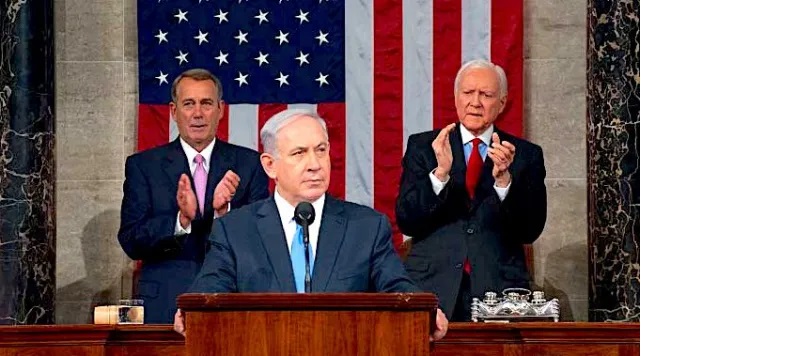
The occasion of Netanyahu’s address, his fourth before a joint session, puts all the complexities before us. Who was, in that hour, in charge — the insane man from the periphery, driven by rage, or his audience of adoring lawmakers at the imperial center, driven by… driven by what? I would say driven by greed, ideology and the work of running an imperium that is failing but has not failed yet. Who controlled whom that day? .
This is power.
Joe Biden, in this same line, accepted more money from the Israeli lobby than anyone else on Capitol Hill during his decades in the Senate — $4.2 million according to Open Secrets, and I understand this is a very low estimate if we count Biden’s post–Senate political career. Code Pink, in a signature-gathering campaign, says Harris has received $5.4 million from the Israel lobby, although it does not indicate at what stage in her career she accepted this extraordinary sum.
August 10, 2024 By Patrick Lawrence / Original to ScheerPost
That deranged speech Bibi Netanyahu delivered to a joint session of Congress last month: I cannot get it entirely out of my mind. It did not change anything — neither the Israeli prime minister nor his hosts seem to desire or intend to change anything in U.S.–Israeli relations. And in this way, there is not much to say about that weird hour the world’s No. 1 terrorist — yes, think about it and tell me I’m wrong — spent at the podium under the Capitol’s rotunda. But the speech did clarify certain things, and then it raised an important question. Let us see about these matters.
There is, to begin with, the question of Netanyahu’s mental stability. If we consider his many outlandish assertions — Israel has minimized civilian casualties in Gaza, Israeli soldiers are to be commended for their moral conduct, those protesting in behalf of Palestinians are probably in Iran’s pay, and so on — we must conclude that the man given to such preposterous misrepresentations is, let’s say, perpendicular to reality.
I am sure Netanyahu spoke in large measure for effect. This must be so. But I am equally sure — note the demeanor in the videos, for instance — he was certain of the truth of what he had to say. Dr. Lawrence’s diagnosis: A man consumed with resentment and hatred, who has led Israel to the brink of a cataclysmic war at the irretrievable cost of its international standing, while dragging the U.S. into it (at similar cost), suffers from severe psychosis with symptoms of paranoia and obsessive-compulsive megalomania.
I do not say this to indulge some cheap denigration of one of the many contemptible political figures now walking around the Western world and its appendages. After Netanyahu’s notably strange performance in Congress July 24 — at times he seemed pure id — I say this diagnosis would hold in a clinical setting. We should all take note of this and brace ourselves accordingly. Never mind who’s driving the bus: It would be better in this case if no one were driving it.
There is also the reception Netanyahu enjoyed on Capitol Hill. Seventy-two ovations by my count, 60–odd of them standing, for a war criminal, a flouter of international law, a man who commits to waging “a seven-front war” across the Middle East?
Bibi’s big theme, running all through his remarks, was congruence, the perfect alignment of Israeli and American interests. Remember? “Our enemies are your enemies, our fight is your fight, and”—here the left fist pounded—“our victory is your victory.”
The response among those in attendance tells you all you need to know about what America’s lawmakers think of this idea. Netanyahu was looking merely for reaffirmation of standing arrangements at a moment when when terrorist Israel’s conduct had begun to turn more stomachs than he had bargained for. And he got what he wanted, needless to say.
This brings us to the question Netanyahu’s speech forces upon us. Does the U.S. control Israel or does Israel control the U.S.? Is the apartheid state another of Washington’s client regimes, albeit — let’s borrow a little from the Chinese — a client with Zionist characteristics? Or is Israel a case — rare, if not unique — of a distant outpost that dictates to the imperial center? The periphery exercises power over the metropole, this to say: This would have to be something new under the sun, surely.
This is not a new question. A lot of people have pondered it for months, if not longer —
The occasion of Netanyahu’s address, his fourth before a joint session, puts all the complexities before us. Who was, in that hour, in charge — the insane man from the periphery, driven by rage, or his audience of adoring lawmakers at the imperial center, driven by… driven by what? I would say driven by greed, ideology and the work of running an imperium that is failing but has not failed yet. Who controlled whom that day? ………………………………………………………………………
This is power.
Joe Biden, in this same line, accepted more money from the Israeli lobby than anyone else on Capitol Hill during his decades in the Senate — $4.2 million according to Open Secrets, and I understand this is a very low estimate if we count Biden’s post–Senate political career. Code Pink, in a signature-gathering campaign, says Harris has received $5.4 million from the Israel lobby, although it does not indicate at what stage in her career she accepted this extraordinary sum.
Harris is now wowing all the dreamy liberals in our midst with gestures here and there intended to suggest that she will be tougher on the Israelis than Joe-the-Zionist and more sympathetic to the Palestinians. Follow the bouncing ball, please, as those honorable Arab–Americans up in Michigan follow it: Harris makes it quite clear, on those occasions she fails to avoid the topic, that she has no intention of making any meaningful adjustment in U.S. policy toward the terrorist state. Let the murdering go on, as long as the Israelis want it to continue.
This, as I say, is power—perversely acquired and perversely exercised………………………………………..
What is at issue in all this is the question of responsibility. Israel exercises considerable power over the U.S. — yes, we all know this — but this is by dint of a corrupt abdication on America’s part. We must not miss this. Washington’s whorish elites have sold U.S. policy to the Israelis, and Congress has sold itself similarly………………………………..
……………………………………..America could sink Netanyahu’s boat any time it chooses to do so. Don’t let the moment fool you: Bibi, as history will show, is at bottom merely a passing punk.
This, to finish the thought, is the power that matters most — imperial power.
Here’s the important thing about the distinction I draw. The ephemeral power Israel asserts in the U.S., accumulated over the eight postwar decades, reaches an historic impasse. It is waning, in a word.
In his final days as a public figure, Joe Biden will continue to carry on about the Zionist state as he has the whole of his political career. “Without Israel, no Jew in the world is safe,” he declared the other day, and hardly for the first time. Kamala Harris is not saying anything about Israel and the Gaza crisis in part because she has little to say about anything, but mostly because, when circumstances require her to break this silence — “weird” indeed, this — it will not be good news for those anticipating even a millimeter’s worth of change.
………………………………………………………………….there was an interesting item at the end of last month on WMAC Radio, the NPR station broadcasting in Upstate New York and western New England. Kamala Harris was just then raising hundreds of millions of dollars, cashing in on the irrational exuberance by then evident among Democrats. At a typically boisterous campaign stop in Pittsfield, Mass., she also faced protesters carrying placards that read, among other things, “End the Genocide” and “All This Money Will Not Wash the Blood Off Your Hands, Kamala.”
What are we looking at here? Pittsfield is a small postindustrial city struggling back to life after General Electric abandoned it decades ago. But this is just the point: Anger about “the Biden–Harris administration” for its participation in Israel’s genocide seems to run right down to this nation’s broken sidewalks. Harris has since gotten the same treatment at a big campaign rally in Philadelphia, and again the other day in Detroit, where she high-handedly dismissed protesters with “I am speaking.” You come away with the impression Americans are simmering — virtually everyone I know is simmering, now that I think about it — and the major media, complicit with the Harris bandwagon, are doing their part to keep this out of sight. Let us not forget: American campuses are quiet after the honorable demonstrations this past spring, but classes resume in a month.
You can bribe some of the people all of the time and all of the people some of the time, but you can’t bribe all of the people all of the time. I think I have my Lincoln right. And I think the Israelis, who, I imagine, don’t bother much with Abe, are on the way to learning that the power they have long exerted over U.S. politics and policy will eventually, in however long, prove ephemeral. https://scheerpost.com/2024/08/10/patrick-lawrence-israel-runs-the-u-s-no-the-u-s-runs-israel-no-wait/
US to send more military aid to Ukraine, as Ukrainian drones target Kursk and the Kursk Nuclear Power PLant

On Friday, Ukrainian drones targeted the Kursk Nuclear Power Plant in Kurchatov, briefly cutting power supplies to the town.
https://www.rt.com/news/602400-pentagon-ukraine-military-aid/ 10 Aug 24
Ammunition worth $125 million comes after Ukraine invaded Russia’s Kursk Region
Washington will send Kiev another $125 million worth of missiles and ammunition, the Pentagon announced as fierce fighting continued in Russia’s Kursk Region.
The US Department of Defense noted on Friday that this was the 63rd batch of aid provided to Ukraine since August 2021 – six months prior to the launch of Russia’s military operation.
To help Kiev meet “critical security and defense needs,” the US will send Stinger anti-aircraft missiles; ammunition for High Mobility Artillery Rocket Systems (HIMARS); rounds for 155mm and 105mm artillery; Javelin, AT-4 and TOW anti-tank missiles; small-arms ammunition; and demolitions ordnance, the Pentagon said in a statement.
The package also included multi-mission radars, Humvee ambulances, spare parts, services, training and transportation.
Washington’s previous batch of military aid, worth $1.7 billion, was sent at the end of July. According to the Pentagon’s own numbers, the US has sent more than $56.2 billion in military aid to Ukraine since President Joe Biden took office in January 2021.
Earlier this week, Ukraine sent several battalions worth of troops into Russia’s Kursk Region. Moscow has accused the invaders of indiscriminately targeting civilians with artillery, small arms and drone strikes. On Friday, Ukrainian drones targeted the Kursk Nuclear Power Plant in Kurchatov, briefly cutting power supplies to the town.
“We don’t feel like this is escalatory in any way,” Pentagon spokeswoman Sabrina Singh told reporters on Thursday, when asked about US military aid to Kiev.
According to Singh, everything Ukraine does is legitimate self-defense from the Russian “invasion,” while Russia can always de-escalate by withdrawing.
The Ukrainian leadership has said the primary goal of the Kursk operation was to induce “fear” in the hearts of the Russian people. One of the units involved in the operation, according to Ukrainian media, is named ‘Nachtigall’ after the notorious Nazi auxiliary from WWII commanded by Roman Shukhevych.
At least five civilians have been killed and 21 wounded – including six children – by the Ukrainian attacks, according to Russian authorities. The defense ministry in Moscow said that the invaders have lost almost 1,000 troops and over 100 armored vehicles as of Friday.
Genocide in Gaza still not on Kamala Harris’ moral radar

‘Don’t’ mention US enabling genocide…we’ve got an election to win.
Walt Zlotow, West Suburban Peace Coalition, Glen Ellyn IL 11 Aug 24
Three weeks in, Democratic presidential candidate Kamala Harris continues support for Israel’s genocidal ethnic cleansing of Palestinians in Gaza.
Over 40,000 dead with thousands more buried under the rubble from tens of thousands of US bombs in Gaza has made no dent on Kamala Harris’s conscience. Nor has a death toll predicted by the UK Medical Journal Lancet that upwards of 185,000 will soon be dead from disease, starvation to go along with endless US weapons of civilian destruction in the most grisly genocidal ethnic cleansing this century.
Of course, Harris has more sense than to cheer on the Israel’s genocide in Gaza. Her campaign frames her support this way: “Harris has been clear: she will always work to ensure Israel is able to defend itself against Iran and Iran-backed terrorist groups”. She claims to be troubled by the suffering caused by endless US bombs there, but refuses to support an embargo on genocide weapons.
Hubby Doug Imhoff chimed in “Let me just make this clear: the vice president has been and will be a strong supporter of Israel as a secure democratic and Jewish state, and she will always ensure that Israel can defend itself, period. Because that’s who Kamala Harris is.” If Imhoff were honest and decent, he’s could do so by simply replacing “democratic” and “Jewish” with “Apartheid” and “genocidal.”
When anti-genocide protesters confronted her Harris about her genocide support during a campaign speech in Detroit, Harris shot back “You know what? If you want Donald Trump to win, then say that. Otherwise, I’m speaking.” That has become the go-to Democratic response to pushback against Democratic support for Israeli genocide in Gaza: ‘Don’t’ mention US enabling genocide…we’ve got an election to win.
Three weeks into her campaign to become the first woman US president, Kamala Harris’ moral compass is frozen in support of Israeli genocide in Gaza. She should ponder this eternal truth. What does it profit a person to gain the world, when she must sell her soul to achieve it?
US Policy: Let Israel Escalate Against Iran, Then Tell Iran Not To Escalate Back
When Iran does whatever it’s about to do, we may be certain that the western empire and its propagandists in the mass media are going to frame it as an unprovoked and outrageous act of aggression and start babbling about “defending” Israel against its “attackers”.
Caitlin Johnstone, Aug 09, 2024, https://www.caitlinjohnst.one/p/us-policy-let-israel-escalate-against?utm_source=post-email-title&publication_id=82124&post_id=147506650&utm_campaign=email-post-title&isFreemail=true&r=1ise1&triedRedirect=true&utm_medium=email
In an article titled “U.S. Warns Iran of ‘Serious Risk’ if It Conducts Major Attack on Israel,” The Wall Street Journal reports that officials within the Biden administration have been warning Iran not to “escalate” against Israel in its planned retaliatory strikes for the assassination of a Hamas leader in Tehran.
“The United States has sent clear messaging to Iran that the risk of a major escalation if they do a significant retaliatory attack against Israel is extremely high,” an anonymous US official told The Wall Street Journal, adding that “there is a serious risk of consequences for Iran’s economy and the stability of its newly elected government if it goes down that path.”
As we sit awaiting Iran’s planned reprisal attack and hope dearly that it doesn’t lead to a major new war in west Asia, one can’t help but read such reports and think it sure would’ve been nice of the Americans to issue these kinds of warnings to Israel against escalating before it went on its insanely escalatory assassination spree in the capital cities of Iran and Lebanon.
You’ll never see western officials so enthusiastic about the idea of de-escalation as they are in those time periods when their side has just severely escalated tensions with an extreme act of aggression, but the other side has yet to retaliate. They remind you of a parent who lets their kid run around clobbering other children at the playground, then when another child goes to hit them back they rush in and start yelling about the need to play nice.
They’ve been doing this song and dance for the last few days, ever since it became clear that Iran was going to retaliate for the assassination of Hamas leader Ismail Haniyeh while he was a guest on their territory.
“Earlier, Vice President Harris and I were briefed in the Situation Room on developments in the Middle East,” President Biden’s Twitter account posted on Monday. “We received updates on threats posed by Iran and its proxies, diplomatic efforts to de-escalate regional tensions, and preparations to support Israel should it be attacked again. We also discussed the steps we are taking to defend our forces and respond to any attack against our personnel in a manner and place of our choosing.”
“Further attacks only raise the risk of dangerous outcomes that no one can predict and no one can fully control,” US Secretary of State Antony Blinken proclaimed on Tuesday.
“Further escalation in the Middle East is in no one’s interests,” tweeted UK Foreign Secretary David Lammy on Tuesday. “I spoke to Iran’s acting Foreign Minister, Ali Bagheri Kani, and cautioned that any Iranian attack would have devastating consequences for the region. Iran and all parties must urgently and immediately de-escalate.”
Israel’s powerful western backers are happy to let it run rampant throughout the region without making any meaningful warnings against its criminal actions or imposing any consequences on it whatsoever. But as soon as it becomes clear that Israel has crossed a red line and is about to get hit, these western empire managers turn into a bunch of hippies who just want peace and love.
When Iran does whatever it’s about to do, we may be certain that the western empire and its propagandists in the mass media are going to frame it as an unprovoked and outrageous act of aggression and start babbling about “defending” Israel against its “attackers”. Imperial history always begins right after Israel’s aggressions, and starts the clock as the retaliations for them emerge.
That’s how the imperial spin machine operates: reversing victim and victimizer, aggressor and defender, claiming to always be acting in self-defense while existing in a continuous state of attack. When the inevitable blowback from these aggressions turns up, they stare with Bambi-eyed innocence and call it an unprovoked attack launched by deranged madmen with hatred in their hearts, and use it to justify even more mass military slaughter in the parts of the world where they already wanted to inflict it.
Are you not tired of having your intelligence insulted like this? I know I am.
America’s Nuclear Weapons Quagmire

what are the American people really getting for all of this new nuclear weapons spending?
The United States is locked in a strategic and ideological battle with itself over the purpose and future of its nuclear arsenal
STIMSON, By Geoff Wilson, Defense Policy & Posture, August 7, 2024
The United States is on track to spend the equivalent of more than two Manhattan projects per year in one of the most expensive nuclear arms races in history. Yet, all of the systems being developed are all significantly over budget and behind schedule, and several might be actively eroding America’s national security by destabilizing global strategic stability and legitimizing the idea of “limited” nuclear use. How did we get here and might there be better alternatives?
Over the past decade, the United States has launched one of the most expensive nuclear arms races in history. As it stands now, this new nuclear modernization comes with a price tag of approximately $1.7 trillion over 30 years.1 To put this in perspective, adjusted for inflation to 2023 dollars, the four years of the Manhattan Project cost approximately $30 billion.2
The Congressional Budget Office (CBO) estimates that the United States is set to spend some $756 billion on nuclear weapons modernization programs between fiscal 2023-2032,3 which averages out to $75 billion a year on nuclear weapons. That is more than two Manhattan projects every year for the next eight years.
Put in other terms, it is nearly all the money the United States spent on nuclear weapons and delivery systems for World War II, spent every year, for the next eight years. When combined with the Department of Defense’s conventional weapons portfolio over the same period, nuclear modernization will drive annual peacetime Pentagon budgets to unprecedented levels.
If you compare the technical obstacles faced by the United States during the nuclear development of the 1940s, to the higher costs for the relatively marginal benefits of the current American nuclear modernization program, it begs the question: what are the American people really getting for all of this new nuclear weapons spending?
Nuclear weapons proponents have framed these expenses as part of a modernization effort to update and refurbish aging systems developed in the 1970’s and 80’s or as a necessity to maintain U.S. global nuclear dominance.4 But this branding masks a serious escalation in disruptive nuclear posture changes, one that includes new weapons and missions that were eliminated by former presidents Reagan and George H.W. Bush after being identified as unnecessary and destabilizing to both strategic stability and nuclear deterrence.
Set against this backdrop, it appears that the United States is in a new global nuclear arms race, a new Cold War 2.0, with the United States set firmly in the driver’s seat. But amidst increased global nuclear risks, the United States is inflicting unnecessary self-harm by expending resources on systems that may actually erode strategic stability and drawing resources away from other critical national security priorities – with very little real future security benefit to show for it.
The Problem
Fundamentally, the problem with rapid new nuclear weapons development is that it is strategically destabilizing. If one nation learns that a rival is rapidly developing systems that could overwhelm or defeat its defenses, a realist response dictates that that nation must do the same to offset any strategic advantage its rival might gain to maintain deterrent parity.
The alternatives are to consider attacking that rival before they have produced new weapons that can defeat your existing forces, or to find a way to negotiate with those rivals to produce verifiable diplomatic agreements to limit the production and deployment of new and destabilizing forces.
History provides many examples of this dynamic. The United Kingdom and Germany engaged in a serious naval arms race that contributed to the tensions preceding World War I…………………………………………….
nuclear modernization plan has now grown from just updating older systems, to the development of entirely new ones as well.
………………………………………………………….. other nuclear powers have taken notice.
Challenges of a New Global Nuclear Arms Race
Since the launch of the new modernization plan, every single nuclear-armed nation has begun redeveloping or expanding their nuclear arsenals.19
………………………………………………… Even more concerning for global strategic stability are growing calls in the United States for entirely new nuclear missions and systems. Already, the United States is in the process of developing, producing, or deploying at least three new weapons systems that can be alternatively called: less-than-deterrent, non-strategic, tactical, or battlefield nuclear weapons. These are weapons that are not meant to reinforce the deterrence-first approach that many Americans have come to believe the U.S. nuclear arsenal is based around today. Instead, they are part of a murkier Cold War-style nuclear warfighting strategy meant to fight and “win” a limited nuclear war at the theater level.
…………………………………………… This class of weapons is incredibly dangerous considering they are viewed as being smaller and less destructive and have been argued as being more usable. Add to that the fact they are traditionally meant to be deployed alongside conventional forces, and their mere possession can be seen as increasing the likelihood of their use under pressure or in crisis situations.25
They also pose a significant discrimination problem to enemy leaders, by building uncertainty into U.S. missile launches, forcing them to constantly evaluate if they are under a conventional or nuclear strike………………………………………………..
,…………………………………………….. Senator Edward Kennedy drove this issue home in 2003 when he argued on the Senate floor, “Some may say that smaller weapons are less dangerous than the larger weapons already in our arsenal. But these nuclear weapons are actually more dangerous… [and they are made] more usable by lowering the thresholds for the first use of nuclear weapons.”
Kennedy warns that this view is deceptive, “Nuclear war is nuclear war is nuclear war. We don’t want it anywhere, anytime, anyplace. Make no mistake, a mini-nuke is still a nuke. ……………………………………………………………………………
…………………………Nuclear Brass Tacks
On the whole, the extremely high costs of these weapons will be a significant factor in the coming defense spending crisis. Spending $1.7 trillion dollars on new nuclear weapons over 30 years – about the total cost of all U.S. student debt – is unsustainable.29
The U.S. defense industrial base has so far proven itself incapable of actually absorbing all of the new nuclear spending. Even if it could, the risks of rampant waste and production delays challenge the industry’s ability to produce these weapons. It thus becomes difficult to say whether or not the United States is actually reaping any benefit from this modernization effort while actively encouraging its rivals to also make new nuclear investments to maintain their own perceived deterrent.
Indeed, national security establishment leaders have been so concerned with whether they can spend more money on nuclear weapons, there has been very little consideration of whether they should.
…………………………………………………………………………………………………………………….. Conclusion
Among the lessoned learned from the first Cold War, the conflict demonstrated that simply possessing more nuclear weapons did not make the United States any safer. While humanity survived the last nuclear arms race, that outcome was far from certain, and the prospect of a new game of nuclear chicken in the Pacific or Europe should be viewed with as much cynicism as can be mustered………………………………………………………………………………… https://www.stimson.org/2024/americas-nuclear-weapons-quagmire/
The deceitfulness of the nuclear weapons industry -as it plays the jobs jobs jobs card

World-Ending Maneuvers? Inside the Nuclear-Weapons Lobby Today, TomDispatch, By Hekmat Aboukhater and William D. Hartung August 7, 2024
“……………………………………………………………………………Playing the Jobs Card
The argument of last resort for the Sentinel and similar questionable weapons programs is that they create well-paying jobs in key states and districts. Northrop Grumman has played the jobs card effectively with respect to the Sentinel, claiming it will create 10,000 jobs in its development phase alone, including about 2,250 in the state of Utah, where the hub for the program is located.
As a start, however, those 10,000 jobs will help a miniscule fraction of the 167-million-member American workforce. Moreover, Northrop Grumman claims facilities tied to the program will be set up in 32 states. If 2,250 of those jobs end up in Utah, that leaves 7,750 more jobs spread across 31 states — an average of about 250 jobs per state, essentially a rounding error compared to total employment in most localities.
Nor has Northrop Grumman provided any documentation for the number of jobs the Sentinel program will allegedly create. Journalist Taylor Barnes of ReThink Media was rebuffed in her efforts to get a copy of the agreement between Northrop Grumman and the state of Utah that reportedly indicates how many Sentinel-related jobs the company needs to create to get the full subsidy offered to put its primary facility in Utah.
A statement by a Utah official justifying that lack of transparency suggested Northrop Grumman was operating in “a competitive defense industry” and that revealing details of the agreement might somehow harm the company. But any modest financial harm Northrop Grumman might suffer, were those details revealed, pales in comparison with the immense risks and costs of the Sentinel program itself.
There are two major flaws in the jobs argument with respect to the future production of nuclear weapons. First, military spending should be based on security considerations, not pork-barrel politics. Second, as Heidi Peltier of the Costs of War Project has effectively demonstrated, virtually any other expenditure of funds currently devoted to Pentagon programs would create between 9% and 250% more jobs than weapons spending does. If Congress were instead to put such funds into addressing climate change, dealing with future disease epidemics, poverty, or homelessness — all serious threats to public safety — the American economy would gain hundreds of thousands of jobs. Choosing to fund those ICBMs instead is, in fact, a job killer, not a job creator……………………………… https://tomdispatch.com/world-ending-maneuvers/
Why US nuclear waste policy got stalled. And what to do about it.

The lack of a repository doesn’t seem to worry nuclear enthusiasts anymore, probably because it doesn’t threaten what reactor licensing there is. Recent legislation—the ADVANCE Act—to accelerate approval of new nuclear technologies does not mention nuclear waste at all. The focus is on subsidizing new reactor projects and “streamlining” licensing.
A difficulty is that current law requires that, before the Energy Department can go forward with a surface storage facility to consolidate the used fuel, it has to have already selected a new geologic repository site, which isn’t happening.
Bulletin, By Victor Gilinsky | July 31, 2024, Victor Gilinsky is a physicist and was a commissioner of the US Nuclear Regulatory Commission during the Ford, Carter, and Reagan administrations
It is often said—somewhat accusingly—that it isn’t technical issues that stand in the way of siting a US geologic repository for highly radioactive waste, but political and social ones. In fact, the issues are inextricably connected. The root of the US failure lies in the original motive of the nuclear establishment in siting such an underground repository. It was not to protect public safety, but to protect continued licensing of nuclear power plants from attack in the courts on grounds that there were no provisions for dealing with the plants’ highly radioactive waste.
The disdain for public safety and the rush to open a repository infected the design process and fostered slapdash decisions. These ultimately sank the technical case for the repository at Nevada’s Yucca Mountain. And while in the end the project was shelved by a political act, behind it were Energy Department and Nuclear Regulatory Commission (NRC) actions that left a deep residue of public distrust, so deep that there isn’t likely to be a US geologic repository, ever.
The contrast with successful waste repository projects in Sweden and Finland is clear. Their regulatory standards were much tighter than those applied by the NRC, the sites were chosen carefully from a scientific point of view, and the designs strictly focused on public safety. It is not surprising that the Scandinavian authorities were able to gain the confidence of their public, and not just because they took pains to consult the public—which the Energy Department did not. They presented a good case for a sound underground facility.
Waste become a problem. ………………………………………………..
Selecting a bad site. Yucca Mountain was initially advertised as being very dry. It turned out there was lots more water in the mountain than the Department expected……………………………. It became clear the waste canisters would corrode much more rapidly than forecast and radioactive leakage beyond the site boundary would exceed even the lax standards imposed by the Environmental Protection Agency and adopted by the NRC……
A flawed licensing process. While the Energy Department wanted credit for the 11,000 drip shields in the NRC review of its license application, it didn’t intend to install them with the waste canisters. For one thing, the cost of the needed 55,000 tons of titanium alloy was substantial, and putting in drip shields would have complicated the waste installation process and required new, as yet undesigned, equipment. Instead, the Energy Department’s plan “postponed” drip shield installation until the repository closed for good, in 100-300 years. But by then it would be impossible to install drip shields over the waste canisters: The internal underground transportation system would not be functioning, and rockfall would anyhow make passage impossible. Asked how the NRC could possibly accept this fantastical commitment, I remember an Energy Department official responding that “the NRC may not question the promise of a sister agency.”
The Energy Department refused to run any computer analyses on how the repository would perform if the drip shields didn’t get installed. Nevada managed to do this and found that, without drip shields, the repository failed the licensing requirement for radioactive leakage from the site. ………………………………………………………
NRC staff participates in all agency licensing hearings. Since at that point staffers had already reviewed the application favorably, they supported the license applicant. In the Yucca Mountain case, the staff outdid itself in its support of the Energy Department. …………………………..
Stop the stalemate. The Yucca Mountain project was stalled indefinitely by the Obama administration before any substantive licensing hearing took place. It was not irrelevant that Nevada Senator Harry Reid was the Democratic majority leader, and his former assistant was NRC chairman. But the technical failures were a vital part of the background leading to this decision.

The 2012 report of a “Blue Ribbon Commission on America’s Nuclear Future” recommended a “consent-based approach” to managing nuclear waste. The Energy Department got religion and formed an Office of Consent-Based Siting, whose website explains that consent-based siting “prioritizes the participation and needs of people and communities and seeks their willing and informed consent to accept a project in their community.” But the department still didn’t get it. It’s not making a show of consulting the public that gains trust. You need a good technical plan to start with and demonstrated competence and sense of responsibility to carry it out, as was the case in the Scandinavian countries. In my judgment, it’s too late for the Energy Department. I don’t think any state would ever trust the Energy Department to build and operate a nuclear waste repository.
The lack of a repository doesn’t seem to worry nuclear enthusiasts anymore, probably because it doesn’t threaten what reactor licensing there is. Recent legislation—the ADVANCE Act—to accelerate approval of new nuclear technologies does not mention nuclear waste at all. The focus is on subsidizing new reactor projects and “streamlining” licensing.
The United States, however, does need a better system for storing highly radioactive used fuel than the current situation of keeping it at over 80 storage locations in 36 states. A difficulty is that current law requires that, before the Energy Department can go forward with a surface storage facility to consolidate the used fuel, it has to have already selected a new geologic repository site, which isn’t happening. This restriction was inserted into the Nuclear Waste Policy Act to prevent the government from siting a “temporary” storage facility and then giving up on an underground repository for permanent disposal of the waste. Now, because of this restriction, the United States has neither centralized storage nor a repository, and the waste keeps piling up. Relaxing the provision in the Nuclear Waste Policy Act that has prevented temporary consolidated storage has to be the starting point of a sensible nuclear waste policy. https://thebulletin.org/2024/07/why-us-nuclear-waste-policy-got-stalled-and-what-to-do-about-it/?utm_source=Newsletter+&utm_medium=Email+&utm_campaign=ThursdayNewsletter08012024&utm_content=NuclearRisk_NuclearWastePolicyStalled_07312024
The United States is launching a new nuclear arms race: to catch up and outsmart Russia and China

August 6th, 2024
Подробнее: https://eadaily.com/en/news/2024/08/06/the-united-states-is-launching-a-new-nuclear-arms-race-to-catch-up-and-outsmart-russia-and-china
Under the slogan of “nuclear deterrence”, the United States began investing in nuclear weapons. Washington plans to modernize and adopt new systems in order to catch up with Russia and China and be able to confront two adversaries at once.
“As a result of investments made under the Obama, Trump and Biden administrations, NNSA was able to deliver more than 200 upgraded nuclear weapons to the Department of Defense last year. This is our largest delivery in one year since the end of the Cold War,” Jill Hruby, administrator of the National Nuclear Safety Administration (NNSA), said at the breakfast of the National Institute for Deterrence Studies “Peace through Strength.“
She noted that the situation with US nuclear weapons has undergone significant changes compared to what it was just a few years ago. The representative of the NNSA explained the reasons for the sharp turn in US policy by external threats.▼ читать продолжение новости ▼
“This is a unique, unprecedented time in the field of global nuclear security. We face growing threats of nuclear weapons from Russia and an expanding nuclear arsenal in China. Russia has deployed nuclear weapons in Belarus, strengthened its partnership with China, and developed new military partnerships with North Korea and Iran.… It is also exploring the possibility of using nuclear weapons in space, which poses an asymmetric threat to the West. In addition to ramping up the pace of nuclear weapons production, China has demonstrated an amazing ability to improve its delivery systems, including deploying hypersonic missiles faster than the United States. If this direction does not change, China will become an equal nuclear adversary with significant economic power,” said Jill Hurby.
In her opinion, the current situation represents a fundamentally different “nuclear” landscape than the last 80 years.
“In general, this is a less predictable and more dangerous time, and our thinking about deterrence needs to be adjusted,” the representative of the department explained. She added that the situation is complicated by the fact that nuclear power is on the verge of revival to combat climate change.
“If this renaissance happens, there will be more nuclear materials and know-how in the world than ever before. In addition, advanced nuclear reactor technology is likely to use higher-grade low-enriched uranium instead of 5 percent low-enriched uranium. Reactor types and reactor fuels are likely to evolve. Despite the fact that this renaissance will bring the necessary options for an environmentally friendly electric power base, it will challenge the current nuclear non—proliferation regime,” the NNSA also notes the potential of breakthrough technologies such as artificial intelligence, which can simplify and accelerate the design of nuclear devices.
But for now, the United States is focusing on confrontation with Russia and China.
“Russia and China are ready to change and expand their nuclear arsenals. But so will we, if we continue to invest and support the program. This means that although we are facing a deteriorating global security situation, we do not need to panic. There is still a lot of work to do, but we also need to prepare well, take the time and think intelligently about the future,” Jill Hurby continued.
According to her, over the past few years, the United States has continued to implement five programs to modernize the weapons of the nuclear triad (strategic aviation, intercontinental ballistic missiles and nuclear submarines).
“Last year we added two more types of weapons to the existing program. These new systems directly respond to emerging deterrence needs and expand the nuclear capabilities available to the president,” the NNSA representative said that we are talking about the B61—13 nuclear bomb and the SLCM−N sea-based cruise missile.
“We now have seven systems that should be developed and put into production by the mid-2030s. This program is not only a major modernization of all three components of the nuclear triad, but also adds new deterrence capabilities that do not currently exist,” said Jill Hurby.
According to her, for 2025, NNSA has applied for the allocation of $ 25 billion from the state budget.
Since the end of the Cold War, a significant part of the scientific and industrial infrastructure in the United States has fallen into disrepair and needs to be restored and modernized, the NNSA representative noted.
“Some of the buildings that we currently use for key processes belong to the Manhattan project or use manufacturing technologies that are less safe and efficient than modern methods. Therefore, in our budget request over the past few years, approximately equal amounts have been spent on inventory modernization and infrastructure modernization,” said Jill Hurby.
The main priority, she added, is to restore the ability to produce new plutonium cores.:
“NNSA is implementing a production strategy at two sites at Los Alamos National Laboratory in New Mexico and at the Savannah River site in South Carolina. When both sites are fully operational, we expect that we will have the necessary capacity: Los Alamos will produce 30 cores per year, and Savannah River will produce at least 50.”
The construction of a uranium processing plant in Tennessee is also considered a priority in the United States. It is planned to complete its construction in 2027, and bring it to full capacity by 2031.
This year, the United States is completing work on the creation of a scheme that will identify high-priority facilities needed for science, production, safety and security until 2050.
“Our thinking about deterrence needs to be changed in order to create an effective deterrence of two equal opponents. Although we all recognize that Russia and China are innovating in their means of deterrence, we have not yet fundamentally changed our own thinking. But we know that we need to outsmart our opponents. It’s time to start this work seriously, not in a panic,” added Jill Hurby.
Biden administration lies on Ukraine war are monstrous

https://heartlandprogressive.blogspot.com/ 6 Aug 24
Notice mainstream news has imposed a virtual blackout of news about US proxy war against Russia in Ukraine. One can watch 24/7 and see nary a story on a war that could go nuclear in a heartbeat.
Couple of reasons for this. Mainstream news understands the US is suffering a staggering defeat in its effort to save its proxy state Ukraine in order to weaken Russia. Neither Republican nor Democratic media want to touch covering America’s dysfunctional war policy. Bleeding only leads when it’s the other side doing all the bleeding.
A second reason is media fatigue from the Biden administration endless lies for all 30 months of this war without a single truth worth reporting.
The original and biggest lie was the one that kicked off this war on February 24, 2022. Biden claimed Russian President Putin woke up one morning and decided to recreate the Soviet Union…starting by gobbling up Ukraine.
The truth is the US had been provoking the Russian invasion starting with President George W. Bush’s 2008 pledge to entice Ukraine into NATO to weaken, isolate Russia. Russia allowing this senseless US provocation to go on for 14 years is something America would never have done if the situation were reversed. It took the US about 14 hours to respond militarily to Russian missiles in Cuba 60 years earlier.
Biden’s next big whopper was framing the resulting conflict as democracy versus authoritarianism. He proclaimed Ukraine President Volodymyr Zelensky ‘The 21st Century Churchill’, saving Ukrainian democracy from Russian authoritarianism.
But for the past 30 months Zelensky has snuffed out every vestige of the touted Ukraine democracy. He’s cancelled elections under martial law, essentially making him president for the war’s life. No wonder he’s doing nothing to negotiate its end. When the war ends, so does Zelensky’s grasp on power, and possibly his life.
Additionally, Zelensky has banned opposition parties, squelched Ukraine’s free press, curtailed religious freedom and erased any hint of Russian culture among Ukrainian citizens so inclined.
But Biden’s most monstrous lie was that he’d do nothing in supporting Ukraine that could trigger nuclear war, something he said was a real possibility.at the war’s start. For 30 months he’s done the opposite, steadily arming Ukraine with nuclear capable F-16 fighters, Abram tanks and long-range missiles that can hit the heart of Russia. Telling Ukraine to be cautious not to provoke nuclear war with them is akin to giving matches to a kid, then telling him to use them judiciously.
There are many more in Biden’s blizzard of lies over the US proxy war in Ukraine. The saddest for the dying country of Ukraine being sacrificed on the altar of Biden’s lust to weaken, isolate Russia is this. “We will stand with Ukraine forever. We will never abandon Ukraine to Russian aggression.” Biden abandoned Ukraine 30 months ago. The US press and citizenry, weary of Biden’s endless lies on Ukraine, have moved on.
World-Ending Maneuvers? Inside the Nuclear-Weapons Lobby Today

A prime example of the power of the nuclear weapons lobby is the Senate ICBM Coalition. That group is composed of senators from four states — Montana, North Dakota, Utah, and Wyoming — that either house major ICBM bases or host significant work on the Sentinel. Perhaps you won’t be surprised to learn that the members of that coalition have received more than $3 million in donations from firms involved in the production of the Sentinel over the past four election cycles. Nor were they alone. ICBM contractors made contributions to 92 of the 100 senators and 413 of the 435 house members in 2024. Some received hundreds of thousands of dollars.
TomDispatch, By Hekmat Aboukhater and William D. Hartung August 7, 2024
The Pentagon is in the midst of a massive $2 trillion multiyear plan to build a new generation of nuclear-armed missiles, bombers, and submarines. A large chunk of that funding will go to major nuclear weapons contractors like Bechtel, General Dynamics, Honeywell, Lockheed Martin, and Northrop Grumman. And they will do everything in their power to keep that money flowing.

This January, a review of the Sentinel intercontinental ballistic missile (ICBM) program under the Nunn-McCurdy Act — a congressional provision designed to rein in cost overruns of Pentagon weapons programs — found that the missile, the crown jewel of the nuclear overhaul plan involving 450 missile-holding silos spread across five states, is already 81% over its original budget. It is now estimated that it will cost a total of nearly $141 billion to develop and purchase, a figure only likely to rise in the future.
That Pentagon review had the option of canceling the Sentinel program because of such a staggering cost increase. Instead, it doubled down on the program, asserting that it would be an essential element of any future nuclear deterrent and must continue, even if the funding for other defense programs has to be cut to make way for it. In justifying the decision, Deputy Defense Secretary William LaPlante stated: “We are fully aware of the costs, but we are also aware of the risks of not modernizing our nuclear forces and not addressing the very real threats we confront.”
Cost is indeed one significant issue, but the biggest risk to the rest of us comes from continuing to build and deploy ICBMs, rather than delaying or shelving the Sentinel program. As former Secretary of Defense William Perry has noted, ICBMs are “some of the most dangerous weapons in the world” because they “could trigger an accidental nuclear war.” As he explained, a president warned (accurately or not) of an enemy nuclear attack would have only minutes to decide whether to launch such ICBMs and conceivably devastate the planet.
Possessing such potentially world-ending systems only increases the possibility of an unintended nuclear conflict prompted by a false alarm. And as Norman Solomon and the late Daniel Ellsberg once wrote, “If reducing the dangers of nuclear war is a goal, the top priority should be to remove the triad’s ground-based leg — not modernize it.”
This is no small matter. It is believed that a large-scale nuclear exchange could result in more than five billion of us humans dying, once the possibility of a “nuclear winter” and the potential destruction of agriculture across much of the planet is taken into account, according to an analysis by International Physicians for the Prevention of Nuclear War.
In short, the need to reduce nuclear risks by eliminating such ICBMs could not be more urgent. The Bulletin of Atomic Scientists’ “Doomsday Clock” — an estimate of how close the world may be at any moment to a nuclear conflict — is now set at 90 seconds to midnight, the closest it’s been since that tracker was first created in 1947. And just this June, Russian President Vladimir Putin signed a mutual defense agreement with North Korean leader Kim Jong-un, a potential first step toward a drive by Moscow to help Pyongyang expand its nuclear arsenal further. And of the nine countries now possessing nuclear weapons, it’s hardly the only one other than the U.S. in an expansionist phase.
Considering the rising tide of nuclear escalation globally, is it really the right time for this country to invest a fortune of taxpayer dollars in a new generation of devastating “use them or lose them” weapons? The American public has long said no, according to a 2020 poll by the University of Maryland’s Program for Public Consultation, which showed that 61% of us actually support phasing out ICBM systems like the Sentinel.
The Pentagon’s misguided plan to keep such ICBMs in the U.S arsenal for decades to come is only reinforced by the political power of members of Congress and the companies that benefit financially from the current buildup.
Who Decides? The Role of the ICBM Lobby

A prime example of the power of the nuclear weapons lobby is the Senate ICBM Coalition. That group is composed of senators from four states — Montana, North Dakota, Utah, and Wyoming — that either house major ICBM bases or host significant work on the Sentinel. Perhaps you won’t be surprised to learn that the members of that coalition have received more than $3 million in donations from firms involved in the production of the Sentinel over the past four election cycles. Nor were they alone. ICBM contractors made contributions to 92 of the 100 senators and 413 of the 435 house members in 2024. Some received hundreds of thousands of dollars.
The nuclear lobby paid special attention to members of the armed services committees in the House and Senate. For example, Mike Turner, a House Republican from Ohio, has been a relentless advocate of “modernizing” the nuclear arsenal. In a June 2024 talk at the Center for Strategic and International Studies, which itself has received well over a million dollars in funding from nuclear weapons producers, he called for systematically upgrading the nuclear arsenal for decades to come, while chiding any of his congressional colleagues not taking such an aggressive stance on the subject.
Although Turner vigorously touts the need for a costly nuclear buildup, he fails to mention that, with $305,000 in donations, he’s been the fourth-highest recipient of funding from the ICBM lobby over the four elections between 2018 and 2024. Little wonder that he pushes for new nuclear weapons and staunchly opposes extending the New START arms reduction treaty.
In another example of contractor influence, veteran Texas representative Kay Granger secured the largest total of contributions from the ICBM lobby of any House member. With $675,000 in missile contractor contributions in hand, Granger went to bat for the lobby, lending a feminist veneer to nuclear “modernization” by giving a speech on her experience as a woman in politics at Northrop Grumman’s Women’s conference. And we’re sure you won’t be surprised that Granger has anything but a strong track record when it comes to keeping the Pentagon and arms makers accountable for waste, fraud, and abuse in weapons programs. Her X account is, in fact, littered with posts heaping praise on Lockheed Martin and its overpriced, underperforming F-35 combat aircraft.
Other recipients of ICBM contractor funding, like Alabama Congressman Mike Rogers, have lamented the might of the “far-left disarmament community,” and the undue influence of “anti-nuclear zealots” on our politics. Missing from the statements his office puts together and the speeches his staffers write for him, however, is any mention of the $471,000 in funding he’s received so far from ICBM producers. You won’t be surprised, we’re sure, to discover that Rogers has pledged to seek a provision in the forthcoming National Defense Authorization Act to support the Pentagon’s plan to continue the Sentinel program.
Lobbying Dollars and the Revolving Door
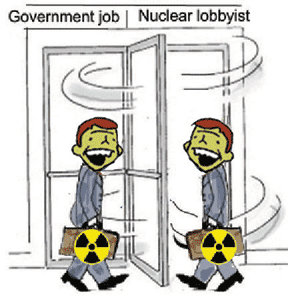
The flood of campaign contributions from ICBM contractors is reinforced by their staggering investments in lobbying. In any given year, the arms industry as a whole employs between 800 and 1,000 lobbyists, well more than one for every member of Congress. Most of those lobbyists hired by ICBM contractors come through the “revolving door” from careers in the Pentagon, Congress, or the Executive Branch. That means they come with the necessary tools for success in Washington: an understanding of the appropriations cycle and close relations with decision-makers on the Hill.
During the last four election cycles, ICBM contractors spent upwards of $226 million on 275 extremely well-paid lobbyists. For example, Bud Cramer, a former Democratic congressman from Alabama who once sat on the defense subcommittee of the House Appropriations Committee, netted $640,000 in fees from Northrop Grumman over a span of six years. He was also a cofounder of the Blue Dog Democrats, an influential conservative faction within the Democratic Party. Perhaps you won’t be surprised to learn that Cramer’s former chief of staff, Jefferies Murray, also lobbies for Northrop Grumman.
While some lobbyists work for one contractor, others have shared allegiances. For example, during his tenure as a lobbyist, former Senate Appropriations Committee Chair Trent Lott received more than $600,000 for his efforts for Raytheon, Textron Inc., and United Technologies (before United Technologies and Raytheon merged to form RX Technologies). Former Virginia Congressman Jim Moran similarly received $640,000 from Northrop Grumman and General Dynamics.
Playing the Jobs Card
The argument of last resort for the Sentinel and similar questionable weapons programs is that they create well-paying jobs…………………………………………………………………….
Unwarranted Influence in the Nuclear Age
Advocates for eliminating ICBMs from the American arsenal make a strong case. (If only they were better heard!) For example, former Representative John Tierney of the Center for Arms Control and Nonproliferation offered this blunt indictment of ICBMs:
“Not only are intercontinental ballistic missiles redundant, but they are prone to a high risk of accidental use…They do not make us any safer. Their only value is to the defense contractors who line their fat pockets with large cost overruns at the expense of our taxpayers. It has got to stop.”
The late Daniel Ellsberg made a similar point in a February 2018 interview with the Bulletin of the Atomic Scientists:
“You would not have these arsenals, in the U.S. or elsewhere, if it were not the case that it was highly profitable to the military-industrial complex, to the aerospace industry, to the electronics industry, and to the weapons design labs to keep modernizing these weapons, improving accuracy, improving launch time, all that. The military-industrial complex that Eisenhower talked about is a very powerful influence. We’ve talked about unwarranted influence. We’ve had that for more than half a century.”
Given how the politics of Pentagon spending normally work, that nuclear weapons policy is being so heavily influenced by individuals and organizations profiting from an ongoing arms race should be anything but surprising. Still, in the case of such weaponry, the stakes are so high that critical decisions shouldn’t be determined by parochial politics. The influence of such special interest groups and corporate weapons-makers over life-and-death issues should be considered both a moral outrage and perhaps the ultimate security risk.
Isn’t it finally time for the executive branch and Congress to start assessing the need for ICBMs on their merits, rather than on contractor lobbying, weapons company funding, and the sort of strategic thinking that was already outmoded by the end of the 1950s? For that to happen, our representatives would need to hear from their constituents loud and clear.
Follow TomDispatch on Twitter and join us on Facebook. Check out the newest Dispatch Books, John Feffer’s new dystopian novel, Songlands (the final one in his Splinterlands series), Beverly Gologorsky’s novel Every Body Has a Story, and Tom Engelhardt’s A Nation Unmade by War, as well as Alfred McCoy’s In the Shadows of the American Century: The Rise and Decline of U.S. Global Power, John Dower’s The Violent American Century: War and Terror Since World War II, and Ann Jones’s They Were Soldiers: How the Wounded Return from America’s Wars: The Untold Story. https://tomdispatch.com/world-ending-maneuvers/
Majority of Americans Oppose Using US Troops To Defend Israel
By Dave DeCamp / Antiwar.com, https://scheerpost.com/2024/08/07/majority-of-americans-oppose-using-us-troops-to-defend-israel/
The majority of Americans oppose the idea of US troops being used to defend Israel if it comes under attack by Iran, according to a poll conducted by the Chicago Council on Global Affairs that was released on Tuesday.
The poll, conducted from June 21–July 1, 2024, found that 56% of Americans oppose US troops defending Israel, while 42% support the idea. Support for defending Israel is stronger among Republicans, with 53% in favor and only 32% of Democrats in favor.
The survey also found that 55% of Americans oppose US troops defending Israel if it comes under attack by a neighboring country.
The results come as the Biden administration is vowing to defend Israel from an expected Iranian reprisal attack for the killing of Hamas’s political chief, Ismail Haniyeh, in Tehran. A major coordinated attack launched by Iran and its allies could result in American casualties, and the US support for Israel risks a major regional war.
The US defended Israel from an Iranian attack in April, which came in response to the Israeli bombing of the Iranian consulate in Damascus, Syria. The Biden administration intervened directly to protect Israel and is pledging to do so again without any authorization from Congress or any debate on the matter.
The Chicago Council showed the lowest level of support for defending Israel among Americans since the Chicago Council began asking the question in 2010. In 2015, 2018, and 2021, the majority of Americans (53%) supported the idea.
The Chicago Council attributed the lower level of American support for defending Israel to Israel’s onslaught in Gaza. “The unrelenting Israeli attacks against Gaza have likely dampened American willingness to defend Israel, especially among Democrats,” reads an article published on the Chicago Council website.
Majority of Americans support more nuclear power, but future of large-scale nuclear is uncertain

A majority of U.S. adults remain supportive of expanding nuclear power in
the country, according to a Pew Research Center survey from May. Overall,
56% say they favor more nuclear power plants to generate electricity. This
share is statistically unchanged from last year. A line chart showing that
a majority of Americans continue to support more nuclear power in the U.S.
But the future of large-scale nuclear power in America is uncertain. While
Congress recently passed a bipartisan act intended to ease the nuclear
energy industry’s financial and regulatory challenges, reactor shutdowns
continue to gradually outpace new construction.
Americans remain more
likely to favor expanding solar power (78%) and wind power (72%) than
nuclear power. Yet while support for solar and wind power has declined by
double digits since 2020 – largely driven by drops in Republican support
– the share who favour nuclear power has grown by 13 percentage points
over that span.
Pew Research 5th Aug 2024
What do Americans really think about the bombing of Hiroshima and Nagasaki?
Bulletin, By Scott D. Sagan, Gina Sinclair | August 5, 2024
In mid-August 1945, within weeks of the end of World War II, Americans were polled on whether they approved of the atomic bomb attacks on Hiroshima and Nagasaki. An overwhelmingly high percentage of Americans—85 percent—answered “yes.” That level of approval has gone down over the years, with (depending on the precise wording of the question) only a slim majority (57 percent in 2005) or a large minority (46 percent in 2015) voicing approval in more recent polls.
This reduction in atomic bombing approval over time has been cited as evidence of a gradual normative change in public ethical consciousness, the acceptance of a “nuclear taboo” or what Brown University scholar Nina Tannenwald has called “the general delegitimation of nuclear weapons.”
This common interpretation of US public opinion, however, is too simplistic. Disapproval has indeed grown over time, but most Americans remain supportive of the 1945 attacks, albeit wishing that alternative strategies had been explored. These conclusions can be clearly seen in the results of a new, more complex public opinion survey, conducted for this article, that asked a representative sample of Americans about their views on the bombing of Hiroshima and Nagasaki, examined alternative strategies for ending the war, and provided follow-on questions to determine how the public weighs the costs and benefits of different strategies.
Scratch beneath the surface, and the American public today, as in 1945, does not display an ethically based taboo against using nuclear weapons or killing enemy civilians, but rather has a preference for doing whatever was necessary to win the war and save American lives…………………………………………………………………………………………….
US public opinion in 2015 and 2024. A 2015 replication of the 1945 Roper poll found that 14.4 percent of Americans felt the United States should not have used atomic bombs at all, that 31.6 percent thought a bomb should have been dropped in a demonstration strike on an unpopulated area, but that almost no one (less than 3 percent) wanted to use more bombs before Japan had a chance to surrender.
For this article, we replicated the 1945 Roper poll again with a representative sample of 2,000 Americans on June 21, 2024, but then asked follow-on questions to help us determine what the public really meant when answering the survey. Such follow-on questions are necessary to understand the public’s deeper set of commitments and preferences. Did those opposing any use of the atomic bombs really support such a policy even if it meant ending the war without a Japanese government surrender? Or would they support dropping the bomb if Japan did not surrender? Would those who favor a demonstration strike today support bombing cities if the demonstration strike failed to compel Tokyo to surrender, or did they oppose atomic attacks against Hiroshima and Nagasaki under all circumstances? In short, what do Americans really think, now, about using nuclear weapons in 1945?
Options and alternatives. The percentage of respondents who said that the United States shouldn’t have used any atomic bombs at all increased from 4.3 percent in 1945, to 14.4 percent in 2015, to 36.7 percent in 2024. The percentage of respondents who preferred the demonstration strike option decreased from 31.6 percent to 20.9 percent. Public support for use of the two bombs, as the United States did in 1945, followed the same general trend, decreasing to 19.4 percent. But what do these trends reveal about US opinion? Our follow-on questions were designed to measure the public’s true willingness to use nuclear weapons and kill enemy civilians…………………………………………………
In short, when reminded of the Japanese refusal to surrender, the strong majority (82.33 percent) of those who originally favored the demonstration strike then accepted nuclear or conventional attacks on Japanese cities.
Why these preferences? The basic finding that over 36 percent of Americans said today that the United States should not have used any atomic bombs cannot reasonably be interpreted as an indication of a widespread nuclear taboo. It may be a positive trend, but it is not a robust opinion. Indeed, less than half of those respondents maintained that position after they were reminded (as was the case in 1945) that Japan had not accepted unconditional surrender prior to the atomic bomb attacks.
Instead, our 2024 Roper Poll replication provides three valuable insights about American public opinion. First, much of US public is, in fact, still supportive of the decision to drop atomic bombs on Hiroshima and Nagasaki. Adding the answers from the different follow-on questions, reveals that 41.3 percent of all respondents were ultimately willing to use a nuclear bomb on one or more cities, and many more Americans (over 25% of all respondents) reported that they didn’t know what their preferences were in this wartime scenario. These findings are inconsistent with the existence of a nuclear taboo and underscore that large hawkish instincts lurk within the U.S. public.
A second novel finding relates to the public’s willingness to attack cities and thereby violate the basic law of armed conflict and the just war principle of non-combatant immunity. While only 41.3 percent of respondents were ultimately willing to use nuclear weapons against cities, many other respondents favored continuing the conventional bombing of Japan. Reasons given by respondents who had at first stated that they opposed nuclear attacks, but then favored continued conventional bombing once reminded that Japan had not accepted unconditional surrender included: “Because if humane tactics don’t work, then you gotta do what you Gotta do;” “Since they refuse to heed to the warning, then they deserve war;” and “If Japan doesn’t surrender than it’s time to show them what we can do.”
Altogether, adding advocates of conventional bombing with advocates of nuclear attacks, 51.25 percent of all respondents chose to attack Japanese cities and kills civilians on a massive scale. This shows that the non-combatant immunity principle, contrary to the claims of some experts, does not have strong “stopping power” at least among the public. These findings challenge the theories of scholars such as Charli Carpenter, Alexander Montgomery, Steven Pinker, Neta Crawford, and Ward Thomas, who posit that a decrease in willingness to use nuclear weapons is a result of broader acceptance of the just war principle of non-combatant immunity.
………………………………………………….. many responses in the 2024 Roper Poll revealed something else: a notable percentage of respondents (15.92 percent) cited their beliefs on the importance of US isolationism and avoiding any engagement in foreign affairs.
……………………………………………These findings about contemporary views of the 1945 atomic bombing are consistent with previous research demonstrating that large segments of the American public are willing to contemplate the use of nuclear weapons in a war against Iran, in order to avoid US military fatalities, or against a terrorist organization planning chemical weapons attacks on the United States. …………………………………
The American public does not hold a strong nuclear taboo and indeed, may be more of a goad than a constraint on any future president who is contemplating the use of nuclear weapons in trying wartime conditions. While the laws of armed conflict and just war doctrine may still be a constraint on nuclear use, their powers are more likely to exercised by the moral compass of individual political leaders or the legal training of senior military officers, not through the deeply problematic instincts of the American public. https://thebulletin.org/2024/08/what-do-americans-really-think-about-the-bombing-of-hiroshima-and-nagasaki/?utm_source=Newsletter&utm_medium=Email&utm_campaign=DayNewsletter08052024&utm_content=NuclearRisk_WhatAmericansReallyThink_08052024
US Congressmen Say ‘No War With Iran!’
“Israel’s dramatic escalation is completely compatible with its past efforts to drag the U.S. into another war,” one expert said of the Israeli assassination of a Hamas leader in Iran.
Jessica Corbett, Aug 04, 2024
Amid mounting fears of a regional war in the Middle East, a pair of Democratic congressmen joined the growing chorus warning against the U.S. engaging in an armed conflict with Iran.
In response to U.S. Sen. Lindsey Graham (R-S.C.) introducing a resolution to authorize the use of U.S. armed forces against Iran, Congressman Ro Khanna (D-Calif.) said on social media Saturday that “the U.S. must not be dragged into a war with Iran.”
“The Iraq War was the biggest American blunder of the 21st century,” Khanna added. “Every candidate running this cycle must be clear on where they stand on this.”
U.S. Rep. Mark Pocan (D-Wis.) said early Sunday: “I agree with Ro Khanna. No war with Iran! Let’s all get on record with this.”
Hassan El-Tayyab, legislative director for Middle East policy at the Friends Committee on National Legislation, urged Khanna to introduce a related war powers resolution, arguing that “we really could use a clear vehicle like this to increase the pressure for no U.S. military intervention in a disastrous war with Iran.”
“We’re a miscalculation or a miscue away from an event that could draw the U.S. and Iran into a direct military conflict.”………………………………………………………………………………………………………. more https://www.commondreams.org/news/us-iran-war
1 This Month
23-25 October – on Zoom – World BEYOND War’s annual global conferenc


Shut down the radiation-damaged Heysham nuclear reactors now
To see nuclear-related stories in greater depth and intensity – go to https://nuclearinformation.wordpress.com

Say No to NASA’s Reckless Nuclear Reactor on the Moon
Say No to NASA’s Reckless Nuclear Reactor on the Moon

-
Archives
- October 2026 (209)
- September 2026 (339)
- August 2026 (330)
- July 2026 (355)
- June 2026 (287)
- May 2026 (306)
- April 2026 (356)
- March 2026 (251)
- February 2026 (267)
- January 2026 (308)
- December 2025 (358)
- November 2025 (359)
-
Categories
- 1
- 1 NUCLEAR ISSUES
- business and costs
- climate change
- culture and arts
- ENERGY
- environment
- health
- history
- indigenous issues
- Legal
- marketing of nuclear
- media
- opposition to nuclear
- PERSONAL STORIES
- politics
- politics international
- Religion and ethics
- safety
- secrets,lies and civil liberties
- spinbuster
- technology
- Uranium
- wastes
- weapons and war
- Women
- 2 WORLD
- ACTION
- AFRICA
- Atrocities
- AUSTRALIA
- Christina's notes
- Christina's themes
- culture and arts
- Events
- Fuk 2022
- Fuk 2023
- Fukushima 2017
- Fukushima 2018
- fukushima 2019
- Fukushima 2020
- Fukushima 2021
- general
- global warming
- Humour (God we need it)
- Nuclear
- RARE EARTHS
- Reference
- resources – print
- Resources -audiovicual
- Weekly Newsletter
- World
- World Nuclear
- YouTube
-
RSS
Entries RSS
Comments RSS

