Trump opposes Israel annexation of West Bank, Republican sources say
November 20, 2024, https://www.middleeastmonitor.com/20241120-trump-opposes-israel-annexation-of-west-bank-republican-sources-say/
Newly-elected United States’ President, Donald Trump, is in opposition to Israel’s reported plans to annex the Occupied West Bank, sources from his Republican Party have revealed.
According to Israeli outlet, Ynet News, a senior Republican Senator close to the President-elect has said that “Trump will not approve annexation” of the West Bank.
Such a move is reportedly seen by the new President as one that would be “a mistake for Israel” which would worsen its international standing – already severely damaged after over a year of the Occupation’s bombardment and invasion of the Gaza Strip.
Trump is also apparently primarily concerned that any official annexation could further disrupt and severely derail efforts to finally reach a normalisation between Israel and Saudi Arabia – a key priority for the incoming Trump administration, with Republican Senator, Lindsey Graham, particularly working on that goal.
The reported comments by the unnamed sources follow increased speculation in recent weeks over Trump’s appointments of controversial figures in his incoming administration, with many of the relevant roles being filled by radically pro-Israel figures who favour annexation of the West Bank.
Shares in nuclear reactor company OKLO bite the dust

Sam Altman-Backed Oklo Slumps After Kerrisdale Says It’s Shorting Stock
By Carmen Reinicke and Will Wade, November 20, 2024 , https://www.bnnbloomberg.ca/investing/2024/11/20/sam-altman-backed-oklo-slumps-after-kerrisdale-says-its-shorting-stock/
Shares of Oklo Inc., the nuclear fission reactor company backed by OpenAI Inc’s Sam Altman, tumbled Wednesday after Kerrisdale Capital said it is shorting the stock.
The report alleges that “virtually every aspect of Oklo’s investment case warrants skepticism,” sending the stock down as much as 10%. Shares pared much of the decline and were down about 6% in midday trading in New York.
Oklo shares have whip-sawed recently, rallying more than 20% this week through Tuesday’s close after falling 25% on Friday following its earnings release and the expiration of a lockup period that allows key investors like Peter Thiel’s venture capital firm to start selling shares.
Oklo declined to comment.
Since the company went public via a special purpose acquisition merger in May, its shares have soared more than 150%.
“In classic SPAC fashion, Oklo has sold the market on inflated unit economics while grossly underestimating the time and capital it will take to commercialize its product,” the Kerrisdale report said.
The company is among a wave of firms developing so-called small modular reactors that are expected to be built in factories and assembled on site. Advocates say the approach will make it faster and cheaper to build nuclear power plants, but the technology is unproven. Only a handful have been developed, and only in Russia and China.
Oklo has said it expects its first system to go into service in 2027, but the Kerrisdale report highlights numerous technical and regulatory hurdles that may delay that schedule. Oklo is pursuing a new technology that it said will make its design safer and cheaper than conventional reactors in use today. The company’s design doesn’t have approval from the US Nuclear Regulatory Commission, a process that typically takes years.
Wall Street is split on the company thus far. Of the four analysts covering Oklo, two have buy-equivalent ratings and two are neutral. The average price target implies about 5% return from where shares are trading.
Besides Altman and Thiel, the company has another potentially high-profile connection. Board member Chris Wright was nominated by President-elect Donald Trump to lead the Energy Department last week.
US one shy of becoming an Ace in blocking genocide ceasefire resolutions in UN
Walt Zlotow, West Suburban Peace Coalition, Glen Ellyn IL 22 Nov 24
For the fourth time since the US enabled Israeli genocide in Gaza, the US vetoed a genocide ceasefire resolution in the UN Security Council.
The resolution passed overwhelmingly 14-1 as Uncle Sam enticed no Security Council partners to help him continue the genocide.
But he didn’t need any since the US, as one of 5 permanent members, has veto power to prevent any such resolution from passing.
Algerian Ambassador Amar Bendjama who voted for the ceasefire, blasted the US veto: “Today’s message is clear to the Israeli occupying power: First you may continue your genocide. You may continue your collective punishment of the Palestinian people with complete impunity. In this chamber, you enjoy immunity,”
In aerial combat, a pilot who downs 5 enemy planes is called an Ace of the Air. With America’s fifth soon to occur veto , America can be called an Ace…of Genocide.
On Way Out, Reckless Biden Allows Deep Russia Strikes
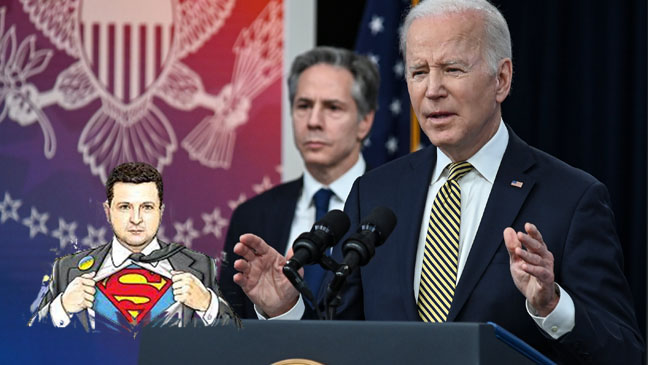
Biden staked his legacy on Ukraine. He was involved in the 2014 coup, in allegedly shady practices there with his son and then in provoking Russia to invade in 2022. He foolishly believed he would prevail in bringing down Putin with an economic, information and proxy ground war. [See: Biden Confirms Why the US Needed This War]
All three are now decisively lost as the U.S. — still under Biden — prepares for the end game. Biden’s only face saver is for Ukraine to get back some of its lost territory by trading for it with Russian territory it seized in Kursk this summer.
November 17, 2024 By Joe Lauria, Consortium News, https://consortiumnews.com/2024/11/17/on-way-out-reckless-biden-allows-deep-russia-strikes/
With his party decisively beat at the polls, the rejected president is gambling with regional security to preserve his ‘legacy’ and to saddle the incoming president, who wants to end the war, with a major new crisis, writes Joe Lauria.
As a parting shot to incoming U.S. President Donald Trump and Russian President Vladimir Putin, the defeated Joe Biden has defied the Pentagon by risking European and U.S. security with his decision announced Sunday to allow Ukraine to fire U.S. long-range missiles into Russian territory.
Just two months ago, in September, Biden had bowed to the realists in the Pentagon to oppose allowing long-range British Storm Shadow missiles from being fired by Ukraine deep into Russia out of fear it would lead to a direct NATO-Russia military confrontation with all that that entails.
Putin warned at the time in that British soldiers on the ground in Ukraine launching the British missiles into Russia with U.S. geostrategic support “will mean that NATO countries — the United States and European countries — are at war with Russia. And if this is the case, then, bearing in mind the change in the essence of the conflict, we will make appropriate decisions in response to the threats that will be posed to us.”
That was a clear warning that British and U.S. targets could be hit. Biden thus wisely backed off.
It was the second time that Biden had sided with the Pentagon against the neocons in his administration when it came to avoiding direct war with Russia.
The first time was in March 2022 when his neocon Secretary of State Antony Blinken stepped out of line to announce that the U.S. would give NATO-member Poland a “green light” to send Mig-29 fighter jets to Ukraine to enforce a no-fly zone against Russian aircraft.
Members of Congress and the media then piled the pressure on Biden to approve it until cooler heads at the U.S. Defense Department, the greatest purveyor of violence in history, stepped in to stop it.
Biden ultimately sided with the Pentagon, and he couldn’t be more explicit why. He opposed a NATO no-fly zone over Ukraine fighting Russian aircraft, he said, because “that’s called World War III, okay? Let’s get it straight here, guys. We will not fight the third world war in Ukraine.”
U.S. Defense Secretary Lloyd Austin at the time backed him up, saying:
“President Biden’s been clear that U.S. troops won’t fight Russia in Ukraine, and if you establish a no-fly zone, certainly in order to enforce that no-fly zone, you’ll have to engage Russian aircraft. And again, that would put us at war with Russia.”
But now Biden has reversed himself on his sensible positions and is defying the Pentagon to roll the dice that Russia’s warnings, repeated on Monday by Putin’s spokesman, won’t lead to nuclear conflict.
While he previously would not even authorize British long-range missile attacks into Russia in September, let alone U.S. ATACMS, on Sunday he authorized the ATACMS, risking Russia taking direct action against U.S. targets.
So what changed Biden’s addled mind?
An Undemocratic Democratic System
First, the undemocratic U.S. electoral system gave Biden the opportunity. His party was voted out of office on Nov. 5, but though the demos rejected Democrats in the White House they get to hang on in power for another 11 weeks, enough time to do considerable mischief to tie up the incoming administration that the people chose. (In a parliamentary system the new prime minister takes office on the next day and names the new cabinet well in advance of the election).
After one-term president George H.W. Bush lost to Bill Clinton in the 1992 election, Bush used those 11 weeks to invade Somalia, saddling Clinton with a foreign policy crisis that would bog him down and distract him from his agenda.
What’s happening now is something similar. Biden wants to undermine Trump’s effort to end the Ukraine war. The incoming vice president has floated the idea of Russia holding on to territory it has won in exchange for peace.
Biden staked his legacy on Ukraine. He was involved in the 2014 coup, in allegedly shady practices there with his son and then in provoking Russia to invade in 2022. He foolishly believed he would prevail in bringing down Putin with an economic, information and proxy ground war. [See: Biden Confirms Why the US Needed This War]
All three are now decisively lost as the U.S. — still under Biden — prepares for the end game. Biden’s only face saver is for Ukraine to get back some of its lost territory by trading for it with Russian territory it seized in Kursk this summer.
So he is authorizing U.S. soldiers to operate ATACMS missiles from Ukraine to beat back a 50,000-man Russian force seeking to take back all of that Russian territory. Part of that force, according to the Pentagon spokesman, is a contingent of at least 10,000 North Korean troops invited by Moscow, thus operating legally on pre-war Russian territory.
Yet the presence of these North Koreans has sent the Biden administration and its allied media into paroxysms of near insanity. The New York Times reported on Sunday:
“Officials said Mr. Biden was persuaded to make the change in part by the sheer audacity of Russia’s decision to throw North Korean troops at Ukrainian lines. He was also swayed, they said, by concerns that the Russian assault force would be able to overwhelm Ukrainian troops in Kursk if they were not allowed to defend themselves with long-range weapons.”
It is not like Biden doesn’t know the potentially grave consequences he is recklessly unleashing. He was already warned about the no-fly zone and said “that’s called World War III, okay?” He was then warned by the Pentagon against allowing the British missiles and acted like a responsible statesman.
But now, when it comes to his precious legacy, he doesn’t appear to give a damn about anything else. He was deprived of a second term (by traitors within his own party he no doubt thinks) and he will risk a NATO-Russia war to avoid the taint of utter defeat in Ukraine.
This is what he’s ignoring, according to the Times:
“Some of Mr. Biden’s advisers had seized on a recent U.S. intelligence assessment that warned that Mr. Putin could respond to the use of long-range ATACMS on Russian soil by directing the Russian military or its spy agencies to retaliate, potentially with lethal force, against the United States and its European allies.
The assessment warned of several possible Russian responses that included stepped-up acts of arson and sabotage targeting facilities in Europe, as well as potentially lethal attacks on U.S. and European military bases.”
Where it goes from there, nobody knows. Thanks, Joe.
Biden’s Missile Crisis

The American people voted for Trump to end the wars. Biden apparently wants to end the world.
Dennis Kucinich, Nov 20, 2024, https://denniskucinich.substack.com/p/bidens-missile-crisis
When President Biden approved the use of supersonic Army Tactical Missile Systems (ATACMS) to strike Russia, he placed in jeopardy the national security of the United States, the safety of our troops abroad and violated the U.S. Constitution, Article I, Section 8, which provides that only Congress can declare war.
Biden has made a decision to insert the U.S. into an unambiguous, escalatory phase, using the territory of Ukraine to attack Russia directly with missiles which can reach 190 miles deep. This is an illegal act by the President which puts our nation on a path to war with Russia.
The American people voted for Trump to end the wars. Biden apparently wants to end the world. Trump is listening to the American people. Biden is listening to NATO’s malignant agenda.
Trump has put America’s interests for peace and prosperity first.
No President has the right to use unilateral executive authority to permit a U.S. missile strike against another nation. It invites a retaliatory attack. It is an impeachable offense.
Congress, as a co-equal branch of government, must act now:
Any Member of Congress can, under privileges of the House, ask for immediate consideration of a joint resolution which invokes Article I, Section 8, and then cuts off all funding for personnel, coordination, technical advisers, materiel, equipment and deployment of ATACMS and emplacement of any other offensive missile systems in Ukraine.
The specter of WWIII has loomed before, in October of 1962, when the Soviet Union used the territory of Cuba to place offensive missiles just 90 miles away from the American mainland.
Absent the wisdom of President Kennedy and the forbearance of Nikita Krushchev, the world was on a path to nuclear annihilation.
If Krushchev had “permitted” Russian missiles to be launched at the U.S. from Cuba, you would not be reading this.
It is magical thinking that U.S. missiles can be used to attack Russia without consequences. Now it is Putin who must exercise forbearance.
North Korea has reportedly sent a detachment to assist Russia. Once the North Koreans learn the Russian language and vice versa, military cooperation will be instructive. That some in the Biden Administration use this occurrence as a bogus excuse to aim U.S. missiles at Russia, shows the neocon/neolieral addiction to war has become a tragicomic death wish.
Western vainglorious cynicism, together with hundreds of billions of dollars for weapons, shoved Ukraine into an unwinnable conflict. Russia is not NATO’s footstool, but its undoing.
The Putin-as-Hitler narrative projected in the media accelerated fear, induced acquiescence and rallied Western support for what was essentially a long-standing war scam by the military-industrial-intelligence complex. The alchemy which turned man into monster turned blood into cash.
Kiev has already paid a horrible price for being a US/NATO proxy: the loss of the flower of its youth, the destruction of its beautiful cities, the spoilation of its fertile farmland, and the sacrifice of its sovereignty.
Now, as U.S. missiles rain down on Russia, a counterstrike will occur, spreading ever wider the misery which has enveloped Ukraine.
The Biden Administration, in the face of the Afghanistan withdrawal debacle, rejected a Ukrainian-Russian diplomatic settlement more than two years ago, and continued financing the war for domestic political reasons, giving Americans a false hope for victory over Russia.
Two weeks ago, the people of the United States voted to stop the endless wars and elected Donald Trump.
Two months to go before the January 20, 2025 Inauguration and Joe Biden has handed Donald Trump a poisoned presidential chalice. Trump knows better than to drink from it.
Nuclear reactor cooling systems threatened by global heating.

Believing that waterways used as cooling sources for nuclear power plants
could get warmer due to climate change, climate scientists and nuclear
engineering specialists at the US Department of Energy’s Argonne National
Laboratory are joining forces to develop a plan B for nuclear power in
Richland, Washington.
The plan is to use Gateway for Accelerated Innovation
in Nuclear (GAIN) funding from DOE to work with Energy Northwest to inform
the design and selection of future nuclear reactor cooling systems and
assess their impacts on electricity cost.
NS Energy 20th Nov 2024, https://www.nsenergybusiness.com/analysis/determining-optimal-configurations-for-nuclear-plants-and-advanced-reactors-in-local-climates/
Report: Biden Allows Ukraine To Strike Russia With Long-Range US Missiles

November 18, 2024 , By Dave DeCamp / Antiwar.com, https://news.antiwar.com/2024/11/17/report-biden-allows-ukraine-to-strike-russia-with-long-range-us-missiles/
The New York Times reported on Sunday that President Biden had authorized Ukraine’s use of long-range US-provided missiles in strikes on Russian territory, an escalation Moscow has made clear risks nuclear war.
US officials told the paper that Ukraine can now use Army Tactical Missile Systems (ATACMS), which have a range of up to 190 miles, to strike Russian territory. The ATACMS are fired by US-made multiple rocket launch systems, including the HIMARS. Ukraine can only fire the HIMARS with coordinates provided by or confirmed by the US and its allies, meaning the US will now directly support strikes deep inside Russia.
The US officials said the ATACMS will likely initially be used to hit Russian troops fighting against Ukrainian forces in Russia’s Kursk Oblast. Ukraine and the US have also said North Korean troops are deployed in Kursk. The US has said the North Korean troops are engaged in combat, but that hasn’t been confirmed by Moscow.
Earlier this year, President Biden gave Ukraine the greenlight to strike Russian border regions with US-provided weapons, including shorter-range rockets fired by the HIMARS. A few months later, Ukraine launched its invasion of Kursk, and Ukrainian officials began pushing hard for the US to support longer-range strikes inside Russia.
In response to those calls and comments from Western officials supporting the idea, Russian President Vladimir Putin said if NATO supported long-range strikes in Russia, it would put the Western military alliance “at war with Russia.”
Putin then ordered changes to Russia’s nuclear doctrine that lowered the threshold for the use of nuclear weapons. Under the new doctrine, an attack on Russia by a non-nuclear armed state that was supported by a nuclear power will be considered a joint attack.
The Kremlin said the changes to the nuclear doctrine were meant as a message to the West. “This is a message that warns these countries of the consequences should they participate in an attack on our country by various means, not necessarily nuclear,” said Kremlin spokesman Dmitry Peskov.
The US appeared to back down on supporting long-range strikes in Russia, but now the Biden administration is looking to escalate the proxy war as much as possible for its last few months in power. President-elect Donald Trump campaigned on ending the proxy war, and the Biden team and officials in Ukraine fear he will just do that. However, some of Trump’s cabinet picks favor escalation in Ukraine, including his National Security Advisor, Rep. Mike Waltz (R-FL).
In a recent interview with NPR, Waltz was asked how Trump could end the war, and he suggested an escalation of sanctions and supporting long-range strikes in Russia.
“First and foremost, you would enforce the actual energy sanctions on Russia. Russia is essentially a gas station with nukes. Putin is selling more oil and gas now than he did prewar through China and Russia. And you couple that with unleashing our energy, lifting our LNG ban, and his economy and his war machine will dry up very quickly,” Waltz said. “So I think that will get Putin to the table. We have leverage, like taking the handcuffs off of the long-range weapons we provided Ukraine as well. And then, of course, I think we have plenty of leverage with Zelensky to get them to the table.”
Germany and US Are in a Race to the Bottom on Suppressing Pro-Palestine Speech

Both countries are adding to the transnational toolkit used to crack down on activists speaking out against genocide.
H.R. 9495 is just one new development in a transnational string of crackdowns on the activists and groups that dare to speak out against Israel’s genocide in Gaza. And while Democrats quibble over terminology, we don’t need to look to fascist regimes to see how quickly civil rights can be eroded. Even under democratic systems, pro-Palestine activists are suppressed and branded as terrorist-supporters. Germany, in particular, offers a playbook — and a mirror.
the German parliament overwhelmingly voted to pass a resolution that would ban public funding for any group that “spreads anti-Semitism, calls into question Israel’s right to exist or calls for a boycott of Israel.”
By Schuyler Mitchell , Truthout, November 18, 2024
Last week, 52 Democrats voted to embolden a fascist.
Let’s back up. For the past year, leading members of the Democratic Party have increasingly called attention to Donald Trump’s authoritarian ambitions.
He tried to overturn an election. He’s threatened to prosecute his political rivals. He’s sowed distrust in the democratic process, deemed the press an “enemy of the people” and pledged to use the National Guard to squash protests and conduct mass deportations of millions of people.
“We cannot allow Donald Trump and the rise of fascism and authoritarianism to take root in America,” Rep. Greg Landsman (D-Ohio) said in a July statement. “To allow Trump to become president and control all three branches of government puts our democracy and freedoms at great risk.”
Democrats are right to name the imminent draconian threat of a second Trump presidency. But such rhetoric stands at odds with their business-as-usual approach to transferring power. For a glaringly obvious example of Democratic doublethink, look no further than the 52 votes from party members, including Landsman, on H.R. 9495: the “Stop Terror-Financing and Tax Penalties on American Hostages Act.”
The fast-tracked House bill died on November 12 after it failed to secure support from the necessary 2/3 majority. Widely condemned by human rights groups, the resolution would allow the Treasury secretary — a presidentially appointed position — to strip any nonprofit organization it deems to be “terrorist supporting” of its tax-exempt status. Free speech and civil rights advocates noted how easily the law could enable an authoritarian ruler to weaponize accusations of “terrorism” to unilaterally silence dissent, particularly against groups that support Palestinian liberation. As of this writing, Israel has killed more than 43,000 Palestinians in Gaza since October 7, 2023, a number the United Nations says is likely an undercount.
H.R. 9495 is just one new development in a transnational string of crackdowns on the activists and groups that dare to speak out against Israel’s genocide in Gaza. And while Democrats quibble over terminology, we don’t need to look to fascist regimes to see how quickly civil rights can be eroded. Even under democratic systems, pro-Palestine activists are suppressed and branded as terrorist-supporters. Germany, in particular, offers a playbook — and a mirror.
Just days before the House voted down H.R. 9495, a parallel legislative measure moved through the German government. On November 7, the parliament overwhelmingly voted to pass a resolution that would ban public funding for any group that “spreads anti-Semitism, calls into question Israel’s right to exist or calls for a boycott of Israel.” The resolution was opposed by more than 103 civil society organizations, including Amnesty International and Oxfam, who wrote in an open letter that “branding legitimate criticism of Israel’s human right record as anti-Semitic also undermines the fight against genuine anti-Semitism.”
While Germany’s resolution is more direct, it shares the same goal as the House Republicans’ bill: shut down organizations that critique Israel. It’s important to note that, while the German constitution includes protections for freedom of expression, it has broad carve-outs for language that is considered a danger to the state, and several laws on the books ban hate speech.
This is, of course, understandable given Germany’s abhorrent past. But amid the genocide in Gaza, Germany has thrown about accusations of Nazism and antisemitism to assuage itself of its own national guilt and shield Israel from anything remotely approaching accountability.
Such a practice, Daniel Denvir wrote in Jacobin earlier this year, “involves demonizing and suppressing expressions of Palestinian identity and anti-Zionism in the guise of Holocaust remembrance.” In Berlin, for instance, officials authorized schools to ban Palestinian flags and keffiyehs, and police have responded with repeated brutality towards Palestine solidarity protests, which have been heavily limited by the state. “Meanwhile, far-right politics are ascendant, with the Alternative for Germany party, or AfD, making terrifying gains in the polls fueled by an anti-migrant politics that’s increasingly echoed across the political spectrum,” Denvir continued.
German politicians do not shy away from making explicit that their opposition to antisemitism is often a cover for racist, anti-immigrant policies. “It is very clear to us that Islamist agitators who are mentally living in the Stone Age have no place in our country,” Germany’s Interior Minister Nancy Faeser, a member of the governing center-left Social Democratic Party, told reporters.
In fact, another draft German law would deport anyone promoting “terrorist crimes.” The resolution includes “liking” a single post on social media as an example of something that could constitute support for terrorism……………………………………. more https://truthout.org/articles/germany-and-us-are-in-a-race-to-the-bottom-on-suppressing-pro-palestine-speech/?utm_source=feedotter&utm_medium=email&utm_campaign=FO-11-18-2024&utm_content=httpstruthoutorgarticlesgermanyandusareinaracetothebottomonsuppressingpropalestinespeech&utm_source=Truthout&utm_campaign=07ed4ae08b-EMAIL_CAMPAIGN_2024_11_18_10_03&utm_medium=email&utm_term=0_bbb541a1db-07ed4ae08b-650192793
Trump’s Election Is Also a Win for Tech’s Right-Wing “Warrior Class”

Donald Trump pitched himself to voters as a supposed anti-interventionist candidate of peace. But when he reenters the White House in January, at his side will be a phalanx of pro-military Silicon Valley investors, inventors, and executives eager to build the most sophisticated weapons the world has ever known.
During his last term, the U.S. tech sector tiptoed skittishly around Trump; longtime right-winger Peter Thiel stood as an outlier in his full-throated support of MAGA politics as other investors and executives largely winced and smiled politely. Back then, Silicon Valley still offered the public peaceful mission statements of improving the human condition, connecting people, and organizing information. Technology was supposed to help, never harm. No more: People like Thiel, Palmer Luckey, Trae Stephens, and Marc Andreessen make up a new vanguard of powerful tech figures who have unapologetically merged right-wing politics with a determination to furnish a MAGA-dominated United States with a constant flow of newer, better arms and surveillance tools.
These men (as they tend to be) hold much in common beyond their support of Republican candidates: They share the belief that China represents an existential threat to the United States (an increasingly bipartisan belief, to be sure) and must be dominated technologically and militarily at all costs. They are united in their aversion, if not open hostility, to arguments that the pace of invention must be balanced against any moral consideration beyond winning. And they all stand to profit greatly from this new tech-driven arms race.
Trump’s election marks an epochal victory not just for the right, but also for a growing conservative counterrevolution in American tech that has successfullyrebranded military contracting as the proud national duty of the American engineer, not a taboo to be dodged and hidden. Meta’s recent announcement that its Llama large language model can now be used by defense customers means that Apple is the last of the “Big Five” American tech firms — Amazon, Apple, Google, Microsoft, and Meta — not engaged in military or intelligence contracting.
Trump’s election marks an epochal victory not just for the right, but also for a growing conservative counterrevolution in American tech.
Elon Musk has drawn the lion’s share of media scrutiny (and Trump world credit) for throwing his fortune and digital influence behind the campaign. Over the years, the world’s richest man has become an enormously successful defense contractor via SpaceX, which has selling access to rockets that the Pentagon hopes will someday rapidly ferry troops into battle. SpaceX’s Starlink satellite internet has also become an indispensable American military tool, and the company is working on a constellation of bespoke spy satellites for U.S. intelligence agency use.
But Musk is just one part of a broader wave of militarists who will have Trump’s ear on policy matters…………………………………………………………………………… https://theintercept.com/2024/11/17/tech-industry-trump-military-contracts/
Pilgrim Worker Claims He Was Poisoned by Radiation

Adam Snyder’s lawsuit says Holtec knew of danger and withheld facts
By Christine Legere Nov 16, 2024, https://provincetownindependent.org/featured/2024/11/16/pilgrim-worker-claims-he-was-poisoned-by-radiation/?fbclid=IwY2xjawGo1QpleHRuA2FlbQIxMQABHWShU5dHZhyKJptDuy4JZpZN9jdHmZc-esBuN4ZA6V8bJ02NZeQ-CWEfnw_aem_o8Hlm0YsDqphDpYEcT3x5g
PLYMOUTH — A 41-year-old worker assigned to the decommissioning of the Pilgrim Nuclear Power Station for several months in 2021 claims he was poisoned by radiation and that Holtec Pilgrim, the plant’s owner, misled workers about safety. He has sued the company for injuries caused by “the release of radioactive, hazardous, and toxic substances.”
Adam Snyder, a resident of Ohio, was employed by William Industrial Services, a company subcontracted by Holtec to work at a handful of nuclear plants the company is decommissioning. According to court documents, Snyder’s job was to remove fuel rods during the decommissioning process.
In an amended complaint filed on Nov. 8 in the U.S. District Court, he claims Holtec knew about the unsafe working conditions.
The complaint was initially filed in Plymouth Superior Court in early September. It was moved to federal court at Holtec’s request. Holtec had also filed a motion to dismiss the complaint, saying it lacked details and had not been filed under the provisions of the Price Anderson Act. That law ensures that there is a substantial pool of money available for those who suffer damage from a nuclear incident.
Snyder’s attorney, Andrew Abraham of Keches Law Group in Milton, provided more details in an amended complaint filed in federal court and in his opposition to Holtec’s motion to dismiss. On Nov. 14, the judge allowed the amended complaint and denied Holtec’s motion, saying it was within the rights of the plaintiff to amend the complaint.
Abraham filed the action under the Atomic Energy Act and the Price Anderson Act, federal laws that regulate commerce in the nuclear industry. The named defendants are Holtec Pilgrim LLC, the subsidiary of Holtec International that owns the plant, and several related limited liability companies formed by Holtec. Snyder has requested a jury trial.
The court documents include inspection reports done at Pilgrim starting in 2020, shortly after Holtec bought the shuttered plant and began decommissioning it. “Throughout decommissioning of this facility, [Holtec] has caused the release of radioactive, hazardous and toxic substances into the jobsite,” Snyder states in the filing.
Snyder’s Claims
Snyder was assigned to Pilgrim from May to December 2021. He states in the court filing that Holtec knew of the unsafe conditions caused by elevated radiation levels at the site but withheld information from those working at the plant. Snyder claims his Holtec supervisor, Leon Johnson, “assured him the jobsite was safe to work at without protective gear or a ventilator and that the site had been tested for radioactive materials.”
Snyder claims he was exposed to nuclear radiation and was poisoned, causing “serious sickness.” During the last several weeks of his assignment at Pilgrim, he started to experience nausea, fatigue, and lack of stamina. Those symptoms grew worse in the six to eight weeks after he left the site, causing chronic nausea and vomiting.
In 2022, he learned of inspections done by the Nuclear Regulatory Commission at Pilgrim, citing violations by Holtec related to improper monitoring and radioactive contamination in the same areas where he had worked.
In March 2023, doctors at WVU Medicine Wheeling Hospital told him that too much time had passed since exposure to put him on medicines for that condition. He was told to get his lymph nodes and blood tested annually. He was prescribed Ondansetron HCL, which he still must take daily for nausea. The medicine is prescribed to patients undergoing cancer treatments including chemotherapy and radiation.
Without the medication, Snyder is too sick to leave his house. In his opposition to Holtec’s motion to dismiss the complaint, attorney Abraham notes that one of Snyder’s co-workers also developed symptoms at about the same time as Snyder and had part of his tongue and esophagus surgically removed.
The experience at Pilgrim “ended my nuclear career,” said Snyder in a recent phone interview. His lawsuit seeks $393,000 for lost wages and medical expenses.
Snyder said he filed the complaint to shine a light on Holtec’s practices. “If it was $5 million or their boardroom going to jail,” he said, he would choose the latter. “What has gone on at that plant is the worst of the worst. All the money in the world doesn’t matter if you’re in a hospice bed.”
Lack of Monitoring
An NRC inspection report, released in late 2022, described a violation that occurred between Aug. 12 and Aug. 24, 2020, four months before Snyder’s arrival at Pilgrim. Holtec did not perform radiation or surface contamination surveys or take radiological air samples in the 23-foot elevation of the dry well where workers were unbolting and removing control-rod drives from the underside of the reactor vessel, which they then removed from the drywell.
The area was posted as an area of high radiation and high contamination, and workers located under the vessel wore plastic air-fed suits to provide protection from water, radioactive contamination, and potential airborne radioactivity. Support workers wore powered air-purifying respirators.
As a result of Holtec’s failure to perform the surveys, six workers received unplanned intakes of radioactive material, according to the inspection report.
Attorney Abraham included in the complaint an NRC inspection report from 2022, shortly after Snyder had left Pilgrim, that described violations related to failures to properly survey radiological conditions in areas where workers were present. In January of that year, a month after Snyder had finished working at the Pilgrim plant, a radiation protection technician performed a survey at the nine-foot elevation of the drywell and posted it as a “high contamination area.”
On April 7, 2022, a survey found three new areas “of loose surface contamination” at the nine-foot elevation of the work area that warranted radiological posting. Despite those readings, Holtec workers failed to conduct surveys of those areas. The 9-foot elevation was therefore inaccessible to the NRC inspector.
In a review of documents related to monitoring, the inspector found that a stop-work should have been executed based on the radiation levels found in areas on elevation 9, yet no such order was made. The NRC documented the violation as a Level IV, of low safety significance, because Holtec entered the deficiency into its corrective action program.
In an inspection done earlier this year and reported by the Independent, a series of mistakes had been made that had resulted in one worker getting an internal dose of 132 millirem and a 43-millirem external dose when surveying the underside of the head of the reactor vessel on April 2. The annual dose limit for the public is 100 millirems per year total, although workers in the nuclear power industry have a considerably higher annual dose limit of 5,000 millirem.
The judge has not yet scheduled any hearings in Snyder’s suit.
Biden Ramps Up Nuclear Brinkmanship On His Way Out The Door
Caitlin Johnstone, Nov 18, 2024, https://www.caitlinjohnst.one/p/biden-ramps-up-nuclear-brinkmanship?utm_source=post-email-title&publication_id=82124&post_id=151801494&utm_campaign=email-post-title&isFreemail=true&r=1ise1&triedRedirect=true&utm_medium=email
The New York Times reports that the Biden administration has authorized Ukraine to use US-supplied long-range missiles to strike Russian and North Korean military targets inside Russia — yet another dangerous escalation of nuclear brinkmanship in this horrific proxy war.
The Times correctly notes that authorizing Ukraine to use ATACMS, which have a range of about 190 miles, has long been a contentious issue in the Biden administration for fear of provoking military retaliations against the US from Russia. This reckless escalation has been authorized despite an acknowledgement from the anonymous US officials who spoke to The New York Times that they “do not expect the shift to fundamentally alter the course of the war.”
As Antiwar’s Dave DeCamp notes, Vladimir Putin said back in September that if NATO allows Ukraine to use western-supplied weapons for long-range strikes inside Russian territory, it would mean NATO countries “are at war with Russia.” This is about as unambiguous a threat as you’ll ever see.
NYT reports that Biden’s policy shift “comes two months before President-elect Donald J. Trump takes office, having vowed to limit further support for Ukraine.” And it is here worth noting that last week it was reported by The Telegraph that British PM Keir Starmer and French President Emmanuel Macron had been scheming to thwart any attempt by Trump to scale back US support for Ukraine by pushing Biden to authorize long-range missile strikes in Russian territory.
But it is also true that the day before the US election Mike Waltz, Trump’s next national security advisor, had himself endorsed the idea of authorizing long-range missile strikes into Russia with the goal of pressuring Moscow to end the war. His plan for disentangling the US from the conflict entails ramping up sanctions on Russia and “taking the handcuffs off the long-range weapons we provide Ukraine” in order to pressure Putin into eagerly accepting a peace deal.
So while this is being framed as an administration that’s more hawkish on Russia executing a maneuver that’s designed to hamstring the peacemongering of an incoming administration that’s less favorable to assisting Ukraine, in reality it may just be goal-assisting the next administration in a policy change it had planned on implementing anyway.
Either way, it’s insane. Putin ordered changes to Russia’s nuclear doctrine in September in order to ward off these sorts of escalations by lowering the threshold at which nuclear weapons could be used to defend the Russian Federation, and they’re just barreling right past that bright red line like they barreled over the red lines which led to the invasion of Ukraine. And the fact that they’re adding yet another nuclear-armed state into the mix with North Korea is just more gravy for the nuclear brinkmanship pot roast.
At one point in 2022, US intelligence agencies reportedly assessed that the odds of Russia using a nuclear weapon in Ukraine was as high as fifty percent, but the Biden administration kept pushing forward with this proxy war anyway. These freaks are taking insane risks to advance agendas that stand to yield the slimmest of benefits even by their own assessments.
We are living in dark and dangerous times.
Restart of Three Mile Island tests US appetite for nuclear revival
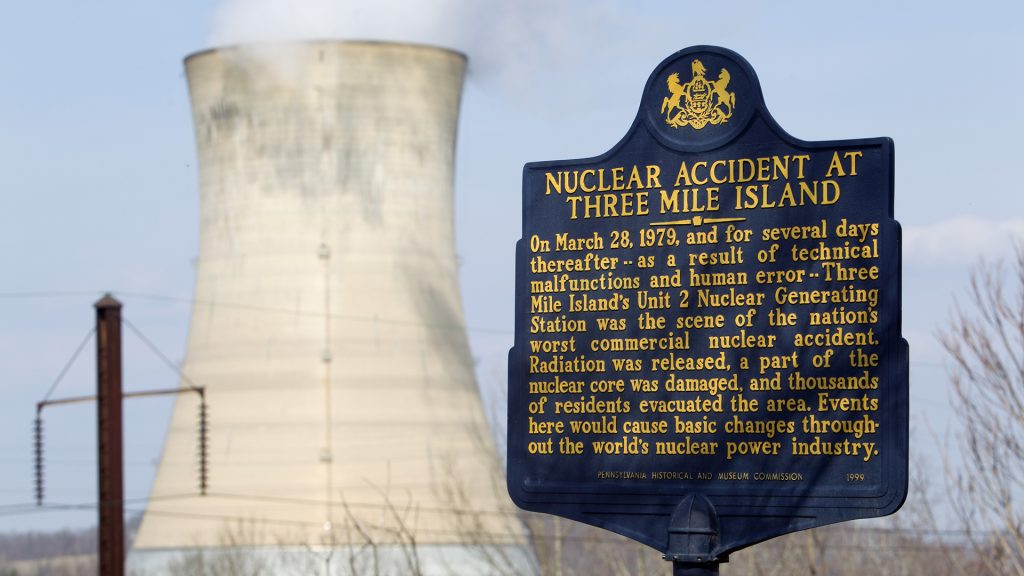
Legal threats, skills shortages and regulatory challenges complicate reopening of plant at site of nuclear accident
Ft.com Jamie Smyth in Middletown, Pennsylvania, 17 Nov 24
A group of veteran community activists is planning legal action to block the reopening of Three Mile Island nuclear plant in a test of whether the American public will back an atomic energy boom financed by Big Tech and US taxpayers. Three Mile Island Alert, a group founded almost half a century ago to lobby for the closure of the plant in Middletown, Pennsylvania — site of the worst nuclear accident in US history — said it would challenge government licences required by operator Constellation Energy, which is targeting a restart in 2028.
The legal threat is one of several obstacles facing the utility as it races to meet the terms of a 20-year power supply deal struck with Microsoft. The $1.6bn project could become a potent symbol of the revival of nuclear energy in the US.
Constellation must obtain numerous regulatory approvals, train hundreds of staff and upgrade equipment at a time when nuclear supply chains are stretched. It must also persuade the local community — and the incoming administration of Donald Trump — that the benefits of restarting the plant outweigh the risks.
“The restart is not going to happen by 2028: that is pure fantasy,” Eric Epstein, a 64-year old former history professor and chair of TMI Alert, told the Financial Times. “We haven’t even cleaned up Three Mile Island unit two, the site of the accident is still highly radioactive . . . and now we’re going to generate more nuclear waste. It’s disappointing and it’s manifestly unfair.”
TMI’s second reactor was closed in 1979 after a partial meltdown caused a radiation leak, prompting a chaotic response from then operator Metropolitan Edison Company and public authorities that dented public trust. The plant’s first reactor was shuttered in 2019 for economic reasons when the US shale revolution produced so much cheap gas that nuclear energy could not compete.
Read more ………… https://www.ft.com/content/b90f6e21-bb8d-4606-9e5e-c4acb56b86ce
: Restart of Three Mile Island tests US appetite for nuclear revival
Biden Authorizes Ukrainian Long-Range Strikes Into Russia Using ATACMS Missiles – Reports
Ilya Tsukanov, 17 Nov 24, https://sputnikglobe.com/20241117/biden-authorizes-ukrainian-long-range-strikes-into-russia-using-atacms-missiles—reports-1120914282.html
The US and its allies spent months debating whether or not to give Ukraine the go-ahead to use its NATO-provided long-range strike systems to target Russia. In September, President Putin warned that allowing Kiev to use its Western long-range missiles on Russia would mean NATO’s direct participation in a war against the Russian Federation.
President Biden has signed off on the Ukrainian military’s use of US-made ATACMS missiles to try to help defend its faltering positions in Ukrainian-occupied areas of Russia’s Kursk region, the New York Times reported on Sunday, citing US officials apprized of the situation.
The US and its allies spent months debating whether or not to give Ukraine the go-ahead to use its NATO-provided long-range strike systems to target Russia. In September, President Putin warned that allowing Kiev to use its Western long-range missiles on Russia would mean NATO’s direct participation in a war against the Russian Federation.
President Biden has signed off on the Ukrainian military’s use of US-made ATACMS missiles to try to help defend its faltering positions in Ukrainian-occupied areas of Russia’s Kursk region, the New York Times reported on Sunday, citing US officials apprized of the situation.
Officials told the newspaper that they “do not expect the shift” in policy “to fundamentally alter the course of the war” (NYT’s phrasing), and indicated that Biden could further authorize Kiev to use the weapons in directions besides Kursk in the future.
Washington reportedly expects the ATACMS to be used to strike troop concentrations, military equipment, logistics, ammunition depots and supply lines, all with the goal of “blunt[ing] the effectiveness” of the ongoing Russian military operation to clear Kursk of Ukrainian forces.
According to NYT’s information, some Pentagon officials opposed delivering the missile systems to Ukraine in the first place due to the US Army’s limited supply. Others reportedly expressed fears that their delivery and use could escalate the conflict and even prompt direct Russian retaliation against US and NATO forces – something President Putin has explicitly warned about.
The ATACMS go-ahead also appears to be connected to to the increasingly dire situation for Ukrainian forces across the front, with US officials said to have become “increasingly concerned” about the Ukrainian army being “stretched thin by simultaneous Russian assaults in the east, Kharkov and now Kursk.”
President-elect Trump’s statements about seeking to quickly end the conflict have also reportedly weighed in the outgoing administration’s decision, NYT said.
Leaked tritium reached the Mississippi

by beyondnuclearinternational, https://beyondnuclearinternational.org/2024/11/17/leaked-tritium-reached-the-mississippi/
False assurances by Xcel Energy and the Nuclear Regulatory Commission have now been retracted by the regulator, reports John LaForge
In April, I reported on false assurances made by Xcel Energy and the Nuclear Regulatory Commission (NRC) regarding the November 2022 leak from the Monticello, Minnesota nuclear reactor of some 829,000 gallons of cooling water containing a huge concentration of radioactive tritium (technically, 5.2 million picocuries per liter).
In eye-opening remarks at the Monticello Community Center on May 15, NRC Senior Environmental Project Manager, Stephen J. Koenick, apologized for the commission staff’s often-repeated claims that leaked tritium from the 53-year-old reactor had not reached the Mississippi River — drinking water source for 20 million people, including the Minneapolis/St. Paul metro area.
In his underreported apology, Koenick said, “I would like to take a moment to address and clarify some miscommunication regarding the presence of detectable tritium in the Mississippi River. I know we … reported there were no indication[s] of [a] tritium leak [which] made it to the Mississippi.
“However, … in our Draft Environmental Impact Statement, we … conclude there were some very low concentrations of tritium in the Mississippi River.” Koenick went on to say, “So we apologize for this miscommunication.”
The weekly Monticello Times reported on the vanishingly rare public confession and its crucial admission that radioactive tritium from the massive 2022 leak had contaminated the Mississippi. The paper published a report on the front-page on Jun. 6, under the headline: “NRC apologizes, changes its stance on tritium leak: Now says low concentrations got into Mississippi River.”
What Koenick meant by “miscommunication” were false assurances made to the press that no tritium had been found by Xcel’s testing of the river. On Mar. 18, 2023, NRC spokesperson Viktoria Mitlyng even told the press, “There is no pathway for the tritium to get into drinking water.”
As recently as May 7, 2024, NRC presenters at a separate NRC-sponsored public hearing, also held in Monticello, said that Xcel had found “no detectable levels” of tritium in the river.
Tritium is the radioactive form of hydrogen. It cannot be removed by any kind of filtering and contaminates huge volumes of regular water that it contacts. Tritium is a danger to health if taken internally, by drinking or breathing, because it moves like water to every part of the body, and because it crosses the placenta where it endangers the fetus and causes birth abnormalities and problem pregnancies.
Xcel has applied for a second operating license extension for the Monticello jalopy which, if granted, would allow the reactor, one of the three oldest in the country, to run until the age of 80. Over 3,000 public comments have been sent to the NRC regarding its Draft Environmental Impact Statement on the 80-year-risk — most of them voicing alarmed opposition.
While studying the NRC’s Draft EIS, Nukewatch’s Lindsay Potter discovered an extremely odd coincidence.
As with any environmental impact study, the NRC has to establish a formal calendar for information-gathering. The data collection time-frame for the Monticello draft officially ended on August 18, 2023.
According to Xcel Energy and NRC documents, August 18 was the very same day that radioactive tritium contamination in Xcel’s groundwater tests near the Mississippi River exceeded the federal EPA drinking water limit. (Technically 20,000 picocuries per liter.)
Curiously, high and rapidly increasing levels of tritium (from the plume created by the major 2022 leak) was detected in a monitoring well near the river, beginning July 27, 2023. Then, tests over the following three weeks show the concentration of tritium grew five-fold, the documents show, until on August 18 when the tritium concentration exceeded the United States EPA’s drinking water allowable max.
As a result of the NRC’s data collection cut-off date, the Draft EIS omits the critical time-frame immediately after August 18, when tritium levels were above permitted limits and still increasing.
Likewise, Xcel’s “2023 Annual Radioactive Effluent Release Report” submitted to the NRC, fails to provide precise data on groundwater monitoring tests results following Aug. 18, 2023, noting in general terms only that tests done after Aug. 18, 2023 found no unsafe levels of contamination.
Based on past “miscommunications,” readers can decide whether such public assurances are reliable.
John LaForge is a co-director of Nukewatch, a peace and environmental watchdog group in Wisconsin, edits the group’s quarterly newsletter, and with Arianne Peterson co-edited Nuclear Heartland, Revised Edition: A guide to the 450 land-based missiles of the United States.
This article first appeared on Southside Pride and is republished with permission of the author.
Biden’s Last Minute US-Saudi Deal Could Open Door Nuclear Arms Race
Robert Inlakesh, November 15, 2024, https://www.mintpressnews.com/bidens-last-stand-us-saudi-deal-conflict-nuclear-arms-race/288567/
recent report suggests that quiet negotiations are underway between Riyadh and Washington as the two nations work toward securing a U.S.-Saudi security agreement before President Biden’s term concludes. The initiative appears aimed at establishing what Israeli Prime Minister Benjamin Netanyahu has dubbed “the new Middle East.”
Before the conflict in Gaza erupted on Oct. 7, 2023, U.S. and Saudi officials were deep in discussions over a controversial security pact. The proposed agreement is part of a sweeping initiative designed to pave the way for normalization between Saudi Arabia and Israel.
The initial framework of the U.S.-Saudi deal was anticipated to include a provision akin to NATO’s Article 5, asserting that an attack on one would constitute an attack on all. By September 2023, it became clear that the security pact would hinge on Riyadh’s decision to normalize ties with Israel. Another key demand from Saudi Crown Prince Mohammed bin Salman was the development of a nuclear program, a point expected to be a defining feature of the agreement.
The U.S.-Saudi agreement, however, was far more ambitious than simply providing incentives for normalization; it was part of a sweeping strategy encompassing the entire West Asia region.
In June 2022, Jordan’s King Abdullah II publicly voiced his support for a “Middle East-type NATO.” Speculation quickly followed that such an alliance could include Jordan, Egypt, Saudi Arabia, the United Arab Emirates, and other U.S.-aligned Arab nations—all working in tandem with Israel and the United States. The objective would be to establish a regional bloc capable of counterbalancing Iran’s Axis of Resistance and reinforcing U.S. influence across the region.
Such an alliance would align closely with the push to establish the India-Middle East-Europe Economic Corridor—a trade route designed to connect Asia and Europe through a land passage spanning the UAE, Saudi Arabia, Jordan, and Israel.
On Sept. 9, 2023, the White House issued a memorandum touting the “landmark” trade corridor, with President Biden calling it “a really big deal” during his visit to the G20 summit in New Delhi. Later that month, Israeli Prime Minister Benjamin Netanyahu addressed the United Nations General Assembly, unveiling a map that underscored the emerging Israeli-Arab partnership and featured the trade route, which he hailed as “the new Middle East.”
The only obstacle to the U.S.-backed Arab-Israeli alliance against Iran—and the ambitious trade corridor—was the lack of a formal normalization agreement between Saudi Arabia and Israel. By late September, Saudi Crown Prince Mohammed bin Salman publicly suggested that an agreement with Israel was “getting closer,” effectively sidelining the Palestinian cause.
However, the entire project—predicated on the assumption that the Palestinian issue was no longer a significant factor—was upended by the Hamas-led surprise attack on Israel on Oct. 7.
Saudi Arabia has recently emphasized that establishing a Palestinian state is a prerequisite for any normalization agreement with Israel. Throughout 2024, discussions between Riyadh and Washington regarding a controversial security pact have intermittently surfaced in the news. According to a report by Axios, there is a concerted effort to finalize this security agreement before President Joe Biden’s term concludes in January.
While the full details of the agreement remain undisclosed, two primary aspects have raised concerns: the establishment of a Saudi civilian nuclear program and a defense clause that could obligate the U.S. to engage militarily against Riyadh’s adversaries in the event of an attack.
In his 2024 address to the United Nations General Assembly, Israeli Prime Minister Benjamin Netanyahu once again turned to props, illustrating a vision of an Arab-Israeli alliance he described as the “dream” set against Iran’s “nightmare.” The presentation made clear that Netanyahu remains hopeful of reviving the region’s pre-Gaza war blueprint.
A U.S.-Saudi defense agreement binding Washington to Saudi Arabia’s defense could have significant implications. Any breakdown in the truce between Riyadh and Sana’a could entangle U.S. forces in Yemen’s conflict. Additionally, the establishment of a Saudi nuclear program risks being perceived by Iran as a security threat, heightening regional tensions and adding a new layer of volatility to the Middle East.
1 This Month
23-25 October – on Zoom – World BEYOND War’s annual global conferenc


Shut down the radiation-damaged Heysham nuclear reactors now
To see nuclear-related stories in greater depth and intensity – go to https://nuclearinformation.wordpress.com

Say No to NASA’s Reckless Nuclear Reactor on the Moon
Say No to NASA’s Reckless Nuclear Reactor on the Moon

-
Archives
- October 2026 (199)
- September 2026 (339)
- August 2026 (330)
- July 2026 (355)
- June 2026 (287)
- May 2026 (306)
- April 2026 (356)
- March 2026 (251)
- February 2026 (267)
- January 2026 (308)
- December 2025 (358)
- November 2025 (359)
-
Categories
- 1
- 1 NUCLEAR ISSUES
- business and costs
- climate change
- culture and arts
- ENERGY
- environment
- health
- history
- indigenous issues
- Legal
- marketing of nuclear
- media
- opposition to nuclear
- PERSONAL STORIES
- politics
- politics international
- Religion and ethics
- safety
- secrets,lies and civil liberties
- spinbuster
- technology
- Uranium
- wastes
- weapons and war
- Women
- 2 WORLD
- ACTION
- AFRICA
- Atrocities
- AUSTRALIA
- Christina's notes
- Christina's themes
- culture and arts
- Events
- Fuk 2022
- Fuk 2023
- Fukushima 2017
- Fukushima 2018
- fukushima 2019
- Fukushima 2020
- Fukushima 2021
- general
- global warming
- Humour (God we need it)
- Nuclear
- RARE EARTHS
- Reference
- resources – print
- Resources -audiovicual
- Weekly Newsletter
- World
- World Nuclear
- YouTube
-
RSS
Entries RSS
Comments RSS

