The mystery of a Truchas woman who died with extraordinary amounts of plutonium in her body
KUNM | By Alice Fordham, https://www.kunm.org/local-news/2024-01-08/the-mystery-of-a-truchas-woman-who-died-with-extraordinary-amounts-of-plutonium-in-her-body
With the release of the movie Oppenheimer last year, there has been a resurgence of interest in the history of the Los Alamos National Laboratory. But for writer Alicia Inez Guzmán at the investigative nonprofit Searchlight New Mexico, that interest has been there for years as she has covered the past and present of the lab and its impact on the people of northern New Mexico. Her reporting includes the town of Truchas, where she grew up. In her latest report, Guzmán looks at the story of one woman who lived in Truchas, and died in 1972, inexplicably with extraordinarily high levels of plutonium in her body. Guzmán spoke with KUNM about her reporting.
ALICIA INEZ GUZMAN: When I first heard about this mystery woman, it was on an airplane coming back to Santa Fe. And I was sitting next to Jay Coghlan, who’s the executive director of Nuclear Watch New Mexico. And he said something to the effect of, the woman with the most plutonium in her body after the Trinity Site detonation, was from Truchas. And I just thought it was so fascinating and cryptic that I actually got the source of the information, which is the LAHDRA report or the Los Alamos Historical Document and Retrieval Assessment. And that’s where I was able to read for myself that there was a woman from Truchas, who had 60 times the amount of plutonium than the average New Mexico resident, and it was attributed to the Trinity Site, which led me on a wild goose chase basically
KUNM: Why was this so intriguing to you?
GUZMAN: Sure, so Truchas is 225 miles away from the Trinity Site. It’s in northern New Mexico in the Sangre de Cristo Mountains. And we know of course, the fallout did reach places like Truchas and far beyond, but in order for somebody to have plutonium in their body, they have to ingest it or inhale it. And so that was part of the question that I had was: well, she’s 225 miles away, could she have ingested or inhaled plutonium at that distance?
KUNM: So you had these questions, how did you go about finding out more about this person?
GUZMAN: When she was listed in the larger report, simply she was from Truchas, alive when Trinity detonated. So I had two pieces of information to go on. But what I realized was that the reason why they had that information about her at all was because the lab had conducted a series of autopsies on not only workers from Los Alamos National Laboratory, but the surrounding community. And once I found that information out, I was able to determine that there had actually been a class action lawsuit made on behalf of families of people who had been autopsied, because their families had never given informed consent. So I had to go to the courthouse here in Santa Fe, and from there, I found an issue of Health Physics magazine from 1979. And her name was not given, but it gave her age, at death, where she was from, what she did — a housewife — and the year that she died. And so, when I did a search in obituaries for that set of criteria, only one woman came up. And it turns out, as I suspected, that I knew the family.
KUNM: And what did they learn from you, and what did you learn from them?
GUZMAN: I should start out with what they learned, because I had to basically call them and reveal that possibly their grandmother had been involved in this clandestine study. And that if it was her, she had by far the most amount of plutonium in her body than anybody else who had been autopsied as a resident in that study. So, I think it was a huge shock to them.
Of course, what I learned from them was that this woman, whose name is Epifania Trujillo, she ended up moving in with her daughter and son in law, and her son in law, as it happened, worked at the laboratory as a janitor in a hot site, a hot site being somewhere where there was radiation, and that all of his children, he had seven children, all of his children except for one ended up getting cancer, and his wife. And so, I started talking to epidemiologists and toxicologists and physicists to really think through: is it possible that instead of having been exposed or contaminated from the Trinity Site, could it be Epifania and her family had been exposed and contaminated by what I later came to know or find out was take-home toxins? And largely what I hypothesize in the story was it is far more likely that her exposure came from Los Alamos National Laboratory, then it would be from Trinity Site.
Coldwater Creek to finally have warning signs after decades of nuclear contamination
Nuclear waste stored outside St. Louis was found to pose a risk to nearby Coldwater Creek as early as 1949. The contaminated creek will finally have warning signs almost 75 years later.
Missouri Independent, BY: ALLISON KITE – JANUARY 8, 2024
More than 70 years after workers first realized barrels of radioactive waste risked contaminating Coldwater Creek, the federal government has started work to put up signs warning residents.
The U.S. Army Corps of Engineers said in a statement Monday that it was working with the Environmental Protection Agency to add signs along the creek to help it monitor areas “that may pose a risk if disturbed.”
Coldwater Creek has been contaminated for decades with radioactive waste left over from the World War II-era effort to build an atomic bomb. But though the creek winds through some of St. Louis’ busiest suburbs and past public parks and schools, the federal government had resisted calls to post signs warning visitors of the contamination.
“This is decades of potential exposure that could have been prevented that they drug their feet on,” said Dawn Chapman, co-founder of Just Moms STL, an organization formed to advocate for communities affected by St. Louis-area radioactive waste.
Despite the delays, Chapman said she’s thankful that the signs are finally going to be installed.
The St. Louis area has long struggled with a radioactive waste problem. Uranium for the Manhattan Project, the name given to the effort to develop the first atomic bomb, was refined in downtown St. Louis.
After World War II, radioactive waste left over from those efforts was trucked to the St. Louis airport and dumped — some on the open ground and some in barrels — next to Coldwater Creek. As early as 1949, Mallinckrodt Chemical Works, the company that refined uranium for the federal government, was aware the waste could escape deteriorating barrels and enter the creek…………………………………………………………………………………………………………………………..
While the Army Corps, which has overseen the sites since the late 1990s, said the remaining contaminated sites surrounding Coldwater Creek only pose a risk if they’re disturbed, in previous decades exposure to the creek’s waters may have raised the risk of cancer for St. Louis residents.
The Agency for Toxic Substances and Disease Registry concluded in 2019 that children and adults who played in or near Coldwater Creek or lived in its floodplain between the 1960s and 1990s may have been exposed to radioactive materials that raise the risk of certain cancers. The agency — part of the Centers for Disease Control and Prevention — recommended signs be placed along the creek to warn residents of the potential exposure risk.
According to the St. Louis Post-Dispatch, the Army Corps said at the time doing so wasn’t its role………………………………………………………………………………………………………………………….
The announcement comes at a time of renewed focus on St. Louis’ radioactive waste problem. Bush and U.S. Sen. Josh Hawley have sought compensation for residents sickened because of exposure to radioactive waste, and an investigation by The Missouri Independent, MuckRock and The Associated Press found that private companies and government agencies downplayed the risks associated with the contamination for decades .
Andy Quinones, senior communications manager for the city of Florissant, said the Army Corps had requested to put signs in several of the city’s parks that sit along the creek.
“I’m glad,” Quinones said, “that they are taking the initiative to start doing a better job of informing the public.” https://missouriindependent.com/2024/01/08/coldwater-creek-to-finally-have-warning-signs-after-decades-of-nuclear-contamination/
The ‘Ghost Budget’: How America Pays for Endless War
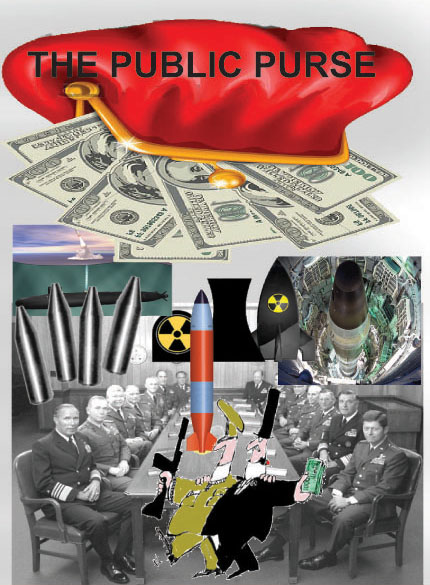
The post-9/11 war funding pattern was completely different. For the first time since the American Revolutionary War, war costs were covered almost entirely by debt. There were no wartime tax increases or cuts in spending. Quite the reverse
a “culture of endless money” inside the Pentagon.
the ability to keep borrowing and spending with minimal oversight allowed the United States to keep fighting indefinitely.
Prior to 2001, U.S. wars were financed through a mixture of higher taxes and budget cuts, and funded mostly through the regular defense budget. The post-9/11 war funding pattern was completely different.
By Linda Bilmes / Just Security https://scheerpost.com/2024/01/08/the-ghost-budget-how-america-pays-for-endless-war/
The post-9/11 wars in Iraq and Afghanistan were enabled by a historically unprecedented combination of budgetary procedures and financing methods. Unlike all previous U.S. wars, the post-9/11 wars were funded without higher taxes or non-war budget cuts, and through a separate budget. This set of circumstances – one that I have termed the “Ghost Budget” – enabled successive administrations to prosecute the wars with limited congressional oversight and minimal transparency and public debate. I adopted the name “Ghost Budget” because the term “ghost” appeared frequently in post-9/11 government reports in reference to funds allocated to people, places, or projects that turned out to be phantoms.
The Ghost Budget was the result of an interplay between changes in the U.S. budgetary process, a more assertive military establishment, and the conditions in global capital markets. It has had far-reaching implications for the conduct and course of the post-9/11 wars and for defense policy today.
Funding the Post-9/11 Wars
The “Ghost Budget” was the biggest budgetary anomaly in U.S. history. Prior to 9/11, U.S. wars were financed through a mixture of higher taxes and budget cuts, and funded mostly through the regular defense budget. One third of the costs of World War I and half the costs of World War II were met through higher taxes. During World War II, President Franklin D. Roosevelt described paying taxes as a “patriotic duty” as he raised taxes on business, imposed a “wealth tax,” raised inheritance taxes, and expanded the number of income taxpayers to roughly 80 percent of the workforce by 1945. Wars in Korea and Vietnam largely followed a similar pattern, with President Harry Truman pledging to make the country “pay as you go” for the Korean War. War funding was also a central issue in the Vietnam War, which ended when Congress refused to appropriate money for the South Vietnamese military.
The post-9/11 war funding pattern was completely different. For the first time since the American Revolutionary War, war costs were covered almost entirely by debt. There were no wartime tax increases or cuts in spending. Quite the reverse: far from demanding sacrifices, President George W. Bush slashed federal taxes in 2001 and again in 2003, just as the United States invaded Iraq. President Donald Trump reduced taxes further in 2017. Overall, federal taxes declined from 18.8 percent of GDP in 2001 to 16.2 percent by the start of 2020. In the same period, outstanding federal debt held by the public rose from $3.5 trillion to $20 trillion. War spending contributed at least $2.2 trillion to this increase.
Not only was the financing strategy unprecedented, but the budgetary mechanism used to approve the vast post-9/11 wartime spending also diverged radically from the past. In all previous conflicts, the United States paid for wars as part of its regular defense appropriations (the defense “base budget”), after the initial period (1-2 years) of supplemental “emergency” funding bills. By contrast, for the entire decade from FY 2001 to FY 2011, Congress paid for the conflicts in Iraq and Afghanistan as “emergencies,” devoid of serious legislative or executive oversight.
By statute, emergency spending is defined as “unanticipated…sudden…urgent…unforeseen…and temporary” and is typically reserved for one-off crises such as floods and hurricanes. Such emergency spending measures are exempt from regular procedural rules in Congress because the intent is to disburse money quickly in situations where delay would be harmful.
Congress continued to enact “emergency supplemental” funding even as the war effort expanded. The United States sent 130,000 military personnel into Iraq in 2003 (alongside troops from more than 30 countries). By 2009, there were 187,200 U.S. “boots on the ground” in Iraq and Afghanistan, supported by a similar number of military contractors, with nearly 500 U.S. military bases set up across Iraq, but the conflict was still being paid for as an “emergency.” In FY 2012, President Obama renamed the “Global War on Terror” as “Overseas Contingency Operations” (OCO) but the war continued to be funded using money that – although not designated as “emergency” – was explicitly exempted from regular spending limits on other government spending programs.
How We Got Here
There were three primary drivers of the Ghost Budget: unusual economic conditions, congressional budget dysfunction, and military assertiveness.
Economic Conditions: Unlike earlier wars, the post 9/11 conflicts took place in an era of free-flowing international capital markets. That provided the U.S. Treasury with access to a deep and global pool of capital, making it easy to borrow large amounts without negatively affecting the cost. It was also a period of historically low interest rates. Real interest rates (nominal rate minus inflation) on 10-year Treasury bonds fell from 3.4% at the start of 2001 to negative (-0.4%) by early 2021 — a 40-year low. Consequently, the Treasury was able to borrow trillions of dollars to pay for the wars, and simultaneously finance the tax cuts of 2001 and 2003 without having any material effect on the amount of debt service being repaid through the annual budget. By FY 2017, total public debt had more than tripled, but debt service payments as a percentage of annual budget outlays had decreased to 6.6 percent, compared to 8.5 percent of federal budget outlays in FY 2002. In terms of cash outlays, this meant that the United States paid only slightly more in interest payments in FY 2017 than it had in FY 2002 ($268 billion versus $232 billion in 2018 dollars). Borrowing seemed virtually painless.
Budget Dysfunction: For several decades, the federal budget process has become increasingly dysfunctional. This breakdown may be traced to the post-Watergate budget reforms enacted in 1974, which shifted power away from the President and to the Congress. Most budget experts from both parties agree that the reforms made the budget process weaker, less predictable, less capable of reconciling competing demands, and more prone to fiscal crises. Prior to 1974, the federal government had never ceased operations for lack of funding. Since then, it has “shut down” 22 times, completely or partially. There have been only four years in which Congress passed its annual appropriations bills on time, and a series of near-defaults and other fiscal crises. In the absence of reliable budgets, Congress has enacted hundreds of short-term stopgap “continuing resolutions” to pay the bills. In this context, it was convenient for all the stakeholders to fund the wars as an “emergency” outside the regular process. The President was able to exclude war funding from his annual defense budget request to Congress, thus presenting an artificially low number for the federal budget deficit. This helped the Bush administration sustain the pretense that the wars would be short, while pursuing its political agenda of cutting taxes. Meanwhile, Congress was freed from the need to find politically painful spending cuts elsewhere to pay for the war, and the Pentagon was able to prosecute the wars without worrying about whether Congress would pass the defense appropriations bills on time.
Military Assertiveness: In 2001, the Pentagon was actively seeking to increase its budget after a decade of post-cold war budget cuts. The Afghanistan and Iraq conflict not only reversed the downward trend in military spending, but opened the floodgates to a spending bonanza due to the nature of emergency and OCO appropriations. Unlike the regular defense base budget, the wartime supplemental money was easier to secure, had few restrictions on how it could be spent, and avoided the lengthy internal Planning, Programming, Budgeting & Execution Process (PPBE) budget justification process. Consequently, the Defense Department was able to shift war funding into other categories to obtain items on its long-time “wish list” that were only tangentially (or not at all) related to the wars in Iraq or Afghanistan. Former Defense Secretary Robert Gates termed this a “culture of endless money” inside the Pentagon.
By 2009, war spending accounted for almost one quarter of the total military budget; the Pentagon budget had grown to its highest level since the Second World War, and military spending had rebounded from 2.9% of GDP in FY 2001 to above 4% of GDP, where it remained through FY 2019. The OCO budget had evolved into a second defense budget that was largely untethered from the wars, and protected the military from congressional budget volatility.
Implications for Perpetual War
The Ghost Budget provided the ability to keep borrowing and spending in an almost unconstrained manner for more than two decades. The absence of new taxes insulated the public from the mounting cost of the wars and broke the expectation that wars would inevitably involve higher taxes. The OCO budget extended far beyond the immediate operational needs of the wars in Afghanistan and Iraq, perpetuating military actions throughout the region. As Immanuel Kant predicted in Perpetual Peace (1795), the ability to keep borrowing and spending with minimal oversight allowed the United States to keep fighting indefinitely.
Implications for Perpetual War
The Ghost Budget provided the ability to keep borrowing and spending in an almost unconstrained manner for more than two decades. The absence of new taxes insulated the public from the mounting cost of the wars and broke the expectation that wars would inevitably involve higher taxes. The OCO budget extended far beyond the immediate operational needs of the wars in Afghanistan and Iraq, perpetuating military actions throughout the region. As Immanuel Kant predicted in Perpetual Peace (1795), the ability to keep borrowing and spending with minimal oversight allowed the United States to keep fighting indefinitely.
The legacy of the Ghost Budget is that money is no longer a serious deterrent to war. To date, 99% of US assistance to Ukraine has been funded by supplemental emergency funds – which means that this spending is in addition to the $840 billion regular defense budget. The Biden administration has asked Congress to approve another $106 billion in emergency funding for the Middle East, Ukraine, and other regions. Regardless of the merits of any particular endeavor, the use of Ghost Budgets makes it far easier to prolong the fighting at any cost.
Another Voice: Nuclear (yet again)

By CRISPIN B. HOLLINSHEAD, January 7, 2024, https://www.ukiahdailyjournal.com/2024/01/07/another-voice-nuclear-yet-again/
At COP28, the latest United Nations Climate gathering, nuclear power received more attention. Saudi Arabia committed to developing nuclear electrical generation. China is constructing 21 large nuclear reactors. Some people believe a massive nuclear build out will avert the climate crisis. The 436 reactors now operating produce about 10 percent of the global electricity. It would take 10,000 additional reactors to completely decarbonize the global economy.
It is true that an operating reactor produces no greenhouse gases (GHG), but when the whole life cycle of a reactor is analyzed, including construction and fuel enrichment, a standard 1,000MW reactor releases GHG comparable to a natural gas power plant. Even that evaluation is incomplete, as it excludes complete decommissioning of a large nuclear plant (never been done), and long-term storage of high level nuclear waste (not yet done even after 70 years).
Nuclear corporations were blackmailed into business. After the atomic destruction in Japan, the US government wanted a happy face for the atom, so Atoms For Peace promoted “power too cheap to meter.” The electrical industry was told to develop nuclear power, or the government would do it, putting them out of business. This was a bluff, but nobody knew it then.
Economically, nuclear power is a bust. Reactors are large, expensive, and centralized, making construction more an art than manufacturing. Costs consistently comes in over budget and behind schedule, making nuclear power more expensive than solar or wind, even including storage. Even operating an existing nuclear reactor is more costly than building renewable projects. While solar, wind, and battery costs are dropping every year, nuclear costs keep increasing. Small modular reactors (SMR), heralded as the salvation of the nuclear industry, suffer the same cost problems, plus a lack of customers. The only SMR project in the US was just canceled due to cost overruns.
Uranium is a finite commodity, and used inefficiently. A reactor core contains tons of highly processed enriched uranium. After a few years, when only 5 percent of the uranium has been consumed, the core must be replaced. When fission byproducts build up, performance degrades to the point of economic inefficacy. Millions of tons of highly radioactive “spent” fuel are stored at reactor sites. The best uranium deposits have already been developed, leaving only poorer quality ore. Most low level enriched uranium comes from Russia.
But the real economic costs come when a reactor breaks. Designed to last for 40 years, decisions were made in the beginning with incomplete information, with multiple units built on those designs in order to make nuclear construction seem profitable. So far, the worst US designed reactor failures were the 40 year old units at Fukushima, in 2011. Complete cleanup cost estimates are over $1T. Actual repairs have yet to begin, because radioactivity is too high for even robots to function for very long, let alone humans.
The only reactors still operating in California are the 40 year old pair at Diablo Canyon, near San Luis Obispo. Heavy radioactivity embrittles metal, making it more prone to shock failure. Several earthquake faults have been identified near the site, including one right through the plant. PG&E has done embrittlement tests, but refuses to release the results to the public, claiming “proprietary rights”. The Diablo Canyon reactors were recently granted a 5-year extension, with no changes required to the existing, aging equipment.
A reactor failure due to a seismic event could affect a large area of central California, from LA to San Francisco and inland to Nevada, depending on which way the wind blows. But PG&E would not be liable for any damages beyond $13B, due to the Price Anderson Act, a sweet heart deal the US made when the nuclear industry began. Every liability insurance policy written has an exclusion for nuclear damages. This all helps the nuclear industry seem profitable.
Nuclear power highlights a fundamental capitalist problem: the conflict between safety and profits. Each reactor is so powerful, that any accident can become catastrophic faster than humans can react. It is so expensive, that the incentive is enormous to cut costs to be more profitable. Add in limited corporate financial liability, and you get a recipe for disaster.
Fukushima shows the “small probability, high impact” nature of a failed nuclear reactor. The economics of even a properly operating reactor fail basic capitalist reasoning. To leave a habitable planet for our descendants, we have to do better.
Crispin B. Hollinshead lives in Ukiah. This and previous articles can be found at cbhollinshead.blogspot.com.
Carlsbad depositary- 79% of waste came from nuclear wastes from Idaho National Laboratory
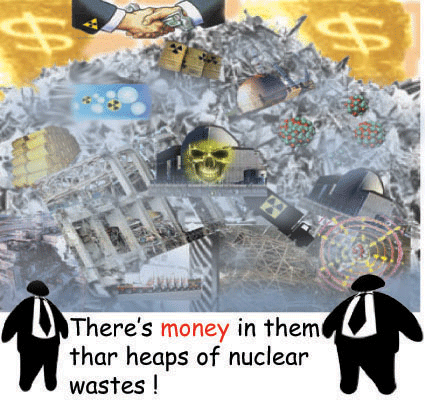
Hundreds of shipments of nuclear waste were buried at a facility near
Carlsbad in 2024, and the federal government was poised to send even more
waste to the site in 2024. For that work, the Department of Energy’s
contractor Salado Isolation Mining Contractors (SIMCO) earned about $11.5
million or about 89% of its available $13 million fee between Feb. 4, 2023
when SIMCO took over the contract and the end of the last federal fiscal
year on Sept. 30, 2023.
DOE records show 479 shipments of transuranic (TRU)
nuclear waste were received at the Waste Isolation Pilot Plant between Jan.
1 and Dec. 31, 2023, from federal labs and other nuclear facilities around
the U.S. TRU waste is made of clothing materials, equipment and other
debris irradiated during nuclear activities, and it is buried in a salt
deposit at WIPP about 2,000 feet underground. The DOE said in 2023 it
worked to increase shipments to 17 per week, and hold that level in the
coming years. Most of the waste, about 79%, came from Idaho National
Laboratory in the form of 377 waste shipments.
Carlsbad Current-Argus 7th Jan 2024
Amid Fears of Wider War, US Reportedly Drafting Plans to Bomb Yemen
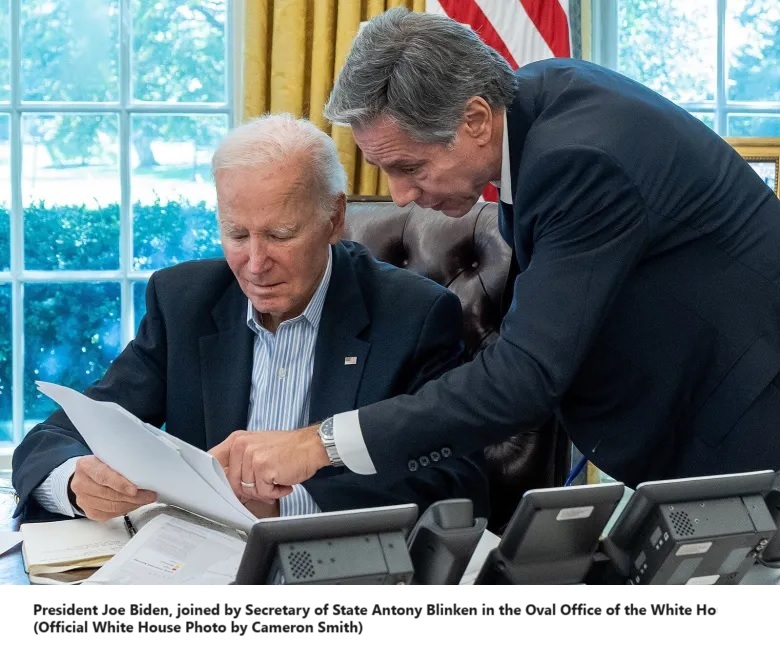
“Biden’s support for Israel’s Gaza war ties the U.S. to Israel’s escalatory cycle that may result in American soldiers dying in yet another Middle East war,” warned one analyst.
By Jake Johnson / Common Dreams, https://scheerpost.com/2024/01/05/amid-fears-of-wider-war-us-reportedly-drafting-plans-to-bomb-yemen/
The Biden administration is reportedly drafting plans to bomb Houthi targets in Yemen amid escalating fears of a wider war in the Middle East, where the U.S. is inflaming regional tensions by heavily arming Israel’s assault on the Gaza Strip.
Politicoreported Thursday that U.S. officials are “increasingly concerned” that Israel’s devastating war on Gaza “could expand… to a wider, protracted regional conflict.” Citing unnamed U.S. officials, the outlet noted that the U.S. military is drawing up plans to “hit back at Iran-backed Houthi militants who have been attacking commercial shipping in the Red Sea.”
Usamah Andrabi, communications director for Justice Democrats, wrotein response to the new reporting that U.S. President Joe Biden is “pushing the United States to the brink of a new endless war in the Middle East, all because he doesn’t want to stop funding Benjamin Netanyahu’s attempted eradication of the Palestinian people and Palestine itself.”
Eli Clifton, a senior adviser to the Quincy Institute for Responsible Statecraft, similarly argued that “Biden’s support for Israel’s Gaza war ties the U.S. to Israel’s escalatory cycle that may result in American soldiers dying in yet another Middle East war.”
“Biden has leverage to call for a cease-fire in Gaza,” Clifton added. “He isn’t using it.”
“The most effective way of avoiding this escalation is not to bomb the Houthis but to secure a cease-fire in Gaza.”
News of the administration’s private planning comes after dozens of advocacy organizations implored Biden not to consider any military assault on Yemen, which has been ravaged by years of Saudi-led, U.S.-backed bombing.
It also comes after several recent U.S. and Israeli attacks in the Middle East intensified concerns that the region is perilously close to all-out war.
On Tuesday, an Israeli drone strike in the Lebanese capital of Beirut killed a senior Hamas official, prompting Hezbollah’s leader to vow a “response and punishment.” Days earlier, an Israeli airstrike in Syria killed a senior adviser in Iran’s Islamic Revolutionary Guard Corps.
The U.S., for its part, has bombed Syria and Iraq multiple times over the past several months in response to drone and missile attacks on American forces stationed in the region. A U.S. airstrike in central Baghdad on Thursday killed Mushtaq Jawad Kazim al-Jawari, the leader of an Iran-aligned militia group operating in Iraq and Syria.
Biden administration officials have said publicly that they don’t want the Gaza war to expand, but their continued military support for Israel’s mass atrocities in Gaza and opposition to diplomatic efforts to stop the bloodshed in the Palestinian enclave has cast serious doubt on their commitment to preventing a full-blown conflict.
“The most effective way of avoiding this escalation is not to bomb the Houthis but to secure a cease-fire in Gaza,” Trita Parsi, executive vice president of the Quincy Institute for Responsible Statecraft, wrote in response to Politico‘s reporting.
“But Biden won’t even consider that—instead, he is ‘getting ready’ for a regional war,” Parsi added. “This is a dereliction of his duty to keep Americans safe.”
Antony Blinken Is A Cold-Blooded Sociopath

CAITLIN JOHNSTONE, JAN 8, 2024
US Secretary of State Antony Blinken just referred to the US-sponsored assassination of yet another journalist in Gaza as a “terrible tragedy”…………………………………………………..
Blinken went on to acknowledge the scores of journalists who have been killed in Gaza, saying that this shows the need to get humanitarian aid into the enclave and achieve a lasting peace. What Blinken did not do is issue anything resembling a condemnation of Israel and the clear and demonstrable fact that it has been highly focused on the task of murdering journalists in Gaza. He just offered his deepest condolences for Dahdouh’s death, framed it as a passive “tragedy” instead of an active assassination using highly sophisticated military technology under the sponsorship and support of the United States, and moved on.
It’s hard to say who’s worse, the far-right Israelis who openly revel in the butchery they are inflicting in Gaza, or the liberal Americans who directly sponsor that butchery and then look you dead in the eye and tell you how deeply, sincerely sorry they are to hear that another person in Gaza has died in a tragic accident.
Blinken is always doing sociopathic stuff like this. Late last month he tweeted, “This has been an extraordinarily dangerous year for press around the world. Many killed, many more wounded, hundreds detained, attacked, threatened, injured — simply for doing their jobs. I am profoundly grateful to the press for getting accurate, timely information to people.”
I mean, can you believe the gall of this freak? As though his own administration wasn’t responsible for most of those killings. As though Israel has not spent the last three months directing wildly disproportionate firepower at the places it knows journalists are hiding.
He’s standing there on top of a pile of corpses while mournfully shaking his head about their tragic unfortunate deaths.
There’s something about the job of US secretary of state that appears to require a significant level of sociopathy. From war criminal Henry Kissinger to Madeleine “We think the price was worth it” Albright to Mike “We lied, we cheated, we stole” Pompeo, the absolute worst person in any given presidential administration is very often the head of the State Department. A severe personality disorder is practically in the job description.
This is because while the secretary of state is officially the head of US diplomacy, “diplomacy” for the US empire looks a whole lot different from what it looks like for normal countries. US “diplomacy”, in practice, typically looks like going from country to country negotiating for international alignment behind wars, starvation sanctions, proxy conflicts and western-backed uprisings. In theory the State Department should be the department of peace, but in practice it’s just a subtler, sneakier military department.
Nothing epitomizes the depraved manipulations of the US empire better than Antony Blinken. There is no better representation of that empire than Tony standing there on his mountain of corpses, covered in blood, telling you how sorry he is to learn of the unfortunate accidental deaths of the people he just murdered, staring at you with his cold dead eyes, playing remarkably soulless blues guitar under the light of a bright red moon. https://www.caitlinjohnst.one/p/tony-blinken-is-a-cold-blooded-sociopath?utm_source=post-email-title&publication_id=82124&post_id=140464817&utm_campaign=email-post-title&isFreemail=true&r=1ise1&utm_medium=email
 | |||
| |||
All CNN Gaza Coverage Seen by Bureau Monitored by Israeli Defense Force Before Publication
The word “genocide” is “taboo” in the outlet’s newsroom, one staffer said.
SCHEERPOST, By Sharon Zhang / Truthout, 6 Jan 24
CNN has for years maintained a policy of running all of its coverage on Israel and Palestine, including its recent Gaza coverage, past its bureau in Jerusalem, where it is subject to the censorship policies set by Israel’s military, damning new reporting by The Intercept has revealed.
The Jerusalem CNN staff who review the reporting do so under the watchful eye of the Israel Defense Forces (IDF), which, as The Intercept has previously reported, is maintaining strict media bans around the genocide in Gaza, including censorship of topics and stories that may be embarrassing to the IDF. All reporters in Israel must sign an agreement to abide by such rules set by the IDF, and Israel has reportedly censored thousands of news stories since the beginning of the current massacre in Gaza.
In practice, this means that coverage of Israel and Palestine have a strong pro-Israel bias, as one anonymous staff member explained to The Intercept………………………………………..
Further, the investigation found that CNN leaders have explicitly prescribed policies that favor Israel.
In an email sent October 26, CNN’s News Standards and Practices sent staff an email directing them to refer to the ministry of health in Gaza as “Hamas-controlled” every time they reference the Palestinian death count — a widespread practice among major outlets, despite numerous human rights groups and war experts maintaining that the Gaza health ministry’s death tolls have historically been accurate and that public health experts have independently found no evidence that the ministry has inflated death counts.
“If the underlying statistics have been derived from the ministry of Health in Gaza, we should note that fact and that this part of the Ministry is ‘Hamas-controlled’ even if the statistics are released by the West Bank part of the ministry or elsewhere,” the memo said.
Then, on November 2, CNN’s Senior Director of News Standards and Practices, David Lindsey, sent another note to staff explicitly saying that statements from Hamas leaders should not be given a platform unless highly contextualized, and that as a rule, Hamas “representatives are engaging in inflammatory rhetoric and propaganda.”…………………………………………………..
The report lends evidence to what advocates for Palestinian rights have long maintained: that major U.S. and many other western outlets have a strong anti-Palestinian bias. This has become especially potent amid the current genocide, as CNN and other major outlets have come under scrutiny for embedding themselveswith the IDF to report on Gaza, meaning that they are escorted and observed by Israeli military forces and must submit coverage to the IDF before publication, all while supposedly reporting with an “objective” lens. https://scheerpost.com/2024/01/06/all-cnn-gaza-coverage-seen-by-bureau-monitored-by-idf-before-publication/
The real reason why the USA pushed for the world to “triple nuclear power” at COP 28.

While China dominates the wind- and solar-power sectors, nuclear energy is one area where officials believe the U.S. could compete with its long menu of newer reactor types and fuels.
U.S. puts diplomatic clout behind sales of cutting-edge reactors that have yet to show commercial success
Washington Heats Up Nuclear Energy Competition With Russia, China
By William Mauldin and Jennifer Hiller, Jan. 6, 2024 https://www.wsj.com/politics/national-security/washington-heats-up-nuclear-energy-competition-with-russia-china-f2f18e75
WASHINGTON—To compete with its biggest geopolitical rivals, the U.S. government is looking toward small nuclear reactors.
Not a single so-called small modular reactor has been sold or even built in the U.S., but American officials are trying to persuade partner countries to acquire the cutting-edge nuclear reactors still under development by U.S. firms. The goal: to wrest nuclear market share from Russia—the global industry giant—and defend against China’s fast-growing nuclear-technology industry.

The U.S. hopes that putting its clout behind a new technology can cement future commercial and diplomatic relationships and chip away at China’s and Russia’s ability to dominate their neighbors’ energy supply.
The Biden administration also sees nuclear energy as a way to export reliable green (?) energy, since nuclear-power plants split atoms and don’t burn carbon-based fuels that contribute most to climate change. With Russia’s broad 2022 invasion of Ukraine sending Poland and other European countries looking for new energy partners, U.S. officials and industry leaders see a potential opening in the market for U.S. exports to compete with China’s growing nuclear ambitions.
While China dominates the wind- and solar-power sectors, nuclear energy is one area where officials believe the U.S. could compete with its long menu of newer reactor types and fuels. The U.S. aims to sign agreements for partnerships lasting 50 years or longer to provide U.S. technology to Moscow’s former energy partners and to fast-growing countries in Southeast Asia worried about overreliance on Chinese and Russian energy.
“If we’re the supplier, we support the energy security of our allies and partners,” said Ted Jones, head of national security and international programs at the Nuclear Energy Institute, a U.S. industry group. “We help prevent them from finding themselves in the situation of Europe with respect to Russian gas and nuclear.”
At the core of the U.S. campaign is a technology, yet-unproven in the U.S., called a small modular reactor, or SMR. SMRs generate about one-third the energy of a conventional nuclear reactor and can be prefabricated and shipped to the site. Among other potential advantages, they are intended to be cheaper than larger reactors, which often have to be custom designed, and they can be installed to meet growing demand for energy, according to the International Atomic Energy Agency.
‘Very, very long-term strategic partnership’
U.S. officials say they are working with developers of SMRs, and the government-run Export-Import Bank and the U.S. International Development Finance Corp., to win overseas orders that will bring down costs and build an order book for the new technology, all while linking the countries’ energy systems to the U.S. and its allies. By 2035, the U.S. Nuclear Energy Agency estimates that the global SMR market could reach 21 gigawatts of power, enough to power two billion LED lightbulbs.
“It’s important that the United States maintains that leadership in the transition from the laboratory to the grid and deployment and commerciality,” said Geoffrey Pyatt, the State Department’s assistant secretary of energy resources. “It’s about building a very, very long term strategic partnership.”
To make nuclear-energy exports a viable tool of foreign policy, U.S. companies will have to prove they can deliver smaller reactors for export on time and budget, a goal that has eluded larger nuclear-power plants in the West.
The U.S. has yet to build an SMR, and none is yet under construction in the U.S. The concept’s economics remain unproven, as does the timeline for building such a reactor. One company, Kairos Power, recently received construction approval for a demonstration project in Tennessee. It plans to focus on the domestic market. NuScale Power, one of the major U.S. players, recently canceled an SMR project in Idaho when a group of utilities in the Mountain West couldn’t get enough members to commit.
To make the concept work, most SMRs’ developers would need a pipeline of orders so they could move into factory-style production, lowering unit costs.
Among the potential customers U.S. industry and government officials are looking at are Polish energy company Orlen, which wants to build SMRs designed by GE Hitachi Nuclear Energy.
The U.S. Export-Import Bank and U.S. International Development Finance Corp. have offered to arrange up to $4 billion in financing for a plant planned by NuScale in Romania, with an aim of going online in 2029 or 2030. U.S. officials also say they are in discussions with Bulgaria, Ghana, Indonesia, Kazakhstan and the Philippines on new nuclear projects.
China is leading the world in reactor construction and recently started commercial operations of a plant with two SMRs. The country is now building 22 of the 58 reactors under construction around the world, according to the International Atomic Energy Agency. China has built reactors in Pakistan and aims to join Russia as a major exporter of nuclear technology.
Last year, China and the U.S. were jockeying to provide civilian nuclear technology to Saudi Arabia. Washington appeared close to a deal, part of a regional pact with Israel, but it was derailed by Hamas’s attack on Israelis in October and the subsequent war in Gaza.
U.S. sales pitch: We’re less risky than Russia and China
Russia’s state-owned Rosatom, meanwhile, is a major exporter of both reactors and nuclear fuel.
According to the latest World Nuclear Industry Status Report, it was building 24 reactors: 19 large reactors in countries from Turkey to Bangladesh, a barge to be equipped with two small reactors under construction in China but intended for use in Russia, and three reactors at home. Of the reactors under construction in Russia, two are large; the third is an SMR that would use liquid metal for cooling. Rosatom started commercial operations of two SMRs on a floating barge in 2020, though that project took longer and cost more than expected.
Washington is counting on partner countries’ interest in working with U.S. firms and what officials are selling as a less risky tie-up than working with Moscow and Beijing on projects that have a lifespan of 50 years or more.
“It’s never good if our allies are dependent on a potential adversarial country for energy,” said Bret Kugelmass, chief executive of nuclear-power startup Last Energy, which plans to build microreactors that would generate 20 megawatts of electricity and be sited near factories.
The process for hammering out a network of government and commercial deals can take years, with U.S. officials working alongside foreign counterparts, export credit agencies, nuclear-energy firms and utilities, not to mention the U.S. Congress. Russia and China have the advantage of state-led financial sectors to fund projects that can span a decade until power flows.
U.S. industry executives and government officials say they are now working on shortcuts to marketing reactors, including setting up a single government-to-government deal that includes corporate contracts and public and private financing assistance.
The new deals are designed to appeal to partner countries that want a simpler path to getting a reactor, without the heavy dose of Chinese financing that U.S. officials say might have strings attached.
Bill Introduced in House Calls for US to Drop Charges Against Julian Assange

Call your representative and tell them to support H.Res. 934
By Dave DeCamp / Antiwar.com January 7, 2024 https://scheerpost.com/2024/01/07/bill-introduced-in-house-calls-for-us-to-drop-charges-against-julian-assange/
Aresolution introduced in the House last month calls for the US to drop the charges against WikiLeaks founder Julian Assange, who faces up to 175 years in prison if extradited to the US and convicted for journalism that exposed US war crimes.
The bill, introduced by Rep. Paul Gosar (R-AZ), expresses “the sense of the House of Representatives that regular journalistic activities, including the obtainment and publication of information, are protected under the First Amendment and that the federal government should drop all charges against and attempts to extradite Julian Assange.”
Assange, who’s been held in London’s Belmarsh Prison since 2019, has a hearing scheduled at the UK High Court on February 20 and 21 to appeal his extradition to the US, which is likely his final chance. Ahead of the hearing, WikiLeaks and Assange’s supporters are asking Americans to contact their House representatives and urge them to support Gosar’s resolution.
Click here to find your representative, or call the House switchboard operator at (202) 224-3121. Tell them to support H.Res. 934 to protect the First Amendment and press freedom.
So far, the resolution has eight co-sponsors: Reps. James McGovern D-MA), Thomas Massie (R-KY), Marjorie Taylor Greene (R-GA), Anna Paulina Luna (R-FL), Eric Burlison (R-MO), Jeff Duncan (R-SC), Ilhan Omar (D-MN), and Clay Higgins (R-LA).
US Foreign Policy Is a Scam Built on Corruption

Despite these remarkable and costly debacles, one following the other, the same cast of characters has remained at the helm of US foreign policy for decades, including Joe Biden, Victoria Nuland, Antony Blinken, (both seen at left ), Jake Sullivan, Chuck Schumer, Mitch McConnell, and Hillary Clinton.
The more wars, of course, the more business.
by Jeffrey D. Sachs / Common Dreams, January 7, 2024 https://scheerpost.com/2024/01/07/us-foreign-policy-is-a-scam-built-on-corruption/
The $1.5 trillion in military outlays each year is the scam that keeps on giving—to the military-industrial complex and the Washington insiders—even as it impoverishes and endangers America and the world.
On the surface, US foreign policy seems to be utterly irrational. The US gets into one disastrous war after another — Afghanistan, Iraq, Syria, Libya, Ukraine, and Gaza. In recent days, the US stands globally isolated in its support of Israel’s genocidal actions against the Palestinians, voting against a UN General Assembly resolution for a Gaza ceasefire backed by 153 countries with 89% of the world population, and opposed by just the US and 9 small countries with less than 1% of the world population.
In the past 20 years, every major US foreign policy objective has failed. The Taliban returned to power after 20 years of US occupation of Afghanistan. Post-Saddam Iraq became dependent on Iran. Syria’s President Bashar al-Assad stayed in power despite a CIA effort to overthrow him. Libya fell into a protracted civil war after a US-led NATO mission overthrew Muammar Gaddafi. Ukraine was bludgeoned on the battlefield by Russia in 2023 after the US secretly scuttled a peace agreement between Russia and Ukraine in 2022.
To understand the foreign-policy scam, think of today’s federal government as a multi-division racket controlled by the highest bidders.
Despite these remarkable and costly debacles, one following the other, the same cast of characters has remained at the helm of US foreign policy for decades, including Joe Biden, Victoria Nuland, Jake Sullivan, Chuck Schumer, Mitch McConnell, and Hillary Clinton.
What gives?
The puzzle is solved by recognizing that American foreign policy is not at all about the interests of the American people. It is about the interests of the Washington insiders, as they chase campaign contributions and lucrative jobs for themselves, staff, and family members. In short, US foreign policy has been hacked by big money.
As a result, the American people are losing big. The failed wars since 2000 have cost them around $5 trillion in direct outlays, or around $40,000 per household. Another $2 trillion or so will be spent in the coming decades on veterans’ care. Beyond the costs directly incurred by Americans, we should also recognize the horrendously high costs suffered abroad, in millions of lives lost and trillions of dollars of destruction to property and nature in the war zones.
The costs continue to mount. US Military-linked outlays in 2024 will come to around $1.5 trillion, or roughly $12,000 per household, if we add the direct Pentagon spending, the budgets of the CIA and other intelligence agencies, the budget of the Veteran’s Administration, the Department of Energy nuclear weapons program, the State Department’s military-linked “foreign aid” (such as to Israel), and other security-related budget lines. Hundreds of billions of dollars are money down the drain, squandered in useless wars, overseas military bases, and a wholly unnecessary arms build-up that brings the world closer to WWIII.
Yet to describe these gargantuan costs is also to explain the twisted “rationality” of US foreign policy. The $1.5 trillion in military outlays is the scam that keeps on giving—to the military-industrial complex and the Washington insiders—even as it impoverishes and endangers America and the world.
To understand the foreign-policy scam, think of today’s federal government as a multi-division racket controlled by the highest bidders. The Wall Street division is run out of the Treasury. The Health Industry division is run out of the Department of Health and Human Services. The Big Oil and Coal division is run out of the Departments of Energy and Interior. And the Foreign Policy division is run out of the White House, Pentagon and CIA.
Each division uses public power for private gain through insider dealing, greased by corporate campaign contributions and lobbying outlays. Interestingly, the Health Industry division rivals the Foreign Policy division as a remarkable financial scam. America’s health outlays totaled an astounding $4.5 trillion in 2022, or roughly $36,000 per household, by far the highest health costs in the world, while America ranked roughly 40th in the world among nations in life expectancy. A failed health policy translates into very big bucks for the health industry, just as a failed foreign policy translates into mega-revenues of the military-industrial complex.
The more wars, of course, the more business.
The Foreign Policy division is run by a small, secretive and tight-knit coterie, including the top brass of the White House, the CIA, the State Department, the Pentagon, the Armed Services Committees of the House and Senate, and the major military firms including Boeing, Lockheed Martin, General Dynamics, Northrop Grumman, and Raytheon. There are perhaps a thousand key individuals involved in setting policy. The public interest plays little role.
The key foreign policy makers run the operations of 800 US overseas military bases, hundreds of billions of dollars of military contracts, and the war operations where the equipment is deployed. The more wars, of course, the more business. The privatization of foreign policy has been greatly amplified by the privatization of the war business itself, as more and more “core” military functions are handed out to the arms manufacturers and to contractors such as Haliburton, Booz Allen Hamilton, and CACI.
In addition to the hundreds of billions of dollars of military contracts, there are important business spillovers from the military and CIA operations. With military bases in 80 countries around the world, and CIA operations in many more, the US plays a large, though mostly covert role, in determining who rules in those countries, and thereby on policies that shape lucrative deals involving minerals, hydrocarbons, pipelines, and farm and forest land. The US has aimed to overthrow at least 80 governments since 1947, typically led by the CIA through the instigation of coups, assassinations, insurrections, civil unrest, election tampering, economic sanctions, and overt wars. (For a superb study of US regime-change operations from 1947 to 1989, see Lindsey O’Rourke’s Covert Regime Change, 2018).
In addition to business interests, there are of course ideologues who truly believe in America’s right to rule the world. The ever-warmongering Kagan family is the most famous case, though their financial interests are also deeply intertwined with the war industry. The point about ideology is this. The ideologists have been wrong on nearly every occasion and long ago would have lost their bully pulpits in Washington but for their usefulness as warmongers. Wittingly or not, they serve as paid performers for the military-industrial complex.
There is one persistent inconvenience for this ongoing business scam. In theory, foreign policy is carried out in the interest of the American people, though the opposite is the truth. (A similar contradiction of course applies to overpriced healthcare, government bailouts of Wall Street, oil-industry perks, and other scams). The American people rarely support the machinations of US foreign policy when they occasionally hear the truth. America’s wars are not waged by popular demand but by decisions from on high. Special measures are needed to keep the people away from decision making.
In theory, foreign policy is carried out in the interest of the American people, though the opposite is the truth.
The first such measure is unrelenting propaganda. George Orwell nailed it in 1984 when “the Party” suddenly switched the foreign enemy from Eurasia to Eastasia without a word of explanation. The US essentially does the same. Who is the US gravest enemy? Take your pick, according to the season. Saddam Hussein, the Taliban, Hugo Chavez, Bashar al-Assad, ISIS, al-Qaeda, Gaddafi, Vladimir Putin, Hamas, have all played the role of “Hitler” in US propaganda. White House spokesman John Kirby delivers the propaganda with a smirk on his face, signaling that he too knows that what he is saying is ludicrous, albeit mildly entertaining.
The propaganda is amplified by the Washington think tanks that live off of donations by military contractors and occasionally foreign governments that are part of the US scam operations. Think of the Atlantic Council, CSIS, and of course the ever-popular Institute for the Study of War, brought to you by the major military contractors.
The second is to hide the costs of the foreign policy operations. In the 1960s, the US Government made the mistake of forcing the American people to bear the costs of the military-industrial complex by drafting young people to fight in Vietnam and by raising taxes to pay for the war. The public erupted in opposition.
From the 1970s onward the government has been far more clever. The government ended the draft, and made military service a job for hire rather than a public service, backed by Pentagon outlays to recruit soldiers from lower economic strata. It also abandoned the quaint idea that government outlays should be funded by taxes, and instead shifted the military budget to deficit spending which protects it from popular opposition that would be triggered if it were tax-funded
It has also suckered client states such as Ukraine to fight America’s wars on the ground, so that no American body bags would spoil the US propaganda machine. Needless to say, US masters of war such as Sullivan, Blinken, Nuland, Schumer, and McConnell remain thousands of miles away from the frontlines. The dying is reserved for Ukrainians. Sen. Richard Blumenthal (D-Conn.) defended American military aid to Ukraine as money well spent because it is “without a single American service woman or man injured or lost,” somehow not dawning on the good Senator to spare the lives of Ukrainians, who have died by the hundreds of thousands in a US-provoked war over NATO enlargement.

This system is underpinned by the complete subordination of the U.S. Congress to the war business, to avoid any questioning of the over-the-top Pentagon budgets and the wars instigated by the Executive Branch. The subordination of Congress works as follows. First, the Congressional oversight of war and peace is largely assigned to the House and Senate Armed Services Committees, which largely frame the overall Congressional policy (and the Pentagon budget). Second, the military industry (Boeing, Raytheon, and the rest) funds the campaigns of the Armed Services Committee members of both parties. The military industries also spend vast sums on lobbying in order to provide lucrative salaries to retiring members of Congress, their staffs, and families, either directly in military businesses or in Washington lobbying firms.
It is the urgent task of the American people to overhaul a foreign policy that is so broken, corrupted, and deceitful that it is burying the government in debt while pushing the world closer to nuclear Armageddon.
The hacking of Congressional foreign policy is not only by the US military-industrial complex. The Israel lobby long ago mastered the art of buying the Congress. America’s complicity in Israel’s apartheid state and war crimes in Gaza makes no sense for US national security and diplomacy, not to speak of human decency. They are the fruits of Israel lobby investments that reached $30 million in campaign contributions in 2022, and that will vastly top that in 2024.
When Congress reassembles in January, Biden, Kirby, Sullivan, Blinken, Nuland, Schumer, McConnell, Blumenthal and their ilk will tell us that we absolutely must fund the losing, cruel, and deceitful war in Ukraine and the ongoing massacre and ethnic cleansing in Gaza, lest we and Europe and the free world, and perhaps the solar system itself, succumb to the Russian bear, the Iranian mullahs, and the Chinese Communist Party. The purveyors of foreign policy disasters are not being irrational in this fear-mongering. They are being deceitful and extraordinarily greedy, pursuing narrow interests over those of the American people.
It is the urgent task of the American people to overhaul a foreign policy that is so broken, corrupted, and deceitful that it is burying the government in debt while pushing the world closer to nuclear Armageddon. This overhaul should start in 2024 by rejecting any more funding for the disastrous Ukraine War and Israel’s war crimes in Gaza. Peacemaking, and diplomacy, not military spending, is the path to a US foreign policy in the public interest.
More nuclear corruption?

Georgia joins list of states acting against best interest of ratepayers
From: Georgia Wand, Nuclear Watch South, 7 Jan 24, https://beyondnuclearinternational.org/2024/01/07/more-nuclear-corruption/
The Georgia Public Service Commission (PSC) and Georgia Power are facing renewed accusations of collusion and possible corruption following the recent rate increase approved by the PSC for the Vogtle units 3 and 4 nuclear expansion project. Similar to recent high-profile nuclear corruption scandals in Ohio, Illinois and South Carolina, Georgia’s utility commissioners acted against the best interests of Georgia ratepayers, rubber-stamping cost recovery for mistakes made by Georgia Power.
Georgia Power, despite numerous warnings and opportunities to avert rate increases, secured rate base increases of $7.56 billion in cost overruns for Vogtle 3 and 4 during the December 19, 2023 hearing before the Georgia PSC. This rate increase, added to previous rate increases for Vogtle, will raise residential and small business electric rates by 26%. The full rate increase adopted by the PSC will go into effect when Vogtle 4 attains commercial operation. The December 19 PSC vote for $7.56 billion only included construction costs. Once Unit 4 enters commercial operation, Georgia Power will expand their rate base an astounding $11.1 billion to include financing costs of $3.5 billion, on which Georgia Power also profits.
Nuclear Watch South and Georgia WAND believe the SEC should investigate Georgia Public Service Commission and Georgia Power as it did for the failed Summer nuclear expansion in South Carolina and the recent bribery scandals in Ohio and Illinois. In October a Southern Company whistleblower brought the SEC to bear on the failed Kemper carbon capture coal plant being built by Southern Company’s Mississippi Power. Southern Company is also the parent of Georgia Power.
Glenn Carroll, Nuclear Watch South’s coordinator, said: “The Commission’s decision to saddle Georgia Power ratepayers with an additional $7.56 billion in costs for Vogtle Units 3 and 4 demonstrates the complete lack of meaningful regulatory oversight to protect consumer interests. From the very beginning, the PSC and Georgia Power have turned a blind eye to the construction problems and delays that have plagued this unneeded project. This level of contempt for hard working Georgians, who pay their electric bills under the assumption that they aren’t getting ripped off, is shameful and deserving of a federal investigation — similar to the investigation in Ohio that found its top utilities regulator accepting bribes from the utilities he was supposed to regulate.”
Earlier in December, former Ohio Public Utilities’ Commission (PUCO) chairman Samuel Randazzo was charged by federal prosecutors for bribery and embezzlement crimes related to the 2020 bailout (HB 6) of nuclear power plants in Ohio. Similar to the Vogtle expansion, the Ohio PUCO rubberstamped cost increases for ratepayers for (in this case existing) FirstEnergy-owned nuclear reactors, against the interests of Ohio ratepayers. Randazzo’s arrest followed the conviction of Ohio’s former statehouse speaker, Larry Householder, who was found guilty in the same corruption scheme laid forth by FirstEnergy.
Kimberly Scott, executive director of Georgia WAND, said: “This is another unconscionable financial hit to Georgia Power customers who have been consistently burdened with rate increases from a utility that realized $17 billion in profits during the span of Vogtle construction when construction costs were underestimated and behind schedule. Georgia Power executives admitted to mistakes in the planning and execution of the new reactors, but have refused to shoulder the financial burden of these mistakes, and instead have passed the increased costs off on to customers, with the approval of PSC Commissioners. This enormous rate hike is based on a stipulated agreement between PSC staff and Georgia Power which was struck before any public hearings or presentation of any evidence.
“There is an extensive history of corruption in the nuclear industry, most recently in Ohio where former house speaker Larry Householder was sentenced this year to 20 years in prison for racketeering related to a nuclear plant bailout. Illinois and South Carolina’s nuclear scandals resulted in numerous federal convictions. Nuclear power plants deliver enormous profits to utilities since state authorities almost always force customers to pay huge rate increases for the inevitable cost overruns. That is what happened to us in Georgia – and now it’s time for a full accounting of what happened behind closed doors.”
Patty Durand, former president of the Smart Energy Consumer Collaborative and a recent candidate for the Georgia PSC, spoke as an expert witness on behalf of the Concerned Ratepayers of Georgia in the recent Plant Vogtle prudency proceeding before the Georgia PSC. She wrote in a letter to the Atlanta Journal Constitution following the Georgia PSC’s approval of the rate increase: “The Georgia Public Service Commission allows Georgia Power to receive rich profits – far higher than industry norms, which violates their mandate of regulating in the public interest. And elected commissioners voted on Tuesday to make it worse by approving the largest rate increase in state history for Plant Vogtle, the most expensive power plant ever built on earth.
“Commissioners have known for years that the costs of construction for nuclear energy was far higher than other forms of generation, yet authorized this project with no cost cap or customer protections. As predicted, Vogtle construction costs went far over budget, yet commissioners do nothing to help vulnerable populations afford utility bills. Even before these huge cost increases take effect, over 240,000 Georgia Power customers were disconnected from power last year, with most of those disconnected belonging to minority households.
“The people of Georgia deserve a state agency that protects them from monopoly overreach instead of celebrating how business friendly they are, but that’s not what we have. Meanwhile, Public Service Commission elections have been on hold for over a year due to litigation related to violations of the Voting Rights Act, and two commissioners in expired seats continue to vote.”
Mass layoffs at small nuclear reactor companies

Pioneering Nuclear Startup Lays Off Nearly Half Its Workforce. NuScale is the second major U.S. reactor company to cut jobs in recent months.

Huff Post, By Alexander C. Kaufman, Jan 5, 2024,
Almost exactly one year ago, NuScale Power made history as the first of a new generation of nuclear energy startups to win regulatory approval of its reactor design ― just in time for the Biden administration to begin pumping billions of federal dollars into turning around the nation’s atomic energy industry.
But as mounting costs and the cancellation of its landmark first power plant have burned through shrinking cash reserves, the Oregon-based company is laying off as much 40% of its workforce, HuffPost has learned.
At a virtual all-hands meeting Friday afternoon, the company announced the job cuts to remaining employees. HuffPost reviewed the audio of the meeting. Two sources with direct knowledge of NuScale’s plans confirmed the details of the layoffs.
NuScale did not respond to a call, an email or a text message seeking comment.
Surging construction costs are imperiling clean energy across the country. In just the past two months, developers have pulled the plug on major offshore wind farms in New Jersey and New York after state officials refused to let companies rebid for contracts at a higher rate.
But the financial headwinds are taking an especially acute toll on nuclear power. It takes more than a decade to build a reactor, and the only new ones under construction in the U.S. and Europe went billions of dollars over budget in the past two decades. Many in the atomic energy industry are betting that small modular reactors ― shrunken down, lower-power units with a uniform design ― can make it cheaper and easier to build new nuclear plants through assembly-line repetition.
The U.S. government is banking on that strategy to meet its climate goals. The Biden administration spearheaded a pledge to triple atomic energy production worldwide in the next three decades at the United Nations’ climate summit in Dubai last month, enlisting dozens of partner nations in Europe, Asia and Africa.
The two infrastructure-spending laws that President Joe Biden signed in recent years earmark billions in spending to develop new reactors and keep existing plants open. And new bills in Congress to speed up U.S. nuclear deployments and sell more American reactors abroad are virtually all bipartisan, with progressives and right-wing Republicans alike expressing support for atomic energy…………
Until November, NuScale appeared on track to debut the nation’s first atomic energy station powered with small modular reactors. But the project to build a dozen reactors in the Idaho desert, and sell the electricity to ratepayers across the Western U.S. through a Utah state-owned utility, was abandoned as rising interest rates made it harder for NuScale to woo investors willing to bet on something as risky a first-of-its-kind nuclear plant.
In 2022, NuScale went public via a SPAC deal, a type of merger that became a popular way for debt-laden startups to pay back venture capitalists with a swifter-than-usual initial public offering on the stock market.
In its latest quarterly earnings, NuScale reported just under $200 million in cash reserves, nearly 40% of which was tied up in restricted accounts……………………………………..
NuScale, which has four other projects proposed in the U.S. and tentative deals in at least eight other countries, isn’t the only nuclear startup navigating choppy waters.
In October, Maryland-based X-energy, which is working with the federal government to develop a next-generation reactor using gas instead of water for cooling, cut part of its workforce and scrapped plans to go public.
In September, California-based Oklo appeared to lose a $100 million contract to build its its salt-cooled “micro-reactors” at an Air Force base in Alaska, as the independent Northern Journal newsletter first reported. ………. https://www.huffpost.com/entry/nuscale-layoffs-nuclear-power_n_65985ac5e4b075f4cfd24dba
DOE docs: Carbon removal proposal bets on rare nuclear reactors
E & E News, ClimateWire, By Corbin Hiar | 01/03/2024
A climate technology startup aims to suck carbon from the atmosphere using a new type of nuclear power plant that’s never been built in the United States.
The use of so-called small modular reactors could provide a steady supply of electricity that’s free of climate pollution to a major carbon removal facility planned in Wyoming, according to Energy Department documents obtained by POLITICO’s E&E News. But some experts worry that relying on a novel nuclear plants could jeopardize the development of a federally funded proposal to develop direct air capture, an emerging industry that uses fans, filters, heat and piping to siphon carbon dioxide from the sky.
“It adds complication upon complication,” said Wil Burns, the co-director of American University’s Institute for Carbon Removal Law and Policy. “You’re starting off with a complex new technology, and now you’re trying to wed another complex technology, including one that’s in transition.”
The interest in small nuclear reactors by CarbonCapture, the lead developer of the carbon removal proposal, is among several previously undisclosed components of its initial concept for the Wyoming Regional Direct Air Capture Hub, outlined in documents released by the DOE via a Freedom of Information Act request.
The revelation comes as the Biden administration is moving to pour billions of dollars into commercializing direct air capture technologies while also resuscitating the nuclear power industry. The administration considers the success of both, which is far from assured, to be essential in the fight against climate change.
There are currently only two commercial-scale direct air capture facilities in operation worldwide that remove carbon dioxide from the air and store it underground or in long-lasting products like concrete. Building direct air capture plants and other types of carbon removal facilities — while rapidly weaning the world off of fossil fuels — is necessary to avoid the worst impacts of global warming, climate scientists say.
In theory, nuclear power plants could provide direct air capture developers with a steady supply of carbon-free electricity and heat.
Yet only two new reactors have come online in the U.S. over the past quarter-century. Small modular reactors have been promoted by the administration and nuclear energy advocates as a way to address concerns about cost and waste that derailed the nuclear industry in the 1990s.
That vision was thrown into doubt in November when a nuclear power company — facing spiraling costs and fleeing customers — pulled the plug on a $1.4 billion project to develop the nation’s first small modular reactors………………………………………………………
For Burns, who also teaches at Northwestern University and has reviewed carbon removal business plans for the payments company Stripe, the new details about CarbonCapture’s initial project designs suggest more due diligence is warranted.
“Government needs to be thinking this through before we commit a lot more money,” he said…………………………………………… https://www.eenews.net/articles/doe-docs-carbon-removal-proposal-bets-on-rare-nuclear-reactors/.
COP28’s Nuclear Energy Promise Is Still a Long Way Off

The role nuclear energy might play in the future global energy mix should be supported by realistic analysis not on hope about what might be accomplished on hypothetical pathways.
During the past decade, the industry has shifted its
attention from constructing relatively large scale ~1,000 MWe pressurized
and boiling water reactors to considering small modular reactors, SMRs ≤
300 MWe. It is widely believed that SMRs will be of lower cost than the
disastrous cost levels experienced at the Vogtle, GA, and abandoned V.C.
Summer, South Carolina, plant construction. Accordingly, SMRs have
attracted a great deal of private and federal investment, but low overnight
capital cost has yet to be demonstrated.
Optimism arose beginning in
mid-2022 that nuclear deployment in the United States was entering a period
of growth. The GE-Hitatchi BWRX-300 MWe SMR was selected for deployment by
the Ontario Power Group at its Darlington site. It is under consideration
by Saskatchewan’s SaskPower and the TVA at Clinch River, Tennessee.
NuScale, partnering with Utah Associated Municipal Power Systems (UAMPS),
planned to combine twelve 77 MWe pressurized water modules to produce a 924
MWe plant at the Department of Energy’s (DOE) Idaho Falls ID site by
2030. The DOE’s GEN IV Advanced Reactor Demonstration Program selected
X-Energy’s Xe-100 high-temperature gas reactor (four 80 MWe modules
ganged together to produce 320 MWe) and TerraPower’s 345 MWe molten salt
Natrium reactor, each to receive $110 million 50/50 cost share. X-Energy
has selected DOW’s Seadrift TX chemical plant as its first location.
TerraPower was selected at a retired coal plant at Kemmerer, WY, which
PacifiCorp will operate.
Toward the end of 2023, expectations collapsed.
COVID-19, unexpected inflation, and high borrowing rates have caused all
the early participants to extend their anticipated completion dates, exceed
initial cost targets, and indicate additional financing will be needed.
After the massive budget outlays of the Bipartisan Infrastructure Act and
Inflation Reduction Act legislation, it is unlikely that major additional
support will come from the federal government.
In November, NuScale
announced the cancelation of its UAMPS project, delivering a major setback
to nuclear energy expectations. The DOE has provided $232 million for the
project since 2020, and the department has backed the project with a $1.4
billion cost-share deal. The project was abandoned because of the
substantial cost overruns and the unwillingness of UAMPS members to pay
higher prices for the off-take electricity.
Accordingly, the United States
will not have acquired a record declining unit cost on SMR reactors, at
least until the mid-2030s. In sum, we are confronted with an aspirational
goal for the growth of international nuclear energy deployment at
mid-century and a decidedly guarded assessment of nuclear energy progress
today based on conditions in the United States, the country with the
largest deployment of nuclear reactors and a history of leading the world
in nuclear technology. The role nuclear energy might play in the future
global energy mix should be supported by realistic analysis, not hope about
what might be accomplished on hypothetical pathways.
The National Interest 2nd Jan 2024
1 This Month
19 February – VIRTUAL EVENT-Decision Time: AI and Our Nuclear Arsenal
12:45 p.m. Central / 1:45 p.m. Eastern
To see nuclear-related stories in greater depth and intensity – go to https://nuclearinformation.wordpress.com
-
Archives
- February 2026 (161)
- January 2026 (308)
- December 2025 (358)
- November 2025 (359)
- October 2025 (376)
- September 2025 (258)
- August 2025 (319)
- July 2025 (230)
- June 2025 (348)
- May 2025 (261)
- April 2025 (305)
- March 2025 (319)
-
Categories
- 1
- 1 NUCLEAR ISSUES
- business and costs
- climate change
- culture and arts
- ENERGY
- environment
- health
- history
- indigenous issues
- Legal
- marketing of nuclear
- media
- opposition to nuclear
- PERSONAL STORIES
- politics
- politics international
- Religion and ethics
- safety
- secrets,lies and civil liberties
- spinbuster
- technology
- Uranium
- wastes
- weapons and war
- Women
- 2 WORLD
- ACTION
- AFRICA
- Atrocities
- AUSTRALIA
- Christina's notes
- Christina's themes
- culture and arts
- Events
- Fuk 2022
- Fuk 2023
- Fukushima 2017
- Fukushima 2018
- fukushima 2019
- Fukushima 2020
- Fukushima 2021
- general
- global warming
- Humour (God we need it)
- Nuclear
- RARE EARTHS
- Reference
- resources – print
- Resources -audiovicual
- Weekly Newsletter
- World
- World Nuclear
- YouTube
-
RSS
Entries RSS
Comments RSS
 nuclear-news