Charges on conspiracy to sell uranium to Iran
Iranian Charged With Illegal Nuclear Shipments Via China Bloomberg, By Emily Grannis – Jul 13 An Iranian and a Chinese resident were charged with conspiring to sell uranium and cobalt to Iran, and successfully shipping lathes and alloy wire, using a Chinese company to evade U.S. export controls…..
Today’s indictment follows charges filed in federal court in Manhattan yesterday against another Iranian national accused of illegally exporting $390,000 worth of industrial parts to Dubai and sending them on to Iran. The case is U.S. v. Khaki, 12-cr-00061, U.S. District Court, District of Columbia (Washington).
http://www.bloomberg.com/news/2012-07-13/iranian-charged-with-illegal-nuclear-shipments-via-china.html
3,400 damaged steam generator tubes in San Onofre nuclear power plant!
 US nuclear plant problem worse than thought: report Google News 13 July 12 LOS ANGELES — US nuclear regulators published an update on California’s troubled San Onofre power plant Thursday, sparking an expert warning that the problem is more serious than first thought.
A reactor at the nuclear power plant near San Diego was shut down in January after a  radiation leak, although the Nuclear Regulatory Commission (NRC) said there was no danger to the public.
Investigations found unexpected erosion on tubes that carry radioactive water, and the entire plant was shut down, forcing Californian authorities to fire up alternative power generation
facilities.
On Thursday, an update on the tube erosion, posted on an obscure part of the NRC’s website, showed the situation had worsened. “This reveals a far greater problem than has been previously disclosed, and raises serious questions about whether it is safe to restart either unit,” said Daniel Hirsch, a nuclear expert at the University of California, Santa Cruz.
The new data shows that more than 3,400 steam generator tubes in the new steam generators at San Onofre have been found to be damaged — about 1,800 in Unit 3 and 1,600 in Unit 2 — he said……. http://www.google.com/hostednews/afp/article/ALeqM5hn3SqZ5jtiFKISpfeEx8GsQRTzfA?docId=CNG.f9be015e81629b87f9e150d82ec26f2f.761
Canada’s govt landing tax-payers with unnecessary nuclear power costs
Greens want Ontario nuclear costs reviewed BY JONATHAN JENKINS Toronto Sun, JULY 12, 2012 TORONTO – Ontario’s Green Party is asking for an independent review of all nuclear costs in Ontario.
“Protecting our pocketbooks from nuclear cost overruns is clearly not a priority for the McGuinty government,” Green Party Leader Mike Schreiner said in a news release.
“Every nuclear project in Ontario’s history has gone over budget. It’s an irresponsible waste of our money to pay $26 million for the nuclear industry to study their own costs.”….
Ontario suspended plans to build the two new reactors in 2009 after costs estimate from three companies — Westinghouse, Candu and Areva — came in far above what the government had been expecting.
But now that Bentley is restarting the process by paying Westinghouse and Candu to submit estimates, New Democrat energy critic Peter Tabuns called the expense “just crazy”.
“Giving people tens of millions of dollars just to prepare a bid on a contract, I just don’t think is reasonable,” Tabuns said. “OPG is a big sophisticated organization with its own staff. They can do their own analysis.”
Ontario now has a surplus of electrical generation and running what it has is very expensive, Tabuns said. Building more nuclear now — even if it’s just to replace aging units at Pickering — risks blowing the budget.
“Why would we go back to a mid-twentieth century technology?” he said.“Whatever they put forward (on cost), double it. If they’re saying $10 to $14 billion, then it’s probably going to be $20 to $30 billion.” http://www.torontosun.com/2012/07/12/greens-want-ontario-nuclear-costs-reviewed
Nuclear industry continues to need a law to protect itself from itself!
 this is the only industry that has a law protecting it from itself. The Price-Anderson Nuclear Industries Indemnity Act of 1957 caps the liability of power plant owners and their insurance companies for nuclear accidents at $12.6 billion, after which taxpayers are on the hook. Chernobyl is estimated to have cost some $235 billion for containment, cleanup, and resettlement. Similar costs for the Fukushima disaster are yet to be determined, but estimates have also been in the several hundred-billion dollar range. Many proponents of nuclear power are the same “let the market work” advocates in economics and politics today. If the market were allowed to function in this case, would any new nuclear power plants be built in America — or existing ones re-licensed — if Price-Anderson were repealed?
Is New Nuclear Energy Just Mission Impossible? HUFFINGTON POST, Terry Tamminen Former Secretary, California EPA 07/11/2012 “….the Mission Impossible assignment facing global economies today — powering growth with nuclear energy.
The debate over nuclear energy has generally boiled down to the challenge of waste disposal. Of course there is always talk of safety, but proponents quickly point to the half-century of global experience with nuclear energy and the very few, albeit disastrous, incidents of the proverbial genie escaping its lead-lined, super-cooled, concrete bottle.
Proponents are also quick to dismiss waste issues by pointing to new technologies that recycle much of the spent fuel. The wild card that is common to every nuclear facility and which puts this technology squarely in the Mission Impossible category however, is not technology or waste — it’s human error….. the fact that engineers did not predict it [the Fukushima nuclear catastrophe] and that everyone at Edison is surprised by the failure attests to the limits of human calculation — even after that half-century of experience.
Nor can we dismiss the waste disposal issue so quickly, especially in an age when terrorists are thought to covet spent nuclear material for making mayhem. Delaware Senator Tom Carper commented recently that Congress has tried to solve the disposal issue for decades, but “over 30 years later, we find ourselves at what is really a dead end,” he said. Continue reading
Nuclear power licensing and relicensing at a dead end in USA
opposition groups are saying that they will push hard to require site-specific evaluations, which could add years to any licensing or re-licensing process.

 Nuclear Waste Issue Searing American Landscape Forbes, 11 July 12, Nuclear waste possibly ranks as that industry’s top quagmire: Nuclear plant operators are supposed to store their spent fuel onsite until it is properly cooled and at which point, it is supposed to go into a permanent burial facility. The problem is that such an eternal resting spot has never come to pass.
The dilemma has gotten even more complex now that a federal appeals court ruled last month that the Nuclear Regulatory Commission did not properly do its job when it previously told those same nuclear operators that they could extend their onsite storage from 30 years to 60 years . With such a triumphant court decision in their hands, environmental and citizen groups pounced: They subsequently asked the U.S. Court of Appeals in the District of Columbia to stop issuing any nuclear construction or operating licenses until the NRC does its job.
“It’s hard to see how federal and state officials can justify putting more taxpayers or customer money at risk on new reactor projects until this situation is resolved,” says Former NRC Commissioner Peter Bradford, who has lent his support to the 22 groups, called CleanEnergy.org , who filed this petition before the court. Continue reading
A brief history of USA’s nuclear waste (mis)management
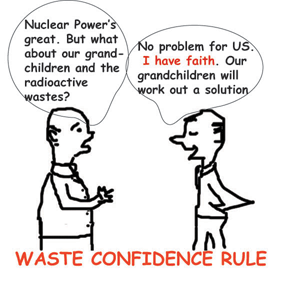 In 2010, the Nuclear Regulatory Commission issued a “waste confidence decision” that asserted that used fuel rods could be stored at the power plants for 60 years after they close down. NRC also asserted that a permanent repository would be ready to handle such wastes “when necessary.”
NUCLEAR WASTE Manila Bulletin By ATTY. ROMEO V. PEFIANCO July 11, 2012, “…Storing used fuel rods from nuclear power reactors is one problem that remains unsolved by the US Nuclear Regulatory Commission. Nuclear waste in the US comes from: 1) nuclear weapons production facilities, 2) nuclear power plants, 3) medical equipment previously used in radiation treatments, 4) industrial sources of radioactivity used as a more powerful alternative to X-rays, and 5) residues from uranium mining. Continue reading
$26 million just to find out how much 2 nuclear reactors might cost
TORONTO – It’s like giving the cashier at Tim Hortons a penny to find out how much a cup of coffee costs.CNews 11 July 12,
Ontario Power Generation (OPG) has agreed to pay two prospective reactor builders $26 million to come up with an estimate on how much two new nuclear reactors at the Darlington Generating Station would cost, Energy Minister Chris Bentley told a Queen’s Park committee
Wednesday. Continue reading
USA: Atomic Safety and Licensing Board rules that Pilgrim Watch cannot challenge NRC’s safety rulings
Judges rule against nuclear plant foes http://www.capecodonline.com/apps/pbcs.dll/article?AID=/20120711/NEWS/207110334/-1/NEWSMAP by PATRICK CASSIDY, July 11, 2012 A panel of three judges on the federal Atomic Safety and Licensing Board has rejected a bid by opponents of the Pilgrim Nuclear Power Station in Plymouth to be heard on the response of U.S. nuclear regulators to the Fukushima Dai-ichi disaster last year in Japan.
Duxbury-based Pilgrim Watch had argued that orders issued after the earthquake- and tsunami-fueled nuclear meltdown did not go far enough.
In their ruling issued Tuesday the judges found that, based on judicial and U.S. Nuclear Regulatory Commission precedent, the enforcement orders issued by the NRC “are not open to challenge in an adjudicatory proceeding on Pilgrim Watch’s claim of inadequacy.”
Pilgrim Watch had challenged two orders from the NRC that required that all boiling-water reactors similar to Pilgrim and Fukushima have reliable venting systems and instrumentation to measure water levels in spent fuel pools.
Pilgrim Watch can appeal the ruling to the five-member NRC, according to agency spokesman Neil Sheehan. A group of 14 opponents of Pilgrim’s operations who were arrested for trespassing during a protest there in May are scheduled to appear today in Plymouth District Court.
Workers exposed to airborne uranium, due to pressurised yellowcake containers
Pressurized drums create yellowcake uranium hazard, NRC says By Todd Sperry, CNN Senior Producer July 11, 2012 – Washington (CNN) — After three Canadian employees were exposed to yellowcake uranium last month when a lid blew off a pressurized 55-gallon drum, a uranium mining company has informed U.S. nuclear regulatory officials it has found additional drums possibly susceptible to the same problem, CNN has learned..
.. The NRC and
Canadian nuclear officials are investigating drums shipped from a Willow Creek, Wyoming, mining facility operated by Uranium One to an Ontario processing plant where workers opened them, including the one that ejected the powder. The three employees were overcome by a cloud of yellowcake uranium that had unexpectedly become pressurized.
The worker closest to the drum and two others in the area, who were not wearing respirators, were exposed to airborne uranium, according to the NRC..
… Yellowcake is the byproduct of uranium ore that is mined, crushed and milled until concentrated. It is a key component in manufacturing uranium fuel for nuclear reactors.
NRC officials gave Uranium One until this week to identify whether any other drums had become pressurized during manufacture or shipment…… Other drums shipped to the Canadian facility containing yellowcake were found to be bulging from internal pressure, the NRC said.
New nuclear power plants – Georgia, Tennessee, South Carolina – just gobbling up money!
 The plants burning natural gas are far cheaper to build than nuclear power plants…..….
Building costs rise at US nuclear sites Bloomberg, By Ray Henry on July 10, 2012 ATLANTA (AP) — America’s first new nuclear plants in more than a decade are costing billions more to build and sometimes taking longer to deliver than planned, problems that could chill the industry’s hopes for a jumpstart to the nation’s new nuclear age.
Licensing delay charges, soaring construction expenses and installation glitches as mundane as misshapen metal bars have driven up the costs of three plants in Georgia, Tennessee and South Carolina, from hundreds of millions to as much as $2 billion, according to an Associated Press analysis of public records and regulatory filings.
Those problems, along with jangled nerves from last year’s meltdown in Japan and the lure of cheap natural gas, could discourage utilities from sinking cash into new reactors, experts said. The building slowdown would be another blow to the so-called nuclear renaissance, Continue reading
The underestimated dangers at Los Alamos nuclear weapons laboratory
Nuclear Weapons Lab Underestimates Risk of Radiation Leak, Study Finds, Project on Government Oversight (POGO) By MIA STEINLE, 10 July 12, One of the nation’s main nuclear weapons labs has sharply underestimated the amount of radiation that could leak from the facility as a result of an earthquake, according to a federal advisory panel.
The radiation could be more than four times as intense as the Los Alamos National Laboratory predicted in a safety analysis last year, according to a recent report by the Defense Nuclear Facilities Safety Board. Continue reading
An community solar energy scheme is paying off
 How a community solar scheme is turning sunshine into dollars REneweconomy, By Kelly Vaughn on 11 July 2012 Rocky Mountain Institute Years ago, a Basalt native Paul Spencer set out to build an off-grid home not far from RMI’s Snowmass office. Through the process of designing and building his house, he developed a passion for real estate, and became well versed in renewable energy technologies. He began looking into the option of a green development in the Roaring Fork Valley: super-efficient homes powered by renewable energy.
But, due to trees shading the proposed building sites, rooftop solar didn’t work. Instead, Spencer proposed to build a shared solar array that would power the neighborhood. While the development didn’t go through, the community solar concept remained.
Now, Spencer is the president and founder of Carbondale-based Clean Energy Collective (CEC) an LLC that builds, operates, and maintains community-based clean energy facilities, currently all solar PV……..
Secrecy surrounding laser uranium enrichment technology, with its risks of nuclear weapons spread
Commercialization of the SILEX technology has sparked concerns of nuclear proliferation. Arms control advocates fear that commercialization could lead other countries to follow suit, raising concerns about the technology falling into the wrong hands.
 Uranium enrichment plant meeting to be closed to public Star News, By Wayne Faulkner July 10, 2012 The last major review before a revolutionary laser uranium enrichment plant could be built in Castle Hayne will take place behind closed doors.
The unusual step in closing the hearing Wednesday is because the discussions will include non-public information about GE Hitachi Global Laser Enrichment but also the sensitive technology that would be used at the plant, said David McIntyre, spokesman for the Nuclear
Regulatory Commission.
The hearing, before a panel of administrative judges at the NRC’s headquarters in Maryland, is being conducted by the Atomic Safety and Licensing Board, which then would make recommendations to the NRC for possible approval of a 40-year license to operate the plant….
The NRC on Feb. 29 approved the plant’s environmental-impact statement.
There will be no more public comment about the plant or technology, McIntyre said.
The facility on GE’s Castle Hayne campus near the intersection of Interstate 140 and Castle Hayne Road would be the nation’s first laser-based commercial uranium enrichment operation, using an Australian technology called SILEX, or Separation of Isotopes by Laser
Excitation. Continue reading
Strike and problem of decaying concrete at Canada’s nuclear power plants
those employees should also be demanding safety in their workplace as well. At least one Candu plant – Gentilly-2 in Quebec – is decaying .
The plant is one of many that regulators say is operating well past its expected life of 25 to 30 years
Major Problems Facing Canada’s Nuclear Sector http://www.care2.com/causes/major-problems-facing-canadas-nuclear-sector.html#ixzz20GmGP3Pi by Amy Boughner July 9, 2012 Canada’s nuclear industry is once again facing major issues. More than 800 Candu Energy employees are on strike as of the morning of July 9, looking for higher wages. The scientists, engineers and technologists work at Candu plants in Ontario, Quebec and New Brunswick. Continue reading
Decaying concrete a problem for aging nuclear power plants
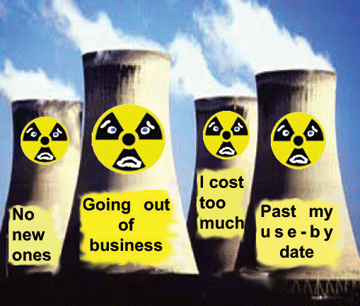 concrete degradation has surfaced in the reactor containment buildings of three U.S. nuclear power stations. The Nuclear Regulatory Commission recently warned operators there that design strengths and assumptions used in original containment building design plans “may no longer hold true,” if ASR and its telltale cracks and fissures are present.
Decaying concrete raising concerns at Canada’s aging nuclear plants, National Post Ian MacLeod, Postmedia News Jul 8, 2012 Decaying concrete at nuclear power plants is the latest concern for nuclear safety authorities.
At Quebec’s sole atomic power station, Gentilly-2, eroding concrete has prompted federal licensing officials to suggest that any provincial attempt to refurbish and re-license the 30-year-old plant must satisfy federal concerns over the aging concrete’s ability to stand up to another two or three decades of service.
The move comes as economic pressures force nuclear utilities to consider refurbishing their nuclear plants and operating them well past their 25- to 30-year initial lives. Continue reading
1 This Month

Tell Congress: Prevent Nuclear Catastrophe in Iran

Tell Congress: Prevent Nuclear Catastrophe in Iran

Read the Public Inquiry Report, the Commissioners’ report, Surrendering Australia: The AUKUS Deception is available to download for free at aukuspublicinquiry.com. Or just watch the replay of the National Press Club Luncheon.


Shut down the radiation-damaged Heysham nuclear reactors now
To see nuclear-related stories in greater depth and intensity – go to https://nuclearinformation.wordpress.com

Say No to NASA’s Reckless Nuclear Reactor on the Moon
Say No to NASA’s Reckless Nuclear Reactor on the Moon
-
Archives
- November 2026 (269)
- October 2026 (302)
- September 2026 (339)
- August 2026 (330)
- July 2026 (355)
- June 2026 (287)
- May 2026 (306)
- April 2026 (356)
- March 2026 (251)
- February 2026 (267)
- January 2026 (308)
- December 2025 (358)
-
Categories
- 1
- 1 NUCLEAR ISSUES
- business and costs
- climate change
- culture and arts
- ENERGY
- environment
- health
- history
- indigenous issues
- Legal
- marketing of nuclear
- media
- opposition to nuclear
- PERSONAL STORIES
- politics
- politics international
- Religion and ethics
- safety
- secrets,lies and civil liberties
- spinbuster
- technology
- Uranium
- wastes
- weapons and war
- Women
- 2 WORLD
- ACTION
- AFRICA
- Atrocities
- AUSTRALIA
- Christina's notes
- Christina's themes
- culture and arts
- Events
- Fuk 2022
- Fuk 2023
- Fukushima 2017
- Fukushima 2018
- fukushima 2019
- Fukushima 2020
- Fukushima 2021
- general
- global warming
- Humour (God we need it)
- Nuclear
- RARE EARTHS
- Reference
- resources – print
- Resources -audiovicual
- Weekly Newsletter
- World
- World Nuclear
- YouTube
-
RSS
Entries RSS
Comments RSS

