US Dept of Energy warns on climate change damaging nuclear and coal plants
 Warming already taking toll on U.S. energy sector — DOE Hannah Northey, E&E reporter Greenwire: July 11, 2013 Rising temperatures, decreasing water availability, more severe storms and rising seas stemming from climate change are already affecting every part of the country’s energy sector, and those threats will only grow more severe in years to come, the Energy Department said today.
DOE in a new report outlines the effects a warming world with more chaotic and damaging 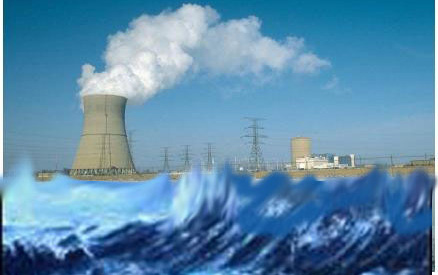 storms, wildfires and other natural disasters is having on oil and gas exploration, power plants, and an aging electric grid.
The outlook isn’t pretty.
The agency pointed to the unprecedented shutdown of a nuclear reactor because of rising seawater temperatures on the Connecticut coast last year, as well as the request by power plants to dump hotter-than-permitted water into nearby lakes and streams.
In another case, high temperatures and high demand last year caused a transformer and power line to trip in Arizona, triggering a cascading blackout that tripped the San Onofre nuclear plant offline, leaving millions of people without power.
Wildfires are threatening large swaths of the electric grid, and waning water resources are calling  into question just how much hydropower the United States can generate.
What the report also makes clear is that storms like Superstorm Sandy are only a taste of things to come……..
Coming years could bring more damage, DOE said, noting that last year was the warmest year since record keeping began in 1895 for the contiguous United States, and the hottest month for the nation was July 2012. Those higher temperature have ushered in heat waves, a longer wildfire season, decreased sea ice in the Alaskan Arctic sea and a longer growing season, DOE said.
 In many cases, historic drought conditions are combining with high temperatures to parch power plants throughout the country that need water to cool reactors, generate steam or produce hydroelectricity.
Higher temperatures are also putting pressure on the system in the form of demand as an increasing number of air conditioners pull power from the grid, causing even more devastating consequences during rolling blackouts and brownouts.
The report calls for a host of new, innovative methods to protect the grid, power plants, and oil and gas producers from the effects of climate change but doesn’t make specific recommendations or provide cost estimates…..http://www.eenews.net/stories/1059984249
Nuclear weapons insanity: America’s AIR-2 Genie rocket
it was basically a suicide device.
 The craziest part about this? In the only live test during Operation Plumbob, the US Air Force put five guys directly under the blast to prove how “safe” it was to use over populated areas. P
And the US government made 3,000 Genies.
The Five Most Insane Nuclear Delivery Systems Jaolpnik MICHAEL BALLABAN, 14 July 13
“…….Earlier this week we looked at the giantSoviet nuclear gun. That thing is definitely batty, what with its giant cannon at one end and what was essentially a tank at the other end turning it into a self-propelled howitzer. The Americans had a crazy nuke gun, too, and for awhile it looked like maybe we’d just stand and shoot atomic cannons at each other.
The thing is though, with both of those artillery pieces the actual physics package was intended to reach at least 15 miles away before the thing actually exploded. And even then, that was waytoo close.
What would happen, then, if you wanted it to explode even closer?
The AIR-2 Genie was a doomsday rocket of absolute desperation.
genie_missile_test
With the Cold War in its deepest freeze but without the benefit of long-range ICBMs, American military planners thought the only way New York, Los Angeles, or Chicago would be bombed would be in massive waves of Soviet bombers. Unfortunately, if 100 of them come at you at once, you may not shoot them all down. And really, only one getting through your defenses is necessary for absolute devastation.
In 1958, when the AIR-2 was introduced, the problem was compounded by the fact that missile guidance systems still weren’t quite up to snuff. Directly hitting all of the bombers coming at you was going to be a near-impossible task. The solution was to launch one, single, solitary missile. That missile, completely unguided, with a nuclear bomb on board, would cause a big enough explosion to hopefully wipe out all the attackers. With a big enough boom, you wouldn’t need a guidance system.
Oh, and the range was only six miles. In case you’re forgetting, most nukes make a bigger boom than that, so it was basically a suicide device.
The craziest part about this? In the only live test during Operation Plumbob, the US Air Force put five guys directly under the blast to prove how “safe” it was to use over populated areas. P
And the US government made 3,000 Genies…….. http://jalopnik.com/the-five-most-insane-nuclear-delivery-systems-768180979
America must wake up to its growing nightmare of radioactive trash
If America chooses not to wake up to this reality, sooner or later it will cost us dearly: A spent fuel accident at San Onofre Nuclear Waste Dump could cost a trillion dollars. The spent fuel will need to be guarded for hundreds of millennia, but right now it is MOST important that it be guarded properly.
Shutting down ALL the reactors now, and properly securing ALL the waste immediately, is the only logical thing to do
 A spent fuel accident at San Onofre Nuclear Waste Dump could cost a trillion dollars. Deal with it. Salem News Ace Hoffman July 13th, 2013 ”……..For all intents and purposes Fukushima was a spent fuel accident. While it’s true that the reactors tripped after the earthquake and had only been shut off for a short while when the tsunami struck, it’s also true that even if the reactors had been off for years, the same basic sequence of events could have happened if water wasn’t circulated properly around the used fuel assemblies.
Spent fuel is incredibly deadly stuff, but in fact, Fukushima was not a “worst case scenario” by any means. An even larger catastrophe is still possible at Fukushima because of the fuel that’s still there in the spent fuel pools and dry casks, and because the melted blobs of “corium” (uranium and plutonium) can theoretically go critical again. Massive explosions of the corium blobs are also possible without a new criticality event, when/if they reach the local water table. And more than two years after the meltdowns, nobody knows precisely where the corium blobs are.
There are 23 reactors similar to Fukushima’s operating in America, and all other types of reactors have other dangers which make them just as capable of catastrophic accidents as those were, but in different ways. There are no “safe” reactors, and there is no safe way to store or transport the fuel. Continue reading
Nuclear waste casks filling up one aweek, and rate is increasing

it is crazy to keep making this radioactive trash
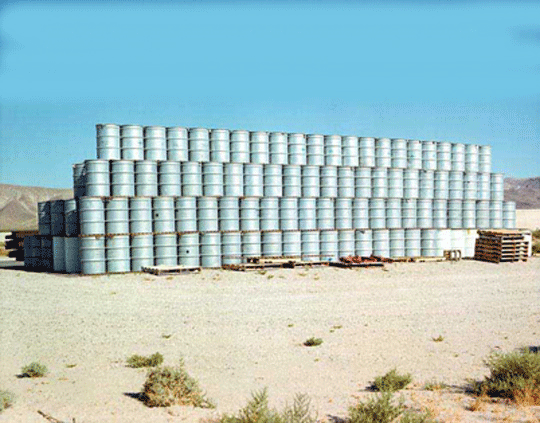
New dry casks are popping up around the country at the rate of about one a week these days. As spent fuel pools fill up, that rate will increase to a steady-state (for 100 reactors) of about 4 to 6 dry casks per week around the nation.
Each one, if its contents get out, could wipe out a small state
A spent fuel accident at San Onofre Nuclear Waste Dump could cost a trillion dollars. Deal with it. Salem News Ace Hoffman July 13th, 2013 “……..Nevertheless, some people, even some among those who helped shut down San Onofre because of the danger, now refuse to talk about moving the waste, primarily for one of two reasons:
First, they are concerned about transportation accidents — a reasonable fear. But consider this: Transport risks last for only a few days each trip, and there are a finite number of trips, because, thankfully, the reactors at San Onofre are permanently closed. So that’s a relatively limited risk. On the other hand, leaving the waste to sit dangerously in an earthquake/tsunami/growing population zone is a danger that lasts for decades or centuries, and possibly forever.
The other reason some people oppose transporting the waste away from San Onofre is that there’s nowhere to put it. Continue reading
San Onofre nuclear plant – doomed by its new steam generators
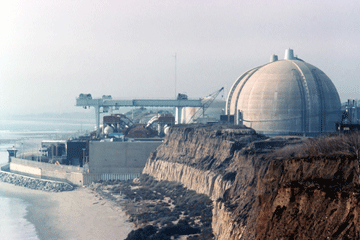 How San Onofre’s new steam generators sealed nuclear plant’s fate San Onofre’s replacement generators were supposed to extend the nuclear plant’s life and save money. The opposite ensued. LA Times, By Abby Sewell and Ken Bensinger July 13, 2013,
In March 2004, an attorney for Southern California Edisonsat before state utility regulators to propose what seemed like a great deal.
The San Onofre nuclear plant was approaching the end of its life span. But Edison wanted to invest $680 million in new steam generators, attorney Carol Schmid-Frazee told a judge presiding over a hearing at the California Public Utilities Commission’s San Francisco headquarters. The new equipment, she said, would give the 2,200-megawatt plant a new lease on life, providing cheap, reliable energy in Southern California for decades to come while also saving ratepayers nearly $2 billion.
Edison’s lawyer also issued an ominous warning: If regulators did not approve the upgrade, the plant would close, provoking “very serious problems with the California electric grid.”
The commission was persuaded, and Edison began remaking San Onofre.
But less than a year after the new steam generators came online, a tube in one of them sprang a radioactive leak, setting off a chain of events that ultimately led Edison to close the plant permanently…… http://www.latimes.com/news/local/la-me-07-14-san-onofre-tic-toc-20130714,0,5736015.story
Peaceful anti nuclear protestors arrested in Kansas City
Two dozen arrested in nuclear-plant protest KSHB.com 14 July 13 KANSAS CITY, Mo. – Two dozen people were arrested Saturday morning for trespassing at the entrance to the National Nuclear Security Administration’s new south Kansas City complex in a peaceful protest against the nuclear weapons that will soon be built there.
Scheduled for completion sometime next year, the plant at 150 Hwy and Botts Road will replace the current nuclear-bomb-parts plant at the Bannister Federal Complex at Bannister and Holmes, now operated by Honeywell Federal Manufacturing and Technologies. …The protestors were organized by the local chapter of PeaceWorks to coincide with Nuclear Abolition Week, July 6-13…. http://www.kshb.com/dpp/news/local_news/nearly-two-dozen-arrested-in-nuclear-plant-protest#ixzz2Z9cKfsUh
Nuclear wastes in dry cask storage – still very dangerous
 A spent fuel accident at San Onofre Nuclear Waste Dump could cost a trillion dollars. Deal with it. Salem News Ace Hoffman July 13th, 2013 “…….There are a total of about 75 sites in America with operating or closed nuclear reactors. Almost all have spent fuel stored on site. Most are under various airline routes. All are vulnerable to terrorism. San Onofre has repeatedly been cited as a likely terrorist target by elected officials because of the devastating damage an attack could do to the economy and lives of so many millions of people. Have the lessons of 9-11 truly been forgotten just 12 years later?
The time to solve the nuclear waste problem is now, not later. Once the waste has “cooled” enough to remove it from the pools, it is still incredibly hot (as much as 400 degrees Fahrenheit at the fuel rod’s surfaces) and stays hot for many years. The heat is produced mainly by the decay of fission products, emitting deadly gamma rays (hence the lead, steel, and cement shielding) as well as alpha and beta particles.
The spent nuclear fuel is in danger of fire by several methods, including, of all things, water intrusion, which can lead to zirconium cladding degradation along with splitting the water molecules into separate hydrogen and oxygen atoms. This chemical reaction created an explosive atmosphere three times at Fukushima, and is known to have happened in at least one dry cask here in the sStates — but it was discovered before an explosion occurred. Will we always be so lucky?
As the fission products decay, the spent fuel cools and becomes “safer.” However, it doesn’t become “safe” ever. Many of the most dangerous isotopes, such as cesium and strontium, have half-lives in the 30 year range, and are at their peak now. Thus, the importance of taking care of the “spent fuel problem” is highest now — much higher than, say, 30 years from now when about half the cesium and strontium will have decayed. So waiting makes no sense. The waste’s most virulent components are at their peak quantities right now, and an accident now would be the most devastating for the planet’s collective DNA — DNA which has already taken a terrible hit from weapons testing and use, from Chernobyl, from Fukushima, from 1000 other accidents and purposeful spills, and from continuing leaks at Hanford and other nuclear sites.
There is really only one logical conclusion, of course: It’s time to shutdown the reactors everywhere. In China, Russia, France, England, India, South Korea, and everywhere else, not just in southern California. Currently nuclear waste is stored in at least four locations in California. Those four sites need to be consolidated into one highly protected site, with earthen berms between EACH cask, and a “no-fly” zone and other considerations.
But how will consolidation be accomplished when communities are bullied into supporting flimsy, inadequate dry cask storage wherever the waste was produced, regardless of the danger?
Activists in Humboldt County and around Rancho Seco have accepted dry cask storage for years. Why shouldn’t southern California?
The answer is, because southern Californians understand, post-Fukushima, what the real dangers of spent fuel are……”. http://www.salem-news.com/articles/july142013/san-onofre-bdb-ah.php
U.S. government warns on climate change threat to nuclear and coal power plants
US power plants at risk from climate change, government says SMH, July 12, 2013 Power plants across the US are at increased risk of temporary shutdown and reduced power generation as temperatures and sea levels continue to rise and water becomes less available, the country’s Department of Energy said.
By 2030, there will be nearly $US1 trillion in energy assets in the Gulf region alone at risk from increasingly costly extreme hurricanes and sea-level rises, according to the Energy Department report on the impact of climate change on energy infrastructure.
“As President Obama said in his speech last month, climate change is happening,” said spokeswoman April Saylor in a statement. “As climate change makes the weather more extreme, we have a moral obligation to prepare the country for its effects.”
The report calls on federal, state and local governments to more urgently prepare critical infrastructure – particularly coal, natural gas and nuclear plants – for the compounded risks posed by floods, storms, wildfires and droughts…….
Greenpeace USA spokesman Robert Gardner said the administration’s focus should primarily be transitioning to wind and solar technology, not relying on fossil fuels and nuclear energy.
“The question is why the Department of Energy is really focusing on continuing the problem which has caused this tidal wave of global warming,” said Gardner. : http://www.smh.com.au/environment/climate-change/us-power-plants-at-risk-from-climate-change-government-says-20130712-2pv6h.html#ixzz2YxjjqAdb
American Medical Association wants action on radiation in seafoods
 American Medical Assn. Urges Testing Seafood For Radiation http://www.simplyinfo.org/?p=10663 July 11th, 2013 The American Medical Association has passed a resolution calling for the US to continue to monitor and publicly report radiation contamination in seafood. The original resolution included the language that cited Fukushima as a main reason for the concern and focused on the Pacific ocean. The final resolution broadened it to include all seafood.
The resolution was approved before the recent announcement that Fukushima Daiichi has been continually leaking contamination into the Pacific for the last 2+ years.
The resolution is a good step for public health. The current policy of the FDA does no ongoing seafood testing for radiation. That done soon after the Fukushima disaster was vague, using frozen fish of unknown catch date and fish with an unknown catch location within Japan. The FDA and USDA so far have not publicly released any seafood testing for products hauled places other than Japan. The current US contamination level before the government will intervene is 1200 bq/kg far higher than other countries including Japan.
Busting the nuclear industry’s propaganda fairy tale
As always in the face of failure, the industry puts forth new designs as a basis for new promises, now touting small modular reactors with the same fervour with which it touted large, partially modular reactors a decade ago. Congress finds a few hundred million to preserve these dreams even as its cutbacks shatter so many others.
A new movie, Pandora’s Promise (no film-maker familiar with nuclear history would include “promise” in a title intended to be pronuclear), recently screened at Sundance.Featuring the same old converts and straw men, it opened in cinemas a few weeks ago to tiny audiences and generally unenthusiastic reviews, especially from reviewers knowledgeable about nuclear power.
 In the astonishing persistence of the global appetite for false nuclear promises lies the critical importance of the World Nuclear Industry Status Report, published on Thursday.
Nuclear renaissance was just a fairy tale http://www.guardian.co.uk/environment/2013/jul/11/nuclear-renaissance-power-myth-us The promise of cheap, low-carbon power – with 31 new reactors in the US – was based on rhetoric and obedience. Anyone who doubts that should read the new status report on the industry Peter Bradford guardian.co.uk, 12 July 2013 Nuclear power requires obedience, not transparency. The gap between nuclear rhetoric and nuclear reality has been a fundamental impediment to wise energy policy decisions for half a century now.
For various reasons, in many nations the nuclear industry cannot tell the truth about its progress, its promise or its perils. Its backers in government and in academia do no better.
Rhetorical excess from opponents of nuclear power contributes to the fog, but proponents have by far the heavier artillery. In the US, during the rise and fall of the bubble formerly known as “the nuclear renaissance”, many of the proponents’ tools have been on full display. Continue reading
New guidelines allow far greater radiation exposure to the public
 For Future Reactor Meltdowns, EPA Means “Extra Pollution Allowed” by JOHN LaFORGE Cutting Corners, Cutting Costs, Creating Cancer
As the nuclear power industry struggles against collapse from skyrocketing costs, bankrupting repair bills and investor flight (four operating reactors were permanently closed this year, more than in any previous 12 month period), the government seems to have capitulated to political pressure to weaken radiation exposure standards and save nuclear utilities billions.
On April 15, the EPA issued new Protective Action Guides (PAGs) for dealing with large scale radiation releases — like the catastrophic triple reactor meltdowns at Fukushima, Japan that spread cesium and radio-iodine worldwide. The new PAGs are like a government bailout, saving reactor owners the gargantuan costs of comprehensive cleanup. And eerily, the new PAGs seem to presume the inevitability of radiation disasters that the industry — with its fleet of 100 rickety 40-year-old units — can’t currently afford to withstand.
According to Daniel Hirsch, President of Committee to Bridge the Gap, the latest PAGs took effect in April but can be amended — and EPA is taking comments. Hirsch says that the National Council on Radiation Protection’s plans for implementing the new PAGs “would allow the public to be exposed to extraordinarily higher levels of radiation than previously permitted” during reactor accident emergencies.
The new PAGs also allow extremely high contamination of food, he says. “In essence,” Hirsch reports, the PAGs say “nuclear power accidents could be so widespread and produce such immense radiation levels that the government would abandon cleanup obligations” forcing people to absorb and live with far more cancers.
To cut costs, industry has long pushed for weakening radiation exposure rules. In 2002, Roger Clarke president of the International Commission on Radiological Protection (ICRP) warned in the Bulletin of the Atomic Scientists, “Some people think that too much money is being spent to achieve low levels of residual contamination.” The ICRP recommends exposure standards to governments for nuclear industry workers and the public…….http://www.counterpunch.org/2013/07/09/for-future-reactor-meltdowns-epa-means-extra-pollution-allowed/
Permissible radiation doses established by polluters
 For Future Reactor Meltdowns, EPA Means “Extra Pollution Allowed”, Counter Punch, Cutting Corners, Cutting Costs, Creating Cancer, by JOHN LaFORGE, 11 July 13,
“……….There is no exposure to ionizing radiation that’s safe. Even the smallest exposures have cellular-level effects that can lead to immune dysfunction, birth defects, cancer and other diseases. The National Academy of Sciences’ 7th book-length on the biological effects of ionizing radiation, BEIR-VII, declared that any exposure, regardless of how small, may cause the induction of cancer. BEIR-VII also explicitly refuted and repudiated the pop culture “hormesus” theory, promoted by industry boosters, that a little radiation is good for us and acts like a vaccination.
Today, the nuclear industry — military, industrial and medical — is required to keep radiation exposures only “as low as reasonably achievable.” This tragicomic standard is neither a medical nor scientific concept. It’s not based on health physics or biology. It’s merely the formal admission that radiation producers cannot keep worker or public exposures to a level that is safe — that is zero.
Exposure limits have been established at the convenience of the military and industrial producers of radioactive pollution, not by medical doctors of health physicists. The late Dr. Rosalie Bertell made clear 36 years ago in Robert Del Tredici’s book At Work In the Fields of the Bomb, “The people with the highest vested interest are the ones that are making the nuclear bombs. And it turns out they have complete control over setting the permissible [radiation exposure] levels.” Since then, little has changed in the regulatory world (although scientists have found that far more damage is caused by low dose radiation than was earlier thought possible): the ICRP’s 1990 recommendations to reduce worker and public exposures by three-fifths has yet to be adopted by the United States.
We can thank industrial and political roadblocks for that, yet in spite of them the government’s permissible dose (lazy reporters often write “safe” dose) of radiation has dramatically decreased over the years — as we’ve come to better understand the toxic, carcinogenic and mutagenic properties of low-level exposures. In the 1920s the permissible dose was 75 rem (radiation equivalent man) per year for nuclear industry workers. In 1936, the limit was reduced to 50 rem per year; then 20-25 in 1948; 15 in 1954; and down to 5 rem per year in 1958. The general public is officially allowed to be exposed to one-tenth the workers’ dose, or 0.5 rem per year. The ICRP’s 1990 suggestion was to cut this to 2 and 0.2 respectively.
With cancer rates at pandemic proportions, adding higher radiation exposures to the effects of 80,000 chemicals that contaminate our air, water and food only makes our chance of avoiding the dread disease slimmer. Rather than permitting increased doses of dangerous and sometimes deadly radiation, especially following reactor disasters, the government should be acting to prevent them — like Germany, Italy and Japan — by preparing the phase-out of the country’s accident-prone nukes.
John LaForge is a co-director of Nukewatch, a nuclear watchdog and environmental justice group in Wisconsin.
AUDIO: crisis of dangerous radioactive trash at Pilgrim Nuclear Power Plant
it would make sense to just stop producing this radioactive trash
At Pilgrim — like Fukushima — spent fuel is stored in a pool high above the reactor. Tarantino says the pool contains all the nuclear waste ever produced by Pilgrim’s reactor.
“We have 40 years worth of spent fuel in the reactor building,” Tarantino said. “Fuel has never left the site.”…… Pilgrim is rapidly running of room. In two years there won’t be any space left in the pool and Pilgrim will have to shut down unless a new waste storage site can be built outside of the reactor building….
Workers have already begun constructing a road to transport huge containers — called dry cask storage — out of the reactor building to a special concrete pad nearby. This is this construction that opponents were trying to photograph with their kite camera……
 AUDIO http://www.wbur.org/2013/07/10/pilgrim-nuclear-waste-permit Residents Challenge Pilgrim’s Permit For New Nuclear Waste Site By Bruce Gellerman July 10, 2013 PLYMOUTH, Mass. — Since 1972, the Pilgrim Nuclear Power Plant here has generated prodigious amounts of electricity, tons of radioactive waste and plenty of controversy.
Wednesday night, the debate heats up as the Plymouth zoning board votes on whether to allow Entergy — the plant’s owner — to continue with construction on a new waste storage site. The vote could stall or even stop the nuclear power plant for good.
Security, And Public Scrutiny
A few weeks ago, anti-nuclear activists — with the help from the law firm EcoLaw — flew a kite with a camera over the plant. They wanted to see what Entergy was building on the 1,600-acre site along Cape Cod Bay.
“This is the first time in a long time that citizens have pulled back the blanket of secrecy that has allowed Entergy to operate without much public scrutiny on the local level,” said attorney Meg Sheehan, who was born and raised in Plymouth. Continue reading
Congress wants answers about nuclear waste transport through Las Vegas
 Titus asks for disclosure of nuclear waste routes
http://www.knoxnews.com/news/2013/jul/10/titus-asks-for-disclosure-of-nuclear-waste/ Associated Press July 10, 2013 LAS VEGAS (AP) — A frustrated congressional representative is asking for more disclosure about a plan to route nuclear waste through Las Vegas.
Rep. Dina Titus, D-Nev., sent a letter Tuesday to the head of the federal Department of Energy asking to discuss a plan to ship 403 canisters of bomb-grade nuclear waste through her home state.
The Las Vegas Sun (http://bit.ly/130TXZE ) reports that she berated the department for failing to provide Congress with adequate information about the plan to ship the canisters from the Oak Ridge
National Laboratory in Tennessee to a Nevada National Security Site. Continue reading
Deep burial a cheaper way than MOX to dispose of plutonium
 Nuclear waste: DC has ignored a cheaper way to dispose of plutonium — until now Sentinel.com, Douglas Birch & R. Jeffrey Smith The Center for Public Integrity, 7 July 13,
For the past decade, Washington has known how to dispose of excess U.S. plutonium at a cost estimated to be hundreds of millions of dollars less than what the Energy Department is spending on a South Carolina factory meant to transform plutonium into fuel for nuclear reactors.
Instead of burning the plutonium, the cheaper alternative mixes it with glass or ceramics and some other materials, so it can be buried deep underground. Continue reading
1 This Month
Tell Congress: Prevent Nuclear Catastrophe in Iran

Tell Congress: Prevent Nuclear Catastrophe in Iran

Read the Public Inquiry Report, the Commissioners’ report, Surrendering Australia: The AUKUS Deception is available to download for free at aukuspublicinquiry.com. Or just watch the replay of the National Press Club Luncheon.


Shut down the radiation-damaged Heysham nuclear reactors now
To see nuclear-related stories in greater depth and intensity – go to https://nuclearinformation.wordpress.com

Say No to NASA’s Reckless Nuclear Reactor on the Moon
Say No to NASA’s Reckless Nuclear Reactor on the Moon
-
Archives
- November 2026 (246)
- October 2026 (302)
- September 2026 (339)
- August 2026 (330)
- July 2026 (355)
- June 2026 (287)
- May 2026 (306)
- April 2026 (356)
- March 2026 (251)
- February 2026 (267)
- January 2026 (308)
- December 2025 (358)
-
Categories
- 1
- 1 NUCLEAR ISSUES
- business and costs
- climate change
- culture and arts
- ENERGY
- environment
- health
- history
- indigenous issues
- Legal
- marketing of nuclear
- media
- opposition to nuclear
- PERSONAL STORIES
- politics
- politics international
- Religion and ethics
- safety
- secrets,lies and civil liberties
- spinbuster
- technology
- Uranium
- wastes
- weapons and war
- Women
- 2 WORLD
- ACTION
- AFRICA
- Atrocities
- AUSTRALIA
- Christina's notes
- Christina's themes
- culture and arts
- Events
- Fuk 2022
- Fuk 2023
- Fukushima 2017
- Fukushima 2018
- fukushima 2019
- Fukushima 2020
- Fukushima 2021
- general
- global warming
- Humour (God we need it)
- Nuclear
- RARE EARTHS
- Reference
- resources – print
- Resources -audiovicual
- Weekly Newsletter
- World
- World Nuclear
- YouTube
-
RSS
Entries RSS
Comments RSS

