Shilling for nuclear industry intensifies, but the industry still stinks in America
 the nuclear business stinks in the United States. It’s gotten so bad that French nuclear giant EDF inked a deal last year to gradually dump its U.S. nuclear operations thanks to dwindling profits and dimming prospects that it will get to build new reactors.
There are far better, more sustainable alternatives that will keep the lights on. Among the best is wind power. Believe it or not, wind is quickly gaining market share in Texas. According to government projections, plummeting costs for solar panels could make sun-powered utilities more competitive than natural gas within a single decade,
Sorry Carol Browner, and your new friends in the nuclear industry. In terms of safety and money, building new reactors amounts to a lose-lose proposition.
A gust of nuclear-powered hot air from the industry
http://bristolpress.com/articles/2014/05/31/opinion/doc538a72d3949cd339945913.txt May 31, 2014 By EMILY SCHWARTZ GRECO and WILLIAM A. COLLINS Have you heard how nuclear power is a low-carbon solution that could ratchet down climate change? Even former Environmental Protection Agency chief Carol Browner is touting the industry for its supposed reliability, low-cost and diminutive carbon footprint.
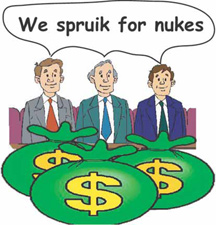
For years, including when she served as President Barack Obama’s climate czar, Browner shared the widespread green view best summed up by this slogan: No nukes is good nukes.
Now, she’s shilling for Nuclear Matters. This atomic lobbying outfit, funded by industry giants like Exelon, is trumpeting nuclear reactors as a climate panacea in full-page New York Times ads and any media outlet willing to listen to members of its “leadership council,” which includes a gaggle of senators-turned-lobbyists like Judd Gregg, Evan Bayh, and Blanche Lincoln. As the saying goes, everything has its price. But what’s driving this nuclear-powered media shopping spree? After decades without any new construction, a total of five new reactors are slated to open by 2018 in Tennessee, South Carolina and Georgia.
Those projects were supposed to usher in a nuclear construction boom that’s not materializing for several reasons. One is safety. Another is the rise of fracking. A gusher of natural gas offers another dangerous alternative to coal-fired power plants that’s exposing the myth of nuclear energy’s so-called affordability as a flat-out lie.
For more than three years, the global media has tuned in with varying degrees of intensity to the steady drumbeat of fallout (literally) from Japan’s Fukushima catastrophe. After other ideas failed, the government over there is shifting into sci-fi overdrive with a plan to create a mile-long underground frozen wall to contain the destroyed power plant’s radiation.
Hey, if that doesn’t pan out, Japan can order its scientists to genetically engineer a Godzilla creature that guzzles radioactive seawater. The fact is that safety concerns have made Japan go nuclear-free, at least for now, by shuttering the reactors that used to generate 30 percent of the country’s electricity. Continue reading
America’s plans for pre-emptive nuclear attack on Russia or China
US Plans ‘First Strike’ Nuclear Attack on Russia or China By Richard Cottrell, Rick Rozoff, and Bruce Gagnon Global Research, June 01, 2014RT the TruthSeaker Star Wars tested for Eastern Europe; US space weapons “unofficial declaration of war”; “soft assassinations” planned for last weekend’s EU election winners.
Seek truth from facts with Gladio, NATO’s Dagger at the Heart of Europe author and former European MP Richard Cottrell; Stop NATO newslist’s Rick Rozoff; and Bruce Gagnon of the Global Network Against Weapons and Nuclear Power in Space.
This is a rush transcript.
RT: US revives plans for a nuclear first strike on Russia. Coming up.
Announcer: “Soft assassinations” of anti-NATO leaders.
Star Wars tested for Eastern Europe.
And US space weapons quote an “unofficial declaration of war.”
RT: Secret clauses of NATO membership state, the US can and will depose Europe’s governments on the orders of the White House.
Giuseppe De Lutiis, NATO author: Even if the electorate were to show a different inclination, secret protocols guarantee alignment by any means.
RT: “By any means” means exactly that. Early NATO whistleblower Hans Otto exposed ‘”kill lists” of leading European politicians that defied investigators’ belief, but were subsequently confirmed by police.
Officers found 15 pages of members of the German Communist Party to be assassinated, and 80 pages on Germany’s Social Democrats, one of the two major parties in the country.
The documents state these assassinations would take place “in case of X”. X may refer, writes NATO scholar Dr. Daniele Ganser, to mass protests against a US-backed government, or an election victory of a genuinely left-wing party.
Instructions for such operations were kept at NATO military headquarters south of Brussels.
Der Spiegel reveals a quote “a strictly secured wing of the building. A grey, steel bank vault door prohibits trespassing to the unauthorized.” Papers on NATO operations in Europe are marked “American eyes only.”
When the EU Parliament officially demanded NATO stop these operations, which have become known by the codename Gladio, the US simply ignored it……http://www.globalresearch.ca/us-plans-first-strike-attack-on-russia-or-china/5384799
Canada’s nuclear industry plans propaganda campaign, especially in schools
 Canada’s uncertain nuclear future article is based on Canada’s Nuclear Energy Sector: Where to from here? published by Canada’s Public Policy Forum. 2 June 2014“……One approach to address the concerns of the anti-nuclear movement is to work with environmental NGO leaders, to foster trust and a less-polarised dialogue. Such dialogues will be difficult and will take time: workshop participants said this approach was successful in the forestry sector, but it required much time and effort over two decades. To gain social license and broader acceptance, groups outside the sector will need to initiate the discussions. The start of this dialogue can be seen in the US, with recent efforts by some prominent environmental NGO leaders, who had once been opposed to nuclear.
The often passionate public reaction against nuclear power is a significant challenge. Extensive media coverage of the Fukushima Daiichi disaster in Japan, bad memories of Chernobyl and Three Mile Island, and common misunderstandings around radiation mean the public is often reluctant to embrace nuclear power plant construction or to view nuclear as a viable energy source. A key to success in both the UK and France has been including information about nuclear energy in school curriculums.
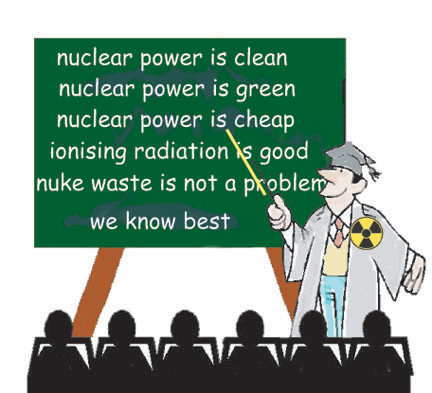
By educating students about nuclear energy, both countries have been successful in helping to dispel myths around safety and security that persist elsewhere. These countries have shown that education could be a useful first step to engaging citizens in a more enlightened discussion on nuclear energy. Given the diverse energy sources in Canada, school boards would be wise to develop science programmes that explore all types of energy and allow students to be exposed to and learn about the positive and negative aspects of all of them.
Nuclear company Exelon spends $millions buying support in Washington
Nuclear Giant Exelon Launches Front Group to Cover Its Assets Elliott Negin HUFFINGTON POST 2 June 14,
“……..Exelon Already Holds Sway in Washington
Nuclear Matters is just the latest gambit of a very powerful political player. Over the last five years, Exelon has spent millions on political candidates and tens of millions on lobbying, and has taken advantage of its close ties with the Obama administration to weaken or stymie stronger nuclear plant safeguards.
According to the nonpartisan Center for Responsive Politics, Exelon has spent nearly $8 million on political campaigns since 2008, more than any other private electric utility. Over that same time period, Exelon also spent $34.6 million on lobbying, putting it in the top 10 among electric utilities. In addition, Exelon is one of the biggest corporate donors to trade associations, pro-business alliances and other politically active nonprofits, according to a January report by the Center for Public Integrity. In 2012, Exelon gave $13.6 million to approximately two dozen nonprofits, the second-largest amount voluntarily disclosed among the Fortune 300 companies CPI reviewed.
Exelon’s lobbyists also have enjoyed unparalleled access to the Obama administration, according to an August 2012 New York Times exposé. The Times provided several examples of how the company exerted its influence, including delaying and weakening a proposed EPA rule to prevent power plant water intake systems from killing fish and other aquatic life.
The Times also reported that Exelon joined with NEI and other plant owners to challenge the NRC’s post-Fukushima safety recommendations. Specifically, they opposed a proposed requirement that they install filters on hardened vents at 31 boiling water reactors to help prevent radiation discharges into the environment in the event of an accident. Those reactors are similar in design to the six at the Fukushima facility.
Filtered vents are now required in Japan and much of Europe, and the Nuclear Regulatory Commission technical staff recommended they be installed here. But Exelon and the rest of the U.S. nuclear industry, loathe to spend hundreds of millions of dollars on filters, insist there are other ways to achieve the same result and lobbied hard to avoid the upgrade.
In early 2013, more than 50 of the industry’s friends in Congress sent letters to the NRC requesting that the commissioners reject the filtered vent recommendation and slow down the implementation of other post-Fukushima safety reforms. A number of the signatories have reactors in or near their districts, and most have received sizeable campaign contributions from the nuclear industry. Two sign-on letters, for example, came from House members, one from 21 Republicans and the other from 26 Democrats. Since 2008, the nuclear industry gave more than $3.32 million to the 41 of the letters’ 47 signatories. Roughly 30 percent of that funding came from Exelon.
The industry prevailed — for the time being. Despite the fact that the NRC technical staff provided ample evidence that filtered vents are a sensible, cost-effective measure that would protect nearby communities, NRC commissioners issued an order requiring owners of the 31 reactors to upgrade their hardened vents that stopped short of requiring filters. Instead, the commissioners gave their staff two years to review all the options for reducing radiation releases. The NRC will then open the proposed rule to public comment and finalize it by the end of 2017…… http://www.huffingtonpost.com/elliott-negin/nuclear-giant-exelon-laun_b_5428994.html
USA’s plans for nuclear weapons in Space

 US Plans ‘First Strike’ Nuclear Attack on Russia or China By Richard Cottrell, Rick Rozoff, and Bruce Gagnon Global Research, June 01, 2014 RT the TruthSeaker Star Wars tested for Eastern Europe; US space weapons “unofficial declaration of war”; “soft assassinations” planned for last weekend’s EU election winners. “……/Bruce Gagnon, Global Network Against Weapons in Space: This is in the planning process today. The US Space Command practicing engaging in a first strike attack and this is the key element here. These are first strike attack planning, these so-called missile defense systems are key elements in US first strike attack planning. The idea is to hit China or Russia first with a first strike, and then when they try to fire their nuclear retaliatory capability, it is then that the so-called missile “defense” systems would be used to pick off any retaliatory strike, so after a first strike sword is thrust into the heart of China or Russia, then the missile defense shield would be used to pick off any retaliation giving the US the a “successful” first strike attack.
It has nothing at all to do with defense, it has nothing to do with freedom or democracy, or any of those words that are used all the time to disguise the true intentions; it’s all about full spectrum dominance.
RT: Several decades ago the first Star Wars initiative faced intense public and industry debate.
Today the US is controlled by just six mainstream media, all totally suborned to the White House. The result is an Orwellian silence on perhaps the most dangerous issue today.
Europeans may decide they want their leaders chosen by NATO, or even that they support nuclear strikes on China and Russia.
Since the US-controlled mainstream’s never even informed the public these apocalyptic plans are on the agenda, the first people may hear of it, would be this. Seek truth from facts. This is The Truthseeker.http://www.globalresearch.ca/us-plans-first-strike-attack-on-russia-or-china/5384799
Exelon and Nuclear Energy Institute set up A Tool to Squelch Renewables
Nuclear Giant Exelon Launches Front Group to Cover Its Assets Elliott Negin HUFFINGTON POST 2 June 14, “……Exelon and NEI clearly know their way around Washington. But some arguments sound a lot less self-serving when they appear to come from a disinterested third-party. A case in point is Nuclear Matters’ contention that the United States has to maintain its entire fleet of nuclear power plants to stave off the worst consequences of global warming.
To be sure, nuclear power is the largest source of low-carbon electricity in the country, a major selling point. But Nuclear Matters’ website ominously warns that “the closings of just a handful of nuclear energy plants would have a devastating environmental impact on our country and make it nearly impossible for us to meet our clean energy or carbon reduction goals.”
Is that right? Not quite. As it turns out, ramping up renewables — especially wind and solar — and energy efficiency could replace a significant amount of nuclear generation, and do it in a hurry.
Let’s look at the numbers. What would happen if Exelon closed the five reactors in Illinois that energy analysts have identified as ripe for retirement? The five reactors — one at Clinton and two each at Byron and Quad Cities — have a rated capacity of 5,203 megawatts (MW).
In 2012 alone, the U.S. wind industry installed the functional equivalent. It added 13,131 MW of new capacity, which, at a 35 percent capacity factor — that is, the percentage of time the generator is actually producing power — would produce about the same amount of electricity as Exelon’s five reactors operating at a 90 percent capacity factor. According to the American Wind Energy Association, there is currently 17,200 MW of new wind capacity under construction or with signed power purchase agreements that will be built over the next two to three years. Those wind farms will produce the equivalent output of more than six typical 1,100 MW nuclear reactors.
Now add solar power to the mix. According the Solar Energy Industries Association, the solar industry installed 8,120 MW of new capacity in 2012 and 2013, and is projected to install another 25,000 MW by 2016, which altogether will produce the equivalent output of about seven nuclear reactors. And let’s not forget energy efficiency. The American Council for an Energy Efficient Economy projects that by 2020, existing energy efficiency resources standards in 26 states will save the equivalent output of more than 27 reactors.
In other words, renewables and efficiency could go a long way to replace nuclear plants — and retiring coal plants–to dramatically reduce U.S. carbon emissions. While more transmission capacity would be needed for wind and utility-scale solar projects, there is progress on this front. In addition to four new transmission projects constructed last year, which could support 10,000 MW of new wind capacity, there are 15 projects in advanced stages of development that could support an additional 60,000 MW of wind in Plains, Midwestern and Western states by 2018. These transmission projects also could open up new markets for nuclear plants.
But you’re not going to hear about the potential of renewables and energy efficiency from Nuclear Matters. Exelon started the front group for the same reason NEI created the CASEnergy Coalition: to prop up the nuclear industry. And not only does Exelon want state and federal authorities to rescue its financially ailing reactors, it also has another goal in mind. A key component of Exelon’s game plan is to hamstring its low-carbon competition, namely the wind and solar industries. More on that in my next blog later this week. http://www.huffingtonpost.com/elliott-negin/nuclear-giant-exelon-laun_b_5428994.html
______________
Elliott Negin is the director of news and commentary at the Union of Concerned Scientists. Steve Clemmer, UCS director of energy research and analysis, and Mike Jacobs, a UCS senior energy analyst, contributed to this blog.
USA’s EPA proposes New Power Generation Emissions Rules
 EPA Proposes New Power Generation Emissions Rules http://www.energymatters.com.au/index.php?main_page=news_article&article_id=4329 The USA’s Environmental Protection Agency has proposed regulations with a goal of slashing carbon dioxide emissions from existing coal fired power plants by as much as 30 percent by 2030.
The USA’s power generation sector is the nation’s biggest source of carbon emissions; representing around 38 percent of the total load.
According to the EPA, the average age of the nation’s coal plants is 42 years. Under the EPA’s proposal, which was directed by President Barack Obama; emission targets for power plants could be met in a few different ways – through power plant upgrades, changing from using coal as a fuel to natural gas, enhancing energy efficiency or increasing uptake of renewable energy.
Rhone Resch, president and CEO of the Solar Energy Industries Association (SEIA), said the announcement marked a defining moment in American history.
“As a nation, we’re poised to finally turn the page from sooty smokestacks to sunnier skies,” he said.
Mr. Resch says the nation’s solar industry is ready to help states meet the challenge.
“Simply put, solar can be a real game-changer for regulators looking to meet the changing needs of their state. Why? Because solar energy is reliable, cost competitive, environmentally friendly and easily scalable, fitting the needs of any state’s Section 111 (d) compliance plan.”
As we reported earlier, cumulative operating solar PV capacity reached 13,395 MW at the end of Q1 2014 in the USA and 74% of new electricity generation capacity in the USA added during the period was solar.
“Solar is now the fastest-growing source of renewable energy in the United States, employing 143,000 Americans and accounting for nearly 30 percent of all new electric generation capacity installed in 2013 – second only to natural gas. All totalled, solar is generating enough clean, reliable and affordable electricity to power 3 million homes,” said Mr. Resch.
The EPA says the proposed regulations will result in the avoidance of up to 6,600 premature deaths, up to 150,000 asthma attacks in children, and up to 490,000 missed work or school days – and this will provide up to $93 billion in climate and public health benefits. It also states the efforts will reduce electricity bills roughly 8 percent by increasing energy efficiency and reducing demand in the electricity system.
With the renewable energy revolution gaining pace and spurred on by initiatives such as the EPA proposes, it seems investing in coal is becoming an increasingly risky affair.
Settlement reached between Vancouver Province and uranium company
 Vancouver’s Boss Power closes on $30-million settlement with province over uranium ban By Tyler Orton http://www.biv.com/article/20140602/BIV0108/140609993/vancouvers-boss-power-closes-on-30-million-settlement-with-province Mon Jun 2, 2014 A Vancouver-based resource company has closed on a $30-million settlement with the B.C. government, officially putting to bed a nearly six-year-old lawsuit.
The province imposed a halt on all uranium exploration and development in April 2008. Boss Power Corp. (TSX.V: BPU) filed suit later in the year claiming the B.C. government expropriated the company’s interest in its Blizzard uranium property near Kelowna when it imposed a “no registration reserve” under the Mineral Tenure Act.
The reserve allowed the government to ensure no future claims included the rights to uranium, however, Boss Power argued the property was registered before this ban went into effect.
Boss Power and Victoria settled for $30 million in 2011 before the case went to court.
The final amended settlement will divide the settlement up between other parties with interests in the property.
About 80% of the settlement will be held in a trust until Boss Power is reorganized into two different corporations, an arrangement expected to be approved in August.
Dodgy future for Canada’s nuclear industry
 Canada’s uncertain nuclear future article is based on Canada’s Nuclear Energy Sector: Where to from here? published by Canada’s Public Policy Forum. 2 June 2014 “……. over the past two decades declining R&D funding has combined with an absence of new domestic nuclear power plant construction to push the sector into stagnation. Political and public support, once a source of strength and pride for the nuclear industry, has waned to such an extent that it is one of the greatest contributors to nuclear energy’s decline. Recent decisions by political leaders, including moratoria on uranium mining in Quebec, Nova Scotia and British Columbia, Ontario’s hesitancy to build proposed new reactors, and the federal government’s privatisation of the reactor business of Atomic Energy Canada Limited (AECL), are seen by many as evidence that government is now looking to redefine its role in the sector……..
Challenges
The following serious challenges have significantly impaired the industry’s ability to compete in domestic and international markets:
High capital costs. In today’s uncertain economic environment, it is difficult to make the political case that public funds should be committed to large, expensive energy projects that may not come online for nearly a decade. Typically, investment costs of nuclear power plants account for around 60% of total project lifecycle costs.
Unclear foreign investment rules. Organisations that constitute a “strategic asset” to Canada may be barred from foreign purchase or takeover. In fact, the phrase “strategic asset” is not discussed in the Canada Investment Act, but its frequent mention by federal and provincial politicians has created confusion in Canada and abroad. As a result, there is uncertainty around whether foreign entities will be able to purchase Canadian nuclear energy companies and assets, or even compete in the Canadian market. In the absence of a transparent investment framework, it is difficult for international organisations to expand or develop operations in Canada that could generate greater economic growth.
A historical CANDU monopoly places the sector in a niche market.The Canada Deuterium Uranium (CANDU) reactor has been the flagship of Canada’s nuclear energy sector for almost 50 years. But since the nuclear energy market shifted to light water reactors (LWRs) — approximately 30 years ago, when France started procuring LWR technology from the US — heavy water reactors have become a minority technology in the global market.
Acquiring and maintaining social license. Among the greatest challenges facing stakeholders in the nuclear sector is the lack of social license for new nuclear power plants. This concern does not necessarily exist in communities near power plants or uranium mines, but it is a broader perspective within the general population. Concerns around safety, spent fuel storage, and high capital costs have decreased public and political support for large nuclear construction programmes. Fears over nuclear proliferation and plant meltdowns and accidents, like those at Chernobyl, Three Mile Island and Fukushima, are common…..
Few political champions. An important element in any country with a successful nuclear energy programme is leaders who champion the merits of nuclear energy, often at great political risk. Overcoming the concerns of the public is much more difficult without this political support……
The University of Washington Medical Center tracking patients’ radiation exposure
 Hospital turns to big data to track, reduce radiation exposure June 2, 2014 To reduce patient exposure to radiation, the University of Washington School of Medicine is taking advantage of big data.Dose tracking technology adopted by the medical center can pull information from multiple imaging devices, then sort it into a database where it can be sliced and diced, according to InformationWeek. UW Medical Director William Shuman said that the data helps to “validate” its imaging efforts, in addition to pinpointing areas in need of improvement.
: Hospital turns to big data to track, reduce radiation exposure – FierceMedicalImaging http://www.fiercemedicalimaging.com/story/hospital-turns-big-data-track-reduce-radiation-exposure/2014-05-30#ixzz33clZoajc
Medical Center Uses Analytics To Reduce Radiation http://www.informationweek.com/healthcare/analytics/medical-center-uses-analytics-to-reduce-radiation/d/d-id/1269179
Uranium mining’s grave risk of polluting aquifer in Southern Black Hills, South Dakota
Risks too great to allow Hills uranium mining Jerry Wilson Argus leader 1 June 14, Chinese and Canadian-funded Powertech wants to mine uranium in the Southern Black Hills by the in situ method — dissolving uranium in the aquifer, pumping it to the surface for extraction, then dumping polluted water deep into the Earth.
Twice before, foreign corporations mined uranium in the Hills and left a radioactive mess. The South Dakota Department of Environment and Natural Resources lists 263 abandoned uranium sites in the state. Radioactive material and toxic heavy metals have polluted tributaries of several South Dakota rivers.
We needn’t repeat the mistakes of neighboring states. The Crow Butte mine near Crawford, Neb., has a long history of spills and “excursions” of radioactive water into the aquifer. And the Wyoming Department of Environmental Quality cited the Smith Ranch/Highland mine near Glenrock, Wyo., for “an inordinate number of spills, leaks and other releases … pond leaks, well casing failures and excursions.” The cleanup was projected to cost $150 million, four times the company’s bond.
Below the Inyan Kara aquifer that Powertech wants to mine lies the Minnelusa aquifer, then the Madison, all vital to future life in the region. A study of risks to the Madison aquifer by three South Dakota School of Mines and Technology researchers concluded that “Water supplies for Rapid City … and the surrounding suburban and rural areas are extremely vulnerable to contamination.” The DENR’s mission statement is clear — “protecting South Dakota’s environment and natural resources for today and tomorrow.” Unfortunately, our Legislature passed a law –– written by Powertech lobbyists –– that tied the hands of the DENR to do its job.
If in situ uranium mining pollutes the water vital to life, tourism and ranching in the Southern Hills, we might know in a year or two, or perhaps only after Powertech is gone. That is a chance we cannot afford to take. The Powertech mine must be stopped.
US tax-payer is propping up the uranium industry
THE GOVERNMENT IS PROPPING UP THE URANIUM INDUSTRY AND WE’RE PAYING FOR IT http://www.esquire.com/blogs/politics/white-mesa-uranium-mill-lawsuit-053014 The Department of Energy is promoting uranium mining at places like the White Mesa Mill and is tasked with the pricey cleanup. By Leslie Macmillan on May 30, 2014
The Grand Canyon Trust, an environmental group, has sued the operator of America’s last conventional uranium processing mill, saying its vast piles of spent ore and radioactive waste emit dangerous levels of radon and other toxins that violate the Clean Air Act.
The group and other critics of the White Mesa Mill near Blanding, Utah say it is a poorly disguised nuclear waste dump that would have gone out of business long ago were it not propped up by a lucrative federal contracts.
 The uranium market has declined in the wake of the Fukushima meltdown. To stay alive in a depressed market, Energy Fuels Resources, the mill’s operator, recycles mine tailings and radioactive waste — known as “alternate feed” — from Superfund sites around the country. The mill extracts any remnants of uranium from the waste then sells the concentrated, purified uranium, called yellowcake, to its customers, some of which are government-owned utilities obligated to buy White Mesa yellowcake at prices far higher than the $35 a pound it is currently fetching on the spot market. The leftover waste, a toxic stew of industrial chemicals, is stored in open pits called impoundments.
Energy Fuels spokesperson Curtis Moore said the issues raised in the lawsuit “are either inaccurate or have already been addressed through the proper regulatory channels.”
Taylor McKinnon of the Grand Canyon Trust says he hopes the lawsuit will “rip the mill from the rat’s nest of bureaucrats who have been protecting the status quo.”
The mill, he and other critics contend that uranium mining, milling and cleanup has become a virtual cottage industry — one orchestrated largely by the federal government.
During the Cold War period of 1940s through the 1980s, uranium was mined extensively in the Colorado Plateau to supply critical materials for the nation’s nuclear weapons program. The U.S. Department of Energy manages the nation’s surplus uranium and much of the cleanup of old processing mills.
Travis Stills, an energy and conservation law attorney, argues that the DOE’s mandate to “provide a domestic supply of uranium” is outdated and wreaks havoc on environmental and human health. He also says it’s unnecessary. The DOE already owns a uranium stockpile worth $7 to $8 billion.
The DOE doesn’t want to sell off the stockpile, Stills argues, because that would drive uranium prices down. Instead, the government artificially inflates prices to keep the industry going, he says.
Energy Fuels also operates several mines at the Grand Canyon, despite the federal ban on uranium mining there, because it possesses old mining claims that were “grandfathered in.” The company said in December it planned to shutter its Pinenut Mine there as well as the White Mesa Mill in 2014 and potentially reopen them in 2015. It reversed that decision last month and announced it would continue mining, but stockpile the ore pending better market conditions.
Cleaning up uranium is not cheap. The DOE is spending a billion dollars to dispose of tailings at an enormous site near Moab — a cost “born by the taxpayer,” the Trust’s lawsuit points out. On the Navajo reservation alone, there are 500 abandoned uranium mines. The EPA estimates the cleanup cost would be in the hundreds of millions. An $18 million bond has been posted for cleaning up White Mesa Mill when it stops processing uranium — not nearly enough, Stills argues. He says the federal government — and the taxpayer — will be left holding the bag for that cleanup too.
Indeed, the DOE is slated to inherit White Mesa Mill for cleanup. Stills says that the department’s mission, to at once promote uranium mining and oversee its cleanup, is contradictory but that it keeps the agency employed. “It’s bureaucratic make-work,” he says. “As long as they keep making a mess, they’ll need to keep cleaning it up.”
Largest environmental settlement ever to clean up South Dakota uranium mine
Settlement gives $179 million to clean up abandoned uranium mine in Harding County, Rapid City Journal, 1 June 14, Used in the early years of America’s thirst for nuclear fuel, the Riley Pass uranium mine in Harding County was one of hundreds of sites mined to provide fuel for nuclear weapons and reactors.
Companies strip-mined the site, which sprawls across 250 acres of bluffs and other land in the North Cave Hills, about five miles east of the town of Ludlow about 130 miles northwest of Rapid City. In those days, there were no regulations forcing companies to clean up old mines.
“Back in the Cold War era, there was almost sort of a gold rush going on up there for uranium,” said Dan Seifert, a project coordinator for the Riley Pass mine with Custer National Forest.
But for the past 50 years, the mining site has been abandoned, and waste products known as spoils have sat exposed to the wind and rain. That allowed toxic metals and elements like arsenic, uranium, radium and thorium vulnerable to be carried away by the weather.
Now, a tangled series of court proceedings has resulted in a $179 million plan to clean up the majority of the mine site. That money is part of a settlement, announced last month by the U.S. Department of Justice and approved by a judge last week, required Anadarko Petroleum Corp. to pay a $5.15 billion settlement of fraud claims from a 2006 acquisition of Kerr-McGee. Continue reading
Corporate executives could be liable for damages for funding climate denialsim
Big Carbon’s Big Liability Environmental groups have warned directors of fossil fuel companies that they may be held personally liable for misleading the public about climate change. The Nation Dan Zegart May 29, 2014
A new and potentially potent weapon is being unleashed in the climate wars. Yesterday, three major international environmental organizations warned the corporate executives of some of the largest fossil fuel companies that they could be personally liable for damages for funding climate change denialists and working against efforts to slow climate change. Continue reading
Treasure Island homes to be tested for radiation
 OFFICIALS TO TEST TREASURE ISLAND HOMES FOR RADIATION By Nick Smith abc 7 News, Saturday, May 31, 2014 SAN FRANCISCO (KGO) –Officials told San Francisco’s Treasure Island residents that more testing would be done to examine the risks posed by potential radiation exposure there.
“I always just feel like there’s a little bit more to what they’re saying,” Treasure Island resident Linda Brown said. Dozens of Treasure Island residents spent the day pressing state officials for new information about possible health risks associated with radiation contamination at or near their homes. ……
1 This Month
Tell Congress: Prevent Nuclear Catastrophe in Iran

Tell Congress: Prevent Nuclear Catastrophe in Iran

Read the Public Inquiry Report, the Commissioners’ report, Surrendering Australia: The AUKUS Deception is available to download for free at aukuspublicinquiry.com. Or just watch the replay of the National Press Club Luncheon.


Shut down the radiation-damaged Heysham nuclear reactors now
To see nuclear-related stories in greater depth and intensity – go to https://nuclearinformation.wordpress.com

Say No to NASA’s Reckless Nuclear Reactor on the Moon
Say No to NASA’s Reckless Nuclear Reactor on the Moon
-
Archives
- November 2026 (238)
- October 2026 (302)
- September 2026 (339)
- August 2026 (330)
- July 2026 (355)
- June 2026 (287)
- May 2026 (306)
- April 2026 (356)
- March 2026 (251)
- February 2026 (267)
- January 2026 (308)
- December 2025 (358)
-
Categories
- 1
- 1 NUCLEAR ISSUES
- business and costs
- climate change
- culture and arts
- ENERGY
- environment
- health
- history
- indigenous issues
- Legal
- marketing of nuclear
- media
- opposition to nuclear
- PERSONAL STORIES
- politics
- politics international
- Religion and ethics
- safety
- secrets,lies and civil liberties
- spinbuster
- technology
- Uranium
- wastes
- weapons and war
- Women
- 2 WORLD
- ACTION
- AFRICA
- Atrocities
- AUSTRALIA
- Christina's notes
- Christina's themes
- culture and arts
- Events
- Fuk 2022
- Fuk 2023
- Fukushima 2017
- Fukushima 2018
- fukushima 2019
- Fukushima 2020
- Fukushima 2021
- general
- global warming
- Humour (God we need it)
- Nuclear
- RARE EARTHS
- Reference
- resources – print
- Resources -audiovicual
- Weekly Newsletter
- World
- World Nuclear
- YouTube
-
RSS
Entries RSS
Comments RSS

