The coming economic disaster for USA’s nuclear towns, starting with Kewaunee
 Wisconsin Reactor’s Demise Shows Nuclear Towns’ Plight Bloomberg News By Tim Jones July 08, 2014 “……..The Wisconsin facility is part of what Moody’s Investors Service describes as the largest wave of U.S.-based nuclear and coal electric-plant retirements in the past 35 years. The closings stem from abundant supplies of cheaper natural gas and changes in environmental policies. The consequences can be sudden and drastic, affecting school funding, real-estate values and economic development that were linked to the facilities.
Unlike abandoned industrial plants, which can be retooled for another manufacturer, nuclear plants leave another legacy: radioactive waste, which at the Kewaunee site sits in concrete canisters about 100 yards (91 meters) from Lake Michigan.
“The challenge that local officials have to face is large,” said Julie Beglin, one of the report’s co-authors……..
“It was cheaper to purchase energy on the open market than to produce it at Kewaunee,” said Mark Kanz, a company spokesman. “I’m sure it won’t be the last to close. There will be other plants that go through decommissioning, whether it’s economics or from equipment-related issues.”…….
While the economics of power generation can change, two factors work against the nuclear industry, said David Lochbaum, director of the Nuclear Safety Project at the Union of Concerned Scientists.
“The cost of non-nuclear electricity is trending down,” Lochbaum said, “and the cost of maintaining aging nuclear power reactors is trending up.”……
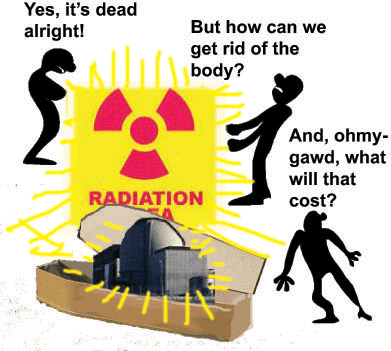 Six Decades The aftermath of a nuclear power plant’s leaving a community is more complicated and lengthy than the end of a conventional industrial facility. Federal regulations governing the decommissioning of sites are designed to protect the public.
The process must be completed within 60 years, according to the Nuclear Regulatory Commission. Seventeen plants, including Kewaunee, are in some phase of decommissioning, the NRC said on its website…….http://www.businessweek.com/news/2014-07-08/wisconsin-reactor-s-slow-motion-end-shows-nuclear-towns-plight
Mystery, danger and continuing radiation release from Waste Isolation Pilot Project (WIPP)
Environmental radiation releases spiked again in mid-June around the surface site of the only U.S. underground nuclear weapons waste storage facility near Carlsbad, New Mexico. The facility, the Waste Isolation Pilot Project (WIPP), has been shut down since February 14, when its isolation technology failed, releasing unsafe levels of Plutonium, Americium, and other radio-nuclides into the environment around the site.
Radiation levels in the underground storage area, 2,150 feet below the surface vary from near-normal to potentially lethal. At the time of the February accident, more than 20 WIPP workers suffered low level radioactive contamination, even though none of them were underground. WIPP assumes, but cannot confirm, that underground conditions have not changed since May 31, when the last entry team went into the mine, as reported by WIPP field manager Jose Franco on June 5:…….
What happened underground remains a mystery and a danger
More than five months after the February accident, officials still have no certain understanding of what went wrong. It is generally thought that one 55 gallon drum of waste (perhaps more than one) overheated and burst, spilling radioactive waste in a part of the storage area known as Panel 7, Room 7. This room, designated a “High Contamination Area,” measures 33 by 80 feet and presently has 24 rows of waste containers. The room holds 258 containers, tightly stacked and packed wall-to-wall, with no aisles to allow easy access. There is some clearance between the top of the stacks and the room’s ceiling.
The high contamination in Room 7 is a threat to human inspectors, limiting inspection of the room to date to mechanical means, primarily cameras on extension arms. As a result of these limitations, WIPP teams have inspected only ten of the 24 rows of waste containers in Room 7. Rows #1-14 have been out of reach of the available equipment.
WIPP has begun building a full scale replica of Room 7 above ground, to provide a realistic staging area in which to test methods of remote observationthat might reach the 14 uninspected rows………http://dissidentvoice.org/2014/07/radiation-releases-continue-from-nuclear-waste-isolation-project
Unreported very high risk of nuclear drums exploding at New Mexico waste facility

 Internal Memo: 10 times more WIPP nuclear drums risk exploding than media reported — Expert: Data shows increasing amount of radioactivity going into environment — Official: Something “caused drum to later catch fire”; Gov’t should investigate if truck fire & electrical surge led to the radiation release http://enenews.com/10-times-as-many-potentially-explosive-nuclear-waste-drums-inside-wipp-dump-than-reported-expert-data-shows-increased-amounts-of-radioactivity-going-into-environment-official-drum-ca
 AP, July 4, 2014 (emphasis added): Teams of scientists and engineers are still trying to determine exactly what caused a barrel [at New Mexico’s Waste Isolation Pilot Plant (WIPP)] from Los Alamos to burst […] Despite hundreds of experiments to date, investigators have been unable to create any reaction that would have caused the container to leak like it did […] The accident has […] indefinitely shuttered the mine […] According to the memo obtained by The Associated Press, [Los Alamos National Laboratory’s Principal Associate Lab Director Terry Wallace] told employees at a meeting Monday that the probe is focused on 16 barrels of highly acidic, nitrate-salt-bearing waste, including the drum that leaked at [WIPP]. Ten of the other barrels [11 total, including the one that ruptured] are also underground at the [WIPP] mine[…] Wallace is quoted in the memo as saying that a technical review “identified certain conditions that might potentially cause an exothermic reaction inside a drum. Among them are neutralized liquids, a low pH and the presence of metals.”
According to the AP’s article above, the investigation is now focusing on 11 barrels in the WIPP underground, yet only a few weeks ago the AP reported: “Officials say 6… potentially explosive containers of waste [were shipped] from Los Alamos National Laboratory… [Five] are being stored at a site in West Texas [and] one at the Waste Isolation Pilot Plant [believed to be the source of the radiation leak].
Albuquerque Journal interview with Miles Smith, EnergySolutions’ vice president of Southwest operations, July 3, 2014: “We don’t believe the combination we put into the drums, we don’t think it has the ability to start burning on its own. It needs an outside source of ignition […] It doesn’t look like the kitty litter was the cause […] I don’t believe [absorbent materials] caused the explosion or the fire. [One of the two suspect products, an acid neutralizer, is not a problem]. Its safety sheet says it is not incompatible [The other product, a base neutralizer, is incompatible with the nitrates in WIPP waste but this neutralizer wasn’t used in the WIPP-bound barrels.] We think there are other things that caused the drum to later catch fire [there] are a lot of things out there [to investigate, including a truck fire and an electrical surge in the days before the leak.]
Albuquerque Journal, July 3, 2014: Don Hancock of the Southwest Research and Information Center, a WIPP watchdog, said Smith’s comments are consistent with those of state Environment Department […] but noted that no one from [Los Alamos National Lab] has weighed in. “I would say I’ve always been skeptical of the kitty litter issue,” he said. “Anybody with a cat knows that kitty litter itself is not combustible. It’s got to be kitty litter and something else.”
Don Hancock, Southwest Research and Information Center, June 25, 2014: […] the current data show that there are increased amounts of radioactivity going into the environment as contaminated filters are being changed. […] DOE presumes that the ventilation system and the exhaust shaft are too contaminated to use in a re-opened facility. On June 18, the House Appropriations Committee approved $20 million dollars […] as a down payment for new ventilation and a new exhaust shaft. […] it is very difficult or impossible to determine exactly what happened and how much contamination was released.
Spent nuclear fuel crisis at closed Kewaunee nuclear plant
Outcry prompts expedited plan to move fuel at Kewaunee nuclear plant Milwaukee Wisconsin Journal Sentinel by Thomas Content 6 July 14 The Kewaunee nuclear power plant stopped producing electricity more than a year ago, but it left behind highly hazardous waste that has no place to go.
Radioactive rods of used nuclear fuel are cooling in a large storage pool inside the reactor, located east of Green Bay on the shore of Lake Michigan. Plant owner Dominion Resources Inc. wants to speed up plans to empty the pool and put the rods in more secure long-term storage.
Under Dominion’s plan, all of the spent fuel will be moved from the pool by the end of 2016. The rods will be encased in 24 concrete casks, each standing 18 feet tall, that will be moved from the reactor building to a concrete pad outside, said Dominion spokesman Mark Kanz.
Once they’re relocated, it’s unclear how long the radioactive remnants of the nuclear industry will stay in the casks. That’s because the federal government has no long-term plan for disposing of the waste now stored at scores of reactors around the country. According to the Nuclear Energy Institute, Wisconsin has 1,430 tons, or about 2%, of the nation’s spent fuel.
Dominion hired NAC International of Atlanta to build and fill the casks, and move them from the Kewaunee reactor building. Terms of Dominion’s deal with NAC haven’t been disclosed, but the company told federal regulators that it will spend $103 million through 2016 to manage the spent fuel.
The company accelerated plans to remove and encase the spent fuel to address concerns raised by members of the local community, Kanz said.
Last year, residents and officials in the Kewaunee County Town of Carlton criticized Dominion after the company said it would take the full 60 years allowed by the federal government to decommission the power plant.
Taking that long to shutter the plant would cripple efforts to attract economic development to the area, they said………
A nuclear safety watchdog group, the Union of Concerned Scientists, says the risk to the public is decreased when the spent fuel is placed in concrete casks rather than keeping it in spent fuel pools………
The project is being paid for by the customers of three Wisconsin utilities — the former co-owners of the power plant. Those customers paid surcharges over the years into a decommissioning fund.
The value of that fund is less than Dominion says it needs to spend, at $649.3 million at the end of 2013. Dominion says the money is being invested so that it will grow over time and that there should be sufficient money available to pay for the decommissioning.
Dominion has also committed $60 million from its Virginia-based parent company toward the project, in the event funds in the decommissioning fund run short.
Wisconsin’s electric utility customers wouldn’t end up having to pay more, because Dominion bought the plant from Wisconsin utilities and took responsibility for decommissioning at that time.
When Wisconsin regulators approved the sale of the Kewaunee Power Station in 2005, they ordered Dominion to return any unspent decommissioning funds to state ratepayers……
As the stalemate in Washington over waste storage continues, the stockpiles of stored spent nuclear fuel enclosed in concrete casks are multiplying. How long the concrete casks will stay at the Kewaunee, Point Beach and La Crosse reactors in Wisconsin is very much up in the air.
Dominion’s plan calls for concrete casks to start being shipped to the control of the federal government within seven years — but that timeline may be merely wishful thinking, said David Lochbaum of the Union of Concerned Scientists’ nuclear safety project.
“I likely have a better chance of winning the lottery than spent fuel leaving Kewaunee site in 2021 — and I don’t buy lottery tickets,” he said. http://www.jsonline.com/business/outcry-prompts-expedited-plan-to-move-fuel-at-kewaunee-nuclear-plant-b99302369z1-265974071.html
Ever escalating costs of failed Florida nuclear plant
 Trigaux: Failed Florida nuclear plant’s costs keep rising Tampa Bay Times Robert Trigaux 3 July 14, The costs of prematurely closing Crystal River 3 — Duke Energy’s sole nuclear power plant in Florida — keep on rising. Duke Energy recently agreed to a settlement that sent at least $55 million to eight minority owners of “CR3.” That’s the nuke plant Duke closed last year due to a bungled do-it-yourself repair job that the power company finally acknowledged last year would prove too expensive to fix. The bigger settlement sums are going to minority investors like Ocala and the Orlando Utilities Commission. But even smaller towns like Bushnell and Alachua, with small stakes in CR3, will be compensated.
Another $8.4 million will go to nine wholesale customers with contracts to receive electricity from CR3. Those customers range from Homestead, south of Miami, to Bartow in Hillsborough County.
Total payout to minority owners and wholesale customers: $63.4 million.
The 860-megawatt Crystal River plant was expected to operate until 2036. Instead, CR3’s concrete containment wall cracked in 2009. Never restarted, the plant is scheduled to be decommissioned over the next 60 years at a cost topping $1 billion……..
CR3’s demise coincided with a severe state recession that has decreased demand for electricity since 2008.
“We do not need to add more capacity at this time,” McCain said. “But it was important for these cities and utilities to end their ownership and liabilities in Crystal River 3. This settlement transfers ownership back to Duke.”
One more CR3 conflict resolved with big checks. They likely won’t be the last.
$63.4 million: Cashing out of Duke Energy’s closed nuclear plant………..
Contact Robert Trigaux at rtrigaux@tampabay.com or (727) 893-8405. Follow him@venturetampabay. http://www.tampabay.com/news/business/energy/amid-pricey-ripples-from-failed-florida-nuclear-plant-minority-investors/2186912
Tough challenge: nuclear cleanup of 1976 ‘Atomic Man’ Hanford disaster site
Nuclear site home to the 1976 ‘Atomic Man’ disaster that exposed worker to ‘500 times’ the occupational standard of radiation to be demolished Daily Mail, 4 July 14
- Harold McCluskey was working at the Hanford Nuclear Reservation when a chemical reaction caused a glass glove box to explode.
- He was exposed to the highest dose of radiation from the chemical element americium ever recorded — 500 times the occupational standard
- It took more than a year for doctors to remove enough radioactive material from his body to make it safe for him to be around other people
- The DOE hopes to have the facility ready for demolition by summer 2016
By DAILY MAIL REPORTER and AP
“……….Hanford contains the nation’s greatest collection of nuclear waste, and for more than two decades has been engaged in the dangerous work of cleaning up that waste. The space now dubbed the McCluskey Room is located inside the closed Plutonium Finishing Plant and is scheduled for cleanup this summer.
‘It’s been largely closed up since the accident,’ Geoff Tyree, a spokesman for the U.S. Department of Energy in Richland, said Wednesday. ‘It was restricted for the potential for airborne radiation contamination.’
Since 2008, the Department of Energy and contractor CH2M HILL Plateau Remediation Company have been preparing the plant for demolition.
‘About two-thirds of the Plutonium Finishing Plant is deactivated — cleaned out and ready for demolition,’ said Jon Peschong, an assistant DOE manager in Richland. ‘Cleaning out the McCluskey Room will be a major step forward.’
When specially trained and equipped workers enter the room this summer, they will encounter airborne radioactivity, surface contamination, confined spaces and poor ventilation, the DOE said.
They will be wearing abrasion-resistant suits that protect them from surface contamination and chemicals. A dual-purpose air system will provide cool air for breathing and cool air throughout the suit for worker comfort, allowing them to work for longer periods of time. The suits are pressurized, to prevent workers from coming into contact with airborne contaminants.
The McCluskey Room ‘is going to be the toughest work ahead of us as we finish cleaning the plant and getting it ready for demolition by the end of September 2016,’ Tyree said. http://www.dailymail.co.uk/news/article-2678623/Department-Energy-plans-demolition-nuclear-site-home-1976-Atomic-Man-disaster-exposed-worker-500-times-occupational-sta
All too close to USA Nuclear Waste project – very strong earthquake
‘Very strong’ quake hits New Mexico border — Seismic data spikes at WIPP nuke site — Emergency declared at nearest nuclear plant — “Larger magnitude event could still occur” — TV: “Sounded like a train derailed” — “Very rare… Still trying to figure out what caused it… no known fault lines in area” (VIDEOS) http://enenews.com/very-strong-quake-hits-near-new-mexico-border-seismic-data-spikes-near-wipp-site-emergency-decalred-at-nearest-nuclear-plant-larger-magnitude-event-could-still-occur-tv-sounded?utm_source=feedburner&utm_medium=e
USGS, June 29, 2014: M5.2 – 50km NW of Lordsburg, NM 04:59:33 UTC (Max CDI (maximum reported intensity) = VII, Very Strong)
Fox 10, June 29, 2014: “Thought we heard a train coming… it sounded like a train might have derailed… [Scared] is an understatement, we were shaking.” -Sherry Huggins, near New Mexico/AZ border
KOLD-TV Tuscon, June 29, 2014: “A very rare occurrence… even the lights were moving around [in our Tuscon studio]”
Fox 10, June 29, 2014: “A lot of people were like what’s going on?… Looks like a bomb went off.” -Steve Krafft, reporter
NRC, June 30, 2014: PALO VERDE (nuclear plant near Phoenix, AZ) […] Emergency Class: UNUSUAL EVENT […] EMERGENCY DECLARED […] “The following event description is based on information currently available. If through subsequent reviews of this event, additional information is identified that is pertinent to this event or alters the information being provided at this time, a follow-up notification will be made […] Initial walkdowns of plant equipment and review of plant parameters have found no unusual conditions or damage to plant equipment. No abnormalities caused by the seismic event were observed. […] Initial analysis of the Seismic Monitoring Instrumentation System indicated a seismic event, below the magnitude of the 0.10g spectra Operating Basis Earthquake (OBE) and the 0.20g spectra Safe Shutdown Earthquake (SSE). […] Notified DHS, FEMA […] Emergency classification termination was declared […]
KOLD-TV Tuscon, June 29, 2014: “They are still trying to figure out what caused the quake because there is no known fault line in the area… It’s very common to see aftershocks, especially after a strong earthquake like what we saw… So where is this all coming from?… It’s probably occurring along a fault that we don’t know anything about… Maybe there is a new fault… and they’re going to be able to hopefully identify that fault… it’s not coming from any of the known faults.”
KRQE, June 29, 2014: “The southern half of New Mexico got a Saturday shake-up.”
Copper Area News, June 30, 2014: It is likely that small magnitude aftershocks will continue in the Duncan area for days or weeks. Most will probably go unfelt. A larger magnitude event could still occur. In the event of severe ground shaking, residents are advised to “Drop, Cover and Hold on”.
Global warming – grounds for judge to reject coal project!

 Coal Mine’s Rejection on Global-Warming Grounds Has Major Implications http://insideclimatenews.org/carbon-copy/20140701/coal-mines-rejection-global-warming-grounds-has-major-implications If the judge’s reasoning holds up in other cases it could undermine the rationales for much bigger projects, such as the Keystone XL pipeline.
U.S. District Court Judge R. Brooke Johnson’s decision halts exploration proposed by Arch Coal that would have bulldozed six miles of roads on 1,700 untrammeled acres of public land.
When the agencies touted the supposed economic benefits of expanded coal mining in the Sunset Roadless Area, Johnson ruled, they should also have considered any global-warming costs.
The decision was a significant judicial endorsement of a policy tool known as the “social cost of carbon,” which economists and climate scientist use to put a price in today’s dollars on the damages from drought, flood, storm, fire, disease and so forth caused by future global warming due to our emissions from burning fossil fuels.
“It is arbitrary to offer detailed projections of a project’s upside while omitting a feasible projection of the project’s costs,” Johnson decreed.
The Obama administration has increasingly used the social-cost figure to help decide whether restraints on carbon dioxide emissions are worthwhile. Industry groups and their allies in Congress have sought to limit its use. Environmentalists call it a useful device for making clear that there are high costs as well as benefits to burning fossil fuels.
“This decision means that these agencies can’t bury their heads in the sand when confronting the very real impacts of climate change,” said Ted Zukoski, an attorney with Earthjustice, which represented conservationists who sued to block the mining expansion. f the judge’s reasoning holds up in other challenges to agency decisions, it could undermine the rationales for much bigger projects, such as the proposed Keystone XL tar sands pipeline. In its environmental review of the KXL, the State Department ignored repeated requests by the Environmental Protection Agency to estimate the social cost of carbon from burning the unusually dirty fuel the pipeline would deliver from Canada to the Gulf Coast.
In the Colorado case, the judge wrote, “by deciding not to quantify the costs at all, the agencies effectively zeroed out the cost.”
That violated a key precept of the National Environmental Policy Act, the judge said, which requires a “hard look” at all the environmental costs of government decisions.
That this can be difficult or contentious does not allow agencies “completely to ignore a tool in which an interagency group of experts invested time and expertise,” he wrote. “Common sense tells me that quantifying the effect of greenhouse gases in dollar terms is difficult at best. The critical importance of the subject, however, tells me that a ‘hard look’ has to include a ‘hard look’ at whether this tool, however imprecise it might be, would contribute to a more informed assessment of the impacts than if it were simply ignored.”
Renewable energy records in Texas and California
 Renewable energy records set in California and Texas http://www.pv-magazine.com/news/details/beitrag/renewable-energy-records-set-in-california-and-texas_100015571/?utm_content=buffer11a9a&utm_medium=social&utm_source=twitter.com&utm_campaign=buffer#ixzz369kysSef 30. JUNE 2014 BY: IAN CLOVER Solar power in California sets new one-day record of 4.76 GW in June as Texas joins the ranks of the renewables big league, powered largely by wind. Figures from the California Independent System Operator (Cal ISO) revealed this week show that the Golden State broke its own one-day record for solar PV generation on June 1 when 4767 MW of utility scale solar energy was fed into the grid.
The record smashed California’s previous one-day best of 4100 MW in March, which also stood as the highest one-day figure for the whole of the U.S.
California’s solar footprint is growing bigger with each passing day, week and month, with May recording three times as much solar generation as recorded during the same month in 2013. In total, solar PV powered 6% of Cal ISO’s total electric load in May, rising to 14% during peak hours, according to data gathered by the U.S. Energy Information Administration (EIA). In 2013, California added 2145 MW of utility scale solar.
In Texas, wind power accounted for 30% of the state’s electric load on March 26, generating 10.2 GW of electricity according to the Electric Reliability Council of Texas (ERCOT). Regulators in Texas expect that record to be outstripped again shortly as the state’s wind capacity rises above 12 GW.
Last year was a record 12 months for renewable energy generation in the U.S. The solar sector grew by 41% in 2013, with California responsible for more than half of new PV capacity. For the remainder of 2014, the U.S. Energy Information Administration (EIA) expects California to add an additional 1728 MW of utility scale solar before the year is out.
Growng chorus of area residents for the closure of Pilgrim Nuclear power Plant
Islanders Join Chorus Against Pilgrim Nuclear Power Station Vineyard Gazette Olivia Hall, 26 June 14 A movement to close the Pilgrim Nuclear Power Station is gaining ground on Martha’s Vineyard, where some Islanders have begun to voice concerns about their safety in the event of an emergency. The Island, like much of the commonwealth, stands in the shadow of the state’s only nuclear plant. – A public forum is planned for Monday at 7 p.m. at the Katharine Cornell Theatre in Vineyard Haven; the event is titled Pilgrim Nuclear Power Station: Could Fukushima Happen Here? Pilgrim provides 15 per cent of the electricity for southeastern Massachusetts, according to a 2014 report by ISO New England, the region’s electric grid operator. This past spring, Island voters expressed overwhelming support for the decommissioning of the plant at their annual town meetings and at the ballot box. Nonbinding resolutions urging Gov. Deval Patrick to press for closure of the Plymouth plant were supported by most towns. In addition, the Martha’s Vineyard Commission and the Dukes County Commission signed letters to the Nuclear Regulatory Commission asking for the decommissioning of Pilgrim. “Public safety, particularly that of Cape and Islands residents, cannot be assured,” the resolutions read in part. –
False alarm at Californian nuclear power plant
Erroneous Alerts, Sirens, Calls, Alarm Californians, Firehouse MATT HAMILTON ASSOCIATED PRESS JUNE 28, 2014 Repairs to a nuclear power plant’s siren system in San Luis Obispo County sent residents into a panic as they were accompanied by cellphone messages telling them to ‘prepare for action.’ LOS ANGELES (AP) — People in San Luis Obispo County received a series of unsettling, erroneous emergency alerts Friday as repairs were being made to a nuclear power plant’s siren system, including a vague cellphone message that told them to “prepare for action.”
The chain of mistaken alerts began arousing confusion and fear when a siren that’s part of the Diablo Canyon Power Plant’s warning system began wailing Friday afternoon for no apparent reason, county emergency services manager Ron Alsop said………http://www.firehouse.com/news/11539311/erroneous-alerts-sirens-calls-alarm-californians
USA’s EPA carbon plan makes coal the loser, but nuclear power loses out, too
The EPA carbon plan: Coal loses, but nuclear doesn’t win, Bulletin of the Atomic Scientists Mark Cooper. 19 June 14 MARK COOPER The claims and counterclaims about EPA’s proposed carbon pollution standards have filled the air: It will boost nuclear. It will expand renewables. It promotes energy efficiency. It will kill coal. It changes everything. It accomplishes almost nothing.
Evaluating the impact of the so-called Clean Power Plan requires a clear view of how the new rule will work. The plan centers on performance standards, which have yielded effective outcomes in other energy areas—such as appliance efficiency standards and fuel economy standards for light-duty vehicles. It sets a moderate, mid-term target for carbon reductions, but allows for flexibility because it does not dictate the use of specific technologies or products. States are allowed to design programs in response to local conditions.
The EPA plan picks a loser: coal. It does not, however, pick winners among the low-carbon options available. It does not offer much in the way of sweeteners for any specific technology. Assuming that states generally adhere to the prime directive of public utility resource acquisition—choosing the lowest-cost approach—the proposed rule will not alter the dismal prospects of nuclear power, which will therefore play no role in the reduction of carbon emissions from power plants.
EPA’s analysis of the proposed carbon pollution guidelines reflects this reality. EPA forecasts for nuclear power are flat-lined, which means that other resources—including energy efficiency, natural gas, wind, and solar—will carry the full weight of carbon reductions.
It is unlikely that the states will act irrationally enough to make the EPA analysis miss the mark by a wide margin. The marketplace and 48 of the 50 states have declined to embrace nuclear energy during the past decade, despite the incentives included in the Energy Policy Act of 2005……….http://thebulletin.org/epa-carbon-plan-coal-loses-nuclear-doesnt-win7253
USA coastal communiities monitoring sea-borne Fukushima radiation plume
Fukushima radiation concerns coastal communities Tracy Loew, Statesman Journal 25 June 14, Talk in the Oregon coast town of Bandon often turns to the approaching plume of sea-borne radiation from Japan’s crippled Fukushima nuclear power plant.
“We’ve been worried about it and worried about it,” said Zac Adams, owner of Bandon Designsconstruction company. “We’re really concerned about it affecting the fisheries, the wildlife, the tourism, and most importantly our health.”…….
The radiation is expected to hit the U.S. this year at very low levels that wouldn’t harm humans or the environment. But no federal agency is monitoring it.
So Adams joined a citizen-science project, crowd-sourcing funds in his community to test a sample of seawater that he will soon collect.
Four hours north, the Tillamook Estuaries Partnership has funded two collection sites, in Tillamook and Pacific City.
“Over the last year-and-a-half, it’s been an issue that’s been raising in prominence along the coastline,” said Lisa Phipps, executive director of the partnership. “In our area, there have been groups that have been coming together to talk about what is happening in the ocean.”
And fund-raising is underway for two more sites, in Newport and Winchester Bay.
Altogether about 30 sites, from Alaska to Baja, Calif., have been funded, said Ken Buesseler, a chemical oceanographer at the Woods Hole Oceanographic Institution who put together the project, called “How Radioactive is Our Ocean?”
It uses crowd-sourced money and volunteers to collect water samples along the Pacific Coast, then ship them to Buesseler in Massachusetts to be analyzed on an $80,000 instrument………
Buesseler is looking for increased levels of Cesium-137, which already is in all oceans from previous nuclear testing and accidents; and for Cesium-134, a “fingerprint” of Fukushima.
Because of its short, two-year half-life, any Cesium-134 could only have come from the plant, he said.
So far, Buesseler said, no samples have indicated that the plume has reached the West Coast.
Buesseler posts results on the project’s website. They show Cesium-134 and increased levels of Cesium-137 off the coast of Japan and across the ocean.
“We know it’s out there,” Buesseler said. “We’ve seen it more than halfway across the Pacific.”
Northwest of Hawaii, for example, Buesseler has found Cesium-134 at concentrations as high as 3.8 becquerels per cubic meter.
But to put that in context, he said, the U.S. drinking water limit is 7,400 of those units.
“Every additional radiation exposure causes additional risks for cancer,” he said. “But when the numbers are in the one to 10 range, that’s a very small additional risk.”
That’s the range that is expected to hit our shores, with lower levels coming first.
“As the contamination arrives, we expect the concentrations to go up over the next two years,” Buesseler said……..http://www.statesmanjournal.com/story/tech/science/environment/2014/06/25/fukushima-radiation-concerns-coastal-communities/11377463/
Hanford nuclear workers scared to speak out on safety issues
 Survey finds employees at contaminated nuclear site wary of challenging managers Times Colonist, Nicholas K. Geranios / The Associated Press June 24, 2014 SPOKANE, Wash. – Few of the U.S. Department of Energy workers who are helping build a plant to treat the most dangerous radioactive wastes at a nuclear site in Washington state feel they can openly challenge decisions made by management, according to a report obtained Tuesday by The Associated Press.
The survey conducted by the department shows only 30 per cent of its employees at the Hanford Nuclear Reservation feel they can question their bosses……..
Democratic Sen. Ron Wyden of Oregon said the study shows recent allegations of retaliation against Hanford workers who raised safety concerns made other employees less likely to come forward.
Hanford, near Richland in south central Washington, is engaged in a multi-decade cleanup of the nation’s largest collection of nuclear waste.
Two people who recently raised concerns about the design and safety of the unfinished Waste Treatment Plant at Hanford lost their jobs. Donna Busche was fired earlier this year, while Walter Tamosaitis, a 40-year Hanford employee, was laid off last year.
The U.S. Department of Energy has asked its Office of Inspector General to investigate Busche’s firing.
USA bipartisan climate report predicts economic costs of climate change
These and other risks from climate change are spelled out in a new bipartisan report that attempts to tally the potential toll on the economy and to push what has been a highly politicised issue into corporate boardrooms for serious consideration.
The report, titled “Risky Business: The Economic Risks of Climate Change to the United States,” comes from a coalition of high-powered business and political figures, including three former Treasury secretaries.
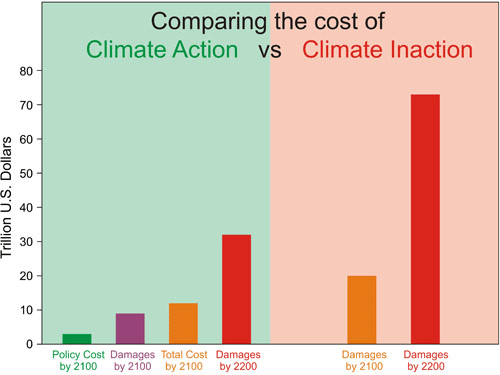
Hampton Bays, NY state, during and after Sandy.Photo: Reuters
The money men who backed the project are Risky Business Project co-chairs Henry M. Paulson Jr., Treasury secretary under President George W. Bush; former New York Mayor Michael R. Bloomberg; and Thomas F. Steyer, a hedge fund manager and big Democratic donor. The trio commissioned the Rhodium Group, an economic research firm, to study the economic impact of global warming.
A key conclusion of the report is that the risks vary, sometimes widely, by region and industry sector. By 2050, it warns, Americans could face double or triple the number of extremely hot days (temperatures exceeding 35 degrees celsius) compared with the annual average in the past 30 years.
The study estimates that communities in the Eastern Seaboard and Gulf Coast could see storm-related property damage jump by as much as $US3.5 billion ($3.74 billion) a year by 2030 and possibly more than double that given likely hurricane conditions.
1 This Month
Tell Congress: Prevent Nuclear Catastrophe in Iran

Tell Congress: Prevent Nuclear Catastrophe in Iran

Read the Public Inquiry Report, the Commissioners’ report, Surrendering Australia: The AUKUS Deception is available to download for free at aukuspublicinquiry.com. Or just watch the replay of the National Press Club Luncheon.


Shut down the radiation-damaged Heysham nuclear reactors now
To see nuclear-related stories in greater depth and intensity – go to https://nuclearinformation.wordpress.com

Say No to NASA’s Reckless Nuclear Reactor on the Moon
Say No to NASA’s Reckless Nuclear Reactor on the Moon
-
Archives
- November 2026 (238)
- October 2026 (302)
- September 2026 (339)
- August 2026 (330)
- July 2026 (355)
- June 2026 (287)
- May 2026 (306)
- April 2026 (356)
- March 2026 (251)
- February 2026 (267)
- January 2026 (308)
- December 2025 (358)
-
Categories
- 1
- 1 NUCLEAR ISSUES
- business and costs
- climate change
- culture and arts
- ENERGY
- environment
- health
- history
- indigenous issues
- Legal
- marketing of nuclear
- media
- opposition to nuclear
- PERSONAL STORIES
- politics
- politics international
- Religion and ethics
- safety
- secrets,lies and civil liberties
- spinbuster
- technology
- Uranium
- wastes
- weapons and war
- Women
- 2 WORLD
- ACTION
- AFRICA
- Atrocities
- AUSTRALIA
- Christina's notes
- Christina's themes
- culture and arts
- Events
- Fuk 2022
- Fuk 2023
- Fukushima 2017
- Fukushima 2018
- fukushima 2019
- Fukushima 2020
- Fukushima 2021
- general
- global warming
- Humour (God we need it)
- Nuclear
- RARE EARTHS
- Reference
- resources – print
- Resources -audiovicual
- Weekly Newsletter
- World
- World Nuclear
- YouTube
-
RSS
Entries RSS
Comments RSS

