In Hanford’s radioactively polluted area, rise in babies born without brains
“It’s Terrifying”: Rapid rise in babies with missing brains and spinal cords sticking out in area surrounding most contaminated nuclear site in US — Mother: Actual number is WAY higher than officials are reporting (VIDEO)http://enenews.com/its-terrifying-rapid-rise-in-babies-with-missing-brains-and-spinal-cords-sticking-out-in-area-surrounding-us-nuclear-site-mother-actual-number-is-way-higher-than-officials-are-reporting-vi?utm_source=feedburner&utm_medium=email&utm_campaign=Feed%3A+ENENews+%28Energy+News%29
Tweet by JoNel Aleccia, former NBC News reporter, Sept 2, 2014: Five pregnancies with anencephaly in Central WA state with due dates this year. State, CDC plan interviews w/ moms

After writing reports on the extremely high rate of babies missing part of their brain (anencephaly) in the 3 counties surrounding the Hanford nuclear site, Aleccia left NBC News. She is now a staff writer at Seattle’s Fred Hutchinson1 Cancer Research Center and authored this Sept. 2, 2014 article: Outreach workers from the Fred Hutchinson Cancer Research Center are drawing on years of community connections in [the counties of Yakima, Benton, and Franklin] to raise awareness about a devastating cluster of severe birth defects that no one can explain… babies are born without parts of the skull and brain… 32 babies since 2010… there were five women in the region who reported they were pregnant with babies with anencephaly, all due later this year… “A lot of what we do is around cancer prevention, but when we hear of other things that also affect health disparities, we take it on.” State and federal officials are urging groups like the Fred Hutch team to help…
It is interesting that a cancer center is getting involved with this Hanford-area birth defect cluster, especially when that cancer center played a key role in the controversial ‘Hanford Thyroid Disease Study’.
According to a review of the study by the National Academy of Sciences: “Fred Hutchinson Cancer Research Center in Seattle enjoyed greater public trust than the federal agencies while carrying out the HTDS… [The study’s] public summary… was misleading… the results of the HTDS were presented with unqualified certainty… Statements attributed to the HTDS investigators appear to have overstated the certainty of the results [such as claiming:] ‘These results provide rather strong evidence that exposures at these levels to 131I do not increase the risk [and] consequently provide a substantial degree of reassurance to the population exposed to Hanford radiation that the exposures are not likely to have affected their thyroid.’”
NBC Right Now, Aug 1, 2014: Local Birth Defect Moms Asking Why They’re Excluded From Cluster — “It’s terrifying”… said Nikki Shelton. Her son Corbin was born just months ago with Spina Bifida… When we asked Shelton and Alicia Jones, whose son Noah has the same defect, if they were under the assumption the Department of Health was including them under their research they both said, “Yes”. “To come to find out that they’re heading onwards with anencephaly and not looking into Spina Bifida is disheartening,” explained Shelton… In Spina Bifida the baby is born with part of their spinal cord sticking out.
On the ‘Washington Neural Tube Defects Cluster’ Facebook page, Nikki Shelton recently wrote: “I wanted you all to have a few numbers to reference to see just how rapidly the Neural Tube Defects are rising in our area. The Department of Health says we are 4 times the national average but we have to be WAY higher than that!… Physicians in Washington are NOT required to report birth defects!! The hospitals also code any termination/miscarriage as a “Complication of Pregnancy”. There are many families that choose to abort once they find out their unborn child has a defect, these are NOT counted in the national average. Not to mention all the defects that are not being reported by the physicians!!!”
Perhaps state officials will see this report that was removed from their website: “Studies… reported an association between neural tube defects [anencephaly/spina bifida] and theradiation dose fathers received… This effect was observed in children whose parents received low doses… while working at Hanford… Other research suggests there is reason to believe that radiation exposure before pregnancy can increase the frequency of birth defects… a study of birth defects in Washington’s Benton and Franklin counties near Hanford…. examined the number of cases of certain birth defects between 1968 and 1980.There were more neural tube defects than expected… Conclusion — As with other health effects from radiation, it is assumed that any exposure to radiation carries some risk of genetic effects and birth defects.”
Amazon to guzzle fossil fuelled electricity in new “server farm”
 Maybe we should all be concerned at the absurdity of this idea of all our data “in the cloud”. It’s not up in the clouds – it’s in dirty great computers taking up acres of space, and using up ever more electricity. In this sense, we are all complicit in pollutting the planet. Why on Earth can’t the IT ndustry grow up, and learn to chuck out unwanted stuff – instead of this mindless, endles storage of DIGITAL STUFF!
 Amazon’s cloud is about to get dirtier http://grist.org/news/amazons-cloud-is-about-to-get-dirtier/By Sam Bliss17 Sep 2014 In the latest effort to satisfy our desire to save every photo, thought, and fragment of information in cyberspace, Amazon plans to build a fat new server farm that will offer “cloud” storage for such companies as Yelp, Netflix, Pinterest, Dropbox, Spotify, Soundcloud, Tumblr, and Vine, to name more than a few.
According to the Seattle Times, the $1.1 billion server farm will be located in Dublin, Ohio. The city is served by an electric utility that gets two-thirds of its juice from coal-fired power plants, and has a history of lobbying for the coal industry.
As a Greenpeace report from earlier this year shows, not all energy-hogging data centers warm the climate equally, and Amazon’s are among the worst of the worst. Fossil fuel burning provides over half the energy used by Amazon’s colossal digital network — and nuclear power supplies another quarter. Here’s the breakdown: (diagram)
By contrast, the Greenpeace report raves that Apple powers the iCloud with 100 percent renewables; Facebook put a data center in Iowa to spark the world’s largest purchase of wind turbines; and Google is signing long-term contracts to buy cleaner power for some of its centers. What’s more, these three web giants teamed up in North Carolina to pressure Duke Energy, the largest U.S. utility and one of the country’s biggest emitters, to offer customers — including their data warehouses — the choice to buy greener electricity.
(Before heaping too much praise on all that progress, recall that these companiesand their founders don’t have perfect track records when it comes to caring for the climate.)
To avoid adding to Amazon’s dirty energy use (and supporting its labor-abusing,writer-exploiting, bookstore-bullying, and publisher-extorting ways) we can host our websites and store our digital stuff elsewhere until the company cleans up its act — and maybe even shop in a real store like back in the old days.
Yet given Amazon’s’s dominion over many of the apps and sites we use for fun, entertainment, information, and procrastination, we’d basically have to give up our computers and all other devices to steer clear of its sovereign realm.
If all the less desirable impacts of the internet were as palpable as the gratification we get from instantly streaming the last five Parks and Recreation episodes (made possible by Amazon’s web infrastructure), it would be a lot easier to make an informed decision about how much digital property we really want.
Maybe we need an app that’ll kick a could of smoke out of the back of our laptops every time we order a bag of groceries from Amazon Fresh.
Questioning the nuclear weapons centre’s sponsorship of Northern New Mexico College
Northern New Mexico College: A Relationship with LANL at What Cost? BY LAJICARITA ⋅ SEPTEMBER 17, 2014 Last week (September 10) La Jicarita ran an article about the controversy at Northern New Mexico College (NNMC) in Española over the direction in which the college is headed, moving from a “career tech” curriculum that serves the local community to an “academic” one that serves a more regional base. Many of the faculty have voted no confidence in the administration, headed by Nancy “Rusty” Barceló, that is spearheading this transition they believe is more beholden to corporate interests than community ones. Twenty-five percent of the full-time faculty has been fired or has resigned.
In that article we also ran an open letter from Dr. Patricia Perea, one of the fired faculty, which laid out her concerns about these changes at NNMC and also about the college’s connections with Los Alamos National Laboratory (LANL). Perea also raised this issue in relationship to the MALCS 2014 Summer Institute at Northern New Mexico College. MALCS is the acronym for Mujeras Activas en Letras y Cambio Social, a Chicana/Native feminist organization that works for social and environmental justice. In another open letter to the community Perea talks about how she was removed from the MALCS site committee because of her questioning of the sponsorship of the MALCS Summer Institute by corporations connected to LANL and the nuclear industrial complex. While the MALCS Summer Institute has come and gone for 2014, it’s not too late to “pay attention” to the the vast network of military and nuclear relationships of LANL contractor and MALCS sponsor Day and Zimmermann, and its relationship to NNMC.

This is her letter:
17 July 2014
Dear Colleagues, Community Members, Family and Friends:
Once again, I write this letter with care, love, respect, and not a little fear. Mujeres Activas en Letras y Cambio Social (MALCS) is an organization I hold very close to my heart. ……. I find it imperative that I let our diverse communities know one thing. I have expressed the following concern in both public and private communication via email, conversation, written correspondence. Please take a moment to allow me to address it here.
Sponsorship for the MALCS 2014 Institute.
There are numerous in-kind contributors to the MALCS 2014 Summer Institute at Northern New Mexico College. All of these are local and that is wonderful. However, I ask you to pay attention to one of the major “2014 MALCS Summer Institute Sponsors:” Day and Zimmermann S.O.C. Los Alamos. I have stated before that I voiced concerns regarding sponsorship from Los Alamos National Labs. I have also stated that I was reprimanded by Dr. Barceló for voicing these concerns. President Barceló’s blind spot has now become the MALCS Executive Committee’s informed decision to endorse taking sponsorship, funding and association from Day and Zimmerman S.O.C. Los Alamos.
I did not grow up in northern New Mexico. I did; however, grow up in Canyon, Texas. Therefore, I know I have the experience to speak to a large part of the Los Alamos National Labs (LANL) issue. For over thirty years, my mother worked at Pantex (a nuclear weapons facility). We had great benefits, job security, excellent union representation. Pantex has been a significant employer for much of the populations of color in the Texas Panhandle. It does come at great cost. There are widespread health issues – thyroid cancers, thyroid imbalances, lymphoma, blood cancers, various tumors, etc. When I taught at Brown University, we discussed national areas of sacrifice. Many students were not familiar with this term. I named the effects of living in these areas. To emphasize these effects, I listed every member of my family who has been diagnosed with cancer. To me, this was significant, but nor particularly exceptional (at least not exceptional in the Panhandle). The students were stunned. How could that much cancer happen to one family across generations?
There is no small amount of evidence that links cancer to the radiation produced by nuclear energy and its accouterments. We all know the cancer rates around the Trinity Site in Alamogordo, New Mexico are astounding. We know the effects of the major crises like Chernobyl or Fukushima. Organizations such as Honor Our Pueblo Existence (H.O.P.E.) led by Santa Clara Pueblo elder Marian Naranjo address these issues and struggle to make LANL accountable on a daily basis. I voice concern over the sponsorship of the MALCS 2014 Institute by Day and Zimmerman S.O.C. Los Alamos knowing that it is a double-edged sword. Los Alamos National Labs supports both the community and NNMC in innumerable ways. In just as many ways, it harms.
This we know. But I ask you to consider thinking about Day and Zimmermann, the corporation that provides Los Alamos National Labs with both management and security services. For over 100 years, this corporation (based out of Pennsylvania) has worked in the fields of energy production (oil, nuclear), weapons production, weapons disposal and security management.
They have established, acquired or contracted with the following military suppliers and partners during the past 70 years: ……….
For me and for the members of our communities who live in national areas of sacrifice; live near or cross the U.S.-México border, serve in the military, it is imperative we inform ourselves of MALCS’ sponsors. It is imperative we know this. As working class women, many of us have family who served in Vietnam, the Persian Gulf, Iraq and Afghanistan. Many of us suffer the health consequence of exposure to herbicides and radiation. I mentioned cancer above, but there are incredibly high amounts of immunodeficiency diseases such as lupus and rheumatoid arthritis in our communities of color, particularly among women………
 I encourage the audience of this letter to demand that a conversation be held at the 2014 Institute regarding the politics of this major sponsorship………..As the MALCS Site Committee, we chose to embracethe connection between our bodies and our environment. We chose to embrace environmental science and environmental justice. How can we, in good conscience, have this conversation when we do not hold ourselves or the partnerships we cultivate accountable? We have worked so hard to form a model of women of color feminism and social change in MALCS, how can we let this go unaddressed? How do we call for a more just world, how do we honor our antepasados, our elders, the seven generations to come when we eat from the poisoned table of Day and Zimmerman?………
In the spirit of the women of color feminists/activists who have come before me, I ask that a discussion of all of the issues raised in this letter be held widely across diverse groups and forums as it concerns all of us. And I ask in particular that a discussion regarding these issues be held at the 2014 MALCS Institute at Northern New Mexico College.
Sincerely, Dr. Patricia Marie Perea
RELEVANT LINKS:…….http://lajicarita.wordpress.com/2014/09/17/northern-new-mexico-college-a-relationship-with-lanl-at-what-cost/
Vermont’s largest city gets 100% of its electricity from renewables
Largest City in Vermont Now Gets All Its Power From Renewables, Reader Supported News, By Ari Phillips, ThinkProgress 15 September 14  he 42,000 people living in Burlington, Vermont can now feel confident that when they turn on their TVs or power up their computers they are using renewable energy. With the purchase of the 7.4 megawatt Winooski One hydroelectric project earlier this month, the Burlington Electric Department now owns or contracts renewable sources — including wind, hydro, and biomass — equivalent to the city’s needs.
“We’re now in a position where we’re supplying Burlington residents with sources that are renewable,” said Ken Nolan, manager of power resources for Burlington Electric Department, earlier this month. “The prices are not tied to fossil fuels — they’re stable prices — and they provide us with the flexibility, from an environmental standpoint, to really react to any regulation or changes to environmental standards that come in the future.”…….
Vermont has a statewide goal of getting 90 percent of its energy from renewable sources by 2050, including electricity, heating, and transportation. Christopher Recchia, the commissioner of the Vermont Department of Public Service, told the Associated Press that Burlington’s achievement shows that they’re able to make this transition cost-effectively and “in a way that makes Vermonters really positioned well for the future.”
The Washington Electric Co-operative, which has about 11,000 customers across central and northern Vermont, also reached the 100 percent renewable milestone earlier this year. Both utilities acknowledge that when renewable sources aren’t readily available — if the wind isn’t blowing or water levels are low — they will purchase traditional fossil fuel-generated electricity. However, when the wind is strong and water levels are high more than enough electricity is generated and the surplus can be sold to other utilities. On average, they will be selling more than they buy……..http://readersupportednews.org/news-section2/318-66/25892-largest-city-in-vermont-now-gets-all-its-power-from-renewables
Consortium makes legal challenge against water diversion for nuclear power

 Groups appeal decision in Utah nuclear power plant case By Amy Joi O’Donoghue, Deseret News 17 Sept 14 A consortium of environmental groups are challenging a district court judge’s ruling upholding Utah’s decision to allow more than 53,000 acre-feet of water to be diverted for use in a planned nuclear power plant. SALT LAKE CITY — Environmental groups led by anti-nuclear activists HEAL Utah are challenging a judicial ruling that upheld Utah’s decision to allow Green River water to be used in a proposed nuclear power plant.
The groups contend Utah 7th District Judge George Harmond erred last fall when he upheld a decision by Utah State Engineer Kent Jones granting more than 50,000-acre feet of water for the Blue Castle Holdings plant.
Jones approved the transfer of 50,300 acre-feet of water from the Kane and San Juan County conservancy districts — water that will be ultimately diverted from the Green River in a withdrawal the groups say is not sustainable.
“The Colorado River basin is already over-allocated,” said John Weisheit, conservation director of Living Rivers, one of the groups involved in the lawsuit. “Shortages will likely begin next year for lower basin states and there is a strong chance that hydropower stops at Glen Canyon Dam before this decade is even over.”…..
Opponents to the plant — which is still undergoing the federal licensing process through the U.S. Nuclear Regulatory Commission — also challenged the decision on economic grounds.
“They’ve raised less than 0.1 percent of the total cost of these projects,” said Park City attorney John Flitton of Flitton Babalis, representing the groups.
“What they’re trying to do is get a permit to sell to someone else, and while they wait, they’re tying up water which is increasingly important.”……
Blue Castle Holdings’ president and CEO is Aaron Tilton, a former Utah lawmaker from Utah County who has said his project will withstand judicial scrutiny, meet stringent licensing and safety requirements imposed by federal regulators and provide an alternative, clean source of power for Utah consumers.
The appeal, filed before the Utah State Court of Appeals Wednesday, seeks to unravel those arguments.
“It’s past time for Tilton to admit what we all know — his nuclear scheme is all smoke and no fire,” says Christopher Thomas, HEAL Utah’s executive director. “This project costs too much, uses too much water, and produces expensive power the state doesn’t even want to buy. We hope the Court of Appeals will see that under Utah law, it should not proceed.”
Email: amyjoi@deseretnews.com http://www.deseretnews.com/article/865611130/Groups-appeal-decision-in-Utah-nuclear-power-plant-case.html
At last – thorough research into cancers caused by world’s first atomic-bomb test
a sadness that still hangs over Tularosa.
“Whole families have died here,”
 Decades After Nuclear Test, U.S. Studies Cancer Fallout http://online.wsj.com/articles/decades-after-nuclear-test-u-s-studies-cancer-fallout-1410802085
Examination Will Probe Radiation Exposure Near 1945 Trinity Blast in New MexicoBy
DAN FROSCH Write to Dan Frosch at dan.frosch@wsj.com Sept. 15, 2014 TULAROSA, N.M.—Nearly 70 years after the U.S. conducted the world’s first atomic-bomb test here in the New Mexico desert, federal researchers are slated to visit the state this month to begin studying whether some residents developed cancer due to the blast.
As part of the long anticipated project, scheduled to start Sept. 25, investigators with the National Cancer Institute will interview people who lived in the state around the time of the 1945 Trinity test and assess the effects of consuming food, milk and water that may have been contaminated by the explosion.
For years, residents of the rural, heavily Hispanic villages near the test site have claimed that a mysterious wave of cancer has swept through this dusty stretch of south-central New Mexico, decimating families and prompting calls for the government to determine whether radiation exposure played a role. Continue reading
USA’s Dept of Energy handing out funds to universities for nuclear education
ISU awarded nuclear research grant http://www.localnews8.com/news/isu-awarded-nuclear-research-grant/28065212 Kaitlin Loukides Sep 15, 2014 POCATELLO, Idaho –
Idaho State University could soon give schools such as M.I.T a run for its money, after the U.S. Department of Energy’s Nuclear Energy University Program awarded ISU more than $600,000 in grant money this week.
Out of that, $400,000 will go toward the Dept. of Nuclear Engineering, where students and faculty will research ways to create benchmarks future nuclear designers around the world can measure the accuracy of their own models.
In layman’s terms: these guys will use this money to do a bunch of research way over most people’s heads in order to set a new standard everyone else in the world will use to make sure their nuclear computer models are on-par.
ISU nuclear science associate professor Dr. Chad Pope said these grants are extremely difficult to obtain since ISU is competing for that funding against every other university in the nation.
He said this research will not only help the nuclear world, but will also benefit local communities who will reap the benefits of ISU’s industry-changing research.
We’re already on the map, and this keeps us there,” Pope said. “It helps us push the science forward and become preeminent in this field. It’s great for the university, it’s great for the community, and it will really help us establish ourselves as a prominent science university.”
Pope said the close connections ISU has with the INL and the Argonne National Laboratory in Chicago could have also helped the department get recognized for this grant.
The money will span over a three-year time period, and once the research is complete, it’s expected to become published in the International Handbook of Evaluated Reactor Physics.
“De-coupling” – de-linking profits from sales in the energy utilities
 SINK THE ‘FLOATING NUKES’ WITH CLEAN ENERGY, EFFICIENT USE http://www.njspotlight.com/stories/14/09/14/opinion-sink-the-floating-nukes-with-clean-energy-efficient-use/ R. WILLIAM POTTER | SEPTEMBER 15, 2014
Decoupling sales from volume can help utilities embrace energy efficiency and solar power, while ambitious targets can give them a reason to do so In 1976 I was a rookie attorney with the newly formed Department of the Public Advocate — later abolished by Republican governors Christy Whitman in 1991 and (after brief resurrection under Gov. Jim McGreevey) by Chris Christie in 2008.
One of my first cases was to oppose plans by the state’s electric utilities to encircle New Jersey with a flotilla of “floating nuclear plants” anchored on barges along the coast, including two within sight of Atlantic City and another in Bayonne Harbor.
While these plans may seem absurd in hindsight, at the time many state officials praised the idea of barge-mounted nukes as the only way to meet ever-rising consumer electric needs without polluting New Jersey’s degraded air quality.
In response, we petitioned the state Public Utility Commission — now called the Board of Public Utilities (BPU) — for an order compelling those utilities to invest enough in energy conservation to reduce demand for power, which would eliminate the need for the floating nukes or, for that matter, many land-based power plants, thereby saving ratepayers billions of dollars while also protecting the environment.
Needless to say, the utilities opposed the idea of saving energy on the customer side of the meter as the better way of meeting ratepayer needs, an idea I had picked up from a small band of alternative energy innovators, such as Amory Lovins (author of “Soft Energy Paths”). I can recall the utility witnesses in the PUC hearings testifying that conservation has the effect of “penalizing” utilities and their shareholders. Conserve more, earn less summarized their positions.
And here’s the rub, they were right. This is because traditional rate-base/rate of return regulation — going back to Woodrow Wilson’s era — ties utilities’ profits to the amount of power sold from a fixed set of capital investments (rate base) in power plants, power lines, and other hard assets.
In other words, “the financial health of most gas and electric utilities was tied directly to retail sales because their fixed costs are recovered through charges based on how much people use,” as summarized in a blog by an attorney for the Natural Resources Defense Council (NRDC), one of the premier environmental organizations in the nation.
As a result, utilities could not be blamed for promoting increased sales, even as they paid lip service to saving energy. And they could not be blamed for pushing ever-more-ambitious capital construction programs, such as the ill-fated floating nukes project, which eventually were canceled largely due to mounting technical problems and soaring cost overruns.
Fast-forward to 2014: After all these years there is now a practical way of delinking profits from sales volume and rewarding utilities for investing their dollars — called “patient capital” by PSE&G’s visionary president, Ralph Izzo — in “energy efficiency and renewable energy, notably solar photovoltaic systems.”
“Decoupling” is the name for the process of ending the historic linkage between electric and gas sales volume and the ability of the utility to earn profits on its capital investments in the infrastructure — power plants, wires, poles, substations, and the like. (Note: a decade ago, New Jersey’s electric utilities split off their power generation function into standalone “nonutility” companies that compete for contracts to sell to consumers and deliver through utility power lines.)
As it turns out decoupling is remarkably simple to implement: To de-link profits from sales or “throughput,” the utilities would be allowed to earn a given level of revenues set by the BPU based on the number of customers served, regardless of actual sales to those customers. And if profits fall short of targets set by the BPU or if the utilities over-earn in a given period, the BPU would hold a “true-up” proceeding to reset rates and revenues up or down.
Now for the big question: What is the likely impact on consumers of decoupling revenues from sales? Not much. According to another NRDC report, “25 states had adopted some form of decoupling for at least one electric or natural gas utility by the end of 2012, and the rate impacts for consumers have been ‘small to minuscule.” Moreover in nearly 40 percent of the true-up cases the NRDC studied, the ratepayers received refunds as part of periodic true-ups.
The beauty of decoupling is that it “helps keep the utilities’ profits ‘whole’ while their customers are saving energy,” as the NRDC report summarizes. That’s because there is no longer an economic incentive for utilities to boost power sales and oppose effective energy efficiency and renewable energy programs that would cut into those sales. In fact, with decoupling, utilities will have an incentive to get into the energy-efficiency and renewable energy business, by dispatching crews to install home insulation and building solar projects that could reduce electric power sales.
But “a decoupling mechanism alone” is not enough; “it only removes the utilities’ disincentive to support energy efficiency and solar energy,” according to the Solar Energy Industries Association (SEIA) in a recent posting. “To be most effective in promoting [energy-efficiency and renewable-energy] policies, decoupling should be linked with specific targets and also create rewards for utilities for achieving environmental targets beyond their mandates,” SEIA concludes.
In short, there is a pressing need to couple decoupling reforms with vibrantly pro-energy-efficiency and pro-renewable-energy policies such as those contained in the proposed “Renewable Energy Transition Act” (RETA), which sets enforceable targets and timetables for using energy efficiency and renewable energy to meet 80 percent of New Jersey’s power generation needs by 2050.
With this two-pronged approach — decoupling revenues from sales volume and setting ambitious targets for saving energy and developing solar power — New Jersey can show the nation how to curtail global warming by reducing the pollution emanating from fossil-fuel power plants. It’s also a kind of insurance policy protecting us against the perceived need to build risky power plants like the failed floating nukes efforts of yesteryear.
Nuclear regulatory Commission rejects expert advice on California earthquake danger
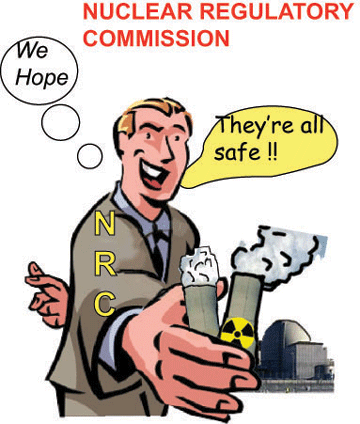 Regulators reject call for nuke plant shutdown By MICHAEL R. BLOOD, Associated Press September 10, 2014 LOS ANGELES (AP) — The Nuclear Regulatory Commission on Wednesday rejected a senior federal expert’s recommendation to shut down California’s last operating nuclear power plant until the agency can determine whether its twin reactors can withstand powerful shaking from nearby earthquake faults……..
Peck, now a senior reactor instructor for the NRC in Tennessee, argued the NRC is not applying safety rules it set out for the plant’s operation……..The agency’s ruling was issued on the same day that PG&E released hundreds of pages of scientific research that found a fault 650 yards from the reactors, known as the Shoreline, is twice as long as initially believed, making it capable of producing potentially stronger earthquakes, and intersections between some faults in the region could create larger earthquakes than previously considered. PG&E said in a statement that the plant remains seismically safe and able to withstand the largest potential earthquakes in the area.
Former California Sen. Sam Blakeslee, a geophysicist who has previously raised seismic concerns at Diablo, said “it’s premature to declare the plant is safe in light of this new information.”…….http://www.sfgate.com/business/energy/article/Regulators-reject-call-for-nuke-plant-shutdown-5746362.php
Orlando City Council dumping their investment in Duke nuclear power plant
 Orlando moves to dump stake in Duke’s nuke plant By Kevin Spear Orlando Sentinel, September 14, 2014 The Orlando City Council is expected to approve a plan Monday to dump city ownership in Duke Energy’s crippled nuclear generator for an amount far less than the original purchase value.
Duke’s nuke plant near Crystal River was bedeviled with concrete failures even before it started up in 1977, two years after Orlando’s electric utility bought a small share of the reactor. Disabled by epic calamity that began five years ago, the unit was supposed to run until at least 2036 and, depending on overhauls, possibly many years beyond then……….
the Florida Municipal Power Agency, which provides wholesale electricity to 30 cities, suggested the Duke plant could turn into a liability quagmire.
“There is much uncertainty and risk involved in decommissioning a nuclear power plant,” the agency stated in a memo to its directors.
“The project is planned to take up to 60 years to complete, and involves complex dismantling and transportation of contaminated material.”…….
Company officials determined that further repairs would cost $1.5 billion to $3.4 billion and take as many as eight years.
After much suspense, Duke Energy finally announced last year that the nuke was beyond saving and would be “placed in a safe, stable condition for 60 years until decommissioning work is completed in 2074.”
During a tour of the nuclear generator in 2011, plant operators said that more than 1,300 bundles of used uranium fuel were stored in a pool 30 feet deep.
That fuel pool, cooled to 101 degrees and blended with boron to stop the splitting of atoms, will remain a long-term maintenance and security concern for Duke Energy.
Asked Friday about the status for that highly radioactive fuel, Duke spokeswoman Heather Danenhower declined to provide further information.
“For security reasons, we do not disclose the number of nuclear fuel assemblies in our spent fuel pool,” Danenhower said.
Uncompetitive nuclear industry is rigging regulations and “spinning” media in order to survive
Killing the Competition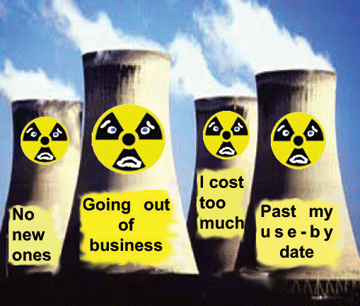
Exelon and Entergy see sustainable energy solutions—renewable energy, efficiency, conservation, etc.—as a long-term threat to
their profits. This is not because of excessive regulations or safety requirements on nuclear power: the industry has not had to implement a single safety upgrade due to the Fukushima meltdowns and faces less regulatory enforcement than it did twenty years ago. The closure of a record number of reactors since 2013 has exposed fundamental economic problems facing the industry, and a growing number of nuclear plants simply cannot compete with modern, efficient, cost-effective
energy resources.
USA’s Waste Isolation Pilot Plant sent plutonium to city 30 miles away!
 Plutonium found in city nearly 30 miles from US nuclear site — Newspaper: Explosion ‘melted through’ container causing radioactive release — More Pu-241 went airborne than all other types of plutonium combined, yet not included in test results http://enenews.com/plutonium-detected-city-30-miles-nuclear-site-explosion-melted-container-released-four-types-plutonium-officials-testing-pu-241-leaked-all-others-combined?utm_source=feedburner&utm_medium=email&utm_campaign=Feed%3A+ENENews+%28Energy+News%29
Carlsbad Current-Argus, Sept. 9, 2014: DOE will provide WIPP update next week — It appears the Waste Isolation Pilot Plant is far from reopening… According to photographic evidence made public by the DOE, it appears a chemical reaction caused an explosion inside one of the waste drums. The explosion melted through portions of the drum, and the incident triggered a small release of americium and plutonium into the outside air about half a mile from the facility.
“Plutonium… about half a mile from the facility”? Recently published air monitoring data from the state of New Mexico indicates that soon after the WIPP radioactive release 3 types of plutonium were found nearly 30 miles away in Carlsbad, the state’s 10th largest city. The levels were similar to those found within the nuclear site’s boundary:
- WIPP NW Border, 2/21-2/28: Plutonium-238 = 0.015 pCi/sample (Lab minimum detectable activity [MDA] = 0.0082)
- WIPP site, 2/21-2/28: Plutonium-239/240 = 0.0092 pCi/sample (MDA = 0.0062)
- WIPP site, 2/28-3/11: Plutonium-238 = 0.027 pCi/sample (MDA = 0.024)
- Carlsbad, 25+ mi. away, 2/28-3/11: Plutonium-238 = 0.016 pCi/sample (MDA = 0.0074)
- Carlsbad, 25+ mi. away, 2/28-3/11: Plutonium-239/240 = 0.022 pCi/sample (MDA = 0.0074)
More Plutonium-241 was released from WIPP than all other plutonium isotopes combined, yet officials have not included it in any publicly available test results:
- Plutonium-241 = 15,900 dpm
- Plutonium-239/240 = 11,600 dpm
- Plutonium-238 = 514 dpm
Nuclear industry muscling in on USA’s climate standards
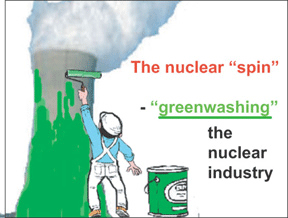 Killing the Competition The Nuclear Power Agenda to Block Climate Action, Stop Renewable Energy, and Subsidize Old Reactors, Report by Nuclear Information and Resource Center (NIRS) Sept 14
Hanford Nuclear Reservation’s dangerous”atomic man” room entered after 38 years
Workers enter dangerous ‘Atomic Man’ room at Hanford Nuclear Reservation http://www.oregonlive.com/pacific-northwest-news/index.ssf/2014/09/workers_enter_dangerous_atomic.html?utm_source=feedburner&utm_medium=twitter&utm_campaign=Feed%3A+oregonlive%2FkRom+%28Oregon+Local+News%29&utm_content=IceRocket+Blog+SearchSPOKANE, Wash. — Workers have entered one of the most dangerous rooms at the Hanford Nuclear Reservation.
The so-called McCluskey Room in the Plutonium Finishing Plant is named after worker Harold McCluskey. He was covered with radioactive material in 1976 when a glove box exploded. McCluskey, who was 64 at the time, lived for 11 more years and died from causes not related to the accident. He became known as the Atomic Man.
Hanford, located near Richland, Washington, for decades made plutonium for nuclear weapons. The site is now engaged in cleaning up the resulting radioactive mess.
Cleaning up the McCluskey Room is expected to take a year. A crew with contractor CH2M HILL Plateau Remediation Co. donned specially designed radiation suits before entering the McCluskey Room earlier this week. One of their first tasks was improving ventilation to better protect workers from airborne contamination as they clean out its equipment.
“This was the first of multiple entries workers will make to clean out processing equipment and get the McCluskey Room ready for demolition along with the rest of the plant,” said Bryan Foley, project director for the Department of Energy. “It has taken a year to prepare for this first entry.”
The room was used to recover americium — a plutonium byproduct — during the Cold War.
McCluskey was working in the room when a chemical reaction caused a glass glove box to explode. He was exposed to the highest dose of radiation from americium ever recorded — 500 times the occupational standard.
Covered with blood, McCluskey was dragged from the room and put into an ambulance headed for the decontamination center. Because he was too hot to handle, he was removed by remote control and transported to a steel-and-concrete isolation tank.
During the next five months, doctors extracted tiny bits of glass and razor-sharp pieces of metal embedded in his skin.
Nurses scrubbed him down three times a day and shaved every inch of his body every day. The radioactive bathwater and thousands of towels became nuclear waste.
McCluskey also received about 600 shots of zinc DTPA, an experimental drug that helped him excrete the radioactive material.
He was placed in isolation in a decontamination facility for five months. Within a year, his body’s radiation count had fallen by about 80 percent and he was allowed to return home.
California leads in its commitment to renewable energy
California Successfully Emphasizes Renewable Energy Commitment The Desert Sun, Morris Beschloss, September 8, 2014 Over the years, California has justifiably claimed the exalted position of originator of new ideas in fashion, entertainment, social media, and even electric cars. The state’s Silicon Valley is the shining symbol of the world’s breakthrough communications technology.
But now it seems that a significant escalation of solar energy and, to a lesser extent, “wind” is lending credibility to the once improbable California campaign to generate one-third of its power from renewable resources by 2020. This now realizable objective is personified by “NextEra Resources’ Blythe Solar Project” by the U.S. Department of the Interior.
Although originally eclipsed by the 1,000 megawatt photovoltaic farm originally proposed, conceivably the largest solar project in the world, the implementation of “Blythe” will generate enough power to service 485,000 homes, and reduce gas emissions by 400,000 metric tons per year.
California now leads the nation in cumulative solar electricity capacity, and was number one in solar capacity added last year. The windmills in Southern California’s San Gorgonio Pass are also setting new records as are the geothermal plants along the southern edge of California’s Salton Sea……..it is encouraging to see that America’s most populous state (California, with 12.5% of the nation’s population), is regaining its rightful place as the visionary of the United States’ bright future…….http://www.desertsun.com/story/money/industries/morrisbeschlosseconomics/2014/09/08/california-successfully-emphasizes-renewable-energy-commitment/15281441/
1 This Month
Tell Congress: Prevent Nuclear Catastrophe in Iran

Tell Congress: Prevent Nuclear Catastrophe in Iran

Read the Public Inquiry Report, the Commissioners’ report, Surrendering Australia: The AUKUS Deception is available to download for free at aukuspublicinquiry.com. Or just watch the replay of the National Press Club Luncheon.


Shut down the radiation-damaged Heysham nuclear reactors now
To see nuclear-related stories in greater depth and intensity – go to https://nuclearinformation.wordpress.com

Say No to NASA’s Reckless Nuclear Reactor on the Moon
Say No to NASA’s Reckless Nuclear Reactor on the Moon
-
Archives
- November 2026 (224)
- October 2026 (302)
- September 2026 (339)
- August 2026 (330)
- July 2026 (355)
- June 2026 (287)
- May 2026 (306)
- April 2026 (356)
- March 2026 (251)
- February 2026 (267)
- January 2026 (308)
- December 2025 (358)
-
Categories
- 1
- 1 NUCLEAR ISSUES
- business and costs
- climate change
- culture and arts
- ENERGY
- environment
- health
- history
- indigenous issues
- Legal
- marketing of nuclear
- media
- opposition to nuclear
- PERSONAL STORIES
- politics
- politics international
- Religion and ethics
- safety
- secrets,lies and civil liberties
- spinbuster
- technology
- Uranium
- wastes
- weapons and war
- Women
- 2 WORLD
- ACTION
- AFRICA
- Atrocities
- AUSTRALIA
- Christina's notes
- Christina's themes
- culture and arts
- Events
- Fuk 2022
- Fuk 2023
- Fukushima 2017
- Fukushima 2018
- fukushima 2019
- Fukushima 2020
- Fukushima 2021
- general
- global warming
- Humour (God we need it)
- Nuclear
- RARE EARTHS
- Reference
- resources – print
- Resources -audiovicual
- Weekly Newsletter
- World
- World Nuclear
- YouTube
-
RSS
Entries RSS
Comments RSS

