Prioritizing nuclear power and natural gas over renewable energy is a risky move for Ontario’s energy future
Norman W. Park, The Conversation, 11 Feb 25
The demand for electricity is growing rapidly as the world transitions from fossil fuels to low carbon-emitting forms of energy. However, making this transition will be difficult.
Ontario is projected to require 75 per cent more electricity by 2050, spurred by increasing demand from the industrial sector, data centres, electric vehicle (EV) adoption and households, according to the Independent Electricity System Operator (IESO).
To meet this demand, Ontario Energy Minister Stephen Lecce has proposed transforming the province into an “energy superpower” by aggressively expanding nuclear energy and natural gas while cutting support for wind and solar renewable energy.
This plan was spelled out in a policy directive from Lecce instructing the IESO to consider bids from all energy sources, opening the door to allow bids from natural gas and nuclear energy.
This is a departure from previous policies. Previously, under former Energy Minister Todd Smith, the IESO had stipulated bids for the electrical grid should only be from wind, solar, hydro or biomass.
The Ontario government should reconsider these plans. Non-renewable energy sources are costly, rely on new, expensive technologies, ignore the harm to human health and ignore the consequences for global warming.
Expanding nuclear
A central pillar of the Ontario government’s energy plan is the aggressive expansion of nuclear power. The province has committed to refurbishing 14 CANDU reactors at Bruce, Darlington and Pickering, and has proposed constructing new reactors at Bruce.
Ontario is also the first jurisdiction in the world to contractually build a BWRX–300 small modular reactor project at Darlington, despite not knowing its projected cost.
The cost of this small modular reactor may be much higher than similarly sized solar, wind and natural gas projects. This is unsurprising, given that the costs of nuclear projects are often much higher than projected.
Ontario encountered a similar issue when the Darlington nuclear generating station was constructed. The actual costs of nuclear projects were more than double projected costs and took almost six years longer to complete than projected.
Given these historical challenges and uncertainties, the province’s push for nuclear expansion is a cause for concern.
Opposition to wind and solar
Despite significant cost reductions in utility-scale wind and solar farms, which makes them less expensive than nuclear and fossil fuels in many parts of the world, Ontario’s recent policy directive reduced support for these non-emitting renewable energy sources…………………………………………………………..
Reconsidering Ontario’s energy transition
Ontario’s energy transition must involve supplying more energy to an expanding electrical grid while ensuring it remains reliable and resilient. The current government’s plans to turn the province into an “energy superpower” will commit Ontario to decades of costly expenditures and relies on unproven new technologies.
The government’s proposal to increase natural gas to supply the electricity grid and new buildings will increase the risk of premature death and serious illness to Ontarians and will increase greenhouse gas emission, undermining efforts to combat global warming.
Lecce should reconsider his current policy directive to the IESO. Future bids for the electrical grid should instead be evaluated for their impacts on the health of Ontario residents and climate change.
Ontario’s energy policies should also be guided by knowledgeable experts outside of government, rather than solely by politicians. Establishing a blue-ribbon committee comprising energy scientists and environmental specialists would provide needed oversight and ensure the province’s energy strategy is cost-effective, technologically sound and aligned with climate goals.
Ontario has an opportunity to lead by example in balancing energy needs with environmental and health priorities. https://theconversation.com/prioritizing-nuclear-power-and-natural-gas-over-renewable-energy-is-a-risky-move-for-ontarios-energy-future-246289
America’s nuclear gamble: The dangerous push to resume atmospheric testing
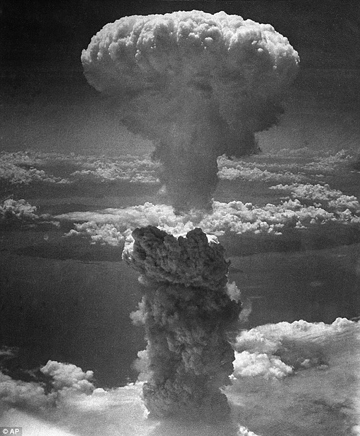
Experts warn of catastrophic fallout as calls grow to restart nuclear weapons tests abandoned since 1963.
By Karl Grossman, February 10, 2025
“The United States may need to restart explosive nuclear weapons testing,” declared Robert Peters, research fellow for nuclear deterrence and missile defense at The Heritage Foundation, the right-wing organization close to the Trump administration, in a lengthy report last month. Issued on January 15, it was titled: “America Must Prepare to Test Nuclear Weapons.”
Peters stated that “the President may order the above-ground testing of a nuclear weapon….And while the United States leaving the [Nuclear] Test Ban Treaty may not be optimal and may indeed have negative downstream effects, doing so may be necessary to stave off further adversary escalation.”
There has not been a nuclear weapon tested above-ground in the United States since 1962, Peters said. That was a year before the Nuclear Test Ban Treaty of 1963 was signed by the U.S., Soviet Union and United Kingdom. It prohibits nuclear weapons tests in the atmosphere, underwater or in outer space. It allowed underground tests as long as they didn’t result in “radioactive debris to be present outside the territorial limits of the state under whose jurisdiction or control” the test was conducted.
“Resuming atmospheric testing of nuclear weapons would be disastrous,” says Joseph Mangano, executive director of the Radiation and Public Health Project. He cited the “lessons learned from above-ground nuclear weapons testing—the radioactive fall-out that harmed many people, especially infants and children.”
Testimony by a co-founder of the Radiation and Public Health Project, the late Dr. Ernest Sternglass, a physicist, before the then Congressional Joint Committee on Atomic Energy, was instrumental in President John F. Kennedy signing the Nuclear Test Ban Treaty of 1963.
As President Kennedy said in a 1963 national address: “This treaty can be a step towards freeing the world from the fears and dangers of radioactive fallout.” He said that “over the years the number and the yield of weapons tested have rapidly increased and so have the radioactive hazards from such testing. Continued unrestricted testing by the nuclear powers, joined in time by other nations which may be less adept in limiting pollution, will increasingly contaminate the air that all of us must breathe.” Kennedy spoke of “children and grandchildren with cancer in their bones, with leukemia in their blood, or with poison in their lungs” as a result.
The Heritage Foundation’s 900-page publication “Project 2025” is the “governing agenda” for the Trump administration, writes Susan Caskie, executive editor of the magazine The Week, in its current issue. “Many of its authors and contributors,” she noted, are now members of the administration, some appointed to “even Cabinet posts.” …………………………………………………………………………………………………………………..
Are we, if there is a return to atmospheric nuclear weapons testing, to go back to the years of radioactive fallout—and the resulting health impacts? And, as Kennedy stated, “children and grandchildren with cancer in their bones, with leukemia in their blood, or with poison in their lungs.” more https://www.nationofchange.org/2025/02/10/americas-nuclear-gamble-the-dangerous-push-to-resume-atmospheric-testing/
Uranium fever collides with industry’s dark past in Navajo country

by Jacob Lorinc, Phys Org, 20Jan 25
A few miles south of the Grand Canyon, thousands of tons of uranium ore, reddish-gray, blue and radioactive, are piled up high in a clearing in the forest.
They’ve been there for months, stranded by a standoff between the mining company that dug them deep out of the ground, Energy Fuels Inc., and the leader of the Navajo Nation, Buu Nygren.
Back in the summer, Energy Fuels had triggered an uproar when it loaded some of the ore onto a truck, slapped a “radioactive” sign over the taillights and drove it through the heart of Navajo territory. Radioactive is an alarming word anywhere, but here in Navajo country, surrounded by hundreds of abandoned uranium mines that powered America’s nuclear arms race with the USSR and spewed toxic waste into the land, it causes terror.
Those fears have only grown in the past couple of years as nuclear power came back in vogue and sparked a uranium rush in mining camps all across the Southwest. So when the news made it to Nygren that morning, he was furious. No one had sought his consent for the shipment. He quickly ordered dozens of police officers to throw on their sirens, fan out and intercept the truck.
The dragnet turned up nothing in the end—the truck snuck through—but the hard-line response delivered a warning, amplified over social media and ratified days later by the governor of Arizona, to the miners: Stay out of Navajo country.
Cut off from the lone processing mill in the U.S.—all the main routes cut through Navajo territory—executives at Energy Fuels stockpiled it by the entrance of the mine. When the heaps of crushed rock grew too sprawling, they pulled the miners out of the tunnels and turned the drilling machines off.
The standoff represents the ugly side of the world’s sudden re-embrace of nuclear power. Yes, there’s the promise of a steady stream of clean energy to fuel the AI boom, fight climate change and, in the wake of Vladimir Putin’s invasion of Ukraine, replace Russian oil and gas.
But there’s also the fear—both around the nuclear reactor sites popping up across the world and in the communities surrounding mining operations in Australia, Kyrgyzstan and Navajo Nation, where the locals are still documenting cancer cases decades after the last of the Cold War-era outfits shut down.
It’s like the backlash erupting over all sorts of other mining projects crucial to the transition away from fossil fuels—lithium, nickel, copper, cobalt, zinc—just with the added threat of radioactivity.”Generations and generations of my people have been hurt,” Nygren, 38, said in an interview. “Go find uranium somewhere else.”
Truth is there isn’t all that much uranium at the Energy Fuels mine, known as Pinyon Plain, or any of the other half-dozen mines that opened in the Southwest the past couple years.
In most cases, crews are simply combing through the untouched veins of mines that were closed when the 2011 Fukushima disaster scared global leaders away from nuclear power and crashed the uranium market. Pooled all together, they only hold a fraction of the hundreds of millions of pounds of ore buried in any of the top mines in Canada, Kazakhstan and Namibia.
So the rush of mining activity here serves as a testament to the magnitude of the uranium fever sweeping the globe right now. At just over $70 per pound, the price is up some 200% over the past five years—even after it gave back a chunk of its gains in 2024.
……………………………………………………….At Pinyon Plain, they’re used to setbacks. Prospectors discovered the deposit in the 1970s but by the time all the mining permits were secured a decade later, the global uranium market had collapsed. Just like in 2011, the initial trigger was a nuclear disaster, the Chernobyl meltdown. And then, a few years later, the Berlin Wall fell and the nuclear arms race was over.
Plans were hatched over the years to open the mine as uranium prices bumped higher, but the enthusiasm would die as soon as the rally faded. It took the 2022 price surge to get Chalmers, who’s been scouting out Pinyon Plain ever since he first joined Energy Fuels back in the 1980s, to finally ram it through.
Now, after a single shipment to the mill in Utah, he’s stuck again. As he sees it, routes 89 and 160 are federal highways and, as a result, subject to federal shipping laws. The company doesn’t need the Navajos’ authorization, he says. To Nygren, every single inch of Navajo territory is subject to tribal law……………………..
Animosity towards mining companies runs high on Navajo land. It’s visible everywhere. On huge roadside billboards and small office signs, in fading pinks and yellows and jet blacks, too. They read “Radioactive Pollution Kills” and “Haul No” and, along the main entrance to Cameron, a hard-scrabble village on the territory’s western edge, “No Uranium Mining.”
A few miles down the road, big mounds of sand streaked gray and blue rise, one after the other, high above the vast desert landscape. They are the tailings from some of the uranium mines that were abandoned in the territory last century.
To Ray Yellowfeather, a 50-year-old construction worker, the tailings were always the “blue hills,” just one big playground for him and his childhood friends.
“We would climb up the blue hills and slide back down,” Yellowfeather says. “Nobody told us they were dangerous.”
Years later, they would be cordoned off by the Environmental Protection Agency as it began work to clean up the mines. By then, though, the damage was done. Like many around here, Yellowfeather says he’s lost several family members to stomach cancer. The last of them was his mother in 2022
Yellowfeather admits he doesn’t know exactly what caused their cancer but, he says, “I have to think it has to do with the piles of radioactive waste all around us.” It’s in the construction material in many of the homes and buildings and in the aquifers, too. To this day, drinking water is shipped into some of the hardest-hit areas.
The U.S. government has recognized the harm its nuclear arms projects have done to communities in the Southwest. In 1990, Congress passed a law to compensate victims who contracted cancer and other diseases. It paid out some $2.5 billion over the ensuing three decades.
The EPA, meanwhile, has been in charge of the clean-up of the abandoned mines. Two decades after the program began, though, only a small percentage have been worked on at all.
This is giving mining companies an opportunity to curry favor in tribal communities by offering to take over and expedite the clean-up of some mines. Chalmers has made it a key point in negotiations with Nygren.
…………. the EPA released a detailed study on Pinyon Plain. In it, the agency found that operations at the mine could contaminate the water supply of the Havasupai, a tribe tucked in such a remote corner of the Grand Canyon that it receives mail by mule. The report emboldened Havasupai leaders to step up their opposition to the mine, adding to Chalmers’s growing list of problems.”…….. https://phys.org/news/2025-01-uranium-fever-collides-industry-dark.amp?fbclid=IwY2xjawIUwvtleHRuA2FlbQIxMQABHey6Nv6MJqijcV5suiJOZjDx46rSSzwyrFBVrtbA0McaSeoPu-rhCeR0zQ_aem_N06qMIWp_xVHiPlfOH7DG
Trump Says He’ll Audit the Pentagon-Will it prove to be a bridge too far?
Bill Astore, Feb 09, 2025, https://bracingviews.substack.com/p/trump-says-hell-audit-the-pentagon?utm_source=post-email-title&publication_id=1156402&post_id=156757346&utm_campaign=email-post-title&isFreemail=true&r=c9zhh&triedRedirect=true&utm_medium=email
President Donald Trump says he’s ready to tackle the Pentagon, which has failed seven audits in a row. He says America might save “trillions” after effective audits. Will it happen?
The Pentagon budget currently sits at roughly $900 billion for this fiscal year, representing more than half of federal discretionary spending. This vast sum doesn’t include (among other things) Homeland Security, nuclear weapons covered by the Department of Energy, the VA (Veterans Administration), and interest on the national debt due to wasteful failed wars in places like Afghanistan and Iraq.
A successful audit of the Pentagon would be a monumental victory for what’s left of American democracy. It may also prove to be a bridge too far for Trump. The National Security State is America’s unofficial fourth branch of government and arguably its most powerful. It is a colossus that hides malfeasance and corruption behind a “top secret” security classification. It deters and prevents efforts at transparency by crying that those who try to expose its crimes are endangering national security. It expects your obedience and praise, not your questions and criticism.
Presidents, of course, are supposed to serve as the commander-in-chief of the U.S. military. They rarely do. Not nowadays. The U.S. system may in theory rest on civilian control of the military, but the military has been out of control since at least 1947, when it rebranded itself the “Department of Defense” instead of the old War Department. Not coincidentally, every war America has fought since then has been undeclared, i.e. lacking a formal Congressional declaration of war.
America has fought a mind-blowing number of wasteful and illegal wars that have been sold to the people through lies, whether in Vietnam (“The Pentagon Papers”), Iraq (No WMD), Afghanistan (“The Afghan War Papers”), and elsewhere. Few things are needed more in America than an honest reckoning of Pentagon spending—and future Pentagon war plans.
Such a reckoning could very well save our lives—indeed, the world, if done honestly and transparently by true patriots. It could also prove to be a bridge too far—for any president.
Is “Bad Faith”‘s Council for National Policy the Atlas Network’s half-brother?

Ed COMMENT. I put this article up on the Australian website. You might think that it has nothing to do with Australia.
But it does! The fascist chaos now developing in the USA could spread to Australia, as the Atlas Network promotes its Australian off-shoot “Advance”. Advance will funnel $millions into Trumpian-style propaganda, to influence the coming Australian federal election.
The long game of the Mont Pelerin Society that spawned the Atlas Network became colonising government and the law, to make them the servants of the largest players in the economy.
February 6, 2025 Lucy Hamilton, https://theaimn.net/is-bad-faiths-council-for-national-policy-the-atlas-networks-half-brother/
The Council for National Policy is the ultra-secret body tracked in the documentary Bad Faith. Are the Mont Pelerin Society fingerprints there just by chance?
The chaos that is erupting from the people around Trump was forecast in the 900 pages of Project 2025 for those paying attention. The firehose of brutality and stupidity is coming too fast for observers to encompass. Whether it’s 25 year olds with the power to alter code in the Bureau of Fiscal Service or a Christian Nationalist-driven freeze on all public spending or trying to deport Navajo people, the whole project reeks of reckless cruelty and apparent irrationality.

Just as Ronald Reagan implemented 2/3 of the first Mandate for Leadership, Donald Trump implemented 2/3 of his first iteration. Now the Mandate is known as Project 2025 and it’s no longer just a “business republican” project. It’s a Christian Nationalist project too. And 2/3 of the first executive orders of this Trump administration came from Project 2025.
The man likely to take the helm of the Office of Management and Budget, Russell Vought, was revealed as the Christian Nationalist radical he is in this undercover sting operation last year. The chaos is intended to continue. He has said he intends to put career civil servants “in trauma.” He also intends to use the military to crush protests.
This domestic chaos will be deadly; the freeze on USAID spending will kill people sooner. These radicals around Trump do not care: their eugenicist beliefs run deep. It’s a longterm goal: this 2006 annual Atlas Network report contains an essay repeating disdain for foreign aid as a failed concept by (MPS member since 1984, erstwhile president and critical figure in the growth of Atlas and several junktanks), Leonard Liggio. There is no reflection on how many nations need foreign aid because of MPS-driven restructuring and neoliberal interventions to keep those nations impoverished and dependent.
Ronald Reagan, the first de facto Atlas Network US president said: “The nine most terrifying words in the English language are: I’m from the Government, and I’m here to help.” The Trump apparatchiks are trying to make that a vicious reality.
The long game of the Mont Pelerin Society that spawned the Atlas Network became colonising government and the law, to make them the servants of the largest players in the economy. They sold the mission as “freedom” in a “free market,” with “small government” staying out of the little guy’s way. That was not the real intent. Democratic projects, rights or a decent life for the individual (below enabler class) were intended by few in the project. Neofeudalism is a more apt label. You are not even to be allowed to protest your (or others’) immiseration.
People committed to the neoliberal project have a firm commitment to making government look ineffective and wasteful. It may be that government efforts to tackle the pandemic risked making people trust government. The steps towards a UBI might have stung badly for people who believe government spending should only serve the already rich. It is likely also that coercive measures like lockdowns, mask wearing and vaccine mandates triggered their socialism-alarms. There is extensive evidence of junktank partners’ investmentin pandemic disinformation and the fighting of public health measures including masking.
It’s possible that the greater inclusivity of a pluralist society might have been enough on its own to repulse the narrow-minds of this machinery; it could be that the pandemic broke them.
Either way, after the worst of the pandemic, one of the Atlas Network’s most pivotal junktanks appointed a Rad Trad Catholic extremist with connections to Opus Dei as its president, in September 2021. Kevin Roberts was an Atlas operative before this. He used to run the Atlas Texas Public Policy Foundation.
He was also however, by 2022, already on the Council for National Policy board.
The Bad Faith (2024) documentary reveals in grim detail how the Council for National Policy (CNP) was the theocratic machine that built the Moral Majority. It was the network that brought together the extremist Evangelical preachers of that movement, media organisations and funders with some of the Republican Party’s most effective strategists. The documentary is based on journalist Anne Nelson’s extensive investigations in Shadow Network.

Key figures amongst the Republican Party strategists that founded the CNP belonged to the Mont Pelerin Society, just as the key operators in the Atlas Network did – and do.
(Atlas has, since it was founded in 1981, vacuumed up other junktanks and networks into its web of shared strategies and personnel connections: whether they are Atlas spawned or interlinked can be complex to disentangle. Whether CNP was in part an MPS project at its foundation is opaque. It could be that class interests of a small band of operatives led to overlaps in strategising. The two networks are, however, overtly operating in concert now with both strongly represented in the Project 2025 Advisory Board.)

Catholic zealot Paul Weyrich co-founded the Heritage Foundation in 1973. Many historic clips of Weyrich uttering his extreme beliefs are to be viewed in Bad Faith. In 1981, the CNP was founded to galvanise the 1978 undertaking to use the issue of abortion to create a Christian Republican voter bloc. (In 1978, abortion was a fringe Catholic issue, of little interest to Evangelicals.)
Weyrich’s co-founder at Heritage was Catholic Edwin Feulner, later an MPS president, but a member from 1972. He is also a CNP member.
The CNP’s Republican founders included Episcopalian (Anglican) Morton Blackwell, an MPS member from 2007, who created the Atlas Network-and-CNP’s Leadership Institute founded in 1979. It aims to increase “the number and effectiveness of conservative leaders in the public policy process. More than 300,000 conservatives have become leaders through Leadership Institute training.”
Fellow CNP founder was Evangelical? Edwin Meese III who worked with Atlas’s Ronald Reagan from 1966, and was later one of his attorney-generals. Meese was involved with Heritage from 1988. A third was Catholic Richard Viguerie who invented the direct mail scam that fostered the demonising of Democrats to scare grannies out of their pittance.
Both Atlas and the CNP receive funding from Charles Koch and his circle including the Bradleys. On the CNP leaked membership list, Lawson Bader is identified. He is an MPS member and has been president and CEO of Donors Trust and Donors Capital Fund since 2015. Donors Trust is known as the “dark money ATM of the right.” The Mercer family, that funded Breitbart and Cambridge Analytica, is also listed as a CNP donor. The united Devos and Prince families are key donors. Betsy DeVos has roles at several Atlas junktanks. Peter Thiel, tech plutocrat, is now a significant funder of Donors Trust.
Boeing, Coors, Cinemark, Forbes media and Morgan Stanley all have senior figures affiliated with CNP. (Coors money was central to the Heritage Foundation’s funding, with Joseph Coors, Evangelical and white supremacist, a co-founder.)
Currently the CNP and Atlas share several critical partner organisations apart from Heritage and Leadership such as the Federalist Society which has been described as creating the imperial juristocracy around Donald Trump’s second presidency. Another is the American Legislative Exchange (ALEC) that produces reactionary and anti-labour model bills for state legislatures to reproduce. A thirdis Americans For Tax Reform, which Grover Norquist (CNP member) founded at Ronald Reagan’s “request.”
The Acton Institute, Media Research Center, Capital Research Center, Buckeye Institute, National Center for Public Policy Research, Center for Security Policy, Young America’s Foundation, American Conservative Union (parent of CPAC), Discovery Institute and Americans for Prosperity are other joint members. Tea Party Patriots is a CNP member that is spawned as an astroturf outfit out of Atlas’s Freedomworks.
The CNP’s members include the Club for Growth, which is another Koch-supported entity. It funds Republican candidates who fight labour rights. The farce of fighting for the working man that Trump’s campaign feigns is exposed by the many junktanks here strategising to suppress workers.(1)
The CNP is a particularly ugly partner for the Atlas Network which advertises itself as “strengthening the worldwide freedom movement.” It unites the NRA with Turning Point USA with a range of hate groups promoting Islamophobia and homophobia. Its Christofascist members fight rights for women as well.
A key member is the Alliance Defending Freedom which the SPLC summarises as having supported “the recriminalization of sexual acts between consenting LGBTQ adults in the U.S. and criminalization abroad; has defended state-sanctioned sterilization of trans people abroad; has contended that LGBTQ people are more likely to engage in pedophilia; and claims that a “homosexual agenda” will destroy Christianity and society.” Not much freedom there.
The Conservative Partnership Institute (CPI) founded by Senator Jim DeMint, former Heritage Foundation president, in 2017, is a CNP member since 2020. This sub-network has spawned a range of extreme election denial and reactionary policy junktanks. One notable CPI entity is America First Legal, white supremacist Stephen Miller’s critical creation. It is largely funded by Bradley donations.
One of the significant names on the CNP list is Steve Bannon. He has been fighting for the “deconstruction of the administrative state” for years. His esoteric traditionalist beliefs call for the destruction of the age of slaves (democracy) to be replaced by the age of priests. His ally Curtis Yarvin, inspiration of many of the tech-fascist oligarchs, argues a CEO-monarch should replace the democratic experiment. It looks like Elon Musk thinks that should be him.
Many of the Christofascist organisations and individuals in the CNP are anti-democratic, believing that a theocracy is the answer to America’s ills. There is, at minimum, no freedom of religion allowed.
The destruction around Trump is a genuine threat to American’s democratic experiment.
That Reagan’s Mandate for Leadership should have become Project 2025 is startling on its own. The linking of Atlas’s ostensible campaign for freedom with the CNP’s campaign for theocratic coercion illustrates starkly that the freedom is only for a few.
* * * * *
Mont Pelerin is a secretive, invitation only organisation, but some of its leaked members can be found here. The Council for National Policy is ultra-secretive but its leaked members can be found here.
(1) (Business donors who had captured former Democrat Kirsten Sinema years back seem to have sent her back from early retirement to vote down Biden’s choice for a Labor Relations Board that might have been able to protect workers’ rights into the Trump era.)
This research is supported by an Australian Government Research Training Program Scholarship.
State Dept. Plans New $7 Billion Arms Sale to Israel

This comes as President Trump talks up an ethnic cleansing plan for the Gaza Strip
by Connor Freeman February 8, 2025, https://news.antiwar.com/2025/02/08/state-dept-plans-new-7-billion-arms-sale-to-israel/
The State Department has formally notified Congress of its plans for a massive arms sale to Israel worth over $7 billion, including thousands of missiles and bombs, the Associated Press reported on Friday. This follows Prime Minister Benjamin Netanyahu’s visit to Washington DC this week and Donald Trump’s announcement that the US will “own” Gaza after it is ethnically cleansed of its indigenous Palestinian population.
Per the State Department, Congress was notified of two separate sales, one is worth $6.75 billion. This first sale includes 2,800 500-pound bombs and 166 small-diameter bombs, along with thousands of guidance kits, fuses, bomb components, and other equipment. Deliveries of these bombs would begin later this year. The other package, worth $660 million, includes 3,000 Hellfire missiles and related equipment. Deliveries for this second arms sale are expected to take place by 2028. According to the AP, the use of these missiles will require the IDF to receive supplemental training by the US military.
Officials from the Joe Biden administration informally made Congress aware of the sale last month, at the time they said some of the weapons could be sent from current Pentagon stockpiles but most of the arms would take at least a year, or more likely several years, to deliver.
This comes as a fragile ceasefire in Gaza is still holding, despite the IDF killing dozens of Palestinians in Gaza since it was implemented and amid hostage exchanges on both sides. Israeli officials indicate that the increased military aid and arms sales are meant to compel Netanyahu to see the ceasefire deal through to its second and third phases, following the current 42-day truce. Last month, Trump released a shipment of 2,000-pound bombs that the previous administration had paused over a dispute regarding the Israeli invasion of Rafah last year.
Earlier this week, Trump asked leaders in Congress to approve another $1 billion arms transfer, financed with US military aid, that includes 4,700 1,000-pound bombs worth over $700 million and $300 million worth of armored bulldozers. The bulldozers are infamously used to carry out violent assaults and home demolitions in the occupied West Bank.
The news of the additional arms sales comes as Trump is talking up his plan for Gaza to be ethnically cleansed before the US takes over the Strip and begins a huge real estate development project there. Israeli Defense Minister Israel Katz ordered the IDF to prepare for the “voluntary departure” of the Palestinians from Gaza in accordance with Trump’s plan. He said the Palestinians should be sent to Western countries like Ireland, Norway, and Spain which have recognized the state of Palestine and been highly critical of Tel Aviv’s genocidal onslaught.
Initially, Trump had insisted that nearly 2 million Palestinians living in Gaza could be sent to Egypt and Jordan but the proposal was sharply rejected by Cairo and Amman along with the Palestinians themselves.
Therefore, in order to pursue this forced displacement plan, the Israelis will have to restart their genocidal campaign in Gaza where, according to a recent study in the British medical journal The Lancet, approximately 70,000 people have been killed as result of Israeli military action.
Scores of American doctors, nurses, and surgeons, who have spent hundreds of weeks combined volunteering in Gaza, wrote in an open letter to the White House last fall that tens of thousands more Palestinians had been starved to death as a result of the US-backed siege and Israel’s consistent blocking of vital humanitarian aid.
Connor Freeman is the assistant editor and a writer at the Libertarian Institute, primarily covering foreign policy. He is a co-host on the Conflicts of Interest podcast. His writing has been featured in media outlets such as Antiwar.com, Counterpunch, and the Ron Paul Institute for Peace and Prosperity. He has also appeared on Liberty Weekly, Around the Empire, and Parallax Views. You can follow him on Twitter @FreemansMind96.
Top Pentagon contractors poised for gains as Trump pushes missile shield expansion

The proposed “Iron Dome for America” system is heavily reliant on space-based sensors and potentially controversial space-based interceptors
Space News, by Sandra Erwin, February 3, 2025
WASHINGTON — The nation’s top defense contractors are positioning themselves to capitalize on a new missile defense initiative announced by the Trump administration. Executives from Lockheed Martin, Northrop Grumman, and L3Harris told Wall Street analysts last week that they are well-equipped to support the administration’s push for a “next-generation missile defense shield.”
President Donald Trump’s executive order, titled “The Iron Dome for America,” directs the Department of Defense to accelerate the development and deployment of an advanced missile defense system. The order calls for a multi-layered approach capable of countering a range of threats, including ballistic, hypersonic, and cruise missiles, with a heavy reliance on space-based sensors and potentially controversial space-based interceptors.
“We welcome the urgency that the Trump administration is placing on protecting the homeland from escalating global missile threats,” said Northrop Grumman CEO Kathy Warden during a fourth-quarter earnings call. The company has contracts for satellite-based missile detection and hypersonic weapon interceptors under development.
………..Lockheed Martin, Northrop Grumman and L3Harris are prime contractors in key missile defense programs that could expand under the initiative. L3Harris CEO Christopher Kubasik highlighted his company’s role in producing missile-defense tracking satellites for the Space Development Agency’s Tracking Layer program, a network of satellites designed to detect and track hypersonic threats from low Earth orbit………………………………………………………………………………………..
The administration has yet to provide a cost estimate for the ambitious Iron Dome initiative. The Pentagon’s missile defense efforts are currently funded through a complex web of programs. The Missile Defense Agency receives approximately $10 billion annually, while the Space Development Agency operates with a budget of about $4 billion. The U.S. Space Force maintains additional multi-billion dollar funding streams for missile-warning and missile-detection satellites. https://spacenews.com/top-pentagon-contractors-poised-for-gains-as-trump-pushes-missile-shield-expansion/?utm_source=ActiveCampaign&utm_medium=email&utm_content=Contractors%20prep%20for%20%20Iron%20Dome%20for%20America&utm_campaign=FIRST%20UP%202025-02-04
As China and the U.S. Race Toward A.I. Armageddon, Does It Matter Who Wins?

it doesn’t matter if the U.S. has no real enemies. The military industrial complex must continue to unceasingly grow, according to the logic of the Megamachine. It will invent enemies in order to justify that growth. That’s why we now have thousands of nuclear bombs and a sprawling, AI-driven, globally networked satellite and base infrastructure that encases the Earth like an iron maiden.
Koohan Paik-Mander CounterPunch , 7 Feb 25
A longstanding Sinophobia in the U.S. goes back to the 19th century, with the Chinese Exclusion Act, the tax on Chinese miners during the Gold Rush, and the exclusion from being able to testify in court.
Evidence of this entrenched history lingers today, in the trade sanctions against China, belligerent rhetoric from both Republicans and Democrats that led to a rash of violence against elderly Asian-Americans on American streets, as well as billions of dollars spent to fortify overseas bases in preparation for a U.S.-China war.
And the refusal to cooperate meaningfully with China on anything. As a result, the U.S. is thick in the midst of an AI arms race with China that is predicated on both nations’ dangerous faith in techno-salvation.
Thanks to the legacy of Sinophobia, it takes a whole lot to elicit an overwhelming embrace of China from average Americans, even if temporarily. But that’s what’s happened twice in the last month. The first time was the TikTok fiasco, when millions of distraught TikTok users had had their favorite platform snatched from them like a pacifier from a baby’s mouth. They found solace not in Meta nor X (as had been the plan), but rather, in the Chinese social media platform, Xiaohongshu, also known as “RedNote.”
The second instance was the debut of DeepSeek AI, which came on the heels of one of the most pompous pageants of delusional grandeur ever seen. It was Trump’s inauguration ceremony for his second term. Shortly thereafter, a press conference was held. Three tech oligarchs and the president bloviated about their Stargate AI project. It would cost $500 billion. That’s what they say is needed to stay ahead of the Chinese. (For some reason, the excuse of “staying ahead of the Chinese” seems to justify any astronomical expense.)
In the mean time, thousands of people have been left homeless due to wild fires in L.A., flooding in North Carolina, and even to this day, people from Lahaina, Maui are still without a place to call home. But none of these Americans got a press conference.
Instead, it was the oligarchs who took the stage. Oracle’s Larry Ellison, Masayoshi Son of Starbank, and Open AI founder Sam Altman described Stargate’s plans to build clusters of gigantic data centers across the country from sea to shining sea, each one bigger than any Walmart Superstore. It’s Manifest Destiny for data.
No one at the press conference mentioned that many of the data centers would be built on federal lands, would collectively use as much power as small European nations, require massive volumes of water, or would require a network of nuclear reactors. They did make the dubious promise their AI would cure cancer and heart disease. I think the guys who got wampum for Manhattan got a better deal.
A few days afterward, as if on cue, a Chinese company called DeepSeek that no one had ever heard of dropped their bombshell. The Chinese firm had released its own AI that was open-source, used fifty times less energy, performed on par with all the American AIs, and cost a gazillion times less to produce. Suddenly, the mirage of Silicon Valley’s invincibility faded away to reveal an overvalued industry that had gotten too fat, lazy and full of itself to innovate anything except marketing promises to investors. The very next day, a veritable trillion dollars peeled like a banana off the U.S. stock exchange tech sector. The story everywhere was that Chinese AI had officially “caught up” with the U.S.
When people cheered the scrappy Chinese underdog, it was as much a middle finger to the overblown hubris of the tech oligarchs as it was an embrace of Chinese innovation. It was motivated largely by the same class anger that rose up to lionize Luigi Mangione for killing a health insurance CEO with three inscribed bullets. People had been galled by the consolidated display of the broligarchy on the dais at the Trump inauguration, similar to the royals waving at the minions from the balcony at Buckingham Palace. Their message was unequivocal: We own you.
DeepSeek has been described as a Robin Hood of tech, taking from the rich to give AI to the poor. Sentiments of class anger buoyed admiration for the unknown company from China. They disregarded, for once, the stubborn stains of Sinophobia.
What was also overlooked in the midst of DeepSeek’s dazzling display of stock market disruption was responsible restraint around technology. As both China and the U.S. go hurtling ever faster toward Armageddon in the race to dominate in AI, they have both bought into techno-utopian ideologies, lock, stock and barrel………………………………………………………………….
China and the U.S. are entangled in a geopolitical rivalry, with existential stakes. Sure, it’s satisfying to enjoy the smarting blow that newcomer DeepSeek landed to the capitalist Goliath — China one, U.S. zero. But it’s not a boxing match. Such narrow framing loses sight of the fact that the race for accessible AI is a race for Mutually Assured Destruction (MAD).
………………………………………………………………………………………………………………The weapons industry wouldn’t tolerate the thought of degrowth, just like Microsoft, Google, Meta, Amazon et al. can’t bear it today. The war industry dealt with it by instead aggressively manufacturing enemies and reasons for war faster than it could manufacture more weapons. Now, forty years after the end of the Cold War with Russia, the war budget has increased every year and is now up to one trillion dollars, Los Alamos has begun manufacturing nukes for the first time in decades last year, we’ve got 800 bases around the world, rocket launchpads in wilderness areas, and thousands of satellites in the heavens.
It’s hard to get one’s bearings, especially in the midst of the engineered political maelstrom of the current moment. Fortunately, the books haven’t been burned (yet), so we can turn to the thinkers of the recent past for guidance.
The technology critics of the 20th century, such as Jacques Ellul, Lewis Mumford and Chellis Glendinning, urged us to conceptualize technology not just as a single artifact, such as a laptop, or just AI, or just a satellite, or just a nuclear weapon, but rather, as a whole way of thinking, a way of organizing society, our institutions, a way of being. Technology is not a one-off. It is systemic. Lewis Mumford called all of our technological society the Megamachine.
Every project, technology, organization, and endeavor is an expression of the Megamachine where the economic-growth imperative reigns supreme. It is all of a piece. It doesn’t matter if DeepSeek uses less energy. The growth imperative must be met……
Likewise, it doesn’t matter if the U.S. has no real enemies. The military industrial complex must continue to unceasingly grow, according to the logic of the Megamachine. It will invent enemies in order to justify that growth. That’s why we now have thousands of nuclear bombs and a sprawling, AI-driven, globally networked satellite and base infrastructure that encases the Earth like an iron maiden.
The poster child for the Megamachine in the digital age is Amazon. Former chair of the Federal Trade Commission Lina Khan’s seminal essay “Amazon’s Anti-trust Paradox,” tracks the logic of the behemoth’s growth over its history. She brilliantly unravels how Amazon decisively prioritized sheer growth over profit for its first eight years. The goal was to entrench a broad-spanning networked infrastructure that would guarantee a monopoly and continue to consolidate market dominion. They forwent profits for almost a decade expressly in order to monopolize the market. Again, the imperative for growth and global domination trumps decent common sense.
Former chair of the Federal Trade Commission Lina Khan’s seminal essay “Amazon’s Anti-trust Paradox,” tracks the logic of the behemoth’s growth over its history. She brilliantly unravels how Amazon decisively prioritized sheer growth over profit for its first eight years. The goal was to entrench a broad-spanning networked infrastructure that would guarantee a monopoly and continue to consolidate market dominion. They forwent profits for almost a decade expressly in order to monopolize the market. Again, the imperative for growth and global domination trumps decent common sense.
……………………………………………………………The sooner that the U.S. and China treat one another as fellow members of humankind, rather than adversaries, the real work of cooperation can begin. Both nations are home to millions of indigenous peoples who carry the know-how for surviving and thriving for generations into the future. Their wisdom is more precious than any AI. There’s no shortage of problems that our combined brilliance can improve if not solve: climate, nuclear weapons, species extinction, toxic waste clean-up, housing, microplastics, and last but not least, dangerous unregulated technologies. None of these colossal crises can be addressed as long as we are pointing fingers while locked in the downward spiral of a competition for global hegemony that the U.S. can never win.
Some of us remember the shining moment in history when the U.S. and Soviet Union built trust and signed a raft of nuclear arms control agreements. They modeled what ratcheting down tensions and the path to peace looks like. It would behoove the U.S. and China to follow their lead today, not only with nukes but also with AI and other emerging technologies. https://www.counterpunch.org/2025/02/07/as-china-and-the-u-s-race-toward-a-i-armageddon-does-it-matter-who-wins/
How Australia’s CANDU Conservatives Fell in Love with Canadian Nuclear

This time around, with the current push to embrace nuclear energy, the federal Australian Coalition’s ideas appear to be shaped by the internet, where a pro-nuclear media ecosystem of influencers and podcasters has flourished just as nuclear has become attractive to conservative parties worldwide.
Ontario, Canada is the only place in the world to tear out wind turbines and embrace nuclear power. Australia’s conservatives have been taking notes.
DRILLED, Royce Kurmelovs 5 Feb 25
If there is a Holy Land for nuclear energy, Australian Shadow Climate Change and Energy Minister, Ted O’Brien, seems to think it’s Ontario, Canada.
Other countries have well-established nuclear power industries, of course. There’s the United Kingdom where the Hinkley Point C nuclear reactor – dubbed “the world’s most expensive power plant” – where work began in 2007 with an expected start date of 2027 but is now at least ten years behind schedule and billions over budget. Meanwhile, it’s sister project, Sizewell C, is estimated to cost the equivalent of AUD $80bn (GBP £40bn, USD $49bn). There’s France where, in mid-August 2022, half the country’s nuclear reactors were forced offline, many as a direct result of climate impacts such as heat and drought.
Over in the United States, storied home of the Manhattan Project, where newly minted energy secretary (and fracking CEO) Chris Wright has announced a commitment to “unleash” commercial nuclear energy, one of the last two new nuclear power builds attempted this century forced Westinghouse into bankruptcy protection, and a separate effort by NuScale to build a cutting edge small modular reactor (SMR) was cancelled in November 2023 due to rising costs. There’s also Finland, a country of 5.6 million people, that finally turned on Europe’s newest nuclear reactor 18 years after construction began, finishing up with a price tag three times its budget. Though it had a noticeably positive effect on prices after start up, the cost of building Olkiluoto-3 was so high, its developer had to be bailed out by the French government. Since then, technical faults continue to send the reactor temporarily offline – a remarkably common occurrence among nuclear reactors.
Ontario, however, is so far the only place in the world that has ripped out wind turbines and built reactors – though the AfD in Germany has pledged to do the same if elected, and US President Donald Trump has already moved to stop new windfarm construction. Thanks to much self-promotion by pro-nuclear activists and Canada’s resources sector, that move caught the imagination of O’Brien and Australia’s conservative party. Now, as Australians head to polls in 2025, the country’s conservatives are looking to claw back government from the incumbent Labor Party with a pro-nuclear power play that critics charge is nothing more than a climate-delay tactic meant to protect the status quo and keep fossil fuels burning. “This is your diversion tactic,” says Dave Sweeney, anti-nuclear campaigner with the Australian Conservation Foundation. “There’s a small group that have long held an ambition for an atomic Australia, from first shovel to last waste barrel to nuclear missile. Some of the people who support this are true believers, for others it’s just the perfect smoke screen for the continuation of coal and embedding gas as a future energy strategy.”
Apples and Maple Syrup
On the face of it, Ontario is an odd part of the world on which to model Australia’s energy future. Privatization in both places has evolved messy, complicated energy grids, but that’s about all they have in common. One is a province on the sprawling North American landmass, and the other is a nation that spans a continent. Ontario has half the population of Australia and spends five months a year under ice. Its energy system has traditionally relied on hydro power and nuclear, where Australia is famously the driest inhabited continent on the planet that used to depend on coal but now boasts nearly 40% renewable electricity as of 2024.
One Australian state, South Australia, already draws more than 70% of its power from renewables and frequently records weeks where all its electricity needs are met with solar and wind. Unlike Ontario, and the rest of Canada, Australia has no nuclear industry aside from a single research reactor in the Sydney suburbs. The cost of transmitting power over vast distances in Australia makes up approximately two-fifths of retail power prices. Electricity prices in Ontario, meanwhile, have been artificially lowered by an $7.3bn a year bundle of subsidies for households and businesses. Comparing the two jurisdictions is stranger than comparing apples and oranges; it’s more like comparing apples and maple syrup.
None of this has stopped the province from becoming O’Brien’s touchstone for the marvels of nuclear energy, and “Ontario” from becoming his one-word reply to critics who question the wisdom of creating a new nuclear industry from scratch in Australia. If the country wanted to transition away from coal, the Coalition’s suggestion was it should be embracing nuclear energy — not more renewables — just look at Ontario. “We have to keep learning the lessons from overseas,” O’Brien told Sky News in August 2024. “There’s a reason why countries like Canada, in particular the province of Ontario, has such cheap electricity. They’ve done this many years ago. They were very coal-reliant and eventually, as they retired those plants, they went into nuclear.”
Weirder still, O’Brien is not the only Australian political leader to be chugging the maple syrup. Ever since the conservative Liberal-National Coalition began to float the idea of an atomic Australia as part of their 2025 election pitch, its leader, Peter Dutton, has similarly pointed to the Canadian province as an example for Australia to follow. In interview after interview, Dutton referred to Ontario’s power prices to suggest that nuclear is the future for Australia – raising the question: how did Ontario capture the hearts and minds of Australia’s conservatives?
Atomic Australia
The idea of an atomic Australia has long lived in the heart of Australian conservatism. Former conservative Prime Minister Robert Menzies once begged the United Kingdom to supply Australia with nuclear weapons after World War II, going so far as to allow the British to nuke the desert and the local Indigenous people at a site known as Maralinga. The first suggestion for a civilian nuclear power industry evolved out of this defense program and has never been forgotten. Iron ore magnate Lang Hancock and his daughter, Gina Rinehart, today Australia’s richest woman, both remained fascinated by nuclear energy. In 1977, Hancock, a passionate supporter of conservative and libertarian causes, brought nuclear physicist Edward Teller to Australia on a speaking tour to promote nuclear power, including an address to the National Press Club where he promised thorium reactors would change the world.
Though Australian plans to build a domestic nuclear industry have failed due to eye-watering costs and public concerns about safety, the country today is the fourth largest exporter of uranium according to the World Nuclear Association, sending 4820 tonnes offshore in 2022 and providing 8% of the world’s supply. The country is also planning to acquire a nuclear-powered submarine fleet through AUKUS, an alliance with the US and UK. This increasingly tenuous defense deal is thought unlikely to happen thanks to issues with US and UK shipyards, but the existence of the program has been used to justify the creation of a civilian nuclear power sector. There have been at least eight inquiries or investigations into the viability of a nuclear industry in Australia since 2005, and five proposals to build government-owned nuclear waste dumps since 1990. Each inquiry has concluded that nuclear power would largely be a waste of time and money and, with the exception of two facilities in Western Australia that store low-level radioactive waste, efforts to build additional dumps capable of storing higher grades of waste have mostly foundered for lack of community support. This time around, with the current push to embrace nuclear energy, the federal Australian Coalition’s ideas appear to be shaped by the internet, where a pro-nuclear media ecosystem of influencers and podcasters has flourished just as nuclear has become attractive to conservative parties worldwide.
When Australia LNP opposition leader Peter Dutton formally unveiled the gist of his “coal-to-nuclear” transition plan in June 2024, for example, he was asked what the plan would be to handle the waste and responded with a curious sleight of hand: “If you look at a 470MW [nuclear] reactor, it produces waste equivalent to the size of a can of Coke each year.” A fact check published in the Nine papers pointed out that nuclear reactors typically operate on much larger scales than 470 megawatts. Citing World Nuclear Association figures, it found a typical large-scale nuclear reactor with 1-gigawatt capacity will generate 30 tonnes of spent fuel each year – roughly 10 cubic metres, or 10,000 litres a year. It is unclear where Dutton or his speechwriters stumbled onto this talking point, but it appeared to be a corruption of the idea that one person’s lifetime waste from nuclear energy could fit inside a soda can – a common Facebook meme promoted by the Canadian Nuclear Association. A similar claim was repeated last year in a social media video by Brazilian model and Instagram influencer Isabelle Boemeke.
Boemeke, who goes by the online persona Isodope and claims to be the “world’s first nuclear energy influencer,” begins her video by outlining her daily diet, starting with black coffee and ending with a post-gym snack of energy-dense gummy bears. In a dramatic transition, she then compares the size of a gummy bear to the size of a uranium pellet, before launching into a didactic explanation of the role these pellets play in generating nuclear power.

“It also means the waste it creates is tiny. If I were to get all of my life’s energy from nuclear, my waste would fit inside of a soda can,” she says, before ending by advising her viewers not to drink soda because “it’s bad for you.”
Neither the Canadian Nuclear Association nor Boemeke elaborated on how the world might dispose of the cumulative waste if a significant proportion of the Earth’s population drew their energy from nuclear power – but then that is not the point.
Boemeke is hardly alone. Online there is a small but determined band of highly networked, pro-nuclear advocates, podcasters and social media influencers working to present an alternate vision for an atomic world. Many of those involved in this information ecosystem are motivated by genuine belief or concern over environmental issues, even if their activities often align with right-wing causes and ideas. Nuclear is often positioned as an essential climate solution, as well, although it’s typically a cynical promise: nuclear reactors take decades and billions of dollars to build, buying fossil power more time. In the U.S. especially, pro-fossil conservative politicians often use nuclear as a rhetorical wedge: they will ask any expert or advocate in favor of climate policy whether they support nuclear and imply that if they don’t, they must not be serious about actually addressing the climate crisis by any means necessary.
One of those helping export the strategy from North America to Australia is Canadian pro-nuclear advocate, Chris Keefer, host of the Decouple podcast and the founder of Canadians for Nuclear Energy. A self-described “climate hawk”, Keefer is a practicing emergency physician in Toronto who built an online presence as an advocate for keeping existing nuclear power plants open. Through his public advocacy, he has been instrumental in cultivating the image of Canadian – and particularly Ontarian – nuclear excellence, a legend he has recently promoted in Australia through a series of meetings, speeches and his podcast.
Nuclear on Tour
…………………………………………………………………in September 2023, when Keefer traveled to Australia to give a keynote address at Minerals Week, hosted by the Minerals Council of Australia (MCA) at Parliament House in Canberra. Ahead of his visit, a write up published in the The Australian Financial Review framed Keefer as a “leftie” and “long time campaigner on human rights and reversing climate change” who had previously “unthinkingly accepted long-standing left-wing arguments against nuclear” but had embraced nuclear due to his unionism. During his time in Australia, Keefer says he met with federal Opposition leader Peter Dutton to discuss “Ontario’s coal phaseout and just transition for coal workers”,………………………………………..
As political folklore this was a tale that would have appealed deeply to Keefer’s audience, whose constituencies were threatened by renewable energy projects. The MCA itself has historically been hostile to Indigenous land rights and campaigned heavily to stop or delay any government response to climate change during the 90s, largely in defence of coal producers…………………………………………. The promise of an Ontario-style “blue-blue alliance” – a political alignment between certain blue-collar unions and conservatives – would be alluring, especially given how well a pro-nuclear campaign paired with anti-wind scaremongering. Even a nuclear-curious Labor member may have spotted a way to stem the flow of votes to Greens.
Changing Winds
What Keefer presented to the Australian resources sector as a glorious triumph, Don Ross, 70, recalls as a difficult time in his small community that became a flashpoint in a fight over Ontario’s future. ……………………………………………
As a longtime member of the County Sustainability Group, Ross says an awareness that the climate is changing pushed him and others to fight for the White Pines Wind development back in 2018. In his telling, the community had the best wind resource in the area and had been pitched as a site for development since the year 2000. There were six or seven serious efforts over the years, all small projects in the range of 20 megawatts that would have allowed the community to be largely self-reliant in terms of power. Only White Pines came closest to completion. It was a ten year development process that Ross says was fought at every step by an anti-wind campaign, with some of the campaigners active since 2001.
“They just took all the information from Australia or America or around the world to fight the same fight – they used the same information, same tactics, played on the same fears and uncertainties,” Ross says. “They were very effective. They had the media backing them, and the conservatives saw an opportunity to drive a wedge.”……………………………………………………………………………………………..
By election day, four of the nine towers at the White Pines windfarm development were already built, the cranes were on site, and the other towers were laying in position ready to go. The development was just four weeks from completion when the election was called for Ford.
On his first day in office, Ford cancelled 758 renewable energy contracts. ……………………………… Ontario’s future Energy Minister, Todd Smith – a former radio presenter who has since left politics and now serves as Vice President of Marketing and Business Development at the Canadian nuclear technology firm, Candu Energy, a subsidiary of AtkinsRealis – had opposed White Pines from its inception. ………………………………………………………………….
Next the Ford government slammed the brakes on renewables investment. It shredded a cap-and-trade program that was driving investment in the province, a successful energy efficiency strategy that was working to reduce demand and a deal to buy low-cost hydropower from neighbouring Quebec. During the campaign, Ford promised Ontario’s voters that taxpayers wouldn’t be on the hook for the cost of literally ripping the turbines out of the ground and ending the other 750 or so projects. He had pledged that doing so would actually save CAD $790 million. When the final tally came in, that decision alone ended up costing taxpayers at least CAD $231 million to compensate those who had contracts with the province. The amount finally paid to the German-company behind the White Pines development is unknown. The former developers remain bound by a non-disclosure clause.
Canada’s Nuclear Heartland
…………………………………..Under Ford, Ontario – and later, Canada itself – fell into a nuclear embrace. Much of this, Professor Winfield says, played on a historical amnesia and nostalgia for what was considered a hero industry that traced its origins to the dawn of the atomic era. The province supplied the refined uranium used in the Manhattan Project and its civilian nuclear industry grew out of the wartime program. At first, the long-term strategy was to use domestic nuclear power as a base for a new export industry, selling reactor technology and technical expertise to the world. Development on a Canadian-designed and built reactor, the heavy-water CANDU – short for “Canadian Deuterium Uranium” – began in 1954. Two sites, Pickering and, later, Darlington were set aside for the construction of nuclear plants. The first commercial CANDU reactor would start up at Pickering in 1971 but the hope of a nuclear-export industry died on the back of questions about risk, waste, cost and scandals involving Atomic Energy of Canada that included attempts to sell CANDU reactors to Nicholai Ceausescu’s Romania.
………………………………………………“So Ontario went from an electricity system that was basically almost 100% hydroelectric to a system that was about 60% nuclear by the early 90s. By 1997, eight of the original 20 reactors in Ontario were out of service.”
……………………………………….Until 2018, the idea of a nuclear revival in Ontario seemed a fantasy. Then Doug Ford began ripping out wind turbines and blocking the province from considering renewables as part of its energy mix. It was an act designed to play to his base, especially the workforce within the nuclear industry………………… Whatever the precise figure is today, the weight of numbers from those directly involved, or further out in the supply chain, offered a constituency that could be appealed to. It also helped that Ford’s government was able to run its energy systems largely by executive fiat. …………………….
More of the Same
So far, Ford’s government – re-elected in 2022 – has taken advantage of this opaque arrangement to pursue its plan to refurbish 10 existing nuclear reactors, build four new 1200 megawatt units at the Bruce Nuclear Facility, and four new small-modular reactors (SMR) at Darlington – the centerpiece of Ontario’s promised nuclear revival. ………………………….
…………………….Each [smr] unit is built to be smaller, more standardized, with fewer components or systems. On paper, this is supposed to make it possible to manufacture the units in large batches, bringing down costs, which are historically the barrier to a broader embrace of nuclear power. As the Globe and Mail reported in early December 2024, Christer Dahlgren, a GE-Hitachi executive, acknowledged as much during a talk in Helsinki in March 2019. The company, which is responsible for designing the BWRX-300 reactors – an acronym for “Boiling Water Reactor 10th generation” – to be installed at Darlington, needed to line up governments to ensure a customer base. Keeping the total capital cost for one plant under $1 billion was necessary, he said, “in order for our customer base to go up”.
The initial price for Ontario’s new reactors, however, was offered before the design had been finished. As the cost is not fixed, any change to the design at any part of the process will up the cost as the plans are reworked. ………………………….the publicly-owned utility companies most likely to invest in nuclear power take on considerable financial risk with any given project – a risk that only goes up as the price tag climbs through the billions………..
………………..So far Ontario is the only jurisdiction to fully commit to a new SMR build. In January 2023, Ontario Power Generation, the successor entity to Ontario Hydro, signed the contract to deploy a BWRX-300, and preliminary site preparation at Darlington is currently underway. As Darlington was already an approved site for nuclear operations, the regulatory process is expected to be shorter, meaning the project will move towards construction much more quickly than others might – such as any new greenfield development in Australia. If everything goes to plan – a questionable assumption given the project will bind Ontario and Canada to United States at a time when US President Donald Trump is threatening to impose tariffs – the first reactor is expected to come online by 2028, with additional reactors to follow by 2034 and 2036.
………………….. Some estimates, such as Professor Winfields’, put the total cost of the Ford government’s nuclear refurbishment and SMR build plan in the range of $100bn, but firm numbers on the expected cost of the SMR build and the refurbishment of existing reactors have remained elusive. Industry insiders expect the numbers to be released by the end of 2025 potentially after an early provincial election.
……………….“The idea that anybody would be looking at us as a model in terms of how to approach energy and electricity and climate planning is just bizarre,” says Professor Mark Winfield from York University,. “You can’t make this stuff up. We’re a mess.”
……………………………………………………………..Ontario’s Soft Power
Winfield’s is a very different read of the landscape than the one presented by Chris Keefer, who rejects these criticisms, saying claims about overblown costs and delays are themselves overblown – a deflection that has been repeated by Australian political figures.
……………………………………………………….Nuclear, in Keefer’s view, remains not just a climate solution, but the climate solution. A self-described “climate realist”, he has developed this theme across more than 300 episodes of his podcast, Decouple – much of this output devoted to specifically promoting the Canadian nuclear industry and the CANDU reactor. It is a story told again and again, whether in conversation with figures like climate contrarian and long-time nuclear advocate Michael Shellenberger……………………….
Keefer knows his reach. He says he has given no formal advice to the Australian federal Coalition on nuclear but adds that his podcast “is listened to by policy makers throughout the anglosphere,” meaning that “it is possible that the thinking of Australian policy makers has been influenced by this content.” Among his lesser-known guests have been a small contingent of Australian pro-nuclear activists such as Aidan Morrison and former advisor to Ted O’Brien, James Fleay, both of whom have been publicly involved in making the case for an atomic Australia.
As far as pro-nuclear advocates go, Morrison has self-styled himself the “bad boy of the energy debate”. A physicist who abandoned his PhD with the University of Melbourne, he worked briefly as data scientist with large banks and founded a Hunter S. Thompson-themed bar “Bat Country”. His first foray into public life and nuclear discourse was as a YouTuber, where he used the platform to attack the Australian Energy Market Operator (AEMO) and its Integrated System Plan (ISP), a document produced from a larger, iterative and ongoing planning process that guides the direction of the National Electricity Market. ………In December 2023, Morrison was hired into the Centre for Independent Studies (CIS), another free market think tank and Atlas Network partner, as head of research on energy systems.
………………………………..As Keefer hosted Morrison on his podcast, Morrison returned the favor in October 2024 when he brought Keefer back to Australia for a CIS event titled “Canada’s Nuclear Progress: Why Australia Should Pay Attention.” Leading up to the event, they toured the Loy Yang coal-fired power plant together, and visited farmers in St Arnaud, Victoria who have been campaigning against the construction of new transmission lines. Where Keefer previously presented himself as a lefty with a hard realist take on climate change, his address to the free market think tank took a different tack.
Over the course of the presentation, Keefer once more retold the story of the pivotal 2018 provincial election in Ontario, but this time elaborated on how an alliance between popular conservative movements and blue-collar unions mobilised against what he called a “devastating” renewables build out. Because “it was astonishingly difficult to convert environmentalists into being pro-nuclear”, Keefer explained how he had sought to exploit a vacuum around class politics by targeting workers unions and those employed in the industry by playing to an underlying anxiety…………………………..
In the mix were union groups such as the Laborers International Union of North America (LiUNA), the Society of United Professionals, the boilermakers union and, critically, the Power Workers’ Union. These were all unions whose membership depended on big infrastructure builds, but it was helpful that Keefer’s advocacy aligned with the interests of capital and government.
Twenty thousand signatures on a petition wasn’t enough to save the White Pines wind farm from demolition in 2018, but according to Keefer, 5874 names on an online petition to the House of Commons he organized as part of a campaign to save the Pickering nuclear plant in 2020 was enough to earn him access.
“That really opened the doors in Ottawa politically for me,” he said of the petition to save Pickering. His go-to tactic to achieve this influence, he said, was the “wedging tool” to pull left and centrist parties “kicking and screaming at least away from anti-nuclearism.”
………………………………………………………………………. “So the environmental NGOs were very, very powerful. We needed to form a countervailing force within civil society, and so with that intent I co-founded Canadians For Nuclear Energy in 2020 very quickly, to have some kind of influence.”…………………………………………………………………………………………………………
A Confluence of Energies
Within this convergence of pro-nuclear activism, internationalist conservative political ambition and new media ecosystems, companies within Canada’s nuclear industry have also been positioning themselves to take advantage should the prevailing wind change in Australia. In October 2024, Quebecois engineering services and nuclear company, AtkinsRéalis – the parent company of Candu Energy that now employs Ontario’s former energy minister, Todd Smith – announced it was opening a new Sydney office to “deliver critical infrastructure for Australians”.
Though little known in Australia, the company has a storied history in Canada. Formerly known as SNC-Lavalin, the Quebecois company changed name in 2023 in the long wake of a lingering corruption scandal involving allegations of political interference by Canadian Prime Minister Justin Trudeau in the justice system. Today the company holds an exclusive license to commercialize CANDU reactor technology through Candu Energy and in 2023 signed an agreement with Ontario Power Generation to help develop Canada’s first SMR reactor. A year later, the company signed a memorandum of understanding with GE Hitachi Nuclear Energy to support the deployment of its BWRX-300 reactors in the UK.
………………………………………………Under a future Coalition government, AtkinsRealis’s work with traditional reactors and SMRs would make it one among a field of contenders for lucrative contracts to design, build and operate any nuclear facility……………………………………………………………………………….
Just getting started, however, would require lifting a ban on nuclear power introduced in 1998 by former conservative prime minister John Howard, and any state-level equivalent. Communities, many of which are already concerned about unanswered questions such as how material will be transported and stored, or how much water will be required in the driest inhabited continent, would need to be consulted. …………………………………..
If all goes according to plan – a heroic “if” – the earliest any nuclear generator would come online in Australia is 2037 – or 2035 if the country embraces SMR technology – with the rest to follow after 2040. In the short-to-medium term, the Coalition leader Peter Dutton has freely admitted his government would continue with more of the same in a manner reminiscent of Ontario: propping up Australia’s aging fleet of coal-fired power plants, and burning more gas as a “stopgap” solution in the interim.
………………………………“This is not going to deliver anything in the times that are relevant to what the Australian system needs, or certainly what the climate needs. It’s not a serious policy or proposal.” – Dylan McConnell, an energy systems expert with University of New South Wales
……………… …………………………..To sell this vision to the Australian public, the Coalition released a set of cost estimates in late December 2024, claiming its plan would be (AUD) $263bn cheaper than a renewables-only approach. These figures, however, were declared dead on arrival. Not only did the modelling underpinning them assume a smaller economy, with a vastly lower take up in electric vehicles over time, but it excluded the entire state of Western Australia – a state twice as big as Ontario and nearly four times as big as Texas with a tenth of the population – and did not consider ancillary costs such as water, transport and waste management. Even more nuanced reviews, published weeks later, found the assumptions underpinning the model outlined a program of work that would choke off renewables and backslide on Australia’s commitments under the Paris Agreement………………………………………………………………………………………………………………………
Power Politics
The lack of detail and apparent effort to crib from Ontario’s conservatives on strategy underscores how the politics of nuclear power is what made it attractive to the federal Coalition, a party that continues to fiercely protect the interests of oil, gas and coal producers. As the reality of climate change increasingly compels action, the party has been facing a challenge from independent, climate-conscious candidates known collectively as the “Teals”, running in seats previously thought safe. Nuclear power offers the perception that the party is taking climate change seriously even as it still serves its traditional constituency ………………………………………………… https://drilled.media/news/aus-nuclear
If DOGE Goes Nuclear
The risk of messing with the wrong computer system,
The Atlantic By Ross Andersen, 6 Feb 25
You may have never heard of the National Nuclear Security Administration, but its work is crucial to your safety—and to that of every other human being on the planet. If Elon Musk’s Department of Government Efficiency (DOGE) hasn’t yet come across the NNSA, it surely will before too long. What happens after that could be alarming.
As recently as yesterday morning, Musk made clear that DOGE will go line by line through the government’s books looking for fat targets for budget-cutting, including those that are classified—especially those that are classified. DOGE employees are bound to notice NNSA, a 1,800-person organization that sits inside the Department of Energy and burns through $20 billion every year, much of it on classified work. But as they set out to discover exactly how the money is spent, they should proceed with care. Musk’s incursions into other agencies have reportedly risked exposing sensitive information to unqualified personnel, and obstructing people’s access to lifesaving medicine. According to several nuclear-security experts and a former senior department official, taking this same approach at the NNSA could make nuclear material at home and abroad less safe.
The NNSA was created by Congress in 1999 in order to consolidate several Department of Energy functions under one bureaucratic roof: acquiring fissile material, manufacturing nuclear weapons, and preventing America’s nuclear technology from leaking. It has all manner of sensitive information on hand, including nuclear-weapon designs and the blueprints for reactors that power Navy ships and submarines. Even the Australian Navy, which has purchased some of these submarines, is not privy to their precise inner workings, James Acton, a co-director of the Nuclear Policy Program at the Carnegie Endowment for International Peace, told me. more https://www.theatlantic.com/technology/archive/2025/02/elon-musk-doge-nuclear-weapons/681581/?fbclid=IwY2xjawISvTBleHRuA2FlbQIxMQABHUrPZFLfiJr2WzSs_b18hBjw_kfvMiryvsRp7oWFDJKwab_ymjGYJOpnww_aem_tGIEBzt9c5Ia-phQtt1Nvw
Elon Musk Can Find His $2-Trillion Federal Spending Cut in Nuclear Weapons
DOGE’s Elon Musk should turn his $2-trillion hatchet to wasteful and perilous U.S. nuclear weapons modernization plans
Scientific American, By Dan Vergano edited by Jeanna Bryner, 5 Feb 25
Famously fortunate, Elon Musk now faces a rare opportunity—delivering on one of his signature overblown promises. From his newly created White House cost-cutting desk, all Musk must do is recommend ending one of the most misguided, wasteful and dangerous programs contemplated by the U.S. government, one that Scientific American has pushed for elimination.
Last November Musk set an ambitious target for his Department of Government Efficiency (DOGE), the meme-coin-joke name for his cost-cutting office, his reward for bankrolling Trump’s campaign. Under DOGE, Musk said he would trim $2 trillion from the federal budget. That’s a hefty sum even for the space mogul now regarded as the $400-billion-worth wealthiest man on Earth. (Musk subsequently downplayed $2 trillion as a “best-case outcome.”)
Luckily for him, there is one big, fat target with just that price tag, already sitting in Uncle Sam’s shopping cart, and it’s ripe for cutting: nuclear weapons. In 2010 Trump’s nemesis, then president Barack Obama, first proposed “modernizing” the U.S. triad of land-, sea- and air-based weapons over more than three decades. Almost unnoticed outside of national security circles, the initiative’s $1-trillion sticker price has nearly doubled and, as American University national security scholar Sharon Weiner wrote last year, “is likely to escalate even further by 2050—the supposed end date for modernization.”
Conveniently enough for Musk, his new boss, Trump, called in January for talks on reducing nuclear weapons with China and Russia, while speaking to the World Economic Forum in Davos, Switzerland. “Tremendous amounts of money are being spent on nuclear, and the destructive capability is something that we don’t even want to talk about today, because you don’t want to hear it,” Trump said. “It’s too depressing.”……………………. more https://www.scientificamerican.com/article/elon-musk-can-find-his-usd2-trillion-federal-spending-cut-in-nuclear-weapons/
The national missile defense fantasy—again

Bulletin, By Joe Cirincione | February 4, 2025
National missile defense advocates live in a world of magic and make-believe. Fantasy replaces science, assertions replace facts, and cartoon weapons replace real capabilities.
This enduring fantasy, however, has real-world consequences.
President Donald Trump’s pledge last week to build “a next-generation missile defense shield” that would “defeat any foreign aerial attack on the Homeland [with] space-based interceptors” has provoked a predictable reaction. Russia blasted Trump’s plan, detailed in his new executive order, “The Iron Dome for America.”
But no magic shield is going to protect the United States against nuclear attack.
An idea that never dies. Russian Foreign Ministry spokesperson Maria Zakharova said on Friday of Trump’s plan that “it directly envisages a significant strengthening of the American nuclear arsenal and means for conducting combat operations in space, including the development and deployment of space-based interception systems.”
“We consider this as another confirmation of the US focus on turning space into an arena of armed confrontation… and the deployment of weapons there,” Zakharova added.
The Russian reaction could scuttle Trump’s stated desire to negotiate limits on nuclear weapons. If so, it would repeat the role strategic defenses have played in the Cold War’s nuclear arms race. Efforts to build national defenses always trigger efforts to overcome them with more missiles and other counter-measures—the well-known security dilemma.
Despite all the formidable technical and geopolitical evidence against such schemes, however, “faith in national missile defense never dies,” Washington Post columnist Max Boot observes.
It is no coincidence that Trump’s new order is lifted almost entirely from the Heritage Foundation’s Project 2025 wish list. In the 1980s, the group championed President Ronald Reagan’s original dream to “put in space a shield that missiles could not penetrate—a shield that could protect us from nuclear missiles just as a roof protects a family from rain,” as he told a 1986 high school graduating class.
“Like Israel’s highly effective system of the same name, President Trump’s Iron Dome will provide an impenetrable defense for the American people that will bring peace through strength,” Heritage Foundation fellow Victoria Coates said. It “will fulfill President Reagan’s vision for the Strategic Defense Initiative laid out some four decades ago,” she added.
Doomed to fail. Trump’s executive order is a jumble of false claims and imaginary solutions. It begins by declaring that the risk of a missile attack “remains the most catastrophic threat facing the United States.” That would surprise most experts on existential risks. The climate crisis, the threat of new pandemics, artificial intelligence, and crippling cyber attacks are all at least as likely catastrophic events as nuclear weapons delivered by other means. But threat inflation has always been a key part of efforts to justify urgent action and massive investment.
Trump claims that “over the past 40 years, rather than lessening, the threat from next-generation strategic weapons has become more intense and complex.” Despite being utter nonsense, this claim has gone largely unchallenged.
While it is true that new technologies have increased the lethality of missiles, the missile threat to the United States has decreased dramatically. Arms control treaties and the collapse of the Soviet Union slashed the number of nuclear weapons and nuclear-armed missiles threatening the United States.
In 1985, the Soviet Union deployed 2,345 land-based and submarine-based missiles carrying over 9,300 nuclear warheads. That was the threat Reagan hoped to render “impotent and obsolete” with his missile shield.
Thanks to negotiated agreements, today’s Russia fields only 521 missiles, carrying 2,236 warheads. China’s land-based nuclear-armed missiles capable of reaching the United States have increased from around 20 in 1985 to some 135 today (carrying 238 warheads) and perhaps 72 single-warhead submarine-based missiles. In sum, the United States today faces roughly one-fifth the number of enemy missiles compared to 40 years ago and one-quarter of the nuclear warheads (728 vs. 2,365 missiles and 2,546 vs. 9,320 warheads). That is still a very dangerous threat but by no means a greater one.
Where arms control succeeded, missile defense technology failed.
None of the scores of systems developed by Reagan’s Strategic Defense Initiative (SDI) and its successor organizations have ever come close to providing the imaginary shield that Reagan promised. National missile defenses did not work then. They do not work now. They will likely never work………………………………………
As it became clear that the space-based laser weapons Edward Teller told Reagan he could build were a fantasy, Reagan and subsequent presidents scaled down the program to try to get some kind of workable defense. But after spending over $415 billion over decades, all the United States has to show for the effort is 44 ground-based interceptors in Alaska and California that can hit a cooperative target in carefully scripted demonstrations—about half of the time. Congress currently allocates $30 billion a year on missile defense and defeat programs, most run by the SDI successor, the Missile Defense Agency.
Not an iron dome; more like an iron colander. The major technical problems that remain unresolved—and eventually forced the cancellation of all SDI’s ambitious plans—are the same obstacles that have ruled out an effective ballistic missile defense for more than 60 years:
- the ability of the enemy to overwhelm a system with offensive missiles;
- the questionable survivability of space-based weapons;
- the inability to discriminate among real warheads and hundreds or thousands of decoys;
- the problem of designing battle management, command, control, and communications that could function in a nuclear war; and,
- the low confidence in the ability of the system to work perfectly the first—and, perhaps, only—time it is ever used.
……………………………………………………………………“There is zero possibility of a comprehensive missile defense of the United States in the foreseeable future,” James N. Miller, who served as undersecretary of defense in the Obama administration, told Max Boot. “We are not going to escape mutual assured destruction vis-à-vis Russia or China.”
As shown repeatedly over the past 60 years, the only way to eliminate the threat of nuclear-armed missiles is to negotiate their elimination. Pretending that there is a magic shield that can be willed into existence will only make the problem of national missile defense worse. https://thebulletin.org/2025/02/the-national-missile-defense-fantasy-again/
Google deletes policy against using AI for weapons or surveillance

The pledge had been in place since 2018.
Mashable By Amanda Yeo on February 5, 2025
Google has quietly deleted its pledge not to use AI for weapons or surveillance, a promise that had been in place since 2018.
First spotted by Bloomberg, Google has updated its AI Principles to remove an entire section on artificial intelligence applications it pledged not to pursue. Significantly, Google’s policy had previously stated that it would not design nor deploy AI technology for use in weapons, or in surveillance technology which violates “internationally accepted norms.”
Now it seems that such use cases might not be entirely off the table.
“There’s a global competition taking place for AI leadership within an increasingly complex geopolitical landscape,” read Google’s blog post on Tuesday. “We believe democracies should lead in AI development, guided by core values like freedom, equality, and respect for human rights. And we believe that companies, governments, and organizations sharing these values should work together to create AI that protects people, promotes global growth, and supports national security.”
While Google’s post did concern its AI Principles update, it did not explicitly mention the deletion of its prohibition on AI weapons or surveillance. ……………………..
Google first published its AI Principles in 2018, following significant employee protests against its work with the U.S. Department of Defense. (The company had already infamously removed “don’t be evil” from its Code of Conduct that same year.) Project Maven aimed to use AI to improve weapon targeting systems, interpreting video information to increase military drones’ accuracy.
In an open letter that April, thousands of employees expressed a belief that “Google should not be in the business of war,” and requested that the company “draft, publicize and enforce a clear policy stating that neither Google nor its contractors will ever build warfare technology.”
The company’s AI Principles were the result, with Google ultimately not renewing its contract with the Pentagon in 2019. However, it looks as though the tech giant’s attitude toward AI weapons technology may now be changing.
Google’s new attitude toward AI weapons could be an effort to keep up with competitors. Last January, OpenAI amended its own policy to remove a ban on “activity that has high risk of physical harm,” including “weapons development” and “military and warfare.” In a statement to Mashable at the time, an OpenAI spokesperson clarified that this change was to provide clarity concerning “national security use cases.”
“It was not clear whether these beneficial use cases would have been allowed under ‘military’ in our previous policies,” said the spokesperson……………
Now Google’s revised policy has consolidated this list to just three principles, merely stating that its approach to AI is grounded in “bold innovation,” “responsible development and deployment,” and “collaborative process, together.” The company does specify that this includes adhering to “widely accepted principles of international law and human rights.” Still, any mention of weapons or surveillance is now conspicuously absent. https://mashable.com/article/google-ai-weapons-surveillance-policy
Local opinion: Raytheon pushes The Doomsday Clock closer to midnight

because of their work on both the LRSO and Tomahawk cruise missiles, Raytheon is now seen as the leading contender to produce even more nuclear weapons in the form of new sea-launched nuclear cruise missiles. This further escalation would represent a huge setback to hard-won nuclear arms control progress, when nuclear-armed Tomahawks were removed from submarines over 30 years ago.
Jack Cohen-Joppa Special to the Arizona Daily Star, Jan 31, 2025, 31, 2025, https://tucson.com/opinion/column/local-opinion-raytheon-pushes-the-doomsday-clock-closer-to-midnight/article_46da901c-df20-11ef-8e77-235556fbeeb6.html
In Tom Lehrer’s classic Cold War ditty, “So Long Mom,” a nuclear bomber pilot sings, “I’ll look for you when the war is over, an hour and a half from now.”
It’s darkly funny, because even though we don’t talk much about it, we all know it’s true. Planned or imagined, nuclear war scenarios rarely last longer.
But how much time have we got before then? How near is that threat of omnicide today?
The Doomsday Clock is a visual metaphor created by the Bulletin of Atomic Scientists back in 1947 to illustrate how close we are to global calamity from nuclear weapons and other looming threats to civilization as we know it. Originally set at seven minutes to midnight, in 2023 it advanced to 90 seconds to midnight, largely due to nuclear threats from war in Ukraine.
And Raytheon keeps pushing us closer.
In April 2020, Raytheon, with more than 12,000 local employees and the bulk of its research, development and production based here in Tucson, was awarded a sole-source contract to produce about 1,000 new nuclear-armed, air-launched cruise missiles. Known by the anodyne acronym LRSO (Long Range Stand Off), the missile is arguably both redundant and destabilizing in a time of disappearing nuclear diplomacy.
Not only that, but because of their work on both the LRSO and Tomahawk cruise missiles, Raytheon is now seen as the leading contender to produce even more nuclear weapons in the form of new sea-launched nuclear cruise missiles. This further escalation would represent a huge setback to hard-won nuclear arms control progress, when nuclear-armed Tomahawks were removed from submarines over 30 years ago.
Why aren’t we talking about it in Tucson? Senators Mark Kelly and Ruben Gallego and Rep. Juan Ciscomani all vote for U.S. nuclear domination. Only Rep. Raul Grijalva has spoken out for the 2017 Treaty on the Prohibition of Nuclear Weapons, now adopted by more than half the nations of the world. Despite near-universal condemnation of nuclear weapons by leaders of the world’s religions, we could use more local political and religious leaders speaking out against this blasphemous enterprise in our backyard.
It’s not as if it’s a military secret. The industry press has recently carried reports of LRSO flight tests, budget allocations, production schedules and more. Yet local media have not kept up.
Raytheon also has nothing to say. Usually, Southern Arizona’s largest employer and exporter is mighty proud of the panoply of products in their military portfolio. Their website is filled with fulsome boasts and lurid photos of deadly hardware. But the baddest boy of the bunch is missing in action. The nuclear-armed LRSO only pops up in a handful of financial reports. Raytheon’s original press release heralding the multibillion-dollar contract was posted on its website and quoted by the Tucson media in April 2020. But now it’s gone, simply deleted from its media archive.
Perhaps management has realized that there is nothing to be gained by crowing about their only product that, if used as intended, would be the instrument of multiple war crimes and crimes against humanity (incomprehensible death and devastation, disproportionate civilian casualties, lasting contamination of land and water, etc.). Raytheon’s “products” are certainly nothing I’m proud of as a Tucsonan.
This is the same Raytheon/RTX that last November was fined nearly $1 billion for defrauding the government (i.e., the taxpayer) and paying multiple bribes to promote business with the government of Qatar.
Experts debate whether the LRSO is intended for a nuclear surprise attack, or just another layer of “deterrence.” But if it isn’t meant to be used first, that just makes it fit into plans for a full-scale nuclear war. All ninety minutes of it.
Shouldn’t we all pay more attention, and demand that our elected leaders resist this insanity?
Trump Asks Congress To Approve $1 Billion Arms Transfer to Israel

The deal will be funded by US military aid and includes 1,000-pound bombs and armored bulldozers
by Dave DeCamp February 3, 2025 , https://news.antiwar.com/2025/02/03/trump-asks-congress-to-approve-1-billion-arms-transfer-to-israel/
The Trump administration has asked congressional leaders to approve a new $1 billion weapons transfer to Israel that will be funded by US military aid, The Wall Street Journal reported on Monday.
The deal includes 4,700 1,000-pound bombs worth more than $700 million and $300 million worth of armored bulldozers, which the Israeli military uses to demolish homes and infrastructure in Gaza and the West Bank.
The request for the new arms transfer comes as Israeli Prime Minister Benjamin Netanyahu is in Washington and set to meet with President Trump at the White House on Tuesday. He’s expected to push for US support for Israel to restart its genocidal war in Gaza instead of fully implementing the ceasefire deal.
The Journal report said Netanyahu is also expecting Trump to push ahead with a massive $8 billion deal that President Biden notified congressional leaders about in early January. The report said some Democrats in Congress put a hold on the massive sale and that the Trump administration is now pushing congressional leaders to unblock it.
The $8 billion deal includes munitions for fighter jets and attack helicopters as well as artillery shells. The Trump administration also recently released a hold on a shipment of 2,000-pound bombs for Israel.
Israeli officials suggested that the increased military aid was part of a deal to get Netanyahu to agree to the Gaza ceasefire deal. Trump’s envoy for the Middle East, Steve Witkoff, has said he’s pushing for the full implementation of the agreement, but the ceasefire is very fragile as Netanyahu doesn’t want to implement the second phase.
1 This Month

of the week – Shut Down Drone Warfare!


Tell the Ukrainian Government to Drop Prosecution of Peace Activist Yurii Sheliazhenko

Petition to revoke the licensing of the Near Surface Nuclear Disposal Facility (NSDF) at Chalk River. https://www.ourcommons.ca/petitions/en/Petition/Details?Petition=e-7247
To see nuclear-related stories in greater depth and intensity – go to https://nuclearinformation.wordpress.com
-
Archives
- April 2026 (79)
- March 2026 (251)
- February 2026 (268)
- January 2026 (308)
- December 2025 (358)
- November 2025 (359)
- October 2025 (376)
- September 2025 (257)
- August 2025 (319)
- July 2025 (230)
- June 2025 (348)
- May 2025 (261)
-
Categories
- 1
- 1 NUCLEAR ISSUES
- business and costs
- climate change
- culture and arts
- ENERGY
- environment
- health
- history
- indigenous issues
- Legal
- marketing of nuclear
- media
- opposition to nuclear
- PERSONAL STORIES
- politics
- politics international
- Religion and ethics
- safety
- secrets,lies and civil liberties
- spinbuster
- technology
- Uranium
- wastes
- weapons and war
- Women
- 2 WORLD
- ACTION
- AFRICA
- Atrocities
- AUSTRALIA
- Christina's notes
- Christina's themes
- culture and arts
- Events
- Fuk 2022
- Fuk 2023
- Fukushima 2017
- Fukushima 2018
- fukushima 2019
- Fukushima 2020
- Fukushima 2021
- general
- global warming
- Humour (God we need it)
- Nuclear
- RARE EARTHS
- Reference
- resources – print
- Resources -audiovicual
- Weekly Newsletter
- World
- World Nuclear
- YouTube
-
RSS
Entries RSS
Comments RSS
 nuclear-news