Texas Budget Throws a Lot of Tax Dollars at Unproven Nuclear Technology

The initial $750 million tax dollars invested could swell to $2 billion
Public Citizen 11th April 2025
AUSTIN, Texas – The Texas House of Representatives gave initial approval early Friday to a state supplemental budget that includes $750 million in taxpayer giveaways to developers of advanced nuclear reactors, putting what could ultimately become a $2 billion bet on unproven technology.
The appropriation is part of House Bill 500 – a supplemental budget bill for the 2026-27 biennium – and directed toward the Texas Nuclear Power Fund. This new program would be created by another bill pending before the Legislature.
The initial $750 million in funds could become a $2 billion cost to taxpayers because of the program’s completion bonuses.
“Lawmakers have various strategies to choose from to fix the grid stability problems exposed by 2021’s Winter Storm Uri,” said Adrian Shelley, Texas director of Public Citizen. “With this budget’s subsidies for unproven nuclear technology, lawmakers are again going with the pricier, much harder-to-implement option that its proponents admit will take years to pay off. It’s a promise that comes with a giant “if” and wastes valuable time in the race to fix the grid’s predicted demand and supply issues.”
Gov. Greg Abbott prioritized nuclear energy at the start of the legislative session. In response, legislators proposed the Texas Nuclear Power Fund to incentivize the development of so-called small modular reactors (SMR). However, the technology is not cost-competitive with other forms of power generation, including wind, solar and fossil fuels. The only publicly traded company in the United States trying to build SMRs has canceled six proposals in Idaho after cost overruns of 250%………..
https://www.citizen.org/news/texas-budget-throws-a-lot-of-tax-dollars-at-unproven-nuclear-technology/
Trump declares he would ‘absolutely’ bomb Iran if it refuses to give up its bid for nuclear weapons

The Iran nuclear deal, which Trump scuttled after it was put in place under Barack Obama, was negotiated through multi-party talks.
On Tuesday Trump ridiculed fears of climate change, then pivoted to the Iran threat, which he called much more grave
Says Israel would be ‘very much involved’
By GEOFF EARLE, DEPUTY U.S. POLITICAL EDITOR, 10 April 25 https://www.dailymail.co.uk/news/article-14589765/donald-trump-bomb-iran-nuclear-weapons.html
President Donald Trump openly discussed military action against Iran just days before talks are set to begin on its nuclear program.
He upped his threats a day after he used colorful language to warn against ‘nuclear heat’ while saying Iran must relinquish nuclear ambitions.
A reporter asked Trump to specify his comment Tuesday that it would be ‘very dangerous’ for Iran if nuclear talks are unsuccessful.
Well they can’t have a nuclear weapon,’ Trump said. Pressed on if he meant military action, Trump responded: ‘Oh if necessary? Absolutely, yeah.’
Asked if he had a deadline with Iran, Trump responded, ‘Yeah, I do,’ but declined to say what it was.
But he said this weekend – with talks set to commence in Oman Saturday – was not the deadline. ‘We have a little time, but we don’t have much time,’ the president said.
‘Because we’re not going to let them have a nuclear weapon, can’t let them have a nuclear – and we’re gonna let them thrive. I want them to thrive. I want Iran to be great. The only thing they can’t have is a nuclear weapon.
‘I’m not asking for much. I just … they can’t have a nuclear weapon,’ Trump said.
‘But with Iran, yeah, if we, if it requires military, we’re gonna have military. Israel will obviously be very much involved in that. He’ll be the leader of that. But nobody leads us. We do what we want to do.
In his final cryptic comment, he added: ‘When you start talks, you know they’re going along well or not. And I would say the conclusion would be when I think they’re not going along well. So that’s just a feeling.’
Trump has pledged it is ‘not after a nuclear bomb’ and even expressed interest to direct U.S. investment.
Trump’s comments came on a day he did a sudden U-turn and imposed a 90-day pause on his ‘reciprocal’ tariffs, while maintaining a 10 percent across the board tariff and hiking the tariff on China to 125 percent.
The episode revealed both Trump’s willingness to throw the global system into turmoil to achieve his goals, and his willingness to backtrack amid fears of a recession and trillions worth of market losses. He also signed orders directing the Justice Department to investigate Miles Taylor, who wrote a critical book under the pen name ‘Anonymous’ during his first term, and former cyber security official Chris Krebs, who vouched for the security of the 2020 elections during the COVID pandemic.
Satellite images have revealed the deployment of six nuclear-capable B-2 bombers on Diego Garcia, a British-owned naval base that has been critical during U.S. military campaigns.
Trump on Monday said the U.S. would hold top level ‘direct’ talks with Iran – while brandishing new threats and repeating demands that Iran could not be allowed to have a nuclear weapon.
‘We’re having direct talks with Iran. And they’ve started,’ Trump told reporters while seated in the Oval Office next to Israeli PM Benjamin Netanyahu, himself a top Iran hawk.
The talks are set to take place in Oman, but Iran’s foreign minister, Abbas Araqchi, said the talks would be ‘indirect,’ amid longstanding tensions between the two nations.
The U.S. has avoided such direct talks for years. The Iran nuclear deal, which Trump scuttled after it was put in place under Barack Obama, was negotiated through multi-party talks.
‘I think everybody agrees that doing a deal would be preferable to doing the obvious. And the obvious is not something that I want to be involved with, or frankly, that Israel wants to be involved with, if they can avoid it,’ he added. ‘So we are going to see if we can avoid it, but it’s getting to be very dangerous territory, and hopefully those talks will be successful.’
‘And I think it would be in Iran’s best interests if they are successful.’
On Tuesday Trump ridiculed fears of climate change, then pivoted to the Iran threat, which he called much more grave
‘We were going to be gone, we’re all going to be gone – the environment. No, what they have to worry about is the nuclear – nuclear heat. They don’t have to worry about environmental heat. They have to worry about nuclear heat,’ Trump said on an event where he called for deregulating the coal industry.
‘And if we’re smart, we’re working on that right now with others, having to do with Iran and some other countries,’ Trump said.
‘But that’s the that’s the heat you’re gonna have to worry about. You don’t have to worry about the air is getting warmer. The ocean will rise … within the next 500 to 600 years, giving you a little bit more waterfront property. They say this is going to these guys can handle that. The nuclear we have a bigger problem with, right?’ Trump said.
Iran claims its nuclear program is peaceful, but U.S. intelligence has long warned it was close to being capable of producing nuclear weapons.
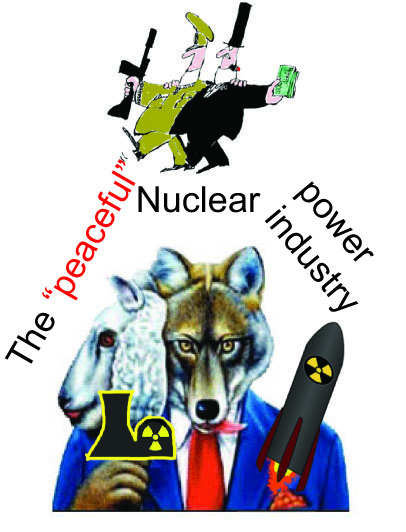
To Secure U.S. Energy Dominance, the Department of Defense Selects Eligible Companies for the Advanced Nuclear Power for Installations Program
Defense Innovation Unit 10th April 2025 Mountain View, CA
– To ensure U.S. energy dominance, the Defense Innovation Unit (DIU), with the Department of the Army and the Department of the Air Force, launched the Advanced Nuclear Power for Installations (ANPI) program. First announced in summer 2024, the program will allow for the design and build of fixed on-site microreactor nuclear power systems on select military installations to support global operations across land, air, sea, space, and cyberspace. The Department of Defense team selected eight companies to be eligible to demonstrate the ability to deliver compliant, safe, secure, and reliable nuclear power.
The companies are now eligible to receive Other Transaction (OT) awards to provide commercially available dual use microreactor technology at various DOD installations. Selected companies for the ANPI program include:
- Antares Nuclear, Inc
- BWXT Advanced Technologies LLC
- General Atomics Electromagnetic Systems
- Kairos Power, LLC
- Oklo Inc.
- Radiant Industries Incorporated
- Westinghouse Government Services
- X-Energy, LLC
“Projecting power abroad demands ensuring power at home and this program aims to deliver that, ensuring that our defense leaders can remain focused on lethality,” said Dr. Andrew Higier, Energy Portfolio Director at DIU. “Microreactors on installations are a critical first step in delivering energy dominance to the Force. Tapping into the commercial sector’s rapid advancements in this area is critical due to the significant private investment in this space over the last few years. The U.S. and the DoD must maintain the advantage and leverage the best of breed nuclear technology for our national security.”
The ANPI project directly supports Executive Order (E.O.) 14156 – Declaring a National Energy Emergency and E.O. 14154 – Unleashing American Energy
……………………………………… In addition to DIU, Army, Air Force, ANPI receives support from the Department of Energy; the NRC; Idaho National Laboratory with Oak Ridge National Laboratory; Los Alamos National Laboratory; Argonne National Laboratory; Pacific Northwest National Laboratory; Sandia National Laboratory; and the Office of Nuclear Energy. https://www.diu.mil/latest/DOD-selects-eligible-companies-for-the-Advanced-Nuclear-Power-for-Installations-Program
Walt Zlotow: Trump, Hegseth off by nearly 1 trillion on national security budget
Walt Zlotow, West Suburban Peace Coalition, Glen Ellyn IL 11 Apr 25 https://theaimn.net/trump-hegseth-off-by-nearly-1-trillion-on-national-security-budget/
Defense Secretary Pete Hegseth is applauding Trump’s boast to push through America’s first trillion dollar defense budget.
“Thank you Mr. President! COMING SOON: the first TRILLION dollar [Defense Department] budget.” Hegseth was echoing boss Trump who chortled “Nobody’s seen anything like it. We have to build out military, and we’re very cost-conscious, but the military is something we have to build, and we have to be strong,”
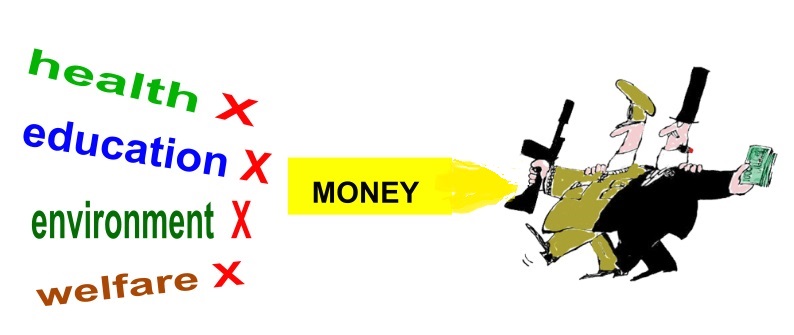
Trump’s defense policy and these quotes epitomize America’s decline as a peaceful, caring nation. Spending that trillion on militarism and warfare worldwide while Trump’s oligarchs are slashing a trillion from the social safety net is putting America into a death spiral from which it may never recover.
But they should really be high-fiving a national security budget that will be approaching $2 trillion based on Trump’s defense agenda.
That’s because the current defense budget under the National Defense Authorization Act of $900 billion just funds the Pentagon. When factoring in the Department of Veterans Affairs, special operations, Homeland Security and the national security share of US debt interest, the total for Fiscal ‘25 national security approaches $1.8 trillion. Regarding special ops, Trump’s failed month long Yemen bombing to stop their resistance to US enabled Israeli genocide in Gaza has already passed a billion bucks.
Current wars US supports in Ukraine, Gaza, Yemen, Somalia, Syria, Iraq and possible upcoming wars in Iran and China, don’t come cheap. Add in cost of over 750 bases in 80 countries hosting over 150,000 military personnel puts the approaching $2 trillion dollar cost in perspective.
Spending all that treasure on national offense (nope, not defense), becomes problematical when Trump is pushing thru trillion dollar tax cuts for his oligarch buddies.
What to do? Of Course, send in oligarch clown Musk to cut a trillion or more from everything that makes life livable for Joe Sixpack.
It is no surprise Trump plans to ravage the social safety net to spend $2 trillion on worldwide military adventurism while giving $4.5 trillion in tax cuts over 10 years mainly to those who don’t need them.
But do Trump and Hegseth have to brag about it?
Trump has threatened Iran over an ultimatum that likely cannot be met

Trump’s ultimatum to Iran appears to be moving the U.S. down a path to where war is the only outcome, as occurred in 1914 – an outcome which ultimately triggered WW1.
Strategic Culture Foundation, Alastair Crooke, April 7, 2025
What is understood now is that ‘we’re no longer playing chess’. There are no rules anymore.
Trump’s ultimatum to Iran? Colonel Doug Macgregor compares the Trump ultimatum to Iran to that which Austria-Hungary delivered to Serbia in 1914: An offer, in short, that ‘could not be refused’. Serbia accepted nine out of the ten demands. But it refused one – and Austria-Hungary immediately declared war.
On 4 February, shortly after his Inauguration, President Trump signed a National Security Presidential Memorandum (NSPM); that is to say, a legally binding directive requiring government agencies to carry out the specified actions precisely.
The demands are that Iran should be denied a nuclear weapon; denied inter-continental missiles, and denied too other asymmetric and conventional weapons capabilities. All these demands go beyond the NPT and the existing JCPOA. To this end, the NSPM directs maximum economic pressure be imposed; that the U.S. Treasury act to drive Iran’s oil exports to zero; that the U.S. work to trigger JCPOA Snapback of sanctions; and that Iran’s “malign influence abroad” – its “proxies” – be neutralised.
The UN sanctions snapback expires in October, so time is short to fulfil the procedural requirements to Snapback. All this suggests why Trump and Israeli officials give Spring as the deadline to a negotiated agreement.
Trump’s ultimatum to Iran appears to be moving the U.S. down a path to where war is the only outcome, as occurred in 1914 – an outcome which ultimately triggered WW1.
Might this just be Trump bluster? Possibly, but it does sound as if Trump is issuing legally binding demands such that he must expect cannot be met. Acceptance of Trump’s demands would leave Iran neutered and stripped of its sovereignty, at the very least. There is an implicit ‘tone’ to these demands too, that is one of threatening and expecting regime change in Iran as its outcome.
It may be Trump bluster, but the President has ‘form’ (past convictions) on this issue. He has unabashedly hewed to the Netanyahu line on Iran that the JCPOA (or any deal with Iran) was ‘bad’. In May 2014, Trump withdrew the U.S. from the JCPOA at Netanyahu’s behest and instead issued a new set of 12 demands to Iran – including permanently and verifiably abandoning its nuclear programme in perpetuity and ceasing all uranium enrichment.
What is the difference between those earlier Trump demands and those of this February? Essentially they are the same, except today he says: If Iran “doesn’t make a deal, there will be bombing. It will be bombing the likes of which they have never seen before”.
Thus, there is both history, and the fact that Trump is surrounded – on this issue at least – by a hostile cabal of Israeli Firsters and Super Hawks. Witkoff is there, but is poorly grounded on the issues. Trump too, has shown himself virtually totalitarian in terms of any and all criticism of Israel in American Academia. And in Gaza, Lebanon and Syria, he is fully supportive of Netanyahu’s far-right provocative and expansionist agenda.
These present demands regarding Iran also run counter to the 25 March 2025 latest annual U.S. Intelligence Threat Assessment that Iran is NOT building a nuclear weapon. This Intelligence Assessment is effectively disregarded. A few days before its release, Trump’s National Security Adviser, Mike Waltz clearly stated that the Trump Administration is seeking the “full dismantlement” of Iran's nuclear energy program: “Iran has to give up its program in a way that the entire world can see”, Waltz said. “It is time for Iran to walk away completely from its desire to have a nuclear weapon”.
On the one hand, it seems that behind these ultimata stands a President made “pissed off and angry” at his inability to end the Ukraine war almost immediately – as he first mooted – together with pressures from a bitterly fractured Israel and a volatile Netanyahu to compress the timeline for the speedy ‘finishing off’ of the Iranian ‘regime’ (which, it is claimed, has never been weaker). All so that Israel can normalise with Lebanon –and even Syria. And with Iran supposedly ‘disabled’, pursue implementation of the Greater Israel project to be normalised across the Middle East.
Which, on the other hand, will enable Trump to pursue the ‘long-overdue’ grand pivot to China. (And China is energy-vulnerable – regime change in Tehran would be a calamity, from the Chinese perspective).
To be plain, Trump’s China strategy needs to be in place too, in order to advance Trump’s financial system re-balancing plans. …………………………………………………………………………………….. https://strategic-culture.su/news/2025/04/07/break-leg-that-old-mafia-warning-trump-has-threatened-iran-over-ultimatum-that-likely-cannot-be-met/
A Iran and US to enter high-stakes nuclear negotiations – hampered by a lack of trust
April 10, 2025. The Conversation, Ali Bilgic, Professor of International Relations and Middle East Politics, Loughborough University
The announcement of planned talks between the US and Iran in Oman signifies a crucial development – especially given the history of distrust and animosity that has characterised their interactions.
There remains a degree of confusion as to whether the negotiations over Iran’s development of a nuclear capacity will be direct or indirect. The US has said that its Middle East envoy, Steve Witkoff, will meet Iran’s foreign minister, Abbas Araghchi. Donald Trump has publicly stated that Iran will be in “great danger” if the negotiations fail.
Iran meanwhile has said that talks will be conducted through an intermediary. Araghchi commented that: “It is as much an opportunity as it is a test. The ball is in America’s court.”
This seeming clash in messaging before the talks have even begun is not the greatest omen for their success, even with the threat of US or Israeli military action hovering over Iran. Representatives from Iran, China and Russia are reported to have met in Moscow on April 8.
China’s foreign ministry released a statement reminding the world that it was the US “which unilaterally withdrew from the JCPOA [the 2015 nuclear deal or joint comprehensive plan of action] and caused the current situation”. It stressed the need for Washington to “show political sincerity, act in the spirit of mutual respect, engage in dialogue and consultation, and stop the threat of force and maximum pressure”.
This followed messaging from Washington which very much focused on the possibility of force and maximum pressure. Speaking to the press after meeting the Israeli prime minister Benjamin Netanyahu, Trump struck a very aggressive note, saying: “Iran cannot have a nuclear weapon and if the talks aren’t successful, I actually think it will be a very bad day for Iran if that’s the case…………………………………………………
Rocky road ahead
A major issue affecting the talks is the low level of trust between the two parties. The US’s involvement in the Gaza conflict – including Trump’s controversial proposal to clear Gaza of Palestinians to make way for possible redevelopment – has further strained relations. So has the recent US campaign against the Tehran-backed Houthi rebels in Yemen.
Further threats of this kind are likely to be seen by Iran as aggressive and coercive – and Trump’s latest rhetoric won’t have helped. This will inevitably undermine the prospects for trust between the parties.
Iran’s scepticism is rooted in past experiences where promises of economic relief were not fulfilled. Trump’s withdrawal of the US from the 2015 nuclear deal in 2018 is a case in point. This perceived breach of trust has made Iran cautious about entering into new agreements without concrete assurances.
The regional context adds another layer of complexity to the talks. American support for Israel’s actions in Gaza is likely to complicate matters. The populations of most Gulf states are fully supportive of Palestinian self-determination and are scandalised at the way the US president has seemingly given the green light to Israel’s breach of the ceasefire and resumption of hostilities.
Iran’s internal politics are also likely to play an important role in shaping its approach to the negotiations. The country is experiencing significant political polarisation between the “hardliners”, spearheaded by the supreme leader Ali Khamenei, and the “reformists”, who are relatively more conciliatory towards the US and Europe. ………………………..https://theconversation.com/iran-and-us-to-enter-high-stakes-nuclear-negotiations-hampered-by-a-lack-of-trust-254106
‘We thought it was the end of the world’: How the US dropped four nuclear bombs on Spain in 1966
Myles Burke https://www.bbc.com/culture/article/20250404-how-the-us-dropped-nuclear-bombs-on-spain-in-1966 7 Apr 25
In 1966, the remote Spanish village of Palomares found that the “nuclear age had fallen on them from a clear blue sky”. Two years after the terrifying accident, BBC reporter Chris Brasher went to find what happened when the US lost a hydrogen bomb.
On 7 April 1966, almost 60 years ago this week, a missing nuclear weapon for which the US military had been desperately searching for 80 days was finally found. The warhead, with an explosive power 100 times that of the bomb dropped on Hiroshima, was carefully winched from a depth of 2,850ft (869m) out of the Mediterranean Sea and delicately lowered onto the USS Petrel. Once it was on board, officers painstakingly cut into the thermonuclear device’s casing to disarm it. It was only then that everyone could breathe a sigh of relief – the last of the four hydrogen bombs that the US had accidentally dropped on Spain had been recovered.
“This was not the first accident involving nuclear weapons,” said BBC reporter Chris Brasher when he reported from the scene in 1968. “The Pentagon lists at least nine previous accidents to aircraft carrying hydrogen bombs. But this was the first accident on foreign soil, the first to involve civilians and the first to excite the attention of the world.”
This terrifying situation had come about because of a US operation code-named Chrome Dome. At the beginning of the 1960s, the US had developed a project to deter its Cold War rival, the Soviet Union, from launching a pre-emptive strike. A patrol of nuclear-armed B-52 bombers would continuously criss-cross the skies, primed to attack Moscow at a moment’s notice. But to stay airborne on these long looping routes, the planes needed to refuel while in flight.
On 17 January 1966, one such bomber was flying at a height of 31,000ft (9.5km) over the Almería region of southern Spain, and attempted a routine air-to-air refuelling with a KC-135 tanker plane. “I believe what happened was the bomber was closing at a too-high rate of closure speed and he didn’t stabilise his position,” US Maj Gen Delmar Wilson, the man in charge of dealing with the catastrophic accident, told Brasher, “with the result that they got too close and collided.”
The B-52 bomber’s impact with the refuelling plane tore it open, igniting the jet fuel the KC-135 was carrying and killing all four of the crew onboard. The ensuing explosion also killed two men in the B-52’s tail section. A third managed to eject, but died when his parachute did not open. The other four members of the bomber’s crew successfully bailed out of their burning plane before it broke apart and fell to earth, raining down both flaming aircraft fragments and its lethal thermonuclear cargo onto the remote Spanish village of Palomares.
Everyone kept talking about a ‘broken arrow’. I learnt then that ‘broken arrow’ was the code word for a nuclear accident – Capt Joe Ramirez
The huge fireball was seen a mile away. Thankfully, it did not trigger a nuclear explosion. The bomber’s warheads were not armed and had built-in safeguards to prevent an unintended atomic chain reaction. But the thermonuclear devices did have explosives surrounding their plutonium cores as part of the triggering mechanism. In the event of an accident, the bombs had parachutes attached to them designed to cushion the impact on landing and prevent radioactive contamination. And indeed, one undetonated bomb did land safely in a riverbed and was recovered intact the following day. Unfortunately, two of the plummeting nuclear bombs’ parachutes failed to open.
That morning, Spanish farmer Pedro Alarcón was walking to his house with his grandchildren when one of the nuclear bombs landed in his tomato field and blew apart on impact. “We were blown flat. The children started to cry. I was paralysed with fear. A stone hit me in the stomach, I thought I’d been killed. I lay there feeling like death with the children crying,” he told the BBC in 1968.
Devastation and chaos
The other hydrogen bomb also exploded when it hit the ground near a cemetery. These dual blasts created vast craters and scattered highly toxic, radioactive plutonium dust across several hundred acres. Burning aircraft debris also showered the Spanish village. “I was crying and running about,” a villager called Señora Flores told the BBC in 1968. “My little girl was crying, ‘Mama, Mama, look at our house, it is burning.’ Because of all the smoke I thought what she said must be true. There were a lot of stones and debris falling around us. I thought it would hit us. It was this terrific explosion. We thought it was the end of the world.”
Once the news that the bomber had come down with nuclear weapons aboard reached US military command, a huge operation was launched. At the time of the disaster, Capt Joe Ramirez was an US Air Force lawyer stationed in Madrid. “There were a lot of people talking, there was a lot of excitement in the conference room. Everyone kept talking about a ‘broken arrow’. I learnt then that ‘broken arrow’ was the code word for a nuclear accident,” he told BBC’s Witness History in 2011.
US military personnel were scrambled to the area by helicopter. When Capt Ramirez arrived in Palomares, he immediately saw the devastation and chaos wrought by the accident. Huge pieces of smoking wreckage were strewn all over the area – a large part of the burning B-52 bomber had landed in the school’s yard. “It’s a small village but there were people scrambling in different directions. I could see smouldering debris, I could see some fires.”
Despite the carnage, miraculously no one in the village was killed. “Nearly 100 tonnes of flaming debris had fallen on the village but not even a chicken had died,” said Brasher. A local school teacher and doctor climbed up to the fire-scarred hillside to retrieve the remains of the US airmen who had been killed. “Later still, they sorted the pieces and the limbs into five coffins, an act that was to cause a certain amount of bureaucratic difficulty when the Americans came to claim only four bodies from that hillside,” said Brasher.
Three of the B-52 crew who managed to eject landed in the Mediterranean several miles off the coast and were rescued by local fishing boats within an hour of the accident. The fourth, the B-52 radar-navigator, ejected through the plane’s explosion, which left him badly burned, and was unable to separate himself from his ejection seat. Despite this, he managed to open his parachute and was found alive near the village and taken to hospital.
However, this still left the problem of locating the plane’s deadly nuclear payload. “My main concern was to recover those bombs, that was number-one priority,” Gen Wilson told the BBC in 1968.
One of our nuclear bombs is missing
“The first night, the Guardia Civil [the Spanish national police force] had come to the little bar in Palomares, and that was about the only place that had electricity. And they had reported what they considered to be a bomb, so we immediately despatched some of our people to this riverbed which is not far from the centre of town, and, in fact, it was a bomb, so we placed a guard on that. And then the next morning, at first daylight, we started conducting our search, and I believe it was something in the order of 10am or 11am the following morning, we located two other bombs.”
This accounted for three of the nuclear bombs, but there was still one missing. By the next day, trucks filled with US troops had been sent from nearby bases, with the beach in Palomares becoming a base for some 700 US airmen and scientists urgently trying to contain any radioactive contamination and locate the fourth warhead.
“The first thing that you could see as the search really got underway in earnest was Air Force personnel linking up hand-by-hand and 40 or 50 people in a line. They would have designated search areas. There were some people with Geiger counters who started arriving, and so they started marking off the areas which were contaminated,” said Capt Ramirez in 2011. When US personnel registered an area contaminated with radiation, they would scrape up the first three inches of topsoil and seal it in barrels to be shipped back to the US. Some 1,400 tonnes of irradiated soil ended up being sent to a storage facility in South Carolina.
Both the US and Spain, which at the time was under the brutal rule of Francisco Franco’s military dictatorship, were keen to downplay the devastating accident. Franco was especially worried that radiation fears would hurt Spain’s tourism industry, a major source of revenue for his regime. In an effort to reassure the local population and the wider world that there was no danger, the US Ambassador to Spain, Angier Biddle Duke, would end up taking a swim in the sea off Palomares coast in front of the international press just weeks after the accident.
But despite hundreds of US personnel conducting an intensive and meticulous search of the surrounding area for a week, they still couldn’t find the fourth bomb. Then Capt Ramirez spoke to a local fisherman who had helped rescue some of the surviving airmen who had splashed down in the sea. The fisherman kept apologising to Capt Ramirez for not being able to save one of the US flyers, whom he thought he had witnessed drifting down into the depths.
Capt Ramirez realised that the fisherman could have actually seen the missing nuclear bomb. “All the bodies had been accounted for, I knew that,” he said. The search then quickly shifted to the Mediterranean Sea, with the US Navy mobilising a flotilla of more than 30 ships, including mine-sweepers and submersibles, to scour the seabed. The exploration of miles of ocean floor was both technically complicated and a very slow process, but after weeks of exhaustive searching, a newly developed deep-diving vessel, Alvin, finally located the missing bomb in an underwater trench.
Nearly four months after it was first lost, the warhead was finally made safe and back in US hands. The next day, despite the secrecy with which the US military had surrounding its nuclear arsenal, it took the unusual step of showing the bomb to the world’s press. Ambassador Duke reasoned that unless people saw the bomb for themselves, they would never feel certain that it had actually been recovered.
Trump claims US held direct nuclear talks with Iran
Aljazeera, 7 April 25
The US president makes the claim in a media conference with Israeli Prime Minister Netanyahu, while also threatening Tehran.
President Donald Trump has announced that the United States has begun direct negotiations with Iran over its nuclear programme, after Tehran had earlier dismissed Washington’s calls for the talks.
“We’re having direct talks with Iran, and they’ve started. It’ll go on Saturday. We have a very big meeting, and we’ll see what can happen,” Trump told reporters at the White House on Monday, alongside Israeli Prime Minister Benjamin Netanyahu.
“And I think everybody agrees that doing a deal would be preferable,” he added, without providing further details.
Trump also warned that Iran would be in “great danger” if diplomatic efforts to curb its nuclear ambitions failed, adding that Tehran “can’t have nuclear weapons”.
Earlier this month, Trump told NBC News: “If they [Iran] don’t make a deal, there will be bombing”. He added that the bombing would be “the likes of which they have never seen before.”
Trump’s announcement of direct talks with Tehran would not be to Netanyahu’s “liking”, as the Israeli leader has long wanted to simply bomb Iran, said Marwan Bishara, Al Jazeera’s senior political analyst.
“Trump has wanted a deal for a long time,” Bishara said. However, “Netanyahu certainly thinks Iran’s defences have been weakened by last year’s Israeli air strikes on Iran. And he sees this as a great opportunity, with US support, for Israel to finish off Iran.”
“In reality, Trump doesn’t want to enter a war with Iran while he is in the midst of trade wars with the rest of the world,” Bishara added.
‘Meaningless talks’
Over the weekend Iranian Minister of Foreign Affairs Abbas Araghchi described the prospect of direct negotiations with the US on Tehran’s nuclear programme as “meaningless”.
Araghchi’s remarks came after Trump said last month in a letter to Iran’s Supreme Leader Ayatollah Ali Khamenei that he hoped there would be a negotiation between the countries.
Tehran, which maintains that it is not seeking a nuclear weapon, has so far rejected Washington’s overtures, but has said it is open to indirect diplomacy – a stance repeated by Araghchi in Sunday’s statement.
In 2018, during his first presidency, Trump withdrew the US from the 2015 nuclear agreement between Iran and world powers, which had placed strict curbs on Tehran’s nuclear activities in exchange for sanctions relief.
Iran says its nuclear activities are solely for civilian purposes. Israel, the US’s top ally in the region, is widely believed to have an undeclared nuclear arsenal.
Netanyahu calls for Palestinians to leave Gaza
Speaking next to Netanyahu, who has been issued an arrest warrant by the International Criminal Court (ICC) for alleged war crimes in Gaza, Trump suggested that the war in Gaza could soon come to an end……………………………………………………………………………………………………….. https://www.aljazeera.com/news/2025/4/7/trump-claims-direct-us-talks-with-iran-on-nuclear-deal-have-begun
With US bombers at the ready, can Trump cut a deal with Iran and avoid a war?
The United States and Iran are once again on a collision course over the
Iranian nuclear program. In a letter dated early March, US President Donald
Trump urged Iranian Supreme Leader Ayatollah Ali Khamenei to negotiate a
new deal.
The new deal would replace the defunct nuclear agreement
negotiated in 2015 between the United States, Iran and five other global
powers. Trump withdrew from that agreement, called the Joint Comprehensive
Plan of Action (JCPOA), during his first term.
Trump gave the Iranians a
two-month deadline to reach a new nuclear deal. If they don’t, the US will
bomb the country. In recent days, American B-2 bombers and warships have
been deployed to the region in a show of force. In response, Tehran has
agreed only to indirect negotiations. It has ruled out any direct talks
while under a US policy of “maximum pressure”.
Khamenei and his
generals have promised a “harsh response” to any military venture. Iran
has vowed to target all American bases in the region. France, one of key
negotiators in the 2015 deal, said this week a failure to secure a new deal
would make a military confrontation “almost inevitable”. In a positive
sign, however, Washington is reportedly “seriously considering” Iran’s
offer for indirect negotiations. And Trump is now suggesting Iran may
actually be open to direct talks.
The Conversation 5th April 2025 https://theconversation.com/with-us-bombers-at-the-ready-can-trump-cut-a-deal-with-iran-and-avoid-a-war-253828
Canada supplied uranium for atomic bombs in WWII — 80 years later, the cleanup continues
Gordon Edwards, 6 Apr 25
Atomic Reaction is a documentary feature film dealing with the radioactive history and contamination of the town of Port Hope Ontario, located on the North shore of Lake Ontario just east of Toronto.
Here is a YouTube of the film: https://www.youtube.com/watch?v=8jC1DPOYoQ0
Canada played a key role in chemically refining uranium from Canada and the Congo for use in the first two atomic bombs dropped on the cities of Hiroshima and Nagasaki in 1945. Canada then became the largest supplier and exporter of uranium in the world, in the post-war period, most of it sold for tens of thousands of nuclear warheads during the Cold War, until the sale of Canadian uranium for nuclear weapons was ended by Prime Miniister Pearson in 1965.
In the process, the town of Port Hope (where all this refining took place until 1980) became thoroughly contaminated with radioactive wastes that were carelessly discarded and dispersed all about town – dumped into the harbour and into open ravines about town, used in roadways and mingled with the sandy beach, and used in huge quantities as construction material and as fill for up to a thousand buildings – homes, schools, offices, throughout town – requiring a massive radioactive cleanup costing over two billion dollars, resulting in two surface mounds of about a million tons each which will remain highly radiotoxic for many thousands of years to come. The cleanup is stlll ongoing today.
A similarly sized mound of radioactive waste is currently planned for the cleanup of the Chalk River Laboratories, created near the end of World War 2 as a secret site for producing plutonium for the US bomb program among other things. Canada sold plutonium to the US military for weapons purposes.
For 20 years after the end of World War 2. The Chalk River megadump has been approved by Canada’s Nuclear regulator, but two of three court challenges have been successful in delaying the implementation pending legally required consultations with the Algonquin peoples on whose traditional land the megadump would be located, and pending the careful evaluation of alternative sites or waste management options that will not destroy the habitat of several endangered species.
Federal regulator approves Canada’s first small modular reactor
the commissioners heard concerns from intervenors that GE-Hitachi hadn’t yet finished designing the reactor, raising questions about how its safety could be analyzed properly.
CNSC decisions are particularly vulnerable to challenges from First Nations.
Matthew McClearn, April 5, 2025, https://www.theglobeandmail.com/business/article-federal-regulator-approves-canadas-first-small-modular-reactor/
The federal nuclear safety regulator has authorized construction of an American small modular reactor (SMR) at the Darlington Nuclear Generating Station in Clarington, Ont., a crucial milestone for a project that has garnered worldwide attention.
The Canadian Nuclear Safety Commission granted the license to Ontario Power Generation on Friday for its Darlington New Nuclear Project. OPG has said it will finish building the first 327-megawatt reactor by the end of 2028, and begin supplying electricity to the province’s grid the following year. The reactor’s cost has not been disclosed publicly, but estimates suggest it could be several billion dollars.
“We now await the go-ahead from the Ontario government to proceed,” said OPG spokesperson Neal Kelly.
The Darlington SMR would represent a host of firsts, accompanied by larger risks and anticipated benefits. It would be the only nuclear reactor under construction in the Western hemisphere, and Canada’s first reactor start since the mid-1980s.
It would also represent the first SMR in any G7 country. And it would be the first BWRX-300; utilities in other jurisdictions (including Saskatchewan, the U.S., Poland and Estonia) have announced plans to build reactor fleets based on the same design.
The BWRX-300 is being designed by Wilmington, N.C.-based GE-Hitachi Nuclear Energy, a leading American reactor vendor. Its construction would make Canada more reliant on U.S. suppliers for enriched uranium fuel and other critical inputs at a moment when relations between the two countries are rapidly deteriorating.
Yet this has not diminished support from Canadian officials. In a statement Friday, Ontario Energy Minister Stephen Lecce called the license “a historic milestone” for his province and the country.
“Ontario is realizing its potential as a stable democratic energy superpower, and I look forward to sharing next steps for this exciting project in the coming weeks.”
OPG applied for the license in late 2022. During hearings held this fall and winter, the commissioners heard concerns from intervenors that GE-Hitachi hadn’t yet finished designing the reactor, raising questions about how its safety could be analyzed properly.
But the commissioners dismissed this concern, finding OPG had supplied adequate information. They noted that an OPG representative told them the design was 95 per cent done; CNSC staff said in other countries, licenses are typically issued when designs are less than one-third complete.
Intervenors also said that the BWRX-300 lacked two fully independent emergency shutdown systems, because it features two systems that insert the same set of control rods into the reactor. The CNSC’s own staffers confirmed this, but told the Commission the probability both insertion systems would fail was “very low.” The Commission said OPG would have to provide additional information about this at a later date.
In response to concerns from certain First Nations concerning OPG’s and the CNSC’s obligation to engage with them, the CNSC imposed what it calls “regulatory hold points.” The first occurs before construction begins on the reactor building’s foundation, another before OPG can install the reactor’s pressure vessel, and a third before testing and commissioning of the facility can begin. The Commission delegated responsibility for supervising these license conditions to CNSC chief regulatory operations officer Ramzi Jammal.
“The Commission is satisfied that the honour of the Crown has been upheld and that the legal obligation to consult and, where appropriate, accommodate Indigenous interests has been satisfied,” the commissioners wrote in their decision.
CNSC decisions are particularly vulnerable to challenges from First Nations. In February the Federal Court granted an application from Kebaowek First Nation for a judicial review of the CNSC’s decision to approve construction of a nuclear waste disposal facility at Chalk River Laboratories. Justice Julie Blackhawk found that the commissioners erred when they declined to apply the United Nations Declaration on the Rights of Indigenous Peoples, and ordered a resumption of consultations.
The CNSC’s authorization applies only to OPG’s first SMR. Since the 1960s, Ontario’s long-standing practice has been to build “four-packs,” power plants with four identical reactors sharing workers and common infrastructure. In 2023, the Ontario government instructed OPG to begin planning for another three BWRX-300s at Darlington.
Over the past several years the utility has cleared and re-graded the site for the first reactor; ongoing excavation has reached 8 metres below ground level. OPG has been installing utilities all four reactors would share, such as water and sewer lines and network cabling.
OPG’s pivot to SMRs means the plant will generate far less power than originally envisioned. Under an earlier plan the site was licensed for up to 4,800 megawatts, whereas the BWRX-300s would possess a quarter of that capacity. (According to rough industry estimates, a single BWRX-300 could meet electricity demand from a city the size of Markham or Vaughan, Ont.)
Also working on the project are AtkinsRealis Group Inc., serving as architect-engineer, and construction giant Aecon Group Inc. Major reactor components are to be built by subcontractors in Ontario: BWX Technologies, for example, is preparing to build its massive pressure vessel at its plant in Cambridge. A 2023 study by the Conference Board of Canada said the four-reactor plant would increase Canada’s GDP by $15.3 billion over 65 years, and support 2,000 jobs.
Promoters, including OPG, have argued that building the first SMR will grant Ontario “first-mover” advantage and allow its nuclear industry to participate in subsequent BWRX-300 constructions worldwide. With numerous U.S. federal officials proclaiming an era of American energy “dominance” and imposing punishing tariffs on allies and trading partners, some observers now doubt this will happen. Mr. Lecce, though, appeared to dismiss that concern in his statement Friday.
“Our government has insisted and successfully negotiated that local Ontario and Canadian businesses must be overwhelmingly used to build SMRs for the world.”
Deloitte seeks to avoid liability over US nuclear fiasco.
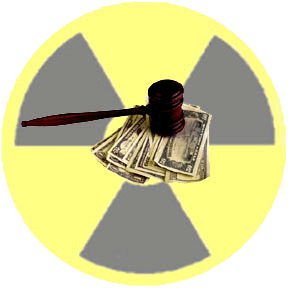
Deloitte has asked a US judge to throw out demands that it compensate
shareholders who lost money in the collapse of one of the country’s
largest nuclear power projects, in a case that has exposed the inner
workings of the Big Four audit firm.
Recently filed documents detail Deloitte’s work auditing the South Carolina utility Scana before the company abandoned construction of two nuclear reactors that had fallen far
behind schedule and billions of dollars over budget. The 2017 fiasco led to
the cut-price sale of Scana to a rival utility, the bankruptcy of the
construction group Westinghouse and jail time for Scana’s former chief
executive, who pleaded guilty to misleading regulators.
A class-action lawsuit on behalf of Scana shareholders alleges Deloitte helped the company
hide burgeoning problems at the VC Summer nuclear project by signing off on
financial statements that indicated it would be completed on time. In fact,
an internal whistleblower at Scana had claimed as early as 2015 that
Westinghouse was impossibly far behind, and Deloitte failed to follow other
red flags, the lawsuit claims.
FT 3rd April 2025, https://www.ft.com/content/89b10731-fcd0-4854-8bb5-1f4067f1bba2
Hegseth Orders Pentagon To Focus on Preparing for War With China Over Taiwan
In an internal memo, Hegseth called China the ‘sole pacing threat’
by Dave DeCamp March 30, 2025 , https://news.antiwar.com/2025/03/30/hegseth-orders-pentagon-to-focus-on-preparing-for-war-with-china-over-taiwan/
Secretary of Defense Pete Hegseth distributed a memo in mid-March ordering the Pentagon to put its focus on preparing for a war with China, a nuclear-armed power, by “assuming risk” in Europe and other parts of the world, The Washington Post reported on Saturday.
The Post didn’t publish the full memo, known as the Interim National Defense Strategic Guidance, but said it “outlines, in broad and sometimes partisan detail, the execution of President Donald Trump’s vision to prepare for and win a potential war against Beijing and defend the United States from threats in the ‘near abroad,’ including Greenland and the Panama Canal.”
The Pentagon has considered China the top “threat” facing the US since the first Trump administration, but the Post report said the memo is “extraordinary in its description of the potential invasion of Taiwan as the exclusive animating scenario that must be prioritized over other potential dangers — reorienting the vast US military architecture toward the Indo-Pacific region beyond its homeland defense mission.”
The report said that the guidance from Hegseth says the Pentagon’s force planning construct “will consider conflict only with Beijing when planning contingencies for a major power war” and leave the “threat from Moscow largely attended by European allies.”
Hegseth wrote that China “is the Department’s sole pacing threat, and denial of a Chinese fait accompli seizure of Taiwan — while simultaneously defending the US homeland is the Department’s sole pacing scenario.”
The memo reflects the Trump administration’s policy toward Europe and calls for NATO allies to take a “far greater” burden sharing. The document says that the US is unlikely to provide substantial support to Europe if Russia’s military advances in the region, saying the US will only provide nuclear deterrence.
The memo also calls for the US to pressure Taiwan to increase military spending “significantly.”
For years now, the US military has been openly preparing for war with China despite the risk of nuclear escalation. It has done this by expanding military bases in the Asia Pacific, building alliances, and increasing support for Taiwan. While being done in the name of deterrence, these steps have only increased tensions in the region, making conflict more likely.
The Post report says that Hegseth’s plans to prepare a “denial defense” of Taiwan include “increasing the troop presence through submarines, bombers, unmanned ships, and specialty units from the Army and Marine Corps, as well as a greater focus on bombs that destroy reinforced and subterranean targets.” His memo also calls for increasing the defenses of US troop positions in the region and establishing more weapons stockpiles.
TRUMP’S PURSUIT OF A UKRAINIAN PEACE: Early Results and Future Prospects
Russian and Eurasian Politics, by Gordonhahn, April 4, 2025
U.S. President Donald Trump and his new and internationally inexperienced administration have been in hot pursuit of a ceasefire and peaceful resolution of the NATO-Russia Ukrainian War. The pursuit has laid bare the false promise of an end to the war on the administration’s first or even one-hundredth day as previously advertised. This is no business deal. This the hardball world of international politics, national power and interests, ancient and not-so-ancient local and international resentments, grievances, betrayals, and hatreds. Despite what may seem as a disappointing complications and the inevitably longer timeline for the arrival of any prospective ceasefire or conclusive peace, significant early progress was made, and the stumbling blocs that have appeared were to be expected and can be overcome with time and the further deterioration of Ukraine’s position on the battle fronts, which is inevitable.
There has been some confusion among observers and the public regarding the process, with issues such as NATO expansion tied to a ceasefire in some minds. This is a subject for a final treaty, not a ceasefire, which is needed to allow peace talks to proceed more smoothly, niot to mention ending the bloodshed and destruction. The ceasefire agreement must not be conflated from peace treaty negotiations. A ceasefire will, therefore, take at least several, if not many months. This is not least of all because of the need to resolve what Russian President Vladimir Putin called “nuances” – organizational measures needed to implement a full-fledged ceasefire.
While agreement, violated albeit, has been achieved on a month-long ceasefire regarding energy infrastructure, the two sides are very far apart regarding any treaty. Putin’s 4 goals for Russia’s ‘special military operation (SMO) contradict directly Zelenskiy’s demands for security guarantees and the return of all territory annexed or occupied by Russia. Again, these are problems to be addressed under any peace treaty. The ceasefire must be fully implemented before any treaty can be addressed in any robust fashion.
Trust-building is desperately needed, especially between Russia and Ukraine and can develop as partial agreements are made, complied with, and yield new agreements. Recent history and a long cultural tradition of security vigilance in Russia and in part inherited by Ukraine, the apposition of Russian nationalism and more rabid Ukrainian ultras-nationalism and neofascism, and, most importantly, the exacerbating factor of outside interference in Ukraine and Russian-Ukrainian relations by the U.S., Europe, and NATO create a matrix of distrust between all the parties, including the ostensible mediating side, the U.S., which is the lead combatant on the NATO side of the NATO-Russia Ukrainian War. The last point undermines the peace process from the start, and depending on how that process develops could end in many in Moscow, already being suspicious, coming to see the entire process as a ruse to hold off a Russian victory, viewing Trump’s America as ‘playing the good cop’, while Zelenskiy and Europe continue the war.
The ceasefire is evolving into four distinct elements — energy infrastructure, sea, air, and land ceasefires – to comprise the overall ceasefire prospectively. The full ceasefire could be achieved by mid-summer but more a more realistic target is before the end of the year……………………………………………………………………………………………………………………………………..
Trump has levers to push the parties towards peace. For the Ukrainians, he can withhold intelligence and weapons supplies. For the Russians he can delay or threaten to forego rapprochement or various aspects of it: sanctions relief, trade agreements, and renewed cooperation regarding the world’s various conflicts. Pres. Trump’s “Liberation Day” 20 percent tariff on EU goods might be adjusted depending on Brussels’ compliance with American wishes for sanctions relief for Russia. Otherwise, the EU is positioned to scuttle BSI 2.0. Indeed, Russia’s 10 percent tariffs and 0 percent on Russia can be adjusted depending on where pressure needs to be applied.
In sum, there are a host of problems that will take months of concerted effective diplomacy led by the U.S. as things stand now. But the Trump administration is short of seasoned diplomats and experienced foreign and security policy experts. We have a long, hard way to go before peace reigns in Ukraine. https://gordonhahn.com/2025/04/04/trumps-pursuit-of-a-ukrainian-peace-early-results-and-future-prospects/
Atomic Safety and Licensing Board (ASLB) rejects intervenors’ Palisades “zombie” nuke reactor restart petition & hearing request
The U.S. Nuclear Regulatory Commission (NRC) Atomic Safety (sic) and Licensing Board (ASLB) has struck again. Per usual, the three-administrative law judge panel (formerly known as hearing examiners) has rejected all contentions re: health, safety, security, and the environment raised by an environmental coalition, denying hearings on the merits. Such rulings reflect the ASLB’s very well earned kangaroo court reputation. Not only is the NRC staff captured by the industry it is supposed to regulate, but so too is NRC’s ASLB.
See the 71-page ASLB ruling, here.
The coalition — Beyond Nuclear, Don’t Waste Michigan, Michigan Safe Energy Future, Nuclear Energy Information Service of Chicago, and Three Mile Island Alert of Pennsylvania — did get the NRC ASLB to acknowledge its legal standing, although the NRC staff sought to block most of the groups. Some of the members/supporters who provided legal standing to the groups opposed by the NRC staff for establishing legal standing happen to live within less than a mile of the Palisades atomic reactor, and thus are very much in harm’s way.
Attorneys Terry Lodge of Toledo, Ohio, and Wally Taylor of Cedar Rapids, Iowa, serve as the coalition’s legal counsel. Coalition expert witnesses include Arnie Gundersen, chief engineer of Fairewinds, as well as Dr. Mark Z. Jacobson of Stanford University, a world renowned advocate for renewable energy as the most time- and cost-effective pathway to climate mitigation. This means nuclear power is an opportunity cost, significantly hampering desperately needed reductions of greenhouse gas emissions, as soon as possible.
The coalition has resisted Holtec International’s scheme to restart the nearly 60-year old “zombie” atomic reactor at Palisades nuclear power plant since the get-go, on April 20, 2022, when Michigan Governor Gretchen Whitmer first floated the trial balloon of indefinite, continued operations, a month to the day before previous owner Entergy permanently shut down the reactor. Palisades was designed in the mid-1960s, and ground was broken on its construction in 1967.
Such a restart of a closed for good atomic reactor is unprecedented. It is also unneeded, insanely expensive for the public, and extremely risky. Palisades has been an atomic lemon since it was fired up in 1971, and is now dangerously age-degraded, after 51 years of problem-plagued operations, and three years of neglect by Holtec of safety-significant systems, structures, and components, such as the now dangerously degraded steam generator tubes. Holtec neglected steam generator tube maintenance for two years (2022-2024), a “rookie error” according to the coalition’s expert witness, Arnie Gundersen of Fairewinds. But this rookie error, Gundersen, points out, could result in a catastrophic reactor core meltdown, if and when NRC allows Holtec to restart Palisades with mere BAND-AID fixes on the breakdown phase steam generator tubes.
The coalition will appeal the ASLB’s absurd ruling to the commissioners of the five-member Nuclear Regulatory Commission. Once the NRC Commissioners rule against us too, we will have exhausted all administrative remedies. At that point, we will file an appeal to the federal courts.
Although the ASLB has rejected all previous coalition contentions, the three-judge panel did not terminate the licensing proceeding. This is because the coalition amended certain contentions, and introduced new ones, based on the recent publication, in late Jaunary 2025, by NRC staff of a draft Environmental Assessment and Finding of No Significant Impact regarding the “zombie” reactor restart scheme.
However, on March 28, 2025 — the 46th annual commemoration of the Three Mile Island Unit 2 meltdown in Pennsylvania — both the NRC staff, as well as Holtec International, opposed all of the coalition’s new and amended environmental contentions, as well.
The coalition will continue to defend its amended and new environmental contentions at every opportunity, as well. Our deadline to do so is later this week.
1 This Month

of the week– Nuclear Reactor Information Task Force

14 May – online event From Bombs to Data Centres: the Face of Nuclear Colonialism
To see nuclear-related stories in greater depth and intensity – go to https://nuclearinformation.wordpress.com
-
Archives
- May 2026 (102)
- April 2026 (356)
- March 2026 (251)
- February 2026 (268)
- January 2026 (308)
- December 2025 (358)
- November 2025 (359)
- October 2025 (376)
- September 2025 (257)
- August 2025 (319)
- July 2025 (230)
- June 2025 (348)
-
Categories
- 1
- 1 NUCLEAR ISSUES
- business and costs
- climate change
- culture and arts
- ENERGY
- environment
- health
- history
- indigenous issues
- Legal
- marketing of nuclear
- media
- opposition to nuclear
- PERSONAL STORIES
- politics
- politics international
- Religion and ethics
- safety
- secrets,lies and civil liberties
- spinbuster
- technology
- Uranium
- wastes
- weapons and war
- Women
- 2 WORLD
- ACTION
- AFRICA
- Atrocities
- AUSTRALIA
- Christina's notes
- Christina's themes
- culture and arts
- Events
- Fuk 2022
- Fuk 2023
- Fukushima 2017
- Fukushima 2018
- fukushima 2019
- Fukushima 2020
- Fukushima 2021
- general
- global warming
- Humour (God we need it)
- Nuclear
- RARE EARTHS
- Reference
- resources – print
- Resources -audiovicual
- Weekly Newsletter
- World
- World Nuclear
- YouTube
-
RSS
Entries RSS
Comments RSS
 nuclear-news