Toronto anxious about city’s unreadiness for a nuclear emergency.
Is Toronto ready for a nuclear radiation emergency? http://www.metronews.ca/news/toronto/2016/01/05/is-toronto-ready-for-a-nuclear-radiation-emergency.html
As KI pill orders skyrocket, critics say Ontario’s nuclear emergency response plan desperately needs a post-Fukushima update. By: Torstar News Service, Published on Tue Jan 05 2016. For 44 years, the Pickering Nuclear Generating Station has operated just five kilometres from Toronto’s eastern edge. The Darlington Nuclear Generating Station sits just over 30 km away. While these plants are essential for keeping the lights on in Toronto, councillors are only just beginning to question the city’s readiness for a nuclear emergency.
On Dec. 1, the city’s executive committee asked the city manager to report back on issues with the Provincial Nuclear Emergency Response Plan, Toronto’s own nuclear emergency response protocols and whether it might be appropriate to expand distribution of potassium iodide (KI) pills beyond the current 10-km radius.
In October, Ontario Power Generation (OPG), which operates both Pickering and Darlington, mailed KI pills — which, taken in the aftermath of a nuclear disaster, can reduce the risk of thyroid cancer — to 200,000 homes and businesses within 10 km of the GTA’s two nuclear power plants.
Anyone living within 50 km of the two plants — an area inhabited by more than 4.5 million people, including the entire city of Toronto — can order them free from preparetobesafe.ca. While just over 600 orders had been placed before a Nov. 10 Torstar News Service story on KI pills, nearly 11,000 additional orders were made by Nov. 15.
“Lessons can be learned from nuclear tragedies in other parts of the world, lessons that can better prepare us and ensure the safety of Toronto residents,” 11 city councillors wrote in their nuclear safety agenda item. “We can also learn from international best practices that shape the emergency response of other regions to ensure we are doing all we can to keep our residents safe.”
Outside city hall, critics are also arguing that the response plan needs to be updated — something the province promised to do after a reactor disaster struck Fukushima, Japan, following a catastrophic tsunami nearly five years ago. Originally drafted in the early 1980s, the provincial response plan hasn’t been revised since 2009.
“Significant work has been done in the past two years related to reviewing and assessing” the response plan, a Ministry of Community Safety and Correctional Services (MCSCS) spokesperson told Torstar. “The objective of this review is to ensure that the PNERP is reflective of a severe, multi-unit nuclear accident comparable to Fukushima.”
The review is expected to be completed this month, with public consultations on a draft plan to begin mid-year. The province would not disclose the details of this new plan.
Although the aging Pickering plant is slated to close in 2020, the multibillion-dollar refurbishing project will extend Darlington’s life by three decades. To critics, a response plan update can’t come soon enough.
Critics on the top issues
Big release of radiation? Big shortcomings
“The province is not planning for an actual big terrible accident like Fukushima,” warns Theresa McClenaghan, executive director of the Canadian Environmental Law Association (CELA). “There’s no detailed planning, resourcing or testing for a big accident that has big emissions out to the atmosphere.”
The emergency plan is based on scenarios in which plant operators would be able to contain and control radioactive releases, McClenaghan says.
“They like to think that if something goes really wrong, they can still control events enough to hold onto any radioactive emissions from the plants for a period of time… But based on Fukushima and Chernobyl, you can’t count on something’s going wrong and everything else going right.
The province’s position:
“(I)n a recent study, the Canadian Nuclear Safety Commission (CNSC) determined that the PNERP would adequately and effectively address a Fukushima type incident.”
Drinking water dangers
“Millions of people get their drinking water from Lake Ontario, but there’s no credible plan on how to deal with tap water contamination in the event of a nuclear accident,” says Greenpeace Canada’s senior nuclear analyst, Shawn- Patrick Stensil.
Both the Darlington and Pickering nuclear power plants sit next to Lake Ontario, and so do three aging nuclear power plants in upstate New York. According to environmental advocacy group Lake Ontario Waterkeeper, nine million Canadians and Americans rely on the lake for their drinking water. Many would be without alterative sources in the event of severe radioactive contamination.
“There’s no planning for this at all,” McClenaghan says. “I have to conclude that they’re assuming that dilution will be the answer.”
The province’s position:
“The PNERP identifies that the Ministry of the Environment (MOE) is responsible for dealing with contaminated water supplies.”
Lack of public awareness
According to a recent poll of 500 people within 10 km of the Darlington Nuclear Generating Station, a majority was unaware of decontamination procedures, the location of monitoring stations or emergency shelters or evacuation plans and routes. Some 80 per cent said they had no emergency plan; 58 per cent admitted to being totally unprepared.
“The polling our group did… shows that there needs to be ongoing and consistent education on what people in the GTA need to do to prepare themselves for a nuclear emergency,” says Durham Nuclear Awareness co-ordinator Janet McNeill.
urham Region is also listed as one of the areas slated for dense growth in the province’s Places to Grow plan.
“They are still putting additional population density in this region, which to me is just an appalling circumstance when we have such poor emergency planning,” McClenaghan adds.
The province’s position:
“The evacuation zones were scientifically determined.”
Expand KI pill distribution
In October, residents and businesses within 10 km of the Pickering and Darlington plants received free supplies of potassium iodide (KI) pills to help prevent thyroid cancer in the event of a radioactive release. While this measure is welcome, it lags behind other jurisdictions.
For example, those within 20 km of New Brunswick’s Point Lepreau Nuclear Generating Station receive pills, while people living within 50 km of Switzerland’s four nuclear power plants get them. On Dec. 1, Toronto’s executive committee voted to study whether the 10-km zone should be expanded to 50 km.
“Even if you did 30-km pre-distribution to every household and 50-km pre-distribution to vulnerable communities and schools, we’d still be far better off than we are today,” McClenaghan says.
The province’s position:
“The current planning basis review is addressing this as well.”
Secret radiation experiments carried out on people
Some of the classified government experiments included:
 * Exposing more than 100 Alaskan villagers to radioactive iodine during the 1960s.
* Feeding 49 retarded and institutionalised teenagers radioactive iron and calcium in their cereal during the years 1946-1954.
* Exposing about 800 pregnant women in the late 1940s to radioactive iron to determine the effect on the fetus.
* Injecting 7 newborns (six were Black) with radioactive iodine.
* Exposing the testicles of more than 100 prisoners to cancer-causing doses of radiation. This experimentation continued into the early 1970s.
* Exposing almost 200 cancer patients to high levels of radiation from cesium and cobalt. The AEC finally stopped this experiment in 1974.
* Administering radioactive material to psychiatric patients in San Francisco and to prisoners in San Quentin.
* Administering massive doses of full body radiation to cancer patients hospitalised at the General Hospital in Cincinnati, Baylor College in Houston, Memorial Sloan-Kettering in New York City, and the US Naval Hospital in Bethesda, during the 1950s and 1960s. The experiment provided data to the military concerning how a nuclear attack might affect its troops.
* Exposing 29 patients, some with rheumatoid arthritis, to total body irradiation (100-300 rad dose) to obtain data for the military. This was conducted at the University of California Hospital in San Francisco.

—In preparing America for nuclear attack during the Cold War years following World War II, thousands of US citizens became the innocent victims of over 4,000 secret and classified radiation experiments conducted by the Atomic Energy Commission (AEC) and other government agencies, such as the Department of Defense, the Department of Health, Education and Welfare, the Public Health Service (now the CDC), the National Institutes of Health, the Veterans Administration (VA), the CIA, and NASA.
Millions of people were exposed to radioactive fallout from the continental testing of more than 200 atmospheric and underground nuclear weapons, and from the hundreds of secret releases of radiation into the environment. Over 200,000 “atomic vets” who worked closely with nuclear detonations at the Nevada test site during the 1950s and 1960s were especially vulnerable to radiation fallout.
Also affected were the thousands of so-called “downwinders”, who lived in nearby small towns in Nevada, Utah, Colorado and New Mexico. These downwinders (along with the animal populations) suffered the worst cumulative radioactive effects of fallout, along with a contaminated environment teeming with radioactive food and farm products. The plight of these poor country people exposed to government-induced radiation sickness has been recorded in Carole Gallagher’s remarkable photo-essay American Ground Zero: The Secret Nuclear War (The Free Press, 1993).
In reviewing declassified AEC records (now the Department of Energy) from the 1950s, Gallagher was shocked to discover one document that described the people downwind of the Nevada Test Site as “a low use segment of the population.” Her shock at such callous bigotry caused her to eventually move West to research, investigate and document those who lived closest to the Test Site, as well as workers at the site, and soldiers repeatedly exposed to nuclear bombs during the military tests.
Disinformation and Nuclear Fallout
In the nuclear arms race, government doctors and scientists brainwashed the public into believing low dose radiation was not harmful. Some officials even tried to convince people that “a little radiation is good for you.” Totally ignored was the knowledge that the radiation from nuclear fallout could lead to an increased risk of cancer, heart disease, neurological disorders, immune system disease, reproductive abnormalities, sterility, birth defects, and genetic mutations which could be passed on from generation to generation. The full extent of this radiation damage to the American public during the Cold War years will never be known. Continue reading
Cold war fears of Nuclear Armageddon ( that risk remains now)
 Memories of Whistling Past Nuclear Armageddon, NYT By FRANCIS X. CLINESJAN. 2, 2016 No one called it terrorism back then, but the angst of day-to-day existence during the Cold War was chillingly recalled with the release last month of the government’s top-secret nuclear target list for 1959. “Population” was the obscenely brief title of target category No. 275 — population, as in the citizens of major cities who war planners estimated would necessarily die by the millions……..
“Duck and cover” jokes and tight-lipped laughter became the real civil defense in the Cold War. It felt smarter to seek survival in satire like Stanley Kubrick’s “Dr. Strangelove.” Or in Mort Sahl’s stand-up skewering of Dr. Wernher von Braun, the captured German rocket scientist, who metamorphosed into an American space-age hero. Mr. von Braun said in his best-selling autobiography that “I aim at the stars.” “But,” Mr. Sahl amended, “sometimes hit London,”……..

the notion of nuclear Armageddon reappeared with the discovery by the New York State Assembly during a routine session that the state, in 1963, had actually constructed a bomb shelter with 4½-foot-thick walls and drawn up a list of 700 or so people who would be privileged to survive in it.
The long-forgotten shelter was a quiet, pet project of Gov. Nelson Rockefeller, who was also one of the era’s chief promoters of bunkers. Immediately, questions arose among the lawmakers: Why didn’t I know about this until now? More urgently: How do I get on the list?…….http://www.nytimes.com/2016/01/03/opinion/sunday/memories-of-whistling-past-nuclear-armageddon.html?_r=0
Documents reveal sloppy unsafe radiation management at San Onofre Nuclear Station
“My general impression from what I have seen in that report is San Onofre was very very sloppy, very very careless in handling radioactive material,” he told NBC 7 Investigates. “You basically had hundreds of pieces of contaminated equipment.”
The radiation levels around the concrete cubicle were so elevated “the inspector did not perform a survey inside,” according to the document
 Documents Detail How Nuclear Material Was Handled at San Onofre Nuclear Generating Station, 7 San Diego
Expert tells NBC 7 Investigates handling of nuclear material was “sloppy”
By JW August and Lynn Walsh Documents newly obtained by NBC 7 Investigates during secret talks about the condition of the land where the San Onofre Nuclear Generating Station (SONGS) sits detail how nuclear material was handled at the plant since the 1980s.
The documents were released to individuals involved with the secret negotiations about the current condition and future handling of the 25-acre property. According to a source familiar with the negotiations, the secret meetings have been going on for about 20 months and involve all the players with a stake in the prime coastal property.
Those players include the U.S. Navy, which owns the property; the U.S. Marines, whose base surrounds the property; and Southern California Edison (SCE) and San Diego Gas and Electric (SDG&E), both of which hold the lease to the property. Continue reading
Wisconsin Republicans’ outrageous lies about nuclear power and renewable energy
These are the same Republicans who publicly deny the overwhelming scientific evidence of global warming, threaten to fire any state employee who even breathes the words, and vow to legally battle EPA clean energy standards to the death.
As soon as Walker and Republicans gained control of state government, they began blocking wind farms around Wisconsin.
 Joel McNally: They’re still lying about nuclear power, The CAP Times, Madison, Wisconsin JOEL McNALLY | state columnist Jan 2, 2016 I still remember the party that night in 1983 when Wisconsin voters passed a statewide referendum banning construction of new nuclear power plants until the nation created someplace to safely store deadly, radioactive nuclear waste. It was a victory for ordinary citizens over just about every powerful force in government, and industry united in condemning us as totally unreasonable and irresponsible.
Three decades later, we now know that was an outrageous lie.
Wisconsin was one of the first of 13 states to pass a moratorium. But even in states that ignored the threat to public safety, soaring costs soon brought new construction to a halt anyway.
And during those three decades, our political system still has failed to create a safe storage repository for radioactive nuclear waste that remains deadly for hundreds of thousands of years.
As a result, dangerous waste remains spread all over this country at nuclear sites that were abandoned years ago. Who knows how long we’ll even remember what went on there. Future archeologists uncovering our so-called civilization in, let’s say, just tens of thousands of years may be in for a deadly surprise.
There was nothing unreasonable or irresponsible about the Wisconsin anti-nuclear movement………
here’s the good news for Wisconsin. All those elected officials who kept pushing nuclear power weren’t telling the truth. We’ve never needed it. Continue reading
The irrationality of the nuclear industry economics – hundreds of $billions in tax-payer subsidies
*Subsidies at inception, reducing capital costs and operating costs.
*Accounting rules allowing companies to write down capital costs after cost overruns, cancellations and plant abandonments, reducing capital-recovery requirements,
*Recovery of “stranded costs” (costs to a utility’s assets because of new regulations or a deregulated market) passed on to rate payers.
 Nuclear Energy Dangerous to Your Wallet, Not Only the Environment, CounterPunch, by PETE DOLACK , 1 JAN 16 The ongoing environmental disaster at Fukushima is a grim enough reminder of the dangers of nuclear power, but nuclear does not make sense economically, either. The entire industry would not exist without massive government subsidies.
Quite an insult: Subsidies prop up an industry that points a dagger at the heart of the communities where ever it operates. The building of nuclear power plants drastically slowed after the disasters at Three Mile Island and Chernobyl, so it is at a minimum reckless that the latest attempt to resuscitate nuclear power pushes forward heedless of Fukushima’s discharge of radioactive materials into the air, soil and ocean.
There are no definitive statistics on the amount of subsidies enjoyed by nuclear power providers — in part because there so many different types of subsidies — but it amounts to a figure, whether we calculate in dollars, euros or pounds, in the hundreds of billions. Quite a result for an industry whose boosters, at its dawn a half-century ago, declared that it would provide energy “too cheap to meter.”
Taxpayers are not finished footing the bill for the industry, however. There is the matter of disposing radioactive waste (often borne by governments rather than energy companies) and fresh subsidies being granted for new nuclear power plants. None of this is unprecedented — government handouts have the been the industry’s rule from its inception. Continue reading
Rain-sodium reaction caused fire in nuclear waste dump

 Beatty waste dump fire blamed on rain-sodium reaction By Wesley Juhl Las Vegas Review-Journal, December 31, 2015
A fire at a low-level radioactive waste dump in Nye County that shut down a 140-mile stretch of Nevada’s main north-south highway for almost 24 hours in October was caused by rainfall that seeped through a compromised cover and reacted with metallic sodium, according to a report released Thursday.
On Oct. 18, during heavy rainfall, the now-closed, state-owned landfill at the US Ecology dump near Beatty roared to life with explosions and fire. Beatty is about 115 miles northwest of Las Vegas, off of U.S. Highway 95.
A state probe of the incident was launched to consider if the fire was related to the wet weather, and if disposal records kept by the state in Carson City and at the site list any materials that could have reacted with water to cause the fire. Monday’s report details how corrosion of the steel drums containing the metallic sodium allowed the packing fluid to seep out, leaving the metallic sodium exposed to underground elements.
The 305-page report released Thursday collects statements from staffers who were there, aerial maps, results of laboratory analyses and a 195-page study on low-level radioactive waste management from 1981 as an attachment……..
Recommendations for long-term fixes from the Nevada Division of Environmental Protection include setting up enhanced monitoring of the waste facility capable of handling remote video surveillance and radioactivity measurement. The agency suggested an evaluation of the various types of wastes placed in the site and a redesign of a more protective cover cap…….. http://www.reviewjournal.com/news/nevada/beatty-waste-dump-fire-blamed-rain-sodium-reaction
Price Anderson Act and other gifts to nuclear industry make it APPEAR to be economic
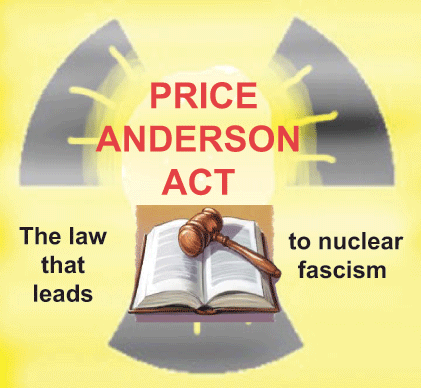 The Vermont Law School paper aptly sums up this picture with this conclusion:
“If the owners and operators of nuclear reactors had to face the full liability of a nuclear accident and meet the alternatives in competition that is unfettered by subsidies, no one would have built a nuclear reactor in the past, no one would build a reactor today, and anyone who owned one would exit the nuclear business as quickly as they could.” [page 69]
If we had a rational economic system, they surely would.
PG&E Corporation deliberately delaying decision on future of Diablo Nuclear Station

As long as PG&E keeps its options open, the state’s progress toward a sustainably carbon-free energy grid remains in suspended animation
PG&E plays coy on the future of Diablo Canyon nuclear plant, LA Times, Michael HiltzikContact Reporter, 1 Jan 16 The Economy Hub “……..More than just the future of Diablo Canyon lies in limbo. The plant’s generating capacity of 2,160 megawatts affects the development of the state’s renewable electric resources. Although PG&E has asserted that the plant’s continued operation would save its customers as much as $16 billion during the additional 20 years, the cost of bringing Diablo Canyon into compliance with environmental and seismic mandates may in fact not be worth the effort. Continue reading
Litany of health problems in US sailors exposed to Fukushima nuclear radiation
the plaintiffs have suffered a litany of health problems including cancer, tumors, brain defects, birth defects, early death and a wide variety of undiagnosed conditions. These are “very serious illnesses for a very large population of very young people
Even though it cannot be legally liable, the Defense Department seems to have been actively obstructing the sailors’ quest for justice.
 Fukushima radiation causes debilitating deformities in US Navy sailors Thursday, December 31, 2015 by: David Gutierrez, staff writer (NaturalNews) U.S. Navy sailors and Marines dispatched to provide aid to Japan following the massive earthquake and tsunami in 2011 are now suffering a variety of rare and undiagnosed health problems, including many involving horrifying and visible changes to their bodies.
After the tsunami, the U.S. Navy’s 7th Fleet, led by the USS Ronald Reagan, was diverted to the coast of Japan to provide relief work. The soldiers were not told that the disaster had triggered multiple meltdowns at the Fukushima Daiichi nuclear power plant, or that a radioactive plume was spreading across the Pacific Ocean.
Aviation Bosun’s Mate Dagan Honda and Aviation Structural Mechanic Ron Wright say they spent all day nearly every day of the mission on the deck of the Reagan, loading supplies. For roughly the first week of the mission, the sailors were given no radiation protection.
“So these sailors literally were marinating in radioactive particles,” said Attorney Charles Bonner, who is representing more than 200 sailors and Marines in a class action lawsuit against Fukushima operator Tokyo Electric Power Company (TEPCO) and several other defendants. Continue reading
Cost overruns are the norm for building nuclear power plants, but investors don’t pay
 Nuclear Energy Dangerous to Your Wallet, Not Only the Environment, CounterPunch, by PETE DOLACK , 1 JAN 16 “……..Significant cost overruns are the norm in building nuclear power plants, and it isn’t investors who are on the hook for them.
Three nuclear projects are under construction in the United States and two in Western Europe, a group that features an assortment of cost overruns and generous guarantees:
*The two new Vogtle reactors in Georgia are already $3 billion over budget although their completion date is three and a half years away. The largest owner, Southern Company, has received $8.3 billion in federal loan guarantees. Overruns at this plant are not unprecedented; the two existing reactors cost $8.7 billion instead of the promised $600 million, resulting in higher electricity rates.
*The Watts Bar 2 nuclear reactor in Tennessee, which received its license to operate in October, has seen its cost rise to $6.1 billion from $2.5 billion. (This is technically a restart of a unit on which construction was suspended in 1985.) The existing reactor at this site has a history of safety problems.
*The Summer 2 and 3 reactors being built in South Carolina have already caused rate payers there to endure a series of rate increases. Cost overruns just since 2012 have totaled almost $2 billion.
*In October 2013, British authorities approved a new nuclear reactor at Hinkley Point, England, that features subsidies designed to give the owner, Électricité de France, aguaranteed 10 percent rate of return on the project. Power from the plant will be sold at a fixed price, indexed to the consumer inflation rate. In other words, The Independentreports, “should the market price fall below that [agreed-upon] levelthe Government would make up the difference.” The agreed-upon fixed price set by the Cameron government at the time was double the wholesale price for electricity.
*Olkiluoto-3 in Finland was supposed to have cost €3 billion, but is 10 years behind schedule and €5 billion over budget.
High costs despite high subsidies…….. http://www.counterpunch.org/2016/01/01/nuclear-energy-dangerous-to-your-wallet-not-only-the-environment/
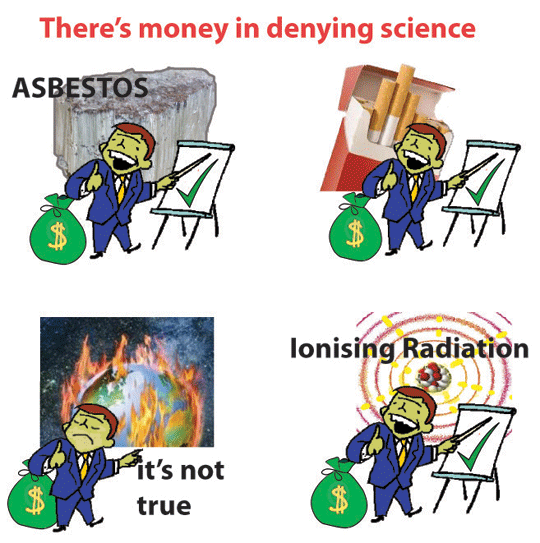
Pro Nuclear Spin: denial of radiation effects, of Fukushima harm
Denial in the face of evidence has certainly been an effective tool to frustrate worldwide efforts to address Climate Change. Why not attempt the same public relations makeover on radiation?
This new, bold initiative appears to be coming in a two-pronged attack: the first is reviving an already disproved theory that radiation may be ‘good for you’: hormesis.
The second is changing the world’s perception of the Fukushima Daiichi triple meltdown that released and deposited massive amounts of radioactivity in many areas of Japan.
The potential ramifications for public health are huge.
Demystifying Nuclear Power: Problem: In a post-Fukushima-triple-meltdown world, do the numbers work for atomic power? Fairewinds,November 17, 2015 by Sue Prent
With a giant blot still reading over the page of its public safety record, the multi-national, multi-billion dollar atomic power industry faces the stark economic reality that without even more of the regulatory and financial support that it has long enjoyed, it cannot successfully compete financially with sustainable methods electrical generation.
Moreover, these preferential government regulations and incredible financial subsidies from countries around the world are more concerned with maintaining a nuclear energy fleet that in the US has long been tied-up with Defense Department interests, and throughout the world has also been an assured method of access to nuclear weapons.
During the early days of atomic reactors, decommissioning, clean-up and long-term radioactive waste storage were not even acknowledged or planned for, and now they crowd onto center stage as aged and leaking plants line up to speedily shutdown and abandon their overflowing nuclear waste cesspools. In the US, people living near the plants and state governments without regulatory authority over this federal process are stunned to discover the financial burden of underfunded decommissioning funds and inadequate decommissioning procedures that will leave the public facing corporate waste abandonment.
That’s right, here’s the hook: if it weren’t for the scientific consensus view that radiation is harmful, and more radiation is even more harmful, nuclear plants might be a whole lot cheaper to operate.
Talk about your “inconvenient truth!”
Recent developments suggest that the atomic power industry, with cooperation from the US Nuclear Regulatory Commission (NRC), may have come up with a crafty way to make the financial numbers work once again: rehabilitate radiation. Continue reading
Underground wall ordered by EPA to prevent fire reaching nuclear waste landfill in Bridgestone
EPA orders barrier for nuclear waste landfill in Bridgestone http://www.bignewsnetwork.com/news/239881975/epa-orders-barrier-for-nuclear-waste-landfill-in-bridgestone Big News Network.comThursday 31st December, 2015 LENEXA, Kansas – The US Environmental Protection Agency (EPA) has ordered the installation of a physical isolation barrier separating the radioactively contaminated West Lake Landfill Superfund Site from the smoldering Bridgeton Landfill to make sure that the underground fire does not reach the buried nuclear waste.
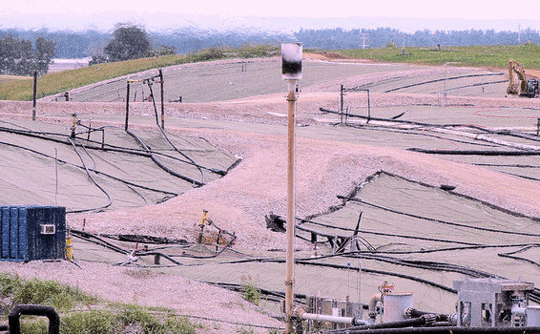
The barrier will consist of an underground wall. The decision also calls for the installation of additional engineering controls, such as cooling loops, to prevent potential impacts that could result if the subsurface smoldering were to come into contact with the radioactive materialscontained in the West Lake Landfill, Mark Hague, EPA regional administrator, said Thursday.
For years landfill owner Republic Services and state and federal regulators have considered a subterranean firebreak separating the smoldering Bridgeton Landfill from the adjacent West Lake Landfill, just a few hundred feet away.
But uncertainty over the location and extent of West Lake’s radioactive contamination has prompted more studies of West Lake, contaminated in 1973 with nuclear weapons processing waste from the Manhattan Project .
Now, EPA says those assessments, conducted with assistance from the US Army Corps of Engineers, are nearly complete. “We now have a better understanding of where those materials are located,” EPA spokeswoman Angela Brees said. “We’re at a point now where we had enough data where we needed to make a decision about a wall.”
The latest report on the radioactive contamination’s location is under final review and will be released soon, she said.
The worrying part is that the underground fire is now within 1,200 feet from the West Lake landfill.
“Finding a solution to mitigate the potential impacts of a subsurface smoldering event is a top priority for the community, and a top priority for EPA,” said Hague. “Today’s announcement is the first step in moving forward with the installation of a physical barrier and other engineering controls to address this issue.”
“We are now working through the highly complex details of implementing our decision and the associated legal steps. Once the plan is finalized, we are committed to providing this information to the public.”
The work of creating an underground barrier will be paid for by Republic Services, owner of both landfills. A spokesman for Republic Services said the company is ready to proceed with the barrier installation work. The company insists there is no risk of the fire reaching the nuclear material, but environmentalists disagree.
Ed Smith of the Missouri Coalition for the Environment said the barrier is not enough. “The only way to ensure a smoldering or surface fire doesn’t impact the radioactive wastes is to remove them,” Smith said, reported abc News.
West Lake was declared a Superfund site in 1990. In 2008, the EPA announced a remediation plan to cap the nuclear waste with rock, clay and soil. Opposition from the environmentalists however forced that the EPA to reconsider its decision.
No new plan has been worked out despite criticism from some lawmakers and residents who feel the agency is moving too slowly.
Worst nuclear contamination is former plutonium plant in Hanford, USA
 HANFORD NUCLEAR RESERVATION: America’s Fukushima December 30, 2015 by State of the Nation America’s Atomic Time Bomb: Hanford Nuclear Waste Still Poses Serious Risks By Marc Pitzke in New York Spiegel Online International
The disaster at Fukushima has raised questions around the world about nuclear safety. But contamination is much worse in the Pacific Northwest of the United States. The former plutonium plant in Hanford, Washington is one of the most contaminated places on earth, and still decades from being cleaned up.
The lambs were born without eyes or mouths. Some had legs that had grotesquely grown together; others had no legs at all. Many were stillborn. Thirty-one were lost in a single night.
On a pasture nearby, a cow was found dead, stiff and with its hooves bizarrely stretched up into the whispering wind. Down by the river, men of the Yakama tribe pulled three-eyed salmon from the Columbia. Trout were covered in cancerous ulcers.
And then the babies started getting sick.
It was in the spring of 1962 that farmer Nels Allison first noticed something was ominously wrong. “Son of a bitch,” he said to his wife. Sheep were always “the first to lie down and die” when something was amiss on Allison’s farm near Basin City, a rural town near the Columbia River in the far northwestern corner of the continental United States. He started referring to that deadly night “the Night of the Little Demons.”
Although the Allisons have long since passed away, the shock endures. As chronicled by journalist Michael D’Antonio in his 1993 book Atomic Harvest, their tale is one of thousands of horror stories that took place in the area surrounding Hanford, Washington, the site of America’s first full-scale plutonium production facility. The site haunts the locals to this day — and imperils them.
Hanford is America’s original atomic sin. At this giant facility sprawled over 586 square miles (1,517 square kilometers), a four-hour drive southeast of Seattle into the vast emptiness of Eastern Washington, the United States once produced most of its nuclear raw materials for the Cold War. Though it was decommissioned in 1988, it remains the most contaminated location in the entire Western Hemisphere.
The US Department of Energy (DOE) recently revised its timetable for Hanford’s decontamination, the biggest environmental cleanup in American history. The end date was moved back, once again. It now hopes to finally wrap up this Herculean task by September 2052 — more than 108 years after Hanford was opened……..http://stateofthenation2012.com/?p=28115
US Chamber of Commerce backs the weakening of radiation safety standards
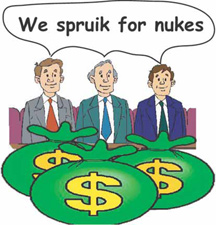 US Chamber of Commerce Nov 19 15
 radiation hormesis is a phenomenon in which low doses of ionizing radiation can be beneficial, stimulating the activation of repair mechanisms and other adaptive responses that protect against adverse effects not activated in the absence of ionizing radiation…….
1 This Month
Tell Congress: Prevent Nuclear Catastrophe in Iran

Tell Congress: Prevent Nuclear Catastrophe in Iran

Read the Public Inquiry Report, the Commissioners’ report, Surrendering Australia: The AUKUS Deception is available to download for free at aukuspublicinquiry.com. Or just watch the replay of the National Press Club Luncheon.


Shut down the radiation-damaged Heysham nuclear reactors now
To see nuclear-related stories in greater depth and intensity – go to https://nuclearinformation.wordpress.com

Say No to NASA’s Reckless Nuclear Reactor on the Moon
Say No to NASA’s Reckless Nuclear Reactor on the Moon
-
Archives
- November 2026 (215)
- October 2026 (302)
- September 2026 (339)
- August 2026 (330)
- July 2026 (355)
- June 2026 (287)
- May 2026 (306)
- April 2026 (356)
- March 2026 (251)
- February 2026 (267)
- January 2026 (308)
- December 2025 (358)
-
Categories
- 1
- 1 NUCLEAR ISSUES
- business and costs
- climate change
- culture and arts
- ENERGY
- environment
- health
- history
- indigenous issues
- Legal
- marketing of nuclear
- media
- opposition to nuclear
- PERSONAL STORIES
- politics
- politics international
- Religion and ethics
- safety
- secrets,lies and civil liberties
- spinbuster
- technology
- Uranium
- wastes
- weapons and war
- Women
- 2 WORLD
- ACTION
- AFRICA
- Atrocities
- AUSTRALIA
- Christina's notes
- Christina's themes
- culture and arts
- Events
- Fuk 2022
- Fuk 2023
- Fukushima 2017
- Fukushima 2018
- fukushima 2019
- Fukushima 2020
- Fukushima 2021
- general
- global warming
- Humour (God we need it)
- Nuclear
- RARE EARTHS
- Reference
- resources – print
- Resources -audiovicual
- Weekly Newsletter
- World
- World Nuclear
- YouTube
-
RSS
Entries RSS
Comments RSS

