Problem of Hanford’s highly radioactive pool of CESIUM-137 AND STRONTIUM-90
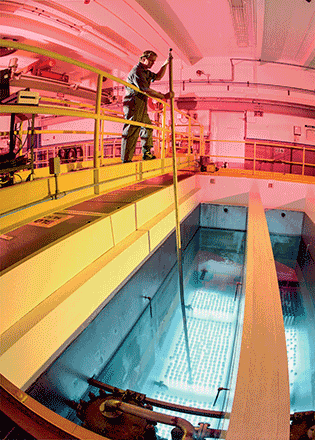 Deep sleep Warren Cornwall*, Science 10 Jul 2015: Vol. 349, Issue 6244, pp. 132-135 DOI: 10.1126/science.349.6244.132 “………..CESIUM-137 AND STRONTIUM-90 are the hot potatoes of the nuclear waste world, packing a powerful radioactive punch in a relatively short half-life of 30 years. At Hanford, there’s barely enough to fill the back of a pickup truck. Yet it contains more than 100 million curies of radiation, roughly one-tenth the radiation in the core of a large nuclear reactor. And it produces enough heat to power more than 200 homes.
To prevent the tubes from causing trouble, they sit under about 4 meters of water in what resembles a giant swimming pool, emanating a blue glow known as Cherenkov radiation as high-energy particles slam into the water. The 1974 building housing the pool is past its 30-year life span, according to DOE’s inspector general. Bombarded by radiation, the pool’s concrete walls are significantly weakened in places. Some of the tubes have failed and been stuck inside larger containers. In a review of DOE facilities conducted after the 2011 disaster at Japan’s Fukushima Daiichi Nuclear Power Station, the department’s Office of Environmental Management concluded that the Hanford pool had the highest risk of catastrophic failure of any DOE facility, for example in a massive earthquake, according to a report from the department’s inspector general. DOE says it plans to move the pool waste into dry casks for safer storage, but it hasn’t said when.
It’s an urgent situation and a huge safety risk,” says Tom Carpenter, executive director of the watchdog group Hanford Challenge in Seattle, Washington, which has been critical of DOE’s efforts to secure the waste.
Borehole advocates point out that the Hanford tubes are less than 7 centimeters in diameter, narrow enough to fit down a hole without extensive repackaging. All could fit into a single shaft. Other military waste could also go down a borehole, advocates add. One candidate is plutonium that DOE has extracted from dismantled nuclear weapons. Most of it is currently stored as softball-sized metal spheres at a DOE facility in Texas. In contrast to Hanford’s cesium and strontium, the plutonium is fairly cool, but extremely long-lived, with a half-life of 24,000 years. DOE is considering other options for the plutonium, including turning it into fuel for nuclear reactors or combining it with other nuclear waste and burying it. But boreholes could be an effective way to put it far out of the reach of anyone trying to lay their hands on bombmaking material……….http://science.sciencemag.org/content/349/6244/132.full
Solar power’s mighty future
 We’ve Barely Begun to Tap the Sun’s Mighty Power http://www.motherjones.com/blue-
 marble/2016/03/solar-power-nrel-study By Tim McDonnell Mar. 24, 2016 It seems like every few weeks there’s some new measurement of how successful solar power is in the United States. In early March, industry analysts found that solar is poised for its biggest year ever, with total installations growing 119 percent by the end of 2016. This week, federal government analysts reported that in 2015, solar ranked number three (behind wind and natural gas) in megawatts of new electricity-producing capacity brought online. That rank is even more impressive when you consider that each individual solar installation is fewer megawatts than a wind turbine, and far fewer than a natural gas plant; that means solar panels are popping up like crazy across the country.
The report is the deepest dive on solar’s potential since NREL conducted a similar analysis in 2008. The new report’s estimate is much larger than the older report’s, mostly because of vast new troves of satellite imagery data of the country’s rooftops and computer models that are better able to calculate how much power each panel can produce. The analysis leaves behind policy and cost considerations. Instead, the only question is: How much power could we really get if we slathered every roof in America with solar panels? The answer: About 39 percent of the country’s electricity consumption, at current levels.
It’s important to note that the report looks only at rooftop panels, as opposed to utility-scale solar farms. Utility-scale solar provides about twice as much power as rooftop panels, so the full potential of solar is likely even higher than what NREL describes in this report. Even 39 percent, though, would be a revolutionary change from where we are now; despite solar’s rapid growth in the last several years, it still accounts for less than 1 percent of electricity consumption. Coal, which is still the nation’s number-one energy source, commands about 32 percent of the market. So the future that NREL is envisioning here would basically flip our energy makeup on its head.
The most potential exists in sunny states, obviously, but also in states that have relatively low electricity needs. [good map on original] Again, NREL stresses that the estimates here “provide an upper bound on potential deployment rather than a prediction of actual deployment.” It’s very unlikely that this exact scenario will come to pass. The most recent study by Stanford energy economist Mark Jacobson, who researches ways the US could get 100 percent of its power from renewable sources, sees rooftop solar contributing about 7 percent of total electricity by 2050. And that’s with, as Vox‘s David Roberts put it, “enormous, heroic assumptions about social and political change.”
But hey…we’re dreamers of the golden dream, right?
Wake up World! Belgium terrorist attack shows vulnerability of nuclear facilities
“Every country, no matter how safe it thinks it is, needs to protect nuclear weapons and the materials you could use to make them against the full spectrum of plausible threats,”
“And wherever there are potential nuclear bomb materials, they need to have armed guards.”
A Nuclear Wake-Up Call in Belgium, Huffpost, 25 Mar 16, By R. Jeffrey Smith “…….The risk of radiation bombs raised few concerns before it became clear that al Qaeda was seeking nuclear materials. And over the past 15 years, those worries have taken a back seat to an even larger anxiety: that materials usable in a Hiroshima- or Nagasaki-sized nuclear bomb might fall into the wrong hands.
As a result, the Obama administration has focused its attention until now on locking down or eliminating the big sparkplugs: plutonium and highly enriched uranium.
But the smaller “dirty bombs” and their lighter security have been a real source of worry among specialists, some of whom say that a detonation somewhere in the world is inevitable.

“I’m surprised it has not happened yet,” said Laura Holgate, the National Security Council’s senior director for weapons of mass destruction terrorism, at a Washington symposium three years ago. The mechanics of such a device are simple and widely known.
An internal Energy Department report in 2013 counted 70,000 medical, industrial and research devices with potentially dangerous radiological materials, and observed that they are “poorly secured at facilities in nearly every country.”……..
“Every country, no matter how safe it thinks it is, needs to protect nuclear weapons and the materials you could use to make them against the full spectrum of plausible threats,” said Matt Bunn, a nuclear security expert and former White House official who is now at Harvard University. “And wherever there are potential nuclear bomb materials, they need to have armed guards.”
Government studies have shown that attackers can reach sensitive areas at many nuclear sites quickly, and that “it’s really hard to design systems” against a concerted assault, Bunn said.
That’s why Britain, Canada, France, Germany and the United States have long posted armed guards at sensitive sites. But many other countries still don’t. The Netherlands, which supplies a large portion of the world’s radioisotopes, is one; Italy, Argentina, Brazil, Slovakia and Spain similarly lack regulations requiring armed guards at their nuclear sites, according to the nonprofit advocacy group Nuclear Threat Initiative.
Many other measures can be taken to limit the risks of radiological materials. These include expert training of security personnel, helping less-developed countries find and use non-threatening industrial or medical alternatives, and creating rigorous systems to track material locations.
A major problem, however, is that the U.S. budget for this work has declined steadily in recent years, largely to make room for increased spending on modernizing nuclear weapons. The administration in February proposed a $7.6 million cut for next year and $270 million less than previously planned over the next four years. A U.S. target for securing radiological materials in 4,400 facilities has slipped by more than a decade, according to the Arms Control Association……..http://www.huffingtonpost.com/the-center-for-public-integrity/a-nuclear-wake-up-call-in_b_9532550.html
“Deadly force” – a new rule for nuclear facility safety
 Tenn. House OKs deadly force by security officers at ‘nuclear power reactor’ facilities http://www.knoxnews.com/news/politics/house-oks-deadly-force-by-security-officers-at-nuclear-power-reactor-facilities-2e94b9d4-2e46-5bc3-e-373013301.html By News Sentinel Staff, 25 Mar 16, NASHVILLE — The House gave final legislative approval Monday night to a bill expanding the use of deadly force by security officers at nuclear power reactor facilities.
Tennessee law currently allows the use of deadly force by security personnel at “category I nuclear facilities” — facilities possessing “strategic special nuclear material” defined and licensed by the Nuclear Regulatory Commission, “when reasonably necessary to prevent or impede an act of radiological sabotage,” under specific circumstances.
The bill expands the law to include any “nuclear power reactor facility.”
The House voted 94-0 Monday on the bill, following the Senate’s 32-0 vote on Feb. 29. The bill now goes to the governor.
Shared solar – a cheaper, better way to go for electricity
Shared solar can help low-income customers get in on the solar development.
Rooftop solar can be expensive, even with incentives or leasing programs, leaving low-income ratepayers out. Shared solar can let them in on the benefits of solar. A couple of recent reports show how.

Love solar power but got no rooftop? “Shared solar” is coming for you. Vox [excellent pictures] by David Roberts on March 24, 2016 To date, solar power has mostly been available to utilities (as big power plants) or individual home and business owners (as rooftop panels).
Left out has been … well, everyone else, those of us who are not utility executives and do not have the money, wherewithal, or suitable rooftops to install solar ourselves. That’s a lot of people who love solar power but have no way to get directly involved in it.
Here’s how shared solar fits into the larger energy picture, how it works, its benefits and drawbacks, and its future potential……There are two kinds of community-scale solar. The first is utility-owned, with power sold to utility customers — a traditional arrangement between a utility and a power plant developer, just on a smaller scale. Lots of smaller utilities, municipals, and co-ops are getting into this.
The other is shared solar, in which customers a) share ownership of a community-scale PV array, b) “subscribe” to the power output of such an array, or c) both.
Existing community-scale solar is split roughly half and half between those two types.
How many shared solar projects are there? From a new report by Deloitte:
In 2010, only two shared solar projects existed [in the US]. Today 77 utilities administer 111 projects across 26 states, accounting for a combined capacity of about 106 megawatts (MW).
That’s a tiny base — less than 1 percent of installed solar PV capacity, according to GTM — but growth is accelerating.
According to RMI, if you include both types, community-scale solar could grow to 30 GW capacity by 2020.
Typically, customers “subscribe” to a shared solar project. Some subscribe to a certain amount of capacity (say, the output of one panel), measured in kW. Some subscribe to a certain amount of power, measured in kWh. The credit for the power appears on a customer’s utility bill.
Who runs these things? “Shared solar arrays,” writes NREL, “can be hosted and administered by a variety of entities, including utilities, solar developers, residential or commercial landlords, community and nonprofit organizations, or a combination thereof.”
Exactly who can build and run a shared solar project depends on whether it is located in a regulated or deregulated energy market (more on that in a second) and what type of utility service area it’s in.
Shared solar is overwhelmingly driven, at least at the moment, by customer demand. So it makes sense that the utilities most responsive to their customers — co-ops, where customers are also owners — are leading the way on shared solar projects.
Deloitte offers this information-packed breakdown of shared solar by utility type:………
Benefits of shared solar
Shared solar has many of the benefits of distributed “behind-the-meter” solar and many of the benefits of larger solar power plants, with few of the drawbacks of either.
Like utility-scale solar, it enjoys economies of scale and simple, established financing models; unlike utility-scale solar, it can squeeze into almost any surface or piece of land, near existing transmission or distribution lines.
Like distributed, behind-the-meter solar it is low risk, can be sited near existing load, increases the resilience of the distribution grid, and satisfies the powerful consumer craving for solar power; at the same time, it is cheaper, simpler (fewer contracts per kW of capacity), and more inclusive than behind-the-meter solar.
Utilities, especially investor-owned utilities, aren’t in love with it (to them it’s just a more expensive version of a solar plant), but if they get their act together, they can use small, strategically sited shared solar projects to ease grid congestion or avoid expensive new grid investments………..
Shared solar can bring solar to low-income customers
One benefit is worth calling out in particular: Shared solar can help low-income customers get in on the solar craze.
Rooftop solar can be expensive, even with incentives or leasing programs, leaving low-income ratepayers out. Shared solar can let them in on the benefits of solar. A couple of recent reports show how.
One is the “Low-Income Solar Policy Guide,” from a coalition of groups including GRID Alternatives, Vote Solar, and the Center for Social Inclusion. The other is from the Interstate Renewable Energy Council (IREC): “Shared Renewable Energy for Low- to Moderate-Income Consumers: Policy Guidelines and Model Provisions.”
Both get into the technical weeds on program design and financing……… http://www.vox.com/2016/3/24/11297054/shared-solar
Solar WINDOWS (not panels)
AMAZING IOT #8: SOLAR WINDOWS (NOT PANELS!) ST Smarter Together, 16 Mar 16 A handful of startups are heading toward a new window of opportunity: solar powered windows. If you think about all of the windows in the world – Manhattan alone has 10.7 million windows – creating a window that allows businesses to save on energy costs would be breaking into an almost unimaginably huge market.
Solar powered windows sound conceptually like an oxymoron: Solar panels absorb and reflect light while windows let light through. Various startups have proposed different solutions to this issue which, at its heart, is a serious one. The company Solaria, uses thin strips of photovoltaics on already existing glass, making windows appear pin-striped. Another startup called Oxford Photvoltaics uses perovskite – an oxide used for superconductors – in order to capture solar energy. ………. competitor Richard Lunt and his team at Michigan State University created solar panel windows with a new method called Transparent Luminescent Solar Concentrator (TSLC). This method has the photovoltaic strips on the edge of the glass, allowing the window to be more transparent than the other two……..http://smartertogether.telenorconnexion.com/2016/03/amazing-iot-8-solar-windows-not-panels/
Spent nuclear fuel staying put near closed San Onofre nuclear power station
 Where is the San Onofre nuclear waste going? Spent fuel staying put for now, San Diego Union Tribune By Rob Nikolewski March 25, 2016 Some 3.6 million pounds of nuclear waste is stored at the now-shuttered San Onofre Nuclear Generating Station (SONGS) but when the waste will be transferred and where it will end up are still very open questions.
“I think everyone can agree we want to get the spent fuel off the San Onofre site sooner rather than later,” said Garry Brown, executive director and CEO of the nonprofit clean water organization Orange County Coastkeeper, Thursday night at the quarterly meeting of the Community Engagement Panel.
After the California Coastal Commission approved a site permit last October, a plan was approved to bury the waste in concrete casks within 125 feet of a seawall and the beach on a low-lying plain at the plant operated by Southern California Edison.
“We need to de-energize the plant as soon as we can,” Tom Palmisano, chief nuclear officer at Southern California Edison, told the 18-member panel during a Powerpoint presentation in Oceanside.
The prospect of casks on site has generated plenty of opposition. “We may never be able to move these,” said Gary Headrick, co-founder of San Clemente Green. “These storage containers are not reliable.”….
Among the problems is the near-paralysis on the part of the federal government to permanently deal with nuclear waste……..http://www.sandiegouniontribune.com/news/2016/mar/25/songs-nuclear-waste/
Vulnerability of San Onofre’s nuclear wastes

 Concerns over nuclear waste stored at San Onofre http://www.cbs8.com/story/31565017/concerns-over-nuclear-waste-stored-at-san-onofrePosted: Mar 26, 2016 SAN DIEGO (CBS 8) – North County residents voice their concerns over the plan to store nuclear waste at the former San Onofre power plant Thursday.
The troubled plant closed four years ago, but the spent fuel could be there for much longer.The process of decommissioning it is expected to be complete by the year 2030.
Some say it’s a plan that has sparked concern over the public safety.
“This nuclear waste at this site is as vulnerable a target as you can possibly have for the terrorist to attack us here,” Mike Aguirre, San Diego Attorney said.
Representatives from Southern California Edison countered that the stored fuel would not be a vulnerable target.
“We have a well-trained security force, reviewed and approved by the NRC to meet, what they consider the credible threats that we need to meet,” Thomas Palmisano said.
The Department of Energy has made a push to create temporary storage sites in west Texas and New Mexico. If the plan gets the green light, it could expedite the removal of nuclear waste from San Onofre.
USA’s nuclear industry in death spiral?
 Has U.S. Nuclear Power’s Death Spiral Begun? With carbon markets and subsidies in doubt, nuclear is no longer affordable IEEE Spectrum, By Peter Fairley 25 Mar 2016 U.S. nuclear power plant operators are fighting a war on two fronts: Crashing prices for natural gas and accelerating market penetration of renewable energy have both contributed to dramatic drops in wholesale power price levels—in some states, they’ve fallen by more than two-thirds over the past decade. This has left nuclear power, whose operating costs are pretty much fixed, with few options other than surrender.
That marks quite a reversal, says Gregory Jaczko, former chairman of the U.S. Nuclear Regulatory Commission. “It’s been a widely held belief that nuclear is incredibly cheap to operate. That was the case 10 years ago, when nuclear plants were cash cows. That’s not the case today, especially as the plants age,” he says.
Fission is already giving ground. Two plants, in Wisconsin and Vermont, shut down in 2013 and 2014, respectively. More shutdowns are anticipated in Massachusetts, New Jersey, and New York, and at least half a dozen more plants are teetering on the brink of insolvency.
Nuclear operators had been expecting President Obama’s Clean Power Plan, which would have established national carbon regulations and increased the cost of fossil-fuel-generated electricity, to offer them a reprieve. But their hope was short-lived: The U.S. Supreme Court decided in February to stay implementation of the plan.

Operators’ next best hope is that state governments will be motivated to step in and save them. ……
By June, state regulators plan to detail special payments for New York’s nuclear plants. For companies that open their books and show that their plants are losing money, New York is vowing to make them whole.
“It’s probably the stickiest energy policy question there is in the electric sector,” says Julien Dumoulin-Smith, a senior power markets analyst with New York City–based UBS Investment Research.
New York is not alone. Several states, including Illinois and Ohio, are seeking to give nuclear power plants an extra boost. Exelon lists the dual-reactor Quad Cities site in Illinois among its uncompetitive plants. Dumoulin-Smith says local power prices are being “pummeled” by wind power, noting that Quad Cities sits just across the border from Iowa, which leads the United States in wind power penetration.
Quad Cities, along with Exelon’s nine other reactors in Illinois, caught a break from regional grid operator PJM, which last year began offering more supplements to power plants that commit to staying in its energy market for several years, thus backstopping its power supply. Those Illinois plants raked in more than US $1.5 billion from PJM’s capacity market last September, ensuring that Quad Cities will remain in operation through mid-2018.
But experts say that tougher times could lie ahead, as the extension of tax breaks for wind and solar power voted through the U.S. Congress in December fuels further growth in renewable generation. New York’s program appears to anticipate this, positing that assistance to nuclear reactors is more of a temporary lifeline than a long-term guarantee. State aid is, according to a white paper from the N.Y. Public Service Commission, a means of supporting “a smooth emission-free transition from nuclear to nonnuclear resources” in the event that energy prices “are not able to support the continued financial viability of the [fission] plants.” This article appears in the March 2016 print issue as “U.S. Fission Fizzles.” http://spectrum.ieee.org/energy/nuclear/has-us-nuclear-powers-death-spiral-begun
Home solar energy is booming in USA
The Surprise New Boom Market for Residential Solar Huffington Post, By Barbara Grady 24 Mar 16 As the price of solar powered electricity keeps falling and rooftop panels pop up in an increasing number of neighborhoods, an interesting thing is shaping up in the market.
Residential solar is no longer for just well-to-do homeowners. Indeed, the growth market in solar is median- and low-income neighborhoods in California and other locales, according to multiple recent reports.

In 2015, a full 65 percent of residential solar getting installed in California was in zip codes with median household incomes of $70,000 or less, while just 6 percent of installations in the state were happening in neighborhoods with median household incomes above $100,000, according to a report from Kevala Analytics.
A surge in solar adoption — as well as a shift in where that adoption is taking place — is driven by economics that make solar the money saving option for electricity rate payers and by policies that offer flexible ways for people to benefit from solar.
In California, Massachusetts, New York, Colorado, the District of Columbia, Maryland and some other places, policies that extend the reach of solar to renters and residents without rooftops are widening the market for individual and community installations alike. Financing mechanisms prevalent in some markets but not in others have also made it possible for people to opt for solar without requiring they have money for big upfront costs.
Federal policies adopted in the last couple of years, such as Property Assessed Clean Energy loan funds, and National Community Solar programs have helped. …..http://www.huffingtonpost.com/greenbiz-group/residential-solars-new-bo_b_9526460.html
Large number of baby deaths close to nuclear contaminated site
 Cemetery full of dead babies missing brains next to US nuclear site — Funeral Director: Almost all infants we have died the same way… “that’s pretty much all I see on death certificates” — Few miles from “most contaminated place in hemisphere” — “One of largest documented anencephaly clusters in US history” (VIDEO) http://enenews.com/one-largest-documented-clusters-history-video?utm_source=feedburner&utm_medium=email&utm_campaign=Feed%3A+ENENews+%28Energy+News%29 March 23rd, 2016
Waiting for answers: a community copes with babies’ deaths
Seattle Times, updated Jan 28, 2016 (emphasis added): How the state is missing chances to find deadly birth defect’s cause… at least 40 other mothers have lost babies to [anencephaly, which result in missing large parts of the brain] in Yakima, Benton and Franklin counties since 2010… one of the largest documented clusters of anencephaly in U.S. history… “Something’s going on and someone needs to tell us,” said [mother Sally] Garcia… Dr. Lisa Galbraith was one of the doctors… In Prosser, the obstetrician oversaw care of Garcia’s pregnancy and others affected by the disorder… “I had a total of four or five babies with anencephaly over the course of two years,” recalled Galbraith… the rate of anencephaly was much higher [than US averages]… Washington health officials… have collected no blood samples, performed no genetic tests and conducted no examination of water, soil… and have no plans to do so… In Texas, just three babies withanencephaly sparked enough outrage to overhaul the state’s birth-defects reporting system.
Seattle Times video transcript – Carlen Majnarich, funeral director: “It’s tragic… It just seems like that’s pretty much all I see on the death certificate is the same diagnosis. And nobody seems to know why. We average close to 100 families a year here in Prosser [a few miles from Hanford]. Almost all the infants that we have have died of anencephaly. It’s just what do you say?”… Sally Garcia (mother who lost her baby to anencephaly): “All these on this side [of the cemetery] are all babies… all babies, starting from right there.”
The Legal Examiner, Dec 31, 2015: [T]he strange eruption of anencephaly cases, which occurs in Washington at a rate almost 5 times as high as the national average, has highlighted a number of government policies that may actually conceal these sort of birth defect “clusters,” rather than help investigate them.
KVEW-TV, Mar 4, 2016: As of November 2015 cases of anencephaly have continued to increase with the current rate at 9.5 per 10,000 live births.
Sara Barron, MS, BSN – American Journal of Nursing, Mar 2016: In the spring of 2012 two babies without brains were born within weeks of each other at the rural hospital in Washington State where I was working… I was stunned when the delivering physician said another patient was expecting the same outcome. After speaking with colleagues at neighboring hospitals, I learned that two other babies with anencephaly had recently been born in the area. In over 30 years of nursing, I had seen only two cases of anencephaly prior to these. I called the Washington State Department of Health and reported a birth defect cluster… RISK FACTORS…Radiation exposure. Popular media and blogs have often linked the Washington State NTD cluster to the Hanford Nuclear Reservation in Benton County, Washington. Althoughleaks from nuclear power plants have been associated with a higher rate of anencephalyand other NTDs, Washington State Department of Health investigators point out that the three counties with the highest prevalence of NTDs were both upwind and upriver of the Hanford site, making the nuclear plant an unlikely cause of the 2012 cluster.
- Bulletin of the Atomic Scientists: “The Hanford Site… is widely considered to be the most contaminated place in the Western Hemisphere”
- KOIN: “The biggest, most toxic nuclear waste site in the Western hemisphere”
- Time: “The largest nuclear clean-up site in the western hemisphere”
- AFP: “The Western hemisphere’s most contaminated nuclear site“”
More infant deaths near Hanford: Cemetery blocks filled w/ babies downwind of US nuclear site — Mother: My newborns died in hours… tumors all over, brain disintegrated after massive stroke — “Body parts, cadavers, fetuses… nuke industry took in the dead of night”
America’s nationwide problem of nuclear wastes, and Edison’s experimental Holtec solution
 O.C. Watchdog: Could there be an ‘early’ nuclear cleanup at San Onofre? Orange County Register, By TERI SFORZA / March 23, 2016 “…….NATIONWIDE PROBLEM Some 72,000 metric tons of highly radioactive waste has piled up at 75 commercial reactor sites in America over the past half-century, according to a recent review by the U.S. Government Accountability Office.
That’s not how it was supposed to be.
To encourage the development of nuclear power, the federal government passed the Nuclear Waste Policy Act of 1982, promising to accept and dispose of spent fuel and high-level waste by Jan. 31, 1998.
Utilities operating nuclear power plants made payments into a Nuclear Waste Fund to pay for disposal.
About $750 million a year was collected from ratepayers, and the disposal program’s funding grew to $41 billion over three decades. But the federal government never accepted any commercial nuclear waste for permanent disposal.
The nuclear industry sued, and a federal judge found that the U.S. Department of Energy couldn’t continue charging for a service it not only wasn’t providing, but wouldn’t provide for many decades. In 2014, utilities stopped collecting the charge – about 20 cents a month on the average electric bill. After the government spent $10 billion on a now-abandoned plan to create a permanent disposal site at Nevada’s Yucca Mountain, about $30 billion remains in the fund, earning about $1 billion in interest a year.
Local governments, including San Clemente, Laguna Beach, Oceanside, Encinitas and San Diego County, are pressing Washington to fulfill its obligations.
“We all want it gone,” said San Clemente City Councilman Tim Brown last month.
BREAKTHROUGH?
Edison agrees.
“We are very much in alignment with our nearby communities, which are making efforts to get the nuclear fuel moved off-site to another location,” said Maureen Brown, Edison spokeswoman. “Before it can be moved off-site, though, it has to be in a dry storage canister for transport. We are continuing with preparations to expand dry storage and get all the fuel out of the spent fuel pools.”
That’s supposed to be done by 2019. Edison has chosen Holtec International’s Hi-Storm Umax underground system for dry storage. The fuel is expected to remain in an “underground monolith” on-site through 2049, when Edison assumes the federal government will take custody of all spent nuclear fuel.)
The Department of Energy will begin public meetings on the new push for interim storage sites on Tuesday in Chicago.A second hearing is scheduled in Atlanta on April 11 and a third in Sacramento on April 26.
“(W)e in the communities surrounding SONGS have a keen interest in removing the spent fuel from the site,” Victor wrote in a recent memo to the Community Engagement Panel. “As the option of Yucca Mountain has stalled, spent fuel has been backing up at sites around the country with no place for permanent disposal. The idea of consolidated interim storage (CIS) could be a solution.
San Onofre’s storage system will be part of a real-time experiment, as Edison partners with the Electric Power Research Institute to develop inspection techniques to monitor casks as they age.
No entity has previously done what Edison is planning – burying this kind of spent fuel in dry casks for decades. Critics have raised concerns about the ability of the casks to withstand the heat of the fuel over time.
Some don’t think temporary storage is the answer.
“If such a site were ever built, it would be a disaster for the hosting community,” said activist Ace Hoffman of Carlsbad. “DOE calls it ‘consent-based,’ but how can future generations that will have to deal with the mess give their consent? And why on earth would they?
“DOE calls it ‘interim,’ but what exactly that means has never been defined, except to mean ‘until a permanent repository opens up somewhere.’ Who’s going to fall for that line?” http://www.ocregister.com/articles/fuel-709466-nuclear-san.html
Scepticism on San Onofre nuclear station cleanup plan
O.C. Watchdog: Could there be an ‘early’ nuclear cleanup at San Onofre? Orange County Register, By TERI SFORZA / March 23, 2016 Federal efforts to speed up the removal of spent radioactive fuel from power plants like the mothballed San Onofre Nuclear Generating Station are gaining momentum and inspiring guarded optimism among local officials.
Critics, however, remain deeply skeptical.
In January, the U.S. Department of Energy launched a new push to create temporary nuclear waste storage sites in regions eager for the business, currently in West Texas and New Mexico.
Several such sites could be up and running while the prickly question of finding a location for a permanent repository – the root of the present paralysis in nuclear waste disposal – is hashed out.
“That could mean moving the fuel from San Onofre a decade earlier than is envisioned now, maybe more,” said David Victor, who chairs the San Onofre Community Engagement Panel. The volunteer group of academic, industry, environmental and local government representatives advises the plant’s owner, Southern California Edison.
“I am cautiously optimistic,” he said. Victor, director of the Laboratory on International Law and Regulation at UC San Diego, met with officials in Washington this month to convey populous Southern California’s eagerness to solve the nuclear waste storage problem. An update on those efforts, as well as the latest on plans to dismantle the shuttered twin reactors, will be presented at 6 p.m. today at the San Onofre Community Engagement Panel’s quarterly meeting in Oceanside.
Decommissioning the plant south of San Clemente is expected to cost $4.1 billion and be mostly completed by 2030. But spent nuclear fuel is expected to remain on the beachside bluff much longer………… http://www.ocregister.com/articles/fuel-709466-nuclear-san.html
US households turning to solar panels. Impact on power industries
 Impact of solar panels keeps growing The U.S. power industry is feeling the pressure, with about 1 million households turning to the sun. PORTLAND PRESS HERALD, BY JONATHAN N. CRAWFORD BLOOMBERG.22 Mar 16 Rooftop solar is casting a $2 billion shadow over power generators across the eastern United States.
With more than a million U.S. houses set to have solar panels by the end of next month, grid managers serving the eastern U.S. plan to cut the amount of electricity they buy from conventional plants by about 1,400 megawatts, starting in 2019, according to industry consultant ICF International Inc. That’s enough juice to power about 780,000 households.
The result could be as much as $2 billion in lost revenue for generators that are already reeling from lower demand, tight environmental regulation and depressed prices. Power producers including NRG Energy Inc. warn that the growing reliance on solar may curtail investment in conventional power plants, threatening the reliability of the U.S. electricity system. That’s already happened in Germany, they say, citing plans by EON and RWE to scrap existing or planned plants……..
Under “Energiewende,” a German transition plan designed to lessen fossil fuel use, about 30 percent of the country’s power is now generated by renewables, sending power prices to their lowest levels in more than a decade. That spurred EON’s Uniper unit to seek closure of two gas-fired units in Bavaria, and Essen-based RWE to scrap plans to start up its coal-fired Westfalen-D plant, valued at $1.1 billion…….
This year, for the first time, operators of regional power grids such as PJM Interconnection, which serves more than 61 million customers ranging from Washington to Chicago, and ISO New England Inc., have included solar growth in their estimates for 2019, spurring more national debate on how the nation’s electrical system will be financed and managed moving forward. http://www.pressherald.com/2016/03/19/impact-of-solar-panels-just-keeps-growing/
St Louis County residents count the health toll from radioactive wastes
As they painstakingly mapped out the cases, Wright, Schanzenbach, and other members of the group were struck by the statistical improbability of what they were seeing. They found higher than average levels of leukemia, rare brain tumors, breast, and colon cancers — all known to be associated with nuclear radiation exposure according the Centers for Disease Control and the US Environmental Protection Agency. “We realized that we were seeing the effects of long-term exposure among people who grew up in North St. Louis County from the 1960s to the 1980s when the contamination was at its worst,” says Wright…….
Over the past four years, more than 100 current and former North St. Louis County residents have filed lawsuits against Mallinckrodt and the other companies involved in the manufacture and disposal of the nuclear waste, alleging these businesses’ reckless and negligent actions caused their cancers and other illnesses.
According to the latest data collected by the survey, as of 2015 there were 1,993 self-reported cancer cases, of which 45, including Patricia Barry’s, were cases of appendix cancer — a disease so rare that it’s usually seen in 1 of about 500,000 people a year in the United States.
In total, there were more than 2,725 reported cases of multi-generational illnesses, including rare cancers, thyroid problems, infertility, autoimmune diseases, and genetic mutations in children. (below, archival photo of waste barrels, st Louis)

Nuclear Waste Creates Casualties of War in Missouri TruthOut , 18 March 2016 By Lori Freshwater, Earth Island Journal | News Analysis “…….Google search revealed shocking information. It seemed there was an unusually high number of rare cancers and diseases afflicting current and former residents of several neighborhoods that Coldwater Creek ran through, including St. Ann. The most likely cause, the news reports and websites she scanned indicated, was the creek, which had been contaminated by radioactive waste from the World War II era. Continue reading
1 This Month
Tell Congress: Prevent Nuclear Catastrophe in Iran

Tell Congress: Prevent Nuclear Catastrophe in Iran

Read the Public Inquiry Report, the Commissioners’ report, Surrendering Australia: The AUKUS Deception is available to download for free at aukuspublicinquiry.com. Or just watch the replay of the National Press Club Luncheon.


Shut down the radiation-damaged Heysham nuclear reactors now
To see nuclear-related stories in greater depth and intensity – go to https://nuclearinformation.wordpress.com

Say No to NASA’s Reckless Nuclear Reactor on the Moon
Say No to NASA’s Reckless Nuclear Reactor on the Moon
-
Archives
- November 2026 (191)
- October 2026 (302)
- September 2026 (339)
- August 2026 (330)
- July 2026 (355)
- June 2026 (287)
- May 2026 (306)
- April 2026 (356)
- March 2026 (251)
- February 2026 (267)
- January 2026 (308)
- December 2025 (358)
-
Categories
- 1
- 1 NUCLEAR ISSUES
- business and costs
- climate change
- culture and arts
- ENERGY
- environment
- health
- history
- indigenous issues
- Legal
- marketing of nuclear
- media
- opposition to nuclear
- PERSONAL STORIES
- politics
- politics international
- Religion and ethics
- safety
- secrets,lies and civil liberties
- spinbuster
- technology
- Uranium
- wastes
- weapons and war
- Women
- 2 WORLD
- ACTION
- AFRICA
- Atrocities
- AUSTRALIA
- Christina's notes
- Christina's themes
- culture and arts
- Events
- Fuk 2022
- Fuk 2023
- Fukushima 2017
- Fukushima 2018
- fukushima 2019
- Fukushima 2020
- Fukushima 2021
- general
- global warming
- Humour (God we need it)
- Nuclear
- RARE EARTHS
- Reference
- resources – print
- Resources -audiovicual
- Weekly Newsletter
- World
- World Nuclear
- YouTube
-
RSS
Entries RSS
Comments RSS

