Staging for a Strike? US Quietly Moves Bombers as Israel Prepares to Hit Iran

In April, Donald Trump remarked that Israel would “lead” any such operation. That comment was interpreted by many as a nod of support, if not a green light, from Washington. Israeli Prime Minister Benjamin Netanyahu, for his part, has repeatedly warned that his government will not allow Iran to become a nuclear weapons state.
a growing consensus across Washington’s think tank circuit: that Tehran is vulnerable, and now is the moment to strike.
By Robert Inlakesh / MintPress News, 24 May 25, https://www.mintpressnews.com/us-deploys-bombers-israel-iran-strike/289846/
As threats of an Israeli strike on Iran grow louder, the United States is making quiet but unmistakable moves of its own. Over the past month, Washington has quietly repositioned strategic bombers and fighter squadrons to Diego Garcia, a remote U.S. military outpost in the Indian Ocean, squarely within striking distance of Tehran.
The official rationale is force protection. But the scale and nature of the deployments have sparked speculation that Washington is laying the groundwork for potential military involvement in an Israeli-led operation, or, at the very least, sending a message to Tehran that it won’t stand in the way.
Roughly a month ago, the U.S. Air Force deployed six B-2 Spirit bombers to Diego Garcia, a third of its active fleet of nuclear-capable stealth aircraft. These bombers, capable of flying directly from the U.S. to targets across the globe, don’t require forward deployment to be effective. Which is why their presence on a remote island in the Indian Ocean is raising eyebrows.
The B-2s have reportedly been used in prior strikes against Ansar Allah targets in Yemen, though with limited strategic effect. Following the declared conclusion of U.S. operations in Yemen, at least some of the B-2s were replaced by four B-52 strategic bombers, another long-range platform associated with show-of-force missions.
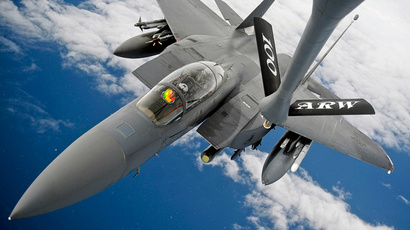
But then, additional firepower arrived. An entire squadron of F-15E Strike Eagle fighter jets was flown to the base. While these jets have strike capabilities, open-source intelligence analysts suggest they were likely deployed for base defense. That assessment, if correct, underscores that the Pentagon sees Diego Garcia not just as a staging ground, but as a potential target in a broader escalation.
Meanwhile, intelligence signals point to real movement on the Israeli side. A CNN report this Tuesday cited intercepted communications and activity on the ground indicating that Israel is preparing to strike Iranian nuclear facilities. U.S. officials reportedly believe the plans are active and serious.
In April, Donald Trump remarked that Israel would “lead” any such operation. That comment was interpreted by many as a nod of support, if not a green light, from Washington. Israeli Prime Minister Benjamin Netanyahu, for his part, has repeatedly warned that his government will not allow Iran to become a nuclear weapons state.
Yet even as diplomatic channels remained open, the introduction of new U.S. “red lines” appears to have derailed progress. U.S. Middle East envoy Steve Witkoff recently declared that Iran must halt all uranium enrichment, a demand not included in the original 2015 nuclear agreement, the Joint Comprehensive Plan of Action (JCPOA).
Iranian officials rejected the move outright. Foreign Minister Abbas Araghchi reiterated that enrichment is a sovereign right and a non-negotiable issue. Ayatollah Seyyed Ali Khamenei dismissed the new U.S. conditions as “nonsense.”
And on May 22, Araghchi issued a sharper warning: Iran, he said, would take “special measures to defend its nuclear facilities” if Israeli threats continued. The statement was deliberately vague, but left little doubt that Tehran is preparing for contingencies.
In Washington, meanwhile, influential think tanks are ratcheting up pressure for a hardline approach. The Washington Institute for Near East Policy (WINEP) has called for the complete dismantling of Iran’s enrichment infrastructure. The Foundation for Defense of Democracies (FDD) has urged more sanctions. The Atlantic Council argues the U.S. must avoid “reviving Obama’s Iran deal.”
Simultaneously, Dana Stroul, a former Biden official now at WINEP, has argued that Iran’s current weakness presents an opportunity for military action. Her view echoes a growing consensus across Washington’s think tank circuit: that Tehran is vulnerable, and now is the moment to strike.
These are the same voices that helped shape past U.S. interventions in the region. Their resurgence now, alongside tactical military deployments and rhetorical escalations, suggests a familiar pattern.
What’s missing from the conversation is any real public debate about the consequences. Not just for Iran, but for U.S. interests, regional stability, and the American public. A confrontation with Iran would carry significant consequences, yet few in Washington have publicly questioned whether such a conflict serves America’s national interest, save for outliers like Rep. Thomas Massie, who has drawn fire from powerful lobbies simply for asking whether this is our fight to begin with.
The buildup at Diego Garcia may be interpreted as precaution. But it’s also a reminder of how quickly precaution becomes policy, and policy becomes war, especially when shaped by proxies, pressure groups, and allies with very different interests.
Wars don’t always begin with votes. In fact, they often begin with quiet deployments far from view, and even farther from the American people they will ultimately affect.
Experts Warn Trump Attack on Nuclear Regulator Raises Disaster Risk

“Simply put,” said one critic, “the U.S. nuclear industry will fail if safety is not made a priority.”
Brett Wilkins, 24 May 25, https://www.commondreams.org/news/nuclear-regulatory-commission-trump
U.S. President Donald Trump on Friday signed a series of executive orders that will overhaul the independent federal agency that regulates the nation’s nuclear power plants in order to speed the construction of new fissile reactors—a move that experts warned will increase safety risks.
According to a White House statement, Trump’s directives “will usher in a nuclear energy renaissance,” in part by allowing Department of Energy laboratories to conduct nuclear reactor design testing, green-lighting reactor construction on federal lands, and lifting regulatory barriers “by requiring the Nuclear Regulatory Commission (NRC) to issue timely licensing decisions.”
The Trump administration is seeking to shorten the yearslong NRC process of approving new licenses for nuclear power plants and reactors to withinf 18 months.
“If you aren’t independent of political and industry influence, then you are at risk of an accident.”
White House Office of Science and Technology Director Michael Kratsios said Friday that “over the last 30 years, we stopped building nuclear reactors in America—that ends now.”
“We are restoring a strong American nuclear industrial base, rebuilding a secure and sovereign domestic nuclear fuel supply chain, and leading the world towards a future fueled by American nuclear energy,” he added.
However, the Union of Concerned Scientists (UCS) warned that the executive orders will result in “all but nullifying” the NRC’s regulatory process, “undermining the independent federal agency’s ability to develop and enforce safety and security requirements for commercial nuclear facilities.”
“This push by the Trump administration to usurp much of the agency’s autonomy as they seek to fast-ttrack the construction of nuclear plants will weaken critical, independent oversight of the U.S. nuclear industry and poses significant safety and security risks to the public,” UCS added.
Edwin Lyman, director of nuclear power safety at the UCS, said, “Simply put, the U.S. nuclear industry will fail if safety is not made a priority.”
“By fatally compromising the independence and integrity of the NRC, and by encouraging pathways for nuclear deployment that bypass the regulator entirely, the Trump administration is virtually guaranteeing that this country will see a serious accident or other radiological release that will affect the health, safety, and livelihoods of millions,” Lyman added. “Such a disaster will destroy public trust in nuclear power and cause other nations to reject U.S. nuclear technology for decades to come.”
Friday’s executive orders follow reporting earlier this month by NPR that revealed the Trump administration has tightened control over the NRC, in part by compelling the agency to send proposed reactor safety rules to the White House for review and possible editing.
Allison Macfarlane, who was nominated to head the NRC during the Obama administration, called the move “the end of independence of the agency.”
“If you aren’t independent of political and industry influence, then you are at risk of an accident,” Macfarlane warned.
On the first day of his second term, Trump also signed executive orders declaring a dubious “national energy emergency” and directing federal agencies to find ways to reduce regulatory roadblocks to “unleashing American energy,” including by boosting fossil fuels and nuclear power.
The rapid advancement and adoption of artificial intelligence systems is creating a tremendous need for energy that proponents say can be met by nuclear power. The Three Mile Island nuclear plant—the site of the worst nuclear accident in U.S. history—is being revived with funding from Microsoft, while Google parent company Alphabet, online retail giant Amazon, and Facebook owner Meta are among the competitors also investing in nuclear energy.
“Do we really want to create more radioactive waste to power the often dubious and questionable uses of AI?” Johanna Neumann, Environment America Research & Policy Center’s senior director of the Campaign for 100% Renewable Energy, asked in December.
“Big Tech should recommit to solutions that not only work but pose less risk to our environment and health,” Neumann added.
Trump’s Golden Dome Is a Combover

By David Swanson, World BEYOND War, May 21, 2025, https://worldbeyondwar.org/trumps-golden-dome-is-a-combover/
According to world-leading war-profiteer Lockheed Martin, its Golden Dome, marketed for it by Donald Trump, “stands as a layered defense shield, safeguarding the American homeland with unwavering precision, ensuring the security and resilience of our nation.” But it doesn’t exactly “stand” anywhere in the present day or what some of us like to call “reality.” Rather, it’s one of those scientific research projects Trump loves to defund if they might succeed or do anyone any good. In the words of Lockheed Martin, the Golden Dome will try to “develop game-changing tech – like space-based interceptors and hypersonic defenses.” In case you’ve been in a daze since Ronald Reagan was pushing non-functioning space-based interceptors, Ronald Reagan was pushing this same madness, and it’s never gone away.
The Golden Dome is guaranteed to waste vast resources desperately needed by people.
The Golden Dome is guaranteed to do tremendous environmental damage in production, testing, and accidents — and especially if ever used.
The Golden Dome is guaranteed to kick start a crazed race to weaponize space by a number of governments, all but one of which have long been trying to ban space weaponization by treaty. It will also fuel arms races to develop new weapons to evade defenses, and to duplicate and out-do the Golden Dome.
The Golden Dome is highly unlikely to actually ever protect anyone from anything.
The Golden Dome is definitely going to be perceived as an aggressive threat by most of the world — already by China, no matter how many times the word “defense” is uttered. It will therefore be a blow to disarmament, cooperation, and the rule of law.
The Golden Dome is the belief in militarism taken to its logical extreme, so it’s very interesting that most of the militarists don’t like it any more than I do.
Here’s the BBC doing its level best to report on this insanity with a straight face:
“An initial sum of $25bn (£18.7bn) has been earmarked in a new budget bill – although the government has estimated it could end up costing 20 times that over decades. There are also doubts about whether the US will be able to deliver a comprehensive defence system for such a huge land mass. Officials warn that existing systems have not kept pace with increasingly sophisticated weapons possessed by potential adversaries. A briefing document recently released by the Defense Intelligence Agency noted that missile threats ‘will expand in scale and sophistication’, with China and Russia actively designing systems ‘to exploit gaps’ in US defences. . . . ‘Israel’s missile defence challenge is a lot easier than one in the United States,’ Marion Messmer, a senior research fellow at London-based Chatham House, told the New York Times. ‘The geography is much smaller and the angles and directions and the types of missiles are more limited.’ Shashank Joshi, defence editor at the Economist, told the BBC the Golden Dome would probably work by using thousands of satellites to spot and track missiles and then use interceptors in orbit to fire at the missiles as they take off and take them out. He said the US military would take the plan very seriously but it was unrealistic to think it would be completed during Trump’s term, and the huge cost would suck up a large chunk of the US defence budget.”
Here’s The Independent not even trying:
“[T]he Golden Dome is overly ambitious in a way that is typical of Trump. Like his infamously unfinished and useless wall along the Mexican border, it is supposedly ‘visionary’, but is, in reality, flawed and vastly expensive. There is no reason why the relatively small Iron Dome system, designed to frustrate short to medium-range missiles, could be scaled up in anything like the way necessary to withstand a sustained attack from intercontinental ballistic missiles or rockets from space itself. Even if it could be made to work, it may not be 100 per cent effective, as is the case with Israel’s Iron Dome – and you wouldn’t want to be in a position where you’d need to find out. By that point, you’d have spent far in excess of Trump’s optimistic costing of $175bn finding out. Maybe he should ask his now strangely absent friend Elon Musk about whether the Golden Dome is a good use of American taxpayers’ money. This brings us to the next typically Trumpian problem: it’s not very well thought through. When Reagan proposed his Strategic Defence Initiative (SDI) in 1983, it was obvious who he had in mind – the Russians. Yet now Trump wants to befriend them and partner up with Putin, and maybe even Presidents Xi, Kim and others in a global strongman alliance. If Golden Dome is protecting America, who is it protecting it from? As yet unknown and unforeseen enemies would be a rational answer, but not if Trump wants to make friends with them all.”
That last argument would be stronger if Trump and his supposed allies were disarming, rather than rapidly building up weapons to slaughter each other’s people and the rest of humanity. Unfortunately, the Golden Dome is a giant declaration that the United States will never be part of global cooperation and disarmament.
Coalition urges Carney to drop nuclear from energy plan

by Abdul Matin Sarfraz, National Observer, May 23, 2025
A coalition of First Nations, physicians and environmental organizations is ramping up pressure on Prime Minister Mark Carney to drop nuclear energy from his “energy superpower” strategy, warning it comes with high costs, long delays and long-term risks.
In an open letter, dozens of organizations urge the federal government to halt funding for nuclear development and instead prioritize renewables, energy efficiency and storage. The letter warns that new nuclear projects are likely to increase electricity costs while delaying meaningful climate action.
“We are concerned that you may be unduly influenced by the nuclear and fossil industry lobbies,” reads the letter.
During the federal election campaign, Carney pledged to make Canada “the world’s leading energy superpower,” focusing on clean and conventional energy. His platform promised faster project approvals and a national clean electricity grid, among other energy promises. The coalition sent their letter in an effort to ensure Carney does not invest more significantly in nuclear energy, as he prepares to set his government’s agenda and ministers’ mandates.
While Carney’s plan doesn’t mention nuclear energy, he praised it during the first leaders’ debate and referenced two companies in the sector he previously worked with at Brookfield Asset Management…………………………………………..
In an open letter, dozens of organizations urge the federal government to halt funding for nuclear development and instead prioritize renewables, energy efficiency and storage.
The federal government — through the Canada Infrastructure Bank — has committed $970 million in low-cost financing to Ontario’s Darlington New Nuclear Project, which aims to build Canada’s first grid-scale small modular reactor.
The federal government also invested millions in Moltex Clean Energy, a New Brunswick-based company developing a technology called Waste to Stable Salt, which aims to recycle nuclear waste into new energy.
Jean-Pierre Finet, spokesperson for le Regroupement des organismes environnementaux en énergie, one of the organizations that signed the open letter, said he worries about the long-term future of any nuclear plants built today without a plan for their waste.
“We object to our federal taxpayer dollars being spent on developing more nuclear reactors that could be abandoned in place, ultimately transforming communities into radioactively contaminated sites and nuclear waste dumps that will require more federal dollars to clean up,” Finet said.
Gordon Edwards, president of the Canadian Coalition for Nuclear Responsibility and a longtime nuclear critic, says the federal government is backing the slowest and most expensive energy option on the table.
“In a climate emergency, you have to invest in things that are faster and cheaper,” Edwards said. “Canada hasn’t built new reactors in decades. There’s no practical experience left, and what’s being proposed now is largely speculative.”
“We’re very concerned about a misappropriation of public money and investment in what we see as a losing strategy,” Edwards said, stressing that the coalition is not asking private companies to stop building plants — but rather asking the federal government to stop subsidizing them.
International concerns echo at home
Much of the current controversy focuses on Ontario’s Darlington New Nuclear Project, as growing skepticism around the cost of small modular reactors mirrors global concerns.
In the US, two nuclear reactors in South Carolina were abandoned after $12.5 billion (CAD) had already been spent, triggering the bankruptcy of Westinghouse Nuclear — now owned by Canadian firms Brookfield and Cameco. Meanwhile, two completed Vogtle reactors in Georgia came in at $48 billion, more than double the original $19-billion estimate, making them among the most expensive infrastructure projects in US history.
In the UK and Europe, new nuclear power project efforts are facing delays, budget overruns, or outright cancellations.
………………………………ome energy experts say the small modular reactor path is out of sync with climate timelines and economic realities. “Nuclear is a very high-cost and high-risk option,” said Mark Winfield, professor at York University and co-chair of its Sustainable Energy Initiative. “These subsidies divert resources from much less costly and lower-risk options for decarbonizing energy systems. The focus on nuclear can delay more substantive climate action.”
Winfield calls small modular reactors “a distraction and likely a dead end,” warning that the technology carries catastrophic accident, safety, security and weapons proliferation risks not found in any other form of energy production.
Winfield said Canada lacks a significant comparative advantage in energy production beyond its legacy hydro assets, and remains a relatively high-cost fossil fuel producer.
“There is no reason to believe that we would be better at other energy production technologies (nuclear, renewables) than anyone else,” Winfield added in an email. ome energy experts say the small modular reactor path is out of sync with climate timelines and economic realities. “Nuclear is a very high-cost and high-risk option,” said Mark Winfield, professor at York University and co-chair of its Sustainable Energy Initiative. “These subsidies divert resources from much less costly and lower-risk options for decarbonizing energy systems. The focus on nuclear can delay more substantive climate action.”
Winfield calls small modular reactors “a distraction and likely a dead end,” warning that the technology carries catastrophic accident, safety, security and weapons proliferation risks not found in any other form of energy production.
Winfield said Canada lacks a significant comparative advantage in energy production beyond its legacy hydro assets, and remains a relatively high-cost fossil fuel producer.
“There is no reason to believe that we would be better at other energy production technologies (nuclear, renewables) than anyone else,” Winfield added in an email.ome energy experts say the small modular reactor path is out of sync with climate timelines and economic realities. “Nuclear is a very high-cost and high-risk option,” said Mark Winfield, professor at York University and co-chair of its Sustainable Energy Initiative. “These subsidies divert resources from much less costly and lower-risk options for decarbonizing energy systems. The focus on nuclear can delay more substantive climate action.”
Winfield calls small modular reactors “a distraction and likely a dead end,” warning that the technology carries catastrophic accident, safety, security and weapons proliferation risks not found in any other form of energy production.
Winfield said Canada lacks a significant comparative advantage in energy production beyond its legacy hydro assets, and remains a relatively high-cost fossil fuel producer.
“There is no reason to believe that we would be better at other energy production technologies (nuclear, renewables) than anyone else,” Winfield added in an email.ome energy experts say the small modular reactor path is out of sync with climate timelines and economic realities. “Nuclear is a very high-cost and high-risk option,” said Mark Winfield, professor at York University and co-chair of its Sustainable Energy Initiative. “These subsidies divert resources from much less costly and lower-risk options for decarbonizing energy systems. The focus on nuclear can delay more substantive climate action.”
Winfield calls small modular reactors “a distraction and likely a dead end,” warning that the technology carries catastrophic accident, safety, security and weapons proliferation risks not found in any other form of energy production.
Winfield said Canada lacks a significant comparative advantage in energy production beyond its legacy hydro assets, and remains a relatively high-cost fossil fuel producer.
“There is no reason to believe that we would be better at other energy production technologies (nuclear, renewables) than anyone else,” Winfield added in an email.ome energy experts say the small modular reactor path is out of sync with climate timelines and economic realities. “Nuclear is a very high-cost and high-risk option,” said Mark Winfield, professor at York University and co-chair of its Sustainable Energy Initiative. “These subsidies divert resources from much less costly and lower-risk options for decarbonizing energy systems. The focus on nuclear can delay more substantive climate action.”
Winfield calls small modular reactors “a distraction and likely a dead end,” warning that the technology carries catastrophic accident, safety, security and weapons proliferation risks not found in any other form of energy production.
Winfield said Canada lacks a significant comparative advantage in energy production beyond its legacy hydro assets, and remains a relatively high-cost fossil fuel producer.
“There is no reason to believe that we would be better at other energy production technologies (nuclear, renewables) than anyone else,” Winfield added in an email. https://www.nationalobserver.com/2025/05/23/news/civil-society-first-nations-groups-carney-nuclear-energy-plan?nih=cCuxV9ZjIGLlEj3vVOQpRJBIfmNu0W4xzKEBn8bDrx8&utm_source=National+Observer&utm_campaign=d2c908330f-EMAIL_CAMPAIGN_2025_05_23_02_10&utm_medium=email&utm_term=0_cacd0f141f-d2c908330f-277064766
Trump’s ‘Golden Dome’ Is Impossible—and It’ll Make Defense Companies a Ton of Money.

A new study detailed all the problems with plans to shoot a missile out of the sky.
By Matthew Gault Gizmodo, April 6, 2025
The Pentagon is expected to deliver plans for a “Golden Dome” to Trump this week. In the crudest sense, the Golden Dome is a missile defense system that would shoot nukes, missiles, and drones that threaten the U.S. out of the sky. A scientific study published earlier this month detailed the scientific impossibility of the scheme
America has tried to build a missile defense system since before Ronald Reagan was president. Reagan wanted to put satellites into space that would use lasers to blast Soviet nukes out of the sky. What we built was somewhat more pedestrian. It also probably won’t work. But defense contractors made a lot of money.
“When engineers have been under intense political pressure to deploy a system, the United States has repeatedly initiated costly programs that proved unable to deal with key technical challenges and were eventually abandoned as their inadequacies became apparent,” explained a new study from the American Physical Society Panel on Public Affairs.
Under Trump, we’re going to do it again.
Trump signed an executive order on January 27 that called on the Pentagon to come up with a plan for an “Iron Dome for America,” which the President and others have taken to calling a “Golden Dome.” According to the EO, Trump wants a plan that’ll keep the homeland safe from “ballistic, hypersonic, advanced cruise missiles, and other next-generation aerial attacks from peer, near-peer, and rogue adversaries.”
The dream of the Golden Dome is simple: shoot missiles out of the sky before they can do any damage. “It’s important to not simply think of Golden Dome as the next iteration of the ground-based missile defense system or solely a missile defense system because it’s a broader mission than that,” Jonathan Moneymaker, the CEO of BlueHalo, a defense company working on Golden Dome adjacent tech, told Gizmodo.
Moneymaker was clear-eyed about the challenges of building Golden Dome. “Everyone looks at it as a replication of Israel’s Iron Dome, but we have to appreciate that Israel’s the size of New Jersey,” he said.
Israel’s Iron Dome has done a great job shooting down Hamas rockets and Iranian missiles. It’s also covering a small territory and shooting down projectiles that aren’t moving as fast as a nuclear weapon or a Russian Kh-47M2 Kinzhal ballistic missile might. The pitch of the Golden Dome is that it would keep the whole of the continental U.S. safe. That’s a massive amount of territory to cover and the system would need to identify, track, and destroy nuclear weapons, drones, and other objects moving at high speed.
That’s like trying to shoot a bullet out of the sky with a bullet. The missile defense study, published on March 3, detailed a few of the challenges facing a potential Golden Dome-style system.
Trump’s executive order is vague and covers a lot of potential threats. “We focus on the fundamental question of whether current and proposed systems intended to defend the United States against nuclear-armed [intercontinental ballistic missile] now effective, or could in the near future be made effective in preventing the death and destruction that a successful attack by North Korea on the United States using such ICBMs would produce.”
Stopping a nuke is the primary promise of a missile system. And if one of these systems can’t stop a nuke then of what use is it?
The study isn’t positive. “This is the most comprehensive, independent scientific study in decades on the feasibility of national ballistic missile defense. Its findings may shock Americans who have not paid much attention to these programs,” Joseph Cirincione told Gimzodo.
Cirincione is the retired president of the Ploughshares Fund and a former Congressional staffer. He investigated missile defense systems and nukes for the House Armed Services Committee. “We have no chance of stopping a determined ballistic missile attack on the United States despite four decades of trying and over $400 billion spent. This is the mother of all scandals,” he said………………………………………………………………………………………………..
So we’re talking about ringing the planet in thousands of munitions-armed satellites. And remember that this is just to handle one nuke launched by North Korea. Imagine scaling up a similar defense shield to guard against all the nukes in Russia and you’ll begin to see the size of the problem………………………………. https://gizmodo.com/trumps-golden-dome-is-impossible-and-itll-make-defense-companies-a-ton-of-money-2000584372
Canada wants to join Golden Dome missile-defence program, Trump says
Ottawa confirms it’s talking to U.S. about major multi-year program
Alexander Panetta · CBC News ·May 20, 2025, https://www.cbc.ca/news/world/golden-dome-trump-us-missile-defence-canada-1.7539390
Donald Trump says Canada has asked to join the missile-defence program his administration is building, adding a new chapter to a long-running cross-border saga.
The U.S. president dropped that news in the Oval Office on Tuesday as he unveiled the initial plans for a three-year, $175 billion US project to build a multi-purpose missile shield he’s calling the Golden Dome.
“Canada has called us and they want to be a part of it,” Trump said. “They want to hook in and they want to be a part of it.”
Canada will pay its “fair share,” he added. “We’ll work with them on pricing.”
Ottawa confirmed it’s talking to the U.S. about this but added a caveat. In a statement, the federal government cast missile-defence discussions as unresolved and as part of the overall trade and security negotiations Prime Minister Mark Carney is having with Trump.
What this means is still extremely murky. It’s unclear what, exactly, Canada would contribute; what its responsibilities would include; what it would pay; and how different this arrangement would be from what Canada already does under the Canada-U.S. NORAD system.
Refused to join
Canada has long participated in tracking North American skies through NORAD, and feeds that data into the U.S. missile-defence program.
But Canada never officially joined the U.S. missile program, which was a source of controversy in Ottawa in the early 2000s when Prime Minister Paul Martin’s government refused to join.
That previous refusal means Canadians can monitor the skies but not participate in any decision about when to launch a hypothetical strike against incoming objects.
New developments have forced the long-dormant issue back onto the agenda.
For starters, the U.S. is creating a new system to track various types of missiles — one more sophisticated and multi-layered than Israel’s Iron Dome, intended to detect intercontinental, hypersonic and shorter-range cruise weapons.
And this happens to be occurring as Canada’s sensors in the Arctic are aging out of use. Canada has committed to refurbishing those sensors.
Rumblings of Canada’s interest started months ago
The first public indication that these combined factors were fuelling a policy shift in Canada came in public comments made earlier this year in Washington.
One U.S. senator said, in February, that he’d heard interest in the missile program from a Canadian colleague, then-defence minister Bill Blair.
Blair publicly acknowledged the interest, saying that, given the upgrades being planned by both the U.S. and Canada, the partnership “makes sense.”
But the form of Canadian participation is, again, unclear. The U.S. commander for NORAD appeared recently to suggest that Canada’s participation will be limited to tracking threats.
One missile-defence analyst says it sounds like an extension of existing Canada-U.S. co-operation through NORAD. Still, says Wes Rumbaugh, it’s interesting that Trump chose to draw attention to it. Trump mentioned Canada’s role several times, unprompted, during his announcement Tuesday.
As for the president’s three-year timeframe, Rumbaugh calls it a long shot. He predicts that only part of the system could be built in that period, and that it will take more years, and more funding, to complete.
It could take much, much more funding. The Congressional Budget Office estimates this project could cost hundreds of billions more than the $175 billion US figure cited by the president.
“This is still a significant challenge,” said Rumbaugh, a fellow in the missile defence project at the Center for Strategic and International Studies think-tank in Washington.
“We’re talking about sort of a next-generation and a widely enhanced missile-defence system. We’re talking about a step-change evolution in American air and missile defence systems that will require significant investment over potentially a long time period.”
Canada confirms Golden Dome discussions
Nearly three hours after Trump’s announcement, Ottawa confirmed the discussions are happening. An evening statement from Carney’s office said Canadians gave the prime minister an electoral mandate to negotiate a comprehensive new security and economic relationship with the U.S.
“To that end, the prime minister and his ministers are having wide-ranging and constructive discussions with their American counterparts,” said the statement.
“These discussions naturally include strengthening NORAD and related initiatives such as the Golden Dome.”
A Canadian cabinet minister involved in similar discussions in the early 2000s says it’s high time the conversation resumed.
“I see this as a positive,” said David Pratt, a Liberal defence minister in the first Martin cabinet.
He favoured Canada’s participation in a North American missile defence system back then but says the government blanched out of fear of political blowback, with its minority government fragile.
He said the refusal to join came with a cost. In part, NORAD lost part of its potential vocation, as missile interception became a U.S.-only activity, and related research and manufacturing opportunities flowed to the U.S., he said.
The specific U.S. ask of Canada was never fully defined back then, he said. Pratt recalls negotiations having just gotten underway about what role Canada would play and whether it would merely host sensors or also interceptors on its soil.
I’m hoping we’ll see NORAD assume what should have been its rightful role,” he told CBC News.
I wrote a speech for Trump’s Golden Dome defense. Get ready to feel something.
Golden comes first, of course, because the entire thing will be made of gold, which everyone knows is the strongest of all the metals. That’s why I use it in all my properties.
Rex Huppke, https://www.usatoday.com/story/opinion/columnist/2025/05/22/trump-golden-dome-missile-defense/83776830007/
After watching President Donald Trump announce plans for a $175 billion “Golden Dome” missile-defense system, I took the liberty of preparing him a speech to better introduce the country to this sure-to-be fabulous and best-ever multilayered space-weapon extravaganza. He says it will be “fully operational before the end of my term,” so it seems a strong sales pitch is in order.
Here goes:
Hello America, it’s me, your favorite president of all time, currently polling higher than any president in history, except for in a few FAKE polls. In keeping with my promise to protect all Americans, except for the few I might accidentally deport or imprison because they say mean things about me — nobody will miss them, and it will all be totally legal and totally cool — I’m excited to give you some more details about our big, beautiful, totally golden Golden Dome, a super-impenetrable anti-missile — it’s so anti-missile you won’t believe it — defense system.
Let’s look at these two beautiful words: golden and dome. Golden comes first, of course, because the entire thing will be made of gold, which everyone knows is the strongest of all the metals. That’s why I use it in all my properties. Tough stuff. I had a big contractor come up to me one time — a huge, tough guy, tears in his eyes — and he said, “Mr. President, you’re the only one smart enough to use gold this much. Nobody else gets it like you do.” It’s so true.
The second word is DOME. I love domes. They’re like a ball, only half. The best half, of course, that being the one on top. Ask any basketball player and they’ll tell you the top half of the ball — what they call the dome — is the best. So many baskets.
Now this dome, aside from being made of gold, will be a slightly different shape than most domes. Not a lot of people know this, but America is not round. I pointed this out to some of my people the other day, and they said, “Sir, that’s such a good point. We never thought of that.”
So I came up with the fact that America is not round. If you look at a map, it’s more kind of a rectangle. And of course it’s flat. Completely flat. They say the earth is round — although some very smart people don’t agree with that — but it’s clear from any map that America, at least, is completely flat.
So you have this big, flat rectangle, and we’re going to protect it from missiles using a Golden Dome that will be more of a rectangle-ish-shaped dome. It could also be a series of domes, I suppose. But like a bunch of domes forming a giant, flat rectangle. We’ll see.
But as I said, it will be impenetrable, and that will be thanks to space and lasers and other things that very smart people like myself totally understand. It’s going to be so fantastic, really. Our Golden Dome will be the best roughly rectangular dome anyone has ever seen.
Now, some losers out there are already complaining about this perfect plan. A Chinese foreign ministry spokeswoman named Mao Ning said our beautiful, perfect flat-and-rectangular dome of gold “heightens the risk of space becoming a battlefield.”
Well, I’ve got news for you, Mao. I’m pretty sure space is already a battlefield. Love is a battlefield — I’ve heard many say that — and that means space is definitely a battlefield too. And it’s a battlefield we’re going to win with our precious, precious gold and tough lasers.
Some in the fake news have whined like little losers about the cost. We have $25 billion in the big, beautiful tax bill that is currently moving through Congress. And the cost of the whole thing — and can you really put a cost on gold or domes? — will be easily covered by cuts to services that for far too long have been going to ungrateful poor people who have no gold.
Many of those poor people are supporters of mine, of course, and I love them dearly, and they love me. But they’ll understand if we make a few little — or possibly very large, because large is good, we love large — cuts to Medicaid and Medicare while also adding trillions to the debt Republicans used to care about. They’ll understand that’s a perfect decision when they look into the sky and see those giant sheets of beautiful gold protecting us from missiles, and they’ll know their hunger is worth it for our protection. Trust me, they will. Those people will believe anything.
As everyone knows, everything I’ve ever built is perfect and infallible. And that will be the case with our amazing, patriotic Golden Dome. You can now purchase scale models of the dome — gold-plated and of the very highest quality — on my website, and 1% of all sales will go to building the dome or to dome marketing.
MAKE AMERICA DOME AGAIN!
Civil society says nuclear deserves no place in Prime Minister Carney’s “Energy Superpower” project.

Gordon Edwards, May 21, 2025
Today 131 civil society and Indigenous groups representing many thousands of members across Canada reminded Prime Minister Mark Carney that climate action requires renewable – not nuclear – energy.
In an open letter to Prime Minister Carney, available HERE, representatives from the civil society and Indigenous groups wrote that building more nuclear reactors is not a cost-effective, clean or smart climate option. The government’s “Energy Superpower” project should include renewable energy and exclude nuclear reactor development from public subsidies.
The groups reminded the Prime Minister that, as an economist, he must appreciate that energy efficiency, renewables and energy storage are the best investments for energy supply, requiring less capital investment and providing the best return on the dollar for energy production, job creation, and rapid greenhouse gas reduction.
New nuclear projects are already far more expensive than proven renewable energy sources and there is no guarantee that new nuclear reactor designs will ever generate electricity safely and affordably. Spending on nuclear development is wasting time that must be spent urgently on genuine climate action.
“The nuclear industry, led by American corporations and start-ups, has failed to convince us that new reactor designs will address the climate crisis and overcome the exorbitant cost, toxic radioactive waste and threats of nuclear disasters that have plagued the nuclear industry for decades,” said Dr. Gordon Edwards, president of the Canadian Coalition for Nuclear Responsibility (CCNR).
“Quebec has rejected nuclear power. We object to our federal taxpayer dollars being spent on developing more nuclear reactors that could be abandoned in place, ultimately transforming communities into radioactively contaminated sites and nuclear waste dumps that will require more federal dollars to clean up,” said Jean-Pierre Finet, spokesperson for le Regroupement des organismes environnementaux en énergie (ROEÉ).
The groups are asking for a meeting with Prime Minister Carney to discuss Canada’s energy future.
Read the letter HERE with the list of 131 signatory groups.
US House seeks to create another Ukraine disaster in Georgia
Walt Zlotow, West Suburban Peace Coalition, Glen Ellyn IL, 22 May 25
Not satisfied with destroying Ukraine to weaken Russia, the US House passed a deranged bill to set the stage for a Ukraine redo, this time in tiny former Soviet republic Georgia.
It overwhelmingly passed the Mobilizing and Enhancing Georgia’s Options for Building Accountability, Resilience, and Independence Act (MEGOBARI Act) by a vote of 349 to 42.
MEGOBARI may be the stupidest acronym ever. But its intent is even stupider.
The bill is simply a Ukraine style regime change ploy to kick Russia out of its neighbor Georgia’s polity so Georgia can join NATO and the EU.
MEGOBARI doesn’t mince niceties” “[T}he consolidation of democracy in Georgia is critical for regional stability and United States national interests… (so it is) the policy of the United States to support the constitutionally stated aspirations of Georgia to become a member of the European Union and NATO,” to “continue supporting the capacity of the Government of Georgia to protect its sovereignty and territorial integrity… (and) to combat Russian aggression, including through sanctions on trade with Russia and the implementation and enforcement of worldwide sanctions on Russia.”
The US regime change party, including all but 34 Republican and 8 Democrats, can’t tolerate the duly elected Russian aligned Georgian Dream Party ruling Georgia. Claiming this tiny spec of a country with just 3.8 million souls and a miniscule $35 billion GEP is essential to US national security interests is preposterous.
Georgia has suffered thru senseless US intervention for 22 years beginning with the 2003 CIA aided Rose Revolution that eventually installed pro US puppet Mikheil Saakashviili as president, ousting pro Russian
Eduard Shevardnadze. Hear echoes of Ukraine there?
Five years later, goaded by the US, Saakashvili tried to reclaim 2 breakaway Georgian provinces aligned with Russia. Big mistake. His attack provoked a Russian pushback that crushed the Georgian intervention. At the start, premier US war lover Sen. John McCain shouted “Today we are all Georgians.” When Georgia caved so did McCain, likely channeling SNL’s Roseanne Roseannadanna’s ‘Oh, never mind.’
But here we are 17 years on and US war lovers are at it again in the ‘Weaken Russia’ game with patsy Georgia. MEGOBARI even includes the ominous directive that allows Congress “…in consultation with the Secretary of Defense… to expand military co-operation with Georgia, including by providing further security and defense equipment ideally suited for territorial defense against Russian aggression and related training, maintenance, and operations support elements.”
Might be time for all 349 clueless congresspersons supporting MEGOBARI to be flown to Ukraine’s eastern war front to see just how glorious their ‘Weaken Russia’ campaign is going with our hapless Ukrainian proxies.
Top nuke officials admit staffing challenges after DOGE layoffs, hiring freeze
Testifying to a Senate committee, National Nuclear Security Administration leaders acknowledged staffing woes after DOGE-led reductions.
Davis Winkie. USA TODAY, https://www.usatoday.com/story/news/politics/2025/05/21/nuclear-weapons-leaders-describe-workforce-woes-doge/83770727007/
Key Points
- During May 20 testimony, top acting officials from the National Nuclear Security Administration acknowledged the risk and impact of workforce vacancies caused by Elon Musk’s DOGE.
- A USA TODAY investigation published May 18 detailed the potential impact of endemic federal staffing shortages at NNSA recently exacerbated by the Trump administration’s cuts to the federal workforce.
WASHINGTON − Top leaders of the agency responsible for the U.S. nuclear weapons stockpile admitted to DOGE-related staffing challenges at a Senate hearing.
Asked by Sen. Angus King, I-Maine, if a hiring freeze, resignations and attrition could bring “some pretty important vacancies,” acting National Nuclear Security Agency defense programs head David Hoagland said, “That’s very true.” Hoagland said at the May 20 hearing that his office had “shifted people around” to meet “critical needs.”
Hundreds of NNSA staff were fired by Elon Musk‘s Department of Government Efficiency earlier this year, amid a $1.7 trillion nuclear weapons upgrade, in a chaotic wave of layoffs. Most were later rehired. Other critical staffers agreed to leave their jobs under DOGE’s “fork in the road” resignation offer.
King said NNSA claims that staffing shortages hadn’t placed agency’s mission at short term risk “strikes me as implausible.”
The NNSA struggled with staffing and talent pipeline issues for decades before the new Trump administration, a recent USA TODAY investigation found. Then Musk launched efforts to reduce the federal workforce, which further destabilized the NNSA workforce, experts said.
The agency currently faces a near-total hiring freeze and lost more than 130 of its 2,000 federal employees to the DOGE deferred resignation program. More than 300 more employees were fired and reinstated in February damaging morale.
NNSA’s acting principal deputy administrator, James McConnell, said told senators on a subcommittee of the Armed Services Committee the agency could handle the losses “in the short term,” but he said the NNSA needs to “make sure that our resources are adequate.”
Experts told USA TODAY sustained staffing shortages could cause further delays and cost overruns on the agency’s beleaguered portions of the nation’s broader $1.7 trillion nuclear arsenal modernization effort. USA TODAY documented billions of dollars in overruns, as well as safety issues, at NNSA facilities that were attributed to staffing shortages.
Marv Adams, Hoagland’s Senate-confirmed predecessor atop NNSA’s defense programs, said in an interview that during his tenure, “our federal [warhead] program offices struggled to keep up and not get behind because of understaffing.”
The agency’s field offices faced similar strain, according to David Bowman, a retired civil servant and former manager of the NNSA’s Nevada Field Office. From 2020 until his retirement in the fall of 2024, Bowman oversaw operations at the expansive Nevada National Security Site.
NNSA field offices must review and approve much of the work the agency’s massive contractor workforce does on the nuclear arsenal, as well as safety management plans. In an interview, Bowman said such review “requires … technical experts who are feds.”
“If the field offices or the safety experts are short staffed, the work is going to back up,” he said.
Bowman described finding qualified staff for his far-flung office northwest of Las Vegas as “the big challenge we had.”
Contributing: Cybele Mayes-Osterman, USA TODAY
NNSA completes assembly of the first B61-13 nuclear gravity bomb ahead of schedule
Major nuclear stockpile milestone assembled almost a year ahead of target date through streamlined production
National Nuclear Security Administration, May 19, 2025
MARILLO, TX – U.S. Secretary of Energy Chris Wright announced at the Pantex Plant today that the Department of Energy’s National Nuclear Security Administration (DOE/NNSA) has completed the manufacture of the first B61-13 gravity bomb, the latest modification to the B61 family of nuclear weapons. The first unit was assembled almost a year before the original target date and less than two years after the program was first announced, making the B61-13 one of the most rapidly developed and fielded weapons since the Cold War.
“Modernizing America’s nuclear stockpile is essential to delivering President Trump’s peace through strength agenda,” said Secretary of Energy Chris Wright. …………………………………………………………………………………………………………………… https://www.energy.gov/nnsa/articles/nnsa-completes-assembly-first-b61-13-nuclear-gravity-bomb-ahead-schedule
White House weighs overhaul of Nuclear Regulatory Commission

E and E News, By Francisco “A.J.” Camacho | 05/14/2025
Draft White House executive orders would overhaul nuclear regulation and hand the Department of Energy secretary new powers to approve advanced reactor designs and projects — placing a nuclear safety gatekeeper directly under President Donald Trump.
A review by POLITICO’s E&E News of the language in four separate draft orders shows that nuclear advocates in the Trump administration are looking for ways to bypass the independent Nuclear Regulatory Commission and challenge its central claim over nuclear safety standards.
“This is the detailed, agency-specific effort to override the historic independent agency construct,” Stephen Burns, former chair of the NRC during the Obama administration, said in an interview.
Burns emphasized that many of the reforms outlined in the draft orders are already being implemented under the ADVANCE Act that Congress passed last year. He questioned the necessity and merits of White House micromanagement.
“Everybody should be worried about that, especially because we depend on nuclear power plants for about 20 percent of our electricity across this country,” said Emily Hammond, a former DOE deputy general counsel and current George Washington University law professor. “That’s an important segment of low-carbon electricity, and if it’s not safe, that’s a huge gap to fill.”
It isn’t clear when or if any of the draft orders will land on Trump’s desk. But as written now, the drafts return to a theme laid out in many of Trump’s energy orders: Radical policy overhauls are needed to power the rapidly growing U.S. tech industry.
Efforts to restart large nuclear plants along with private-sector investment and Department of Energy support for small modular reactor technology are pushing the industry forward after decades of little or no growth. The government and big technology firms say they hope to plug AI data centers into nuclear power plants that can provide around-the-clock generation.
But in asserting more direct control over the NRC, some nuclear boosters fear more harm than good. Trump’s February executive order subjects “significant regulatory actions” to review by the White House’s Office of Information and Regulatory Affairs, or OIRA.
Judi Greenwald, executive director of the Nuclear Innovation Alliance, said adding the OIRA review of either technical nuclear safety issues or minor activities would make NRC less efficient and introduce uncertainty into licensing timelines.
“NRC’s reputation as a trusted regulator is important to the public, to industry, and to potential customers of U.S. nuclear technology both here and abroad,” Greenwald said. “We don’t want changing political winds in either direction to undermine NRC’s credibility.”
Sources with direct knowledge of how NRC and the White House are handling the February order have told E&E News that OIRA has instructed the agency to submit all draft rules. OIRA will decide on a case-by-case basis if a given regulation is “significant.” If it is, the White House will conduct a second review that may entail comments or edits. The draft rules will then be returned to the commission.
People familiar with policy discussions say OIRA has already deemed reactor safety rules to be “significant” enough for a deeper White House review. The proposed “Part 53” advanced reactor rule and updates to environmental standards are also considered likely to trigger a second review.
The new process also obscures the public record of internal commission deliberations.
“It would potentially run afoul of the Sunshine Act,” said Adam Stein, nuclear energy innovation director at the pro-nuclear think tank Breakthrough Institute. “The Atomic Energy Act does not say the commission will send regulations to OIRA for approval. It says that the commission will decide.”
The prospect of stripping away much of the NRC’s independence has rattled Republicans and Democrats on the House Energy and Commerce Committee.
Rep. Jay Obernolte (R-Calif.) said in February that he’s willing to give the administration “the benefit of the doubt” as it tries to bring more political control over independent agencies. “Everyone should be able to agree that regulatory authorities like the NRC should not be involved in the day-to-day political struggles that occur here in Washington, D.C.,” he said.
Rep. Lori Trahan (D-Mass.) characterized any White House effort to exert more control over the NRC as a “dangerous attempt to serve the interests of Donald Trump and his donors.”
“Undermining the NRC’s independence invites safety risks, regulatory dysfunction, and corruption that threaten the future of nuclear energy in America,” she said.
Adding to the instability is growing speculation about leadership changes at the NRC. The term of Trump-appointed Chair David Wright expires in June, and no renomination has been announced.
“At this point, it would be difficult to get him through the process without a lapse,” Stein said.
Here is what we know about the four draft orders:
Draft Order 1: Overhauling NRC
The White House is circulating draft executive orders that could radically alter nuclear policy. They touch on several fronts, from restructuring the NRC to reorienting federal nuclear research and development priorities to setting a goal to quadruple U.S. nuclear power capacity by 2040.
The first draft viewed by E&E News would order NRC, OIRA, the Department of Government Efficiency and “other agencies” to finalize NRC rules that would establish deadlines for reviewing license applications; reconsider the NRC radiation safety threshold; revise the environmental review process; expedite approvals for reactors that have been tested at DOE and Defense Department sites; and shrink the Advisory Committee on Reactor Safeguards, which independently reviews all nuclear licensing actions.
And the agencies, the draft says, would have 18 months to finish this “wholesale regulatory revision” of the NRC with mandatory “reductions in force.”………………………………………………………………….
Draft Order 2: Nuclear R&D
Another draft order would authorize DOE to more directly spearhead pilot and demonstration reactor projects at national laboratories and on other federal lands.
“The Department shall approve at least three reactors pursuant to this pilot program with the goal of completing construction of each of the three reactors by July 4, 2026,” the draft reads.
Experts say that the timeline is nearly impossible at this point.
Draft Order 3: Nuclear for “national security”
A third draft order seeks to boost American nuclear power by leveraging DOE and the Defense and State departments.
The draft would give the secretaries of Defense and Energy 60 days to “identify 9 military facilities at which advanced nuclear technologies can be immediately installed and deployed,” prioritizing bases in the Arctic and Indo-Pacific. Then, the military would move toward installation.
Another section would have the secretary of Energy “site, approve, and authorize the design, construction, and operation of privately-funded advanced nuclear technologies at Department of Energy-owned sites for the purpose of powering AI infrastructure.” It would classify such nuclear power as “defense critical infrastructure” and allow them to connect to the commercial grid……………
Other sections of the draft order would release DOE-held high-assay, low-enriched uranium to private advanced reactor developers and create a new State Department envoy to promote American nuclear exports.
Draft Order 4: Nuclear supply chain
The final draft order primarily focuses on bolstering the nuclear energy supply chain. It would have DOE bolster R&D and deployment of uranium enrichment and nuclear fuel recycling, fund the restart of closed nuclear plants and improve the “nuclear engineering talent pipeline” with other Cabinet departments.
It is unclear how likely Trump is to sign any of these draft executive orders. “Each executive order is almost written from a certain agency’s perspective,” Stein said. “They overlap and conflict in some places probably because they weren’t written together.”……………….. https://www.eenews.net/articles/white-house-weighs-nrc-overhaul/
Trump’s Break with Israel: Genuine Shift or Political Theater?
May 19th, 2025, Kit Klarenberg, https://www.mintpressnews.com/trump-breaks-with-israel/289818/
When Donald Trump was re-elected president in November 2024, expectations were widespread that Israel’s assault on Gaza would intensify, and that the incoming administration would take a much more active role in neutralizing Tel Aviv’s regional adversaries. The affinity between Benjamin Netanyahu, many Israelis, and Trump is well-established. As Foreign Policy noted in October 2024, “Israel is Trump country, and Trump’s No. 1 supporter is its prime minister,” the magazine wrote. Trump’s victory was widely celebrated in Israel, both publicly and at the state level.
Just days later, former CIA Director and Defense Secretary Leon Panetta predicted the president would give Netanyahu a “blank check” to cause havoc across the Middle East, up to all-out war with Iran. After taking office in January, the president did little to dispel such forecasts—quite the opposite. In February, Trump outlined plans for “Gaza Lago”—a total displacement and forced resettlement of Gaza’s Palestinian population and the creation of a so-called “Riviera of the Middle East” in its place.
In March, Trump renewed hostilities against Yemen’s Ansar Allah, after the group reinstated its Red Sea blockade in response to Israel’s flagrant breaches of its cease-fire agreement with Hamas. Battering Yemen far harder than Biden ever had, U.S. officials boasted that the air and naval effort against Ansar Allah would continue “indefinitely.” Trump also claimed that Washington’s “relentless strikes” would leave the resistance decimated.
In early May, however, Trump declared the mission over after agreeing to a cease-fire under which Ansar Allah would stop targeting U.S. ships in return for free rein in its war against Israel. Tel Aviv was reportedly kept out of the loop, learning of the deal via news reports. Mike Huckabee, the U.S. ambassador to Israel, responded to backlash over the deal by stating that the U.S. “isn’t required to get permission from Israel” to make deals.
Huckabee, an ultraconservative evangelical and outspoken Zionist who vowed upon his nomination to refer to Israel in biblical terms such as the “Promised Land,” and who has frequently claimed that Jews hold a “rightful deed” to Palestinian land, surprised observers with the statement. Yet it seemed to mark the beginning of a dramatic shift in direction by the Trump administration, which, as MintPress News has previously documented, is stacked with pro-Israel hawks.
Since then, Trump has embarked on a tour of the Middle East, with Israel conspicuously absent from his itinerary. Instead, he has traveled to states in the Gulf Cooperation Council. Meanwhile, the president negotiated the release of the last living U.S. hostage held by Hamas and convened direct peace talks with the resistance group—in both cases without Tel Aviv’s involvement. There are rumors that Hamas may end hostilities in return for U.S. recognition of a Palestinian state, an offer Trump is reportedly open to.
Washington went on to sign a slew of deals with Riyadh across various sectors, including the largest-ever defense agreement between the two countries, valued at nearly $142 billion. In sum, a string of seismic developments strongly suggests that Trump’s administration is breaking with the previously unshakable U.S. policy of lockstep support for Israel and serving its interests in nearly every regard—an arrangement in place since the country’s founding in 1948. But is this previously unthinkable rupture real, or just for show?
From the United States to Europe, Criticizing Israel Is Becoming a Crime
After October 7, governments across the West are moving to criminalize criticism of Israel — placing free speech under growing global threat.
MintPress News·Kit Klarenberg·Apr 30
Trump Snubs Israel in Middle East Pivot
Purported rifts in the U.S.-Israel relationship are nothing new. Throughout Barack Obama’s presidency, multiple mainstream reports suggested the relationship was “strained,” especially due to sharp personal differences between the then-president and Netanyahu. Similarly, from the start of the Gaza genocide, major news outlets intermittently reported that Joe Biden was “privately” angry with Netanyahu’s behavior. Meanwhile, White House spokespeople and prominent Democrats, including Alexandria Ocasio-Cortez, publicly insisted that the administration was committed to securing a cease-fire.
In both cases, though, the U.S. financial and military aid that is fundamental to Israel’s continued existence and erasure of the Palestinian people continued unabated, if not increased. In late April, Israel’s ambassador to Washington, Michael Herzog, who served from 2021 to 2025, proudly declared that “the [Biden] administration never came to us and said, ‘Cease-fire now.’ It never did.” As such, skepticism about the sincerity and substance of the Trump administration’s abrupt break from its traditionally pro-Israel trajectory is well-founded.
Giorgio Cafiero, CEO of Gulf State Analytics, tells MintPress News that there may be a real shift underway in U.S. foreign policy, driven in large part by Trump’s determination to counter China’s rising global influence, particularly in the Middle East. It is this agenda that, for now, is pushing Washington to conduct “a foreign policy increasingly friendly to deep-pocketed states on the Arabian Peninsula, at the expense of the historic U.S.-Israel alignment.” As Cafiero put it:
Trump wants to pull Saudi Arabia, Qatar and the UAE et al closer to U.S. geopolitical and geo-economic influence, while pulling them away from China to some extent. He likely won’t have much success in slowing down the momentum of Arab-Chinese relations in energy, investment, trade, logistics, commerce, AI, digitization, and so on. But in terms of defense and security, the U.S. will continue to dominate, and Trump will make clear these are uncrossable ‘red lines’ in terms of the Gulf’s relationship with China from Washington’s perspective.”
Trump’s large trade and investment deals with Gulf states play heavily into his “Make America Great Again” agenda and self-mythologizing as a dealmaker at home and abroad. The Gulf states are “ripe for lucrative deals” for U.S. companies, Cafiero says, adding that these agreements will create jobs and generate “good optics” for the administration at home.
Geopolitical risk analyst Firas Modad agrees that economic factors are central to Trump’s current course shift, and are alienating Tel Aviv. “Trump needs to sell F-35s. The U.S. defense industry needs the funds. The sale of F-35s to Turkey and perhaps to Saudi Arabia… a new deal with Iran, a Saudi civilian nuclear program — these will all be big bones of contention with Israel,” Modad said.
If nuclear negotiations succeed, Trump will likely seek to open Iranian markets to U.S. firms too. Israel doesn’t want this either. Trump is showing Netanyahu how much Israel needs the U.S., not the other way around.”
The Battle for the ‘Woke Right’: How Israel Is Dividing MAGA
A growing rift within MAGA sees right-wing influencers clashing over Israel and the ‘woke right.’
MintPress News·Robert Inlakesh·May 15
Gulf States Rise as Israel Loses Clout
Seyed Mohammad Marandi, a Tehran-based political analyst and professor at the University of Tehran, tells MintPress News that a “rift” between the U.S. and Israel does indeed exist, but that it is “difficult to say how significant or deep it truly is.”
Marandi believes the broader U.S. power structure recognizes that its support for what he calls the “Gaza Holocaust” since October 2023—“a 24/7 televised genocide”—has seriously damaged the West’s international image and soft power, telling MintPress News that “By default, this has greatly enhanced the soft power of China, Iran and Russia. The Global South looks to them, not the U.S. or its European vassals, for leadership, direction and partnership.”
Modad agrees, noting that in March 2023, Saudi Arabia unexpectedly reconciled with Iran “under Chinese auspices, without meaningful consultation with Washington.” Now that Arab and Muslim states view China and Russia as viable economic and military partners, the prospect of political scientist Samuel P. Huntington’s “Sino-Islamic alliance” becoming a reality is increasingly likely.
“The Americans will do whatever it takes to avoid resource-rich or militarily capable Muslim countries falling into Beijing’s orbit, even if that’s at Israel’s expense,” Modad tells MintPress News.
Marandi sees potential for shifts in U.S. relations with the region, saying “the space is there for progress”—though such progress remains “limited in scope and purely prospective for now.” He believes the current divide between Washington and Tel Aviv is largely tied to Netanyahu’s leadership.
“There’s a chance he’ll be sacrificed to preserve and rehabilitate Israel’s image internationally, with blame for everything since October 7 placed squarely on him,” Marandi says. “It would be like blaming Hitler alone for World War II and the Holocaust, instead of the system he led and everyone who enabled it.”
Marandi doubts a broader U.S.-Israel split will occur, saying the relationship is “so substantial, it’s not going to completely wither and die” over current events. “The Zionist lobby in the U.S. remains very powerful,” Marandi notes, adding that while Israel “has been discredited worldwide and is internationally despised, with people across the West condemning and abhorring the Zionist regime, the lobby still exerts enormous influence over Washington’s domestic and foreign policy.”
Modad is likewise under no illusions about the Israeli lobby’s clout in Washington. He expects its affiliated groups—and the many lawmakers they generously fund—to aggressively push back against Trump’s shift. He also suggests the administration could respond to the pressure by forcing the American Israel Public Affairs Committee (AIPAC) to register as a foreign agent. Given AIPAC’s political clout, such a move would be unprecedented.
U.S. political scientist John Mearsheimer has described AIPAC as “a de facto agent for a foreign government” with “a stranglehold on Congress.” Indeed, the powerful lobbying organization has a disturbing success rate in helping to elect hardcore proponents of Israel to Congress and the Senate, and aggressively works to unseat anyone on Capitol Hill who expresses solidarity with Palestinians. This effort has only intensified since October 7, and the organization is so confident in its impunity that it openly advertises its activities.
For example, AIPAC publishes an annual report highlighting its “policy and political achievements.” The committee’s 2022 report boasts, among other things, of securing $3.3 billion “for security assistance to Israel, with no added conditions” and funding “pro-Israel candidates” to the tune of $17.5 million—the most of any U.S. PAC. A staggering 98% of those candidates went on to win, defeating 13 pro-Palestinian challengers in the proces
A network of figures like Ben Shaprio, think tanks, and foreign policy advocates helped shift the right from advocating free speech to embracing blacklists.
AIPAC Faces White House Resistance
Trump is not unaware of the Israel lobby’s outsized influence over U.S. domestic and foreign affairs. As Marandi notes, on Jan. 15, Trump shared a video of Professor Jeffrey Sachs in which he blames Benjamin Netanyahu for the 2003 U.S. invasion of Iraq—a war that Trump has long criticized. The crucial role that AIPAC and its allies played in laying the groundwork for that war has largely been forgotten.
That’s likely due in part to the organization’s large-scale online cleanup operations in which evidence of their early cheerleading for a full-scale U.S. invasion of Iraq was quietly erased. In December 2001, AIPAC published a briefing for U.S. lawmakers on the “major threat” it claimed that Saddam Hussein posed in the Middle East, to U.S. interests in the region and to “Israel’s security”—accusing him of producing weapons of mass destruction and harboring terrorist organizations.
Both claims were false, forming the basis of Washington’s case for the invasion. AIPAC later removed the briefing from its website. In 2015, a committee spokesperson told The New York Times that “AIPAC took no position whatsoever on the Iraq War.” Later that year, AIPAC President Robert A. Cohen went even further, claiming that “Leading up to the start of the Iraq War in March 2003, AIPAC took no position whatsoever, nor did we lobby on the issue.”
Today, Israel and its lobbying network are pushing for another major conflict in the Middle East—this time with Iran. In April, The New York Times, citing anonymous briefings, revealed that Tel Aviv had drawn up detailed plans for an attack on the Islamic Republic that would have required U.S. support—plans that were reportedly waved off by Trump. Israeli officials were said to be furious over the leak, with one calling it “one of the most dangerous leaks in Israel’s history.”
While Tel Aviv is purportedly still planning a “limited attack” on Iran, The New York Times report sent an unambiguous message to Netanyahu and his government that the Trump administration would not support any such action under any circumstances. Opposition to belligerence towards Tehran is in itself quite an extraordinary reversal for Trump and his cabinet, given their past rhetoric and stances. Before even taking office, it was reported that the administration was concocting plans to “bankrupt Iran” with “maximum pressure.”
Secretary of State Marco Rubio, who had long called for tightening already devastating sanctions on Tehran, was at the forefront of this push. He was eagerly supported by National Security Adviser Mike Waltz, a Pentagon veteran who previously sat on the House Armed Services Committee. At an event convened by NATO adjunct the Atlantic Council in October 2024, Waltz bragged about how Trump had previously almost destroyed the Islamic Republic’s currency, and looked ahead to doling out even worse punishment following the president’s inauguration.
However, the reportedly positive progress of nuclear negotiations between the U.S. and Iran today suggests Trump and his team have not only jettisoned these ambitions but are determined to avoid war. Cafiero believes this objective is one of the key geopolitical considerations driving the President’s current course in the Middle East. He notes such a conflict would inevitably be “messy, bloody, and costly,” and believes Netanyahu’s determination “to pull the U.S. into war” means Trump now sees Israel as a real liability:
Trump views West Asia as a region the U.S. has historically been sucked into, and he believes Washington shouldn’t be excessively entangled there anymore – no more costly and humiliating quagmires, diverting resources and attention away from other parts of the world, where China is making major economic and geopolitical gains. The Gulf monarchies are sources of regional stability – they’re diplomatic bridges and interlocutors, facilitating dialogue and negotiation, and assisting in winding down local and international conflicts, or at least U.S. involvement in them.”
A costly and humiliating quagmire conflict between the U.S. and Iran would certainly be – and were Israel to dare strike Tehran alone, Washington would likely suffer adverse consequences in any event. A September 2024 report from the powerful and secretive lobby group the Jewish Institute for National Security of America (JINSA) spelled out in forensic detail that it would take “five minutes or less” for Iran’s ballistic and hypersonic missiles to reach most U.S. military bases in the Middle East and obliterate them.
Is US Support for Israel Ending?
Fears of such an eventuality, and the Empire’s repeatedly proven inability to prevail in battling Yemen’s Ansar Allah, surely lie behind Trump’s determined push for peace with Iran. Even if the administration’s current sidelining of Tel Aviv in favor of the Gulf states is temporary and conducted purely for expediency, given current geopolitical contexts, never before in Israel’s history have its leaders’ wishes and wills been so flagrantly and concertedly overlooked or outright contravened in American corridors of power.
Should this rocky period represent a mere transitory blip in the U.S./Israel relationship, the episode at least amply demonstrates that Washington isn’t as beholden to Israel as its leaders and the international Israel lobby like to think. With China’s rising influence and the newly anointed multipolar world going nowhere, U.S. leaders may think twice about being so deferential to Tel Aviv’s demands, its designs of endless territorial expansion, and its perpetual wars against its neighbors in the name of “security”.
US should never have intervened in Ukraine – Trump
19 May 25, https://www.rt.com/news/617888-us-never-intervened-ukraine-trump/
US President Donald Trump has rebuked his predecessor, Joe Biden, for funneling vast amounts of American taxpayer money into a foreign conflict that “should have remained a European situation.”
Speaking to reporters at the White House following a phone call with Russian President Vladimir Putin on Monday, Trump expressed frustration over the “crazy” scale of US involvement in the Ukraine conflict. He reiterated that it is “not our war” and stressed that his administration is working to end it through diplomacy.
This is not our war. This is not my war… I mean, we got ourselves entangled in something that we shouldn’t have been involved in. And we would have been a lot better off – and maybe the whole thing would have been better off – because it can’t be much worse. It’s a real mess,” Trump said.
The president stated that Washington has provided “massive” and “record-setting” levels of military and financial assistance to Kiev – far exceeding what the EU and other NATO countries have contributed.
“We don’t have boots on the ground, we wouldn’t have boots on the ground. But we do have a big stake. The financial amount that was put up is just crazy,” he added.
Again, this was a European situation. It should have remained a European situation. But we got involved – much more than Europe did – because the past administration felt very strongly that we should,” he said. “We gave massive amounts, I think record-setting amounts, both weaponry and money.”
Trump’s conversation with Putin was followed by calls with the leaders of Germany, Italy, and the UK, as well as European Commission President Ursula von der Leyen and Ukraine’s Vladimir Zelensky.
“They have a big problem. It’s a terrible war. The amount of anger, the amount of hate, the amount of death,” Trump said, adding that the conflict has reached a point where “it’s very hard to extradite themselves away from what’s taken place over there.”
Trump said he believes both Putin and Zelensky want peace, but only time will tell if it can be achieved.
Pressed by reporters on whether he has a “red line” that would cause him to walk away from mediating the conflict or potentially escalate US involvement, Trump declined to elaborate. “Yeah, I would say I do have a certain line, but I don’t want to say what that line is because I think it makes the negotiation even more difficult than it is,” he said.
Putin described the conversation with Trump as “substantive and quite candid,” adding that Moscow is prepared to work with Kiev on drafting a memorandum aimed at achieving a future peace agreement.
“In general, Russia’s position is clear. The main thing for us is to eliminate the root causes of this crisis,” the Russian president said.
Nuclear weapons woes: Understaffed nuke agency hit by DOGE and safety worries
The consequences of DOGE’s disruptions at the National Nuclear Security Administration could be far-reaching, experts say.
Davis Winkie and Cybele Mayes-Osterman, USA TODAY, 18 May 25
- For decades, the NNSA has struggled with federal staffing shortages that have contributed to safety issues as well as delays and cost overruns on major projects.
- Experts fear that the Trump administration’s moves to reduce the federal workforce may have destabilized the highly specialized federal workforce at the National Nuclear Security Administration.
- USA TODAY reviewed decades of government watchdog reports, safety documents, and congressional testimony on U.S. nuclear weapons.
In 2021, after a pair of plutonium-handling gloves had broken for the third time at the Los Alamos National Laboratory, contaminating three workers, and after the second accidental flood, investigators from the National Nuclear Security Administration found a common thread in a plague of safety incidents: the contractor running the New Mexico lab lacked “sufficient staff.”
So did the NNSA.
The agency, whose fewer than 1,900 federal employees oversee the more than 60,000 contractors who build and maintain the U.S. nuclear arsenal, has struggled to fill crucial safety roles. Only 21% of the agency’s facility representative positions – the government’s eyes and ears in contractor-run buildings – at Los Alamos were filled with qualified personnel as of May 2022.
Now, President Donald Trump’s administration has thrown the NNSA into chaos, threatening hard-won staffing progress amid a trillion-dollar nuclear weapons upgrade. Desperately needed nuclear experts are wary of joining thanks to chaotic job cuts by Elon Musk’s Department of Government Efficiency, experts say.
The disruption of NNSA’s chronically understaffed safety workforce is “a recipe for disaster,” said Joyce Connery, former head of the Defense Nuclear Facilities Safety Board.
Los Alamos is not the only facility with staffing shortages in crucial safety roles.
As of May 2022, less than one-third of facility representative roles at NNSA’s Y-12 facility in Oak Ridge, Tennessee, and the Pantex plant near Amarillo, Texas were held by fully qualified employees, according to a USA TODAY review of nuclear safety records.
At Pantex, where technicians assemble and disassemble nuclear weapons, only a quarter of safety system oversight positions had fully qualified hires, and only 57% of those safety positions had qualified employees at Y-12.
Nuclear weapons workers don’t grow on trees, nor do the federal experts who oversee them. Many of the jobs require advanced degrees, and new hires often need years of on-the-job training. Security clearance requirements limit the most sensitive jobs to U.S. citizens.
America’s nuclear talent crisis isn’t new, but its consequences have grown as tens of billions of dollars pour into the NNSA annually in a broader $1.7 trillion plan to modernize U.S. nuclear weapons.
Congress ordered the cramped, aging plutonium facility at Los Alamos – called PF-4 – to begin mass production of plutonium pits, a critical component at the heart of nuclear warheads, for the first time in more than a decade.
Enter Elon Musk and DOGE…………………………………………………………………………………………………………..
What’s at stake
The struggle for staff has been NNSA’s Achilles heel for decades – and the stakes have only grown.
But despite efforts to develop talent, watchdogs said in February of this year the NNSA was “understaffed” and struggling to execute key oversight requirements.
Then came DOGE…………………………………………………………………………………….
Connery fears the strain and staffing problems could combine to disastrous effect.
“When you take an inexperienced or an understaffed workforce and you combine it with old facilities and a push to get things done – that is a recipe for disaster,” Connery said. https://eu.usatoday.com/story/news/politics/2025/05/18/nuclear-weapons-woes-nuke-agency-hit-by-doge-and-safety-worries/83621978007/
1 This Month

of the week– Nuclear Reactor Information Task Force

14 May – online event From Bombs to Data Centres: the Face of Nuclear Colonialism
To see nuclear-related stories in greater depth and intensity – go to https://nuclearinformation.wordpress.com
-
Archives
- May 2026 (102)
- April 2026 (356)
- March 2026 (251)
- February 2026 (268)
- January 2026 (308)
- December 2025 (358)
- November 2025 (359)
- October 2025 (376)
- September 2025 (257)
- August 2025 (319)
- July 2025 (230)
- June 2025 (348)
-
Categories
- 1
- 1 NUCLEAR ISSUES
- business and costs
- climate change
- culture and arts
- ENERGY
- environment
- health
- history
- indigenous issues
- Legal
- marketing of nuclear
- media
- opposition to nuclear
- PERSONAL STORIES
- politics
- politics international
- Religion and ethics
- safety
- secrets,lies and civil liberties
- spinbuster
- technology
- Uranium
- wastes
- weapons and war
- Women
- 2 WORLD
- ACTION
- AFRICA
- Atrocities
- AUSTRALIA
- Christina's notes
- Christina's themes
- culture and arts
- Events
- Fuk 2022
- Fuk 2023
- Fukushima 2017
- Fukushima 2018
- fukushima 2019
- Fukushima 2020
- Fukushima 2021
- general
- global warming
- Humour (God we need it)
- Nuclear
- RARE EARTHS
- Reference
- resources – print
- Resources -audiovicual
- Weekly Newsletter
- World
- World Nuclear
- YouTube
-
RSS
Entries RSS
Comments RSS
 nuclear-news