Low income earners to benefit from Obama’s new solar energy project
White House’s New Initiative to Install 1GW of Solar for Needies, Energy trend, 21 July 16 Under name of President Obama, the White House announces “Clean Energy Savings for All Initiative” and aims to offer a total of 1GW solar to low- and moderate-income families by 2020.
The Initiative, which was announced through a FACT SHEET on July 19, includes an investment of approximately US$288 million from housing associations, energy corporations, and power companies for solar deployment. The Initiative targets installing 1GW of solar systems for around 200,000 low- to moderate-income families by 2020.
President Obama’s Climate Action Plan set a goal of installing 100MW of renewable energy on federally-assisted affordable housing by 2020. The new initiative, depicted as “new catalytic goal,” will bring 10 fold of solar to the needy Americas. The Clean Energy Savings to All Initiative is the successor to the Climate Action Plan.
The new scheme will be implemented in collaboration with state agencies. Propergy-Assessed Clean Energy (PACE) funding, a community solar competition and jobs programs will also be involved in.
The Initiative is supported by government agencies include the Departments of Energy (DOE), Housing and Urban Development (HUD), Agriculture (USDA), Health and Human Services (HHS), Veteran’s Affairs (VA), and the Environmental Protection Agency (EPA).
Celeste Tsai, analyst at EnergyTrend, describes this new initiative as “an American version of PV Poverty Alleviation Project.” This program will be helpful for expanding renewable energy installations and relevant jobs as well as creating economical supports for needy families……., the new program will further declare Obama’s commitment to developing renewable energy and creating new jobs for the United States. http://pv.energytrend.com/news/White_House_New_Initiative_to_Install_1GW_of_Solar_for_Needies.html
The dark money behind Stewart Brand’s advocacy of nuclear power
his affiliations with questionable institutes, corporations focused on energy-for-profits, and government agencies whose interests very likely contradict the people’s, brings to question the validity of his expertise on the matter of nuclear energy, as it very well may be influenced by those who funded and mandated his research.
The news that the EPA plans to raise the allowed dosage of radiation should not only concern you, it should piss you off; there is nothing “safe” about ionizing radiation, and the only reason the public is being convinced otherwise is so the US government can keep hold of nuclear technology.

Radioactive Drinking Water in the U.S. Raises the Nuclear Debate, WeAre Anonymous, July 18th, 2016 | by EV Reports have recently surfaced that the EPA plans to raise the allowable radioactivity levels in drinking water by 3,000 times, which is the equivalent of receiving over 250 chest x-rays in one year. The notion that there is a safe level of radiation has been perpetuated by the US government for generations to promote the idea that nuclear energy is safe, but of course the government’s true motives behind the use of nuclear technology has little to do with energy, and more to do with weapons of mass destruction…..
There are a few things readers need to know about Stewart Brand,[pro nuclear advocate]
From 1987 to 1989, Brand worked for corporations such as Royal Dutch/Shell—an energy-for-profit company—as a “private-conference” organizer for the corporation’s strategic planners. In 1988 he joined the Board of Trustees at the Santa Fe Institute, an organization founded by George Cowan, who was an American physical chemist known for his participation in the Manhattan Project (for those who are unfamiliar with the Manhattan Project, see our List of Most Horrifying US Government Experiments).
The Santa Fe Institute receives funding from various sources including government and corporate. This is normal for many institutes, but in the case of the Santa Fe Institute, it’s also a little… thought provoking, considering some of the areas of research at the institute are: Evolutionary diversification of viral strains, interactions and conflicts in primate social groups (primal traits still held by humans), as well as structures and dynamics of species interactions that includes food webs.
These topics of study might not seem too ominous at first, except the institute also has an interest in researching the emergence of hierarchy and cooperation in the human species, (Cowan, 2010). Cooperation sounds cool, but when it follows the word “hierarchy,” and when you mix it all together with government and corporate interests, it doesn’t immediately paint a pretty picture.
In 1987 Brand wrote “The Media Lab: Inventing the Future at MIT.” MIT, or the Massachusetts Institute of Technology, is also known for receiving extensive funding from the government and corporations, and they work closely with other institutes such as the David H. Koch Institute for Integrative Cancer Research—David Koch being one of the infamous “Koch brothers.”
The name “Koch” is almost synonymous with Rockefeller and Rothschild in the corporate-world. In recent years, the oil-tycoon brothers have been known to invest millions of dollars into the US’s higher education system—introducing curriculums focused on capitalism and industry rather than helping the poor or protecting the environment—and they’re known to influence elections through “dark money” groups. Continue reading
Total cost of Pentagon’s secretive bomber program estimated at $100 billion

 How much does the Pentagon’s secretive bomber really cost? (And should you be allowed to know?), WP By Christian Davenport July 20 There’s been controversy swirling around the Pentagon’s newest bomber program ever since last year, when the Air Force awarded the contract for what’s considered to be the most important national security procurement project over the next decade.
First, the losers, a team made up of defense giants Boeing and Lockheed Martin, filed a legal challenge, saying the Air Force’s selection of Northrop Grumman “was fundamentally flawed.” Northrop successfully fended off that protest, but now it faces more challenges, this time on Capitol Hill, where a backroom fight for funds and arguments over the largely classified bomber’s secrecy have begun.
Earlier this month, Sen. John McCain (R-Ariz.), the powerful chairman of the Armed Services Committee, led an effort that would have forced the Air Force to reveal the total cost of the program—which one analyst estimated could reach $100 billion. But in a closed-door session, a band of senators blocked the move, arguing that revealing the figure would also divulge the bomber’s capabilities and allow potential enemies to defend against it……….
Falls Church-based Northrop is working on building 100 of the so-called B-21 bombers, designed to penetrate deep into enemy territory and capable of carrying nuclear weapons. The fleet is slated to enter service in the 2020s and would eventually replace the aging B-52s and the B-1…..
Since the company won the contract to build the Pentagon’s stealthy and highly classified bomber, some details about the project have begun to seep out. But one significant detail has remained under wraps: what it will end up costing.
Air Force officials have maintained that revealing the projects total price tag would also allow enemies to glean details about it, such as how far it can fly and how many bombs it can carry.
To which McCain had this to say: “Nonsense.”
The Air Force has already revealed the so-called average “unit cost” of each B-21 bomber in 2016 dollars: $564 million. It has also disclosed the development cost: $23 billion. But it has not said what the total costs would add up to over the life of the program with inflation added……
Todd Harrison, a defense analyst at the Center for Strategic and International Studies, said that adversaries could, in fact, glean insights into the program by knowing the cost. But that argument is problematic, he said, since the Pentagon has already revealed so much about the cost already.
“It baffles me,” he said. “They may be politically naïve and think they don’t have to tell Congress or the public. It’s going to create a headache for them every year because folks like John McCain are going to continue to demand the total cost.”
Based on the unit cost and the development figures, Harrison estimates that the total cost is about $100 billion. https://www.washingtonpost.com/news/checkpoint/wp/2016/07/20/how-much-does-the-pentagons-secretive-bomber-really-cost-and-should-you-be-allowed-to-know/
Russian, USA, Japanese nuclear salesmen move their Indian nuclear plans to Andhra Pradesh
 A.P. set to be country’s nuclear power hub http://www.thehindu.com/
 news/national/andhra-pradesh/ap-set-to-be-countrys-nuclear-power-hub/article8876943.ece SUHASINI HAIDAR
Govt. is pinning its mega plans for generating the ‘clean’ energy on coastal Andhra Pradesh.
Weeks after the government announced that U.S. company Westinghouse’s Nuclear Power Project (NPP), planned in Gujarat’s Mithi Virdi, is being moved to Andhra Pradesh, sources confirmed to The Hindu that Russian-owned Rosatom will build its next phase of six reactors in Andhra Pradesh as well.
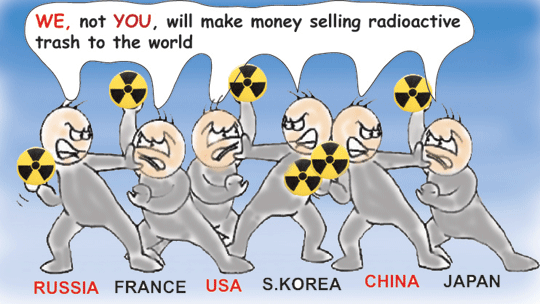
With other States like Gujarat, Tamil Nadu, West Bengal and Maharashtra facing local protests over NPPs, the government is now pinning its mega plans for generating the ‘clean’ energy on coastal Andhra Pradesh. In fact, if all the projects under consideration from Russia, the U.S. and NPCIL were to actually go through, NPPs in Andhra could account for more than 30,000 MW of the Modi government’s goal of 63,000 MW installed capacity by 2031. The site for the next set of six Russian reactors was discussed during A.P. Chief Minister Chandrababu Naidu’s recent visit to Russia, where he met Russian PM Dmitry Medvedev.
Sources told The Hindu the project site identified, believed to be Kavali in Nellore district, could be announced during President Vladimir Putin’s visit to India in October. “It’s huge,” said Commerce Minister Nirmala Sitharaman, who had led the delegation to Russia. “In Andhra Pradesh, six nuclear centres are going to be created, totalling thousands of megawatts in capacity. Of course, Andhra Pradesh will have both American and Russian participation in nuclear energy generation, but the Russians will be the first to “Make in India” in the nuclear sphere in Andhra,” Ms. Sitharaman told The Hindu.
The “American participation” referred to is the plan for Toshiba-Westinghouse to set up 6 AP1000 reactors of 1,100 megawatts each, a proposal that had run into trouble in Gujarat due to “stiff protests from farmers” during the land acquisition process for 777 hectares, a senior official in the Gujarat government said.
“In addition, Tata, Adani and Essar, which are the largest power producers in the State, were never comfortable with another giant plant being set up in the State,” the official said. During Prime Minister Narendra Modi’s visit to Washington in June 2016, NPCIL and Westinghouse had announced the move to Andhra Pradesh, with a commitment to complete the commercial agreement for 6 reactors by June 2017.
Meanwhile, another Russian project that has been hanging fire for years, to build 6 ‘VVER’ (Water-Water Energy) Reactors of 1000 MWe in West Bengal’s Haripur may also be moved to Andhra Pradesh due to local protests. “We are looking for a site in some coastal area of Andhra Pradesh where a similar reactor, which was meant for Haripur, will come up,” Dr. Sekhar Basu, now Chairman of the Atomic Energy Commission, had told reporters last September, although West Bengal officials told The Hindua final decision has not been taken.
State officials hope Tamil Nadu, Gujarat and West Bengal’s loss will soon be Andhra Pradesh’s gain, and the State already has the Kovvada nuclear park project for 6 1000MW reactors in Srikakulam under way. However, the coast isn’t completely clear. Kovvada has seen some protests of the kind seen at Kudankulam, Mithi Virdi and Haripur. While many local residents are unwilling to part with land, others have concerns over environmental hazards, especially given that some of the sites identified for nuclear projects are in a seismically sensitive zone, and have seen tremors in the past.
Confirming that several projects are only in “preliminary stages”, the Andhra Pradesh government’s media adviser Parkala Prabhakar told The Hindu: “The Central government has asked some more sites for other plants. We have asked the Collectors of Prakasam and Nellore to spot the sites. Once those sites are identified, the NPCIL will come for inspection to check the compatibility,” indicating that while Andhra’s nuclear power-hub dreams are in sight, they may take a while to come to fruition. (With Appaji Reddem in Vijayawada & Mahesh Langa in Ahmedabad)
Democratic senators Urge Obama To Cancel super costly Nuclear Cruise Missile

 Senators Urge Obama To Cancel Nuclear Cruise Missile Aaron Mehta, Defense News July 21, 2016 WASHINGTON — A group of ten Democratic senators have penned a letter to US President Barack Obama urging him to cancel development of a new nuclear-capable cruise missile, in what appears to be the next salvo from nonproliferation advocates on Capitol Hill against the weapon.
At issue is the Long-Range Standoff (LRSO) cruise missile, which will replace the Air-Launched Cruise Missile (ALCM) program with 1,000 to 1,100 cruise missiles, representing the US Air Force’s standoff nuclear delivery capability. The ALCM program is scheduled to age out in 2030.
Proponents say the LRSO is vital to maintaining America’s nuclear posture into the future. But opponents argue the weapon is too costly and unnecessary given other nuclear options, with a vocal minority in Congress starting to advocate heavily for that position.
“Independent estimates suggest that nuclear weapons sustainment and modernization plans could cost nearly one trillion dollars over the next 30 years, putting enormous pressure on our defense budget at a time when non-nuclear systems will also require major expenditures,” wrote the authors of the letter. “In particular, we urge you to cancel plans to spend a least $20 billion on a new nuclear air-launched cruise missile, the Long Range Standoff weapon, which would provide an unnecessary capability that could increase the risk of nuclear war.”
The letter was signed by Sens. Ed Markey and Elizabeth Warren of Massachusetts, Diane Feinstein and Barbara Boxer of California, Al Franken of Minnesota, Jeff Merkley of Oregon, Sherrod Brown of Ohio, Patrick Leahy of Vermont, Ron Wyden of Oregon, and Bernie Sanders, the Vermont senator who recently ended his campaign for the presidency…….
The letter also urged Obama to officially adopt a policy of no-first-use of nuclear weapons, something the United States has traditionally been unwilling to do.
“In light of our unmatched conventional military capabilities, we do not need to rely on the threat of nuclear first-use to deter non-nuclear attacks on our homeland or our allies,” the authors wrote. “By adopting a policy of no-first-use of nuclear weapons, the United States could reduce the risk of accidental nuclear conflict while deterring both conventional and nuclear threats to our security.”
Neither the desire to drop the LRSO, nor the goal of a no-first-use policy, appears likely to gain much traction with Donald Trump, officially named the Republican nominee for president this week.
Speaking to The New York Times, Trump reaffirmed a commitment to the so-called nuclear triad but was noncommittal on the no-first-use idea………http://www.defensenews.com/story/defense/policy-budget/congress/2016/07/21/senators-obama-nuclear-missile-lrso/87384128/
Calgary, Canada succeeds brilliantly with wind-powered Light Rail Transport
 Calgary’s wind-powered LRT an incredibly successful system: Nenshi , Green Energy Futures July 6, 2015 “Every one of these three-car trains that goes by has a capacity of 600 people. That means it’s taking about 550 cars off the road. It makes a lot of sense,” says Calgary Mayor Naheed Nenshi. By David Dodge and Duncan Kinney
The CTrain in Calgary is one of the greatest examples of electrified transport in Canada.
It is overwhelmingly popular with residents, boasting an average weekday ridership of 325,000. It has kickstarted smarter, denser development around its stations. And, best of all, it and the City of Calgary’s operations are 100 per cent powered by renewable energy.
“It’s hugely important to me. I wish I could take it every day, but it’s an incredibly successful transit system,” says Calgary mayor Naheed Nenshi. “It has amongst the highest ridership of any LRT system anywhere — about 50 per cent of the people who travel downtown every day come downtown by public transit, and the majority of those use the CTrain system.”
But it’s when you compare Calgary to the other transit systems in Canada that it starts to get really interesting. The Pembina Institute has compiled some fascinating data, released in its Fast Cities report last year (disclosure: Green Energy Futures is presented by the Pembina Institute).
Calgary takes home the top spot when it comes to the amount of existing rapid transit lines per million residents; over the past ten years it has laid the most track out of any other city in the report. Continual investment in the system is an important factor that too many cities ignore.
City building
A full three-car CTrain carries 600 people. Not only does the CTrain take a lot of cars off the road, it also helps the city grow in a smarter, denser way………….
Powered by the wind
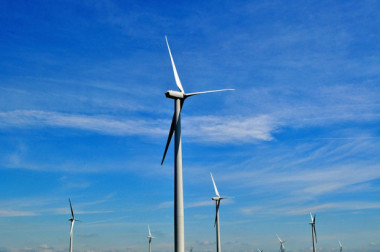
Perhaps the greatest coup of Calgary’s CTrain system is that it is powered by wind energy. In 2001, Calgary city council voted to purchase 21,000 megawatt-hours of wind power a year for 10 years. That’s the amount of electricity that the LRT uses in a year.
Now, the LRT does not run on electrons delivered straight from wind turbines — instead, it’s connected to the standard electricity grid. But while that grid is still dominated by natural gas and coal, Calgary’s 2001 investment meant 12 wind turbines were erected.
Then in 2012, Calgary went all-in on renewable energy, purchasing 100 per cent renewable power for all of the city’s operations. This investment meant two wind farms got built, totaling 144 megawatts of installed wind capacity.
While the CTrain is still 100 per cent powered by wind, the city’s other operations use a mix of renewable energies: wind, hydro, biomass and solar power. The power purchase agreement totals 450,000 megawatt-hours a year or the equivalent power demand of over 65,000 Calgary homes.
This is one of the killer apps of electrified rail transport: the ability to choose cleaner, greener options. By purchasing wind power, Calgary Transit reports they are saving 56,000 tonnes of carbon dioxide emissions per year.
Cities like Calgary are playing a leadership role without breaking the bank. While the City of Calgary wouldn’t disclose the terms of their power purchase agreement with ENMAX, wind is the cheapest source of electricity in Alberta. The 2013 average pool price for wind according the Alberta Electric System Operator was 5.5 cents per kilowatt-hour while coal was 7.7 cents per-kilowatt hour.
In December 2014 when Quebec issued requests for proposals to build 450 MW of wind power, the average price for accepted bids was 7.6 cents per kWh, including 1.3 cents per kwH transmission costs. Solar power purchase agreements are being signed for as low as 5.84 cents a kWh in Dubai and at 8 cents/kWh in Brazil.
The bottom line is Calgary’s LRT and city operations are running on 100 per cent renewable energy, making the city a leader in Canada. Doubly cool are the phenomenal ridership numbers Calgary has achieved for its LRT — something that is reducing congestion, bringing down emissions and building the clean energy economy of the future. http://www.greenenergyfutures.ca/episode/c-train-success-nenshi-calgary
Green State, Golden State: Clean Energy Policy Creates Good Jobs
 http://capitalandmain.com/latest-news/issues/labor-and-economy/green-state-golden-state-clean-energy-policy-makes-good-jobs-0719/ by Dean Kuipers July 19, 2016 California’s deserts are blooming with windmills and solar farms and, according to a new University of California, Berkeley report, these large-scale projects are creating top quality jobs. The Link Between Good Jobs and a Low Carbon Future, issued by the Don Vial Center on the Green Economy at Berkeley’s Labor Center, finds that despite the one-off nature of large, clean energy construction projects, these renewable-power enterprises are creating high-paying, long-lasting blue-collar jobs.
USA Dept of Energy funds Florida research into nuclear recycling
 Florida State receives #10 million for nuclear research center Florida State 24/7 JULY 21, 2016
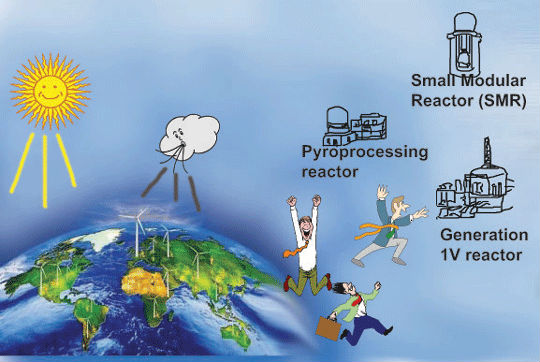
Kathleen Haughney Florida State University will receive $10 million from the U.S. Department of Energy to create a new Energy Frontier Research Center… The center will focus on developing technologies for recycling nuclear fuel and cleaning up Cold War-era weapon production sites. It will be led by Thomas Albrecht-Schmitt, the Gregory R. Choppin Professor of Chemistry at FSU……..Three other institutions will also host research centers. They are The Ohio State University, the University of South Carolina and DOE’s Pacific Northwest National Laboratory. http://news.fsu.edu/Top-Stories/Florida-State-receives-10M-for-nuclear-research-center
Natural Resources officials to meet Canadian Nuclear Safety Commission about allegations of nuclear unsafety
 CNSC head to meet with officials to tackle allegations in anonymous letter, GLORIA GALLOWAY, OTTAWA — The Globe and Mail, Jul. 19, 2016 Natural Resources officials will meet with the head of the Canadian Nuclear Safety Commission to discuss allegations that information was withheld from commissioners as they made critical decisions about the licensing of the country’s nuclear plants.
An anonymous letter, purportedly written by specialists at the nuclear regulator, was sent five weeks ago to CNSC president Michael Binder. It points to five separate cases in which the commission’s staff sat on relevant information about risk or non-compliance that might have called the safety of a nuclear plant into question…….
The anonymous letter writers say nuclear hazards have been underestimated, plant operators have been permitted to skip requirements of the licensing regime, and assessments outlining what could happen in the event of a major nuclear disaster – such as the one that occurred in Fukushima, Japan in 2011 – have been withheld from the commissioners and the public……
Among other allegations, the writers of the anonymous letter to Mr. Binder say an evaluation of the effects of a Fukushima-scale nuclear disaster in Canada has never been released to the commissioners or the public.
In a 2014 e-mail obtained by the environmental group Greenpeace under access to information laws, François Rinfret, a director at the regulator, said a scenario for a Fukushima-size disaster would “become the focal point of a licence renewal and, despite brilliant attempts to caution readers … would be used malevolently at a public hearing” by people concerned about nuclear energy. http://www.theglobeandmail.com/news/politics/anonymous-letter-accuses-cnsc-of-withholding-critical-information/article30998523/
As with tobacco, the climate wars are going to court


Déjà vu: as with tobacco, the climate wars are going to court Skeptical Science
18 July 2016 by dana1981, JohnMashey Investigative journalism has uncovered a “web of denial” in which polluting industries pay “independent” groups to disseminate misinformation to the public and policymakers. The same groups and tactics were employed first by the tobacco industry, then fossil fuel companies. Big Tobacco has been to court and lost; now it’s Big Oil’s turn. Political leaders are choosing sides in this war.
Elizabeth Warren Rips Think Tanks & Policy Groups For Fake Climate Change Research
Research by Inside Climate News revealed that Exxon did top notch climate science research in the late 1970s and early 1980s, which revealed the dangers its products posed via climate change. Soon thereafter, Exxon launched misinformation campaigns by funding “think tanks” and front groups to manufacture doubt about climate science and the expert consensus on human-caused global warming.Exxon wasn’t alone. Koch Industries, Peabody Energy, and other fossil companies have similarly funneled vast sums of money to these groups. Last week, Senate Democrats, including presidential candidate Bernie Sanders and vice presidential contenders Elizabeth Warren and Al Franken signed a Resolution expressing congressional disapproval of the fossil fuel industry’s misinformation campaign.19 Senate Democrats also took to the floor of the Senate to speak out against the web of denial, with repeated references to the tobacco/fossil connections.
Senator Elizabeth Warren speaking about the web of denial on the Senate floor.
The climate battle goes to court
The fossil fuel industry has already put forth its best scientific argument in court,and lost. Now 17 state attorneys general, led by New York Attorney General Eric Schneiderman, have formed a coalition to investigate ExxonMobil’s activities. As Schneiderman put it:
The First Amendment, ladies and gentlemen, does not give you the right to commit fraud
However, Lamar Smith (R-TX), chairman of the House Science Committee, along with his Republican colleagues last week issued subpoenas to Schneiderman and Massachusetts Attorney General Maura Healey, accusing them of violating Exxon’s First Amendment rights. As Smith claimed:
The Committee has a responsibility to protect First Amendment rights of companies, academic institutions, scientists, and nonprofit organizations. That is why the Committee is obligated to ask for information from the attorneys general and others.
In this battle of First Amendment claims, Big Oil & Coal use the same argument as Big Tobacco, who lost.
The fossil fuel industry copied the tobacco playbook
Last century, we saw a similar battle with tobacco. By the 1950s, the tobacco industry knew that its products caused cancer and other diseases. They still marketed their harmful products to children, and soon created pseudo-academic institutes like the Council for Tobacco Research to cast doubt on smoking’s damage. However, the institutes’ connections to the tobacco industry were too obvious; they wanted “independent” voices.In the 1980s the Koch brothers started creating a vast web of “think tanks” that could simulate credible independence, funded via dark money, often tax-exempt. Big Tobacco eagerly joined, to “quarterback behind the scenes.” They contributed great marketing talent, some later hired by Kochs.As extensively documented at DeSmogBlog, Big Tobacco has long funded science-denying think tanks, such as the Heartland Institute, Heritage Foundation, Cato Institute, George Marshall Institute, American Legislative Exchange Council (ALEC), and Manhattan Institute, to name a few. ExxonMobil later funded these same groups.The fossil fuel industry has adopted the tobacco industry’s playbook, and shared the same web of denial. The Senate Resolution made this point, calling out both the tobacco and fossil fuel industries for having:
(A) developed a sophisticated and deceitful campaign that funded think tanks and front groups, and paid public relations firms to deny, counter, andobfuscate peer-reviewed science; and(B) used that misinformation campaign to mislead the public and cast doubt in order to protect their financial interest
Their tactics have grown more sophisticated, for example using money anonymizers like Donors Trust to ensure their “dark money” becomes even harder to trace.
The tobacco industry lost in court
In 1999, the US Justice Department filed a civil Racketeer Influenced and Corrupt Organizations Act (RICO) lawsuit against the major tobacco companies and their associated industry groups. In 2006, US District Court Judge Gladys Kessler ruledthat the tobacco industry’s campaign to “maximize industry profits by preserving and expanding the market for cigarettes through a scheme to deceive the public” about the health hazards of smoking amounted to a racketeering enterprise. She wrote a clear statement, appealed fruitlessly by tobacco companies:
The First Amendment Does Not Protect Defendants’ False and Misleading Public Statements
The attorneys general investigating Exxon have a strong case that the fossil fuel industry is similarly guilty of racketeering by deceiving the public in order to maximize profits. Exxon and other fossil fuel companies knew of the dangers of carbon pollution more than three decades ago, and yet funneled tens of millions of dollars to think tanks that disseminate misinformation to try to convince the public and policymakers otherwise.Sharon Eubanks led the Justice Department trial team, as documented in the book Bad Acts: The Racketeering Case Against the Tobacco Industry and was a key contributor to the report Establishing Accountability for Climate Change Damages. Of the Exxon case, she said:
I think a RICO action is plausible and should be consideredThe First Amendment defense of the fossil fuel industry by House Republicans simply doesn’t hold water. Defending the fossil fuel industry today is no different than defending the tobacco industry in the 1990s, as did Lamar Smith’s colleague“Smokey Joe” Barton (R-TX).Unsurprisingly, oil & gas is the top industry donor to Lamar Smith. History books will reflect poorly on those who sold out millions of peoples’ health for personal gain or industry profits, and on those who worked to destabilize the climate on which future generations will rely for the sake of their own political power orExxonMobil’s record profits. http://www.skepticalscience.com/deja-vu-climate-wars-going-to-court-like-tobacco.html
Allegations that nuclear risk information was withheld from Canadian Nuclear Safety Commission
 Letter claims info on nuclear risks withheld from safety commissioners GLORIA GALLOWAY OTTAWA — The Globe and Mail, Jul. 18, 2016 The Canadian Nuclear Safety Commission is investigating allegations contained in an anonymous letter claiming to be written by specialists at the nuclear regulator that says information has been withheld from commissioners while making critical decisions about the licensing of this country’s nuclear plants.
The letter, which was sent several weeks ago to CNSC president Michael Binder, points to five separate cases in which the commission’s staff sat on relevant material about risk or non-compliance that might have called the safety of a plant into question.
The letter says hazards have been underestimated, plant operators have been permitted to skip requirements of the licensing regime and assessments outlining what could happen in the event of a major-scale nuclear disaster – such as the one that occurred in Fukushima, Japan, in 2011 – have been withheld from the commissioners and the public…….
The letter was also sent to representatives of two environmental groups, as well as to a current and former CNSC commissioner.
Although it is impossible to verify that the letter was written by CNSC specialists, environmentalists who received copies of the document say the level of detail, the manner of speaking and the amount of complexity suggest it was written by someone with inside knowledge. And, they say, the problems are symptomatic of a culture at the commission in which employees are expected to act as boosters of the nuclear industry rather than watchdogs of nuclear safety.
The letter writers, who say they are remaining anonymous because they are not confident of whistle-blower protection, are asking Dr. Binder to assign an independent expert to review the accuracy of their claims. They make eight additional recommendations for improving the licensing regime, many of them relating to specific issues at the Darlington Nuclear Generating Station on Lake Ontario, just east of Toronto, and at the Bruce plant on Lake Huron.
“Our primary concern is that CNSC commissioners do not receive sufficient information to make balanced judgments,” the letter says. And “because insufficient information is made available, other branches of government cannot make informed decisions. For example, the government of Ontario cannot make a good decision about financing the refurbishment of Darlington without knowing all the facts.”
Dr. Binder was appointed by the former Conservative government of Stephen Harper after it fired then-CNSC president Linda Keen when she balked at skirting safety rules. Ms. Keen now serves as a corporate director for various organizations and does consulting work.
“We’ve seen the CNSC become a cheerleader for the nuclear industry since the Harper government fired former CNSC president Linda Keen,” said Shawn-Patrick Stensil, a senior energy analyst with Greenpeace Canada who was one of the two environmentalists to receive a copy of the letter. “The Trudeau government needs to restore the independence of Canada’s nuclear regulator,” he said.
The letter writers refer to a number of cases in which, they say, the commissioners have made decisions without knowing all of the facts…….
Theresa McClenaghan, executive director of the Canadian Environmental Law Association, who was the other environmentalist sent a copy of the letter, said actions of this sort – in which whistle-blowers make such specific allegations – are both rare and surprising. But, she said, she has no doubt it was written by someone inside the CNSC.
“We are often very concerned that commissioners are not getting the full story from the proponents or the regulatory staff,” Ms. McClenaghan said. “In the hearings, we really do see a frustrating amount of apologetics for the industry going on by staff.”
Mr. Stensil, of Greenpeace, said the most serious issue raised in the letter is the allegation suggesting that CNSC staff knows about additional risks being posed by reactors, but is ignoring them. That is what happened at Fukushima, he said.
“That’s not a nuts-and-bolts or an engineering issue,” Mr. Stensil said. “That’s a safety culture issue.” http://www.theglobeandmail.com/news/politics/anonymous-letter-claims-info-on-nuclear-risks-withheld-from-safety-commissioners/article30964195/
Lawsuit against USA’s The Federal Energy Regulatory Commission (FERC)’s rules disincentivising renewable energy
Did An Entire Region Of The U.S. Just Disincentivize Renewables? This Lawsuit Says Yes. Climate Progress BY SAMANTHA PAGE JUL 15, 2016 DURING THE POLAR VORTEX OF 2014, POWER COMPANIES STRUGGLED. THERE WASN’T ENOUGH NATURAL GAS POWER IN THE PIPELINE (PUN INTENDED), AND PRICES SKYROCKETED.
The shortage was expensive for homeowners — some saw their monthly bill go up five-fold from January to February — but for utilities, it was expensive, dangerous, and scary. No one wants to be on the hook for a bunch of families losing power in the middle of a -7°F night.
Following the prolonged cold snap, PJM, the entity that oversees utilities in the Mid-Atlantic and parts of Appalachia and the Midwest, put a plan into action: It would help the local utilities ensure that power was more reliable. To do this, PJM fast-tracked new rules for capacity resources — an industry phrase for guaranteed electricity supply. The Federal Energy Regulatory Commission (FERC) approved the new rules last May.
But now four environmental groups, including the Natural Resources Defense Council and the Sierra Club, have announced a lawsuit against FERC, saying the rules are going to cost consumers and are unduly burdensome to renewable energy.
Under the new rules, renewable energy providers, such as solar and wind companies, will have a hard time participating in PJM’s capacity market, where utilities pay to make sure that they have a certain amount of electricity guaranteed in future years. The new rules require the providers in the market to be able to provide consistent production year-round, whereas wind and solar perform better during different parts of the year.
“The new rules will funnel billions of dollars from electricity consumers to fossil and nuclear power plants while severely limiting clean energy participation in PJM’s capacity market,” writes Jennifer Chen, an attorney with NRDC’s Sustainable FERC project……..
Chen and her colleagues argue that making it difficult for renewables (and demand response) to participate in the capacity market will push the auction prices higher — prices that, again, will be passed on to consumers, while disincentivizing developers and investors from pursuing renewable energy projects in PJM.
“The way that PJM’s rules operate basically doesn’t acknowledge the contribution of anything but fossil fuel resources that operate year-round,” Casey Roberts, an attorney for the Sierra Club, told ThinkProgress. “What regulators need to bring about a smarter energy future is rules that are more flexible and recognize the different capabilities that different resources offer.”
The irony of the new PJM rules is that during the polar vortex, wind performed incredibly well, saving consumers $1 billion in electricity costs, according to research by the American Wind Energy Association……..
environmental groups will put the pressure on FERC to reconsider the rule. The lawsuit will be filed in the D.C. Circuit Court of Appeals. http://thinkprogress.org/climate/2016/07/15/3798275/renewables-deserve-capacity-markets-too/
North America looking at a Trillion Dollar Renewable Energy Market

A Trillion Dollar Renewable Energy Market Might Have Just Opened Up in North America
An agreement between the U.S., Canada, and Mexico could open up new growth for the solar industry. The Motley Fool Travis Hoium (TMFFlushDraw)
Jul 4, 2016 Leaders of the U.S., Canada, and Mexico agreed this week to increase their renewable energy consumption in an effort to get half of North America’s energy from renewable sources by 2025. It’s a lofty goal, despite assertions that 37% of the region’s energy already comes from renewables. But it highlights just how much of a coordinated effort the countries are taking. And it may open a trillion dollar energy market for renewable energy companies.
Cross-border transmission is big
One of the biggest things holding back renewable energy from an even larger market share is transmission lines. There’s not enough transmission that goes from the windy sections of Texas or Iowa or the sunny corners of Nevada and California to population centers. Part of the agreement will be to build cross-border transmission that will allow cheap renewable energy to flow more freely to where it’s needed.
To put the potential impact into perspective, the Brattle Group estimated that $130 billion in grid upgrades and transmission will be needed in the next decade to meet renewable standards in the U.S. And if those standards go up, we’re talking about billions, or hundreds of billions more.
The companies that could benefit from this are transmission line builders like Quanta Services (NYSE:PWR) and MYR Group (NASDAQ:MYRG), which have been talking about the upgrade cycle in transmission lines for years. Maybe this will help some of that come to fruition. On the ownership side, National Grid is a major infrastructure company with transmission lines all over the world……..
The two developers that would likely get a lot of business from a North America expansion of renewables are First Solar and SunPower (NASDAQ:SPWR), which are the two largest solar developers in the U.S. For example, SunPower just won 500 megawatts out of 1,860 megawatts auctioned in Mexico, part of the country’s major expansion in renewables. If Mexico starts exporting solar or wind energy to Southern California it could expand that solar market……..
Maybe the renewable energy revolution has legs left in North America after all. http://www.fool.com/investing/2016/07/04/a-trillion-dollar-renewable-energy-market-just-ope.aspx
Socorro a national sacrifice area for depleted uranium
SOCORRO – The City of Depleted Uranium
https://www.kickstarter.com/projects/782822554/socorro-the-city-of-depleted-uranium
by Norbert G. Suchanek, 20 July 16, Depleted uranium contamination in the USA: Socorro in New Mexico was used for decades as testing range for depleted uranium (DU). About this project
Socorro became a national sacrifice area. People in Socorro are suffering similar health effects as the local population in Iraq who were hit by DU-Weapons during the Gulf Wars. The film gives details of the abuses and transgressions on the people of Socorro who’s community was downwind and downgrade of the depleted uranium testing sites which had been active since 1972. Until today most of the population of Socorro are unaware about the testing on the Socorro mountain and the dangers of depleted uranium.
Main character of the film is Damacio A. Lopez, who was born in Socorro. He served the US-army during Cold war and Cuba Crisis and became later a professional golf player. When he found out about the horrible consequences of the use of depleted uranium on the battle fields during the Gulf wars in Iraq and in his native town, he became one of the first activists fighting for a global ban of these weapons.
Damacio studied the terrible health effects of DU Weapons in the battlefields of Iraq and the Balkans for many years. He has founded the International Depleted Uranium Study Team (IDUST) and influenced and produced several important reports and films about Depleted Uranium like the film: “URANIUM 238: THE PENTAGON’S DIRTY POOL”. This film won the Jury Award as the Best Short Film of the first International Uranium Film Festival in 2011. Damacio is also the principle founder of the International Coalition to Ban Uranium Weapons (ICBUW) and works at the UN on a treaty to ban uranium weapons.
SOCORRO – THE CITY OF DEPLETED URANIUM will be the first film that this testing of depleted uranium will be exposed to world public. It will make clear that not only the populations in Iraq or in the Balkans are suffering from DU but also US citizens across the US who live close to the military testing sites and firing ranges.
Damacio Lopez says: “I am from a family in Socorro in New Mexico and I have been working to create an International Treaty to ban Depleted Uranium Weapons for the past 30 years. In 1986 I discovered that depleted uranium testing was taking place on the Socorro Mountain just 2 miles away down wind from our family home. My father would spends hours in his garden while black clouds moved over head from the DU test site. He eventually died of various cancers.”
See also: Depleted Uranium: Metal of Dishonorhttp://www.democracynow.org/1999/4/19/depleted_uranium_metal_of_dishonor
International Coalition to Ban Uranium Weapons (ICBUW) –http://www.bandepleteduranium.org/
The Case for an Immediate Ban on the Military Use of Depleted Uraniumwww.ru.nl/publish/pages/630064/archief_lopez_uranium_en.pdf
“Uranium 238: The Pentagon’s Dirty Pool” https://www.youtube.com/watch?v=cEqE8DdpHOM
Depleted uranium weapons have left behind a trail of human misery and vituperative debate. What’s not known about them is just as disturbing as what is..https://newint.org/features/2007/11/01/keynote/
FRIENDLY FIRE, THE LINK BETWEEN DEPLETED URANIUM MUNITIONS AND HUMAN HEALTH RISKS http://www.gulfwarvets.com/du8.html
Aging Pickering Nuclear Station that is well past its prime: time to shut it
Liberals Should Shutter Nuclear Plant Well Past Its Prime Huff Post Mike Schreiner Leader of the Green Party of Ontario 07/18/2016 Ontario could save money, increase public safety and create jobs if it closes the Pickering Nuclear Station when its operating licence expires on Aug. 31, 2018. Yet, the Liberal government has approved plans to extend Pickering’s operating life to 2024.
Pickering is already 15 years past its best before date. It’s the fourth oldest nuclear station in North America and the seventh oldest nuclear station in the world. Given its age, it is not surprising that Pickering is one of the most unreliable and poorestperforming nuclear plants in North America. Or that is has the highest operating costs of any nuclear station in North America.
Best before dates are important — not only for the milk you drink but also for the nuclear plant you live by. Pickering is surrounded by over 2.2 million people who live within the 30-kilometre high-risk zone. The Liberals are rolling the dice on a nuclear station that is surrounded by more people than any nuclear plant in North America………
Ontario is currently selling excess electricity at a loss. Ontario’s total electricity exports (22.6 billion kWh) exceeded the total output of the Pickering Nuclear Station (22.6 billion kWh) in 2015. Ontario’s peak hour demand for electricity has declined by 17 per cent in the past decade.
Even if electricity demand goes up because of the Ontario’s efforts to electrify the transportation system, Ontario can purchase electricity from other sources at a lower cost.
We live next door to the world’s fourth largest producer of water power — Quebec. Quebec has a large and growing supply of water power available for export. On average, Quebec water power sells at one third the price of power from Pickering. Why not use this low cost source of clean power to meet possible increases in demand and to cover gaps from the anticipated temporary shut down of the Darlington Nuclear Station?
Ontario can also do more to stretch our energy dollars by investing in energy efficiency measures. The cheapest source of energy is the energy we save. According to the Independent Electricity System Operator (IESO), large industrial energy efficiency programs save electricity at an average cost of 1.5 cents per kWh. Residential, commercial and small industrial energy efficiency programs save electricity at an average cost of 3.5 cents per kWh — far below OPG’s estimate cost of power from Pickering of around nine cents per kWh.
The Liberals seem more interested in making the nuclear lobby happy than in making smart energy choices for the people of Ontario.
And while I understand why the nuclear lobby would fight to protect jobs at Pickering, I believe the Liberal government has a responsibility to make energy decisions that benefit all the people of Ontario even if it means cancelling their $100,000 dinners with the premier.
Moreover, what if we could convert operating jobs at Pickering into jobs decommissioning Pickering–making the area safer for residents while establishing Ontario’s expertise in the decommissioning of nuclear plants. Doing this would create 16,000 person years of employment according to a study by Torrie Smith Associates. This could establish Ontario’s global expertise in decommissioning nuclear plants. With a number of nuclear plants around the world reaching their best before dates, Ontario nuclear workers could benefit from becoming the global experts in shutting down nuclear plants.
The Liberals have a choice to make — give the nuclear lobby what it wants or provide the people of Ontario with an affordable, clean electricity supply; a supply that doesn’t include an old and aging Pickering Nuclear Station that is well past its best before date. http://www.huffingtonpost.ca/mike-schreiner/pickering-nuclear-plant_b_11051446.html
1 This Month
Tell Congress: Prevent Nuclear Catastrophe in Iran

Tell Congress: Prevent Nuclear Catastrophe in Iran

Read the Public Inquiry Report, the Commissioners’ report, Surrendering Australia: The AUKUS Deception is available to download for free at aukuspublicinquiry.com. Or just watch the replay of the National Press Club Luncheon.


Shut down the radiation-damaged Heysham nuclear reactors now
To see nuclear-related stories in greater depth and intensity – go to https://nuclearinformation.wordpress.com

Say No to NASA’s Reckless Nuclear Reactor on the Moon
Say No to NASA’s Reckless Nuclear Reactor on the Moon
-
Archives
- November 2026 (190)
- October 2026 (302)
- September 2026 (339)
- August 2026 (330)
- July 2026 (355)
- June 2026 (287)
- May 2026 (306)
- April 2026 (356)
- March 2026 (251)
- February 2026 (267)
- January 2026 (308)
- December 2025 (358)
-
Categories
- 1
- 1 NUCLEAR ISSUES
- business and costs
- climate change
- culture and arts
- ENERGY
- environment
- health
- history
- indigenous issues
- Legal
- marketing of nuclear
- media
- opposition to nuclear
- PERSONAL STORIES
- politics
- politics international
- Religion and ethics
- safety
- secrets,lies and civil liberties
- spinbuster
- technology
- Uranium
- wastes
- weapons and war
- Women
- 2 WORLD
- ACTION
- AFRICA
- Atrocities
- AUSTRALIA
- Christina's notes
- Christina's themes
- culture and arts
- Events
- Fuk 2022
- Fuk 2023
- Fukushima 2017
- Fukushima 2018
- fukushima 2019
- Fukushima 2020
- Fukushima 2021
- general
- global warming
- Humour (God we need it)
- Nuclear
- RARE EARTHS
- Reference
- resources – print
- Resources -audiovicual
- Weekly Newsletter
- World
- World Nuclear
- YouTube
-
RSS
Entries RSS
Comments RSS

