USA needs to face up to the nightmare of high burn-up, and indeed, of all, nuclear wastes
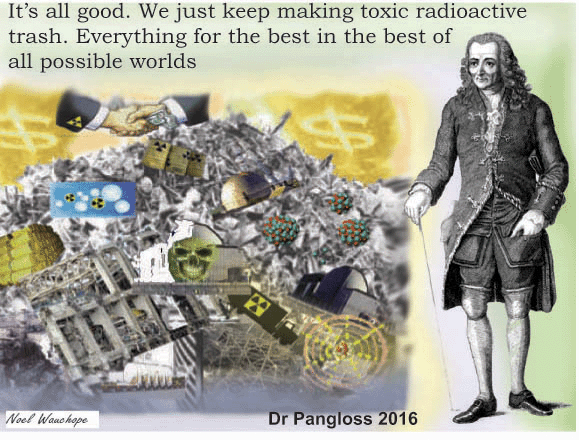
Spent nuclear power fuel accumulated over the past 50 years is bound up in more than 241,000 long rectangular assemblies containing tens of millions of fuel rods. The rods, in turn, contain trillions of small, irradiated uranium pellets. After bombardment with neutrons in the reactor core, about 5 to 6 percent of the pellets are converted to amyriad of radioactive elements with half-lives ranging from seconds to millions of years. Standing within a meter of a typical spent nuclear fuel assembly guarantees a lethal radiation dose in minutes.
Heat from the radioactive decay in spent nuclear fuel is also a principal safety concern. Several hours after a full reactor core is offloaded, it can initially give off enough heat from radioactive decay to match the energy capacity of a steel mill furnace. This is hot enough to melt and ignite the fuel’s reactive zirconium cladding and destabilize a geological disposal site it is placed in. By 100 years, decay heat and radioactivity drop substantially but still remain dangerous. For these reasons, the US Government Accountability Office (GAO) informed the Congress in 2013 that spent nuclear fuel is “considered one of the most hazardous substances on Earth.”
US commercial nuclear power plants use uranium fuel that has had the percentage of its key fissionable isotope—uranium 235—increased, or enriched, from what is found in most natural uranium ore deposits. In the early decades of commercial operation, the level of enrichment allowed US nuclear power plants to operate for approximately 12 months between refueling. In recent years, however, US utilities have begun using what is called high-burnup fuel. This fuel generally contains a higher percentage of uranium 235, allowing reactor operators to effectively double the amount of time the fuel can be used, reducing the frequency of costly refueling outages. The switch to high-burnup fuel has been a major contributor to higher capacity factors and lower operating costs in the United States over the past couple of decades.
While this high-burnup trend may have improved the economics of nuclear power, the industry and its regulator, the Nuclear Regulatory Commission (NRC), have taken a questionable leap of faith that could, according to the Electric Power Research Institute, “result in severe economic penalties and in operational limitations to nuclear plant operators.” Evidence is mounting that spent high-burnup fuel poses little-studied challenges to the temporary used-fuel storage plans now in place and to any eventual arrangement for a long-term storage repository.
High burnup significantly boosts the radioactivity in spent fuel and its commensurate decay heat. Of particular concern is the effect of high-burnup fuel on the cladding that contains it in the fuel assemblies used in commercial reactors. Research shows that under high-burnup conditions, that cladding may not be relied upon as the primary barrier to prevent the escape of radioactivity, especially during prolonged storage in the “dry casks” that are the preferred method of temporary storage for spent fuel. Resolution of these problems remains elusive.
For instance, research shows that in regard to high-burnup waste the fuel cladding thickness of used fuel is reduced and a hydrogen-based rust forms on the zirconium metal used for the cladding, and this thinning can cause the cladding to become brittle and fail. In addition, under high-burnup conditions, increased pressure between the uranium fuel pellets in a fuel assembly and the inner wall of the cladding that encloses them causes the cladding to thin and elongate. And the same research has shown that high burnup fuel temperatures make the used fuel more vulnerable to damage from handling and transport; cladding can fail when used fuel assemblies are removed from cooling pools, when they are vacuum dried, and when they are placed in storage canisters.
The NRC and the nuclear industry do not have the necessary information to predict when storage of high-burnup fuel may cause problems. To err on the side of caution, high-burnup fuel might have to be left in cooling pools for 25 years—as opposed to the current three to five years for lower burnup spent fuel— to allow cladding temperatures to drop enough to reduce risks of cladding failure before the fuel is transferred to dry storage. Also, the cooling pools at US commercial reactors are rapidly filling, with more than 70 percent of the nation’s 77,000 metric tons of spent fuel in reactor pools, of which roughly a fourth is high burnup. So far, a small percentage of high-burnup used fuel assemblies are sprinkled amid lower burnup fuel in dry casks at reactor sites. But by 2048—the Energy Department’s date for opening a permanent geologic disposal site—the amount of spent fuel could double, with high burnup waste accounting for as much as 60 percent of the inventory.
What’s next? In 2014, the NRC adopted a “continued storage” rule that recognized the strong likelihood of long-term surface storage of used nuclear fuel—but that rule basically ignored high-burnup spent fuel. Under the rule, the agency currently permits dry storage casks to accommodate a uniform loading of spent fuel below a certain level of use in reactors. The average burnup for the US reactor fleet is measured by the amount of energy produced, expressed in gigawatt days per metric ton of uranium; at present, used fuel assemblies are allowed to go up to 62,000 gigawatt days per metric ton.
Accordingly, a few high burnup assemblies, with higher decay heat, may be mixed with lower burnup assemblies in a storage canister. But there is little guidance on how this can be done without exceeding NRC peak temperature requirements. NRC’s current regulatory guidance concedes that “data is not currently available” supporting the safe transportation of high burn spent nuclear fuel. Owners of the shuttered Maine Yankee and Zion reactors are not taking a chance and have packaged high burnup spent fuel as it were damaged goods, stored in double-shell containers instead of single-shell, to allow for safer transport.
The impacts of decay heat from high-burnup spent fuel on the internal environment of commercial dry casks are virtually impossible to monitor, according to a 2014 NRC-sponsored study, “because of high temperatures, radiation, and accessibility difficulty.” The uncertainties of storing a mix of high- and low-burnup spent fuel in a canister are compounded by the lack of data on the long-term behavior of high-burnup spent fuel. This problem was highlighted by the Nuclear Waste Technical Review Board, an expert panel that provides scientific oversight for the Energy Department on spent fuel disposal. That panel said there is little to no data to support dry storage and transport for spent fuel with burnups greater than 35 gigawatt days per metric ton of uranium. In a May 2016 letter to the Energy Department, the board raised elemental questions that should have been answered before the NRC and reactor operators took this leap of faith: “What could go wrong? How likely is it? What are the consequences?” The board provided no answers to those questions.
It will take the Energy Department at least a decade to complete a study involving temperature monitoring in a specially designed dry cask containing high burnup fuel. Meanwhile, as high-burnup inventories increase, the higher amounts of radioactivity and decay heat associated with high-burnup fuel assemblies are putting additional stress on cooling pool storage systems.
This is happening at a time when concerns over spent fuel pool storage conditions are increasing. “As nuclear plants age, degradations of spent fuel pools … are occurring at an increasing rate,” a study by Oak Ridge National Laboratory concluded in 2011. “During the last decade, a number of NPPs [nuclear power plants] have experienced water leakage from the SFPs [spent fuel pools] and reactor refueling cavities.” As a result of increasing high burnup loadings, spent nuclear pool storage systems are likely to require upgrading, which will certainly drive up costs at a time when age and deterioration are of growing concern.
These concerns were given greater prominence in May of this year by a National Academy of Sciences panel established by Congress to review the response of the NRC to the Fukushima nuclear accident. In its report, the panel warned the NRC about terrorist attacks for the second time since 2004 and urged the agency to “ensure that power plant operators take prompt and effective measures to reduce the consequences of loss-of-pool-coolant events in spent fuel pools that could result in propagating zirconium cladding fires.” Allison Macfarlane, then chair of the U.S. Nuclear Regulatory Commission (NRC), noted in April, 2014 that “land interdiction [from a spent nuclear fuel pool fire at the Peach Bottom Reactor in Pennsylvania] is estimated to be 9,400 square miles with a long term displacement of 4,000,000 persons.”
Down the road, it is likely that spent nuclear fuel will have to be repackaged to mitigate decay heat into smaller containers ahead of final disposal. High-burnup fuel will only complicate the process, and increase costs, currently estimated in the tens of billions of dollars. Depending on the geologic medium, a maximum of four assemblies for high burnup, as opposed to the dozens in current storage casks, would be permitted after 100 years of decay; larger packages containing no more than 21 assemblies might have to be disposed if there is forced ventilation for 50 to 250 years—driving up repository costs.
The basic approach undertaken in this country for the storage and disposal of spent nuclear fuel needs to be fundamentally revamped. Instead of waiting for problems to arise, the NRC and the Energy Department need to develop a transparent and comprehensive road map identifying the key elements of—and especially the unknowns associated with—interim storage, transportation, repackaging, and final disposal of all nuclear fuel, including the high-burnup variety. Otherwise, the United States will remain dependent on leaps of faith in regard to nuclear waste storage—leaps that are setting the stage for large, unfunded radioactive waste “balloon mortgage” payments in the future.
USA sends three strategic bombers to Pacific region, in unspoken threat to China
 US Nuclear-Bomber Triad in Pacific for First Time as China Reaches Boiling Point http://sputniknews.com/military/20160812/1044182905/nuclear-bomber-triad-china-pyongyang.html With tensions in the South China Sea and throughout the Pacific Rim at increasing levels, the Obama Administration adds fuel to the fire by dispatching enough nuclear weaponry to kill everyone in the region.
The United States has dispatched its three strategic bomber types to the Pacific region for the first time, in a bid to reassure allies amid growing aggression from China in the wake of the Hague-based Court of Arbitration ruling against Beijing’s claim to territories in the South China Sea, and the deployment of the THAAD anti-missile system.
Announced Wednesday, the US Air Force will dispatch a Boeing B-52H Stratofortress, a Rockwell B-1B Lancer, and a Northrup Grumman B-2A Spirit bomber to operate concurrently in the US Pacific Command region in support of the Continuous Bomber Presence (CBP) and Bomber Assurance and Deterrence (BAAD) missions.
The move by the United States supplements a sizeable but undisclosed number of B-52s stationed at Andersen Air Force Base on the Island of Guam since 2006. The move called for the transfer of a fleet of B-1Bs and three B-2s to be deployed to Andersen Air Force Base to assist with the BAAD mission.
The US Air Force announcement cited the need to ward off potential adversaries but refused to explicitly name China, whose growing military strength puts Beijing on other side of the American nuclear barrel, though the connection is “clear,” according to IHS Jane’s Defence. Additionally, the region has become increasingly unstable due to a proliferation of nuclear weapons and ballistic missiles at the hand of the unstable regime of Kim Jong-Un in North Korea.
While the United States mission to deter and contain North Korea is understandable, the willingness of the White House to escalate tensions with Beijing marks a shift in the Obama Administration’s posture toward China, previously focused on strengthening defense and economic relationships with regional allies to provide a countervailing political force in the Pacific, as opposed to embarking on a path toward increased militarism.
The movement of US B-1Bs, B-2As, and B-52Hs to the Pacific region has not only incensed of China, but has left North Korea feeling cornered, accusing the US of planning a preemptive nuclear strike against Pyongyang, according to a report by Agence France-Presse (AFP).
Lawsuit claims that US aid to Israel is illegal under the Foreign Aid Act

 Lawsuit claims US aid to Israel violates nuclear pact Institute for Research:
 Middle Eastern Policy says atomic powers who don’t sign NPT aren’t legally eligible for American money, Times of Israel, BY JTA August 12, 2016 A lawsuit filed in a US district court claims that American aid to Israel is illegal under a law passed in the 1970s that prohibits aid to nuclear powers who don’t sign the Nuclear Non-Proliferation Treaty.
Discussing his August 8 lawsuit in an interview to Court House News, Smith said the litigation has been 10 years in the making.
Though Israel is not a signatory to the Nuclear Non-Proliferation Treaty, Smith noted that it is a known nuclear power and recipient of US aid. Israel has neither confirmed nor denied possession of nuclear weapons but is widely believed to possess dozens if not hundreds of nuclear warheads.
The US has had a long-standing policy of keeping mum on the existence of Israel’s nuclear weapons program, an open secret that successive US administrations since Gerald Ford have refused to publicly acknowledge.
Smith’s lawsuit comes on the eve of an aid deal that would boost US assistance to the country by between $1 billion and $2 billion per year over a decade. Israel already gets $3 billion a year in US aid.
In addition to the United States and President Barack Obama, the complaint names as defendants Secretary of State John Kerry, CIA Director John Brennan, Defense Secretary Ash Carter, and the secretaries of the Treasury, Energy and Commerce Departments.
“Defendants have collectively engaged in a violation of administrative procedure and the Take Care Clause by unlawful failure to act upon facts long in their possession while prohibiting the release of official government information about Israel’s nuclear weapons program, particularly ongoing illicit transfers of nuclear weapons material and technology from the US to Israel,” the 33-page lawsuit states.
To sustain a policy of “nuclear ambiguity” on Israel’s weapons program, Smith says the government uses improper classification and threatens federal employees and researchers with prosecution, fines and imprisonment.
The gag is driven, according to the complaint, by a Department of Energy directive known as WNP-136, Foreign Nuclear Capabilities. Smith says his digging under the Freedom of Information Act brought a version of the document to light that was “nearly 90 percent redacted.”
“This is an Energy Department directive that demands imprisonment for any federal official or contractor who even mentions that Israel might have a nuclear weapons program,” Smith said in an interview.
In the lawsuit, Smith says foreign aid to Israel violates two amendments of the 1961 Foreign Aid Act, known as the Symington and Glenn amendments, which ban aid to clandestine nuclear powers……..http://www.timesofisrael.com/lawsuit-claims-us-aid-to-israel-violates-atomic-pact/
Chinese executives charged with spying on USA nuclear technology, particularly Small Nuclear Reactor plans
 US government accuses Hinkley point partner of nuclear espionage, SC Magazine, Max Metzger, Reporter, 12 Aug 16 Major partners in the controversial nuclear power plant at Hinkley Point have been accused in American courts of attempting to steal US nuclear technology. Fears over Chinese involvement in a new nuclear power plant at Hinkley Point have been reinforced as a major partner in the plant’s development has been accused by the US government of nuclear espionage.
Szuhsiung Ho, an advisor to the state-owned China General Nuclear Power (CGN) company, which would have a 33 percent stake in the new plant at Hinkley, has been charged with “conspiracy to unlawfully engage and participate in the production and development of special nuclear material outside the United States”.
Essentially, the US Department of Justice has accused Szuhsiung Ho, otherwise known as Allen Ho, of trying to steal US nuclear technology.
Ho, under orders from CGN, is supposed to have tried to get US nuclear experts to help develop nuclear material in China. According to a statement released by the DoJ, for nearly 20 years, between 1997 and 2016, Ho “identified, recruited and executed contracts with US-based experts from the civil nuclear industry who provided technical assistance related to the development and production of special nuclear material”.
Of particular interest to Ho and his co-conspirators was assistance with CGN’s programmes on small modular reactors, advanced fuel assembly and fixed in-core detectors.
If one is to act as an agent of a foreign power within the United States, their status must be declared to the US attorney general. Not only did Ho not do this but explicitly told those he was trying to recruit that he was acting on behalf of the Chinese state. The DoJ records him as telling his potential recruits that he was working surreptitiously to help China “to design their Nuclear Instrumentation System independently and manufacture them independently”.
None of the accusations have yet been proven but the charges could carry a sentence of life and a US$250,000 (£192,000) fine.
The case is being pursued by a number of US law enforcement agencies including the Department of Energy – National Nuclear Security Administration and the US Federal Bureau of Investigation (FBI). Executive assistant director of the FBI’s national security branch Michael Steinbach said in a statement, “The arrest and indictment in this case send an important message to the US nuclear community that foreign entities want the information you possess”.
“The federal government has regulations in place to oversee civil nuclear cooperation, and if those authorities are circumvented, this can result in significant damage to our national security. The US will use all of its law enforcement tools to stop those who try to steal US nuclear technology and expertise.”…….http://www.scmagazineuk.com/us-government-accuses-hinkley-point-partner-of-nuclear-espionage/article/515702/
China General Nuclear Power Group (CGN) is accused of stealing US nuclear secrets
Chinese investor in Hinkley Point faces nuclear espionage charges http://www.rsc.org/chemistryworld/2016/08/chinese-investor-hinkley-point-nuclear-espionage , 12 August 2016Matthew Gunther
The charges only add to a growing sense of uncertainty around the Hinkley Point project. Earlier this month, the UK government announced it will reassess the investment plan and only make a final decision on whether the plant should be built this autumn.
Although the main investor, EDF Energy, has played down fears the project will be scrapped, China has warned the UK it must reach a decision quickly. Writing in the Financial Times, the Chinese ambassador to the UK, Liu Xiaoming, said: ‘Right now, the China–UK relationship is at a crucial historical juncture.’
Ho, who is a US citizen with dual residency in China, is set to appear in court next week.
Huge majority of Scarborough-Rouge River residents oppose keeping Pickering Nuclear operating beyond 2018

 Ontario Clean Air Alliance, 12 Aug 16, Residents in the Scarborough Rouge River riding oppose keeping the Pickering Nuclear Station operating beyond 2018 by a wide margin. Informed about Pickering’s high costs and large surrounding population – including all the homes in this riding — close to 70% of voters said the plant should be shut down in 2018 when its current licence expires. (Click here for full polling results.)
Voters in Scarborough-Rouge River will head to the polls on Sept. 1st to elect a new MPP in a provincial by-election. Currently, it is a race between PC candidate Raymond Cho (49%) and Liberal candidate Piragal Thiru (43%). Liberal supporters overwhelmingly support closing the plant, as do a strong majority of PC voters concerned about costs. NDP and Green supporters support closure in even greater numbers.
Living as little as 10 kilometers from Canada’s oldest nuclear plant – which is also the 4th oldest nuclear plant in North America – residents also felt they had been poorly informed about emergency measures in case of an accident at the aging plant. Fifty-nine percent rated safety-related communications poor or very poor.
Riding residents overwhelmingly supported closing Pickering when told that the province has a large surplus of electricity and lower cost options for keeping the lights on. We hope local candidates — and party leaders — will listen to Scarborough voters and promise to direct Ontario Power Generation to drop its plan to apply for a ten-year licence extension for the old and trouble-prone Pickering station.
Carefully considered findings are the basis for Diablo Canyon nuclear shutdown plan
 Huge Step for Zero-Carbon Replacement of Diablo Canyon, NRDC August 11, 2016 Ralph Cavanagh Operating California’s Diablo Canyon nuclear power plant past its 2025 license expiration would cost more than twice what many had anticipated, and significantly more than replacing it with energy efficiency and renewable resources, according to an analysis submitted today to the California Public Utilities Commission (CPUC) by the plant owner. The filing can be found here. NRDC continues to believe that substituting those zero-carbon resources for Diablo Canyon will save electricity users at least $1 billion.
The operating cost estimate (more than 10 cents per kilowatt-hour) is among the important new details that Pacific Gas & Electric Company (PG&E) filed with the CPUC on the widely supported Joint Proposal to retire and replace Diablo Canyon. NRDC helped negotiate and joined that proposal, announced in late June, and while critics claim that polluting natural gas will fill the gap, today’s filing reaffirms that this is incorrect (as has been clearly stated from the start)……..
Important information in today’s filing
The PG&E analysis concludes with a telling statement : “Finally, as California continues to move closer to a cleaner energy future, a large non-dispatchable unit such as Diablo Canyon no longer ‘fits’ the needed generation profile of the changing energy landscape.”
PG&E reinforces this point with specific references to California’s climate and clean energy leadership, which the utility fully embraces. Important excerpts from the filing include:
- “Over the course of the past decade, California has continued to lead in creating a new energy future for the State, a future that is focused on reducing greenhouse gas emissions by providing additional energy supply options . . . Policies to support this vision have accelerated in the past several years, including the passage of Senate Bill (SB) 350, which calls for a doubling of energy efficiency goals and achieving a 50 percent Renewable Portfolio Standard (RPS) by 2030.”
- “PG&E has conducted extensive analysis on the cumulative impacts of these policy changes . . . These forecasts show that a substantial portion of [Diablo Canyon’s] energy output is anticipated to not be needed to serve PG&E’s [customers] beyond 2025. In addition, if [Diablo Canyon] were not retired but instead its license renewed, the generation from Diablo Canyon could exacerbate the challenges of integrating increasing amounts of wind and solar into the system . . . PG&E’s analysis projects that it would be more expensive from a consumer perspective to continue to operate Diablo Canyon . . . than to retire Diablo Canyon when the licenses expire in 2024 and 2025 and implement the joint proposal.”
- In conclusion: “the most efficient and effective path forward for achieving California’s SB 350 policy goal for deep reductions in GHG (greenhouse gas) emissions would be to retire Diablo Canyon at the expiration of its current operating licenses and replace it with a portfolio of GHG-free resources, as provided in the Joint Proposal.”
These are not quotes from NRDC, remember, although we are in full support: these are the carefully considered findings of one of the nation’s largest natural gas and electric utilities, with more than three decades of experience in nuclear power generation……
Comments on the filing are due in 30 days. NRDC will work with other supporters, including PG&E and its workers, to encourage CPUC approval of the Joint Proposal at the earliest possible date. https://www.nrdc.org/experts/ralph-cavanagh/huge-step-zero-carbon-replacement-diablo-canyon
Plan filed for shutdown of California’s last nuclear power plant – Diablo Canyon
 PG&E files plan to shut down Diablo Canyon nuclear power plant, http://www.latimes.com/business/la-fi-nuclear-power-pacific-gas-20160811-snap-story.html Rob Nikolewski , 11 Aug 16 A joint proposal calling for the shutdown of California’s lone remaining nuclear power plant was formally submitted by Pacific Gas & Electric to the California Public Utilities Commission on Thursday.
A number of environmental organizations and labor unions joined PG&E in the proposal to close both units at the Diablo Canyon nuclear facility near San Luis Osbispo by 2025. The plan would replace Diablo Canyon’s 2,160 megawatts of electricity generation with a combination of renewable sources, energy storage, better energy efficiency and changes to the power grid.
“Today’s action represents a major milestone,” PG&E President Geisha Williams said in an email to the utility’s employees. The proposal was first announced on June 21.
PG&E plans to pay nearly $50 million to San Luis Obispo County to help offset property taxes that would decline because of the plant closing.
“Retiring nuclear power plants and replacing them with energy efficiency and solar is good for California’s environment and good for our economy,” said Dan Jacobson, legislative director for Environment California, one of the environmental groups involved in crafting the joint proposal.
PG&E officials say they don’t expect long-term customer rates will increase if Diablo Canyon is shut down. They believe re-licensing the plant and operating it through 2044 will be more expensive than adopting the joint proposal. The proposal anticipates declining costs for renewable power, as well as lower demand from customers.
Following the shuttering of the San Onofre Nuclear Generating Station in January 2012, Diablo Canyon is the last nuclear power plant in California. According to the most recent data from the California Energy Commission, nuclear power accounted for 9.2% of the state’s power mix. rob.nikolewski@sduniontribune.com
America’s nuclear missile system gives President a “4 minute” window for decision
 If we’re going to design the entire system in this way, to emphasize the speed and decisiveness of a single person, we should probably also pick that person carefully.
Our Nuclear Procedures Are Crazier Than Trump
U.S. presidents are currently given a four-minute window to decide whether or not to initiate an irreversible apocalypse. Sad! FOREIGN POLICY, BY JEFFREY LEWIS AUGUST 5, 2016 “……The “system” for launching U.S. nuclear weapons, the former CIA director Gen. Michael Hayden said, “is designed for speed and decisiveness. It’s not designed to debate the decision.”…..The nuclear command and control system, however, is designed to function under crushing time pressures. And it does so by removing any opportunity for the president to weigh his or her options or modify existing plans. If the president decides to end the world, you could probably show the whole debate in a half-hour sitcom — during one of its commercial breaks…….
$700 million of public money goes to New York’s FitzPatrick nuclear deal. WHY?
 Watchdogs: Why transfer $700 million of public money in FitzPatrick nuclear deal? Syracuse.com, 9 Aug 16 SYRACUSE, N.Y. – Watchdog groups warned Tuesday that New York may be giving up too much by transferring $700 million from a public fund to Exelon Corp. as part of the deal to keep open the James A. FitzPatrick nuclear plant in Oswego County.
Under terms of the deal announced Tuesday, the state will transfer the cash from a New York Power Authority trust fund — set aside to pay for the eventual decommissioning of the FitzPatrick plant — to Exelon Corp.
Two watchdog groups who track the nuclear power industry say they are concerned about the transfer from public to private hands.
Jessica Azulay, program director for the Syracuse-based Alliance for a Green Economy, said the unprecedented deal announced Tuesday gave too much control to Exelon.
“Governor Cuomo has truly given away the store,” Azulay said in a statement. “As if the billions of dollars of consumer money gifted in subsidies to the nuclear industry weren’t enough, now we find out that another $700 million in public assets will be handed to Exelon in order to sweeten the deal for their purchase of FitzPatrick.”
Money in the state’s decommissioning fund is set aside to make sure that FitzPatrick and its nuclear waste will be safely handled and cleaned up when the plant reaches the end of its useful life and is taken off line.
Tim Judson, executive director of the Nuclear Information and Resource Service in Takoma Park, Md., said now the public will lose control over that process.
“Public ownership over FitzPatrick’s decommissioning fund provides a safeguard to prevent Exelon from misusing money New Yorkers paid to ensure a responsible cleanup, and for the state to have some control over when and how that cleanup will happen after it retires,” Judson said.
“Most states are not so lucky to have a way of reigning in nuclear owners who plan to mothball nuclear sites for decades, leaving the contamination and the waste to fester,” Judson said. “It is folly for New York to give up this fund over to Exelon.”…….. Contact Mark Weiner anytime: Email | Twitter | Facebook | 571-970-3751 http://www.syracuse.com/news/index.ssf/2016/08/watchdogs_why_transfer_700_million_of_public_money_in_fitzpatrick_nuclear_deal.html
Stop the nuclear industry welfare programme
 After 60 years, the taxpayer should not continue to subsidise multibillion-dollar corporations in the nuclear energy sector Guardian, Bernie Sanders and Ryan Alexander, 13 Apr 2012 “……Nuclear welfare started with research and development. According to the non-partisan Congressional Research Service, since 1948 the federal government has spent more than $95bn (in 2011 dollars) on nuclear energy research and development (R&D). That is more than four times the amount spent on solar, wind, geothermal, biomass, biofuels, and hydropower combined. But federal R&D was not enough; the industry also wanted federal liability insurance too, which it got back in 1957 with the Price-Anderson Act. This federal liability insurance programme
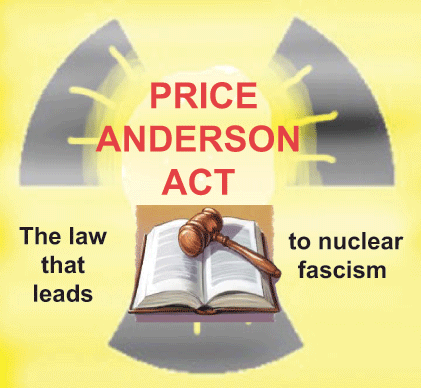 for nuclear plants was meant to be temporary, but Congress repeatedly extended it, most recently through 2025. Price-Anderson puts taxpayers on the hook for losses that exceed $12. 6bn if there is a nuclear plant disaster. When government estimates show the cost for such a disaster could reach $720bn in property damage alone, that’s one sweetheart deal for the nuclear industry!
R&D and Price-Anderson insurance are still just the tip of the iceberg. From tax breaks for uranium mining and loan guarantees for uranium enrichment to special depreciation benefits and lucrative federal tax breaks for every kilowatt hour from new plants, nuclear is heavily subsidised at every phase. The industry also bilks taxpayers when plants close down with tax breaks for decommissioning plants. Further, it is estimated that the cost to taxpayers for the disposal of radioactive nuclear waste could be as much as $100bn……https://www.theguardian.com/commentisfree/cifamerica/2012/apr/13/nuclear-industry-us-welfare
Are tax-payers paying for nutty space nuclear research?
BRINGING NUCLEAR POWER TO MARS – FRANK H. SHU (SETI TALKS 2016), Raw Science SETI Talks @ MicroSoft Silicon Valley – July 29, 2016 Dr. Frank Shu lectured with SETI Talks at MicroSoft Silicon Valley on July 29, 2016:

Establishing a lunar base is probably a wise first first step to colonizing Mars, and colonizing Mars will be a giant leap forward for humankind to travel to the stars…..
A reliable source of primary energy is needed for such tasks, but anywhere on the surface of the Moon, there is no sunlight two weeks out of four, and no wind whatsoever. Nuclear power is the default option, just as is the case of naval submarines where the crews need to live and work in closed environments submerged under the water of the ocean for months at a time. However, the light water reactors of naval submarines are not a good choice for environments that lack large bodies of water, and we argue, as first realized by a former NASA Engineer, Kirk Sorensen, that molten salt reactors, of the type invented by Oak Ridge National Lab in the 1960s, are much better suited for a lunar base, or for that matter, a Mars colony.
Dr. Shu discussed his patented design for the best possible two-fluid molten-salt breeder-reactor (2F-MSBR) that one could build, using thorium that can be mined locally without requiring shipments from mother Earth. He closed by considering two spin-off applications:
(1) saving civilization on Earth from the worst ravages of climate change by scaled-up 2F-MSBRs;
(2) using the fission fragments of related nuclear fission reactions for ion-propulsion that produces rockets two to three orders of magnitude faster than achievable with chemical rockets, making possible, perhaps, a first generation of starships. http://www.rawscience.tv/bringing-nuclear-power-to-mars-frank-h-shu-seti-talks-2016/
Canadian Nuclear Safety Commission’s sham review of safety allegations
 CNSC review dismissing nuclear-safety concerns called a ‘sham’ GLORIA GALLOWAY OTTAWA — The Globe and Mail – Corrected version, Aug. 09, 2016 An internal review by the Canadian Nuclear Safety Commission dismisses allegations that important information was withheld during the licensing of nuclear plants but two nuclear scientists say the review is “less than impartial” and a “sham” that should give Canadians no comfort.
In June, CNSC president Michael Binder received an anonymous letter, purported to have been written by employees at the nuclear regulator, that pointed to five separate cases in which the commission’s staff sat on relevant information that might have called the safety of a nuclear plant into question.
Peter Elder, a strategic adviser within the CNSC’s regulatory operations branch, who says he was able to maintain a neutral position because he did not work on the safety of nuclear power plants between 2008 and 2015, conducted a review that concluded late last week that none of the five cases point to any safety issues………
But two nuclear experts have written subsequent letters to Mr. Binder asking him to discard Mr. Elder’s review and to allow an arm’s-length inquiry into the allegations of the anonymous whistle-blowers.
Frank Greening, a nuclear chemist who is a former senior research scientist at Ontario Hydro, the predecessor of Ontario Power Generation, wrote that Mr. Elder’s claim to have conducted an independent investigation was “quite extraordinary and ridiculous.”
Mr. Elder “cannot possibly be independent because he is an employee of the CNSC,” wrote Dr. Greening. He asked Mr. Binder to “reject Mr. Elder’s less than impartial review.”
In a telephone interview, Dr. Greening said PSAs have, for many years “been taken very very seriously and formed the backbone of a licence renewal. And now the CNSC turns around and says well actually, they’re really not that important. That’s absurd.
“If I was one of those whistle-blowers, I would be very very distressed at this stage of the game.”
In a second letter, Sunil Nijhawan, a nuclear safety engineer with more than 35 years in the industry, wrote that Mr. Elder’s conclusions display an ignorance of basic safety principles and the legislated role of the CNSC.
“After a lifetime of working in PSAs I am now asking why so many of us toiled for years and why the industry was forced to spend well over $50-million on PSAs so far?” Dr. Nijhawan wrote. “Why are many in the rest of the world doing brilliant peer-reviewed PSAs and using the findings to not only improve operations, reduce risk and also come up with improved designs?”
Mr. Elder’s “sham” review only reinforces that view held by international nuclear professionals that there is an “incestuous” relationship between the CNSC and the utilities, Dr. Nijhawan wrote.
CNSC officials said in an e-mail on Tuesday that Mr. Elder’s review would be discussed at a commission meeting next week and they could make no further comment.
Tom Mulcair, the Leader of the federal New Democrats, wrote to Natural Resources Minister Jim Carr after the anonymous letter became public to say he found the allegations alarming and warning that they must not be ignored……..http://www.theglobeandmail.com/news/national/cnsc-review-dismissing-nuclear-safety-concerns-called-a-sham/article31338092/
Implementing storage technologies – necessary in transition from nuclear power
As nuclear power plants close, states need to bet big on energy storage Skeptical Science 9 August 2016 by dana1981 Eric Daniel Fournier, Post Doctoral Researcher, Spatial Informatics, University of California, Los Angeles and Alex Ricklefs, Research Analyst in Sustainable Communities, University of California, Los Angeles This article was originally published on The Conversation . Read the original article.
“……due to negative opinion and costly renovations, we are now observing a trend whereby long-running nuclear power plants are shutting down and very few new plants are being scheduled for construction in the United States.
Utilities are moving toward renewable electricity generation, such as solar and wind, partially in response to market forces and partially in response to new regulations that require utilities to reduce greenhouse gas emissions. In California, in particular, the shift toward renewable energy for market and environmental reasons, along with the public’s negative perception of nuclear energy, has caused utilities to abandon nuclear power.
While opponents can view the shutdown of nuclear power plants as a health and environmental success, closing nuclear plants intensifies the challenges faced by utilities to meet electricity consumption demand while simultaneously reducing their carbon footprint. PG&E, for example, has pledged to increase renewable energy sources and energy efficiency efforts, but this alone will not help them supply their customers with electricity around the clock. What can be used to fill the sizable gap left by Diablo Canyon’s closing?
Solar and wind energy sources are desirable as they produce carbon-free electricity without producing toxic and dangerous waste byproducts. However, they also suffer from the drawback of being able to produce electricity only intermittently throughout the day. Solar energy can be utilized only when the sun is out, and wind speeds vary unpredictably.
In order to meet customer electricity demand at all hours, energy storage technologies, alongside more renewable sources and increased energy efficiency, will be needed.
Enter energy storage
Energy storage has long been touted as the panacea for integrating renewable energy into the grid at large scale. Replacing the power generation left by Diablo Canyon’s closing will require expansive additions to wind and solar. However, more renewable energy generation will require more storage.
There are many different energy storage technologies currently available or in the process of commercialization, but each falls into one of four basic categories: chemical storage as in batteries, kinetic storage such as flywheels, thermal storage and magnetic storage.
The different technologies within each of these category can be characterized and compared in terms of their:
- power rating: how much electrical current produced
- energy capacity: how much energy can be stored or discharged, and
- response time: the minimum amount of time needed to deliver energy. [excellent graphs provided here on original]
The key challenge that utilities are now faced with is how to integrate energy storage technologies for specific power delivery applications at specific locations.
This challenge is further complicated by the electric power transmission system and consumer behaviors that have evolved based on a energy supply system dominated by fossil fuels. Additionally, storage technologies are expensive and still developing, which makes fossil fuel generators look more economically beneficial in the short term.
Implementing storage technologies
Currently in California, energy storage is effectively provided by fossil fuel power plants. These natural gas and coal-powered plants provide steady “baseload” power and can ramp up generation to meet peaks in demand, which generally happen in the afternoon and early evening.
A single energy storage device cannot directly replace the capacity potential of these fossil fuel sources, which can generate high rates of power as long as needed.
The inability to perform a like-for-like replacement means that a more diversified portfolio strategy toward energy storage must be adopted in order to make a smooth transition to a lower carbon energy future. Such balanced energy storage portfolio would necessarily consist of some combination of:
- short-duration energy storage systems that are capable of maintaining power quality by meeting localized spikes in peak demand and buffering short term supply fluctuations. These could include supercapacitors, batteries and flywheels that can supply bursts of power quickly.
- Lower speed energy storage that can supply a lot of power and store a lot of energy. These systems, such as pumped hydro and thermal storage with concentrated solar power, are capable of shifting the seasonality of solar production and servicing the unique power requirements for large scale or sensitive power users in the commercial and industrial sectors.
This set of storage technologies would have to be linked up in a kind of chain, nested and tiered by end use, location and integration into the grid. Additionally, management systems will be needed to control how the storage technologies interact with the grid.
Currently without sufficient energy storage in place, utilities now use natural gas to fill in the gaps in electricity supply from renewable sources. Utilities use “peaker” plants, which are natural gas-fueled plants that can turn generation up or down to meet electricity demand, such as when solar output dips in the late afternoon and evening, while producing air pollution and greenhouse gas emissions in the process.
With natural gas consumption for electricity generation on the rise, would it be better to keep nuclear power while energy storage technologies mature? Although less polluting than coal, natural gas produces greenhouse gas emissions and has the potential to causeenvironmentally dangerous leaks, as seen in Aliso Canyon.
With nuclear, it is still not clear what to do with nuclear waste, and the disaster at Japan’s Fukushima nuclear power plant in 2011 highlights how catastrophically dangerous nuclear power plants can be.
Regardless of which situation you believe is best, it is clear that energy storage is the major limitation to achieving a carbon-free electricity grid.
California’s commitment to renewable energy sources has helped shift the state to using less fossil fuels and emitting less greenhouse gases. However, careful planning is needed to ensure that energy storage systems are installed to take over the baseline load duties currently held by natural gas and nuclear power, as renewables and energy efficiency may not be able to carry the burden.
Subsidizing Nuclear Will Only Make Our Grid Problems Worse
 http://www.forbes.com/sites/ucenergy/2016/08/11/subsidizing-nuclear-will-only-make-our-grid-problems-worse/2/#20c51fcc386e Steve Cicala, While low natural gas prices are something to celebrate for consumers, the mood among the owners of America’s nuclear power fleet is not so cheerful as low energy prices threaten their bottom line. In turn, the owners of nuclear plants are threatening to shut down unless the government (and ultimately the ratepayer) steps in to close the shortfall. They have even announced plant closings to show they mean business.
Ordinarily, this kind of thing might be left solely up to markets to sort out. But with nuclear accounting for almost 60% of the carbon-free electricity in the United States, it’s fair to say that losing nuclear plants make it a lot tougher to meet goals to avoid catastrophic climate change. So there is a compelling case that there is a public interest at stake with the potential closure of these plants.
The result: a high-stakes game of chicken is playing out between producers, consumers, and state regulatory commissions in capitols across the country to keep these plants open. New York made history last week when it decided it couldn’t do without nuclear and gave in to providing subsidies. The news came just a couple months after California decided the opposite—putting all its chips into renewables. Illinois continues to wrestle with the very same decision but has yet to place its bet.
First, if the amount of the subsidy is tied to how much the operator requests, you should assume that they’re going to ask for more than they need (obvious, I hope).
Second, the companies at the center of these negotiations have multiple plants, so they make decisions on a particular plant keeping in mind the impact of that decision on the rest of its fleet. Closing a plant in one state after being denied subsidies is a way of signaling to regulators in other states that they seriously risk suffering the same fate. This means that companies may close profitable plants (and pay the cost), because it maximizes the total subsidy they will receive across all of their plants. It also means that firms may actually be eager to close plants as a means of driving up the price of electricity that their remaining plants will receive. Thus, their demands are less about unprofitability than about market power.
The final strategic consideration in these negotiations is about option value. Firms should be willing to endure periods of losses if keeping the plant open preserves the ability to make it all back and more when times are good. Thus, a subsidy that covers the operating cost of the plant is paying more than what the plant actually requires to make staying open in its best interest. It’s making the plant profitable in every year, rather than on average from now until the end of its useful life. Firms would love to be profitable every year, but only require the expectation of future profitability to stay open for business.
So should regulators take the industry at its word?
It’s important to note that—in spite of announced or actual “closing” of plants—hardly a screw has been removed from any of the nuclear plants recently “retired.” Decommissioning is a long-term process with many opportunities to change course as long as the operating license remains valid. This makes announcing closure a lot like convincing a child you’ll leave without them if they don’t get in the car: “I’m putting my shoes on….I’m putting my coat on…I’m getting the keys…I really mean it…” Regulators should not be so naïve.
Although pitched as temporary, urgent subsidies to expedite passage, these negotiations should be viewed as setting a long-term policy approach. If, in five years, natural gas prices remain low and renewables continue to expand (as there’s every reason to believe), we’ll be right back at the negotiating table with an industry on proclaimed life support. There are few policies that deliver less innovation than guaranteed payment, no matter the prevailing economics of the industry.
Is there a better approach? Let’s put aside finally putting a price on carbon (the easy way). I’ve crunched some numbers for Illinois’ Clinton Nuclear Power Station, which Exelon EXC -1.14% recently declared will “close.” It appears the root of the problem is less about low natural gas prices or the growth in renewablesthan our woefully inadequate transmission system.
Lack of transmission capacity underlies nuclear’s inability to recover their fixed operating costs in two ways. When demand is high, a congested system prevents distant nuclear generators from delivering power to profitable markets, leaving them on the sidelines upstate instead of making money in the city (note that it’s security, not economics that threatens to close the Indian Point plant in downstate New York).
The Clinton plant is an example of what nuclear has to look forward to without transmission capacity to deliver wind power to market. In the chart above, I plot the congestion loss at Clinton against hourly wind generation in 2015 (controlling for demand). In other words, this is by how many dollars per megawatt-hour Clinton is earning below the broader Illinois market, and how it varies with the amount of wind being generated on the wider Midwest system. A future with increased wind generation is not a bright one for the Midwestern nuclear fleet.
Of course, transmission infrastructure is not free—but regulators should be deciding between those one-time costs remedying the cause of a $70 million shortfall per year at Clinton alone, or writing a check every year for the foreseeable future to paper over the real problem.
Want to learn more? Listen to my Off the Charts podcast. And, follow me at@SteveCicala.
1 This Month
19 November – Webinar – The Reality of Reprocessing
Time: 11:00 AM Pacific Time (US & Canada) / 2:00 PM Eastern / 7:00 PM UK / 8:00 PM CET
Register for the Zoom Event Here

Tell Congress: Prevent Nuclear Catastrophe in Iran

Tell Congress: Prevent Nuclear Catastrophe in Iran

Read the Public Inquiry Report, the Commissioners’ report, Surrendering Australia: The AUKUS Deception is available to download for free at aukuspublicinquiry.com. Or just watch the replay of the National Press Club Luncheon.


Shut down the radiation-damaged Heysham nuclear reactors now
To see nuclear-related stories in greater depth and intensity – go to https://nuclearinformation.wordpress.com

Say No to NASA’s Reckless Nuclear Reactor on the Moon
Say No to NASA’s Reckless Nuclear Reactor on the Moon
-
Archives
- November 2026 (178)
- October 2026 (302)
- September 2026 (339)
- August 2026 (330)
- July 2026 (355)
- June 2026 (287)
- May 2026 (306)
- April 2026 (356)
- March 2026 (251)
- February 2026 (267)
- January 2026 (308)
- December 2025 (358)
-
Categories
- 1
- 1 NUCLEAR ISSUES
- business and costs
- climate change
- culture and arts
- ENERGY
- environment
- health
- history
- indigenous issues
- Legal
- marketing of nuclear
- media
- opposition to nuclear
- PERSONAL STORIES
- politics
- politics international
- Religion and ethics
- safety
- secrets,lies and civil liberties
- spinbuster
- technology
- Uranium
- wastes
- weapons and war
- Women
- 2 WORLD
- ACTION
- AFRICA
- Atrocities
- AUSTRALIA
- Christina's notes
- Christina's themes
- culture and arts
- Events
- Fuk 2022
- Fuk 2023
- Fukushima 2017
- Fukushima 2018
- fukushima 2019
- Fukushima 2020
- Fukushima 2021
- general
- global warming
- Humour (God we need it)
- Nuclear
- RARE EARTHS
- Reference
- resources – print
- Resources -audiovicual
- Weekly Newsletter
- World
- World Nuclear
- YouTube
-
RSS
Entries RSS
Comments RSS

