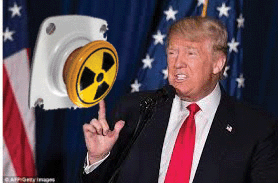
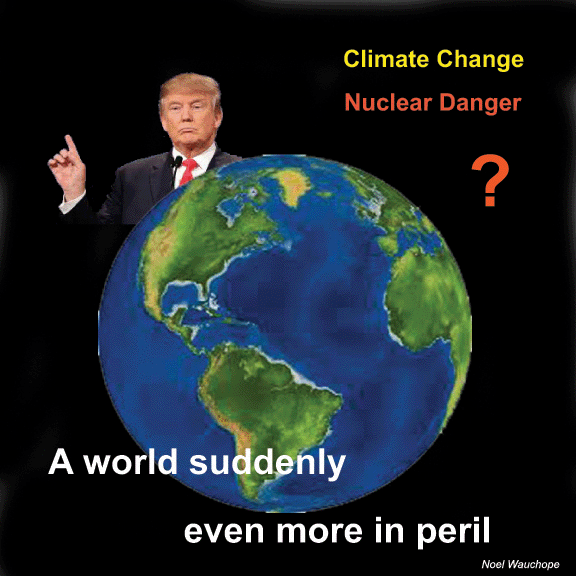
“A man you can bait with a tweet is not a man we can trust with nuclear weapons.” The words of his vanquished opponent, Hillary Clinton, are perhaps the biggest anxiety hanging over the shock election of Donald Trump to the US presidency: can he be trusted with the power to launch Armageddon?
Every US president has constant access to a nuclear launch device only he can activate. Born in the Cold War, it is designed for when Russian nuclear missiles are detected making their 30-minute flight to the US, allowing 10-15 minutes to decide to order a counter-strike which would not be countermanded. But it could be used in other scenarios. “There is nothing to prevent a launch for very little reason,” says Paul Ingram of the British American Security Information Council, an arms control think-tank in London.
Would Trump hit the button? He has said he would be “very, very slow on the draw” but has refused to rule out using nukes, asking several times during the campaign, if they are never used, “why do we make them?”
The answer is deterrence: so fear of retaliation will deter any nuclear attack. Trump’s refusal to rule out their use is in fact close to existing US policy, but he has also suggested using them against ISIS, even though conventional weapons would have similar tactical effects.
“The very fact that one person, whoever it is, can decide to launch a nuclear strike is very worrying,” says Ingram.
Hair-trigger alert The president’s ability to respond rapidly is to allow the launch of 450 US land-based missiles before they are destroyed in an attack – for which reason they are kept on hair-trigger alert.
One way to reduce the risk of a rash launch would be for President Obama to take US missiles off hair-trigger alert before he leaves, which would be politically delicate to reverse. Or Trump, who wants better relations with Russia, might do it himself.
The use of existing nukes is one thing; proliferation is another. Trump has said he will “renegotiate” last year’s agreement with Iran to limit its uranium enrichment. Arms control experts say we are never likely to get a better deal, so Trump’s plan could see Iran resume its efforts.
And as North Korea approaches nuclear capability, Trump has suggested its neighbours might develop their own nuclear weapons. In April he said that US allies should pay more for the nuclear protection offered by the US umbrella – or defend themselves, “including with nukes”.
Japan and South Korea, under threat from North Korea, are already under pressure to do that. But both are non-nuclear states in the Non-Proliferation Treaty, and have sworn never to develop their own weapons. Their abandonment of that pledge could well be the death-knell of the treaty. While it has failed to disarm the major nuclear powers, it has kept other countries, such as Egypt and Saudi Arabia, from trying to develop the bomb.
Anti-nuclear norms Its failures in disarmament led a large majority of UN members to vote in October to start work on a new treaty that simply bans nuclear weapons for everyone. Existing nuclear nations rejected the idea (apart from North Korea, which voted for it), as, ominously, did Japan and South Korea. Non-nuclear NATO members backed it in the hope of strengthening global anti-nuclear norms.
Those may not last long in the Trump era. He has long called NATO “obsolete” and questions US commitments to Europe. The threat of losing reliable US defence could lead to military build-up in Europe, handing nuclear deterrence to the small UK and French nuclear arsenals, which would then be more likely to go ahead with expensive upgrades.
Thomas Homer-Dixon at the Balsillie School of International Affairs in Waterloo, Canada, sees a more insidious threat. He believes Trump could pick fights abroad and incite attacks on alleged enemies at home to generate a constant “emergency” to bolster his support. Russia’s Vladimir Putin, whom Trump has long admired, uses such tactics.
“The risk of a slide into war which ultimately involves nuclear weapons is very real,” he says. “Trump has an insatiable need to dominate, and he seems incapable of ignoring a slight.” The deadly nuclear winter predicted to follow even a limited nuclear exchange could one day answer the president-elect’s question: if we have these weapons, why don’t we use them?
Donald Trump and the nuclear codes Mr Trump will soon control America’s nuclear codes http://www.economist.com/news/briefing/21709999-mr-trump-will-soon-control-americas-nuclear-codes-donald-trump-and-nuclear-codesNov 12th 2016 IN A ritual out of sight of the cameras on Inauguration Day in January, America’s “nuclear briefcase” will change hands and President Donald Trump will receive a card, sometimes known as the “biscuit”. The card, which identifies him as commander-in-chief, has on it the nuclear codes that are used to authenticate an order to launch a nuclear attack. At that point, should he wish, Mr Trump can launch any or all of America’s 2,000 strategic nuclear missiles.
There are no constitutional restraints on his power to do so. Even if all his advisers have counselled against it, as long it is clearly the president giving the command, the order must be carried out. There are no checks and balances in the system. Moreover, once the order is given there is likely to be only a matter of minutes in which it could be rescinded. Once the missiles are flying, they cannot be called back or disarmed. Mr Trump, from what he has said, does not take this responsibility lightly. Indeed, he has often stated that he believes nuclear weapons to represent the greatest threat to humanity and that he will not be trigger-happy, “like some people might think”. But in common with his predecessors, he does not rule out their use. With little more than ten minutes to take a decision that could kill hundreds of millions of people, even the calmest individual would be under intolerable stress if informed that America was under imminent attack. It is not Mr Trump’s fault that the system, in which the vulnerable land-based missile force is kept on hair-trigger alert, is widely held to be inherently dangerous. Yet no former president, including Barack Obama, has done anything to change it.
Of greater concern would be how Mr Trump might behave in an escalating confrontation if Russia were to rattle its nuclear sabre even more loudly. It is possible that his apparent desire to be buddies with Vladimir Putin might help defuse a dangerous situation. He is, however, notoriously thin-skinned and unable to stop himself responding to any perceived slight with vicious (verbal) attacks of his own. He also revels in braggadocio and is known to be reluctant to take advice. Marco Rubio, a rival for the Republican nomination, questioned whether he had the temperament to be put in charge of the nuclear codes. So did Hillary Clinton. They were right to do so. But it is now Mr Trump, not them, who takes the biscuit.
There’s no way around it: Donald Trump looks like a disaster for the planet Vox by Brad Plumer@bradplumerbrad@vox.com Nov 9, 2016 This is happening. Donald Trump is going to be president of the United States.
And there’s no way around it: What he’s planning to do looks like an absolute disaster for the planet (and the people on it). Specifically, all the fragile but important progress the world has made on global warming over the past eight years is now in danger of being blown up.
Trump has been crystal clear about his environmental plans. Much of the media never wanted to bring it up, never wanted to ask about it in debates, never wanted to turn their addled attention away from Hillary Clinton’s email servers to discuss what a Trump presidency might mean for climate change. But the warning signs were there:
Trump called global warming a Chinese hoax. He couldn’t have been blunter about this. He also tapped Myron Ebell, an avowed climate denier, to head his EPA transition team.
Trump has said, straight up, he wants to scrap all the major regulations that President Obama painstakingly put in place to reduce US carbon dioxide emissions, including the Clean Power Plan. If Trump wants to rewrite these rules through executive action, he can. Or Republicans in Congress could try to pass a law forbidding the EPA from ever regulating CO2 again.
Trump has also hinted he wants to downsize the EPA. “What they do is a disgrace,” he has said. He now has the power to rewrite or scale back other regulations on mercury pollution, on ground-level ozone, on coal ash, and more.
Trump has said he wants to repeal all federal spending on clean energy, including R&D for wind, solar, nuclear power, and electric vehicles. This would require Congress, but it’s not impossible.
Trump has said he wants to pull the United States out of the Paris climate deal. There’s nothing stopping him here. Technically, the US can’t officially withdraw for four years, but for all practical purposes, the Trump administration could ignore it.
So what happens if Trump gets his way? More air pollution, more carbon emissions. Exactly how much more remains to be seen. There are, after all, plenty of other factors pushing down US emissions that Trump has no control over. Natural gas from fracking would continue to kill coal power. Wind and solar would continue to grow. But it’s nearly impossible to imagine emissions under Trump dropping at the sharp pace necessary to slow global warming. And emissions could even rise, as this analysis from Lux Research suggests.
Even more importantly, the impact of Trump’s moves on the rest of the world could be seismic.
The world is making cautious progress on global warming. Trump wants to blow that all up.
For the last eight years, the Obama administration has been using every regulatory lever at its disposal to push down US greenhouse gases — aiming for a 28 percent cut below 2005 levels by 2025. Obama has also been trying to coax countries like China to participate in a global climate deal, in which every country would voluntarily pledge to restrain its emissions and meet regularly at the UN to ratchet up ambitions over time.
That plan finally came to fruition last December, when the world agreed to a sweeping climate agreement in Paris. The Paris deal was always delicate, and the current pledges weren’t nearly enough to avoid dangerous global warming, defined as 2°C or more. But the deal was a start. And the hope was that by cooperating and exerting diplomatic pressure on each other, all countries would steadily increase action over time.
This plan, which Clinton wanted to build upon, was far from a sure bet to halt global warming. But it was arguably the most plausible and promising accord yet proposed in the history of international climate talks.
Now it’s in peril. If Trump yanks the United States out of the Paris agreement, the deal won’t die, but momentum could wane. One can imagine China and India deciding they don’t need to push nearly as hard on clean energy if the world’s richest and most powerful country doesn’t care. At best, progress would slow. At worst, the entire arrangement could falter, and we set out on a path for 4°C warming or more.
These are decisions that will reverberate for thousands of years and affect hundreds of millions of people. We can’t easily undo the effects of all that extra carbon dioxide we keep putting into the air. Without drastic reductions in emissions (or possibly risky geoengineering), global temperatures will keep rising. The ice caps in Greenland and Antarctica will keep melting. Once that process gets underway, we can’t reverse it. The seas will rise. South Florida will eventually vanish beneath the oceans. Megadroughts will become more likely in the Southwest. For generations and generations.
Next U.S. president has said climate change is a hoax
Focus on talks in Morocco aimed at implementing Paris deal
The global fight against climate change will suffer a blow from Donald Trump’s victory in the U.S. presidential election, threatening the industries working to clean up pollution from fossil fuel.
The next president has questioned the science of climate change, vowed to withdraw from the Paris agreement on global warming and pledged to stimulate production of coal, the dirtiest fossil fuel. Green campaigners and policymakers, some of whom are gathered this week in Morocco for talks on implementing the Paris deal, sounded the alarm over the upheaval they expect when Trump takes office in January.
“The presidency of Donald Trump relegates the West as we knew it to the realm of the past,” Reinhard Butikofer and Monica Frassoni, co-chairs of the European Green Party, said in a statement. “If Donald Trump pursues the foreign policies that he announced during his campaign, this will severely undermine trans-Atlantic relations, the international rule of law and world peace.”
Under President Barack Obama, the U.S. rescued a two-decade-old process the United Nations promoted to rein in pollution damaging the climate, forging the Paris deal last year. Along with China and more than 190 other countries, the accord set out a framework for all nations to cut emissions. Trump has said he will cancel that work.“This is a very bad outcome,” Tom Steyer, founder of San Francisco-based advocacy group NextGen Climate Action, said in a phone interview Wednesday. “The Paris accord was a historic attempt to move forward as a globe to deal with a global problem, with American leadership. If he follows through on his campaign statements, that would be a devastating mistake.”
Delegates at COP22 react to Trump win
May Boeve, executive director of the anti-fossil-fuel campaign group 350.org, said in a statement that “Trump will try and slam the brakes on climate action. Our work becomes much harder now, but it’s not impossible, and we refuse to give up.”
Envoys drawn from environment and energy ministries gathered on Monday for two weeks of talks on climate organized by the UN, aiming to make progress implementing the Paris deal. They are due to finish their work on Nov. 18 with a set of rules on how Paris will be implemented.
It would be difficult for Trump to pull out of the Paris accord, which is part of the 1992 UN Framework Convention on Climate Change, which the U.S. ratified under Republican President George H.W. Bush. Trump would have to renounce the 1992 treaty or risk bringing down the entire UN process to scrap Paris. He’d have to give three years of notice to withdraw legally.
“If the U.S. pulls out of this process and is seen as going as a rogue nation on climate change, that will have implications for everything else on President Trump’s agenda when he wants to deal with foreign leaders,” Alden Meyer, who has been following the UN talks for more than two decades, said at the organization’s annual gathering in Marrakech on Wednesday. “I think he will soon come to understand that.”Doubts about U.S. support for the accord may stall progress in talks in Morocco this week and next, since other nations wouldn’t trust that any commitments the U.S. made will stick after Trump takes office. The U.S. is the richest among the top six polluting nations, and its support for the deal is essential to keep China and other developing economies working for cleaner industry.French Environment Minister Segolene Royal expressed concern about Trump’s stance in a posting on Twitter, noting that Obama “ratified and committed” the U.S. to the Paris agreement and there should be “no withdrawal,” adding, “Let’s stay vigilant for climate.”
November 9, 2016 According to his campaign aides, president-elect, Donald Trump is considering making a decision that would be completely devastating to, not only America, but the entire planet.Sarah Palin is reportedly being considered to take a position as one of Trump’s top cabinet leaders, specifically, the Interior Secretary of the Department of the Interior. In that role, Palin would be in charge of the country’s natural energy resources and America’s climate change policies.
Yes, a woman who doesn’t believe in global warming, or evolution for that matter, will be running the department in control of our energy resources. Palin is a big supporter of the oil industry and all the money it brings in, regardless of the price the planet will pay, so you can imagine what her agenda will be.
Trump himself said that he would “love to” put Palin to work in one way or another. Knowing Trump now, that could mean sexual favors, but he certainly wants her to do some real work as well. Trump said this about adding Palin to his cabinet:
“I’d love that. Because she really is somebody who knows what’s happening and she’s a special person.”Special. Of all the words Donald Trump could have used to describe the most dimwitted person to ever be involved in politics, aside from Michele Bachmann, special is definitely an accurate one to describe Sarah Palin.
Palin told CNN’s Jake Tapper that she would absolutely love to be relevant again:
“I think a lot about the Department of Energy, because energy is my baby: oil and gas and minerals, those things that God has dumped on this part of the Earth for mankind’s use instead of us relying on unfriendly foreign nations.”In case you were wondering, “The Department of the Interior manages one-fifth of the land in the country. That’s 35,000 miles of coastline and 1.76 billion acres of the Outer Continental Shelf. We also are entrusted to honor our agreements with 562 Indian tribes and to conserve fish, wildlife, and their habitats, responsibilities that affect millions of people.”
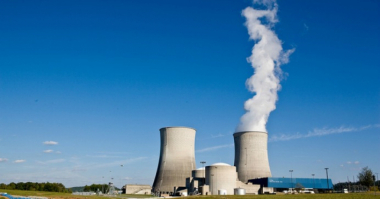
Watts Bar Unit 2, last old reactor of the 20th century: a cautionary tale, Bulletin of the Atomic Scientists Don SaferSara Barczak, 8 Nov 16More than four decades after construction began in 1973, the Tennessee Valley Authority (TVA) is finally getting close to starting up the Watts Bar Unit 2 nuclear reactor. Only final tests stand in the way of it receiving an operating license from the Nuclear Regulatory Commission (NRC). While the TVA and the nuclear industry describe Watts Bar 2 as “the first new nuclear generation of the 21st Century,” in fact the TVA resuscitated a demonstrably unsafe 1960s-era ice condenser design that was abandoned decades ago by the rest of the nuclear industry. Mismanagement and construction problems have driven the project’s price tag up with billions of dollars in cost overruns. Safety continues to be compromised as the NRC is allowing the TVA to delay post-Fukushima seismic design upgrades indefinitely. Rather than exemplifying a fine technological achievement, the history of Watts Bar Units 1 and 2 is a cautionary tale of the worst pitfalls of nuclear power and the federal regulatory system.
This pair of nuclear reactors has a unique distinction. Back in 1996, Watts Bar Unit 1 was the last reactor completed in the United States, at a hefty $6.8 billion. No other reactors have come online since. In fact, according to the NRC, eight US reactors have permanently shut down since Watts Bar 1 was licensed…….
Watts Bar 2 comes from a federally owned utility that has a history of delays, problems, and fiscal irresponsibility when it comes to nuclear power. This history raises the question of why Watts Bar 2 has survived such a long time and whether it should ever be allowed to open. It is a saga of delays and cost overruns, antiquated designs, inadequate quality control and oversight, failure to implement post-Fukushima upgrades, and a deficient safety culture, among other problems—all at a time when there is still no place for long-term storage of the nuclear waste that will be generated. And because the TVA manufactures tritium for use in America’s nuclear weapons, there will inevitably be greater releases of tritium into the air and water of the region—natural resources which already receive four times as much tritium as originally expected.
Ironically, Watts Bar 2 comes when the large-scale development of new, truly clean energy sources is a burgeoning reality. Created as an innovative model for the nation in the 1930s, the Tennessee Valley Authority has become an entrenched, top-down bureaucracy wedded to the past by its continuing embrace of nuclear and other polluting energy sources in the 21st century.
Let us look at some of the reasons for the delays and overruns in turn.
Problematic, antiquated design. …….
Quality control concerns at Watts Bar……..
Post-Fukushima design upgrades postponed…….
Watts Bar and nuclear weapons. …….
A safer, less risky future is possible. Ratepayers, utilities, and regulators should heed this cautionary tale, whose lessons are only reinforced by recent efforts to build ever more costly and delayed new reactors here in the United States, including SCANA’s V.C. Summer reactor in South Carolina, and the Southern Company’s Plant Vogtle reactors in Georgia. (And abroad at Flamanville, France; Olkiluoto, Finland; and Hinkley Point, Great Britain.) New nuclear power generation is turning out to be the failed technology of the 21st century…….. http://thebulletin.org/watts-bar-unit-2-last-old-reactor-20th-century-cautionary-tale8783
Donald Trump will be the only climate-denying world leader Mashable, BY ANDREW FREEDMAN, 10 Nov 16 If a Donald J. Trump administration acts on the president-elect’s view that global warming’s a “hoax,” the consequences of the presidential election may echo for generations. When he’s sworn into office in January, Trump becomes the only leader of a major industrialized country to deny the existence of human-caused global warming.
This is a first for the U.S., considering that even former president George H.W. Bush signed a climate change agreement in 1992, when the issue was just emerging. Presidents Clinton, George W. Bush and Barack Obama have all pursued reductions to emissions of planet-warming greenhouse gases, such as carbon dioxide.
In the lead-up to the election, environmental leaders and climate scientists issued apocalyptic warnings of what a Trump presidency would do to efforts to rein in global warming, given that the Paris Climate Agreement only just went into effect on Nov. 4, and is still fragile. Now, some of these same people are shellshocked, but remain resolved to opposing attempts to slow the pace of emissions cuts, which climate science says is a crucial factor in determining how much the world will warm in the next several decades.
No time to waste
The U.S. and the world can’t afford to stall or slide backwards on climate progress, according to scientific research. Studies show climate change proceeding faster than anticipated, with a narrowing window to act in order to forestall the worst impacts of global warming, such as a catastrophic increase in sea levels.
In fact, a recent U.N. report showed that if we are to have any hope of meeting the Paris Agreement’s goal of limiting global warming to under 2 degrees Celsius, or 3.6 degrees Fahrenheit, below preindustrial levels, emissions cuts need to become more ambitious.
The Obama administration committed to reducing U.S. greenhouse gas emissions by 25 to 28 percent below 2005 levels by 2025, and it’s expected to lay out a decarbonization plan by midcentury during the ongoing U.N. climate talks in Marrakech, Morocco.
However, to achieve these cuts, the Environmental Protection Agency’s (EPA) regulations on coal-fired power plants, known as the Clean Power Plan, would need to survive court challenges and be implemented by a supportive White House.
During the campaign, Trump made clear he would dismantle those regulations and others.
A Trump White House will have few checks on its power given that Republicans hold both houses of Congress, meaning that there could be significant rollbacks of EPA regulations and climate-related executive orders that could have ramifications beyond a single presidential term.
A slowdown or halt in U.S. emissions cuts would shift the climate math in favor of more severe global warming impacts. Leading environmental activist and journalist Bill McKibben emphasized that issue when reached on Wednesday, telling Mashable that “… The results of this election may eventually be measured in inches or feet of sea level rise.”
“Our job is to limit the damage, a harder job today than yesterday, but it wasn’t easy then either. Since physics is indefatigable I guess we better be too,” McKibben, a founder of the environmental group 350.org, said. Prominent climate scientist Hans Joachim Schellnhuber, who leads the Potsdam Institute for Climate Impact Research in Germany, said the ramifications for global climate action are dire.
The climate system doesn’t forget, and it doesn’t forgive
“The U.S. de-elected expertise and will likely show a blockade mentality now, so Europe and Asia have to pioneer and save the world,” Schellnhuber said in a statement. “Formally leaving the Paris Agreement would take longer than one Presidential term, yet of course the U.S. could simply refuse reducing national emissions which would mean a de facto exit out of international climate policy.”
He went on to say that the U.S. is “one of the world’s biggest economies, and even just four years of unbridled emission staying in the atmosphere for many hundreds years would make a substantial difference. The climate system doesn’t forget, and it doesn’t forgive.”
Environmental groups unite
Trump’s election may help unify the environmental movement in opposition to the White House, making opposition to new fossil fuel projects, anti-regulatory moves and other potential actions more intense and effective.
“This is an undeniable tragedy, but of course as organizers, our job is try and forge some sort of way ahead,” said Jamie Henn, a spokesman for 350.org, in an email on Wednesday morning.
Electrical fault, fire triggers low-level emergency notice at Indian Point http://westfaironline.com/82994/electrical-fault-fire-triggers-low-level-emergency-notice-at-indian-point/ By Ryan Deffenbaugh November 8, 2016An electrical fault and small fire in Indian Point Energy Center’s Unit 2 nuclear reactor Tuesday morning caused the plant’s owners, Entergy Corp. to declare and subsequently terminate a Notice of Unusual Event emergency notification.
The unusual event notice is the lowest of the Nuclear Regulatory Commission’s four emergency classification levels. The fire was self-extinguished moments after it started and there were no injuries or impact on plant operations, Entergy said.
The cable that experienced the electrical faulty carries electricity between both operating units at the Buchanan plant.
The company is investigating the cause of the fault, according to Entergy.
Robert Dodge: A ‘jobs program’ to end humanity Ventura County Star November 5, 2016 Nuclear weapons present the greatest public health and existential threat to our survival every moment of every day. Yet the United States and other nuclear nations stand in breach of the 1968 Nuclear Non-Proliferation Treaty, which commits them to work in good faith to end the arms race and achieve nuclear disarmament.
Now, 48 years later, the efforts of the nuclear nations toward this goal are not evident, and the world is as dangerous as it was during the height of the Cold War and arguably more dangerous with current scientific evidence on the catastrophic effects of even limited regional nuclear war.
This year’s presidential campaign has once again done little to focus on the dangers of nuclear weapons, focusing more on who has the temperament to have their finger on the button with absolutely no indication of any understanding of the consequences to all of humanity by the use of these weapons, even on a very small scale. In addition to tensions between Russia and the U.S. in Ukraine and Syria, there is a real danger of nuclear war in South Asia, which could kill more than 2 billion people from the use of just 100 Hiroshima-size weapons.
The rest of the world is finally standing up to this threat to survival. They are taking matters into their own hands and refusing to be held hostage by the nuclear nations. They will no longer be bullied into sitting back and waiting for the nuclear states to make good on empty promises.
At the United Nations this past month, 123 nations voted to commence negotiations next year on a new treaty to prohibit the possession of nuclear weapons. Despite President Obama’s 2009 pledge to seek the security of a world free of nuclear weapons, the U.S. voted no and led the opposition to this treaty.
Rather than meet our obligations under international law, the U.S has proposed to begin a new nuclear arms race, spending $1 trillion over the next 30 years to modernize and rebuild every aspect of our nuclear weapons programs — a “jobs program” to end humanity. Each of the nuclear nations is expected to do the same, continuing the arms race for generations to come………
From a medical and public health stance, based on our current evidence-based understanding of what nuclear weapons can actually do, any argument for continued possession of these weapons by anyone is untenable and defies logic. There is absolutely no reasonable or adequate medical response to nuclear war.
With any public health threat — from Zika and Ebola to polio and HIV — prevention is the goal. The global threat from nuclear weapons is no different. The only way to prevent the use of nuclear weapons is to ban and eliminate them. Our future depends upon this.
President Kennedy, speaking on nuclear weapons before the U.N. Security Council in September 1961, said, “The weapons of war must be abolished before they abolish us.” Our children’s children will look back and rightly ask why we — the only nation to ever use nuclear weapons — remained on the wrong side of history when it came to abolishing them.
Even though a shuttered nuclear plant is no longer producing electricity, it remains highly regulated to maintain safety for employees and nearby communities. When employees start heading for the exits, plant owners risk seeing institutional knowledge leave with them.
That’s what happened earlier this year at the financially squeezed James A. FitzPatrick Nuclear Power Plant in central New York, after Louisiana-based Entergy Corp. announced plans in November 2015 to shut down the plant for good.
By the time jockeying by New York lawmakers and deal-making with nuclear juggernaut Exelon Corp. removed the plant from a list of doomed facilities in early August, more than 10 percent of FitzPatrick’s 615 workers had jumped ship.
A similar portion of Fort Calhoun’s workforce has followed suit, according to Mart Sedky, Omaha Public Power District’s division manager of human resources. Employees there began leaving as soon as word got out in May that the plant, the nation’s smallest, was on the chopping block, she said.
David Lochbaum, director of the Nuclear Safety Project for the Union of Concerned Scientists, a nonprofit group, said retention bonuses are a “guard against” such rushes for the exits.
“If people start bailing out because they see the writing on the wall and they want to protect themselves and their families, that poses a challenge to the plant owner,” he said.
Early estimates call for about $45 million worth of retention bonuses and separation packages to Fort Calhoun employees. That number doesn’t include salaries at the plant, which had a $71.2 million payroll in 2015.
A spokeswoman at Entergy would not comment on retention agreements at the FitzPatrick plant in New York. But the company committed approximately $55 million to $60 million in severance and employee retention payments to employees at its now-closed Vermont Yankee Nuclear Power Station in southern Vermont, according to a statement from Entergy announcing the plant’s closing in August 2013.
Nuclear operators elsewhere have also found that money talks in turbulent times. Retention agreements kept nuclear professionals in place at the Kewaunee Power Station in Wisconsin when that plant’s owner announced its closing in late 2012. A spokesman for Dominion Resources, which closed Kewaunee for good in May 2013, said financial details around retention agreements with the plant’s employees were proprietary.
Today there are fewer than 200 employees on-site, down from more than 600 when the plant was running at full-power status.
In testimony supporting a rate hike to the North Dakota Public Service Commission in August 2013, Xcel Energy’s Timothy O’Connor said the Minnesota company was thwarted in its attempts to attract employees from Kewaunee to its own struggling nuclear plant because of retention incentives.
“Employees without retention agreements are extremely vulnerable to other nuclear competitors and this is one reason why (Xcel) has lost a large experience base,” O’Connor, Xcel’s chief nuclear officer, said at the time.
October 1964 Nuclear testing in Mississippi http://mashable.com/2016/11/06/mississippi-nuclear-test/#QAtiwfQCDiqT [many photographs] Waiting on the big bang
by Alex Q. Arbuckle, 6 Nov 16 At 10 a.m. on Oct. 22, 1964, a five-kiloton nuclear device was detonated in Lamar County, Mississippi.
The previous year, as a response to rising public anxiety over the potential fallout of bigger and bigger test explosions, the United States, Great Britain and the Soviet Union had signed the Partial Test Ban Treaty, which prohibited all nuclear testing in the atmosphere, underwater and in outer space. Underground detonations were not banned in the treaty because it was still technically unclear how they could be detected to ensure compliance.
After signing the treaty, the United States government created Project Dribble, an effort to study how underground nuclear tests could be detected — or hidden.
The site of Project Dribble’s first detonation was 28 miles southwest of Hattiesburg in the Tatum Salt Dome, a massive Mesozoic salt deposit 1,000 feet below the ground.
The plan called for two detonations. The first, code-named Project Salmon, would be an explosion 2,700 feet down in solid salt. The second detonation, Project Sterling, would use a smaller bomb in the cavity left behind by the first blast.
Scientists hypothesized that the shockwaves of the second detonation would be muffled by the cavity, effectively concealing it from seismographic detection. The first blast was scheduled for Sept. 22, but was postponed repeatedly because the wind direction was not ideal.
Finally, on Oct. 22, the conditions were right.
Four-hundred residents were evacuated from the area around and downwind of the blast site. For their trouble, adults were paid $10 and children $5.
At 10 a.m., the Project Salmon device detonated with approximately one-third of the power of the bomb that destroyed Hiroshima.
The earth rose and roiled in waves, pecans fell from trees, dogs howled in fear, creeks ran black with disturbed sediment, and buildings thirty miles away swayed for minutes on end.
Within a week, hundreds of residents had filed damage claims with the government, citing burst pipes, cracked masonry and suddenly dry wells. The test was a success, however. The blast vaporized a spherical void in the salt 110 feet in diameter. When sensors were lowered into the cavity more than three months later, temperatures still measured over 400 degrees Fahrenheit.
Two years after Project Salmon, the second part of the test, Project Sterling, was carried out. A much smaller bomb — equal to 350 tons of TNT versus the first bomb’s 5,000 tons — was detonated in the cavity.
As the scientists hypothesized, the cavity absorbed nearly all of the blast’s seismic force. People on the surface barely felt a bump.
The blasts, which gave the government plenty of data on how underground nuclear tests could be hidden and detected, were declared a success — the only nuclear detonations to ever occur in the eastern United States.
Advocates Protest In their letter, the plan’s opponents argue that the Nuclear Waste Policy Act of 1982 bars the federal government from taking responsibility for interim waste in the absence of a federal repository.
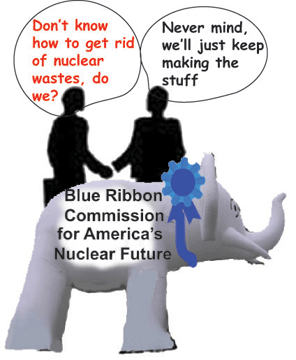
the concept of interim storage came out of the Obama Administration’s Blue Ribbon Commission on nuclear waste.
Meanwhile, the Energy Department remains decades away from developing a permanent repository.
.At nearly every meeting of the San Onofre Community Engagement Panel, residents line up to ask whether sea air might cause corrosion in the casks, what the chance of leakage is, and who’s responsible if the casks degrade
As the amount of waste grows, so does the government’s liability……….The government’s estimated total liability is $29 billion.”That’s probably low, because it’s getting more expensive to store this stuff,”
$2 Billion Needed Annually for Advanced Nuclear, Group Says http://www.bna.com/billion-needed-annually-n57982082293/ Bloomberg BNA By Rebecca KernNov. 3— Advanced nuclear reactor technologies would be speeded up if the federal government increased spending to $2 billion annually on research and development test beds and demonstration projects, nuclear experts advised.
In order to move advanced nuclear reactors from the conceptual stage where they are today to the testing stages and eventual deployment, the government needs to increase its funding from its approximately $500 million per year to $2 billion per year over a 10-year period, Armond Cohen, executive director of the Clean Air Task Force, said during a Nov. 3 event releasing the Global Nexus Initiative’s policy memo outlining a framework for advanced reactors.
The Global Nexus Initiative is a group formed two years ago by the Nuclear Energy Institute, which represents the nuclear industry, and the Partnership for Global Security, a nonpartisan, non-profit focusing nuclear security policy.
The report is based on discussions during the group’s February workshop on the challenges to deploying advanced reactors, which are non-light water nuclear reactors that rely on other substances, such as sodium, to cool the reactor that have the potential to be cheaper to build and safer than existing reactor technologies.
Todd Allen, a senior visiting fellow at Third Way, a policy research group, said that government funding should be focused on early innovation for startup companies, of which some fraction will move up to commercial deployment…..http://www.bna.com/billion-needed-annually-n57982082293/
U.S. District Court Judge Thomas Rice rejected an Energy Department argument that the federal agency was not endangering enough Washington residents to allow the state to sue.
“The state has an inherent and fundamental sovereign interest in ensuring that all Washington workers are safe,” Rice wrote in his opinion.
Washington Attorney General Bob Ferguson filed the lawsuit last fall against the Energy Department and its contractor, Washington River Protection Solutions. The lawsuit contends that hazardous tank vapors pose a serious risk to Hanford workers.
‘This motion was just another example of the federal government’s culture of indifference to worker safety at Hanford,” Ferguson said Thursday.
Ferguson’s office contends that hundreds of workers have been exposed to vapors escaping from nuclear waste storage tanks since the early 1980s and that those breathing the vapors developed nosebleeds, chest and lung pain, headaches, coughing, sore throats, irritated eyes, and difficulty breathing.
Hanford for decades made plutonium for nuclear weapons, and now is engaged in cleaning up a massive inventory of radioactive and chemical wastes left over from that work.
Much of the waste is stored in 177 giant underground storage tanks at Hanford, which is located near Richland.
After more than 50 workers were exposed to tank vapors earlier this year, Ferguson asked a federal court to immediately order the government to implement enhanced safety measures. That motion is still pending before the court.
Officials for the Energy Department in Richland did not immediately return a telephone call seeking comment on Thursday.
Lawyers for the Energy Department had argued that the state lacked legal standing to file the lawsuit, in part because it involved about 2,000 workers out of a population of millions of residents. The agency also contended that no evidence has been provided showing that Hanford workers have been harmed by vapors. Symptoms like headaches are common, they have said.
Lost Nuke: The Last Flight of Bomber 075 book trailer
By George Baker, Andrew Kurjata, CBC NewsPosted: Nov 04, 2016 The Royal Canadian Navy is sending a ship to determine if a diver has discovered “the lost nuke” — a Mark IV bomb that went missing after a U.S. bomber crashed off B.C.’s North Coast in the early days of the Cold War.
Sean Smyrichinsky found the mystery object during a recent diving trip near Banks Island. “I got a little far from my boat and I found something that I’d never ever seen before,” he recalled. “It resembled, like, a bagel cut in half, and then around the bagel these bolts molded into it.”
When he got back to the ship he tried to describe the object to his crew.
“I came out from the dive and I came up and I started telling my crew, ‘My god, I found a UFO. I found the strangest thing I’d ever seen!'”
The ‘lost nuke’
Smyrichinsky started asking around and was told the story of Convair B-36B, a U.S. Air Force bomber that crashed off B.C. in 1950. In a book published earlier this year, historian Dirk Septer traces the story of that flight, summarizing it in publicity documents as a Cold War drama:
“Just before midnight on February 13, 1950, three engines of a US Air Force B-36 intercontinental bomber caught fire over Canada’s northwest coast. The crew jumped, and the plane ditched somewhere in the Pacific Ocean. Almost four years later, the wreck of the bomber was found accidentally in a remote location in the coastal mountains of British Columbia, three hours’ flying time in the opposite direction of where it was supposed to have crashed.
“After years of silence, the United States finally admitted to losing its very first nuclear bomb; the incident was its first Broken Arrow, the code name for accidents involving nuclear weapons. But was the bomb dropped and exploded over the Inside Passage, or was it blown up at the aircraft’s resting place in the mountains?”
The lost bomb was a Mark IV. As soon as Smyrichinsky looked it up on Google Images, he recognized it as the object he had found.
“It was a piece that looked very much like what I saw,” he said. “The plane that was carrying the bomb, it crashed 50 miles south of where I found that object.”
“What else could it possibly be? I was thinking UFO, but probably not a UFO, right?”
Probably not nuclear
Major Steve Neta of the Canadian Armed Forces confirmed the location of Snyrichinsky’s find does coincide with the site of the 1950 crash.
Neta also said records indicate the lost bomb was a dummy capsule, and so there is little risk of the object being a nuclear weapon.
Tell Congress: Prevent Nuclear Catastrophe in Iran
Read the Public Inquiry Report, the Commissioners’ report, Surrendering Australia: The AUKUS Deception is available to download for free at aukuspublicinquiry.com. Or just watch the replay of the National Press Club Luncheon.