Jeremy Scahill on Donald Trump and the Military-Industrial Complex
by Alexander Reed Kelly
Feb 2, 2017 In an interview with acTVism, investigative journalist Jeremy Scahill discussed the connection between President Trump’s Cabinet picks and the military-industrial complex.
Scahill also addressed the history of anti-war movements and Germany’s role in the United States’ “war on terror.” He examined the significance of the Ramstein Air Base in Germany, and questioned the legality of its activities.
Jeremy Scahill on the Military Industrial Complex, Donald Trump, Ramstein & Anti-War Movements
Trump administration not serious about jobs growth: ignores renewable energy
 Trump Is Foolish to Ignore the Flourishing Renewable Energy Sector http://www.truth-out.org/opinion/item/39306-trump-is-foolish-to-ignore-the-flourishing-renewable-energy-sector Sunday, February 05, 2017By Linda Pentz Gunter, Truthout | Op-Ed President Donald Trump claims to be focused on providing “jobs for all Americans,” but — in another example of his reliance on “alternative facts” — he has emphasized the fossil-fuel sector as the likeliest site to create those jobs. He is clearly not paying attention to the recently released figures from the US Department of Energy (DOE) that show soaring jobs growth in the US renewable energy sector.
Indeed, as Tomás Carbonell of Environmental Defense Fund wrote in December 2016, the clean energy sector “currently supports hundreds of thousands of manufacturing and construction jobs around the country, and employs far more people than the coal or oil and gas industries.”
Solar, already far outpacing fossil fuels and nuclear energy, jumped from 300,192 US jobs in 2015 to 373,807 in 2016. The industry anticipates further such growth in 2017. The wind energy sector, while smaller in actual job numbers at 101,738, nevertheless experienced even faster growth than solar, increasing by 32 percent over 2015 numbers.
According to the International Renewable Energy Agency’s 2016 Annual Review of Renewable Energy and Jobs, employment in the US solar industry “grew 12 times as fast as overall job creation in the US economy, and surpassed those in oil and gas extraction (187,200) or coal mining (67,929).”
The United States has been steadily increasing its investment in renewable energy, according to figures in the 2016 World Nuclear Industry Status Report, which compares the nuclear and renewable energy sectors in terms of growth, installed capacity, electricity generation and general trends. However, the US — while second in the world with $44.1 billion invested in renewable energy development in 2015 — still lags far behind China, which invested $102.9 billion that same year.
The US electricity sector is likely to see further shifts in employment as the country’s aging and perpetually more dangerous nuclear fleet continues to close in a declining industry that currently employs around 68,000. However, fears that a nuclear shutdown would boost fossil fuel use have proven unfounded. Nebraska and California have announced they will replace their shuttered or imminently closing nuclear plants with solar power, wind power and energy efficiency.
In New York, after announcing the planned shutdown of the Indian Point nuclear power plant by 2021, Gov. Andrew Cuomo released plans to build the nation’s largest offshore wind energy project off the Long Island coast.
Frustratingly, Cuomo also announced a $7.6 billion state subsidy to prop up three upstate nuclear power plants. One, the James A. FitzPatrick Nuclear Power Plant, is the same design as those that melted down in Japan. Even its owner, Entergy, which is selling the reactor to Exelon, wanted to close it. The state handout will make every nuclear job at the three plants — FitzPatrick, Nine Mile Point and Ginna — worth around $300,000 a year. Re-directing this money into the renewables sector would have created more, longer-term and safer jobs for the economically depressed region.
Globally, wind and solar are on a dramatic upward trajectory, while nuclear energy has been fundamentally flat lining since the start of the 21st century. A reduction, and eventual elimination of fossil fuel use is, of course, essential if the planet is to survive.
Sustainable new US jobs will not be created by building pipelines, sending working people back down collapsing coal mines or sending workers out to incendiary offshore oil rigs. If the Trump administration were serious about job growth, it would focus on renewable energy investment rather than make hollow promises to revive mining in declining communities where coal was once king.
The danger of Steve Bannon and “America First”
 Robert Reich: Why Putting Steve Bannon on the National Security Council Is So Terrifying, In These Times, 30 Jan 17 The dangers of “America First.”
Bannon will join the NSC’s principals committee, the top inter-agency group advising the President on national security.
Meanwhile, the Director of National Intelligence and the Chairman of the Joint Chiefs of Staff will now attend meetings only when “issues pertaining to their responsibilities and expertise are to be discussed,” according to the presidential memorandum issued Saturday.
Political strategists have never before participated in National Security Council principals meetings because the NSC is supposed to give presidents nonpartisan, factual advice.
But forget facts. Forget analysis. This is the Trump administration.
And what does Bannon have to bring to the table?
In case you forgot, before joining Donald Trump’s inner circle Bannon headed Breitbart News, a far-right media outlet that has promoted conspiracy theories and is a platform for the alt-right movement, which espouses white nationalism.
This is truly scary.
Former National Security Adviser Susan Rice calls the move “stone cold crazy.” Former Defense Secretary Robert Gates, who also served under George W. Bush, says the demotions are a “big mistake.”
Republican Sen. John McCain, chairman of the Armed Services Committee, told CBS News, “I am worried about the National Security Council. … The appointment of Mr. Bannon is a radical departure from any National Security Council in history.” McCain added that the “one person who is indispensable would be the chairman of the Joint Chiefs of Staff, in my view.”
Here’s the big worry: Trump is unhinged and ignorant. Bannon is nuts and malicious. If not supervised by the Joint Chiefs of Staff, their decisions could endanger the world…….
Not incidentally, “America First” was the name of the pro-Nazi group led by Charles Lindbergh that bitterly fought FDR before U.S. entry into World War II to keep America neutral between Churchill’s Britain and Hitler’s Reich.
Trump’s and Bannon’s version of “America First” is no less dangerous. It is alienating America from the rest of the world, destroying our nation’s moral authority abroad, and risking everything we love about our country.
Unsupervised by people who know what they’re doing. Trump and Bannon could also bring the world closer to a nuclear holocaust. http://inthesetimes.com/article/19853/reich-trump-bannon-america-first-national-security-council
Pentagon urges Trump to expand nuclear weapons, ready for “limited” atomic war.
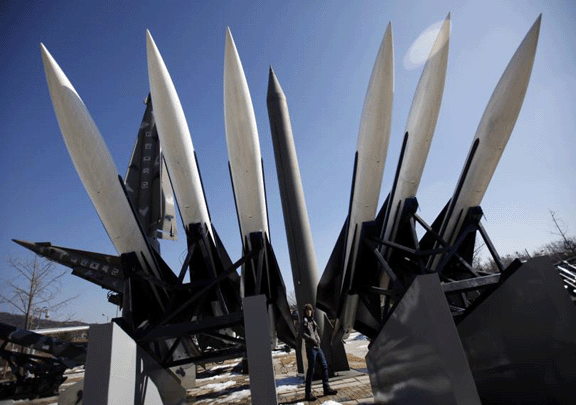 Pentagon Panel Urges Trump Team to Expand Nuclear Options Report suggests “tailored nuclear option for limited use”, Roll C all, John M. Donnelly, 1 Feb 17, A blue-ribbon Pentagon panel has urged the Trump administration to make the U.S. arsenal more capable of “limited” atomic war. The Defense Science Board, in an unpublished December report obtained by CQ, urges the president to consider altering existing and planned U.S. armaments to achieve a greater number of lower-yield weapons that could provide a “tailored nuclear option for limited use.”
The recommendation is more evolutionary than revolutionary, but it foreshadows a raging debate just over the horizon.
Fully one-third of the nuclear arsenal is already considered low-yield, defense analysts say, and almost all the newest warheads are being built with less destructive options. But experts on the Pentagon panel and elsewhere say the board’s goal is to further increase the number of smaller-scale nuclear weapons — and the ways they can be delivered — in order to deter adversaries, primarily Russia, from using nuclear weapons first.
Critics of such an expansion say that even these less explosive nuclear weapons, which pack only a fraction of the punch of the bombs America dropped on Japan in 1945, can still kill scores of thousands of people and lead to lasting environmental damage. They worry that expanding the inventory of lower-yield warheads — and the means for delivering them — could make atomic war more thinkable and could trigger a cycle of response from adversaries, possibly making nuclear conflict more likely. And, they say, such an expansion would cost a lot of money without necessarily increasing security.
The issue will gain greater prominence in the next several years as an up-to-$1 trillion update of the U.S. nuclear arsenal becomes the biggest Pentagon budget issue. That update, as now planned, mostly involves building new versions of the same submarines, bombers, missiles, bombs and warheads. Support for the modernization effort is bipartisan.
But any effort to create new weapons, or even to modify existing ones, in order to expand the arsenal of potentially usable nuclear weapons is likely to trigger opposition.
“There’s one role — and only one role — for nuclear weapons, and that’s deterrence. We cannot, must not, will not ever countenance their actual use,” said Sen. Dianne Feinstein, D-Calif. “There’s no such thing as limited nuclear war, and for the Pentagon’s advisory board to even suggest such a thing is deeply troubling.”
“I have no doubt the proposal to research low-yield nuclear weapons is just the first step to actually building them,” she added. “I’ve fought against such reckless efforts in the past and will do so again, with every tool at my disposal.”
Conservatives on the congressional defense committees generally support exploring new nuclear options………
Fears of expanded arms race
Those who oppose development or production of more small-scale nuclear weapons argue that U.S. conventional capabilities are unmatched. They also say there’s no reason to believe Russia, for all its bluster, would go nuclear in a conflict, because it would never assume the United States wouldn’t respond either with overwhelming conventional force or nuclear weapons.
Moreover, they say, the United States has or will have plenty of lower-yield nuclear bombs to drop if necessary. And, they add, there are few scenarios in which missiles would be needed to deliver such warheads, because aircraft will suffice, particularly if they can launch atomic-tipped cruise missiles from long distances.
There are potentially serious disadvantages to expanding the lower-yield arsenal, the critics also contend.
First, there’s the cost — expected to be in the billions………http://www.rollcall.com/news/policy/pentagon-panel-urges-trump-team-expand-nuclear-options
US Defence Secretary Jim Mattis warns NKorea against nuclear attack
 US warns NKorea against nuclear attack, http://www.sbs.com.au/news/article/2017/02/03/us-warns-nkorea-against-nuclear-attack SBS News, 3 Feb 17, Newly minted US Defence Secretary Jim Mattis has told North Korea that any attack on the US or its allies will attract an “effective and overwhelming” response.
New study for USA intelligence agencies: could he Russian and Chinese leadership could survive a nuclear attack
US Congress orders review of Russian & Chinese leadership’s nuclear strike ‘survivability’ Rt.com 30 Jan, 2017 The US Congress has directed intelligence agencies and the Pentagon’s Strategic Command to evaluate the ‘survivability’ of Russian and Chinese leaders in the event of a nuclear strike on their aboveground and underground defense facilities.
The comprehensive study will be carried out by the US intelligence agencies as well as the Strategic Command, which is in charge of the American nuclear forces. They will evaluate whether the Russian and Chinese leadership could survive a nuclear attack and continue to operate in a post-strike environment, according to a little-reported section of the 2017 National Defense Authorization Act (NDAA). Read more
If we are in arms race, US started it by pulling out of ABM treaty – Putin
The review will include “an identification of which facilities various senior political and military leaders of each respective country are expected to operate out of during crisis and wartime,” as well as the “location and description of above-ground and underground facilities important to the political and military leadership survivability.
“Key officials and organizations of each respective country involved in managing and operating such facilities, programs, and activities” should also be identified, says the document, which is somewhat reminiscent of an elaborate war plan.
“Our experts are drafting an appropriate response,” Navy Captain Brook DeWalt, spokesman for the Strategic Command, said in an email to Bloomberg on Monday. While “it’s premature to pass along any details at this point, we can update you further at a later date.”
Although the study was ordered before Donald Trump took office, it appears to coincide with his statement that he would unconditionally support strengthening US strategic arsenals. In an incendiary tweet in December, Trump wrote that Washington “must greatly strengthen and expand its nuclear capability until such time as the world comes to its senses regarding nukes.”
Later in the month, Trump stunned arms control experts, reportedly telling Mika Brzezinski, co-host of MSNBC’s ‘Morning Joe’ program: “Let it be an arms race. We will outmatch them at every pass and outlast them all.”
The remarks came despite Trump’s separate statement that he would consider a rapprochement with Moscow in response for a possible new deal on nuclear arms reduction………. https://www.rt.com/news/375604-russia-china-nuclear-survivability/
Nuclear Regulatory Commission will continue to allow operation of troubled Pilgrim Nuclear Power Station
 Staff ‘Overwhelmed’ at Nuclear Plant, but U.S. Won’t Shut It, NYT, 2 Feb 17 FEB. 1, 2017PLYMOUTH, Mass. — One by one, ordinary residents confronted the federal regulators, telling them during a three-hour meeting Tuesday night that the Pilgrim Nuclear Power Station here was not safe and should be shut down.
Urgent need for Europe to act to preserve the Iran nuclear deal


 Europe should act fast to preserve the Iran nuclear deal, Bulletin of the Atomic Scientists, Ellie Geranmayeh, 2 FEBRUARY 2017 US President Donald Trump has stirred all kinds of controversy with European allies during his first fortnight in office. Now, his administration’s evolving policy on Iran is becoming another source of concern across the Atlantic. Europe has a crucial but short window to clearly outline its position on the Iran nuclear deal in ways that could influence policymakers in Washington. In doing so, Europe should focus on preserving the agreement under existing terms as enshrined by the United Nations, and charting a course that minimizes confrontation—whether intentional or accidental—between Iran and the United States in an already turbulent Middle East.
On Wednesday, new National Security Advisor Michael Flynn declared that the United States was “putting Iran on notice.” While it is not clear what exactly he meant, he also criticized Iran’s missiles tests and behavior in the region, calling Tehran’s actions “provocative” and staking out a US position distinctly different from those of Europe and Russia. Although Flynn didn’t directly attack the nuclear deal reached between Iran and six world powers in July 2015, a war of words could easily escalate in ways that threaten it.
The Iran nuclear deal, also known as the Joint Comprehensive Plan of Action (JCPOA), scaled back the country’s nuclear activities in exchange for sanctions relief. As a presidential candidate, Trump suggested he would “dismantle the disastrous deal” or renegotiate it. As president-elect he condemned the deal, but has since said he would “rigorously” enforce it. And during a White House briefing the same day as Flynn’s comments, US officials stressed “that they were not linking Iran’s missile and regional actions to the nuclear deal at this point,” as Al-Monitor reported. On Thursday, though, Trump tweeted that Iran “should have been thankful for the terrible deal the U.S. made with them.” Going forward, it seems likely that Trump’s calculations over the nuclear deal and sanctions will be influenced by developments on non-nuclear issues and also events abroad—among Russia, US allies in Europe, the Gulf Arab states, and Israel.
An early test of the US administration’s stance will come this spring, when the president is required to renew sanctions waivers that enable non-US companies to do business with Iran, in accordance with the terms of the nuclear deal. ……
The Iran nuclear deal steered the United States and its allies away from resorting to yet another futile military encounter in the Middle East. It was never intended to solve every problem between the West and Iran, and the two sides continue to take opposing views on a number of critical issues. However, the agreement has proven that Iran and the West have the capacity to resolve complex security challenges through a transactional relationship if there are mutually beneficial outcomes. Instead of watching Tehran and Washington relapse into the rhetoric of war and conflict, Europe should encourage them to build on this winning formula. http://thebulletin.org/europe-should-act-fast-preserve-iran-nuclear-deal10488
Fear of nuclear war leads Texans to build expensive bunkers
 DOOMSDAY DUNGEONS/ (PICTURES) Inside the nuclear bomb shelters being installed throughout Texas as residents prepare for global apocalypse. The bunkers range from £31,000 to £6.6million THE SUN, BY SAM WEBB 2nd February 2017

Dangerous steps by Russia and Trump on nuclear arms control

 Trump, Russia take a dangerous first step on nuclear arms control, The Hill, BY RICHARD NEPHEW AND ADAM MOUNT, 2 Feb 17 In a recent interview with the the London Times, Donald Trump suggested that he would offer to lift U.S. sanctions over Russia’s invasion of Ukraine as part of a nuclear arms control agreement.
At a time when tensions between the two countries are growing, a verifiable and stabilizing new arms control agreement would be genuinely welcome. But a bad deal would only make matters worse.
The comments about sanctions relief raise real questions about whether the incoming administration is willing to pay any price to improve relations with Russia (and why).
Today, both countries are making investments to replace nuclear systems that were first fielded during the Cold War. An agreement to limit these modernization plans could save money, stabilize the nuclear balance, and be safer to maintain and operate.
Under President Obama, the United States found that it could meet its deterrence requirements after a further one-third reduction in deployed strategic warheads, beyond what was agreed in the New Strategic Arms Reduction Treaty (New START) in 2010, and offered this deal to Russia.
A new arms control agreement would be difficult to achieve today. Putin declined Obama’s one-third offer and has signaled that he is not willing to negotiate over his most dangerous systems, its vast and opaque stocks of low-yield and short-range weapons.
At the same time, Russia has violated the 1987 Intermediate-Range Nuclear Forces (INF) Treaty by developing a new prohibited cruise missile and indicated no real willingness to address the concerns of the United States and other treaty participants. Arms control accords are among the most consequential and the most difficult negotiations in the world, features that will surely attract Trump — but changing Putin’s position will be a very tall order. …….http://thehill.com/blogs/pundits-blog/foreign-policy/317403-trump-russia-take-a-dangerous-first-step-on-nuclear-arms
A faulty concept of “acceptable risk” – by America’s Nuclear Regulatory Commission
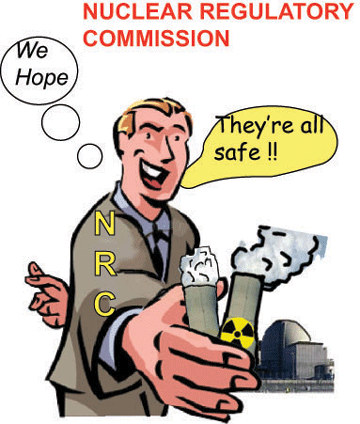 When 10,000 square miles of contamination is an acceptable risk: The NRC’s faulty concept, Bulletin of the Atomic Scientists, 9 JANUARY 2017 Victor Gilinsky In making safety decisions, the Nuclear Regulatory Commission uses accident probability calculations that are much more optimistic than anything that nuclear manufacturers like General Electric and Westinghouse actually believe. The result is weak public protection. A good example is the NRC commissioners’ rejection in 2014 of a proposal to limit the possible severe consequences of spent fuel pool fires in nuclear power plants because the proposal’s cost, however modest, exceeded the value of the expected reduction in “risk.”
Spent fuel pools are where highly radioactive (and thus thermally hot) used reactor fuel is stored after it is removed from the reactor core. If a pool loses its water supply, the spent fuel can overheat and eventually burn, releasing large quantities of radioactivity. The spent fuel pool issue gained prominence after the 2011 Fukushima accident. For a time during the accident the dominant concern was that spent fuel in Fukushima’s damaged Unit 4 pool might catch fire. It didn’t happen, but it could have multiplied the effects of the catastrophic Fukushima accident manyfold. The NRC staff told the commissioners in 2014 that a worst-case spent fuel pool fire in a US plant like those at Fukushima—of which there are nearly three dozen—could release 25 times more long-lasting radioactivity than escaped from the Fukushima reactor vessels, and perhaps even more. Such a release could render 10,000 square miles uninhabitable and (around the Pennsylvania nuclear plant the staff chose as an example) could require the evacuation of 4 million persons.
The specific proposal before the commissioners was to limit the amount of radioactive spent fuel in a pool and thus to reduce the consequences of a fire by a factor of ten. This would be accomplished by speeding up the transfer of radioactive spent (used) fuel from the pool into “dry cask” storage. The plant owners have to do this eventually, but earlier transfers increase the cost. The commissioners saw their role as deciding whether the safety benefit—the reduction in risk—warranted this cost increase.
In fact, they weren’t deciding anything. The commissioners lent an air of official seriousness to the proceeding, but the decision making was on autopilot. It involved calculating the average risk (R) of an accident by multiplying two numbers, the accident’s probability (P) and its consequence (C). If P is sufficiently small, the average risk (or P times C) will be negligible no matter how large the consequence. And, therefore, the possible reduction in risk will hardly be worth any expenditure. That is how it worked in the 2014 case of a possible spent fuel fire, and that is how it has worked in most cases involving protection against severe accidents.
Actually, most cases don’t get this far. The commission has a threshold for the staff to investigate a safety issue posed by a hypothetical accident. If the estimated probability of “prompt” deaths offsite is below 2 in 1 million per year, the NRC staff need not investigate further. This involves a kind of Catch-22. The NRC assumes effective evacuation of the surrounding area in the event of an accident, so there aren’t people to be irradiated, and even substantial accidents don’t exceed the commission’s threshold……..
Consider the implications of NRC’s risk definition for the risk of long-term land contamination: The NRC staff’s projection of about 10,000 square miles, when multiplied by the staff-estimated accident probability, becomes an annual risk of about one-thousandth of a square mile, or less than an acre per year. Since valuable farmland runs at several thousand dollars per acre, the NRC conclusion is that any safety improvement that costs more than that isn’t worthwhile in terms of saving land. Similarly, the risk of displacing persons, becomes about half a person displaced per year, perhaps at a cost of tens of thousands of dollars, and so, again, per NRC logic, it is not worth spending more than that to avoid long-term evacuations to protect against severe spent fuel pool fires. This isn’t the conclusion most people would arrive at for themselves or their home towns.
There are several things wrong with the NRC’s cost-benefit approach to nuclear safety. To begin with, neither factor in the risk formula—probability times consequence—can be calculated with any accuracy. For example, the consequences of an accident requiring the long-term, possibly permanent, evacuation of 4 million will surely not be limited to the expense of such an evacuation. It would, for example, almost certainly spell the end of nuclear power use in the United States and likely in many countries, with huge economic consequences. …….
Nor is the situation much better when it comes to estimating the accident probability. As there is little data on large accidents, the accident probability is a calculated number. The NRC staff relies increasingly on elaborate calculations that model the various failure modes of a nuclear plant. For outsiders, or for that matter the NRC commissioners themselves, the result essentially comes out of a black box. …..
Which brings us to a deep flaw in NRC’s safety methodology—its reliance on the average risk as the figure of merit. It is by no means the only possible measure of risk. We know that in many statistical situations the average is not the best choice to characterize the data. It works where there are well-established data on both probabilities and consequences as, for example, in considering measures to reduce auto accidents. It doesn’t make sense for high consequence/low probability events, for one thing, because the numbers are so poorly known. Also, using average risk doesn’t reflect what most people—the people the NRC is supposed to be protecting—want to achieve. They don’t want to risk losing a city, no matter what the calculated probabilities. That is how the nuclear manufacturers—Westinghouse and General Electric—see it, too. They refuse to participate in any project unless they are guaranteed to be free of any liability for any offsite accident consequences. If they believed the NRC risk calculations, they would have no difficulty in accepting the litigation risk—but they obviously don’t. In short, the organizations most highly knowledgeable about nuclear safety don’t trust the NRC’s probabilistic calculations………
Any change in the NRC’s approach to nuclear risk must come from the outside; the agency has too much invested in the current approach for internal reform to have a chance. When a witness at the 2014 Commission meeting on spent fuel pool fires, Clark University professor Gordon Thompson, questioned using the average risk as the figure of merit, only one commissioner took notice and that was to ridicule the notion. The commissioners should have paid more attention.
A definition of risk that placed greater emphasis on avoiding large-consequence events would be more in line with the common sense of the public whom the NRC is supposed to be protecting. If nuclear power is to have any long-term future, it will have to go beyond even that level of protection. A 2012 report of the American Society of Mechanical Engineers, a group heavily involved with the nuclear industry, called for a major step-up in nuclear safety and warned that severe accident impacts on people’s lives were “wholly inconsistent with an economically viable and socially acceptable use of nuclear energy.” Just as the nuclear manufacturers don’t want to bet their companies on calculations of nuclear safety, neither do people at large want to bet their cities and countrysides. http://thebulletin.org/when-10000-square-miles-contamination-acceptable-risk-nrc%E2%80%99s-faulty-concept10459
Donald Trump gives right-wing investment banker Breitbart News firebrand a top security role!
 Bannon Is Given Security Role Usually Held for Generals JAN. 29, 2017 WASHINGTON — The whirlwind first week of Donald J. Trump’s presidency had all the bravura hallmarks of a Stephen K. Bannon production.
A personal story of nuclear radiation, cancer and death
 James Knieling no high level international nuclear waste dump in south australia, 30 Jan 17
 Funny thing about Radiation debris, once it drops into your house, its like the “Relatives Visiting From Hell!” I watched the biggest ever above ground Nuke go off from 75-miles away, while my dad hoisted it into position at the Mercury’s Nevada Test Site. *It was dark with only the lights of Fremont Street’s Casinos at 0530 and then the brightest light you ever did not look at went on. Then a 50mph wind struck us, and it felt like a hundred little bee stings on my bare arms, legs, and face
Then it was gone. About 20-years later they found Nuclear Hot Particles in the attics of our street. My dad built and operated 67-above ground nuclear bomb hoists in 1956-7. He died of his exposure, never being warned that his badge had gone red hot, with Small Cell Lung & Bone Cancer.
My field was Radiation Health Technology to work at the Nevada Test Site so when I had the chance to go to Bikini Atoll and see all the on-site data and films I went. I went on the 60-yr post-blast and we took reading for a week. The coconuts were lethal, the coconut crabs were lethal, the ground was, even with 17″ of protection fill, still off gassing lethal hot particles.
We were billeted in structures built several feet off the ground with blowers underneath to vent the radiation. We were told not to walk bare foot, and not sit, or linger on the ground. We were told to “Never, Ever turn off the A/C and Never, Ever to shut the fresh air vent!” Funny thing about being safe to visit. Only a 150+ people had a problem with the “OK to Visit” notice, and they dropped dead. See the sign below from the Bikinian Cemetery? Guess who’s in it? Answer~!The Bikinians the US Govt suckered as “Its safe to come home!” Not, they started dropping like flies! https://www.facebook.com/groups/1314655315214929/
A Washington State judge uses doubt on climate change as legal cause to block a climate activist’s defense

Would any judge question a medical expert’s evidence in the way that this judge doubts the evidence of the world’s climate scientists? Then again – they do say that “the law is an ass”
Judge in environmental activist’s trial says climate change is matter of debate
Controversial statements angered environmentalists who insist courts have an obligation to recognize the science about manmade climate change, Guardian, Sam Levin 31 Jan 17, A Washington state judge has sparked outrage for remarks questioning the existence of climate change and the role of humans in global warming.
During the high-profile trial of Ken Ward, a climate activist facing 30 years in prison for shutting down an oil pipeline, Judge Michael E Rickert said: “I don’t know what everybody’s beliefs are on [climate change], but I know that there’s tremendous controversy over the fact whether it even exists. And even if people believe that it does or it doesn’t, the extent of what we’re doing to ourselves and our climate and our planet, there’s great controversy over that.”
The Skagit County judge made the comments on 24 January while addressing Ward’s request to present a “necessity defense” in court, meaning he would argue that the grave threat of climate change justified civil disobedience.
Rickert’s controversial statements, along with his decision to block Ward from arguing that his pipeline protest was necessary to prevent harm to the planet, angered environmentalists who insist that American courts have an obligation to recognize the science and consensus among researchers about man-made climate change.
“I thought it was shocking and deeply worrisome for my case,” said Ward, 60, of Corbett, Oregon, who temporarily shut off the safety valve of the TransMountain pipeline in Skagit County. “We are in the late stages of global collapse, and to have someone who is presumably as knowledgeable and aware as a judge should be blithely dismissing the biggest problem facing the world is chilling.”
Ward, whose trial began on Monday, is part of a group of activists that targeted oil sands pipelines in Washington, Oregon, North Dakota, Montana and Minnesota on 11 October 2016. The coordinated #ShutItDown actions – which have led to a dozen criminal cases and threats of hefty prison sentences against activists and journalists – was aimed at stopping 15% of US crude oil imports for a day.
He later added that with climate change, there’s “great controversy” with “over half of our political leaders”. (Critics have slammed the GOP as the “only major party in the advanced world” to deny climate change)……. https://www.theguardian.com/environment/2017/jan/31/environmental-activist-trial-judge-questions-climate-change-ken-ward
The link between “peaceful” nuclear power and nuclear weapons
 What is the Relationship of Nuclear Energy Plants and Nuclear Weapons? Finding the Missing Link January 28, 2017 Scott Jones, Ph.D.
Setting aside the classical tenderness of the phrase, they are Mother and Child. Within the science community and the business of commercial nuclear energy this reality is a given. However, the “Atoms for Peace” commercial slogan may have introduced some ambiguity about this reality. This is quickly cleared up for the lay person by a January 1983 article published in The Bulletin of the Atomic Scientists:
“An even more specific confirmation of the economic advantage
of the commercial-power route to bombs is available in a most
distressing form: the admission by the U.S. government, in late 1981,
 that it is considering turning to commercial-reactor fuel as the
 source of plutonium for a new round of nuclear warheads. Would
the United States even consider paying the political costs of such a
move unless the economic attractiveness were compelling?”
The family relationship is the basic and fundamental link between nuclear energy production and nuclear weapons. However, it leads to other important relationships.
Nuclear weapons are the result of willful national security political decisions. After the development and use of nuclear weapons by the Unites States, every country that followed in the club of nuclear weapon owners made that decision because of an assessment that it gave them security that they otherwise would not have. It was claimed to be a defensive move to deter all potential enemies from use of nuclear weapons against them……
What we can say with certainty is that a nuclear power plant nominates itself as a potential target. What cannot easily be predicted is who or what may be the aggressor. While progress is being made in predicting threats from nature, it will always remain to a significant degree a capricious force.
In the human realm, current and traditional enemies most certainly will be on target and threat lists. But the threat may be from a terrorist group that selects one of the world’s existing 450 operating nuclear power plants in 31 countries, or later, one the 60 new plants under construction in 16 countries. Which plant to attack may be decided because it is assessed to be the most vulnerable target for their capability to attack.
There is no shortage of targets now and the number is increasing. Success will not be measured by the amount of radiation released. That will almost be immaterial.
The global nuclear power plant network shares a nervous system that is highly tuned to every nuclear event. Deserved or not an accident or an attack will be perceived by much of the world through a memory lens of Hiroshima, Nagasaki, Chernobyl, and Fukushima. http://akiomatsumura.com/2017/01/what-is-the-relationship-of-nuclear-energy-plants-and-nuclear-weapons.html
1 This Month
19 November – Webinar – The Reality of Reprocessing
Time: 11:00 AM Pacific Time (US & Canada) / 2:00 PM Eastern / 7:00 PM UK / 8:00 PM CET
Register for the Zoom Event Here

Tell Congress: Prevent Nuclear Catastrophe in Iran

Tell Congress: Prevent Nuclear Catastrophe in Iran

Read the Public Inquiry Report, the Commissioners’ report, Surrendering Australia: The AUKUS Deception is available to download for free at aukuspublicinquiry.com. Or just watch the replay of the National Press Club Luncheon.


Shut down the radiation-damaged Heysham nuclear reactors now
To see nuclear-related stories in greater depth and intensity – go to https://nuclearinformation.wordpress.com

Say No to NASA’s Reckless Nuclear Reactor on the Moon
Say No to NASA’s Reckless Nuclear Reactor on the Moon
-
Archives
- November 2026 (166)
- October 2026 (302)
- September 2026 (339)
- August 2026 (330)
- July 2026 (355)
- June 2026 (287)
- May 2026 (306)
- April 2026 (356)
- March 2026 (251)
- February 2026 (267)
- January 2026 (308)
- December 2025 (358)
-
Categories
- 1
- 1 NUCLEAR ISSUES
- business and costs
- climate change
- culture and arts
- ENERGY
- environment
- health
- history
- indigenous issues
- Legal
- marketing of nuclear
- media
- opposition to nuclear
- PERSONAL STORIES
- politics
- politics international
- Religion and ethics
- safety
- secrets,lies and civil liberties
- spinbuster
- technology
- Uranium
- wastes
- weapons and war
- Women
- 2 WORLD
- ACTION
- AFRICA
- Atrocities
- AUSTRALIA
- Christina's notes
- Christina's themes
- culture and arts
- Events
- Fuk 2022
- Fuk 2023
- Fukushima 2017
- Fukushima 2018
- fukushima 2019
- Fukushima 2020
- Fukushima 2021
- general
- global warming
- Humour (God we need it)
- Nuclear
- RARE EARTHS
- Reference
- resources – print
- Resources -audiovicual
- Weekly Newsletter
- World
- World Nuclear
- YouTube
-
RSS
Entries RSS
Comments RSS

