Local students advocate for nuclear Post Register, May 11, 2017 By KEVIN TREVELLYAN ktrevellyan@postregister.com
Emma Redfoot and Kelley Verner noticed something when marching last year in Chicago in an effort to save two nuclear power plants from decommission
……….Fifty-four percent of Americans oppose nuclear energy, according to a 2016 Gallup poll, up from 43 percent in 2015. Last year was the first time the majority of the country opposed nuclear since Gallup started asking the question in 1994.
Public hesitance to embrace nuclear increases the need for advocacy, centrist [??] think tank Third Way communications adviser Suzanne Baker said. Baker previously was an INL spokeswoman.
“Nuclear is an often misunderstood technology,” she said. “And advocacy becomes an important way to help humanize and tell the story of the technology in a way that connects with people. Technical information is important and useful, but it doesn’t always tell us why something matters, and advocacy can do that.”…….
Advocacy can make a difference, Baker said. Following the Chicago pro-nuclear march, the Illinois House of Representatives passed a bill subsidizing operation of the unprofitable Clinton and Quad Cities nuclear generating stations.
Students for Nuclear is focusing its efforts on a handful of other plants that may face decommissioning in coming years. The group has about 70 members who attend colleges across the country.
Over the summer Redfoot and Verner will visit Pacific Northwest National Laboratory in Washington state to discuss nuclear advocacy. They’ll also speak at an American Nuclear Society meeting, and Redfoot will speak to the Association of Environmental Studies and Sciences.
The group also is in contact with the Idaho Conservation League and The Nature Conservancy……..
Redfoot and Verner are trying to bolster group membership with students who aren’t studying nuclear, and they’re gathering stories of those who are to add to the Students for Nuclear website.
Tillerson, at Arctic meeting, signs document affirming need for action on climate change, LA Times, William Yardley, 11 May 17, US Secretary of State Rex Tillerson signed his name Thursday to a document that affirms the need for international action against climate change, adding further uncertainty to the direction of climate policy under the Trump administration.
The document, signed by Tillerson and seven foreign ministers from Arctic nations meeting this week in Fairbanks, Alaska, says the participants concluded their meeting “noting the entry into force of the Paris agreement on climate change and its implementation, and reiterating the need for global action to reduce both long-lived greenhouse gases and short-lived climate pollutants.”
Called the Fairbanks Declaration, the document says the leaders signed it “recognizing that activities taking place outside the Arctic region, including activities occurring in Arctic states, are the main contributors to climate change effects and pollution in the Arctic, and underlining the need for action at all levels.”
The Trump administration has been in conflict for months over what to do about U.S. involvement in the landmark 2015 Paris climate accord, which commits nearly 200 nations to establishing goals to reduce emissions that lead to climate change.
Trump has repeatedly questioned climate science, calling climate change a hoax perpetrated by the Chinese and vowing during his campaign to “cancel” the Paris agreement……..
Tillerson, the former chief executive of Exxon, is among those who have argued that the U.S. should keep its commitment.
The Fairbanks Declaration does not affirm that the U.S. will honor the Paris accord. Nor does it explicitly state that human activity is causing climate change.
And Tillerson’s spoken remarks at the meeting made clear that the administration is divided. After vowing that the U.S. would “continue to be vigilant in protecting the fragile environment in the Arctic,” Tillerson said this about current U.S. climate policy:
“In the United States, we are currently reviewing several important policies, including how the Trump administration will approach the issue of climate change. We’re appreciative that each of you has an important point of view and you should know that we are taking the time to understand your concerns. We’re not going to rush to make a decision. ……..
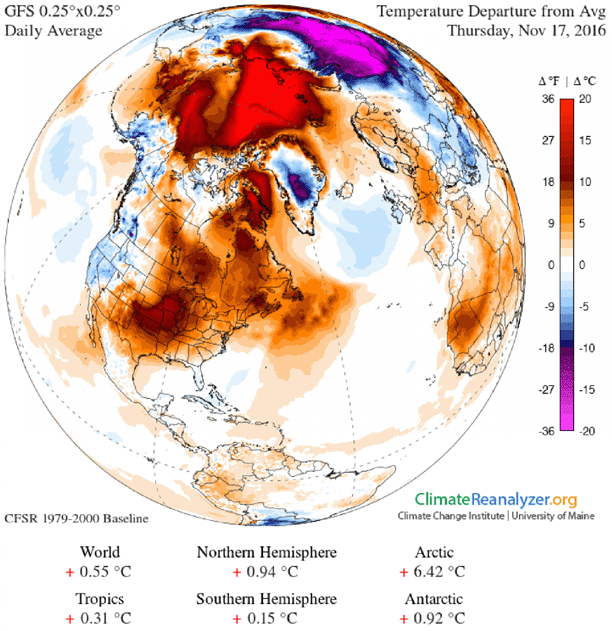
No part of the world is warming faster than the Arctic.
Summer sea ice regularly shrinks to record lows, coastlines are eroding and wildfires are getting worse. Even the frozen tundra, a critical natural storage tank for carbon emissions, is no longer so frozen. Scientists reported this week that it is warming so rapidly that it now is emitting more carbon than it captures.
The Fairbanks Declaration includes several other references to climate change and taking action to mitigate it or adapt to it. It refers to “reiterating the importance of climate science to our understanding of the changing Arctic region and our activities in the Arctic environment.”……http://www.latimes.com/nation/la-na-arctic-council-20170511-story.html
How ‘Worst-Case Scenario’ At New Brunswick Nuclear Plant Could Affect Down East Maine, Maine Public, 12 May ByJENNIFER MITCHELL Point Lepreau is a nuclear power plant just across the border in St. John. Next month its operating license expires, and the Canadian Nuclear Safety Commission is considering whether to renew it for another five years. While that’s not a long amount of time for a 30-year-old plant, there are passionate arguments for and against its operation and implications for an entire region.
This is the second of two parts. To read Part 1, a tour of Point Lepreau, click here.
Back in the 1950s, an U.S. Atomic Energy Commission film, “The Magic of the Atom,” was meant to ease the anxiety people might feel about living and working near a nuclear power plant.
“Today, if you were to take a trip in almost any direction across our great country, you might suddenly come upon a sign like this: Atomic City,” the film’s narrator says.
But after the 1979 disaster at Three Mile Island, nuclear plants developed a more sinister reputation, and ever since, facilities like Point Lepreau have been battling that legacy………
there are some who are speaking out against the facility’s license renewal.
“The health risks are too great. There is no way to make nuclear safe,” says Willi Nolan of Kent County, New Brunswick.
Nolan says she has made it her business to follow up on past major nuclear accidents, and she says the potential devastation to the environment is a deal breaker.
“I just spent some time with four survivors of Fukushima and I’m told, you know, after the worst-case scenario happened there, that there are now people dropping on the streets, 30 years old, 40 years old. We’re still not finished with Chernobyl. There are still human health effects, cancers, childhood conditions,” she says.
When it comes to a nuclear plant meltdown, there are two basic zones of concern: the critical emergency zone that extends for a 10-mile radius, and then what’s known as the ingestion pathway. That spans a 50-mile radius and, in the case of Lepreau, would include towns like Eastport, Calais, Lubec, and East Machias.
But how much do emergency responders in those towns know about nuclear events?
“Very little,” says Mike Hinerman, who runs Washington County’s Emergency Management Agency…….
the biggest problem, experts say, would come in the weeks, months and years after the event, because anything grown in or harvested from that 50-mile ingestion pathway could be tainted — for decades.
“What do you do with apples? What do you do with fish? What do you do with clams?” says Robert Gardiner, MEMA’s technological hazards manager……..a major Lepreau event would devastate the county’s economy, affecting everything from shipping at Eastport to aquaculture, forest products, fishing, tipping, hunting and tourism, and of course the region’s wild blueberries……..
Nuclear Waste From the Cold War Is Being Stored in Unsafe Conditions. Time to Fix the Problem is Running Out, TIME, Nicholas K. Geranios and Manuel Valdes / AP, May 11, 2017 (RICHLAND, Wash.) — The collapse of a tunnel containing radioactive waste at the Hanford nuclear weapons complex underscored what critics have long been saying: The toxic remnants of the Cold War are being stored in haphazard and unsafe conditions, and time is running out to deal with the problem.
“Unfortunately, the crisis at Hanford is far from an isolated incident,” said Kevin Kamps of the anti-nuclear group Beyond Nuclear.
For instance, at the Savannah River Site in South Carolina, which opened in the 1950s and produced plutonium and tritium, the government is laboring to clean up groundwater contamination along with 40 million gallons of radioactive liquid waste stored in tanks that are decades past their projected lifespan. The job is likely to take decades.
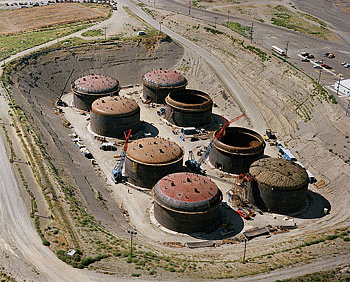
In addition to the tunnel collapse discovered Tuesday, dozens of underground storage tanks at the Hanford Nuclear Reservation in Washington state — some dating to World War II — are leaking highly radioactive materials.
The problem is that the U.S. government rushed to build nuclear weapons during the Cold War with little thought given to how to permanently dispose of the resulting waste.
Safely removing it now is proving enormously expensive, slow-going, extraordinarily dangerous and so complex that much of the technology required simply does not exist. The cleanup has also been plagued with political and technical setbacks.
For example, the nation’s only underground nuclear waste repository, in New Mexico, closed to new shipments in 2014 after an improperly packed drum of waste ruptured. The site just recently reopened.
The U.S. Department of Energy spends about $6 billion a year on managing waste left from the production of nuclear weapons. “The temporary solutions DOE has used for decades to contain radioactive waste at Hanford have limited lifespans,” said Sen. Ron Wyden, an Oregon Democrat and frequent Hanford critic. “The longer it takes to clean up Hanford, the higher the risk will be to workers, the public and the environment.”
U.S. Energy Secretary Rick Perry acknowledged the problem with nuclear waste, saying the nation can no longer delay fixing the problem because lives are at stake.
During a tour Wednesday of the Los Alamos National Laboratory in New Mexico, Perry said the federal government has failed to remove the waste in a timely manner and he pledged to make progress.
A recently approved bipartisan federal budget deal for this fiscal year includes $2.3 billion for the ongoing Hanford cleanup, which matches the amount that Sen. Patty Murray, a Washington Democrat, worked to include last year. President Donald Trump is expected to release his 2018 proposal later this month.
Washington Gov. Jay Inslee said the state plans to issue an order making sure the federal government determines the cause of the tunnel collapse. The order will also require the Energy Department to assess if there’s an immediate risk of failures in any other tunnels and take actions to safely store waste in the tunnels until a decision is made about how to permanently handle the material.
Collapsed tunnel sealed at U.S. nuclear site after accident, Chicago Tribune, Nicholas K. GeraniosAssociated Press, 11 May 17, Workers at a Washington state nuclear site where a tunnel filled with nuclear waste in railroad cars partially collapsed have safely sealed off a large sinkhole that emerged as a result of the collapse, U.S. Energy Secretary Rick Perry said Thursday.
Authorities also revealed that the 400-square foot (37-square meter) sinkhole they filled with soil could have been there since last weekend before it was discovered Tuesday. That’s because the area around the Hanford Nuclear Reservation’s waste-filled tunnels is not observed every day by workers who patrol the site’s sprawling grounds………
Washington state officials on Wednesday demanded that the federal Energy Department immediately assess the integrity of all the Hanford tunnels.
“The infrastructure built to temporarily store radioactive waste is now more than a half-century old,” said Maia Bellon, director of the state Department of Ecology, which oversees and regulates the federal government’s Hanford cleanup.
The 360-foot long (110-meter) rail tunnel that collapsed was built in 1956 from timber, concrete and steel and covered with 8 feet (2.4 meters) of dirt. Eight flatbed railroad cars loaded with radioactive material were parked there in 1965.
A much larger nearby tunnel built in 1964 has 28 railroad cars with radioactive waste.
The Energy Department was warned in a 2015 report it commissioned that both tunnels were vulnerable to a collapse from an earthquake or deterioration of tunnel building materials caused by intense radiation, the report said.
The nearby Yakama Nation said it has warned about the safety of the tunnels for several years.
“No preventative action was taken,” the tribe said in a statement.
The tribe also said the tunnels should be cleaned of radioactive waste and radiation long before a deadline of 2042 set by a cleanup agreement between the federal and state governments.
The creation of the centre focusing on specific threats, will allow the Central Intelligence Agency to “harness the full resources, capabilities, and authorities” to deal with North Korea, CNN quoted the statement as saying late Wednesday.
The centre will put together CIA analysts and officers side by side in one location to tackle the threat from Pyongyang.
“The new Mission Centre draws on experienced officers from across the Agency and integrates them in one entity to bring their expertise and creativity to bear against the North Korea target,” the statement said.
Former CIA senior analyst John Nixon told CNN he expected the centre to issue “sitreps” — situation reports — for the intelligence community and President Donald Trump’s administration, possibly twice daily, indicating a round-the-clock watch by an office of significant size.
In the statement, CIA Director Mike Pompeo said the creation of the centre focuses the CIA’s efforts against the “serious threats” emerging from North Korea, which has ramped up both nuclear and missile tests in an effort to enhance its military capabilities.
There are 10 such existing centres in the CIA, and the new addition will be the most focused in terms of geographical area and remit — the Korean Peninsula currently falls under the jurisdiction of the Mission Centre for East Asia and Pacific.
On the opposite side, supporting FirstEnergy, were unions, a contractor’s group, and the Perry local school district, which benefits from taxes from the Perry nuclear power plant.
The Ohio Manufacturers’ Association, the Ohio Consumers’ Counsel, the Lordstown Energy Center, Dynegy, now the state’s largest owner of coal-fired power plants, the American Petroleum Institute and the Electric Power Supply Association were among more than a dozen groups testifying against enabling legislation before the Ohio House Public Utilities Committee.
“House Bill 178 or the Zero Emission Nuclear credit bill would provide an enormous subsidy to one nuclear operator for units that they contend are no longer economic to operate,” said Robert Flexon, CEO of Houston-based Dynegy Inc.
“Our economy will not grow and prosper by artificially keeping alive business that can no longer compete in the marketplace through expensive subsidies,” he told lawmakers. “That has been the case throughout American history. Were that not so, we’d still have buggy whip and icebox manufacturers and teletype and elevators operators.”
Later in an interview, Flexon said the zero emissions argument, meaning the plants deserve higher rates because they don’t produce carbon dioxide, is a “red herring.”
“The nuclear plants are deeply out of the money. You [the state] would be throwing billions of dollars down a nuclear waste hole. These plants can’t live without subsidies. Why do you want to put more bills on your citizens? It’s beyond me.”
Flexon was joined by William Siderewicz, president of Boston-based Clean Energy Future, which is building four gas turbine power plants at two northern Ohio locations, including Lordstown.
You would be throwing billions of dollars down a nuclear waste hole. These plants can’t live without subsidies.”
Calling for the House to “summarily reject” any form of the legislation, Siderewicz charged that FirstEnergy’s objective was not to save Davis-Besse and Perry nuclear power plants, but to prepare for selling the plants or closing them and paying for the decommissioning.
Former Republican lawmaker Jeff Jadobson, now a lobbyist, appeared before the committee on behalf of the Ohio Consumers’ Counsel and the Northeast Ohio Public Energy Council, which oppose the bill.
He said Ohio consumers are stuck with the 18th highest electric rate in the nation despite being “awash in shale oil and natural gas that have given us historically low gas prices” — which is leading to a building boom in new gas plants.
“But there is a problem that is preventing Ohio families and businesses from realizing the full benefits of lower prices in the market,” he said. “That problem is the continuing requests by Oho electric utilities — now years since the 1999 deregulation law’s transition period ended — for consumers to pay subsidies above the market price of electricity.”
He said FirstEnergy received $9.8 billion in subsidies between 2001 and 2010 to help it transition from the old regulated markets to competitive deregulated markets. And as of Jan. 1, the company has been permitted to collect an additional $204 million a year for up to five years in additional subsidies.
“FirstEnergy is back. Respectively, you should stop this cycle of subsidies and give consumers more of the benefit of competition intended under the 1999 law,” he told the lawmakers.
Earlier in the day, Chris Zeigler, executive director of the American Petroleum Institute’s Ohio division, and Erica Bowman, API chief economist, told reporters that FirstEnergy’s proposed subsidies could stall the development of the 10 or more gas turbine power plants proposed or already being built in Ohio. And in turn, that could stall further development of Ohio’s rich shale gas deposits.
Bowman also testified, concluding that API is strongly opposed to House Bill 178. It would skew markets by propping up uncompetitive nuclear generation, increase costs for ratepayers and job-creating industries, and discourage investment in natural gas production and gas-fired power plants. ”
Other opponents included the Ohio Environmental Council, AARP Ohio, the League of Women Voters of Ohio, Ohio Citizen Action the Environmental Defense Fund and the Nuclear Information and Resource Service.
FirstEnergy initially asked that lawmakers vote on the bill by June 30, but at this point that is not expected to happen.
All of the testimony is posted on the committee’s website.
Reports of impending Toshiba bankruptcy raise new doubts about S.C. nuclear project, The Post and Courier, By David Wren dwren@postandcourier.com, May 11, 2017
The utilities building new reactors at a Midlands nuclear plant aren’t saying what impact a potential Toshiba Corp. bankruptcy filing could have on the troubled construction project, even as more questions are being raised about the Japanese conglomerate’s financial health……..Toshiba’s business partners told The Wall Street Journal that they are bracing for a bankruptcy filing that could wipe out many of the Tokyo firm’s commitments, including a guarantee to pay up to $1.7 billion in cost overruns at the V.C. Summer Nuclear Station in Jenkinsville…….
The utilities must make a decision by June 26 whether to build one or both of the reactors or scrap the plan entirely. Santee Cooper’s board of directors met in a private session Wednesday to get legal advice on the project but took no action…….
The utilities also are counting on an extension of federal tax credits for new nuclear projects to keep V.C. Summer alive. Those credits expire at the end of 2020, and it’s not certain the two reactors — which are only about one-third complete, according to a filing with the S.C. Public Service Commission — will be online by then. An effort to extend the tax credit deadline has gotten little traction in Congress.
“It is very, very important to the viability,” Jimmy Addison, SCANA’s chief financial officer, said of the tax credits during a conference call with analysts last month.
Meanwhile, Georgia Power, the nation’s only other utility adding new nuclear generation, could make a decision as early as Friday whether to finish two reactors under construction at its Plant Vogtle near Augusta. Westinghouse is the contractor on that project, where Toshiba has guaranteed $3.7 billion in payments. An interim agreement to keep work on track at Vogtle expires Friday but could be extended.
Georgia Power spokesman John Kraft told the Atlanta Journal-Constitution that the utility “will take every action available to hold Westinghouse and Toshiba accountable for their financial responsibilities” even if the parent company files for bankruptcy protection.
Like V.C. Summer, the Vogtle project is behind schedule and over budget to the tune of about $3 billion……..
Glaciers rapidly shrinking and disappearing: 50 years of glacier change in Montana https://phys.org/news/2017-05-glaciers-rapidly-years-glacier-montana.html#jCphttp://phy.so/413641276May 10, 2017 The warming climate has dramatically reduced the size of 39 glaciers in Montana since 1966, some by as much as 85 percent, according to data released by the U.S. Geological Survey and Portland State University. On average, the glaciers have reduced by 39 percent and only 26 glaciers are now larger than 25 acres, which is used as a guideline for deciding if bodies of ice are large enough to be considered glaciers.
The data include scientific information for the 37 named glaciers in Glacier National Park and two glaciers on U.S. Forest Service land. The retreat of glaciers is significant in Montana because of the impact shrinking glaciers can have on tourism, as well as being a visual indicator of mountain ecosystem change in the northern Rocky Mountains.
“The park-wide loss of ice can have ecological effects on aquatic species by changing stream water volume, water temperature and run-off timing in the higher elevations of the park,” said lead USGS scientist Dr. Daniel Fagre.
Portland State geologist Andrew G. Fountain partnered with USGS on the project. He said glaciers in mountain ranges throughout the United States and the world have been shrinking for decades.
“While the shrinkage in Montana is more severe than some other places in the U.S., it is in line with trends that have been happening on a global scale,” Fountain said.
Scientists used digital maps from aerial photography and satellites to measure the perimeters of the glaciers in late summer when seasonal snow has melted to reveal the extent of the glacial ice. The areas measured are from 1966, 1998, 2005 and 2015/2016, marking approximately 50 years of change in glacier area.
Site visits to glaciers were also made over several years to investigate portions that were covered by rock debris that are difficult to see with digital imagery. The mapped measurements of glaciers complement ground surveys of glaciers using GPS along with repeat photography that involves re-photographing historic photos of glaciers taken early last century when there were an estimated 150 glaciers larger than 25 acres in Glacier National Park.
“Tracking these small alpine glaciers has been instrumental in describing climate change effects on Glacier National Park to park management and the public,” said Lisa McKeon, USGS scientist who has been documenting glacier change since 1997.
This information is part of a larger, ongoing USGS glacier study of glaciers in Montana, Alaska and Washington to document mass balance measurements that estimate whether the total amount of ice is increasing or decreasing at a particular glacier. This information helps scientists understand the impact of large scale climate patterns on glaciers in distinctly different mountain environments.
The data for Glacier National Park’s named glaciers are available at the USGS ScienceBase website. Additional information about the glacier research can be found at the USGS Northern Rocky Mountain Science Center website and the USGS Benchmark Glacier program website.
Current state law requires an “all-hazard emergency plan for the natural, technological, or human-caused hazards which could affect” citizens. But a law passed in 1984 says that any such plan “may not include preparation for emergency evacuation or relocation of residents in anticipation of nuclear attack.”
A bill introduced by senators David Frockt, a Democrat, and Mark Miloscia, a Republican, would get rid of that language.
They say recent tensions between the U.S. and North Korea makes the idea timely.
A state regulatory hearing on Thursday opened the Georgia Public Service Commission’s latest biannual review of Plant Vogtle (VOH’-gohl) costs, focused on $222 million reported between July and December. But the bankruptcy filing by Westinghouse Electric Co., the U.S. nuclear unit of Japan’s Toshiba Corp., loomed large.
Construction of two new reactors south of Augusta is already years behind schedule and billions of dollars over budget.
Georgia Power officials said the company still is studying the cost and timeline to complete both reactors, cancel one or both. They say a recommendation will be brought back to the commission.
US energy secretary touts nuclear power, KOB4, May 10, 2017 ALAMOS, N.M. (AP) – U.S. Energy Secretary Rick Perry says he will advocate for nuclear power as often and as strongly as he can as the nation looks for ways to fuel its economy and limit the effects of electricity generation on the environment.
Beyond Nuclear, TAKOMA PARK, MD, May 9, 2017— A tunnel at the Hanford Nuclear Site in Washington State collapsed today on top of railcars stored there that contain “mixed” radioactive waste, an accident that local watchdog group, Hanford Challenge, describes as a “crisis.”
The tunnel is located next to the Plutonium Uranium Extraction Facility, also known as PUREX, and contains substances classified as “dangerous waste.” The collapse prompted an initial evacuation of workers in the area that then spread to a “take cover” order for the entire site.
The already embattled Hanford site was originally part of the Manhattan Project, and a major supplier of military plutonium. It houses 177 storage tanks containing liquid radioactive sludges, some of which have been leaking radioactive effluent that could eventually threaten the Columbia River. Cleanup at the site did not begin until 1989. The Hanford tunnel collapse may have been caused by soil subsidence due to vibrations from nearby road works.
“The current unfolding crisis at Hanford, the bursting barrel at Waste Isolation Pilot Plant (WIPP) in New Mexico in 2014, and the exploding radioactive waste dump in Beatty, Nevada in 2015, show that radioactive waste management is out of control,” said Kevin Kamps, Radioactive Waste Watchdog at Beyond Nuclear
”That’s why the Yucca Mountain dump in Nevada, the Canadian dump targeted at the Great Lakes shore, and the parking lot dumps in Texas and New Mexico must be blocked, to prevent future disasters,” Kamps added.
WIPP, a radioactive waste repository mainly for military waste and situated near Carlsbad, NM, suffered an accident on February 14, 2014. The explosion there released radioactivity that exposed workers who were stationed above ground at the time and forced an almost three-year shutdown of the site. The disaster cost $2 billion and counting. As at Hanford, a relatively minor event — the use of the wrong kitty litter for cleanup — was blamed for the WIPP accident, prompting serious questions about competence and safeguards at such critically dangerous sites.
A leak in a massive nuclear waste storage tank at Hanford in April 2016 was described as “catastrophic” by a former tank farm worker there, even as the U.S. Department of Energy tried to downplay the problem.
Most commercial radioactive waste is currently stored at reactor sites around the country. However, military radioactive waste has continued to pose an on-going storage nightmare. Beyond Nuclear advocates for commercial reactor waste to be stored on-site but in facilities known as Hardened On-Site Storage, or HOSS, and not in the risky pools and inadequate waste casks, as is the current practice. -30- Beyond Nuclear aims to educate and activate the public about the connections between nuclear power and nuclear weapons and the need to abandon both to safeguard our future.
Beyond Nuclear advocates for an energy future that is sustainable, benign and democratic. The Beyond Nuclear team works with diverse partners and allies to provide the public, government officials, and the media with the critical information necessary to move humanity toward a world beyond nuclear. Beyond Nuclear: 6930 Carroll Avenue, Suite 400, Takoma Park, MD 20912. Info@beyondnuclear.org. www.beyondnuclear.org.
Tunnel collapses at Hanford; no radiation released, officials say http://www.king5.com/news/local/hanford/tunnel-collapses-at-hanford-no-radiation-released-officials-say/438227872Hundreds of workers were told to take cover at the Hanford Nuclear Reservation after a tunnel full of highly contaminated materials collapsed Tuesday morning. But officials say no radiation was released and no workers were hurt.Officials say a collapsed patch of ground above the tunnel was larger than first believed. The U.S. Department of Energy said the collapse covered about 400 square feet (37.1 square meters) instead of the 16 square feet (1.4 square meters) first reported.
Nuclear waste storage tunnel caves-in at Hanford
Hundreds of workers were told to go into a “take cover” position after the tunnel in a plutonium uranium extraction (PUREX) plant collapsed.
The agency says the rail tunnels are hundreds of feet long, with about eight feet (2.4 meters) of soil covering them. The U.S. Department of Energy says the incident caused the soil above the tunnel to sink between 2 and 4 feet (half to 1.2 meters).
“I would underscore this is confined to a small area of the Hanford site,” Destry Henderson, deputy news manager for the Hanford Joint Information Center, told NBC News. “The facility does have radiological contamination right now but there is no indication of a radiological release,” Henderson said.
A manager sent a message to all personnel telling them to “secure ventilation in your building” and “refrain from eating or drinking.”
A source said “take cover” status was expanded to the entire site at 10:35 a.m. The source also said that crews doing road work nearby may have created enough vibration to cause the collapse, and that Vit Plant employees were in cover mode as well.
Dahr Jamail | Former US Intelligence Officers Scathingly Critique Trump’s So-Called Foreign Policy, May 08, 2017, By Dahr Jamail, Truthout | News Analysis
“……..As the Trump administration appears poised to become increasingly involved in Syria and the greater Middle East, what is life like under the bombs?………
As that conflict continues with no end in sight, in yet another direct contradiction to his campaign promises to avoid involvement in Middle East conflicts, Trump is now on the brink of plunging the US deeper into the morass of blood, destruction and suffering across the Middle East and beyond.
Several former intelligence officials spoke with Truthout about the Trump administration’s military escalations, and what his mistakes could mean for the world’s future.
Syria as a Distraction The former officials pointed to Trump’s escalation of US attacks on Syria as a distraction from investigations into his administration.
I think it’s clear that Donald Trump found it expedient to fire the 59 Tomahawk missiles at the Syrian air base on April 7 as a way to quell the media frenzy surrounding ‘Russiagate’ that was causing his approval ratings to tank,” Elizabeth Murray, who was formerly the deputy national intelligence officer for the Near East in the National Intelligence Council, told Truthout. Murray retired in 2010 after a 27-year career with the Central Intelligence Agency (CIA), where she served as a media and political analyst on Middle Eastern issues.
Murray believes Trump seized the opportunity to blame the Syrian government for the April 4 chemical weapon incident so that he could use it as a pretext to bomb.
“By giving his generals the green light to launch the missiles, he was able to silence media criticism, appease pro-war neoconservative elements and shore up his flagging image,” Murray explained……….
From Bad to Worse
According to Murray, in terms of the trajectory of developments in Syria and Iraq, it’s very difficult to be optimistic in the near term.
“What’s really disturbing is that US citizens are being prevented from knowing what is really going on with regard to US involvement in those countries,” she said. “The Trump administration has announced that the public will no longer be informed of new troop deployments to Iraq and Syria, while this was routinely disclosed under the previous administration.”
She sees that as an indication that US military activity in both countries is being ramped up in a clandestine manner; and since deploying ground troops to these countries is wildly unpopular, the Trump administration has decided to keep the American people in the dark………
Given that the US military does not report numbers of civilian casualties in Iraq, Syria and Afghanistan, it is impossible for Americans to hold their so-called leaders accountable when they are prevented from knowing what is even occurring.
“These kinds of policies will leave us dependent on journalists and whistleblowers willing to risk their lives and livelihoods to tell the truth,” Murray added. “Meanwhile, weapons manufacturers and Washington, DC-based ‘beltway bandits’ [the cottage industry of think tanks and contractors servicing the Defense Department and intelligence agencies] will continue to thrive under a foreign policy of endless wars.”………
Murray thinks face-to-face talks with North Korean leadership are required to de-escalate tensions, which Trump has gone out of his way to ratchet up. Additionally, she says Washington should scale back the ongoing hostile rhetoric and major military maneuvers it has been conducting in the region.
Tell Congress: Prevent Nuclear Catastrophe in Iran
Read the Public Inquiry Report, the Commissioners’ report, Surrendering Australia: The AUKUS Deception is available to download for free at aukuspublicinquiry.com. Or just watch the replay of the National Press Club Luncheon.