Fusion energy start-up claims to have cracked alchemy.
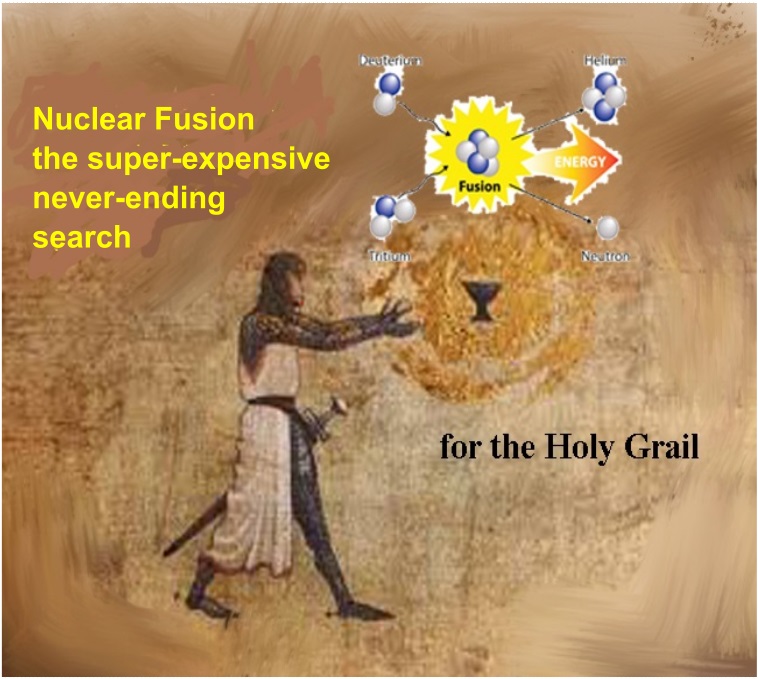
A fusion energy start-up claims to have solved the millennia-old challenge
of how to turn other metals into gold. Chrysopoeia, commonly known as
alchemy, has been pursued by civilisations as far back as ancient Egypt.
Now San Francisco-based Marathon Fusion, a start-up focused on using
nuclear fusion to generate power, has said the same process could be used
to produce gold from mercury.
In an academic paper published last week,
Marathon proposes that neutrons released in fusion reactions could be used
to produce gold through a process known as nuclear transmutation.
FT 22nd July 2025, https://www.ft.com/content/06f91e0d-3007-40bd-b785-86fef4890809
Trump has backed himself into a corner on Ukraine

The chances of President Putin backing down without any concessions from Ukraine or from their European sponsors are so low as to be almost non-existent.
the additional military support that the US is now offering to Ukraine, paid for by European NATO allies, won’t be sufficient to tip the military balance in Ukraine’s favour…………….. the military facts on the ground are that Russia continues to gain ground…………………. fifty days favours Russia more than Ukraine, militarily.
He now has fifty days to reach agreement on Ukrainian neutrality
Ian Proud, Jul 17, 2025, https://thepeacemonger.substack.com/p/trump-has-backed-himself-into-a-corner?utm_source=post-email-title&publication_id=3221990&post_id=168542067&utm_campaign=email-post-title&isFreemail=true&r=1ise1&triedRedirect=true&utm_medium=email
One year after he undertook to end the Ukraine war in one day, and just past six months into his Presidency, Donald Trump has kicked the peace can down the road by fifty days. The ultimatum to President Putin to make peace or face sanctions has practically no chance to changing Russian aims in Ukraine. Backed into a corner, Trump may finally be forced to address Russia’s underlying concerns.
In televised remarks on 14 July during his meeting with NATO Secretary General, Mark Rutte, President Trump said, ‘if we don’t have a [peace] deal in fifty days, we’re going to be doing very severe tariffs, tariffs at about a hundred percent, you’d call them secondary tariffs.’
As he was in 2017, Trump also now finds himself hemmed in by beltway politics and unable to deliver a reset in US-Russia relations that he instinctively seems to want.
The Sanctioning Russia Act of 2025 would put in place so-called secondary sanctions on Russia by imposing stiff tariffs of up to 500% against countries such as China and India that inter alia import Russian energy. US lawmakers want to strong arm Trump into forcing President Putin to back down in Ukraine via the back door. But there is a yawn-inducing sense of déjà vu here.
The 2017 Countering American Adversaries Through Sanctions Act, signed into law on 2 August 2017, had no impact on Russian policy towards Ukraine, but led to a huge collapse in US-Russia relations. This was illustrated most clearly by the decision to cut US diplomatic staffing in Russia by 755 personnel, meaning among other things, that today it is practically impossible for a Russian citizen to apply for a US visa inside of Russia itself; the US Embassy simply doesn’t have enough staff.
To avoid a repeat of 2017, Trump now appears to be buying himself fifty days in DC to reach peace in Ukraine before he is forced by the Senate to impose secondary sanctions on Russia. The 14 July announcement was therefore about domestic US politics more than about foreign policy.
But what Trump has in fact done is to set a clear ultimatum on Russia to reach a peace deal with Ukraine, with no clear commitment to meeting Russia’s specific demands, the key demand being Ukraine’s neutrality and revocation of its NATO aspiration.
As an ultimatum, this won’t work, because the additional military support that the US is now offering to Ukraine, paid for by European NATO allies, won’t be sufficient to tip the military balance in Ukraine’s favour.
Additional Patriot missiles and interceptors may well reduce the overall impact of Russian drone and missile strikes on Ukrainian cities. But the military facts on the ground are that Russia continues to gain ground. At several points along the front line, around Pokrovsk, and Kupiansk, towards Konstiantynivka and Siversk, there have been significant recent Russian gains, by the slow attritional standards of this war.
As reported by the Guardian in the UK, even some Ukrainian politicians and bloggers have come out to say that fifty days will simply allow Russia to occupy further Ukrainian land. The most interesting point about that report is the revelation that a British mainstream media outlet is reporting oppositionist views from Ukraine, rather than the narrative from Zelensky’s propaganda machine.
So, fifty days favours Russia more than Ukraine, militarily.
And the so-called secondary tariffs are only secondary to Russia. To countries like China they would be actual tariffs, taxing Chinese goods and those from other affected countries at an additional 100% on top of exist rates.
Yet, when the US last hiked tariffs on China at a rate of 145%, Trump was quickly forced to back down as China simply increased their tariffs against US goods by a proportionate rate. If Trump believes that China would not do so again, then I’m afraid he is deluded.
Even in the (frankly) unlikely event that China did not respond to ‘secondary’ tariffs in kind, it is far from clear how President Xi Jinping would force President Putin to change his war aims in Ukraine, without himself appearing to lose face in China, which would be politically damaging to him.
Which brings us back to Trump’s ultimatum. One commentator remarked that he has managed to ‘back himself into a corner in the Oval Office’, which is not an easy thing to do. The chances of President Putin backing down without any concessions from Ukraine or from their European sponsors are so low as to be almost non-existent.
Donald Trump, who appears largely to have sub-contracted resolving the Ukraine war to Marco Rubio and Keith Kellogg (where has Steve Witkoff disappeared to?), may now be forced to invest more personal time to bringing the war to an end.
Yes, he has engaged directly with President Putin in talks which is to be welcomed, in a diplomacy-starved war. But his real problem is his inability to encourage Ukraine and its European sponsors to address Russia’s underlying concerns about the war.
The most significant concern is, and has always been, about the need for Ukraine to adopt neutrality and revoke its aspiration to NATO membership. There has been absolutely no sign of compromise on this key underlying concern in Kyiv, Brussels, Berlin or London.
Offering Ukraine more weapons, however well-intended, will simply encourage Zelensky, Mark Rutte, Ursula von der Leyen, Friedrich Merz and Keir Starmer, in their view that Ukraine’s NATO aspirations remain alive and well. And, unfortunately, Russia will not silence its guns until, at the very least, a deal on Ukrainian neutrality is reached.
That leaves Trump with only one place to go. He must now invest personal time into urging Ukraine and Europe to accept neutrality for Ukraine as part of a ceasefire deal and longer-term peace process. If he doesn’t, the politics of Washington DC may force him to impose tariffs on China in a way which will, more than anyone else, hurt American people, and hurt his reputation.
Trump axes nuclear waste oversight panel
By Francisco “A.J.” Camacho | 07/21/2025, https://www.eenews.net/articles/trump-axes-nuclear-waste-oversight-panel/
The move comes at a time when Republicans and Democrats alike are pursuing a nuclear expansion, with Presiden Donald Trump aiming to quadruple nuclear power capacity by 2050.
President Donald Trump dismissed all but one of the members of the U.S. Nuclear Waste Technical Review Board, diminishing oversight over the country’s long-term spent nuclear fuel storage program.
“On Wednesday, the White House sent emails to seven Board members — Drs. Richelle Allen-King, Miles Greiner, Silvia Jurisson, Nathan Siu, Seth Tuler, Scott Tyler, Brian Woods — dismissing them from the Board, effective July 16, 2025,” Christopher Burk, the board’s director of external affairs, said in an email. “As a result, Dr. Peter Swift, Board Chair, is the sole member of the Board. The NWTRB staff and funding have remained in place.”
The move came at a time when Republicans and Democrats alike are pursuing a nuclear expansion, with Trump aiming to quadruple nuclear power capacity by 2050. It also comes amid a major shakeup at the Nuclear Regulatory Commission, with administration officials directing the agency to apply minimal scrutiny in reviewing reactors backed by the departments of Energy or Defense and the firing of Christopher Hanson, a Democratic commissioner and former NRC chair under former President Joe Biden.
US Nuclear Industry Revival on the Horizon

In late May, President Trump issued four separate Executive Orders (EOs)
with respect to growing the nuclear power industry in the US. As the
implementation of these orders begins, several Washington focused
publications have written about one emerging consequence of these EOs—the
likely termination of NRC oversight with respect to approval of new nuclear
reactor designs.
This major responsibility is being moved to the Pentagon
and the Department of Energy. One administration official referred to the
NRC’s prospective role in reactor approval as akin to a rubber stamp. The
implied criticism here being that the NRC was much too slow in approving
new reactor designs and are an obstacle to the President’s goal of
dramatically increasing nuclear power in the US. So, in effect, they got
FEMA’d. This raises the question whether we are effectively deregulating
commercial nuclear energy technologies, assuming, of course, that the
prospective review processes of the Pentagon and DoE are less rigorous than
the NRC’s.
Oil Price 21st July 2025, https://oilprice.com/Alternative-Energy/Nuclear-Power/US-Nuclear-Industry-Revival-on-the-Horizon.html
Trump axes nuclear waste oversight panel
The move comes at a time when Republicans and Democrats alike are pursuing a nuclear expansion, with Presiden Donald Trump aiming to quadruple nuclear power capacity by 2050.
By: Francisco “A.J.” Camacho | 07/21/2025
ENERGYWIRE | President Donald Trump dismissed all but one of the members of the U.S. Nuclear Waste Technical Review Board, diminishing oversight over the country’s long-term spent nuclear fuel storage program.
“On Wednesday, the White House sent emails to seven Board members — Drs. Richelle Allen-King, Miles Greiner, Silvia Jurisson, Nathan Siu, Seth Tuler, Scott Tyler, Brian Woods — dismissing them from the Board, effective July 16, 2025,” Christopher Burk, the board’s director of external affairs, said in an email. “As a result, Dr. Peter Swift, Board Chair, is the sole member of the Board. The NWTRB staff and funding have remained in place.”
The move came at a time when Republicans and Democrats alike are pursuing a nuclear expansion, with Trump aiming to quadruple nuclear power capacity by 2050. It also comes amid a major shakeup at the Nuclear Regulatory Commission, with administration officials directing the agency to apply minimal scrutiny in reviewing reactors backed by the departments of Energy or Defense and the firing of Christopher Hanson, a Democratic commissioner and former NRC chair under former President Joe Biden………………..
Energy Wire 21st July 2025, https://subscriber.politicopro.com/article/eenews/2025/07/21/nuclear-waste-oversight-panel-finally-gets-the-ax-under-trump-00463505
…
MAGA Going to Israel for Propaganda Training

The Israeli government is paying to have 16 MAGA social media influencers, with millions of followers, brought to Israel to learn how to stop American youth from turning against Tel Aviv over Gaza, writes Joe Lauria.
By Joe Lauria, Consortium News, https://consortiumnews.com/2025/07/20/maga-going-to-israel-for-propaganda-training/
The Israel foreign ministry will spend $86,000 to finance a tour of Israel for 16 Americans to get them to use their vast online influence to craft more positive images of a nation openly engaged in genocide.
The effort is being made as Israel reacts to a significant turn in public opinion against it, especially by Western youth. Tel Aviv realizes its usual methods of propaganda — and apparently its own inhouse troll army — are no longer working as they once did.
The daily Haaretz reported:
“Foreign Ministry officials say the tour delivers significant media, advocacy, and diplomatic benefits – and represents a strategic shift, as traditional outreach is no longer sufficient to shape public opinion. They aim to leverage the massive followings of young social media influencers to bolster Israel’s standing in the U.S.”
The Americans, whose names have not been divulged, belong to the MAGA and America First movements, the newspaper said. They are all younger than 30 and each have hundreds of thousands or millions of followers, a vast, target-rich environment for propaganda. Israel intends to bring more than 500 “influencer delegations” to Israel this year, the ministry said.
It is paying an organization called Israel365 to organize the first American tour because it is in a “unique position to convey a pro-Israel stance that aligns entirely with the MAGA and America First agenda.”
Israel365’s website says the group “stands unapologetically for the Jewish people’s God-given right to the entire Land of Israel,” calls the two-state solution a “delusion,” and says it’s defending “Western civilization against threats from both Progressive Left extremism and global jihad.”
Israeli officials justified the no-bid contract with the organization because of its “experience and know-how in creating awareness, engagement, and mobilization of Christian audiences regarding their support for the Jewish people and the State of Israel,” Haaretz reported.
Ministry officials told the newspaper that “while older Republicans and American conservatives still hold pro-Israel views, positive perspectives towards Israel are falling across all younger age groups.”
News of the tour comes after the U.S. national teachers union voted to ditch the Zionist curriculum of the Ant-Defamation League, which was influencing young American minds.
Western youth, including conservatives, have become increasingly aware of the history of Israel’s expulsion of Palestinian people from their land and of Israel’s stated genocidal intent and actions in Gaza today. It is a wave of understanding Israel needs to contain.
A ministry source said: “We’re working with influencers, sometimes with delegations of influencers. Their networks have huge followings, and their messages are more effective than if they came directly from the ministry.”
Haaretz reported:
“The strategy appears to be paying off. During the 12-day conflict last month with Iran, Israeli digital messaging garnered roughly 1.8 billion online views, boosted in part by social media influencers with millions of followers. The Foreign Ministry has set a goal of bringing 550 influencer delegations to Israel by the end of 2025 to continue this outreach.”
The Foreign Ministry chose Israel365 because “with the rise of the America First movement and MAGA in American politics, it’s essential for Israel that the movement adopt a pro-Israel position.” A Foreign Ministry document said Israel365 “has the ability to smoothly link the spiritual/biblical and geopolitical aspects of support for Israel.”
Joe Lauria is editor-in-chief of Consortium News and a former U.N. correspondent for The Wall Street Journal, Boston Globe, and other newspapers, including The Montreal Gazette, the London Daily Mail and The Star of Johannesburg. He was an investigative reporter for the Sunday Times of London, a financial reporter for Bloomberg News and began his professional work as a 19-year old stringer for The New York Times. He is the author of two books, A Political Odyssey, with Sen. Mike Gravel, foreword by Daniel Ellsberg; and How I Lost By Hillary Clinton, foreword by Julian Assange.
Trump threatens to bomb Iran again if it builds new nuclear plants.

US president claims it would take ‘years’ to bring sites at Fordow, Natanz
and Isfahan back into service. In a post on his Truth Social site sent from
his golf club near Washington, he claimed all three of Tehran’s nuclear
sites had been destroyed after the US dropped 14 30,000lb GBU-57 “bunker
buster” bombs on them. “It would take years to bring them back into
service and, if Iran wanted to do so, they would be much better off
starting anew, in three different locations, prior to those sites being
obliterated, should they decide to do so,” he said before ending with his
trademark signoff. “Thank you for your attention to this matter!”
Telegraph 19th July 2025. https://www.telegraph.co.uk/world-news/2025/07/19/trump-threatens-to-bomb-iran-again-if-it-builds-new-nuclear/
Rotten Apple: Dozens of Former Israeli Spies Hired by Silicon Valley Giant

July 18th, 2025, Alan Macleod
Apple has made headlines in recent weeks for touting its commitment to privacy and human rights, rolling out tools to limit surveillance and spyware. But behind the corporate messaging lies a much darker reality.
The company has quietly brought in dozens of veterans from Unit 8200, Israel’s shadowy military intelligence unit known for blackmail, mass surveillance, and targeted killings.
Many of these hires took place as Israel escalated its war on Gaza, and as CEO Tim Cook publicly expressed support for Israel while disciplining employees for pro-Palestinian expressions. Apple’s deepening ties to Israel’s most controversial intelligence raise uncomfortable questions, not only about the company’s political loyalties, but also about how it handles vast troves of personal user data.
A MintPress News investigation has identified dozens of Unit 8200 operatives now working at Apple. The company’s hiring spree coincides with growing scrutiny of its ties to the Israeli government, including its policy of matching employee donations to groups such as Friends of the IDF and the Jewish National Fund, both of which play a role in the displacement of the Palestinian people. The intense pro-Israel bias at the corporation has led many former and current employees to speak out.
This investigation is part of a series examining the close collaboration between Unit 8200 and Western tech and media companies. Previous investigations examined the links between Unit 8200 and social media giants like TikTok, Facebook and Google, and how former Unit 8200 spies are now responsible for writing much of America’s news about Israel/Palestine, holding top jobs at outlets like CNN and Axios.
A Few (Dozen) Bad Apples
Israel’s international reputation has taken a severe hit amid multiple spying scandals and ongoing attacks against its neighbors. During this same period, Apple has ramped up its recruitment of former Israeli intelligence personnel.
The Silicon Valley giant has hired dozens of former agents from the controversial Israeli intelligence outfit, Unit 8200, raising questions about the corporation’s political direction.
Nir Shkedi is among the most prominent examples. From 2008 to 2015, he served as a commander and Chief of Learning at Unit 8200, leading a team of approximately 120 operatives who developed new artificial intelligence tools to perform rapid data analysis.
Unit 8200 is at the forefront of this technology, and is known to have used AI to auto-generate kill lists of tens of thousands of Gazans, including children. These tools helped the Israeli Defense Forces (IDF) bypass what it called human targeting, “bottlenecks,” and strike huge numbers of Palestinians.
Shkedi has been a physical design engineer at Apple’s Bay Area campus since 2022.
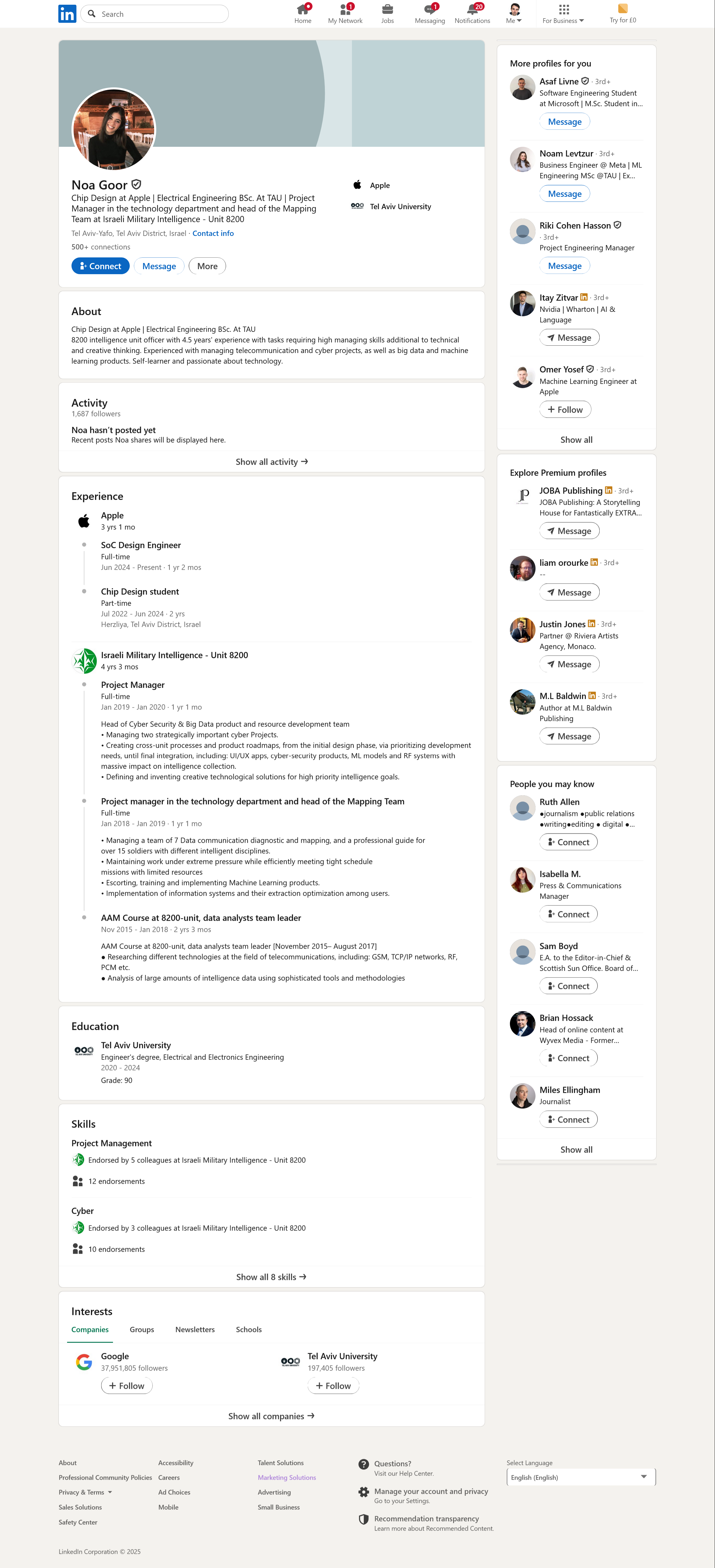
Noa Goor is another senior Unit 8200 figure turned Apple employee. From 2015 to 2020, Goor rose to become a project manager and head of cybersecurity and big data development team at Unit 8200, where she, in her own words, “invent[ed] creative technological solutions for high priority intelligence goals” and “manag[ed] two strategically important cyber projects” for the IDF.
One of the most important cyber projects Unit 8200 has launched in recent times is the September pager attack on Lebanon, an act that injured thousands of civilians and was widely condemned as an act of international terrorism, including by former CIA Director Leon Panetta. While Goor was not personally involved in that operation, Unit 8200 has spearheaded similarly nefarious actions for decades.
In 2022, Goor was hired by Apple as a system-on-chip design engineer.
Eli Yazovitsky, meanwhile, was directly recruited from Unit 8200. In 2015, he left a high-powered nine-year career as a manager in the military unit to join Apple, where he rose to become an engineering manager. He has since moved on to tech giant Qualcomm.
Unit 8200 is Israel’s most elite—and most controversial—military intelligence unit. It serves as the backbone of both Israel’s burgeoning tech sector and its repressive surveillance apparatus. The unit has developed cutting-edge technology like facial recognition and voice-to-text software to surveil, repress, and target Palestinians.
The vast amounts of data gathered on the Palestinian population, including their medical history, sex lives, and search histories, have been used for coercion and extortion. If a certain individual needed to travel across checkpoints for crucial medical treatment, permission could be suspended until they complied. Information about extramarital affairs or sexual orientation, especially homosexuality, is exploited as blackmail material. One former Unit 8200 agent recalled that he was instructed during his training to memorize different Arabic words for “gay” so that he could listen out for them in intercepted conversations.
Internationally, Unit 8200 may be best known for its “former” agents who created the notorious Pegasus software, used by repressive governments around the world to spy on tens of thousands of prominent figures, including royals, heads of state, activists, and journalists.
Among them was Washington Post columnist Jamal Khashoggi, who was assassinated by Saudi operatives in Türkiye in 2018.
While military service is mandatory for Jewish Israelis, few end up in Unit 8200 by accident. Described as “Israel’s Harvard,” parents spend fortunes on STEM-based extracurricular lessons for their children in the hopes that they will be selected to join the IDF’s most elite and selective unit. Those chosen are rewarded with lucrative careers in the tech industry upon completion of their service.
Given Unit 8200’s documented history of violence, espionage, and surveillance, both domestically and internationally, it is worth asking whether tech giants should be hiring its alumni in such large numbers.
Shkedi, Goor, and Yazovitsky are the most high-profile examples, but they are from alone. A closer look reveals that dozens of other Unit 8200 veterans have also secured key roles at Apple.
Engineering and Hardware Design:
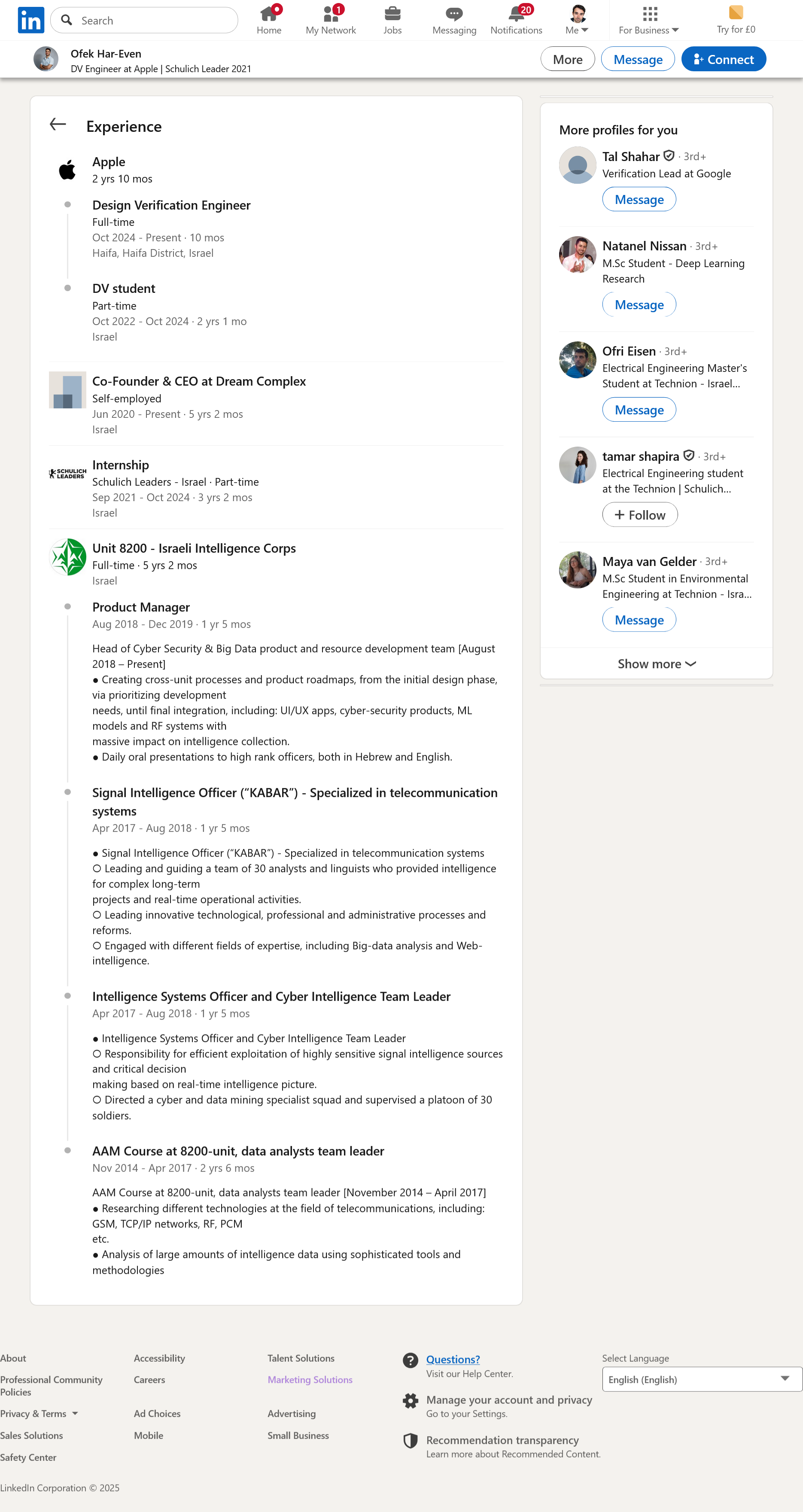
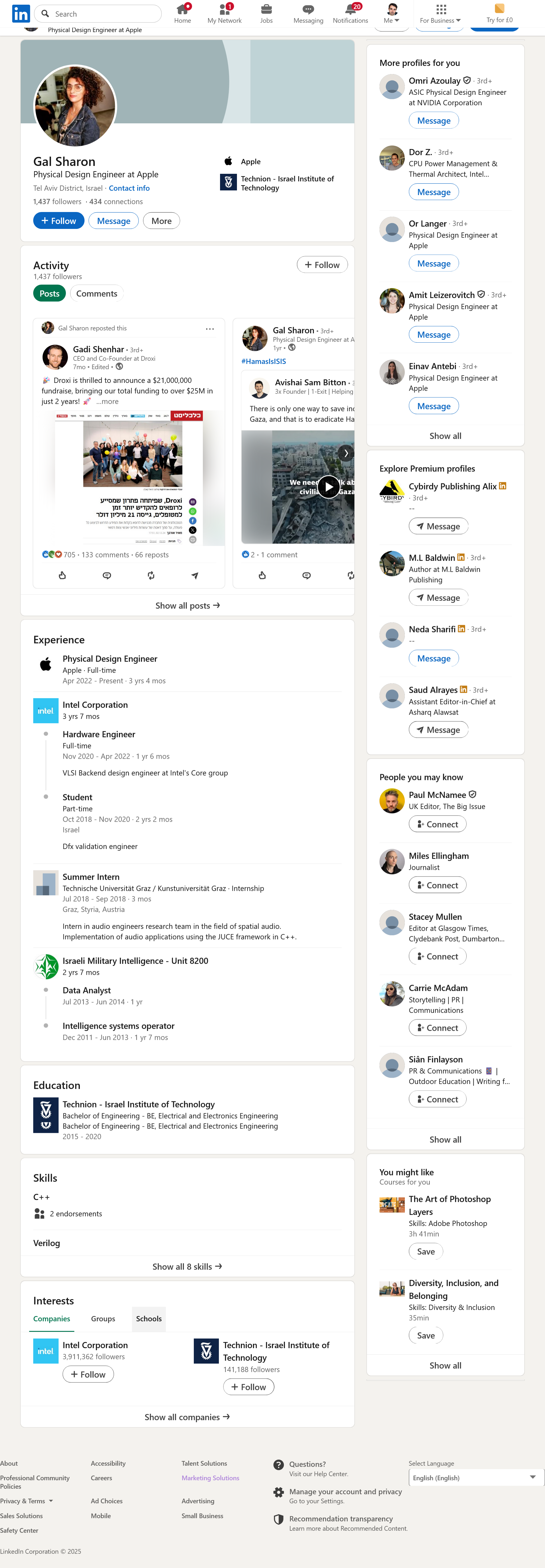
Natanel Nissan, formerly head of data analysis at Unit 8200, joined Apple’s Tel Aviv office in 2022. Ofek Har-Even, a longtime officer and manager in the unit, has been a design verification engineer at Apple since 2022. Gal Sharon, a former intelligence systems operator and data analyst, has also worked as a physical design engineer since that same year.
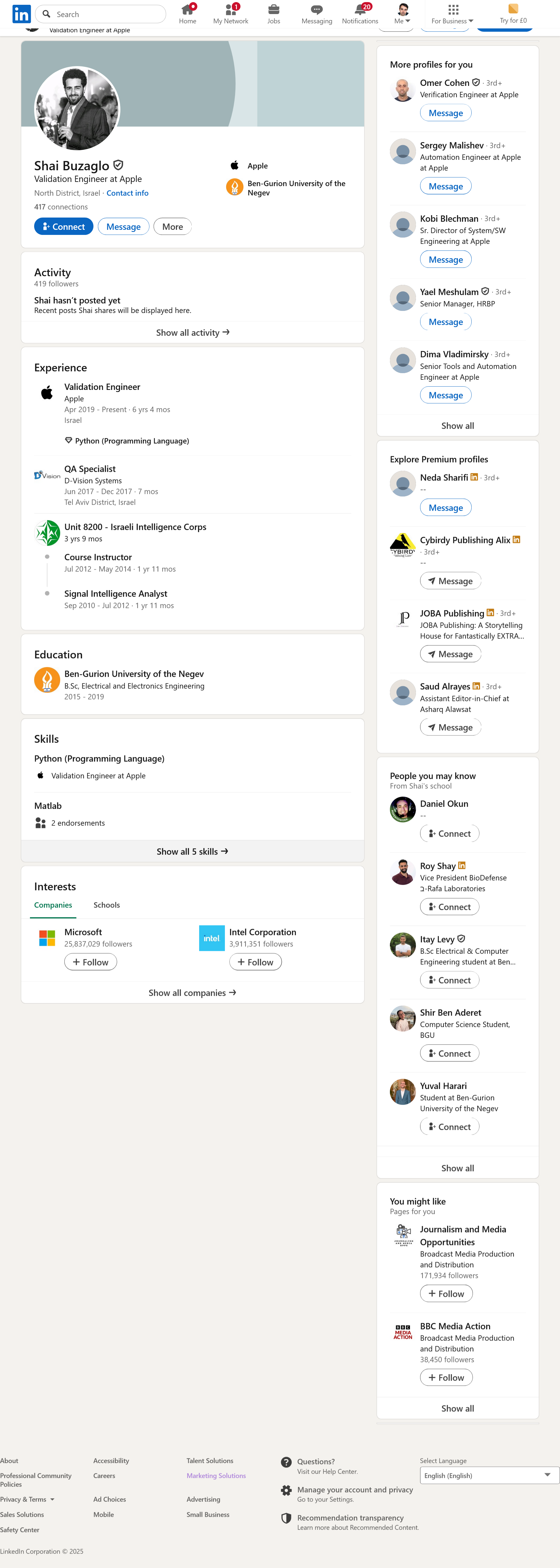
Mayan Hochler and Shai Buzgalo, both former Unit 8200 analysts and instructors, hold roles in physical design and validation engineering, respectively.
Software and Cybersecurity:
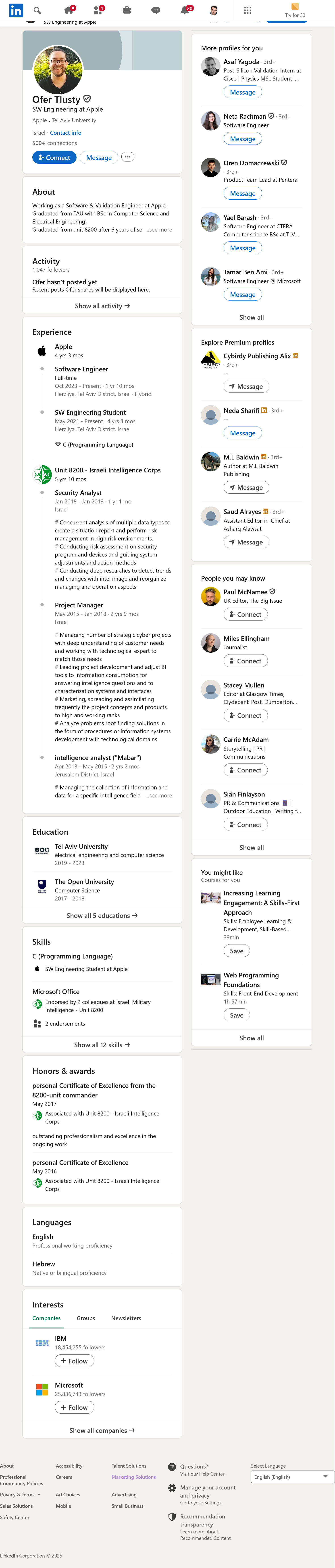
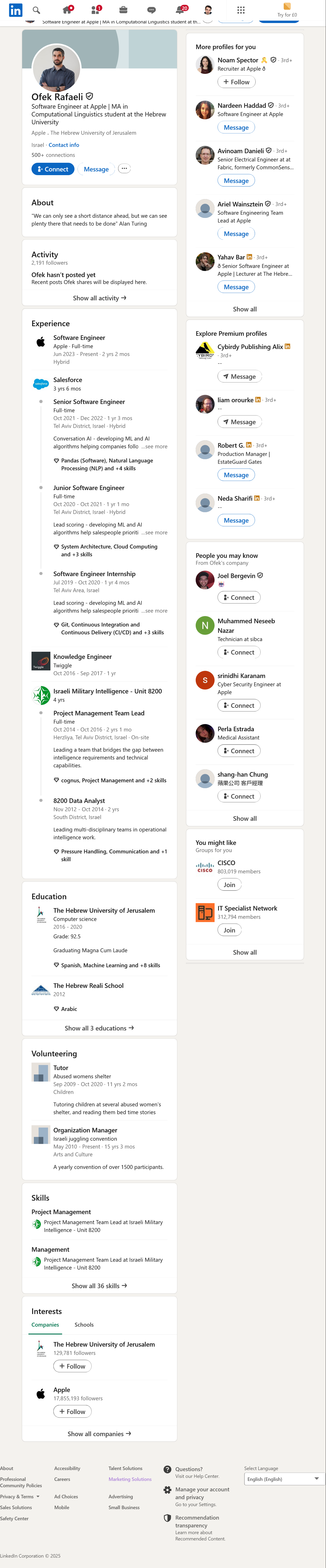
Ofer Tlusty, who served nearly six years in Unit 8200 as a security and intelligence analyst, has worked as a software engineer at Apple since 2021. Ofek Rafaeli, who served between 2012 and 2016 and rose to project manager during Israel’s 2016 assault on Gaza, became a software engineer at Apple in 2023.
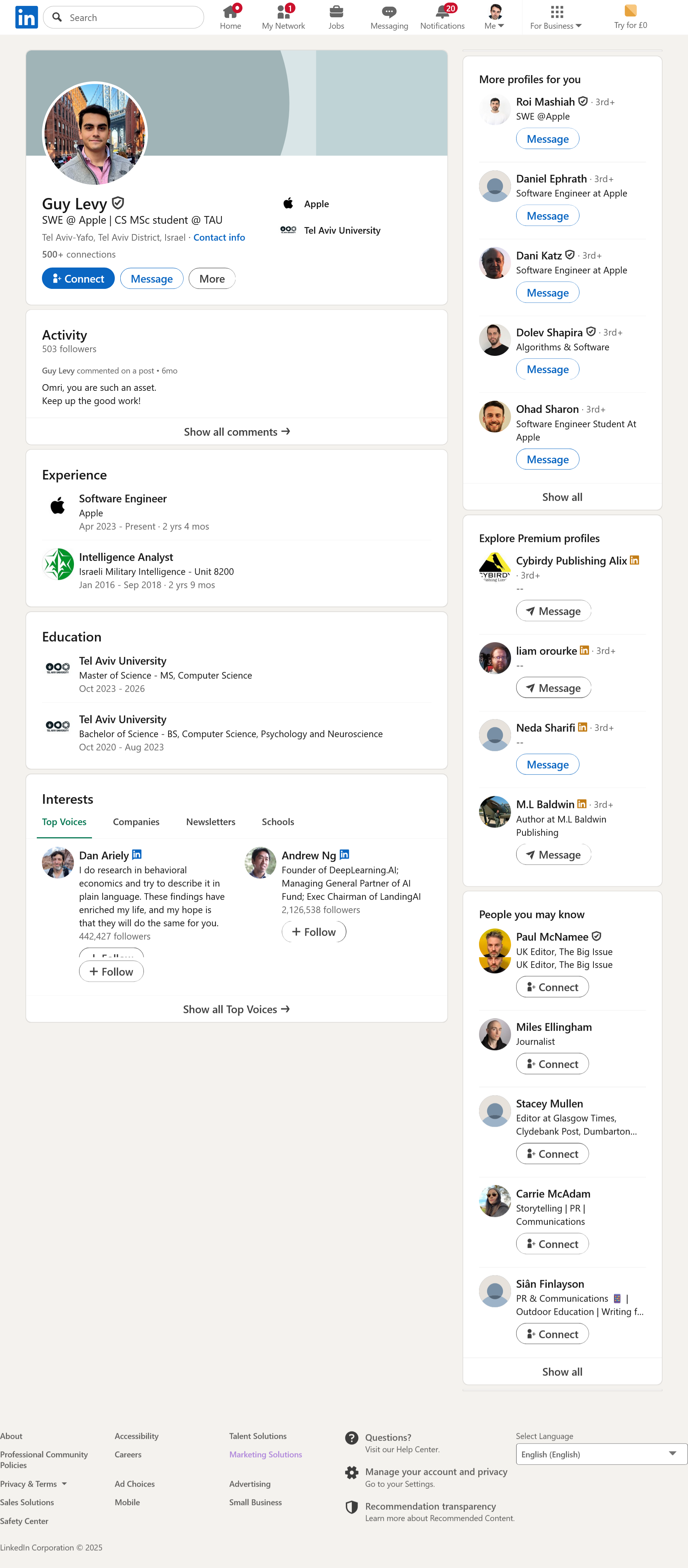
Guy Levy, a former intelligence analyst, now also works as a software engineer.
AI, Machine Learning, and Validation:
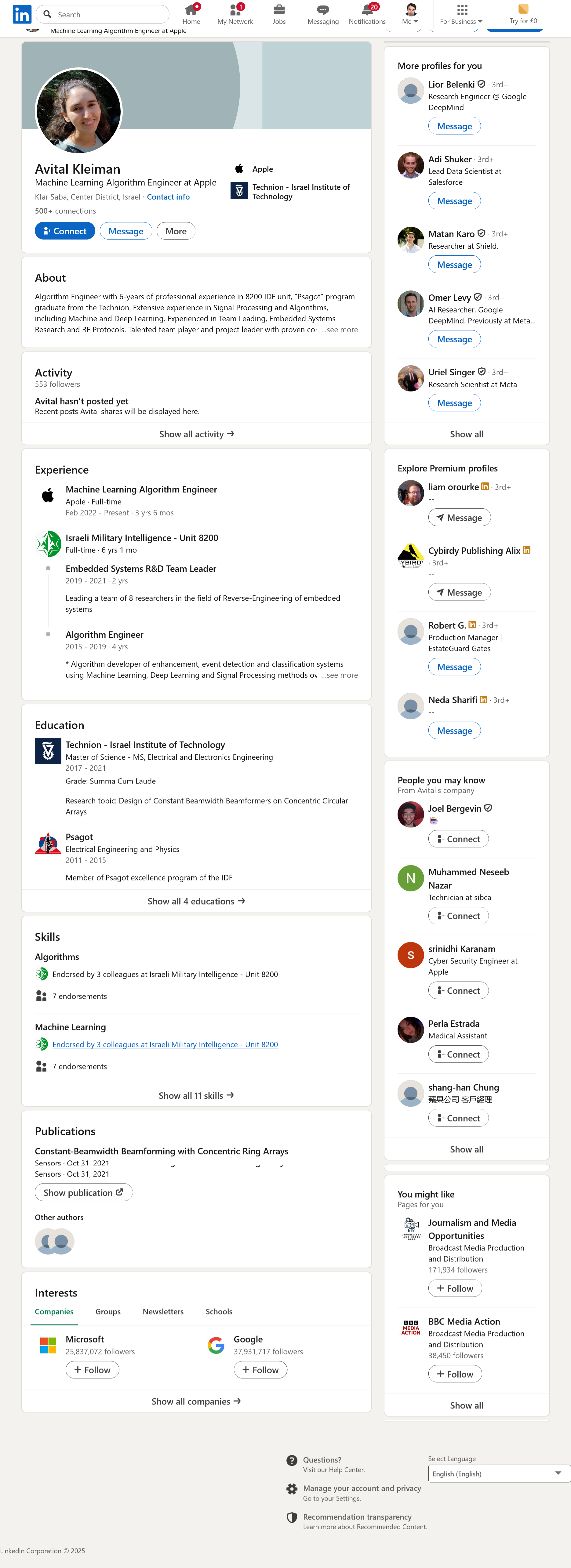
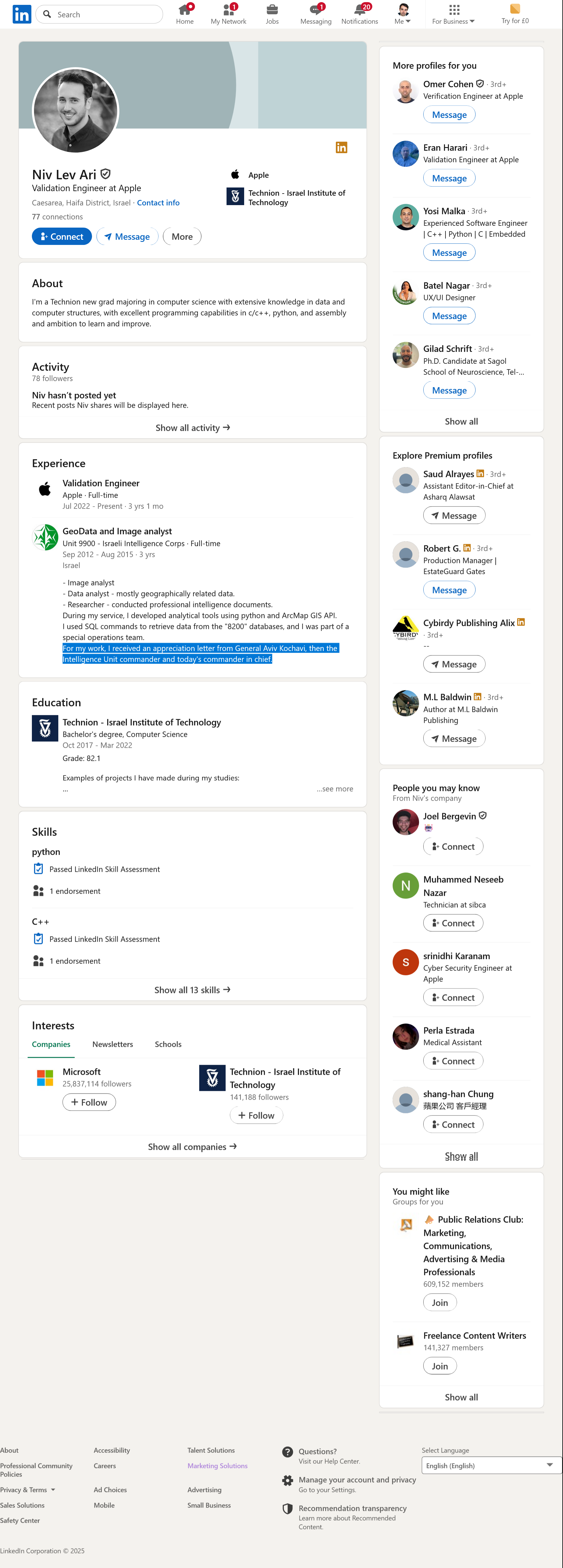
Avital Kleiman, a six-year veteran of Unit 8200, is now a machine learning algorithm engineer at Apple. Niv Lev Ari, currently a validation engineer, notes in his LinkedIn profile that he received a letter of commendation from Unit 8200 commander Aviv Kochavi for his work in the unit.
Other Technical Roles:
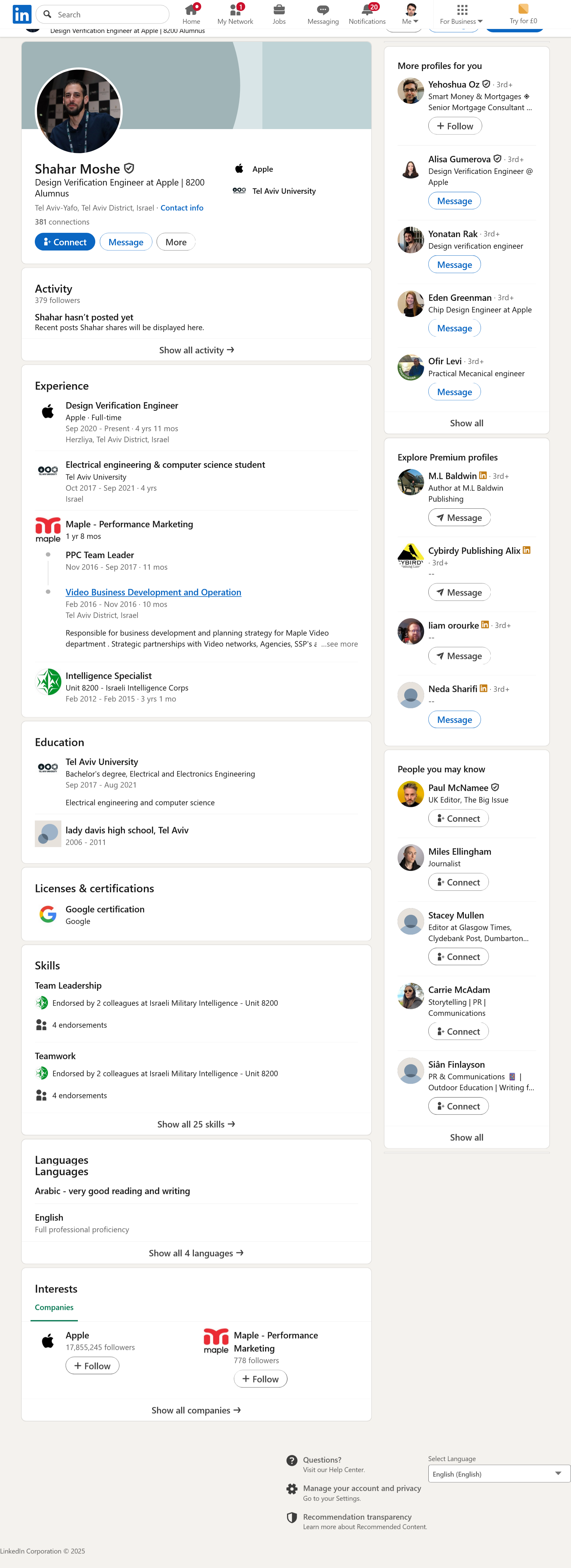
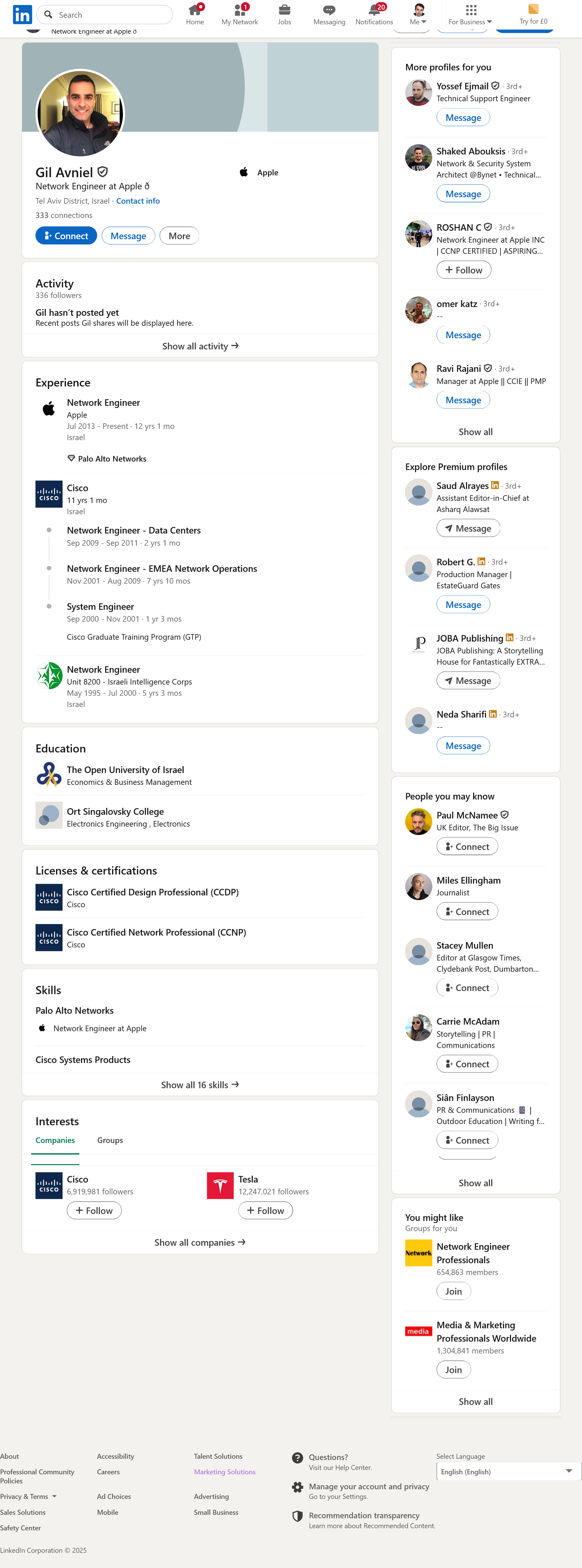
Shahar Moshe, who worked as an intelligence specialist at Unit 8200 from 2012 to 2015, is now a design verification engineer. Gil Avniel, who spent over five years in the unit, currently serves as a network engineer.
An Apple Rots From the Core
The growing number of former Israeli intelligence operatives working at Apple does not seem to concern the company’s senior management. CEO Tim Cook is known to hold strongly pro-Israel views and has spearheaded the Silicon Valley giant’s collaboration with the Israeli state.
Apple has acquired several Israeli tech firms and now operates three centers in the country, employing around 2,000 people. In 2014, Cook invited Israeli Prime Minister Benjamin Netanyahu to the company headquarters in Cupertino, CA, where, in front of the cameras, the two openly embraced. The following year, Cook accepted an invitation from President Reuven Rivlin to visit Israel. “It is a great privilege to host you and your team here,” Rivlin said, “Even for me, as one who prefers to write with a pen and paper, it is clear what a great miracle you have created when I look at my staff, and my grandchildren.”
Effusive praise for the Apple CEO has also come in the form of honors from pro-Israel organizations. In 2018, the Anti-Defamation League presented Cook with its inaugural Courage Against Hate Award at its Never Is Now Summit on anti-Semitism and Hate, where the organization described him as a “visionary leader in the business community.”
In the wake of the October 7, 2023, attacks, Cook sent out a company-wide email expressing his solidarity with Israel. “Like so many of you, I am devastated by the horrific attacks in Israel and the tragic reports coming out of the region,” he wrote, My heart goes out to the victims, those who have lost loved ones, and all of the innocent people who are suffering as a result of this violence.”
Yet, according to Apples4Ceasefire—a group of former and current employees opposing Israeli actions in Gaza—he has yet to say anything publicly about the mass devastation caused by the Israeli response to October 7.
Indeed, the Silicon Valley corporation has a policy of matching employee donations to groups such as Friends of the IDF, which raises money to buy equipment for IDF soldiers, and the Jewish National Fund, an organization that participates in the theft and destruction of Palestinian land.
Under Cook’s leadership, Apple employees have been disciplined or even fired for wearing pins, bracelets, or keffiyehs in support of the Palestinian people. Nevertheless, groups such as Apples4Ceasefire continue to speak out about what they describe as Apple’s complicity in genocide.
The Unit 8200 Tech Takeover
To be fair, Apple is far from the only tech or media company to hire large numbers of former Unit 8200 operatives. A 2022 MintPress exposé revealed hundreds of Israeli intelligence veterans working at Google, Facebook, Microsoft, and Amazon.
Perhaps the most notable of these is Emi Palmor, a former Israeli justice ministry official who sits on Facebook’s 21-person Oversight Board. Described by Mark Zuckerberg as his platform’s “supreme court,” the board ultimately decides what content is allowed or removed from the world’s largest social network. Facebook has worked closely with the Israeli government to censor or deplatform Palestinian content and accounts.
Even TikTok, often seen as a more open platform, has been hiring former Israeli spies to help manage its operations, according to a November investigation by MintPress. Reut Medalion, for example, served as a Unit 8200 intelligence commander and led its cybersecurity operations team.
In December 2023, during the peak of Israel’s attack on Gaza, Medalion moved to New York City to accept a job as global incident manager for TikTok’s trust and safety division. Considering the events going on in the world at the time, it’s worth asking what sorts of “global incidents” she was brought in to manage.
After MintPress exposed Medalion’s past to a worldwide audience, she deleted her entire digital footprint from the internet.
Former Israeli intelligence operatives have also found their way into American newsrooms, shaping coverage of the Middle East. A recent MintPress investigation uncovered a network of former Unit 8200 operatives working in some of the most influential newsrooms in the United States.
Among them is Axios correspondent Barak Ravid, whose Middle Eastern coverage won him the prestigious White House Press Correspondents’ Award. Until at least 2023, Ravid was a member of Unit 8200. CNN has also hired at least two former agents to produce their news coverage, one of whom, Tal Heinrich, now serves as the official spokesperson for Prime Minister Netanyahu.
Given this pattern, Silicon Valley’s partiality towards Israel should not come as no surprise. From tech giants like Google and Amazon to social media powerhouses like TikTok and Facebook, the field is filled with former Israeli spies. Apple is no exception, having hired dozens, if not more, Unit 8200 operatives to run its platforms and shape the company.
This investigation does not claim that the Israeli state is deliberately infiltrating Silicon Valley. However, what it does unquestionably suggest is that the outlook and general biases of these entities are strongly pro-Israel. What does it say about Silicon Valley’s culture that individuals with well-documented ties to a controversial foreign spy agency are considered ideal hires?
It is unthinkable that former intelligence agents of Hezbollah, Iran’s Ministry of Intelligence, or Russia’s FSB or GRU would be hired en masse, and trusted with our most sensitive data. Yet, when it comes to Israel (or U.S. surveillance agencies), the answer is different. Many of these employees are not even “former” agents, and are directly recruited from Unit 8200 while still in active service, despite Israeli law explicitly prohibiting the group’s members from identifying themselves or divulging their alliances.
Thus, in this light, it appears that those like Apples4Ceasefire struggling to end the company’s double standards are fighting an uphill battle.
The first US atomic rush was a bust. Will Trump’s big nuclear-for-AI plans fare any better?
Bulletin, By Chloe Shrager | July 18, 2025
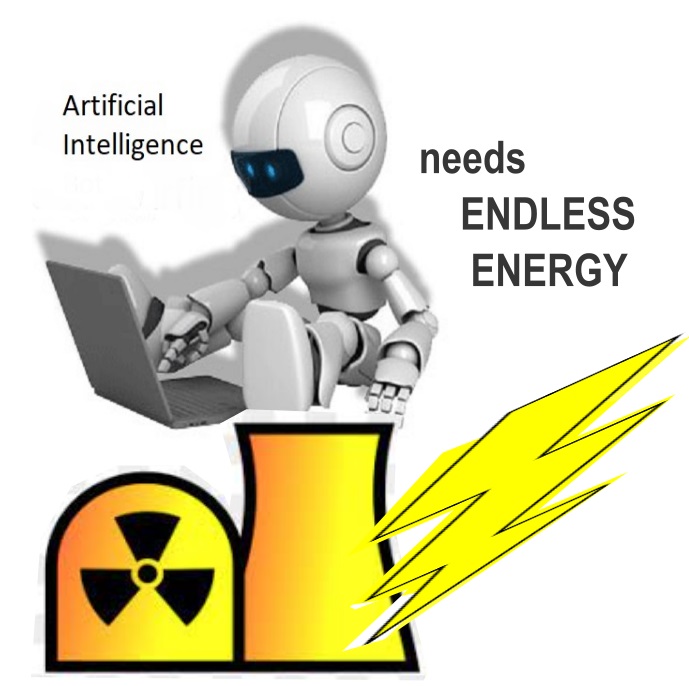
As Big Tech turns to nuclear power to solve the artificial intelligence power problem, critics have cast doubt on energy developers’ ability to build new reactors on a timeline that will satisfy data centers’ energy needs.
High costs and lack of commercial economic viability have been persistent obstacles to new nuclear infrastructure development. But on May 23, President Donald Trump signed four executive orders that represent the most explicit government commitment to nuclear power for artificial intelligence yet.
Three of the orders explicitly mention AI as a driver for nuclear energy development and a potential beneficiary. One directive incentivizes the operation of privately funded advanced nuclear reactor technologies on federal sites—mainly national laboratories or military installations—allegedly to power AI infrastructure, labelled as “critical defense facilities,” and mandates the deployment of small modular nuclear reactors on one of these sites within 30 months.
Previously, tech companies were the most vocal advocates pushing for nuclear power to meet AI’s energy demands. Now the US government—heavily influenced by Big Tech’s hand—has made nuclear power for AI a national security priority, setting a goal of quadrupling the United States’ nuclear capacity from 100 gigawatts to 400 gigawatts by 2050. Whether government intervention can overcome the challenges that have plagued nuclear deployment for decades remains to be seen—and if so, at what cost?
Déjà vu. As with the rise of the nuclear power industry in the 1950s and 60s, the demand for nuclear energy is being created, justified, and incentivized by the government and its national security interests rather than by market forces.
Robert Duffy, a professor of political science at Colorado State University, summarized the history of the US nuclear power industry in a 2004 paper.
“The atomic energy subgovernment was endowed with additional prestige and power because of the program’s identification with national security issues,” Duffy wrote. “The actors in this tightly knit monopoly were united by the conviction that the development of atomic energy, first as a weapon but later as a means of generating electricity, was both necessary and desirable for the nation’s welfare.”
Duffy showed that the government’s rush to create a nuclear industry in the United States ultimately undermined that very industry. The hasty development, government incentives, and ambitious timelines led to cost overruns, safety problems, and public opposition that ultimately killed new nuclear construction for decades.
Today, the Trump administration is repeating history by declaring AI technologies driven by advanced nuclear power generators a key national security interest.
“There seems to be an aspect to the government’s interest in AI which is sort of positing that as the next nuclear weapons race,” Tim Judson, executive director of the Nuclear Information and Resource Service, observes. “If you expect the most powerful countries in the history of the world, and the wealthiest corporations that have ever existed, which are trying to develop […] ‘digital gods,’ to not do everything they can to win that race, then you don’t understand human nature, and you don’t understand geopolitics.”
But by trying to rush nuclear power development again for geopolitical reasons (then the Cold War, now the global AI race), the US government risks creating another failed—or at least costly and insufficiently safe—nuclear program…………………………………………
………………………………………………………………………………………………………..Sticky problems. Even without the economic hurdles, the fundamental problem remains timing, and presidential orders cannot change the laws of physics. As Mycle Schneider, an independent nuclear policy analyst and main contributor to the World Nuclear Industry Status Report, bluntly states: “I doubt that any SMR would be operating 10 years from now in the Western world.”
Schneider’s skepticism isn’t unfounded. Construction times for nuclear plants average around 10 years, he said, and that’s just the construction phase—which only begins with the pouring of reactor foundations. Even with the Trump administration’s regulatory streamlining and federal site access, the reality of nuclear development timelines clashes directly with AI’s immediate energy needs. “All of these deals with nuclear companies are about future power plants maybe coming online in the 2030s, but all the AI data centers are being built today,” Judson observes.
Small modular reactors have long been promoted by the industry—and now also the government—as a solution to nuclear power’s problems, promising faster construction, lower costs, and standardized designs. The Trump administration’s nuclear orders specifically enable SMR testing and deployment on federal sites, betting that government support can make SMR promises a reality.
But the reality has proven far more complex, even with unprecedented government backing. Canada’s recent approval of the world’s first SMR in a G7 country demonstrates both the promise and the problems. The project’s price tag sits at nearly $21 billion Canadian dollars ($15.1 billion US dollars) for four reactors at Ontario’s Darlington site, roughly $12.5 million US dollars per megawatt—far exceeding the costs of renewable alternatives that can be deployed in a fraction of the time. Even more so, Judson says the energy company GE Vernova-Hitachi chose to pursue its SMR project in Canada because the Canadian Nuclear Safety Commission regulations allow construction permit applications to be submitted with much of the design still incomplete. “The jury is very much still out on whether the BWRX-300 [SMR design] will prove feasible to build on time and on budget, but what we know so far is not encouraging,” Judson said.

The long-term management of nuclear waste also poses a sticky issue to new nuclear development, especially the relatively higher waste per gigawatt from SMRs compared to full-scale reactors, which has no permanent solution yet……………………………………………………………. https://thebulletin.org/2025/07/the-first-us-atomic-rush-was-a-bust-will-trumps-big-nuclear-for-ai-plans-fare-any-better/
80 Years After Trinity

No longer represented as a plausible deterrent, the bomb now stood poised to become what Los Alamos Director J. Robert Oppenheimer would describe shortly after the war as “weapons of terror, of surprise, of aggression… [used] against an essentially defeated enemy.”
Why Was There So Little Dissent at Los Alamos and What Does It Mean Today?
By Eric Ross, 17 July 25, https://tomdispatch.com/80-years-after-trinity/
In recent months, nuclear weapons have reemerged in global headlines. Nuclear-armed rivals India and Pakistan approached the brink of a full-scale war, a confrontation that could have become an extinction-level event, with the potential to claim up to two billion lives worldwide.
The instability of a global order structured on nuclear apartheid has also come into sharp relief in the context of the recent attacks on Iran by Israel and the United States. That system has entrenched a dangerous double standard, creating perverse incentives for the proliferation of world-destroying weaponry, already possessed by nine countries. Many of those nations use their arsenals to exercise imperial impunity, while non-nuclear states increasingly feel compelled to pursue nuclear weapons in the name of national security and survival.
Meanwhile, the largest nuclear powers show not the slightest signs of responsibility or restraint. The United States, Russia, and China are investing heavily in the “modernization” and expansion of their arsenals, fueling a renewed arms race. And that escalation comes amid growing global instability contributing to a Manichean world of antagonistic armed blocs, reminiscent of the Cold War at its worst.
The nuclear threat endangers not only global peace and security but the very continuity of the human species, not to speak of the simple survival of life on Earth. How, you might wonder, could we ever have arrived at such a precarious situation?
The current crisis coincides with the 80th anniversary of the Trinity Test, the first detonation of an atomic weapon that would soon obliterate the Japanese cities of Hiroshima and Nagasaki and so inaugurate the atomic age. So many years later, it’s worth critically reassessing the decisions that conferred on humanity such a power of self-annihilation. After all, we continue to live with the fallout of the choices made (and not made), including those of the scientists who created the bomb. That history also serves as a reminder that alternative paths were available then and that another world remains possible today.
A Tale of Two Laboratories
In the summer of 1945, scientists and technicians at Los Alamos National Laboratory in New Mexico worked feverishly to complete the construction of the atomic bomb. Meanwhile, their colleagues at the University of Chicago’s Metallurgical Laboratory mounted a final, ultimately unsuccessful effort to prevent its use.
The alarm spreading in Chicago stemmed from a sobering realization. The Manhattan Project that they had joined on the basis of a belief that they were in an existential arms race with Nazi Germany had, by then, revealed itself to be a distinctly one-sided contest. Until then, the specter of a possible German atomic bomb had conferred a sense of urgency and a veneer of moral legitimacy on what many scientists otherwise recognized as a profoundly unethical undertaking.
Prior to the fall of Berlin, Allied intelligence had already begun to cast serious doubt on Germany’s progress toward developing an atomic weapon. By April 1945, with the Nazi regime in a state of collapse and Japan’s defeat imminent, the threat that served as the original justification for the bomb’s development had all but vanished.
No longer represented as a plausible deterrent, the bomb now stood poised to become what Los Alamos Director J. Robert Oppenheimer would describe shortly after the war as “weapons of terror, of surprise, of aggression… [used] against an essentially defeated enemy.”
By that point, it was evident that the bomb would be used not to deter Germany but to destroy Japan, and not as the final act of World War II but as the opening salvo of what would become the Cold War. The true target of the first atomic bomb wasn’t, in fact, Tokyo, but Moscow, with the people of Hiroshima and Nagasaki sacrificed on the altar of American global imperial ambition.
For the scientists at Chicago, that new context demanded new thinking. In June 1945, a committee of physicists led by James Franck submitted a report to Secretary of War Henry Stimson warning of the profound political and ethical consequences of employing such a bomb without exhausting all other alternatives. “We believe,” the Franck Report stated, “that the use of nuclear bombs for an early, unannounced attack against Japan [would be] inadvisable.” The report instead proposed a demonstration before international observers, arguing that such a display could serve as a gesture of goodwill and might avert the need to use the bombs altogether.
One of that report’s signatories, Leo Szilard, who had been among the bomb’s earliest advocates, further sought to prevent what he had come to recognize as the catastrophic potential outcome of their creation. With Germany defeated, he felt a personal responsibility for reversing the course he had helped set in motion. Echoing concerns articulated in the Franck Report, he drafted a petition to be circulated among the scientists. While acknowledging that the bomb might offer short-term military and political advantages against Japan, he warned that its deployment would ultimately prove morally indefensible and strategically self-defeating, a position which would also be held by six of the seven U.S. five-star generals and admirals of that moment.
Szilard emphasized that the atomic bomb wasn’t just a more powerful weapon but a fundamental transformation in the nature of warfare, an instrument of annihilation. He already feared Americans might come to regret that their own government had sown the seeds of global destruction by legitimizing the sudden obliteration of Japanese cities, a precedent that would render a heavily industrialized, densely populated country like the United States especially vulnerable.
Moreover, he concluded that using such weapons of unimaginable destructive power without sufficient military justification would severely undermine American credibility in future arms control efforts. He observed that the development of the bomb under conditions of extreme wartime secrecy had created an abjectly anti-democratic situation, one in which the public was denied any opportunity to deliberate on such an irrevocable and consequential decision.
As Eugene Rabinowitch, a co-author of the Franck Report (who would later co-found The Bulletin of Atomic Scientists), would note soon after, the scientists in Chicago were growing increasingly uneasy in the face of escalating secrecy: “Many scientists began to wonder: against whom was this extreme secrecy directed? What was the sense of keeping our success secret from the Japanese? Would it have helped them to know that we had an atomic bomb ready?”
Rabinowitch concluded that the only “danger” posed by such a disclosure was that the Chicago scientists might be proven right, and Japan might surrender. “Since there was no justifiable reason to hold the bomb secret from the Japanese,” he argued, “many scientists felt that the purpose of deepened secrecy was to keep the knowledge of the bomb… from the American people.”
In other words, officials in Washington were concerned that a successful demonstration might deprive them of the coveted opportunity to use the bomb and assert their newly acquired monopoly (however temporary) on unprecedented power.
The Road to Trinity and the Cult of Oppenheimer
Seventy scientists at Chicago endorsed the Szilard Petition. By then, however, their influence on the project had distinctly diminished. Despite their early contributions, notably the achievement of the first self-sustained nuclear chain reaction in December 1942, the project’s center of gravity had shifted to Los Alamos.
Recognizing this, Szilard sought to circulate the petition among his colleagues there, too, hoping to invoke a shared sense of scientific responsibility and awaken their moral conscience in the critical weeks leading up to the first test of the weapon. Why did that effort fail? Why was there so little dissent, debate, or resistance at Los Alamos given the growing scientific opposition, bordering on revolt, that had emerged in Chicago?
One answer lies in Oppenheimer himself. In popular culture and historical scholarship, his legacy is often framed as that of a tragic figure: the reluctant architect of the atomic age, an idealist drawn into the ethically fraught task of creating a weapon of mass destruction compelled by the perceived exigencies of an existential war.
Yet the myth of him as a Promethean figure who suffered for unleashing the fundamental forces of nature onto a society unprepared to bear responsibility for it obscures the extent of his complicity. Far from being a passive participant, in the final months of the Manhattan Project, he emerged as a willing collaborator in the coordination of the coming atomic bombings of Hiroshima and Nagasaki.
When Oppenheimer and physicist Edward Teller (who would come to be known as “the father of the hydrogen bomb”) received Szilard’s petition, neither shared it. While Oppenheimer offered no response, Teller provided a striking explanation: “The things we are working on are so terrible that no amount of protesting or fiddling with politics will save our souls.” He further rejected the idea that he held any authority to influence the bomb’s use. “You may think it is a crime to continue to work,” he conceded, “but I feel that I should do the wrong thing if I tried to say how to tie the little toe of the ghost to the bottle from which we just helped it escape.”
Teller later claimed to be in “absolute agreement” with the petition, but added that “Szilard asked me to collect signatures… I felt I could not do so without first seeking Oppenheimer’s permission more directly. I did so and Oppenheimer talked me out of it, saying that we as scientists have no business meddling in political pressure of that kind… I am ashamed to say that he managed to talk me out of [it].”
Teller’s explanation was likely self-serving given his later acrimonious rift with Oppenheimer over the hydrogen bomb. Yet further evidence indicates that Oppenheimer actively sought to suppress debate and dissent. Physicist Robert Wilson recalled that upon arriving at Los Alamos in 1943, he raised concerns about the broader implications of their work and the “terrible problems” it might create, particularly given the exclusion of the Soviet Union, then an ally. The Los Alamos director, Wilson remembered, “didn’t want to talk about that sort of thing” and would instead redirect the conversation to technical matters. When Wilson helped organize a meeting to discuss the future trajectory of the project in the wake of Germany’s defeat, Oppenheimer cautioned him against it, warning that “he would get into trouble by calling such a meeting.”
The meeting nonetheless proceeded, with Oppenheimer in attendance, though his presence proved stifling. “He participated very much, dominating the meeting,” Wilson remembered. Oppenheimer pointed to the upcoming San Francisco Conference to establish the United Nations and insisted that political questions would be addressed there by those with greater expertise, implying that scientists had no role to play in such matters and ought to abstain from influencing the applications of their work.
Reflecting on his mindset at the time, Oppenheimer explained, “When you see something that is technically sweet, you go ahead and do it and you argue about what to do about it only after you have had your technical success. That is the way it was with the atomic bomb.” In a similar vein, his oft-quoted remark that “the physicists have known sin” was frequently misinterpreted. He was not referring, he insisted, to the “sin” of the destruction of Hiroshima and Nagasaki, but to pride for “intervening explicitly and heavy-handedly in the course of human history.”
When situated within this broader context of a professed commitment to scientific detachment, Oppenheimer’s behavior becomes more intelligible. In practice, however, his stated ideals stood in stark contrast to his conduct. While he claimed to reject political engagement, he ultimately intervened in precisely such a manner, using his position to advocate forcefully for the bomb’s immediate military use against Japan without prior warning. He emerged as a leading opponent of any prospective demonstration, cautioning that it would undermine the psychological impact of the bomb’s use, which could only be realized through a sudden, unannounced detonation on a relatively untouched, non-military target like the city of Hiroshima. This position stood in sharp contrast to that of the Chicago scientists, of whom only 15% supported using the bomb in such a manner.
That climate of deference fostered a culture of complicity, where questions of social responsibility were subordinated to uncritical faith in authority. Reflecting on that dynamic, physicist Rudolf Peierls acknowledged, “I knew that Oppenheimer was on a committee and was briefing with the high-ups. I felt there were two things one could rely on: Oppenheimer to put the reasonable ideas across, and that one could trust people. After all, we are not terrorists at heart or anything… Both these statements might now be somewhat optimistic.”
Ultimately, the only member of Los Alamos to register dissent was Joseph Rotblat, who quietly resigned on ethical grounds after learning in November 1944 that there was no active Nazi atomic bomb program. His departure remained a personal act of conscience, however, rather than an effort to initiate a broader moral reckoning within the scientific community.
“Remember Your Humanity”
The legacy of Oppenheimer, a burden we all now carry, lies in his mistaking proximity to power for power itself. Rather than using his influence to restrain the bomb’s use, he exercised what authority he had to facilitate its most catastrophic outcome, entrusting its consequences to political leaders who soon revealed their recklessness. In doing so, he helped lay the groundwork for what President Dwight D. Eisenhower would, in his farewell address to Congress in 1961, warn against as “the disastrous rise of misplaced power.”
Yet we are not doomed. This history should also remind us that the development and use of nuclear weapons was not inevitable. There were those who spoke out and a different path might well have been possible. While we cannot know exactly how events would have unfolded had dissent been amplified rather than suppressed, we can raise our own voices now to demand a safer, saner future. Our collective survival may well depend on it. How much longer a world armed with nuclear weapons can endure remains uncertain. The only viable path forward lies in renewing a commitment to, as Albert Einstein and Bertrand Russell urged, “remember your humanity, and forget the rest.” With ever more nations developing increasingly powerful arsenals, one thing remains clear: as the Doomsday Clock moves ever closer to midnight, there is no time to waste.
Trump sprang Ukraine surprise on NATO states – Reuters
Trump noted that the plan is seen by Washington as a business opportunity.
16 July 25, https://www.rt.com/news/621575-trump-ukraine-weapons-surprise/
Several bloc members reportedly only learned they were supposed to fund American weapons for Kiev when it was announced by the US president.
Several NATO member states were not notified in advance that they would be asked to fund new arms deliveries to Ukraine under US President Donald Trump’s latest proposal, Reuters has reported, citing European officials.
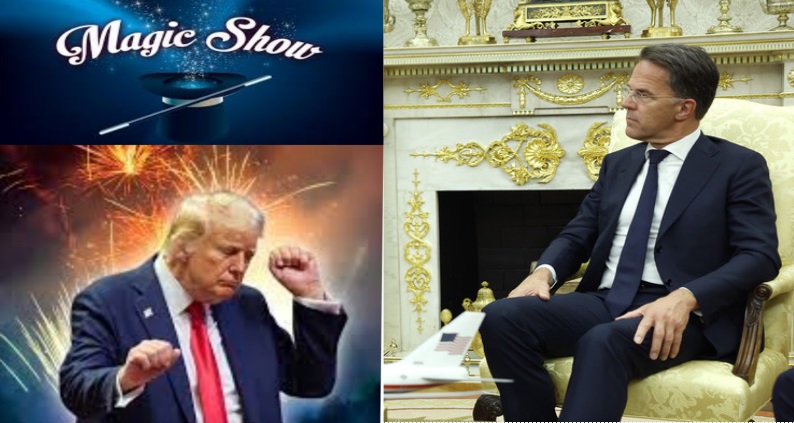
On Monday, Trump pledged to provide more US-made weapons to Kiev through a new scheme funded by European NATO members. “We’re not buying it,” Trump said during an Oval Office meeting with the bloc’s secretary-general, Mark Rutte. “We will manufacture it, and they’re going to be paying for it.”
Trump noted that the plan is seen by Washington as a business opportunity.
Rutte said six countries – Finland, Denmark, Sweden, Norway, the Netherlands, and Canada – were willing to take part in the arms procurement scheme. However, high-ranking sources at the embassies of two of those countries told Reuters they only learned of their supposed participation when the announcement was made.
“It is my clear sense that nobody has been briefed about the exact details in advance,” one European ambassador told Reuters. “And I also suspect that internally in the administration they are only now beginning to sort out what it means in practice.”
Several countries have already distanced themselves from Trump’s plan. According to Politico and La Stampa, France and Italy will not be financially supporting the effort. Hungary and the Czech Republic have also declined to participate, with Czech Prime Minister Petr Fiala saying Prague is focusing on other projects.
EU foreign policy chief Kaja Kallas, on the other hand, has welcomed the proposal but emphasized that Washington should “share the burden,” stating that if European countries pay for the weapons, it should be considered as “European support.”
Since taking office in January, Trump has renewed pressure on NATO members to increase defense spending and warned that the US may not defend allies who do not meet their obligations.
Russia has repeatedly condemned Western arms supplies to Ukraine, arguing that it only prolongs the bloodshed and does not change the course of the conflict. The Kremlin maintains that foreign military aid is being used to escalate the hostilities rather than seek a diplomatic resolution.
Trump’s nuclear power push weakens regulator and poses safety risks, former officials warn
Spencer Kimball, Jul 17 2025
Key Points
Former NRC commissioners say the order threatens the regulator’s independence, raising safety concerns that could undermine public confidence.
President Donald Trump has ordered an overhaul of the Nuclear Regulatory Commission, part of his push to quadruple nuclear power in the U.S. by 2050.
The order requires the NRC to make decisions on nuclear plants within 18 months, completely revise its regulations and reduce its staff.
Former NRC commissioners say the order threatens the
regulator’s independence, raising safety concerns that could undermine
public confidence. President Donald Trump’s push to approve nuclear
plants as quickly as possible threatens to weaken the independent regulator
tasked with protecting public health and safety, former federal officials
warn.
Trump issued four sweeping executive orders in May that aim to
quadruple nuclear power by 2050 in the U.S. The White House and the
technology industry view nuclear as powerful source of reliable electricity
that can help meet the growing energy needs of artificial intelligence.
The most consequential of Trump’s orders aims to slash regulations and speed
up power plant approvals through an overhaul of the Nuclear Regulatory
Commission. The NRC is an independent agency established by Congress in
1975 to make sure that nuclear reactors are deployed and operated safely.
Trump accuses the NRC of “risk aversion” in his order, blaming the
regulator for how few nuclear plants have been built in the U.S. over the
past three decades. The president says that the NRC is focused on
protecting the public from “the most remote risks,” arguing that such a
cautious approach to approving plants restricts access to reliable
electricity.
CNBC 17th July 2025, https://www.cnbc.com/2025/07/17/trumps-nuclear-power-push-weakens-regulator-and-poses-safety-risks-former-officials-warn.html
Trump Asked Zelensky If He Could Strike Moscow If the US Provided Longer-Range Weapons.

Trump later denied that he was considering sending long-range weapons to Ukraine and said that Ukraine shouldn’t target Moscow
by Dave DeCamp | Jul 15, 2025, https://news.antiwar.com/2025/07/15/trump-asked-zelensky-if-he-could-strike-moscow-if-the-us-provided-longer-range-weapons/
President Trump has encouraged Ukraine to step up strikes deep inside Russia and even asked Ukrainian President Volodymyr Zelensky if his forces were capable of striking Moscow if the US provided longer-range weapons, the Financial Times reported on Tuesday.
Sources told the FT that the conversation occurred during a July 4 phone call. “Volodymyr, can you hit Moscow? . . . Can you hit St Petersburg too?” Trump asked. Zelensky replied that his forces could “absolutely” strike the Russian cities if the US provided the necessary weapons.
The report said that Trump signaled backing for the idea of providing long-range weapons in order to “make them [Russians] feel the pain” to pressure Moscow at the negotiating table. In comments to reporters, Trump later denied that he was considering providing Ukraine with long-range weapons and said that Zelensky “shouldn’t target Moscow.”
The White House confirmed that the conversation about striking Moscow took place, but insisted Trump wasn’t encouraging Ukrainian attacks inside Russia. A White House official told the BBC that Trump was “merely asking a question, not encouraging further killing. He’s working tirelessly to stop the killing and end this war.”
The FT report said that US officials have also provided Zelensky with a list of potential long-range weapons the US could supply. The Ukrainians have been asking for Tomahawk missiles, which have a range of over 1,000 miles, making them capable of hitting Moscow from Ukrainian territory.
Last year, the Biden administration gave Ukraine the green light to use ATACMS missiles in strikes on Russian territory. The ATACMS have a range of about 190 miles, which is not far enough to hit Moscow. Russia has made clear that attacks on its territory risk nuclear escalation since it lowered the threshold for its use of nuclear weapons in response to the US backing the ATACMS attacks.
The revelation about the Trump-Zelensky call came after the US president announced a new plan to provide Ukraine with “billions of dollars” worth of weapons by selling arms to NATO countries that will then transfer them to the war-torn nation. He also threatened major tariffs on Russia and its trading partners if a peace deal isn’t reached in 50 days, an ultimatum Moscow has rejected.
U.S. Military Launches MASSIVE Drills to Prepare for WAR with China | KJ Noh
https://www.youtube.com/watch?v=UfHiRlHD3ZY
The U.S. launched massive military drills focused on war with China in the Pacific theater this week, involving 12,000 personnel from the Air Force and Space Force, and more than 350 aircraft, with the Secretary of the Air Force noting that this exercise is “the first of its kind since the Cold War.”
- US conducts Department-level War drills not seen in a generation aimed at China
- How Trump’s Tariff Tantrum and Rubio in ASEA are part of this escalation; Beijing’s countermove: ASEAN-China FTA
- History: Tariffs as economic warfare & as continuation of the TPP: Hybrid warfare and continuity of war agenda
- 4 phases of Taiwan’s history/4 phases of US-China relation: Taiwan’s proxy role
- Weaponization and provocation: does China have to respond?
- Russia-China two-front-war accusations; strategic sequencing, division of labor, separation anxiety
“If we make no effort to change direction, we will end up where we are heading.”
Small Nuclear Reactor company’s focus turns to raising $500+ million.

COMMENT. The ask for $500-million has been out there for about two years. Deadbeats, all of them involved in this sorry excuse for a project. It’s pathetic.
It comes after review by Canadian Nuclear Safety Commission that it hopes to parlay into newfound investment
Adam Huras, Jul 10, 2025,
https://tj.news/new-brunswick/smr-companys-focus-turns-to-raising-millions-to-finish-design-work
ARC Clean Technology says its focus is now raising what is likely still the hundreds of millions of dollars it needs to finish the design work of its small modular nuclear reactor.
It’s a figure that’s likely upwards of $500 million, according to two former ARC CEOs.
That’s with the aim to enable NB Power to submit a license to construct application hopefully by 2027, with a target commercial deployment at Point Lepreau in the early 2030s.
It comes after the completion of a review by the Canadian Nuclear Safety Commission that it hopes to parlay into newfound private investment.
Earlier this week, the country’s safety commission said it identified “no fundamental barriers” to licensing the ARC’s proposed sodium-cooled fast neutron reactor, after completing a second design review that had stretched on for over three years.
It’s a result that ARC is calling a “pivotal step” toward commercial deployment.
That’s while adding it gives the company new “global credibility” in a race to market.
Its focus now is raising new money.
“Our current focus is on advancing strategic partnership and investment discussions to set the stage for the next phase of design work to support a license to construct application,” ARC Clean Technology spokesperson Sandra Donnelly told Brunswick News.
Asked specifically how much money is needed, Donnelly declined to say.
“We continue to evaluate the going forward cost estimate through current discussions with strategic partners,” she said.
“We are not sharing specific numbers.”
ARC’s former CEO Bill Labbe had previously said the ARC-100 would cost $500 million to develop and needed an additional $600 million more in power purchase agreements to move the project forward.
That was after the Higgs government gave $20 million to ARC, while the feds awarded the company another $7 million.
Ottawa also provided NB Power with $5 million to help it prepare for SMRs at Point Lepreau.
The Gallant Liberal government also first spent $10 million on ARC and Moltex, the province’s other company pursuing SMR technology, as they set up offices in Saint John now roughly eight years ago.
In an interview with Brunswick News on Thursday, another former ARC president and CEO, Norm Sawyer, who left the company in 2021 and is now a board member at the National Research Council Canada, pegged the figure needed to likely be between US$500 and $700 million.
“A preliminary design is almost essentially complete,” Sawyer said of the Phase 2 review. “Obviously, the next step needs money.
“They would also have to staff up.”
Sawyer said further design work could involve upwards of 100 employees with intensive final engineering to be completed.
That doesn’t include the construction of a facility at Lepreau, Sawyer said.
Brunswick News first reported last spring that ARC had handed out layoff notices to employees, while confirming that, in parallel, its president and CEO since 2021, Labbe, was leaving the company.
Asked if staffing levels will now change, Donnelly said that’s now “being reviewed as part of preparations for the next phase of design work.”
“It’s a positive step for them, it’s just can they leverage it now to get to the next step which is really investment,” Sawyer said. “I think there’s value there for investors.
“It’s also up to how much risk investors are willing to take. I think the investor would want a PPA (power purchase agreement) first.”
A power purchase agreement is a long-term contract where a nuclear power plant sells electricity to a buyer, often a utility, government, or large energy consumer.
NB Power CEO Lori Clark told a committee of MLAs at the provincial legislature earlier this year that ARC is “looking for investors now.”
Clark herself travelled to South Korea last December to promote ARC’s “commercialization possibilities,” in part to drum up new financial support.
A trilateral collaboration agreement was announced last year between South Korea’s utility, ARC, and NB Power with the goal of establishing “teaming agreements for global small modular reactor fleet deployment.”
ARC also said that it welcomed in February “multiple delegations” from South Korea’s utility.
No financial agreement has been revealed as of yet.
Finding the money necessary to finish design work is integral to building timelines.
“Our next objective is to complete the required design work by 2027 to enable NB Power to submit a license to construct application, with a target commercial deployment in early 2030s,” Donnelly said.
“Timelines will continue to be reviewed as design work and partnership discussions progress.”
The company still faces other challenges.
Brunswick News has also reported that ARC is still in search of a new enriched uranium supplier, after it originally planned to buy from Russia. It’s a problem Sawyer has suggested might result in a redesign of the company’s small modular nuclear reactor technology.
Asked if the concern over an enriched uranium source has been resolved, Donnelly said that “the availability of HALEU (high-assay low-enriched uranium) fuel remains an overall market issue.
“We are encouraged that the HALEU supply chain has advanced significantly over the past year with strong government support in multiple countries, and we continue to evaluate multiple options to secure a fuel supply for the first ARC unit,” she added.
The enriched uranium is an integral component of the company’s ARC-100 sodium-cooled fast reactor.
But it’s not as simple as finding that enriched uranium closer to home. While Canada mines uranium, and there are currently five uranium mines and mills operating in Canada, all located in northern Saskatchewan, it does not have uranium enrichment plants.
The U.S. opened its first and only enrichment plant, operated by Centrus Energy in Ohio, amid a federal push to find a solution to the Russia problem. It remains the only facility in the U.S. licensed to enrich uranium, and has a lineup for SMR firms seeking its fuel.
That said, there appeared to be a glimmer of hope on the uranium front late last year as the Trudeau federal government’s fall economic statement promised support to strengthen nuclear fuel supply chains.
“To support demand for allied enriched nuclear fuel and bolster supply chain resiliency, the 2024 fall economic statement announces the government’s intent to backstop up to $500 million in enriched nuclear fuel purchase contracts from the United States or other allied countries, including high-assay low-enriched uranium (HALEU), subject to further consultations with industry stakeholders on program details, and provide $4 million over 10 years, starting in 2024-25, for Natural Resources Canada to administer the program,” reads the fall mini budget.
The current Carney government has yet to table a budget laying out whether that commitment will continue to go ahead.
1 This Month

of the week– Nuclear Reactor Information Task Force

14 May – online event From Bombs to Data Centres: the Face of Nuclear Colonialism
To see nuclear-related stories in greater depth and intensity – go to https://nuclearinformation.wordpress.com
-
Archives
- May 2026 (92)
- April 2026 (356)
- March 2026 (251)
- February 2026 (268)
- January 2026 (308)
- December 2025 (358)
- November 2025 (359)
- October 2025 (376)
- September 2025 (257)
- August 2025 (319)
- July 2025 (230)
- June 2025 (348)
-
Categories
- 1
- 1 NUCLEAR ISSUES
- business and costs
- climate change
- culture and arts
- ENERGY
- environment
- health
- history
- indigenous issues
- Legal
- marketing of nuclear
- media
- opposition to nuclear
- PERSONAL STORIES
- politics
- politics international
- Religion and ethics
- safety
- secrets,lies and civil liberties
- spinbuster
- technology
- Uranium
- wastes
- weapons and war
- Women
- 2 WORLD
- ACTION
- AFRICA
- Atrocities
- AUSTRALIA
- Christina's notes
- Christina's themes
- culture and arts
- Events
- Fuk 2022
- Fuk 2023
- Fukushima 2017
- Fukushima 2018
- fukushima 2019
- Fukushima 2020
- Fukushima 2021
- general
- global warming
- Humour (God we need it)
- Nuclear
- RARE EARTHS
- Reference
- resources – print
- Resources -audiovicual
- Weekly Newsletter
- World
- World Nuclear
- YouTube
-
RSS
Entries RSS
Comments RSS
 nuclear-news