Trump’s huge military budget will accelerate U.S. economic decay
May 30, 2025 Gary Wilson, Struggle La Lucha
President Donald Trump delivered a rally-style commencement speech at the U.S. Military Academy at West Point on May 24, aggressively promoting militarism, nationalism, and his ongoing attacks on diversity, equity, and inclusion (DEI) as well as transgender rights.
Addressing the graduating cadets, Trump glorified the U.S. military as “the greatest and most powerful army the world has ever known,” claiming personal credit for its expansion during his first term.
“I rebuilt the army and the military like nobody has ever rebuilt it before,” Trump boasted, putting military power at the center of U.S. global dominance.
Trump intensified his militaristic agenda: “We’re getting rid of the distractions and focusing our military on its core mission: crushing America’s adversaries, killing America’s enemies, and defending our great American flag.”
Trump said that’s why the U.S. will invest in new tanks, planes, drones, ships, and missiles. In addition, the U.S. will build the Golden Dome Missile Defense Shield, which has been described as a $175 billion fantasy and a boondoggle for Elon Musk’s SpaceX.
He also praised recent reactionary policies designed to dismantle DEI programs in the armed forces.
The Trump administration has moved to ban trans troops from the military — a decision the Supreme Court upheld earlier this month. Trump’s policies have reintroduced a discriminatory ban on transgender military personnel and imposed new uniform physical standards aimed at severely limiting women’s participation in combat roles.
Unprecedented military expansion
On May 2, Trump released his budget request for 2026, dubbed the “One Big Beautiful Bill.” Over 75% of Trump’s budget is allocated for the military and police.
In the budget proposal, military spending is $1.01 trillion, accounting for approximately 60% of the total requested. For the non-military Departments of Homeland Security, Justice, and Veterans Affairs, the request is $272.2 billion.
Funding for departments whose primary purpose isn’t military, military-adjacent, or policing is $409 billion, or only 24% of the budget.
The proposal includes $163 billion in federal spending cuts, all of which target non-defense programs. For a breakdown of the cuts, see: Trump’s ‘big beautiful’ cuts to Social Security, Medicare, Medicaid and more.
Military Keynesianism
Both Donald Trump and Joe Biden have argued that increased military spending and the production of armaments will reindustrialize the country and create jobs, using this rationale to justify historically large Pentagon budgets. And completely ignoring that military expansion is not, in any way, shape, or form, reindustrialization.
Trump has explicitly said it would provide unmatched military strength and support job creation through the purchase of new equipment and capabilities, mirroring the arguments made by Democrats, including Biden, about the economic benefits of Pentagon budgets.
The Biden administration promoted the jobs argument, especially when seeking support for military aid to Ukraine, Israel, and Taiwan. Biden described the U.S. arms industry as the “arsenal of democracy,” emphasizing the economic benefits to states involved in weapons production.
Military Keynesianism is an economic policy approach that advocates for sustained, high levels of military spending as a primary tool for government stimulus and economic growth, based on the core principles of Keynesian economics………………………………………………………………………………………………………………………. https://www.struggle-la-lucha.org/2025/05/30/trumps-big-beautiful-budget-military-spending-soars-accelerating-u-s-economic-decay/
A superhighway to nuclear hell
by beyondnuclearinternational, https://beyondnuclearinternational.org/2025/06/02/a-superhighway-to-nuclear-hell/
Trump’s reckless and accelerated nuclear orders would destroy safety oversight and endanger the public, writes Linda Pentz Gunter
On May 23rd, with several strokes of his pen, President Trump issued orders that would roll back US energy policy about 50 years.
On that day, Trump signed five Executive Orders (EOs): Restoring Gold Standard Science; Ordering the Reform of the Nuclear Regulatory Commission; Reinvigorating the Nuclear Industrial Base; Reforming Nuclear Reactor Testing at the Department of Energy; and Deploying Advanced Nuclear Reactor Technologies for National Security. (This page keeps a running tally of all the White House executive orders.
All of this madness was announced in a press release headlined “President Trump Signs Executive Orders to Usher in a Nuclear Renaissance, Restore Gold Standard Science.” Just in case there was any confusion about what this meant, the press release included an explanation that read: “Gold Standard Science is just that—science that meets the Gold Standard.”
Collectively, the four orders that focused on the nuclear sector would: reduce and undermine the already inadequate safety oversight authority of the US Nuclear Regulatory Commission (NRC); fast-track unproven new reactor projects without regard for safety, health or environmental impacts; curtail or possibly even end public intervention; weaken already insufficient radiation exposure standards; and reopen the pathway between the civil and military sectors, all while “unleashing” (Trump’s favorite verb) nuclear power expansion on a dangerous and utterly unrealistic accelerated timeline.
The precursive warning shot to all this had been fired on February 5th with Energy Secretary Chris Wright’s own Executive Order: Unleashing the Golden Era of American Energy Dominance, ‘dominance’ being another of Trump’s favorite big beautiful words, along with ‘big’ and ‘beautiful’ (—see his One Big Beautiful Bill Act.) “It’s time for nuclear, and we’re going to do it very big,” Trump told industry executives when he signed the orders.
Perhaps it’s no surprise to find that ‘dominance’ appears 35 times in the Heritage Foundation’s 2023 handbook, Authoritarianism for Dummies, officially known as Project 2025. Variations on the word ‘unleash’ appear 19 times. ‘Tremendous’ shows up 11 times. So does ‘gold standard’.
Which brings us to the fifth executive order of May 23, Restoring Gold Standard Science. While it does not specifically reference nuclear power, the order determines a hierarchy that will put political appointees in charge of specialized federal agencies, including the NRC. The order also itemizes a set of requirements on how scientific research and activities must be conducted, including “without conflicts of interest.”
But guess whose stocks soared after the release of Trump’s nuclear Executive Orders? Answer: Oklo, the company attempting to deliver the first US micro-reactors. Guess who was on the board of Oklo before his appointment as Trump’s Energy Secretary? Yes, Chris Wright.
Uranium mining company Centrus Energy and the U.S. Navy’s main nuclear reactor supplier, BWX Technologies, also saw their stock prices soar after Trump’s executive orders were released.
An Oklo executive, Jacob DeWitte, who was present at the signing, brought along a golf ball to help Trump understand just how little uranium is needed for the lifetime needs of a single human being (an entirely irrelevant statistic given the lethality contained in that glowing little golf ball.) Trump called the golf ball show-and-tell “very exciting” before teeing up another order that will not only muzzle but actually persecute scientists for any findings with which the Trump hive don’t agree.
The definition of ‘sound science’, under Trump’s ‘gold standard’, is simply anything happening now or under the previous Trump administration. Anything that happened under the Biden administration is “politicized science”.
Among the enforcers who will police and punish the NRC, along with other federal agencies who stray from Trump’s “science” script, is the Director of the Office of Science and Technology Policy, one Michael Kratsios.
Kratsios is the former chief of staff to AI entrepreneur, venture capitalist and nuclear promoter, Peter Thiel. Thiel’s venture capital firm, Founders Fund, supported nuclear fuel start-up General Matter, in contention to produce high-assay low-enriched uranium (HALEU) for advanced nuclear reactors. One of the executive orders will “seek voluntary agreements pursuant to section 708 of the DPA with domestic nuclear energy companies that could deliver HALEU fuel.”
Kratsios is already sharpening his knives to go after the NRC, viewed as an obstacle to fast-tracking the new nuclear projects that Kratisios’s former boss, among others, will be pushing.
“Today’s executive orders are the most significant nuclear regulatory reform actions taken in decades,” said Kratsios on May 23. “We are restoring a strong American nuclear industrial base, rebuilding a secure and sovereign domestic nuclear fuel supply chain, and leading the world towards a future fueled by American nuclear energy. These actions are critical to American energy independence and continued dominance in AI and other emerging technologies.”
There has already been some pushback against allowing a political appointee to be the arbiter of scientific integrity. “Putting that power in the hands of a political appointee who doesn’t need to consult with scientific experts before making a decision is very troubling,” Kris West of COGR, an association of research universities, affiliated medical centers, and independent research institutes, told Science.
A group of scientists has written an open letter, retitling the order “Fool’s Gold Standard Science,” declaring that it “would not strengthen science, but instead would introduce stifling limits on intellectual freedom in our Nation’s laboratories and federal funding agencies”.
Part of the “regulatory reform” outlined as “gold standard science” and that Kratsios will oversee, is gutting the NRC, which, complains the White House, “charges applicants by the hour to process license applications with prolonged timelines that maximize fees while throttling nuclear power development.”
Somehow, “throttling nuclear power development” is not what springs to mind when reviewing the record of an agency that consistently favors the financial needs of the nuclear industry over the interests of public safety and the environment.
Furthermore, charges the White House, the NRC “has failed to license new reactors even as technological advances promise to make nuclear power safer, cheaper, more adaptable, and more abundant than ever.”
Trump, who seems to treat executive orders like a Nike slogan (“just do it”), has commanded that the US quadruple its nuclear energy capacity by 2050. This will be achieved not only by stripping the NRC of its power to scrutinize the safety assurances for new, primarily small modular reactors, but by expediting their licensing while keeping current reactors running longer and hotter and even reopening permanently closed ones.
Licensing timeframes will be slashed to “a deadline of no more than 18 months” for final decisions on construction and operating license applications for new reactors, and to just one year “for final decision in an application to continue operating an existing reactor of any type.”
The Trump order will also require “the reactivation of prematurely shuttered to partially completed nuclear facilities.” The former refers to Palisades, Three Mile Island and Duane Arnold so far. The latter is about the abandoned two-reactor Westinghouse AP 1000 project at V.C. Summer in South Carolina.
Currently operating reactors will be expected to add “5 gigawatts of power uprates”, which comes with its own set of safety concerns given the age of the US nuclear reactor fleet.
Everything has been put on a superhighway to nuclear hell, unhinged from the very real obstacles to fast-tracking nuclear expansion, most notably the cost and risks.
“A pilot program for reactor construction and operation outside the National Laboratories,” will require the Energy Secretary to “approve at least three reactors pursuant to this pilot program with the goal of achieving criticality in each of the three reactors by July 4, 2026,” one order said.
An astonishing “10 new large reactors with complete designs under construction by 2030,” is another aspirational command.
The Secretary of Energy must also designate at least one site for advanced reactor technologies within three months of the order, and ensure that it will host a fully operational reactor there “no later than 30 months from the date of this order.”
None of these timelines share any precedent with the track record of nuclear power plant construction, and bullying or handcuffing the NRC won’t change that.
That’s because, as Toby Dalton and Ariel Levite of the Carnegie Endowment for International Peace point out in their recent column in The Hill: “The Nuclear Regulatory Commission has not presented the key obstacle to nuclear development in the U.S.” The orders, they said “underestimate the addition of time to market due to limitations on workforce availability, supply chain, financing, specialty fuels and community buy-in.”
The Carnegie authors also criticized the way the orders treat nuclear power as if it is similar to any other form of energy. “The orders downplay or ignore the special magnitude of nuclear risks, the series of traumatic accidents suffered by leading nuclear power nations and the unique environmental and multi-generational footprint of nuclear waste and spent fuel,” they wrote.
What reining in the NRC will achieve is an even greater reduction in confidence over the safe operation of current and future nuclear reactors.
“This push by the Trump administration to usurp much of the agency’s autonomy as they seek to fast-track the construction of nuclear plants will weaken critical, independent oversight of the U.S. nuclear industry and poses significant safety and security risks to the public,” said Ed Lyman, a physicist and Director of Nuclear Power Safety at the Union of Concerned Scientists.
To set all this right, the DOGE kids will soon be paying a visit to the NRC to fire people. DOGE, says the Reform the NRC order, will “reorganize the NRC to promote the expeditious processing of licensing applications and the adoption of innovative technology. The NRC shall undertake reductions in force in conjunction with this reorganization, though certain functions may increase in size consistent with the policies in this order, including those devoted to new reactor licensing.”
But “reorganizing” the NRC will have the reverse effect, argues Senator Ed Markey (D-MA) a longtime nuclear watchdog on Capitol Hill, including during his earlier years in the US House of Representatives. “It will be impossible for NRC to maintain a commitment to safety and oversight with staffing levels slashed and expertise gone,”Markey said.
“Allowing DOGE to blindly fire staff at the NRC does nothing to make it easier to permit or regulate nuclear power plants, but it will increase the risk of an accident,” said ranking member of the House Energy and Commerce Committee, Frank Pallone (D-NJ), who called the orders “dangerous.”
But then the Trump administration doesn’t actually consider nuclear power itself to be dangerous, and instead accuses the NRC of being overly cautious, saying: “Instead of efficiently promoting safe, abundant nuclear energy, the NRC has instead tried to insulate Americans from the most remote risks without appropriate regard for the severe domestic and geopolitical costs of such risk aversion.”
Consequently, it’s no surprise to find a clause in the order that reads: “The personnel and functions of the Advisory Committee on Reactor Safeguards (ACRS) shall be reduced to the minimum necessary”. The ACRS panel is composed of cream-of-the-crop scientists from the national laboratories, universities and other areas of academia. Its mandate, ironically and in place for decades, has been precisely to uphold “Gold Standard Science” in the nuclear power sector.
Like everything else Trump does, all of this constitutes another accident waiting to happen. “If you aren’t independent of political and industry influence, then you are at risk of an accident,” confirmed former NRC chair Allison Macfarlane of efforts to undermine her former agency.
The orders are a “guillotine to the nation’s nuclear safety system”, another former NRC chair Greg Jaczko told the Los Angeles Times.
Also guillotined is any pretense about protecting the public from the harm caused by exposure to the ionizing radiation released by the nuclear power sector.
No longer must we adhere to the standard, endorsed by the National Academy of Sciences, that exposure to any amount of radiation, no matter how small, could be harmful to human health. (This is especially true if it involves consistent and chronic longterm exposure even to what might be considered “low” doses.)
Instead, say Trump’s orders, “the NRC shall reconsider reliance on the linear-no-threshold (LNT) model for radiation exposure and the ‘as low as reasonably achievable’ standard, which is predicated on LNT.” Those models, says the White House, are “flawed.”
This will of course open the door to the hormesis advocates who, without any firm basis in actual science, insist that a little radiation is good for all of us.
It’s time to set the record straight on radiation and the damage it causes, particularly to pregnancy, children and women,” responded Cindy Folkers, radiation and health hazard specialist at Beyond Nuclear. “Contrary to what Trump’s recent EO claims, abundant and largely officially ignored scientific evidence demonstrates that childhood cancers increase around normally operating nuclear facilities, with indications that these cancers begin during pregnancy. The uranium mining needed to produce fuel for reactors, is associated with a number of health impacts. Even already existing background radiation is associated with childhood cancers.”
The already flimsy separation between the civil and military nuclear sectors is all but erased in the new EOs, most notably in the emphasis on a return to the reprocessing of irradiated reactor fuel. This operation separates out the uranium and plutonium while producing a vast amount of so-called low- and intermediate-level liquid and gaseous wastes that are routinely released into the air and sea.
Reprocessing was rejected in the US by the Ford and Carter administrations as too proliferation risky, given that plutonium is the trigger component of a nuclear weapon. It is still carried out in France — and until recently in the UK — where radioactive isotopes released by these operations have been found as far away as the Arctic Circle. The UK reprocessing activities at Sellafield rendered the Irish Sea the most radioactively contaminated sea in the world.
But, wrote the White House in the Deploying Advanced Nuclear Reactor Technologies EO: “Within 90 days of the date of this order, the Secretary of Energy shall identify all useful uranium and plutonium material within the Department of Energy’s inventories that may be recycled or processed into nuclear fuel for reactors in the United States.” That sounds like a return to mixed oxide fuel, or MOX, another program that was abandoned, but not until after a protracted opposition campaign launched by our movement — Nix MOX — finally prevailed.
Another order directs “The Secretary of Defense, through the Secretary of the Army” to “commence the operation of a nuclear reactor, regulated by the United States Army, at a domestic military base or installation no later than September 30, 2028.”
Some of those closed civil nuclear power plants could find themselves repurposed by the Department of Defense, serving as “energy hubs for military microgrid support.” Advanced nuclear reactor technologies will also be expected to power AI datacenters “within the 48 contiguous States and the District of Columbia, in whole or in part, that are located at or operated in coordination with Department of Energy facilities, including as support for national security missions, as critical defense facilities, where appropriate.”
Pronounced Kratsios in the May 23 press release: “We are recommitting ourselves to scientific best practices and empowering America’s researchers to achieve groundbreaking discoveries.”
Until they come and arrest you for telling the truth.
Linda Pentz Gunter is the international specialist at Beyond Nuclear and writes for and edits Beyond Nuclear International.
The NRC’s new Mission Impossible: Making Atoms Great Again

If the NRC complies with them and reduces itself to a rubber-stamp, the public will be increasingly at risk.
Perhaps recognizing that this NRC “reform” will likely render the agency non-functional for the foreseeable future, the administration hedged its bets by issuing two other orders that would bypass NRC licensing altogether.
The NRC has been given a new mission to facilitate nuclear power at the expense of public health and environmental protection.
By Edwin S. Lyman | May 29, 2025
In early May, drafts of presidential executive orders surfaced that would “reform” (e.g., dismantle) the long-established independent safety and security framework under which the United States regulates commercial nuclear power. For those who held out hope that the leaked orders were trial balloons and would be shot down by stakeholders who value regulatory stability and clarity—such as nuclear power plant operators—disappointment loomed. On May 23, President Donald Trump signed the orders, which in some respects had gotten even more extreme than originally advertised.
One order mandates that the Nuclear Regulatory Commission (NRC) fundamentally change its mission to support the absurd and reckless goal of quadrupling of US nuclear energy capacity to 400 gigawatts by 2050—which would, if achieved, add the equivalent of 300 large nuclear plants to the US fleet—by prioritizing speedy licensing over protecting public health and safety from radiation exposure. This would effectively make the NRC a promotional agency not unlike its predecessor, the Atomic Energy Commission, thereby undoing the NRC’s 51-year history as the independent safety regulator established by the 1974 Energy Reorganization Act. Congress considered but ultimately watered down a legislative provision to do just that last year. Now President Trump wants to finish the job by requiring the NRC to “facilitate nuclear power” in addition to “ensuring nuclear safety.”
The order requires that the agency undertake “a wholesale revision of its regulations and guidance documents” and produce draft and final versions of the new rules within nine and 18 months, respectively. Anyone who has even a passing familiarity with this massive body of regulatory detail—refined over decades of increasing technical knowledge, facility operating experience (including the 1979 Three Mile Island and 2011 Fukushima Daiichi accidents), and often impassioned debate about “how safe is safe”—surely knows this is a nigh impossible task. The challenge is compounded by the vague criteria provided to guide the revision, which invoke subjective terms that are the bane of regulators, such as “reduce unnecessary burdens” and “focus on credible, realistic risks.”
This exercise in busywork on a massive scale will only serve as a disruptive distraction from the NRC’s important work overseeing the operating fleet of US nuclear reactors, likely leading to regulatory paralysis and delays.
Specifically, even though the NRC has already been working to shorten approval timelines under pressure from Congress, the order directs the commission to establish fixed, 18-month deadlines for approving applications for new reactors of any type, providing no leeway except for “instances of applicant failure.” Imposing such a rigid schedule may appease arrogant vendors of new nuclear designs who resent the scrutiny of regulators, but such a dictat is terrible for nuclear safety. New nuclear reactors in the licensing pipeline are mostly experimental in design; they have had little to no operating experience and introduce novel safety concerns that require painstaking and time-consuming experiments and analyses to resolve. Forcing technical reviewers to paper over such gaps in knowledge to meet arbitrary deadlines may lead to faster approvals, but it is sure to create implementation headaches and serious safety problems for anyone who tries to build and operate these first-of-a-kind reactors. And dedicated safety professionals at the NRC are not likely to remain in an environment where they are compelled to compromise their integrity, depleting the workforce needed to process a growing number of applications.
NRC reviews often uncover safety issues that reactor applicants miss. A case in point is the NuScale small modular reactor. During the review of the original NuScale design, NRC staff identified a mechanism that could cause the reactor to become critical and melt down following an emergency shutdown, leading the company to make last-minute design changes.
In the anti-science push that we have come to expect from the Trump administration, the order also deems well-established models of the risks of low-level radiation exposure to “lack sound scientific basis.” It directs the agency to “specifically consider adopting determinate radiation limits”—that is, to accept the view of a small minority that there is a “safe” level of radiation and incorporate it into its regulations—despite an actual lack of sound scientific basis supporting such a claim. The NRC recently affirmed in a unanimous vote that the “linear no-threshold model” (the principle that any level of radiation is harmful, but the cancer risk is proportional to the dose), which is the foundation of international radiation protection standards, remains an effective basis for the NRC’s regulatory framework. Compelling the NRC to rewrite its regulations based not on the current state of scientific knowledge but on pseudoscience will only create chaos and ultimately put the public at unnecessary risk.
Perhaps recognizing that this NRC “reform” will likely render the agency non-functional for the foreseeable future, the administration hedged its bets by issuing two other orders that would bypass NRC licensing altogether. Those orders encourage approval of reactors within the purview of the Defense Department and the Energy Department. This would have a detrimental impact on nuclear safety in both cases: Defense lacks the expertise to conduct such reviews (as it hasn’t approved its own nuclear reactors in decades); and Energy’s self-regulation of nuclear plants would be tainted by conflicts of interest, as the agency would directly benefit from approval of these projects. One order calls for deploying reactors to power artificial intelligence data centers at Energy Department sites, even if they are privately owned and operated. Whether this order actually expands Energy Department authority to approve reactors for commercial purposes is a complicated question best left for the lawyers. But there is clear intent to sideline the Nuclear Regulatory Commission and the relatively high level of public engagement and transparency that the agency offers compared to the Defense and Energy departments.
Another goal of the orders is to “promote American nuclear exports.” But what the administration doesn’t realize is that the NRC’s image (deserved or not) as the world’s “gold standard” nuclear safety regulator is a critical selling point for the US brand and US nuclear vendors. This is especially true for countries new to nuclear power that lack their own regulatory expertise and put their faith in NRC licensing. Yet nearly every action in the orders will undermine global confidence that the NRC is continuing to make independent safety judgments about new reactor designs and isn’t merely doling out seals of approval to Trump’s preferred cronies of the moment. Also, adopting radiation protection standards that violate international norms is not likely to bolster confidence in US designs around the world.
The NRC has been given a new mission to facilitate nuclear power at the expense of public health and environmental protection. But it doesn’t have to choose to accept it. It’s no surprise that an administration that embraces conflicts of interest would not care about preserving NRC’s non-promotional status. But unless the Supreme Court says otherwise, it is far from clear that independent agencies are obligated to follow executive orders—and as an independent agency, the NRC would be well justified in rejecting any attempt to negate Congress’ chief rationale for creating it in 1974. Chairman David Wright often says that safety is the NRC’s “North Star.” Now he can show that he means what he says by rebuffing President Trump’s crude and possibly illegal attempt to effectively destroy the Nuclear Regulatory Commission and undermine its authority to protect the public from potentially disastrous corner-cutting by the nuclear industry.
For decades, the nuclear industry has blamed overregulation for the cost overruns and delays that have plagued new projects and caused it to lose the confidence of investors. Now, these dangerous executive orders call the bluff. If the NRC complies with them and reduces itself to a rubber-stamp, the public will be increasingly at risk. Only time will tell if the industry, even without needed oversight and reasonable regulation, can build nuclear plants on schedule and on budget, or if it will finally have to grapple with the real root causes of its failure to thrive.
The Nuclear Gambit: Trump just handed the atom to the highest bidder

NJ Today News, 2 June 25, https://njtoday.news/2025/05/31/the-nuclear-gambit-trump-just-handed-the-atom-to-the-highest-bidder/
The air in America reeks of uranium and unchecked ambition as the Trump administration, in a move that can be described as arson, signed a series of executive orders designed to gut the Nuclear Regulatory Commission—the last line of defense between corporate nuclear profiteers and the American public.
This was no mere policy shift.
This was a full-scale sabotage of oversight, a calculated demolition of the very safeguards that have kept Three Mile Island from becoming a recurring nightmare. With the stroke of a pen, Trump has effectively turned the NRC into a rubber-stamp factory, slashing staff, silencing public input, and fast-tracking reactor approvals with all the caution of a drunk gambler doubling down on a losing hand.
The Death of Independent Regulation
The NRC was created for one reason: to keep nuclear power from killing people. But in Trump’s America, profit margins matter more than containment walls. His executive order, dripping with disdain for “overregulation,” directs the NRC to stop worrying about “trivial risks”—as if radiation exposure were a mere nuisance, like a parking ticket.
Meanwhile, the newly christened Department of Government Efficiency (DOGE)—a bureaucratic black hole designed to strangle federal agencies—will “streamline” the NRC by cutting staff and kneecapping its ability to conduct rigorous safety reviews.
Senator Ed Markey, one of the few voices in Washington still screaming into the void, put it bluntly: “Trump wants to turn this critical regulatory agency into the Johnny Appleseed of nuclear energy without safeguards and despite the law that states the NRC has no role in promoting the expansion of nuclear activity. This executive order is a giveaway to the nuclear industry, which has a track record that includes mismanaging for 15 years and at a $35 billion price tag, building just one nuclear power plant in Georgia. That is the very definition of waste.”
The Corporate Handshake
Of course, none of this happens in a vacuum. Standing beside Trump at the signing ceremony was Joe Dominguez, CEO of Constellation Energy, the largest nuclear operator in the U.S. Constellation has big plans—like restarting Three Mile Island’s Unit 1 reactor, the same site where a partial meltdown in 1979 nearly turned Pennsylvania into a no-go zone.
Dominguez, ever the corporate evangelist, whined about “silly questions” slowing down permits—as if nuclear safety were some bureaucratic prank rather than a matter of life and death.
And why the rush? Because AI needs power.
That’s right—the same tech bros who brought us algorithmic chaos now demand 24/7 nuclear juice to fuel their data centers.
Never mind that the last two reactors built in the U.S. were seven years late and $18 billion over budget. Never mind that small modular reactors (SMRs), the industry’s latest pipe dream, are financial black holes propped up by taxpayer subsidies. The grift must go on.
The Ghosts of Uranium Past
But the darkest specter looming over this radioactive power grab is uranium mining—an industry with a legacy of death and environmental ruin.
The Navajo Nation still bears the scars of decades of exploitation, with poisoned water, cancer clusters, and abandoned mines littering their land. Now, with Trump’s orders expanding domestic uranium production, those horrors may return under the banner of “energy dominance.”
Amber Reimondo of the Grand Canyon Trust put it best: “They’re repeating history, pretending the lessons were never learned.”
The Fallout
What does this all mean? It means fewer safety checks. It means rushed reactor designs. It means communities silenced in the name of “efficiency.” And, most of all, it means a windfall for nuclear executives while taxpayers foot the bill for their inevitable disasters.
Edwin Lyman of the Union of Concerned Scientists put it bluntly: “This is a recipe for catastrophe.”
But in Trump’s America, catastrophe is just another business opportunity.
Welcome to the atomic age, version 2.0—where the only thing more unstable than the reactors is the maniac in charge of them.
Trump Says New Iran Deal Must Allow US To ‘Blow Up Whatever We Want’

A senior Iranian adviser said the proposal would amount to “submission and surrender”
by Will Porter May 30, 2025, https://news.antiwar.com/2025/05/30/trump-says-new-iran-deal-must-allow-us-to-blow-up-whatever-we-want/
President Donald Trump argued that any revived nuclear accord with Iran should permit the United States to destroy the country’s nuclear infrastructure and send inspectors to Iranian facilities at any time.
The president outlined his vision for a new agreement during a White House presser on Wednesday, calling for a “very strong document” that would effectively give Washington carte blanche over Tehran’s nuclear energy program.
“I want it very strong – where we can go in with inspectors, we can take whatever we want, we can blow up whatever we want, but [with] nobody getting killed,” he told reporters. “We can blow up a lab, but nobody is gonna be in the lab, as opposed to everybody being in the lab and blowing it up.”
He did not elaborate on those remarks, however, leaving it unclear whether Washington had actually pushed for such major concessions at the negotiating table. The Islamic Republic would be unlikely to accept a deal under those terms.
Ali Shamkhani, a senior adviser to Iran’s supreme leader Ayatollah Ali Khamenei, later denounced Trump’s comments in a social media post, suggesting his proposal would cross Tehran’s “red lines.”
“Efforts to reach Iran’s nuclear plants and ‘blow up their facilities’ have been a dream of previous US presidents,” he wrote. “Iran is an independent state with a strong defense structure, a resilient people, and clear red lines. Negotiations are a means to progress and preserve national interests and honor, not submission and surrender.”
During the same news conference on Wednesday, Trump said he had urged Israeli Prime Minister Benjamin Netanyahu to refrain from military action against Iran amid the ongoing nuclear talks, arguing the move would be “inappropriate” as the two sides were “very close to a solution.” He went on to claim that a new agreement could be reached with Tehran in “a couple weeks,” though his previous assessments have proven overly optimistic.
The threat of an Israeli attack has loomed large over the US-Iran negotiations, as Tel Aviv continues to accuse Tehran of pursuing nuclear weapons despite repeated American intelligence assessments to the contrary.
During a visit to Iran last month, Saudi Arabia’s defense chief reportedly warned top Iranian officials that failure to “quickly” reach a deal with the US could prompt airstrikes by Israel. The Saudi minister added that Trump had “little patience for drawn-out negotiations,” and suggested that a new conflict with Tel Aviv would destabilize the region, according to sources cited by Reuters.
Will Porter is assistant news editor and book editor at the Libertarian Institute, and a regular contributor at Antiwar.com. Find more of his work at Consortium News and ZeroHedge.
Donald Trump’s Fool’s Gold

“Golden Dome for America is a revolutionary concept to further the goals of peace through strength,” asserts its manufacturer, Lockheed Martin, our first clue that the Golden Dome has nothing whatever to do with peace.
there’s not much use in a Golden Dome unless it’s one hundred percent effective, which it has a one hundred percent probability of not being………….. If just one missile gets through, the level of destruction would be devastating, and the US would then likely retaliate after which all bets are off.
the Golden Dome is merely a deterrent meant to frighten off aggressors. That means we are about to spend $175 billion on something the US would never actually use.
Linda Pentz Gunter, May 30, 2025, https://www.counterpunch.org/2025/05/30/donald-trumps-fools-gold/
Alright, as it turns out, the golden toilet was just a myth. Donald Trump doesn’t have one. But not to fret. President Trump’s private Boeing 757 jet (not the even more lavish one he may shortly be gifted by Qatar) reportedly has gold-plated seat belts. His Trump Tower apartment features a 24-carat gold front door. Inside, there are gold ceilings, golden plant pots and even a gold elevator!
Fancy a visit to Mar-a-Lago? Its imitation Versailles aesthetic has been described as that of an upscale bordello.
Trump’s favorite restaurant is, of course, the Golden Arches, (also known as McDonald’s). And then there’s his lustrous golden tan with the reverse raccoon eyes. We could suggest that Trump’s three trophy wives were all gold diggers, but that wouldn’t be very golden hearted. Remember the golden showers kompromat rumor? Ick, let’s not go there, either.
The wannabe king boasted during his January 20 inaugural address that “The Golden Age of America begins right now.” Six weeks later, during his March 4 Joint Address to Congress, Trump reassured the audience that his Golden Age truly was coming. “Get ready for an incredible future,” he said. “The Golden Age of America has only just begun. It will be like nothing that has ever been seen before.”
That last part was certainly true.Next came Trump’s embarrassingly titled One Big Beautiful Bill Act that would cause almost 14 million Americans to lose health care, 11 million to be deprived of food stamps, and slashes $700 billion from Medicaid and $500 billion from Medicare. This was necessary, insists the Trump junta, because there’s just so much wasteful spending in Washington — except of course the $45 million US taxpayers will spend on Trump’s June 14 he-man vanity project, that will parade tanks on the streets of the capital and fighter jets overhead.
The Big Beautiful Bill was followed a day later with much fanfare — but surprisingly without any actual golden trumpeters — by the signing of Trump’s five executive orders on nuclear power. “President Trump Signs Executive Orders to Usher in a Nuclear Renaissance, Restore Gold Standard Science,” announced the press release that presaged these disastrous directives.
The orders dramatically weaken nuclear regulatory and safety oversight, put new reactor development on an entirely unrealistic timetable, knit the civil and military nuclear sectors firmly back together again and make a major nuclear accident more likely.
They also endeavor to drastically weaken existing and inadequate radiation protection standards that already don’t account for the heightened vulnerability to harm of pregnant women, infants and children.
However, since we are now entering the age of enlightenment, the press release went on to explain: “Gold Standard Science is just that—science that meets the Gold Standard.” Thank you for clearing that up.
All of these dangerous developments have arrived wrapped — or should I say gilded — in a nausea-inducing level of overblown rhetoric that showcases Trump’s obsession with all things gold, both literal and metaphorical.
And now, as if all this golden fleecing of American taxpayers wasn’t enough, we have the Golden Dome for America!
“Golden Dome for America is a revolutionary concept to further the goals of peace through strength,” asserts its manufacturer, Lockheed Martin, our first clue that the Golden Dome has nothing whatever to do with peace. Lockheed Martin is integrally involved in the US nuclear weapons complex, and is a key partner in the development and production of US submarine-launched nuclear ballistic missiles, specifically the Trident II D5, the most lethal destructive force on earth.
The idea of having an invincible missile defense system that could intercept and destroy all missiles targeting the United States, has been around since the 1950s and was developed in various iterations, garnering headlines under the Ronald Reagan administration with the announcement of his Strategic Defense Initiative (SDI), quickly nicknamed “Star Wars” by its detractors.
SDI was highly ambitious, complex, expensive and controversial, and arguably led to the failure of what promised to be a bilateral elimination of nuclear weapons agreed by Reagan and then Russian premier, Mikhail Gorbachev in 1986 when Reagan refused to place limitations on SDI.
“Unexpectedly, the two leaders agreed that they could eliminate ‘all [U.S. and Soviet] nuclear weapons,’ but Gorbachev added the contingency that SDI be confined to the laboratory,” wrote Aaron Bateman for the Arms Control Association in a 2023 article on SDI. “After Reagan refused to accept any limits on SDI, the two leaders departed Reykjavik without a deal in hand.”
By the end of the 20th century, the SDI program had been renamed National Missile Defense (NMD), eventually shifting to a focus on a Ground-Based Midcourse Defense (GMD) system, whose primary task is to defend against incoming long-range ballistic missiles aimed at the US.
As the Union of Concerned Scientists states in the headline to its history of US missile defense, “Since the system’s deployment in 2002, six out of ten test intercepts have failed.”
The Golden Dome is fundamentally another ambitious reboot of SDI. Trump claims he has already settled on what he calls the “architecture”, which makes you wonder if he sees this as some sort of floating palace, a Mar-a-Lago in the sky? When the plan was unveiled in the White House, Defense Secretary, Pete Hegseth, stood by the glittery poster looking for all the world like some sort of game show host.
The Golden Dome price tag is a whopping $175 billion (there’s austerity for you!) and apparently it will all be up and running before Trump’s term is out in January 2029, (assuming Trump willingly leaves office and we still have a democratic election process by then.)
It’s a goal longtime national security and nuclear policy expert, Joe Cirincione, called “insane” in an interview with The Bulletin of the Atomic Scientists, “You probably won’t even get the architecture of the system settled by the end of his administration,” Cirincione said.
Even more insane is that, far from enhancing the safety of the US, the Golden Dome is entirely provocative and, as a nervous China has already warned, will only increase the risks of militarizing space and could even relaunch a global arms race (arguably something that is already underway).
In any case, there’s not much use in a Golden Dome unless it’s one hundred percent effective, which it has a one hundred percent probability of not being. Its predecessor certainly didn’t achieve that and was what Cirincione described as “the longest-running scam in the history of the Department of Defense.”
If just one missile gets through, the level of destruction would be devastating, and the US would then likely retaliate after which all bets are off.
Our current missile defense system, whose earliest iteration was deployed in 1962, has cost at least $531 billion so far according to Stephen Schwartz, a longtime analyst on nuclear weapons costs.
On BlueSky, Schwartz called the Golden Dome project “delusional and reckless. There’s no way to design, test, construct, and deploy a comprehensive system to reliably stop any missiles launched from land, sea, or space, and do it in ‘two-and-a-half to three years’ for $175 billion.”
So far, US missile defense interception attempts (fortunately all tests), have had a success rate that spans a range of 41% to 88% depending on whether you accept an independent analysis, which generates the lower number, or “official” tallies, which produce the higher one. Either way, it’s not 100%.
The Golden Dome, it turns out, is no golden ticket to survival.
But no matter, since, its proponents argue, the Golden Dome is merely a deterrent meant to frighten off aggressors. That means we are about to spend $175 billion on something the US would never actually use.
Trump would do well to take a lesson from Shakespeare’s Prince of Morocco who, in The Merchant of Venice, discovers that “All that glisters is not gold.” Indeed, when he chooses the golden box (of course) over the other less sparkly ones, he learns that what tends to lurk inside such “gilded tombs” are merely “worms.”
Or maybe Trump should just stop talking and heed the most important lesson of all? Silence is golden.
Linda Pentz Gunter is a writer based in Takoma Park, Maryland. She is the international specialist at Beyond Nuclear.
Davis-Besse Report Reveals Constant Pollution, Flawed Monitoring, and Unending Nuclear Waste
Ohio Atomic Press, 30 May 2025
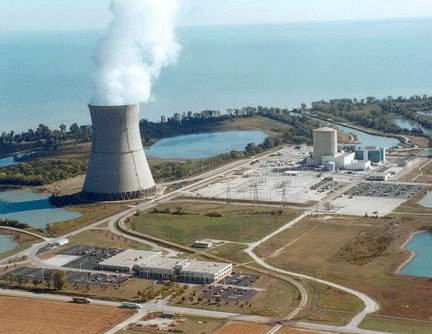
OAK HARBOR, OH – The Davis-Besse Nuclear Power Station’s 2024 Annual Radiological Environmental Operating Report and Radioactive Effluent Release Report, presented as a routine compliance document, is, upon closer inspection, a testament to the inherent contradictions and failures of nuclear power. Far from offering reassurance, a detailed breakdown of its contents reveals a systematic downplaying of risk, consistent operational deficiencies, and an unavoidable legacy of environmental burden.
This analysis dissects the report’s core assertions, exposing the fallacies and highlighting the damning issues that FirstEnergy (now Vistra) attempts to obscure through technical jargon and regulatory compliance claims.
The Fallacy of “Acceptable” Contamination: Routine Radioactive Releases
The report repeatedly emphasizes that radioactive releases are “well below applicable federal regulatory limits.” This is a fundamental fallacy. “Below limits” does not equate to “zero risk” or “no impact.” It merely signifies adherence to arbitrary thresholds set by regulators, thresholds that do not account for the cumulative effects of decades of exposure or the long-term biological impacts of even low-level radiation.
- Continuous Effluents: Davis-Besse admits to the routine discharge of both gaseous and liquid radioactive effluents. Tables 14 (“Gaseous Effluents Summation of All Releases”) and 17 (“Liquid Effluents – Summation of All Releases”) within the report confirm these ongoing releases. The fact that these are planned and continuous highlights that nuclear power is inherently a polluting industry. Every day, radioactive isotopes are deliberately introduced into our air and water, becoming part of the ecosystem and our food chain.
Irreducible Public Dose: Despite claims of minimal impact, the report’s own dose calculations (Tables 21, 22, and 23) confirm that the public does receive a measurable radiation dose from Davis-Besse’s operations. The identification of a critical pathway through a garden just over half a mile from the plant unequivocally demonstrates direct, localized human exposure. To assert that total body doses are “not distinguishable from background” is a deceptive attempt to normalize environmental contamination. Background radiation is not static; it is augmented by every single planned release, contributing to a cumulative burden on local populations.
Operational Failures: A Flawed Monitoring System
The credibility of any environmental report hinges on robust and reliable monitoring. Davis-Besse’s 2024 report exposes a litany of operational failures that directly undermine the accuracy and completeness of its environmental data………………………………………………………………………………………………………………………………………………………………
Damning Legacies: Groundwater Contamination and Unresolved Waste
Beyond the daily operations, the report touches on two long-standing, inherently “damning issues” that underpin the environmental cost of nuclear power: localized contamination and an unresolved waste crisis………………………………………………………………………………………
Conclusion: A Report of Inconvenient Truths
The Davis-Besse Nuclear Power Station’s 2024 environmental report, when subjected to rigorous scrutiny, is not a document of reassurance but rather a catalog of inconvenient truths. It confirms continuous environmental contamination, highlights persistent failures in monitoring and data integrity, and underscores the profound, unresolved challenge of radioactive waste management. For those committed to a truly clean and sustainable energy future, this report serves as a compelling argument against the ongoing fallacy that nuclear power can ever be truly benign………………… https://www.ohioatomicpress.com/nuclear-news/2536207_davis-besse-report-reveals-constant-pollution-flawed-monitoring-and-unending-nuclear-waste?fbclid=IwY2xjawKotsZleHRuA2FlbQIxMQBicmlkETE5N1drbzFkSjRoZXlUOFRXAR7H0k0sGjhgS1_UeBtK8SEEmwdUM4HcqvR03EoYKAtXm8DIiM9FD9ybXiELvA_aem_MWU5pe3_TNSnSMO21fC8OQ
Trump’s nuclear vision collides with Trump’s actual policies

Some nuclear-watchers are more explicitly worried that the EOs could backfire — specifically, that the Trump administration’s anti-bureaucratic mission of overhauling the Nuclear Regulatory Commission could lead to the kind of disaster that would threaten the fragile new bipartisan consensus around nuclear power.
By DEREK ROBERTSON , 05/28/2025 With help from Gabby Mille, https://www.politico.com/newsletters/digital-future-daily/2025/05/28/trumps-nuclear-vision-collides-with-trumps-actual-policies-00373330
Many of these nuclear boosters have noted — echoing the Secretary of Energy himself, in a hearing last week — that continued nuclear innovation could hinge on Congress continuing to fund the Loan Programs Office, an increasingly high-profile sub-office of the DOE responsible for funding experimental nuclear projects. Thomas Hochman, infrastructure director at the Foundation for American Innovation, in a conversation with POLITICO claimed some momentum for the pro-nuclear cadre’s cause of the moment, saying, “if things go the right way in Congress [the LPO] will continue to have authority.”
With a slate of splashy executive orders Friday, president Donald Trump promised to “usher in a nuclear energy renaissance …providing a path forward for nuclear innovation.”
By streamlining the Nuclear Regulatory Commission, exploring building reactors on federal land and ordering the quadrupling of the U.S.’ nuclear energy capacity, the administration moved to, as Secretary of Energy Chris Wright said in a statement, “unshackle our civil nuclear energy industry and ensure it can meet this critical moment.”
That all should be music to the ears of the burgeoning pro-nuclear revival, which has seen energy and infrastructure wonks across the political spectrum advocate for nuclear energy as a cleaner, scalable alternative to fossil fuels.
But it also raises a question that is becoming familiar in the second Trump administration: How is this all supposed to happen amid Trump’s radical cutbacks to research — to say nothing of government oversight or safety rules?
As with similar administration goals on supercomputing, or innovation, or artificial intelligence, these big promises aren’t happening in a policy vacuum. They’re happening amid an all-fronts rollback of America’s massive research and regulation infrastructure. Even some of those cheering the nuclear EOs are worried that Trump’s bone-deep cuts to the federal government could doom the nuclear revival before it kicks off.
The Nuclear Innovation Alliance, a nonprofit cheerleader for advanced nuclear reactor development, took the moment to urge GOP-controlled Washington to “adequately resource and staff DOE to meet this moment.” President and CEO Judi Greenwald wrote in a statement that Trump’s cuts — actual and proposed — at the Department of Energy “undermine the Department’s efforts and make it harder to implement these executive orders.”
The progressive pro-nuclear Breakthrough Institute, in its own response to the EOs, enumerated the new staffing levels it would require just to license new plants, and worried that the EOs focused on regulatory overhaul “threaten to reduce the NRC’s workforce, independence, and resources.”
Many of these nuclear boosters have noted — echoing the Secretary of Energy himself, in a hearing last week — that continued nuclear innovation could hinge on Congress continuing to fund the Loan Programs Office, an increasingly high-profile sub-office of the DOE responsible for funding experimental nuclear projects. Thomas Hochman, infrastructure director at the Foundation for American Innovation, in a conversation with POLITICO claimed some momentum for the pro-nuclear cadre’s cause of the moment, saying, “if things go the right way in Congress [the LPO] will continue to have authority.”
Some nuclear-watchers are more explicitly worried that the EOs could backfire — specifically, that the Trump administration’s anti-bureaucratic mission of overhauling the Nuclear Regulatory Commission could lead to the kind of disaster that would threaten the fragile new bipartisan consensus around nuclear power.
In an op-ed for The Hill published this morning, the Carnegie Endowment for International Peace’s Toby Dalton and Ariel Levite argued that the ADVANCE Act, passed in 2024, has already gone a long way toward overhauling licensing processes for new reactors and that the Trump administration risks gilding the lily.
“What Americans need is confidence that any nuclear power plant built and operated in the U.S. is safe, secure and ultimately beneficial to American and host community prosperity,” Dalton and Levite wrote, while concluding “the net result of these executive orders, coupled with the additional impact of other administration actions to reform governmental regulatory processes to align with White House policies, is to risk public trust in nuclear energy.”
The nuclear revival has largely been inspired by the massive thirst for energy that cutting-edge technologies carry with them, from enormous AI data centers to semiconductor manufacturing to even cryptocurrency mining. Nuclear is an attractive, relatively clean option for solving these problems, with an attractive retrofuturist sheen to boot.
It’s always been a risky bet, though, given its unique safety concerns and steep costs — and that was in the pre-Trump days of relative policy stability. As even its allies have pointed out, the Trump administration’s lurching, unpredictable approach — taking big, sometimes contradictory swings at issues of “American greatness” — could backfire in a major way, especially when public safety is a factor.
But with so much wind at their sails, and relatively few bipartisan, technocratic wins to be had in the early Trump era, nuclear supporters are still willing to be cautiously optimistic.
“I don’t think any of that stuff is sort of like, you know, so complex as to be unachievable,” Hochman said. “The worst possible outcome is just that nothing really gets done.”
Trump’s new ‘gold standard’ rule will destroy American science as we know it
Guardian, Colette Delawalla, Victor Ambros, Carl Bergstrom, Carol Greider, Michael Mann and Brian Nosek, 29 May 25
The new executive order allows political appointees to undermine research they oppose, paving the way for state-controlled science.
Science is under siege.
On Friday evening, the White House released an executive order called Restoring Gold Standard Science. At face value, this order promises a commitment to federally funded research that is “transparent, rigorous, and impactful” and policy that is informed by “the most credible, reliable, and impartial scientific evidence available”. But hidden beneath the scientific rhetoric is a plan that would destroy scientific independence in the US by giving political appointees the latitude to dismiss entire bodies of research and punish researchers who fail to fall in line with the current administration’s objectives. In other words: this is Fool’s-Gold Standard Science…………………………………………………………………………………………………….
https://www.theguardian.com/commentisfree/2025/may/29/trump-american-science
How Donald Trump Discovers the Art of Political Negotiation
Donald Trump knew nothing about the history of Russia and Ukraine, but he’s learning quickly. He no longer believes the Western delusions that Moscow wants to invade Ukraine, and then the rest of Europe. Nor does he believe the delusions of Kaja Kallas and the Balts, for whom Russia is a “prison of peoples” that must be dismembered.
by Thierry Meyssan, Voltaire Network | Paris (France) | 27 May 2025 https://www.voltairenet.org/article222331.html
We don’t understand the negotiations in Ukraine and the Middle East because we don’t understand the difference between wars and civil conflicts. We approach peacemaking as if it were a matter of dividing up common property during a divorce, after a few years of living together. But wars are of unparalleled intensity and are rooted in long-standing conflicts, often spanning several generations. Generally speaking, material conditions, suffering, and violence are of secondary importance compared to injustices.
Furthermore, the negotiating method of this business leader turned head of state, like Donald Trump, is dizzying. He strives to evoke incoherent positions and maintain none, simply to shake up his partners in the hope of getting their assets out of their pockets. This method, which has nothing diplomatic about it, ignores the underlying causes of conflicts. It only acknowledges what each side complains about. Ultimately, it can lead to agreements that some signatories might accept at the moment, but later regret.
In any case, we must act quickly. The wars in Ukraine and the Middle East, even though they have diminished in intensity, continue to kill and destroy. The sensational announcements that this or that war could have been resolved in a few days have already run up against harsh realities.
True diplomats and true warriors don’t aim to win over others, but to live with them. They can’t get along with business leaders who want to be the best, but they can solve problems with the help of those who intend to produce what can be useful to others. Donald Trump is of this ilk.
However, the current problems are not Russian, but primarily American. This could also be the case with Palestine and Iran. Making progress on the Ukrainian conflict requires, first and foremost, not changing the Russian point of view, but addressing the unconditional support of some Westerners for the “integral nationalists,” historical allies of the Nazis. It quickly became clear to the Trump team that the Russian claim to “denazify” Ukraine was not a war propaganda invention [1]. There are several hundred monuments to the glory of Reich collaborators in Ukraine, not to mention buildings and avenues bearing their names [2]. Reading the works of Dmytro Dontsov, particularly his book Націоналізм (Nationalism), is now mandatory in the Ukrainian armed forces; a work equivalent to Adolf Hitler’s Mein Kampf (My Struggle) [3]. The most important church in Ukraine was banned because it recognizes the authority of the Patriarch of Moscow.
Several million books were burned because they were written in Russian, that evil language, or because they were written by Russian authors, such as Alexander Pushkin (1799-1837) or Leo Tolstoy (1828-1910). All opposition political parties have been banned, and the current president, Volodymyr Zelensky, has banned new elections by extending the martial law that prohibits them every three months.
To address this issue, Donald Trump must give the Ukrainians something in return. He chose to question the savagery Russia displays when it is certain it is right, which it is. The Western press chose to focus only on the passage where the US president wonders if Vladimir Putin has gone mad. But in the same post, he also denounced Volodymyr Zelensky’s speech. He thus equated the Russian president’s cruelty with the Ukrainian leader’s bad faith. It is important to realize that while emotionally he gives the Ukrainians the upper hand, politically he gives it to the Russians.
It turns out that we belong to a civilization where emotion has replaced reason. We mourn with the fundamental nationalists, believing we share the suffering of the Ukrainians. However, in time, we will recognize the facts and turn against the fundamental nationalists we support today, or even against Ukrainians in general, because we will be ashamed of our current positions. This is the way of history: we always return to positions we can be proud of.
Vladimir Putin has already anticipated our reversal. According to him, the European Union’s unilateral coercive measures will not last. We will eventually return to our former loves, when we celebrated Franco-Russian friendship. This is why he is holding back his army, whose military superiority would have allowed him to capture Odessa long ago and thus complete the reconstruction of the old Russia.
This is what’s at stake now. Territorial boundaries matter little compared to relationships between people. Material issues are always secondary to individual freedom. The people living in Ukraine will have no trouble accepting the partition of their country once they are freed from the pressure exerted on them by the fascists who massacred their great-grandparents.
Donald Trump knew nothing about the history of Russia and Ukraine, but he’s learning quickly. He no longer believes the Western delusions that Moscow wants to invade Ukraine, and then the rest of Europe. Nor does he believe the delusions of Kaja Kallas and the Balts, for whom Russia is a “prison of peoples” that must be dismembered.
Similarly, Donald Trump knew nothing about the history of Israel and Iran, but he learned that the revisionist Zionists of Yitzak Shamir organized SAVAK, the political police of the Shah, Reza Pahlevi, and his Prime Minister, the Nazi General Fazlollah Zahedi, who had just left British jails after the overthrow of Mohammad Mossadegh [4]. It is difficult to admit, but yes, the terrible SAVAK was organized by Israeli Jews, “revisionist Zionists,” in the service of a Nazi general [5], just as it is difficult to admit that the Ukrainian integral nationalists killed many more of their compatriots than foreign enemies. Donald Trump and his negotiator, Steve Witkoff, have understood that what is at stake in the Middle East is not military nuclear power (even if it is Israel and not Iran that has the bomb), but the second round of crimes committed by the Shah’s regime with the discreet support of certain Israelis.
Protest against Chalk River nuclear waste disposal project
It’s a choice between defending life and water or protecting the nuclear industry.
Pierre Chapdelaine de Montvalon, Radio-Canada, Espaces Autochtones, May 26, 2025-https://ici.radio-canada.ca/espaces-autochtones/2167618/chalk-river-kebaowek-dechet-nucleaire
Opposition to the proposed Chalk River nuclear waste disposal site continues unabated. A coalition of Aboriginal leaders and elected officials met Monday morning in Montreal to denounce the proposed Near Surface Disposal Facility (NSDF) on the Ontario side of the Ottawa River.
For nearly 10 years, the community of Kebaowek, in Témiscamingue, has been fiercely opposed to the construction of such a site, and is leading a court battle against the organization responsible for the project, Canadian Nuclear Laboratories (CNL).
At a press conference, First Nation Chief Lance Haymond reiterated his community’s fears about the risks of water contamination and the effects on biodiversity of such a project, which he said would not respect First Nations’ rights.
Several speakers added their voices to call on the governments of Quebec and Canada to reject the project.
For the new Chief of the Assembly of First Nations Quebec-Labrador, Francis Verreault-Paul, such a project is a threat to our waters, our rights, our cultures and our traditional ways of life.
“Where is the free, prior and informed consent of First Nations, which is at the heart of the United Nations Declaration on the Rights of Indigenous Peoples?” he asked at a press conference.
It’s a choice between defending life and water or protecting the nuclear industry.
The Quebec government challenged
Manon Massé, Aboriginal Affairs spokesperson for the Québec solidaire party, took advantage of the press conference to directly challenge Quebec Premier François Legault, Environment Minister Benoit Charette and Ian Lafrenière, Minister responsible for relations with First Nations and Inuit.
“What do you mean, these people should not react against such a project? It’s immoral and inhuman to allow Quebecers to be put at risk like this.”
At the time of publication, the office of the Minister of the Environment had not responded to our questions.
“It makes no sense for such a project to be so close to such an important water resource,” added Rébecca Pétrin, Director of Eau secours. “Why aren’t our governments opposed to this?”
A Long Term Project
The proposed near-surface waste management facility is a project launched in 2016 by Canadian Nuclear Laboratories, a private-sector consortium [of multinational corporations] responsible for managing federal nuclear sites.
The corporation’s proposed site would house low-level radioactive waste from the Chalk River Laboratories site, Canada’s largest nuclear science research complex, and other Canadian sites.
This waste includes contaminated soil and discarded items such as mops, protective clothing and rags that have been slightly contaminated.
LNC claims in its documentation that the project poses no contamination risk to the river.
“The NSDF is designed to protect the Ottawa River, not harm it. Drinking water downstream is not at risk,” states the LNC reference document.
The organization also assures us that radioactivity at the site will return to naturally occurring levels in a hundred years, and that the site will be monitored for hundreds of years.
Preventing long-term contamination
The president of the Canadian Coalition for Nuclear Responsibility, Gordon Edwards, insisted at the press conference that such waste should not be stored near any watercourse, and feared long-term contamination.
[14 of the 31 radioactive waste materials to be stored in the NSDF have half-lives of more than 100,000 years, and 22 of them have half-lives of more than 5,000 years.]
The octogenarian activist cited the example of a disused salt mine in Germany, which had been used as a dump for low-level nuclear waste.
After 20 years, radioactive pollutants began to seep into the environment and contaminate the ground water, despite all the precautions taken.
“Instead of pretending that this is not a problem, or that it’s a problem that has been solved, we need to consider that we have an intergenerational responsibility. We shouldn’t be thinking of simply abandoning this waste permanently. I don’t think we have sufficient scientific knowledge to do that,” he explains in an interview.
In early 2024, the Chalk River site was found to be discharging toxic wastewater.
A project challenged in court
In 2024, the Canadian Nuclear Safety Commission (CNSC) announced that it was giving the green light to construction of the NSDF.
This decision was successfully challenged in court by the Kebaowek Algonquin community.The Federal Court first ruled in favor of the Kebaowek on the government’s failure to obtain free, prior and informed consent in the case, which runs counter to the United Nations Declaration on the Rights of Indigenous Peoples (UNDRIP), adopted and codified by Ottawa in 2021.
“We never gave our consent to the project, and we were never consulted,” said Chief Lance Haymond.
Canadian Nuclear Laboratories has appealed the court’s decision, but has also initiated a consultation process with the First Nation.
“It’s difficult to talk to CNL representatives about the parameters of a consultation process, when on the other hand, their lawyers are fighting us in court,” lamented Lance Haymond in an interview.
“The government can’t talk about reconciliation while appealing court decisions.”
– Lance Haymond, Chief of Kebaowek First Nation
In writing, the Canadian Nuclear Safety Commission (CNSC) states that it is committed to working with Kebaowek First Nation and CNL to implement the court’s directive in a transparent and judicious manner. “We are working with the Kebaowek First Nation and the CNL to develop a collaborative consultation process consistent with the court’s directive.”
The Federal Court also recognized that the Canadian Nuclear Laboratories had not sufficiently examined other options for the location of the nuclear waste dump. [This is required by law because of several species at risk that have been identified by Kebaowek.] CNL has also appealed the decision.
A third lawsuit by citizens’ groups and scientists opposed to the project was dismissed by the Federal Court.
Nine other Anishnabeg Algonquin communities support Kebaowek’s fight against the development of the NSDF, as do dozens of Quebec municipalities.
Pikwakanagan, an Anishnabe community on the other side of the Ottawa River in Ontario, supports the project.
Trump warns Netanyahu off Iran strike as nuclear talks continue
28 May,2025 https://www.aljazeera.com/news/2025/5/28/trump-warns-netanyahu-off-iran-strike-as-nuclear-talks-continue
US president says an Israeli strike ‘would be inappropriate to do right now because we’re very close to a solution.’
United States President Donald Trump has said that he told Israeli Prime Minister Benjamin Netanyahu to hold off on any strike against Iran to give his administration more time to push for a new nuclear deal with Tehran, as several rounds of talks have been held in Oman and Italy.
Trump told reporters on Wednesday at the White House that he relayed to Netanyahu a strike “would be inappropriate to do right now because we’re very close to a solution”
The Israeli leader has been threatening a bombardment of Iranian nuclear facilities. Iran has said it would respond with severity if any such attack were launched.
In the meantime, Iran may pause uranium enrichment if the US releases frozen Iranian funds and recognises its right to refine uranium for civilian use under a “political deal” that could lead to a broader nuclear accord, two Iranian official sources told the Reuters news agency.
The sources, close to the negotiating team, said on Wednesday that a “political understanding with the United States could be reached soon” if Washington accepted Tehran’s conditions. The sources told Reuters that under this arrangement, Tehran would halt uranium enrichment for a year.
The latest developments came as the head of the UN’s atomic watchdog group said that “the jury is still out” on negotiations between Iran and the US over Tehran’s rapidly advancing nuclear programme. But Rafael Mariano Grossi described the ongoing negotiations as a good sign.
“I think that is an indication of a willingness to come to an agreement. And I think that… is something possible.”
The 2015 nuclear deal, formally known as the Joint Comprehensive Plan of Action (JCPOA), placed limits on Iran’s nuclear programme in exchange for sanctions relief.
It collapsed after Trump unilaterally withdrew the US from the agreement in 2018, leading to a sharp escalation in tensions and a breakdown in diplomatic relations.
The key sticking point
US officials have repeatedly said that any new deal must include a firm commitment from Iran to halt uranium enrichment, which they view as a potential pathway to building nuclear weapons.
However, Iran has consistently denied seeking nuclear arms, insisting its programme is solely for civilian purposes. It has rejected Washington’s demand to eliminate enrichment capabilities, calling it an infringement on national sovereignty.
It remains the critical sticking point after negotiators for Tehran and Washington met for a fifth round of Oman-mediated talks in Rome.
Instead, Iran has reportedly proposed that the US publicly recognise Tehran’s right to enrich uranium under the Nuclear Non-Proliferation Treaty (NPT), and approve the release of Iranian oil revenues frozen under US sanctions.
US protects Israel as Netanyahu vows to ‘take over’ Gaza, using hunger as as weapon
Israel’s Prime Minister Netanyahu vowed to colonize Gaza, saying, “We will take control of all the territory of the Strip”. He is using starvation as a weapon, as Donald Trump tries to expel Palestinians to Libya or other countries. The US imposed sanctions on the International Criminal Court (ICC) to protect Israeli war criminals.
GeoPoliticalEconomy, By Ben Norton, 22 May 25
Prime Minister Benjamin Netanyahu has admitted that Israel’s goal is to colonize Gaza.
“We will take control of all the territory of the [Gaza] Strip”, Netanyahu pledged on 19 May.
Israel had agreed to a ceasefire in January, but unilaterally violated the agreement in March and restarted its brutal war on Gaza.
Donald Trump personally gave Israel the green light to break the truce, according to Israeli officials.
Israeli minister boasts: “We’re destroying everything… We are conquering, cleansing, and remaining in Gaza”
Israel’s extreme-right Finance Minister Bezalel Smotrich, a member of the Israeli security cabinet and Netanyahu ally, boasted that the IDF is “destroying everything left in the Gaza Strip”, and that “the army is leaving no stone unturned”, reported the top Israeli newspaper Haaretz.
Smotrich admitted that Israel is intentionally killing civilian members of the government of Gaza, including those who are not part of Hamas. “We’re eliminating ministers, bureaucrats, money handlers”, he said with pride.
“We are conquering, cleansing, and remaining in Gaza until Hamas is destroyed”, bragged Smotrich.
In January 2023, before the latest Gaza war, Smotrich described himself as a “fascist homophobe”, telling Israel’s LGBT community, “I won’t stone gays, [as long as] you won’t feed me shrimp”.
In November 2023, just a few weeks after the war started, Smotrich publicly called for the mass expulsion of Palestinians from Gaza, through so-called “voluntary migration”.
Then, in April 2024, Smotrich demanded the “total annihilation” of Gaza. He invoked a Biblical passage in which God ordered the complete destruction of the nation of Amalek, including the killing of all women and children: “You will blot out the remembrance of Amalek from under heaven”. This was an explicit call for genocide.
After Donald Trump won the US presidential election in November 2024, Smotrich tweeted that 2025 would be the year when Israel fully colonized and officially annexed “Judea and Samaria”, the term Israeli settlers use for the West Bank — which according to international law is Palestinian territory that has been illegally occupied by Israel since 1967.
In Gaza, Israel uses starvation as a “bargaining chip”, UN humanitarian chief says
As Israel unilaterally restarted its brutal war in March, it also imposed a suffocating blockade on Gaza, preventing food and medicine from entering the densely populated strip.
The UN humanitarian chief, Tom Fletcher, stated on 13 May that all 2.1 million Palestinians trapped in Gaza faced famine conditions.
Fletcher called on the UN Security Council (UNSC) “to stop the 21st-century atrocity to which we bear daily witness in Gaza”.
The UNSC has been unable to take action, however, because it has been paralyzed by the United States, which has repeatedly used its veto power to protect Israel. This was true under the Joe Biden administration, and it has continued since Trump returned to the White House in January.
Fletcher serves as the United Nations under-secretary-general for humanitarian affairs and emergency relief coordinator.
“I can tell you from having visited what’s left of Gaza’s medical system that death on this scale has a sound and a smell that does not leave you”, Fletcher recalled. “As one hospital worker described it, ‘children scream as we peel burnt fabric from their skin’”.
The UN humanitarian chief stated that “Israel denies us access, placing the objective of depopulating Gaza before the lives of civilians”.
Instead of allowing in UN aid, the US and Israel created an alternative mechanism that Fletcher described as a “cynical sideshow” and “deliberate distraction”, which is merely a “fig leaf for further violence and displacement”.
The US-Israeli plan for Gaza “makes starvation a bargaining chip”, the UN humanitarian chief said.
A week later, on 19 May, Fletcher warned, “There are 14,000 [Palestinian] babies that will die in the next 48 hours unless we can reach them”.
“We run all sorts of risks trying to get that baby food through to those mothers who cannot feed their children right now because they’re malnourished”, the UN humanitarian chief explained.
Israel’s mass starvation strategy
Israel is using mass starvation as a tactic to try to ethnically cleanse Palestinians from Gaza, or kill those who refuse to leave.
The independent website Drop Site News reported on speeches given by Prime Minister Netanyahu and Finance Minister Bezalel Smotrich, which frankly outline their sadistic strategy.
Netanyahu revealed that he only allowed a few aid trucks to enter Gaza in order to minimize international condemnation and ensure continued US support………………………………………………………….
Trump plans to expel Palestinians and ethnically cleanse Gaza
Trump has floated various plans to try to ethnically cleanse Gaza and expel Palestinians to another country………………………………………………………………………
Trump’s ICC sanctions paralyze the Hague, protecting Israel from legal consequences
The International Criminal Court (ICC) issued an arrest warrant in November 2024 for Israel’s Prime Minister Netanyahu and former Defense Minister Yoav Gallant, accusing them of committing crimes against humanity and war crimes in Gaza.
In February 2025, just two weeks after he returned to the White House, Trump imposed sanctions on the ICC, accusing it of “engag[ing] in illegitimate and baseless actions targeting America and our close ally Israel”.
“The ICC’s recent actions against Israel and the United States set a dangerous precedent, directly endangering current and former United States personnel, including active service members of the Armed Forces, by exposing them to harassment, abuse, and possible arrest”, the White House warned.
The Trump administration invoked the 2002 American Servicemembers’ Protection Act. This law, which was passed under the George W. Bush administration, is commonly known as the “Hague Invasion Act”, and threatens military intervention in the Netherlands to stop the prosecution of US officials and their allies.
The US-based Center for Constitutional Rights denounced Trump’s sanctions on the ICC as a “direct attack on the rule of law” that is “intended to embolden perpetrators across the world and to inhibit the pursuit of international justice against the most powerful”.
The Associated Press reported in May that Trump’s sanctions on the ICC have paralyzed the Hague and prevented it from investigating the crimes committed by top Israeli officials.
The ICC’s chief prosecutor, Karim Khan, who is a British citizen, had his bank accounts in the UK frozen.
Microsoft even cancelled Khan’s email account.
Microsoft has provided the Israeli military with advanced artificial intelligence (AI) and cloud computing services during its genocidal war on Gaza, the Israeli newspaper Haaretz reported.
A non-governmental organization that helps the ICC compile evidence had to move its money out of US bank accounts, due to Trump’s sanctions, according to the AP.
“The Hague-based court’s American staffers have been told that if they travel to the U.S. they risk arrest”, the AP added. https://geopoliticaleconomy.com/2025/05/23/us-israel-netanyahu-take-over-gaza-hunger/
US Has 500 Troops in Taiwan in Major Challenge to China
The number of US troops in Taiwan was disclosed by a retired US Navy rear admiral in a recent congressional hearing
by Dave DeCamp May 26, 2025, https://news.antiwar.com/2025/05/26/us-has-500-troops-in-taiwan-in-major-challenge-to-china/
A retired US Navy admiral recently revealed that the US has 500 troops in Taiwan, a major challenge to Beijing’s red lines related to the island.
Ret. Adm. Mark Montgomery made the disclosure at a House hearing on May 15, where he was arguing that the US should send more military personnel to Taiwan.
“We absolutely have to grow the joint training team in Taiwan. That’s a US team there that’s about 500 people now, it needs to be 1,000,” said Montgomery, who now works for the Foundation for the Defense of Democracies (FDD), an extremely hawkish think tank.
“If we’re going to give them billions of dollars in assistance, sell them tens of billions of dollars worth of US gear, it makes sense that we’d be over there training and working,” he added.
So far, the Pentagon has not confirmed the number, but due to the sensitivity of the matter, the US military typically offers few details about its operations in Taiwan.
After Washington severed diplomatic relations with Taipei in 1979, the US would still deploy a handful of military trainers to Taiwan. The small US presence was always an open secret but wasn’t officially confirmed until 2021, when then-President Tsai Ing-wen became the first Taiwanese leader to acknowledge US troops were on the island since 1979.
At the time of Tsai’s acknowledgment, only a few dozen US troops were believed to be on the island for training purposes. In 2023, media reports said the US was increasing its military presence to about 200 soldiers.
Last year, Taiwan confirmed that some of the US military trainers were deployed to Kinmen, a group of islands that are controlled by Taiwan but located just off the coast of mainland China.
The US has significantly increased military support for Taiwan in recent years despite constant warnings from China that the island is the “first red line” in US-China relations that must not be crossed.
Experts warn Trump’s nuclear blitz could trigger ‘Next Three Mile Island’
Brett Wilkins, Common Dreams, May 24, 2025 https://www.rawstory.com/trump-nuclear-2672196220/?fbclid=IwY2xjawKjnDZleHRuA2FlbQIxMQBicmlkETEzMGNjOWI3bFRMSEJiaUlwAR4t6X-H7T5I-o-kJ91nrJSopEuECY5lTfTvuemKX7ecn0rbBfTP2vKInLv2Wg_aem_YNxd4-jClVC7LuYhQWfF_A
U.S. President Donald Trump on Friday signed a series of executive orders that will overhaul the independent federal agency that regulates the nation’s nuclear power plants in order to speed the construction of new fissile reactors—a move that experts warned will increase safety risks.
According to a White House statement, Trump’s directives “will usher in a nuclear energy renaissance,” in part by allowing Department of Energy laboratories to conduct nuclear reactor design testing, green-lighting reactor construction on federal lands, and lifting regulatory barriers “by requiring the Nuclear Regulatory Commission (NRC) to issue timely licensing decisions.”
The Trump administration is seeking to shorten the yearslong NRC process of approving new licenses for nuclear power plants and reactors to within 18 months.
White House Office of Science and Technology Director Michael Kratsios said Friday that “over the last 30 years, we stopped building nuclear reactors in America—that ends now.”
“We are restoring a strong American nuclear industrial base, rebuilding a secure and sovereign domestic nuclear fuel supply chain, and leading the world towards a future fueled by American nuclear energy,” he added.
However, the Union of Concerned Scientists (UCS) warned that the executive orders will result in “all but nullifying” the NRC’s regulatory process, “undermining the independent federal agency’s ability to develop and enforce safety and security requirements for commercial nuclear facilities.”
“This push by the Trump administration to usurp much of the agency’s autonomy as they seek to fast-track the construction of nuclear plants will weaken critical, independent oversight of the U.S. nuclear industry and poses significant safety and security risks to the public,” UCS added.
Edwin Lyman, director of nuclear power safety at the UCS, said, “Simply put, the U.S. nuclear industry will fail if safety is not made a priority.”
“By fatally compromising the independence and integrity of the NRC, and by encouraging pathways for nuclear deployment that bypass the regulator entirely, the Trump administration is virtually guaranteeing that this country will see a serious accident or other radiological release that will affect the health, safety, and livelihoods of millions,” Lyman added. “Such a disaster will destroy public trust in nuclear power and cause other nations to reject U.S. nuclear technology for decades to come.”
Friday’s executive orders follow reporting earlier this month by NPR that revealed the Trump administration has tightened control over the NRC, in part by compelling the agency to send proposed reactor safety rules to the White House for review and possible editing.
Allison Macfarlane, who was nominated to head the NRC during the Obama administration, called the move “the end of independence of the agency.”
“If you aren’t independent of political and industry influence, then you are at risk of an accident,” Macfarlane warned.
On the first day of his second term, Trump also signed executive orders declaring a dubious “national energy emergency” and directing federal agencies to find ways to reduce regulatory roadblocks to “unleashing American energy,” including by boosting fossil fuels and nuclear power.
1 This Month
Chernobyl: The Lost Tapes – A good documentary on Chernobyl on SBS available On Demand for the next 3 weeks– https://www.sbs.com.au/ondemand/tv-program/chernobyl-the-lost-tapes/2352741955560

of the week–London Campaign for Nuclear Disarmament

Tell the Ukrainian Government to Drop Prosecution of Peace Activist Yurii Sheliazhenko
To see nuclear-related stories in greater depth and intensity – go to https://nuclearinformation.wordpress.com
-
Archives
- April 2026 (114)
- March 2026 (251)
- February 2026 (268)
- January 2026 (308)
- December 2025 (358)
- November 2025 (359)
- October 2025 (376)
- September 2025 (257)
- August 2025 (319)
- July 2025 (230)
- June 2025 (348)
- May 2025 (261)
-
Categories
- 1
- 1 NUCLEAR ISSUES
- business and costs
- climate change
- culture and arts
- ENERGY
- environment
- health
- history
- indigenous issues
- Legal
- marketing of nuclear
- media
- opposition to nuclear
- PERSONAL STORIES
- politics
- politics international
- Religion and ethics
- safety
- secrets,lies and civil liberties
- spinbuster
- technology
- Uranium
- wastes
- weapons and war
- Women
- 2 WORLD
- ACTION
- AFRICA
- Atrocities
- AUSTRALIA
- Christina's notes
- Christina's themes
- culture and arts
- Events
- Fuk 2022
- Fuk 2023
- Fukushima 2017
- Fukushima 2018
- fukushima 2019
- Fukushima 2020
- Fukushima 2021
- general
- global warming
- Humour (God we need it)
- Nuclear
- RARE EARTHS
- Reference
- resources – print
- Resources -audiovicual
- Weekly Newsletter
- World
- World Nuclear
- YouTube
-
RSS
Entries RSS
Comments RSS
 nuclear-news