A Lawsuit Against Greenpeace Is Meant to Bankrupt It and Deter Public Protests, Environmental Groups Warn

.“This case and its outcome should be
the concern of every American,” a legal expert says as the Dakota Access
Pipeline trial is set to begin. Next week, not far from where thousands of
Indigenous and environmental activists gathered in North Dakota nine years
ago in opposition to the Dakota Access Pipeline, one of the most
consequential trials to emerge from that conflict is set to begin. The
case, filed by pipeline developer Energy Transfer, accuses Greenpeace of
defaming the company while funding and supporting some protesters who
damaged its property. On its face, the trial is an attempt to seek millions
of dollars in damages from an environmental group for campaigning against a
pipeline project. At its heart, however, many activists, legal experts and
even the company’s chief executive say the case is about much more.
“It’s about really the silencing of the Greenpeace entities,” said
Sushma Raman, interim executive director of Greenpeace USA, during a press
call Thursday, referring to how both the organization’s U.S. arm and its
international parent are named. “It’s about trying to bankrupt some of
the entities, and more importantly it’s silencing and sending a message
to broader civil society.”
Inside Climate News 21st Feb 2025, https://insideclimatenews.org/news/21022025/greenpeace-lawsuit-meant-to-deter-public-protests/
United States: White House Threatens Nuclear Regulatory Commission’s Independence

Energy Intelligence Group, Jessica Sondgeroth, Washington, 21 Feb 25,
The Trump administration’s expansive assertion of presidential power now threatens the independence of the US Nuclear Regulatory Commission (NRC) after the White House this week issued an executive order (EO) claiming control over federal agencies that were established to be independent of politics. The Feb. 18 EO tasks the White House’s Office of Management and Budget (OMB) with the authority to manage independent agencies’ obligations and spending to ensure they align with “the President’s policies and priorities.” These agencies will also have to submit for review to an OMB office “all proposed and final significant regulatory actions.” The extent to which this erodes the NRC’s independence may vary depending on how NRC responds and on OMB actions taken, but nuclear energy sector veterans, critics and advocates are nonetheless waving red flags.
The White House decision “to meddle in safety regulation” is “devastating,” former NRC chair Allison Macfarlane, now a policy professor at the University of British Columbia, told Energy Intelligence. “The US NRC used to be referred to as the ‘gold standard’ for nuclear regulators. No longer. Now other countries can take that mantle.” Macfarlane said that as NRC chair, she spent years championing regulatory independence “to ensure national security and economic security. A nuclear accident, as happened in Japan, can devastate a country’s economy, not to mention its nuclear industry. I guess the folks at the White House have never learned this lesson?”
The EO, titled “Ensuring Accountability for All Agencies”, is only the latest White House challenge to the independence of various executive agencies and to Congressional lawmaking, from science and health research to environmental oversight to public education. This particular EO seeks to broaden the White House’s authority over independent regulatory agencies, including the Federal Trade Commission, Federal Energy Regulatory Commission, Federal Communications Commission and Securities and Exchange Commission. The EO does make some exceptions, but the NRC is not among them.
……………………………………………Given “the blatant and unmitigated conflicts of interest in the White House, and the newfound love among Trump and Elon [Musk]’s tech bro friends for nuclear power,” Ed Lyman, a nuclear regulatory watchdog at the Union of Concerned Scientists, warned in an email that the agency “could be turned into a mere rubber stamp for whatever projects are favored by the President at the moment.” This could override the NRC’s “public health and safety mandate in the name of ‘consistency with the President’s policies and priorities.'”
The NRC was established as an independent agency by Congress in the Energy Reorganization Act of 1974. That law took the NRC’s predecessor, the Atomic Energy Commission, and split its regulatory and promotional roles into the NRC and what is today the US Department of Energy (DOE), respectively. “The NRC was explicitly created to be independent of energy system policy goals under the Atomic Energy Commission that Congress perceived as too political and influenced by the industry,” Adam Stein, nuclear energy innovation director, noted. “Shifting from an independent agency to an agency under direct control of one party under the President creates the same problem from a different influence.”
……………………The nuclear industry lobbies Congress for favorable policies but also communicates directly with the NRC through filings and public meetings to advocate for its interpretation of Congressionally-mandated regulatory reforms.
…………………….For agencies as specialized as the NRC, mass layoffs or buyouts threaten to undermine core competencies and training activities — particularly given the recent hiring of 600 staff, a growing workload of new reactor licensing activities and concerns over the aging workforce.
https://www.energyintel.com/00000195-25b1-ddbd-a9dd-3ff520010000
NWMO closing Teeswater office, to dispose of DGR site lands
The Post Rob Gowan, Feb 21, 2025
The Nuclear Waste Management Organization’s offices in Teeswater was to close to the public on Feb. 14 and the organization plans to dispose of the lands it had secured for a potential underground used nuclear fuel vault in South Bruce.
The more than 1,800 acres of land the organization had secured in South Bruce through a series of option and purchase agreements between 2019 and 2021 will be disposed of “in a manner respectful of the original commercial agreements and considerate to market conditions and appropriate timing,” an NWMO spokesperson said via email on Feb. 12.
“We cannot disclose any specific details regarding the agreements, as these are private commercial transactions,” NWMO’s regional communications manager for South Bruce, Carolyn Fell, said via email.
Bill Noll of the Protect Our Waterways – No Nuclear Waste group opposed to the DGR, said they are hopeful that NWMO does dispose of the land, as there continues to be some nervousness about the ultimate plans in the area.
“We know the NWMO is considering another DGR, the intermediate-level and non-fuel high level waste,” Noll said. “We have always been concerned about getting the last chapter done.”
In December, the NWMO announced that it had selected the Township of Ignace and Wabigoon Lake Ojibway Nation in northern Ontario as the future site for its deep geological repository. South Bruce was the only other site under consideration. ………………………………………………………………
the NWMO announced in late November it had selected the northern Ontario site.
Fell said on Feb. 12 that as part of the NWMO’s site investigations, several boreholes were drilled in the potential siting area in South Bruce, used to advance the understanding of the subsurface geology in the area.
With the site selected, the deep boreholes and shallow groundwater monitoring wells in South Bruce will be decommissioned, Fell said.
“This means the monitoring equipment will be removed and the boreholes then sealed in compliance with the applicable Ontario regulations (Ontario Water Resources Act/Oil Gas and Salt Resources Act),” Fell wrote. “This work is anticipated to be completed by the end of 2025.” ………………………………………………………………..
“While communities engaged in the used fuel DGR process may choose to participate, there is no requirement for them to do so,” Fell noted.
One potential impediment to a DGR being cited in the area could be SON’s willingness. For the used-fuel DGR process, the NWMO was insistent a project would not move ahead without the support of the local First Nation whose traditional territory the site falls within.
SON announced in late January that it would issue a moratorium on future nuclear intensification and waste projects if substantial progress is not made on nuclear legacy issues in its territory within six months. https://www.thepost.on.ca/news/local-news/nwmo-closing-teeswater-office-to-dispose-of-dgr-site-lands
Technogarchy Goes to Washington
The “Muskification” of Meta and the Free Speech, Fact-Checking Charade
Billionaire tech owners who align themselves with whatever administration occupies the White House undermine democracy by threatening a dangerous consolidation of private and public power.
Project Censured, By Mischa Geracoulis and Mickey Huff, February 20, 2025
On January 7, 2025, Meta CEO Mark Zuckerberg announced on “Fox & Friends” that the recent US elections point toward the need to prioritize free speech, proclaiming that Meta’s fact-checkers have been too politically biased.
Meta’s new global policy chief, former deputy chief-of-staff in the George W. Bush White House and energy lobbyist, Joel Kaplan, lauded Meta for returning to its free expression roots. No stranger to Meta, during Trump’s first reign, the GOP operative oversaw changes to Facebook’s algorithm to promote right-wing content and advocated against restricting racially incendiary and conservative content.
The Biden Administration also had influence over Meta’s algorithms, as Zuckerberg revealed to Joe Rogan and the House Judiciary Committee. According to Zuckerberg, under the guise of fact-checking, Facebook was pressured to “moderate” (ie. censor) certain information, too, especially around issues like the Hunter Biden laptop story and COVID-19 origin, and pandemic policies (including satire and humorous posts). In a recent letter to the Judiciary Committee, Zuckerberg lamented, “I believe the government was wrong, and I regret that we were not more outspoken about it.” He also noted that tech companies should not cave to political pressures in either direction.
Zuckerberg’s statements and revelations to Rogan, however, contradict that Meta—and other social media platforms, as documented by the Twitter Files—actually do fall in line with the reigning political party. This is deeply problematic in both aforementioned examples as it acts to further erode public trust. Time will tell, but if past is prologue, it appears the opposite has been the trend with Big Tech kowtowing to the political establishment.
Angie Drobnic Holan, director of the International Fact-Checking Network and former PolitiFact editor-in-chief, who also served on Facebook’s original fact-checking team, told Poynter that Meta’s 180-degree turn on fact-checking appears as though Zuckerberg is seeking to please Trump and, once again, to conform with the goals of the right………………………………..
Following in the footsteps of Elon Musk, slated to co-chair the Trump administration’s new Department of Government Efficiency (DOGE), Zuckerberg and other Big Tech CEOs made pre-inauguration pilgrimages to Mar-a-Lago, seeking to curry favor with the Trump administration. Taking a cue from the Silicon Valley CEOs, even New York City mayor Eric Adams turned up at Mar-a-Lago just days before the inauguration, presumably hoping to dodge 2024 corruption charges for accepting bribes from and conspiring with the Turkish government.
The Billionaire Row Big Tech CEOs who attended Trump’s inauguration, including Musk, Zuckerberg, Amazon/Washington Post’s Jeff Bezos, Apple’s Tim Cook, Google’s Sundar Pichai, and TikTok’s Shou Zi Chew, had “better seats than most of the cabinet members.” The opulent optics of that inaugural spectacle did not come about by accident. They were crafted to convey a clear message about who was lining up to support the new Trump administration, with Big Tech’s oligarchs and the digital information interests they represent positioned at the forefront. The role these entities play moving forward should be carefully scrutinized, especially around issues of narrative control, agenda setting, and censorship in service of Trump and the MAGA GOP……………………………………………………………………………………….
The end of DEI could lead to real-life harms
Meta joins the growing list of companies—including Target, McDonald’s, Walmart, Boeing, Molson Coors, Ford, Harley-Davidson, John Deere, and Amazon—that are ending or scaling back their diversity, equity, and inclusion (DEI) programs.
Zuckerberg told Joe Rogan that the corporate world is “culturally neutered” and could do with more masculine energy and aggression. Statistics show, nevertheless, that women comprise just 25 to 35 percent of tech jobs in the US, and only 11 percent hold executive positions. Juliet A. Williams, gender studies professor and Social Science Interdepartmental Program chair at UCLA, asserts that the term “neutered” is gendered dog whistling that promotes gender traditionalism and anti-LGBTQ+ rhetoric.
St. John’s University law professor Kate Klonick told The Intercept, “To pretend these new rules are any more ‘neutral’ than the old rules is a farce and a lie.”
Reporters Without Borders (RSF) Director General Thibaut Bruttin has stated the “‘Muskification’ of the Meta group’s platforms obeys a political strategy that allows private sector interests to prevail over the need for a public conversation based on facts.” Signaling hostility toward journalism, Meta is accentuating its disengagement from the universal right to access reliable news and information, “reinforcing a model based on virality, at the risk of amplifying hate speech, manipulation and false information,” Bruttin wrote.
……………………………………………………………..The Technogarchy displaces democracy and journalism
The new changes will also permit users to post more acerbic criticism of ethnicity and nationality, which has been at issue in places such as the Philippines and Myanmar and that RSF finds troubling. At present, Meta’s changes only apply to its users in the United States, but RSF warned that new US policies might foreshadow “a global strategy of marginalizing journalism and its actors in the name of a freedom of expression perverted to serve ideological interests.”
Amnesty International reported that in 2017, Facebook’s algorithms “substantially contributed to the atrocities perpetrated by the Myanmar military against the Rohingya people.” How to Stand Up to a Dictator, Philippine journalist and Nobel laureate Maria Ressa’s 2022 book, documents Facebook’s role in disseminating dangerous disinformation during Rodrigo Duterte’s presidential campaign and election, which was “accomplished with a loyal ‘troll army’ that boosted pro-Duterte narratives on social media, while smashing down opposition.”
Ressa warns that Meta’s end to fact-checking and DEI policies come down to safety issues. A “world without facts” becomes “a world that’s right for a dictator.” Ressa is right to be concerned. However, there is an elitist assumption at play here, based on tacit faith in those fact-checkers as infallible, unbiased judges of complex, charged issues such as DEI policy or Russiagate. Ascribing to any individual or group a monopoly on the truth stifles legitimate debate about such controversial issues. Despite its best intentions, a protectionist approach to fact-checking may inadvertently undermine public trust when members of the public discover that fact-checking organizations have stifled fact-based perspectives deemed to be unpalatable. More broadly, as suggested previously, this furthers the erosion of public trust especially in government institutions and the Fourth Estate, both of which are near or at record-low approval ratings, according to the Pew Research Center.
Marc Owen Jones, associate professor of media analytics at Northwestern University in Qatar and author of Digital Authoritarianism in the Middle East (2022), views Zuckerberg’s changes as indicative of the U.S’s move toward authoritarianism, which thrives in an environment of disinformation and a manufactured “war against reality.” Getting rid of fact-checkers, Jones told Democracy Now!, signals acquiesce to Trump’s demands, perpetuates the right-wing notion that the United States suffers from a crisis of censorship, and promotes what Jones has elsewhere called “institutionalized violence by algorithm.”
Vaidhyanathan sees it differently because, according to him, in the United States, the government worships corporations. Zuckerberg is not bowing to Trump, but the other way around, Vaidhyanathan told Democracy Now!. “Zuckerberg always gets what he wants out of the United States government,” Vaidhyanathan asserted, adding that, now, Zuckerberg “sees an opportunity to get even more of what he wants out of the Trump administration.”…………………………………………………….
The evergreen need for independent journalism and critical media literacy
Meta’s changes ultimately point to a more productive solution—the evergreen necessity of independent media and critical media literacy. Crowdsourced content, pundit-driven infotainment, and AI can never replace research, investigative journalism founded on ethical reporting practices, and critical thinking skills. It’s only been since 2016 that fact-checking, under the purview of Big Tech, became an entity separate from the job of journalism, MSNBC’s Ali Velshi has noted. That’s a problem best addressed by educators and journalists, not outsourced to Big Tech.
Social media, even in the presence of fact-checkers, was never, and can never, serve as a replacement for the work of an independent free press— one that not only checks facts, but checks the power of Big Tech, government, and the corporate media, holding them accountable to the public. https://www.projectcensored.org/technogarchy-washington-muskification-meta/
Hating Trump no reason to oppose Trump Ukraine peace initiative.
Walt Zlotow, West Suburban Peace Coalition, Glen Ellyn IL , 23 Feb 25
Some of my progressive comrades are bombarding social media in opposition to Trump’s peace plan to end the Russo Ukraine war. For the first 2 years, 11 months of America’s proxy war against Russia using Ukrainian cannon fodder, they were largely silent. They were loath to criticize President Biden and Vice President Harris, particularly during a presidential campaign. Their focus was laser like on domestic issues to prevent a return of the despised Trump to the presidency.
Trump not only won, he immediately pivoted to peace in Ukraine. He totally overturned the Biden war playbook. He announced Ukraine (really the US) had lost, must never join NATO, and not get back the Russian leaning Eastern Ukraine Russia annexed.
More. Trump announced a complete reset of the US Russia relationship to include diplomatic engagement and friendly relations with Russia that Biden had jettisoned during his entire term.
More again. Ending the war and reestablishing diplomatic relations will reduce the risk of nuclear war present for every one of the 1,095 days of this senseless war. It makes possible renewing the three nuclear treaties the US abandoned this century, two of them by Trump.
But instead of supporting this astonishing breakthrough, progressives have gone ballistic. They charge dictator wannabe Trump is selling out Ukrainian sovereignty, like Chamberlain did to Czechoslovakia at Munich in 1938. They claim this will allow Russia to recreate the Soviet Union, then march into Western Europe. Preposterous.
In doing so they ignore this war was provoked by Biden to weaken Russia. It would never have resulted in war had Biden honored Russia’s security concerns regarding no Ukraine NATO on Russia’s border.
Worse yet, progressives are blind to the fact that the war was lost on Day One when Biden announced the US would not participate with US military. Why? He wisely advised that would result in WWIII.
The result? Ukraine is on the brink of defeat, having upwards of a million dead or wounded. Over ten million have fled Ukraine for safer climes. Potential draftees are deserting en mass. The economy is on life support. President Zelensky cancelled elections, banned free press, outlawed the Russian Orthodox Church on his march to becoming dictator for the war’s duration. Once it’s over…so is Zelensky.
None of this made a dent in progressives till Trump demanded this madness end and followed thru arranging lightning fast negotiations with Russian leaders to end it. Then progressives surfaced to demonize Trump and his peace initiative. They have joined the most virulent pro war advocates in the Republican Party, the military, the media determined to sabotage the most hopeful development to end further destruction of Ukraine and depletion of US treasure.
Every progressive opposing Trump’s peace initiative enables another 500,000 dead Ukrainians, another $175 billion in squandered US treasure, and no end to Biden’s catastrophic and failed proxy war to weaken Russia.
Ponder that progressives.
Trump just assaulted the independence of the nuclear regulator. What could go wrong?

By Allison Macfarlane | February 21, 2025
President Trump, through his recent Executive Order, has attacked independent regulatory agencies in the US government. This order gives the Office of Management and Budget power over the regulatory process of until-now independent agencies. These regulatory agencies include the Federal Elections Commission, the Federal Trade Commission, the Securities and Exchange Commission, the Federal Energy Regulatory Commission—and my former agency, the Nuclear Regulatory Commission, which I chaired between July 2012 and December 2014.
An independent regulator is free from industry and political influence. Trump’s executive order flies in the face of this basic principle by requiring the Office of Management and Budget to “review” these independent regulatory agencies’ obligations “for consistency with the President’s policies and priorities.” This essentially means subordinating regulators to the president.
In the past, the president and Congress, which has oversight capacity on the regulators, stayed at arm’s length from the regulators’ decisions. This was meant to keep them isolated, ensuring their necessary independence from any outside interference. Trump’s executive order implies there are no longer independent regulators in the United States.
Independent regulators should not only be free from government and industry meddling; they also need to be adequately staffed with competent experts and have the budget to operate efficiently. They also need to be able to shut down facilities such as nuclear power plants that are not operating safely, according to regulations. To do this, they need government to support their independent decisions and rulemaking.
Independence matters. When I was chairman, I traveled the world talking about the importance of an independent regulator to countries where nuclear regulators exhibited a lack of independence and were subject to excessive industry and political influence. It is ironic that the US Nuclear Regulatory Commission—often called the “Gold Standard” in nuclear regulation—has now been captured by the Trump administration and lost its independence. So much for the Gold Standard; the Canadian, the French, or the Finnish nuclear regulator will have to take on that mantle now.
To understand what is at stake, one needs to look no further than the Fukushima accident in March 2011, which showed the world how a country’s economic security is vulnerable to a captured regulator………………………………………………………..
An independent investigation by the Diet (Japan’s house of parliament) into the cause of the Fukushima accident concluded unequivocally that: “The TEPCO Fukushima Nuclear Power Plant accident was the result of collusion between the government, the regulators and TEPCO, and the lack of governance by said parties. They effectively betrayed the nation’s right to be safe from nuclear accidents.” Japan’s government and nuclear industry continue to struggle with the clean-up of the Fukushima site, and it purposely began in 2023 to release still-contaminated water into the Pacific Ocean. Nearby countries responded by banning fishing products from the region.
As the industry often says, a nuclear accident anywhere is a nuclear accident everywhere. …………………… more https://thebulletin.org/2025/02/trump-just-assaulted-the-independence-of-the-nuclear-regulator-what-could-go-wrong/?fbclid=IwY2xjawImRopleHRuA2FlbQIxMQABHXcsEIvbsR7x3_k1wSvr8EHSizxiqUnLBb42mZ2YJGeOYLxrftrY4-5HVg_aem_Q1k1WJJnpyqw6WEHOuvZ2Q
Algonquin community wins part of court challenge over nuclear waste dump near Ottawa River
Federal judge orders nuclear regulator to renew consultation with Kebaowek First Nation on contentious project
Brett Forester · CBC News ·Feb 21, 2025
An Algonquin community in Quebec is declaring victory after a judge upheld part of its court challenge to a proposed radioactive waste dump to be built about a kilometre away from the Ottawa River.
The Canadian Nuclear Safety Commission approved the project in January 2024, greenlighting Canadian Nuclear Laboratories (CNL) to build the “near-surface disposal facility” at the Chalk River research campus near Deep River, Ont., 150 kilometres northwest of Ottawa.
But according to Federal Court Justice Julie Blackhawk, the regulatory body failed to consider internationally recognized Indigenous rights and how they apply in Canadian law when consulting with Kebaowek, rendering the approval decision both unreasonable and incorrect.
“The consultation process in this matter was not adequate,” Blackhawk wrote in a decision released Wednesday.
The judge ordered the commission and CNL to resume consultations with Kebaowek “in a robust manner,” while properly considering the UN Declaration on the Rights of Indigenous Peoples (UNDRIP) and its standard of free, prior and informed consent.
The consultation must be adapted to address Indigenous laws, knowledge and be aimed at reaching an agreement, to be completed by Sept. 30, 2026, Blackhawk ruled.
Kebaowek had asked the court to quash the commission’s approval entirely, requiring CNL to restart the process altogether. But Blackhawk declined, calling that impractical, sending the matter back to the commission to correct the process instead.
Nevertheless, community leaders are ecstatic, said Chief Lance Haymond.
“It’s clear that when Canada adopted UNDRIP, the provisions of UNDRIP had to be applied in Canadian law from the beginning, not in some time in the future,” said Haymond, whose community is 300 kilometres northwest of Ottawa.
“I think that’s a win for Kebaowek, and that’s a win for First Nations across this country.”
Haymond hailed the decision as one with far-reaching implications for industry and project proponents, meaning he expects it will be appealed. …………………………………….
The facility would contain up to one million cubic metres, or about 400 Olympic-sized swimming pools worth, of low-level radioactive waste from the Second World War-era Chalk River site in a specially designed mound.
Kebaowek has raised concerns about the project’s potential impact on drinking water, wildlife and Indigenous rights.
In the judicial review, the community raised novel legal arguments, centring on the commission’s obligations under the United Nations Declaration on the Rights of Indigenous Peoples Act,federal legislation passed in 2021.
The law requires Canada to harmonize federal laws with UNDRIP, an international instrument outlining minimum standards for the protection of Indigenous peoples’ rights around the world. …………………………..more https://www.cbc.ca/news/indigenous/kebaowek-judicial-review-win-1.7464036#:~:text=An%20Algonquin%20First%20Nation%20in,away%20from%20the%20Ottawa%20River.
Charles Freeman -USA fighting Russia ‘to the last Ukrainian’. Interview with full transcript
UNMISSABLE – and in my opinion, the very best commentary on the Ukraine situation

23 Mar. 2022, Transcribed by Noel Wauchope, This is Aaron Mate. joining me is Charles Freeman. He is a retired veteran U.S diplomat who has served in a number of senior positions including as the Assistant Secretary of Defense and U.S. ambassador to Saudi Arabia.
Question, What is your assessment of the russian invasion so far and how the biden administration has responded to it?
FREEMAN A huge question. I thought in the run-up to this that Mr Putin was following a classic form of coercive diplomacy massing troops on Ukraine’s border issuing very clear offers to negotiate threatening indirectly to escalate beyond the border not in Ukraine which the Russians repeatedly said they did not intend to invade but perhaps through putting pressure on the United States similar to the one the pressure that the Russians feel from us namely missiles within no warning distance at all of the capital.
Of course Washington doesn’t have quite the significance in our case that Moscow does for the Russians but still I thought that was what was in store. I don’t think his troops were prepared for it. There’s no evidence that they had the logistics in place or that the troops were briefed about where they were going and why and so it looks like an impetuous decision and if so it ranks with the decision of Tsar Nicholas ii the last tsar to go to war with japan in 1904. That had disastrous consequences for political order in Russia and I think this is a comparable blunder.
There are lots of things being said about the course of the war which is now about a months old and many of them are I think frankly tendentious nonsense for example it’s alleged that the Russians are deliberately targeting civilians but I think in most wars the ratio of military to civilian deaths is roughly one to one and in this case the recorded civilian deaths are about one-tenth of that which strongly suggests that the Russians have been holding back. We may now see the end of that with the ultimatum that has been issued in connection with Mario Paul where if I understood correctly what the Russians are saying, they were saying surrender or face the consequences and the consequences would be a terrible leveling of the city
We don’t know where this war is going to end . whether there will be a Ukraine or how much of a Ukraine there will be , what the effects inside Russia will be. There’s clearly a lot of dissent in Russia although i’m sure it’s being exaggerated by our media .
The war is a fog of lies on all sides. It is virtually impossible to tell what is actually happening because every side is staging the show the champion of that is mrZielensky who is brilliant as a communicator. It turns out he’s a an actor who has found his role and probably helps Ukraine a great deal to have a president who is an accomplished actor who came equipped with his own studio staff, who is um using that brilliantly and I would say Mr Zielinski was elected to head a state called Ukraine and he has created a nation called Ukraine he is he is somebody who’s perceived heroism has rallied Ukrainians to a degree that no one ever expected .
But we don’t know where this is going and more to the point the United states is not part of any effort to negotiate an end to the fighting. To the extent that there is mediation going on it seems to be by Turkey possibly Israel, maybe China that’s about it and the United States is not in the room.
Everything we are doing rather than accelerating an end to the fighting and some compromise seems to be aimed at prolonging the fighting assisting the Ukrainian resistance, which is a noble cause I suppose but that will result in a lot of dead Ukrainians as well as dead Russians.
And also, the sanctions have no goals attached to them there’s no conditions which we’ve stated which would result in their end. And finally we have people now calling, including the President of the United states and the Prime Minister of Great Britain calling Putin a war criminal and professing that they will intend to bring it to trial somehow.
Now this gives Mr Putin absolutely no incentive to compromise or reach an accommodation with the Ukrainians and it probably guarantees a long war and there seemed to be a lot of people in the United States who think that’s just dandy. It’s good for the military-industrial complex. It reaffirms our negative views of Russia it reinvigorates NATO. it puts China on the spot.
You know what’s so terrible about a long war – you know if you’re not Ukrainian you probably see some merit in a long war so this has not gone as anybody predicted, not Mr Putin not the intelligence community of the United States which extrapolated war plans from the disposition of forces on the ukrainian border. Not the way the Germans who are now rearming anticipated
It’s got a lot of shock value to it and it’s changing the world in ways we still don’t understand. I wonder if U.S intelligence extrapolated that Russia would invade based on the certainty that the U.S would reject Russia’s core security demands – namely neutrality for Ukraine and Ukraine not joining NATO and I’m wondering if their assurance that Biden would reject those demands – if that’s what made them all the more confident that Russia would then invade.
Question, And on that point about NATO, I wanted to get your response to some comments that Zeilinski recently made. He was speaking to Farid Zakaria of CNN and he made what that was a really telling admission about what he was told to say publicly about NATO before the war.
I requested them personally to take to say directly that we are going to accept or not NATO in a year or two, or just say it five and clearly or just say no. And the response was very clear you are not going to be a member but publicly the doors will remain open but if you are not ready if you just want to see us straddle two worlds if you want to see us in this dubious position where we do not understand whether you can accept us or not you cannot place us in this situation you cannot force us to be in this limbo.
So that’s Zielinski saying that he was told by NATO original members presumably the U.S. that we’re not going to let you in but publicly we’re going to leave the door open. I’m wondering Ambassador Freeman your response to that?
FREEMAN. Well those are two questions. First in my experience the intelligence community does not start from estimates of U.S. policy and I think what we saw was an order of battle analysis with the judgment as expressed at one point by Secretary of State Lincoln – that you know if we masked 150 000 troops on somebody’s border that would mean we were about to invade in other words mirror imaging. You know that’s what we would do therefore that’s what the Russians will do.
I think Mr Putin was surprised by being stiff-armed on the after all 28 year old demands that NATO stop enlarging in the direction of Russia that at root this is a contest over whether Ukraine will be in the U.S sphere of influence, the Russian sphere of influence or neither’s, and neutrality, which is what mr putin had started out saying he wanted .
What’s compatible with neither side having ukraine within its sphere? Whether that’s now possible or not I don’t know. I think one of the mistakes Mr Putin made in upping the ante was to make it very difficult for Ukraine to become neutral but on the question of what mr Zielinski was told Ithink this is remarkably cynical or perhaps it was not even unrealistic on the part of leaders in the West.
Zielensky is obviously a very intelligent man and he saw what the consequences of being put in what he called limbo would be – namely Ukraine would be hung out to dry and the west was basically saying we will fight to the last Ukrainian for Ukrainian independence, which essentially remains our stand . It’s pretty cynical despite all the patriotic fervor and I’d add .
I have heard , I know people who have been attempting to hold an inquiry in the West. It’s very depressing. really we should rise to this occasion we should be concerned about achieving a balance in Europe that sustains peace. That requires incorporating Russia into a governing Council for Europe of some sort. Europe historically has been at peace only when all the great powers who could overthrow the peace have been co-opted into it. A perfect example is the Congress of Vienna which followed the Napoleonic wars where Kissinger’s great hero met in it and others had the good sense to to reincorporate France into the governing Councils of Europe.
That gave Europe a hundred years of peace. Of course there were a few minor conflicts but nothing major. After World War One when the victors, the United States and Britain and France insisted on excluding Germany from a role in the affairs of Europe as well as this newly formed Soviet Union, the result was World War Two, and the cold war.
It’s really depressing that instead of trying to figure out how to give Russia reasons not to invade countries and to violate international laws, instead of trying to give Russia reasons for being well behaved, – with the use of force you take us back.
Question. In the 1990s you served in the Clinton administration at a time when there was a big discussion, big debate in washington over the future of European security architecture. This is after the soviet union had collapsed. Russia was never weaker. There were people, including inside the George H.W. Bush administration, who talked about pledging support for neutrality not trying to bring the former Soviet states into one camp or the other.
Ultimately President Clinton went with NATO expansion, went with violating the pledges that accompanied the end of the Soviet Union to expand NATO to Russia’s borders. can you take us back to that time and the debates that were taking place and how that’s fueled the crisis we’re in today?
FREEMAN. Well I actually had a good deal to do with the formulation of what became known as the Partnership for Peace and this was two things. It was a pathway to responsible application for NATO membership but it was and it was also a cooperative security system. Rather than a collective security system for Europe it left the members to decide whether they defined themselves as European or not so Tajikistan joined the partnership, but it made no effort to civilianize ts defense establishment or subject its military to parliamentary oversight. And it didn’t learn the 3 000 standardization agreements that are the operating doctrine of NATO that allow Portuguese soldier to die for Poland or vice versa so that process was the the question of what countries would have what relationship with NATO was left to those countries,which is what happened in 1994 and which was a midterm election year.
In 1996, which was a presidential election year was interesting. In 1994 Mr Clinton was talking out of both sides of his mouth he was telling the Russians that we were in no rush to add members to NATO and then our preferred path was the Partnership for Peace. At the same time he was hinting to the ethnic diasporas of Russophobic countries in Eastern Europe , (and by the way it’s easy to understand their russophobia given their history), that no no we were going to get these countries into NATO as fast as possible and in 1996 he made that pledge explicit.
1994 he got an outburst from Yeltsin who was then the President of the Russian Federation. In 1996 he got another one and as time went on when Mr Putin came in he regularly protested the enlargement of NATO in ways that disregarded Russia’s self-defense interests. So there should have been no surprise about this in 2018, For 28 years Russia has been warning that at some point it would snap and it has. And it has done it in a very destructive way both in terms of its own interests and in terms of the broader prospects for peace in Europe.
There really is no excuse for what Mr Putin has done to understand it is not to condone it
It’s hard for people to be objective about this and and they’re immediately accused of being Russian agents or let us just say the price of speaking on this subject is to join the pom-pom girls in a frenzy of support for our position and if you’re not part of the chorus you’re not allowed to say anything. SoI think that this has very injurious effects on Western liberties and it has enforced and almost Iwon’t say it’s totalitarian but it’s certainly a similar kind of control on freedom of expression.
So I think that what happened here was a combination of forces. There were those people in the United States w ho were triumphalist about the end of the cold war. There were those who felt that what they perceived as victory – think it was a default by the Russians but anyway the game was over. This allowed the United States to incorporate all the countries right up to Russia’s borders and beyond them. Beyond those borders in the Baltics – into an american sphere of influence and essentially they posited a global sphere of influence for the United States modeled on the Monroe Doctrine and that’s pretty much what we have. Ukraine entered that sphere of influence it was not neutral after 2014.
That was the purpose of the coup – to prevent neutrality or a pro-Russian government in Cuba and to replace it with a pro-American government that would bring Ukraine into our sphere since about 2015 after this is of course Russia reacted by annexing Crimea
Since 2015 we have – let me say about Crimea – of course Russia reacted because it’s major naval base on the Black Sea is in Crimea . And the prospect that Ukraine was going to be incorporating into NATO and an American sphere of influence would have negated the value of that base . So i don’t think it had anything to do with the wishes of the people of Crimea who however were quite happy to be part of Russia rather than Ukraine. So since about 2015 the United States has been arming training Ukrainians against Russia.
A major step up in in 2017 in that ironically because of Mr Trump , who was actually impeached for trying to leverage arms sales to Ukraine for political dirt on dividends. But at any rate it isn’t as though Ukraine was not treated as an extension of NATO. It was, and this had a good deal to do with the Russian decision to invade.
I understand that the Ukrainian forces, although they’ve lost their command and control , there are major units that are surrounded and in danger of being annihilated by he Russians. There are cities that are in danger of being pulverized. None of this has happened yet but the ukrainians do not lack weaponry. They have more than enough to deal with the Russian forces on a dispersed basis in there and they have shown themselves to be very courageous in defending their country with those weapons. A lot of them are dying for their country one can admire that and but one must also lament it
Question, I quote you. Elliott Cohen served as a counselor to Condoleezza Rice when she was the Secretary of State , and he writes this in the Atlantic magazine: he says the United States and ts NATO allies are engaged in a proxy war with Russia they are supplying thousands of munitions and hopefully doing much else. sharing intelligence. For example with the intent of killing Russian soldiers and because fighting is as the military theorist Carl von Clausewitz said –
” a trial of moral and physical forces through the medium of the latter we must face a fact to break the will of Russia and free Ukraine from conquest and subjugation many Russian soldiers have to flee surrender or die, and the more and faster the better.”
That’s Elliot Cohen, former state department advisor in the Atlantic. I’m wondering what your response is to that, especially him calling just openly declaring that the U.S. is using Ukraine for what he calls a proxy war against Russia?
FREEMAN. Well Professor Cohen is a very honest man, which is to his credit, and therefore his adherence to neoconservative objectives is entirely transparent, and what he just said what you quoted him as saying, is consistent with the neoconservative objective of regime change in Russia and it’s also consistent with fighting to the last ukrainian to achieve it
I find it deplorable but I have to say it’s probably representative of a very large body of opinion in Washington. Why why does this view of Ukraine as essentially a cannon fighter against Russia why is it so prevalent in Washington. This is essentially cost free from the united states as long as we don’t cross some Russian red line that leads to escalation against us we are engaged as Professor Cohen said, in a proxy war, and we’re selling a lot of weapons that makes arms manufacturers happy . We’re supporting a valiant resistance which makes gives politicians something to crow about. We’re going against an officially designated enemy Russia which makes us feel vindicated.
Question, So from the point of view of those with these self-interested views of the issue this is a freebie and as someone with extensive experience in China you serve as President Nixon’s translator interpreter when he did his historic visit to China, I’m wondering what you make of China’s response to Russia’s invasion so far? And these warnings that they’ve been receiving in recent days from the Biden administration trying to basically tell them not to help out Russia or else there will be consequences?
FREEMAN, Well this has been fascinating to watch. The Chinese clearly agree with Mr Putin and Russian nationalists in objecting to NATO enlargement um having been subjected to foreign spheres of influence in the 19th and 20th century they don’t like them. They don’t believe Ukraine should be part of either the Russian or the U.S. sphere of influence they are the last citadel of Westphalianism in the world. They really do believe strongly in sovereignty and territorial integrity. Mr Putin went to Beijing for the winter olympics and had a long discussion with Xi Jinping the Chinese President and they agreed that NATO should not enlarge . There should not be spheres of influence and that the security architecture in Europe needed to be adjusted to relieve Russia of the sense of menace that it experiences. I don’t believe for a minute that mr mr putin told mr c that he planned to invade Ukraine. In fact he may have said he had no intention of doing it. I don’t know.
He may indeed have had no intention of doing it at that point, assuming that his coercive diplomacy was going to get a response. ut of course it got no response. It got an evasive set of counter proposals about arms control which didn’t address the main question he was raising which was how Russia could feel secure when a hostile alliance was advancing to its very borders. Anyway poor Mr Xi Jinping – he now has to straddle something he probably almost certainly had no idea was in prospect. On the one hand he can oppose spheres of influence and demand consideration for the security concerns of great powers as he does with regard to Russia and with regard to his own country. But on the other hand Ukraine is being violated .
So the Chinese have had an awkward straddle. The irony is Idon’t think this was intended, but inadvertently this has put them in a position where they’re one of the few countries that might conceivably mediate an end to the fighting. I noticed that recently the Chinese have played , emphasized heavily, the need for there to be negotiations to bring that fighting to an end at the earliest possible moment. That doesn’t mean that they’re going to end up mediating. Mediation is a very difficult thing, and often the mediation with two friends can end up with two enemies.
So this is not something you take on lightly. At this point however, I would just say nobody knows what’s going on. At least if anybody does know they’re not saying what’s going on between Russians and Ukrainians in the meetings that they are having. The Turks claim that the two sides are close to an agreement on various points. Lavrov and Cabela. the Ukrainian foreign minister. have both said something similar. But there is no agreement and it’s not clear at this point whether there can be an agreement by taking the land corridor from Donetsk to Crimea
Mr Putin has taken something that he probably will be very unwilling to give up and as I said you ask Ukrainians to accept neutrality when they’ve been battered around the way they have been and lost all the people lives and property that they have. It’s not at all easy for them so even though from the very beginning the solution has been obvious, which is some variant of the Austrian State tree of 1955 meaning a guaranteed independence in return for two things.
One – decent treatment of minorities inside the guaranteed state and
Second – neutralityfor the guaranteed state.
Question. This should have there from the beginning. This is still the objective as far as we can tell but it’s been made more difficult rather than less by the outbreak of war what’s your sense of the agency and the free reign that zelinski actually has to make decisions and the extent of u.s influence over him?
FREEMAN. One of the things that the late Professor Stephen F Cohen warned about it to me in 2019, was that unless the U.S steps up and supports Zielinski in his mandate of making peace with the rebels in the East then he has no chance because otherwise he’ll have to submit to the far right inside Ukraine who are very influential. Since then i’ve seen no indication there has been any sort of support from Washington for making peace with Russia. Trump of course was impeached when he paused those weapons sales. There’s that famous incident where Lindsey Graham and John m\McCain and Amy Klobuchar go to the front lines in late 2016 of the uUrainian military’s fight against the rebels in the donbas and Lindsey Graham says:
‘‘this is 2017 it is going to be the year of offense and Russia has to pay a heavier price. Your fight is our fight” ”All of us will go back to Washington and we will push the case against Russia. Enough of Russian aggression. It is time for them to pay a heavier price. I believe you will win. I am convinced you will win and we will do everything we can to provide you with what you need to win.”
Question. fast forward to when Biden came in. Time magazine reported that when Zielinski shut down the three leading opposition TV networks in Ukraine that was conceived as a welcome gift to the Biden administration to fit withtheir agenda so what do you think is the extent of U.S’s influence over Zielensky’s decisions?
FREEMAN. Zielenski was selected by a landslide not because of anything except – he wasn’t all the other candidates so his political capital very quickly evaporated and he really had no power to make decisions Whether there were other people behind him making decisions or that he mouthed or whether he was taking instructions from the Biden administration or the Trump administration or whoever is unclear.
But what it what is clear to me is that Mr Zielensky’s performance as the leader of wartime Ukraine has gained him enormous political capital. He has the ability now to make a compromise. It will not be easy as you indicated. There are elements in the coalition that supports him who are very right-wing and anti-Russian perhaps even neo-Nazi. And by the way anti-semitism is a disastrous aspect of Nazism but it’s not the definition of Nazism, and apparently you can be a Nazi and have and have a Jewish President and not feel uncomfortable about it. So I think this is a simplistic argument – well because Ukraine has a secular Jewish president who apparently doesn’t really identify as Jewish but is identified as Jewish this means somehow that there can’t be any Nazis backing him. It’s ridiculous.
Anyway it’s clear that Ukraine has been very divided in multiple directions ever since its independence and I’m sure those fissures continue to exist. Mr Zielinski however -has he really has empowered himself? I think if he gets backing from the United States and others here we have a problem
Not only do we have the statements that Putin is a war criminal and must be brought to trial -statements coming out of leaders in the West including President Biden but we also have people like Boris Johnson saying the sanctions have to stay on, whatever Russia does, because Russia has to be punished. Well this means russia has absolutely no incentive to accommodate, and it also means that Mr Zielinski has no freedom to accommodate
So this is the opposite of an effort to resolve the issue. It’s an effort in effect, whatever its intent, to perpetuate the fighting. And and that is going to be disastrous for the Ukrainians, for the Russians and and for Europe and ultimately from the United States
Question. You mentioned the neo-Nazi issue in Ukraine let me quote you from a new article in the washington post by Rita Katz. She’s the executive director of the site Intelligence Group. Her article is called ”Neo-Nazis are exploiting Russia’s war in Ukraine for their own purposes” . Not since Isis have we seen such a flurry of recruitment activity, and she writes this – in many ways the Ukraine situation reminds me of Syria in the early and middle years of the last decade. Just as the Syrian conflict served as the perfect breeding ground for for groups like Al Qaeda and the Islamic State, similar conditions may be brewing in Ukraine for the far right. I’m wondering your response is to that as well?
FREEMAN. I think she’s got logic on her side. I frankly don’t know Ukraine personally well enough to know exactly what the definition of a member of the Azov brigade or other neo-Nazi groups is.
I think right-wing populism is ugly enough in our own country, to imagine that it’s even uglier in a country as divide as Ukraine and you know –
I don’t dismiss the whole thing at all because Ukraine has a horrible history of running pogroms uh first against Jews and then frankly against Russians , and so to dismiss the argument that there are people with violent tendencies and great prejudice, ethnic prejudices involved in this fight, seems to me to be wrong. So I hadn’t read the article you cited. I don’t know the the author but she makes sense to me.
Question. I’m curious what you make now of the allegations we’re getting from both the U.S and Russia against the other that the other side is plotting false flag chemical attacks. This has only surfaced in recent days
In the case of the U.S, it strikes me that they’re recycling a playbook that they employed under the Obama administration, which was there were people inside the Obama white house who wanted to put out the option of military intervention, and the red line was a good way to pursue that. I’m wondering if you think the Biden administration, especially the remnants of the Obama administration, Blinken, Sullivan and Biden himself , are recycling that playbook. I certainly hope not but it does have a resemblance to the probably false flag use of chemical weapons in Syria and it it almost worked in Syria?
FREEMAN. This isn’t the slam dunk there are real questions. There are the questions about whether this was the Turkish or Turkish and Saudi or whoever, was afalse flag intended to force an American escalation over Syria. It was only when that happened that it almost worked in Syria and this could well be a replay. From a military point of view, I can’t see any reason that the Russians would want to use chemical weapons. Usually they are a defensive device against a mass attack, but there’s no such thing going on in Ukraine. They don’t need chemical weapons. They have enough rightful weapons of other types without having to do that, so this does strike me as on its surface it’s suspicious.
Question. As the former U.S Ambassador to Saudi Arabia what do you make of their positioning so far ?There’s a lot of talk of them essentially moving closer with Russia. A lot was made that MBS (Mohammed bin Salman) refused to take Joe Biden’s call when he phoned him recently, and Saudi Arabia considering accepting payments for oil in the Chinese currency and the implications of that. yYur thoughts there when it comes to Saudi Arabia’s apparent shifting stance here?
FREEMAN. Saudi Arabia has been very ill at ease with its U.S. relationship for a long time. The affection that the Saudis once enjoyed in the United States from a limited number of people to be sure, has been replaced by mass Islamophobia. Saudi Arabia has been successfully vilified in U.S politics. Saudi Arabia’s assumption that the United States would back the monarchy against the tax on it from at home or abroad, was thrown into doubt when the United States rather gleefully saw Mubarak overthrown in Egypt. The United States is now the competitor for oil production and exports, no longer a consumer. The murder of Jamal Khashoggi and its attribution to Mohammed bin Salman, the crown prince, obviously does not endear him to us or us to him and so mr biden has refused to speak with him.
So at this point the Saudis have gone full bore, looking for alternative partners to rely upon and there is no single partner that they can rely upon. But they have every interest in exploring alternative relationships not just with Russia or China but with India and others and they are doing the same thing with the United Arab Emirates. Even if bound to the United States in the so-called Abraham Accords it has a reputation well deserved for real politique.
It too is crafting its own future and it is not prepared to mortgage that future to American policy especially when the common view in the Gulf is that the United States is retreating. So this brings us all to back to the Chinese the Indians the Brazilians, others who have not got onto the bandwagon hurling invective at Russia. I think the Chinese ambassador the other day it was – onto someone of the Sunday talk shows and to the extent they let him get a word in, he he said very clearly and I agree with him, that you know condemnation does not accomplish anything very much at all, and what is required is serious diplomacy, and what has been missing has been serious diplomacy.
There have been condemnations, there have been sanctions, there have been armed shipments to the Ukrainians from a remarkable range of sources by the way.
I mean it illustrates the extent of Mr Putin’s mistake that even Austria and Switzerland, two neutral countries have provided aid to the Ukrainian resistance, as has Finland.
So Mr Putin has paid a huge price in terms of arousing animosity against this country. India and Brazil are in the same situation as as China. They’re in the same straddle. They see no benefit in alienating a partner, namely Russia, and while they both may care about the independence of Ukraine. I think taking sides with the United States against Russia, which is what they’re being asked to do, is a step too far. You know, let’s face it, this is in large measure as I said at the outset. a struggle between the United states and Russia for a sphere of influence that will include Ukraine. It’s U.S. Russia.
It’s not Russia versus Europe so in this context, why would a great power that values its cooperation with Russia want to alienate Russia?
Question. We’re going to wrap any final words for us. At the beginning of this interview you said that the you know that long-term geopolitical implications of this crisis are unknown. The world is changing in ways we don’t know, but I wonder if there’s any speculation that you are comfortable engaging in about what the geopolitical implications are. A lot of people are are speculating that this could mean the weakening of us dollar supremacy, as a result of China and Russia drawing closer together. Any thoughts on that and anything else you want to leave us with?
FREEMAN. No, I think the reliance on our sovereignty over the dollar, to our abuse of that sovereignty if you will, to impose sanctions that are illegal under the U.N Charter, which are unilateral, ultimately risks the status of the dollar, and we may in fact be in a moment when the dollar is taken down a notch or two
Well, I should just say that the dollar serves two purposes. One is as a store of value. If you have dollars you’re fairly confident that they’re going to have a significant value 10 years from now as well as today so that is why countries keep reserves in dollars and it’s why people stash dollars in mattresses all over the world.
The other use of the dollar is to settle trade transactions. It’s the most convenient currency in which to do that and in many cases when other currencies are used they are used with reference to the dollar and the dollar exchange rates.
Both these things are now in jeopardy. The oil trade commodities being priced in dollars is the basis for the dollar’s international value.
Iif you look at the united states trade and development’s balance of payments patent you will see that we are in chronic deficit that says the dollar is overvalued [ and that means it’s vulnerable to devaluation
The communications system in Belgium, that handles most of the world’s transactions was established to ensure that the trade could be conducted unencumbered by politics. And now it’s being encumbered by U.S. imposed unilateral sanctions on a huge array of countries – Iran Russia China , even threatened against India . So if the use of the dollar is now encumbered. It’s less desirable and people will want to make workarounds around it .
Will the dollar hold its value now we have a Congress that repeatedly goes to the brink of defaulting on our national debt?
This is not something that inspires confidence, and I’ll add a final factor which I think is very injurious potentially and that is bankers get deposits because they are fiduciaries they are meant to hold the deposits for the benefit of those who deposit the money and not to rip it off themselves.
But we’ve just confiscated the entire national treasury of Afghanistan. We’ve confiscated the Venezuelan reserves. We hav eour allies – the British have confiscated Venezuela’s gold reserves. And we’ve confiscated half of Russian reserves. The Anglo-American reputation as bankers. as fiduciaries, is in trouble, and so the question is, if you’re a country that thinks well maybe you might have some serious policy difference with the United States someday why would you put your money in dollars
The answer has been – there’s no alternative. But there are now major efforts being made to create alternatives so we we we’re not there yet. I don’t want to make a prediction, but I think this is a major question that we need to monitor carefully. because if the dollar loses its value, the American influence on the global level decreases enormously.
Aaron. Yes Freeman. Thank you as always for your time and insight. I say this on behalf of many people in my audience who have come to rely on your expertise. It’s really really appreciated.
Donald Trump wants to end nuclear weapons funding
“THERE’S no reason for us to be building brand-new nuclear weapons, we
already have so many you could destroy the world 50 times over, 100 times
over … We’re all spending a lot of money that we could be spending on
other things that are actually, hopefully much more productive.”
The quoted statement is a sensible one. Indeed, it broadly aligns with Scottish
CND’s longstanding case against nuclear weapons: that the exorbitant
expenditure on building weapons that would be illegal ever to use is sheer
waste, and that our society could be profoundly regenerated by investing
such resources in the public sphere.
But the above quote is not a Scottish
CND press release. In fact, these are the words of US president Donald
Trump, spoken to reporters in the Oval Office only last week. At that same
meeting with the press, Trump also mentioned his hopes to meet with the
presidents of China and Russia: “And I want to say, ‘let’s cut our
military budget in half’. And we can do that. And I think we’ll be able
to.”
The National 21st Feb 2025, https://www.thenational.scot/politics/24952282.donald-trump-wants-end-nuclear-weapons-funding-listen/
Burying The CIA’s Assange Secrets

The Dissenter, Kevin Gosztola, Feb 19, 2025
The CIA won the dismissal of a lawsuit brought by four Americans who claimed they had their privacy rights violated when they visited Julian Assange in Ecuador’s London embassy.
A United States judge dismissed a lawsuit pursued by four American attorneys and journalists, who alleged that the CIA and former CIA Director Mike Pompeo spied on them while they were visiting WikiLeaks founder Julian Assange in Ecuador’s London embassy.
“The subject matter of this litigation,” Judge John Koeltl determined [PDF], “is subject to the state secrets privilege in its entirety.” Any answer to the allegations against the CIA would “reveal privileged information.”
Few publications followed this case as closely as The Dissenter. It unfolded at the same time that the U.S. government pursued the extradition of Assange, making any outcome potentially significant.
On August 15, 2022, Margaret Ratner Kunstler, a civil rights activist and human rights attorney, and Deborah Hrbek, a media lawyer, filed their complaint. Journalist Charles Glass and former Der Spiegel reporter John Goetz also joined them as plaintiffs.
The lawsuit claimed that the plaintiffs, like all visitors, were required to “surrender” their electronic devices to employees of Undercover Global, a Spanish security company managed by David Morales that was hired by Ecuador to handle embassy security. They were unaware that UC Global had allegedly “copied the information stored on the devices” and shared the information with the CIA.
Pompeo allegedly approved the copying of visitors’ passports, “including pages with stamps and visas.” He ensured that all “computers, laptops, mobile phones, recording devices, and other electronics brought into the embassy,” were “seized, dismantled, imaged, photographed, and digitized.” This included the collection of IMEI and SIM codes from visitors’ phones.
Morales and UC Global were named as defendants in the lawsuit, however, due to the fact that they were not in the U.S., the claims against them were never really litigated.
In December 2023, Koeltl dismissed multiple claims that were filed against the CIA. But remarkably, he found that the four Americans who had visited Assange had grounds to sue the CIA for violating their “reasonable expectation of privacy” under the Fourth Amendment of the U.S. Constitution.
“If the government’s search (of their conversations and electronic devices) and seizure (of the contents of their electronic devices) were unlawful, the plaintiffs have suffered a concrete and particularized injury fairly traceable to the challenged program and redressable by a favorable ruling,” Koeltl declared.
Soon after, the court was notified that the CIA would assert the state secrets privilege to block the lawsuit.
Bill Burns, who was the CIA director, submitted a declaration in April 2024 that asserted “serious” and “exceptionally grave” damage to the “national security” of the U.S. would occur if the case proceeded.
……………………………………………… Burying secrets so deep and for so long that the public does not find them is typically the CIA’s objective when they invoke the state secrets privilege. They have buried a 6,300-page Senate intelligence report on CIA rendition, detention, and torture during the global war on terrorism. They are now burying their Assange secrets.
The decision all but ensures that the CIA will be able to conceal what they allegedly did to Assange, WikiLeaks, and his supporters for several decades. The agency, with support from the U.S. Justice Department, has already frustrated a Spanish court trying to prosecute Morales and other UC Global employees for alleged criminal acts.
It was always unlikely that Assange’s defense would uncover details about the CIA’s alleged actions and share those revelations during an Espionage Act trial. The restrictions the government and courts impose on defendants come with procedures to shield the CIA from scrutiny.
When the prosecution against Assange ended in a plea deal in June 2024, that benefited the CIA even if it was not the outcome that current and former high-ranking officials had desired. The CIA would never have to worry about the agency’s actions being discussed by the press and on social media during a high-profile trial.
Of course, there is also the matter of the CIA allegedly violating the privacy rights of Assange visitors while the U.S government targeted a journalist living under political asylum in a foreign embassy. The U.S. news media never showed much interest in the CIA’s actions, however, let’s not forget there was widespread global opposition to the Assange prosecution that helped end the case. The agency is right to be concerned that if more was known it might erupt into an international scandal. https://thedissenter.org/burying-the-cias-assange-secrets/
“Radioactive Russian Roulette” at San Onofre: Exposing Critical Safety Failures.
Charles Langley of Public Watchdogs has exposed a critical issue that demands immediate attention: the Nuclear Regulatory Commission (NRC) has granted Southern California Edison (SCE) sweeping exemptions from emergency planning and safety requirements, putting millions of lives at risk. These alarming exemptions—despite strong objections from state officials—leave the public dangerously unprotected in the event of a nuclear emergency.
| The Samuel Lawrence Foundation is calling on all community members to read the article and understand the gravity of this situation. With these dangerous exemptions in place, we are vulnerable to catastrophic risks. The time to act is now—before it’s too late. Read the full article here.Let’s make our voices heard and demand stronger safety measures to protect the health and safety of millions of Californians. |
US Strategic Bombers Fly Near Gaza As Israel Threatens To Open ‘Gates of Hell’ GRAVITAS | WION.
A squadron of six US Air Force bombers has reportedly been flying over the Mediterranean Sea, consisting of B-52 Stratofortress. According to reports, the American aircraft took off from an American base in England on Monday, possibly heading towards West Asia. This comes a day after the U.S. and Israel displayed a united front on Gaza, with PM Benjamin Netanyahu warning to open the “gates of hell” in Gaza if all hostages are not returned. Watch in for more details!
Why it would be a bad idea for the Trump administration to conduct a “rapid” nuclear test

Bulletin, By Sulgiye Park, Jennifer Knox, Dylan Spaulding | February 18, 2025
The career of Brandon Williams, President Trump’s pick to run the National Nuclear Security Administration, does not give many clues about his priorities for the agency that safeguards the US nuclear arsenal. He served as a naval officer, co-founded a venture capital firm, and farmed truffles in upstate New York before spending two years in Congress as a Republican representative. (He lost his reelection bid in November 2024.) Like many of Trump’s nominees, he has had little direct interaction or experience with the federal agency he aspires to run. But for the Trump team, that may be the appeal of Williams. The search for an agency leader required a candidate willing to restart the US nuclear testing program, according to former Los Alamos National Laboratory director Terry Wallace: “That more or less disqualifies any recent director of any nuclear weapons lab.”
Restarting the US nuclear testing program could be one of the most consequential policy actions the Trump administration undertakes—a US test could set off an uncontrolled chain of events, with other countries possibly responding with their own nuclear tests, destabilizing global security, and accelerating a new arms race. Yet, despite its significance to US national security, nuclear testing is not a subject Trump campaigned on, nor is it mentioned in the 2024 Republican Party platform. This silence on the issue is unsurprising: Nuclear testing is politically divisive and unpalatable to voters. When the first Trump administration contemplated a nuclear test in 2020, it faced significant backlash from Congress and nuclear experts. Trump’s appointee to the NNSA is likely to remain coy on the subject during his upcoming confirmation hearings.
Behind the scenes, however, close advisors to the administration are busy making the case for a new era of explosive nuclear testing to the national security community. Robert O’Brien, a national security advisor in the first Trump administration, was allegedly involved in the selection of Williams. Laying out a vision of Trump’s foreign policy priorities, O’Brien recently argued that “Washington must test new nuclear weapons for reliability and safety.” However, O’Brien’s claim is not supported by the agencies and officials tasked with overseeing the US nuclear stockpile…………………………………………………………………………………………………………………………………………………… more https://thebulletin.org/2025/02/why-it-would-be-a-bad-idea-for-the-trump-administration-to-conduct-a-rapid-nuclear-test/
President Trump Wants to Cut the Pentagon Budget in Half. How?
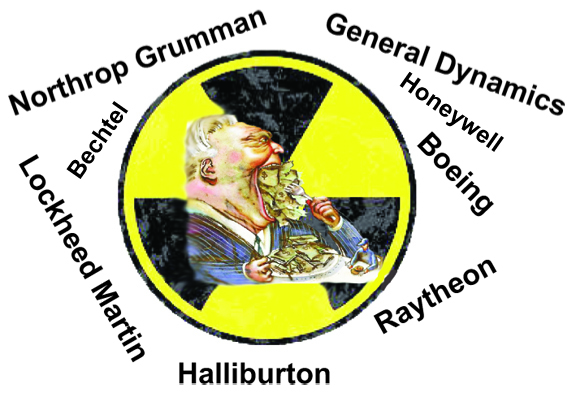
According to USAspending.gov and Defense News, the largest defense contractors in 2023 included:
BAE Systems – $13.6 billion
Lockheed Martin Corp. – $60.8 billion
RTX (Raytheon) – $40.7 billion
Northrop Grumman Corp. – $35.0 billion
Boeing Company – $30.8 billion
General Dynamics Corp. – $30.4 billion
L3Harris Technologies – $13.9 billion
Dennis Kucinich and Elizabeth Kucinich, Feb 18, 2025, https://denniskucinich.substack.com/p/president-trump-wants-to-cut-the
The President advances a three-pronged strategy for national security: 1. Negotiate a peace deal for Ukraine. 2. Negotiate nuclear arms drawdown with China and Russia. 3. Cut military spending by 50%
It is Presidents’ Day, and President Donald Trump has made a bold statement regarding military spending—one that no other president in modern history has made. He claims he could cut the Pentagon budget by about 50%.
President Trump has suggested a major cut in defense spending, proposing that the United States, Russia, and China each reduce their military budgets by 50%. He has also expressed a desire to begin denuclearization and arms control discussions with both Russia and China to accomplish this objective.
Military contractors poured $4,440,605 into Kamala Harris’s campaign—more than double what they contributed to Donald Trump. Yet, even with the support of establishment figures like Dick Cheney, their favored candidate fell short. The defeat of the military contractor’s candidate may have consequences for the industry.
Now, with President Trump in office and a bold initiative to cut Pentagon spending by 50%, the defense industry faces a challenge unlike any before.
The financial markets are already responding: Major U.S. defense firms are experiencing notable stock declines, while European defense companies surge in anticipation of increased regional military spending. Lockheed Martin, General Dynamics, and Northrop Grumman have all seen stocks fall, while companies such as Rheinmetall, BAE Systems, and Saab are benefiting from investors expecting a shift in global defense priorities.
As President Trump pursues negotiations to bring peace to Ukraine, European governments appear to be moving in the opposite direction, increasing military budgets and deepening their involvement in the conflict. European defense firms are thriving as they anticipate further arms sales to governments committed to escalating military engagement rather than seeking diplomatic solutions.
This contrast underscores the significance of Trump’s initiative—challenging the entrenched military-industrial complex, wherever it is located, and seeking to end perpetual warfare.
The era of unchecked military expansion may be coming to an end, and for the first time in decades, the ability of the defense industry to influence U.S. military policy is being curtailed.
Will it happen? We don’t know, but President Trump’s bold proposal to cut Pentagon spending reflects his signature negotiation style—starting with an aggressive position to shift the conversation and force a change in conditions, in this case – – scrutiny of military waste.xpansion may be coming to an end, and for the first in decades, the ability of the defense industry to influence U.S. military policy is being curtailed.
Rather than a rigid policy demand, Trump’s talk of a 50% cut in military spending challenges the entrenched interests of the military-industrial complex, putting pressure on defense contractors to reduce costs, compelling Congress to justify every dollar spent.
Peace, diplomacy and international agreements between military superpowers are now squarely on the priority policy table for the first time in decades and are being understood as pragmatic. Such strategic diplomacy can open the door for arms reduction talks with other global superpowers.
By challenging the status quo, Trump is causing security and economic prosperity to be merged. Trump is causing a rethink of national priorities, that America’s strength is built on both security and economic prosperity, and that unlimited military spending threatens both.
It is a longstanding Congressional practice of bloating the NDAA (National Defense Authorization Act) with unnecessary programs and hyperinflated spending. In all other authorization packages, things must be reduced and streamlined.
In the “defense” bill, they are always padded out and multiple zeros added to appropriations requests by habit. Very few lawmakers have the courage to vote against a “defense” bill despite knowing its excesses, and media will spin on the attack if they do.
Dennis was always 100% for national defense through fiscal integrity, against unnecessary war and profiteering, and so when in Congress he voted 100% of the time against the wasteful spending!
Throughout our careers, we have championed the principle of “Strength Through Peace.” This philosophy is rooted in the belief that true national security is not achieved through ever-expanding military budgets, but through diplomacy, cooperation, and a commitment to resolving conflicts without war.
We have carried this message forward, advocating that real strength is found in preventing war, not waging it. For decades, we have worked to place peace at the center of national policy—not as an idealistic dream, but as the most pragmatic and sustainable path forward.
It is a new day when a President questions military waste and opens the door for de-escalation of global conflict. However, notwithstanding the President’s ambition for sharp reductions in military spending, the current budget is a golden trough for contractors. Let’s take a look.
Breaking Down the Pentagon’s Nearly $1 Trillion Budget
The Pentagon’s budget is a massive and complex expenditure. Here’s a rough estimate of where the money goes:
- 25% goes toward soldiers’ pay and benefits.
- 25% is allocated for base operations, including training.
- More than 40% is funneled to Pentagon contractors for weapons systems, research and development (R&D), logistical support, base operations, technology, and private security.
- Additional funds go toward military construction and nuclear weapons programs.
Top Defense Contractors & Their 2023 Revenue
According to USAspending.gov and Defense News, the largest defense contractors in 2023 included:
- Lockheed Martin Corp. – $60.8 billion
- RTX (Raytheon) – $40.7 billion
- Northrop Grumman Corp. – $35.0 billion
- Boeing Company – $30.8 billion
- General Dynamics Corp. – $30.4 billion
- L3Harris Technologies – $13.9 billion
- BAE Systems – $13.6 billion
These companies receive billions annually in government contracts, making them deeply invested in maintaining high levels of military spending.
Military Contractors’ Political Contributions (2023-2024)
According to OpenSecrets, the top defense contractors contributed significantly to political campaigns in the current election cycle:
L3Harris Technologies – $2,475,712 total ($1,126,096 to Democrats, $1,331,975 to Republicans)
Lockheed Martin – $4,470,698 total ($2,393,034 to Democrats, $2,021,283 to Republicans)
Northrop Grumman – $3,354,889 total ($1,903,884 to Democrats, $1,385,924 to Republicans)
RTX Corp (Raytheon) – $2,805,535 total ($1,472,920 to Democrats, $1,258,511 to Republicans)
General Atomics – $2,507,912 total ($595,947 to Democrats, $1,660,970 to Republicans)
In the presidential race, defense contractors have donated:
- Kamala Harris – $4,440,605
- Donald Trump – $1,787,259
In total, the defense sector has contributed over $41.4 million in the 2023-2024 election cycle. For every $1 contributed to political campaigns, these companies receive $10,000 in government contracts—a return on investment most businesses could only dream of.
Trump’s Negotiation Strategy: What Is He Really Aiming For?
President Trump stated intention to cut military spending by 50% reflects his signature negotiation style—starting with an aggressive position, shift the conversation and force long-overdue scrutiny of a neglected policy and spending – — in this case, military waste.
Defense contractors will be under pressure to reduce costs. Congress will be forced to ever more careful review of defense appropriations. Just the mere mention of a shift in spending by the President galvanizes budget hawks to search for waste, fraud and abuse in Pentagon contracting,
Is War a Racket?
As Marine Corps General Smedley Butler once famously said, “War is a racket.” If so, how do we end that racket? Here are six possible reforms:
- Ban political contributions from federal contractors – No company receiving taxpayer-funded contracts should be allowed to donate to political campaigns.
- Prohibit companies that overcharge the government from receiving contracts – Firms with histories of price gouging should be disqualified from future defense spending.
- Restrict Pentagon officials from working for defense contractors – A five-year cooling-off period should be implemented for former officials joining military contractors.
- Ban members of Congress from lobbying for defense contractors – Prevent lawmakers from cashing in by lobbying for the companies they previously regulated.
- Establish public financing for all federal campaigns – This would reduce corporate influence in government decisions.
- Pass a Constitutional Amendment to repeal Citizens United and Buckley v. Valeo – Overturning these Supreme Court decisions would reduce corporate and special interest control over elections.
Trump’s Approach: A New Era?
Despite his rhetoric, President Trump is not calling for the disestablishment of America’s defense. Instead, he proposes a new strategy: engaging China and Russia in parallel arms reductions while scaling back America’s nuclear arsenal. This approach could set the stage for fresh arms reduction treaties and a shift away from perpetual military expansion.
For the first time, there is a sitting president who is starting to walk this path. If he follows through, this could mark the most significant shift in American military policy in decades.
If the ultimate goal is to restore peace and fiscal responsibility in America, then the President challenging the military-industrial complex may be the most important fight of all and is deserving of our support.
US government tries to rehire nuclear staff it fired days ago
BBC, Brandon Drenon, 16 FEB 25
The US government is trying to rehire nuclear safety employees it had fired on Thursday, after concerns grew that their dismissal could jeopardise national security, US media reported.
The National Nuclear Security Administration (NNSA) workers were among hundreds of employees in the energy department who received termination letters.
The department is responsible for with designing, building and overseeing the US nuclear weapons stockpile.
The terminations are part of a massive effort by President Donald Trump to slash the ranks of the federal workforce, a project he began on his first day in office, less than a month ago.
US media reported that more than 300 NNSA staff were let go, citing sources with knowledge of the matter.
That number was disputed by a spokesperson for the Department of Energy, who told CNN that “less than 50 people” were dismissed from NNSA.
The Thursday layoffs included staff stationed at facilities where weapons are built, according to CNN.
The Trump administration has since tried to reverse their terminations, according to media outlets, but has reportedly struggled to reach the people that were fired after they were locked out of their federal email accounts.
A memo sent to NNSA employees on Friday and obtained by NBC News read: “The termination letters for some NNSA probationary employees are being rescinded, but we do not have a good way to get in touch with those personnel.”…………………………………………………..
https://www.bbc.co.uk/news/articles/c4g3nrx1dq5o
1 This Month
Watch the 2026 Doomsday Clock unveiling live here on January 27 at 10 a.m. EST
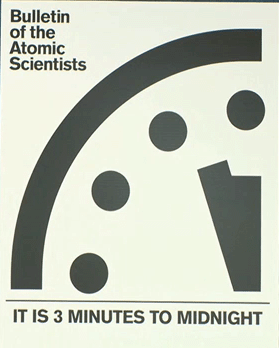
To see nuclear-related stories in greater depth and intensity – go to https://nuclearinformation.wordpress.com/
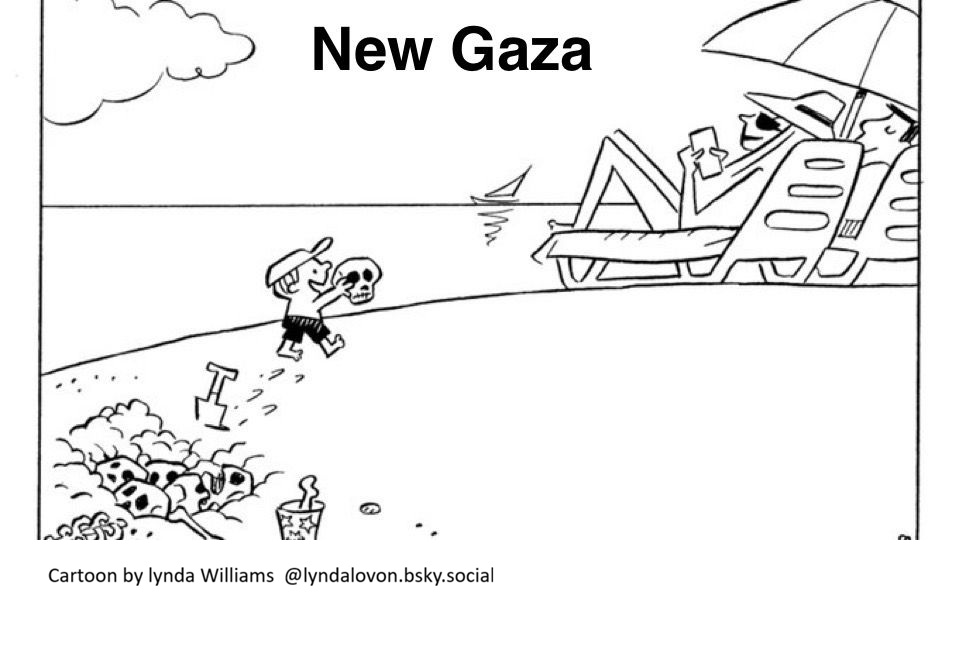
29 Jan. Thursday 7-8 p.m. Webinar – World’s Largest Nuclear Station in Port Hope, ON?

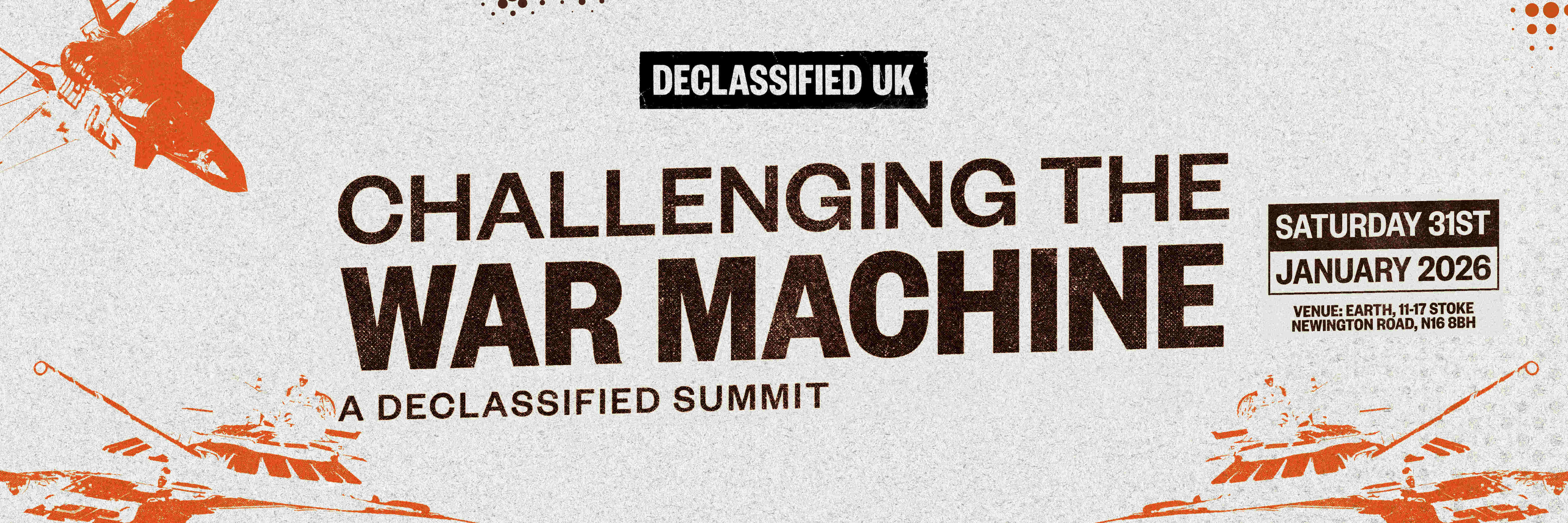
31st January – Challenging the War Machine – a DECLASSIFIED UK SUMMIT

Website of the Week
Now until to February 10, 2026 Radioactive waste storage in France: the debate is finally open! How to participate?
-
Archives
- January 2026 (277)
- December 2025 (358)
- November 2025 (359)
- October 2025 (376)
- September 2025 (258)
- August 2025 (319)
- July 2025 (230)
- June 2025 (348)
- May 2025 (261)
- April 2025 (305)
- March 2025 (319)
- February 2025 (234)
-
Categories
- 1
- 1 NUCLEAR ISSUES
- business and costs
- climate change
- culture and arts
- ENERGY
- environment
- health
- history
- indigenous issues
- Legal
- marketing of nuclear
- media
- opposition to nuclear
- PERSONAL STORIES
- politics
- politics international
- Religion and ethics
- safety
- secrets,lies and civil liberties
- spinbuster
- technology
- Uranium
- wastes
- weapons and war
- Women
- 2 WORLD
- ACTION
- AFRICA
- Atrocities
- AUSTRALIA
- Christina's notes
- Christina's themes
- culture and arts
- Events
- Fuk 2022
- Fuk 2023
- Fukushima 2017
- Fukushima 2018
- fukushima 2019
- Fukushima 2020
- Fukushima 2021
- general
- global warming
- Humour (God we need it)
- Nuclear
- RARE EARTHS
- Reference
- resources – print
- Resources -audiovicual
- Weekly Newsletter
- World
- World Nuclear
- YouTube
-
RSS
Entries RSS
Comments RSS
 nuclear-news
