Trump Rejects Intel on Iran’s Nuclear Program, Raising War Fears

19 June 2025 Michael Taylor, https://theaimn.net/trump-rejects-intel-on-irans-nuclear-program-raising-war-fears/
In a move that’s barely registering in Australian media, President Trump has publicly dismissed U.S. intelligence assessments concluding Iran is not actively building a nuclear weapon, prompting concerns he may be leaning toward military conflict. The story carries significant global implications, including for Australia as a U.S. ally in the Indo-Pacific.
While returning from the G7 summit in Canada, Trump told reporters aboard Air Force One, “I don’t care what [U.S. intelligence] said. I think [Iran] were very close to having one.” This directly contradicted Director of National Intelligence Tulsi Gabbard’s March 2025 congressional testimony, where she stated Iran’s supreme leader had not restarted the nuclear weapons program suspended in 2003. Gabbard noted Iran’s enriched uranium stockpile was at historic highs but maintained it was not pursuing a bomb. U.S. intelligence, including a November 2024 report under President Biden, similarly found no evidence of an active Iranian nuclear weapons program, though it highlighted activities such uranium enrichment that could position Iran to build one if it chose.
Trump’s remarks align him closely with Netanyahu, who has long warned of an “imminent” Iranian nuclear threat and recently advocated for pre-emptive strikes. Israel launched airstrikes on Iranian facilities last week, citing an International Atomic Energy Agency report that Iran breached non-proliferation obligations and had enough near-weapons-grade uranium for multiple bombs, despite U.S. intelligence sources countering that Iran is “not actively pursuing a nuclear weapon” and is up to three years away from producing one.
Trump’s dismissal of his own intelligence community has fueled speculation about his intentions. His frustration with stalled diplomatic efforts to curb Iran’s nuclear ambitions was evident when he said, “I’m not too much in the mood to negotiate with Iran.” The U.S. has deployed additional military assets to the region, including a carrier group and fighter jets, to provide Trump with “more options” for intervention.
The White House has reiterated Trump’s long-standing stance: “Iran cannot have a nuclear weapon.” A June 17 statement listed over a dozen instances since February 2025 where Trump emphasised this, framing it as a non-negotiable red line. Yet, his recent rhetoric, including a social media post demanding “UNCONDITIONAL SURRENDER” from Iran, suggests a hardening position.
Trump may be under pressure from pro-Israel hawks in his circle, who downplay the risk of Iranian retaliation and frame strikes as a limited operation against nuclear sites. Others, such as former CIA analyst Ray McGovern, argue Trump’s threats are “mainly bluster” to project strength, predicting he’ll back off to avoid derailing U.S.-Russia détente or triggering a global economic crisis. Still, the absence of Gabbard from key national security discussions signals a possible sidelining of voices advocating restraint.
Australia’s strategic alignment with the U.S. through AUKUS and its role in Middle East operations (e.g., past deployments in Iraq) mean a U.S.-Iran conflict could draw Canberra into logistical or political support, yet public discourse hasn’t engaged. The Australian government has not commented publicly on Trump’s stance (that I am aware of), and local coverage of Iran remains limited to brief mentions of Israel’s strikes.
A U.S. military strike on Iran could destabilise the Middle East, spike global oil prices, and strain Australia’s economy, which relies heavily on energy markets. It risks escalating into a broader conflict, potentially involving China or Russia, both of which have ties to Iran. Australia’s alliance obligations could also pressure it to back U.S. actions, complicating its Indo-Pacific balancing act. Either Trump is flexing his military muscle to deter Iran without war, or he’s being nudged toward a catastrophic conflict by Israel’s agenda.
The bottom line: The disconnect between Trump’s rhetoric and U.S. intelligence underscores a volatile decision-making process, with implications Australia can’t afford to ignore.
Working Hard to Justify Israel’s Unprovoked Attack on Iran

Belén Fernández, https://fair.org/home/working-hard-to-justify-israels-unprovoked-attack-on-iran/ 18 June 25
Imagine for a moment that Country A launched an illegal and unprovoked attack on Country B. In any sort of objective world, you might expect media coverage of the episode to go something along the lines of: “Country A Launches Illegal and Unprovoked Attack on Country B.”
Not so in the case of Israel, whose special relationship with the United States means it gets special coverage in the US corporate media. When Israel attacked Iran early last Friday, killing numerous civilians along with military officials and scientists, the press was standing by to present the assault as fundamentally justified—no surprise coming from the outlets that have for more than 20 months refused to describe Israel’s genocide of Palestinians in the Gaza Strip as genocide.
‘Preemptive strike’
From the get-go, the corporate media narrative was that Israel had targeted Iranian military and nuclear facilities in a “preemptive strike” (ABC, 6/13/25), with civilian casualties presented either as an afterthought or not at all (e.g., AP, 6/18/25). (As the Israeli attack on Iran has continued unabated for the past week in tandem with retaliatory Iranian strikes on Israel, the Iranian civilian death toll has become harder to ignore—as, for example, in the Washington Post’s recent profile of 23-year-old poet Parnia Abbasi, killed along with her family as they slept in their Tehran apartment building.)
On Monday, June 16, the fourth day of the assault, the Associated Press reported that Israeli strikes had “killed at least 224 people since Friday.” This figure appeared in the eighth paragraph of the 34-paragraph article; the first reference to Iranian civilians appeared in paragraph 33, which informed readers that “rights groups” had suggested that the number was a “significant undercount,” and that 197 civilians were thus far among the upwards of 400 dead.
Back in paragraph 8, meanwhile, came the typical implicit validation of Israeli actions:
Israel says its sweeping assault on Iran’s top military leaders, uranium enrichment sites and nuclear scientists, is necessary to prevent its longtime adversary from getting any closer to building an atomic weapon.
That Israel’s “preventive” efforts happened to occur smack in the middle of a US push for a diplomatic resolution to the Iranian nuclear issue has not proved to be a detail that is overly of interest to the US media; nor have corporate outlets found it necessary to dwell too deeply on the matter of the personal convenience of war on Iran for Israeli prime minister Benjamin Netanyahu—both as a distraction from the genocide in Gaza, and from his domestic embroilment in assorted corruption charges.
In its own coverage, NBC News (6/14/25) highlighted that Netanyahu had “said the operation targeted Iran’s nuclear program and ‘will continue for as many days as it takes to remove this threat.’” Somehow, it is never deemed worth mentioning in such reports that it is not in fact up to Israel—the only state in the region with an (undeclared) nuclear arsenal, and a non-signatory to the Nuclear Non-Proliferation Treaty—to be policing any perceived nuclear “threat.” Instead, Israeli officials are given ample space, time and again, to present their supposed cause as entirely legitimate, while getting away with murder—not to mention genocide.
‘Potential salvation’
Its profile of the young poet Abbasi notwithstanding, the Washington Post has been particularly aggressive in toeing the Israeli line. Following Netanyahu’s English-language appeal to Iranians to “stand up” against the “common enemy: the murderous regime that both oppresses you and impoverishes you”—a pretty rich accusation, coming from the man currently presiding over mass murder and all manner of other oppression—Post reporter Yeganeh Torbati (6/14/25) undertook to detail how some Iranians “see potential salvation in Israel’s attack despite risk of a wider war.”
In her dispatch, Torbati explained that in spite of reports of civilian deaths, “ordinary Iranians” had “expressed satisfaction” at Israel’s attacks on Iran’s “oppressive government.” As usual, there was no room for any potentially relevant historical details regarding “oppressive” governance in Iran—like, say, the 1953 CIA-orchestrated coup d’état against the democratically elected Mohammad Mossadegh, which paved the way for the extended rule-by-terror of the torture-happy Iranian shah, whose oppression was aided by manic acquisition of US weaponry.
On Monday, Torbati was back with another report on how, amid Israel’s attacks on Iran, the Iranian population had “lamented the lack of adequate safety instructions and evacuation orders” from its government, “turning to social media for answers.” The article quotes a Tehran resident named Alireza as complaining that “we have nothing, not even a government that would bother giving safety suggestions to people”—although it’s anyone’s guess as to what sort of suggestions the government is supposed to offer given the circumstances. Try not to be sleeping in your apartment when Israel decides to bomb it?
We thus end up with an entire article in a top US newspaper suggesting that the issue at hand is not that Israel is conducting illegal and unprovoked attacks on Iran, but rather that the Iranian government has not publicized proper safety recommendations for dealing with said attacks. At one point, Torbati concedes that “the government did provide some broad safety instructions,” and that “a government spokeswoman, Fatemeh Mohajerani, recommended that Iranians take shelter in metros, mosques and schools.”
Refusing to leave it at that, Torbati goes on to object that “it was unclear why mosques and schools would be safer than other buildings, given that Israel had already targeted residential and other civilian structures”—which again magically transforms the issue into a critique of the Iranian government for lack of clarity, as opposed to a critique of Israel for, you know, committing war crimes.
‘It’s all targeted’
Which brings us to the New York Times, never one to miss a chance to cheerlead on behalf of Israeli atrocities—like that time in 2009 that the paper’s resident foreign affairs columnist literally advocated for targeting civilians in Gaza (FAIR.org, 1/30/25), invoking Israel’s targeting of civilians in Lebanon in 2006 as a positive precedent. Now, a Times article (6/15/25) headlined “Israel’s Attack in Iran Echoes Its Strategy Against Hezbollah” wonders if another Lebanese precedent might prove successful: “Israel decimated the group’s leadership last fall and degraded its military capabilities. Can the same strategy work against a far more powerful foe?”
After reminiscing about “repeated Israeli attacks on apartment buildings, bunkers and speeding vehicles” in Lebanon in 2024—which produced “more than 15 senior Hezbollah military commanders eliminated in total”—the piece speculates that Israel’s ongoing attacks on Iran and assassinations of top Iranian officers seem “to be following the script from last fall” in Lebanon. Swift confirmation comes from Randa Slim at the Middle East Institute in Washington: “It’s all targeted, the assassination of their senior officials in their homes.”
Never mind that Israel’s activity in Lebanon last fall amounted to straight-up terrorism—or that somehow these “targeted assassinations” managed to kill some 4,000 people in Lebanon between October 2023 and November 2024 alone. In unceasingly providing a platform to justify Israeli aggression and mass civilian slaughter throughout the region, the US corporate media at least appears to be following its own script to a T.
Report: Trump Privately Approved Plans To Attack Iran But Has Withheld Final Order
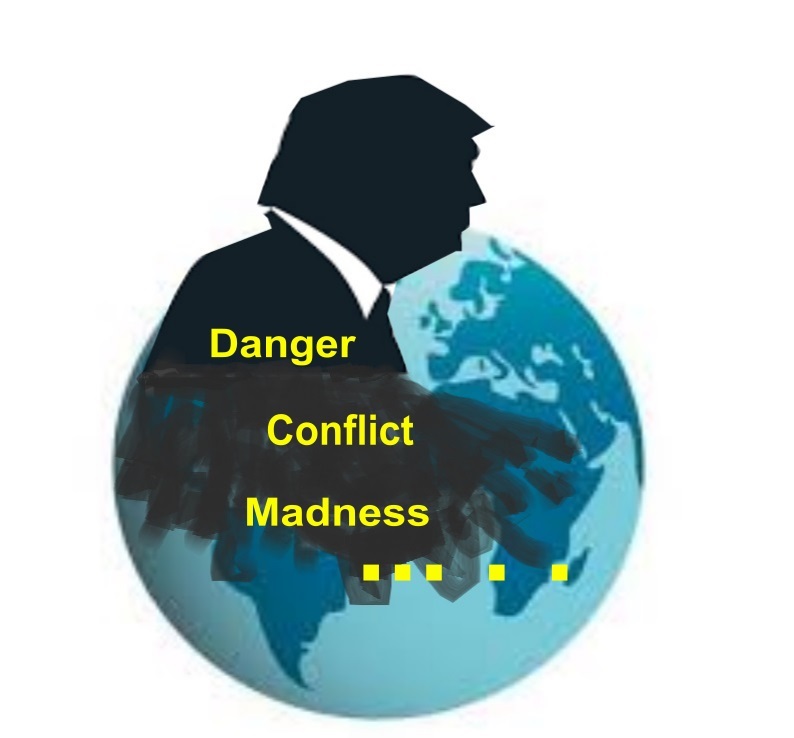
Iran has made clear it will hit US bases in the region if the US attacks
by Dave DeCamp | Jun 18, 2025, https://news.antiwar.com/2025/06/18/report-trump-privately-approved-plans-to-attack-iran-but-has-withheld-final-order/
The Wall Street Journal reported on Wednesday that President Trump has told his top officials that he approved plans to attack Iran but is holding off on giving the final order for now.
Sources told the Journal that Trump was waiting to see if Iran would agree to give up its nuclear program, which is almost certainly not going to happen. Iranian Supreme Leader Ayatollah Ali Khamenei has rejected the US president’s calls for surrender, and Tehran’s position is that it won’t negotiate while under Israeli attack.
Iran also has no reason to trust the US at the moment since Trump backed Israel’s attack amid negotiations between Washington and Tehran. Trump has refused to say if he will launch airstrikes on Iran, telling reporters on Wednesday, “I have ideas on what to do, but I haven’t made a final—I like to make the final decision one second before it’s due.”
The Journal report didn’t specify what attack plans Trump approved, but it would likely involve US airstrikes on the Fordow nuclear plant, which is buried deep underground, making it impossible to do significant damage without US bunker buster bombs and the US heavy bombers needed to drop them.
Iran has made clear it would hit back if the US launches airstrikes, and many US bases in the region are in range of Iranian missiles. Trump could be planning to launch limited airstrikes to damage Fordow, but American casualties could lead the US into deeper involvement in the war.
Israeli officials are expecting the US to intervene with direct attacks on Iran soon. “The whole operation is premised on the fact that the US will join at some point,” an Israeli official told CNN on Tuesday.
Israeli Prime Minister Benjamin Netanyahu launched the war based on the pretext of preventing Iran from obtaining nuclear weapons, but US intelligence had assessed that Tehran wasn’t seeking a nuclear bomb.
House Progressives Back War Powers Resolution as Trump Ratchets Up Rhetoric Against Iran

Brett Wilkins, 17 June 25, https://www.commondreams.org/news/progressives-war-powers-iran
Numerous House progressives said Tuesday that they will support legislation that would force President Donald Trump to obtain congressional permission to wage war on Iran, a development that followed Monday’s introduction of two Senate measures aimed at stopping Trump from dragging the United States into the widening Israel-Iran war.
Reps. Thomas Massie (R-Ky.) and Ro Khanna (D-Calif.) on Tuesday introduced legislation affirming the legal requirement under the War Powers Resolution of 1973—also known as the War Powers Act—for the president to notify lawmakers within 48 hours of committing troops to military action and limiting such action to 60 days, with a 30-day withdrawal period, unless Congress declares war or issues an authorization for the use of military force.
“The Constitution does not permit the executive branch to unilaterally commit an act of war against a sovereign nation that hasn’t attacked the United States,” Massie explained in a statement. “Congress has the sole power to declare war against Iran. The ongoing war between Israel and Iran is not our war. Even if it were, Congress must decide such matters according to our Constitution.”
In a post on the social media site X, Massie thanked the resolution’s co-sponsors, all of them Democrats: Don Beyer (Va.), Greg Casar (Texas), Alexandria Ocasio-Cortez (N.Y.), Lloyd Doggett (Texas), Jesús “Chuy” García (Ill.), Val Hoyle (Ore.), Pramila Jayapal (Wash.), Summer Lee (Pa.), Jim McGovern (Mass.), Ilhan Omar (Minn.), Ayanna Pressley (Mass.), Delia Ramirez (Ill.), Rashida Tlaib (Mich.), and Nydia Velazquez (N.Y.).
More lawmakers—possibly including Republicans—are expected to sign on to the measure.
“The president does not have the power to unilaterally declare war. Congressional authorization isn’t optional,” Lee said on social media. “When some profit both financially and politically from endless war, the rest of us pay the price. We can’t let them lie us into another conflict that will cost innocent lives.”
Tlaib asserted that “the American people aren’t falling for it again. We were lied to about ‘weapons of mass destruction’ in Iraq that killed millions [and] forever changed lives.”
The progressive political action committee Justice Democrats welcomed Massie’s measure: “Here’s an opportunity for bipartisanship that doesn’t sell out the American people. Every member of Congress should oppose U.S. involvement, funding, weapons, or troops fighting another endless war in the Middle East.”
The House proposal follows Monday’s introduction of a war powers resolution by Sen. Tim Kaine (D-Va.) and bill by Sen. Bernie Sanders (I-Vt.) that would prevent the Trump administration from using federal funds for a military attack on Iran without congressional approval. It also echoes a 2020 resolution proposed in the then-Democrat-controlled House that would have banned Trump from waging war on Iran without lawmakers’ approval.
Explaining her support for Massie’s legislation, Omar said, “I support this resolution because the American people do not want another war.”
Indeed, an Economist/YouGov poll published Tuesday revealed that only 16% of surveyed voters “think the U.S. should get involved in the conflict between Israel and Iran.” Just 10% of respondents who voted for former Vice President Kamala Harris last year and 19% of 2024 Trump voters want the U.S. to wage war on Iran, as do 15% of self-described Democrats, 11% of Independents, and 23% of Republicans.
A separate survey commissioned by Demand Progress and conducted by the Bullfinch Group recently found that 53% of registered voters—including 58% of Democrats, 47% of Independents, and 56% of Republicans—want Trump to “obtain congressional authorization before striking targets in other countries.”
“We applaud Rep. Massie and Sen. Kaine for introducing these resolutions to keep us out of yet another war in the Middle East,” Demand Progress senior policy adviser Cavan Kharrazian said Tuesday. “It should be in the interest of Republicans and Democrats to uphold the Constitution and prevent Israel from dragging us into a disastrous war with Iran.”
“The American people, including a clear majority of Republican voters, believe the president must obtain congressional authorization before initiating strikes against another country,” Kharrazian added. “Congress must listen to them and reassert its constitutional war powers authority by passing these resolutions.”
Israel claims it attacked Iran to stop it from obtaining nuclear weapons. However, successive U.S. intelligence assessments have concluded for decades—most recently in March—that Iran is not trying to build nukes. On Tuesday, Trump brushed off his own director of national intelligence’s findings that Iran is not close to having a nuclear bomb.
As Trump ratcheted up his cryptic threats against Tehran amid ongoing Israeli attacks on Iran and Iranian counterstrikes, anti-war voices including the National Iranian American Council (NIAC) and the peace group CodePink urged restraint and negotiation to avert escalating the Mideast crisis.
NIAC, which is circulating a petition demanding Congress act to avert U.S. intervention, is planning to hold a Tuesday afternoon No War With Iran Action Hour co-hosted with Peace Action and Action Corps.
“Trump continues to renege on his own commitments to diplomacy and an end to wars by perpetuating [Israeli Prime Minister Benjamin] Netanyahu’s war of aggression through his own vocal support and U.S. military equipment and personnel in the region,” NIAC said Tuesday. “Israel’s assaults on Tehran have killed upwards of 224 Iranians and hospitalized over 1,277 more.”
“Happening at the same time, in just the last day alone, Israeli forces have also killed at least 51 Palestinians desperate for aid and food at a World Food Program site in southern Gaza,” NIAC noted. “There is no telling how much more devastation for Iran, Israel, and the U.S. an expanded war on Iran would bring.”
“President Trump must immediately halt military aid and support for the Israel war on Iran,” the group added, “and if he will not, Congress must act within its constitutional authority to save millions of American, Iranian, Israeli, and Palestinian lives.”
‘We now have complete and total control of the skies over Iran’: Trump
June 17, 2025, https://www.middleeastmonitor.com/20250617-we-now-have-complete-and-total-control-of-the-skies-over-iran-trump/
US President Donald Trump claimed to have “complete and total control” of Iranian airspace Tuesday after five days of Israel’s bombing that targeted military and nuclear sites, Anadolu reports.
“We now have complete and total control of the skies over Iran,” Trump said in a social media post. “Iran had good sky trackers and other defensive equipment, and plenty of it, but it doesn’t compare to American made, conceived, and manufactured ‘stuff.’ Nobody does it better than the good ol’ USA.”
The comments come one day after Defense Secretary Pete Hegseth confirmed that the US deployed additional military assets to the Middle East, a move he and other senior Trump administration officials have maintained is “defensive” in nature amid speculation that American forces could join Israel’s military campaign.
A defense official told Anadolu on Monday that Hegseth directed the Nimitz Carrier Strike Group to the CENTCOM area of responsibility to sustain “our defensive posture and safeguard American personnel.”
Regional tensions have escalated since Friday when Israel launched airstrikes on multiple sites across Iran, including military and nuclear facilities, prompting Tehran to launch retaliatory strikes.
Israeli authorities said at least 24 people have been killed and hundreds injured since then in Iranian missile attacks. Iran said at least 224 people have been killed and more than 1,000 wounded in the Israeli assault.
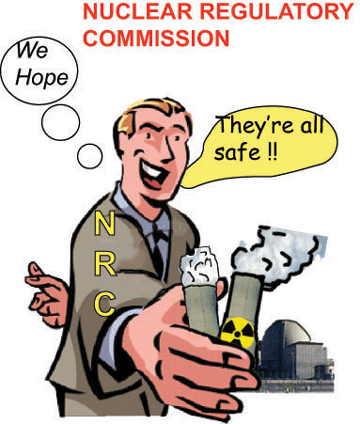
President Trump fires a member of the Nuclear Regulatory Commission
June 16, 2025, Geoff Brumfiel
President Trump has fired one of the five members of the independent
commission that oversees the nation’s nuclear reactors. Nuclear Regulatory
Commissioner Christopher T. Hanson was terminated on Friday, according to a
brief email seen by NPR from Trent Morse, the White House Deputy Director
of Presidential Personnel. The e-mail said only that Hanson’s “position as
Commissioner of the U.S. Nuclear Regulatory Commission is terminated
effective immediately.”
“All organizations are more effective when leaders
are rowing in the same direction,” White House Deputy Press Secretary Anna
Kelly told NPR via e-mail. “President Trump reserves the right to remove
employees within his own Executive Branch who exert his executive
authority.” In a statement shared with NPR, Hanson said that he was fired
“without cause,” and that he had devoted his term to “preserving the
independence, integrity and bipartisan nature of the world’s gold standard
nuclear safety institution. … I continue to have full trust and
confidence in their commitment to serve the American people by protecting
public health safety and the environment.”
Hanson was appointed to the NRC
by President Joseph Biden in 2020 and then reappointed in 2024. His current
term was set to expire in 2029, according to a bio on the NRC’s website
that has since been removed. Some observers of the nuclear industry were
sharply critical of the decision. “I think that this coupled with the other
attacks by the administration on the independence of the Nuclear Regulatory
Commission could have serious implications for nuclear safety,” says Edwin
Lyman, director of nuclear power safety at the Union of Concerned
Scientists, an environmental watchdog group. “It’s critical that the NRC
make its judgements about protecting health and safety without regard for
the financial health of the nuclear industry.”
NPR 16th June 2025, https://www.npr.org/2025/06/16/nx-s1-5435285/trump-fires-nuclear-regulatory-commission-member-nrc
The World’s Most Dangerous Man and His Enabler
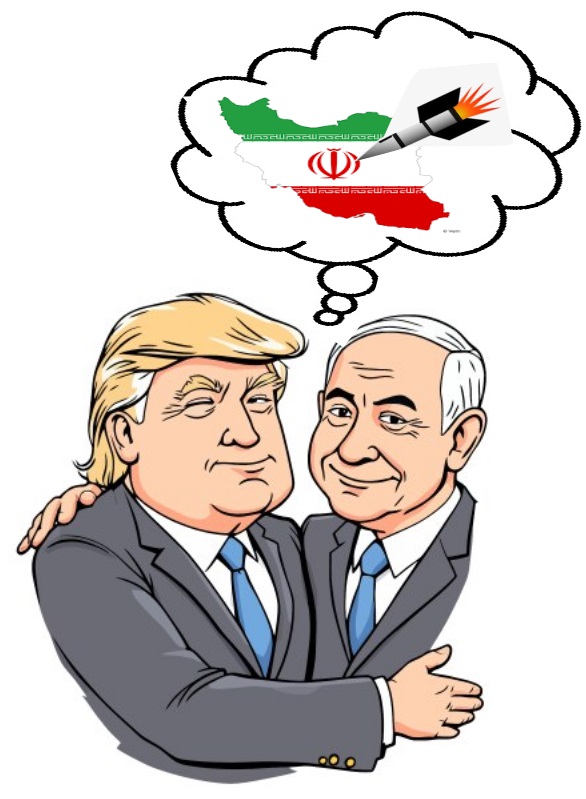
And so we come to the case of Donald J. Trump. I do not consider the American president to be as dangerous as Benjamin Netanyahu. He, Trump, may be stupider than Bibi, but he is not as unhinged. I count Trump Netanyahu’s enabler, and this is the role he just played.
now we have a nuclear-armed nation of many-times-demonstrated dangerous judgments threatening “a State without nuclear weapons,” as the IAEA refers to Iran.
June 16, 2025 By Patrick Lawrence / Original to ScheerPost
It is some years since I described Benjamin Netanyahu as the most dangerous man in West Asia. That was back when we heard all about the menace of the Assad regime in Damascus, the Beelzebub otherwise known as Iran’s supreme leader, and other such unthinkably malign figures.
The Israeli prime minister just graduated. By any serious reckoning he is the world’s most dangerous man as of the shockingly reckless, altogether nihilist attacks he launched against the Islamic Republic in the early hours of Friday, June 13. I will get to Donald Trump’s place in the ratings in a sec.
In his initial announcement of Operation Rising Lion, Netanyahu asserted that Iran presents “an existential threat” to Israel and that he had no choice but to order an attack. This is nonsense, but we had better pay attention to the nonsense. With this loaded phrase, Bibi has effectively licensed the Zionist state to launch a nuclear weapon if these attacks fail to destroy all of the Islamic Republic’s nuclear programs, as seems likely. This is my read.
There is indeed an existential threat abroad as of last Friday. But it extends well beyond Iran and, indeed, West Asia. As the self-defined Jewish state’s long, dreadful record makes plain, it appears to recognize no limits to the violence it will inflict on others, its breaches of international law and the norms of the human cause, and the risks it will inflict on the world in the name of what amounts to a biblically authorized project of subjugation and domination.
To finish this point, the obsessed leader of a nuclear-armed nation never subjected to the terms of the Non–Proliferation Treaty has just attacked a non-nuclear nation it calls a mortal danger to Israel’s survival because of the nuclear weapons it does not possess. You do the math, as the expression goes.
“Operation Rising Lion,” for the record, is a reference to the Prophecy of Balaam, an infidel with a very mixed record but who impressed the ancient Israelites with his exceptional powers of divination. In the Revised Standard Version of Numbers, 23:24, we find him saying, “Behold, the people shall rise up as a great lion, and lift up himself as a young lion: he shall not lie down until he eat of the prey, and drink the blood of the slain.” So does Bibi, who has the Palestinians down as evil Amalekites straight out of the Old Testament’s mythologies, once again state his purpose.
Israel and Iran are now at war, as one Tehrani told The New York Times after she listened to explosions and watched the flicker fires out her window last Friday evening. All is changed now. Netanyahu has craved this war for decades, always justifying his lust — a clinically psychotic lust, it is right to say — by way of endless lies and an apparently bottomless paranoia. These lies and this paranoia just put the world in danger of a global confrontation. We are all Iranians now: I am perfectly willing to say this.
As to President Trump and the American role in this, there is no need any longer for any of us to deceive ourselves. I continue to insist, against many who think otherwise, that the Zionist state is to be understood as a recklessly over-indulged client and not the Übermeister of U.S. policy. It is a complex dynamic, I mean to say, but the Zionist state just got done what the imperium wants in its broader ambition to “reshape the Middle East,” as the neoconservative cliques who direct U.S. policy have long put it. As I have noted previously in this space, borrowing from spookspeak, Israel does Washington’s wet work in West Asia.
■
As many commentators have remarked in many places, the Israelis have a well-established practice of lying in matters to do with events, policies, the conduct of the Israel Defense Forces, and so on. All governments lie, as I.F. Stone famously contended on many occasions, but the Israelis are in a class of their own among the officially mendacious, it is fair to say.
The thing about the Israelis is that they continue to lie even after a given lie is exposed. Netanyahu, a ready-to-hand case in point, still goes on about how the Hamas militias who attacked southern Israel on Oct. 7, 2023, raped men and women, beheaded some babies and baked others in ovens, and so on. All of this has been exposed as false, the product of Israel’s hasbara apparatus, the constantly-in-motion machine that produces propaganda for the consumption of international audiences. But Bibi nonetheless continues to retail these smears.
And this is the case with Netanyahu’s claims that, as of last week, Iran was on the very brink of producing nuclear weapons, and it was therefore urgent to stop it.
When he announced Operation Rising Lion, Netanyahu asserted, “It could be in a year, it could be within a few months — it could be less than a year.” Read this carefully. It is sheer fear mongering, not a stated fact in it. There is no more substance to these assertions than there has been since Netanyahu first started carrying on in this fashion in the early 1990s. Anyone aware of the record knows this is merely another in the long line of statements Netanyahu has made of this kind. Bibi knows all his “coulds” and predictions are groundless — Israeli intel and the Central Intelligence Agency have told him so — and he cannot but know those paying attention know he knows this. Now this transparent lie proves enough to start a war with two sides and risk a war with many.
On June 11, two days before the Israelis launched their attacks on Iran, a social media account going by The United States of Israel posted on “X” a timeline of Netanyahu’s claims that the Islamic Republic was about to cross the threshold and become a nuclear-capable danger. There are 20 entries, beginning in 1992 and ending earlier this year. In 1996 Iran was some months to one year away from building a bomb. In 2010 it was a year away, in 2021 months to a year, and so on.
I am not familiar with The United States of Israel and cannot vouch for every entry, but of those I know, they are all accurate. I think first of 2013, when Netanyahu addressed the U.N. General Assembly on Oct.1 with that infamously ridiculous graphic that readers may recall — the bomb shaped like a bowling ball with a fuse out of the top. The forecast then, a dozen years ago, was a year to nuclear capability.
………………………………….. commentators and others now place much weight on a report from the International Atomic Energy Agency charging that Iran has been in violation of its obligations under the Nuclear Non–Proliferation Treaty.
Some facts: The agency is an organ of the United Nations and has 35 members. It convened to vote on a resolution that was advanced by the United States, Britain, France and Germany. This resolution was presented Thursday, June 12, a day before Israel began attacking Iran. It passed with a vote of 19 board members in favor, three against (Russia, China, Burkina Faso) and 11 abstentions; two board members did not vote.
These facts merit scrutiny. Why did four Western powers, which unanimously support Israel and oppose Iran, introduce this resolution when, by last Thursday, United States and European officials were already warning of an imminent Israeli attack? Why did 16 other nations — many of them non–Western, some of them (Canada, the Netherlands, South Korea, Japan) U.S. allies — decline to back the resolution? On the day of the vote, you may recall, the State Department withdrew its diplomatic staff from its embassy in Baghdad and encouraged the families of military personnel in the region to evacuate on a voluntary basis.
Iran’s foreign minister, Abbas Araghchi, immediately interpreted the IAEA’s censure as politically motivated, a preface to the Israelis’ operation the next day. Let us take care here: This view of events cannot be verified as so, but it most certainly cannot be dismissed.
The IAEA censure is contained in the four-page June 12 report. This is a highly technical document having to do with the agency’s access to nuclear-related sites in Iran and the Iranians’ official accounts of their nuclear programs in their regular contacts with the IAEA. The points of contention between the agency and the Iranians go back five years; the most recent of these dates to November 2024. Nothing happened last week or last month or the month before that to prompt the agency’s censure.
Here is a key passage in the document:
Noting with concern the Director General’s conclusion, most recently in GOV/2025/25, that these issues stem from Iran’s obligations under its NPT Safeguards Agreement and unless and until Iran assists the Agency is [sic] resolving the outstanding issues, the Agency will not be in a position to provide assurance that Iran’s nuclear programme is exclusively peaceful …
Does this read to you like a declaration that Iran is on the brink of nuclear-capability and must urgently be stopped? Or does this read as another in a long line of interim reports, the basis for further interaction of the kind that has gone on routinely for decades? Does this, or any other passage if you care to read the technical prose, support Bibi Netanyahu’s latest predictions as earlier quoted? Does it support the commentaries of David French and Bret Stephens? Put this report next to the assertions of these people and you have an across-the-board case of gross distortion.
Iran, in response to the IAEA censure, now threatens to withdraw altogether from the Non–Proliferation Treaty and pursue its nuclear capabilities in earnest. You can read this as a potential horror show or you can think about the principle of deterrence. I have been of the latter persuasion for many years in the Iranian case. Deterrence was held very high as a strategic concept during the Cold War decades. I regretted the circumstances that made deterrence necessary but saw the necessity of it. And now we have a nuclear-armed nation of many-times-demonstrated dangerous judgments threatening “a State without nuclear weapons,” as the IAEA refers to Iran. I come to the same conclusion.
Abbas Araghchi, Iran’s now-perturbed foreign minister, was due to travel to Oman Sunday, June 15, for further talks with the United States on a nuclear accord that would replace the agreement Netanyahu railed against even before it was signed and Trump abandoned. This is now off, for obvious reasons.
And so we come to the case of Donald J. Trump. I do not consider the American president to be as dangerous as Benjamin Netanyahu. He, Trump, may be stupider than Bibi, but he is not as unhinged. I count Trump Netanyahu’s enabler, and this is the role he just played.
Trump is as deep in the pockets of the Israel lobbies and various wealthy American supporters of the Zionist state as any other American pol, allowing for very few exceptions. But in his support of so dangerous an operation as Rising Lion, Trump may have outdone them all, it seems to me. It is one thing, condemnable enough, to back a genocide by way of limitless supplies of weapons, political support and diplomatic cover. Isn’t another to approve of aggression that carries the risk of global conflagration? The degree of cynicism strikes me as yet greater than Joe Biden’s, and I admit that is going some.
There was a day or so just before Netanyahu’s lion began to rise when Trump put Marco Rubio, his hapless secretary of state, out in front of the microphones and cameras to tell the world no, the U.S. had no prior knowledge of Israel’s plans and there were no “American airplanes” involved. It transpires that Rubio meant no jets with the “USAF” insignia painted on their fuselages. Newsweek reported the day the Israelis attacked that Israel has deployed a variety of American-made fighter jets in the Israeli inventory — F–35s, F–16s and F–15s — against the Iranians. You might ask whether this amounts to tacit consent, but don’t bother. The Israelis, ever eager to boast of America’s approval of all their malevolence, have clarified the matter.
Antiwar.com, the libertarian news site, reported June 13 that a senior Israeli official disclosed to The Jerusalem Post that the Netanyahu and Trump regimes colluded “to convince Tehran that diplomacy was still possible after Israel was ready to attack Iran.” As the Jerusalem Post reported, “The round of U.S.–Iranian nuclear negotiations scheduled for Sunday was part of a coordinated U.S.–Israeli deception aimed at lowering Iran’s guard ahead of Friday’s attack.”
Here is the able Dave DeCamp’s report in Antiwar.com and here is the Jerusalem Post’s. And here, for good measure, is how The New York Times played this story under the headline, “A Miscalculation by Iran Led to Israeli Strikes’ Extensive Toll, Officials Say.” Those foolish Iranians: They took the Americans at their word.
All this while, to complete the picture, Trump was on his Truth Social messaging platform with this kind of thing:
We remain committed to a Diplomatic Resolution to the Iran Nuclear Issue! My entire Administration has been directed to negotiate with Iran. They could be a Great Country, but they first must completely give up hopes of obtaining a Nuclear Weapon. Thank you for your attention to this matter!”
I like the flipped-off flattery, the upper-case nouns, and the exclamation points. Very Donald. So is what we read about in the above-cited publications.
I do not want to go on about how cravenly the U.S. so often conducts itself in matters of state. This has been noted often enough. But what the United States just did to Iran with the assist of its client seems to me the ne plus ultra of diplomatic betrayals. I can think of only one other case that offers a useful comparison.
That was when Vladimir Putin personally negotiated a settlement of the Ukraine crisis in its early stages. The Russian president invested heavily in the two Minsk Protocols, signed in September 2014 and February 2015, as a promising solution to the divisions evident in Ukraine after the U.S.–cultivated coup in Kiev in February 2014. He subsequently discovered neither Ukraine nor the Western powers that served as guarantors of these accords, France and Germany, ever had any intention of implementing them.
Essentially at issue in these two cases is trust and breaches thereof. A measure of trust is foundational in international relations. Without it there can be no constructive diplomacy, either between adversaries or, for that matter, among allies. Nations are that much closer to a default of hostility and potential chaos. The Europeans broke trust with the Russians when they abandoned the Minsk accords as soon as they signed them. Trump just broke trust with the Iranians. This is devastation of a kind — scorched-earth statecraft, we may as well call it.
To finish this point, do you think others do not notice this? The Chinese, to name the most critical case?
Trump and Netanyahu just executed the cheapest sort of good-cop, bad-cop routine with Tehran. It is a variant of Biden’s duplicity as he armed Israel with all it needed to proceed with its genocide in Gaza while claiming to fight “night and day” for a ceasefire. Biden betrayed the Palestinians, Trump the Iranians. They have both betrayed all of us. These are acts of desperation, in my final read. Let us not forget why this is, and in which direction history’s wheel turns. https://scheerpost.com/2025/06/16/patrick-lawrence-the-worlds-most-dangerous-man-and-his-enabler/
NewsReal: Israel Attacks Iran, Seeks Regime Change. Will Trump Take US Into War?
Sott.net, 16 Jun 2025
Israel’s brazen attack against Iran on June 13th could result in the culmination of the NeoCons’ plan for the ‘New American Century’: the toppling of the last regime resisting them in the Middle East. The US and Israel would thus fully control the world’s primary ‘energy spigot’ and cement their joint role as global hegemon(s) for decades to come.
Israel intends for this ‘short war’ to last a couple of weeks, after which Iran will be ruled by a new government with a new ideology, having submitted to US-raeli domination.
Wishful thinking?
Well, it depends on what capabilities Iran has to withstand Israel’s onslaught, whether its population is psychologically committed to resisting, and whether the US will have to directly intervene to fully realize Netanyahu’s dream of deposing the Ayatollah and defeating Iran’s military.
If the latter comes about, Trump will have shot MAGA – and his devoted followers, who are extremely hostile about the US engaging in another major Middle East war – through the heart. He isn’t so psychopathic and stupid, is he? https://www.sott.net/article/500130-NewsReal-Israel-Attacks-Iran-Seeks-Regime-Change-Will-Trump-Take-US-Into-War
WHAT I HAVE BEEN TOLD IS COMING IN IRAN
The initial battle plan for a new war
Seymour Hersh, Jun 20, 2025, Seymour Hersh Substack
This is a report on what is most likely to happen in Iran, as early as this weekend, according to Israeli insiders and American officials I’ve relied upon for decades. It will entail heavy American bombing. I have vetted this report with a longtime US official in Washington, who told me that all will be “under control” if Iran’s Supreme Leader Ali Khamenei “departs.” Just how that might happen, short of his assassination, is not known. There has been a great deal of talk about American firepower and targets inside Iran, but little practical thinking, as far I can tell, about how to remove a revered religious leader with an enormous following.
I have reported from afar on the nuclear and foreign policy of Israel for decades. My 1991 book The Samson Option told the story of the making of the Israeli nuclear bomb and America’s willingness to keep the project secret. The most important unanswered question about the current situation will be the response of the world, including that of Vladimir Putin, the Russian president who has been an ally of Iran’s leaders.
The United States remains Israel’s most important ally, although many here and around the world abhor Israel’s continuing murderous war in Gaza. The Trump administration is in full support of Israel’s current plan to rid Iran of any trace of a nuclear weapons program while hoping the ayatollah-led government in Tehran will be overthrown………………………………. ………….(Subscribers only) https://seymourhersh.substack.com/p/what-i-have-been-told-is-coming-in?utm_source=post-email-title&publication_id=1377040&post_id=166335210&utm_campaign=email-post-title&isFreemail=true&r=ln98x&triedRedirect=true&utm_medium=email
After Iraq There’s No Excuse For Buying The War Lies About Iran
Caitlin Johnstone, Jun 17, 2025, https://www.caitlinjohnst.one/p/after-iraq-theres-no-excuse-for-buying?utm_source=post-email-title&publication_id=82124&post_id=166146740&utm_campaign=email-post-title&isFreemail=true&r=1ise1&triedRedirect=true&utm_medium=email
There is absolutely no excuse for buying into the war propaganda about Iran after what we all saw with Iraq.
“OMG nuclear weapons!” Shut up, idiot. If you’re a grown adult with internet access still swallowing this load of bull spunk in the year 2025 you’re either stupid or evil.
President Donald Trump is now saying he has no intention of seeking or facilitating a ceasefire with Iran, telling reporters that he’s after a “complete give-up” from Iran instead.
“I’m not too much in a mood to negotiate,” Trump said.
Asked by the press if he’s worried about US troops being targeted by Iran in the coming days, the president said “We’ll come down so hard if they do anything to our people. We’ll come down so hard. The gloves are off. I think they know not to touch our troops.”
This is a stupid, crazy lie. Iran has explicitly said it will strike US bases in the region if the US attacks Iranian territory. If you punch someone, you expect to be punched back.
If Trump orders US forces to bomb Iran, it will be because he wants to start a war and knowingly chose to do so.
One of the dumbest narratives we’re currently being fed about Iran is the claim that Israel is precision-striking high-level targets in Iran while Iran is just bombing civilians all over the place in Israel.
A casual glance at the death tolls shows this is clearly false. As of this writing the current official death count sits at 24 Israelis killed by Iran and 224 Iranians killed by Israel — most of whom are reportedly civilians. On Friday they bombed a residential building and killed 60 people, including 20 kids.
Israeli Defense Minister Israel Katz thumped his chest on Twitter about an IDF strike on an Iranian television station on Monday, saying “The Iranian regime’s propaganda and incitement broadcasting authority was attacked by the IDF after a widespread evacuation of residents in the area.”
I wonder how the western press who are currently deceiving the public to promote Israel’s information interests feel about this new rule that it’s okay to bomb media outlets if someone decides they’re propaganda?
People shouldn’t be so hard on Trump about all this. You’d probably start a war with Iran too if someone was threatening to leak your child molestation video.
The war on Iran isn’t really about nuclear weapons — if it was they would’ve kept the nuclear deal in place, which was working as intended. The Gaza holocaust isn’t really about Hamas or hostages — if it was they would’ve just targeted Hamas or negotiated a hostage deal.
It’s all lies. The war on Iran is about regional hegemony and the genocide in Gaza is about Israel’s longstanding desire to remove all Palestinians from a Palestinian territory. It’s not about self-defense, it’s about land and power, and it always has been.
This is one of the reasons antiwar people have been focusing so hard on Gaza, by the way. It wasn’t just because it’s a horrific genocide happening right in front of us, it was because it always risked blowing up into a regional war involving Israel’s western allies. We’ve been watching it expand into the West Bank, Lebanon, Yemen, Syria, and into Iran for a bit last year, and now it’s blown up into all-out war between Israel and Iran with the US poised to join in.
For 20 months I’ve been getting people asking me why I’ve been so laser-focused on Gaza while paying less attention to this or that conflict or foreign policy issue. This is why. It’s a waking nightmare in and of itself, but it’s also always been a powderkeg that could explode into something much, much worse.
US assisted Israeli war on Iran just another US regime change operation
16 June 2025 AIMN Editorial, By Walt Zlotow https://theaimn.net/us-assisted-israeli-war-on-iran-just-another-us-regime-change-operation/
In the 80 years since WWII, the US has engaged in roughly 80 regime change operations, an average of one per year. Some utilized outright war. Some used proxies. Some consisted of crippling economic sanctions designed to hurt the people so severely they would overthrow the targeted ruler.
Some succeeded immediately. Some took years to achieve regime change. Many failed.
The 1960 regime change operation in Cuba initially used sanctions. When that failed the US used Cuban dissident proxies in an invasion ending in catastrophe. Cuba brought in Russian missiles to prevent further regime change shenanigans. That nearly blew up the whole world simply to change out the Cuban communist regime in a tiny land 1/90th America’s size with a population just 3% of the American behemoth. After 65 years US embargo still makes life horrible for Cubans but does nothing to achieve regime change.
Then there is the current US regime change operation targeting Iran. The US has been itching to change out the Islamic theocracy ruling Iran since their 1979 revolution kicked out the US puppet we installed after our 1953 regime change operation deposed the democratically elected Prime Minister Mohammad Mosaddegh.
But the current Iran regime change operation is truly unique. It’s being conducted by our best buddies in the Middle East, Israel, who launched a ferocious attack against Iran wholly supported, indeed cheered on by the US. Israel is ecstatic the US enabled their war since they’re even more committed to Iran regime change than America.
In possibly the most despicable, duplicitous act of diplomatic treachery in US history, the US lulled Iran from being on alert for attack by scheduling a sixth negotiating session on Iran’s nuclear program while knowing the bombs were about to fall. An Israeli official admitted to the Jerusalem Post; “The round of US-Iranian nuclear negotiations scheduled for Sunday was part of a coordinated US-Israeli deception aimed at lowering Iran’s guard ahead of Friday’s attack.”
Besides keeping Iran’s defenses from preparing for attack, the deception was designed to keep military, political and nuclear scientists from moving to safety. Some were killed in their imagined safe homes.
Israel claims their attacks were defensive to keep Iran from building a nuclear bomb. Poppycock. That argument was simply a MacGuffin, a Hitchcock style directorial plot device to keep the narrative moving. And that narrative is regime change of the theocracy ruling Iran and inflicting massive devastation so Iran will no longer be a hegemonic rival to Israel for Middle East supremacy.
The US is delighted that it may finally achieve its first Iran regime change since deposing Moseddgegh 72 years ago. And it will do so without dropping a single bomb or losing a single soldier or civilian. Firing the bombs and burying their dead will fall to its proxy Israel which, in their lust to topple Iran, is only too happy to fill that proxy role.
On December 6-7, 1941, two Japanese diplomats were still negotiating with US officials in DC when Japan attacked Pearl Harbor. The US charged Japan with dastardly deception to enable their attack. But history later attributed the two events as unrelated due to the slow, poor communication methods of 84 years ago. Not so with America’s grotesque use of diplomacy to achieve, as Sen. Lindsay Graham gloated “Game on” for regime change in Iran.
Next time the US wants to negotiate a sensitive issue of war and peace, the opposition will not say; ‘Remember Pearl Harbor.’ They’ll proclaim; ‘Remember Iran.’
Trump Threatens to Bomb Iran to Smithereens for “Playing By the Rules”

there is no provision in international law or under the UN Charter that allows one country to attack another country based on its own subjective perception of what ‘may or may not’ constitute a threat.
Did we mention that the Trump campaign was given over $100 million by wealthy Zionist donors whose driving ambition is to topple the government in Tehran and absorb territorial Iran into Greater Israel?
Mike Whitney • June 9, 2025, https://www.unz.com/mwhitney/trump-threatens-to-bomb-iran-to-smithereens-for-playing-by-the-rules/
President Donald Trump is threatening to launch air strikes on Iran for activities that are approved under the terms of Iran’s treaty obligations. This is not a matter on which there should be any debate. The Treaty on the Non-Proliferation of Nuclear Weapons (NPT) explicitly grants all parties, including Iran, the “inalienable right” to develop, research, produce, and use nuclear energy for peaceful purposes. This “inalienable right” includes the enriching of uranium.
Trump either doesn’t understand what a “treaty” is or thinks its terms should not apply to Iran. For the sake of clarity, a treaty is a formal, legally binding agreement between sovereign states that is governed by international law. It establishes mutual obligations, rights, or rules on matters such as trade, security, nuclear non-proliferation, or environmental protection. A treaty is not optional and cannot be repealed by executive fiat. States that ratify treaties are legally obligated to comply with their terms in good faith. Political leaders, as representatives of the state, are expected to uphold these obligations.
This is all very straightforward which is why we find so it hard to understand why Trump is threatening a country that is clearly “in compliance” with its obligations under the NPT. Here’s what Trump said on Friday on Air Force One:
“They won’t be enriching. If they enrich, then we’re going to have to do it the other way… (air strikes) And I don’t really want to do it the other way but we’re going to have no choice. There’s not going to be enrichment.”
Trump has no legal authority to determine whether Iran can enrich uranium or not. It’s simply not his decision to make. Even Grok — with its obvious pro-Israel bias — understands this. Check it out:
Donald Trump, whether as a private citizen or as U.S. president, has no legal authority under international law to demand that Iran stop enriching uranium. Iran, as a sovereign state and signatory to the Treaty on the Non-Proliferation of Nuclear Weapons (NPT), has the right under Article IV to develop nuclear energy for peaceful purposes, including uranium enrichment, provided it complies with its safeguards obligations under Article III and its Comprehensive Safeguards Agreement (CSA) with the International Atomic Energy Agency (IAEA). No individual state, including the United States, has the unilateral legal authority under international law to prohibit Iran from exercising this right. Any demand from Trump would be a political or diplomatic action, not a legally binding directive, unless backed by a UN Security Council resolution, which would require agreement from other permanent members (e.g., Russia, China). Grok
Trita Parsi explains how Trump has adopted John Bolton’s Iran policy.[0n original]
Also, there is no provision in international law or under the UN Charter that allows one country to attack another country based on its own subjective perception of what ‘may or may not’ constitute a threat. That’s insanity, and it flies in the face of the UN’s efforts to ensure peace and security through collective action and multilateralism. Besides, there is no credible legal case against Iran, because Iran is not violating the rules. What the MSM stubbornly refuses to tell the public is that Iran has no nuclear weapons and no nuclear weapons program. And—according to the IAEA—Iran has been “in compliance” since 2003 and has never diverted nuclear material to a weapons program. In other words, there’s no legal case against Iran at all. Zilch.
So, what is the point of Trump’s fulminations? Why is he threatening a peaceful country that is clearly “playing by the rules”?
Did we mention that the Trump campaign was given over $100 million by wealthy Zionist donors whose driving ambition is to topple the government in Tehran and absorb territorial Iran into Greater Israel?
Could that be a factor? Could that explain why Trump convened 5 separate meetings with Iranian negotiators without once mentioning the issue of “nuclear enrichment”, but then—Surprise, Surprise—did a swift 180 after which he made “zero enrichment” the foundational demand for which he has declared unflinching support?
Could that be a factor? Could that explain why Trump convened 5 separate meetings with Iranian negotiators without once mentioning the issue of “nuclear enrichment”, but then—Surprise, Surprise—did a swift 180 after which he made “zero enrichment” the foundational demand for which he has declared unflinching support?
How do you explain that sudden about-face? Is Trump pursuing an Israeli agenda or putting “America First”?
And why would Trump stake-out such a flimsy, untenable position when he knows that enrichment is the one provision in the NPT on which Iran will never budge?
The obvious answer is that Trump doesn’t want an agreement; he does not want to resolve the issue peacefully. That’s why he focused on the one issue on which there is no flexibility, figuring (quite rightly) that enrichment can be used as a pretext for war. And that’s the goal, war with Iran.
(Readers who have been following developments with Iran closely may recall that Trump’s original demand was that “Iran cannot have a nuclear weapon”. (Iran has agreed to that demand.) But now, he has sneakily changed the wording to “no enrichment” as if the two things are the same. Naturally, the pro-Israel media has not drawn attention to the president’s sleight-of-hand fearing that it would reveal the deceptive game he is playing. But, the fact remains, Trump used the negotiations to look like he genuinely wanted peace, and then quickly moved the goalposts as the “talks” progressed. Bottom line: A peaceful settlement was never Trump’s objective.
This is from an article at The Times of Israel (June 8, 2025)
This is how desperate the Trump team (and their Israeli allies) are to cast suspicion on Iran’s perfectly legal activities. They’ve actually dug up the details of research that was conducted in 2003. (a period during which Iran has admitted to “aspects of a nuclear weapons program.”) Notice that the IAEA report does not suggest that anything illegal is going on today, or that there is any indication that Iran has an active nuclear weapons program, or even that they are diverting nuclear material to some other location. No. What they’re referring to happened more than two decades ago. It’s a joke.
And the same rule applies to the uranium that has been enriched to 60% which the Iranians have admitted to many times in the past. They’re not hiding anything; they’re looking for sanction’s relief, that’s all. Turns out, they don’t like economic strangulation. Are you surprised?
By the way, under the terms of the NPT, Iran is allowed to enrich uranium to 60% as the treaty does not explicitly set a maximum enrichment level for non-nuclear-weapon states. This is a fact, but it is a fact that is omitted in 100% of the MSM coverage of the issue. Why would that be?:-
Iran Needs Nuclear Energy
Many people believe that a country with vast oil resources like Iran has no need for nuclear energy, but that’s simply not true. Much of Iran’s electricity generation takes place at the Bushehr Nuclear Power Plant, Iran’s primary nuclear power facility, that uses low-enriched uranium to generate significant electrical power and reduce reliance on fossil fuels.
Iran also uses nuclear technology to produce radioisotopes for medical diagnostics and treatment,… widely used in cancer diagnosis and imaging. Iran claims its nuclear program supports healthcare by providing isotopes for over 1 million patients annually.
Iran also uses nuclear energy in industrial applications, agriculture, water resource management, scientific research, cancer treatment, technology and radioisotope production. The fact is, no country would join the NPT if they were denied the “peaceful use” of nuclear power. Why would they?
Finally….
Americans should realize that nothing one reads about Iran in the western media can be trusted; it is all poisoned with the same, vile anti-Iran hatred and bias. Since the 1979 Revolution to today, US policy towards Iran has been an unbroken chain of relentless hectoring, belligerence and demonization. Washington has never treated Iran with the respect it deserves nor will it in the future. That’s because—on a fundamental level—the entire US political class despises Iran for asserting sovereign control over their-own vast resources and for failing to kowtow to their mucky-muck overlords in Washington. That’s the real issue; Iran has refused to cave in to Uncle Sam’s diktats which is why it must be punished with economic strangulation, “maximum pressure” and, inevitably, war. That is how America treats the peasants in the provinces, with an iron fist.
Iran’s foreign minister Abbas Araghchi summed up Iran’s approach at a recent ceremony for the late Ayatollah Khomeini. He said:
“The main foundation of Iran’s foreign policy is based on the principle of renouncing foreign domination. Trump’s ban on enrichment is itself domination, and this is unacceptable to the Iranian people.”
To its credit, Iran has never ‘given an inch’ to Washington’s endless badgering and saber-rattling. They have stuck by their principles and defended their right as a free country to choose their own development model, their own political system and their own collective future without bullying or coercion.
Iran should be applauded for shrugging off Washington’s threats and intimidation, and for its unflinching commitment to the principle of sovereign independence. They have preserved their dignity through 45 years of nonstop hostility and antagonism.
Bravo, Iran.
Trump Praises ‘Excellent’ Israeli Strikes on Iran.
A source said Washington provided Tel Aviv with “exquisite” intel for the assault
by Kyle Anzalone | Jun 13, 2025, https://news.antiwar.com/2025/06/13/trump-praises-excellent-israeli-strikes-on-iran/
President Donald Trump endorsed the massive Israeli strike on Iran early on Friday morning, calling the attack “excellent.” A source explained that the US provided Israel with intelligence for the operation.
Speaking with ABC News on the phone following the Israeli strikes across the Islamic Republic, Trump said, “I think it’s been excellent.” He continued, “We gave them a chance and they didn’t take it. They got hit hard, very hard. They got hit about as hard as you’re going to get hit. And there’s more to come. A lot more.”
Trump refused to provide details about the US role in the attack, saying, “I don’t want to comment on that.”
However, elements of Washington’s support for Tel Aviv are becoming public. Israeli officials told the Jerusalem Post and Axios that the White House helped to create the illusion that the US was still seeking a diplomatic settlement with Iran.
Just hours before the attack, President Trump declared that he was committed to a “Diplomatic Resolution to the Iran Nuclear Issue!” But it appears he had already greenlit the Jewish state’s attack on the Islamic Republic.
A source provided further details of the US support, telling ABC News that Washington provided Tel Aviv with “exquisite” intelligence. Additionally, the source said the US will help Israel defend against any Iranian response.
The Iranian Foreign Ministry said in a statement that it holds the US responsible for the attack. “The Zionist regime’s aggressive actions against Iran cannot have been carried out without the coordination and authorization of the United States. Accordingly, the United States government, as the main supporter of this regime, will also be responsible for the dangerous effects and consequences of the Zionist regime’s adventure,” the ministry said.
Since starting the assault early Friday morning, Israeli forces have delivered multiple rounds of strikes targeting Iranian military sites, nuclear facilities, and residential buildings. Top Iranian nuclear scientists and generals have been confirmed killed.
Tel Aviv said the operation, dubbed “Nation of Lions,” will last several days.
Israel is seeking more support from the US. The Jerusalem Post reports that Israeli Defense Minister Israel Katz will hold a call with Secretary of Defense Pete Hegseth later on Friday to lobby Washington for more military assistance. Additionally, Trump is expected to speak with Israeli Prime Minister Benjamin Netanyahu by phone.
Kyle Anzalone is the opinion editor of Antiwar.com and news editor of the Libertarian Institute. He hosts The Kyle Anzalone Show and is co-host of Conflicts of Interest with Connor Freeman.
Ghoulish US Congresspersons applaud dastardly Israeli attack on Iran
17 June 2025 By Walt Zlotow ,https://theaimn.net/ghoulish-us-congresspersons-applaud-dastardly-israeli-attack-on-iran/
No surprise upon hearing the news, supreme US warmonger Senator Lindsay Graham (R-SC) immediately chortled “Game on. Pray for Israel.” That would be like a US Senator saying “Game on, pray for Germany” after their September 1, 1939 attack on Poland. Just like Germany, Israel cited ‘self-defense’ for their criminal, senseless bombardment that could provoke a regional if not nuclear war.
Rep. Carlos A. Gimenez (R-FL) was a tad less ecstatic but bloodthirsty nonetheless charging: “The threat from Iran will only stop when the regime is destroyed. Anything less is just a temporary respite from the existential threat Iran poses to our allies and the free world.”
Even relatively moderate Maine Republican Senator Susan Collins offered up this huge whopper before hoping for an Israeli victory. “Our country too is at risk as Iran continues its development not only of fissile material but also of ballistic missiles.” The only risk this conflict has to America is destroying every decent, peaceful, humane value our country should be embracing.
The majority of congresspersons commenting, fully support the Israeli regime change attack on Iran just as they’ve been supporting the Israeli genocide in Gaza for the past 20 months. Most are Republicans but one Democratic Senator, John Fetterman, offered this bit of heartless cruelty to the bombarded Iranians: “Our commitment to Israel must be absolute and I fully support this attack. Keep wiping out Iranian leadership and the nuclear personnel We must provide whatever is necessary – military, intelligence, weaponry – to fully back Israel in striking Iran.”
We can only surmise why these unhinged congresspersons support the most heinous conduct any governmental leader can inflict on a people posing no threat to America. But in so doing they disgrace their office, they disgrace America, they disgrace themselves.
Walt Zlotow, West Suburban Peace Coalition, Glen Ellyn IL
Trump’s Nuclear Plan Faces Major Hurdles
By Felicity Bradstock – Jun 14, 2025
- Trump aims to boost U.S. nuclear energy capacity from 100GW to 400GW by 2050, mandating quicker licensing and new reactor construction.
- Nearly all U.S. uranium is imported—especially from Russia—posing a major obstacle given recent bans and tariffs.
- With minimal enrichment capacity and mining, companies like Centrus stress the need for urgent public-private investment to meet demand.
The U.S. President recently announced plans to quadruple the U.S. nuclear
capacity by 2050. However, several challenges must be overcome to meet this
target. Firstly, building a new nuclear plant can take a decade or more,
meaning that operators would have to apply for permits for new projects now
to get them up and running in the coming decades.
In addition, the U.S.
continues to rely heavily on Russia for its Uranium, despite having
introduced heavy sanctions on the country’s energy sector in response to
its 2022 invasion of Ukraine. The U.S. would need to seek an alternative
supply of enriched uranium, or significantly increase its domestic
production, to fuel its power plants.
Oil Price 14th June 2025, https://oilprice.com/Energy/Energy-General/Trumps-Nuclear-Plan-Faces-Major-Hurdles.html
1 This Month
Chernobyl: The Lost Tapes – A good documentary on Chernobyl on SBS available On Demand for the next 3 weeks– https://www.sbs.com.au/ondemand/tv-program/chernobyl-the-lost-tapes/2352741955560

of the week–London Campaign for Nuclear Disarmament

Tell the Ukrainian Government to Drop Prosecution of Peace Activist Yurii Sheliazhenko
To see nuclear-related stories in greater depth and intensity – go to https://nuclearinformation.wordpress.com
-
Archives
- April 2026 (114)
- March 2026 (251)
- February 2026 (268)
- January 2026 (308)
- December 2025 (358)
- November 2025 (359)
- October 2025 (376)
- September 2025 (257)
- August 2025 (319)
- July 2025 (230)
- June 2025 (348)
- May 2025 (261)
-
Categories
- 1
- 1 NUCLEAR ISSUES
- business and costs
- climate change
- culture and arts
- ENERGY
- environment
- health
- history
- indigenous issues
- Legal
- marketing of nuclear
- media
- opposition to nuclear
- PERSONAL STORIES
- politics
- politics international
- Religion and ethics
- safety
- secrets,lies and civil liberties
- spinbuster
- technology
- Uranium
- wastes
- weapons and war
- Women
- 2 WORLD
- ACTION
- AFRICA
- Atrocities
- AUSTRALIA
- Christina's notes
- Christina's themes
- culture and arts
- Events
- Fuk 2022
- Fuk 2023
- Fukushima 2017
- Fukushima 2018
- fukushima 2019
- Fukushima 2020
- Fukushima 2021
- general
- global warming
- Humour (God we need it)
- Nuclear
- RARE EARTHS
- Reference
- resources – print
- Resources -audiovicual
- Weekly Newsletter
- World
- World Nuclear
- YouTube
-
RSS
Entries RSS
Comments RSS
 nuclear-news