IT’S known as the birthplace of the atomic bomb. But a letter written to the bomb’s laboratory has us all extremely concerned. Matt Young@MattYoung, IN 2011 something alarming happened at a United States nuclear weapons laboratory that was deliberately kept quiet.
According to The Centre for Public Integrity, a pair of workers with “cavalier attitudes” at the Los Alamos National Laboratory stuffed “so much plutonium into a small space that they came close to triggering an accidental nuclear chain reaction, all to get some photos”.
“Plutonium is the unstable, radioactive, man-made fuel of a nuclear explosion, and it isn’t amenable to showboating,” it said. “When too much is put in one place, it becomes ‘critical’ and begins to fission uncontrollably, spontaneously sparking a nuclear chain reaction, which releases energy and generates a deadly burst of radiation.”
And it gets much, much worse.
Los Alamos National Laboratory in Santa Fe, New Mexico — responsible for the design of nuclear warheads — was a top secret facility during World War II and the birthplace of the atomic bomb.
But it is in a state of chaos — in fact, it has been for years.
A damning letter by the Defense Nuclear Facilities Safety Board, released this week and seen by news.com.au, said it had found “numerous weaknesses” in the lab’s safety standards dating back to 2014.
It had also failed recent safety tests indicating how it would respond to an emergency including radioactive leaks or earthquakes.
Referred as Project Y after it was established in 1943, the laboratory was one of a series of top secret labs in the United States given codewords to maintain secrecy at the time.
It was known as the “heart” of the nuclear project and was primarily responsible for the Manhattan Project, which developed the first ever nuclear weapons. The scientists within its labs were responsible for the creation of several atomic bombs, including the Fat Man, which was detonated in the Japanese city of Nagasaki in August, 1945.
It is also responsible for the hydrogen bomb.
Since the end of WWII, the lab continued its focus on bomb designs. It is still open today and is one of the largest science and technology institutions in the world with a focus on national security, space exploration and nuclear fusion, among other “non-war” technology.
“Though the world is rapidly changing, this essential responsibility (nuclear) remains the core mission,” it states on its website.
It is also “responsible for the safety, security, and effectiveness of the nuclear explosive packages in the stockpile”.
But over the years, more and more mistakes have begun to leak from its labs, with critical, radioactive material breached, dumped and mishandled.
Last week, the US Department of Energy, which is responsible overseeing the United States’ nuclear arsenal, put out a final request for proposals to manage the site.
Government Scientist Blocked from Talking About Climate and Wildfires
Critics are accusing the Trump administration of stifling the dissemination of taxpayer-funded science, Scientific American , By Brittany Patterson, ClimateWire on October 31, 2017
A U.S. Forest Service scientist who was scheduled to talk about the role that climate change plays in wildfire conditions was denied approval to attend the conference featuring fire experts from around the country.
William Jolly, a research ecologist with the agency’s Rocky Mountain Research Station in Missoula, Mont., was supposed to give a 30-minute presentation titled “Climate-Induced Variations in Global Severe Fire Weather Conditions” at the International Fire Congress in Orlando, Fla., next month. The event is hosted by the Association for Fire Ecology (AFE).
The travel denial follows reports last week that U.S. EPA blocked three scientists from making presentations at a conference in Rhode Island featuring climate change. Critics accused the Trump administration of stifling the dissemination of taxpayer-funded science……..
Jolly’s presentation was slated to be part of a special session exploring the connection between wildfire and climate change. It focuses on what scientists can learn about fire behavior in a warming future by looking at clues from the past, according to Anthony Westerling, a professor at the University of California who is moderating the session.
“It’s kind of weird that they would make it hard for a government scientist to take part in this because managing wildfire is a huge challenge logistically and financially on a vast array of federal lands,” he said. “These scientists, by participating in these kinds of society meetings, share their thoughts and hear other people’s thoughts, which is important because their work is supposed to form how these lands are managed and how we prepare for and adapt under climate change.”
Jolly is not the only scientist whose request was denied. No travel authorizations were given to researchers from the Rocky Mountain Research Station’s Human Dimensions Science Program, according to AFE. That includes Karin Riley, a research ecologist who studies the relationship between climate and wildfire. Riley is vice president of AFE’s board of directors.
Three U.S. Geological Survey researchers who are scheduled to give presentations at the wildfire conference next month have been in limbo for months while their travel request is reviewed. All three scientists are slated to speak about climate change…….
The science shared at the Fire Congress draws on real world catastrophes. The United States is experiencing its most expensive fire season in history, with more than 8.8 million acres burned, according to the National Interagency Fire Center.
Massive fires have rained chaos on communities in Montana and California, in part due to climate change increasing the number of fires and making them more severe. A 2015 report by the Forest Service found that modern fire seasons are 78 days longer and burn twice as many acres as they did in 1970. The agency predicted that the number of acres burned could double again by 2050 (Climatewire, Aug. 6, 2015)……. https://www.scientificamerican.com/article/government-scientist-blocked-from-talking-about-climate-and-wildfires/
California governor heads to Europe for climate talks http://m.startribune.com/california-governor-heads-to-europe-for-climate-talks/454332843/?section=nationBy KATHLEEN RONAYNE , ASSOCIATED PRESS October 31, 2017 SACRAMENTO, Calif. — California Gov. Jerry Brown is continuing his international fight against climate change with an 11-day trip to Europe starting Saturday including stops at the Vatican and a United Nations conference in Germany.
Brown is a chief adversary to Republican President Donald Trump in the battle over U.S. climate policy, promising to help the country reach its emissions reductions targets even as Trump withdraws from an international climate accord. He’s been named the special adviser for states and regions at the U.N. Climate Change Conference in Bonn, Germany.
“While the White House declares war on climate science and retreats from the Paris Agreement, California is doing the opposite and taking action,” Brown said in a statement announcing the trip. “We are joining with our partners from every part of the world to do what needs to be done to prevent irreversible climate change.”
The non-profit California State Protocol Foundation, which accepts donations from private businesses, pays for Brown’s international travel. Travel for Brown’s staff members will be partially covered by money from the non-profit Climate Registry and the Climate Action Reserve, a program that deals with carbon offset projects, spokesman Evan Westrup said.
Brown’s November trip follows visits to China and Russia earlier this year to promote international collaboration on climate change. Next year, he plans to host a summit in San Francisco.
He will give a speech Saturday to the Vatican Pontifical Academy of Sciences symposium. During the week, Brown will address European Parliament leaders, the state parliament in Baden-Wurttemberg Germany, meet with representatives from national scientific academies and serve on several panels at the U.N. conference.
Govs. Kate Brown of Oregon, Jay Inslee of Washington and Terry McAuliffe of Virginia — all Democrats — will join him on a panel about states’ roles in fighting climate change. California Senate leader Kevin de Leon, also a Democrat, is scheduled to speak Friday at a Vatican workshop on climate.
Swamp Tales: Puerto Rico Cancels $300 Million Trump Crony Electrical Grid Rebuild Contract, The Progressive, by Harvey Wasserman October 30, 2017, The swampish saga would be hard to invent. In early October, Puerto Rico’s Energy Power Authority awarded a $300 million tax-funded contract to reconstruct the island’s hurricane devastated power grid to a two-person, two-year-old firm based in the small Montana hometown of Trump Interior Secretary Ryan Zinke. The company is financially backed by a major donor to Donald Trump’s 2016 presidential campaign.
About eighty percent of Puerto Rico is still without power. Many hospitals are still dark. Local citizens needing medical treatments such as surgeries or dialysis have been forced to flee to places where electric power is available.
Puerto Rico’s power grid centers on antiquated oil, gas, and coal generators, the median age of which is forty-four years. Just two percent Puerto Rico’s juice came from wind and solar. One wind farm, on the south side of the island, survived Hurricane Maria largely intact, as did at least one small commercial solar array.
For Puerto Rico’s 3.4 million residents, restoring power is a matter of life and death. But the $300 million dollar contract was handed, with no public hearings, legislative discussion or long-term planning, to Whitefish, an obscure company from rural Montana.
At least one Zinke relative—his son—has worked on part-time contract for Whitefish. Zinke claims he had nothing to do with the deal.
Anti-Trump sentiment is rampant throughout the island, fed by a lack of concern expressed by the President for Puerto Ricans’ dire situation, and capped by a recent visit in which he pitched paper towels to a crowd of bewildered local residents. When San Juan mayor Carmen Yulin Cruz questioned the contract with Whitefish, the company threatened to stop work, then apologized.
The Puerto Rican power company’s contract astoundingly exempted Whitefish from official audits, stating, “In no event shall [governmental bodies] have the right to audit or review the cost and profit elements.” It also waived “any claim against Contractor related to delayed completion of the work,” meaning Whitefish was empowered to pretty much take as long as it wanted to complete the job……..
the uproar should also focus on the growing demand that the electric power systems in Puerto Rico and the rest of the Caribbean be reconstructed around renewables and microgrids, rather than fossil-fired central distribution networks.
Most likely those systems will not be built by Trump cronies flown in at huge expense, who then must dodge rocks and bottles being thrown by angry locals.
#NukeGate: SCANA’s Failed Gambit https://www.fitsnews.com/2017/10/31/nukegate-scanas-failed-gambit/ Crony capitalist utility screws up the one card it had to play October 31, 2017. By FITSNewsSouth Carolina’s crony capitalist government-run utility, used to dictating terms to its bought-and-paid for politicians, got dealt a measure of its own medicine this week when state lawmakers – themselves badly exposed by the Palmetto State’s ongoing #NukeGate debacle – refused to play ball with the company.
What happened? SCANA attempted to use the planned ouster of two top corporate officials – CEO Kevin Marsh and top nuclear office Stephen Byrne – as a means of “cutting a deal” with state legislators.
As we exclusively reported on Saturday morning, “early reports indicated the besieged Cayce, S.C.-based company may have been attempting to use Marsh’s ouster as a ‘bargaining chip’ – a way for SCANA to gain leverage in its multi-front war with lawmakers, state and federal investigators and aggressive attorneys currently pressing a multitude of claims against the company.”
No such leverage was available, however … meaning SCANA essentially screwed up the one card it had to play (a card which, frankly, should have been played a long time ago).
This week reporters John McDermott and Andy Shain of The (Charleston, S.C.) Post and Courierconfirmed that leaders in the S.C. House of Representatives “refused to cut a deal with SCANA for Marsh and Byrne’s departure.” Oy …
Compounding the damage of this botched overture, SCANA has decided to replace Marsh from within – elevating its current finance chief Jimmy Addison to the role of CEO.
:Marsh, Addison and Byrne are among the top SCANA executives who made bank while presiding over #NukeGate – a multi-billion command economic intervention in the energy marketplace that has failed spectacularly, leaving Palmetto State taxpayers and ratepayers on the hook for a pair of new nuclear reactors that now may never be built.
In fact, ratepayers are continuing to pay $37 million per month on these reactors, even though work on the project has been abandoned.
To recap: SCANA and its state-owned partner, Santee Cooper, spent the past decade building a pair of next-generation AP1000 pressurized water reactors in Jenkinsville, S.C. at a cost of $9.8 billion. The money was spent, but the reactors were never finished. In fact they’re not even half-finished – with the cost to complete them ranging anywhere from $9-16 billion.
Unable to pony up that kind of cash, Santee Cooper pulled the plug on the project on July 31 … killing an estimated 5,600 jobs, squandering billions of dollars in investment (including more than $2 billion raised through rate increases on consumers) and throwing the state’s energy future into chaos.
Recently released documents revealed executives at the two utilities knew over a year-and-a-half ago that the project was doomed – yet continued to raise rates on consumers anyway. Not surprisingly, the project’s failure has spawned numerous lawsuits and a pair of criminal investigations – one state, one federal.
It’s also cratered SCANA’s stock price and prompted a desperate effort on the part of current governor Henry McMaster to unload Santee Cooper … for a song.
While members of the S.C. House leadership were correct to rebuke any overture from SCANA, they remain squarely on the hook for this multi-billion dollar disaster. Same with their colleagues in the State Senate and former South Carolina governor Mark Sanford, who failed to veto the now notorious legislation that enabled SCANA and Santee Cooper to effectively socialize their investment risk on this failed project.
U.S. sends nuclear-capable B-2 stealth bomber on mission in Pacific ahead of Trump visit to Asia, Japan Times, BY JESSE JOHNSON,STAFF WRITER, 29 Oct 17, The U.S. military sent a nuclear-capable B-2 stealth bomber from Whiteman Air Force Base in Missouri on a long-range mission to the Pacific area of operations over the weekend, it said Sunday, a day after Pentagon chief Jim Mattis highlighted rival North Korea’s “accelerating” atomic weapons program during a visit to South Korea.
The U.S. military’s Strategic Command said in a statement that the type of long-range mission conducted was to “familiarize aircrew with air bases and operations in different geographic combatant commands, enabling them to maintain a high state of readiness and proficiency.”
In a message likely intended to reassure Japan and South Korea ahead of U.S. President Donald Trump’s visit to Asia, which kicks off later this week, the statement also referred to the B-2 mission as “a visible demonstration of commitment to our allies and enhancing regional security.”
The flight path of the B-2 was unclear, and Strategic Command did not respond to a request for comment, but the last time one of the stealth bombers flew near the Koreas was during a rare show of force over the peninsula in 2013. Military experts say that any U.S. strike on North Korea would almost certainly involve the powerful bombers……..
The weekend flight of the B-2, which can carry conventional as well as nuclear bombs, comes just ahead of Trump’s Asia tour, which is scheduled to kick off with a visit to Japan between Nov. 5-7. That visit will include talks with Prime Minister Shinzo Abe that are expected to focus on the North Korean nuclear crisis……
On Saturday Mattis blasted North Korea for “outlaw” behavior and vowed that the U.S. would never accept a nuclear North.
“North Korea has accelerated the threat that it poses to its neighbors and the world through its illegal and unnecessary missile and nuclear weapons programs,” he said, adding that U.S.-South Korean military and diplomatic collaboration thus has taken on “a new urgency.”
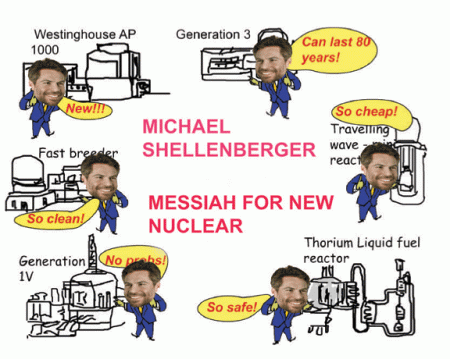
Michael Shellenberger is visiting Australia this week. He has been a prominent environmentalist (of sorts) since he co-authored the 2004 essay, The Death of Environmentalism. These days, as the President of the California-based ‘Environmental Progress’ lobby group, he is stridently pro-nuclear, hostile towards renewable energy and hostile towards the environment movement.
Shellenberger is visiting to speak at the International Mining and Resources Conference in Melbourne. His visit was promoted by Graham Lloyd in The Australian in September. Shellenberger is “one of the world’s leading new-generation environmental thinkers” according to The Australian, and if the newspaper is any guide he is here to promote his message that wind and solar have failed, that they are doubling the cost of electricity, and that “all existing renewable technologies do is make the electricity system chaotic and provide greenwash for fossil fuels.”
Trawling through Environmental Progress literature, one of their recurring themes is the falsehood that “every time nuclear plants close they are replaced almost entirely by fossil fuels”. South Korea, for example, plans to reduce reliance on coal and nuclear under recently-elected President Moon Jae-in, and to boost reliance on gas and renewables. But Shellenberger and Environmental Progress ignore those plans and concoct their own scare-story in which coal and gas replace nuclear power, electricity prices soar, thousands die from increased air pollution, and greenhouse emissions increase.
Fake scientists and radiation quackery
Environmental Progress’ UK director John Lindberg is described as an “expert on radiation” on the lobby group’s website. In fact, he has no scientific qualifications. Likewise, a South Korean article falsely claims that Shellenberger is a scientist and that article is reposted, without correction, on the Environmental Progress website.
Shellenberger says that at a recent talk in Berlin: “Many Germans simply could not believe how few people died and will die from the Chernobyl accident (under 200) and that nobody died or will die from the meltdowns at Fukushima. How could it be that everything we were told is not only wrong, but often the opposite of the truth?”
There’s a simple reason that Germans didn’t believe Shellenberger’s claims about Chernobyl and Fukushima ‒ they are false. Shellenberger claims that “under 200” people have died and will die from the Chernobyl disaster, but in fact the lowest of the estimates of the Chernobyl cancer death toll is the World Health Organization’s estimate of “up to 9,000 excess cancer deaths” in the most contaminated parts of the former Soviet Union. And of course there are higherestimates for the death toll across Europe.
Shellenberger claims that the Fukushima meltdowns “killed precisely no one” and that “nobody died or will die from the meltdowns at Fukushima”. An Environmental Progress report has this to say about Fukushima: “[T]he science is unequivocal: nobody has gotten sick much less died from the radiation that escaped from three meltdowns followed by three hydrogen gas explosions. And there will be no increase in cancer rates.”
In support of those assertions, Environmental Progress cites a World Health Organization report that directly contradicts the lobby group’s claims. The WHO report concluded that for people in the most contaminated areas in Fukushima Prefecture, the estimated increased risk for all solid cancers will be around 4% in females exposed as infants; a 6% increased risk of breast cancer for females exposed as infants; a 7% increased risk of leukaemia for males exposed as infants; and for thyroid cancer among females exposed as infants, an increased risk of up to 70% (from a 0.75% lifetime risk up to 1.25%).
Applying a linear-no threshold (LNT) risk factor to the estimated collective radiation dose from Fukushima fallout gives an estimated long-term cancer death toll of around 5,000 people. Nuclear lobbyists are quick to point out that LNT may overestimate risks from low dose and low dose-rate exposure ‒ but LNT may also underestimate the risks according to expert bodies such as the US National Academy of Sciences’ Committee on the Biological Effects of Ionizing Radiation.
US refusal to accept N. Korea as nuclear power leaves little room for talks By KIM GAMEL | STARS AND STRIPES October 29, 2017 SEOUL, South Korea – Defense Secretary Jim Mattis insisted the United States will never accept North Korea as a nuclear power, warning the communist state will face a massive military response if it attacks.
But he also clung to diplomatic efforts aimed at resolving the standoff over the North’s nuclear weapons program.
The mixed messages reflect the lack of good options in dealing with the North, which conducted its sixth and most powerful nuclear test on Sept. 3 and has made rapid progress in developing a missile that could threaten the U.S. mainland.
U.S. policy has been aimed at forcing Pyongyang to abandon its nuclear ambitions. but North Korea has defiantly persisted with its efforts despite punishing economic sanctions and diplomatic pressure.
Trump team drawing up fresh plans to bolster US nuclear arsenal Congress and US allies briefed on progress of Nuclear Posture Review Pence: ‘There’s no greater force for world peace than the US nuclear arsenal’, Guardian, Julian Borger 29 Oct 17,
The Trump administration is working on a nuclear weapons policy that is intended to mark a decisive end to the era of post-cold war disarmament, by bolstering the US arsenal and loosening the conditions under which it would be used.
A draft of the new Nuclear Posture Review (NPR) was presented in September at a White House meeting between Donald Trump and his top national security advisers. Congress and US allies have been briefed on the progress of the new draft.
The document is still being debated with a target for completion by the end of this year or the beginning of next. Among the new elements under consideration are a low yield ballistic missile intended primarily to deter Russia’s use of a small nuclear weapon in a war over the Baltic states; a sea-launched cruise missile; a change in language governing conditions in which the US would use nuclear weapons; and investments aimed at reducing the time it would take the US to prepare a nuclear test.
Trump has frequently voiced his intention to build up the US arsenal. According to one report, he was outraged at a meeting with military leaders in July when he was shown a downward sloping graph of the US weapons stockpile since the cold war, and had to be talked out of ordering a tenfold increase.
The White House denied the report but it has repeatedly made clear it aims to adopt a more aggressive nuclear stance………
Like much else about Trump’s presidency, the new policy is aimed at erasing the legacy of his predecessor. Barack Obama began his administration with a major speech in Prague in April 2009, committing the US to disarmament and the eventual elimination of nuclear weapons globally………
On Thursday, Christopher Ford, special assistant to the president on weapons of mass destruction and counterproliferation, told a meeting on nuclear threats organised by the Ploughshares Fund: “The traditional post-cold war approach of seeking to demonstrate disarmament bona fidesby showing steady numerical movement towards elimination, while trying to avoid steps that could actually undermine US national security, has largely run its course and is no longer tenable, especially given evolving security conditions.
“So it’s time to explore alternative approaches – and we are.”
Ford did not provide further details, as he said the NPR was still being worked on. Several sources briefed on its progress said elements under consideration include:
A low-yield ballistic missile, possibly using the Trident D5 missile but using only the first, fission, part of its two-stage warhead.
Bringing back nuclear Tomahawk sea-launched cruise missiles, which were dropped from the arsenal in 2013.
Reducing the lead time the US would need to resume nuclear testing from its current level of three years.
A relaxation of constraints laid down in Obama’s 2010 NPR, which pledged the US would only used its nuclear weapons in “extreme circumstances to defend the vital interests of the United States or its allies and partners” and never against non-weapons states in compliance with their non-proliferation obligations.
Any change in the US arsenal would have to be approved by Congress, which controls the funding for the nuclear weapons programme and which is already concerned that its ballooning cost is eating away at conventional capabilities.
Democrats push bill to stop a Trump pre-emptive strike on North Korea
Conyers-Markey legislation has two Republican backers in House
President’s threat to ‘totally destroy’ North Korea fuelled nuclear war fears, Guardian, Julian Borger 27 Oct 17, Congressional Democrats have introduced legislation aimed at preventing Donald Trump from launching a pre-emptive attack on North Korea, as concerns grew about the administration’s failure to explore talks with Pyongyang.
The new legislation prohibiting an attack on North Korea without congressional authority was launched by Democrats John Conyers in the House and Ed Markey in the Senate. It has two Republicans among the 61 backers in the House, but at present no formal Republican backing in the Senate.
“As a veteran of the Korean war, I am ashamed that our commander-in-chief is conducting himself in a reckless manner that endangers our troops stationed in South Korea and our regional allies,” Conyers said.
“President Trump’s provocative and escalatory rhetoric, with threats to unleash ‘fire and fury’ and ‘totally destroy’ North Korea, cannot be allowed to turn into reality,” Senator Markey said. “As long as President Trump has a Twitter account, we must ensure that he cannot start a war or launch a nuclear first strike without the explicit authorization of Congress.”
The bill’s supporters acknowledge that it will not pass without attracting more Republican support, but they argue that it helps focus attention on the unlimited authority of a US president to order the use of nuclear weapons, many of which can be launched within a few minutes. No official has the power to stop or even delay the launch.
Senator Dianne Feinstein, speaking at a conference organised by the Ploughshares Fund, an non-proliferation advocacy group said she once asked a former head of US Strategic Command if he would carry out a launch order even if he knew it was a catastrophically bad decision. “He looked me straight in the eye and said: Yes,” Senator Feinstein recalled……..
Ted Lieu, the Democratic congressman who co-authored the bill in January to limit the president’s power to launch a first strike said the best recruiter for Republican support was Trump’s behaviour.
To shore up the INF, the United States could propose something the Russians have already advocated—that the INF Treaty be expanded to ban this category of ballistic missiles globally.Such a move would not immediately apply to the most troubling nuclear-tipped missiles, those with ranges far in excess of 1,000 kilometers. But a worldwide INF could be a first step toward an eventual goal of banning all ballistic missiles.
Ballistic missiles have beneficial purposes; they place satellites in orbit, and those satellites provide the world with vital communications capabilities and navigation and weather information. Ballistic missiles send astronauts and space stations into Earth orbit and research probes far across the solar system.
But ballistic missiles armed with nuclear warheads are enablers of apocalypse. There is no effective defense against these missiles, even though the United States has spent more than 30 years and $500 billion trying to build radars that can track them and interceptor missiles that will shoot them down.
Military ballistic missiles have other negative characteristics. The short time needed for them to reach target (if the United States and Russia are the assumed combatants, 10 to 30 minutes) creates pressure to launch first in a conflict. In a crisis, ballistic missiles on high alert can wind up becoming the leading edge of a devastating war begun by miscalculation.
Because of the obvious dangerousness of ballistic missiles, there is a long history of official efforts to limit or eliminate them. Those efforts have shown that agreements to reduce the dangers of ballistic missiles can catalyze improved relations between potential adversaries. The landmark 1987 Intermediate-Range Nuclear Forces (INF) treaty required Washington and Moscow to eliminate all ballistic missiles with ranges between 500 and 1,000 kilometers. Both nations recognized that these missiles could not be defended against and their proximity to the Cold War boundaries of Europe meant they were highly destabilizing in a crisis. A total of 2,692 missiles (including a small number of cruise missiles) were eliminated under the treaty.
Acknowledging the danger of nuclear ballistic missiles, President Reagan proposed an agreement requiring their total elimination to Soviet leader Gorbachev at their summit in Reykjavik, Iceland in 1985. The Soviets did not accept the proposal because Reagan insisted that America’s program to build missile defenses remain unconstrained. That program—known then as the Strategic Defense Initiative and today as the National Missile Defense Program—has yet to develop effective means to defeat ballistic missiles.
In the mid 1990s, Alton Frye, then Washington director of the US Council on Foreign Relations, advocated an international ban on offensive ballistic missiles, an idea whose time has perhaps come again. Many political and technical challenges would need to be addressed to negotiate and enforce new international limitations on ballistic missiles. But model institutional and scientific mechanisms for such efforts exist in the form of preceding treaties, including INF and New START. Procedures and technologies for inspection, verification, and enforcement of agreements limiting or banning all types of ballistic missiles have already been proven. Political will, as usual is the major missing ingredient.
While Perry proposes to eliminate only land-based ballistic missiles and retain submarine-based missiles, such a move could create powerful international momentum to negotiate new international limits or bans on certain types of ballistic missiles—with an ultimate goal of banning all nuclear-armed ballistic missiles. If a united international community were to seriously consider such a course, it could bring increased pressure on North Korea, Iran, and other nations to suspend or roll back their offensive ballistic missile programs. If they refused, the possibility of using military force against their nuclear and ballistic missile programs would gain legitimacy and support.
One place to start seeking new limits on ballistic missiles has been in the news for months: the INF Treaty, which the United States and Russia have accused one another of violating. Russia’s support of the treaty has weakened over the years because it is forbidden to deploy ballistic missiles with ranges between 500 and 1,000 kilometers, but its neighbors who are not party to the treaty are permitted to do so. China has many such missiles, and Turkey, South Korea, and Japan could develop them in the future. To shore up the INF, the United States could propose something the Russians have already advocated—that the INF Treaty be expanded to ban this category of ballistic missiles globally.
Such a move would not immediately apply to the most troubling nuclear-tipped missiles, those with ranges far in excess of 1,000 kilometers. But a worldwide INF could be a first step toward an eventual goal of banning all ballistic missiles. A renewed focus on the danger of these weapons—accompanied by US statements that it is willing to eliminate its land-based ICBMs under the right conditions—might elicit greater support from Russian and China in efforts to defuse the North Korean crisis and control Iranian missile testing.
Like the nuclear weapons ban treaty the UN recently adopted, a ballistic missile ban would require sustained, long-term effort to achieve anything like full success. But the United States has everything to gain from taking a leadership role and asserting that offensive ballistic missiles are dangerous and destabilizing weapons that should eventually be eliminated from the arsenals of all nations.
Pentagon Chief Mattis Stresses Diplomacy in North Korea Crisis, NBC News , by ASSOCIATED PRESS, 27 Oct 17 PANMUNJOM, Korea — On his first visit to the tense but eerily quiet frontier between North and South Korea as U.S. secretary of defense, Jim Mattis conveyed the message he hopes will win the day: Diplomacy is the answer to ending the nuclear crisis with the North, not war.
Non-partisan analysis reveals the cost of energy secretary Rick Perry’s proposal to give handouts to some of the country’s oldest and dirtiest power plants, Guardian, Oliver Milman, 27 Oct 17, A Trump administration plan to subsidize coal and nuclear energy would cost US taxpayers about $10.6bn a year and prop up some of the oldest and dirtiest power plants in the country, a new analysis has found.
The Department of Energy has proposed that coal and nuclear plants be compensated not only for the electricity they produce but also for the reliability they provide to the grid. The new rule would provide payments to facilities that store fuel on-site for 90 days or more because they are “indispensable for our economic and national security”.
Rick Perry, the energy secretary, said the subsidies were needed to avoid power outages “in times of supply stress such as recent natural disasters”.
The plan would provide a lifeline to many ageing coal and nuclear plants that would otherwise go out of business, primarily due to the abundance of cheap natural gas and the plummeting cost of renewables.
The Department of Energy noted 531 coal-generating units were retired between 2002 and 2016, while eight nuclear reactors have announced retirement plans in the past year.
Donald Trump has vowed to arrest this decline and end the “war” on mining communities by repealing various environmental regulations put in place during the Obama administration.
Perry’s pro-coal market intervention would cost taxpayers as much as $10.6bn a year over the next decade, according to a joint analysis by the non-partisan groups Climate Policy Initiative and Energy Innovation. Just a handful of companies, operating about 90 plants on the eastern seaboard and the midwest, would benefit from the subsidies, the report found.
“The irony of putting costs on consumers for resources that are no longer competitive is really striking,” said Brendan Pierpoint, energy finance consultant at Climate Policy Initiative. “It would serve to keep a lot of uneconomic plants in the market that currently can’t compete with the changing dynamics of cheap gas and the falling cost of renewables.”
The Trump administration has raised concerns that the growth of intermittent wind and solar energy could undermine the so-called “baseload” power provided by coal and nuclear, pointing to power outages during the Polar Vortex cold wave that swept over North America in 2014.
However, recent studies of the grid have found that it has not been weakened by the loss of coal and nuclear plants and is barely affected by power outages. Also, coal-fired plants are not immune to natural disasters, with facilities going offline during the Polar Vortex and Hurricane Harvey, which hit Texas this year.
An unlikely alliance of renewable energy advocates and the American Petroleum Institute has complained that Perry’s plan tips the scales in favor of a failing coal industry and has vowed to fight the proposal. The rule would also jar with the supposed free market principles of an administration that has attacked subsidies for wind and solar, as well as intervention in healthcare insurance markets.
“Perry’s obsession with propping up these expensive, dirty facilities will cost Americans real money,” said Mary Anne Hitt, a campaigner at the Sierra Club.
“These ageing coal plants are making Americans sick, and now Secretary Perry wants to force us to pay tens of billions of dollars to Wall Street to keep them running, so they can continue polluting our air and water.”
Perry’s plan has to be approved by the Federal Energy Regulatory Commission (FERC), which is housed within the Department of Energy but is an independent agency. Two of FERC’s three commissioners were appointed by Trump, with one,Neil Chatterjee, already voicing support for subsidizing coal and nuclear. Perry has asked for a ruling on his request by 27 November.
The aggressively pro-fossil fuels stance of the Trump administration has been advanced elsewhere this week, with the House of Representatives approving a budget plan that would open the way for oil drilling in a vast Arctic wildlife refuge in Alaska.
Meanwhile, the interior department has released a plan to sweep away the regulatory “burdens” that slow down or prevent mining and drilling on public lands.
US Military Strike Against North Korea Pose Risk Of ‘Unacceptable War’: Expert, International Business Times, BY SUMAN VARANDANI@SUMAN09A mid the ongoing tensions in the Korean Peninsula of a possible nuclear threat from North Korea, the United States had said that further provocation from Pyongyang could result in a preventive military strike. However, a renowned American expert on the North Korean issue has told Yonhap News Agency that the U.S. would not remove all of North Korea’s nuclear and ballistic missile capabilities.
“A preventive military strike would not destroy all of North Korea’s capabilities. It would risk a wider war that would inflame South Korea and Japan and potentially cause millions of casualties,” Michael Green, vice president for Asia at the Center for Strategic and International Studies (CSIS), said last week in Washington, D.C., in his meeting with South Korean journalists.
Green proposed economic sanctions as the most viable tool to end North Korea’s nuclear weapons program. While mentioning about other ways in which the U.S. military strike could backfire, Green said: “It would also threaten the U.S. because North Korea has an ability even without ballistic missiles to transfer nuclear weapons to terrorist groups, so a preventive military strike would not get all of North Korea’s nuclear capabilities and would risk an unacceptable war.”
Green also claimed that diplomatic negotiations with Pyongyang would also not yield any concrete result as to stopping the Kim Jong Un regime’s nuclear advancement, given the country’s track record of breaking previous agreements.
“We shouldn’t end sanctions or military exercises in order to have dialogue with Pyongyang because then we will prove there’s no cost to North Korea for the path it’s on,” Green said, suggesting that the U.S. build “infrastructure of sustained consequence” for North Korea to facilitate diplomacy work with the regime. “We now have to restore deterrence and restore credibility if we have any chance in medium to long run diplomacy.”……http://www.ibtimes.com/us-military-strike-against-north-korea-pose-risk-unacceptable-war-expert-2605939
Tell Congress: Prevent Nuclear Catastrophe in Iran
Read the Public Inquiry Report, the Commissioners’ report, Surrendering Australia: The AUKUS Deception is available to download for free at aukuspublicinquiry.com. Or just watch the replay of the National Press Club Luncheon.
19 November – Webinar – The Reality of Reprocessing
Time: 11:00 AM Pacific Time (US & Canada) / 2:00 PM Eastern / 7:00 PM UK / 8:00 PM CET