NRDC 1st June 2018 The Trump Administration has made no secret of its desire to prop up coal
and nuclear plants for political purposes and today the White House made it abundantly clear. At the same time, a leaked draft memo unveiled last night repackages a previously rejected idea to bail out coal and nuclear plants, this time arguing that they are needed to protect national security.
The memo proposes that the U.S. Department of Energy (DOE) issue an order requiring electricity grid operators to purchase, for two years, electricity from expensive and uncompetitive coal and nuclear facilities that would otherwise retire. Neither the White House nor DOE have owned up to the memo or its contents.
But White House Press Secretary Sarah Huckabee Sanders stated today that stopping coal and nuclear retirements remains a priority for President Trump, and that he has directed DOE Secretary Rick Perry “to prepare immediate steps to stop the loss of these resources, and looks forward to his recommendations.” https://www.nrdc.org/experts/john-moore/coal-and-nuclear-bailout-memo-recycled-idea-new-hat
“Unfortunately, impending retirements of fuel-secure power facilities are leading to a rapid depletion of a critical part of our nation’s energy mix, and impacting the resilience of our power grid,” the White House said in a statement.
The Trump administration has been preparing to invoke emergency powers granted under Cold War-era legislation to order regional grid operators to buy electricity from ailing coal and nuclear power plants. There have been meetings this week at the Cabinet deputies’ level and at the National Security Council.
According to the draft memo, the Energy Department would exercise its emergency authority to order grid operators to give preference to plants “that have a secure on-site fuel supply” and that “are essential to support the Nation’s defense facilities, critical energy infrastructure, and other critical infrastructure.” Only coal and nuclear plants regularly keep fuel on site.
The Energy Department would also establish a “Strategic Electric Generation Reserve.” The memo added that “federal action is necessary to stop the further premature retirements of fuel-secure generation capacity.” The emergency rules would be a “prudent stopgap measure” that would last two years while the Energy Department did further study.
“President Trump believes in total energy independence and dominance, and that keeping America’s energy grid and infrastructure strong and secure protects our national security, public safety and economy from intentional attacks and natural disasters,” the White House said.
The idea of declaring an emergency under the Defense Production Act of 1950 (used by President Harry S. Truman for the steel industry) and Section 202 of the Federal Power Act has been promoted by the chief executives of the coal-mining firm Murray Energy and the Ohio utility FirstEnergy, both of whom have contributed heavily to Trump’s political activities.
Robert Murray presented a proposal to Energy Secretary Rick Perry in March 2017, the month Perry took office. And on April 2 of this year, FirstEnergy appealed for emergency help after a subsidiary operating ailing power plants filed for bankruptcy protection.
The Federal Energy Regulatory Commission, an independent agency, unanimously rejected an earlier proposal by the Energy Department that would have favored coal and nuclear plants.
In a recent appearance at a Washington Post Live event, FERC Chairman Kevin McIntyre said that using the emergency powers was “perhaps not the most obvious fit.”
He said using that section of the Federal Power Act “tees off the concept of continuance of a war in which the United States is involved as being kind of the baseline circumstance that would justify a DOE order to certain types of facilities to either begin operating or continue operation.”
Environmental groups, natural-gas producers, and Republicans and Democrats who have pushed for greater competition in electricity markets all condemned the latest signal that the administration might be moving closer to imposing the Energy Department’s plan.
They noted that the coal and nuclear power plants that would benefit have failed to compete against natural gas, solar and wind. Many of the plants have operated far longer than anticipated when they were built.
“Uneconomic, dirty coal plants retiring does not represent a national security risk,” Michael Panfil, director of federal energy policy and senior attorney with the Environmental Defense Fund, wrote on his blog. “If Trump chooses to bail out these failing coal plants, he’ll be forcing Americans to pay for dirty energy that pollutes our environment and makes people sick.”
Katie Bays of Height Capital Markets, an investment research firm, wrote in a commentary: “If DOE proceeds as the memo suggests, a selection of coal and nuclear plants, ostensibly those at risk of retirement, would receive subsidized payments . . . under a stitched-together ‘Frankenstein’s monster’ of federal authorities. Above all, the subsidy would be a major victory for FirstEnergy as it negotiates with bondholders over the value of coal and nuclear plants owned by its bankrupt FirstEnergy Solutions subsidiary.”
FirstEnergy’s top lobbyist last year was Jeff Miller, who was campaign manager for the presidential campaign of Perry, now energy secretary. Trump attended a private dinner with Miller and a handful of political advisers in early April.
Trump wants to manipulate regulation to force a taxpayer bailout of pollution-based energy companies. Coal baron Robert Murray recently donated to Trump’s reelection efforts and is already seeing his investment pay off.
The Trump administration is preparing a massive bailout of the pollution-causing industry, specifically those who donated millions to support his campaign.
Bloomberg reports that Trump officials are planning to push grid operators to buy electricity from coal and nuclear plants that are out of sync with the move toward cleaner, more reliable energy. The outlet notes that the move would be an “unprecedented intervention into U.S. energy markets.”
A leaked memo Department of Energy, now under the control of secretary Rick Perry (former governor of Texas), shows plans to invoke emergency authority to give an excuse for the scheme.
The memo claims “Federal action is necessary to stop the further premature retirements of fuel-secure generation capacity.”
Sara Chieffo, vice president of Government Affairs for the League of Conservation Voters, slammed the proposal in a statement to Shareblue Media.
“The Trump administration is once again bending over backwards to prop up dying, dirty energy sources instead of building the clean energy economy our communities need and deserve,” Chieffo said.
If the bailout advances, some of the biggest beneficiaries would be polluters who invested massively to install Trump in the White House.
These figures include coal baron Robert Murray. Murray is the head of Murray Energy Corporation, one of the largest independent operators of coal mines in the country. His company has a horriblesafety record and multiple injuries to miners as a result.
He, like Trump, calls climate change “a total hoax.”
Murray recently donated $1 million to America First Action, the administration’s designated pro-Trump super PAC pushing for his reelection.
Before that Murray spent over $300,000 backing Trump in 2016 and donated $300,000 to Trump’s poorly attended inauguration.
Murray has been involved in direct meetings with Perry designed to implement changes in an “action plan” he presented to the administration. The plan was a list of changes to policy and regulations that would benefit the coal industry directly.
Trump has often been a booster of coal polluters. During the campaign he echoed fellow Republicans and their fraudulent claims that President Barack Obama was waging a “war on coal.” Trump recently said he had ended the “war on beautiful clean coal” with moves to ease environmental legislation.
Clean energy has been on the rise in America, and as Lara Ettenson, a senior scientist at the Natural Resources Defense Council recently wrote, clean energy “is the driving force behind job growth” in the energy industry.
Pollutant-based power sources like coal are the past, and the only way the operators in the industry like Murray can continue to be propped up is through a bailout like the one Trump is planning.
Trump wants taxpayer money to be used to keep his top patrons in business, while continuing to churn out toxic gases into the environment. He’s engineering a bailout of his cronies, and money for his re-election is likely to come rolling in if he has his way.
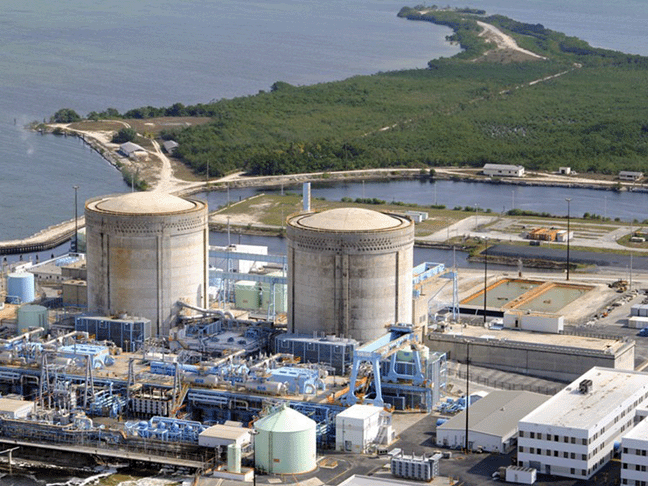
FPL, speakers clash on plan to run Turkey Point nuclear plant to 2053, Palm Beach Post ByCharles Elmore– Palm Beach Post Staff Writer 1 June 18
Opinions are splitting faster than atoms when it comes to Florida’s oldest nuclear power plant, Turkey Point.
To hear officials working for Juno Beach-based Florida Power & Light tell it, the plant hums along as a money-saving, greenhouse gas-trimming success story that deserves federal regulatory blessing to have its oldest reactor turn 80 years old on the job in 2052. A second reactor would reach the milestone a year later. That would rank among the longest tenures in the nation and double the average of less than 40 years.
But the request for a 20-year extension represents something else entirely to scores of environmentalists, activists, students and others who traveled from places such as West Palm Beach and Boca Raton for a chance to speak at a public meeting near the plant south of Miami.
They see a plant with an outdated canal cooling system threatening fragile ecosystems and water supplies, and a candidate to become the unwanted sequel to Japan’s Fukushima nuclear disaster. They say Turkey Point is in no shape to get an octogenarian’s operating license without big changes to protect South Florida’s environment and guard against threats such as rising seas and stronger hurricanes.
In public hearings, U.S. Nuclear Regulatory Commission officials are weighing those and other points of view.
Public comments can be filed by June 21. An agency decision is expected by October 2019.
“I have a stake in the outcome of this process,” said Laura Stinson, 20, a senior at Florida Atlantic University in Boca Raton, who is pursuing a degree in marine biology. She said it is “imperative these canals be closed” in favor of another solution such as cooling towers, which she and others argue present lower risk for introducing heated water, high salt concentrations, and other disruptions into surface and ground water systems.
Laura Reynolds, a consultant in West Palm Beach for the Southern Alliance for Clean Energy, said FPL must be held to account for a “massive pollution plume” that “has built up under the plant for 45 years.”
……Turkey Point’s two nuclear units began commercial operation in 1972 and 1973, and would operate to 2052 and 2053 under the proposal.
Comment on Turkey Point
Got comments on the plan for the Turkey Point nuclear plant to continue to operate for 80 years? Tell the Nuclear Regulatory Commission by June 21. Include Docket ID NRC-2018-0101 with your comment, via the regulations.govwebsite.
Major challenges remain for nuclear transportation in America
Perhaps the most pressing issue is nuclear waste and in particular, excess plutonium, most of which remains at Amarillo’s Pantex plant and will need to be moved to secure disposal facilities in the years to come.
public fears endure about whether moving such materials can ever truly be “safe.”
The Secret ‘White Trains’ That Carried Nuclear Weapons Around the U.S. History, BRIANNA NOFIL 31 May 18 At first glance, the job posting looks like a standard help-wanted ad for a cross-country trucker. Up to three weeks a month on the road in an 18-wheel tractor-trailer, traveling through the contiguous 48 states. Risks include inclement weather, around-the-clock travel, and potentially adverse environmental conditions. But then the fine print: Candidates should have “experience in performing high-risk armed tactical security work…and maneuvering against a hostile adversary.”
The U.S. government is hiring “Nuclear Materials Couriers.” Since the 1950s, this team of federal agents, most of them ex-military, has been tasked with ferrying America’s 6,800 nuclear warheads and extensive supply of nuclear materials across the roads and highways of the United States. America’s nuclear facilities are spread out throughout the country, on over 2.4 million acres of federal real estate, overseen by the Department of Energy (DOE)—a labyrinth of a system the Bulletin of the Atomic Scientists called “highly scattered and fragmented…with few enforceable rules.”
Some sites are for assembly, some are for active weapons, some are for chemicals, some are for mechanical parts. What this means in practice is that nuclear materials have to move around—a lot.
For as long as the United States has had nuclear weapons, it has struggled with the question of how to transport America’s most destructive technology throughout the country without incident. “It’s the weak link in the chain of nuclear security,” said Dr. Edwin Lyman of the Union of Concerned Scientists.
Today the United States relies almost entirely on million-dollar, Lockheed Martin tractor-trailers, known as Safeguard Transporters (SGTs) and Safe Secure Trailers (SSTs) to move nuclear material. But from the 1950s through the 1980s, the great hope for safe transit was so-called “white trains.”
These trains looked entirely ordinary, except for a few key details. They featured multiple heavily armored boxcars sandwiched in between “turret cars,” which protruded above the rest of the train. The turrets had slit windows through which armed DOE guards peered out, prepared to shoot if they needed to defend the train. Some guards had simple rifles, while others reportedly had automatic machine guns and hand-grenade launchers. Known in DOE parlance “safe, secure railcars,” or SSRs, the white trains were highly resistant to attack and unauthorized entry. They also offered “a high degree of cargo protection in event of fire or serious accident,” the DOE assured a wary Congress in 1979.
…….. Today’s nuclear infrastructure—much of which is focused on decommissioning rather than building weapons—is reliant on Safeguard Transporters and their armed drivers. Much like the rest of the America’s nuclear arsenal, many of the trucks are antiquated; about half of the SSTs are over 15 years old. The trucks, which log over three and a half million miles each year, are accompanied by unmarked escort vehicles and their only easily recognizable feature is their U.S. Government license plates.
Transportation of nuclear materials is currently overseen by the Office of Secure Transportation (OST), an agency that has attracted only minimal attention in the years since the fall of the Soviet Union. But a 2017Los Angeles Times investigation suggested problems may lurk beneath the surface. OST is understaffed, with the average courier working about 75 hours a week. Turnover is extremely high. In 2010, a DOE investigation found “widespread alcohol problems” within the agency, including incidents that occurred while couriers were on secure transportation missions. The DOE conceded that these episodes “indicate a potential vulnerability in OST’s critical national security mission.”
Major challenges remain for nuclear transportation in America. Plans to “modernize” America’s nuclear arsenal, supported by both the Obama and Trump administrations, mean that weapons will be taking more trips than ever on American roads. Beginning in 2010, around one thousand W76 warheads traveled from Bangor, Washington back to Amarillo, Texas, for upgrades to extend the life of the weapon by 30 years—a massive undertaking, entirely dependent on the OST’s fleet of Safeguard Transporters. Perhaps the most pressing issue is nuclear waste and in particular, excess plutonium, most of which remains at Amarillo’s Pantex plant and will need to be moved to secure disposal facilities in the years to come.
Whether waste or weapons, trains or trucks, the United States has been remarkably fortunate in avoiding major transportation mishaps. Since the days of the white trains, the government has insisted that nuclear materials are being moved across the American landscape in the safest possible way, persisting through crashes, fires, and interfering nuns. Yet public fears endure about whether moving such materials can ever truly be “safe.”
Now That Xcel Won’t Get Its Nuclear Bill, What’s Next? Bulletin of the Atomic Scientists JESSICA COLLINGSWORTH, POLICY ANALYST, CLEAN ENERGY | JUNE 1, 2018 Earlier this month the Xcel Nuclear Plant Costs Bill (SF3504/HF3708) passed the Senate but failed to pass through the Minnesota House. The bill created a system of approving nuclear plant repair costs for Xcel Energy that would have circumvented the normal process of the Minnesota Public Utilities Commission (MN PUC) and left ratepayers to shoulder potentially excessive costs of keeping Xcel’s nuclear plants running.
……So now that the Xcel nuclear bill didn’t pass, what’s next, and what does this all mean for Minnesota’s clean energy future? Trying to keep Xcel’s nuclear fleet in the blackXcel’s nuclear fleet is struggling to stay profitable in the face of cheaper alternatives (like renewable energy and natural gas) and looming upkeep costs. Xcel estimates it will need at least $1.4 billion dollars in repairs over the next 17 years for its Monticello and Prairie Island nuclear plants. To provide certainty that Xcel would be able to recover those costs from ratepayers, they introduced legislation that would have allowed the company to get upfront approval from the PUC for its future nuclear expenses instead of approval after those investments have been made (how it works currently). The legislation would have provided certainty for Xcel that they would be able to recover these maintenance costs from ratepayers.
This is a bad deal for ratepayers because the legislation dilutes the PUC’s authority, and attempts to bypass the PUC’s current process for reviewing costs to determine if they’re prudent. That’s why UCS opposed the bill: it was an attempt to avoid the existing regulatory review process and shift financial risk from Xcel’s shareholders to ratepayers. This is not the first legislative attempt to dilute the power of the MN PUC.
Maintaining the current process for approving costs is important
Xcel is due to file their next Integrated Resource Plan (IRP), also known as their 15-year business plan, in February 2019. The IRP process allows for a comparison of electricity options to make sure consumers are getting the most bang for their ratepayer bucks. The IRP process is where Xcel will detail how they plan to generate and supply power to their customers over the next 15 years, including any expected expenses to keep its nuclear plants up and running.
A successful IRP includes evaluation of existing resources, a robust economic analysis of different supply-side and demand-side options under a range of scenarios and assumptions, including future environmental costs and fuel prices, opportunities for stakeholder engagement, adequate reporting requirements, and a robust set of criteria of which to base approval or denial of utility plans to spend ratepayer dollars.
It’s important to keep the current process because it protects ratepayers from excessive charges. By separating out the nuclear plant upkeep costs, we’re not comparing them to other options that would maintain a reliable and affordable energy supply for less cost to ratepayers. The legislation would have pre-approved these costs, meaning any cost overruns due to mismanagement by Xcel would have been automatically passed on to ratepayers. To protect Minnesota consumers, it’s important to keep the robust IRP process and maintain the PUC’s authority to scrutinize Xcel’s expenditures……..https://blog.ucsusa.org/jessica-collingsworth/xcel-nuclear-bill-whats-next
NEW YORK — Secretary of State Mike Pompeo cited progress Thursday toward salvaging a historic summit between President Trump and North Korean leader Kim Jong Un and what he called the “once in a lifetime opportunity” of ending the nuclear weapons threat from North Korea.
Following two days of talks with Kim’s right-hand aide, Vice Chairman Kim Yong Chol, Pompeo spoke as though the summit Trump had canceled last week was likely to be reinstated, but still framed it as an “expected” first meeting.
Ionizing radiation can cause cells to turn cancerous, Pakistan Observer Islamabad : It is well established that exposure to ionizing radiation can result in mutations or other genetic damage that cause cells to turn cancerous.
Now a new study led by researchers with the U.S. Department of Energy’s Lawrence Berkeley National Laboratory (Berkeley Lab) has revealed another way in which radiation can promote cancer development.
Working with cultures of human breast cells, the researchers discovered that radiation exposure can alter the environment surrounding the cells so that future cells are more likely to become cancerous.
“Our work shows that radiation can change the microenvironment of breast cells, and this in turn can allow the growth of abnormal cells with a long-lived phenotype that has a much greater potential to be cancerous,” says Paul Yaswen, a cell biologist and breast cancer research specialist with Berkeley Lab’s Life Sciences Division.
A cell’s phenotype is its full complement of observable physical or biochemical characteristics. Different cells can have phenotypes that look dramatically different or exhibit radically different behaviour even though their genetic makeup (genotype) is identical.
Signals from outside the cell can alter a cell’s phenotype by regulating (or de-regulating) the cell’s use of its genes. Studies have shown that if a cell develops a pre-cancerous phenotype, it can pass on these “epigenetic” changes to its daughters, just as it can pass on genetic mutations.
“Many in the cancer research community, especially radiobiologists, have been slow to acknowledge and incorporate in their work the idea that cells in human tissues are not independent entities, but are highly communicative with each other and with their microenvironment,” Yaswen says. “We provide new evidence that potential cancer agents and their effects must be evaluated at a systems level.”
Yaswen is the corresponding author of a paper describing this study that appears in the on-line journal Breast Cancer Research. Co-authoring the paper were Rituparna Mukhopadhyay, Sylvain Costes, Alexey Bazarov, William Hines and Mary Helen Barcellos-Hoff.
“The work we did was performed with non-lethal but fairly substantial doses of radiation, unlike what a woman would be exposed to during a routine mammogram,” says Yaswen, who is also a member of the Bay Area Breast Cancer and the Environment Research Center. “However, the levels of radiation involved in other procedures, such as CT scans or radiotherapy, do start to approach the levels used in our experiments and could represent sources of concern.”……….
This study was jointly funded the National Institute of Environmental Health Sciences (NIEHS), and the National Cancer Institute (NCI), NIH, through the Bay Area Breast Cancer and the Environment Center, and by the NASA Specialized Center of Research. https://pakobserver.net/ionizing-radiation-can-cause-cells-to-turn-cancerous-5/
Motley Fool 28th May 2018, It has been a tough few years for one-time high-flying uranium miner Cameco Corp.. Over the last five years, its value has plummeted by 38% after nuclear power fell into disfavour after the 2011 Fukushima disaster in Japan, which caused the price of uranium to collapse.
Since then, uranium has remained caught in a protracted slump, despite claims by industry insiders and analysts that it is poised to rebound because of a combination of growing demand and emerging supply constraints. Nonetheless, despite these claims, there has been no sign of a sustained rally, and an upturn in the fortunes of the radioactive metal may never occur.
Ontario Greens would close nuclear plant this summer
Province could save $1.2B by closing Pickering plant, buying power from Quebec, leader says CBC News
The Pickering Nuclear Generating Station would close this summer if the Green Party of Ontario formed a government, according to leader Mike Schreiner.
Speaking on CBC Radio’s Ontario Today, Schreiner said while 1,900 jobs would be lost if the plant closed, others could be created by developing the plant’s prime waterfront property.
The party would not close the Bruce or Darlington nuclear generating stations, Schreiner said.
“There is no way we can shut down our nuclear plants tomorrow. It’s just unrealistic because (nuclear) produces 70 per cent of our power,” Schreiner said, though the party does oppose rebuilding such facilities.
The Liberals and the Progressive Conservatives have also said they would close the Pickering plant, but not until 2024. Like the Greens, the NDP has vowed to start decommissioning it this year.
Schreiner would also turn to Quebec to meet more of Ontario’s electricity needs. Cheap power from Quebec would help bring down hydro prices for consumers, he said.
The savings from both the plant closure and cheaper power from the neighbouring province would add up to $1 billion, Schreiner said, which could then be invested in making homes and businesses more energy efficient, Schreiner said.
“Nobody should have to choose between putting food on the table (and) paying their electricity bill,” Schreiner said.
Toshiba exits US nuclear project https://www3.nhk.or.jp/nhkworld/en/news/20180531_37/31 May 18 Japanese electronics maker Toshiba is walking away from a nuclear energy project in the US. The firm says it won’t take part in building or operating the nuclear plant.
There are 2 reactors on the drawing board. Toshiba executives say the project is no longer financially viable.
They say an increase in shale production has caused a fall in electricity sales.
They also point to stricter regulations introduced after the 2011 nuclear accident in Fukushima. Toshiba joined the South Texas Project in 2008. Executives were hoping to start operating the reactors around 2016 or 2017.
But the power company that’s heading up the project hasn’t started building them.
Toshiba is cutting its ties to the nuclear power business overseas.
The firm incurred massive losses through its former American nuclear subsidiary, Westinghouse.
FERC, DOJ support Illinois nuclear subsidies in court filing UTILITY DIVE,31 May 18
Dive Brief:
The Federal Energy Regulatory Commission and Department of Justice filed a joint legal brief in support of Illinois nuclear subsidies on Tuesday.
Lawyers for the two agencies wrote the zero emission credits (ZECs) for Illinois nuclear plants do not interfere with FERC’s authority to regulate wholesale power markets, as generators claimed. If the subsidies disrupt market operations, “the solution lies with the Commission, not the courts,” the agencies wrote.
The legal opinion will likely also apply to a pending court challenge against New York nuclear subsidies, as well as a New Jersey subsidy program enacted last week. The FERC opinion could also make a Supreme Court case over the subsidies less likely, analysts say.
Dive Insight:
The Tuesday amicus brief from FERC and DOJ is a blow for opponents of nuclear subsidies, who hoped the courts would throw out the recent state programs designed to keep uneconomic plants from retiring.
In their brief, filed with the U.S. Court of Appeals for the Seventh Circuit, FERC and DOJ write the Illinois program does not suffer from the “fatal defect” that doomed other state subsidy programs in the courts.
………Evaluating methods to integrate state energy policies into wholesale markets has been a focus at FERC in recent years — and also a point of contention. In March, the commission approved an ISO-New England plan to change its capacity market auctions to handle subsidized resources, but the 3-2 vote exposed divides between regulators on how to handle future cases.
TVA spokesman Scott Brooks said the federal utility is pursuing action to collect for the overcharges by the contractor. May 31st 2018, by Dave Flessner
The Tennessee Valley Authority was overcharged nearly $4.4 million by a contractor at the Watts Bar Nuclear Power Plant for construction of the Unit 2 reactor from 2013 to 2015, according to an audit released Wednesday.
TVA’s inspector general said Williams Plant Services (WPS) used labor classifications not provided in its contract for nearly $3.5 million of work at Watts Bar and another $430,322 for excessive markups, ineligible overtime and other unsupported labor costs. The contractor also improperly billed for $435,624 of temporary living allowances and travel costs, according to TVA auditors. Read more from our newspartners at the Chattanooga Times Free Press.
BRENT MARCHBANKS, 31 May 18 We must demand that congressional and state office seekers explain their position on this longstanding and crucial issue.
We should all contact Attorney General Wasden and urge him to protect the Batt deal. May 30, 2018
Since the 1940s, science has sought a way and a place to safely and permanently store nuclear waste. So far, no luck. Tons and tons of nuclear waste is “orphaned” in our own country and around the world, with no place to go.
Many Idahoans believe that the 1995 Batt agreement resolved this issue as to our state and the private companies, the U.S. and the other countries who are looking for places to send their poison.
It didn’t.
The Idaho National Laboratory (INL) and some of Idaho’s elected officials now want to open our state to 7,000 cubic meters of Hanford’s radioactive waste. Ominously, INL is anxious to “renegotiate” the Batt agreement to allow even more toxic stuff into the state.We must demand that congressional and state office seekers explain their position on this longstanding and crucial issue.
We should all contact Attorney General Wasden and urge him to protect the Batt deal.
Logan has 10 months to consider modular nuclear reactor program, HJ News.com, By Sean Dolan staff writer, 31 May 18, “……..Right now, Logan is the largest city participating in a plan to build a small modular nuclear reactor just north of Idaho Falls.
The project is still in the development phases, and Logan has several opportunities to pull out of the project, including a coming deadline in March 2019. At that point, UAMPS Chief Legal Officer Mason Baker said, UAMPS will gauge how many cities are participating and decide whether it makes good business sense to keep going. Baker said UAMPS hopes Logan will sign power contracts before the March deadline.
……“There’s all kinds of risks,” said Logan Light and Power Director Mark Montgomery. “There’s first-of-its-kind risk, there’s construction risk, there’s design risk, there’s a regulatory risk and probably other risks that I’m forgetting.”
Logan is set to participate in the nuclear reactor at 30 megawatts, which exceeds any of the city’s existing power contracts. Logan Finance Director Rich Anderson said there is always risk involved in the power business, but he is concerned with the financial risk involved in this level of participation…..Since 2016, Logan has paid UAMPS $206,000 for administration and general costs and has another $250,000 budgeted for this year. City Attorney Kymber Housley said there’s a risk that Logan could pay UAMPS hundreds of thousands of dollars for a project that might never happen.
“One of the big risks is it gets caught up in litigation,” Housley said in a Wednesday interview. “I don’t even think it’s a question of if; it’s more of a question of how many lawsuits will be brought trying to stop a nuclear plant.”
Tell Congress: Prevent Nuclear Catastrophe in Iran
Read the Public Inquiry Report, the Commissioners’ report, Surrendering Australia: The AUKUS Deception is available to download for free at aukuspublicinquiry.com. Or just watch the replay of the National Press Club Luncheon.
19 November – Webinar – The Reality of Reprocessing
Time: 11:00 AM Pacific Time (US & Canada) / 2:00 PM Eastern / 7:00 PM UK / 8:00 PM CET