nuclear-news

The News That Matters about the Nuclear Industry Fukushima Chernobyl Mayak Three Mile Island Atomic Testing Radiation Isotope

  • Home
  • 1 This Month
  • ACTION !
  • Disclaimer
  • Links
  • PAGES on NUCLEAR ISSUES

Depleted uranium – the cancer-causing weapon still taking its toll in Iraq

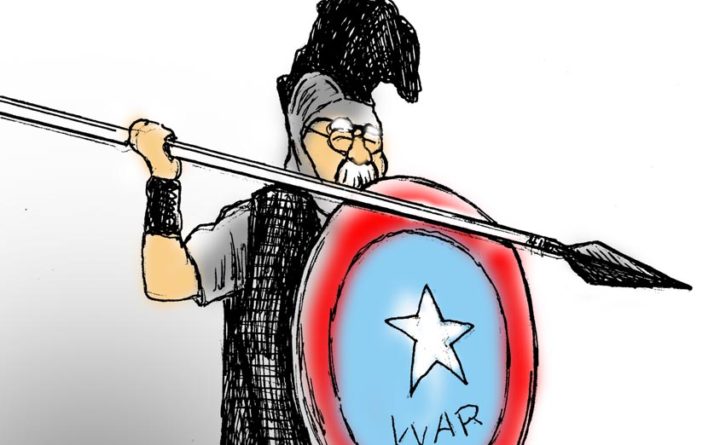
Cancer as Weapon: Poppy Bush’s Radioactive War on Iraq Counter Punch, by JEFFREY ST. CLAIR , DECEMBER 7, 2018, At the close of the first Gulf War, Saddam Hussein was denounced as a ferocious villain for ordering his retreating troops to destroy Kuwaiti oil fields, clotting the air with poisonous clouds of black smoke and saturating the ground with swamps of crude. It was justly called an environmental war crime.

But months of bombing of Iraq by US and British planes and cruise missiles has left behind an even more deadly and insidious legacy: tons of shell casings, bullets and bomb fragments laced with depleted uranium. In all, the US hit Iraqi targets with more than 970 radioactive bombs and missiles.

It took less than a decade for the health consequences from this radioactive bombing campaign to begin to coming into focus. And they are dire, indeed. Iraqi physicians call it “the white death”-leukemia. Since 1990, the incident rate of leukemia in Iraq has grown by more than 600 percent. The situation is compounded by Iraq’s forced isolations and the sadistic sanctions regime, recently described by UN secretary general Kofi Annan as “a humanitarian crisis”, that makes detection and treatment of the cancers all the more difficult.

“We have proof of traces of DU in samples taken for analysis and that is really bad for those who assert that cancer cases have grown for other reasons,” said Dr. Umid Mubarak, Iraq’s health minister.

Mubarak contends that the US’s fear of facing the health and environmental consequences of its DU bombing campaign is partly behind its failure to follow through on its commitments under a deal allowing Iraq to sell some of its vast oil reserves in return for food and medical supplies.

“The desert dust carries death,” said Dr. Jawad Al-Ali, an oncologist and member England’s Royal Society of Physicians. “Our studies indicate that more than forty percent of the population around Basra will get cancer. We are living through another Hiroshima.”

Most of the leukemia and cancer victims aren’t soldiers. They are civilians. And many of them are children. The US-dominated Iraqi Sanctions Committee in New York has denied Iraq’s repeated requests for cancer treatment equipment and drugs, even painkillers such as morphine. As a result, the overflowing hospitals in towns such as Basra are left to treat the cancer-stricken with aspirin.

This is part of a larger horror inflicted on Iraq that sees as many as 180 children dying every day, according to mortality figures compiled by UNICEF, from a catalogue of diseases from the 19th century: cholera, dysentery, tuberculosis, e. coli, mumps, measles, influenza.

Iraqis and Kuwaitis aren’t the only ones showing signs of uranium contamination and sickness. Gulf War veterans, plagued by a variety of illnesses, have been found to have traces of uranium in their blood, feces, urine and semen.

Depleted uranium is a rather benign sounding name for uranium-238, the trace elements left behind when the fissionable material is extracted from uranium-235 for use in nuclear reactors and weapons. For decades, this waste was a radioactive nuisance, piling up at plutonium processing plants across the country. By the late 1980s there was nearly a billion tons of the material.

Then weapons designers at the Pentagon came up with a use for the tailings: they could be molded into bullets and bombs. The material was free and there was plenty at hand. Also uranium is a heavy metal, denser than lead. This makes it perfect for use in armor-penetrating weapons, designed to destroy tanks, armored-personnel carriers and bunkers.

When the tank-busting bombs explode, the depleted uranium oxidizes into microscopic fragments that float through the air like carcinogenic dust, carried on the desert winds for decades. The lethal dust is inhaled, sticks to the fibers of the lungs, and eventually begins to wreck havoc on the body: tumors, hemorrhages, ravaged immune systems, leukemias.

In 1943, the doomsday men associated with the Manhattan Project speculated that uranium and other radioactive materials could be spread across wide swaths of land to contain opposing armies. Gen. Leslie Grove, head of the project, asserted that uranium weapons could be expected to cause “permanent lung damage.” In the late, 1950s Al Gore’s father, the senator from Tennessee, proposed dousing the demilitarized zone in Korea with uranium as a cheap failsafe against an attack from the North Koreans.

After the Gulf War, Pentagon war planners were so delighted with the performance of their radioactive weapons that ordered a new arsenal and under Bill Clinton’s orders fired them at Serb positions in Bosnia, Kosovo and Serbia. More than a 100 of the DU bombs have been used in the Balkans over the last six years.

Already medical teams in the region have detected cancer clusters near the bomb sites. The leukemia rate in Sarajevo, pummeled by American bombs in 1996, has tripled in the last five years. But it’s not just the Serbs who are ill and dying. NATO and UN peacekeepers in the region are also coming down with cancer. As of January 23, eight Italian soldiers who served in the region have died of leukemia.

The Pentagon has shuffled through a variety of rationales and excuses. First, the Defense Department shrugged off concerns about Depleted Uranium as wild conspiracy theories by peace activists, environmentalists and Iraqi propagandists. When the US’s NATO allies demanded that the US disclose the chemical and metallic properties of its munitions, the Pentagon refused. It has also refused to order testing of US soldiers stationed in the Gulf and the Balkans.

If the US has kept silent, the Brits haven’t. A 1991 study by the UK Atomic Energy Authority predicted that if less than 10 percent of the particles released by depleted uranium weapons used in Iraq and Kuwait were inhaled it could result in as many as “300,000 probable deaths.”

The British estimate assumed that the only radioactive ingredient in the bombs dropped on Iraq was depleted uranium. It wasn’t. A new study of the materials inside these weapons describes them as a “nuclear cocktail,” containing a mix of radioactive elements, including plutonium and the highly radioactive isotope uranium-236. These elements are 100,000 times more dangerous than depleted uranium.

Typically, the Pentagon has tried to dump the blame on the Department of Energy’s sloppy handling of its weapons production plants. This is how Pentagon spokesman Craig Quigley described the situation in chop-logic worthy of the pen of Joseph Heller.: “The source of the contamination as best we can understand it now was the plants themselves that produced the Depleted uranium during the 20 some year time frame when the DU was produced.”

Indeed, the problems at DoE nuclear sites and the contamination of its workers and contractors have been well-known since the 1980s. A 1991 Energy Department memo reports: “during the process of making fuel for nuclear reactors and elements for nuclear weapons, the Paducah gaseous diffusion plant… created depleted uranium potentially containing neptunium and plutonium”

But such excuses in the absence of any action to address the situation are growing very thin indeed. Doug Rokke, the health physicist for the US Army who oversaw the partial clean up of depleted uranium bomb fragments in Kuwait, is now sick. His body registers 5,000 times the level of radiation considered “safe”. He knows where to place the blame. “There can be no reasonable doubt about this,” Rokke told Australian journalist John Pilger. “As a result of heavy metal and radiological poison of DU, people in southern Iraq are experiencing respiratory problems, kidney problems, cancers. Members of my own team have died or are dying from cancer.”

Depleted uranium has a half-life of more than 4 billion years, approximately the age of the Earth. Thousand of acres of land in the Balkans, Kuwait and southern Iraq have been contaminated forever. If George Bush Sr., Dick Cheney, Colin Powell and Bill Clinton are still casting about for a legacy, there’s a grim one that will stay around for an eternity.

This article is adapted from Been Brown So Long, It Looked Like Green to Me.   https://www.counterpunch.org/2018/12/07/cancer-as-weapon-of-mass-destruction-poppy-bushs-radioactive-war-on-iraq/


December 10, 2018 Posted by Christina Macpherson | environment, health, Iraq, USA, weapons and war | Leave a comment

The negative legacy pf President George HW Bush

Cancer as Weapon: Poppy Bush’s Radioactive War on Iraq,   Roaming Charges, Counter Punch, by JEFFREY ST. CLAIR, 7 Dec 18  

+ As the neoliberal establishment rushed to eulogize Poppy and lament the degeneracy of honor and ethics in American politics, let’s not forget that Bush’s fingerprints are all over the October Surprise of 1980, when emissaries from the Reagan campaign convinced the Iranians to delay the release of the hostages in Tehran until after the elections, an illegal meddling that almost certainly sealed the election of Ronald Reagan. This was a far more serious crime than than Michael Flynn’s calls to Sergei Kislyak.

+ National Cathedral in a Republic built on the of separation of church and state seems like a bad idea.

+ The legacy of Poppy Bush shows just how deadly bi-partisanship can be. Political gridlock saves lives.

+ Poppy Bush went to war on Iraq in 1990. It hasn’t ended yet…

+ 88,500 tons: amount of bombs, by weight, dropped on Iraq and Kuwait by Poppy Bush.

+ Mark Thiessen, a columnist at the Washington Post, encouraged all Americans to become “the nation George HW Bush wanted us to be.” How do we go about doing that? By setting up a Go Fund Me page for death squads in El Salvador?

+ As a general rule, the more guns fired off in a funeral salute, the more people the departed dignitary has killed.

+ Leave it to the “historian” Jon Meacham to deliver the rosiest and most distorted hagiography of Bush of the day. According to Meacham the “real” George Bush is the one who cried in Cracow in the presence of a child with leukemia and not, I presume, the George Bush whose DU bombs caused thousands of childhood leukemias in Iraq.

+ I didn’t find the odious Alan Simpson funny. If they really wanted comedy, the Bush family should have treated the nation to five minutes of Dan Quayle at the podium.

+ Simpson’s incessant quipping has always disguised the fact that he is one of the meanest bastards in DC.

+ Too bad Alex Cockburn wasn’t around to render his final judgment. Not on Poppy Bush, but on the two women he found himself so irresistibly attracted to: Marilyn Quayle and Laura Bush.

+ Cockburn on Bush at CIA: “Bush Sr., like JFK, sanctioned a Murder, Inc. in the Caribbean, and wilted under pressure from the [Scoop] Jackson Democrats, aka Military Industrial Complex. It was Bush who appointed the notorious “Team B” to contradict in-house CIA analyses suggesting the Soviet threat was not as fearsome as that depicted on the cartoon (aka editorial) page of the Wall Street Journal.”

+ More Cockburn on the Bushes: “Sr. arrived in Midland in 1948, later recalling that “We all just wanted to make a lot of money quick.” The time I interviewed her back in 1980, I thought Barbara Bush one of the meaner women I’d met in a long time.”

+ James Gibney (former US diplomat): “George W. Bush took another step on the road to national redemption with his address and its delivery.”

+ Those fizzing sounds in the background were the fonts of Holy Water beginning to boil when John Bolton and Dick Cheney entered the Cathedral…

Remind me of the first steps W. took on his road to redemption? Was it when he picked up a paintbrush or shared a candy with Michelle O?

+ Emmanuel Macron is probably despairing that he didn’t get an invite to Poppy’s funeral. Anything to get out of Paris before the yellow-vested san culottes storm the Elysée Palace…

+ Remember when George HW Bush called Michael Dukakis a “card-carrying member of the ACLU,” as if it was evidence of the Duke’s treachery against all the great things the Republic stands for. The best endorsement the ACLU has ever gotten.

+ Tim Shorrock: “A minister (Russell Levinson) who jokes about the US war against the Sandinistas during his eulogy for a dead president betrays the Christianity he is claiming to represent. How tawdry. There is nothing beautiful about empire.”

Last laugh: the Sandinistas are still here and George HW Bush is not.

+ Rev. Levinson: “Mission…..Accom-…uhm…no…Complete…yeah…Complete.”

+ Sorry, Rev., people didn’t forget “all President Bush did for us,” they are simply too overwhelmed by all he did to us…

+ Sitting in the second row at Bush’s funeral was Al Gore, the first politician to covertly use Willie Horton in a racially-motivated smear of Michael Dukakis, during the early (Gore didn’t last long) Democratic primaries in 1988. But Bush and his henchman, Lee Atwater, weaponized the Horton story with some of the most racist ads ever to air on network TV. The ads were sponsored by a group run by rightwing activist Floyd Brown. The name of his group? Citizens United.

+ As much as Trump enjoys maligning the Bush family, I’m sure his lawyers are closely scrutinizing Poppy’s pardons of the Iran/contra gang: Cap Weinberg, Elliott Abrams, Dewey Clarridge, Alan Fiers, Claire George and Robt. McFarlane…

+ Too bad Dan Rather isn’t there to reenact Poppy’s greatest victory (aside from bombing the hapless retreating Army snarled in traffic on the Highway of Death), when with Roger Ailes as his cornerman, Bush TKO’d Rather with a counterpunch accusing of him walking off the CBS set, then boasted on an open mic: “The bastard didn’t lay a glove on me.”. . . .(After his debate with Geraldine Ferraro, Bush bragged about “kicking a little ass tonight.”)

+ Thanks W. for the thrilling anecdote about James Baker messaging Poppy’s feet. But that begs the question: Who will rub Trump’s feet? Paulie? Pence? Miller?

+ Odd, that W. didn’t thank Poppy for the nanny he hired for him back in 2000, Dick Cheney…

+ W. joked that Poppy used to call him and Bill Clinton brothers with different mothers. I guess we finally know who Bill Clinton’s real father was …

+ The network commentators are now following Bush’s hearse as it winds its way to Andrews Airbase with the same attention to detail and narrative nuance that they gave to the OJ’s van on the 405.

+ Poppy named Jeb! and W. the executors of his estate. I guess he still didn’t trust Neil (Silverado S&L) Bush with the checkbook…

+ Disappointed that W. didn’t thank his dad for pulling those strings to get him out of Vietnam. This is the kind timely of confession that would spotlight the common ground in Washington, heal the country and bring the Bushes, Clintons and Trumps closer together.

+ With Trump not messing on the carpet at Poppy’s funeral and news that he is poised to nominate Bill Barr, GHWB’s former AG, to replace Sessions, the icy relationship between the Trumps and the Bushes seems to be thawing. The next thing you know Trump will be sharing hard candies and Diet Cokes with Laura and hanging one of Shrub’s paintings in the Lincoln Bedroom.

+ Barr, a fanatic proponent of the unitary theory of executive power, was the architect of Bush’s Iran/contra pardons.

+ Now that both families have spilled rivers of blood in the Middle East, I guess all is forgiven…

+ Another thing Bush and Trump share: both of their fathers were Nazi sympathizers, the difference being that while Fred attended solidarity rallies for the Nazis in New York, Prescott the Banker actually helped finance their rise to power.

+ The Washington Post’s slobbering eulogy for Bush praises Poppy’s “competence.” Competence? The man picked the male Sarah Palin as his VP running mate: Dan Quayle.

+ The Post’s editorial department also hailed Bush’s alleged “restraint.” Tell it to the 408 civilians who perished when Bush targeted the Amiriyah shelter in Baghdad with two “smart” bombs.

+ Chris Matthews keeps nattering on about how the Bush funeral was a showcase for “nobility in government.” I thought the point of the American Revolution was to expunge nobility from government?

+ Give me a raw Trump Tweet over this disingenuous froth any day…  https://www.counterpunch.org/2018/12/07/cancer-as-weapon-of-mass-destruction-poppy-bushs-radioactive-war-on-iraq/
December 10, 2018 Posted by Christina Macpherson | politics, USA | 2 Comments

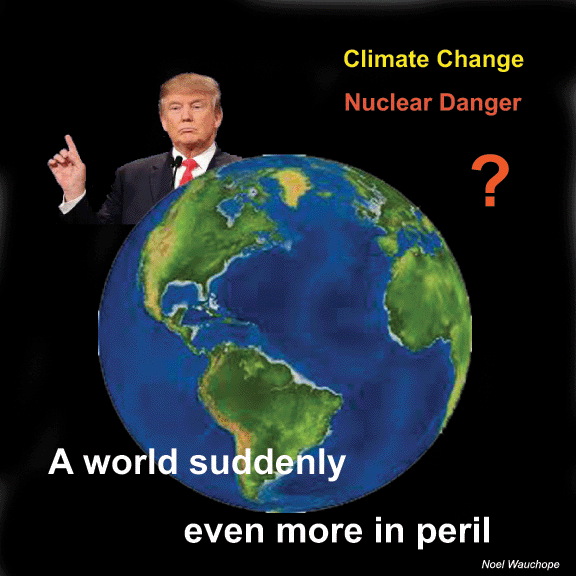
Donald Trump – ” It’s time to scrap the Paris climate accord


Trump, observing French turmoil, suggests end of climate change pact https://www.reuters.com/article/us-usa-trump-france/trump-observing-french-turmoil-suggests-end-of-climate-change-pact-idUSKBN1O70RP, 9 Dec 18WASHINGTON (Reuters) – U.S. President Donald Trump, commenting on the clashes between police and “yellow vest” protesters in Paris, said on Saturday that it may be time to do away with the Paris accord on climate change.

“Very sad day & night in Paris,” the president said in a message issued on Twitter. “Maybe it’s time to end the ridiculous and extremely expensive Paris Agreement and return money back to the people in the form of lower taxes?”

Reporting by David Morgan; Editing by Nick Zieminski

December 10, 2018 Posted by Christina Macpherson | climate change, politics international, USA | 1 Comment

Saudi Arabia, the US, Kuwait and Russia tried to erase meaning of UN’s report on the impacts of 1.5C warming  

Climate science on 1.5C erased at UN talks as US and Saudis step in Climate Home News,  08/12/2018, In a moment of drama in Poland, countries closed ranks against a push by oil producers to water down recognition of the UN’s report on the impacts of 1.5C warming  By Sara Stefanini and Karl Mathiesen

Four big oil and gas producers blocked UN climate talks from welcoming the most influential climate science report in years, as a meeting in Poland descended into acrimony on Saturday.

By failing to reach agreement after two and half hours of emotional negotiations, delegates in Katowice set the scene for a political fight next week over the importance of the UN’s landmark scientific report on the effects of a 1.5C rise in the global temperature.

The battle, halfway through a fortnight of Cop24 negotiations, was over two words: “note” or “welcome”.

Saudi Arabia, the US, Kuwait and Russia said it was enough for the members of the UN climate convention (the UNFCCC) to “note” the findings.

But poor and undeveloped countries, small island states, Europeans and many others called to change the wording to “welcome” the study – noting that they had commissioned it when they reached the Paris climate agreement in 2015.

“This is not a choice between one word and another,” Rueanna Haynes, a delegate for St Kitts and Nevis, told the plenary. “This is us, as the UNFCCC, being in a position to welcome a report that we requested, that we invited [scientists] to prepare. So it seems to me that if there is anything ludicrous about the discussion that is taking place, it is that we in this body are not in a position to welcome the report.”

The four opposing countries argued the change was not necessary. Saudi Arabia threatened to block the entire discussion if others pushed to change the single word – and warned that it would disrupt the last stretch of negotiations between ministers next week.

The aim of the Cop24 climate summit is to agree a dense set of technical rules to underpin the Paris Agreement’s goals for limiting global warming to well below 2C, and ideally 1.5C, by the end of the century.

The scientific report was published by the Intergovernmental Panel on Climate Change (IPCC) in October. It found that limiting global warming to 1.5C, rather than below 2C, could help avoid some of the worst effects of climate change, and potentially save vulnerable regions such as low-lying islands and coastal villages in the Arctic. But it also made clear that the world would have to slash greenhouse gases by about 45% by 2030……….

Financial aid is still contentious issue. The rules on how and what developed countries must report on their past and planned funding, and the extent to which emerging economies are urged to do the same, remains largely up for debate.

In a further moment of drama on Saturday afternoon, Africa stood firm as UN officials tried to finalise a draft of the rules that will govern the deal. Africa’s representative Mohamed Nasr said the continent could not accept the deal as it was presented, forcing the text to be redrafted on the plenary floor.

“You can’t bully Africa, it’s 54 countries,” said one negotiator, watching from the plenary floor.

The change will mean new proposals to be made to the text next week. That would allow African ministers to attempt to strengthen a major climate fund dedicated to helping countries adapt to climate change and push for less strict measures for developing countries.

“We have been voicing our concerns, maybe the co-chairs in their attempt to seek a balanced outcome they overlooked some of the stuff. So we are saying that we are not going to stop the process but we need to make sure that our views are included,” Nasr told CHN.

Mohamed Adow, a campaigner with Christian Aid, said the African intervention had “saved the process” by ensuring that dissatisfied countries could still have their issues heard.

“It’s actually much better than it’s ever been in this process at this stage,” he said. “Because this is the end of the first week and ministers have been provided with clear options. Of course nothing is closed but the options are actually narrower.”

It was a long and emotional plenary meeting to mark the halfway point in a fortnight of negotiations.

Four big oil and gas producers blocked the UN climate talksfrom welcoming the most influential climate science report in years – and met backlash from a broad range of poor, developing and rich countries. The battle was over two words: “note” or “welcome”.

Saudi Arabia, the US, Kuwait and Russia wanted the final statement to merely “note” the UN science report on the effects of 1.5C rise in the global temperature. But a call that started with the alliance of small island states pushed to “welcome” the findings.

The plenary chair’s attempt to find a compromise fell flat, setting the scene for a big political fight when ministers arrive in Katowice next week.

And that wasn’t the only moment of drama on Saturday. Earlier in the day, Africa stood firm as UN officials tried to finalise a draft of the rules that will govern the Paris Agreement. “You can’t bully Africa, it’s 54 countries,” one negotiator said.

The change will mean new proposals could come next week.  http://www.climatechangenews.com/2018/12/08/climate-science-1-5c-erased-un-talks-us-saudis-step/

December 10, 2018 Posted by Christina Macpherson | climate change, Russia, Saudi Arabia, USA | Leave a comment

Idaho closure of nuclear-waste treatment plant to affect Hanford

 https://www.seattletimes.com/seattle-news/u-s-to-shut-down-idaho-nuclear-waste-processing-project/December 8, 2018 With the Idaho treatment  not be economically feasible to bring in radioactive waste from other states.

The U.S. Department of Energy in documents made public this week said the Advanced Mixed Waste Treatment Project that employs 650 workers will end next year.

Officials said workers are wrapping up processing 85,000 cubic yards of radioactive waste at the department’s 890-square-mile site that includes the Idaho National Laboratory.

A $500 million treatment plant handles transuranic waste that includes work clothing, rags, machine parts and tools that have been contaminated with plutonium and other radioactive elements. The U.S. Nuclear Regulatory Commission says transuranic wastes take much longer to decay and are the most radioactive hazard in high-level waste after 1,000 years.

The Energy Department said that before the cleanup began, Idaho had the largest stockpile of transuranic waste of any of the agency’s facilities. Court battles between Idaho and the federal government culminated with a 1995 agreement requiring the Energy Department to clean up the Idaho site.

The Idaho treatment plant compacts the transuranic waste, making it easier to ship and put into long-term storage at the Waste Isolation Pilot Plant in New Mexico.

Federal officials this year floated the idea of keeping the $500 million treatment plant running in Idaho with waste from other states — mostly radioactive waste from the former nuclear weapons production area in Hanford.

With the Idaho treatment plant scheduled to shut down, it’s not clear how the transuranic waste at Hanford and other sites will be dealt with.

The Energy Department “will continue to work to ensure a path forward for packaging and certification of TRU (transuranic) waste at Hanford and other sites,” the agency said in the email to the AP.

Local officials and politicians generally supported the idea because of the good-paying jobs. The Snake River Alliance, an Idaho-based nuclear-watchdog group, said it had concerns the nuclear waste brought to Idaho would never leave.

A 38-page economic analysis the Department of Energy completed in August and released this week found “it does not appear to be cost effective due to packaging and transportation challenges in shipping waste” to Idaho.

“As work at the facility will continue into 2019, no immediate workforce impacts are anticipated,” the agency said in an email to The Associated Press on Friday. The Energy Department “recognizes the contribution of this facility and its employees to DOE’s cleanup mission and looks forward to applying the knowledge gained and experience of the workforce to other key activities at the Idaho site.”

The agency said it would also consider voluntary separation incentives for workers.

December 10, 2018 Posted by Christina Macpherson | USA, wastes | Leave a comment

Public health and safety endangered by weakening The Defense Nuclear Facilities Safety Board (DNFSB)

Nuclear safety groups criticize DOE order https://www.abqjournal.com/author/mhayden, BY MADDY HAYDEN / JOURNAL STAFF WRITER, , December 8th, 2018 SANTA FE, N.M. — Nuclear safety watchdog groups around the country are calling on the Department of Energy to rescind an order they fear will limit the board tasked with overseeing operations at some of the nation’s nuclear facilities and ultimately negatively affect safety at such facilities.

The Defense Nuclear Facilities Safety Board (DNFSB) has itself raised concerns over Order 140.1, “Interface with the Defense Nuclear Facilities Safety Board,” put into place by the DOE in April.

The board held a second public hearing on the order in Washington, D.C., on Nov. 28.

The DNFSB was created by Congress in 1988 to provide oversight and provide information to the public on safety issues at some DOE nuclear facilities.

“We are deeply concerned that Order 140.1 constrains crucial oversight activities of the DNFSB and thereby endangers public health and worker safety,” said Kathy Crandall Robinson of the Alliance for Nuclear Accountability during the late-November hearing.

Chief among the concerns with the order, which the DOE says is aimed at “clarifying” the roles of the department and DNFSB, is language that limits formal DNFSB oversight to issues of public safety as those beyond facility boundaries.

The order, Robinson said, “threatens to send us on a glide path back to a careless era as if this were a time when safety concerns and dangers at nuclear weapons facilities are shrinking.”

“They are not,” she added, citing plans to ramp up plutonium pit production at Los Alamos National Laboratory.

Lydia Dennett of the non-partisan Project on Government Oversight expressed concerns over the reasoning behind the order’s implementation, namely that the decision was possibly driven by government contractors.

“This policy makes it easier for contractors to hide any information they don’t want to come to light,” she said.

The order stipulates the DNFSB may not talk to contractor employees without getting authorization from management and DOE, according to the Alliance for Nuclear Accountability.

The Alliance for Nuclear Accountability represents more than 30 organizations located near DOE and National Nuclear Security Administration sites around the country, including the Albuquerque-based Southwest Research Information Center.

Don Hancock of the Southwest Research and Information Center pointed out in a news release sent by the alliance a 2011 DNFSB report that identified fire hazards at the Waste Isolation Pilot Plant in southeast New Mexico.

Three years later, an underground fire caused the temporary closure of the facility.

Contact the writer.

December 10, 2018 Posted by Christina Macpherson | safety, USA | Leave a comment

USA Energy Dept extends period for public comment on classification of High Level nuclear waste

Public gets more time to consider controversial radioactive waste issue https://www.tri-cityherald.com/news/local/hanford/article222835225.html, BY TRI-CITY HERALD STAFF, December 08, 2018 RICHLAND, WA 

The Department of Energy has agreed to extend the public comment period on its proposal to loosen its interpretation of what it considers high level radioactive waste.

The 60-day public comment period, which was set to end Dec. 10, has been extended until Jan. 9

The extension came at the urging of Sen. Ron Wyden, D-Ore., and 75 organizations across the nation, including Hanford Challenge, Columbia Riverkeeper, Heart of America Northwest and the Natural Resources Defense Council.

Defining less of the nation’s nuclear waste as high level could speed up environmental cleanup at places like the Hanford nuclear reservation and save billions of dollars.

It could give DOE more flexibility on how it deals with some of the 56 million gallons of waste stored in underground tanks.

The Energy Communities Alliance — which includes Hanford Communities, a coalition of local government near the Hanford Site — supports the proposal.

But critics like Hanford Challenge say it also could mean more toxic waste would be allowed to remain in the ground at Hanford.

Comments may be emailed to HLWnotice@em.doe.gov.

December 10, 2018 Posted by Christina Macpherson | USA, wastes | Leave a comment

U.S. preparing to wreck the Strategic Arms Reduction Treaty (START)?

U.S. Preparing Grounds to Scrap Key Nuclear Treaty, Lavrov Says, Bloomberg, By Stepan Kravchenko, December 7, 2018, NATO rejected Russian offer to discuss INF accord, Lavrov says. Huawei official’s arrest shows U.S. ‘arrogance,’ minister says

The U.S. is preparing to wreck the Strategic Arms Reduction Treaty (START), a key accord with Russia on limiting nuclear weapons, Russian Foreign Minister Sergei Lavrov said.

“I have the impression that they are preparing the ground to destroy this document as well,” following the U.S. decision to withdraw from another nuclear accord, the Intermediate-Range Nuclear Forces Treaty, Lavrov told a televised press conference in Milan on Friday after a meeting of OSCE foreign ministers. Russia has repeatedly sent proposals to the U.S. to begin talks on extending the START agreement but has received no response so far, he said.

The New START treaty signed in 2010, which followed on from a 1991 agreement, is due to expire in 2021. Under the accord, Russian and U.S. arsenals are restricted to no more than 1,550 strategic warheads on no more than 700 deployed strategic missiles and bombers. U.S. National Security Adviser John Bolton said during a visit to Moscow in October that Washington “does not have a position that we’re prepared to negotiate” on a new START treaty, adding that there’s “plenty of time” before the deal expires…….https://www.bloomberg.com/news/articles/2018-12-07/u-s-preparing-grounds-to-scrap-key-nuclear-treaty-lavrov-says

December 8, 2018 Posted by Christina Macpherson | politics international, USA, weapons and war | 1 Comment

If USA dumps the Intermediate-Range Nuclear Forces Treaty (INF) – Putin threatens arms race

Putin threatens arms race if US dumps nuclear treaty https://www.theguardian.com/world/2018/dec/05/putin-threatens-arms-race-if-us-dumps-nuclear-treaty – Andrew  Roth in Moscow

Russia would also build new medium-range missiles if the US were to do so, says president

Vladimir Putin has threatened that Russia will develop new missiles banned by the intermediate-range nuclear forces treaty if the US exits the pact and pursues an arms buildup of its own.

The Russian president’s remarks came one day after the US secretary of state, Mike Pompeo, said Moscow was in “material breach” of the cold war-era treaty and issued a 60-day ultimatum for Russia to correct the alleged violations. Otherwise, he said, the US would quit the 1987 accord, considered a milestone in reducing the threat of a nuclear war in Europe.

In Moscow on Wednesday, Putin told journalists the US had provided “no evidence” of Russian violations, and threatened an arms race if the US sought to develop new medium-range missiles after exiting the treaty.

“Apparently, our American partners believe that the situation has changed so drastically that the US should also have such weapons,” Putin said in remarks carried by the Interfax news service. “What response is our side to give? A simple one: then we’ll do the same.”

The arms treaty, signed by Ronald Reagan and Mikhail Gorbachev, banned ground-launched missiles with a range between 500-5,500km. The US and Nato have said that tests of a new Russian cruise missile, designated 9M729, violate the treaty.

The US effort to exit the treaty was spearheaded by John Bolton, Donald Trump’s hawkish national security adviser.

According to a leaked memo published by the Washington Post, Bolton has ordered the Pentagon to “develop and deploy ground-launched missiles at the earliest possible date”.

While it would take a substantial length of time to develop an entirely new missile, existing medium-range weapons in the US arsenal, such as sea-launched Tomahawk cruise missiles, could be adapted for ground launch more quickly, arms experts said.

However, Nato allies would have to agree unanimously to have any new missile deployed in Europe.

The standoff comes amid a buildup of Russian and Nato forces in Europe, including nuclear forces. Nato claims that Russia has deployed nuclear-capable missiles to Kaliningrad, and on Wednesday the Russian military confirmed it had deployed powerful new anti-ship missiles to Crimea following last month’s maritime clash with Ukraine.

December 6, 2018 Posted by Christina Macpherson | politics international, Russia, USA, weapons and war | Leave a comment

Witness: Flynn said Russia sanctions would be ‘ripped up’

By Tom Hamburger / The Washington Post

Posted at 9:33 PM Updated at 9:33 PM

WASHINGTON — As President Donald Trump delivered his inaugural address on the steps of the U.S. Capitol in January, his new national security adviser, Michael Flynn, sent a text to a former business associate telling him that a plan to build nuclear power plants in the Middle East in partnership with Russian interests was “good to go,” according to a witness who spoke with congressional investigators.

Flynn had assured his former associate that U.S. sanctions against Russia would immediately be “ripped up” by the Trump administration, a move that would help facilitate the deal, the associate told the witness.

The witness provided the account to Rep. Elijah Cummings of Maryland, the ranking Democrat on the House Oversight and Government Reform Committee, who detailed the allegations in a letter Wednesday to the panel’s chairman, Rep. Trey Gowdy, Republican of South Carolina.

Cummings did not identify the witness, whom he described as a whistleblower. But he asked Gowdy to issue a subpoena to the White House for documents related to Flynn, saying the committee has “credible allegations” that Flynn “sought to manipulate the course of international nuclear policy for the financial gain of his former business partners.”

Robert Kelner, an attorney representing Flynn, declined to comment. White House lawyer Ty Cobb said, “I respectfully decline to comment on anonymous information which impacts the special counsel investigation.” He was referring to the ongoing inquiry on Russian interference in the 2016 presidential campaign.

http://www.providencejournal.com/news/20171206/witness-flynn-said-russia-sanctions-would-be-ripped-up

December 4, 2018 Posted by arclight2011part2 | secrets,lies and civil liberties, USA | Leave a comment

Dark money, so-called “independent” Nuclear Matters, Georgia’s Public Service Commission and regulatory capture

The fight over a Georgia nuclear plant shows we need to ban dark money https://www.theguardian.com/commentisfree/2018/dec/03/the-fight-over-a-georgia-nuclear-plant-shows-we-need-to-ban-dark-money, Jon Ossoff

More than $1m of industry funding is being funnelled into a runoff election to decide who pays for a power company’s botched project – shareholders or the people?

This is a convoluted tale of secret corporate money in politics, the capture of regulators by those they are meant to regulate, incompetence, and greed.

We learned this week that more than $1m in dark money – secretly sourced political spending – is pouring into Tuesday’s runoff election for Georgia’s Public Service Commission (PSC).

The PSC is powerful; by setting rates it determines how much Georgians pay for electricity each month, and among its mandates is to safeguard the public interest by regulating Georgia’s energy industry.

But PSC elections have tended to fly under the radar, and they’ve long been dominated by candidates vetted and approved by Georgia Power – Georgia’s monopoly energy company – and its owner, the Southern Company.

So what’s with all the dark money this time around?

There are four key players in this drama: the Southern Company, which owns Georgia Power; a political committee called “Georgians for a Better Future”; a lobbying group called Nuclear Matters; and a powerful trade group called the Nuclear Energy Institute.

Spending these unprecedented sums in support of the incumbent Republican commissioner, Chuck Eaton, is “Georgians for a Brighter Future”, established just weeks ago for the specific purpose of intervention in our PSC runoff, in which Eaton faces a vigorous challenge from the Democratic rising star Lindy Miller.

Just three weeks into its existence, “Georgians for a Brighter Future” has been lavishly and swiftly funded for this mission by Nuclear Matters, the Washington-based “non-profit” that lobbies for the nuclear energy industry.

Thanks to America’s corrupted campaign finance laws, Nuclear Matters’ funders are secret. But the likely sponsors are not hard to establish. Nuclear Matters itself is an arm of the Nuclear Energy Institute, the nationwide nuclear industry’s trade association (we used to call them cartels), funded in part by the Southern Company.

Georgia Power’s CEO, Paul Bowers, is on Nuclear Matters’ board of directors. Former Georgia PSC chairman and diligent industry servant Stan Wise sits on its “advocacy council”. So does University of Georgia professor David Gattie, who provides consistent academic cover for Georgia Power’s business agenda and has not to my knowledge disclosed whether he receives industry funding.

Wise, according to reporting in The Atlanta Journal-Constitution, “resigned [from the PSC] earlier this year but hung on to his post long enough to join Eaton and three other members in green-lighting Georgia Power’s plan to continue construction on two new nuclear reactors at Plant Vogtle, a project now running five years behind schedule with billions of dollars in cost overruns.”

Here the purpose of this dark money assault on Georgia voters becomes clearer.

Plant Vogtle is Georgia Power’s – and therefore the Southern Company’s – nuclear power station in eastern Georgia. In 2013 the Southern Company began construction of two new reactors at Vogtle, backed by $8.3bn in federal loan guarantees.

Then the Southern Company proceeded to botch the project. Now years behind schedule and billions over budget, we face a classic political dilemma: who will pay? Georgia Power, the Southern Company, and their shareholders? Or Georgia Power’s customers – the people?

Not surprisingly, the Southern Company is determined that Georgia’s energy consumers – “ratepayers” – should pay for billions in cost overruns. Under our country’s perverse rules of corporate governance, this is, I suppose, rational. The alternative is that their shareholders and executives take a haircut.

Enter Democrat Lindy Miller, the first-time candidate, who fought her way against the odds into this runoff. Miller is no opponent of nuclear energy and she supports continued construction of Plant Vogtle to deliver cheap energy to Georgia without massive greenhouse gas emissions. She just doesn’t think Georgia ratepayers should pay for the Southern Company’s gross failure to meet a budget or a schedule.

It seems that’s just not acceptable to the Southern Company. As with the investment bankers and rating agencies who were bailed out despite their responsibility for the 2008 financial crisis, the Southern Company wants the public to bear the cost of its malpractice.

So we see this massive, 11th-hour political intervention in support of Eaton, the Southern Company’s chosen candidate. Why? Because he will reliably vote to saddle Georgia’s teachers, firefighters, veterans, retirees and working families with higher energy bills to bail out his powerful benefactors.

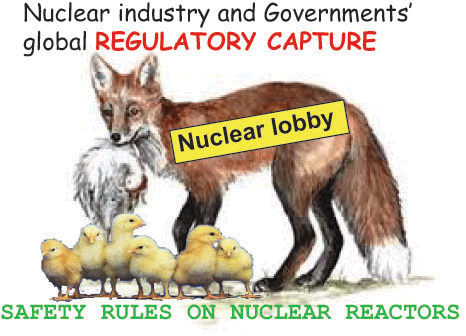
This story presents a microcosm of much that is wrong with American politics. The Southern Company’s dominance of Georgia’s PSC is what policy nerds call “regulatory capture”. With a relatively modest investment of millions, this multibillion-dollar industry is attempting to buy a seat on the public body that regulates it, even though Georgia law nominally forbids regulated entities from funding candidates for regulatory offices.

This money, like so much political spending, is laundered through a series of lobby groups and “non-profits” to obscure its origins and the agenda behind it. Dark money political spending, which is meant to mislead the public and serves only the interests of concentrated corporate power, should be banned by Congress and state legislatures.

It’s worth recalling that the Southern Company in its present form was born of trust-busting action ordered by the United States Congress. In 1947, its parent company, Commonwealth & Southern Energy, was dissolved by the Securities and Exchange Commission under the anti-trust authority of the Public Utility Holding Company Act. So the Southern Company as we know it now was born, ironically, of anti-trust action.

Fast-forward 71 years. Unrestrained corporate consolidation is once again crushing consumers and competitors in nearly every major sector of the US economy, while behemoth firms and trade groups wield virtually limitless political power. The Southern Company, the monopoly power giant, would force citizens to subsidize its own inefficiency, and they’re using their financial and political muscle to buy this seat on the PSC and evade financial responsibility.

There are good arguments for scale in energy production. But perhaps it’s time to revisit the anti-trust victories of the early 20th century.

And ban dark money now.

December 4, 2018 Posted by Christina Macpherson | secrets,lies and civil liberties, USA | Leave a comment

Link between 1979 Three Mile Island nuclear accident and thyroid cancer cases

New PSU study links 1979 TMI accident to thyroid cancer

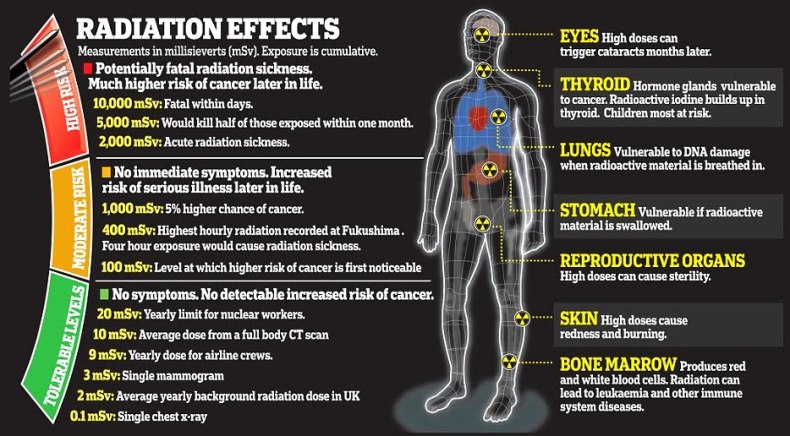
Brett Sholtis, bsholtis@ydr.com York Daily Record,   June 12, 2017 A new Penn State College of Medicine study has found a link between the 1979 Three Mile Island accident and thyroid cancer cases in southcentral Pennsylvania.

The study marks the first time the partial meltdown can be connected to specific cancer cases, the researchers have said.

The findings may pose a dramatic challenge to the nuclear energy industry’s position that radiation released had no impact on human health.

The study was published Monday in the medical journal Laryngoscope, one day before Exelon Corp. announced that Three Mile Island would close in 2019. It’s likely to come as another blow to a nuclear power industry already struggling to stay profitable.

Exelon officials declined to comment on the findings, pointing out that it doesn’t own the damaged reactor and wasn’t running the plant during the accident…….

thyroid cancer caused by low-level radiation has a different “mutational signal” than most thyroid cancer, Goldenberg said. He and his colleagues used molecular research that had been pioneered after the Chernobyl nuclear disaster to find that genetic signal. …..

The next step is to expand the study by tapping into resources from other regional hospitals, he said.

The study contradicts conclusions about Three Mile Island held by many nuclear energy proponents, including the Nuclear Regulatory Commission. …… https://www.ydr.com/story/news/2017/05/31/psu-study-links-1979-tmi-accident-thyroid-cancer/358027001/

December 4, 2018 Posted by Christina Macpherson | health, USA | Leave a comment

What will ratepayers have to pay to resolve fight over failed V.C. Summer nuclear project?

Dominion wants a deal to end the SC nuclear fight. Here’s what it could cost ratepayers. By Andrew Brown abrown@postandcourier.com, Dec 3, 2018   COLUMBIA — For 15 days, South Carolina’s utility regulators reviewed testimony and sorted through mountains of evidence on the failed V.C. Summer nuclear project in order to decide how much S.C. Electric & Gas customers should pay for two unfinished reactors.

But as the high-stakes hearing wrapped up last week, the utility regulators were asked to consider one more thing.

Dominion Energy wanted the commissioners to review a new offer that would allow the Virginia-based energy company to seal its proposed takeover of SCE&G’s parent, SCANA Corp. It was the third plan Dominion pitched to regulators.

  • Less than four days later, SCANA announced another deal — this time with several law firms that were suing the company in a class action lawsuit on behalf of SCE&G ratepayers. That legal settlement threw support behind Dominion’s plans in the state Public Service Commission and is contingent upon the regulators giving the utilities what they want.
  • With a decision from regulators due by Dec. 21, here’s some explanation of what this dual settlement offer could mean for ratepayers, who have already dumped more than $2 billion into the abandoned nuclear project and who face paying more in the future.
  • What does Dominion’s latest offer in the Public Service Commission include? 
  • The initial plan from Dominion called for the average SCE&G ratepayer to receive a roughly $1,000 refund check but required customers to pay another $3.8 billion for the reactors.
  • Dominion has since offered to do away with the refund checks if the utility commissioners don’t like the idea. Instead, the company offered to further reduce how much customers pay for the abandoned reactors moving forward.
  • Under the more recent plan, residential and business ratepayers would be required to pay another $2.3 billion for the reactors over the next two decades. ………
  • What other plans are the state’s utility regulators considering? 
  • The Office of Regulatory Staff is sticking to its plan. Customers will still have to pay for the reactors moving forward, due to the 2007 state law that allowed SCE&G to charge customers in advance for the project.
  • But under the utility watchdog’s plan, the average residential ratepayers would kick in a little more than $5 per month for the failed project.
  • Overall, all SCE&G’s customers will pay back $1.7 billion over the next two decades under that plan, according to the Office of Regulatory Staff. ……..
  • What does the new settlement in the class action lawsuit do? 
  • The press release announcing the pending legal settlement mentioned $2 billion in rate relief for SCE&G customers. But that money was already part of the deal that Dominion put forward in the Public Service Commission.
  • In reality, SCANA and the trial attorneys representing SCE&G ratepayers plan to settle the high-stakes case for $115 million, which matches the money set aside in golden parachutes for SCANA executives let go after the Dominion sale, and whatever money can be made from the sale of several SCANA properties, including an office in downtown Charleston.
  • ………… https://www.postandcourier.com/business/dominion-wants-a-deal-to-end-the-sc-nuclear-fight/article_93463a28-f3e5-11e8-b9bd-9b4df318cd08.html

December 4, 2018 Posted by Christina Macpherson | business and costs, USA | Leave a comment

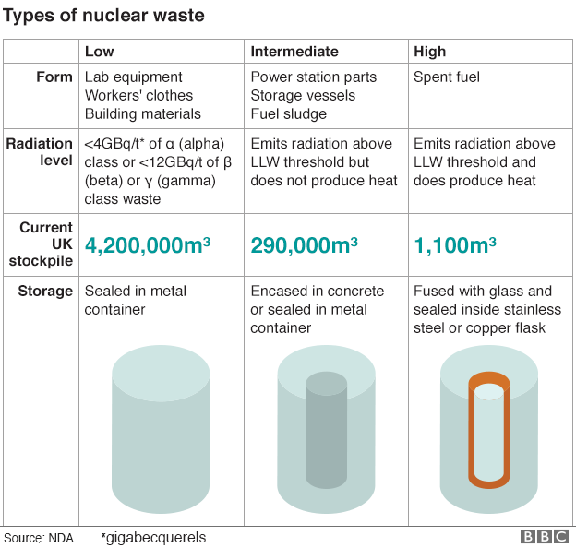
Massive problem of USA’s high level nuclear waste – scientists struggling for a solution

US nuclear waste dump capacity a challenge https://www.news.com.au/world/breaking-news/us-nuclear-waste-dump-capacity-a-challenge/news-story/69f13410922c5570e187c9e529a54ffd

If the plan were to be approved, the US Energy Department has estimated that it would take 31 years to dilute and dispose of the of weapons-grade plutonium.

The lack of space at the US government’s only underground nuclear waste repository is among several challenges identified by a group of scientists and other experts who are looking at the viability of disposing of weapons-grade plutonium at the desert location.

The National Academies of Sciences, Engineering, and Medicine released a preliminary report on the US government’s plan, which calls for diluting 34 metric tons of plutonium and shipping it to the Waste Isolation Pilot Plant in southern New Mexico.

The purpose of the work would be to satisfy a nonproliferation agreement with Russia.

Another challenge, the scientists say, would be getting officials in that country to approve of the dilution of the materials.

The pact between the two countries was initially based on a proposal for turning the surplus plutonium into fuel that could be used for commercial nuclear reactors. That project, beset by years of delays and cost overruns, was cancelled earlier this year.

The review of the plan that calls for shipping the plutonium to New Mexico was requested by Congress. A final report from the National Academies is expected mid 2019.

The US Energy Department’s Office of Environmental Management has demonstrated that diluting the plutonium is possible by working with a separate batch of material. However, citing a lack of information, the scientists did not study the agency’s ability to scale up that process to handle the 34 metric tons that are part of the nonproliferation agreement.

If the plan were to be approved, the Energy Department has estimated that it would take 31 years to dilute and dispose of all 34 metric tons.

The work would involve four sites around the US – the Pantex Plant in West Texas, the Savannah River Site in South Carolina, Los Alamos National Laboratory in northern New Mexico and the Waste Isolation Pilot Plant.

The panel of scientists found that the agency doesn’t have a well-developed plan for reaching out to those host sites and stressed that public trust would have to be developed and maintained over the life of the project.


December 3, 2018 Posted by Christina Macpherson | USA, wastes | Leave a comment

Delay in compensation for NUCLEAR LAB EMPLOYEES WITH RADIATION-LINKED CANCERS

NUCLEAR LAB EMPLOYEES WITH RADIATION-LINKED CANCERS HAVE BEEN FORCED TO WAIT YEARS FOR POTENTIAL BENEFITS  At the Los Alamos National Laboratory in New Mexico, workers are still waiting for answers about who is liable for sicknesses they say were caused by radiation from the lab. REBECCA MOSS PACIFIC STANDARD, Nov 30, 2018 

Ten years ago, a security guard at Los Alamos National Laboratory submitted a petition to the federal government seeking compensation and benefits for his fellow lab workers who were sick with cancer and believed that radiation at the lab was to blame.

Andrew Evaskovich’s petition took advantage of a process put in place by Congress in 2000 that allowed groups of workers to secure benefits if they could show that they worked at a nuclear facility, that they had a cancer linked to radiation, and that lab managers failed to accurately keep track of their exposures over time.

Under the law, the National Institute for Occupational Safety and Health, a federal agency that makes recommendations on work-related injuries and illnesses, had six months to review Evaskovich’s petition and recommend whether it should be approved or denied.

A decade later, Evaskovich and his colleagues are still waiting for a final answer. Continue reading →

December 3, 2018 Posted by Christina Macpherson | employment, USA | Leave a comment

« Previous Entries     Next Entries »

1 This Month

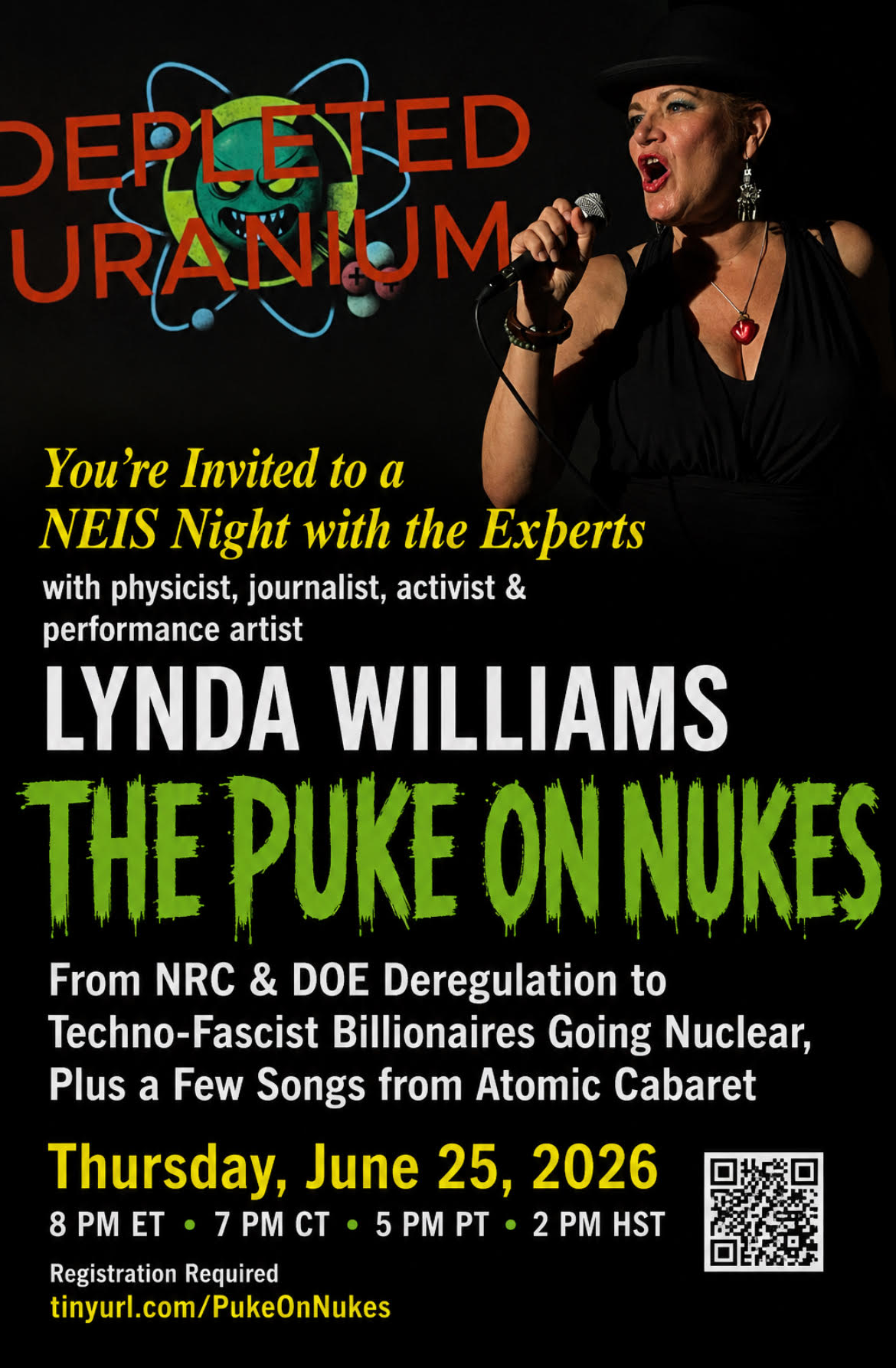
25 June- THE PUKE ON NUKES

Thursday, June 25, 2026

7pm Central Time (8pm ET, 6pm MT, 5pm PT) UTC – 5
From NRC & DOE Deregulation to Techno-Fascist Billionaires Going Nuclear, Plus a Few Songs from Atomic Cabaret REGISTER

26 June –  Radiation Trainwreck at the NRC / Join the Protect Better Campaign – https://us02web.zoom.us/meeting/register/4ZlZ5_qLSHGiLSCg8FF6Bg#/registration

1st July – Webinar Waste of Space: The Environmental Harm of Military and Civil Space Activity  st July, 7 pm

Report Launch Online: We are seeing an increasing exploitation of space for military and commercial purposes. This must change.

Protect Sazan Island from the Trump family! https://secure.avaaz.org/campaign/en/protect_sazan_island_from_the_trump_family_loc/?bqFCVab&v=174511&cl=22707147157&_checksum=5e9dde668860e8231c33699735e16a1fbf22ab2cb01da50c999fe8732b9775ef&utm_source=email&utm_medium=blast_email&utm_campaign=174511

Cuba Is Not a Failed State – It Is a Besieged State

PETITION: “Global Appeal to Endorse Palestinian Right of Return of Refugees” 

​To see nuclear-related stories in greater depth and intensity – go to https://nuclearinformation.wordpress.com

  • Categories

    • 1
      • Arclight's Vision
    • 1 NUCLEAR ISSUES
      • business and costs
        • employment
        • marketing
      • climate change
      • culture and arts
      • ENERGY
        • renewable
          • decentralised
          • energy storage
      • environment
        • oceans
        • water
      • health
        • children
        • psychology – mental health
        • radiation
        • social effects
        • women
      • history
      • indigenous issues
      • Legal
        • deaths by radiation
        • legal
      • marketing of nuclear
      • media
        • investigative journalism
        • Wikileaks
      • opposition to nuclear
      • PERSONAL STORIES
      • politics
        • psychology and culture
          • Trump – personality
        • public opinion
        • USA election 2024
        • USA elections 2016
      • politics international
      • Religion and ethics
      • safety
        • incidents
      • secrets,lies and civil liberties
        • civil liberties
      • spinbuster
        • Education
      • technology
        • reprocessing
        • Small Modular Nuclear Reactors
        • space travel
      • Uranium
      • wastes
        • – plutonium
        • decommission reactor
      • weapons and war
        • Atrocities
        • depleted uranium
      • Women
    • 2 WORLD
      • ANTARCTICA
      • ARCTIC
      • ASIA
        • Burma
        • China
        • India
        • Indonesia
        • Japan
          • – Fukushima 2011
          • Fukushima 2012
          • Fukushima 2013
          • Fukushima 2014
          • Fukushima 2015
          • Fukushima 2016
          • Fukushima continuing
        • Malaysia
        • Mongolia
        • North Korea
        • Pakistan
        • South Korea
        • Taiwan
        • Turkey
        • Vietnam
      • EUROPE
        • Belarus
        • Bulgaria
        • Denmark
        • Finland
        • France
        • Germany
        • Greece
        • Ireland
        • Italy
        • Kazakhstan
        • Kyrgyzstan
        • Russia
        • Spain
        • Sweden
        • Switzerland
        • UK
        • Ukraine
      • MIDDLE EAST
        • Afghanistan
        • Egypt
        • Gaza
        • Iran
        • Iraq
        • Israel
        • Jordan
        • Libya
        • Saudi Arabia
        • Syria
        • Turkey
        • United Arab Emirates
      • NORTH AMERICA
        • Canada
        • USA
          • election USA 2020
      • OCEANIA
        • New Zealand
        • Philippines
      • SOUTH AMERICA
        • Brazil
    • ACTION
    • AFRICA
      • Kenya
      • Malawi
      • Mali
      • Namibia
      • Niger
      • Nigeria
      • Somalia
      • South Africa
    • Atrocities
    • AUSTRALIA
    • Christina's notes
    • Christina's themes
    • culture and arts
    • Events
    • Fuk 2022
    • Fuk 2023
    • Fukushima 2017
    • Fukushima 2018
    • fukushima 2019
    • Fukushima 2020
    • Fukushima 2021
    • general
    • global warming
    • Humour (God we need it)
    • Nuclear
    • RARE EARTHS
      • thorium
    • Reference
      • Reference archives
    • resources – print
    • Resources -audiovicual
    • Weekly Newsletter
    • World
    • World Nuclear
    • YouTube
  • Pages

    • 1 This Month
    • ACTION !
    • Disclaimer
    • Links
    • PAGES on NUCLEAR ISSUES
      • audio-visual news
      • Anti Nuclear, Clean Energy Movement
        • Anti Nuclear movement – a success story
          • – 2013 – the struggle for a nuclear-free, liveable world
          • – 2013: the battle to expose nuclear lies about ionising radiation
            • Speakers at Fukushima Symposium March 2013
            • Symposium 2013 Ian Fairlie
      • Civil Liberties
        • – Civil liberties – China and USA
      • Climate change
      • Climate Change
      • Economics
        • – Employment
        • – Marketing nuclear power
        • – Marketing Nuclear Power Internationally
        • nuclear ‘renaissance’?
        • Nuclear energy – the sick man of the corporate world
      • Energy
        • – Solar energy
      • Environment
        • – Nuclear Power and the Tragedy of the Commons
        • – Water
      • Health
        • Birth Defects in the Chernobyl Radiation Affected Region.
      • History
        • Nuclear History – the forgotten disasters
      • Indigenous issues
      • Ionising radiation
        • – Ionising radiation – medical
        • Fukushima FACT SHEET
      • Media
        • Nuclear Power and Media 2012
      • Nuclear Power and the Consumer Society – theme for December 2012
      • Peace and nuclear disarmament
        • Peace on a Nuclear Free Earth
      • Politics
        • – Politics USA
      • Public opinion
      • Religion and ethics
        • -Ethics of nuclear power
      • Resources – print
      • Safety
      • Secrets and lies
        • – NUCLEAR LIES – theme for January 2012
        • – Nuclear Secrets and Lies
      • Spinbuster
        • 2013 nuclear spin – all about FEAR -theme for June
        • Spinbuster 1
      • Technology
        • TECHNOLOGY Challenges
      • Wastes
        • NUCLEAR WASTES – theme for October 2012
        • – Plutonium
      • Weapons and war
      • Women
  • Archives

    • June 2026 (230)
    • May 2026 (306)
    • April 2026 (356)
    • March 2026 (251)
    • February 2026 (268)
    • January 2026 (308)
    • December 2025 (358)
    • November 2025 (359)
    • October 2025 (376)
    • September 2025 (257)
    • August 2025 (319)
    • July 2025 (230)
  • Categories

    • 1
      • Arclight's Vision
    • 1 NUCLEAR ISSUES
      • business and costs
        • employment
        • marketing
      • climate change
      • culture and arts
      • ENERGY
        • renewable
          • decentralised
          • energy storage
      • environment
        • oceans
        • water
      • health
        • children
        • psychology – mental health
        • radiation
        • social effects
        • women
      • history
      • indigenous issues
      • Legal
        • deaths by radiation
        • legal
      • marketing of nuclear
      • media
        • investigative journalism
        • Wikileaks
      • opposition to nuclear
      • PERSONAL STORIES
      • politics
        • psychology and culture
          • Trump – personality
        • public opinion
        • USA election 2024
        • USA elections 2016
      • politics international
      • Religion and ethics
      • safety
        • incidents
      • secrets,lies and civil liberties
        • civil liberties
      • spinbuster
        • Education
      • technology
        • reprocessing
        • Small Modular Nuclear Reactors
        • space travel
      • Uranium
      • wastes
        • – plutonium
        • decommission reactor
      • weapons and war
        • Atrocities
        • depleted uranium
      • Women
    • 2 WORLD
      • ANTARCTICA
      • ARCTIC
      • ASIA
        • Burma
        • China
        • India
        • Indonesia
        • Japan
          • – Fukushima 2011
          • Fukushima 2012
          • Fukushima 2013
          • Fukushima 2014
          • Fukushima 2015
          • Fukushima 2016
          • Fukushima continuing
        • Malaysia
        • Mongolia
        • North Korea
        • Pakistan
        • South Korea
        • Taiwan
        • Turkey
        • Vietnam
      • EUROPE
        • Belarus
        • Bulgaria
        • Denmark
        • Finland
        • France
        • Germany
        • Greece
        • Ireland
        • Italy
        • Kazakhstan
        • Kyrgyzstan
        • Russia
        • Spain
        • Sweden
        • Switzerland
        • UK
        • Ukraine
      • MIDDLE EAST
        • Afghanistan
        • Egypt
        • Gaza
        • Iran
        • Iraq
        • Israel
        • Jordan
        • Libya
        • Saudi Arabia
        • Syria
        • Turkey
        • United Arab Emirates
      • NORTH AMERICA
        • Canada
        • USA
          • election USA 2020
      • OCEANIA
        • New Zealand
        • Philippines
      • SOUTH AMERICA
        • Brazil
    • ACTION
    • AFRICA
      • Kenya
      • Malawi
      • Mali
      • Namibia
      • Niger
      • Nigeria
      • Somalia
      • South Africa
    • Atrocities
    • AUSTRALIA
    • Christina's notes
    • Christina's themes
    • culture and arts
    • Events
    • Fuk 2022
    • Fuk 2023
    • Fukushima 2017
    • Fukushima 2018
    • fukushima 2019
    • Fukushima 2020
    • Fukushima 2021
    • general
    • global warming
    • Humour (God we need it)
    • Nuclear
    • RARE EARTHS
      • thorium
    • Reference
      • Reference archives
    • resources – print
    • Resources -audiovicual
    • Weekly Newsletter
    • World
    • World Nuclear
    • YouTube
  • RSS

    Entries RSS
    Comments RSS

Site info

nuclear-news
Create a free website or blog at WordPress.com.
Privacy & Cookies: This site uses cookies. By continuing to use this website, you agree to their use.
To find out more, including how to control cookies, see here: Cookie Policy
  • Subscribe Subscribed
    • nuclear-news
    • Join 2,102 other subscribers
    • Already have a WordPress.com account? Log in now.
    • nuclear-news
    • Subscribe Subscribed
    • Sign up
    • Log in
    • Report this content
    • View site in Reader
    • Manage subscriptions
    • Collapse this bar

Loading Comments...