
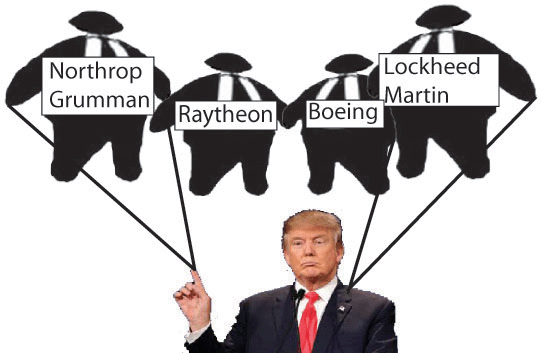
What It Would Cost to Modernize the U.S. Nuclear Arsenal — and Who Would Benefit, Yahoo Finance Lou Whiteman, The Motley Fool, Motley Fool, January 28, 2019 The United States would have to spend $494 billion over the next decade to enact its plan to modernize its nuclear arsenal, a figure that highlights the opportunity before contractors as the Pentagon seeks ways to pay for one of its top priorities. The total, which comes from a biannual report put out by the Congressional Budget Office (CBO), is 23% higher than the $400 billion price tag in the 2017 estimate. It comes at a delicate time for the Pentagon, which, after enjoying two years of steady budget increases, is facing a much less certain fiscal 2020 allocation.
……..Here’s who stands to benefit from the push to renew the nuclear triad.
Next-generation bombers
 Northrop Grumman (NYSE: NOC) in late 2015 beat a team including Boeing (NYSE: BA) and Lockheed Martin to design and build a new long-range bomber. The Pentagon is expected to purchase at least 100 aircraft, with deliveries expected to begin in the mid-2020s and extend for a decade.
The plane, now known as the B-21, has been a near-casualty of Congressional budget battles in recent years, but the Pentagon continues to spend upwards of $2 billion per year on development. Overall, the CBO expects the Pentagon to spend $49 billion on bomber acquisition between now and 2028, which would easily make the B-21 Northrop’s most important platform……….
America’s most important deterrent
The Columbia-class submarine, designed to take over for the Ohio-class ballistic missile sub and house the nation’s stockpile of Trident sub-launched ballistic missiles, features a stealth electric drive propulsion system and improved maneuverability. The sub, to be built by General Dynamics’ (NYSE: GD) Electric Boat subsidiary with support from Huntington Ingalls (NYSE: HII), is due to be operational by 2028 to ensure second-strike capability should the U.S. be hit by a catastrophic attack………
A new rocket competition
The only major piece of the triad renewal still up for grabs is the task of replacing the nation’s arsenal of intercontinental ballistic missiles. …….In August 2017, the Air Force awarded Boeing and Northrop Grumman $349 million and $329 million, respectively, to develop competing new designs, with a goal of selecting a winner next year. The government is expected to spend more than $60 billion on ICBMs over the next decade, meaning the award would be a needle-mover for the eventual winner.
The stakes are also high for the two potential manufacturers of the solid-propellant rocket engines that will be used to power the missiles. Northrop brought one of the two contenders in-house last year with its $9.2 billion deal for Orbital ATK. The other, Aerojet Rocketdyne (NYSE: AJRD), has warned the Air Force and lawmakers it needs to win at least part of this procurement to remain a viable supplier.
Given the Pentagon’s priority to nurture a healthy and competitive supply base, it would not be a surprise to see both Aerojet and the former Orbital business split the ICBM engine award.
How to invest
January 29, 2019
Posted by Christina Macpherson |
business and costs, USA, weapons and war |
1 Comment
Hampton Sides, author of a new book about a turning point in the Korea war, explores the state of the Koreas and Trump’s forthcoming visit. Interview, Bloomberg, By Tobin Harshaw, January 28, 2019,
“……It is a cliche that the so-called police action in Korea from 1950 to 1952 is America’s “forgotten war.” But, like most cliches, there is a lot of truth to it. American ignorance about the Korean War is a shame, and not only because it devalues the sacrifices of those who fought in it. With North Korea’s nuclear arsenal now threatening the U.S. mainland (not to mention Hawaii, Japan and the folks on the southern end of the peninsula), and President Donald Trump and Kim Jong Un set to meet again next month, a little historical perspective might be helpful.
………. HS: Be mindful of the fact that North Korea’s fear and loathing of the U.S., however warped it seems, does have legitimate historical roots. During the Korean War, the U.S. bombed that country back to the Stone Age: Every building, every bridge, every village. The stated goal was to not leave a single brick standing upon another brick. That air campaign was gratuitous and cruel. We killed hundreds of thousands of civilians. We’re a country that has a habit of bombing people and then wondering why those people hate us. As we parse the madness that is the Kim regime, we should always keep in mind that this underlying history of “terror from above” figures into that madness.
Kim strikes many as a lunatic, but his nuclear strategy has actually been quite rational and effective in achieving his goals. So coaxing him to give up his nukes will take some extremely creative and forceful negotiating. The Hermit Kingdom desperately needs many, many things from the outside world — food, medicines, capital, technology, expertise and so on, and Kim knows this. A big question is whether he would really allow his own people to benefit in any meaningful way from the flow of goods and amenities that a removal of sanctions would usher in. Another question is whether he’d actually allow outside experts to come in and closely monitor his regime’s nuclear compliance. Caveats aside, we can only hope the talks continue. I’m highly skeptical of Trump’s much-avowed skills as a deal-maker, but a deal is certainly in the interest of the whole wide world.
……….. HS: It was repeatedly said during the 2016 campaign that Douglas MacArthur is Trump’s “favorite general.” I don’t get the sense that Trump reads history — or anything else, for that matter — but it’s a telling detail. Because with Douglas MacArthur you had a grandiose and vainglorious autocrat who had surrounded himself with sycophants and yes-men. He was a colorful and interesting character — in narrative terms, a gift that keeps on giving. But he was a thoroughgoing narcissist. It was said that he didn’t have a staff; he had a court. He didn’t want to hear inconvenient information. He didn’t like experts — he was the expert. He was in love with the vertical pronoun. It was all about him.This sounds extremely familiar to me.
………. Of course, Korea should never have been divided in the first place — drawing that line created one of the great geopolitical tragedies of modern times. Many thousands of families were torn apart and never allowed to see each other again. Historically speaking, there’s no difference between northern and southern Korea. It’s one country, one language, one culture, one people.
Or at least it was. After more than 70 years of living apart, a reunification, if by some miracle it ever happened, would be a wrenching and doubtless violent process. It’s not clear how a brainwashed and traumatized people from an impoverished police state integrates into the dynamic capitalist society that is modern South Korea. Still, I believe it’s destined to happen one day.https://www.bloomberg.com/opinion/articles/2019-01-27/korean-war-in-current-events-from-the-1950s-to-a-nuclear-north
January 29, 2019
Posted by Christina Macpherson |
history, North Korea, politics international, USA |
Leave a comment

US to Offer Nuclear Waste Technology to Other Countries https://learningenglish.voanews.com/a/us-to-offer-nuclear-waste-technology-to-other-countries/4758652.html Susan Shand. The U.S. Department of Energy’s nuclear security office is developing a project to help other countries deal with nuclear waste. The information comes from two
sources who spoke to the Reuters news agency. They asked not to be named because of the sensitivity of the issue.The sources say the plan aims to keep the United States competitive against other countries that are developing their own waste technology. For example, both Russia and France offer services to take care of nuclear waste.
Dov Schwartz is the spokesman for the National Nuclear Security Administration. He confirmed the group is thinking about how to help other countries reduce nuclear waste. However, Schwartz did not give details.
The NNSA also declined a Reuters request for an interview with Brent Park, who is leading the effort.
What would the technology do?
The unnamed sources say the technology could involve crushing, heating or sending an electric current through nuclear waste to reduce its size.
The machinery to do so would be put in a “black box” the size of a shipping container. It would be sent to other countries with nuclear energy programs; however, it would remain owned and operated by the United States, the sources said.
The sources did not name countries to which the service would be offered. They also did not say where the waste would be stored after it is run through the equipment. But they said they were worried the processes could increase the risk of dangerous materials reaching militant groups or nations unfriendly to the United States.
Former U.S. President Jimmy Carter banned nuclear waste reprocessing in 1977. The reprocessing opens pure amounts of uranium and plutonium, both of which could be used to make nuclear bombs.
NNSA spokesperson Dov Schwartz said the plans under consideration do not involve reprocessing. But he did not say what technologies could be used.
Concerns
The government of U.S. President Donald Trump has made promoting nuclear technology abroad a high priority. The U.S. Energy Secretary, Rick Perry, visited Saudi Arabia this month for talks on a nuclear energy deal with the kingdom. And the American business Westinghouse hopes to sell nuclear power technology to countries from Saudi Arabia to India.
But a top arms control officer during the Obama administration questions the direction of the Trump government. Thomas Countryman said the U.S. should improve its ability to get rid of its own nuclear waste before helping other countries.
A nuclear expert at the Union of Concerned Scientists also expressed some doubt about the NNSA plan. Edwin Lyman said NNSA should not be focused so much on reducing the size of nuclear waste. Instead, it should be concerned about the dangers of nuclear waste that make it hard to store.
Lyman said even a small amount of nuclear waste gives off radioactivity and heat. It “remains dangerous for hundreds of thousands of years,” he said.
January 29, 2019
Posted by Christina Macpherson |
business and costs, USA, wastes |
Leave a comment
‘Deadly, toxic business’: New Mexico will reject nation’s nuclear waste, activists vow, Orange County Register, 27 Jan 19
Plan to keep waste at reactor sites is working fine, they say
In Southern California, the greatest hope for removing highly radioactive nuclear waste from the quake-prone coast might be those private, temporary storage sites that need licenses from the federal government to open.
But in New Mexico — where Holtec International wants to build such a site that could store waste from San Onofre, Diablo Canyon and scores of other commercial reactors — locals vow to do everything in their power to keep the state from becoming America’s biggest nuclear waste dump.
“The rush is on by the Nuclear Regulatory Commission to grant Holtec a license before the people realize we’re being sacrificed for another government nuclear experiment,” said Noel Marquez, an artist and member of the Alliance for Environmental Strategies.
“We’re having to research, for ourselves, the long-term consequences of this deadly, toxic business. We’re being targeted for environmental injustice.”
The passionate show-of-force came Tuesday, the day before the NRC’s three-judge Atomic Safety and Licensing Board heard oral arguments from project opponents in Albuquerque. The aim is to figure out which groups have standing with the NRC to oppose the Holtec project, but legal challenges to the plan are under way in other courts as well.
Below the radar, the NRC’s plan for temporarily storing nuclear waste is actually working pretty well, said Terry Lodge, an attorney for opponents: “They are storing waste at nuclear reactor sites, relatively uneventfully and not particularly expensively,” he said.
That, to many Californians near the shuttered San Onofre and Diablo Canyon plants, is exactly the problem.
‘Entire project is illegal’
Those familiar with America’s nuclear waste wars may be experiencing Yucca Mountain deja vu.
New Mexico, like Nevada, has no commercial nuclear reactors. Many New Mexicans, like many Nevadans, don’t want to become the nation’s nuclear dump. But New Mexicans, unlike Nevadans, have a different legal argument to make.
Congress’ Nuclear Waste Policy Act of 1982 forbids permanent waste storage on the Earth’s surface, and — given the federal government’s decades-long paralysis in finding a permanent, deep geologic repository — Holtec’s temporary facility could well wind up being a permanent one, they say.
 “The entire project is illegal,” said Diane Curran, an attorney representing the group Beyond Nuclear. If New Mexicans “step up and say, ‘We’ll take it in our above-ground facility,’ I’m really afraid you’ll have it forever — a shallow graveyard for the nation’s nuclear waste.”
At a press briefing Tuesday, opponents raised the specter of cracked and damaged fuel canisters and/or rods; of dangers related to transporting canisters from all corners of the country to New Mexico by road or rail; and of the “geologic unsuitability” of the Southeastern New Mexico site, where there are underground caves, sinkholes from mining and brine that could corrode the storage containers. They also painted Holtec as an opportunistic player trying to maximize its profits and eliminate all risk.
Holtec is in some hot water with the NRC for redesigning spent fuel canisters used at San Onofre without notifying the NRC and following proper procedures…….https://www.ocregister.com/2019/01/23/deadly-toxic-business-new-mexico-will-reject-nations-nuclear-waste-activists-vow/?fbclid=IwAR0sCI-yT4Dgf6W27ejxWdySCC9Rses5q4WcXCyc4niYXLGFb2AIHg9qEws
January 28, 2019
Posted by Christina Macpherson |
USA, wastes |
1 Comment

Why Excluding Nuclear, Fossils With Carbon Capture, & Biofuels From The Green New Deal Makes Financial & Climate Sense, Clean Technica January 24th, 2019 , By Mark Z. Jacobson & Mark A. DelucchiThe Green New Deal and multiple proposed laws and resolutions in the U.S. House (HRes.540, HR.3314, HR.3671) and Senate (SRes.632, S.987) call for the United States to move entirely from fossil fuels to clean, renewable electricity and/or all energy. A new bill was just introduced by Rep. Ted Lieu (D-Los Angeles County) and Rep. Jimmy Gomez (D-CA), calling for the U.S. to produce 100 percent of its electric power from renewables by 2035.
Recently, though, some vocal advocates have pushed back, claiming that the only way prices will stay low with large amounts of renewables on the power grid is to use nuclear power, fossil fuels with carbon capture, and biofuels, which they claim are “zero carbon.”
Here is why nuclear, fossils with CCS, and biofuels should be excluded.
All three technologies are opportunity costs. They raise costs to consumers and society, slow solutions to global warming and air pollution by increasing carbon and emissions relative to clean, renewables (thus are not zero carbon), and/or create risks that clean, renewables don’t have.
For example, onshore wind and utility PV are now the cheapest forms of electricity in most countries, including the U.S. New nuclear today costs 4 to 6 times that of new solar or wind to produce the same electricity. Further, a nuclear plant takes 5 to 17 years longer between planning and operation than does a solar or wind farm.
Thus, every dollar spent on nuclear results in 1/5th the energy production and 5 to 17 years more coal and gas burning than if wind or solar were installed instead. This delay and lower energy production from new nuclear condemns millions more to die from air pollution, which today kills 4 to 9 million people worldwide.
By choosing to build several nuclear plants a decade ago that have yet to operate, China suffered an increase in its overall CO2 emissions by 1.4 percent between 2016 and 2017 rather than seeing a decrease of 3.4 percent if it had spent the money on wind and solar instead.
Given that many 100% renewable policies call for a full transition of electricity by 2035, and given the financial and time requirements of nuclear, it is all but impossible for any more than a few new nuclear plant to be in place in by then.
In terms of emissions, nuclear is not zero carbon. A new plant emits 9 to 37 times the carbon emissions over its life as onshore wind, partly due to the fossil fuels used in mining and refining uranium continuously and building the facility but more because coal and gas plants are emitting during the long planning-to-operation time of a nuclear plant.
Evaluation of Nuclear Power as a Proposed Solution to Global Warming, Air Pollution, and Energy Security
Just as importantly, according to the Intergovernmental Panel on Climate Change, there is “robust evidence and high agreement” that nuclear power raises concerns about weapons proliferation, core meltdown, creation and storage of radioactive waste, and land-use degradation from mining. Wind and solar power do not have these concerns.
Next, neither coal nor natural gas with carbon capture and sequestration (CCS) is remotely close to zero carbon. For example, the Petra Nova project in Texas combines a coal plant with CCS. However, a natural gas plant was built just to run the CCS equipment, and when accounting for the actual efficiency, natural gas combustion emissions, CO2 combustion emissions, and methane leaks from mining the gas, the plant reduces only 22 percent of the carbon it was designed to over 20 years – at an additional cost of $4,200/MW. That same investment could have been spent on wind and solar to replace the entire coal plant and 100% of its emissions.
Evaluation of Coal and Natural Gas With Carbon Capture as Proposed Solutions to Global Warming, Air Pollution, and Energy Security
Adding CCS to coal plants also increases air pollution and land degradation by about 25 percent. Finally, the captured CO2 is used for enhancing oil recovery, causing even greater damage to climate and health. Thus, CCS represents an enormous opportunity cost compared with developing wind or solar.
Finally, biofuels for transportation and electricity cause substantial air pollution, climate-relevant emissions, land degradation, and water drawdown compared with truly clean, renewables such as wind and solar………..https://cleantechnica.com/2019/01/24/why-excluding-nuclear-fossils-with-carbon-capture-biofuels-from-the-green-new-deal-makes-financial-climate-sense-realitycheck/
|
|
|
January 26, 2019
Posted by Christina Macpherson |
climate change, politics, USA |
Leave a comment
 Bill Gates comes to Washington — selling the promise of nuclear energy, WP, By Steven Mufson, January 25
Bill Gates thinks he has a key part of the answer for combating climate change: a return to nuclear power. The Microsoft co-founder is making the rounds on Capitol Hill to persuade Congress to spend billions of dollars over the next decade for pilot projects to test new designs for nuclear power reactors.
Gates, who founded TerraPower in 2006, is telling lawmakers that he personally would invest $1 billion and raise $1 billion more in private capital to go along with federal funds for a pilot of his company’s never-before-used technology, according to congressional staffers…….
Gates said in his year-end public letter. “The problems with today’s reactors, such as the risk of accidents, can be solved through innovation.” …..
But many nuclear experts say that Gates’s company is pursuing a flawed technology and that any new nuclear design is likely to come at a prohibitive economic cost and take decades to perfect, market and construct in any significant numbers.
Lawmakers are listening to him. Through the Energy Department, Congress approved $221 million to help companies develop advanced reactors and smaller modular reactors in fiscal 2019, above the budget request. But Gates and TerraPower, which received a $40 million Energy Department research grant in 2016, are looking for more. …….
Edwin Lyman, a nuclear expert at the Union of Concerned Scientists, said TerraPower is one of many companies that is raising the public’s hopes for advanced nuclear reactor designs even though they’re still on the drawing boards and will remain unable to combat climate change for many years.
“We think the vendors of advanced nuclear power designs are saying they can commercially deploy them in a few years and all over the world,” Lyman said. “We think that is counterproductive because it is misleading the public on how fast and effective these could be.” ……
Many nuclear power experts say that the technology Gates is promoting — called a “traveling wave reactor” — does not work as advertised, at least not yet. “These designs . . . require advances in fuel and materials technology to meet performance objectives,” a Massachusetts Institute of Technology report said last year.
TerraPower has changed key elements of its design and has still not resolved critical problems, experts say……
critics say TerraPower has been stumbling over a handful of obstacles.
First, TerraPower has discovered that the traveling wave didn’t travel so well and that it would not evenly burn the depleted uranium in the “candle.” Second, and partly as a result, it needed to change the design to reshuffle the fuel rods — and do that robotically while keeping the reactor running. Third, it has struggled to find a metal strong enough to protect the fuel rods from a bombardment of neutrons more intense than those commonly used in reactors — and for a much longer period of time…….
In many ways, TerraPower’s design resembles fast breeder reactors. Fast breeders have faster moving neutrons, the subatomic particles that trigger fission.
Allison Macfarlane, former chairman of the Nuclear Regulatory Commission, said earlier versions of fast breeder reactors have turned in a “dismal performance.” The United States built two small reactors at a government laboratory in Idaho, Japan built a commercial unit called Monju, and France built two called Phenix and Superphenix — and all of them have been shut down.
………TerraPower has also been working with the Energy Department on another reactor. If it moved ahead, it could obtain federal funds for 60 percent of the cost of a test reactor, Burkey said. That design would rely on molten salt as both coolant and fuel. TerraPower believes an advanced molten salt reactor could be more efficient and produce less waste than current models.
However, that technology was examined in different countries 60 years ago — and abandoned. Lyman said the molten salt was “highly corrosive, so you need special materials for the reactor. That’s an engineering problem they still have to confront.” …… https://www.washingtonpost.com/national/health-science/bill-gates-comes-to-washington–selling-the-promise-of-nuclear-energy/2019/01/25/4bd9c030-1445-11e9-b6ad-9cfd62dbb0a8_story.html?noredirect=on&utm_term=.115327089881
January 26, 2019
Posted by Christina Macpherson |
politics, spinbuster, USA |
Leave a comment
Republicans at U.S. nuclear regulator pass stripped down safety rule, CNBC , JAN 24 2019
Timothy Gardner WASHINGTON, Jan 24 (Reuters) – Republicans on the U.S. nuclear power regulator approved a stripped down safety rule on Thursday that removes the need for nuclear plants to take extra measures based on recent science to protect against hazards such as floods and earthquakes.The Nuclear Regulatory Commission, a board of three Republicans and two Democrats, approved the rule on a 3-2 vote along party lines. Dissents are rare on the NRC and the two Democrats strongly disagreed with the approval.
They said the Republican decision could allow plants to avoid protections against risks of natural disasters that have become apparent with science methods that have evolved since most plants were built about 40 years ago. …….
Commissioner Jeff Baran, a Democrat, said NRC staff had included the extra safety measures in the draft after years of work, but Republicans had jettisoned them.
“Instead of requiring nuclear power plants to be prepared for the actual flooding and earthquake hazards that could occur at their sites, the NRC will allow them to be prepared only for the old out-of-date hazards typically calculated decades ago when the science of seismology and hydrology was far less advanced than it is today.”
NRC Chairman Kristine Svinicki, a Republican, said after the vote that the commission’s work since 2011 has resulted in “tangible safety improvements at every U.S. nuclear power plant.” ……..

A nuclear power safety advocate said new information showed that plants may experience bigger floods and earthquakes than they are now required to withstand, and that it is possible the commission will not require nuclear plants that face greater hazards to make upgrades.
“Nuclear plants must be protected against the most severe natural disasters they could face today – not those estimated 40 years ago,” when many plants were built, Edwin Lyman, acting director of the Nuclear Safety Project at the Union of Concerned Scientists, said. (Reporting by Timothy Gardner Editing by Susan Thomas) https://www.cnbc.com/2019/01/24/reuters-america-republicans-at-u-s-nuclear-regulator-pass-stripped-down-safety-rule.html
January 26, 2019
Posted by Christina Macpherson |
safety, USA |
Leave a comment

The U.S. Military Wants Tiny Road Mobile Nuclear Reactors That Can Fit In A C-17
The power demands to sustain American military operations are only increasing, but small nuclear power plants could present new problems.The Drive, BY JOSEPH TREVITHICK, JANUARY 24, 2019 The U.S. military’s secretive Strategic Capabilities Office, or SCO, is asking for potential vendors to submit proposals for small mobile nuclear reactors to help meet ever-growing demands for power during operations in remote and austere locations. This request for information comes as the U.S. Army, in particular, is looking to extend the amount of time its units can operate independent of established supply chains, but portable nuclear power could introduce new risks to the battlefield.
SCO first announced that they were looking for “information on innovative technologies and approaches” relating to a possible future “small mobile nuclear reactor prototype design” on FedBizOpps, the U.S. government’s main contracting website,
on Jan. 18, 2019. The organization posted an amended version of the notice, which outlines a “multi-phase prototype project” as part of what it is calling Project Dithulium, four days later. …..
SCO basic requirements envision a reactor that can generate between one and 10 megawatts of energy, less than the average output for even a small
research reactor, and weigh less than 40 tons. The final design would need to be portable by semi-trailer truck, ship, or a U.S. Air Force C-17A Globemaster III cargo plane.
The goal is to develop a system that personnel can set up in three days or less and shut down and pack up in less than a week. The reactor itself would remain functional for at least three years without needing new fuel.
SCO is hoping to consider up to three designs under the first phase of the project, which would be an in-depth design study that would last between nine and 12 months. The plan is to then down select to a single design for Phase II, in which the winning contractor would build and demonstrate their prototype reactor.
There are a number of potential concepts already in various stages of development that could meet SCO’s requirements. The U.S. Department of Energy’s own Los Alamos National Laboratory (LANL), in cooperation with the Westinghouse power company, has been working on one design called MegaPower for some time now. Westinghouse is separately working on its own eVinci micro reactor design……….
There is no fixed timeline yet for when Phase I might begin, but as the request for information notes, there is already significant demand for this kind of miniaturized portable power plant. …….
The Army is certainly watching the SCO’s Project Dithulium, if it isn’t involved in it directly. In October 2018, the service put out its own report on the potential uses of nuclear power on the battlefield………
The other branches of the U.S. military have their own requirements for this kind of portable power, as well. The Air Force and the Marine Corps are both actively exploring new concepts for rapidly establishing bases that could benefit from the addition of power from small nuclear reactors.
But this is hardly the first time the U.S. military has explored using mobile nuclear reactors to meet its power needs. The Army experimented with a host of land-based designs between the 1950s and 1970s, before shelving the concept………
However, one of the biggest potential problems with battlefield nuclear power continues to be safety. There are obvious concerns about what happens when you begin deploying dozens, if not hundreds of small nuclear reactors into areas that are, by definition, full of hostile threats……
even if the reactor itself cannot catastrophically fail, something that may be a tall order to ensure in austere conditions regardless of the design, powering remote and austere bases with nuclear power could run other risks. If hostile forces end up destroying the reactor, it could potentially lead to the hazardous dispersal of radioactive material.
This, in turn, could produce short- and long-term health and safety concerns for U.S. forces and innocent civilians in the surrounding area. Even if the risk is minor, the perception of those dangers could impact public opinion about American military activities ….
There’s also a proliferation issue in building a large number of mobile reactors and placing them in war zones. There is also a matter of disposing of the nuclear waste material they’ll produce. …..
A reactor that is by design mobile would almost certainly be an attractive target for terrorists or militants looking to build a so-called “dirty bomb” that mixes radiological material and conventional explosives. ….
On top of that, unlike existing portable generators, any mobile nuclear reactor would require much more robust control systems to ensure its safe and reliable operation. Depending on the reactor’s exact configuration, there is the possibility that a cyber attack might be able to shut it down or otherwise hamper its operation at a critical point.
In October 2018, the Government Accountability Office released a report that slammed the Department of Defense’s existing protections against cyber attacks and said that the U.S. military did not have a good grasp of the extent of the potential threat. Nuclear reactors spread across an area of operations would only increase the potential vectors for such an attack. …… http://www.thedrive.com/the-war-zone/26152/the-u-s-military-wants-tiny-road-mobile-nuclear-reactors-that-can-fit-in-a-c-17
January 26, 2019
Posted by Christina Macpherson |
USA, weapons and war |
Leave a comment
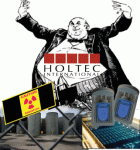 Company defends plans for nuclear waste storage facility https://www.sfchronicle.com/news/article/Holtec-defends-plans-for-nuclear-waste-storage-13558485.php, Jan. 24, 2019 ALBUQUERQUE, N.M. (AP) — A New Jersey-based company on Thursday defended plans to build a multibillion-dollar facility in the New Mexico desert to store spent fuel from commercial reactors around the United States, citing long-standing yet unmet obligations by the federal government to find a permanent solution for dealing with the tons of waste building up at the nation’s nuclear power plants.
The project proposed by Holtec International would allow for spent fuel rods to be transferred from dozens of sites around the country to a more secure temporary home in southeastern New Mexico, said Jay Silberg, an attorney representing the company.
“We believe that this is an extremely important facility for this nation,” Silberg told members of a U.S. Nuclear Regulatory Commission panel during the second day of a public meeting in Albuquerque.
It will be up to the panel to decide which environmental and nuclear watchdog groups have standing to intervene in the case and which objections they can pursue as federal regulators weigh whether to grant a license to Holtec.
Reams of documents have already been submitted to the commission, and the overall process is expected to be lengthy.
A Texas-based company also has applied for a license to expand its existing hazardous waste facility in Andrews County to include an area where spent fuel could be temporarily stored.
Opponents have raised concerns about the legality of the project, the safety of transporting the high-level waste across the country and the potential exposure and water and soil contamination if something were to go wrong along the way or at the site once the material was delivered.
Attorneys for the Sierra Club, Beyond Nuclear and other groups also are worried that risks could escalate if Holtec is allowed to reject and return damaged, leaking or contaminated casks that are transported to New Mexico.
The attorneys also focused on the proposed location, which is more than 30 miles from the nearest city but still in the heart of a congested region that’s experiencing a major oil and gas boom.
Holtec experts testified that there’s no evidence of land caving in at the site, that earthquakes are not believed to be a credible threat and that while it would not be able to repackage the waste if a container is damaged, it would be able to “take steps” to remedy problems that might arise.
Carlsbad City Councilor Jason Shirley told the panel that his community supports the project, saying it would result in more jobs and local tax revenue.
January 26, 2019
Posted by Christina Macpherson |
USA, wastes |
1 Comment
 Feds agree to delay relicensing New Hampshire’s Seabrook nuclear power plant
The Nuclear Regulatory Commission on Wednesday agreed to temporarily delay issuing a new operating license for Seabrook Nuclear Power Station, a massive 1,244-megawatt generator owned by NextEra.
In a notice, the NRC said it would delay relicensing the coastal New Hampshire plant through 2050 until the commission meets with the public.
Last week, congressional delegates from Massachusetts and New Hampshire wrote to the NRC seeking a delay until a hearing can be held this summer on problems with the plant’s structural concrete.
The concrete suffers from alkali-silica reaction, or ASR. The swelling and cracking was identified by plant operators in 2009. NextEra developed a plan to manage and monitor the deformation, a plan that the federal commission has accepted.
A hearing on the concrete problems, to be held before a panel of administrative judges, is set for this summer. A nuclear watchdog group, the C-10 Research & Education Foundation, plans to challenge NextEra’s plan for managing the ASR……..
Last week, Massachusetts Sens. Edward J. Markey and Elizabeth Warren joined U.S. Rep. Seth Moulton to ask that licensing be stayed until the ASR hearing can be held. From New Hampshire, Sen. Jeanne Shaheen, Sen. Margaret Wood Hassan and Rep. Chris Pappas also wrote to the NRC, saying more public involvement was needed. ……..https://www.masslive.com/politics/2019/01/feds_agree_to_delay_relicensin.html
January 26, 2019
Posted by Christina Macpherson |
safety, USA |
Leave a comment
 Here’s how many billions the US will spend on nuclear weapons over the next decade, Defense News
January 26, 2019
Posted by Christina Macpherson |
USA, weapons and war |
Leave a comment
$115 million nuclear contract draws scrutiny on Perry, Houston Chronicle, By James Osborne , January 25, 2019 WASHINGTON — Energy Secretary Rick Perry’s decision to award a $115 million no-bid contract to develop an advanced nuclear enrichment facility in Ohio is drawing scrutiny from Senate Republicans.
The Department of Energy said this month it would award the contract to Centrus Energy, a former government-owned contractor that ceased enrichment operations in 2013 before declaring Chapter 11 bankruptcy.
In a letter to Perry this week, Sen. John Barrasso, R-Wyo., chairman of the Senate Environment and Public Works Committee, said the company had a Ohio is drawing scrutiny from Senate Republicans.The Department of Energy said this month it would award the contract to Centrus Energy, a former government-owned contractor that ceased enrichment operations in 2013 before declaring Chapter 11 bankruptcy
In a letter to Perry this week, Sen. John Barrasso, R-Wyo., chairman of the Senate Environment and Public Works Committee, said the company had a mixed history in fulfilling federal contracts for nuclear fuel and questioned whether the money it received would end up supporting the Russian state-owned firm TENEX, from which Centrus buys enriched uranium.
“This contract appears to use American taxpayer funding to bailout Centrus, an unsuccessful business that relies on commercial relationships with Russian state-owned corporations to stay in business,” Barrasso wrote. “Congress did not authorize or fund this project.”
Both the Department of Energy and Centrus declined to comment for this story…….https://www.chron.com/business/energy/article/115-million-nuclear-contract-draws-scrutiny-on-13562022.php
January 26, 2019
Posted by Christina Macpherson |
politics, USA |
Leave a comment
 Professor says nuclear energy is safest, most practical energy source, Waste from lifetime of nuclear energy use in US would fit in soda can, professor said, The Badger Herald, by COURTNEY ERDMAN · Jan 24, 2019
 University of Wisconsin hosted an international relations professor Thursday, who argued nuclear energy was the safest, most practical power source, and the best one to transition the world away from fossil fuels. ……. Goldstein recognized that many people are also afraid of nuclear waste and how to dispose of it, but their fears are also unfounded.“The actual waste would fit in a soda can if you used your whole lifetime of American-style electricity from nuclear power,” Goldstein said. …….
https://badgerherald.com/news/2019/01/24/professor-says-nuclear-energy-is-safest-most-practical-energy-source/
January 26, 2019
Posted by Christina Macpherson |
spinbuster, USA |
Leave a comment
US Panel to Hear Arguments in Nuclear Waste Storage Case https://www.usnews.com/news/best-states/new-mexico/articles/2019-01-23/us-panel-to-hear-arguments-in-nuclear-waste-storage-case
Environmentalists and nuclear watchdog groups are lining up against plans to build a $2.4 billion storage facility in southeastern New Mexico for spent nuclear fuel from commercial reactors around the United States., Jan. 23, 2019 BY SUSAN MONTOYA BRYAN, Associated Press, ALBUQUERQUE, N.M. (AP) — Environmentalists and nuclear watchdog groups are lining up against plans to build a $2.4 billion storage facility in southeastern New Mexico for spent nuclear fuel from commercial reactors around the United States.
Attorneys for the groups are scheduled Wednesday to make oral arguments before a panel with the U.S. Nuclear Regulatory Commission during a hearing in Albuquerque.
The panel will determine which groups have standing and which objections will be considered as part of the case.
New Jersey-based Holtec International has applied for a license to construct the facility about 35 miles (56 kilometers) east of Carlsbad. It would be capable of storing as much as 120,000 metric tons of high-level radioactive waste.
Opponents have concerns about the project’s legality, the safety of transporting the fuel across the country and potential environmental effects.
January 24, 2019
Posted by Christina Macpherson |
USA, wastes |
Leave a comment
|
Does America Still Need the Nuclear Triad? The U.S. can deliver nuclear weapons from air, land, and sea. That could change. Jan 24, 2019 Popular Mechanics, By Kyle Mizokami
“……..Because the U.S. can launch nukes from the air, land, or sea, it would be practically impossible for another country to knock out America’s offensive capabilities and prevent the counterstrike.
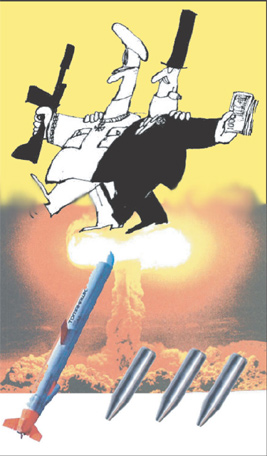
The U.S. is currently working on replacing all three legs of the triad: bombers, intercontinental ballistic missiles, and submarine-launched missiles. It’s an overhaul that will cost hundreds of billions of dollars, and no doubt overshoot the Pentagon’s price estimates when all is said and done. But before we spend all that money, one must look around and ask the question: Is this still the best way? In the 21st century, does America really need three ways to launch nukes?………
During the Cold War, each arm of the triad justified its existence by doing something better than the other two. Strategic heavy bombers such as today’s B-2 Spirit and the longstanding B-52H Stratofortress could carry many nuclear bombs and strike multiple geographically distinct targets ……..
Intercontinental ballistic missiles (ICBMs) loft nuclear warheads into space on ballistic trajectories. They are buried by the hundreds in underground concrete silos scattered across America……
The third arm of the triad was nuclear-powered submarines carrying their own nuclear-tipped ballistic missiles……
But as the second decade of the 21st century draws to a close, the nuclear triad is showing its age. The B-2 Spirit bomber was introduced in the 1990s, while the B-52H has been flying since the early 1960s and may keep working for decades to come. The Minuteman III ICBM was first deployed in the early 1970s. The U.S. Navy’s Ohio-class ballistic missile submarines date to the 1980s and 1990s.
After decades of pushing back plans to replace all three arms, the U.S. is now faced with a situation where it needs to replace all three at once. The new B-21 Raider bomber, which will replace the B-2 bomber, will cost an estimated $97 billion dollars. The new ICBM, Ground Based Strategic Deterrent (GBSD), will cost around $100 billion. Finally, new ballistic missile submarines will cost $128 billion.
That adds up to a serious bill. The cost is about the equivalent of running the entire U.S. Armed Forces for five months. And the price tag could rise substantially if any of the programs run into expensive technical problems. If history is any guide, then at least one of them will.
Could the U.S. thrive in 21st century without a nuclear triad? To see a possible way forward, just look at the emerging colossus of China. The world’s most populous nation is building more aircraft carriers, more amphibious ships, and more modern combat aircraft than ever before. What China is not doing is significantly expanding its nuclear arsenal.
China has approximately 280 nuclear weapons, a number we can deduce from the amount of fissile material it has produced. That total represents about one sixth the number of deployed U.S. and Russian nuclear weapons. China’s nukes are spread between land-based ballistic missiles and submarine-launched missiles. It has no air-delivered nuclear weapons for its modest bomber force. In other words, China has a diad.
China is a “no first use” country, meaning it has vowed to never use nuclear weapons first. It also bother with advanced nuclear technologies such as anti-ballistic missile systems or placing multiple warheads on a single missile. Why not? China’s entire nuclear philosophy boils down to this: The country may very well be destroyed by a surprise nuclear attack, but enough Chinese nuclear weapons will survive to make the attack simply not worth it.
Essentially, China’s nuclear doctrine is assured destruction, but stripped of unnecessary complexities. China doesn’t lose any sleep over Russia or America’s overwhelming advantage in nuclear arms. As long as China can hit back and nuke at least a handful of American (or Russian) cities, the balance of terror remains.
Does China’s nuclear posture work? Even a strike against tiny North Korea runs the risk of a nuclear counterstrike by China, and the loss of just one American city would be a catastrophe.
……. it’s hard to ignore the stripped-down logic of the Chinese model, which says the only credibility necessary is the ability to strike back after an attack—the rest is just overthinking the issue.
If that’s truly the case, then what use is a triad? Could the U.S. get rid of one or two arms of the triad, spending that money elsewhere in the defense budget to enhance conventional capabilities?
………Could the U.S. cut ICBMs and rely on a force of submarines and bombers, or submarines alone? These are important questions the American people need to ask before spending $300 billion replicating the weapons of the Cold War. Perhaps the U.S. should stick with the nuclear triad—but at the very least, America needs a national conversation about what nuclear security means and how to achieve it. https://www.popularmechanics.com/military/weapons/a25983826/us-nuclear-triad/
|
|
January 24, 2019
Posted by Christina Macpherson |
USA, weapons and war |
Leave a comment












 nuclear-news