|
It’s only one month into 2019 and meteorologists are already talking in superlatives as extreme weather patterns have brought cities and towns across the globe to a standstill.
 Thermometer on snow shows low temperatures – zero. Low temperatures in degrees Celsius and fahrenheit. Cold winter weather – zero celsius thirty two farenheit. In the United States this week, some 200 million Americans experienced a historic deep freeze that saw temperatures plummet below -32 degrees Celsius (-26 Fahrenheit), killed at least 23 people and led to the cancellation of more than 2,300 flights.
On Thursday, temperatures in 11 states in the continental US saw temperatures lower than the one recorded in Utqiagvik, Alaska’s northernmost city, situated north of the Arctic Circle.
Authorities in some of the hardest-hit cities such as Minneapolis and Chicago implored residents to stay indoors to prevent frostbite — in one Chicago hospital, doctors treated 50 frostbite victims; some may lose an arm or a leg.
Across the pond, the United Kingdom recorded record lows this week as frosty weather pounded parts of England, Scotland and Wales.
On Thursday, residents in Braemar in northeast Scotland experienced -14.4 C (6.1 F), according to the UK’s national weather service, the Met Office. This was the lowest temperature recorded in the UK since 2012.
Heavy snow has created roadblocks for travelers across the country. Some flights at London’s Heathrow Airport were canceled Friday; passengers were stuck on snow-covered runways at airports in Manchester and Liverpool earlier in the week. Hundreds of schools across parts of England and Wales closed Friday, with the Met Office continuing to warn of treacherous driving conditions in some southern parts of the country.
In the southwestern county of Cornwall Thursday night, more than 100 motorists ended up abandoning their cars on a major highway blanketed in snow and walking to a pub, where they spent the night. Parts of France also came under a weather warning after heavy snow fall, Météo France, the national meteorological service, warned earlier this week.
 But as parts of the US and Europe saw record lows, Australia’s Bureau of Meteorology announced it had been the country’s hottest January on record.The “unprecedented” heat wave that burned its way through all of the country’s melted roads, saw infrastructure fail and killed thousands of animals.
In the Northern Territory, the bodies of dozens of wild horses were found strewn along a dried-up water hole. In Victoria, more than 2,000 flying foxes died from heat stress, in what local media described as a “nightmare” event. Similar mass flying fox deaths have been recorded in the states of New South Wales and Queensland. In the southern state of Tasmania, dozens of bushfires broke out, destroying homes and wilderness as hundreds of firefighters sought to get the blazes under control.
On January 24, residents in the southern city of Adelaide experienced the hottest day on record for their city, with temperatures peaking at 46.6 C (116 F).
Throughout the country, health warnings have been issued, advising people to stay indoors during the hottest part of the day, minimize physical activity and keep hydrated.
While the current heat continues to cause problems for Australians now, scientists warn that without coordinated action on climate change, heat waves will become more likely.
“Climate change is making heat waves more likely but any individual event is effectively a weather phenomenon,” Ben Webber, lecturer in climate science in the Climatic Research Unit at the UK’s University of East Anglia, told CNN.
“We can try and mitigate against the worst effects of climate change by reducing carbon emissions, that’s really the best thing to do — but obviously that requires global action. So individuals can help, but it has to be a big global action to be effective,” he said.
“That comes back to what politicians have been trying to agree on … and that’s why these extreme events are part of the motivation for striving to limit global mean temperatures’ rise to less than 2 degrees (Celsius) or possibly to 1.5 degrees against current levels,” Webber said. While we can’t control the weather, he added, we can adapt to and minimize the impact that extreme weather can have on us. That comes down to having the necessary infrastructure in place to deal with the extremes, he said.
CNN’s Gianluca Mezzofiore contributed to this report.
|
|
February 4, 2019
Posted by Christina Macpherson |
AUSTRALIA, climate change, EUROPE, NORTH AMERICA |
Leave a comment

Brant Ulsh, skeptic on radiation limits, to head EPA radiation panel, Japan Times, 2 Feb 19, WASHINGTON  – The Environmental Protection Agency has appointed a scientist who argues for easing regulations on lower-level radiation exposures to lead the agency’s radiation advisory committee.
Acting EPA head Andrew Wheeler on Thursday announced the appointment of Brant Ulsh, a health physicist, as one of the EPA’s science advisers and the panel’s chairman. Ulsh has been a leading critic of the EPA’s decades-old position that exposure to any amount of ionizing radiation is a cancer risk.
In a paper he co-wrote last year, Ulsh and a colleague argued that the position was based on outdated scientific information and forced the “unnecessary burdens of costly clean-ups” on facilities working with radiation.
The EPA under President Donald Trump has targeted a range of environmental protections, in line with Trump’s arguments that overly strict environmental rules have hurt U.S. businesses. Environmental and public health advocates say the rollbacks threaten the health and safety of Americans.
Some environmental groups and scientists have criticized what they say is the administration’s openness to an outlier position on radiation risks.
“Once again the Trump administration is moving to the fringe for its scientific advice, choosing someone who could undercut foundational protections from radiation,” Bemnet Alemayehu, a staff scientist at the Natural Resources Defense Council environmental advocacy group, said in a statement Friday. “We need sound science to dictate health protections, not dangerous theories.”
EPA spokesman John Konkus declined comment Friday, referring a reporter to a news release announcing the appointment.
Ulsh did not immediately respond to an email Friday asking for comment, including whether he intended to use the advisory position to encourage reconsideration of the EPA’s no-tolerance policy on lower doses of radiation exposure……… https://www.japantimes.co.jp/news/2019/02/02/world/science-health-world/brant-ulsh-skeptic-radiation-limits-head-epa-radiation-panel/#.XFdRStIzbGg
February 4, 2019
Posted by Christina Macpherson |
politics, radiation, USA |
Leave a comment

 150 Congressional Republicans Represent Fossil Fuel Companies Instead of Their Communities https://www.desmogblog.com/2019/01/30/150-congressional-republicans-climate-deniers-fossil-fuel-companies?utm_source=dsb%20newsletter
 ,
January 30, 2019 by ClimateDenierRoundup.Last week,
we mocked the fossil fuel industry’s use of an outlet it owns to brag about perverting democracy — but we didn’t actually call out the politicians in the industry’s pocket.
Lucky for us, the Center for American Progress Action Fund did just that this week. A new analysis from CAP tallies up the climate deniers in the 116th Congress. As it turns out, there are a lot: 150.
But that’s actually an improvement from last year, when there were 180. Of those 180, 47 are no longer serving: 22 were defeated in 2018, 16 retired, five resigned, and four went to other positions.
United States 150 out of 335 United States Members of Congress are climate deniers, collecting $68,359,582 in dirty money.
Top recipients
Mitch McConnell (R) – $3,018,793
Jim Inhofe (R) – $2,111,110
John Cornyn (R) – $3,444,515
Ted Cruz (R) – $3,372,000
Kevin Brady (R) – $1,753,762
The number of climate deniers receiving fossil fuel funding elected to the 116th Congress. Credit: Center for American Progress Action Fund
This may explain why the industry was so keen last week to assert the influence their money has. As it turns out, taking the cash may actually be a bad move for a candidate, since fossil-fuel funded candidates lost 30 seats in the 2018 elections (not factoring in the myriad of other factors at play, of course).
And make no mistake — it is the fossil fuel industry that demands denial, not average Americans. CAP Action Fund cites polling that shows a majority of Americans, including Republicans, know that climate change is real, that it is making weather more extreme, and that we should take action to reduce fossil fuel use.
Exact numbers obviously depend on the poll, but by and large it’s safe to say that a majority of all Americans, including some 55 percent to 66 percent of Republicans, support various types of climate action, including the policies in the Green New Deal.
What drives politicians to take positions opposed by the majority of people who vote for them? Well, money, of course. That’s why the report comes with a nifty interactive that shows you how many of each state’s members of Congress are in denial, as well as how much money they’ve received directly from the fossil fuel industry.
Mitch McConnell and Jim Inhofe top the list at $3 million and $2 million in dirty money over their careers, while the lifetime average among the 150 deniers is a scant $455,731 — which certainly sounds low. But that doesn’t include money spent on outside PACs and support.
The Kochs, for example, planned to spend $400 million on the 2018 election. That doesn’t include the additional money the Kochs spend bankrolling fake news operations like the Daily Caller. And even that’s hardly the only fossil fuel propaganda outlet! For example, there’s the Western Wire, where two of their writers, who also work as public relations strategists representing Exxon, recently posed as reporters to try and get information about one of the Exxon cases.
February 4, 2019
Posted by Christina Macpherson |
climate change, politics, USA |
Leave a comment
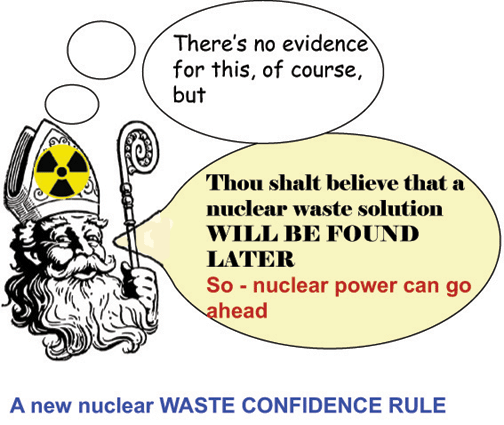
Nuclear waste burial fund grows to $43 billion, but DOE has not buried an ounce of spent fuel https://www.sgvtribune.com/2019/02/01/billions-pile-up-in-nuclear-waste-burial-fund-but-no-permanent-storage-solution-on-the-horizon/
Radioactive waste still stuck at San Onofre and other reactors across the nation By TERI SFORZA | tsforza@scng.com | Orange County Register, February 1, 2019 A U.S. Department of Energy fund to pay for the eventual disposal of nuclear waste has been earning $1.5 billion in interest each year — totaling a whopping $43.4 billion in 2018 — even as millions of pounds of radioactive waste pile up all over America in want of a permanent home.
The DOE piggy bank, dubbed the Nuclear Waste Fund, is invested in securities and earmarked for permanent disposal of spent fuel generated by commercial reactors such as San Onofre and Diablo Canyon. The fund’s most recent audit shows its value actually is down from 2016’s $46 billion.
That much money can buy a lot of things — except, apparently, permanent disposal of the nation’s nuclear waste.
For half a century, the fate of spent nuclear fuel has been marked by paralysis as officials squabble over what to do: build a deep geological repository at Yucca Mountain in Nevada, approve temporary private storage in New Mexico and Texas, or leave it at the 75 reactor sites where it was created.
The fight means mounting liabilities for taxpayers. The U.S. Government Accountability Office says delays in taking custody of commercial spent nuclear costs the federal government another $500 million every year.
The Nuclear Waste Fund was created in the last century, when nuclear power was viewed as the nation’s future. To encourage its development, the federal government passed the Nuclear Waste Policy Act of 1982, promising to accept and dispose of commercial nuclear fuel and high-level waste by Jan. 31, 1998.
In return, the utilities that owned the nuke plants would make quarterly payments into the disposal fund.
The utilities held up their end of the bargain — pumping about $750 million a year into the fund — but the DOE did not. And nearly 40 years on, it has not accepted an ounce of commercial nuclear waste for permanent disposal.
So the utilities operating nuclear plants found themselves stuck with this waste, and sued the DOE for breach of contract. Along the way, a federal judge said the DOE cannot charge for a service it not only isn’t providing, but won’t provide for many decades — and, in 2014, utilities all across America finally stopped paying into the Nuclear Waste Fund.
Their ratepayers probably didn’t much notice. The fee for consumers was tiny (about one-tenth of 1 cent for each nuclear-generated kilowatt hour), translating to some 20 cents a month on the average electric bill. But it added up.
Even after spending about $11 billion on the possibly dubious Yucca Mountain project, and even after fee collection ceased, the Nuclear Waste Fund continues to earn that $1.5 billion a year in interest.
And the government’s — and, thus, taxpayers’ — liabilities grow.
Costly delay
The DOE has paid out $6.9 billion to utilities for sticking them with the waste through 2017 — money that has been used to construct temporary storage on plant sites, such as the “concrete bunker” that has been so controversial at the shuttered San Onofre plant.
The DOE estimates it will pay another $28 billion or so for the storage debacle before it’s all over. The nuclear industry believes DOE’s bill will be much higher — closer to $50 billion.
None of that money comes from the Nuclear Waste Fund. Rather, it will come from the pockets of taxpayers, whether or not they got power from nuclear energy.
Grinding into action?
Two private companies are seeking federal licenses to open temporary storage sites in Texas and New Mexico for America’s commercial nuclear waste. The annual interest earned by the Nuclear Waste Fund — $1.5 billion — could be used to pay for private interim storage without further congressional appropriation, according to the Congressional Research Service.
But fierce opponents in New Mexico vow to keep the nation’s nuclear waste out of their backyards.
Meanwhile, the Nuclear Regulatory Commission issued the final volumes of its Yucca MountainSafety Evaluation Report and concluded that a deep geologic repository there would comply with safety and environmental standards once it’s permanently sealed.
But “scientific confidence about the concept of deep geologic disposal has turned out to be difficult to apply to specific sites,” the Congressional Research Service said. “Every high-level waste site that has been proposed by DOE and its predecessor agencies has faced allegations or discovery of unacceptable flaws, such as water intrusion or earthquake vulnerability, that could release unacceptable levels of radioactivity into the environment.
“Much of the problem results from the inherent uncertainty involved in predicting waste site performance for the 1 million years that nuclear waste is to be isolated under current regulations.”
And a newly elected congressman representing the San Onofre area has formed a new task force to push the issues of waste disposal and safety onto the front burner. The new group will feature some of the fiercest critics of Southern California Edison’s San Onofre Community Engagement Panel, a volunteer group advising Edison on the plant’s tear-down.
“We cannot allow the status quo to continue indefinitely,” said U.S. Rep. Mike Levin, D-San Juan Capistrano.
February 4, 2019
Posted by Christina Macpherson |
USA, wastes |
Leave a comment
Russia withdraws from Cold War-era nuclear weapons treaty with US https://www.abc.net.au/news/2019-02-02/russia-withdraws-from-cold-war-era-nuclear-weapons-treaty/10774536 Russia has suspended a Cold War-era nuclear weapons treaty, President Vladimir Putin said, after the United States accused Moscow of violations and said it would withdraw from the arms control pact.
 Key points:
- Russia will start work on new missiles, including hypersonic ones

- US and Russia both allege the other has violated the INF treaty
- China urges dialogue amid fears of nuclear arms race
The Intermediate-range Nuclear Forces (INF) Treaty prevents the two superpowers from possessing, producing or test-flying ground-launched nuclear cruise missiles with a range of 500 to 5,500 kilometres.
The United States announced it will withdraw from the INF treaty in six months unless Moscow ends what it says are violations of the pact, but Russia denied violating the treaty.
“The American partners have declared that they suspend their participation in the deal, we suspend it as well,” Mr Putin said during a televised meeting with foreign and defence ministers.
Mr Putin said Russia will start work on creating new missiles, including hypersonic ones, and told ministers not to initiate disarmament talks with Washington, accusing the United States of being slow to respond to such moves.
“We have repeatedly, during a number of years, and constantly raised a question about substantiative talks on the disarmament issue,” Mr Putin said.
“We see that in the past few years the partners have not supported our initiatives.”
The US alleges a new Russian cruise missile violates the important pact, signed by former leaders Ronald Reagan and Mikhail Gorbachev in 1987.
The missile, the Novator 9M729, is known as the SSC-8 by the North Atlantic Treaty Organisation (NATO).
Russia said the missile’s range put it outside the treaty, and accused the US of inventing a false pretext to exit a treaty it wants to leave anyway so it can develop new missiles.
Russia also rejected the demand to destroy the new missile.
During the meeting with Mr Putin, Russian Foreign Minister Sergey Lavrov accused the US of violating the INF and other arms deals, including the non-proliferation treaty.
Mr Putin said Russia would not deploy its weapons in Europe and other regions unless the US did so.
Fears of new arms race
The row over the INF treaty is yet another twist in Russia’s worsening relations with the United States and the West, with tensions over Russia’s annexation of Crimea from Ukraine as well as allegations of it meddling with the presidential election in the US and being behind a nerve agent attack in Britain.
The treaty’s suspension has drawn a strong reaction from Europe and China.
European nations fear the treaty’s collapse could lead to a new arms race with possibly a new generation of US nuclear missiles stationed on the continent.
In a statement, China’s Ministry of Foreign Affairs said the bilateral treaty was important to maintain “global strategic balance and stability”.
“China is opposed to US withdrawal action and urges the United States and Russia to handle their differences properly through constructive dialogue,” the statement said, warning that unilateral withdrawal could trigger “negative consequences”.
February 4, 2019
Posted by Christina Macpherson |
China, politics international, Russia, USA, weapons and war |
Leave a comment
US Sen. Warren: Ban US first strike nuclear weapons option https://www.sfgate.com/news/article/US-Sen-Warren-Ban-US-first-strike-nuclear-13585408.php February 3, 2019 BOSTON (AP) — U.S. Sen. Elizabeth Warren wants to make sure the United States never uses nuclear weapons first.
The Massachusetts Democrat has introduced a bill with Democratic U.S. Rep. Adam Smith of Washington that would make it the official policy of the United States not to use nuclear weapons first.
The lawmakers say the United States currently retains the option to be the first to use nuclear weapons in a conflict, even in response to a non-nuclear attack.
They said banning the use of nuclear weapons for first-strike purposes would “reduce the chances of a nuclear miscalculation.”
Fellow Massachusetts Democratic U.S. Sen. Edward Markey and U.S. Rep. Ted Lieu, a California Democrat, have also sponsored a bill that would bar the president from launching a nuclear first strike without congressional approval.
February 4, 2019
Posted by Christina Macpherson |
politics, USA, weapons and war |
Leave a comment
 Should legislators help save Ohio nuclear plants? NO: FirstEnergy bailout would be crony capitalism at its worst Columbus Dispatch, 4 Feb 19, Crony capitalism is never acceptable and should be always met with public outrage. But more-covert pay-to-play schemes that affect Ohio’s long-term economic health are particularly egregious. Take for instance the campaign-contributions scheme from FirstEnergy Solutions over the past year. While transactions to more than a dozen of Ohio policymakers may seem normal to the average voter, recent activity in Columbus reveals a much more calculated operation that seemly puts FirstEnergy’s nuclear agenda ahead of Ohio’s future.
In April 2018, FirstEnergy Solutions filed for bankruptcy in the wake of massive financial problems arising from the company’s competitive power-generation fleet. The company announced it would shut down its Ohio nuclear plants over a three-year period because continued operation wasn’t profitable. FirstEnergy had been unsuccessfully pursuing bailouts from the Public Utilities Commission of Ohio since 2014 and seeking a nuclear subsidy in the legislature since 2016 without success.
So it scrambled desperately for a lifeline, hatching a plan to offer sizable campaign donations to candidates hoping to gather up political allies to support its demand for $300 million a year to keep its plants operational.
What did FirstEnergy cough up for its legislative lifeline? For starters, the company gave $172,000 in total to Ohio House candidates, many of whom had no legislative or energy-industry experience. It also donated $565,000 to the Republican Governors Association, an amount more than five times what the company gave to Governor Mike DeWine’s Democratic counterpart.
We can clearly see the pay, but what exactly was the play? Conveniently, on the first day of the new General Assembly a standing committee on power generation was established, setting the stage to justify passage of a nuclear bailout and help out FirstEnergy. Additionally, FirstEnergy recently announced a debt-restructuring agreement with its creditors. Not coincidentally, this surprise development came on the tails of securing state-lawmaker support to bail out FirstEnergy.
This situation is pay-to-play politicking at its worst, flying in the face of the new administration’s promises to be the most innovative administration in Ohio’s history. Part of an innovation agenda should include rejecting political favoritism toward uncompetitive and less technologically advanced nuclear power plants. Ohioans need to know that FirstEnergy’s attempt to influence a bailout for its failing nuclear plants isn’t just bad ethics. It’s also awful public policy.
Incidentally, natural gas is fueling jobs and consumer cost savings across America. This is especially true in Ohio, …………https://www.dispatch.com/opinion/20190203/column-should-legislators-help-save-ohio-nuclear-plants-no-firstenergy-bailout-would-be-crony-capitalism-at-its-worst
February 4, 2019
Posted by Christina Macpherson |
business and costs, politics, USA |
Leave a comment
UN Nuclear Watchdog Warns Against Meddling Over Iran, Bloomberg By Jonathan Tirone, February 2, 2019,
………Late Wednesday, at a private reception for diplomats, IAEA Director General Yukiya Amano lashed out at efforts to hamstring an organization that’s been at the forefront of nuclear security for decades, according to two foreign officials who were there. Without naming Israel and the U.S., the career Japanese diplomat made it clear those countries were the source of his ire, they said.
“The agency’s independence must not be undermined,” Amano said, according to the IAEA’s website. “If attempts are made to micro-manage or put pressure on the agency in nuclear verification, that is counterproductive and extremely harmful.”
An IAEA official said on Saturday that the U.S. wasn’t Amano’s intended target. He declined to specify which countries prompted the rebuke.
Three years into an agreement that was meant to be a hallmark of the Obama administration, in which Iran agreed to curb its nuclear activities in return for sanctions relief, IAEA inspectors say Tehran is in full compliance.
That hasn’t stopped the Trump administration from backing out of the agreement, piling on new penalties and trying to use the agency to turn the screws with help from Israeli Prime Minister Benjamin Netanyahu.
Iran Abides Nuclear Limits
Enriched uranium has remained below thresholds agreed under deal
President Donald Trump’s hardline stance on Iran has heightened tensions with the other signatories to the agreement: China, France, Germany, Russia and the U.K. It’s also sowed divisions between the White House and America’s spy agencies, with Trump castigating his own intelligence officials this week for being “passive and naive when it comes to the dangers of Iran.”
Netanyahu went to the U.S. Congress to lobby against the agreement before it was signed and has continued to criticize the deal since, arguing that it won’t prevent Iran from attaining nuclear weapons……..
fake newscast in Israel came as Iran’s deputy foreign minister was in Vienna for talks with the IAEA, which is trying to keep the accord from unraveling.
Iran’s leadership has said the country’s ready to re-start its enrichment program using more advanced technology if the agreement fails. The country is considering making the kind of nuclear fuel used in naval propulsion, implying it could enrich uranium closer to the levels needed for weapons.
Meanwhile, the European Union is moving to help countries evade the sanctions that the Trump administration imposed to stop countries from trading with Iran.
On Thursday, the 28-member bloc finalized a new financial mechanism for bypassing the U.S. restrictions. The special purpose vehicle, called the Instrument in Support of Trade Exchanges, will be headquartered in Paris and staffed with German leadership.
The vehicle will have a positive “impact on trade and economic relations with Iran, but most importantly on the lives of Iranian people,” a draft of the joint communique seen by Bloomberg says.
The U.S. mission to the IAEA in Vienna said in an emailed response to questions that the watchdog “can continue to count on the full support of the United States” as it carries out its “important mandate in Iran.” https://www.bloomberg.com/news/articles/2019-02-01/fake-news-goes-nuclear-as-iaea-sees-u-s-israel-meddling-on-iran
February 4, 2019
Posted by Christina Macpherson |
Iran, politics international, USA |
Leave a comment
 SNC-Lavalin should be barred from federal contracts: Angus, Call comes after two former executives pleaded guilty to breaking laws Elizabeth Thompson · CBC News Feb 03, 2019 The Canadian government should suspend engineering giant SNC-Lavalin from competing for future federal government contracts after two former top executives pleaded guilty to charges in recent weeks, says NDP MP Charlie Angus.
“How is it that a company with such a horrific record of corporate malfeasance is able to obtain so many government contracts and continue to bid on government contracts?” said Angus.
On Friday, former SNC-Lavalin CEO Pierre Duhaime pleaded guilty to breach of trust in a plea deal that resulted in 20 months of house arrest, 240 hours of community service and a $200,000 donation to a fund for victims of crime. His trial had been scheduled to begin Monday……….
“I’m astounded that SNC is still given such favoured status with the Liberal government in terms of contracts.”NDP MP Charlie Angus.
SNC Lavalin is still before a court in Montreal, charged with fraud and corruption in connection with payments of nearly $48 million to public officials in Libya under Moammar Gadhafi’s government and allegations it defrauded Libyan organizations of an estimated $130 million.
Ryan said the company is contesting the case and has pleaded not guilty.
If the company is convicted, it could be blocked from federal government contracts for a decade.https://www.cbc.ca/news/politics/snc-lavalin-contracts-angus-1.5003135
February 4, 2019
Posted by Christina Macpherson |
Canada, secrets,lies and civil liberties |
Leave a comment
Gene Eisman, Washington Post 1st Feb 2019 . In 1979, I was working for a member of the Pennsylvania
governor’s Cabinet and lived in Harrisburg, Pa., a few miles from the
Three Mile Island nuclear plant. When one of the reactors melted down, I
saw real panic as state workers left their offices to pick up their
children at school. I spent several days in the state’s underground
emergency command facility during the crisis, talking to the Federal
Emergency Management Agency in Washington, providing it with real-time
updates on the situation. Having been through that, I believe that
Mr. Gates’s idea to build new nuclear power plants would be the height
of folly, any claims he makes notwithstanding.
https://www.washingtonpost.com/opinions/i-lived-through-three-mile-island-new-nuclear-plants-are-a-bad-idea/2019/02/01/3e15b3e8-2573-11e9-b5b4-1d18dfb7b084_story.html
February 4, 2019
Posted by Christina Macpherson |
PERSONAL STORIES, USA |
Leave a comment
 Proposed deal would delay report on Georgia nuclear plant The News and Observer, THE ASSOCIATED PRESS, FEBRUARY 02, 2019 ATLANTA
Georgia utility regulators are being asked to delay a Georgia Power report showing whether the Plant Vogtle nuclear expansion has fallen further behind schedule.
Additional construction delays would increase the project’s costs — and that could lead to higher power bills for many Georgians, The Atlanta Journal-Constitution reported.
Some consumer and environmental groups are objecting to any delay in updates.
“The company and the project do not deserve this break in scrutiny at this critical time,” Sara Barczak, a director for the Southern Alliance for Clean Energy, wrote in an emailed statement to the Journal-Constitution.
“The ratepayers do not deserve this extended period of a lack of protection and transparency as their exposure potentially increases by more than a billion dollars,” Barczak said.
The delay also means the company won’t make its latest disclosure while the state legislature is in session, said Liz Coyle, the executive director of Georgia Watch.
“There is a lack of transparency in what is happening with schedule and budget at a time when the legislature could take some action,” Coyle said.
Georgia Power denied the move is an intentional effort to avoid the legislative session……….https://www.newsobserver.com/news/business/article225448705.html
February 4, 2019
Posted by Christina Macpherson |
politics, USA |
Leave a comment
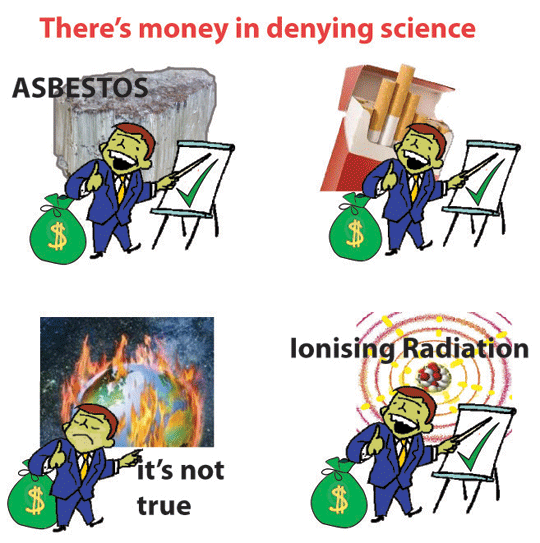
Skeptic on radiation limits will head EPA radiation panel, https://www.kwch.com/content/news/Skeptic-on-radiation-limits-will-head-EPA-radiation-panel-505198021.html By ELLEN KNICKMEYER, Associated Press 1 Feb 19, WASHINGTON (AP) — The Environmental Protection Agency has appointed a scientist who argues for easing regulations on lower-level radiation exposures to lead the agency’s radiation advisory committee.
Acting EPA head Andrew Wheeler on Thursday announced the appointment of Brant Ulsh, a health physicist, as one of the EPA’s science advisers and the panel chairman. Ulsh has been a leading critic of the EPA’s decades-old position that exposure to any amount of ionizing radiation is a cancer risk.
In a paper he co-wrote last year, Ulsh and a colleague argued that the position was based on outdated scientific information and forced the “unnecessary burdens of costly clean-ups” on facilities working with radiation.
The EPA under President Donald Trump has targeted a range of environmental protections, in line with Trump’s arguments that overly strict environmental rules have hurt U.S. businesses. Environmental and public health advocates say the rollbacks threaten the health and safety of Americans.
Some environmental groups and scientists have criticized what they say is the administration’s openness to an outlier position on radiation risks.
“Once again the Trump administration is moving to the fringe for its scientific advice, choosing someone who could undercut foundational protections from radiation,” Bemnet Alemayehu, a staff scientist at the Natural Resources Defense Council environmental advocacy group, said in a statement Friday. “We need sound science to dictate health protections, not dangerous theories.”
EPA spokesman John Konkus declined comment Friday, referring a reporter to a news release announcing the appointment.
Ulsh did not immediately respond to an email Friday asking for comment, including whether he intended to use the advisory position to encourage reconsideration of the EPA’s no-tolerance policy on lower doses of radiation exposure.
Last year, Ulsh told The Associated Press that “we spend an enormous effort trying to minimize low doses” at nuclear power plants, for example.
“Instead, let’s spend the resources on minimizing the effect of a really big event,” he said.
U.S. agencies have long maintained there is no threshold of radiation exposure that is risk-free.
The National Council on Radiation Protection and Measurements reaffirmed that last year after reviewing 29 public health studies on cancer rates among people exposed to low-dose radiation.
The EPA last year proposed a rule that would have instructed regulators to consider “models across the exposure range” when it comes to dangerous substances.
Environmental groups and some scientists expressed concern then that the directive could open the way for an agency retreat from its long-standing no-tolerance rule for ionizing radiation exposure. But the proposed rule did not mention radiation, and EPA officials denied it would have applied to radiation. It said the agency still follows its no-tolerance guidelines.
But the EPA’s proposal last year did specify consideration of a particular scientific model, called the U curve, put forward by Edward Calabrese, a toxicologist and leading proponent of the theory that exposure to radiation and other hazardous substances can actually be healthy at low doses
The EPA’s initial news release on the rule last April quoted Calabrese as praising the proposal, calling it a “major scientific step forward” in assessing the risks of “chemicals and radiation.”
EPA calendars obtained through the Freedom of Information Act show an appointment between Calabrese and EPA chief of staff Ryan Jackson on June 28, 2017, early in the tenure of Scott Pruitt, Wheeler’s predecessor.
February 2, 2019
Posted by Christina Macpherson |
secrets,lies and civil liberties, spinbuster, USA |
Leave a comment
 Guardian, Julian Borger, World affairs editor, Sat 2 Feb 2019
Announcement gives Russia 180 days to destroy violating missiles and launchers to avoid new arms race Donald Trump has confirmed that the US is leaving the Intermediate-range Nuclear Forces (INF) treaty, saying “we will move forward with developing our own military response options” to Russia’s suspect missile.In a written statement, Trump said that the US would be suspending its compliance with the 1987 treaty on Saturday, and would serve formal notice that it would withdraw altogether in six months.
He left the door open to the treaty being salvaged in that 180-day window, but only if Russia destroys all of its violating missiles, launchers and associated equipment. Since 2013, the US has alleged that Russia has developed a new ground-launched cruise missile which violated the INF prohibition of missiles with ranges between 500km and 5,500km.
Russia for several years denied the missile existed but has more recently acknowledged its existence, saying its range does not violate INF limits.
“This is in reality, under international law, Russia’s final chance,” a senior administration official said. “If there is to be an arms race, it is Russia that has undermined the global security architecture.”
In his statement, Trump warned that unless Russia destroyed its missile by August: “We will move forward with developing our own military response options and will work with Nato and our other allies and partners to deny Russia any military advantage from its unlawful conduct.”
Washington’s European allies have been anxious that the death of the INF treaty would lead to a return to the tense days of the 1980s, and an arms race involving short- and medium-range missiles on European soil………
, neither the Trump nor Pompeo gave any indication whether the administration would agree to extend the 2010 New Start treaty, the last remaining arms control agreement constraining the arsenals of the two major nuclear weapons powers.
Both the US and Russia have abided by the New Start limit of 1,550 deployed, strategic nuclear warheads, but the treaty expires in 2021, leaving little time to negotiate a five-year extension.
Alexandra Bell, a former state department arms control official and senior policy director at the Centre for Arms Control and Non-Proliferation, said: “New Start is working, it’s good for American national security and this administration is putting global security at risk by foot-dragging on extension.” https://www.theguardian.com/world/2019/feb/01/inf-donald-trump-confirms-us-withdrawal-nuclear-treaty
February 2, 2019
Posted by Christina Macpherson |
politics international, USA, weapons and war |
1 Comment
 It’s so cold, even a nuclear reactor in N.J. can’t do its job,Feb 1, By Chris Franklin | For NJ.com
The frigid temperatures the state is experiencing has taken its toll in a number of ways. One of the consequences has been the shutdown of one of the nuclear reactors in Salem County.
PSEG spokesman Joseph Delmar Sr. says the utility company’s Salem Unit 2 reactor was manually taken offline by control room operators early Thursday morning at 3:01 a.m. due to frazil icing conditions at the circulating water intake structure on the non-nuclear side of the power plant. ………Chris Franklin can be reached at cfranklin@njadvancemedia.com. Follow him on Twitter @cfranklinnews or on Facebook. Have a tip? Tell us. nj.com/tips. https://www.nj.com/salem/2019/02/its-so-cold-even-a-nuclear-reactor-in-nj-cant-do-its-job.html
February 2, 2019
Posted by Christina Macpherson |
climate change, USA |
Leave a comment
















 nuclear-news