nuclear-news

The News That Matters about the Nuclear Industry Fukushima Chernobyl Mayak Three Mile Island Atomic Testing Radiation Isotope

Denver Federal Center nuclear reactor violations lead to fine, short shutdown 

https://www.denverpost.com/2019/02/08/denver-federal-center-nuclear-reactor-violations/

The Nuclear Regulatory Commission has proposed to have a $7,250 fine levied  Concerns over the operation of a nuclear reactor at the Denver Federal Center has one arm of the federal government proposing to fine another and a reactor supervisor has been reassigned with his access revoked.

The Nuclear Regulatory Commission has proposed to have a $7,250 fine levied against the U.S. Geological Survey for “research reactor violations,” according to an NRC news release dated Tuesday.

The NRC carried out two separate investigations of the TRIGA (Training, Research, Isotopes, General Atomics) nuclear reactor, which is used for research, and found violations associated with staffing and training requirements, the release stated.

One investigation was completed on Jan. 18, 2018, the other on June 12, 2018, according to a notice of violation letter which identified the supervisor as Brycen Roy.

Roy, who was reached Friday night by phone, declined comment.

The USGS has “implemented corrective actions,” according to the release, but not before “pausing reactor operations to allow for an assessment of the violations and the operational culture of the reactor organization.”

One violation involved “deliberately falsified documentation showing that reactor operators had completed required training, when in fact the training never took place,” the NRC said. The supervisor presented “false documentation” to an NRC inspector, according to the release

A second investigation found that the supervisor “violated staffing requirements by performing certain reactor tests without a second qualified person present, as required by NRC regulations.”

The USGS can dispute the violation and penalty, or could agree to third-party mediation, the release stated.

The Denver Federal Center, a 623-acre campus which houses 28 agencies in 44 buildings, is surrounded by Lakewood. It’s west of Kipling Street, south of West 6th Avenue and north of West Alameda Avenue.

February 11, 2019 Posted by | safety, USA | Leave a comment

Growing cancer rates: the focus must be on prevention, on researching environmental causes

Laura N. Vandenberg: It’s time to talk about cancer prevention — and the role of the environment https://www.ehn.org/laura-n-vandenberg-its-time-to-talk-about-cancer-prevention-2628192178.html

An inadequate focus on researching and understanding the role of the environment in cancer prevention is a failure for public health.  8 Feb 19, 

Such funding is crucial to continue tackling the devastating disease. However, missing from the State of the Union—and most other conversations about tackling cancer—is a focus on prevention, specifically the need to research, understand and communicate the role environmental exposures play in cancer risk.

The numbers on cancer incidence and deaths are complex. Although childhood cancer mortality rates have dropped considerably from the 1960s, data from the American Cancer Society shows that incidence rates have increased 0.6 percent per year since 1975.

In this way, childhood cancers are like several others. Between 2005 and 2014, yearly cancer incidence rates rose for several types: thyroid cancer by 4 percent; invasive breast cancer by 0.3 percent in black women; leukemia by 1.6 percent; liver cancer by 3 percent; oral and pharynx cancers by 1 percent in Caucasians; pancreatic cancer by 1 percent in Caucasians; colon cancer by 1.4 percent in individuals younger than 55 years of age; rectal cancer by 2.4 percent in individuals younger than 55; and melanoma by 3 percent in individuals aged 50 and older.

While these cancer rates have increased, overall rates of cancer deaths have started to fall. In fact, since the 1990s, improved detection and treatment, as well as decreased smoking rates, have contributed to significant reductions in cancer mortality.

Reduced deaths from cancer are a great public health victory. These statistics prove that public health interventions like educational programs designed to curb smoking can have dramatic effects.

They also suggest that investments in improved detection and diagnosis are money well spent. A focus on treatments has also improved quality of life for cancer patients and their likelihood of remission.

But where is the call for better cancer prevention? As rates of numerous cancers continue to rise, the failure to identify the causes of cancer remains a disappointment for public health officials and researchers alike.

We know that environmental factors can contribute to cancer risk. Some, like smoking, are avoidable. Others are lifestyle factors that people can change like drinking less alcohol, decreasing consumption of processed meats, using protection from the sun, and increasing exercise.

Yet, other environmental factors like exposures to chemicals in the environment, including endocrine disruptors, have received little attention. While some NIH-funded programs like the Breast Cancer and Environment Research Program have worked to identify chemicals in the environment that promote cancer, funding for cancer prevention initiatives has stagnated.

Despite the limited resources invested in studies of environmental risk factors for cancer, we know enough to take action on some chemicals of concern.

For example, communities contaminated with perfluorinated chemicals, several of which are known to cause cancer, have demanded attention from government officials in addition to asking for more research.

Individuals living in these communities have the right to know how they are being exposed, and what their risks might be – for cancer and other diseases.

It is great that cancer research was raised in the President’s State of the Union speech, and that the difficulties associated with caring for a family member with cancer was mentioned in Stacey Abrams’ rebuttal.

But a failure to focus on prevention, a failure to acknowledge the role of the environment in causing cancer, and a failure to allocate funds to prevention research, are all failures for public health.

Dr. Vandenberg is an Associate Professor of Environmental Health Sciences at the University of Massachusetts Amherst School of Public Health and Health Sciences. Her work on endocrine disrupting chemicals has been funded by the National Institutes of Health including the BCERP program, which focuses on the environmental causes of breast cancer

February 9, 2019 Posted by | health, Reference, USA | 6 Comments

California disapproves of Federal Dept of Energy’s plan for cleaning up radioactive Santa Susana Field Lab

SSFL impasse – State disapproves of DOE’s final environmental study , Simi Valley Acorn,    State officials overseeing the cleanup at the Santa Susana Field Lab are criticizing a federal agency’s proposal to address contamination on its portion of the former rocket engine testing site.  On Jan. 28, the California Department of Toxic Substances Control issued a letter accusing the U.S. Department of Energy of reneging on a 2010 cleanup agreement promising to remove all contamination in its part of the 2,850-acre field lab.

SSFL was used for 50 years in the development of ballistic missiles, rockets and space shuttle equipment. A partial nuclear meltdown occurred in Area IV in 1959, but it wasn’t made public until decades later. The DOE is responsible for removing soil and groundwater contamination in Area IV and the northern buffer zone.

“DOE ignores that its preferred alternative is inconsistent with the (agreement which) clearly defines DOE’s obligation to clean up soils in Area IV to background levels, or reporting limits if no background value exists, on a point-by-point basis,” DTSC officials said in the letter.

The state agency said it intends to hold the U.S. Department of Energy accountable to the requirements of the previous agreement, which involves a more thorough cleanup of the property.

The letter also requested that DOE extend the 30-day comment period, which closed at the end of January, through March 1 to allow more “meaningful public participation and opportunity for comment.”

The letter is in response to the Department of Energy’s final environmental study, which was released Dec. 18.

In the study, the federal agency called for the removal of the remaining buildings in Area IV—a radioactive materials handling facility and a hazardous waste management facility—and recommended a combination of treatment and monitoring to deal with the groundwater. It also proposed a “risk-based” soil cleanup plan, in which any contaminant found is removed. Environmentalists have argued in favor of removing much more soil………..

Five activist groups lobbying for complete site remediation, meaning they want to see the property restored to what it was before SSFL was built, voiced their objections the same day DTSC issued its letter.

The Natural Resources Defense Council, Physicians for Social Responsibility, Southern California Federation of Scientists, Committee to Bridge the Gap, and the Rocketdyne Cleanup Coalition all sent letters Jan. 28 accusing the DOE of breaching the legally binding 2010 agreement and violating fundamental environmental laws.

Denise Duffield, spokesperson for Physicians for Social Responsibility, told the Simi Valley Acorn this week that the DOE’s final study is an “unconscionable breach of its commitment to clean up all of its contamination at SSFL.”

DOE, Duffield asserts, wants to leave behind 98 percent of contamination and just “walk away from remediating much of the contaminated groundwater.”

“Polluters do not get to decide how much of their contamination they get to clean up,” she said. “Also, the (study) fails to take into account the devastating Woolsey fire, which started at and burned much of the contaminated SSFL in November.”

Duffield said her group wants local, state and federal officials to lean on the DOE to revise its final study……..
Once DOE issues its record of decision, Jones said, it still has to wait for DTSC to release its final EIR. https://www.simivalleyacorn.com/articles/ssfl-impasse/

February 9, 2019 Posted by | safety, USA | Leave a comment

Investors in Northrop, Boeing, etc rejoice! USA to spend $500 billion on nuclear weapons

Across this nuclear triad, the takeaway for investors is, there’s a lot of money on the table up for grabs………Definitely going to be a bullish sign for these defense contractors going forward.   

The $500 Billion Push to Modernize the Nuclear Triad, Cold War-era technology is due for replacement, but the cost is out of this world., Motley Fool Staff, (the_motley_fool), Feb 5, 2019 .

On this segment of Industry Focus: Energy, The Motley Fool’s Nick Sciple and Fool.com contributor Lou Whiteman discuss a Congressional Budget Office report that estimates the U.S. needs to invest nearly $500 billion to modernize its nuclear weapon systems. That includes new submarines, bombers, and rockets, as well as the systems that support them.

A full transcript follows the video…..

Lou Whiteman “……..The CBO just updated a study on the triad. They determined almost $500 billion, $494 billion, needs to be spent in the next 10 years on nuclear triad modernization. That’s up considerably, 20% or more, from their 2017 estimate. Part of that is, we have a road map for some of this spending. Part of it is, now, we’re getting into the years where hopefully, those investments will be made. So, some of that increase was expected. But it’s a massive amount, half $1 trillion is going to go into new bombers, new subs, new rockets, new warheads to put on them, plus all the support. It’s a huge area. The details, some of them have to be worked out, but it’s almost guaranteed revenue for some of these companies, the lucky winners of these, because it’s a huge priority for the United States…….

Sciple: Let’s talk about some of these items. Northrop Grumman is developing a new bomber, the B-21. The number that I saw is, between now and 2028, the Pentagon is expected to spend $49 billion on that program. Can you talk about the significance of that aircraft for Northrop Grumman, as well as for our defense arsenal as a country?

Whiteman: That’s the keystone project for Northrop Grumman. They won that bomber. It’s been a slow road……. This is a huge expense. They’re doing their best to modernize it. It’s replacing an aircraft that isn’t that old…….

Whiteman: Naval is a big part of the bull story on General Dynamics ……….

Whiteman: ………The Minuteman is our go-to rocket. It needs to be replaced. That’s the only part of this triad that we don’t know who the eventual winner is. It’s going to be a big deal for either Northrop or Boeing.

………Sciple: Across this nuclear triad, the takeaway for investors is, there’s a lot of money on the table up for grabs………Definitely going to be a bullish sign for these defense contractors going forward.

Whiteman: Exactly right. You can maybe wonder about individual quarters and exact timing, but over the long haul, if you’re a long-term investor, this is pretty close to guaranteed, that these programs are going to be invested in, and this is revenue that’s going to be coming in.   https://www.fool.com/investing/2019/02/05/the-500-billion-push-to-modernize-the-nuclear-tria.aspx

February 7, 2019 Posted by | business and costs, USA, weapons and war | Leave a comment

Yes, the Green New Deal is expensive,but nothing to compare with the nuclear boondoggle

SOUTH CAROLINA SPENT $9 BILLION TO DIG A HOLE IN THE GROUND AND THEN FILL IT BACK IN, The Intercept, Akela Lacy  February 6 2019 

THE OBJECTION RAISED most frequently when it comes to a Green New Deal is its cost. It’s preposterous; it’s too expensive; we just can’t afford it.

But before scoffing at the prospect of the wealthiest nation in the history of the world funding such a project, it’s worth taking a look at what one of the country’s poorest states was recently able to spend.

South Carolina, in a bid to expand its generation of nuclear power in recent years, dropped $9 billion on a single project — and has nothing to show for it.

The boondoggle, which was covered widely in the Palmetto State press but got little attention nationally, sheds light on just how much money is genuinely available for an industrial-level energy transformation, if only the political will were there.

There are no firm figures tied to a Green New Deal, but former Green Party presidential candidate Jill Stein’s proposed version of the project would have cost between $700 billion and $1 trillion. The new plan, being crafted with the help of progressive groups like the Sunrise Movement and pushed to the top of the House legislative agenda by Alexandria Ocasio-Cortez and other progressives, promises more substantial change on a much shorter schedule. In addition to moving the U.S. to 100 percent renewable energy in 10 years, upgrading all residential and industrial buildings for energy efficiency, and eliminating greenhouse gases from manufacturing and agriculture, it includes a jobs guarantee and a recognition of the rights of tribal nations. Ocasio-Cortez and Massachusetts Sen. Ed Markey are planning to introduce legislation for the plan this week, Axios reported.

In South Carolina, lawmakers greenlighted a multibillion-dollar energy project and stuck utility customers with the tab. “In the private sector,” former Nuclear Regulatory Commissioner Gregory Jaczko told The Intercept, “you would never be able to justify this.”

The saga, and related nuclear project failures, calls into question the role of new nuclear energy production in the effort to decarbonize the economy. New plants, Jaczko said, take too long to build for the urgency of the climate crisis and simply aren’t cost effective, given advances in renewable energy. “I don’t see nuclear as a solution to climate change,” Jaczko said. “It’s too expensive, and would take too long if it could even be deployed. There are cheaper, better alternatives. And even better alternatives that are getting cheaper, faster.”

The Nuclear Boondoggle

It started in 2008. SCE&G and Santee Cooper announced plans to add two nuclear reactors to the V.C. Summer Nuclear Station in Jenkinsville, South Carolina, ……….

Left With the Tab

Thanks to a state law passed in 2007, residents in South Carolina are footing the bill for a massive failed nuclear reactor program that cost a total of $9 billion. Analysts say that corporate mismanagement and poor oversight means residents and their families will be paying for that failed energy program —  which never produced a watt of energy — for the next 20 years or more.

South Carolina Attorney General Alan Wilson has since called parts of the law, the Base Load Review Act, “constitutionally suspect,” and state senators have voted to overturn it —  but that wouldn’t necessarily get ratepayers off the hook for paying for the failed project.

Both the Justice Department and the Securities and Exchange Commissionopened separate investigations into the failed project, and at least 19 lawsuits have been filed against one company involved.

The two South Carolina companies, South Carolina Electric & Gas and Santee Cooper, a state-owned utility, spent $9 billion on a plan to build two nuclear reactors and eventually canceled it due to a series of cost miscalculations and corporate buyouts that left one construction company bankrupt and sent shockwaves all the way to Japanese tech giant Toshiba.

……….because nuclear power involves heavier upfront capital costs and financing charges, Jaczko explained, states looking to revive nuclear power tried to bypass those extra costs by passing laws allowing companies to save money by recovering the cost of financing the projects during the period of construction.

“Even the law that was written in South Carolina envisioned the fact that the project could get canceled. But of course everybody promised that that wouldn’t happen,” Jaczko said……..

For conservatives and corporate-friendly Democrats, the idea of spending absurd amounts of money on a comprehensive national plan to wean the economy off dirty energy and create sustainable jobs is out of the question. It’s an idea much easier to swallow when its stated purpose is corporate profit, as in South Carolina. Or at the federal level, national defense. President Donald Trump signed into law last summer a $717 billion defense bill, up from $600 billion in 2016, and around $300 billionin 2000. In December the president tweeted that U.S. military spending was “Crazy!”

For scale, the national deficit for fiscal year 2019 is just shy of $1 trillion. Of the $4.4 trillion federal budget, military spending across agencies makes up close to $800 billion. The federal government spent about $1.1 trillion on health care in 2018. The latest government shutdown cost the U.S. an estimated $11 billion, the Congressional Budget Office reported. Trump requested $5.7 billion for a border wall, and Republicans in the House found it.

But $9 billion and zero nuclear reactors later, ratepayers in South Carolina have no say after their legislators played with the state’s resources and lost. If one state can throw away $9 billion on a project that never happened, legislators in Washington will have a difficult time claiming that they can’t find federal dollars to finance a plan that 81 percent of registered voters support.

“We can pay for a Green New Deal in the same way we pay for — whether it’s wars, or tax cuts, or any of the other great social programs that we have,” Greg Carlock told The Intercept. He’s a senior adviser at Data for Progress, where he authored a report outlining policy proposals for the Green New Deal. Unlike Ocasio-Cortez, Carlock says he disagrees with the argument that you have to tax the wealthy, or the middle class, to pay for a Green New Deal. Instead, he argues, Congress should just authorize new spending, like it does for everything else………

Investing in clean energy, sustainable jobs, and a basic standard of health care would actually save money in the long run — tens to hundreds of billions of dollars per year, according to a climate assessment released under the Trump administration this year. The argument that the money isn’t there just doesn’t hold up.

“Any politician whose first question about the Green New Deal is how to pay for it isn’t taking seriously the millions who will die if we fail to take action on the scale scientists say we need,” Stephen Hanlon, communications director for the Sunrise Movement, said in a statement to The Intercept.

“What we are talking about is a putting millions of people to work so they can buy food for their families, etc. This is the greatest investment in the American economy in generations, and that kind of investment pays substantial dividends,” Hanlon said.

“We will pay for this the same way we paid for the WWII (sic) and the original New Deal: deciding it’s a priority as a nation and that we can’t afford not to take action.”

Meanwhile, a $28 billion nuclear project in Georgia is headed for a similar fate. https://theintercept.com/2019/02/06/south-caroline-green-new-deal-south-carolina-nuclear-energy/

February 7, 2019 Posted by | politics, USA | 7 Comments

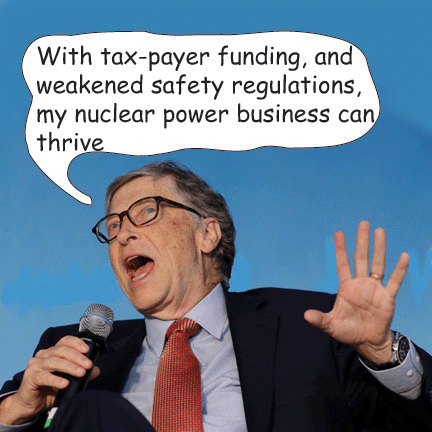
Call for taxpayers not to fund Bill Gates’ small modular nuclear reactor folly

Taxpayers should not fund Bill Gates’ nuclear albatross https://thinkprogress.org/nuclear-power-is-so-uneconomical-even-bill-gates-cant-make-it-work-without-taxpayer-funding-faea0cdb60de/

Nuclear power is so uneconomical even Gates can’t make it work without billions from taxpayers.

JOE ROMMFEB 4, 2019Nuclear power is so uneconomical that even Bill Gates, who is worth $90 billion, can’t make it work without massive taxpayer funding.

Gates has been going around Capitol Hill in recent weeks trying “to persuade Congress to spend billions of dollars over the next decade… for a pilot of his company’s never-before-used technology, according to congressional staffers,” the Washington Post reported.

“This plea for federal largesse from a decabillionaire illustrates why further nuclear subsidies make no sense,” energy and finance expert Greg Kats writes in a forthcoming article for GreenBiz.com shared with ThinkProgress. Kats served as director of finance for the Department of Energy’s (DOE) Office of Energy Efficiency and Renewable Energy in the mid-1990s. (Disclosure: The author of this piece worked with Kats at the time as DOE acting assistant secretary.)

The reality is that nuclear power is so uneconomical that existing U.S. nuclear power plants are bleeding cash — and in many places it’s now cheaper to build and run new wind or solar farms than to simply run an existing nuclear power plant.

Saving the existing unprofitable nuclear plants would require a subsidy of at least $5 billion a year, according to an analysis last July by the Brattle Group.

So, given existing plants are so uneconomic, it’s no shock that building and financing an entire new fleet of nuclear plants is wildly unaffordable — especially since a new nuclear plant can cost $10 billion or more.

The nuclear industry has effectively priced itself out of the market for new power plants, at least in market-based economies. That’s why nuclear power’s share of global power generation has dropped to around 11 percent — its lowest level in decades.

The November “Cost of Energy Analysis 2018” by the financial firm Lazard Ltd makes clear just how untenable nuclear power is.

Even worse for nuclear, the price of electricity from new renewable plants and new nuclear plants have been headed in opposite directions for this entire decade.

Lazard reports that since 2010, the cost of wind power has dropped by 66 percent, the cost of solar power has dropped 83 percent, but the cost of nuclear power has increased by more than 50 percent.

The average lifecycle cost of electricity from new nuclear plants is now $151 per megawatt-hour, or 15.1 cents per kilowatt-hour (c/kWh). Meanwhile it is 4.3 c/kWh for utility scale solar and 4.2 c/kWh for wind. By comparison, the average price for electricity in the United States is under 11 cents per kWh.

Gates and his company, TerraPower, are working on so-called small modular reactors (SMRs), which use unproven next-generation technology and would be much smaller than current nuclear plants. Gates claims that this technology is needed in order to help drive down the price of nuclear power.

But the reality is that an SMR “worsens” the cost problem, as physicist M.V. Ramana explained in a December 2017 analysis.

“Larger reactors are cheaper on a per megawatt basis,” Ramana pointed out, “because their material and work requirements do not scale linearly with generation capacity.” In short, bigger reactors deliver cheaper power than smaller ones — that’s why the industry has kept scaling up the size over the years.

Yet in 2016, a major study by South Australia’s nuclear royal commission concluded that both large nukes and SMRs “consistently deliver strongly negative NPVs” (net present values) for both 2030 and 2050 — even for the strong climate action scenario. In other words, both large and small nuclear plants are projected to be unprofitable even in a future where carbon pollution has a high price.

Even the nuclear-friendly French — who get 70 percent of their power from nuclear  — can’t build an affordable, on-schedule next generation power plant. Last summer, for instance, the French utility EDF announced another delay and cost over-run for what would be the country’s first “third-generation” pressurized water reactor. Power magazine reported the price tag has “ballooned to €10.9 billion (USD $12.75 billion), triple the original budget.”

As for Gates’ TerraPower, analysts looking at the company’s specific design approach say the technology is just not ready for primetime. Last year, a major Massachusetts Institute of Technology report by nuclear power experts concluded such designs “require advances in fuel and materials technology to meet performance objectives.”

The company itself told the Washington Post in an email that it “has been researching new steel alloys.” But such alloys would need to be tested for years if not decades to prove they can withstand the intense bombardment of neutrons over the lifetime of the reactor.

The reality is that next generation nuclear power is still at the research phase. It is far from ready for a pilot that would be so expensive that even the world’s second richest man (after Amazon’s Jeff Bezos) isn’t willing to finance it himself, but has to go begging for federal money.

Gates asserted in a year-end blog post that “Nuclear is ideal for dealing with climate change, because it is the only carbon-free, scalable energy source that’s available 24 hours a day,”

But in fact, battery storage costs have plummeted this decade some 80 percent, meaning that we can increasingly use wind power when it isn’t windy and solar power when it isn’t sunny.

In places like Colorado, both wind power with storage and solar power with storage are vastly cheaper than new nuclear plants. Indeed, new Colorado wind farms with batteries already provide power at the same price as just running existing nuclear power plants.

Certainly, the climate crisis demands that we pursue all practical and economical approaches to cutting carbon pollution. And even some environmental groups are in favor of keeping existing nuclear plants running longer.

But as Kats explained, right now, new nuclear power plants are just far too expensive. What’s more, major investments in multibillion-dollar pilots and reactors could actually take away funds from clean energy technologies that would reduce vastly more

That’s not to say we shouldn’t keep investing in nuclear power research in the hope that someday it becomes affordable.

But given that we must make deep cuts in carbon pollution this decade to even have a chance of avoiding catastrophic climate change, we must focus the vast majority of our money today on vastly more affordable carbon-cutting technologies.

February 7, 2019 Posted by | politics, USA | 4 Comments

Cost of USA’s cold war nuclear weapons waste clean-up now estimated at $377 Billion

February 7, 2019 Posted by | USA, wastes, weapons and war | Leave a comment

Utah Senate committee calls for nuclear power – not everyone is happy

Nuclear power in Utah? Senators say ‘yes, please,by Michael Locklear, February 5th 2019 , State lawmakers are considering a non-binding resolution welcoming nuclear power to Utah, although opponents are concerned about the radioactive waste it would generate.

The resolution, sponsored by Republican Sen. Curt Bramble of Provo, was passed out of a Senate committee on Monday.

It “recognizes that advanced nuclear technology is a safe, resilient, and environmentally sustainable energy resource.”……..

Utah Associated Municipal Power Systems, working with a company called NuScale, is planning a nuclear facility to be built in Idaho. It’s now moving through the regulatory process. Construction could begin in 2026. ………

Michael Simpson, the chair of the University of Utah’s metallurgical engineering department  said nuclear power is cleaner, but he raised concerns about the cost and the nuclear waste.

“The state of Utah should be wary of starting a project to build a nuclear reactor if there’s no place for them to send the fuel,” Simpson said.

“It really is incredibly poisonous stuff,” said Michael Shea of the environmental nonprofit HEAL Utah, “and even if they can store it within the site itself, there’s still a lot of potential for contamination or accidents.” ………

A spokeswoman for Rocky Mountain Power said the utility had no plans to build a nuclear facility, with a statement that reads: “Our most recent Integrated Resource Plan (2017 IRP) included a cost analysis that reflected nuclear generation to be more costly than other resources. However, we are always evaluating emerging technologies to support future needs.”

The resolution now moves to the full Senate. https://kutv.com/news/local/nuclear-power-in-utah-senators-say-yes-please

February 7, 2019 Posted by | politics, USA | Leave a comment

TVA says sale of Bellefonte nuclear plant to Haney would be illegal until regulators approve deal

TVA says sale of Bellefonte nuclear plant to Haney would be illegal until regulators approve deal, TVA defends decision to scrap sale of nuclear plant

February 5th, 2019, by Dave Flessner

The Tennessee Valley Authority says it cannot complete the sale of its Bellefonte Nuclear Power Plant to developer Franklin L. Haney because Haney doesn’t have a license yet to operate the unfinished twin-reactor plant in Alabama.

In a 25-page legal brief filed in federal court Monday, TVA attorneys contend that any sale to Haney would be illegal under the Atomic Energy Act since Haney is trying to acquire and eventually operate the nuclear plant without a properly approved permit.

Haney’s company, Nuclear Development LLC , was the top bidder for Bellefonte at a TVA auction of the abandoned plant in November 2016. But Nuclear Development only filed a license transfer application with the U.S. Nuclear Regulatory Commission (NRC) to take over TVA’s construction permit on the Bellefonte plant on Nov. 13, 2018 — two weeks after the sale was originally supposed to close and only 17 days before an extended deadline for the sale on Nov. 30.

TVA told Haney the day before the Nov. 30 sale was supposed to be completed that it could not sell Bellefonte as a nuclear plant without approval of the license transfer by the NRC. In the sales agreement with Haney, TVA said “federal law at all times govern the validity, interpretation and enforceability” of the sale………..

The legal fight over whether TVA must now sell the Bellefonte plant to Haney is moving in some uncharted waters since the NRC has not previously transferred a deferred construction permit on a nuclear plant to a private individual or a company that has not previously operated a nuclear plant. NRC spokesman Scott Burnell said last month that the NRC staff is still reviewing Haney’s application to take over the deferred construction permit.

Although no active construction has occurred at Bellefonte in nearly a decade, TVA has maintained the plant in deferred status…………

Aided by more than $2 billion in production tax credits for new nuclear generation allocated for Bellefonte and the prospect of $5 billion or more in federal loan guarantees for the project, Haney claims he should be able to finish the reactors at a cost allowing him to deliver power as much as $500 million a year cheaper for electricity users.

But Haney, a former Chattanooga real estate developer who now lives in south Florida, has no previous experience owning or operating a nuclear plant. Haney has amassed a fortune over the past four decades buying, developing and leasing properties to TVA, the Internal Revenue Service and other government agencies and airports, along with hotels, office buildings and other developments.

Haney said he is assembling a team of top engineering, design and construction firms with experience in the nuclear power industry to finish building Bellefonte.

Haney, who contributed more than $1 million to President Trump’s inaugural fund through a limited partnership known as HFNWA and once hired Haney’s personal attorney Michael Cohen to help with the Bellefonte project, has applied for federal loan guarantees for Bellefonte. The U.S. Department of Energy is still considering Haney’s loan application……… https://www.timesfreepress.com/news/breakingnews/story/2019/feb/05/tva-says-bellefonte-illegal/488049/

February 7, 2019 Posted by | legal, USA | Leave a comment

New Hampshire must say no to nuclear war

My Turn: New Hampshire must say no to nuclear war, https://www.concordmonitor.com/NH-must-say-no-to-nuclear-war-23265489 By MINDI MESSMERFor the Monitor 2/6/2019 School children are no longer participating in duck-and-cover drills, but Americans and the public officials who represent them are becoming increasingly aware that the risks of a nuclear war, which could be started intentionally or accidentally, have not gone away.

Events here at home and abroad have brought renewed attention to this issue. Americans have suddenly realized that U.S. presidents have authority to order a nuclear weapon strike without consulting anyone. Just one phone call and hundreds of U.S. nuclear missiles can be launched in less than 10 minutes. Meanwhile, national security experts are speculating about a renewed nuclear arms race as the U.S. and Russia develop new nuclear weapons and the U.S. prepares to withdraw from arms control treaties, including the landmark 1987 Intermediate-range Nuclear Forces (INF) Treaty that President Ronald Reagan signed with Soviet leader Mikhail Gorbachev. Both sides accuse the other of violating the treaty.

Cities and towns across New Hampshire and the country – including Durham and New London, N.H., Baltimore, Los Angeles and Portland, Maine – are passing resolutions calling on the United States to limit the risk of nuclear war by changing U.S. policies. About a dozen other New Hampshire cities are considering following suit. California and the U.S. Conference of Mayors have passed similar resolutions. Organizations including the Unitarian Universalist Association, Union of Concerned Scientists, Federation of American Scientists and Physicians for Social Responsibility have joined the call.

The resolutions recommend a number of steps that would make nuclear war less likely. Most importantly, they call on the U.S. to state that it will never use a nuclear weapon first; no U.S. president should ever start a nuclear war.

The N.H. General Court may be the next to take a position on this issue. The State-Federal Relations and Veterans Affairs Committee in the N.H. House will hold a hearing today on HCR 7, a resolution introduced by Rep. Chuck Grassie that calls on the U.S. to establish a “no first use” policy.

If enacted, the measure would throw New Hampshire’s support behind legislation, introduced in Congress last week by House Armed Services Committee Chair Adam Smith and Senate Armed Services Committee member Elizabeth Warren, to make it U.S. policy not to use nuclear weapons first.

As the world’s most powerful country, the only reason the U.S. needs nuclear weapons is to deter a nuclear attack on America or its allies. The threat that the U.S. may use its nuclear weapons first is counterproductive and could prompt a pre-emptive strike from a nuclear-armed adversary if it feared a U.S. nuclear launch was imminent.

Knowing that the U.S. could respond to a nuclear attack with its own nuclear strike, however, is a real deterrent; that is the message a no-first-use policy would send to the rest of the world.

When cities and states enact resolutions like the one before the N.H. Legislature, it sends a strong message to Washington decision-makers, both in Congress and the White House, that they must act for the safety of all Americans.

(Mindi Messmer of Rye is an environmental scientist working with the Union of Concerned Scientists and a former N.H. state representative.)

February 7, 2019 Posted by | politics, USA, weapons and war | Leave a comment

Boeing Sued for Negligence in Wildfire That Devastated Malibu

Bloomberg, By Edvard Pettersson, February 6, 2019, Boeing Co. was accused of negligence tied to a wildfire that tore through Malibu, California, in November and that purportedly started on the grounds of the nearby, disused Rocketdyne testing site.

A group of homeowners sued Boeing along with Edison International, the parent of the utility they say was at fault in igniting the fire, on Tuesday in Los Angeles. They claim Boeing failed to properly manage the vegetation on the Santa Susana Field Laboratory and allowed the fire to spread to surrounding neighborhoods.

The Woolsey fire killed 3, burned about 100,000 acres and destroyed 1,500 structures in and around Malibu. Southern California Edison has said an electrical substation on the Boeing property suffered an outage two minutes before the fire was first reported.

…… The case is LaPlante v. Southern California Edison, 19STCV03419, California Superior Court, Los Angeles County.https://www.bloomberg.com/news/articles/2019-02-06/boeing-sued-for-negligence-in-wildfire-that-devastated-malibu

February 7, 2019 Posted by | legal, USA | Leave a comment

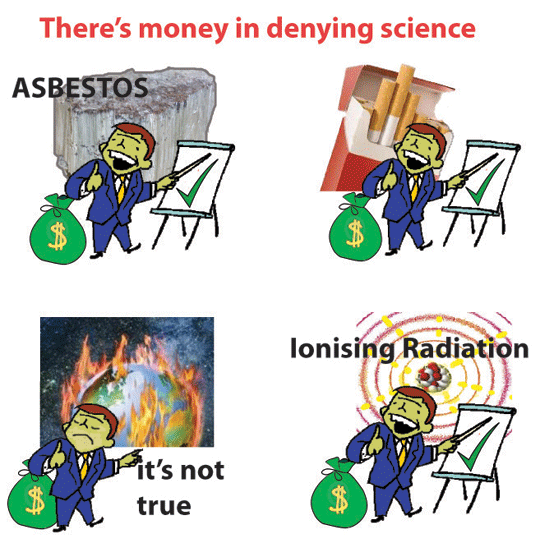
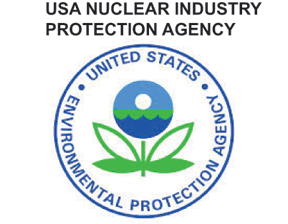
New radiation panel leader appointed by EPA in the interests of nuclear corporations, not of the public

Guy Who Wants to Eliminate Radiation Limits Will Lead EPA on Radiation, https://www.care2.com/causes/guy-who-wants-to-eliminate-radiation-limits-will-lead-epa-on-radiation.html By: Kevin Mathews, February 3, 2019, About Kevin, Follow Kevin at @care2

When Trump supporters chant “make America great again,” I have difficulty imagining that any of them are longing for the days when radiation exposure went unregulated. Nevertheless, that’s precisely the direction the EPA is headed with its latest appointment.

Brant Ulsh, a health physicist working for a consulting firm, will serve as both a scientific advisor to the EPA and as the new leader of the Radiation Advisory Committee. Ulsh is a controversial choice because he is considered the nation’s most outspoken critic of radiation levels.

His papers and positions put him at odds with the overwhelming majority of the scientific community that believes coming into contact with even low levels of ionizing radiation poses a significant cancer risk. He claims the science is too outdated and insufficient to warrant the existing government standards.

“Once again the Trump administration is moving to the fringe for its scientific advice, choosing someone who could undercut foundational protections from radiation,” wrote the Natural Resources Defense Council in a statement regarding Ulsh’s appointment.  “We need sound science to dictate health protections, not dangerous theories.”

If you’re wondering what angle Ulsh is working, he admits to it in his own papers. Evidently, he’s concerned that our radiation regulations put “unnecessary burdens” on corporations. Funny how the conservatives in power always seem more concerned with the extra money rich companies pay to keep people safe than actual public safety.

For what it’s worth – and it should be worth a lot, EPA head Andrew Wheeler – just last year the National Council on Radiation Protection and Measurements reviewed 29 studies that reconfirmed a correlation between low level radiation exposure and an increased risk of cancer.

As a scientific advisor to the EPA and the head of the Radiation Advisory Committee, Ulsh could play a pivotal role in rolling back the standards that dictate acceptable amounts of radiation. Since humans can’t detect when they’re exposed to radiation, we rely on enforcement of these limits to keep us safe.

Make no mistake – this appointment isn’t accidental. There are countless scientists who could have led the Radiation Advisory Committee that accept the existing scientific consensus on radiation levels. To choose an outlier like Ulsh is to look for someone to deliberately take the agency in a different direction.

In fact, thanks to an Associated Press story from last year, we know that the EPA was already making plans to throw out regulations on radiation, so having a scientist like Ulsh bring his own opinions could be the ideal vehicle in order to accomplish that agenda.

At the risk of being hyperbolic, at this point, I think we’ve got to ask ourselves: is the Trump administration just trying to kill us? They’re appointing fossil fuel lobbyists to oversee climate change, corporate polluters to worry about clean water, chemical bigwigs to regulate pesticides and now a pro-radiation guy to set radiation standards.

Is nothing sacred? Does the Trump administration feel no obligation to keep the American people safe? If the EPA is so confident that scientists are wrong and radiation isn’t actually harmful, maybe it should start by experimenting at the White House before unleashing it on the public at large.

February 4, 2019 Posted by | secrets,lies and civil liberties, spinbuster, USA | 2 Comments

Extreme cold shuts down N.J. Nuclear Reactor, due to an unusual ice phenomenon

Rare Ice Phenomenon Forced a Shutdown at a N.J. Nuclear Reactor, Fortune, By JIM EFSTATHIOU JR. and BLOOMBERG ,February 1, 2019

The arctic blast wreaking havoc across much of the U.S. was cold enough to shut down a nuclear reactor, thanks to a rare phenomenon called frazil ice.

Public Service Enterprise Group shut one unit at its Salem nuclear plant in southern New Jersey early Thursday after intake screens froze over, restricting the flow of water needed to cool the reactor, according to spokesman Joe Delmar. A second unit at the station on the Delaware river was powered down because of the same problem.

The 60-foot (18-meter) tall intake screens rotate in and out of the water, preventing debris like floating wood from entering the plant. Under extreme conditions like this week—overnight low temperatures at the station fell into the single digits—the frazil ice can accumulate on the screens, blocking the flow. That caused water circulators to shut down and prompted Newark-based Public Service to take the plant offline………http://fortune.com/2019/01/31/ice-shutdown-new-jersey-nuclear-reactor/

February 4, 2019 Posted by | climate change, USA | Leave a comment

Tax-payer costs for weaponry – US Navy awards $15.2bn to build two nuclear-powered aircraft carriers

US Navy awards $15.2bn to build two nuclear-powered aircraft carriers Naval Technology, 4 Feb 19,  The US Navy has awarded a $15.2bn contract modification to Huntington Ingalls Industries’ (HII) Newport News Shipbuilding division to build two nuclear-powered aircraft carriers.

The multi-ship contract comes after the US Navy expressed its intention to pursue a block-purchase of two Ford-class aircraft carriers in a bid to save money.

According to the Navy, the deal is expected to deliver savings of more than $4bn to the government.

Under the contract, HII will provide the detail design and construct the Gerald R Ford-class nuclear-powered aircraft carriers Enterprise (CVN 80) and CVN 81.

Newport News Shipbuilding president Jennifer Boykin said: “Today’s announcement is a triumphant step toward returning to a 12-ship aircraft carrier fleet and building the 355-ship Navy our nation needs.

“Most importantly for us, it provides stability into the year 2032 for our workforce and for our supplier businesses across the US.”………https://www.naval-technology.com/news/us-navy-nuclear-powered-aircraft-carriers/

February 4, 2019 Posted by | USA, weapons and war | Leave a comment

Commissioners Disagree on Final Rulemaking in Response to Fukushima Accident

https://www.lexology.com/library/detail.aspx?g=ad53e9d3-58ca-4bae-bb07-066ea9255afa, Morgan Lewis & Bockius LLP,  1 Feb  2019

A divided Commission at the US Nuclear Regulatory Commission (NRC) on January 24 approved the Mitigation of Beyond-Design-Basis Events rulemaking (Final Rule). The NRC began the rulemaking in December 2016 as part of its efforts to evaluate and implement, if necessary, regulatory changes in response to the Fukushima Daichi event in March 2011. In somewhat of a surprise, the majority of Commissioners last week rejected large portions of the proposed rule submitted by the NRC staff over two years ago. The rationale for changing the Final Rule demonstrates a renewed emphasis on applying backfit analyses. Continue reading

February 4, 2019 Posted by | safety, USA | Leave a comment