nuclear-news

The News That Matters about the Nuclear Industry Fukushima Chernobyl Mayak Three Mile Island Atomic Testing Radiation Isotope

U.S. Department of Energy seeks new certification for its Waste Isolation Pilot Plant

Exchange Monitor 18th April 2019 , The Department of Energy is seeking another five-year certification from
the Environmental Protection Agency for its Waste Isolation Pilot Plant
near Carlsbad, N.M. The WIPP Land Withdrawal Act requires DOE to seek
recertification every five years to ensure the site’s compliance with
federal radioactive waste disposal requirements, according to an executive
summary of the application.

The package provides new data on the
underground repository, its waste inventory, and key changes since the last
update. The site was first certified for permanent disposal of transuranic
waste in 1998. The Environmental Protection Agency can “modify, revise,
or suspend” the certification, EPA supervisory environmental scientist
Thomas Peake said Tuesday during a two-day meeting in Washington, D.C., of
the National Academies’ Nuclear and Radiation Studies Board.

https://www.exchangemonitor.com/epa-recertification-sought-wipp-2024/?printmode=1

April 22, 2019 Posted by | USA, wastes | Leave a comment

Canada’s Came co Corp slow to clean up groundwater contaminated with uranium at Saskatchewan mill

Saskatoon Star Phoenix 20th April 2019 , Canada’s largest uranium producer says it’s developing a plan to clean
up groundwater contaminated with uranium and radiation four months after it was first discovered at a shuttered mill in northern Saskatchewan.

Cameco Corp. reported in December that a sampling well adjacent to its Key Lake mill “was showing an increasing trend in uranium concentration” after 50,000 litres of water were “released” over the previous year. Carey Hyndman, aspokeswoman for the Saskatoon-based company, said this week that the incident was immediately reported to the Saskatchewan Ministry of Environment and the Canadian Nuclear Safety Commission.

https://thestarphoenix.com/news/local-news/cameco-developing-plan-to-clean-up-contaminated-groundwater-at-key-lake

April 22, 2019 Posted by | Canada, Uranium, water | Leave a comment

Pentagon’s strange and dangerous plan for small nuclear reactors at the battle scene

April 20, 2019 Posted by | Small Modular Nuclear Reactors, USA, weapons and war | Leave a comment

On climate change impacts, nuclear lobby has captured the regulators

April 20, 2019 Posted by | climate change, politics, secrets,lies and civil liberties, USA | Leave a comment

USA is preparing more charges against Julian Assange

April 20, 2019 Posted by | civil liberties, USA | Leave a comment

State subsidies for nuclear power in USA are simply not necessary

State Nuclear Subsidies Not Needed, Forbes, Adam Millsap-19 Apr 19 
Natural gas has become the dominant source of electricity generation in the United States and this is creating some financial issues for the nuclear industry. Since 2010, several nuclear plants around the country have closed and economic conditions, particularly low natural gas prices, are often citedas a factor. Officials from companies that own and operate struggling plants are seeking government assistance to stay afloat, but state lawmakers should be skeptical.

The decline in the price of natural gas since 2008, shown in the figure below, [on original] has made it difficult for some nuclear plants to compete. Prior to 2008, some thought a nuclear renaissance was on the horizon. Now this seems unlikely.

Nuclear power is characterized by the initial high costs of plant construction followed by relatively low operating costs. When alternative energy sources—such as coal, oil, solar, etc.—are expensive, it can make economic sense to bear the high costs of nuclear plant construction. But when other prices are low, as with today’s abundant natural gas and increasingly competitive wind and solar power, it’s harder to justify new plant construction.

Not only are economic conditions working against new nuclear plants, but they are also unfavorable to many existing plants. Unsurprisingly, officials from the companies that own and operate the struggling plants want some government help. A recent report in Pennsylvania’s York Dispatch shows that Exelon Corp.—the owner of some of the struggling plants—significantly increased its lobbying spending in Pennsylvania in 2018 compared to the previous five election cycles. Spending increased from an average of just over $646,000 from 2008 to 2016 to nearly $1.8 million in 2018.

There is some evidence that the lobbying is working. …..

Subsidies work by taxing one group and giving the revenue to another. In the Pennsylvania and Ohio bills, the funding for the subsidy is raised via higher electricity rates on consumers.

Supporters of both bills argue that nuclear is a vital source of clean energy and that without legislation nuclear plants will continue to shut down. But despite competition from natural gas and renewables, it’s not clear that the nuclear industry as a whole is in deep financial trouble. According to a recent analysis, all but one of Pennsylvania’s five nuclear plants are covering their costs. Since there is no financial stress requirement in the Pennsylvania bill, profitable plants in the state will benefit just as much as the current unprofitable one—Three Mile Island Unit 1.

More broadly, a recent State of the Market Report for PJM, which is the regional transmission organization that coordinates the movement of wholesale electricity in Pennsylvania, Ohio, and other nearby states, also casts doubt on the general unprofitability of nuclear power. The report projects that only three of 18 nuclear plants in the region—Three Mile Island along with Davis-Besse and Perry in Ohio—won’t be able to cover their costs for at least one year between 2019 to 2021. ……

 it’s not clear that subsidizing inefficient nuclear plants is the most economical way to address climate change , since subsides have problems of their own……

subsidies to nuclear plants are also likely to crowd out new, more efficient electricity plants. Total electricity generation in the United States has declined slightly since 2010 despite economic growth in the form of real GDP per capita, as shown below. [on original]

In a world of declining or even stable electricity use, the profit motive for investing in new capacity is weakened if new plants are not allowed to out-compete less efficient plants for market share. So as long as less efficient nuclear plants are meeting consumer demand, newer plants powered by natural gas, wind, solar, or some other source will have a difficult time finding a market.

Stu Bressler, senior vice president of operations and markets for PJM Interconnection, recently said essentially this when he told Ohio lawmakersthat subsidizing less competitive plants “…could prevent the building of more efficient and cost effective plants, including cleaner technologies like solar and wind.”

Finally, just because a subsidy has the potential to improve economic efficiency doesn’t mean it will. A subsidy that is too small will not generate enough of the good or service. A subsidy that is too large can generate too much, leading to more inefficiency than no subsidy at all. The bureaucratic costs of estimating the correct subsidy, implementing it, and administering it must also be considered. If these costs outweigh the potential gains in efficiency from the subsidy, then the economy would be better off without it.

It doesn’t appear that Ohio or Pennsylvania lawmakers have rigorously estimated the appropriate subsidy or accounted for the costs of implementing and administering one in their proposals. Without such analysis, it’s unlikely that the proposed nuclear subsidies will lead to an improvement in consumer welfare. Instead, these subsidies will likely do more harm than good, as they seem to be primarily designed to help a few unprofitable nuclear plants rather than carefully thought out pieces of a broader, market-based energy plan.

Adam A. Millsap is the Assistant Director of the L. Charles Hilton Jr. Center at Florida State University and an Affiliated Scholar at the Mercatus Center at George Mason University. https://www.forbes.com/sites/adammillsap/2019/04/19/state-nuclear-subsidies-not-needed/#e532f23111dc

April 20, 2019 Posted by | politics, USA | Leave a comment

Harvey Wasserman: America’s “Hole-in-the-Head” Nuke Suicide Pact Gets Court Approval 

April 20, 2019 Posted by | politics, USA | Leave a comment

Three Mile Island, and the nuclear industry’s legacy of cancer

The legacy of nuclear power is checkered at best, Delware State News, Apr 18th, 2019 · by Alan Muller

Forty years ago, on March 28, 1979, the Three Mile Island (TMI) Unit 2 nuclear power reactor in central Pennsylvania — about 95 miles northwest of Dover — partially melted down and experienced at least one explosion.

Many of us living in Delaware at the time were very concerned about being downwind and somewhat downstream of a nuclear accident of unknown magnitude.

The causes were a combination of equipment failures, design defects and operator errors. The operators did not have accurate indications of what was going on in the reactor, so they couldn’t make the right decisions. Reportedly, more than half of the radiation monitors in the area were broken, so there was not adequate indication of how much radioactivity was released and where it went.

Days afterwards: “[Pa.] Governor Thornburgh advised pregnant women and pre-school age children to leave the area within a five-mile radius of the Three Mile Island facility until further notice. This led to the panic the governor had hoped to avoid; within days, more than 100,000 people had fled surrounding towns.”

Ever since the TMI meltdown, nuke industry sources and public health authorities have claimed that too little radioactivity was released to harm people’s health…….

Failure to investigate TMI health effects was published in the Bulletin of the Atomic Scientists in 2004. This included failure to investigate, media blackouts and the firing of Pennsylvania Health Commissioner Gordon MacLeod by Gov. Thornburgh after he pointed out increases in infant mortality and other health problems near TMI.

Jane Lee, a local farmer, with others, went door-to-door and said they had found and documented many acute health problems. I knew Jane towards the end of her life. She’d been unable to arrange publication of her work, and wasn’t online A deposit of Jane Lee Papers at Dickenson College (Carlisle, Pa.) may hold some of this information.

More recently in 2017:

“A new Penn State College of Medicine study has found a link between the 1979 Three Mile Island accident and thyroid cancer cases in south central Pennsylvania. The study marks the first time the partial meltdown can be connected to specific cancer cases, the researchers have said. The findings may pose a dramatic challenge to the nuclear energy industry’s position that radiation released had no impact on human health.” …….

All nuclear plants release radiation to air and water during normal operation, as do other parts of the nuclear fuel cycle such as uranium mining. Many nuclear plants have tall stacks intended to disperse “noncondensible” radioactive emissions. See one in pictures of the Peach Bottom nuclear plant — three of this same General Electric design melted down in Japan in 2011. Evidence is accumulating that these releases from normal operations may have health impacts.

Some reports claim the only health effects from TMI were mental health impacts from stress, as if “mental health impacts” were unimportant.

The TMI meltdown ended expansion of the U.S. nuclear power industry — after TMI, no new reactors were ordered in the U.S. and many projects were stopped.

Now, 40 years later, the remaining industry is collapsing, largely because wind and solar have become cheaper. The remaining TMI unit is to shut down this year. But the nuke industry isn’t going down without a fight, trying to rebrand itself as a climate change solution. In fact, the nuclear fuel cycle releases less climate-changing carbon dioxide than fossil-fuel burning but much more than wind or solar (per unit of electricity generated).

It is timely to think about TMI as Delaware is surrounded by nuclear power reactors. About 10 percent of all those in the U.S. are within 50 miles of Delaware. The Salem/Hope Creek reactors, the nearest, have recently received an enormous subsidy from the state of New Jersey to stay open. On the other hand, the Oyster Creek, N.J., reactor has closed.

This contraction of the nuclear power industry won’t be easy for people working in it, or for some of the nuclear host communities. But it will happen regardless and ultimately we will be safer and healthier for it.

To ignore the human impacts of the nuclear industry is a moral failure.

Alan Muller is executive director of Green Delaware.   https://delawarestatenews.net/opinion/commentary-the-legacy-of-nuclear-power-is-checkered-at-best/

April 20, 2019 Posted by | health, USA | Leave a comment

USA’s new proposal “Creating an Environment for Nuclear Disarmament”

Sidetrack or kickstart? How to respond to the US proposal on nuclear disarmament. Bulletin of the Atomic Scientists , By Lyndon BurfordOliver MeierNick Ritchie, April 19, 2019 Speaking to the Geneva-based Conference on Disarmament on March 26, US Assistant Secretary of State Chris Ford presented the “Creating an Environment for Nuclear Disarmament” (CEND) initiative. According to Ford, the scheme “aims to help the international community find a path forward by setting in motion a ‘Creating an Environment Working Group’ process.” He described CEND as a “pathbreaking new initiative” to bring countries together in a constructive dialogue to explore how “it might be possible to ameliorate conditions in the global security environment so as to make that environment more conducive to further progress toward—and indeed, ultimately to achieve—nuclear disarmament.”………

The name change is important because it points to the initiative’s key problem: the risk that the United States and other nuclear weapon states will use the process of Creating an Environment for Nuclear Disarmament to deflect pressures to take concrete action on disarmament. ……

What’s in a name? Shifting from conditions to progress. While the shift from “creating the conditions” to “creating the environment” suggests a willingness to listen (at least, to allies and P5 states), a closer comparison between Ford’s Geneva remarks and his earlier statements on the subject leads one to be sceptical. The Geneva speech does not substantively move beyond the conditions narrative. Ford consistently and repeatedly argues that disarmament can only move forward when and if the prevailing security conditions are improving. This focus is problematic for a number of reasons.

First, it is conservative and unimaginative; it highlights the barriers to disarmament, rather than exploring ways to make progress…..

nuclear weapon states often highlight the “conditions” for nuclear disarmament, mainly to argue that others are responsible for the fact that these conditions are “not ripe” yet….

the “conditions” narrative is perceived by many as a stepping away from Nuclear Non-Proliferation Treaty (NPT) disarmament commitments, including specifically the disarmament Action Plan agreed by NPT states parties at the 2010 Review Conference. The United States and other nuclear weapon states have been trying to diminish the importance of such commitments by arguing that they were concluded under different, arguably “better” circumstances. …….

The core challenge remains mobilizing the collective political will to take practical steps forward and working out effective measures that could precipitate a deeper transformation of global nuclear politics. In this regard, the issue of how the CEND working group relates to the Treaty on the Prohibition of Nuclear Weapons (often called the ban treaty) will be important.

The United States and other nuclear-armed states have not engaged with the ban treaty. …… the CEND working group will itself lack legitimacy if it sets itself up in opposition to the ban treaty. .. the group of ban treaty supporters is now so large that its voice will have to be heard in the CEND process. …..

for the time being, the Creating the Environment for Nuclear Disarmament working group is only an idea, but it could offer a new opportunity for states to engage on progress towards nuclear disarmament. It could be a serious, honest, and open forum to discuss the responsibilities of all states, including the nuclear weapon states, in helping create the conditions for nuclear disarmament and taking specific steps in that direction. For that to happen, however, participating states must have shared ownership, including financial buy-in as appropriate, to make sure that they have an equal say in the make-up and functioning of the group and the conclusions it reaches over time.  https://thebulletin.org/2019/04/sidetrack-or-kickstart-how-to-respond-to-the-us-proposal-on-nuclear-disarmament/

April 20, 2019 Posted by | USA, weapons and war | Leave a comment

Artificial Intelligence Could Solve Nuclear Fusion’s Biggest Problem

April 20, 2019 Posted by | technology, USA | 2 Comments

U.S. Ignored Russia’s Nuclear War Prevention Pact – Reports

https://www.themoscowtimes.com/2019/04/19/us-ignored-russias-nuclear-war-prevention-pact-reports-a65313  Russia sent the United States a draft joint declaration on how to prevent nuclear war, only to never hear back from Washington, the Kommersant business daily reported on Friday.The U.S. and Russia are suspending the 1987 Intermediate-range Nuclear Forces (INF) Treaty this summer. The only U.S.-Russia arms control pact limiting deployed nuclear weapons — the New START — expires in February 2021.

“Nuclear war cannot be won and it must never be unleashed,” Kommersant quotedRussia’s draft joint declaration, which was sent to the U.S. in October 2018, as stating.

Similar declarations have been adopted between the U.S. and the Soviet Union in the early 1970s. Russian Foreign Minister Sergei Lavrov reportedly suggested a revival of the nuclear war avoidance pact ahead of U.S. national security adviser John Bolton’s visit to Russia in October 2018.

Andrea Kalan, spokeswoman for the U.S. Embassy in Moscow, told the publication that Washington adheres to arms control systems with partners “that honor their commitments responsibly.”

Kremlin spokesman Dmitry Peskov accused the U.S. of routinely ignoring Russia’s inroads on Friday.

Russia’s proposals to the U.S. included “strategic security and stability, cooperation in the fight against cybercrime, and so on,” Peskov said.

“All these Russian initiatives and proposals were in effect left unanswered,” he was quoted as saying to reporters by Kommersant.

April 20, 2019 Posted by | politics international, USA, weapons and war | Leave a comment

The long-lasting unsolved problem of Three Mile Island’s radioactive trash

Where will the nuclear waste go after Three Mile Island shuts down? The Inquirer, by Andrew Maykuth, April 14, 2019  After the infamous Three Mile Island nuclear accident 40 years ago, most of the reactor’s partially melted uranium fuel was hauled away to the Idaho National Lab, where the radioactive waste now slowly decays in steel and concrete containers, awaiting long-term disposal.

April 18, 2019 Posted by | USA, wastes | 1 Comment

USA Congressmen concerned at slow clean-up of dangerous San Onofre nuclear site

April 18, 2019 Posted by | politics, USA, wastes | Leave a comment

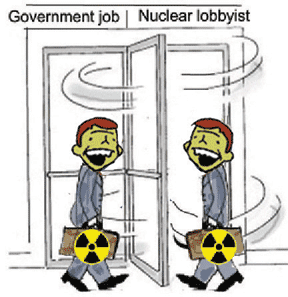
Trump’s administration speeds up the revolving door between Pentagon and nuclear weapons companies

April 18, 2019 Posted by | business and costs, politics, secrets,lies and civil liberties, USA | Leave a comment

Holtec’s nuclear decommissioning and wastes empire to grab Indian Point

Holtec to snap up Indian Point nuclear units for decommissioning, Utility Dive,Iulia Gheorghiu@IMGheorghiu    17 Apr 19

Dive Brief:

  • Holtec International announced an agreement on Tuesday to acquire Entergy’s Indian Point nuclear power plant units for expedited decommissioning.
  • Entergy will sell Units 1, 2 and 3 to a Holtec subsidiary, transferring licenses, spent fuel, decommissioning liabilities and nuclear decommissioning trusts for the units. Unit 1 was retired in 1974 while Unit 2 and Unit 3, totaling about 2 GW, are scheduled to retire in April, 2020 and April, 2021, respectively, according to Entergy’s agreement with New York state.
  • Holtec announced its intentions in August to buy Entergy’s Pilgrim power plant in Massachusetts and the Michigan-based Palisades nuclear plant, as well as Exelon’s Oyster Creek plant in New Jersey, shut down last September. In each case, the deals will will require approval from the Nuclear Regulatory Commission (NRC), along with state agencies.

Dive Insight:

The sale of Indian Point to a decommissioning firm marks the beginning of the end for the nuclear plant — the only one in New York not to receive subsidies under the state’s Zero Emission Credit program.

“The sale of Indian Point to Holtec is expected to result in the completion of decommissioning decades sooner than if the site were to remain under Entergy’s ownership,” Leo Denault, Entergy CEO and chairman, said in a statement.

The NRC is still reviewing the license transfer applications for Pilgrim and Exelon’s Oyster Creek. The regulators had not yet received any formal application regarding Indian Point and Palisades, the latter of which is set to be retired in 2022.

Entergy has not announced the value of the nominal cash considerations it would receive for Indian Point or any of its other nuclear decommissioning transfers.

However, another spent nuclear fuel specialist, NorthStar Group Services, took over Entergy’s closed Vermont Yankee nuclear power plant in October. In that case, the NRC required “some additional financial guarantees” beyond the plant’s nearly half a billion dollars in its decommissioning trust fund, according to NRC spokesperson Neil Sheehan

…… The decision for Entergy to shut down its merchant nuclear generation early comes amid several other recent nuclear plant closures.

“The plant owners have found it difficult to deal with the financial realities of low costs of natural gas, subsidies to other forms of power and other factors,” Sheehan told Utility Dive.

Situated near the Hudson River in Buchanan, New York, Indian Point’s two operating units power New York City and the surrounding county.

The Department of Energy is otherwise obligated to remove the waste to a permanent storage site, though selecting one has proved to be a drawn out process in Congress.

Until the DOE acts or the waste can be sent to Holtec, the company plans to transfer the spent nuclear fuel to dry cask onsite storage, which will be under guard, monitored during the shutdown and decommissioning activities.

…….. Two interim storage facilities for nuclear waste are currently seeking regulator approval to begin their intake of used fuel. One of them is Holtec’s proposed facility in New Mexico, HI-STORE Consolidated Interim Storage (CIS). …… https://www.utilitydive.com/news/holtec-to-snap-up-indian-point-nuclear-units-for-decommissioning/552894/

April 18, 2019 Posted by | decommission reactor, USA | 2 Comments