Climate change poses huge flooding risk to USA’s nuclear stations, but this is ignored by Trump administration
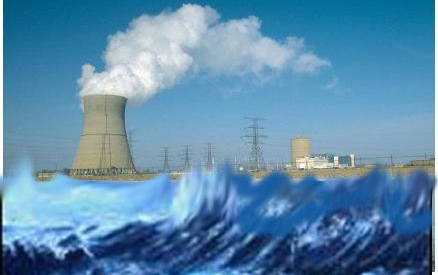 Trump administration is ignoring a massive problem at U.S. nuclear plants Trump administration is ignoring a massive problem at U.S. nuclear plants “54 of the [60] nuclear plants operating in the U.S. weren’t designed to handle the flood risk they face.” https://thinkprogress.org/nuclear-plants-flood-risk-trump-2eb58bc654a7/  At first, the main effort was a direct bailout — Energy Secretary Rick Perry’s failed planto subsidize nuclear (and coal) power plants by raising consumer energy bills. At first, the main effort was a direct bailout — Energy Secretary Rick Perry’s failed planto subsidize nuclear (and coal) power plants by raising consumer energy bills.
Now the administration has started cutting corners in nuclear safety and oversight. Trump appointees, who are a majority at the U.S. Nuclear Regulatory Commission (NRC), are allowing the nuclear industry to avoid costly upgrades to plants that are not designed to withstand current flood risk. What’s especially shocking about this decision, made by the NRC in January, is that a remarkable “54 of the [60] nuclear plants operating in the U.S. weren’t designed to handle the flood risk they face,” as Bloomberg reported last week after reviewing information exchanged between the plant owners and the NRC. Yet, even after examining all of the same information, the three NRC commissioners appointed by President Donald Trump decided to ignore NRC staff recommendations to address the problem. As a result, U.S. nuclear plants weren’t required to upgrade their designs or equipment. The NRC had ordered the original review of the flood risk to U.S. nuclear plants in the wake of the March 2011 Fukushima Daiichi disaster in Japan. In that tragic incident, an earthquake and tsunami led to three nuclear reactors melting down and widespread radiation releases. The cleanup effort will take decades and is currently estimated to cost $470 billion to $660 billion. Nuclear power plants are uniquely vulnerable to flooding because they need to be located next to a river, lake, or ocean since they require a dependable source of vast quantities of water for cooling. But if a major flood event disables the plant’s power and shuts off its cooling systems — as happened at Fukushima — then the reactor will overheat and start melting down, which, in turn can breach the containment vessel, leading to dangerous radioactive releases. Given the terrible cost of such a flood-driven failure, the NRC told all U.S. nuclear plant operators to examine their current flood risk and compare it to what the plants were designed to withstand. After all, since most of the decades-old plants were built, risks have increased thanks to urbanization and climate change. At the same time, flood modeling tools have vastly improved. The results were stunning. Of the 60 U.S. nuclear plants, Bloomberg reports that 53 “weren’t built to withstand their current risk from intense precipitation,” while 25 couldn’t handle current flood projections. Worse, 19 plants — nearly one third of the total — were now at risk of three or more flooding threats that they were not designed to weather, including the maximum storm surge they might face. And this review may actually understate the flood risk because the plant owners were allowed “not only to perform their own estimates of current flood risk but also to decide what assumptions to make.” Even so, some nuclear plants face flood risks of more than 10 feet above their design level. In response to the new flood risks, the NRC staff had proposed that U.S. nuclear plants upgrade their safety equipment. The industry, however, favors simply relying on an existing system called Flex, for Flexible Mitigation Capability, whereby emergency generators and pumps are put in concrete bunkers. On January 24, the three Trump-appointed commissioners overrode objections by the two other commissioners and ruled that U.S. nuclear operators could skip the upgrades required to handle the actual flood risk they face. What’s more, they were not required to routinely update their flood risk analysis as climate science advanced. The Trump appointees also did away with a requirement that U.S. nuclear plants perform Flex drills. That move is especially dangerous considering that as recently as December 2016, one of the emergency generators at the Palo Verde plant near Phoenix “exploded during a routine test,” as AZCentral.com reported in 2017. Nuclear plants clearly need more drills and tests, not fewer. But the Trump appointees appear to support the president’s view that essentially all regulations on industry are bad. The result, as former NRC chair Gregory Jaczko explained to Bloomberg, is that “any work that was done following Fukushima is for naught because the commission rejected any binding requirement to use that work.” Jaczko added, “It’s like studying the safety of seat belts and then not making automakers put them in a car.” So nine out of 10 U.S. nuclear plants are simply unprepared for the flood risk they face today — and they don’t have to plan for the ever-worsening risks posed by climate change. The president is once again failing to protect Americans from a very real threat to their health and safety. |
|
|
USA’s Dept of Energy fails to provide adequate funding for Hanford nuclear clean-up
“The HAB views the combined lack of compliant budget appropriations, the unanticipated problems at Hanford, and the extreme increase in estimated funding levels identified in the lifecycle cost report with great concern,” the board told DOE. Those factors will result in cleanup taking longer and costing more, putting workers, the environment, and the public at increased risk, the letter says.
“They will also result in additional discussion about reducing standards or potentially conducting a lesser quality cleanup,” according to the board.
Unanticipated problems in work at the former plutonium production complex have included the spread of radioactive contamination at the Plutonium Finishing Plant demolition in 2017 and the May 2017 collapse of the older of two PUREX Plant radioactive waste storage tunnels.
The Energy Department has addressed the issues, but the costs and schedule impacts from these and other unanticipated setbacks could compound the challenge of meeting milestones set under the legally binding Tri-Party Agreement on Hanford cleanup, the budget letter said.
The latest Hanford Lifecycle Scope, Schedule and Cost Report, released in January, “is particularly concerning,” the board said. It put the remaining cost of Hanford cleanup and the initiation of long-term stewardship at $323 billion to $677 billion, and said work could continue beyond this century. The amount of funding needed annually would increase to $4 billion starting in fiscal 2020 and later could peak as high as $16 billion in 2088 under the worst-case scenario.
“Receiving appropriation for even the low-range annual funding estimates will be extremely challenging, thereby putting the cleanup mission in further jeopardy,” the letter said.
For fiscal 2020, which begins Oct. 1, DOE is seeking $2.1 billion for the two offices at Hanford. That would be a $400 million reduction from current funding levels.
End of nuclear cooperation waivers could quietly kill Iran deal
|
Forget oil sanctions, end of nuclear cooperation waivers could quietly kill Iran deal https://www.al-monitor.com/pulse/originals/2019/04/iran-jcpoa-nuclear-deal-sanctions-waivers-trump-arak-fordow.html April 24, 2019 Much of the current debate on the Donald Trump administration’s “maximum pressure campaign” against Iran concerns its decision not to extend waivers allowing eight nations – including China, India and Turkey – to import limited amounts of Iranian oil. However, it is the possible revocation of waivers that allow the remaining parties to the deal signed in 2015 to engage in civil nuclear cooperation with Iran — with the aim of reducing the proliferation risks of the Iranian nuclear program — that poses the greatest threat to the future of the nuclear deal. US national security adviser John Bolton and a group of hawkish lawmakers in Congress are agitating for the Trump administration to cancel three key waivers issued in November 2018, when the United States reimposed secondary sanctions on Iran. These waivers pertain to technical work on Iran’s civil nuclear program required under the terms of the Joint Comprehensive Plan of Action (JCPOA) and cover activities at three sites: Fordow, Arak and Bushehr. The aim of this cooperation is to jointly work toward significantly reducing proliferation risks. In Arak, a waiver is necessary to enable Iran to redesign its heavy water research reactor in order to “support peaceful nuclear research and radioisotope production for medical and industrial purposes.” The proposed redesigned Arak reactor would vastly cut the potential for a plutonium path to the bomb. The underground uranium enrichment facility of Fordow is being converted into a “nuclear, physics and technology center.” The aim here is to keep uranium enrichment literally closer to the surface and thus more vulnerable in case of an Iranian dash for the bomb. At Bushehr, the site of a Russian-built nuclear power plant that became operational in 2011, the waiver is necessary to allow Iran to continue to purchase the fuel it needs to run the reactor and produce electricity. A decision to revoke the waivers for civil nuclear cooperation would constitute perhaps the most direct US assault on the JCPOA to date. For this reason, Secretary of State Mike Pompeo and other figures in the Trump administration, worried about political blowback, have been arguing for their continuation, with European governments lobbying the United States aggressively on the issue. Note, however, that even with the present waivers in place, it is apparent that implementation of the nuclear cooperation has been faltering. Revocation of the waivers would have further and grave consequences for the future of the JCPOA. |
|
|
Chelsea Manning is denied bail, by U.S. appeals court
U.S. appeals court denies Manning’s bail request, upholds contempt finding, Sarah N. Lynch, 24 Apr 19, WASHINGTON (Reuters) – Former U.S. Army intelligence analyst Chelsea Manning will remain in jail after a federal appeals court on Monday denied her request to be released on bail, and upheld a lower court’s decision to hold Manning in civil contempt for refusing to testify before a grand jury.
The ruling is a blow to Manning, who has been detained since March after she declined to answer questions in connection with the government’s long-running investigation into Wikileaks and its founder Julian Assange.
In a comment released by a spokesman, Manning said that while disappointing, the appeals court ruling will still allow her to “raise issues as the government continues to abuse the grand jury process.”
“I don’t have anything to contribute to this, or any other grand jury,” Manning added.
Assange was arrested on April 11 at Ecuador’s Embassy in London, after U.S. prosecutors in the Eastern District of Virginia unsealed a criminal case against him alleging he conspired with Manning to commit computer intrusion.
The Justice Department said Assange was arrested under an extradition treaty between the United States and Britain.
……Manning has tried to fight the grand jury subpoena in the Assange case, citing her First, Fourth and Sixth Amendment rights under the Constitution.
Manning’s lawyer, Moira Meltzer-Cohen, suggested prosecutors were abusing “grand jury power,” and that “the likely purpose of her subpoena is to help the prosecutor preview and undermine her potential testimony as a defense witness for a pending trial.”
Her lawyers have also argued that the courtroom was improperly sealed during substantial portions of the hearing.https://www.reuters.com/article/us-usa-manning/us-appeals-court-denies-mannings-bail-request-upholds-contempt-finding-idUSKCN1RY14O
How a nuclear apocalypse could be launched: how a president’s power to do this could be restrained
|
PRESSING THE BUTTON: HOW NUCLEAR-ARMED COUNTRIES PLAN TO LAUNCH ARMAGEDDON (AND WHAT TO DO ABOUT THE U.S.) War on the Rocks, By ANDY CHOW 24 Apr 19, “What would happen if the president of the U.S.A. went stark-raving mad?”That question appeared on the cover of Fletcher Knebel’s bestselling 1965 novel, Night of Camp David. Knebel, who also wrote Seven Days in May, described a president succumbing to paranoia as those around him struggled to keep him from starting a nuclear war. For obvious reasons, the book was re-released in 2018 in a new edition.
The presidency of Donald Trump has renewed a lingering debate about how much of the terrible responsibility to inflict large-scale nuclear destruction nuclear-armed countries should invest in a single person. The question is not only about Trump, of course. He is a member of a club that also includes Russia’s Vladimir Putin, China’s Xi Jinping and North Korea’s Kim Jong Un — “Rocketman” himself. It is a club that is far more exclusive than the Mar-a-Lago. The terms of this debate are well-known and relate to the specific requirements of nuclear deterrence. On the one hand, there is a broad desire to retain political control over the use of nuclear weapons and to ensure that nuclear weapons are never used by accident or by an unauthorized person. On the other hand, it is typically thought that the credibility of deterrence relies on the certainty of retaliation under all circumstances, even in difficult ones, such as in response to a surprise attack. These twin goals are in tension, a situation that Peter Feaver famously termed the “always/never” dilemma — the weapons should “always” launch when ordered by a legitimate authority, but “never” if no legal order has been given. Each nuclear-armed state has struck a slightly different balance at different points in time, with states shifting “back and forth between delegative and assertive postures” depending on the importance placed on the urgency of response and the general state of civil-military relations and domestic politics. A preference for “always” — certainty that any lawful launch order will be executed — may lead a state to accept a greater risk that nuclear weapons could be used without proper authorization. The preference for “always” could, in extreme cases, lead to so-called “dead hand” systems that would ensure the launch of nuclear-armed missiles even if political leaders were dead. A common procedure to manage the always/never dilemma is to require two or more persons at various links in the chain of command to agree on a step involving nuclear weapons (the so-called “two-man” rule.) The two-person rule may differ greatly in practice across states……. Neither of us is terribly convinced by recent proposals from Congress to insert itself into the process and usurp, in part, the president’s authority to order a nuclear strike. The president is the commander in chief. Once Congress appropriates the funds for military forces, it has little to say about how these forces might be used beyond the power to declare war. Congress has consistently avoided even this responsibility, as the failure to revise the 2001 Authorization for the Use of Military Force demonstrates. Nevertheless, Congress could attempt to compel the president, time and circumstances permitting, to confer with at least the vice president, secretary of defense, and the chairman of the Joint Chiefs of Staff regarding any decision to use nuclear weapons and especially a decision to initiate the use of nuclear weapons. These individuals need not be given a veto in the process, but each must be offered a chance to give advice. There would be little downside to such an approach. In our work, we find no evidence that states requiring a collective decision are seen by potential adversaries as less credible than single-person models that favor speed and legitimacy. In NATO, the collective use of nuclear weapons requires consensus of all members of the North Atlantic Council, although the United States, the United Kingdom, and France retain the ability to use nuclear weapons on their own. Whatever doubts we might have about the certainty of retaliation in the most extreme scenarios, those doubts pale in comparison to the ones we have about the wisdom of allowing a single individual unfettered authority to order the use of nuclear weapons. Jeffrey Lewis is a scholar at the Middlebury Institute of International Studies at Monterey. Bruno Tertrais is Deputy Director at the Fondation pour la recherche stratégique in Paris. https://warontherocks.com/2019/04/pressing-the-button-how-nuclear-armed-countries-plan-to-launch-armageddon-and-what-to-do-about-the-u-s/ |
In USA most men support nuclear power, but most women do not.
Americans love clean energy. Do they care if it includes nuclear?
A new poll gets deep into voter preferences on climate policy. VOX, By Nuclear power: The numbers on nuclear power are fascinatingly all over the place. More Republicans than Democrats support it, and more Democrats than Republicans oppose, but not by a ton in either case. The biggest split was not by party but by gender, with 62 percent of men somewhat or strongly supporting it and just 32 percent of women. ……. https://www.vox.com/energy-and-environment/2019/4/23/18507297/nuclear-energy-renewables-voters-poll
A dangerous mix – LSD drugs and sailors on nuclear aircraft carriers
This can’t be good.
A sailor assigned to the nuclear reactor department aboard the USS Ronald Reagan admitted to bringing LSD aboard the aircraft carrier, Navy Times reports.
In a copy of a plea deal obtained by Navy Times, Machinist’s Mate (Nuclear Power) 3rd Class Philip S. Colegrove said he “wrongfully” brought the powerful hallucinogen aboard the Reagan while docked at various ports across Japan, as though there’s a right way to bring acid into the heart of a nuclear-powered warship.
The recent guilty pleas from Colegove and Electrician’s Mate (Nuclear Power) 2nd Class Sean M. Gevero bring the total number of Reagan nuclear reactor sailors disciplined in connection to “LSD abuse” aboard the Reagan to four, per Navy Times. A fifth is currently awaiting an Article 32 hearing
Ten other sailors, all from the same department, already faced administrative discipline last year for possessing and distributing LSD in connection to a drug ring aboard the nuclear aircraft carrier
The prevalence of LSD in a critical nuclear-related facility is surprisingly not confined to the Navy: In May 2018, 14 airmen from the Air Force security units at F.E. Warren Air Force Base in Wyoming tasked with safeguarding nuclear missile silos were disciplined for dropping acid between shifts.
But the fact that these LSD rings popped up in the first place isn’t surprising at all. As I previously wrote, the middle of nowhere is the same kind of boring and awful whether it’s patrolling the Pacific or guarding nuclear silos in America’s heartland.
Anyway, if anyone has any insights into the right way to bring LSD into your (potentially radioactive) place of work, give me a shout — for, uh, science.
Nuclear reactors at risk from flooding due to climate change
Flooding linked to climate change puts beaches, nuclear plants at risk https://www.axios.com/climate-change-flooding-waikiki-beach-nuclear-plants-f2c4da7b-0155-4749-a47d-2e606066ee52.html 22 Apr 19, An increasing risk of flooding across the U.S. from climate change has caused lawmakers — from Hawaii to the East Coast — to consider new measures to protect at-risk areas.
The big picture: The risks span from the nation’s natural jewels to some of its most important infrastructure. Rising sea levels mean that Hawaii’s Waikiki Beach could be underwater within the next 15 to 20 years — and an increasing number of U.S. nuclear plants were never designed to handle the flood risk from climate change.
- State lawmakers are considering spending millions for a coastline protection program aimed at defending the city from regular tidal inundations, AP reports.
- 54 of the 60 nuclear plants in the U.S. aren’t prepared for the flood risks expected due to climate change “Nineteen face three or more threats that they weren’t designed to handle,” Bloomberg reports.
Local residents still waiting for old Santa Susana Field Laboratory to be cleaned up
 As hikers head to Santa Susana Field Lab, residents rally for a cleanup , Daily News, By OLGA GRIGORYANTS | ogrigoryants@scng.com | Los Angeles Daily News April 19, 2019 An Earth Day nature walk sponsored by Boeing Co. near the old Santa Susana Field Laboratory is drawing the scorn of local residents, who say the walk is part of an effort to gloss over the lack of a cleanup in the area after years of Cold War contamination from the rocket engine testing.
The walk includes a tour of the former field laboratory and the landscape around it in a region that includes massive sandstone rock formations, expansive views and oak trees nestled in the hills above the west edge of the San Fernando Valley……
a group of residents and activists plan to show up in the area Saturday to continue efforts calling for a long-promised clean up of contamination at the site that dates back to the Cold War, and to research and testing on the Mercury and Apollo missions. ….
The lab appeared on the map in the 1940s, and about two decades later it became the site of a partial meltdown accident that left the area polluted with radioactive and chemical contamination.
The United States Department of Energy and NASA signed an agreement in 2010, promising to remove all contamination from the site by 2017. The state’s Department of Toxic Substance Control, or DTSC, asked Boeing, which owns a portion of the area, to commit to its own cleanup. https://www.dailynews.com/2019/04/19/as-hikers-head-to-santa-susana-field-lab-residents-rally-for-a-cleanup/
Why the USA media covers climate change so poorly
 Why is the US news media so bad at covering climate change? Guardian, Kyle Pope and Mark Hertsgaard, 23 Apr 2019
The US news media devotes startlingly little time to climate change – how can newsrooms cover it in ways that will finally resonate with their audiences?
This article is excerpted from a piece published by Columbia Journalism Reviewand the Nation. The Guardian is partnering with CJR and the Nation on a 30 April conference aimed at reframing the way journalists cover climate change.More information about the conference, including a link to RSVP, is here.
Last summer, during the deadliest wildfire season in California’s history, MSNBC’s Chris Hayes got into a revealing Twitter discussion about why US television doesn’t much cover climate change. Elon Green, an editor at Longform, had tweeted, “Sure would be nice if our news networks – the only outlets that can force change in this country – would cover it with commensurate urgency.” Hayes (who is an editor at large for the Nation) replied that his program had tried. Which was true: in 2016, All In With Chris Hayes spent an entire week highlighting the impact of climate change in the US as part of a look at the issues that Hillary Clinton and Donald Trump were ignoring. The problem, Hayes tweeted, was that “every single time we’ve covered [climate change] it’s been a palpable ratings killer. So the incentives are not great.”
The Twittersphere pounced. “TV used to be obligated to put on programming for the public good even if it didn’t get good ratings. What happened to that?” asked @JThomasAlbert. @GalJaya said, “Your ‘ratings killer’ argument against covering #climatechange is the reverse of that used during the 2016 primary when corporate media justified gifting Trump $5 billion in free air time because ‘it was good for ratings,’ with disastrous results for the nation.”
When @mikebaird17 urged Hayes to invite Katharine Hayhoe of Texas Tech University, one of the best climate science communicators around, on to his show, she tweeted that All In had canceled on her twice – once when “I was literally in the studio w[ith] the earpiece in my ear” – and so she wouldn’t waste any more time on it.
“Wait, we did that?” Hayes tweeted back. “I’m very very sorry that happened.”
This spring Hayes redeemed himself, airing perhaps the best coverage on American television yet of the Green New Deal. All In devoted its entire 29 March broadcast to analyzing the congressional resolution, co-sponsored by Representative Alexandria Ocasio-Cortez and Senator Ed Markey, which outlines a plan to mobilize the United States to stave off climate disaster and, in the process, create millions of green jobs. In a shrewd answer to the ratings challenge, Hayes booked Ocasio-Cortez, the most charismatic US politician of the moment, for the entire hour.
Yet at a time when civilization is accelerating toward disaster, climate silence continues to reign across the bulk of the US news media. Especially on television, where most Americans still get their news, the brutal demands of ratings and money work against adequate coverage of the biggest story of our time. Many newspapers, too, are failing the climate test. Last October, the scientists of the United Nations’ Intergovernmental Panel on Climate Change (IPCC) released a landmark report, warning that humanity had a mere 12 years to radically slash greenhouse gas emissions or face a calamitous future in which hundreds of millions of people worldwide would go hungry or homeless or worse. Only 22 of the 50 biggest newspapers in the United States covered that report.
Instead of sleepwalking us toward disaster, the US news media need to remember their Paul Revere responsibilities – to awaken, inform and rouse the people to action. To that end, the Nation and CJR are launching Covering Climate Change: A New Playbook for a 1.5-Degree World, a project aimed at dramatically improving US media coverage of the climate crisis. When the IPCC scientists issued their 12-year warning, they said that limiting temperature rise to 1.5C would require radically transforming energy, agriculture, transportation, construction and other core sectors of the global economy. Our project is grounded in the conviction that the news sector must be transformed just as radically.
The project will launch on 30 April with a conference at the Columbia Journalism School – a working forum where journalists will gather to start charting a new course. We envision this event as the beginning of a conversation that America’s journalists and news organizations must have with one another, as well as with the public we are supposed to be serving, about how to cover this rapidly uncoiling emergency. Judging by the climate coverage to date, most of the US news media still don’t grasp the seriousness of this issue. There is a runaway train racing toward us, and its name is climate change. That is not alarmism; it is scientific fact. We as a civilization urgently need to slow that train down and help as many people off the tracks as possible. It’s an enormous challenge, and if we don’t get it right, nothing else will matter. The US mainstream news media, unlike major news outlets in Europe and independent media in the US, have played a big part in getting it wrong for many years. It’s past time to make amends.
If 1.5C is the new limit for a habitable planet, how can newsrooms tell that story in ways that will finally resonate with their audiences? And given journalism’s deeply troubled business model, how can such coverage be paid for? Some preliminary suggestions. (You can read this story in its entirety at Columbia Journalism Review or The Nation.)
Don’t blame the audience, and listen to the kids. The onus is on news organizations to craft the story in ways that will demand the attention of readers and viewers. The specifics of how to do this will vary depending on whether a given outlet works in text, radio, TV or some other medium and whether it is commercially or publicly funded, but the core challenge is the same.
A majority of Americans are interested in climate change and want to hear what can be done about it. This is especially true of the younger people that news organizations covet as an audience. Even most young Republicans want climate action. And no one is speaking with more clarity now than Greta Thunberg, Alexandria Villaseñor and the other teenagers who have rallied hundreds of thousands of people into the streets worldwide for the School Strike 4 Climate demonstrations.
Establish a diverse climate desk, but don’t silo climate coverage. ……
Learn the science…….
Don’t internalize the spin. ……
Lose the Beltway mindset. …..
Help the heartland…….
Cover the solutions. ,,,,
Don’t be afraid to point fingers. ….
If American journalism doesn’t get the climate story right – and soon – no other story will matter. The news media’s past climate failures can be redeemed only by an immediate shift to more high-profile, inclusive and fearless coverage. Our #CoveringClimateNow project calls on all journalists and news outlets to join the conversation about how to make that happen. As the nation’s founders envisioned long ago, the role of a free press is to inform the people and hold the powerful accountable. These days, our collective survival demands nothing less. https://www.theguardian.com/environment/2019/apr/22/why-is-the-us-news-media-so-bad-at-covering-climate-change
ANOTHER FEDERAL JUDGE RULES THE TRUMP ADMINISTRATION ILLEGALLY ROLLED BACK CRITICAL ENVIRONMENTAL PROTECTIONS
 ON EVE OF EARTH DAY, ANOTHER FEDERAL JUDGE RULES THE TRUMP ADMINISTRATION ILLEGALLY ROLLED BACK CRITICAL ENVIRONMENTAL PROTECTIONS https://www.atg.wa.gov/news/news-releases/eve-earth-day-another-federal-judge-rules-trump-administration-illegally-rolled Apr 21 2019
AG Ferguson’s 20th legal victory against Trump Administration
OLYMPIA — Attorney General Bob Ferguson released the following statement today after a federal judge in Montana ruled that the Trump Administration illegally revoked an Obama-era moratorium on new coal leases on federal lands, and must comply with a federal law requiring environmental analysis before leasing coal-mining rights on public lands:
“It’s fitting that on the eve of Earth Day, another federal judge slaps down the Trump Administration’s illegal effort to roll back basic environmental protections,” said Ferguson. “The Trump Administration illegally revoked the Obama-era moratorium on leasing public lands for coal-mining even though its Interior Department admitted it did not fully understand the societal and environmental impacts of extraction. This ruling sends a clear message that the federal government cannot take an action that impacts our environment without careful review and deliberation – which, to be polite, is not a strong suit of The Trump Administration.”
Case background
In May 2017, Ferguson filed a federal lawsuit against the U.S. Department of the Interior and the Bureau of Land Management over a program to lease coal mining rights on public land, which contributes to significant coal-train traffic through the state of Washington. The lawsuit challenged then-Secretary Ryan Zinke’s decision to restart the federal coal-leasing program without supplementing or replacing its nearly 40-year-old environmental study.
The lawsuit was jointly filed by California, New Mexico, New York and Washington in the U.S. District Court for the District of Montana, Great Falls Division.
Coal from federal leases following Zinke’s order would be transported by rail across Washington. In particular, coal from the Powder River Basin is shipped to or through the state. According to the Washington Department of Transportation, the baseline number of trains in 2015 numbered 70 per day on some track segments in the state, including multiple coal trains. Diesel exhaust and coal dust from uncovered coal train cars can negatively affect air quality.
Washington has a further interest in the effects of increased coal production and consumption on climate change. Washington experiences many negative effects of climate change, including rising ambient temperatures, a diminished and unpredictable snowpack necessary for water consumption and hydropower generation, and ocean warming and acidification, which is harmful to Washington’s shellfishery.
The AGO’s Counsel for Environmental Protection is handling the case for Washington.
Attorney General Ferguson created the Counsel for Environmental Protection in 2016 to protect our environment and the safety and health of all Washingtonians.
Ferguson has filed 35 lawsuits against the Trump Administration and has not lost a case. Ferguson now has 20 legal victories against the Trump Administration. Eleven of those cases are finished and cannot be appealed. The Trump Administration has or may appeal the other nine, which include lawsuits involving Dreamers and 3D-printed guns. After more than two years of litigation, no court to rule on the merits of the Attorney General’s arguments in a lawsuit against the Trump Administration has ruled against the office.
-30-
The Office of the Attorney General is the chief legal office for the state of Washington with attorneys and staff in 27 divisions across the state providing legal services to roughly 200 state agencies, boards and commissions. Visit www.atg.wa.gov to learn more.
Contacts:
Brionna Aho, Communications Director, (360) 753-2727; Brionna.aho@atg.wa.gov
Pennsylvania considers subsidising so-called “clean” nuclear energy
|
Pennsylvania decides whether to subsidize nuclear energy as “clean” https://thebulletin.org/2019/04/pennsylvania-decides-whether-to-subsidize-nuclear-energy-as-clean/
By Heather Wuest, April 22, 2019 To drive growth in its clean energy market and combat climate change, Pennsylvania adopted the Alternative Energy Portfolio Standards Act in 2004.This requires energy companies to buy specific percentages of their total electricity from clean energy sources. The requirements started small but are designed to increase over time. There are now 16 different clean energy choices for electric utilities to choose from in Pennsylvania. But new legislation would include a 17th clean generation option—nuclear power. Bills introduced in the state’s House and Senate are intended to prevent the retirement of the Three Mile Island nuclear plant outside Harrisburg and the Beaver Valley plant near Pittsburgh. Both plants are set for closure because they cannot compete on price with electricity from natural gas-fired power plants and renewable energy sources. Adding nuclear to the clean energy list would not be a simple or inexpensive process. Pennsylvania energy consumers would have to pay hundreds of millions in subsidies to make the nuclear plants economically viable. It’s a process that other energy generators and the manufacturing sector worry will distort Pennsylvania’s energy market. But the nuclear industry supports roughly 16,000 industry jobs and generates 93 percent of the electricity produced in the state by sources that don’t emit carbon dioxide in the process. Pennsylvania is hardly alone in its quest to buy clean energy; many other states are implementing plans that require energy companies to purchase set amounts so-called “carbon-free” electricity. In some states, nuclear is subsidized as a “green” energy source; in others, it is not. In Pennsylvania, it may be. The battle over that issue will play out in the state Legislature between now and early June, when the owner of the Three Mile Island plant is expected to decide whether to refuel or close it. |
|
|
A conservative backlash against Trump, as he appoints fossil fuel insiders to federal agencies?
|
Trump Appointed Fossil Fuel Insiders to Federal Agencies. It’s Backfiring. BY Mike Ludwig, Truthout, April 20, 2019 President Trump enjoys broad support from conservative Christians because of his promises to attack reproductive rights and stack the courts in their favor, but thousands of anti-choice “evangelical environmentalists” lashed out at his administration this week. Their gripe? An Environmental Protection Agency (EPA) proposal to gut the regulatory analysis behind pollution standards that have drastically reduced mercury and other toxic emissions from coal-burning power plants. Mercury, after all, can harm fetuses and developing brains.
In a letter published in The Hill this week, the Evangelical Environmental Network became the latest group to speak out against an EPA that would heavily revise the cost-benefit analysis behind its Mercury and Air Toxics Standards, or MATS, which have required coal plants to invest in pollution controls that reduced the amount of mercury they spew into the air by up to 90 percent over the past decade. Progressive environmental groups, lawmakers in both parties and even electric utilities also came out against the proposed rule-making during a public comment period that ended this week. The unusual dissent from conservative evangelicals was the latest evidence that Trump’s plan to unleash fossil fuels production by stacking federal agencies with industry insiders and slashing regulatory oversight is backfiring. The president’s first picks to run the EPA and the Interior Department resigned in scandal, and their replacements are already mired in investigations and ethical concerns. ……… https://truthout.org/articles/trump-appointed-fossil-fuel-insiders-to-federal-agencies-its-backfiring/ |
|
An emerging hopeful trend for US nuclear policy
A new, hopeful moment for US nuclear policy, Bulletin of the Atomic Scientists, By Joe Cirincione, April 17, 2019 Underneath the daily, depressing headlines, five converging trends offer hope, for the first time in more than a decade, for dramatic positive change in US nuclear policy.
The first trend is the growing recognition that current US nuclear security strategies have failed to make America safer. The policies pursued by President Donald Trump have made every nuclear danger he inherited worse, not better. Military budgets are spiraling out of control, new weapons and new doctrines are increasing the risk of nuclear use, effective treaties and agreements are frivolously discarded, and diligent diplomacy is replaced with narcissistic summitry. Our policies have alienated our allies and, most ominously, the instability of the president has exposed the underlying insanity of a system that gives one person the unchecked power to start a nuclear war that could end human civilization.
It is hard to find a bright spot in the Trump approach to nuclear affairs. The world is fully entrenched in a new arms race, with every nuclear-armed nation producing new weapons. Yet Trump is trying to destroy the accord that rolled back and contained Iran’s nuclear program, and he has seesawed his way to an incoherent North Korea policy. In fact, he and National Security Adviser John Bolton are methodically shredding the entire nuclear safety net of agreements, treaties, alliances, and security assurances constructed by their predecessors over decades.
This torrent of bad news has had one positive impact: It has made crystal clear that the United States needs a fundamentally new, saner nuclear strategy.
The second trend offers hope for developing such a strategy. The November elections brought fresh leadership and energy to the Congress. The House of Representatives can provide a check on a dangerous president and become a proving ground for new ideas and new policies. Leaders old and new are rising to the challenge.
Rep. Adam Smith, a 20-year veteran and now chair of the House Armed Services Committee, wants to “totally re-do the nuclear posture review.” Dozens of senators and members have introduced visionary legislation that could form the planks of a new strategic platform. There will be debates and votes on new weapons, a no first use policy, and efforts to prevent a nuclear arms race by preserving existing treaties.
The presidential campaigns, meanwhile, have started in earnest. Some candidates are already advancing dramatic, alternative security policies to end unjust wars and rethink our nuclear posture. Sen. Elizabeth Warren—who says, “our current nuclear strategy is not just outdated, it is dangerous”—mirrors Smith’s policy priorities with a three-part proposal: No new weapons, more arms control not less, and no first use. Sen. Bernie Sanders told a Fox News town hall April 15, “We have to bring the United States and the rest of the world together to do everything we can to rid this world of nuclear weapons.”
Meanwhile, six candidates have already said that one of their top priorities would be to re-commit the United States to the Iran anti-nuclear deal, including Warren, Sanders, Kamala Harris, Julian Castro, Amy Klobuchar, and Wayne Messam. Many also support negotiations with North Korea—but done with a competent team, a fully staffed State Department, and plans that rely less on summitry and more on diplomacy.
The most important trend, however, is the rise of vibrant mass movements that have translated angry street protests into sustained political action, powered 100 new members into Congress, and now are linking up with the “activist leadership” style of these members and some presidential candidates. Though primarily focused on domestic matters, these organizations are ready to embrace national security in their campaigns for a more just and equitable society. This is precisely the type of grassroots pressure needed to encourage political leaders to break with the nuclear-industrial complex and its outmoded programs and strategies—and then press for the implementation of new policies in Congress and in the White House.
Relatedly, the success of the Treaty on the Prohibition of Nuclear Weapons campaign indicates that the global appetite for the elimination of these weapons is growing. Allied governments—often in the grip of conservative defense officials who resist changes to nuclear doctrine—may be more receptive to discussion about disarmament, faced with this popular sentiment and the scares Trump’s personality and policies have given them.
Finally, trillion-dollar tax cuts and profligate military spending have brought budget realities home to America. ….. https://thebulletin.org/2019/04/a-new-hopeful-moment-for-us-nuclear-policy/
1 This Month

22 June – Virtual Event –Climate Change: New Data, New Debate

Monday, June 22, 2026 2:30 p.m. – 3:15 p.m. CT
YouTube. Register here
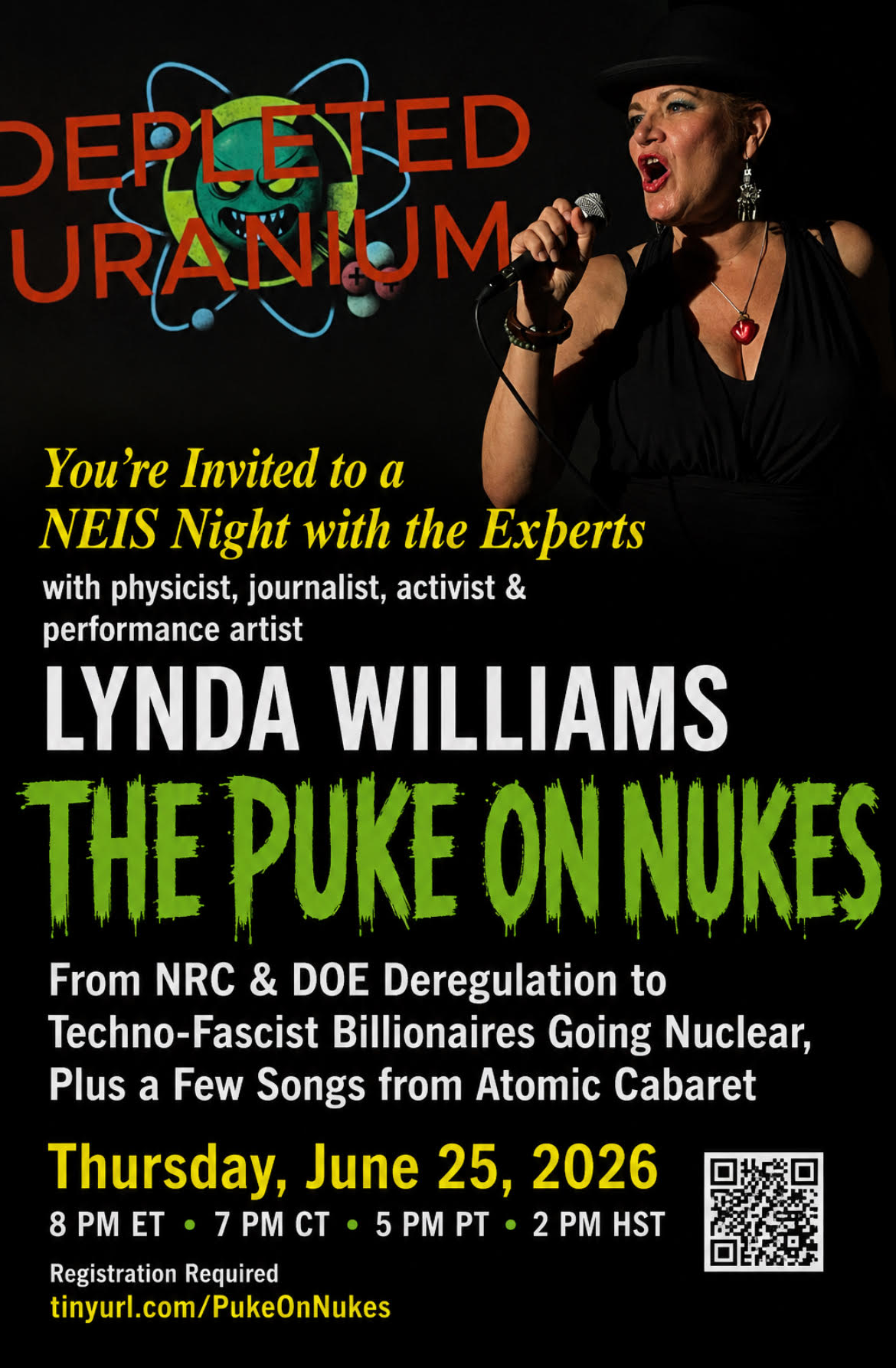
25 June- THE PUKE ON NUKES
Thursday, June 25, 2026
7pm Central Time (8pm ET, 6pm MT, 5pm PT) UTC – 5
From NRC & DOE Deregulation to Techno-Fascist Billionaires Going Nuclear, Plus a Few Songs from Atomic Cabaret REGISTER
26 June – Radiation Trainwreck at the NRC / Join the Protect Better Campaign – https://us02web.zoom.us/meeting/register/4ZlZ5_qLSHGiLSCg8FF6Bg#/registration
1st July – Webinar Waste of Space: The Environmental Harm of Military and Civil Space Activity st July, 7 pm

Report Launch Online: We are seeing an increasing exploitation of space for military and commercial purposes. This must change.

Protect Sazan Island from the Trump family! https://secure.avaaz.org/campaign/en/protect_sazan_island_from_the_trump_family_loc/?bqFCVab&v=174511&cl=22707147157&_checksum=5e9dde668860e8231c33699735e16a1fbf22ab2cb01da50c999fe8732b9775ef&utm_source=email&utm_medium=blast_email&utm_campaign=174511


Cuba Is Not a Failed State – It Is a Besieged State
PETITION: “Global Appeal to Endorse Palestinian Right of Return of Refugees”
To see nuclear-related stories in greater depth and intensity – go to https://nuclearinformation.wordpress.com
-
Archives
- June 2026 (221)
- May 2026 (306)
- April 2026 (356)
- March 2026 (251)
- February 2026 (268)
- January 2026 (308)
- December 2025 (358)
- November 2025 (359)
- October 2025 (376)
- September 2025 (257)
- August 2025 (319)
- July 2025 (230)
-
Categories
- 1
- 1 NUCLEAR ISSUES
- business and costs
- climate change
- culture and arts
- ENERGY
- environment
- health
- history
- indigenous issues
- Legal
- marketing of nuclear
- media
- opposition to nuclear
- PERSONAL STORIES
- politics
- politics international
- Religion and ethics
- safety
- secrets,lies and civil liberties
- spinbuster
- technology
- Uranium
- wastes
- weapons and war
- Women
- 2 WORLD
- ACTION
- AFRICA
- Atrocities
- AUSTRALIA
- Christina's notes
- Christina's themes
- culture and arts
- Events
- Fuk 2022
- Fuk 2023
- Fukushima 2017
- Fukushima 2018
- fukushima 2019
- Fukushima 2020
- Fukushima 2021
- general
- global warming
- Humour (God we need it)
- Nuclear
- RARE EARTHS
- Reference
- resources – print
- Resources -audiovicual
- Weekly Newsletter
- World
- World Nuclear
- YouTube
-
RSS
Entries RSS
Comments RSS
 nuclear-news