President Kennedy strongly warned Israel against getting nuclear weapons
|
PRESIDENT KENNEDY GAVE ISRAEL A STRONG WARNING ABOUT ITS NUCLEAR REACTOR IN 1963
A telegram from Kennedy dated July 4, 1963, congratulates Eshkol on assuming the prime ministership after David Ben-Gurion’s resignation and recounts talks between Kennedy and Ben-Gurion about inspections at the reactor in Dimona.
“As I wrote Mr. Ben-Gurion, this government’s commitment to and support of Israel could be seriously jeopardized if it should be thought that we were unable to obtain reliable information on a subject as vital to peace as Israel’s effort in the nuclear field,” the telegram said. The telegram was declassified in the 1990s but was not widely available until last week when the National Security Archives, a project affiliated with George Washington University, posted it on its website…….https://www.jpost.com/Diaspora/President-Kennedy-gave-Israel-a-strong-warning-about-its-nuclear-reactor-in-1963-589107 |
|
Environmentalists astounded that panel rules in favour of Holtec’s nuclear waste storage plan for New Mexico

|
Holtec clears hurdle for proposed nuclear-waste storage facility https://www.courierpostonline.com/story/news/2019/05/09/holtec-lea-county-new-mexico-storage-site-uranium-nuclear-waste/1155441001/
A three-judge panel this week rejected nearly 50 objections to the Camden firm’s proposal for a “consolidated interim storage facility” that would initially hold up to 8,680 metric tons of uranium in a remote area of southeastern New Mexico. The radioactive waste would be stored underground in 500 canisters made at Holtec’s Camden plant and elsewhere. The spent fuel would come from nuclear power plants across the country, including some being decommissioned by a Holtec affiliate. The ruling keeps Holtec’s proposal “on track for licensing in 2020,” the company said.It describes the planned facility as “safe and secure” and says the sealed metal canisters, to be buried in steel and concrete vaults, are “terror-resistant.” “Provided funding is obtained … and if construction could start in 2021, the (storage facility) could be ready to accept spent fuel shipments beginning in 2023,” Holtec spokeswoman Joy Russell said Thursday. “This ‘interim” storage facility could well become a permanent repository without the protections of a permanent repository,” Sierra Club attorney Wally Taylor said in a statement. Beyond Nuclear, a Maryland-based nonprofit, said it was “astounded” by the ruling. It estimates the Holtec complex, with plans for 19 expansion phases over 20 years, could ultimately hold more than 173,000 metric tons of uranium. Environmentalists have also expressed concern over the potential danger of transporting spent fuel from nuclear plants across the country. In its ruling, the board said only three of six challengers had standing to request a hearing on Holtec’s license application. It said Sierra Club and Beyond Nuclear have members living near the proposed storage site, while an oil-and-gas company, Fasken Land and Minerals, has business operations in the area. But the board said none of the petitioners’ objections were admissible. As a result, it concluded, “this proceeding is terminated.” Jim Walsh: @jimwalsh_cp; 856-486-2646; jwalsh@gannettnj.com |
|
Patients not always aware of the risks in medical radiation treatment
|
Radiation therapy consent forms too difficult to read, Reuters, Lisa Rapaport 10 May 19,
(Reuters Health) – Cancer patients usually get written consent forms to sign before radiation that are supposed to clearly spell out the treatment risks, but a new U.S. study suggests these forms are too complex for most patients to easily understand. While radiotherapy has become more precise in recent years, it can still damage some healthy cells and tissues in addition to destroying the cancer. Common short-term side effects can include fatigue as well as skin problems like itching, blistering and peeling. Lasting side effects depend on the type and location of radiation therapy and can include more serious problems like new malignancies elsewhere on the body. In theory, informed consent is a cornerstone of modern cancer treatment. But the study results suggest that paperwork patients receive to explain radiation is falling short of this goal. “We looked at the readability of these forms and discovered that, even using the most conservative estimates, they were at far higher reading levels than most patients understand,” said study co-author Dr. Andrew Einstein of the Columbia University Irving Medical Center in New York City. …… https://www.reuters.com/article/us-health-radiotherapy-informed-consent/radiation-therapy-consent-forms-too-difficult-to-read-idUSKCN1SE2FR |
|
|
Trump announces new sanctions on Iran. Iran warns it will step away from nuclear deal
U.S. Issues New Sanctions as Iran Warns It Will Step Back From Nuclear Deal, NYT, By David E. Sanger, Edward Wong, Steven Erlanger and Eric Schmitt, May 8, 2019
WASHINGTON — Iran’s president declared on Wednesday that he would begin to walk away from the restrictions of a 2015 nuclear deal, and the Trump administration responded with a new round of sanctions against Tehran, reviving a crisis that had been contained for the past four years.
The escalation of threats caught the United States’ allies in Europe in the crossfire between Washington and Tehran. And while the announcement by President Hassan Rouhani of Iran did not terminate the landmark nuclear accord that was negotiated by world powers, it put it on life support.
Britain, France and Germany all opposed President Trump’s move a year ago to withdraw the United States from the accord that limited Iran’s capacity to produce nuclear fuel for 15 years. Ever since, the Trump administration has ramped up a pressure campaign against Iran’s military and clerical leaders, including blocking global oil exports and expediting warships and B-52 bombers to the Persian Gulf this week to face down what officials described, without evidence, as a new threat by Tehran against American troops in the Middle East.
European officials had promised to set up a bartering system to evade American sanctions imposed against Iranian oil. But that effort has largely failed, even as Iran complied with its obligations under the agreement, from production limits to inspections.
On Wednesday morning in Tehran, Mr. Rouhani declared he had run out of patience.
“The path we have chosen today is not the path of war, it is the path of diplomacy,” he said in a nationally broadcast speech. “But diplomacy with a new language and a new logic.”
Rather than exit the deal entirely, Mr. Rouhani announced a series of small steps to resume the production of nuclear centrifuges and to begin accumulating nuclear material.
-
Mr. Rouhani also set a series of carefully calibrated deadlines for European leaders — essentially forcing them to either join the United States in isolating Iran or uphold the nuclear deal that world powers spent years negotiating with Tehran.
He said the Europeans had 60 days to assure that Iran could “reap our benefits” under the nuclear accord, by making up for lost oil revenues and allowing the country back into the international financial system.
If the Europeans agree, they will be subject to sanctions by the United States. If they dismiss Mr. Rouhani’s claims, he says Iran will take more dramatic steps.
Hours later, the White House announced that it was taking additional measures to squeeze Iran’s economy by imposing sanctions on its steel, aluminum, iron and copper sectors. Iran’s industrial metals industries account for about 10 percent of its exports, according to a Trump administration estimate.
Mr. Trump said in a statement that the move “puts other nations on notice that allowing Iranian steel and other metals into your ports will no longer be tolerated.”
Under John R. Bolton, the national security adviser who has long advocated pressing for regime change in Iran, the White House has been urging ever-escalating sanctions…….Hours later, the White House announced that it was taking additional measures to squeeze Iran’s economy by imposing sanctions on its steel, aluminum, iron and copper sectors. Iran’s industrial metals industries account for about 10 percent of its exports, according to a Trump administration estimate.
Mr. Trump said in a statement that the move “puts other nations on notice that allowing Iranian steel and other metals into your ports will no longer be tolerated.”
Under John R. Bolton, the national security adviser who has long advocated pressing for regime change in Iran, the White House has been urging ever-escalating santions……Hours later, the White House announced that it was taking additional measures to squeeze Iran’s economy by imposing sanctions on its steel, aluminum, iron and copper sectors. Iran’s industrial metals industries account for about 10 percent of its exports, according to a Trump administration estimate.
Mr. Trump said in a statement that the move “puts other nations on notice that allowing Iranian steel and other metals into your ports will no longer be tolerated.”
Under John R. Bolton, the national security adviser who has long advocated pressing for regime change in Iran, the White House has been urging ever-escalating sanctions…….https://www.nytimes.com/2019/05/08/us/politics/iran-nuclear-deal.html
Long delay before Savannah River Plutonium Disposal can start
 NNSA Won’t Start Savannah River Plutonium Disposal Until 2028 https://www.exchangemonitor.com/mfff-alternative-wont-running-2028-nnsa-says/?printmode=1BY EXCHANGEMONITOR 8 May 19 The National Nuclear Security Administration (NNSA) indicated Monday it will not start disposal of 34 metric tons of surplus weapon-usable plutonium in South Carolina until 2028 — a date by which the agency could accrue more than $1 billion in financial penalties for failing to remove the material from the South Carolina facility.The semiautonomous Department of Energy cited the schedule for startup of the Surplus Plutonium Disposition Project in a chart in the “NNSA Strategic Integrated Roadmap 2020-2044.” NNSA Won’t Start Savannah River Plutonium Disposal Until 2028 https://www.exchangemonitor.com/mfff-alternative-wont-running-2028-nnsa-says/?printmode=1BY EXCHANGEMONITOR 8 May 19 The National Nuclear Security Administration (NNSA) indicated Monday it will not start disposal of 34 metric tons of surplus weapon-usable plutonium in South Carolina until 2028 — a date by which the agency could accrue more than $1 billion in financial penalties for failing to remove the material from the South Carolina facility.The semiautonomous Department of Energy cited the schedule for startup of the Surplus Plutonium Disposition Project in a chart in the “NNSA Strategic Integrated Roadmap 2020-2044.”
The unfunded, unauthorized Surplus Plutonium Disposition Project, also sometimes called dilute-and-dispose, is the NNSA’s new method of getting rid of the plutonium under an arms-reduction pact signed with Russia in 2000. The NNSA once planned to dispose of the plutonium by turning it into commercial reactor fuel in Savannah River’s now-canceled Mixed Oxide Fuel Fabrication Facility (MFFF) — a partially built structure the agency now wants to turn into a factory for fissile nuclear warhead cores called pits. Under federal law, the NNSA must pay the state of South Carolina a maximum of $100 million annually for every year after Jan. 1, 2016, that the agency fails to remove 1 metric ton of surplus weapon-usable plutonium from the Savannah River Site. South Carolina in 2016 sued DOE in federal court to collect after the agency ditched the MFFF in favor of dilute-and-dispose — chemically weakening the plutonium, suspending it in an inert material known as stardust, and burying it deep underground at DOE’s Waste Isolation Pilot Plant near Carlsbad, N.M. In a separate lawsuit in 2017, a U.S. District Court judge in South Carolina ordered the NNSA to remove 1 metric ton of the formerly MFFF-bound plutonium from Savannah River. The NNSA folded that metric ton of material back into its weapon-production pipeline and, some time last year, shipped half of that amount to the Nevada National Security Site over Nevada’s loud objections. |
|
America’s accumulating nuclear trash: new Bill threatens Nevada
 Nevada Warns of Impacts of Rad Waste Disposal Bill https://www.exchangemonitor.com/nevada-warns-impacts-rad-waste-disposal-bill/ BY EXCHANGEMONITOR, 8 May 19, The proposed nuclear waste repository at Yucca Mountain in Nevada could conceivably end up receiving 150,000 metric tons of radioactive waste by the second half of this century, according to a Nevada state government analysis of a proposed U.S. Senate bill to speed up that project.The April 29 memo from Bob Halstead, executive director of the Nevada Agency for Nuclear Projects, is another salvo in the state’s decades-long fight against the planned Department of Energy disposal site. In this case, the target is legislation pending from Sen. John Barrasso (R-Wy.). Nevada Warns of Impacts of Rad Waste Disposal Bill https://www.exchangemonitor.com/nevada-warns-impacts-rad-waste-disposal-bill/ BY EXCHANGEMONITOR, 8 May 19, The proposed nuclear waste repository at Yucca Mountain in Nevada could conceivably end up receiving 150,000 metric tons of radioactive waste by the second half of this century, according to a Nevada state government analysis of a proposed U.S. Senate bill to speed up that project.The April 29 memo from Bob Halstead, executive director of the Nevada Agency for Nuclear Projects, is another salvo in the state’s decades-long fight against the planned Department of Energy disposal site. In this case, the target is legislation pending from Sen. John Barrasso (R-Wy.).
The discussion draft of the Nuclear Waste Policy Amendments Act of 2019 also, according to Halstead: would allow a mobile retrievable storage facility in Nevada; does not guarantee the nation’s nuclear wastes would avoid Las Vegas while being sent to Yucca Mountain; and ignores adverse economic impacts if something goes wrong with the transportation and storage of the wastes. Barrasso’s draft is effectively identical to 2017 legislation from Rep. John Shimkus (R-Ill.) that died in the Senate. It contains a set of measures to advance both temporary storage of the nation’s nuclear waste in a small number of locations and the final repository in Nevada. The proposed bill would increase the limit of wastes at the proposed Yucca Mountain repository from 70,000 metric tons to 110,000 metric tons. “If this change is permitted, Congress will almost certainly further revise upward or eliminate the capacity limit,” Halstead wrote in his memo to the state’s congressional delegation and Gov. Steve Sisolak (D).
The analysis estimated that the United States will create 150,000 metric tons of high-level radioactive waste and spent fuel by 2050. While a second repository closer to the East Coast had at one been considered in the disposal plan, Congress in 1987 limited the disposal approach to Yucca Mountain. |
|

Three Mile Island nuclear station has licence for 15 more years, but now to close
 Three Mile Island Nuclear Plant To Close, Latest Symbol Of Struggling Industry, NPR, May 8, 2019, 40 years after the nation’s worst commercial nuclear accident, the remaining reactor still operating at Three Mile Island in South-central Pennsylvania is closing.
Exelon announced Wednesday that Three Mile Island Generating Station Unit 1 will shut down by September 30th.
The company says the plant has been losing money for years. The nuclear industry generally has struggled to compete with less expensive electricity generated from natural gas and renewable energy.
Exelon first announced it would close two years ago unless lawmakers stepped in to keep it open. It then campaigned to save the plant by seeking a subsidy from Pennsylvania’s legislature. The company argued that, in light of climate change and efforts to address it, the plant deserves compensation for the [supposedly] carbon-free electricity it produces.
When it became clear the subsidy legislation wouldn’t pass within the next month Exelon decided to retire the plant, which was licensed to operate for 15 more years. …….. https://www.npr.org/2019/05/08/721514875/three-mile-island-nuclear-plant-to-close-latest-symbol-of-struggling-industry
Mike Pompeo enthuses over the ‘benefits ‘ of climate change
 Mike Pompeo dismisses climate change, calls melting Arctic ice caps ‘new opportunities for trade’ Marissa Higgins, Daily Kos Staff ·Another day, another horrifying dismissal of climate change by one of our government representatives. In this case, Secretary of State Mike Pompeo decided to describe the Arctic’s melting ice caps as “new opportunities for trade,” which is possibly the worst climate-related take of the day. Pompeo uttered this out-of-touch assertion when he appeared at the Arctic Council Ministerial Meeting in Finland. This probably doesn’t come as a major surprise, but the bulk of Pompeo’s speech centered on China and Russia. Russia, for what it’s worth, has long held a serious reach in the Arctic, but China is rapidly getting closer. Mike Pompeo dismisses climate change, calls melting Arctic ice caps ‘new opportunities for trade’ Marissa Higgins, Daily Kos Staff ·Another day, another horrifying dismissal of climate change by one of our government representatives. In this case, Secretary of State Mike Pompeo decided to describe the Arctic’s melting ice caps as “new opportunities for trade,” which is possibly the worst climate-related take of the day. Pompeo uttered this out-of-touch assertion when he appeared at the Arctic Council Ministerial Meeting in Finland. This probably doesn’t come as a major surprise, but the bulk of Pompeo’s speech centered on China and Russia. Russia, for what it’s worth, has long held a serious reach in the Arctic, but China is rapidly getting closer.
But you know, why not throw in an asinine statement on climate change while you’re at it? “Steady reductions in sea ice are opening new passageways and new opportunities for trade,” Pompeo told the audience……. its centerpiece, the Arctic Ocean, is rapidly taking on new strategic significance,” he continued. “Offshore resources, which are helping the respective coastal states, are the subject of renewed competition.” While this is terrible, it isn’t really surprising given Pompeo’s past comments on climate change. For example, he was asked by ABC News over the weekend how he would rank climate change among other national security threats. …… Just last week, the Trump administration tried to remove references to climate change from the Arctic Council’s declaration. The declaration is a big deal, and all eight countries involved expect to sign it. The eight countries include Canada, Denmark (which includes Greenland), Finland, Iceland, Norway, Russia, Sweden, and the U.S. “There are different tones with which different countries want to approach climate change,” Aleksi Harkonen, the Arctic Ambassador of Finland, said, as reported by CNBC. “It’s not about whether climate change can be mentioned or not. It will be there in the final declaration.” And while everyone (hopefully) agrees that climate change is a serious issue, it’s worth noting that it’s particularly dire in the Arctic. Why? In short, the Arctic is warming at more than double the rate that the rest of the globe is. This means that the region is changing at a rapid rate, which can be impossibly dangerous for wildlife and indigenous populations. Pompeo sees all of this as just a security issue, but it’s a humanitarian one, too……https://www.dailykos.com/stories/2019/5/6/1855803/-Mike-Pompeo-dismisses-climate-change-calls-melting-Arctic-ice-caps-new-opportunities-for-trade |
|
|
Donald Trump and John Bolton conniving to avoid any effective nuclear arms deal?
|
Trump wants to negotiate nuclear deals. He should start with the one he already has. WP, By Editorial Board, May 8 2019 PRESIDENT TRUMP has been suggesting recently that he’s interested in negotiating a reduction of nuclear weapons stockpiles. After speaking Friday with President Vladimir Putin of Russia, Mr. Trump said they discussed “a nuclear agreement” in which “we get rid of some of the tremendous firepower that we have right now.” On April 4, meeting with China’s vice premier, Liu He, Mr. Trump said, “Between Russia and China and us, we’re all making hundreds of billions of dollars’ worth of weapons, including nuclear, which is ridiculous.” If he’s serious, it is important that Mr. Trump focus on practical measures to reduce the nuclear danger, not negotiating feints. The Post reported April 25 that Mr. Trump has “ordered his administration to prepare a push for new arms-control agreements with Russia and China.” The exact nature of his order isn’t known, but Mr. Trump is right to be concerned that many areas of nuclear weapons and systems to deliver them are not covered by treaties and agreements. Soon, the 1987 Intermediate-Range Nuclear Forces Treaty between the United States and Russia will be history; the Trump administration pulled the plug, saying Russia violated it with a new, prohibited ground-based cruise missile system. ……..All these important and worthy goals for negotiation will be extremely difficult and time-consuming. Before Mr. Trump reaches for the moon, he should tackle extension of the 2010 New START accord with Russia limiting strategic nuclear weapons, which expires in February 2021. This treaty has proved successful and worthwhile, limiting both sides to 1,550 deployed warheads and 700 delivery vehicles; it’s a cap on the most threatening nuclear weapons, those that can span the globe in tens of minutes. If Mr. Trump really wants to avert nuclear dangers, this is the place to begin. So far, he hasn’t done much. A more worrisome prospect is that Mr. Trump is raising the most difficult nuclear arms control challenges because he knows they can’t easily be addressed. John Bolton, the national security adviser, has criticized international treaties that tie the hands of the United States and once called the New START limits on weapons launchers “profoundly misguided.” Are Mr. Bolton and Mr. Trump really getting ready to roll up their sleeves for more arms control, or is the latest talk just a disingenuous tactic to avoid it? https://www.washingtonpost.com/opinions/global-opinions/trump-wants-to-negotiate-nuclear-deals-he-should-start-with-the-one-he-already-has/2019/05/08/529c9248-7026-11e9-9eb4-0828f5389013_story.html?utm_term=.1a3804a51813 |
|
A national political conflict over USA’s nuclear waste dump plan for Yucca Mt, Nevada

 War over nuclear waste at Yucca Mountain
  spreads to nation’s capital, by John Treanor, May 6th 2019
https://news3lv.com/news/local/war-over-nuclear-waste-at-yucca-mountain-spreads-to-nations-capital LAS VEGAS (KSNV) — It’s becoming a familiar scene in Carson City.
“Many believe Yucca Mountain is settled science. That Yucca was selected, or that it’s ready to receive nuclear waste. Well, they are wrong,” said Senator Cortez Masto.
The war over Yucca Mountain continues, and the latest battleground was a committee meeting in Washington D.C. where senators debated the plan to open funding to study the site.
Right now, sites across the country have nuclear waste sitting in danger of contaminating waterways or nearby communities.
The federal government has long wanted to bury it deep in Yucca, but Nevada politicians are united against that plan.
Saying that storing it could be dangerous, transporting it here a matter of national security.
Senator Jacky Rosen said, “Severe risks in transportation threaten the health and costs billions in cleanup costs. I ask the members here today, is this a risk you’re willing to take?”
Nevada Senators Jacky Rosen and Catherine Cortez Masto want states to sign off on any nuclear plan before the waste is shipped to them, giving Nevada the opportunity to turn those shipments away. https://news3lv.com/news/local/war-over-nuclear-waste-at-yucca-mountain-spreads-to-nations-capital
For how long can we tolerate dolts as leaders? Mike Pompeo rejoices in climate change and Arctic thawing
|
Mike Pompeo Praises Climate Change in the Arctic as ‘New Opportunities for Trade’, Observer
|
|
U.S. Secretary of State Mike Pompeo ays that a nuclear deal with North Korea is still possible
|
Pompeo insists North Korea nuclear deal still possible despite weapons test, Secretary of state echoes the president, saying ‘there’s opportunity to get a negotiated outcome’ on a denuclearization deal, Guardian, Victoria Bekiempis in New York 6 May 2019 Secretary of State Mike Pompeo insisted Sunday that a nuclear disarmament deal between the US and North Korea was still possible, despite the country’s launch of several short-range projectiles into the sea one day earlier.“There’s an opportunity to get a negotiated outcome, where we get fully verified denuclearization” and said the US hopes to “get back to the table and find the path forward,” he told ABC’s This Week politics program on Sunday. He also claimed that North Korean leader Kim Jong-un is on board with coming to an accord. “Chairman Kim has repeated that,” Pompeo said. “He’s repeated that quite recently, in fact.” Pompeo said the latest missile launch did not cross any international boundaries. “That is, they landed in the water east of North Korea and didn’t present a threat to the United States or to South Korea or Japan,” he said. “And we know that they were relatively short-range.” Pompeo’s statements about brokering a deal echo those of Donald Trump, who said he still thought the US and North Korea would reach a nuclear dealdespite the fact that talks have stalled since the leaders’ recent unsuccessfulsummit meeting in Vietnam. ……. https://www.theguardian.com/world/2019/may/05/mike-pompeo-north-korea-disarmament-deal-possible-despite-weapons-test |
|
Donald Trump still predicting nuclear deal with Kim Jong Un
Trump insists nuclear deal will happen after North Korea fires projectiles, Guardian, 5 May 19, President tweeted on Saturday he believes Kim Jong-un understands North Korea’s ‘great economic potential’ and won’t interfere. Donald Trump said he still believes a nuclear deal with North Korea will happen, after the country fired several unidentified short-range projectilesinto the sea.
The US president tweeted on Saturday that he believes that leader Kim Jong-un “fully realizes the great economic potential of North Korea, & will do nothing to interfere or end it”……..
If it’s confirmed that the North fired banned ballistic missiles, it would be the first such launch since the North’s November 2017 test of an intercontinental ballistic missile. That year saw a string of increasingly powerful weapons tests from the North and a belligerent response from Trump that had many in the region fearing war.
Experts say the North may increase these sorts of low-level provocations to apply pressure on the US to agree to reduce crushing international sanctions
South Korea said it’s “very concerned” about North Korea’s weapons launches, calling them a violation of last year’s inter-Korean agreements to reduce tensions between the countries.
South Korea’s military has bolstered its surveillance in case there are additional weapons launches, and South Korean and US authorities are analyzing the details.
North Korea could choose to fire more missiles with longer ranges in coming weeks to ramp up its pressure on the US to come up with a roadmap for nuclear talks by the end of this year……..https://www.theguardian.com/world/2019/may/04/trump-north-korea-nuclear-deal-short-range-projectiles
Cheaper and permanent, not temporary, disposal of nuclear waste.
We will provide an option for people not satisfied with existing options,” said Deep Isolation’s co-founder and CEO Elizabeth Muller. She pointed out the interim sites were not “deep geologic storage.”
They’re looking at being safe for decades,” Muller said. “They’re looking at temporary storage. We’re looking at disposal.”
David Lochbaum, former director of the Nuclear Safety Program for the Union of Concerned Scientists, has taken a seat on Deep Isolation’s advisory board.
“There are technical, legal and political challenges facing Deep Isolation, to be sure,” Lochbaum said via email. “I think their proposal could very well meet all these challenges.
“The spent fuel storage status quo is only worsening with time,” he said. “We need to find a solution before we run out of time to do so without harm.”
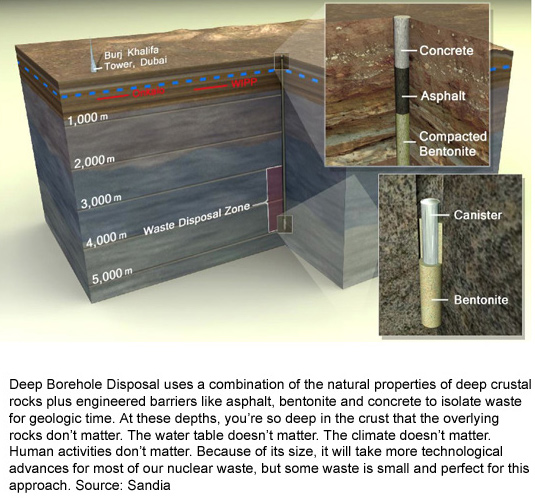
Storage of the highly radioactive waste would be permanent — unlike the options currently available around the world — and the method is being pitched as far less expensive than development of a deep geologic repository such as Yucca Mountain in Nevada. In New England, spent nuclear fuel is being stored on-site at the Maine Yankee, Seabrook, Vermont Yankee, Yankee Rowe, Pilgrim and Millstone nuclear plants.
Although the Department of Energy was required under the Waste Policy Act to remove spent fuel from sites nationwide for storage in a permanent repository by 1998, its plan for a Yucca Mountain repository in Nevada has languished for several years.
The proposal from Deep Isolation calls for drilling a 14-inch-wide vertical access channel up to a mile or more down, depending on geologic conditions, then gradually making the drill hole run horizontally along the line of the rock formation.
The horizontal bed, which could be as long as 2 miles, would serve as the nuclear waste storage area, deep in the subsurface where the rock has been stable and out of contact with the surface for millions of years and would remain out of contact for millions more, unaffected by surface impacts such as sea level rise.
Hundreds of corrosion-resistant canisters, each holding a spent fuel assembly, could be stored in a line inside a single drill hole, and since the technology already exists, the company could be placing fuel in the ground within two to three years, according to Sophie McCallum, Deep Isolation’s chief of staff.
And more than one drill hole can be made on a site.
We are in active discussions with potential customers in the U.S. and internationally to move forward disposal programs of stalled nuclear waste inventories,” McCallum said in an email .
Deep Isolation tested its system, installing a drill hole in Cameron, Texas, where it successfully placed a 5-foot-long canister — the kind used to store military waste such as cesium and strontium — in the horizontal storage area, deep underground. It then retrieved the canister, which Deep Isolation experts say could be done for up to about 50 years.
The company plans to begin with storage of defense waste in the U.S. and commercial waste in other countries, since the federal Waste Policy Act must be amended to allow for permanent storage of the nation’s commercial waste in places other than Yucca Mountain.
Currently about 80,000 metric tons of spent nuclear fuel produced by commercial reactors and another 14,000 metric tons from the nation’s weapons program is being temporarily stored at 80 sites in 35 states, in spent fuel pools or hulking dry casks.
Commercial reactor owners have sued the department for failing to provide promised permanent storage, and damages to date have cost the agency more than $6 billion.
In 2016, the department was investigating a method of storage that called for deep, vertical boreholes into crystalline basement rock, but the program was broken off in 2017 with Yucca Mountain once again taking over as the sole focus for permanent, high-level nuclear waste storage.
Holtec International and Waste Control Services have submitted applications to operate interim storage facilities in New Mexico and West Texas that are under review by the Nuclear Regulatory Commission. Spent fuel would be stored at those locations until a national repository is ready.
“We will provide an option for people not satisfied with existing options,” said Deep Isolation’s co-founder and CEO Elizabeth Muller. She pointed out the interim sites were not “deep geologic storage.”
They’re looking at being safe for decades,” Muller said. “They’re looking at temporary storage. We’re looking at disposal.”
……..Several nuclear watchdog groups have advocated for keeping waste at sites where it has been generated rather than transporting it across the country to other locations. Deep Isolation’s storage method can be done at or near the generation sites, depending on the geology.
…….Deep Isolation was established about three years ago and has operated to date without government or institutional funding but hopes that will change.
……The government estimates it will cost $100 billion to dispose of existing nuclear waste at Yucca. “We project that the cost of Deep Isolation disposal is about one-third of a mined repository,” McCallum said.
David Lochbaum, former director of the Nuclear Safety Program for the Union of Concerned Scientists, has taken a seat on Deep Isolation’s advisory board.
“There are technical, legal and political challenges facing Deep Isolation, to be sure,” Lochbaum said via email. “I think their proposal could very well meet all these challenges.
“The spent fuel storage status quo is only worsening with time,” he said. “We need to find a solution before we run out of time to do so without harm.” https://www.southcoasttoday.com/news/20190504/startup-promotes-permanent-nuclear-waste-storage-via-miles-long-drilling
Discussion on nuclear weapons, between Trump and Putin
|
Trump, Putin discuss nuclear weapons and Venezuela in phone call, Aljazeera, 3 May 19,
US President Donald Trump tweets he ‘had a long and very good’ phone call with Russian President Vladimir Putin. US President Donald Trump and Russian President Vladimir Putin spoke for more than an hour on Friday, discussing the possibility of a new nuclear accord, North Korean denuclearisation, Ukraine and the political situation in Venezuela, the White House said. “Had a long and very good conversation with President Putin of Russia,” Trump said in a post on Twitter, noting they had discussed trade, Venezuela, Ukraine, North Korea, nuclear arms and Special Counsel Robert Mueller‘s investigation of Russian meddling in the 2016 US presidential campaign. White House spokeswoman Sarah Sanders told reporters that the call was an “overall positive conversation”……. Putin told Trump that any external interference in Venezuela’s internal business undermines the prospects of a political end to the crisis, the Kremlin said. Russian Foreign Minister Sergey Lavrov told US Secretary of State Mike Pompeo by phone on Wednesday that further “aggressive steps” in Venezuela would be fraught with the gravest consequences, the Russian ministry said……. New START treatySanders told reporters Trump and Putin talked about the possibility of a new multilateral nuclear accord between the US, Russia and China, or an extension of the current US-Russia strategic nuclear treaty. She did not say which arms control agreement Trump and Putin discussed, but the Russian state news agency Tass reported that they talked about the New START treaty, the last major arms-control treaty remaining between the US and Russia. The 2011 New START treaty expires in February 2021 but can be extended for five years if both sides agree. Without the agreement, it could be harder to gauge each other’s intentions, arms control advocates say. The New START treaty required the US and Russia to cut their deployed strategic nuclear warheads to no more than 1,550, the lowest level in decades, and limit delivery systems – land- and submarine-based missiles and nuclear-capable bombers. It also includes extensive transparency measures requiring each side to allow the other to carry out 10 inspections of strategic nuclear bases each year; give 48 hours notice before new missiles covered by the treaty leave their factories; and provide notifications before ballistic missile launches. Trump has called the New START treaty a “bad deal” and “one-sided”. “They discussed a nuclear agreement, both new and extended, and the possibility of having conversations with China on that as well,” Sanders said. The Kremlin said the two sides confirmed they intended to “activate dialogue in various spheres, including strategic security”. Trump earlier pulled the plug on a decades-old nuclear arms treaty with Russia. Trump accused Moscow of violating the 1987 Intermediate-Range Nuclear Forces Treaty (INF) with “impunity” by deploying missiles banned by the pact. Moscow denies violating it and has accused Washington of being in non-compliance…… North KoreaTrump also raised with Putin the issue of getting North Korea to dismantle its nuclear weapons and ballistic missile programmes. Trump has met twice with North Korean leader Kim Jong Un but Kim has yet to agree to a disarmament deal. Sanders said Trump mentioned several times “the need and importance of Russia stepping up and continuing to put pressure on North Korea to denuclearize.” The Kremlin said both leaders highlighted the need to pursue denuclearisation of the region. During an April summit with Kim in Vladivostok, Putin expressed Russian support for a gradual process of trading disarmament for sanctions relief. https://www.aljazeera.com/news/2019/05/trump-putin-discuss-nuclear-weapons-venezuela-phone-call-190503181032495.html |
|
|
1 This Month

22 June – Virtual Event –Climate Change: New Data, New Debate

Monday, June 22, 2026 2:30 p.m. – 3:15 p.m. CT
YouTube. Register here

Protect Sazan Island from the Trump family! https://secure.avaaz.org/campaign/en/protect_sazan_island_from_the_trump_family_loc/?bqFCVab&v=174511&cl=22707147157&_checksum=5e9dde668860e8231c33699735e16a1fbf22ab2cb01da50c999fe8732b9775ef&utm_source=email&utm_medium=blast_email&utm_campaign=174511

25 June- THE PUKE ON NUKES
Thursday, June 25, 2026
7pm Central Time (8pm ET, 6pm MT, 5pm PT) UTC – 5
From NRC & DOE Deregulation to Techno-Fascist Billionaires Going Nuclear, Plus a Few Songs from Atomic Cabaret REGISTER
26 June – Radiation Trainwreck at the NRC / Join the Protect Better Campaign – https://us02web.zoom.us/meeting/register/4ZlZ5_qLSHGiLSCg8FF6Bg#/registration


Cuba Is Not a Failed State – It Is a Besieged State
PETITION: “Global Appeal to Endorse Palestinian Right of Return of Refugees”
To see nuclear-related stories in greater depth and intensity – go to https://nuclearinformation.wordpress.com
-
Archives
- June 2026 (211)
- May 2026 (306)
- April 2026 (356)
- March 2026 (251)
- February 2026 (268)
- January 2026 (308)
- December 2025 (358)
- November 2025 (359)
- October 2025 (376)
- September 2025 (257)
- August 2025 (319)
- July 2025 (230)
-
Categories
- 1
- 1 NUCLEAR ISSUES
- business and costs
- climate change
- culture and arts
- ENERGY
- environment
- health
- history
- indigenous issues
- Legal
- marketing of nuclear
- media
- opposition to nuclear
- PERSONAL STORIES
- politics
- politics international
- Religion and ethics
- safety
- secrets,lies and civil liberties
- spinbuster
- technology
- Uranium
- wastes
- weapons and war
- Women
- 2 WORLD
- ACTION
- AFRICA
- Atrocities
- AUSTRALIA
- Christina's notes
- Christina's themes
- culture and arts
- Events
- Fuk 2022
- Fuk 2023
- Fukushima 2017
- Fukushima 2018
- fukushima 2019
- Fukushima 2020
- Fukushima 2021
- general
- global warming
- Humour (God we need it)
- Nuclear
- RARE EARTHS
- Reference
- resources – print
- Resources -audiovicual
- Weekly Newsletter
- World
- World Nuclear
- YouTube
-
RSS
Entries RSS
Comments RSS
 nuclear-news