 Beyond the spectacle of summits, Trump isn’t
  truly dedicated to nuclear arms control https://www.aspistrategist.org.au/beyond-the-spectacle-of-summits-trump-isnt-truly-dedicated-to-nuclear-arms-control/
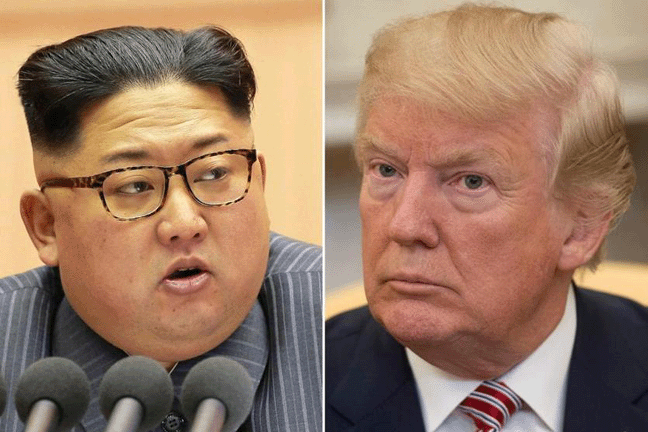
After three decades of intermittent negotiations with North Korea, direct engagement between heads of state was a fresh approach, for which Trump should be commended. But his administration’s indigestion when contemplating anything less than an all-encompassing, landmark accord should have been tempered with a seasoned helping of negotiating flexibility. And looking beyond Hanoi, it’s evident that Trump and his team are hardly committed to nuclear arms control writ large.
Only weeks after the US declared its intention to withdraw from the Intermediate-Range Nuclear Forces (INF) Treaty, which forbids both nuclear and conventional missiles with ranges of 500 to 5,000 kilometres, the Pentagon announced its plans to test a ground-mobile version of the sea-launched Tomahawk cruise missile in August, followed by a 4,000-kilometre-range ballistic missile in November.
Russia and the US have each critiqued the other for treaty noncompliance. Washington has continued to cite the operating range of Russia’s 9M729 missile and Moscow’s failure to course-correct since 2014, whereas Moscow has countered that the US Aegis Ashore missile defence site in Romania could perhaps be repurposed to launch offensive cruise missiles instead of only defensive interceptors.
At a January meeting in Geneva, Russia purportedly offered an inspection of the 9M729 system in exchange for a demonstration that the Aegis launchers couldn’t be converted to accommodate offensive missiles. American diplomats rejected this proposal, and, with the US Defense Department wasting no time to prepare for tests of INF Treaty–violating weapons soon after the agreement becomes void on 2 August, the Trump administration appears all too willing to dispense with existing arms limitations.
US officials have also yet to communicate their stance on prolonging the New Strategic Arms Reduction Treaty (New START). In a phone call with Russian President Vladimir Putin in January 2017, Trump reportedly disparaged the treaty as a ‘bad deal’ after Putin mentioned possible extension beyond 2021. Top US Air Force generals have testified before Congress and spoken publicly in unequivocal support of New START, calling bilateral and verifiable arms-control treaties ‘essential’, ‘of huge value’, ‘unbelievably important’ and ‘good for us’.
Regrettably, Bolton was a strident critic of New START before his appointment to lead Trump’s National Security Council, and the US State Department’s top diplomat for arms control remains noncommittal, explaining that the administration’s consolidated position towards treaty extension is still meandering through bureaucratic interagency review. ‘It gives reason to suspect our American counterparts of setting ground’ to let the treaty expire quietly, said Russia’s deputy foreign minister. Without the INF Treaty and the binding, verifiable limits contained in New START, American and Russian nuclear weaponry could soon be unconstrained for the first time since 1972.
And signatories to the Nuclear Non-Proliferation Treaty have just concluded their final preparatory meeting in advance of the treaty’s review conference next year. Non-nuclear states have expressed irritation that the US and Russia have further created ‘doubt about their intention ever to fulfil their disarmament obligations’. Instead of faithfully pursuing another stepwise reduction in its numbers of launchers and warheads, the US proposed multilateral working groups to discuss specific disarmament challenges. Among the 122 countries that voted in July 2017 for a nuclear-weapons ban, this American initiative, called ‘Creating an Environment for Nuclear Disarmament’, smells like much high-minded talk without any meaningful effort towards US arms reductions.
If Trump desires credibility, dialogue with Russia promises fertile ground. At the outset, his political opponents may deride such overtures as cosying up to Putin. But as highlightedby former admiral Mike Mullen, the top American military officer from 2007 to 2011, ‘even in the darkest days of the Cold War’ the US had regular interchanges with the Soviet Union, but ‘we don’t have them now—it’s not even close’.
And responsibly trimming American and Russian arsenals would make any future pressure on North Korea all the more compelling.
Commitment to arms-control talks could help Washington and Moscow further comprehend areas of shared concern, such as China’s economic clout in central Asia and its adventurism in the Arctic, short of a thaw in relations. If mutually beneficial agreements with Moscow stimulate Trump’s appetite for open-minded negotiations and incremental processes, and achieve appreciation and esteem from the international community, perhaps step-by-step progress with Kim would then become palatable.
Evan Karlik is a lieutenant commander in the US Navy. He spent his early childhood in Western Samoa and the Philippines, and was stationed in Hawaii from 2011 to 2014. He served last year as a Defense Fellow in the US House of Representatives.
May 14, 2019
Posted by Christina Macpherson |
politics international, USA, weapons and war |
Leave a comment
|
 This Old U.S. Navy Nuclear Submarine Could Nuke 24 Cities (In One Shot) This Old U.S. Navy Nuclear Submarine Could Nuke 24 Cities (In One Shot)
If you do the math, the Ohio-class boats may be the most destructive weapon system created by humankind. National Interest,by Sebastien Roblin 13 May 19, In short, a full salvo from an Ohio-class submarine—which can be launched in less than one minute—could unleash up to 192 nuclear warheads to wipe twenty-four cities off the map. This is a nightmarish weapon of the apocalypse.
|
|
May 14, 2019
Posted by Christina Macpherson |
USA, weapons and war |
Leave a comment
 US Air Force nuclear, space programs take hit in border wall reprogramming, Defense News, By: Joe Gould , Aaron Mehta , and Valerie Insinna 13 May 19, WASHINGTON — In the wake of the Pentagon reprogramming $1.5 billion in fiscal 2019 funds to support President Donald Trump’s border wall with Mexico, only the U.S. Air Force appears to be losing money appropriated for equipment updates.
The funding largely comes from personnel accounts in the Air Force, Navy and Army. But the Air Force is the only service to lose funding for hardware, including nuclear and conventional weapons, surveillance aircraft updates, and space programs……..
About half of the non-OCO $818 million sum the Defense Department wants to redirect to the border comes from Air Force accounts, with space and missile programs taking the biggest hit. In total, the Pentagon expects the service to shear $402 million off its FY19 budget.
About $210 million would be cut from Air Force space programs, specifically the Evolved Expandable Launch Vehicle program, which funds the use of rockets that send satellites and other capabilities into space. According to the reprogramming document, one rocket launch has been canceled due to the “Space Test Program (STP)-4 satellite provider termination of the Robotic Servicing of Geosynchronous Satellites (RSGS) spacecraft,” which is no longer necessary under the National Security Strategy……
Other Air Force programs that will take a hit include a planned upgrade to the Minuteman III intercontinental ballistic missile and the air-launched cruise missile programs.
May 14, 2019
Posted by Christina Macpherson |
space travel, USA |
Leave a comment
Former DOE Nuclear Waste Chief Critical of Consent-Based Siting https://www.exchangemonitor.com/former-doe-nuclear-waste-chief-critical-consent-based-siting/
BY EXCHANGEMONITOR 13 May 19, The federal government is not likely ever to secure local consent for disposal of spent fuel from commercial nuclear reactors, but that approach could nonetheless be tested in a plan for temporary storage of the radioactive material, according to a former head of the Energy Department’s Office of Civilian Radioactive Waste Management (OCRWM).
“Consent-based siting does sound very appealing. I just don’t see it leading to a successful leading to a successful conclusion. Of course, I may be wrong,” Ward Sproat, who managed OCRWM from June 2006 to January 2009 before it was dismantled by the Obama administration, wrote in a May 2 letter to Sens. John Barrasso (R-Wy.) and Tom Carper (D-Del.), the top members of the Senate Environment and Public Works Committee.
Among the obstacles to consent, Sproat wrote: history, as illustrated by failed Private Spent Fuel storage project in Utah; politics, including the potential for elected officials who support a facility to be replaced by opponents; and the need for at least two layers of local approval to analyze a selected location and then to begin licensing.
Still, Sproat indicated support for assessing the viability of a consent-based approach for interim storage discussed before the committee by an attorney with the Natural Resources Defense Council (NRDC).
Geoff Fettus, senior attorney for the NRDC’s nuclear program, was among the witnesses for a May 1 hearing on a draft bill from Barrasso that is intended to advance interim storage and permanent disposal of U.S. spent fuel and high-level radioactive waste. Among the measures, the legislation would authorize the secretary of energy to site, build, and operate at least one monitored retrievable storage facility and to store DOE-held waste in a privately operated facility.
In his prepared testimony, Fettus said the NRDC supports changing existing federal laws to give states more authority for regulating radioactive waste as part of a consent-based approach. A pilot program for interim storage should specifically involve a hardened structure at an operational nuclear power plant, Fettus said.
May 14, 2019
Posted by Christina Macpherson |
USA, wastes |
2 Comments
|
Park Record, | May 13, 2019 Martin Jedlicka Park City I would like to respond to Allison Cook’s editorial in a recent Park Record by agreeing with her premise that man-made global warming is an existential threat to human survival on this planet
I disagree with her thesis that nuclear power is the best solution. I know folks who are afraid of industrial nuclear power merely from watching “The Simpsons” on Fox. Sadly, that’s not as silly as it should be. The physics and engineering supporting nuclear power are sound. Unfortunately, the human administration and operation of it is not. We are as a people prone to error, greed and arrogance, with the first often resulting from the latter two. Behind every Homer is a Mr. Burns; ask any engineer if he or she has a story about corners cut by some bottom line-obsessed executive. U.S. nuclear plant workforces have been trimmed by 26,000 jobs in the past decade. A constant call for deregulation at the behest of lobbyists reveals a corporate culture that prioritizes monetary profit over environmental safety, just like the fossil fuel industry.
Ms. Cook asserts that there have been “zero radiation illnesses/casualties” at Fukushima. The tragic facts are that one worker has died from radiation-induced illness. Time will determine the ultimate price paid by the volunteer “Suicide Squads” who exceeded lifetime legal limits and face hundredfold cancer risk. Three studies estimate 130 deaths. The evacuation of the area surrounding the Daiichi and Daini plants resulted in an estimated 1,368 deaths (people, not eagles or tortoises). As of 2015, 166 children in the area have been diagnosed with thyroid cancer, exceeding normal rates by a factor of 30.
The 1979 partial meltdown of reactor No. 2 at Three Mile Island in Pennsylvania sparked widespread anti-nuclear power protests. The cumulative human error that led to radioactive release into the atmosphere inspired the engineering maxim “Normal Accident Theory.” Charles Perrow posited that “normal accidents” result from the “unanticipated interaction of multiple failures in a complex system.”
Seven year later the Chernobyl Plant in Pripyat, Ukraine, caused at least 42 deaths from acute radiation sickness. In a 2005 report, the environmental NGO Greenpeace (which actually supports the use of nuclear power as an alternative to fossil fuel burning) estimates “270,000 cases of cancer attributable to Chernobyl fallout,” with an estimated death toll of 93,000. How one contracts thyroid cancer is debatable but the fact is that by the year 2000, the number of Ukrainians receiving state benefits for radiation related problems was over 3.5 million.
“Radiation” is a catch-all term for myriad forms of energy — my mug of tea is radiating infrared photons into my hand. The nuclear power industry likes to point out the natural radiation occurring around us, from sunshine to bananas and cellphone transmission. Most forms of radiation are harmless as all radiation should be considered in terms of dosage. We need doses of solar radiation to produce vitamin D. Not so with ionizing waves called gamma rays that radiate from isotopes used and produced by nuclear power plants. With short wavelengths and high energy, gamma rays disrupt cells and chromosomes throughout the human body and require dense materials to block them. Like all electromagnetic radiation, they are invisible. It is reasonable for people to fear invisible things that can make you horribly sick and die…… https://www.parkrecord.com/opinion/guest-editorial-nuclear-power-is-subject-to-human-error-and-that-makes-it-a-poor-solution-to-climate-change/
|
|
May 14, 2019
Posted by Christina Macpherson |
spinbuster, USA |
Leave a comment
 Physics department to develop nuclear science program for graduate students, The GW Hatchet, By Jared Gans May 13, 2019 4:24 AM
Faculty in the physics department will receive funding from the Department of Energy to develop new nuclear science and engineering programming for international students.
Faculty said they are working to form a Nuclear Education Hub that will teach aspects of operating nuclear reactors to graduate students in a partnership with Virginia Tech. The efforts, which faculty aim to complete this fall, will focus on recruiting Ukrainian graduate students by offering them the opportunity to learn about nuclear physics unconstrained by outdated Russian safety standards for nuclear power plants, the standards most Ukrainian plants were built on.
Andrei Afanasev, the director of the project and an associate professor of theoretical physics, said faculty are primarily designing the program for Ukrainian students because Ukraine relies on nuclear power plants to generate electricity and because American nuclear companies have shown increasing interest in Ukraine’s nuclear operations……..
William Briscoe, the chair of the physics department, said the partnership was partly inspired by the desire to separate Ukraine from Russian influence ……He said the program is designed to train students who will likely work at Ukrainian nuclear power plants in the future……. https://www.gwhatchet.com/2019/05/13/physics-department-to-develop-nuclear-science-program-for-graduate-students/
May 14, 2019
Posted by Christina Macpherson |
Education, USA |
Leave a comment
|
17 years after work started on a $17 billion Hanford plant, crews are being hired to run it, Tri City Herald BY ANNETTE CARY, MAY 12, 2019 The Department of Energy is preparing to start turning some of the 56 million gallons of radioactive waste held in underground tanks into a stable glass form at the Hanford vitrification plant. BY DEPARTMENT OF ENERGY
Hiring is underway for some of the workers who likely will operate Hanford’s $17 billion vitrification plant.
Some are already at work in one of the Hanford nuclear reservation plant’s key control rooms, helping monitor the Low Activity Waste Facility and its systems around the clock.
The hiring and training of workers to operate the plant is “a significant development on the path to finally beginning to treat Hanford’s toxic and radioactive tank waste,” said the Washington state Department of Ecology, a Hanford regulator…..
The Department of Energy is making plans for a new contract covering vitrification plant operations and maintenance for when the plant starts full operations for treating low activity radioactive waste as soon as 2022. ……
The plant is being built to turn much of the 56 million gallons of waste held in underground tanks into a stable glass form for disposal. The waste is left from the production of plutonium for the nation’s nuclear weapons program during World War II and the Cold War.
Initially, only low activity waste separated out from the waste in the tanks will be treated, with treatment of high level radioactive waste likely delayed until 2033 because of technical issues being resolved at the plant. …The control room is being staffed 24 hours a day now, just as it will be when the plant begins operating. Melters that will heat mixtures of waste and glass-forming materials to 2,100 degrees Fahrenheit will be left on once they are started up…… Commissioning of the Low Activity Waste Facility, or testing all of its systems in unison, could begin in 2021 with the nonradioactive waste simulant……. https://www.tri-cityherald.com/news/local/hanford/article230192404.html
|
|
May 14, 2019
Posted by Christina Macpherson |
- plutonium, USA |
Leave a comment
|
Congress readies for battle over nuclear policy, The Hill,
On issues ranging from the size of the U.S. nuclear arsenal to whether to leave open the possibility of launching a nuclear first strike, leading Democrats in the House and Republicans in the Senate have been meticulously laying out their cases. Those debates will come to a head soon, as the Senate Armed Services Committee begins to consider its version of the defense policy bill in two weeks………
The Congressional Budget Office has estimated modernizing the nuclear arsenal will cost more than $1 trillion over the next 30 years.
House Armed Services Committee Chairman Adam Smith (D-Wash.), who has long lambasted the price tag for nuclear modernization, pledged to make the issue a priority when he took control of the gavel after Democrats won back the House.
……. In late January, Smith also re-introduced his “No First Use Act” — with backing from presidential candidate Sen. Elizabeth Warren (D-Mass.) — that would make it U.S. policy not to strike first with nuclear weapons.
…….. One thing Smith did say is likely to be in the bill is language supporting the New START Treaty, which caps the number of deployed nuclear warheads allowed to the United States and Russia. The treaty is up for extension in 2021, and Trump has indicated he wants China to join the pact as a condition for renewal — something supporters of the treaty describe as a “poison pill.”……. https://thehill.com/policy/defense/443197-congress-readies-for-battle-over-nuclear-policy
|
|
May 13, 2019
Posted by Christina Macpherson |
politics, USA |
Leave a comment
Federal panel rejects all objections to proposed New Mexico nuclear dump https://www.krwg.org/post/federal-panel-rejects-all-objections-proposed-new-mexico-nuclear-dump?fbclid=IwAR1ROpcdsAWDegwnW0vib6ICXXy3q2lzDVTrrOuEbKN4ZbM90Q169XCM6Cc
By SIERRA CLUB • MAY 7, 2019 On Tuesday, the Nuclear Regulatory Commission announced that its Atomic Safety and Licensing Board had rejected every objection made by intervenors challenging Holtec International’s application to build a storage facility for high-level nuclear waste in southeast New Mexico.
Among the requests the panel refused to consider was the objection raised by Sierra Club that U.S. law clearly prohibits nuclear waste being moved to interim facilities before a permanent storage site has been identified. No such permanent sites exist in the U.S.
“This ‘interim’ storage facility could well become a permanent repository without the protections of a permanent repository,” Sierra Club attorney Wally Taylor said in response to Tuesday’s ruling. “Now it is up to the people and public officials in New Mexico to protect New Mexicans from this boondoggle.”
“New Mexico citizens should be very concerned about this project,” Sierra Club Rio Grande Chapter Nuclear-Waste Co-Chair John Buchser said. “Energy Secretary Rick Perry has indicated he is OK with the storage-site proposal in Texas, just across the New Mexico border, becoming a permanent facility. The Sierra Club is very concerned about possible radioactive releases from  containers designed for short-term storage. The transport of this highly radioactive waste is even more risky, and the nation’s rail system is not safe enough to transport this waste.”
Taylor, representing the Sierra Club Rio Grande Chapter, and attorneys for Beyond Nuclear, Fasken, AFES and transportation intervenors raised nearly 50 different contentions before the three-judge board during oral arguments in January in Albuquerque.
The panel, charged with ruling on petitioners’ standing and the admissibility of their contentions under NRC regulations, agreed that some of the six petitioners, including the Sierra Club, had standing, but ruled that not not a single one of nearly 50 contentions raised were admissible for even an evidentiary hearing.
“The board won’t even consider transportation risk,” Buchser said.
“This decision is a perfect example and a lesson for the citizens of New Mexico and the United States of how the NRC process is shamelessly designed to prevent the public from participating,” Taylor said.
“It’s clear from the hearings across the state that the people of New Mexico don’t want this. They need to join forces and make that clear to New Mexico officials,” Taylor said. “State officials can pass and enforce laws that would require permits or other protections from the dangers posed by the transport of high-level radioactive waste to southeast New Mexico.”
The next step for Sierra Club is to appeal to the Nuclear Regulatory Commission.
May 13, 2019
Posted by Christina Macpherson |
legal, safety, USA |
Leave a comment
|
 https://www.jacksonville.com/opinion/20190510/guest-column-nuclear-power-isnt-needed-for-green-new-deal By David Kyler, 10 May 19, https://www.jacksonville.com/opinion/20190510/guest-column-nuclear-power-isnt-needed-for-green-new-deal By David Kyler, 10 May 19, Recently Tim Echols, vice chairman of the Georgia Public Service Commission, made comments that were critical of the proposed Green New Deal.Echols’ comments could hardly have been more misleading, misinformed and cynically ironic.
In dismissing the progressive proposal, Echols defended Georgia’s energy policy and portrayed the Plant Vogtle nuclear plant as a praiseworthy centerpiece of the state’s achievements. But even casual observers recognize Plant Vogtle as a wasteful fiasco and a tribute to extravagant corporate welfare.
Plant Vogtle is now double the starting cost at $30 billion. It is years behind schedule. And it remains a horrendous yet profitable hoax foisted on U.S. taxpayers and Georgia Power customers.
Even if Vogtle were running on schedule and within budget, there are very good reasons why so few nuclear plants are now being built — and why nuclear power has been omitted from the Green New Deal. Here are just some of those reasons:
• Accidents such as Chernobyl and Three Mile Island demonstrate the dangerous public safety risks of nuclear power.
• Mining and processing nuclear fuels produce huge amounts of carbon emissions.
• There is still no acceptable method for long-term storage of deadly radioactive waste.
• The cost of building a nuclear plant requires corporate financing that is lavishly supplemented by government-guaranteed loans.
• Unlike nuclear power, solar equipment can be scaled down to ownership by individual households.
One of the Green New Deal’s major goals is correcting unfair income disparities that have been facilitated by public policies that reward corporations at the public’s expense.
By supporting decentralized energy technology like rooftop solar and omitting corporate-dependent power sources — like nukes — the Green New Deal will help working people build economic security.
Contrary to Echols’ claims, the Green New Deal’s aims are legitimate if ambitious.
Providing clean energy is a commendable and timely enterprise that is vital to America’s future.
David Kyler is the executive director of the Center for a Sustainable Coast in St. Simons Island, Ga.
|
|
May 11, 2019
Posted by Christina Macpherson |
climate change, politics, USA |
Leave a comment
 Congress tries to defund US nuclear transfers to Saudi Arabia. Al-Monitor Bryant Harris May 9, 2019 House Democrats are trying to use the power of the purse to block the transfer of US nuclear technology to Saudi Arabia amid concerns that the Donald Trump administration is too keen to strike a deal with the kingdom.
The House foreign aid panel’s spending bill for fiscal year 2020, released today, would bar the use of federal funds to “support the sale of nuclear technology to Saudi Arabia.” The provision comes as Democrats accuse the Trump administration of using a legal loophole to provide undisclosed nuclear technology and assistance to Riyadh.
“Given the administration’s failure to share important information about these activities with Congress, we included this provision, which prevents the administration from allowing the sale of nuclear technology to Saudi Arabia,” a House Democratic aide who did not want to be identified told Al-Monitor. “We hope this will force much-needed transparency on this issue.”
Lawmakers are concerned that Riyadh has not agreed to terms that would preclude it from enriching uranium or reprocessing plutonium on its territory, precursors to a nuclear weapons program. Crown Prince Mohammed bin Salman notably raised eyebrows last year by vowing that Saudi Arabia would pursue a nuclear weapon if Iran obtained one.
But some nonproliferation experts are skeptical that the legislation unveiled today would effectively deter the administration, which is determined to strike a civil nuclear deal with Riyadh, from continuing nuclear transfers……… https://www.al-monitor.com/pulse/originals/2019/05/congress-tries-defund-us-nuclear-transfers-saudi-arabia.html
May 11, 2019
Posted by Christina Macpherson |
business and costs, politics, USA |
Leave a comment
 In Middle of Nuclear Standoff, U.S. Seizes North Korean Cargo Ship Illicitly Exporting Coal, Slate, By ELLIOT HANNON, 9 May 19
The U.S. has seized a North Korean cargo ship that it alleges has been used to illicitly export coal from the country in violation of international sanctions, the Department of Justice announced Thursday. The move, though many months in the making, is sure to stir resentment in Pyongyang as the two countries try to negotiate denuclearization.
This is the first time the U.S. has seized a North Korean ship for sanctions violations and U.S. officials say it is part of a broader push to increase pressure on Pyongyang to dismantle its nuclear program. The coal sector is key to the North Korean economy and its nuclear weapons program. The ship, named Wise Honest, was also importing heavy machinery…….
May 11, 2019
Posted by Christina Macpherson |
incidents, North Korea, politics international, USA |
Leave a comment
 Trump’s Bet on Kim Might Not Pay Off, All that’s preventing the collapse of talks is that North Korea’s missiles haven’t flown far enough yet. The Atlantic URI FRIEDMAN, 10 May 19
President Donald Trump claimed his deal-making prowess and great relationship with Kim Jong Un had averted a devastating war and neutralized the threat from North Korea’s nuclear weapons. South Korean President Moon Jae In said he was building an “irreversible and lasting peace” on the Korean peninsula.
What’s become glaringly obvious, however, is that all this progress was as provisional as Kim Jong Un’s promise last spring to halt tests of nuclear weapons and long-range missiles.
The spectacular summits between the North Korean leader and his American and South Korean counterparts, the lofty joint statements that emerged from them, the Trump-Kim love letters and demolitions of a nuclear-test site and guard posts along the border between the Koreas—all of it was resting on an exceedingly fragile foundation, a foundation that is starting to crumble.
We’ve now descended to the point at which all that is keeping diplomacy with North Korea from collapsing is how many miles its missiles are flying.
Angered and humiliated by Trump’s decision to walk away from their second summit in Vietnam in February, Kim has gradually been dialing up the pressure on the United States and its allies. He’s reminding audiences at home and abroad that he’s quite capable of renewing his arms buildup in earnest if he doesn’t get his way in nuclear talks. (At the summit, Trump rejected North Korea’s offer to dismantle a nuclear facility in exchange for the lifting of most international sanctions against Pyongyang.)
“North Korea’s military posturing is partially for domestic political consumption and partially an effort to complicate politics for Trump and Moon to elicit concessions,” Leif-Eric Easley, a professor at Ewha Womans University in Seoul, told me. “But while the Kim regime is likely aiming its provocations just below the threshold for a response from the U.S. and its allies in terms of increasing sanctions or scaling up military exercises, it may miss the mark.”
Ahead of the Vietnam summit came the rebuilding of a rocket-launch site that Kim had partially demolished. Then came the test of a mysterious conventional weapon in April, the firing last weekend of what the South Korean government euphemistically referred to as “projectiles” that traveled between 45 and 125 miles, and the launch this week of two short-range missiles that flew 260 and 170 miles, respectively—after more than 500 days of no testing. To make sure the message wasn’t lost on the Americans, the latest weapons demonstration came as Trump’s North Korea envoy, Stephen Biegun, was visiting South Korea and as the U.S. military tested a nuclear-capable intercontinental ballistic missile, or ICBM, in California.
What Kim hasn’t done yet is break last year’s vow and resume nuclear and long-range missile tests, the actions that nearly precipitated a military conflict between the United States and North Korea in 2017 as the North refined its capability to target the U.S. homeland with nuclear-tipped ICBMs……
……… If negotiations fall apart and North Korea returns to expanding its nuclear-weapons arsenal (a program it has quietly continued to work on while negotiating with the United States), it would leave hopes of peace and denuclearization on the peninsula in tatters. It would also raise the risk of military conflict, whether by design or by accident, between the United States and North Korea…….https://www.theatlantic.com/politics/archive/2019/05/trump-and-kim-might-not-save-us-north-korea-diplomacy/589180/
May 11, 2019
Posted by Christina Macpherson |
North Korea, politics international, USA |
Leave a comment
 Perry Supports DOE Reconsideration of High-Level Waste Definition, Exchange Monitor, BY CHRIS SCHNEIDMILLER, MAY 10, 2019
Energy Secretary Rick Perry on Thursday voiced support for his agency’s potential reinterpretation of the definition of high-level radioactive waste.
The Department of Energy proposed the reinterpretation in October and is now reviewing public comments submitted through Jan. 9 on the matter.
Ultimately, DOE could determine the definition should emphasize the radiological threat waste poses to human health, rather than where or how it was generated. That could open the door to disposal methods now prohibited for high-level waste.
The department has not given a timeline for a decision……
Subcommittee Vice Chairman Jerry McNerney (D-Calif.) suggested the reinterpretation could lead to high-level waste being dispoosed of “in less secure sites.” He asked Perry to specify the amount of material DOE is considering reclassifying. The DOE chief did not provide a specific figure.
The Nuclear Waste Policy Act of 1982 and the Atomic Energy Act of 1954 define HLW as highly radioactive material that comes from spent nuclear fuel. That generally involves separating contents in irradiated nuclear fuel and target materials, such as plutonium.
There is roughly 90 million gallons of solids, liquids, and sludge left over from decades of nuclear weapons production, the Blue Ribbon Commission on America’s Nuclear Future said in 2012. By law, that material must go into a geologic repository – which the United States does not yet have, after decades of efforts to bring the Yucca Mountain disposal site into existence.
Some high-level waste that is redesignated as another waste type could be shipped to the Nevada National Security Site, the Waste Isolation Pilot Plant in New Mexico, and the privately held Waste Control Specialists facility in West Texas, the nongovernmental Energy Communities Alliance has said. The Washington, D.C.-based group, which represents communities near DOE sites, has said it does not expect any decision from the department until late 2019. https://www.exchangemonitor.com/perry-supports-doe-reconsideration-high-level-waste-definition/
May 11, 2019
Posted by Christina Macpherson |
USA, wastes |
Leave a comment
|
Chelsea Manning released from jail after refusing to testify in Wikileaks case, Mirror UK
The former US army intelligence analyst spent 62 days in prison after refusing to testify over her histroy with Wikileaks, By Toby Meyjes Chelsea Manning has been released after being jailed for refusing to testify in a Wikileaks case, say reports.10 MAY 2019 The former US army intelligence analyst spent 62 days in prison for refusing to testify about her past association with the whistleblowing site.
However, despite her release she could be returned to custody as early as next week after her legal team was served a subpoena demanding she appears before a different grand jury on May 17, reports Gizmodo.
Her lawyers told the website: “Chelsea will continue to refuse to answer questions, and will use every available legal defense to prove to District Judge Trenga that she has just cause for her refusal to give testimony.”
Manning was previously jailed by US district judge Claude Hilton after being found in contempt of court.
Manning, a former US Army intelligence analyst, leaked more than 725,000 classified documents to the website, while serving in Iraq. …..
The files she handed over to the whisteblowing organisation, headed by Julian Assange, included a video of a US aircraft killing 12 people in Iraq.
In the footage, recorded in 2007, one crew member can be heard bragging ‘hahaha, I hit ’em.’
Manning confessed to her crimes in a 2013 court martial, pleading guilty to 10 offences. https://www.mirror.co.uk/news/us-news/breaking-chelsea-manning-released-jail-15023606
|
|
May 11, 2019
Posted by Christina Macpherson |
civil liberties, USA |
Leave a comment











 nuclear-news