Trump says he will inform Congress of plans to strike land-based cartel targets in Venezuela

CLG News, Oct 24, 2025. https://legitgov.substack.com/p/trump-says-he-will-inform-congress?utm_source=post-email-title&publication_id=3203936&post_id=176990365&utm_campaign=email-post-title&isFreemail=true&r=1ise1&triedRedirect=true&utm_medium=email
Trump says he will inform Congress of plans to strike land-based cartel targets in Venezuela | 23 Oct 2023 | President Trump said Thursday he will inform Congress of his plans to attack land-based cartel targets in Venezuela as he looks to expand his thus-far seaborne military campaign.
“We’re going to go [to Congress]. I don’t see any loss in going — no reason not to,” Trump told reporters at a White House event touting a federal crackdown that’s arrested roughly 3,200 alleged drug cartel members over the past month. “You know they will always complain, ‘Oh, we should have gone.’ So we’re going to definitely,”
Trump said. Trump has threatened land-based strikes for weeks after the administration on Sept. 2 began targeting vessels smuggling drugs off the Caribbean coast of Venezuela. “I don’t think we’re going to necessarily ask for a declaration of war. I think we’re just going to kill people that are bringing drugs into our country. Okay? We’re going to kill them, you know, they’re going to be like dead, okay?” Trump said.
Trump announces military strike kills narcoterrorists, destroys drug submarine | 18 Oct 2025 | President Donald Trump said Saturday that a U.S. military strike destroyed a “very large drug-carrying submarine” in the Caribbean this week, killing two suspected narcoterrorists and capturing two others alive, while releasing video of the strike.
In a statement posted to Truth Social, Trump said the vessel was carrying mostly “fentanyl and other narcotics” toward the U.S. on a “well known narcotrafficking transit route.” He claimed the interdiction prevented as many as 25,000 American overdose deaths.
“It was my great honor to destroy a very large DRUG-CARRYING SUBMARINE,” Trump wrote. “U.S. Intelligence confirmed this vessel was loaded up with mostly Fentanyl… There were four known narcoterrorists on board. Two of the terrorists were killed. The two surviving terrorists are being returned to their Countries of origin, Ecuador and Colombia, for detention and prosecution.”
Trump orders CIA to attack Venezuela: US military kills innocent people in war based on lies
The USA is waging war on Venezuela. Trump authorized CIA “lethal operations” to try to overthrow President Nicolás Maduro. The US military is killing innocent fishermen from Colombia and Trinidad.
Geopolitical Economy, by Ben Norton. 19 Oct 25
The United States is waging war on Venezuela. This is not a hypothetical; it is happening.
The Donald Trump administration is using extreme violence to try to overthrow Venezuela’s President Nicolás Maduro.
The US military has killed dozens of Venezuelans in strikes on boats in international waters without charge or trial. UN experts have publicly condemned these attacks as “extrajudicial executions” that violate international law.
It is not only Venezuelans who have been executed by the US military. Among the victims of these illegal US attacks have been fishermen who were citizens of Colombia and Trinidad and Tobago.
Family members of the victims, from a Trinidadian fishing village, were interviewed by The Guardian, and they condemned Trump for “killing poor people”, arguing that he simply wants to take their “gas and their oil”.
In other words, the Trump administration is killing innocent people from multiple countries as part of its war on Venezuela.
US military threatens Venezuela with B-52 bombers
Week by week, Trump is ratcheting up the US war on Venezuela.
The US military has approximately 10,000 troops in the Caribbean, along with eight warships and a submarine, all preparing to escalate.
The Trump administration has ordered three B-52 bombers to fly off the coast of Venezuela, threatening to bomb the country.
ABC News published a report on 16 October, writing (all emphasis added):
In less than a week, President Donald Trump has threatened to attack inside Venezuela, confirmed ongoing covert operations inside the country, and ordered bombers capable of dropping nuclear weapons to fly in circles off its coast in what appears to be an unprecedented show of force intended to pressure the Venezuelan president to step down.
Trump orders the CIA to carry out “lethal operations” to provoke regime change in Venezuela
Meanwhile, Trump has admitted that he has authorized the CIA to carry out destabilization operations inside Venezuela.
The public narrative of the US government is that it is supposedly targeting “drug traffickers”. This is not true. The real goal is regime change.
The New York Times interviewed members of the Trump administration, and reported, “American officials have been clear, privately, that the end goal is to drive Mr. Maduro from power”.
Trump has ordered the CIA “to carry out lethal operations in Venezuela”, the Times noted.
“The Trump administration’s strategy on Venezuela, developed by Secretary of State Marco Rubio, with help from John Ratcliffe, the C.I.A. director, aims to oust Mr. Maduro from power”, the Times added.
Rubio is a lifelong neoconservative war hawk. He has spent his entire political career pushing for regime change not only in Venezuela, but also in Cuba and Nicaragua.
During Trump’s first term, when the US launched another coup attempt, Rubio was not in the administration, but he lobbied Trump to invade Venezuela.
Trump discussed his attacks on Venezuela in a press conference at the White House on 15 October.
“Why did you authorize the CIA to go into Venezuela?” a journalist asked the US president.
Trump gave two excuses, falsely claiming that it is because Venezuela is supposedly sending criminals to the US and that he wants to stop “drug trafficking”. Both allegations are not true. They are demonstrable lies that the Trump administration is using to try to justify a war of aggression.
The journalist then asked Trump, “Does the CIA have authority to take out Maduro?”
The US president replied, “Oh, I don’t want to answer a question like that. That’s a ridiculous question for me to be given. Not really a ridiculous question, but wouldn’t it be a ridiculous question for me to answer? But I think Venezuela is feeling heat”.
The CIA’s history of terrorism and coups in Latin America
The CIA has carried out myriad crimes against humanity in Latin America. The US spy agency has armed and trained death squads who have burnt down schools and hospitals and tortured and massacred civilians, like the Contras in Nicaragua in the 1980s.
The CIA has also committed war crimes directly. The CIA put mines in Nicaragua’s ports in the 1980s, in a flagrant violation of international law……………………………………………………………………….
Trump lies about “drug trafficking” to push regime change
The false narrative that the Trump administration is using is that it is attacking Venezuela supposedly in order to stop the “flow of drugs” into the US. This is a lie that has been debunked by multiple sources.
The Financial Times published a lengthy report, citing US officials and Venezuelan opposition figures who have been working closely with the Trump administration, and they admitted that the real goal is regime change.
The US government’s priority “is to force the departure of top Venezuelan government figures, preferably via resignation or an arranged handover — but with the clear threat that if Maduro and his inner circle cling to power, the Americans may use targeted military force to capture or kill them”, the FT wrote.
The Trump administration’s unsubstantiated accusations that Venezuela is a major center of drug production are clearly contradicted by the data compiled by UN experts.
Venezuela is not a major source of drugs, nor is it a key transit country.
According to 2022 data from the United Nations Office on Drugs and Crime (UNODC), 65% of the cocaine in the world is produced in Colombia, which has historically been the closest US ally in Latin America and has been dominated by right-wing, pro-US politicians linked to cartels.
Peru is the second-largest source of cocaine, providing 27% of the global total, followed by Bolivia at 8%. Venezuela’s role is so minor it is insignificant.
US government-funded coup leader María Corina Machado pledged to privatize Venezuela’s oil
The Financial Times noted, “At stake in Venezuela are the world’s largest proven oil reserves and valuable deposits of gold, diamonds and coltan”.
The FT cited an anonymous “American businessman with interests in the country” who revealed, “What Trump wants in Venezuela is oil, minerals and gold… He wants US companies down there investing”.
Far-right Venezuelan coup leader María Corina Machado has openly called for privatizing her country’s natural resources and handing them over to US corporations.
Machado, who has been funded by the US government for more than 20 years, was awarded a so-called “Nobel Peace Prize” due to her violent, US-sponsored regime-change efforts.
Even CNN and ex Biden officials are skeptical of Trump’s “drug trafficking” lies about Venezuela
Immediately after the US government-funded extremist María Corina Machado won the so-called “Nobel Peace Prize”, she was interviewed by CNN.
Machado proudly stated that she supports Trump and the murderous war he is waging against her country. In fact, she called for further military escalation.
“We totally support it”, Machado said, in reference to the US military attacks in the Caribbean…………………………………………………………………………….
Today, the Trump administration is falsely claiming that the Venezuelan government is run by drug cartels. This is totally preposterous and is not supported by any evidence.
In her interview with US government-funded Venezuelan coup plotter María Corina Machado, CNN host Christiane Amanpour pushed back against these false claims.
Amanpour cited a previous interview she did with Juan Sebastián González, who helped oversee US policy toward Latin America in the Joe Biden administration, as the senior director of the National Security Council for the Western Hemisphere.
González admitted that Venezuela is not a major producer of drugs…………………………………………………………..
Trump’s lies about Venezuela are so transparent that even CNN and former Biden administration officials are willing to call them out. But their obvious fraudulence is not stopping the US government from escalating its war of aggression in the Caribbean https://geopoliticaleconomy.com/2025/10/20/trump-cia-attack-venezuela-us-war/
Senate should invoke War Powers Act to prevent Trump invasion of Venezuela
23 October 2025 AIMN Editorial, By Walt Zlotow , https://theaimn.net/senate-should-invoke-war-powers-act-to-prevent-trump-invasion-of-venezuela/
The Trump administration is already at war with Venezuela. Trump’s Navy has sent 7 small, unarmed Venezuelan boats to Davy Jones Locker, killing 29 innocents. Trump claims he’s just killing Venezuelan drug smugglers sent by Venezuelan President Nicholas Maduro to kill Americans with illegal drugs. That is not law enforcement. It is premeditated mass murder.
Falsely claiming Maduro is a narco terrorist, Trump has put a $50 million bounty for his arrest. Trump has also sent 8 warships, including a sub, 10,000 troops, 2 B-52 bombers and 10 F-35 fighter jets into the region around Venezuela. That sure looks like a prelude to violent regime change, if not outright invasion.
A few principled senators, disgusted by Trump’s extra-legal war preparations, are pushing back. Senators Tom Kaine (D-VA), Rand Paul (R-KY) and Adam Schiff (D-CA) introduced Senate Joint Resolution 90 which would invoke the War Powers Act of 1973 to prevent Trump from invading Venezuela without authorisation from Congress. Such authorization from Congress will never come.
Their resolution may be voted on next week. Every morally centered American seeking to head off an extralegal, unconstitutional invasion of Venezuela should contact their senators to support that noble effort.
AUKUS. Deal of the century! … For the Americans

by Rex Patrick | Oct 23, 2025, https://michaelwest.com.au/aukus-deal-of-the-century-at-least-for-the-americans/
“Submarines in our time!” He didn’t say it, but Anthony Albanese might as well have, as he returned triumphantly from his meeting with Donald Trump this week.
AUKUS is indeed a fantastic deal. For the Americans, at least.
“Trump is not going to cancel AUKUS”, a well-connected industry source told MWM two weeks ago.
“AUKUS is so good for US industry – Australia is spending billions on their shipyards, and then there’s the purchase of the submarines themselves. General Dynamics Electric Boat and Huntington Ingalls Industries will see tens of billions of Australian dollars flow their way, as will Lockheed Martin and Raytheon”, said the source.
“And assuming things go well, the shipyard mess in the UK will see us going from three US Virginia-class subs to five, and then likely eight. Australia will abandon the UK AUKUS-designed subs, and even more Australian money will flow into the bank accounts of US companies.”
‘They’ll be lobbying the White House to ensure this cash keeps on flowing.’
And clearly, the lobbying has worked so far. Trump has endorsed AUKUS. It’s the sort of deal he likes.
As former Prime Minister Malcolm Turnbull stated in the lead-up to the meeting, it wasn’t going to be in Trump’s interest to withdraw, “The AUKUS deal is a fantastic deal for the Americans, a terrible deal for Australia, so there is no way Donald Trump will walk away from it because what does he get?” he said.
Turnbull was right. He was also right in his analysis after the meeting, “warm words don’t build submarines”.
Submarine woes
The United States is not building enough Virginia-class subs. They’re not building enough for their own Navy, let alone ours. That is the determining fact sitting in the middle of the AUKUS slipway.
For more than a decade, the US Government has been trying to build two Virginia subs per year. But they haven’t been able to move the shipbuilding dial. They’re currently struggling along at 1.1 submarines per annum, not enough to meet their own demand, let alone the 2.3 boats per annum they need to hit to be able to spare a submarine or three for Australia.
The spin from US and Australian politicians is turning in the opposite direction to the analysis of the United States Congressional Research Service, the US Government Audit Office and the US Chief of Naval Operations. No matter the spin from politicians, they can’t cause a change in the engineering and construction taking place at Groton, Connecticut and Newport News, Virginia.
Trump needn’t be worried though; he won’t be the President in the early 2030s when the first Virginia Class sub can’t be delivered because doing so,
will have a detrimental effect on the US Navy’s undersea warfare capability.
The US Congress has enshrined that “America First” requirement in their AUKUS legislation, and the crunch point is already less than a decade away – too little time for the US submarine industrial base to make the enormous strides that are so easily spruiked but so difficult, if not impossible, to achieve.
Eroding our sovereignty
Meanwhile, MWM’s industry source has foreshadowed the closing down of some Australian Defence companies struggling to make ends meet after Defence has cancelled a range of local programs, and is not initiating replacement work, so that they can meet the almost $10B in payments to both the US and UK governments to invest in their industry.
‘AUKUS is sending Australia into a sovereignty-eroding spiral.’
We are already tightly integrated into the US military with common hardware, common ordinance and common tactics. As the US turns its eye towards its superpower competitor, China (incidentally, our biggest trading partner), we are also seeing an expanding US military footprint on Australian soil, including:
and logistics storage in both Victoria and Queensland.
the long-standing Pine Gap joint communications and intelligence facility at Alice Springs,
the critical submarine very low frequency communications station at WA’s North West Cape,
a new mission briefing/intelligence centre and aircraft parking aprons at RAAF Darwin,
fuel storage at Darwin Port, infrastructure at RAAF Tindal near Katherine,
And there’ll be a forward staging base for US Navy Virginia-class subs out of HMAS Stirling near Perth from 2027.
US nuclear-powered, and by the early 2030s likely nuclear-armed, submarines will be using Western Australia as a strategic base for operations extending from the Gulf of Aden and Arabian Sea, the Bay of Bengal, to the South China Sea and the East China Sea and beyond.
‘All th’is is about strategic competition with China.‘
The Australian Defence Force, as it diverts money to AUKUS, will suffer in terms of independent capability. Industry will suffer. The taxpayer will suffer.
Best deal in history
Trump must be rubbing his hands together. This will play out well for the US.
Billions of Australian dollars will flow into the continental US to contribute to its submarine industry – this is a certainty. In contrast, the US will almost certainly not deliver. There is no clawback of expended money for non-delivery.
Australia’s Collins Class submarine capability will atrophy further, as will the general capabilities of the Australian Defence Force, starved of funds. More reliance on the US will see the US Navy station more subs in WA, the US Air Force stationing and staging additional air capabilities in our north, and an increase in the number of US Marines rotating through Darwin.
More than ever, Australia will be reduced to being “a suitable piece of real estate” in US war planning (to adopt the words of one of Australia’s most insightful strategic critics, the late Professor Des Ball).
Australia will have little choice but to let the US do this … and we might be pressured into much more.
‘There will be no choice but to follow the US into conflict with China.‘
We will have limited capabilities and will be left totally reliant on red, white and blue military capabilities. When Richard Marles talks of sovereign capabilities and decision-making, it’s just a political con job.
Trump will, in retirement, post on Truth Social his genius and how he suckered retired Prime Minister Albanese into what Paul Keating would call, in the view from the White House and Pentagon, the best deal in all of history.
Rex Patrick is a former Senator for South Australia and, earlier, a submariner in the armed forces. Best known as an anti-corruption and transparency crusader, Rex is also known as the “Transparency Warrior.”
Mainers will not benefit from coastal rocket launch sites
Economic and oversight concerns make this a bad idea for our state.
I read with interest the Sept. 17 op-ed by Thom Moore, “Maine should vie to be the next US spaceport,” arguing for Maine to become a place where rocket launches occur regularly.
It’s not surprising that a retired NASA scientist who is not from Maine feels our state would be improved by toxic industrial activity of the sort Texas and Florida have to deal with regularly. Moore writes: “… a space industry could make beneficial contributions to Maine’s economy and to the national supply of viable launch sites.”
Let’s examine those claims.
Claims of benefit to Maine’s economy must be weighed against the harms to our traditional economy. Maine’s economy is highly dependent on commercial fishing on the one hand and tourism on the other. Even with the government shutdown, tourists are still flocking to Acadia National Park from all over the world. It’s a uniquely beautiful spot where one can witness the first rays of dawn light in the continental U.S.
Residents of nearby Steuben earlier this year rejected a bid to build a rocket launch site offshore of their village, citing the threat to environmental health of waters where food is harvested and also significant noise pollution. And as far as optics, who wants to see a rocket launch facility within sight of Acadia? Not locals.
Previously, Jonesport rejected a launch site after passing a moratorium to halt development while local residents had time to study the proposal. Which town will be next to say it does not want to hear or see rockets launching from its coast?
At present there is almost no regulatory oversight of such potentially harmful uses of Maine’s shoreline. Look what SpaceX has done to Boca Chica, Texas, over local objections: littered bird nesting grounds with debris from rocket explosions and prevented local residents from access to their beach.
“National supply of viable launch sites” is a backhand acknowledgement of the central role of the Space Force branch of the Pentagon in pushing for launch sites to be constructed. No rocket launch site would be financially viable without military spending, and the U.S. military plans to benefit from the investments of private industry as much as it can with so-called public-private partnerships.
At least two rocket firms in Maine have acknowledged they’ve already received funding from the U.S. Space Force: bluShift Aerospace in Brunswick and VALT Enterprizes in Presque Isle.
But when the Maine Space Corporation was established, legislators were told that its purpose was research and development for civilian and educational purposes. They were explicitly told by the bill’s sponsor that there would be no military use.
This is also what locals in Kodiak, Alaska, were told when a rocket launch site was built there more than 20 years ago. Now, the site has expanded to multiple launch facilities and is most often used for Israeli military satellites and Pentagon payloads. Personnel are brought into Kodiak to oversee these launches, and the only local jobs generated are for custodians and security guards.
Wealthy people looking to profit from using Maine’s natural resources is nothing new. The CMP corridor is being built through the North Woods — over the objections of a majority of Maine voters — in order to enrich CMP and Hydro Quebec.
As you and your neighbors struggle to fund schools and heat your homes amid soaring inflation, ask yourself who would really benefit from building a rocket launch site on the coast of Maine
US offers nuclear energy companies access to weapons-grade plutonium

US offers nuclear energy companies access to weapons-grade plutonium.
Expert warns commercial use of the radioactive material from cold war-era
warheads carries safety risks.
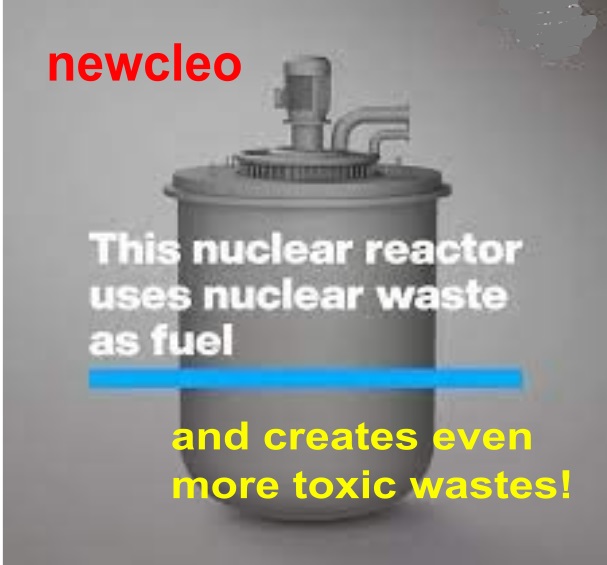
The US has offered energy companies access
to nuclear waste that they can convert into fuel for advanced reactors in
an attempt to break Russia’s stranglehold over uranium supply chains. The
Department of Energy on Tuesday published an application that nuclear
energy groups can use to seek up to 19 metric tonnes of the government’s
weapons-grade plutonium from cold war-era warheads.
In the document seen by
the Financial Times, the energy department said being selected to receive
the plutonium could help companies secure faster approval for a Nuclear
Regulatory Commission license, which is required to operate a nuclear
facility. At least two companies, Oklo, which is backed by OpenAI’s Sam
Altman, and France’s Newcleo, are expected to apply to access the
government’s plutonium stockpile.
FT 21st Oct 2025, https://www.ft.com/content/2fbbc621-405e-4a29-850c-f0079b116216
Inside Oklo: the $20bn nuclear start-up without any revenue.
Nuclear technology company Oklo has no revenues, no licence to operate
reactors and no binding contracts to supply power.
But this has not stopped
the Silicon Valley-based start-up from riding a wave of investor enthusiasm
that has propelled its stock market valuation above $20bn, a rise of more
than 500 per cent since the turn of the year.
The company, backed by
technology boss Sam Altman and with close ties to Donald Trump’s energy
secretary, has set ambitious targets to deliver commercial power to its
first customers in 2027, having broken ground on its pilot in Idaho last
month. Oklo, led by the husband-and-wife team Jacob and Caroline DeWitte, envisages a future powered by a new generation of small modular reactors that use liquid sodium rather than water as a coolant.
FT 22nd Oct 2025, https://www.ft.com/content/cdf09f0e-d673-41f4-8faa-fe795a2b872e
The Rise of the Thielverse and the Construction of the Surveillance State (w/ Whitney Webb) | The Chris Hedges Report
Chris Hedges, October 23, 2025
Whitney Webb traces the Thielverse’s rise and the bipartisan construction of the modern surveillance state that Trump and his benefactors are deploying against dissidents and immigrants today.
The descent into a new, mutated and technology-focused form of American fascism is already here. Those who have kept track of the rise of the Thielverse, which includes figures such as Peter Thiel, Elon Musk and JD Vance, have understood that an agenda to usher in a unique form of authoritarianism has been slowly introduced into the mainstream political atmosphere.
Whitney Webb, investigative journalist and author of One Nation Under Blackmail, joins host Chris Hedges on this episode of The Chris Hedges Report to document the rise of this cabal into the most powerful positions of the American government.
“I think now it’s quite clear that this is the PayPal Mafia’s moment. These particular figures have had an extremely significant influence on US government policy since January, including the extreme distribution of AI throughout the US government,” Webb explains.
It’s clear that the architects of mass surveillance and the military industrial complex are beginning to coalesce in unprecedented ways within the Trump administration and Webb emphasizes that now is the time to pay attention and push back against these new forces.
If they have their way, all commercial technology will be completely folded into the national security state — acting blatantly as the new infrastructure for techno-authoritarian rule. The underlying idea behind this new system is “pre-crime,” or the use of mass surveillance to designate people criminals before they’ve committed any crime. Webb warns that the Trump administration and its benefactors will demonize segments of the population to turn civilians against each other, all in pursuit of building out this elaborate system of control right under our noses.
Transcript:
Chris Hedges
There were many, including some liberals, who mistakenly believed the Trump administration would dismantle the deep state. In fact, as the investigative reporter Whitney Webb has documented, Trump is closely allied with the most authoritarian figures in Silicon Valley, such as Peter Thiel, who envision a world where our habits, proclivities, opinions and movements are minutely recorded and tracked.
These Trump allies do not intend to free us from the tyranny of intelligence agencies, militarized police, the largest prison system in the world, predatory corporations or mass surveillance. They will not restore the rule of law to hold the powerful and the wealthy accountable. Nor will they slash the bloated and unaccountable spending — some $1 trillion dollars — by the Pentagon.
They are rapidly purging the civil service, as well as law enforcement and the military, not to eradicate the deep state, but to ensure that those in charge of state machinery are exclusively loyal to the whims and dictates of the Trump White House. What is being targeted is not the deep state, but the laws, regulations, protocols and rules, and the government civil servants who enforce them, which hinder absolute dictatorial control.
Compromise, limited power, checks and balances and accountability are slated to be abolished. Those who believe that the government is designed to serve the common good, rather than the dictates of a tiny cabal of billionaires, will be forced out. The deep state will be reconstituted to serve the leadership cult.
Laws and the rights enshrined in the Constitution will become irrelevant. It is a coup d’état by inches, one that will be enforced in crude and brutal fashion by Immigration and Customs Enforcement agents on the streets of our cities and empowered by Thiel’s Palantir and the sophisticated forms of monitoring made possible by artificial intelligence and digital surveillance pioneered by Silicon Valley.
Joining me to discuss our emergent Orwellian state is the investigative journalist and author of One Nation Under Blackmail Whitney Webb. You can find her on her website, Unlimited Hangout.
Whitney, let’s go back to the beginning, [John] Poindexter, Iran-Contra, which I covered actually when I was in Nicaragua, because that’s really the origin of where we are today.
Whitney Webb……………………..right after the Reagan administration, Poindexter was sort of in various roles throughout these tech companies that were sort of a prototype to what Palantir and Total Information Awareness (TIA) would later do…………………………………………………………………………….
Peter Thiel incorporated Palantir and as Palantir was developing as a company they, Peter Thiel and Alex Karp, the Palantir co-founders, reached out to Poindexter directly through Richard Perle, who’s a well-known neoconservative figure and was also one of the architects of the Iraq War at the Bush-era Pentagon.
Basically they hatched this plan to privatize this program, rightly calculating that if they turned it into an entirely private sector enterprise, the outrage would essentially dissipate, which it remarkably did because originally it was a public-private partnership housed within DARPA……………………………………………………………………………..
the CIA was Palantir’s exclusive client for, I believe, the first six years of its existence as a company and its engineers went to Langley, the CIA headquarters in Virginia, every two weeks for several years as well where the CIA was developing their algorithm with them, in a very direct partnership and Alex Karp has even said that the CIA was always the intended client of Palantir………………………………………………………….
Palantir, you know, also works extensively now in the private sector as well. They’re a major AI engine for Wall Street banks, for example, and they have different programs that are sold to different entities, but ultimately, they are a massive contractor to essentially every US intelligence agency, and that includes DHS and ICE
………………………………………………….. predictive policing is the term that they use but a lot of other companies have attempted to also get in on this.
One of the most notorious being PredPol that was a partnership I believe with UCLA and LAPD or something to that effect and they’re notoriously inaccurate…………………
another Peter Thiel-backed entity called Carbyne also has a predictive policing component……………………………..
But this is a company that wasn’t just funded by Peter Thiel, it was funded by Jeffrey Epstein and was led for a significant amount of time by Ehud Barak, the former Israeli prime minister, as well and has sort of expanded outwards.
…………………………… The Trump administration was explicitly using Palantir to make databases on every American. But that has been done in a way that has been more covert through something called the Main Core database.
…………………………..William Barr, then Attorney General, created this program at the DOJ called DEEP that basically created the legal infrastructure for pre-crime. And you had Trump come out and say that the way to combat these shootings was to have social media develop algorithms that flag posts to predict shooters before they can act, target some of these anonymous online message boards.
…………………………………………..It is rather unsettling but, as I mentioned earlier, a lot of this profiling of Americans has been going on for a long time under the guise of what was developed by the Iran-Contra crowd covertly. The continuity of government protocols in this effort by parts of the “deep state” or the national security state to basically profile people they deemed unfriendly for whatever reason, people that could be, you know, potentially incarcerated in a time of political upheaval, they said.
……………………………………………………………………………………………………And so since then you have a whole network of people that have either been protege’s of these figures or worked at one point for PayPal. For example the current AI and crypto czar at the White House David Sacks, a former top executive at PayPal with Thiel and all of these other people.
And of course JD Vance, the current vice president, is intimately connected to Peter Thiel……………………………………………………
So Thiel’s influence is incredibly significant. It was also arguably significant during the first Trump administration, but I think now it’s quite clear that this is the PayPal Mafia’s moment. These particular figures have an extremely significant influence on US government policy since January, including the extreme distribution of AI throughout the US government.
…………………………………………………….what I find particularly troubling about this is that a lot of these PayPal Mafia figures Thiel, Musk and Vance, among others, are extremely close to or acolytes really of the philosophy advocated by a fellow named Curtis Yarvin, whose political philosophy is essentially that the way to solve the problems of our current system and current bureaucracy is to basically completely privatize the state and install a CEO in place of the president, who would rule essentially as a dictator, which is completely bonkers and it’s amazing that people have allowed people like Peter Thiel or even Yarvin himself to masquerade as so-called libertarians when they’re very in favor of the authoritarian abilities of the state.
………………………………………………… And you can also see how a lot of these people are also war profiteers, Palantir, of course, not only is this tool of mass surveillance, it’s a tool of mass murder used by the US Army and also by the IDF [Israel Defense Forces] to decide who lives and who dies in Gaza.
And a lot of these other people that have been Thiel protégés, for example, like Palmer Luckey and Anduril, which Luckey co-founded with Trae Stephens, who’s also affiliated with the aforementioned Epstein-funded Carbyne 911.
Anduril is ushering in this era of autonomous warfare, and bankrolled, of course, by Peter Thiel. And they’re also developing the so-called smart wall on the US-Mexico border. And really, you know, these people are developing very Orwellian disturbing systems with not just domestic implications but also very significant implications to how the US military and other militaries operate abroad……………………………………………………………………….
So under the guise of “we’re making the government more efficient”, what aspects of the government are these people in the PayPal Mafia actually making more efficient? Well, one of them is mass murder.
…………………………………………………………………………………… basically the goal of the smart wall, it’s not a physical wall, it’s meant to be basically an invisible wall that uses a combination of surveillance and drone technology to basically intercept anyone crossing the border in a non-authorized way.
………………. I’m not sure exactly what you’d like to talk about as it relates to SpaceX, but it is worth pointing out that they’re a massive military contractor specifically for Space Force created under the first Trump administration. They really are the main contractor for Space Force.
And also, you know, they are directly affiliated with Starlink, the satellite internet company that also arguably has some kind of covert uses with Elon Musk, for example, saying he is going to help sneak Starlinks into Iran, for example
………………………………………………….. through the Department of Government Deficiency, a government efficiency DOGE, a lot was made to facilitate that by laying off a lot of government workers in their place putting, basically replacing them with, AI algorithms.
And those algorithms are, of course, patented and controlled by Silicon Valley companies. And the vast majority of major Silicon Valley companies double as either intelligence or military contractors or both, or have for a very long time.
One that’s often overlooked a lot is Oracle, Larry Ellison’s Oracle. And Larry Ellison, before creating Oracle, worked on Project Oracle at the CIA, and then created Oracle, the company, which then took on the CIA as one of its earliest main clients, similar in a way to what happened with Palantir, as I noted a moment ago.

And now, Larry Ellison is becoming, basically taking over a large swath of American media now. So you’re seeing a lot of these Silicon billionaires that contract for the military are also becoming major owners of mass media. So you see that with Ellison, for example, and it’s also true with Elon Musk after his purchase of Twitter…………………………………………………………………………………………………………………………………………………………………………………..
Chris Hedges
I want you to speculate what this world is going to look like, it is the fusion of corporate and governmental power. In some ways, of course, these corporations will have even more power than government institutions. We just had the presidential memo that came out a couple days ago, which essentially criminalizes… It’s quite an amazing memo that criminalizes people who criticize capitalism, support gender equality.
Whitney Webb
Or really anyone who is antifascist in any capacity…………………………………………………………………………………………………………………….
we lost all of our freedoms, but now al-Qaeda is just let’s shake hands and let them come to the UN while we don’t let anyone from Palestine come. I mean, it’s totally insane. ……………………………………………….
I think Americans have been naive that a lot of the evil that that national security state has done abroad would never be used against them. And I think that we need to be very aware of what is going on here and that the deep state, whatever you want to call it, is expanding and it’s expanding in the hands of private oligarchs that have a very dangerous political vision that is rarely talked about.
……………………………………………………………………..So I think there’s a potentially dark future but there’s still time for awareness about these agendas and for people to develop parallel systems to escape this. And I think it’s very important too that people start really seriously considering how to wean themselves off of these Silicon Valley giants that are building these systems and contracting with these military and intelligence agencies. You know, getting off of Microsoft or Google products………………………………………………………….. https://chrishedges.substack.com/p/the-rise-of-the-thielverse-and-the
Request for an Immediate Stop to the Transportation of Radioactive Waste to Chalk River.

This is a translation of a letter, written in French, sent to the Minister of Natural Resources
by the Bloc Québécois on October 17 2025.
Mr. Tim Hodgson,Minister of Energy and Natural Resources, House of Commons,Ottawa (Ontario)
Dear Minister,
It is with dismay that we learned of your government’s ambition to use the Chalk River site as a “radioactive dump” to house the waste irradiated from at least three different nuclear reactors.
This revelation is all the more distressing because it comes just weeks after we learned that tons of spent fuel were transported over the summer, to this same location at Chalk River, all with the blessing of your government.
We remind you, Mr. Minister, that the site used in Chalk River is located very close to the source of drinking water for millions of Quebecers. This is probably one of the worst possible and imaginable places to decide to store nuclear waste.
And we are not the only ones to be outraged by this location: no less than 140 Quebec and Ontario municipalities as well as the Kebaowek First Nation are urging to abandon your proposed landfill site also located in Chalk River, known as the Near Surface Disposal Facility (NSDF), near the Chalk River Ottawa.
This is an irresponsible project that unnecessarily risks an ecological and environmental disaster with effects for decades and a direct impact on millions of human lives.
As a result we call for an immediate halt to any further operations to transport radioactive waste to the Chalk River site.
There is no reason, no reason at all, to justify the lack of transparency and consideration that your government has shown in this matter. We’re talking about decisions that affect millions of people and an entire ecosystem: they can’t be taken lightly. The bare minimum should be to listen to the views of those affected and to to take into account the consequences that such a choice would have for our world.
We are counting on your sense of responsibility, Minister. There is still time to take a step back, abandon the landfill project and stop all further transportation of nuclear waste to Chalk River.
Mario Simard, Bloc Québécois Critic for Natural Resources
Patrick Bonin, Bloc Québécois Critic for Environment and Climate Change
Sébastien Lemire, Bloc Québécois Critic for Indigenous Relations
C.C.: Julie Dabrusin, Minister of Environment and Climate Change, House of Commons, Ottawa (ON) K1A 0A6 613-995-8425
Climate disasters in first half of 2025 costliest ever on record, research shows.

The first half of 2025 was the costliest on record for major disasters in
the US, driven by huge wildfires in Los Angeles and storms that battered
much of the rest of the country, according to a climate non-profit that has
resurrected work axed by Donald Trump’s administration that tracked the
biggest disasters.
In the first six months of this year, 14 separate
weather-related disasters that each caused at least $1bn in damage hit the US, the Climate Central group has calculated. In total, these events cost
$101bn in damages – lost homes, businesses, highways and other
infrastructure – a toll higher than any other first half of a year since
records on this began in 1980.
Guardian 22nd Oct 2025, https://www.theguardian.com/environment/2025/oct/22/climate-disasters-2025-cost
NRC: Individual fell into ‘reactor cavity’ at Palisades Nuclear Plant
The United States Nuclear Regulatory Commission said the person fell into the reactor cavity, ingested cavity water and was transported off-site.
Steven Bohner, October 22, 2025, https://www.wzzm13.com/article/news/local/nrc-individual-fell-into-reactor-cavity-palisades-nuclear-plant/69-8c68f69f-4b48-4869-b66a-f3b18e8c7bbb
COVERT, Mich. — The United States Nuclear Regulatory Commission (NRC) said an individual fell into a “reactor cavity” at the Palisades Nuclear Plant in Covert, Mich.
The NRC said the incident happened on Oct. 21, around 9:30 a.m., when an individual fell into a reactor cavity at the plant. They said the individual ingested “some amount” of the cavity water, and was decontaminated by radiation protection personnel before being taken off-site to seek medical attention about nine hours later at 4:32 p.m.
The NRC report said the individual had “300 counts per minute detected in their hair,” and categorized the individual as “contaminated.” The report listed the incident as a non-emergency.
The reactor cavity is a space between the reactor vessel and a concrete shield surrounding the reactor, according to the International Atomic Energy Agency.
Holtec International provided 13 ON YOUR SIDE with the following comment:
“While performing work inside the containment building, a Palisades contractor fell into a pool of water located above the reactor. The contractor was wearing all required personal protective equipment, including a life vest, which is standard when working near the pool without a barrier in place. The worker was promptly assisted from the water, evaluated, monitored, and decontaminated for removable contamination in accordance with established industry standards and safety procedures. Radiological assessments are ongoing and are expected to confirm exposure well below regulatory and administrative dose limits. The U.S. Nuclear Regulatory Commission was properly notified, and a review of human performance factors contributing to the incident is underway. The worker sustained minor injuries from their fall and has since returned to work.”
The Palisades Nuclear Plant is in the process of restarting its 800-megawatt reactor. Once restarted, Palisades would become the first nuclear power plant in the United States scheduled to restart its reactor after its fuel had been removed.
In July, the NRC approved a series of licensing and regulatory actions that are essential for the plant to restart, including allowing Holtec to load fuel into the reactor.
At the time of the incident, it is unclear if fuel was present in the reactor.
Vaunted Trump Ceasefire? Israel has a genocidal Palestinian ethnic cleaning to complete
Walt Zlotow, West Suburban Peace Coalition, Glen Ellyn IL, 22 Oct 25, https://theaimn.net/vaunted-trump-ceasefire-faggedaboudit-israel-has-a-genocidal-palestinian-ethnic-cleaning-to-complete/#google_vignette
The tremendous support given to Trump’s second ceasefire in Israel’s genocide in Gaza ignores reality and history.
How quickly the Trump high-fivers forget Israel abandoned Trump’s first ceasefire that lasted from January 19 to March 18. During that time Israel continued to kill hundreds of Palestinians while restricting food, water and medicine. Then, with Trump’s bombs, they resumed their grotesque genocide further obliterating Gaza while killing tens of thousands more Palestinians.
The first ceasefire released 33 Israeli hostages, leaving 48 to languish as Israel returned to their first priority, ridding Gaza of its Palestinians not yet disappeared. It took nearly 7 months for pressure to build on Israel to agree to a second ceasefire to return remaining hostages, 20 living and 28 dead.
But like Ceasefire 1, Ceasefire 2 is just genocidal ethnic cleansing by subtler means. In the first 9 days, Israel’s military has killed or wounded nearly 400 Palestinians, while again restricting food, water and medicine. Israel still occupies over half of Gaza, establishing yellow lines forbidding Palestinians to cross.
On ceasefire day 10 Israel unleased massive air strikes across Gaza. In their most grotesque ceasefire violation, Israel bombed a vehicle that strayed across Israel’s yellow line, killing 11 family members including 3 women and 7 kids.
Was Trump outraged? Only at Hamas who he’s threatening to obliterate by giving Israel the green light to ‘finish the job.’
This should surprise no one with a moral conscience. Israel has been violating the ceasefire in Lebanon for nearly a year. During that time they’ve killed over 4,000 Lebanese, destroyed tens of thousands of homes and gobbled up 5 Lebanese areas.
That’s some ceasefire you negotiated Mr. Trump. All you accomplished is delay Israel’s one and only goal…bringing a Palestinian free Gaza into Greater Israel.
The Great Narco Pretext: Trump Readies for Regime Change in Venezuela.
20 October 2025 Dr Binoy Kampmark, https://theaimn.net/the-great-narco-pretext-trump-readies-for-regime-change-in-venezuela/
Since the start of September, the Trump administration has busied itself with striking boats in international waters stemming from Venezuelan and possibly Colombian waters. Their mortal offence: allegedly carrying narcotics cargo destined for consumers in the United States. A few days following the first strike on September 2, President Donald Trump stated in a War Powers Resolution notification to Congress that the action was one of “self-defense” motivated by “the inability or unwillingness of some states in the region to address the continuing threat to United States persons and interests emanating from their territories.”
In early October, a presidential notice was issued deeming those killed in such strikes on suspicion of drug smuggling “unlawful combatants.” The notice to Congress advanced an anaemic excuse to justify murder instead of arrest, an echo of previous, elastic rationales used by administrations to justify an enlargement of executive war powers: “based on the cumulative effects of these hostile acts against the citizens and interests of the United States and friendly foreign nations, the president determined that the United States is in a non–international armed conflict with these designated terrorist organizations.” The US had “reached a critical point where we must use force in self-defense and defense of others against the ongoing attacks by these designated terrorist organizations.”
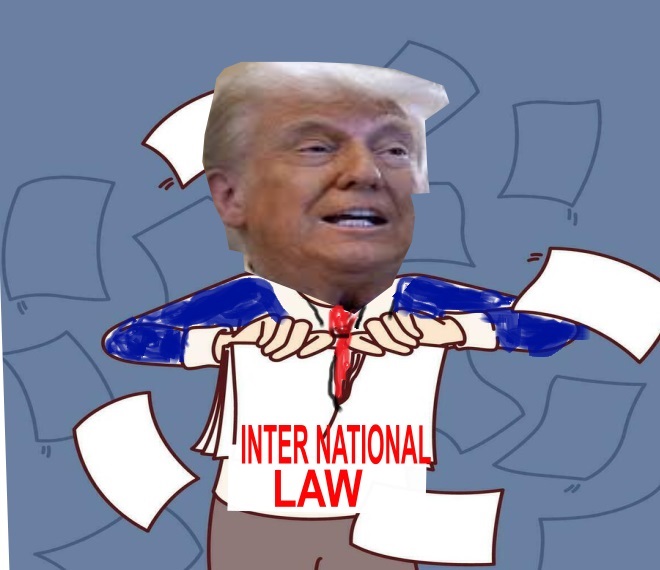
The document amounted to an arrogation of extraordinary wartime powers to combat drug cartels, treating the trafficking of illicit narcotics to an armed assault on US citizens. Geoffrey S. Corn, a former judge advocate general lawyer, thought it a most adventurous move, given that drug cartels were not engaged in “hostilities”. “This is not stretching the envelope,” he told The New York Times. “This is shredding it. This is tearing it apart.”
In the kingdom of alternative legal realities, White House spokeswoman Anna Kelly articulated the position in an email: “the president acted in line with the law of armed conflict to protect our country from those trying to bring deadly poison to our shores, and he is delivering on his promise to take on the cartels and eliminate these national security threats from murdering more Americans.”
The number of possible international law violations are far from negligible. Michael Schmitt lists a few in Just Security. Most obvious is the physical violation of a State’s sovereignty, which can take place through interfering with its “inherently governmental functions” comprising such matters as law enforcement. To also authorise kinetic operations in another State’s territory can amount to wrongful intervention in its international affairs. Last, though not least, is that using force in this context may be unlawful, violating Article 2(4) of the United Nations Charter and customary law.
Nothing in this cooked up scheme adds up. If the intention is to curb overdoses on US soil from drug use, flow of fentanyl would be the object of the exercise. But fentanyl hails from Mexico, not South America. The broader agenda is a more traditional one: the assertion of the imperium’s control over countries in the Americas, eliminating regimes deemed unfriendly to Washington’s interests. Narcotics has become the throbbing pretext, with Trump accusing Venezuela’s President Nicolás Maduro of being the leader of the drug trafficking organisation Cartel of the Suns. He is also accused of using the dark offices of the Tren de Aragua prison gang to conduct “irregular warfare” against the United States, despite countering claims by the intelligence community that the gang is not under Maduro’s control. (The reaffirmation of the initial intelligence assessment by the National Intelligence Council led to the sacking of its acting director, Michael Collins.)
In 2020, the first Trump administration offered a reward of up to US$15 million for information leading to the arrest and conviction of Maduro. Two more increases to the bounty followed, the latest on August 7 being US$50 million following the sanctioning of the Cartel of the Suns by the Department of Treasury as a Specially Designated Global Terrorist. “As leader of Cartel of the Suns,” declares the State Department in its notice of reward, “Maduro is the first target in the history of the Narcotics Rewards Program with a reward offer exceeding $25 million.”
Trump, in one of his moments of sharp frankness, concedes that the Central Intelligence Agency (CIA) has been authorised to conduct covert lethal operations on Venezuelan soil and more broadly through the Caribbean in a presidential finding. “We are certainly looking at land now, because we’ve got the sea well under control,” he told reporters hours after the secret authorisation was revealed.
In explaining his shoddy reasons, Trump cited Venezuela’s emptying of its “prisons into the United States of America” and the issue of drugs. “We have a lot of drugs coming in from Venezuela, and a lot of the Venezuelan drugs come in through the sea, so you get to see that, but we’re going to stop them by land also.”
To the finding can be added a bulking military presence in the region: eight surface warships and a submarine in the Caribbean, 10,000 US troops, largely garrisoned at bases in Puerto Rico, with a contingent of Marines equipped with amphibious assault boats. In the meantime, the recent winner of the Nobel Peace Prize, the Venezuelan opposition figure María Corina Machado, salivates at the prospect of regime change with muscular intervention from Washington. The pieces are being moved into place, and the self-proclaimed peace maker in the White House is readying for war.
Trump furious War Chief Hegseth didn’t kill all on Venezuelan boat No. 6 he sent to Davy Jones Locker.
Walt Zlotow, West Suburban Peace Coalition, Glen Ellyn IL . 19 Oct 25
Rule No. 1 about being a mass murderer of hapless souls on unarmed boats off Venezuela is, ‘Leave no survivors.’ War Secretary Pete Hegseth followed that rule to a tee in his murderous strikes on 5 unarmed boats, killing all 27 aboard.
But he screwed up boat No. 6, allowing 2 survivors to be picked up by Hegseth’s death dealing Navy. Since of course there was no evidence of their involvement in drug smuggling, the irrelevant reason for blasting their boat, Trump’s Hit Man quickly whisked them off to drug kingpin Nicholas Maduro’s Venezuela. Oops, their actual countries of Columbia and Ecuador which are not on Trump’s mass murder radar.
Not bashful about trumpeting his Venezuelan boat murder rampage, Trump took to his War Criminal Social platform, touting “It was my great honor to destroy a very large DRUG-CARRYING SUBMARINE that was navigating towards the United States on a well known narcotrafficking transit route. It was loaded up with mostly Fentanyl, and other illegal narcotics and there were four known narcoterrorists on board the vessel”. Trump omitted his horror that 2 survived to refute his insane murder justification scheme.
Come on Attorney General Pam Bondi. You’ve got Trump’s gleeful confession on the web to convince any responsible juror of his guilt in mass premeditated murder. Time to do your job as Attorney General, enforcing the law instead of being Consigliere for Trump’s Murder Incorporated.
Trump Furloughs Top Nuclear Weapons Staff (What Could Go Wrong?)

The workers responsible for protecting the U.S. nuclear arsenal are now being furloughed.
Robert McCoy, October 21, 2025, https://newrepublic.com/post/202015/trump-furloughs-nuclear-weapons-staff-shutdown
The government’s nuclear watchdog agency is poised to be understaffed, as Politico reports the Trump administration has placed about 80 percent of its personnel on furlough amid the ongoing government shutdown.
The National Nuclear Security Administration is a semiautonomous agency within the Department of Energy that maintains the U.S. nuclear stockpile, responds to nuclear emergencies domestically and abroad, and works to prevent nuclear proliferation globally. The NNSA’s staff of fewer than 2,000 workers oversees about 60,000 contractors.
On Monday morning, the administration sent out furlough notices to about 1,400 employees, Politico reports, leaving just 375 staff members on the job for the time being. This is an unprecedented action in the agency’s 25-year history.
Last week, when the then-impending cuts were first reported, Energy Secretary Chris Wright called the workers “critical to modernizing our nuclear arsenal.”
This is just the latest controversial NNSA staffing news to come out of the second Trump administration. The agency previously faced scrutiny for terminating hundreds of workers at the behest of President Trump’s Department of Government Efficiency, before scrambling to rehire some of them as Wright confessed he’d “made mistakes” and moved “a little too quickly.”
1 This Month

of the week – Shut Down Drone Warfare!


Tell the Ukrainian Government to Drop Prosecution of Peace Activist Yurii Sheliazhenko
Petition to revoke the licensing of the Near Surface Nuclear Disposal Facility (NSDF) at Chalk River. https://www.ourcommons.ca/petitions/en/Petition/Details?Petition=e-7247
To see nuclear-related stories in greater depth and intensity – go to https://nuclearinformation.wordpress.com
-
Archives
- April 2026 (103)
- March 2026 (251)
- February 2026 (268)
- January 2026 (308)
- December 2025 (358)
- November 2025 (359)
- October 2025 (376)
- September 2025 (257)
- August 2025 (319)
- July 2025 (230)
- June 2025 (348)
- May 2025 (261)
-
Categories
- 1
- 1 NUCLEAR ISSUES
- business and costs
- climate change
- culture and arts
- ENERGY
- environment
- health
- history
- indigenous issues
- Legal
- marketing of nuclear
- media
- opposition to nuclear
- PERSONAL STORIES
- politics
- politics international
- Religion and ethics
- safety
- secrets,lies and civil liberties
- spinbuster
- technology
- Uranium
- wastes
- weapons and war
- Women
- 2 WORLD
- ACTION
- AFRICA
- Atrocities
- AUSTRALIA
- Christina's notes
- Christina's themes
- culture and arts
- Events
- Fuk 2022
- Fuk 2023
- Fukushima 2017
- Fukushima 2018
- fukushima 2019
- Fukushima 2020
- Fukushima 2021
- general
- global warming
- Humour (God we need it)
- Nuclear
- RARE EARTHS
- Reference
- resources – print
- Resources -audiovicual
- Weekly Newsletter
- World
- World Nuclear
- YouTube
-
RSS
Entries RSS
Comments RSS
 nuclear-news